Office of
General Treasurer
Seth Magaziner
DEBT MANAGEMENT AND OVERSIGHT
1December 1, 2015
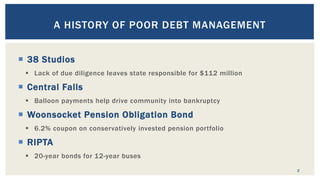
 38 Studios
 Lack of due diligence leaves state responsible for $112 million
 Central Falls
 Balloon payments help drive community into bankruptcy
 Woonsocket Pension Obligation Bond
 6.2% coupon on conservatively invested pension portfolio
 RIPTA
 20-year bonds for 12-year buses
2
A HISTORY OF POOR DEBT MANAGEMENT
3
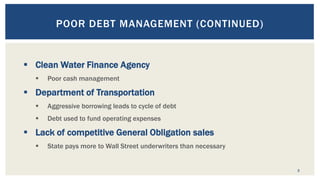
POOR DEBT MANAGEMENT (CONTINUED)
 Clean Water Finance Agency
 Poor cash management
 Department of Transportation
 Aggressive borrowing leads to cycle of debt
 Debt used to fund operating expenses
 Lack of competitive General Obligation sales
 State pays more to Wall Street underwriters than necessary
The Treasurer’s Office conducted comprehensive research to
understand how public debt is managed in Rhode Island, as
compared to national best practices.
 Review of Rhode Island public debt
 Public Finance Management Board (PFMB) Reports
 2016-2020 Capital Improvement Plan
 2009-2010 Municipal Fiscal Stress Task Force
 Auditor General’s Reports and RIPEC reports
 Survey of debt management practices in other states
 Who is responsible for issuing and managing public debt?
 How are issuers of public debt held to best practices?
 What are the responsibilities and staffing levels of debt management offices in other states?
 Survey of national best practices for debt management
 Government Finance Officers Association (GFOA)
 Interviewed local and national experts
4
COMPREHENSIVE RESEARCH PROCESS
 Findings for Rhode Island
 Weak governance and oversight of public debt at all levels
 Lack of specialized staff
 Underutilization of the Public Finance Management Board
 Over-reliance on outside consultants with potential conflicts
 Recommendations to Improve Debt Management
 Improve research and reporting
 Strengthen oversight
 Lessen reliance on outside consultants
 Ensure independence of financial advice
5
SOLVING RHODE ISLAND’S DEBT DILEMMA:
FINDINGS AND RECOMMENDATIONS
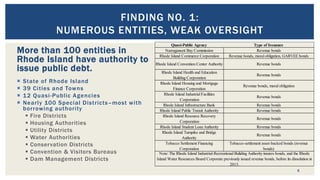
More than 100 entities in
Rhode Island have authority to
issue public debt.
 State of Rhode Island
 39 Cities and Towns
 12 Quasi-Public Agencies
 Nearly 100 Special Districts–most with
borrowing authority
 Fire Districts
 Housing Authorities
 Utility Districts
 Water Authorities
 Conservation Districts
 Convention & Visitors Bureaus
 Dam Management Districts
6
FINDING NO. 1:
NUMEROUS ENTITIES, WEAK OVERSIGHT
Quasi-Public Agency Type of Issuance
Narragansett Bay Commission Revenue bonds
Rhode Island Commerce Corporation Revenue bonds, moral obligation, GARVEE bonds
Rhode Island Convention Center Authority Revenue bonds
Rhode Island Health and Educaiton
Building Corporation
Revenue bonds
Rhode Island Housing and Mortgage
Finance Corporation
Revenue bonds, moral obligation
Rhode Island Industrial Facilities
Corporation
Revenue bonds
Rhode Island Infrastructure Bank Revenue bonds
Rhode Island Public Transit Authority Revenue bonds
Rhode Island Resource Recovery
Corporation
Revenue bonds
Rhode Island Student Loan Authority Revenue bonds
Rhode Island Turnpike and Bridge
Authority
Revenue bonds
Tobacco Settlement Financing
Corporation
Tobacco-settlement asset-backed bonds (revenue
bonds)
Note: The Rhode Island Industrial-Recreational Buliding Authority insures bonds, and the Rhode
Island Water Resources Board Corporate previously issued revenue bonds, before its dissolution in
2015.
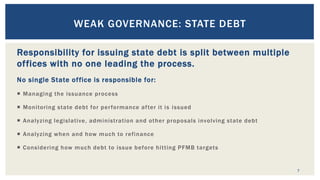
Responsibility for issuing state debt is split between multiple
offices with no one leading the process.
No single State office is responsible for:
 Managing the issuance process
 Monitoring state debt for performance after it is issued
 Analyzing legislative, administration and other proposals involving state debt
 Analyzing when and how much to refinance
 Considering how much debt to issue before hitting PFMB targets
7
WEAK GOVERNANCE: STATE DEBT
The State has very little oversight of Quasi-public and Municipal
Debt.
 Even when there is no moral obligation, the State may feel compelled to step in
 Broad gaps in the State’s ability to oversee quasi-public debt
 Large agencies are exempt from the Kushner Law: Narragansett Bay Commission, Rhode Island
Infrastructure Bank, Rhode Island Housing, Rhode Island Student Loan Authority, Rhode Island
Industrial Facilities Corporation and Rhode Island Health and Education Building Corporation
 General Assembly not given independent financial analysis when making a Kushner vote
 No State oversight of municipal debt
 No guidelines for the more than 100 Quasis and Munis that issue debt
8
WEAK GOVERNANCE: QUASI AND MUNI DEBT
9
FINDING NO.2 :
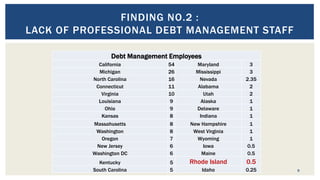
LACK OF PROFESSIONAL DEBT MANAGEMENT STAFF
Debt Management Employees
California 54 Maryland 3
Michigan 26 Mississippi 3
North Carolina 16 Nevada 2.35
Connecticut 11 Alabama 2
Virginia 10 Utah 2
Louisiana 9 Alaska 1
Ohio 9 Delaware 1
Kansas 8 Indiana 1
Massahusetts 8 New Hampshire 1
Washington 8 West Virginia 1
Oregon 7 Wyoming 1
New Jersey 6 Iowa 0.5
Washington DC 6 Maine 0.5
Kentucky 5 Rhode Island 0.5
South Carolina 5 Idaho 0.25
The Public Finance Management Board (PFMB) exists to advise and
assist all State departments, authorities, agencies, boards,
commissions, and public and quasi-public corporations having
authority to issue revenue or general obligation bonds.
 Each state, municipal and regional department, authority, agency, board,
commission, and public and quasi-public corporation having authority to issue
revenue or general obligation bonds or notes shall, no later than thirty (30) days
prior to the sale of any such debt issue at public or private sale, give written notice
of the proposed sale to the board.
 Failure of delivery of the above notice or of the time or efficiency thereof shall not
affect the validity of the issuance of any debt, bond or note.
§ 42-10.1-4 Notice of Debt Issue to Board
10
FINDING NO. 3:
UNDERUTILIZATION OF THE PFMB
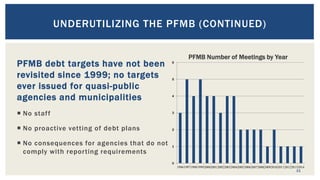
PFMB debt targets have not been
revisited since 1999; no targets
ever issued for quasi-public
agencies and municipalities
 No staff
 No proactive vetting of debt plans
 No consequences for agencies that do not
comply with reporting requirements
11
UNDERUTILIZING THE PFMB (CONTINUED)
0
1
2
3
4
5
6
1996199719981999200020012002200320042005200620072008200920102011201220132014
PFMB Number of Meetings by Year
The State relies heavily on outside consultants with potential
conflicts.
 The State’s financial advisor, underwriters and outside legal counsel are often
compensated based on size and/or frequency of bond issues
 Financial advisors working for both the State and quasi-public agencies or
municipalities face competing allegiances
 Even when the State is the only client, the lines of reporting are not clear
12
FINDING NO. 4:
OVER-RELIANCE ON EXTERNAL CONSULTANTS
RECOMMENDATION NO. 1:
IMPROVE RESEARCH AND REPORTING
13
Professional Debt Management Staff
Treasury recommends establishing an Office of Debt Management with staff
experienced in public finance, reporting to PFMB
 Rhode Island is a major outlier among states by not doing this already
 Debt Management Office to oversee the issuance of all State debt by coordinating
the actions of other State offices, financial advisors, underwriters and legal
counsel
 Independent analysis of legislative, administration and underwriter debt proposals
 Audit debt management practices and promulgate best practices for Quasis and
Munis
RECOMMENDATION NO. 2:
STRENGTHEN OVERSIGHT
14
PFMB Approval for Quasi-Public Debt Issues
Treasury recommends that PFMB approval be required for any debt issuance that has not
been approved by voters or the General Assembly, following staff analysis by the Debt
Management Office
 In Pennsylvania, New York, and South Carolina, the State has various levels of approval authority
over quasi and municipal debt
 PFMB’s role would not be to judge the policy merits of a proposed capital project –just the
viability of the financing plan and the potential financial risk to the State
 Revisit 1999 PFMB debt targets for direct State debt and adopt targets for Quasis and Munis
 Study the possibility of centralizing the issuance process for quasi -public and municipal debt
 North Carolina centrally issues debt on behalf of quasi-public agencies and municipalities
 RIHEBC centrally issues debt for nonprofits and school districts
Exclusive Relationship with the Financial Advisor
Treasury will now require in-state exclusivity with the state’s Financial Advisor
 Minimizes possibility that the State’s Financial Advisors faces competing allegiances
 The State’s Financial Advisor should be hired by the PFMB, providing a much simpler line of
accountability
15
RECOMMENDATION NO. 3:
ENSURE INDEPENDENCE OF FINANCIAL ADVICE
Treasury is already taking action to implement solutions to the
State’s public debt management challenge.
 Treasury has hired a new, nationally respected Financial Advisor
 The Financial Advisor’s contract will require in-state exclusivity
 At Treasury’s direction, the PFMB will:
 Begin the first comprehensive review of State debt policies and targets since the 1990s
 Draft best practices in debt management for Quasis and Munis
16
ACTIONS ALREADY BEING TAKEN
Systemic reform is needed to address Rhode Island’s debt
management challenges
 Rhode Island has a history of poor debt management
 Other states provide good models for reform
 Treasury is already taking action, but we need help from the General Assembly
to bring real reform
17
CONCLUSION

Rhode Island Debt Management and Oversight

  • 1.
    Office of General Treasurer SethMagaziner DEBT MANAGEMENT AND OVERSIGHT 1December 1, 2015
  • 2.
     38 Studios Lack of due diligence leaves state responsible for $112 million  Central Falls  Balloon payments help drive community into bankruptcy  Woonsocket Pension Obligation Bond  6.2% coupon on conservatively invested pension portfolio  RIPTA  20-year bonds for 12-year buses 2 A HISTORY OF POOR DEBT MANAGEMENT
  • 3.
    3 POOR DEBT MANAGEMENT(CONTINUED)  Clean Water Finance Agency  Poor cash management  Department of Transportation  Aggressive borrowing leads to cycle of debt  Debt used to fund operating expenses  Lack of competitive General Obligation sales  State pays more to Wall Street underwriters than necessary
  • 4.
    The Treasurer’s Officeconducted comprehensive research to understand how public debt is managed in Rhode Island, as compared to national best practices.  Review of Rhode Island public debt  Public Finance Management Board (PFMB) Reports  2016-2020 Capital Improvement Plan  2009-2010 Municipal Fiscal Stress Task Force  Auditor General’s Reports and RIPEC reports  Survey of debt management practices in other states  Who is responsible for issuing and managing public debt?  How are issuers of public debt held to best practices?  What are the responsibilities and staffing levels of debt management offices in other states?  Survey of national best practices for debt management  Government Finance Officers Association (GFOA)  Interviewed local and national experts 4 COMPREHENSIVE RESEARCH PROCESS
  • 5.
     Findings forRhode Island  Weak governance and oversight of public debt at all levels  Lack of specialized staff  Underutilization of the Public Finance Management Board  Over-reliance on outside consultants with potential conflicts  Recommendations to Improve Debt Management  Improve research and reporting  Strengthen oversight  Lessen reliance on outside consultants  Ensure independence of financial advice 5 SOLVING RHODE ISLAND’S DEBT DILEMMA: FINDINGS AND RECOMMENDATIONS
  • 6.
    More than 100entities in Rhode Island have authority to issue public debt.  State of Rhode Island  39 Cities and Towns  12 Quasi-Public Agencies  Nearly 100 Special Districts–most with borrowing authority  Fire Districts  Housing Authorities  Utility Districts  Water Authorities  Conservation Districts  Convention & Visitors Bureaus  Dam Management Districts 6 FINDING NO. 1: NUMEROUS ENTITIES, WEAK OVERSIGHT Quasi-Public Agency Type of Issuance Narragansett Bay Commission Revenue bonds Rhode Island Commerce Corporation Revenue bonds, moral obligation, GARVEE bonds Rhode Island Convention Center Authority Revenue bonds Rhode Island Health and Educaiton Building Corporation Revenue bonds Rhode Island Housing and Mortgage Finance Corporation Revenue bonds, moral obligation Rhode Island Industrial Facilities Corporation Revenue bonds Rhode Island Infrastructure Bank Revenue bonds Rhode Island Public Transit Authority Revenue bonds Rhode Island Resource Recovery Corporation Revenue bonds Rhode Island Student Loan Authority Revenue bonds Rhode Island Turnpike and Bridge Authority Revenue bonds Tobacco Settlement Financing Corporation Tobacco-settlement asset-backed bonds (revenue bonds) Note: The Rhode Island Industrial-Recreational Buliding Authority insures bonds, and the Rhode Island Water Resources Board Corporate previously issued revenue bonds, before its dissolution in 2015.
  • 7.
    Responsibility for issuingstate debt is split between multiple offices with no one leading the process. No single State office is responsible for:  Managing the issuance process  Monitoring state debt for performance after it is issued  Analyzing legislative, administration and other proposals involving state debt  Analyzing when and how much to refinance  Considering how much debt to issue before hitting PFMB targets 7 WEAK GOVERNANCE: STATE DEBT
  • 8.
    The State hasvery little oversight of Quasi-public and Municipal Debt.  Even when there is no moral obligation, the State may feel compelled to step in  Broad gaps in the State’s ability to oversee quasi-public debt  Large agencies are exempt from the Kushner Law: Narragansett Bay Commission, Rhode Island Infrastructure Bank, Rhode Island Housing, Rhode Island Student Loan Authority, Rhode Island Industrial Facilities Corporation and Rhode Island Health and Education Building Corporation  General Assembly not given independent financial analysis when making a Kushner vote  No State oversight of municipal debt  No guidelines for the more than 100 Quasis and Munis that issue debt 8 WEAK GOVERNANCE: QUASI AND MUNI DEBT
  • 9.
    9 FINDING NO.2 : LACKOF PROFESSIONAL DEBT MANAGEMENT STAFF Debt Management Employees California 54 Maryland 3 Michigan 26 Mississippi 3 North Carolina 16 Nevada 2.35 Connecticut 11 Alabama 2 Virginia 10 Utah 2 Louisiana 9 Alaska 1 Ohio 9 Delaware 1 Kansas 8 Indiana 1 Massahusetts 8 New Hampshire 1 Washington 8 West Virginia 1 Oregon 7 Wyoming 1 New Jersey 6 Iowa 0.5 Washington DC 6 Maine 0.5 Kentucky 5 Rhode Island 0.5 South Carolina 5 Idaho 0.25
  • 10.
    The Public FinanceManagement Board (PFMB) exists to advise and assist all State departments, authorities, agencies, boards, commissions, and public and quasi-public corporations having authority to issue revenue or general obligation bonds.  Each state, municipal and regional department, authority, agency, board, commission, and public and quasi-public corporation having authority to issue revenue or general obligation bonds or notes shall, no later than thirty (30) days prior to the sale of any such debt issue at public or private sale, give written notice of the proposed sale to the board.  Failure of delivery of the above notice or of the time or efficiency thereof shall not affect the validity of the issuance of any debt, bond or note. § 42-10.1-4 Notice of Debt Issue to Board 10 FINDING NO. 3: UNDERUTILIZATION OF THE PFMB
  • 11.
    PFMB debt targetshave not been revisited since 1999; no targets ever issued for quasi-public agencies and municipalities  No staff  No proactive vetting of debt plans  No consequences for agencies that do not comply with reporting requirements 11 UNDERUTILIZING THE PFMB (CONTINUED) 0 1 2 3 4 5 6 1996199719981999200020012002200320042005200620072008200920102011201220132014 PFMB Number of Meetings by Year
  • 12.
    The State reliesheavily on outside consultants with potential conflicts.  The State’s financial advisor, underwriters and outside legal counsel are often compensated based on size and/or frequency of bond issues  Financial advisors working for both the State and quasi-public agencies or municipalities face competing allegiances  Even when the State is the only client, the lines of reporting are not clear 12 FINDING NO. 4: OVER-RELIANCE ON EXTERNAL CONSULTANTS
  • 13.
    RECOMMENDATION NO. 1: IMPROVERESEARCH AND REPORTING 13 Professional Debt Management Staff Treasury recommends establishing an Office of Debt Management with staff experienced in public finance, reporting to PFMB  Rhode Island is a major outlier among states by not doing this already  Debt Management Office to oversee the issuance of all State debt by coordinating the actions of other State offices, financial advisors, underwriters and legal counsel  Independent analysis of legislative, administration and underwriter debt proposals  Audit debt management practices and promulgate best practices for Quasis and Munis
  • 14.
    RECOMMENDATION NO. 2: STRENGTHENOVERSIGHT 14 PFMB Approval for Quasi-Public Debt Issues Treasury recommends that PFMB approval be required for any debt issuance that has not been approved by voters or the General Assembly, following staff analysis by the Debt Management Office  In Pennsylvania, New York, and South Carolina, the State has various levels of approval authority over quasi and municipal debt  PFMB’s role would not be to judge the policy merits of a proposed capital project –just the viability of the financing plan and the potential financial risk to the State  Revisit 1999 PFMB debt targets for direct State debt and adopt targets for Quasis and Munis  Study the possibility of centralizing the issuance process for quasi -public and municipal debt  North Carolina centrally issues debt on behalf of quasi-public agencies and municipalities  RIHEBC centrally issues debt for nonprofits and school districts
  • 15.
    Exclusive Relationship withthe Financial Advisor Treasury will now require in-state exclusivity with the state’s Financial Advisor  Minimizes possibility that the State’s Financial Advisors faces competing allegiances  The State’s Financial Advisor should be hired by the PFMB, providing a much simpler line of accountability 15 RECOMMENDATION NO. 3: ENSURE INDEPENDENCE OF FINANCIAL ADVICE
  • 16.
    Treasury is alreadytaking action to implement solutions to the State’s public debt management challenge.  Treasury has hired a new, nationally respected Financial Advisor  The Financial Advisor’s contract will require in-state exclusivity  At Treasury’s direction, the PFMB will:  Begin the first comprehensive review of State debt policies and targets since the 1990s  Draft best practices in debt management for Quasis and Munis 16 ACTIONS ALREADY BEING TAKEN
  • 17.
    Systemic reform isneeded to address Rhode Island’s debt management challenges  Rhode Island has a history of poor debt management  Other states provide good models for reform  Treasury is already taking action, but we need help from the General Assembly to bring real reform 17 CONCLUSION