Public Debt
Management
Reporter: PERLA D. MAGHUYOP
What is Public Debt Management ?
-it is the process of developing and implementing a
strategy for managing government debt to raise necessary
funds for meeting risk and cost objectives.
Public debt management plays a vital role in the economic
stability and growth of a country. It involves the strategic
planning, issuance, and repayment of government debt,
which includes both domestic and external borrowings.The
effective management of public debt is crucial as it helps
governments meet their financing needs, maintain a
sustainable debt level, and mitigate risks associated with
borrowing. In this section, we will delve into the
fundamentals of public debt management, exploring
various strategies and options available to governments.
1. Understanding Public Debt: Public debt refers to the total
outstanding debt owed by a government to domestic and
foreign creditors.This debt is typically raised through the
issuance of government bonds, treasury bills, and other debt
instruments. It is important to distinguish between domestic
and external debt, as each has its own implications and risks.
Domestic debt is denominated in the country's own currency
and is owed to domestic lenders, while external debt is
denominated in foreign currencies and is owed to foreign
creditors. Governments must carefully manage both types of
debt to ensure financial stability.
2. Objectives of Public Debt Management:The primary
objectives of public debt management are to ensure the
government's ability to finance its operations, maintain debt
sustainability, and minimize borrowing costs. Governments
aim to strike a balance between meeting their financing
needs and avoiding excessive debt burdens. debt
sustainability analysis is crucial in assessing a country's ability
to meet its debt obligations without compromising its long-
term fiscal health.Additionally, minimizing borrowing costs
is achieved by adopting prudent debt management
strategies, such as optimizing the debt portfolio and utilizing
appropriate borrowing instruments.
3. Debt Management Strategies: Governments have several
options when it comes to managing their public debt. One
approach is active debt management, which involves actively
adjusting the debt portfolio to take advantage of market
conditions and reduce risks.This strategy may include
refinancing existing debt at lower interest rates, lengthening
debt maturities to reduce refinancing risks, or diversifying the
investor base to increase demand for government securities.
On the other hand, passive debt management involves
maintaining a fixed debt portfolio without actively adjusting it.
This approach is often suitable for countries with stable debt
levels and low refinancing risks.
4. Debt Sustainability and Risk Mitigation: Debt sustainability
analysis is crucial in assessing a country's ability to manage its
debt burden. Governments should consider the debt-to-GDP ratio,
debt service-to-revenue ratio, and other relevant indicators to
determine the sustainability of their debt. By maintaining a
sustainable debt level, governments can mitigate risks associated
with excessive borrowing, such as higher interest payments,
limited fiscal space, and vulnerability to external shocks.
Moreover, prudent debt management practices, such as
maintaining a diversified investor base and implementing risk
management tools, can further enhance risk mitigation.
5. Comparing Financing Options: Governments have various
financing options available to meet their funding needs.They can
issue long-term bonds, which provide stable financing and allow
for effective debt management. Alternatively, short-term treasury
bills offer flexibility and liquidity but may expose the government
to refinancing risks. Governments must carefully evaluate their
financing options, considering factors such as market conditions,
investor demand, and cost-effectiveness. For example, during
periods of low interest rates, issuing long-term bonds may be more
favorable, while in times of market volatility, shorter-term
instruments may be preferred.
Public debt management is a critical aspect of economic
governance, ensuring governments can meet their financing
needs while minimizing risks. By understanding the
fundamentals of public debt, setting clear objectives, and
adopting appropriate debt management strategies,
governments can achieve debt sustainability and mitigate
potential risks. It is essential for policymakers to continually
assess and adapt their debt management practices to respond
to changing market conditions and safeguard the economic
stability of their countries.
The role of Fiscal policy in public Debt management:
Fiscal policy is the use of government spending and taxation
to influence the economy. It plays a crucial role in public debt
management as it determines the level of government
borrowing and the use of borrowed funds. Fiscal policy can
either increase or decrease the level of public debt, depending
on the government's spending and taxation decisions.
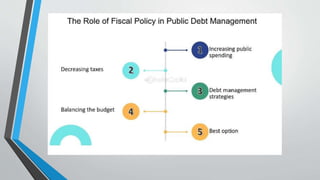
1. Increasing public spending: One way fiscal policy can
increase public debt is through increased
government spending.When the government spends more
than it collects in taxes, it has to borrow money to finance its
spending.This leads to an increase in public debt. For
example, during an economic recession, the government may
increase spending on unemployment benefits and
infrastructure projects to stimulate the economy. However,
this can lead to an increase in public debt if the government
does not have enough revenue to cover the increased
spending.
2. Decreasing taxes: Another way fiscal policy can
increase public debt is through tax cuts.When the
government cuts taxes, it reduces its revenue, which can
lead to an increase in public debt if the government
continues to spend at the same level. For example, if the
government cuts taxes on corporations, it may have less
revenue to fund public services such as healthcare and
education.
3. debt management strategies: Fiscal policy can also play a role
in managing public debt. Governments can use fiscal policy to
implement debt management strategies such as debt
consolidation or debt restructuring. Debt consolidation involves
combining multiple debts into one loan with a lower interest
rate, while debt restructuring involves changing the terms of
existing debt to make it more manageable.These strategies can
help governments reduce their debt burden and make it easier
to pay off their debt over time.
4. Balancing the budget: One way to manage public debt is to
balance the budget, which means that government spending
is equal to government revenue. By balancing the budget, the
government can avoid borrowing money and accumulating
more debt. However, this can be difficult to achieve, especially
during times of economic downturns when government
spending may need to increase to stimulate the economy.
5. Best option:The best option for managing public debt
depends on the specific economic situation of each country.
In general, a combination of fiscal policy measures such
as debt management strategies and balancing the budget
can be effective in managing public debt. However, during
times of economic crisis, governments may need to increase
spending and borrow money to stimulate the economy.
Fiscal policy plays a crucial role in public debt management.
Governments can use fiscal policy to increase or decrease
public debt and implement debt management strategies.
Balancing the budget can be an effective way to manage
public debt, but it may not always be feasible.The best option
for managing public debt depends on the specific economic
situation of each country.
Thank you for listening!!!
God bless everyone!

Public-Debt-Management-Maghuyop REPORTING

  • 1.
  • 2.
    What is PublicDebt Management ? -it is the process of developing and implementing a strategy for managing government debt to raise necessary funds for meeting risk and cost objectives.
  • 3.
    Public debt managementplays a vital role in the economic stability and growth of a country. It involves the strategic planning, issuance, and repayment of government debt, which includes both domestic and external borrowings.The effective management of public debt is crucial as it helps governments meet their financing needs, maintain a sustainable debt level, and mitigate risks associated with borrowing. In this section, we will delve into the fundamentals of public debt management, exploring various strategies and options available to governments.
  • 4.
    1. Understanding PublicDebt: Public debt refers to the total outstanding debt owed by a government to domestic and foreign creditors.This debt is typically raised through the issuance of government bonds, treasury bills, and other debt instruments. It is important to distinguish between domestic and external debt, as each has its own implications and risks. Domestic debt is denominated in the country's own currency and is owed to domestic lenders, while external debt is denominated in foreign currencies and is owed to foreign creditors. Governments must carefully manage both types of debt to ensure financial stability.
  • 5.
    2. Objectives ofPublic Debt Management:The primary objectives of public debt management are to ensure the government's ability to finance its operations, maintain debt sustainability, and minimize borrowing costs. Governments aim to strike a balance between meeting their financing needs and avoiding excessive debt burdens. debt sustainability analysis is crucial in assessing a country's ability to meet its debt obligations without compromising its long- term fiscal health.Additionally, minimizing borrowing costs is achieved by adopting prudent debt management strategies, such as optimizing the debt portfolio and utilizing appropriate borrowing instruments.
  • 6.
    3. Debt ManagementStrategies: Governments have several options when it comes to managing their public debt. One approach is active debt management, which involves actively adjusting the debt portfolio to take advantage of market conditions and reduce risks.This strategy may include refinancing existing debt at lower interest rates, lengthening debt maturities to reduce refinancing risks, or diversifying the investor base to increase demand for government securities. On the other hand, passive debt management involves maintaining a fixed debt portfolio without actively adjusting it. This approach is often suitable for countries with stable debt levels and low refinancing risks.
  • 7.
    4. Debt Sustainabilityand Risk Mitigation: Debt sustainability analysis is crucial in assessing a country's ability to manage its debt burden. Governments should consider the debt-to-GDP ratio, debt service-to-revenue ratio, and other relevant indicators to determine the sustainability of their debt. By maintaining a sustainable debt level, governments can mitigate risks associated with excessive borrowing, such as higher interest payments, limited fiscal space, and vulnerability to external shocks. Moreover, prudent debt management practices, such as maintaining a diversified investor base and implementing risk management tools, can further enhance risk mitigation.
  • 8.
    5. Comparing FinancingOptions: Governments have various financing options available to meet their funding needs.They can issue long-term bonds, which provide stable financing and allow for effective debt management. Alternatively, short-term treasury bills offer flexibility and liquidity but may expose the government to refinancing risks. Governments must carefully evaluate their financing options, considering factors such as market conditions, investor demand, and cost-effectiveness. For example, during periods of low interest rates, issuing long-term bonds may be more favorable, while in times of market volatility, shorter-term instruments may be preferred.
  • 9.
    Public debt managementis a critical aspect of economic governance, ensuring governments can meet their financing needs while minimizing risks. By understanding the fundamentals of public debt, setting clear objectives, and adopting appropriate debt management strategies, governments can achieve debt sustainability and mitigate potential risks. It is essential for policymakers to continually assess and adapt their debt management practices to respond to changing market conditions and safeguard the economic stability of their countries.
  • 11.
    The role ofFiscal policy in public Debt management: Fiscal policy is the use of government spending and taxation to influence the economy. It plays a crucial role in public debt management as it determines the level of government borrowing and the use of borrowed funds. Fiscal policy can either increase or decrease the level of public debt, depending on the government's spending and taxation decisions.
  • 13.
    1. Increasing publicspending: One way fiscal policy can increase public debt is through increased government spending.When the government spends more than it collects in taxes, it has to borrow money to finance its spending.This leads to an increase in public debt. For example, during an economic recession, the government may increase spending on unemployment benefits and infrastructure projects to stimulate the economy. However, this can lead to an increase in public debt if the government does not have enough revenue to cover the increased spending.
  • 14.
    2. Decreasing taxes:Another way fiscal policy can increase public debt is through tax cuts.When the government cuts taxes, it reduces its revenue, which can lead to an increase in public debt if the government continues to spend at the same level. For example, if the government cuts taxes on corporations, it may have less revenue to fund public services such as healthcare and education.
  • 15.
    3. debt managementstrategies: Fiscal policy can also play a role in managing public debt. Governments can use fiscal policy to implement debt management strategies such as debt consolidation or debt restructuring. Debt consolidation involves combining multiple debts into one loan with a lower interest rate, while debt restructuring involves changing the terms of existing debt to make it more manageable.These strategies can help governments reduce their debt burden and make it easier to pay off their debt over time.
  • 16.
    4. Balancing thebudget: One way to manage public debt is to balance the budget, which means that government spending is equal to government revenue. By balancing the budget, the government can avoid borrowing money and accumulating more debt. However, this can be difficult to achieve, especially during times of economic downturns when government spending may need to increase to stimulate the economy.
  • 17.
    5. Best option:Thebest option for managing public debt depends on the specific economic situation of each country. In general, a combination of fiscal policy measures such as debt management strategies and balancing the budget can be effective in managing public debt. However, during times of economic crisis, governments may need to increase spending and borrow money to stimulate the economy.
  • 18.
    Fiscal policy playsa crucial role in public debt management. Governments can use fiscal policy to increase or decrease public debt and implement debt management strategies. Balancing the budget can be an effective way to manage public debt, but it may not always be feasible.The best option for managing public debt depends on the specific economic situation of each country.
  • 19.
    Thank you forlistening!!! God bless everyone!