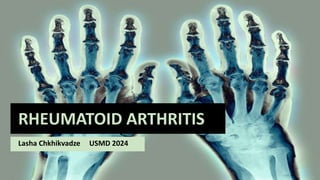
RHEUMATOID ARTHRITIS
Lasha Chkhikvadze USMD 2024
Definition
• Rheumatoid arthritis (RA) is a chronic
usually progressive inflammatory
disorder of unknown etiology
characterized by joint involvement and
systemic manifestations. So it is a
systemic autoimmune disease.
• It affects approximately 1-3% of the
world population
• Occurs 3 times more in women
• peaks at age 30-50 years
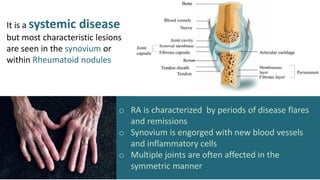
o RA is characterized by periods of disease flares
and remissions
o Synovium is engorged with new blood vessels
and inflammatory cells
o Multiple joints are often affected in the
symmetric manner
It is a systemic disease
but most characteristic lesions
are seen in the synovium or
within Rheumatoid nodules
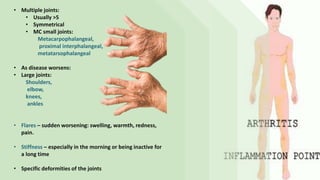
• Multiple joints:
• Usually >5
• Symmetrical
• MC small joints:
Metacarpophalangeal,
proximal interphalangeal,
metatarsophalangeal
• As disease worsens:
• Large joints:
Shoulders,
elbow,
knees,
ankles
• Flares – sudden worsening: swelling, warmth, redness,
pain.
• Stiffness – especially in the morning or being inactive for
a long time
• Specific deformities of the joints
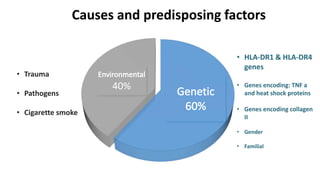
Causes and predisposing factors
40%
• HLA-DR1 & HLA-DR4
genes
• Genes encoding: TNF a
and heat shock proteins
• Genes encoding collagen
II
• Gender
• Familial
• Trauma
• Pathogens
• Cigarette smoke
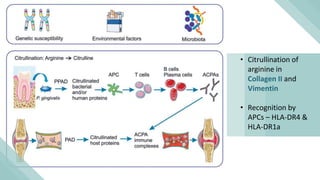
• Citrullination of
arginine in
Collagen II and
Vimentin
• Recognition by
APCs – HLA-DR4 &
HLA-DR1a
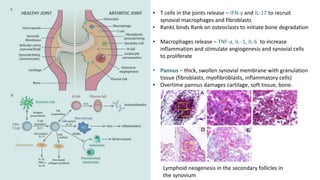
• T cells in the joints release – IFN-y and IL-17 to recruit
synovial macrophages and fibroblasts
• RankL binds Rank on osteoclasts to initiate bone degradation
• Macrophages release – TNF-a, IL- 1, IL-6 to increase
inflammation and stimulate angiogenesis and synovial cells
to proliferate
• Pannus – thick, swollen synovial membrane with granulation
tissue (fibroblasts, myofibroblasts, inflammatory cells)
• Overtime pannus damages cartilage, soft tissue, bone.
Lymphoid neogenesis in the secondary follicles in
the synovium
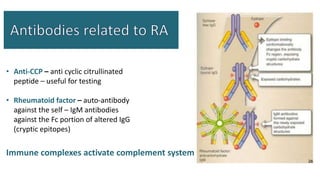
• Anti-CCP – anti cyclic citrullinated
peptide – useful for testing
• Rheumatoid factor – auto-antibody
against the self – IgM antibodies
against the Fc portion of altered IgG
(cryptic epitopes)
Immune complexes activate complement system
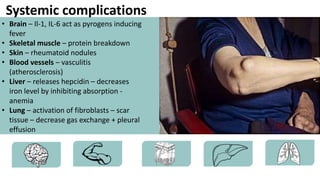
Systemic complications
• Brain – Il-1, IL-6 act as pyrogens inducing
fever
• Skeletal muscle – protein breakdown
• Skin – rheumatoid nodules
• Blood vessels – vasculitis
(atherosclerosis)
• Liver – releases hepcidin – decreases
iron level by inhibiting absorption -
anemia
• Lung – activation of fibroblasts – scar
tissue – decrease gas exchange + pleural
effusion
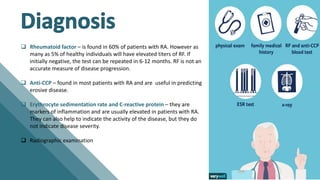
 Rheumatoid factor – is found in 60% of patients with RA. However as
many as 5% of healthy individuals will have elevated titers of RF. If
initially negative, the test can be repeated in 6-12 months. RF is not an
accurate measure of disease progression.
 Anti-CCP – found in most patients with RA and are useful in predicting
erosive disease.
 Erythrocyte sedimentation rate and C-reactive protein – they are
markers of inflammation and are usually elevated in patients with RA.
They can also help to indicate the activity of the disease, but they do
not indicate disease severity.
 Radiographic examination
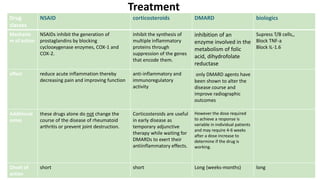
Drug
classes
NSAID corticosteroids DMARD biologics
Mechanis
m of action
NSAIDs inhibit the generation of
prostaglandins by blocking
cyclooxygenase enzymes, COX-1 and
COX-2.
inhibit the synthesis of
multiple inflammatory
proteins through
suppression of the genes
that encode them.
inhibition of an
enzyme involved in the
metabolism of folic
acid, dihydrofolate
reductase
Supress T/B cells,,
Block TNF-a
Block IL-1.6
effect reduce acute inflammation thereby
decreasing pain and improving function
anti-inflammatory and
immunoregulatory
activity
only DMARD agents have
been shown to alter the
disease course and
improve radiographic
outcomes
Additional
notes
these drugs alone do not change the
course of the disease of rheumatoid
arthritis or prevent joint destruction.
Corticosteroids are useful
in early disease as
temporary adjunctive
therapy while waiting for
DMARDs to exert their
antiinflammatory effects.
However the dose required
to achieve a response is
variable in individual patients
and may require 4-6 weeks
after a dose increase to
determine if the drug is
working.
Onset of
action
short short Long (weeks-months) long
Treatment
Thank you!

Rheumathoid arthritis

  • 1.
  • 2.
    Definition • Rheumatoid arthritis(RA) is a chronic usually progressive inflammatory disorder of unknown etiology characterized by joint involvement and systemic manifestations. So it is a systemic autoimmune disease. • It affects approximately 1-3% of the world population • Occurs 3 times more in women • peaks at age 30-50 years
  • 3.
    o RA ischaracterized by periods of disease flares and remissions o Synovium is engorged with new blood vessels and inflammatory cells o Multiple joints are often affected in the symmetric manner It is a systemic disease but most characteristic lesions are seen in the synovium or within Rheumatoid nodules
  • 4.
    • Multiple joints: •Usually >5 • Symmetrical • MC small joints: Metacarpophalangeal, proximal interphalangeal, metatarsophalangeal • As disease worsens: • Large joints: Shoulders, elbow, knees, ankles • Flares – sudden worsening: swelling, warmth, redness, pain. • Stiffness – especially in the morning or being inactive for a long time • Specific deformities of the joints
  • 5.
    Causes and predisposingfactors 40% • HLA-DR1 & HLA-DR4 genes • Genes encoding: TNF a and heat shock proteins • Genes encoding collagen II • Gender • Familial • Trauma • Pathogens • Cigarette smoke
  • 6.
    • Citrullination of argininein Collagen II and Vimentin • Recognition by APCs – HLA-DR4 & HLA-DR1a
  • 7.
    • T cellsin the joints release – IFN-y and IL-17 to recruit synovial macrophages and fibroblasts • RankL binds Rank on osteoclasts to initiate bone degradation • Macrophages release – TNF-a, IL- 1, IL-6 to increase inflammation and stimulate angiogenesis and synovial cells to proliferate • Pannus – thick, swollen synovial membrane with granulation tissue (fibroblasts, myofibroblasts, inflammatory cells) • Overtime pannus damages cartilage, soft tissue, bone. Lymphoid neogenesis in the secondary follicles in the synovium
  • 8.
    • Anti-CCP –anti cyclic citrullinated peptide – useful for testing • Rheumatoid factor – auto-antibody against the self – IgM antibodies against the Fc portion of altered IgG (cryptic epitopes) Immune complexes activate complement system
  • 9.
    Systemic complications • Brain– Il-1, IL-6 act as pyrogens inducing fever • Skeletal muscle – protein breakdown • Skin – rheumatoid nodules • Blood vessels – vasculitis (atherosclerosis) • Liver – releases hepcidin – decreases iron level by inhibiting absorption - anemia • Lung – activation of fibroblasts – scar tissue – decrease gas exchange + pleural effusion
  • 10.
     Rheumatoid factor– is found in 60% of patients with RA. However as many as 5% of healthy individuals will have elevated titers of RF. If initially negative, the test can be repeated in 6-12 months. RF is not an accurate measure of disease progression.  Anti-CCP – found in most patients with RA and are useful in predicting erosive disease.  Erythrocyte sedimentation rate and C-reactive protein – they are markers of inflammation and are usually elevated in patients with RA. They can also help to indicate the activity of the disease, but they do not indicate disease severity.  Radiographic examination
  • 11.
    Drug classes NSAID corticosteroids DMARDbiologics Mechanis m of action NSAIDs inhibit the generation of prostaglandins by blocking cyclooxygenase enzymes, COX-1 and COX-2. inhibit the synthesis of multiple inflammatory proteins through suppression of the genes that encode them. inhibition of an enzyme involved in the metabolism of folic acid, dihydrofolate reductase Supress T/B cells,, Block TNF-a Block IL-1.6 effect reduce acute inflammation thereby decreasing pain and improving function anti-inflammatory and immunoregulatory activity only DMARD agents have been shown to alter the disease course and improve radiographic outcomes Additional notes these drugs alone do not change the course of the disease of rheumatoid arthritis or prevent joint destruction. Corticosteroids are useful in early disease as temporary adjunctive therapy while waiting for DMARDs to exert their antiinflammatory effects. However the dose required to achieve a response is variable in individual patients and may require 4-6 weeks after a dose increase to determine if the drug is working. Onset of action short short Long (weeks-months) long Treatment
  • 12.

Editor's Notes

  • #5 Doctors do not fully understand the exact cause of morning stiffness in RA. However, it is possible that the body's natural rhythms contribute to morning stiffness. During the night, the body increases production of certain hormones, which can trigger swelling that leads to morning stiffness
  • #6 Why trauma? -  Inflammatory events in the initial phase after injury, such as the increased release of inflammatory cytokines, can predispose to the development of OA or inflammatory arthritis. Pathogens -  Proteus mirabilis (P. mirabilis), Epstein–Barr virus (EBV), rubella,influenza, and mycoplasma contribute to the etiopathogenesis of RA.
  • #10 Associated with Felty syndrome – RA + splenomegaly + neutropenia
  • #11 Erythrocyte sedimentation rate (ESR or sed rate) is a test that measures how long it takes red blood cells to settle to the bottom of a long, upright tube, known as a Westergren tube. When there's inflammation, the red blood cells stick together and sink faster. It is a non-specific measurement of inflammation but can provide key insights that are valuable to a diagnosis.2 C-reactive protein (CRP) is a type of protein the liver produces in response to inflammation. While also non-specific, it is a more direct measure of your inflammatory response. ESR and CRP can also be used to diagnose arthritis remission, a state of low disease activity in which inflammation is more or less in check. Rheumatoid Factor (RF): (RF) is a type of autoantibody found in approximately 70% of people living with the disease.1 Autoantibodies are proteins produced by the immune system that attack healthy cells or cell products as if they were germs. While high levels of RF are strongly suggestive of RA, they also can occur with other autoimmune diseases (such as lupus) or non-autoimmune disorders such as cancer and chronic infections. Anti-Cyclic Citrullinated Peptide (anti-CCP): Anti-CCP is another autoantibody found in the majority of people with rheumatoid arthritis. Unlike RF, a positive anti-CCP test result occurs almost exclusively in people with RA. A positive result might even identify people who are at risk for getting the disease, such as those with a family history of it. Because neither test is 100% indicative of RA, they're used as part of the diagnostic process rather than as sole indicators.
  • #12 non-steroidal anti-inflammatory agents (NSAIDs), corticosteroids, and disease modifying anti-rheumatic drugs (DMARDs) Aspirin is the oldest drug of the non-steroidal class, but because of its high rate of GI toxicity, a narrow window between toxic and anti-inflammatory serum levels, and the inconvenience of multiple daily doses, aspirin’s use as the initial choice of drug therapy has largely been replaced by other NSAIDs. There are a large number of NSAIDs from which to choose, and at full dosages all are potentially equally effective.