Patient case
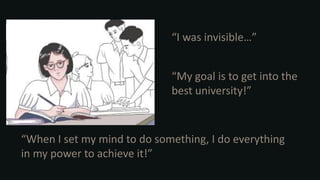
“I was invisible…”
“My goal is to get into the
best university!”
“When I set my mind to do something, I do everything
in my power to achieve it!”
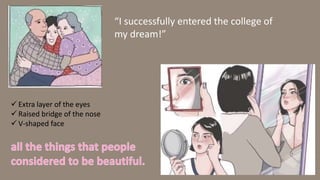
“I successfully entered the college of
my dream!”
 Extra layer of the eyes
 Raised bridge of the nose
 V-shaped face
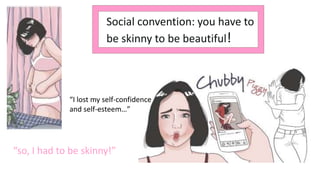
Social convention: you have to
be skinny to be beautiful!
“I lost my self-confidence
and self-esteem…”
“so, I had to be skinny!”
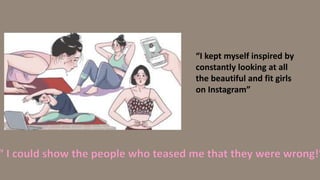
“I kept myself inspired by
constantly looking at all
the beautiful and fit girls
on Instagram”
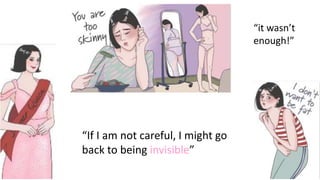
“it wasn’t
enough!”
“If I am not careful, I might go
back to being invisible”
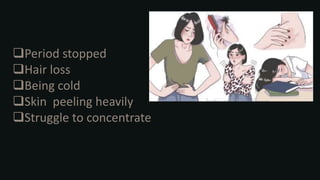
Period stopped
Hair loss
Being cold
Skin peeling heavily
Struggle to concentrate
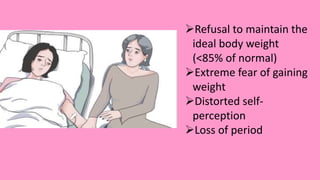
Refusal to maintain the
ideal body weight
(<85% of normal)
Extreme fear of gaining
weight
Distorted self-
perception
Loss of period
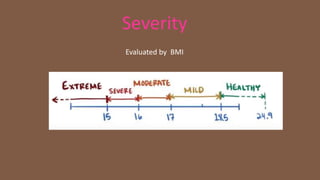
Severity
Evaluated by BMI
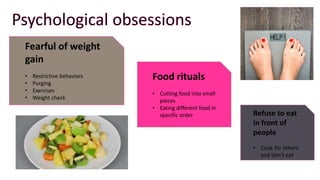
Fearful of weight
gain
• Restrictive behaviors
• Purging
• Exercises
• Weight check
Food rituals
• Cutting food into small
pieces
• Eating different food in
specific order Refuse to eat
in front of
people
• Cook for others
and don’t eat
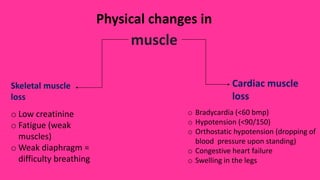
Physical changes in
muscle
Skeletal muscle
loss
Cardiac muscle
loss
o Low creatinine
o Fatigue (weak
muscles)
o Weak diaphragm =
difficulty breathing
o Bradycardia (<60 bmp)
o Hypotension (<90/150)
o Orthostatic hypotension (dropping of
blood pressure upon standing)
o Congestive heart failure
o Swelling in the legs
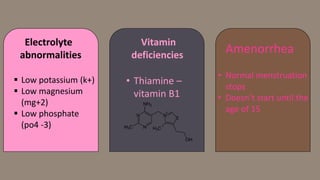
Electrolyte
abnormalities
Vitamin
deficiencies
Amenorrhea
 Low potassium (k+)
 Low magnesium
(mg+2)
 Low phosphate
(po4 -3)
• Thiamine –
vitamin B1
• Normal menstruation
stops
• Doesn’t start until the
age of 15
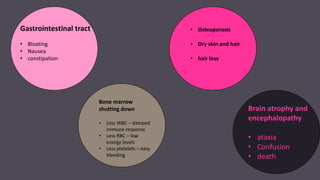
Gastrointestinal tract
• Bloating
• Nausea
• constipation
Bone marrow
shutting down
• Less WBC – damped
immune response
• Less RBC – low
energy levels
• Less platelets – easy
bleeding
• Osteoporosis
• Dry skin and hair
• hair loss
Brain atrophy and
encephalopathy
• ataxia
• Confusion
• death
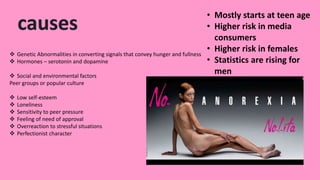
 Genetic Abnormalities in converting signals that convey hunger and fullness
 Hormones – serotonin and dopamine
 Social and environmental factors
Peer groups or popular culture
 Low self-esteem
 Loneliness
 Sensitivity to peer pressure
 Feeling of need of approval
 Overreaction to stressful situations
 Perfectionist character
• Mostly starts at teen age
• Higher risk in media
consumers
• Higher risk in females
• Statistics are rising for
men
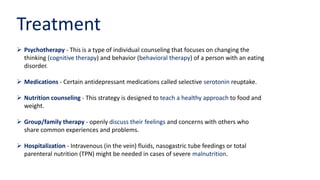
Treatment
 Psychotherapy - This is a type of individual counseling that focuses on changing the
thinking (cognitive therapy) and behavior (behavioral therapy) of a person with an eating
disorder.
 Medications - Certain antidepressant medications called selective serotonin reuptake.
 Nutrition counseling - This strategy is designed to teach a healthy approach to food and
weight.
 Group/family therapy - openly discuss their feelings and concerns with others who
share common experiences and problems.
 Hospitalization - Intravenous (in the vein) fluids, nasogastric tube feedings or total
parenteral nutrition (TPN) might be needed in cases of severe malnutrition.
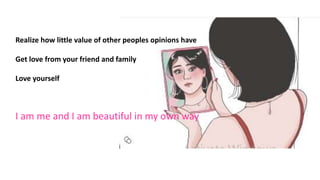
Realize how little value of other peoples opinions have
Get love from your friend and family
Love yourself
I am me and I am beautiful in my own way
Anorexia nervosa - patient case

Anorexia nervosa - patient case

  • 2.
  • 3.
    “I was invisible…” “Mygoal is to get into the best university!” “When I set my mind to do something, I do everything in my power to achieve it!”
  • 4.
    “I successfully enteredthe college of my dream!”  Extra layer of the eyes  Raised bridge of the nose  V-shaped face
  • 5.
    Social convention: youhave to be skinny to be beautiful! “I lost my self-confidence and self-esteem…” “so, I had to be skinny!”
  • 6.
    “I kept myselfinspired by constantly looking at all the beautiful and fit girls on Instagram”
  • 7.
    “it wasn’t enough!” “If Iam not careful, I might go back to being invisible”
  • 8.
    Period stopped Hair loss Beingcold Skin peeling heavily Struggle to concentrate
  • 9.
    Refusal to maintainthe ideal body weight (<85% of normal) Extreme fear of gaining weight Distorted self- perception Loss of period
  • 11.
  • 12.
    Fearful of weight gain •Restrictive behaviors • Purging • Exercises • Weight check Food rituals • Cutting food into small pieces • Eating different food in specific order Refuse to eat in front of people • Cook for others and don’t eat
  • 13.
    Physical changes in muscle Skeletalmuscle loss Cardiac muscle loss o Low creatinine o Fatigue (weak muscles) o Weak diaphragm = difficulty breathing o Bradycardia (<60 bmp) o Hypotension (<90/150) o Orthostatic hypotension (dropping of blood pressure upon standing) o Congestive heart failure o Swelling in the legs
  • 14.
    Electrolyte abnormalities Vitamin deficiencies Amenorrhea  Low potassium(k+)  Low magnesium (mg+2)  Low phosphate (po4 -3) • Thiamine – vitamin B1 • Normal menstruation stops • Doesn’t start until the age of 15
  • 15.
    Gastrointestinal tract • Bloating •Nausea • constipation Bone marrow shutting down • Less WBC – damped immune response • Less RBC – low energy levels • Less platelets – easy bleeding • Osteoporosis • Dry skin and hair • hair loss Brain atrophy and encephalopathy • ataxia • Confusion • death
  • 16.
     Genetic Abnormalitiesin converting signals that convey hunger and fullness  Hormones – serotonin and dopamine  Social and environmental factors Peer groups or popular culture  Low self-esteem  Loneliness  Sensitivity to peer pressure  Feeling of need of approval  Overreaction to stressful situations  Perfectionist character • Mostly starts at teen age • Higher risk in media consumers • Higher risk in females • Statistics are rising for men
  • 17.
    Treatment  Psychotherapy -This is a type of individual counseling that focuses on changing the thinking (cognitive therapy) and behavior (behavioral therapy) of a person with an eating disorder.  Medications - Certain antidepressant medications called selective serotonin reuptake.  Nutrition counseling - This strategy is designed to teach a healthy approach to food and weight.  Group/family therapy - openly discuss their feelings and concerns with others who share common experiences and problems.  Hospitalization - Intravenous (in the vein) fluids, nasogastric tube feedings or total parenteral nutrition (TPN) might be needed in cases of severe malnutrition.
  • 18.
    Realize how littlevalue of other peoples opinions have Get love from your friend and family Love yourself I am me and I am beautiful in my own way

Editor's Notes

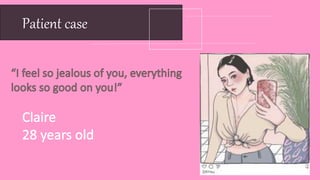
  • #3 It’s what friends often say to Claire. But do they actually know what she has been through to get this body? Hello, It’s Claire, She is 28 years old and will share her eating and body dysmorphic disorder story with us.
  • #4 Claire used to be a girl in school, nobody noticed. All the boys would just look and pass her. She wasn’t even popular in her own group of friends. She was invisible. She used to feel a little down about this, but it was her goal to get into the best university possible . And when she says her mind to do something, she will do everything to achieve it.
  • #5 Her dream was to get into a college and then worry about the appearance. From that moment on she focused all of her time and energy into studying to pass the entrance exam. And once she got accepted, her parents were so excited that told her to ask anything. So, it didn’t take much time to make up mind about the present… First it was her face. She had a cosmetic surgery and added extra layers of her eyes, raised bridge of her nose, and make her face into the V-shape – all the things that people considered to be beautiful.
  • #6 I turned into a completely different, person. But then she was left with the part that stressed her the most, loosing the weight. If I am still fat, no one will consider me beautiful. This is the social convention – you have to be skinny to be beautiful. At least I have been called chubby and piggy by the schoolmate all the time. Making fun of my big arms and legs. As time went I lost my self-confidence and self-esteem. So I had to be skinny.
  • #7 I lost the entire summer break to exercise. At first I got extremely exhausted and nearly gave up. But I kept myself inspired by constantly looking at all the beautiful and fit girls on Instagram. If I could look like them, people would notice me. I could show the people who teased me that they were wrong.
  • #8 Eventually, Claire reached her goal. Once she entered the university she was always in the center of attention. Girls looked at her with jealousy and boys kept asking her phone number. Clothes were getting smaller, but that wasn’t enough. She started controlling her diet. She started loosing weight even faster than with exercising. People told her she was skinny, but she didn’t believe them. She even won the title of the queen of the ball. If I am not careful, I might go back to being invisible. So she continued dieting and exercising even more intensively.
  • #9 While she was obsessing her weight, she didn’t notice disorders in her organism. Her period had stopped coming for months, she was loosing so much hair, she was always cold, her skin started to peel heavily, she was struggling at every single class to focus – and her grades dropped.
  • #10 And once as she was exercising, she lost her consciousness and when she woke up she was already in the hospital. Guess what she was diagnosed?
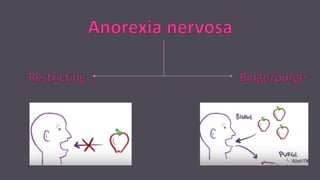
  • #11 There are 2 types of A.N Restricting: when people reduce the amount of food they eat normally. Binge eating and purge: when people eat large amount of food but later throw it up. (don’t mess it up with bulimia, in case of bulimia people are normal or overweigt, in AN people are underweight)