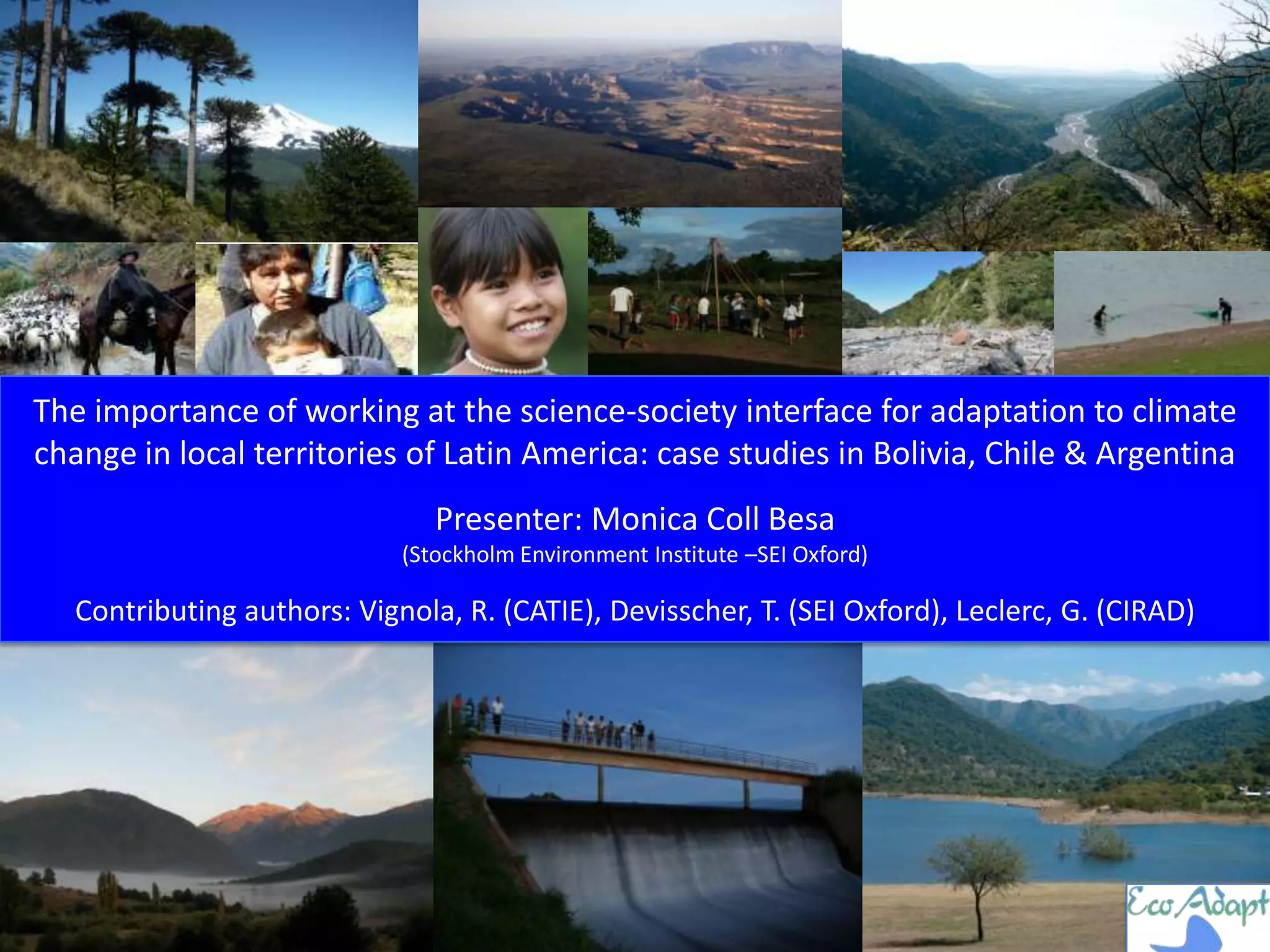
The importance of working at the science-society interface for adaptation to climate
change in local territories of Latin America: case studies in Bolivia, Chile & Argentina
Presenter: Monica Coll Besa
(Stockholm Environment Institute –SEI Oxford)
Contributing authors: Vignola, R. (CATIE), Devisscher, T. (SEI Oxford), Leclerc, G. (CIRAD)
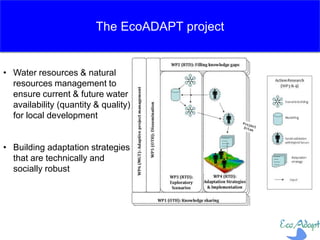
The EcoADAPT project
• Water resources & natural
resources management to
ensure current & future water
availability (quantity & quality)
for local development
• Building adaptation strategies
that are technically and
socially robust
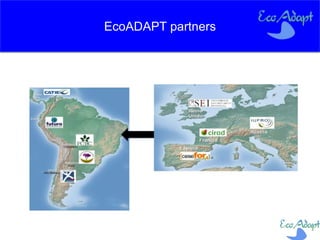
EcoADAPT partners
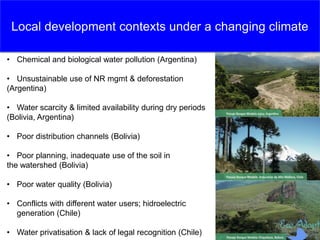
Local development contexts under a changing climate
• Chemical and biological water pollution (Argentina)
• Unsustainable use of NR mgmt & deforestation
(Argentina)
• Water scarcity & limited availability during dry periods
(Bolivia, Argentina)
• Poor distribution channels (Bolivia)
• Poor planning, inadequate use of the soil in
the watershed (Bolivia)
• Poor water quality (Bolivia)
• Conflicts with different water users; hidroelectric
generation (Chile)
• Water privatisation & lack of legal recognition (Chile)
EcoADAPT approach:
• Co-construction of knowledge & research
• The rol of ecosystems to provide water services for the local development
under a changing climate
• CSOs & scientists partnerships
• Build a shared understanding of the problems
• Strengthen collaboration among different actors
• Strengthen collective adaptive capacity
Building bottom-up processes through action-
research for water resources governance
Adaptation understood as a socio-institutional process that requires technical and
socially robust strategies (IPCC, 2012)
Understand the socio-institutional context through participatory social
network mapping to build adaptation strategies that are socially and
technically robust by working at the science-society interface
• Identification of key actors and agents of change
• Understanding the relationships and possible interventions to improve collaboration
among actors
• Identification of barriers and strengths to build adaptation strategies helps to
understand the socio-institutional landscape in a structured way (formal/informal)
• Importance of social and technical validation through the actors
Preliminary impacts from the socio-institutional
component
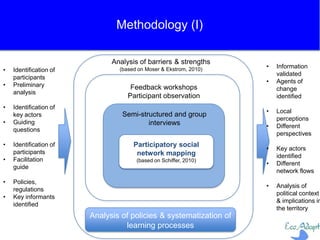
Participatory social
network mapping
(based on Schiffer, 2010)
Semi-structured and group
interviews
Feedback workshops
Participant observation
Analysis of barriers & strengths
(based on Moser & Ekstrom, 2010)
Analysis of policies & systematization of
learning processes
INPUTS OUTPUTS
• Identification of
participants
• Preliminary
analysis
• Identification of
key actors
• Guiding
questions
• Identification of
participants
• Facilitation
guide
• Policies,
regulations
• Key informants
identified
• Information
validated
• Agents of
change
identified
• Local
perceptions
• Different
perspectives
• Key actors
identified
• Different
network flows
• Analysis of
political context
& implications in
the territory
Methodology (I)
Methodology (II):
Participatory Social Network Mapping
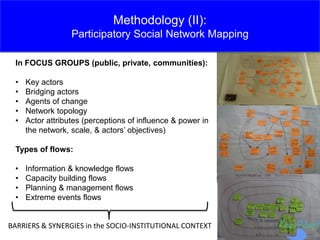
In FOCUS GROUPS (public, private, communities):
• Key actors
• Bridging actors
• Agents of change
• Network topology
• Actor attributes (perceptions of influence & power in
the network, scale, & actors’ objectives)
Types of flows:
• Information & knowledge flows
• Capacity building flows
• Planning & management flows
• Extreme events flows
BARRIERS & SYNERGIES in the SOCIO-INSTITUTIONAL CONTEXT
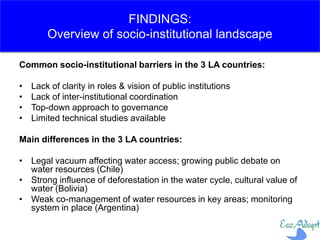
Common socio-institutional barriers in the 3 LA countries:
• Lack of clarity in roles & vision of public institutions
• Lack of inter-institutional coordination
• Top-down approach to governance
• Limited technical studies available
Main differences in the 3 LA countries:
• Legal vacuum affecting water access; growing public debate on
water resources (Chile)
• Strong influence of deforestation in the water cycle, cultural value of
water (Bolivia)
• Weak co-management of water resources in key areas; monitoring
system in place (Argentina)
FINDINGS:
Overview of socio-institutional landscape
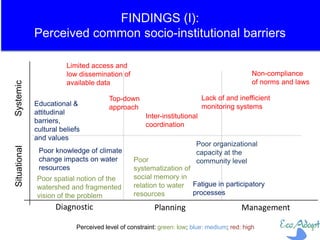
FINDINGS (I):
Perceived common socio-institutional barriers
Perceived level of constraint: green: low; blue: medium; red: high
Non-compliance
of norms and laws
SystemicSituational
Diagnostic Planning Management
Poor knowledge of climate
change impacts on water
resources
Limited access and
low dissemination of
available data
Educational &
attitudinal
barriers,
cultural beliefs
and values
Fatigue in participatory
processes
Lack of and inefficient
monitoring systems
Top-down
approach
Inter-institutional
coordination
Poor
systematization of
social memory in
relation to water
resources
Poor spatial notion of the
watershed and fragmented
vision of the problem
Poor organizational
capacity at the
community level
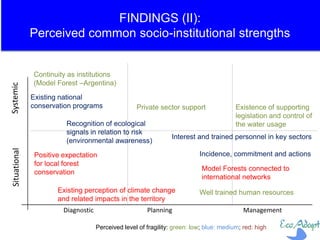
FINDINGS (II):
Perceived common socio-institutional strengths
SystemicSituational
Diagnostic Planning Management
Existing perception of climate change
and related impacts in the territory
Positive expectation
for local forest
conservation
Interest and trained personnel in key sectors
Existence of supporting
legislation and control of
the water usage
Well trained human resources
Incidence, commitment and actions
Recognition of ecological
signals in relation to risk
(environmental awareness)
Existing national
conservation programs
Model Forests connected to
international networks
Continuity as institutions
(Model Forest –Argentina)
Private sector support
Perceived level of fragility: green: low; blue: medium; red: high
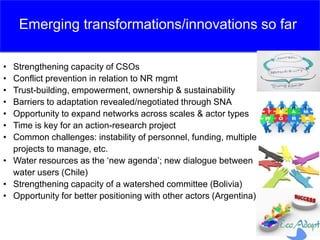
• Strengthening capacity of CSOs
• Conflict prevention in relation to NR mgmt
• Trust-building, empowerment, ownership & sustainability
• Barriers to adaptation revealed/negotiated through SNA
• Opportunity to expand networks across scales & actor types
• Time is key for an action-research project
• Common challenges: instability of personnel, funding, multiple
projects to manage, etc.
• Water resources as the ‘new agenda’; new dialogue between
water users (Chile)
• Strengthening capacity of a watershed committee (Bolivia)
• Opportunity for better positioning with other actors (Argentina)
Emerging transformations/innovations so far
THANK YOU. ANY QUESTIONS??
Contacts: Monica Coll Besa: monica.coll.besa@sei-international.org
Raffaele Vignola: rvignola@catie.ac.cr,
Tahia Devisscher: tahia.devisscher@sei-international.org,
Grégoire Leclerc: gregoire.leclerc@cirad.fr

Preliminary research work from the EcoADAPT project

  • 1.
    The importance ofworking at the science-society interface for adaptation to climate change in local territories of Latin America: case studies in Bolivia, Chile & Argentina Presenter: Monica Coll Besa (Stockholm Environment Institute –SEI Oxford) Contributing authors: Vignola, R. (CATIE), Devisscher, T. (SEI Oxford), Leclerc, G. (CIRAD)
  • 2.
    The EcoADAPT project •Water resources & natural resources management to ensure current & future water availability (quantity & quality) for local development • Building adaptation strategies that are technically and socially robust
  • 3.
  • 4.
    Local development contextsunder a changing climate • Chemical and biological water pollution (Argentina) • Unsustainable use of NR mgmt & deforestation (Argentina) • Water scarcity & limited availability during dry periods (Bolivia, Argentina) • Poor distribution channels (Bolivia) • Poor planning, inadequate use of the soil in the watershed (Bolivia) • Poor water quality (Bolivia) • Conflicts with different water users; hidroelectric generation (Chile) • Water privatisation & lack of legal recognition (Chile)
  • 5.
    EcoADAPT approach: • Co-constructionof knowledge & research • The rol of ecosystems to provide water services for the local development under a changing climate • CSOs & scientists partnerships • Build a shared understanding of the problems • Strengthen collaboration among different actors • Strengthen collective adaptive capacity Building bottom-up processes through action- research for water resources governance Adaptation understood as a socio-institutional process that requires technical and socially robust strategies (IPCC, 2012)
  • 6.
    Understand the socio-institutionalcontext through participatory social network mapping to build adaptation strategies that are socially and technically robust by working at the science-society interface • Identification of key actors and agents of change • Understanding the relationships and possible interventions to improve collaboration among actors • Identification of barriers and strengths to build adaptation strategies helps to understand the socio-institutional landscape in a structured way (formal/informal) • Importance of social and technical validation through the actors Preliminary impacts from the socio-institutional component
  • 7.
    Participatory social network mapping (basedon Schiffer, 2010) Semi-structured and group interviews Feedback workshops Participant observation Analysis of barriers & strengths (based on Moser & Ekstrom, 2010) Analysis of policies & systematization of learning processes INPUTS OUTPUTS • Identification of participants • Preliminary analysis • Identification of key actors • Guiding questions • Identification of participants • Facilitation guide • Policies, regulations • Key informants identified • Information validated • Agents of change identified • Local perceptions • Different perspectives • Key actors identified • Different network flows • Analysis of political context & implications in the territory Methodology (I)
  • 8.
    Methodology (II): Participatory SocialNetwork Mapping In FOCUS GROUPS (public, private, communities): • Key actors • Bridging actors • Agents of change • Network topology • Actor attributes (perceptions of influence & power in the network, scale, & actors’ objectives) Types of flows: • Information & knowledge flows • Capacity building flows • Planning & management flows • Extreme events flows BARRIERS & SYNERGIES in the SOCIO-INSTITUTIONAL CONTEXT
  • 9.
    Common socio-institutional barriersin the 3 LA countries: • Lack of clarity in roles & vision of public institutions • Lack of inter-institutional coordination • Top-down approach to governance • Limited technical studies available Main differences in the 3 LA countries: • Legal vacuum affecting water access; growing public debate on water resources (Chile) • Strong influence of deforestation in the water cycle, cultural value of water (Bolivia) • Weak co-management of water resources in key areas; monitoring system in place (Argentina) FINDINGS: Overview of socio-institutional landscape
  • 10.
    FINDINGS (I): Perceived commonsocio-institutional barriers Perceived level of constraint: green: low; blue: medium; red: high Non-compliance of norms and laws SystemicSituational Diagnostic Planning Management Poor knowledge of climate change impacts on water resources Limited access and low dissemination of available data Educational & attitudinal barriers, cultural beliefs and values Fatigue in participatory processes Lack of and inefficient monitoring systems Top-down approach Inter-institutional coordination Poor systematization of social memory in relation to water resources Poor spatial notion of the watershed and fragmented vision of the problem Poor organizational capacity at the community level
  • 11.
    FINDINGS (II): Perceived commonsocio-institutional strengths SystemicSituational Diagnostic Planning Management Existing perception of climate change and related impacts in the territory Positive expectation for local forest conservation Interest and trained personnel in key sectors Existence of supporting legislation and control of the water usage Well trained human resources Incidence, commitment and actions Recognition of ecological signals in relation to risk (environmental awareness) Existing national conservation programs Model Forests connected to international networks Continuity as institutions (Model Forest –Argentina) Private sector support Perceived level of fragility: green: low; blue: medium; red: high
  • 12.
    • Strengthening capacityof CSOs • Conflict prevention in relation to NR mgmt • Trust-building, empowerment, ownership & sustainability • Barriers to adaptation revealed/negotiated through SNA • Opportunity to expand networks across scales & actor types • Time is key for an action-research project • Common challenges: instability of personnel, funding, multiple projects to manage, etc. • Water resources as the ‘new agenda’; new dialogue between water users (Chile) • Strengthening capacity of a watershed committee (Bolivia) • Opportunity for better positioning with other actors (Argentina) Emerging transformations/innovations so far
  • 13.
    THANK YOU. ANYQUESTIONS?? Contacts: Monica Coll Besa: monica.coll.besa@sei-international.org Raffaele Vignola: rvignola@catie.ac.cr, Tahia Devisscher: tahia.devisscher@sei-international.org, Grégoire Leclerc: gregoire.leclerc@cirad.fr