
RFID
RADIO FREQUENCY IDENTIFICATION
What is RFID?
• Radio-frequency identification (RFID) is an automatic
identification method using radio waves.
• RFID also began to see use in wildlife monitoring and
research. RFID tags can be used to monitor animal
movement without adversely affecting the animal.
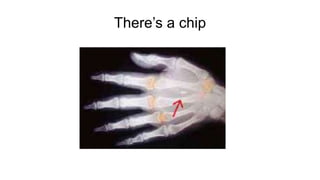
There’s a chip
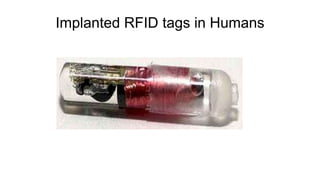
Implanted RFID tags in Humans
Applications
• Asset tracking
• Medical applications
• People tracking
• Retail
• Livestock
• Timing
Tag
• An RFID tag is a device that can store and transmit data
to a reader in a contact less manner using radio waves.
• RFID tags can be classified in three different ways.
Passive Tag
Active Tag
Semiactive Tag
Passive Tag
No on-board power source (for example, a battery)
Uses the power emitted from the reader to energize itself
and transmit its stored data to the reader
Reader always communicates first, followed by the tag.
Smaller than an active or semi-active tag. It has a variety
of read ranges starting with less than 1 inch to about 30
feet (9 meters approximately).
Cheaper compared to an active or semi-active tag.
Active Tag
Has on-board power source (for example, a battery; other
sources of power, such as solar, are also possible)
Own on-board power supply to transmit its data to a
reader.
No need for reader's emitted power for data transmission.
A tag always communicates first, followed by the reader.
Can broadcast its data to its surroundings even in the
absence of a reader
Semi-Active (Semi-Passive) Tags
Have an on-board power source (for example, a battery)
Uses the reader's emitted power for transmitting its data
Also called a battery-assisted tag.
Reader always communicates first, followed by the tag.
Reader????
An RFID reader can read from and write data to compatible RFID tags.
A reader thus doubles up as a writer. The act of writing the tag data by a
reader is called creating a tag.
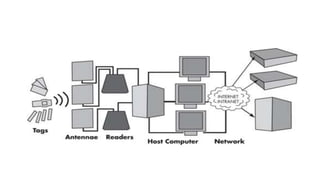
The RFID System
1. Tag
2. Reader
3. Reader antenna
4. Controller
5. Host and software system
6. Communication infrastructure
Working
• A radio device called a tag is attached to the object that
needs to be identified.
• When this tagged object is presented in front of a suitable
RFID reader, the tag transmits this data to the reader (via
the reader antenna).
• The reader then reads the data and has the capability to
forward it over suitable communication channels.
• This application can then use this unique data to identify
the object presented to the reader.
• It can then perform a variety of actions.
Advantages
• Contactless. An RFID tag can be read without any
physical contact between the tag and the reader.
• Writable data. The data of a read-write (RW) RFID tag
can be rewritten a large number of times.
• Absence of line of sight. A line of sight is generally not
required for an RFID reader to read an RFID tag.
Advantages Contd.
• Variety of read ranges.
• Wide data-capacity range.
• Support for multiple tag reads.
• Perform smart tasks
Attacks on RFID System
• Reverse Engineering
• Eavesdropping & Replay
• Man-in-the-Middle Attack or Sniffing
• Denial of Service
• Cloning & Spoofing
Conclusion
RFID, is an emerging technology which can be used for a
variety of applications. However, the potential for abuse of
this technology is vast and requires careful consideration to
avoid.
• Questions???
Questions To Prepare
• What is RFID ?
• Explain the RFID tag and reader. what are the different types of tags ?
• Explain in brief working of RFID system with suitable diagram.
• What are the different types of attack on RFID system and also explain the Eavesdropping
and replay attack .
• Advantages of RFID system .

RFID (RADIO FREQUENCY IDENTIFICATION)

  • 1.
  • 2.
    What is RFID? •Radio-frequency identification (RFID) is an automatic identification method using radio waves. • RFID also began to see use in wildlife monitoring and research. RFID tags can be used to monitor animal movement without adversely affecting the animal.
  • 3.
  • 4.
  • 5.
    Applications • Asset tracking •Medical applications • People tracking • Retail • Livestock • Timing
  • 6.
    Tag • An RFIDtag is a device that can store and transmit data to a reader in a contact less manner using radio waves. • RFID tags can be classified in three different ways. Passive Tag Active Tag Semiactive Tag
  • 7.
    Passive Tag No on-boardpower source (for example, a battery) Uses the power emitted from the reader to energize itself and transmit its stored data to the reader Reader always communicates first, followed by the tag. Smaller than an active or semi-active tag. It has a variety of read ranges starting with less than 1 inch to about 30 feet (9 meters approximately). Cheaper compared to an active or semi-active tag.
  • 8.
    Active Tag Has on-boardpower source (for example, a battery; other sources of power, such as solar, are also possible) Own on-board power supply to transmit its data to a reader. No need for reader's emitted power for data transmission. A tag always communicates first, followed by the reader. Can broadcast its data to its surroundings even in the absence of a reader
  • 9.
    Semi-Active (Semi-Passive) Tags Havean on-board power source (for example, a battery) Uses the reader's emitted power for transmitting its data Also called a battery-assisted tag. Reader always communicates first, followed by the tag.
  • 10.
    Reader???? An RFID readercan read from and write data to compatible RFID tags. A reader thus doubles up as a writer. The act of writing the tag data by a reader is called creating a tag.
  • 11.
    The RFID System 1.Tag 2. Reader 3. Reader antenna 4. Controller 5. Host and software system 6. Communication infrastructure
  • 13.
    Working • A radiodevice called a tag is attached to the object that needs to be identified. • When this tagged object is presented in front of a suitable RFID reader, the tag transmits this data to the reader (via the reader antenna). • The reader then reads the data and has the capability to forward it over suitable communication channels. • This application can then use this unique data to identify the object presented to the reader. • It can then perform a variety of actions.
  • 14.
    Advantages • Contactless. AnRFID tag can be read without any physical contact between the tag and the reader. • Writable data. The data of a read-write (RW) RFID tag can be rewritten a large number of times. • Absence of line of sight. A line of sight is generally not required for an RFID reader to read an RFID tag.
  • 15.
    Advantages Contd. • Varietyof read ranges. • Wide data-capacity range. • Support for multiple tag reads. • Perform smart tasks
  • 16.
    Attacks on RFIDSystem • Reverse Engineering • Eavesdropping & Replay • Man-in-the-Middle Attack or Sniffing • Denial of Service • Cloning & Spoofing
  • 17.
    Conclusion RFID, is anemerging technology which can be used for a variety of applications. However, the potential for abuse of this technology is vast and requires careful consideration to avoid.
  • 18.
  • 19.
    Questions To Prepare •What is RFID ? • Explain the RFID tag and reader. what are the different types of tags ? • Explain in brief working of RFID system with suitable diagram. • What are the different types of attack on RFID system and also explain the Eavesdropping and replay attack . • Advantages of RFID system .