CONTENTS
 Introduction
 Key Members of the Project
 Location
 Solar Energy in India
 Current status of the project
 Financing the project
 Timeline of RUMS
 Role of World bank and IFC
 Impacts on Local Communities
 Challenges faced in its development
 Conclusion
 References
Introduction
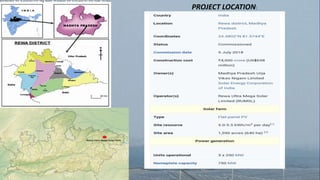
• Rewa Ultra Mega Solar Power Project constructed in 2017 – 18, is located in Gurh tehsil of Rewa district
in Madhya Pradesh, around 35 kms east of the district headquarters of Rewa town.
• The power plant has been set up on close to 1590 acres of forest and private land acquired from villages
of Badwaar, Barsaita, Barsaita Desh, Itaar and Ramnagar of Gurh tehsil.
• The solar power plant has installed capacity to produce 750 MW of power.
• It is claimed to be one of the world’s largest solar photovoltaic power producing project. The project has
a 25 year PPA with Madhya Pradesh Power Management Company Limited (MPPMCL) and Delhi Metro
Rail Corporation (DMRC) to sell its power.
• MPPMCL supplies power to the state electricity distribution companies (Discoms), they would get 76% of
the power produced from Rewa Ultra Mega Solar Power Plant and the remaining 24% would be supplied
to DMRC.
• The project is estimated to meet up to 60% of the day's electricity demand from DMRC.
• Rewa Ultra Mega Solar Limited Company (RUMSL), was formed in July 2015 as a Joint Venture of
SECI and Madhya Pradesh Urja Vikas Nigam (MPUVN). RUMSL, the project implementation
company, with the support from International Finance Corporation (IFC) undertook the auction for
the project based on the lowest tariff in 2016.
• Mahindra Susten (Unit 1) subsidiary of Mahindra Group India, Acme Solar (Unit 2) a private solar
power producer and Solenergi (Unit 3) a part of Actis Solar, were awarded three units of 250 MW
each that comprises of Ultra Mega Power Plant (UMPP) at the end of the auction.
• Mahindra Renewables, ACME Solar Holdings and Solengeri Power emerged as the winner for the
project's three units (250 MW each) at tariffs of Rs 2.979, Rs 2.970 and Rs 2.974 for the first year,
respectively.
• The auction resulted in the first large-scale project in India in which the renewable energy tariff of
INR 3.3 /KWh (5.5 US¢/kWh) breached grid parity. Accounting for an escalation of 5 paisa per year
for the first 15 years, the levelised tariff is about INR 3.3 /KWh (US$ 4.9 cts/KWh).
• The 750 MW Rewa Ultra Mega Solar Power Plant, located in Madhya Pradesh, is one of the biggest single-site solar
power plants implemented across the globe.
• The MNRE had approved this solar power project under its solar park scheme, and it allocated a fund of INR 12 lakhs
per MW for this
• The IFC (International Finance Corporation), a part of the World Bank Group, has invested nearly $440 million (about
₹2,800 crore) in this 750 megawatt solar power plant project.
• The operations of this solar power plant help in reducing 15.4 lakh tonnes of carbon dioxide emissions each year.
• Larsen & Toubro (Oman) was selected to deliver the EPC services for all three units of the Rewa Ultra Mega Solar
Power Park project.
• Rewa Solar Power Park Project has received the World Bank Group’s President award for Innovation and Excellence.
Shri Sanjay Dubey (IAS)
Chairperson
Shri. Ganesh Shankar Mishra(IAS)
Chief Executive Officer, RUMSL
Ms. Dr. Haripriya Gundimeda
Independent Director, RUMSL
Shri. Ishwar Madiwal
Additional General Manager (Finance),
Solar Energy Corporation of India
Shri. Joshit Ranjan Sikidar
Director RUMSL
PROJECT LOCATION:
Solar Energy in India
• India is understood to have immense solar energy potential, due to its
geographical location in a region with high incident solar radiation. It has about
300 days of sunshine per year, with annual mean global solar radiation in a range
of 3.5–6.5 kilowatt-hour (kWh) per square meter per day. It is expected that solar
power can help India meet its growing electricity demand, and build energy
security by cutting imports of costly fossil fuels like coal and petroleum.
The Government of India (GOI) wants a growing share of the country’s electricity to
come from renewable energy. It announced plans to increase renewable energy
capacity to 175 GW by 2022 with more than US$ 150 billion in investments
required. It is aiming to install 100 GW of solar power out of a total renewable
energy of 175 GW. It estimated that at least 60 GW of the targeted installations
will come from large-scale, ground-mounted solar power plants. Of these, 40 GW
will be installed in solar parks, which are concentrated zones of solar power
generation projects that provide developers a well-characterized area, with
appropriate infrastructure and access to amenities, where project risks can be
minimized.
CURRENT STATUS OF THE PROJECT
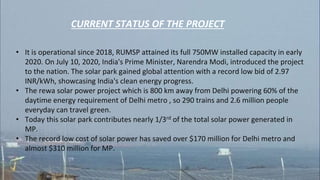
• It is operational since 2018, RUMSP attained its full 750MW installed capacity in early
2020. On July 10, 2020, India's Prime Minister, Narendra Modi, introduced the project
to the nation. The solar park gained global attention with a record low bid of 2.97
INR/kWh, showcasing India's clean energy progress.
• The rewa solar power project which is 800 km away from Delhi powering 60% of the
daytime energy requirement of Delhi metro , so 290 trains and 2.6 million people
everyday can travel green.
• Today this solar park contributes nearly 1/3rd of the total solar power generated in
MP.
• The record low cost of solar power has saved over $170 million for Delhi metro and
almost $310 million for MP.
RUMS PROJECT DESIGN
Facilities
provided
The solar park will provide specialized services to incentivise private developers to invest in solar
energy in the park. These services while not being unique to the park, are provided in a central,
one-stop-shop, single window format, making it easier for investors to implement their projects
within the park in a significantly shorter period of time, as compared to projects outside the park
which would have to obtain these services individually. The implementing agency has been tasked
with acquiring the land for the park, cleaning it, levelling it and allocating the plots for individual
projects. Apart from this, the agency has also been entrusted with providing the following facilities
to the solar project developers for the development of the solar park:
i. Land approved for installation of solar power plants and necessary permissions including
change of land use etc.
ii. Road connectivity to each plot of land.
iii. Water availability for construction as well as running of power plants and demineralisation
plant
iv. Flood mitigation measures like flood discharge, internal drainage etc. v. Construction power
v. Telecommunication facilities
vi. Transmission facility consisting pooling station (with 400/220, 220/66 KV switchyard and
respective transformers) to allow connection of individual projects with pooling station
through a network of underground cables or overhead lines. vii) Housing facility for basic
manpower wherever possible
vii. Parking, Warehouse etc.
Financing the Project:
• According to the World Bank - “the rationale for using public financing under this project is to provide
services where the public sector has an advantage (e.g., providing common infrastructure and
interconnections from the solar park to the state and national grid).
• This will help remove or reduce the private sector’s risk perception about solar power and increase the
availability of private investment and financing for solar power.
• For Rewa Ultra Mega Solar Power Project, IFC’s Infrastructure Investment Department arranged an
investment of US$ 437 million in the form of INR denominated loans with a final maturity of 20 years,
split into three different transactions (one for each of the 250 MW units that made up the UMPP), and
that were processed simultaneously, proving the bankability of the scaling concept, and paving the way
for replication across the sector. IFC financed around 75 percent of the project’s cost, with the
remaining 25 percent coming from shareholder loans and equity.
• The project also benefited from the World Bank and Clean Technology Fund (CTF) financing with
favorable terms. Approved in March 2017, these loans financed the common evacuation infrastructure
at Rewa solar power project, including three 220/33kV substations and connected 220kV transmission
lines to transfer power from the solar plant to the 400/330 kV substation being constructed by PGCIL
which is without any expenditure to RUMSL or the state of Madhya Pradesh.
• It was estimated that the World Bank and CTF loan terms helped directly reduce the tariff by about 4
to 5 paisa (US cents 0.07)/kWh. Rewa Solar plant is India’s only solar project to get funding from CTF,
available at a rate of 0.25% for a 40-year period and the only solar park in India to get a concessional
loan from the World Bank.
GOVT SUPPORT TO THE MEGA PROJECT:
FUNDING ALLOCATION TO PROJECTS(in US$ million)
TIMELINE OF RUMS
 Rewa Ultra Mega Solar Limited (RUMSL), the project implementing agency, mandated
International Finance Corporation (IFC) as a Public Private Partnership (PPP) transaction
adviser to help structure the Rewa solar project and mobilise private investment along
with the World Bank loan.
 Later, IFC also advised on the structuring of the power project as a PPP. It supported the
supported the project preparation process and the processing of the World Bank loan.
World Bank loan.
 On IFC’s inputs, the Government of Madhya Pradesh (GoMP) agreed to a moderate
moderate charge for the land required for three units, common infrastructure in the
infrastructure in the solar power project, allowing for deferred payment over the life of
over the life of the project for land acquisition, construction of internal evacuation
evacuation infrastructure, local area development costs, and solar park administration
administration costs.
The World Bank in March 2017 approved a loan of US$ 100 million to help India increase its power
generation capacity through cleaner, renewable energy sources. The purpose of the loan for the
project – Shared Infrastructure for Solar Parks Project – was to establish large scale solar parks in
the country and support the GOI’s plans to install 100 GW of solar power out of a total renewable-
energy of 175 GW by 2022.
The loan of US$ 100 million is shared between International Bank for Reconstruction and
Development (IBRD) and Clean Technology Fund (CTF) to the tune of US$ 75 million and US$ 25
million respectively.
The US$ 75 million loan from the IBRD, has a 5-year grace period, and a maturity of 19 years. The
US$ 23 million loan from the CTF has a 10-year grace period, and a maturity of 40 years. The US$ 2
million is an interest-free CTF grant.
 The project is supporting MNRE’s (Ministry of New and
Renewable Energy) announced Solar Park Scheme for installing
large-scale, grid- connected solar parks by 2022, with a
targeted, collective installed capacity of 40 GW.
 IREDA, through the state Prospective Implementing Agencies
(PIA)s, will utilise project funding to develop the enabling
common infrastructure (such as power pooling substations, as
well as intra-park transmission infrastructure and access
roads). The objective was also to facilitate solar power
investment by private or public-sector developers.
In the first phase of this project, US$ 200 million, including US$ 75 million from IBRD, US$ 25
million from CTF and US$ 100 million from the GOI and state governments have been
mobilised.
The solar parks supported by the project are expected to mobilise additional US$ 1,828
million of private and public sector financing for solar PV generation capacity and
transmission. The CTF funding would comprise US$ 23 million to be extended under softer
concessional terms and US$ 2 million to be extended in the form of a grant.
Funding Allocation to projects (in US$ million)
 For the Rewa Solar park, IBRD has provided US$ 22 million for financing for such shared
infrastructure as access roads, water supply and drainage, telecommunications, and pooling.
Rewa and Mandsaur solar parks, this includes Madhya Pradesh Power Transmission Company
Limited (MPPTCL) services of about US$ 7 million.
 The total counterpart funding is expected to be higher than 50 percent of the total project
cost.
 CTF has provided US$ 2 million as common fund for technical assistance and has been used
for capacity-building support to IREDA, the SNAs in the states where selected solar parks are
located, and the selected state PIAs, which will include the SNA and/or JV companies or state
agencies across the participating states.
IFC of the World Bank group has been promoting mega solar projects in India through its
multiple projects at different levels. IFC is undertaking transaction advisory projects with
government agencies like New and Renewable Energy Department (NRED), GoMP and SECI in
identifying and structuring renewable energy projects across various states in the country.
One of the transaction advisory projects is for the Rewa Ultra Mega Solar Power Plant in
Madhya Pradesh. IFC will provide transaction advisory support to the NRED, GoMP to assist
in the implementation of a grid connected ground mounted solar UMPP in Rewa district of
Madhya Pradesh which involves installation and operation of grid connected solar panels by
a competitively selected private sector developer(s).
Under Rewa Ultra Mega Solar Power Plant, IFC is providing investments and loans to each of the three private company
contracted to build and operate 3x250 MW solar plants, totaling to 750 MW.
One unit of 250 MW project has been awarded to Solenergi Power Private Ltd. (“SPPL”) within the 750 MW Rewa
Ultra Mega Solar Park. The proposed IFC investment involves providing an IFC A loan /subscribing to Non-Convertible
Debentures (“NCDs”) of up to US$ 50 million and mobilisation of loan of up to US$ 100 million (together “the
Investment”) from other lenders.
Similarly, the second unit has been awarded to Mahindra Renewables Private Limited (MRPL), a 250MW solar
power project within the 750MW Rewa Ultra Mega Solar Park. And third one to Acme Solar pvt. ltd.
 The estimated project cost is around INR 12,800 million.
 The proposed IFC investment involves providing an IFC A loan of up to INR 3,200 million and a potential
mobilisation of loan of up to INR 6,400 million (together “the Investment”) from other lenders.
 The third unit of 250 MW has been awarded to ACME Solar Holdings Limited for development, financing,
construction, operation and maintenance of a 250 MW solar photovoltaic plant.
 The total project cost is US$ 200 million and the loan amount for the project from IFC to ACME Solar is
US$ 50.41 million.
IMPACTS ON LOCAL COMMUNITIES
Land Acquisition
The Environment and Social Impact Assessment of the project (ESIA)Report of Rewa
Solar Power Project notes that the landowners belonging to the Scheduled Tribe (ST)
category are legal titleholders of their land and are mainstreamed, and the only relevant
mitigation measure in their case was compensation for land and other lost assets.
• “As the project area does not fall under the scheduled
area, the landowners belonging to the ST category are
legal titleholders of their land. As reported during the
consultation process, the ST category landowners have
provided their consent voluntarily to sell their land for
the proposed project without any force. They are aware
that for the land contributed they would be receiving
double payment in the form of a Collector Guideline
Rate plus one time solatium based on the prevailing
market value. They also affirmed that this was
communicated to all affected households in the village.
After examining the landowners for the next phase of
land acquisition, it was found that no families from the
Scheduled Tribe (ST) category would be impacted.
The census survey in Phase I found that tribal families are
part of the mainstream society and won't be
economically or physically affected by the project.
The ESIA report suggests that compensation is the only
necessary measure for Indigenous People who have legal
land titles, and they claim adequate consultation with ST
families .
Forest Land
In the ESIA Report it is mentioned that, “land
parcels having homesteads and undertaking
active agricultural activities has not been
included within the project area. The land
parcels under private ownership identified for
the project is instead in a slope terrain.
Because of the slope terrain, no irrigation is
possible for these land parcels, therefore, as
reported by the local communities these
parcels used to depend upon rainfall in order
for agricultural activities to take place. A one
crop cycle used to be practiced in these land
parcels”. (ESIA Report, Page 204)
Local residents claim that the project company initially promised jobs as part of the land acquisition but
failed to fulfill this commitment. While they were assured that one family member would secure a job at
the project site along with compensation, most have only found isolated labour work. Despite protests,
these grievances remain unresolved.
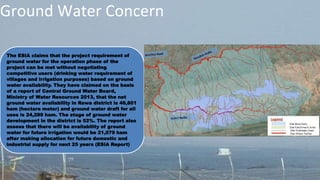
Ground Water Concern
The ESIA claims that the project requirement of
ground water for the operation phase of the
project can be met without negotiating
competitive users (drinking water requirement of
villages and irrigation purposes) based on ground
water availability. They have claimed on the basis
of a report of Central Ground Water Board,
Ministry of Water Resources 2013, that the net
ground water availability in Rewa district is 46,801
ham (hectare meter) and ground water draft for all
uses is 24,289 ham. The stage of ground water
development in the district is 52%. The report also
assess that there will be availability of ground
water for future irrigation would be 21,079 ham
after making allocation for future domestic and
industrial supply for next 25 years (ESIA Report)
• These claims seem rather irrational as the ESIA Report at several places claims
that “groundwater is most suitable for meeting the water requirement during
different stages of the proposed project. The water requirement for agricultural
purposes in the study area is also met through bore well and hand pumps.
• The extraction of the groundwater for the project activities can have an impact
on the availability of the groundwater resources”. (ESIA Report, Page 229). Also,
the ESIA mentions at several places that for the last three years (base year being
2016) the rainfall has been scanty in the region. Besides, this the requirement of
water for drinking and other activities also needs to be looked into.
LIVELIHOOD CONCERNS :
1. TheESIAReportclaimstherehasbeenno lossoflivelihoodforproject-affectedhouseholdsduetothe
unproductivenatureoftheland.
2. Thisclaimisdisputed,asthereportacknowledges thatfarmerswith0.5 hectareslandholdingswithinthe
projectarea have discontinued cultivationduetodecreasedrainfall.Theyhavenowresortedtonon-
agriculturallaborinRewacity,andsomefamily membershave migratedto
othercitiesforworkandsendmoney backtotheirfamilies.
3. Mediumandlargelandholding farmersfalloutsidetheimpactedarea.
4.TheESIAreportstatesthatallproject-affectedfamiliesused toengageinagriculturalactivitiesaroundthree
yearsago.Amongthem,farmers
withlessthan0.5 hectareslandholdings usedto cultivatetheirlandforself-consumption and
supplemented theirincomeby workingasagriculturallaborers.
5. Itraisesskepticismthatforthree yearstherehas beenno rainfall,renderingalllandbarren,yetthereisstill
enoughgroundwateravailableforindustries,agriculture, anddaily consumption of locals.
SOCIAL CONCERNS :
1. Localresidentsclaimthattheprojectprovided jobs tooutsidersandmigrantworkersfrom other statesandcountries, whonowresideinand
aroundthevillageonrent.Manyof theseyoungworkerslivealonewithout theirfamilies.
2. Thereisafearamongvillagersthatuntowardeventsmightoccurinthevillageduetothesemigrantworkers.
3. DespitethemitigationmeasureslistedintheESIAreport,whichencouragetheengagementoflocalpopulationinconstruction activities, the
villagersfeelthattheirexpectationsforemploymentandlocalbenefitshavenotbeenadequatelyaddressedandmanaged.
4. Peoplereportedthatthecompanyhiredpetty contractorsfromotherstatestoremovegrassandweedswithinthesolarplant. These
contractorsemployedlocalvillagerstodothework, butthenabscondedwiththeirwages,leavingthepoortribalfamilieswithout theirrightful
earnings.
5. Villagershaveobservedanincreaseinalcoholconsumption andaddictiontootherintoxicantssincethecommencementofwork onthepower
plant.Whiletheseissuesexistedbefore,theyhavebecomemoreprevalentandopen.Thishasmadeitincreasinglydifficult foryounggirlsand
womentomovearoundthevillageinthelateevenings.
PASTORAL CONCERNS :
1. Localvillagershaveobservedanincreaseincrueltytowardscattlesincetheimplementation of theproject.
2. Previously, cattlefromsurrounding villagesgrazedintheover1000 acresof governmentandprivatelands.Duringsowing season,local
farmers wouldprovidetemporaryshelterfortheircattleinthisarea.
3. After theacquisitionoftheselandsforthepowerplant,peoplearenowforcedtoleavetheiranimalsontheroads,astheycannolonger
access thegrazinglands.Theysearchforfodderandoftenendupenteringcroppedfields,leadingtoconflictswithfarmers.
4. Inresponseto this,farmershaveresortedtotyingthetonguesandmouthsofstraycattletogether usingmetalwires,whichisapainful
method
topreventthemfrom eatingcrops. Thishasresultedinthedeathsof manycattle.
5. Some animalwelfare societieshave attempted torescue dozens of cattle, but thisisnotseen asa sustainable solution bythe local villagers,
whoblametheprojectforthecruelty.
6. The ESIA Report contradicts this situation on the ground, claiming that only 22.5% of the government land (out of a total of 5467.26
hectares) has been transferred to the project. It also states that this land has not been designated as grazing land, and alternate grazing
landisavailable within500 mto1 kmof theproposedproject areaintheeastandwestdirections.
7. The reportargues that the transfer of land would not lead toa loss of access to grazing areas for the project-affected population due to
theabundanceof openavailablelandinthearea.
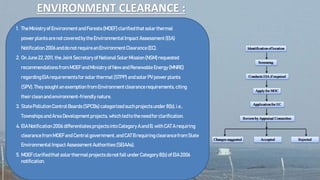
ENVIRONMENT CLEARANCE :
1. TheMinistryofEnvironmentandForests(MOEF)clarifiedthatsolarthermal
powerplantsarenotcoveredbytheEnvironmentalImpact Assessment(EIA)
Notification 2006anddonotrequireanEnvironmentClearance(EC).
2. OnJune22,2011, theJoint Secretaryof NationalSolarMission(NSM)requested
recommendations from MOEFandMinistryof NewandRenewableEnergy(MNRE)
regardingEIArequirementsforsolarthermal(STPP) andsolarPV power plants
(SPV).Theysoughtanexemption from Environmentclearancerequirements, citing
theircleanandenvironment-friendly nature.
3. StatePollutionControlBoards(SPCBs)categorized suchprojects under8(b),i.e.,
TownshipsandAreaDevelopment projects, whichledtotheneedforclarification.
4. EIANotification 2006 differentiates projectsintoCategoryAandB,withCAT A requiring
clearancefrom MOEFandCentralgovernment,andCATBrequiringclearancefrom State
Environmental Impact AssessmentAuthorities (SEIAAs).
5. MOEFclarifiedthat solarthermalprojectsdonotfallunderCategory8(b)of EIA2006
notification.
6. Solarthermalprojectsstillneedclearancefrom SPCBsorUTPCCtoensuretheprojectareadoesnotinvolvespecific sensitiveareas.
7. Guidelinesincludeconsiderationsforwetlands,agriculturalland,ecologicallysensitiveareas,biodiversity-rich areas,areaswithlarge
habitation, andadherencetovariousgovernmentalnorms.
8. Ifanareainvolvesforestland,clarificationisneededfromtheForestDepartmentasper ForestConservationActnorms.
9. ThesitemustconformtoCoastalRegulationZone(CRZ)notification provisions, prohibitingcertainactivitiesinCRZareas.
10. ConsentunderHazardous SubstanceManagementrulesmustbeobtainedbeforeissuingconsent bySPCB.
11.The report argues that the transfer of land would not lead to a loss of access to grazing areas for the project-affected population due to the
abundanceofopenavailablelandinthearea.
12. TheCentralPollution ControlBoard(CPCB)willconductenvironmental impactstudiesandreport to MOEFduringandafterthesetup of
solarthermalandsolarPV power plants,withSPCBsinvolvedinthestudy.
13. AnOfficeMemorandum in2017 reiteratedtheguidelinesfromthe2011OMandaddedprovisions forthedisposalofphotovoltaic cells
underHazardousWasteManagementrules,aswellascompliancewiththeWater(PreventionandControlofPollution)Act, 1974, andtheAir
(PreventionandControlof Pollution) Act, 1981, forthedevelopmentof solarparks.
THECHALLENGES FACED IN
ITSDEVELOPMENT
Though Rewa Ultra Mega Power Project is one
of India's largest solar power projects, it faced
various challenges encountered during its
development.
ENVIRONMENTAL AND SOCIAL
CHALLENGES
LandAcquisition
Theproject required a vastexpanse of land, leading to challenges in acquiring thenecessary
area while addressing environmentalconcerns.
LocalCommunity
Engagement with the local communities and gaining their support was crucial to ensure the
project's successand promote sustainable development.
EcologicalImpact
Protecting the local flora and fauna, including migratory birds,was a key challengeindeveloping the
project in an ecologically sensitiveregion.
TECHNICAL CHALLENGES
Infrastructure
Establishing a high-capacity transmission infrastructure for the project's solar
power generation and distribution posed significant technical challenges.
GridIntegration
Integrating the solar power generated by the project with the existing power grid
required advanced technologies and engineering solutions.
WeatherandSolarVariability
Dealing with weather fluctuations and solar variability required the
implementation of smart technologies and grid balancing mechanisms.
1
2
3
ECONOMICCHALLENGES
HighCapitalCosts
The project encountered economic
challenges due tothe high initial
costs ofprocuring and installing the
necessary solar infrastructure.
FinancialViability
Ensuringtheproject'slong-term
financial viability andcost-
effectivenessincomparison to
conventional energy sourceswas
a crucial challenge.
FundingandInvestment
Securing adequate funding and
attracting investment fromboth
public and private sectors posed
challenges in financing theproject.
CONCLUSION
• Rewa UMSPPisthefirstrenewableprojectinIndia:
• toscheduledpoweroutsidetheRegiontoaninter-State
openaccess customer.
• togetaconcessional loanfromtheWorldBankfor
developmentofinternalevacuation infrastructure of
thepark.
• tointroducethree-tierPaymentSecurity Mechanismto
ensureregularpaymentsfromMPDiscoms tothe
developers.
• todevelopinnovativeenergycontractsinplaceof
conventionalpower contracts.
• tointroducetheconcept ofOptimumSchedulingto
meetalmost 60% daytimeenergyrequirementof
DelhiMetro.
• tosupplysolarenergytobeusedforrailwaytraction
References
1. "India Solar Resource - Global Horizontal Irradiance - Annual Average, by NREL, National Renewable Energy
Laboratory".
2."Electricity | District Rewa, Government of Madhya Pradesh | India". Retrieved 2020-07-10.
3."750 MW Rewa solar project starts supplying power". pv magazine India.
4."Press Information Bureau". pib.gov.in. Retrieved 2021-12-25.
5.www.ETEnergyworld.com. "Solar tariff reaches a historic low of Rs 2.97 a unit at Rewa bidding - ET
EnergyWorld". ETEnergyworld.com. Retrieved 2022-02-18.
6.India Solar Costs Fall To Record In Competitive Biding Auction". Bloomberg. 2017-02-10. Retrieved 2022-02-17.
7.20 firms submit bid for Rewa solar power plant - Times of India". The Times of India. Retrieved 2017-03-20.
8.60% of Delhi Metro now powered by solar energy from Madhya Pradesh". World Bank. Retrieved 2023-02-04.
Rewa Ultra Mega Solar Project Presentation

Rewa Ultra Mega Solar Project Presentation

  • 2.
    CONTENTS  Introduction  KeyMembers of the Project  Location  Solar Energy in India  Current status of the project  Financing the project  Timeline of RUMS  Role of World bank and IFC  Impacts on Local Communities  Challenges faced in its development  Conclusion  References
  • 3.
    Introduction • Rewa UltraMega Solar Power Project constructed in 2017 – 18, is located in Gurh tehsil of Rewa district in Madhya Pradesh, around 35 kms east of the district headquarters of Rewa town. • The power plant has been set up on close to 1590 acres of forest and private land acquired from villages of Badwaar, Barsaita, Barsaita Desh, Itaar and Ramnagar of Gurh tehsil. • The solar power plant has installed capacity to produce 750 MW of power. • It is claimed to be one of the world’s largest solar photovoltaic power producing project. The project has a 25 year PPA with Madhya Pradesh Power Management Company Limited (MPPMCL) and Delhi Metro Rail Corporation (DMRC) to sell its power. • MPPMCL supplies power to the state electricity distribution companies (Discoms), they would get 76% of the power produced from Rewa Ultra Mega Solar Power Plant and the remaining 24% would be supplied to DMRC. • The project is estimated to meet up to 60% of the day's electricity demand from DMRC.
  • 4.
    • Rewa UltraMega Solar Limited Company (RUMSL), was formed in July 2015 as a Joint Venture of SECI and Madhya Pradesh Urja Vikas Nigam (MPUVN). RUMSL, the project implementation company, with the support from International Finance Corporation (IFC) undertook the auction for the project based on the lowest tariff in 2016. • Mahindra Susten (Unit 1) subsidiary of Mahindra Group India, Acme Solar (Unit 2) a private solar power producer and Solenergi (Unit 3) a part of Actis Solar, were awarded three units of 250 MW each that comprises of Ultra Mega Power Plant (UMPP) at the end of the auction. • Mahindra Renewables, ACME Solar Holdings and Solengeri Power emerged as the winner for the project's three units (250 MW each) at tariffs of Rs 2.979, Rs 2.970 and Rs 2.974 for the first year, respectively. • The auction resulted in the first large-scale project in India in which the renewable energy tariff of INR 3.3 /KWh (5.5 US¢/kWh) breached grid parity. Accounting for an escalation of 5 paisa per year for the first 15 years, the levelised tariff is about INR 3.3 /KWh (US$ 4.9 cts/KWh). • The 750 MW Rewa Ultra Mega Solar Power Plant, located in Madhya Pradesh, is one of the biggest single-site solar power plants implemented across the globe. • The MNRE had approved this solar power project under its solar park scheme, and it allocated a fund of INR 12 lakhs per MW for this • The IFC (International Finance Corporation), a part of the World Bank Group, has invested nearly $440 million (about ₹2,800 crore) in this 750 megawatt solar power plant project. • The operations of this solar power plant help in reducing 15.4 lakh tonnes of carbon dioxide emissions each year. • Larsen & Toubro (Oman) was selected to deliver the EPC services for all three units of the Rewa Ultra Mega Solar Power Park project. • Rewa Solar Power Park Project has received the World Bank Group’s President award for Innovation and Excellence.
  • 5.
    Shri Sanjay Dubey(IAS) Chairperson Shri. Ganesh Shankar Mishra(IAS) Chief Executive Officer, RUMSL Ms. Dr. Haripriya Gundimeda Independent Director, RUMSL Shri. Ishwar Madiwal Additional General Manager (Finance), Solar Energy Corporation of India Shri. Joshit Ranjan Sikidar Director RUMSL
  • 6.
  • 7.
    Solar Energy inIndia • India is understood to have immense solar energy potential, due to its geographical location in a region with high incident solar radiation. It has about 300 days of sunshine per year, with annual mean global solar radiation in a range of 3.5–6.5 kilowatt-hour (kWh) per square meter per day. It is expected that solar power can help India meet its growing electricity demand, and build energy security by cutting imports of costly fossil fuels like coal and petroleum. The Government of India (GOI) wants a growing share of the country’s electricity to come from renewable energy. It announced plans to increase renewable energy capacity to 175 GW by 2022 with more than US$ 150 billion in investments required. It is aiming to install 100 GW of solar power out of a total renewable energy of 175 GW. It estimated that at least 60 GW of the targeted installations will come from large-scale, ground-mounted solar power plants. Of these, 40 GW will be installed in solar parks, which are concentrated zones of solar power generation projects that provide developers a well-characterized area, with appropriate infrastructure and access to amenities, where project risks can be minimized.
  • 8.
    CURRENT STATUS OFTHE PROJECT • It is operational since 2018, RUMSP attained its full 750MW installed capacity in early 2020. On July 10, 2020, India's Prime Minister, Narendra Modi, introduced the project to the nation. The solar park gained global attention with a record low bid of 2.97 INR/kWh, showcasing India's clean energy progress. • The rewa solar power project which is 800 km away from Delhi powering 60% of the daytime energy requirement of Delhi metro , so 290 trains and 2.6 million people everyday can travel green. • Today this solar park contributes nearly 1/3rd of the total solar power generated in MP. • The record low cost of solar power has saved over $170 million for Delhi metro and almost $310 million for MP.
  • 9.
  • 10.
    Facilities provided The solar parkwill provide specialized services to incentivise private developers to invest in solar energy in the park. These services while not being unique to the park, are provided in a central, one-stop-shop, single window format, making it easier for investors to implement their projects within the park in a significantly shorter period of time, as compared to projects outside the park which would have to obtain these services individually. The implementing agency has been tasked with acquiring the land for the park, cleaning it, levelling it and allocating the plots for individual projects. Apart from this, the agency has also been entrusted with providing the following facilities to the solar project developers for the development of the solar park: i. Land approved for installation of solar power plants and necessary permissions including change of land use etc. ii. Road connectivity to each plot of land. iii. Water availability for construction as well as running of power plants and demineralisation plant iv. Flood mitigation measures like flood discharge, internal drainage etc. v. Construction power v. Telecommunication facilities vi. Transmission facility consisting pooling station (with 400/220, 220/66 KV switchyard and respective transformers) to allow connection of individual projects with pooling station through a network of underground cables or overhead lines. vii) Housing facility for basic manpower wherever possible vii. Parking, Warehouse etc.
  • 11.
    Financing the Project: •According to the World Bank - “the rationale for using public financing under this project is to provide services where the public sector has an advantage (e.g., providing common infrastructure and interconnections from the solar park to the state and national grid). • This will help remove or reduce the private sector’s risk perception about solar power and increase the availability of private investment and financing for solar power. • For Rewa Ultra Mega Solar Power Project, IFC’s Infrastructure Investment Department arranged an investment of US$ 437 million in the form of INR denominated loans with a final maturity of 20 years, split into three different transactions (one for each of the 250 MW units that made up the UMPP), and that were processed simultaneously, proving the bankability of the scaling concept, and paving the way for replication across the sector. IFC financed around 75 percent of the project’s cost, with the remaining 25 percent coming from shareholder loans and equity. • The project also benefited from the World Bank and Clean Technology Fund (CTF) financing with favorable terms. Approved in March 2017, these loans financed the common evacuation infrastructure at Rewa solar power project, including three 220/33kV substations and connected 220kV transmission lines to transfer power from the solar plant to the 400/330 kV substation being constructed by PGCIL which is without any expenditure to RUMSL or the state of Madhya Pradesh. • It was estimated that the World Bank and CTF loan terms helped directly reduce the tariff by about 4 to 5 paisa (US cents 0.07)/kWh. Rewa Solar plant is India’s only solar project to get funding from CTF, available at a rate of 0.25% for a 40-year period and the only solar park in India to get a concessional loan from the World Bank.
  • 12.
    GOVT SUPPORT TOTHE MEGA PROJECT:
  • 13.
    FUNDING ALLOCATION TOPROJECTS(in US$ million)
  • 14.
  • 15.
     Rewa UltraMega Solar Limited (RUMSL), the project implementing agency, mandated International Finance Corporation (IFC) as a Public Private Partnership (PPP) transaction adviser to help structure the Rewa solar project and mobilise private investment along with the World Bank loan.  Later, IFC also advised on the structuring of the power project as a PPP. It supported the supported the project preparation process and the processing of the World Bank loan. World Bank loan.  On IFC’s inputs, the Government of Madhya Pradesh (GoMP) agreed to a moderate moderate charge for the land required for three units, common infrastructure in the infrastructure in the solar power project, allowing for deferred payment over the life of over the life of the project for land acquisition, construction of internal evacuation evacuation infrastructure, local area development costs, and solar park administration administration costs.
  • 16.
    The World Bankin March 2017 approved a loan of US$ 100 million to help India increase its power generation capacity through cleaner, renewable energy sources. The purpose of the loan for the project – Shared Infrastructure for Solar Parks Project – was to establish large scale solar parks in the country and support the GOI’s plans to install 100 GW of solar power out of a total renewable- energy of 175 GW by 2022. The loan of US$ 100 million is shared between International Bank for Reconstruction and Development (IBRD) and Clean Technology Fund (CTF) to the tune of US$ 75 million and US$ 25 million respectively. The US$ 75 million loan from the IBRD, has a 5-year grace period, and a maturity of 19 years. The US$ 23 million loan from the CTF has a 10-year grace period, and a maturity of 40 years. The US$ 2 million is an interest-free CTF grant.
  • 17.
     The projectis supporting MNRE’s (Ministry of New and Renewable Energy) announced Solar Park Scheme for installing large-scale, grid- connected solar parks by 2022, with a targeted, collective installed capacity of 40 GW.  IREDA, through the state Prospective Implementing Agencies (PIA)s, will utilise project funding to develop the enabling common infrastructure (such as power pooling substations, as well as intra-park transmission infrastructure and access roads). The objective was also to facilitate solar power investment by private or public-sector developers.
  • 18.
    In the firstphase of this project, US$ 200 million, including US$ 75 million from IBRD, US$ 25 million from CTF and US$ 100 million from the GOI and state governments have been mobilised. The solar parks supported by the project are expected to mobilise additional US$ 1,828 million of private and public sector financing for solar PV generation capacity and transmission. The CTF funding would comprise US$ 23 million to be extended under softer concessional terms and US$ 2 million to be extended in the form of a grant.
  • 19.
    Funding Allocation toprojects (in US$ million)
  • 20.
     For theRewa Solar park, IBRD has provided US$ 22 million for financing for such shared infrastructure as access roads, water supply and drainage, telecommunications, and pooling. Rewa and Mandsaur solar parks, this includes Madhya Pradesh Power Transmission Company Limited (MPPTCL) services of about US$ 7 million.  The total counterpart funding is expected to be higher than 50 percent of the total project cost.  CTF has provided US$ 2 million as common fund for technical assistance and has been used for capacity-building support to IREDA, the SNAs in the states where selected solar parks are located, and the selected state PIAs, which will include the SNA and/or JV companies or state agencies across the participating states.
  • 21.
    IFC of theWorld Bank group has been promoting mega solar projects in India through its multiple projects at different levels. IFC is undertaking transaction advisory projects with government agencies like New and Renewable Energy Department (NRED), GoMP and SECI in identifying and structuring renewable energy projects across various states in the country. One of the transaction advisory projects is for the Rewa Ultra Mega Solar Power Plant in Madhya Pradesh. IFC will provide transaction advisory support to the NRED, GoMP to assist in the implementation of a grid connected ground mounted solar UMPP in Rewa district of Madhya Pradesh which involves installation and operation of grid connected solar panels by a competitively selected private sector developer(s).
  • 22.
    Under Rewa UltraMega Solar Power Plant, IFC is providing investments and loans to each of the three private company contracted to build and operate 3x250 MW solar plants, totaling to 750 MW. One unit of 250 MW project has been awarded to Solenergi Power Private Ltd. (“SPPL”) within the 750 MW Rewa Ultra Mega Solar Park. The proposed IFC investment involves providing an IFC A loan /subscribing to Non-Convertible Debentures (“NCDs”) of up to US$ 50 million and mobilisation of loan of up to US$ 100 million (together “the Investment”) from other lenders. Similarly, the second unit has been awarded to Mahindra Renewables Private Limited (MRPL), a 250MW solar power project within the 750MW Rewa Ultra Mega Solar Park. And third one to Acme Solar pvt. ltd.  The estimated project cost is around INR 12,800 million.  The proposed IFC investment involves providing an IFC A loan of up to INR 3,200 million and a potential mobilisation of loan of up to INR 6,400 million (together “the Investment”) from other lenders.  The third unit of 250 MW has been awarded to ACME Solar Holdings Limited for development, financing, construction, operation and maintenance of a 250 MW solar photovoltaic plant.  The total project cost is US$ 200 million and the loan amount for the project from IFC to ACME Solar is US$ 50.41 million.
  • 23.
    IMPACTS ON LOCALCOMMUNITIES Land Acquisition The Environment and Social Impact Assessment of the project (ESIA)Report of Rewa Solar Power Project notes that the landowners belonging to the Scheduled Tribe (ST) category are legal titleholders of their land and are mainstreamed, and the only relevant mitigation measure in their case was compensation for land and other lost assets.
  • 24.
    • “As theproject area does not fall under the scheduled area, the landowners belonging to the ST category are legal titleholders of their land. As reported during the consultation process, the ST category landowners have provided their consent voluntarily to sell their land for the proposed project without any force. They are aware that for the land contributed they would be receiving double payment in the form of a Collector Guideline Rate plus one time solatium based on the prevailing market value. They also affirmed that this was communicated to all affected households in the village.
  • 25.
    After examining thelandowners for the next phase of land acquisition, it was found that no families from the Scheduled Tribe (ST) category would be impacted. The census survey in Phase I found that tribal families are part of the mainstream society and won't be economically or physically affected by the project. The ESIA report suggests that compensation is the only necessary measure for Indigenous People who have legal land titles, and they claim adequate consultation with ST families .
  • 26.
    Forest Land In theESIA Report it is mentioned that, “land parcels having homesteads and undertaking active agricultural activities has not been included within the project area. The land parcels under private ownership identified for the project is instead in a slope terrain. Because of the slope terrain, no irrigation is possible for these land parcels, therefore, as reported by the local communities these parcels used to depend upon rainfall in order for agricultural activities to take place. A one crop cycle used to be practiced in these land parcels”. (ESIA Report, Page 204) Local residents claim that the project company initially promised jobs as part of the land acquisition but failed to fulfill this commitment. While they were assured that one family member would secure a job at the project site along with compensation, most have only found isolated labour work. Despite protests, these grievances remain unresolved.
  • 27.
    Ground Water Concern TheESIA claims that the project requirement of ground water for the operation phase of the project can be met without negotiating competitive users (drinking water requirement of villages and irrigation purposes) based on ground water availability. They have claimed on the basis of a report of Central Ground Water Board, Ministry of Water Resources 2013, that the net ground water availability in Rewa district is 46,801 ham (hectare meter) and ground water draft for all uses is 24,289 ham. The stage of ground water development in the district is 52%. The report also assess that there will be availability of ground water for future irrigation would be 21,079 ham after making allocation for future domestic and industrial supply for next 25 years (ESIA Report)
  • 28.
    • These claimsseem rather irrational as the ESIA Report at several places claims that “groundwater is most suitable for meeting the water requirement during different stages of the proposed project. The water requirement for agricultural purposes in the study area is also met through bore well and hand pumps. • The extraction of the groundwater for the project activities can have an impact on the availability of the groundwater resources”. (ESIA Report, Page 229). Also, the ESIA mentions at several places that for the last three years (base year being 2016) the rainfall has been scanty in the region. Besides, this the requirement of water for drinking and other activities also needs to be looked into.
  • 29.
    LIVELIHOOD CONCERNS : 1.TheESIAReportclaimstherehasbeenno lossoflivelihoodforproject-affectedhouseholdsduetothe unproductivenatureoftheland. 2. Thisclaimisdisputed,asthereportacknowledges thatfarmerswith0.5 hectareslandholdingswithinthe projectarea have discontinued cultivationduetodecreasedrainfall.Theyhavenowresortedtonon- agriculturallaborinRewacity,andsomefamily membershave migratedto othercitiesforworkandsendmoney backtotheirfamilies. 3. Mediumandlargelandholding farmersfalloutsidetheimpactedarea. 4.TheESIAreportstatesthatallproject-affectedfamiliesused toengageinagriculturalactivitiesaroundthree yearsago.Amongthem,farmers withlessthan0.5 hectareslandholdings usedto cultivatetheirlandforself-consumption and supplemented theirincomeby workingasagriculturallaborers. 5. Itraisesskepticismthatforthree yearstherehas beenno rainfall,renderingalllandbarren,yetthereisstill enoughgroundwateravailableforindustries,agriculture, anddaily consumption of locals.
  • 30.
    SOCIAL CONCERNS : 1.Localresidentsclaimthattheprojectprovided jobs tooutsidersandmigrantworkersfrom other statesandcountries, whonowresideinand aroundthevillageonrent.Manyof theseyoungworkerslivealonewithout theirfamilies. 2. Thereisafearamongvillagersthatuntowardeventsmightoccurinthevillageduetothesemigrantworkers. 3. DespitethemitigationmeasureslistedintheESIAreport,whichencouragetheengagementoflocalpopulationinconstruction activities, the villagersfeelthattheirexpectationsforemploymentandlocalbenefitshavenotbeenadequatelyaddressedandmanaged. 4. Peoplereportedthatthecompanyhiredpetty contractorsfromotherstatestoremovegrassandweedswithinthesolarplant. These contractorsemployedlocalvillagerstodothework, butthenabscondedwiththeirwages,leavingthepoortribalfamilieswithout theirrightful earnings. 5. Villagershaveobservedanincreaseinalcoholconsumption andaddictiontootherintoxicantssincethecommencementofwork onthepower plant.Whiletheseissuesexistedbefore,theyhavebecomemoreprevalentandopen.Thishasmadeitincreasinglydifficult foryounggirlsand womentomovearoundthevillageinthelateevenings.
  • 31.
    PASTORAL CONCERNS : 1.Localvillagershaveobservedanincreaseincrueltytowardscattlesincetheimplementation of theproject. 2. Previously, cattlefromsurrounding villagesgrazedintheover1000 acresof governmentandprivatelands.Duringsowing season,local farmers wouldprovidetemporaryshelterfortheircattleinthisarea. 3. After theacquisitionoftheselandsforthepowerplant,peoplearenowforcedtoleavetheiranimalsontheroads,astheycannolonger access thegrazinglands.Theysearchforfodderandoftenendupenteringcroppedfields,leadingtoconflictswithfarmers. 4. Inresponseto this,farmershaveresortedtotyingthetonguesandmouthsofstraycattletogether usingmetalwires,whichisapainful method topreventthemfrom eatingcrops. Thishasresultedinthedeathsof manycattle. 5. Some animalwelfare societieshave attempted torescue dozens of cattle, but thisisnotseen asa sustainable solution bythe local villagers, whoblametheprojectforthecruelty. 6. The ESIA Report contradicts this situation on the ground, claiming that only 22.5% of the government land (out of a total of 5467.26 hectares) has been transferred to the project. It also states that this land has not been designated as grazing land, and alternate grazing landisavailable within500 mto1 kmof theproposedproject areaintheeastandwestdirections. 7. The reportargues that the transfer of land would not lead toa loss of access to grazing areas for the project-affected population due to theabundanceof openavailablelandinthearea.
  • 32.
    ENVIRONMENT CLEARANCE : 1.TheMinistryofEnvironmentandForests(MOEF)clarifiedthatsolarthermal powerplantsarenotcoveredbytheEnvironmentalImpact Assessment(EIA) Notification 2006anddonotrequireanEnvironmentClearance(EC). 2. OnJune22,2011, theJoint Secretaryof NationalSolarMission(NSM)requested recommendations from MOEFandMinistryof NewandRenewableEnergy(MNRE) regardingEIArequirementsforsolarthermal(STPP) andsolarPV power plants (SPV).Theysoughtanexemption from Environmentclearancerequirements, citing theircleanandenvironment-friendly nature. 3. StatePollutionControlBoards(SPCBs)categorized suchprojects under8(b),i.e., TownshipsandAreaDevelopment projects, whichledtotheneedforclarification. 4. EIANotification 2006 differentiates projectsintoCategoryAandB,withCAT A requiring clearancefrom MOEFandCentralgovernment,andCATBrequiringclearancefrom State Environmental Impact AssessmentAuthorities (SEIAAs). 5. MOEFclarifiedthat solarthermalprojectsdonotfallunderCategory8(b)of EIA2006 notification.
  • 33.
    6. Solarthermalprojectsstillneedclearancefrom SPCBsorUTPCCtoensuretheprojectareadoesnotinvolvespecificsensitiveareas. 7. Guidelinesincludeconsiderationsforwetlands,agriculturalland,ecologicallysensitiveareas,biodiversity-rich areas,areaswithlarge habitation, andadherencetovariousgovernmentalnorms. 8. Ifanareainvolvesforestland,clarificationisneededfromtheForestDepartmentasper ForestConservationActnorms. 9. ThesitemustconformtoCoastalRegulationZone(CRZ)notification provisions, prohibitingcertainactivitiesinCRZareas. 10. ConsentunderHazardous SubstanceManagementrulesmustbeobtainedbeforeissuingconsent bySPCB. 11.The report argues that the transfer of land would not lead to a loss of access to grazing areas for the project-affected population due to the abundanceofopenavailablelandinthearea. 12. TheCentralPollution ControlBoard(CPCB)willconductenvironmental impactstudiesandreport to MOEFduringandafterthesetup of solarthermalandsolarPV power plants,withSPCBsinvolvedinthestudy. 13. AnOfficeMemorandum in2017 reiteratedtheguidelinesfromthe2011OMandaddedprovisions forthedisposalofphotovoltaic cells underHazardousWasteManagementrules,aswellascompliancewiththeWater(PreventionandControlofPollution)Act, 1974, andtheAir (PreventionandControlof Pollution) Act, 1981, forthedevelopmentof solarparks.
  • 34.
    THECHALLENGES FACED IN ITSDEVELOPMENT ThoughRewa Ultra Mega Power Project is one of India's largest solar power projects, it faced various challenges encountered during its development.
  • 35.
    ENVIRONMENTAL AND SOCIAL CHALLENGES LandAcquisition Theprojectrequired a vastexpanse of land, leading to challenges in acquiring thenecessary area while addressing environmentalconcerns. LocalCommunity Engagement with the local communities and gaining their support was crucial to ensure the project's successand promote sustainable development. EcologicalImpact Protecting the local flora and fauna, including migratory birds,was a key challengeindeveloping the project in an ecologically sensitiveregion.
  • 36.
    TECHNICAL CHALLENGES Infrastructure Establishing ahigh-capacity transmission infrastructure for the project's solar power generation and distribution posed significant technical challenges. GridIntegration Integrating the solar power generated by the project with the existing power grid required advanced technologies and engineering solutions. WeatherandSolarVariability Dealing with weather fluctuations and solar variability required the implementation of smart technologies and grid balancing mechanisms. 1 2 3
  • 37.
    ECONOMICCHALLENGES HighCapitalCosts The project encounteredeconomic challenges due tothe high initial costs ofprocuring and installing the necessary solar infrastructure. FinancialViability Ensuringtheproject'slong-term financial viability andcost- effectivenessincomparison to conventional energy sourceswas a crucial challenge. FundingandInvestment Securing adequate funding and attracting investment fromboth public and private sectors posed challenges in financing theproject.
  • 38.
    CONCLUSION • Rewa UMSPPisthefirstrenewableprojectinIndia: •toscheduledpoweroutsidetheRegiontoaninter-State openaccess customer. • togetaconcessional loanfromtheWorldBankfor developmentofinternalevacuation infrastructure of thepark. • tointroducethree-tierPaymentSecurity Mechanismto ensureregularpaymentsfromMPDiscoms tothe developers. • todevelopinnovativeenergycontractsinplaceof conventionalpower contracts. • tointroducetheconcept ofOptimumSchedulingto meetalmost 60% daytimeenergyrequirementof DelhiMetro. • tosupplysolarenergytobeusedforrailwaytraction
  • 39.
    References 1. "India SolarResource - Global Horizontal Irradiance - Annual Average, by NREL, National Renewable Energy Laboratory". 2."Electricity | District Rewa, Government of Madhya Pradesh | India". Retrieved 2020-07-10. 3."750 MW Rewa solar project starts supplying power". pv magazine India. 4."Press Information Bureau". pib.gov.in. Retrieved 2021-12-25. 5.www.ETEnergyworld.com. "Solar tariff reaches a historic low of Rs 2.97 a unit at Rewa bidding - ET EnergyWorld". ETEnergyworld.com. Retrieved 2022-02-18. 6.India Solar Costs Fall To Record In Competitive Biding Auction". Bloomberg. 2017-02-10. Retrieved 2022-02-17. 7.20 firms submit bid for Rewa solar power plant - Times of India". The Times of India. Retrieved 2017-03-20. 8.60% of Delhi Metro now powered by solar energy from Madhya Pradesh". World Bank. Retrieved 2023-02-04.