ROGER Y. IBAÑEZ, JR., MSA
Program Chair, BSA Program
DEBESMSCAT-Cawayan Campus
ryibanez@debesmscat.edu.ph
Perform/remember ROGER in dealing
with the choices in the examination
Read the statements carefully
Observe the details in order for you to
understand
Gather the facts/information in your mind
Evaluate the gravity, bearing, or significance of
the statement/s
Remove the statements which are not related
to the question or stem
1. Which of the following statements has a very limited
definition of educational technology?
A. It is a profession composed of various job categories.
B. It refers to the computers used for teaching and
learning.
C. It includes audiovisual materials, interactive
multimedia and self-instructional materials.
D. It is the development, application and evaluation of
system, techniques and aids to improve human
learning
Answer: B.
Educational Technology is the field of study that
investigates the process of analyzing, designing,
developing, implementing, and evaluating the
instructional environment, learning materials, learners,
and the learning process in order to improve teaching
and learning.
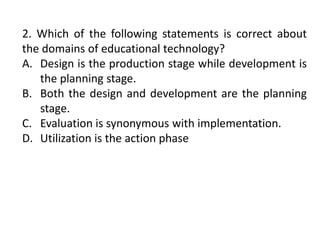
2. Which of the following statements is correct about
the domains of educational technology?
A. Design is the production stage while development is
the planning stage.
B. Both the design and development are the planning
stage.
C. Evaluation is synonymous with implementation.
D. Utilization is the action phase
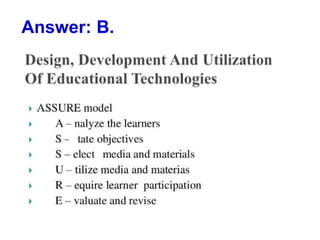
Answer: D.
Design
Is the procedure of creating conditions for learning with the purpose of
specifying products(lessons, modules) and strategies at the macro level.
Development
translates the design specifications into an actual form including its
subcategories that reflect some chronological changes in educational
technology.
Utilization
is the act of using resources and processes for education.
Educational technology then requires management through planning,
organizing, supervising, administering, and coordinating.
Evaluation
is the process of determining the worth, merit, or value of an educational
program, project, or product for the purpose of generating a judgment.
3. Ms. Gomez is planning to integrate technology in her
Mathematics class. Which of the following would be the
logical steps in doing this?
I. Set the objectives
II. Analyze the learners
III. Utilize the materials with showmanship
IV. Evaluate the performance of the students
A. I, II, III, IV
B. II, I, III, IV
C. I, II, IV, III
D. II, I, IV, III
Answer: B.
4. Which of the following is a limitation of
models and real objects in teaching and
learning?
A. They pose problems on storage
B. They make learning more concrete.
C. They provide hands-on learning experiences.
D. They are readily available in the environment,
around school and in the home.
Answer: A.
DISADVANTAGES
 some live animals and plant are
potential hazards. Objects like circuits
and heat sources could be
dangerous.
 some are expensive.
 problems regarding storage and
retrieval may arise.
5. Which group of technologies has the highest
degree of concreteness?
A. Realia and computer
B. Video, picture, and television
C. Digital video, film, versatile compact disc
D. Book, imaginative literature, programmed
instruction
Answer: A.
Realia
Real objects provide a concrete manipulative for
students to handle while listening to the read aloud.
Realia also create total physical responses that help
students recall ideas and themes from the text in
later discussions.
Computer
Computers facilitate audio-visual representation of
information, thus making the process of learning
interactive and interesting.
6. Mrs. Del Prado placed text together with the
relevant graphics on the same page in her
multimedia presentation. Which principle did
she apply?
A. Split attention
B. Spatial contiguity
C. Cost-effectiveness
D. Communication effectiveness
Answer: A.
Split attention
States that when designing instruction, including multimedia instruction, it
is important to avoid formats that require learners to split their attention
between, and mentally integrate, multiple sources of information
Spatial contiguity
Students learn better when corresponding words and pictures are
presented simultaneously rather than successively
12 Principles of Multimedia (Richard
Mayer)
1. The Coherence Principle
2. The Signaling Principle
3. The Redundancy Principle
4. The Spatial Contiguity Principle
5. The Temporal Contiguity Principle
6. The Segmenting Principle
7. The Pre-Training Principle
8. The Modality Principle
9. The Multimedia Principle
10. The Personalization Principle
11. The Voice Principle
12. The Image Principle
7. Mrs. Olivarez presented real samples of rocks
in her General Science class. What principle did
she apply?
A. Appropriateness
B. Authenticity
C. Responsiveness
D. Simplicity
Answer: B.
Principle 7 (Authenticity) in the use of
educational technology states that “they
must present accurate up to date
dependable information”
8. Which is the best reason why teachers state
the objectives before using instructional media?
A. To secure materials
B. To prepare the materials beforehand.
C. To determine which media to use best.
D. To be able to practice how to operate the
equipment
Answer: C.
Guideline number 2 in the guidelines of using
educational technologies states that
“Defining objectives are essential for
planning the lesson and selecting and using
instructional materials”.
9. Which of the following should Mr. Rivera
primarily consider in determining the teaching-
learning objectives and use of instructional
media?
a. The assessment tool to be used
b. The learning activities
c. The learner
d. The teacher
Answer: B.
Guideline number 1 (PURPOSE) in the
guidelines of using educational technologies
states that “ask yourself what you are trying
to accomplish and why this instructional aid
is important” therefore, in order to assess
the importance of IMs to be used, the primary
consideration is the learning activity to be
performed by the students.
10. Which of the following technologies provide
iconic experiences to students/ children?
a. Video and books
b. Pictures and videos
c. Radio and recording
d. Modules and periodicals
Answer: B.
Based on Dale’s
Cone of
Experience, images
and videos belong
to iconic modes of
learning in which
30% of the
information will be
remembered when
they are actually
seen.
11. Which of these technologies used in the
classroom are arranged from the most symbolic
to multisensory?
a. Real objects, print, audio-visual materials and
visual materials
b. Visual materials, audio visual materials, print
and computers
c. Visual materials, print, audio-visual materials
and realia
d. Print, audio-visual materials, computers and
realia
Answer: D.
Symbolic is a way of teaching that uses
variety of symbols
Multisensory instruction is a way of
teaching that engages more than one
sense at a time.
12. Which of the following is inappropriate in
using printed visuals such as charts, graphs and
drawings?
A. Provide written or verbal cues to highlight
important aspect of visuals
B. Present the instructional materials
simultaneously
C. Use materials that everyone can see
D. Make the presentation suspenseful
Answer: B.
Principle 11 of Utilizing Educational technologies
states that the presentation must be presented at the
right time and the right way.
13. Susan wants to learn more English. Specifically,
she wants to improve her listening skills. She has a
CD player, a tape recorder and has internet access.
As an English teacher, what do you suggest?
I. CDs with English listening drills
II. Tapes with English listening drills
III. Internet website such as Go4English, English
Language Listening Lab or Randall’s listening Lab
A. I and II
B. II and III
C. I or III
D. I, II and III
Answer: D.
14. Which of the following statements is
incorrect about the contributions of technology
to student learning?
A. The quality of learning can be improved.
B. The delivery of instruction can be more
interesting.
C. The method of teaching and learning
becomes more interactive.
D. The role of the teacher can be changed into
knowledge dispenser.
Answer: D.
1. Increases students’ motivation, self-esteem, self-
confidence and academic achievement
2. Supplies stimulating environments that encourage
student involvement in the learning process.
3. Promotes high-level thinking skills
4. Offers students diversity, self-paced learning and
opportunities for individual growth and self-
expression.
5. Provides students with unique opportunities to
apply skills and talents and interest with others in
non- threatening environments
6. Changes teachers and students ‘role into positive
directions
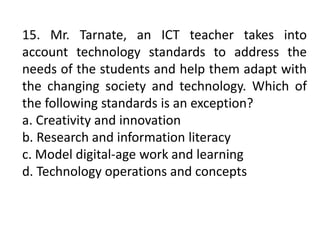
15. Mr. Tarnate, an ICT teacher takes into
account technology standards to address the
needs of the students and help them adapt with
the changing society and technology. Which of
the following standards is an exception?
a. Creativity and innovation
b. Research and information literacy
c. Model digital-age work and learning
d. Technology operations and concepts
Answer: C.
Model digital age work and learning is
ISTE Standard for Teachers and not for
the students
16. Ms. Vinluan, a computer teacher
demonstrates understanding of local and global
issues and exhibits ethical and legal use of
information and communications technology
tools. Which is true about her?
A. She models digital-age work and learning
B. She facilitates and inspires student learning
and creativity.
C. She promotes and models digital citizenship
and responsibility.
D. She designs and develops digital-age learning
experiences and assessments
Answer: C.
ISTE Standard Number 4: Promote
and model digital citizenship and
responsibility - Advocate, model, and
teach safe, legal, and ethical use of digital
information and technology, including
respect for copyright, intellectual property, and
the appropriate documentation of sources
17. With the fast-paced evolution of
technologies nowadays, why are teachers
encouraged to shift gradually from a teacher-
centered instruction to a learner-centered
instruction?
I. A learner-centered instruction focuses on
transformation of facts.
a. II and IV only
b. I, II and IV only
c. I, III and IV only
d. II, III and IV only
18. Ms. Hernandez employs student-centered
instruction as the learners create their digital
portfolios in her computer class. What could be
developed among them through this approach?
A. Repetition and active learning
B. Mastery of skills and information delivery
C. Information processing and passive learning
D. Construction of knowledge and information
exchange
Answer: D.
19. Mr. Torres will have a multimedia
presentation in his Science class. Which of the
following should he avoid?
A. Consider technical quality.
B. Apply different computer effects per slide.
C. Present information through graphic
organizers
D. Use contrasting colors for text and
background.
Answer: B.
2nd Commandment in Creating
Presentation materials states
that “Be consistent in format,
layout and conventions”
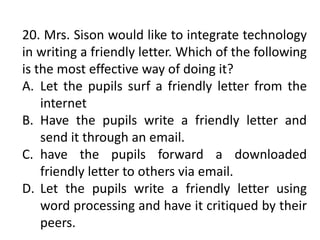
20. Mrs. Sison would like to integrate technology
in writing a friendly letter. Which of the following
is the most effective way of doing it?
A. Let the pupils surf a friendly letter from the
internet
B. Have the pupils write a friendly letter and
send it through an email.
C. have the pupils forward a downloaded
friendly letter to others via email.
D. Let the pupils write a friendly letter using
word processing and have it critiqued by their
peers.
Answer: B.
The best way to integrate
technology into writing is that let
your students write a friendly
letter and send it through an
email.
21. Which of the following computer-based
instructional materials can be used to learn new
concepts?
A. Games
B. Tutorial
C. Simulation
D. Drill and practice
Answer: B.
DRILL AND PRACTICE METHOD provides
opportunities for students to repeatedly practice the
skills that they have previously learned and further
practice necessary for mastery.
TUTORIAL MODE The program tutors or teaches the
student a body of knowledge by presenting
information and asking questions, giving hints if
students.
SIMULATION Realistic situation for role-playing
GAME MODE Game software often creates a contest
to achieve the highest score and either beat others or
beat the computer and the extent of learning depends
on the type of game.
22. Professor dela Cruz would like to create a
presentation material for her lesson on the types
of computer-assisted instruction. To make her
presentation effective, which?
A. Situating tool
B. Informative tool
C. Productivity tool
D. Communicative tool
Answer: C.
Situating tools are the system that situates users in
an environment where they may experience the
context and the happening.
Informative tools are applications that provide large
amounts of information in various formats such as
text, graphics, sound, or video.
Productivity tools are software programs designed
to make computer users more productive as they
work.
Communicative tools refer to three forms of
electronic communication in distance education
courses—e-mail, discussion groups, and chat rooms.
23. Professor Reyes is thinking of an online
learning approach by which content provides
links to information at other locations and serves
as a focal point for a distance education
experience. Which of the following should she
use?
A. Teleconferencing
B. Self-paced program
C. Web-based instruction
D. Computer-aided instruction
Answer: C.
Web-based instruction (WBI) is defined as an
innovative approach for delivering instruction to a
remote audience using the World Wide Web as the
instructional delivery system in which students can
access information and resources from around the
world simply by having a computer with an Internet
connection.
24. Which is NOT a basic consideration in
selecting and evaluating the content of an
educational technology tool?
A. Does it match the content?
B. Can it be easily dismantled?
C. Will it motivate and maintain interest?
D. Is there evidence of its effectiveness?
Answer: B.
Evaluating instructional resources
1. Does the content match the curriculum?
2. Is the content accurate, up to date , and
appropriate for the students?
3. Do the materials teach and/or reinforce learning
effectively?
4. Do these resources enhance instruction?
5. Are the resources easy for the teacher and
students to use?
6. Are the materials of high quality technically?
7. Is the use of this resource practical for my
teaching setting ( cost, needed equipment, ect.)
25. Your father wanted to finish his long
dreamed course but he wanted to do it at home
during his free time. Would you recommend an
online learning?
A. Yes, because online learning is the “in” thing
B. No, because online learning inhibits student-
teacher interaction.
C. No, because hiring a helper would enable him
to attend regularly in his class.
D. Yes, because he could learn at his own pace
using a wide spectrum of technologies.
Answer: D.
Computer-managed instruction (CMI) is
an instructional strategy whereby the
computer is used to provide learning
objectives, learning resources, record
keeping, progress tracking, and
assessment of learner performance.
26. Ms. Delos Santos is a fresh graduate teacher
who was hired to teach in an elementary school
where there are enough resources for
instruction. She wanted to start preparing her
instructional materials. Which is the most
systematic process in doing this?
A. Design, utilization, evaluation, development
B. Design, development, utilization, evaluation
C. Development, design, utilization, evaluation
D. Development, utilization, evaluation, design
Answer: B.
Design
Is the procedure of creating conditions for learning with the purpose of
specifying products(lessons, modules) and strategies at the macro level.
Development
translates the design specifications into an actual form including its
subcategories that reflect some chronological changes in educational
technology.
Utilization
is the act of using resources and processes for education.
Educational technology then requires management through planning,
organizing, supervising, administering, and coordinating.
Evaluation
is the process of determining the worth, merit, or value of an educational
program, project, or product for the purpose of generating a judgment.
27. Which is the most important reason why
teachers need to preview their instructional
materials that will be used in the class?
A. To gain confidence in using them
B. To encourage viewers to be more focused
C. To avoid potential problems that might occur
while materials are in use
D. To ensure appropriateness of the materials
with the objectives and target audience
Answer: D.
Principle number 3 in selecting and utilizing educational
technologies states “that technology must be appropriate to the
level intended in terms of vocabulary level, difficulty concepts,
methods of development, and interest”
28. After Ms. Rivas planned her lesson in English,
she found out that the materials at hand do not
match her objectives. Which is the best thing
that she can do?
A. Modify the available materials
B. Teach the lesson the following day.
C. Change the objectives to match with available
materials.
D. Carry out the lesson as planned and use the
materials at hand.
Answer: A.
Guideline number 2 in the guidelines of using
educational technologies states that
“Defining objectives are essential for
planning the lesson and selecting and using
instructional materials”.
29. Prof. Balagtas used worksheets,
manipulatives, and models in teaching math to
help her students understand the lessons and
love the subject. What did she bear in mind
when she used these materials?
A. Appropriateness
B. Balance
C. Breadth
D. Variety
Answer: D.
Using a variety of tools keeps students’
interest but also responds to the needs of
those who receive information in different
ways.
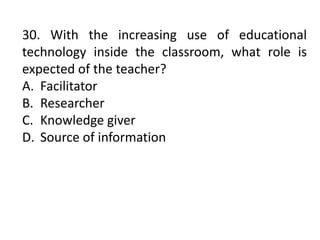
30. With the increasing use of educational
technology inside the classroom, what role is
expected of the teacher?
A. Facilitator
B. Researcher
C. Knowledge giver
D. Source of information
Answer: A.
Since we are now in the digital era, the role of
the teacher is to facilitate learning with the aid
of technologies.
31. It is impractical to bring real objects to the
classroom so Aaron constructed a three-
dimensional visual instead. Which of the
following did he construct?
A. Chart
B. Cartoon
C. Model
D. Graphic organizer
Answer: C.
Model is three-dimensional representation of
a real thing. It can be larger, smaller, or the
same size as the object it represents.
32. You asked your students to show a two-
dimensional illustration of what they have
understood from what they have read. Which of
the following non-projected visuals are you
referring to?
A. Graphic organizer
B. Print materials
C. Model
D. Realia
Answer: A.
GRAPHIC ORGANIZER Diagram – It is “any
line drawing that shows arrangement and
relations as of parts to the whole, relative
values, origins and development,
chronological fluctuations, distributions, etc.”
33. There are several reasons why teachers are
reluctant in using electronic media in the
teaching-learning process. Which is the most
common reason?
A. The limited exposure of teachers to new
equipment
B. Their incompatibility to diverse needs of the
learners
C. The difficulty in integrating technology in the
curriculum
D. The excessive availability of local technology
in the community
Answer: A.
34. Prof. Mandanas would like to use an audio
compact disc in teaching a lesson in Filipino. In
which activity in the teaching-learning process is
it very effective?
A. In developing listening skills
B. In teaching creating thinking
C. In composing poems
D. In building concepts
Answer: A.
35. Plants, pebbles, and blocks are just some of
the effective instructional materials readily found
in the environment if they are utilized properly.
Which of the following is INCORRECT about their
classroom use?
A. Pass a single object around the class.
B. Familiarize yourself with the object or model
before its actual utilization.
C. Use the objects as springboard in encouraging
students’ active participation.
D. Make sure that the realia and model are large
enough to be seen by the whole class.
Answer: A.
Size is the 1st guideline in selecting
instructional materials therefore,
using real objects must be seen by
the furthest student in the
classroom.
36. Prof. Ruiz uses projected visuals such as
Digital Liquid Projector (DLP) in presenting her
lesson. What could be her main reason for using
it?
A. The projected materials are readily available.
B. They are more abstract than any other
visuals.
C. Most projected visuals can be obtained at no
cost.
D. She can easily prepare for own transparencies
in advance.
Answer: A.
37. Ms. Samonte used a film clip in teaching
Social Studies concepts to her First Year High
School class. However, she found out that it was
ineffectively used in the classroom. When is
technology considered INEFFECTIVE?
A. When it promotes mastery of the lesson
B. When it makes viewing more interesting
C. When it helps attain the objectives of the
lesson
D. When it induces alienation on the part of the
learners
Answer: D.
Interest is the 9th principle in
utilizing educational technology in
which the technology used should
catch the interest of learners.
38. Your principal purchased new computer units
for your Learning Resource Center. Which of the
following should be your last consideration in
using the technology?
A. Computers can be used for entertainment.
B. Computers can be used for research activity.
C. Computers can be used for interactive
presentation.
D. Computers can be used to reinforce
discussion of difficult concepts in class.
Answer: A.
Meaningfulness is the 1st principle
in utilizing educational technology in
which the technology used must
contribute to the growth of and
development of learners
39. Computers can be classified according to the
roles they play namely communicative tool,
informative tool, and constructive tool. What is
the other role of computers not mentioned in
this item?
A. Instructional tool
B. Situating tool
C. Utility tool
D. Application tool
Answer: B.
The Computer as Teacher's Tool
1. As an information tool
2. A communication tool
3. A constructive tool
4. As co-constructive tool
5. A situating tool
40. Which of the following categories of CAI will
you use in your class if your objective is to
increase proficiency in a newly learned skill or
refresh an existing one?
A. Tutorial
B. Simulation
C. Drill and practice
D. Instructional game
Answer: C.
DRILL AND PRACTICE METHOD provides
opportunities for students to repeatedly practice the
skills that they have previously learned and further
practice necessary for mastery.
41. Which of the following is an ineffective use of
Presentation software?
A. Darken the room.
B. Use appropriate pacing.
C. Read directly from the slides.
D. Allow interaction with the learner.
Answer: C.
Don't read your presentation straight from the
slides
If your audience can both read and hear, it’s a waste
of time for you to simply read your slides aloud. Your
audience will zone out and stop listening to what
you’re saying, which means they won’t hear any extra
information you include. Instead of typing out your
entire presentation, include only main ideas,
keywords, and talking points in your slide show text.
Engage your audience by sharing the details out loud.
42. Which of the following is NOT an example of
a communicative tool?
a. Chat
b. Electronic mail
c. Teleconferencing
d. Multimedia encyclopedia
Answer: D.
Multimedia encyclopedia is defined as any
application that combines text with graphics,
animation, audio, video, and/or virtual reality.
43. Why is one-way delivery of information a
misuse of communication tools?
A. Because the teacher expects the student to
study more
B. Because it requires activities that focus on
thinking than responding
C. Because it enables the users to focus more on
higher level cognitive activities
D. Because this kind of practice lessens
interaction capabilities of communication
tools
Answer: D.
From the definition, communication is a two-way
process of transferring information (sender and
receiver). therefore communication in the classroom
must be interactive.
44. Internet consists of thousands of connected
computer networks around the world. Which
term does not refer to the internet?
A. NET
B. On-line
C. Cyberspace
D. Information Superhighway
Answer: B.
45. Which technology tool can Prof. Soriano use
to communicate asynchronously with her
students?
A. Chat and blog
B. Chat and instant messaging
C. Blog and video conferencing
D. Electronic bulletin board and email
Answer: D.
Asynchronous tools allow online participants to
communicate with one another within a window of
time. Interactions aren’t confined to instant responses
and discussions can be accessed at times most
convenient for both instructor and learner.
46. In your computer subject, you allow your
class to chat as part of your motivation before
discussing to them the roles of computer as a
tool. How is chat used in this context?
A. Information tool
B. Application tool
C. Communicative tool
D. Situating tool
Answer: B.
47. Which statement is INCORRECT about
computer conferencing?
A. It refers to live student interaction with an
expert.
B. It is also known as discussion forum or
bulletin board.
C. It also refers to online class discussions,
forums or debates.
D. It permits two or more individuals
Answer: A.
Computer Teleconferencing refers to an approach
to distance teaching using a computer(s) to assist in
the presentation of teaching materials or to assistant
learners to work through an already prepared learning
program. The term computer conferencing has the
following meanings:
1. Teleconferencing supported by one or more
computers. 2. An arrangement in which access, by
multiple users, to a common database is mediated by
a controlling computer. 3. The interconnection of two
or more computers working in a distributed manner
on a common application process. Instant Messaging
and chat systems are multicasting approaches for
computer conferencing.
48. Which instructional application will you
introduce to your class if your objective is to help
them find and use information resources
available in the internet?
A. Webquests
B. Hybrid course
C. Scavenger Hunt
D. Distance education
Answer: C.
A scavenger hunt is a game in which organizers
prepare a list defining specific things, which the
participants seek to gather or complete all items on
the list, usually without purchasing them.
WebQuest is an inquiry-oriented activity in which
most or all of the information used by learners is
drawn from the Web. WebQuests are designed to use
learners' time well, to focus on using information
rather than on looking for it, and to support learners'
thinking at the levels of analysis, synthesis, and
evaluation."
49. In the delivery of distance education, what
computer application is used to organize
instructions and track students records and
progress?
A. Computer-based Multimedia
B. Computer-assisted Instruction
C. Computer-mediated Education
D. Computer-managed Instruction
Answer: B.
Computer-assisted instruction (CAI) is an
interactive instructional technique whereby a
computer is used to present the instructional material
and monitor the learning that takes place. Or a
self-learning technique, usually offline/online,
involving the interaction of students with
programmed instructional materials.
50. When is distance education as effective as
the traditional instruction?
A. When the method, technologist and
assessment used are appropriate to the
required competencies.
B. When the course requires more face-to-face
communication between the students and
teachers.
C. When students depend more on their online
mentor.
D. When there is student to student interaction.
Answer: A.
Computer-assisted instruction (CAI) is an
interactive instructional technique whereby a
computer is used to present the instructional material
and monitor the learning that takes place. Or a
self-learning technique, usually offline/online,
involving the interaction of students with
programmed instructional materials.
51. Teacher John is using technology to enhance
the learning in his subject matter. He is
practicing:
A. gamification
B. collaboration
C. technology – driven
D. integration
Answer: D.
Technology integration is the process of
determining where and how technology fits into
teaching and learning
52. The following are the instructional materials
as supplements to textbook, except:
A. computer software
B. tables, charts, and maps
C. guide questions
D. mobile app
Answer: C.
A guiding question is a question which encourages
a student to consider the information they have been
taught, but to come up with their own answers.
53. Teacher Gabriel has shown only the
important portion rather than whole video as a
motivation to his lesson in the class. What did he
achieved?
A. saving on electricity
B. avoiding unnecessary noise
C. better use of time
D. managing discipline
Answer: C.
Principle 11 of Utilizing Educational technologies
states that the presentation must be presented at the
right time and the right way.
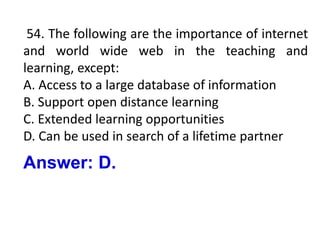
54. The following are the importance of internet
and world wide web in the teaching and
learning, except:
A. Access to a large database of information
B. Support open distance learning
C. Extended learning opportunities
D. Can be used in search of a lifetime partner
Answer: D.
55. Arrange chronologically the following events
of instruction that was developed by Robert
Gagne:
I. Elicit performance
II. Provide feedback
III. Gain attention
IV. Inform learners of objectives
V. Stimulate recall of prior learning
A. I, III, II, V
B. II, V, III, I
C. II, V, III, IV, I
D. III, IV, V, I, II
Answer: D.
The nine steps of Gagne’s “Events of Instruction” are:
1. Gaining the attention of the students
2. Informing the learner of the objective
3. Stimulating recall of prior learning
4. Presenting the content
5. Providing learning guidance
6. Eliciting the performance
7. Providing feedback
8. Assessing the performance
9. Enhancing retention and transfer
56. In providing the students access to the
internet, teachers should observe these
standards, except:
A. Teach students to test reliability and
authenticity of website.
B. Allow students to independently explore the
world wide web.
C. Require students to cite all the websites they
use to ensure that they give proper credit and
avoid plagiarism.
D. Inform students of their limitations in
accessing the internet.
Answer: B.
Allowing students to explore independently on the
net will jeopardize their learnings.
57. Authentic learning can also be similar with
this level n Dale’s Cone of Experience.
A. contrived experiences
B. direct, purposeful experiences
C. dramatized experiences
D. field trips
Answer: B.
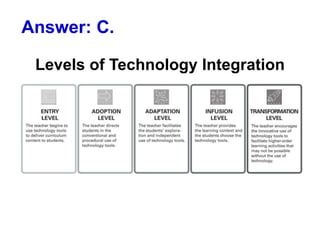
58. What level of technology integration is
reached by teacher Liza who builds a learning
environment that instills the power of
technology tools throughout the day and across.
A. Infusion
B. Adaptation
C. Transformation
D. Adoption
Answer: C.
Levels of Technology Integration
59. What educational technology is most
appropriate in showing the trend in temperature
change from month-to-month?
A. bar graph
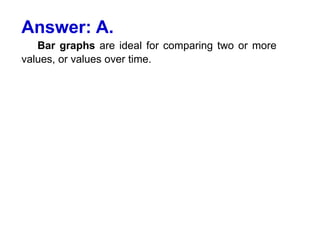
B. flowchart
C. drawing
D. map
Answer: A.
Bar graphs are ideal for comparing two or more
values, or values over time.
60. Blended learning is made is made possible
partly through actual classroom meetings
coupled with ____ instruction.
A. print module
B. tape – recorder
C. online
D. private tutor
Answer: C.
Blended learning is generally applied to the
practice of using both online and in-person learning
experiences when teaching students. In a blended-
learning course, for example, students might attend a
class taught by a teacher in a traditional classroom
setting, while also independently completing online
components of the course outside of the classroom.

Reviewer_Educnsjsjsjsbshshsational-Technology.pptx

  • 1.
    ROGER Y. IBAÑEZ,JR., MSA Program Chair, BSA Program DEBESMSCAT-Cawayan Campus ryibanez@debesmscat.edu.ph
  • 2.
    Perform/remember ROGER indealing with the choices in the examination Read the statements carefully Observe the details in order for you to understand Gather the facts/information in your mind Evaluate the gravity, bearing, or significance of the statement/s Remove the statements which are not related to the question or stem
  • 3.
    1. Which ofthe following statements has a very limited definition of educational technology? A. It is a profession composed of various job categories. B. It refers to the computers used for teaching and learning. C. It includes audiovisual materials, interactive multimedia and self-instructional materials. D. It is the development, application and evaluation of system, techniques and aids to improve human learning
  • 4.
    Answer: B. Educational Technologyis the field of study that investigates the process of analyzing, designing, developing, implementing, and evaluating the instructional environment, learning materials, learners, and the learning process in order to improve teaching and learning.
  • 5.
    2. Which ofthe following statements is correct about the domains of educational technology? A. Design is the production stage while development is the planning stage. B. Both the design and development are the planning stage. C. Evaluation is synonymous with implementation. D. Utilization is the action phase
  • 6.
    Answer: D. Design Is theprocedure of creating conditions for learning with the purpose of specifying products(lessons, modules) and strategies at the macro level. Development translates the design specifications into an actual form including its subcategories that reflect some chronological changes in educational technology. Utilization is the act of using resources and processes for education. Educational technology then requires management through planning, organizing, supervising, administering, and coordinating. Evaluation is the process of determining the worth, merit, or value of an educational program, project, or product for the purpose of generating a judgment.
  • 7.
    3. Ms. Gomezis planning to integrate technology in her Mathematics class. Which of the following would be the logical steps in doing this? I. Set the objectives II. Analyze the learners III. Utilize the materials with showmanship IV. Evaluate the performance of the students A. I, II, III, IV B. II, I, III, IV C. I, II, IV, III D. II, I, IV, III
  • 8.
  • 10.
    4. Which ofthe following is a limitation of models and real objects in teaching and learning? A. They pose problems on storage B. They make learning more concrete. C. They provide hands-on learning experiences. D. They are readily available in the environment, around school and in the home.
  • 11.
    Answer: A. DISADVANTAGES  somelive animals and plant are potential hazards. Objects like circuits and heat sources could be dangerous.  some are expensive.  problems regarding storage and retrieval may arise.
  • 12.
    5. Which groupof technologies has the highest degree of concreteness? A. Realia and computer B. Video, picture, and television C. Digital video, film, versatile compact disc D. Book, imaginative literature, programmed instruction
  • 13.
    Answer: A. Realia Real objectsprovide a concrete manipulative for students to handle while listening to the read aloud. Realia also create total physical responses that help students recall ideas and themes from the text in later discussions. Computer Computers facilitate audio-visual representation of information, thus making the process of learning interactive and interesting.
  • 14.
    6. Mrs. DelPrado placed text together with the relevant graphics on the same page in her multimedia presentation. Which principle did she apply? A. Split attention B. Spatial contiguity C. Cost-effectiveness D. Communication effectiveness
  • 15.
    Answer: A. Split attention Statesthat when designing instruction, including multimedia instruction, it is important to avoid formats that require learners to split their attention between, and mentally integrate, multiple sources of information Spatial contiguity Students learn better when corresponding words and pictures are presented simultaneously rather than successively
  • 16.
    12 Principles ofMultimedia (Richard Mayer) 1. The Coherence Principle 2. The Signaling Principle 3. The Redundancy Principle 4. The Spatial Contiguity Principle 5. The Temporal Contiguity Principle 6. The Segmenting Principle 7. The Pre-Training Principle 8. The Modality Principle 9. The Multimedia Principle 10. The Personalization Principle 11. The Voice Principle 12. The Image Principle
  • 19.
    7. Mrs. Olivarezpresented real samples of rocks in her General Science class. What principle did she apply? A. Appropriateness B. Authenticity C. Responsiveness D. Simplicity
  • 20.
    Answer: B. Principle 7(Authenticity) in the use of educational technology states that “they must present accurate up to date dependable information”
  • 25.
    8. Which isthe best reason why teachers state the objectives before using instructional media? A. To secure materials B. To prepare the materials beforehand. C. To determine which media to use best. D. To be able to practice how to operate the equipment
  • 26.
    Answer: C. Guideline number2 in the guidelines of using educational technologies states that “Defining objectives are essential for planning the lesson and selecting and using instructional materials”.
  • 27.
    9. Which ofthe following should Mr. Rivera primarily consider in determining the teaching- learning objectives and use of instructional media? a. The assessment tool to be used b. The learning activities c. The learner d. The teacher
  • 28.
    Answer: B. Guideline number1 (PURPOSE) in the guidelines of using educational technologies states that “ask yourself what you are trying to accomplish and why this instructional aid is important” therefore, in order to assess the importance of IMs to be used, the primary consideration is the learning activity to be performed by the students.
  • 29.
    10. Which ofthe following technologies provide iconic experiences to students/ children? a. Video and books b. Pictures and videos c. Radio and recording d. Modules and periodicals
  • 30.
    Answer: B. Based onDale’s Cone of Experience, images and videos belong to iconic modes of learning in which 30% of the information will be remembered when they are actually seen.
  • 31.
    11. Which ofthese technologies used in the classroom are arranged from the most symbolic to multisensory? a. Real objects, print, audio-visual materials and visual materials b. Visual materials, audio visual materials, print and computers c. Visual materials, print, audio-visual materials and realia d. Print, audio-visual materials, computers and realia
  • 32.
    Answer: D. Symbolic isa way of teaching that uses variety of symbols Multisensory instruction is a way of teaching that engages more than one sense at a time.
  • 33.
    12. Which ofthe following is inappropriate in using printed visuals such as charts, graphs and drawings? A. Provide written or verbal cues to highlight important aspect of visuals B. Present the instructional materials simultaneously C. Use materials that everyone can see D. Make the presentation suspenseful
  • 34.
    Answer: B. Principle 11of Utilizing Educational technologies states that the presentation must be presented at the right time and the right way.
  • 35.
    13. Susan wantsto learn more English. Specifically, she wants to improve her listening skills. She has a CD player, a tape recorder and has internet access. As an English teacher, what do you suggest? I. CDs with English listening drills II. Tapes with English listening drills III. Internet website such as Go4English, English Language Listening Lab or Randall’s listening Lab A. I and II B. II and III C. I or III D. I, II and III
  • 36.
  • 37.
    14. Which ofthe following statements is incorrect about the contributions of technology to student learning? A. The quality of learning can be improved. B. The delivery of instruction can be more interesting. C. The method of teaching and learning becomes more interactive. D. The role of the teacher can be changed into knowledge dispenser.
  • 38.
    Answer: D. 1. Increasesstudents’ motivation, self-esteem, self- confidence and academic achievement 2. Supplies stimulating environments that encourage student involvement in the learning process. 3. Promotes high-level thinking skills 4. Offers students diversity, self-paced learning and opportunities for individual growth and self- expression. 5. Provides students with unique opportunities to apply skills and talents and interest with others in non- threatening environments 6. Changes teachers and students ‘role into positive directions
  • 39.
    15. Mr. Tarnate,an ICT teacher takes into account technology standards to address the needs of the students and help them adapt with the changing society and technology. Which of the following standards is an exception? a. Creativity and innovation b. Research and information literacy c. Model digital-age work and learning d. Technology operations and concepts
  • 40.
    Answer: C. Model digitalage work and learning is ISTE Standard for Teachers and not for the students
  • 41.
    16. Ms. Vinluan,a computer teacher demonstrates understanding of local and global issues and exhibits ethical and legal use of information and communications technology tools. Which is true about her? A. She models digital-age work and learning B. She facilitates and inspires student learning and creativity. C. She promotes and models digital citizenship and responsibility. D. She designs and develops digital-age learning experiences and assessments
  • 42.
    Answer: C. ISTE StandardNumber 4: Promote and model digital citizenship and responsibility - Advocate, model, and teach safe, legal, and ethical use of digital information and technology, including respect for copyright, intellectual property, and the appropriate documentation of sources
  • 43.
    17. With thefast-paced evolution of technologies nowadays, why are teachers encouraged to shift gradually from a teacher- centered instruction to a learner-centered instruction? I. A learner-centered instruction focuses on transformation of facts. a. II and IV only b. I, II and IV only c. I, III and IV only d. II, III and IV only
  • 44.
    18. Ms. Hernandezemploys student-centered instruction as the learners create their digital portfolios in her computer class. What could be developed among them through this approach? A. Repetition and active learning B. Mastery of skills and information delivery C. Information processing and passive learning D. Construction of knowledge and information exchange
  • 45.
  • 46.
    19. Mr. Torreswill have a multimedia presentation in his Science class. Which of the following should he avoid? A. Consider technical quality. B. Apply different computer effects per slide. C. Present information through graphic organizers D. Use contrasting colors for text and background.
  • 47.
    Answer: B. 2nd Commandmentin Creating Presentation materials states that “Be consistent in format, layout and conventions”
  • 48.
    20. Mrs. Sisonwould like to integrate technology in writing a friendly letter. Which of the following is the most effective way of doing it? A. Let the pupils surf a friendly letter from the internet B. Have the pupils write a friendly letter and send it through an email. C. have the pupils forward a downloaded friendly letter to others via email. D. Let the pupils write a friendly letter using word processing and have it critiqued by their peers.
  • 49.
    Answer: B. The bestway to integrate technology into writing is that let your students write a friendly letter and send it through an email.
  • 50.
    21. Which ofthe following computer-based instructional materials can be used to learn new concepts? A. Games B. Tutorial C. Simulation D. Drill and practice
  • 51.
    Answer: B. DRILL ANDPRACTICE METHOD provides opportunities for students to repeatedly practice the skills that they have previously learned and further practice necessary for mastery. TUTORIAL MODE The program tutors or teaches the student a body of knowledge by presenting information and asking questions, giving hints if students. SIMULATION Realistic situation for role-playing GAME MODE Game software often creates a contest to achieve the highest score and either beat others or beat the computer and the extent of learning depends on the type of game.
  • 52.
    22. Professor delaCruz would like to create a presentation material for her lesson on the types of computer-assisted instruction. To make her presentation effective, which? A. Situating tool B. Informative tool C. Productivity tool D. Communicative tool
  • 53.
    Answer: C. Situating toolsare the system that situates users in an environment where they may experience the context and the happening. Informative tools are applications that provide large amounts of information in various formats such as text, graphics, sound, or video. Productivity tools are software programs designed to make computer users more productive as they work. Communicative tools refer to three forms of electronic communication in distance education courses—e-mail, discussion groups, and chat rooms.
  • 54.
    23. Professor Reyesis thinking of an online learning approach by which content provides links to information at other locations and serves as a focal point for a distance education experience. Which of the following should she use? A. Teleconferencing B. Self-paced program C. Web-based instruction D. Computer-aided instruction
  • 55.
    Answer: C. Web-based instruction(WBI) is defined as an innovative approach for delivering instruction to a remote audience using the World Wide Web as the instructional delivery system in which students can access information and resources from around the world simply by having a computer with an Internet connection.
  • 56.
    24. Which isNOT a basic consideration in selecting and evaluating the content of an educational technology tool? A. Does it match the content? B. Can it be easily dismantled? C. Will it motivate and maintain interest? D. Is there evidence of its effectiveness?
  • 57.
    Answer: B. Evaluating instructionalresources 1. Does the content match the curriculum? 2. Is the content accurate, up to date , and appropriate for the students? 3. Do the materials teach and/or reinforce learning effectively? 4. Do these resources enhance instruction? 5. Are the resources easy for the teacher and students to use? 6. Are the materials of high quality technically? 7. Is the use of this resource practical for my teaching setting ( cost, needed equipment, ect.)
  • 58.
    25. Your fatherwanted to finish his long dreamed course but he wanted to do it at home during his free time. Would you recommend an online learning? A. Yes, because online learning is the “in” thing B. No, because online learning inhibits student- teacher interaction. C. No, because hiring a helper would enable him to attend regularly in his class. D. Yes, because he could learn at his own pace using a wide spectrum of technologies.
  • 59.
    Answer: D. Computer-managed instruction(CMI) is an instructional strategy whereby the computer is used to provide learning objectives, learning resources, record keeping, progress tracking, and assessment of learner performance.
  • 60.
    26. Ms. DelosSantos is a fresh graduate teacher who was hired to teach in an elementary school where there are enough resources for instruction. She wanted to start preparing her instructional materials. Which is the most systematic process in doing this? A. Design, utilization, evaluation, development B. Design, development, utilization, evaluation C. Development, design, utilization, evaluation D. Development, utilization, evaluation, design
  • 61.
    Answer: B. Design Is theprocedure of creating conditions for learning with the purpose of specifying products(lessons, modules) and strategies at the macro level. Development translates the design specifications into an actual form including its subcategories that reflect some chronological changes in educational technology. Utilization is the act of using resources and processes for education. Educational technology then requires management through planning, organizing, supervising, administering, and coordinating. Evaluation is the process of determining the worth, merit, or value of an educational program, project, or product for the purpose of generating a judgment.
  • 62.
    27. Which isthe most important reason why teachers need to preview their instructional materials that will be used in the class? A. To gain confidence in using them B. To encourage viewers to be more focused C. To avoid potential problems that might occur while materials are in use D. To ensure appropriateness of the materials with the objectives and target audience
  • 63.
    Answer: D. Principle number3 in selecting and utilizing educational technologies states “that technology must be appropriate to the level intended in terms of vocabulary level, difficulty concepts, methods of development, and interest”
  • 64.
    28. After Ms.Rivas planned her lesson in English, she found out that the materials at hand do not match her objectives. Which is the best thing that she can do? A. Modify the available materials B. Teach the lesson the following day. C. Change the objectives to match with available materials. D. Carry out the lesson as planned and use the materials at hand.
  • 65.
    Answer: A. Guideline number2 in the guidelines of using educational technologies states that “Defining objectives are essential for planning the lesson and selecting and using instructional materials”.
  • 66.
    29. Prof. Balagtasused worksheets, manipulatives, and models in teaching math to help her students understand the lessons and love the subject. What did she bear in mind when she used these materials? A. Appropriateness B. Balance C. Breadth D. Variety
  • 67.
    Answer: D. Using avariety of tools keeps students’ interest but also responds to the needs of those who receive information in different ways.
  • 68.
    30. With theincreasing use of educational technology inside the classroom, what role is expected of the teacher? A. Facilitator B. Researcher C. Knowledge giver D. Source of information
  • 69.
    Answer: A. Since weare now in the digital era, the role of the teacher is to facilitate learning with the aid of technologies.
  • 70.
    31. It isimpractical to bring real objects to the classroom so Aaron constructed a three- dimensional visual instead. Which of the following did he construct? A. Chart B. Cartoon C. Model D. Graphic organizer
  • 71.
    Answer: C. Model isthree-dimensional representation of a real thing. It can be larger, smaller, or the same size as the object it represents.
  • 72.
    32. You askedyour students to show a two- dimensional illustration of what they have understood from what they have read. Which of the following non-projected visuals are you referring to? A. Graphic organizer B. Print materials C. Model D. Realia
  • 73.
    Answer: A. GRAPHIC ORGANIZERDiagram – It is “any line drawing that shows arrangement and relations as of parts to the whole, relative values, origins and development, chronological fluctuations, distributions, etc.”
  • 74.
    33. There areseveral reasons why teachers are reluctant in using electronic media in the teaching-learning process. Which is the most common reason? A. The limited exposure of teachers to new equipment B. Their incompatibility to diverse needs of the learners C. The difficulty in integrating technology in the curriculum D. The excessive availability of local technology in the community
  • 75.
  • 76.
    34. Prof. Mandanaswould like to use an audio compact disc in teaching a lesson in Filipino. In which activity in the teaching-learning process is it very effective? A. In developing listening skills B. In teaching creating thinking C. In composing poems D. In building concepts Answer: A.
  • 77.
    35. Plants, pebbles,and blocks are just some of the effective instructional materials readily found in the environment if they are utilized properly. Which of the following is INCORRECT about their classroom use? A. Pass a single object around the class. B. Familiarize yourself with the object or model before its actual utilization. C. Use the objects as springboard in encouraging students’ active participation. D. Make sure that the realia and model are large enough to be seen by the whole class.
  • 78.
    Answer: A. Size isthe 1st guideline in selecting instructional materials therefore, using real objects must be seen by the furthest student in the classroom.
  • 79.
    36. Prof. Ruizuses projected visuals such as Digital Liquid Projector (DLP) in presenting her lesson. What could be her main reason for using it? A. The projected materials are readily available. B. They are more abstract than any other visuals. C. Most projected visuals can be obtained at no cost. D. She can easily prepare for own transparencies in advance.
  • 80.
  • 81.
    37. Ms. Samonteused a film clip in teaching Social Studies concepts to her First Year High School class. However, she found out that it was ineffectively used in the classroom. When is technology considered INEFFECTIVE? A. When it promotes mastery of the lesson B. When it makes viewing more interesting C. When it helps attain the objectives of the lesson D. When it induces alienation on the part of the learners
  • 82.
    Answer: D. Interest isthe 9th principle in utilizing educational technology in which the technology used should catch the interest of learners.
  • 83.
    38. Your principalpurchased new computer units for your Learning Resource Center. Which of the following should be your last consideration in using the technology? A. Computers can be used for entertainment. B. Computers can be used for research activity. C. Computers can be used for interactive presentation. D. Computers can be used to reinforce discussion of difficult concepts in class.
  • 84.
    Answer: A. Meaningfulness isthe 1st principle in utilizing educational technology in which the technology used must contribute to the growth of and development of learners
  • 85.
    39. Computers canbe classified according to the roles they play namely communicative tool, informative tool, and constructive tool. What is the other role of computers not mentioned in this item? A. Instructional tool B. Situating tool C. Utility tool D. Application tool
  • 86.
    Answer: B. The Computeras Teacher's Tool 1. As an information tool 2. A communication tool 3. A constructive tool 4. As co-constructive tool 5. A situating tool
  • 87.
    40. Which ofthe following categories of CAI will you use in your class if your objective is to increase proficiency in a newly learned skill or refresh an existing one? A. Tutorial B. Simulation C. Drill and practice D. Instructional game
  • 88.
    Answer: C. DRILL ANDPRACTICE METHOD provides opportunities for students to repeatedly practice the skills that they have previously learned and further practice necessary for mastery.
  • 89.
    41. Which ofthe following is an ineffective use of Presentation software? A. Darken the room. B. Use appropriate pacing. C. Read directly from the slides. D. Allow interaction with the learner.
  • 90.
    Answer: C. Don't readyour presentation straight from the slides If your audience can both read and hear, it’s a waste of time for you to simply read your slides aloud. Your audience will zone out and stop listening to what you’re saying, which means they won’t hear any extra information you include. Instead of typing out your entire presentation, include only main ideas, keywords, and talking points in your slide show text. Engage your audience by sharing the details out loud.
  • 91.
    42. Which ofthe following is NOT an example of a communicative tool? a. Chat b. Electronic mail c. Teleconferencing d. Multimedia encyclopedia
  • 92.
    Answer: D. Multimedia encyclopediais defined as any application that combines text with graphics, animation, audio, video, and/or virtual reality.
  • 93.
    43. Why isone-way delivery of information a misuse of communication tools? A. Because the teacher expects the student to study more B. Because it requires activities that focus on thinking than responding C. Because it enables the users to focus more on higher level cognitive activities D. Because this kind of practice lessens interaction capabilities of communication tools
  • 94.
    Answer: D. From thedefinition, communication is a two-way process of transferring information (sender and receiver). therefore communication in the classroom must be interactive.
  • 95.
    44. Internet consistsof thousands of connected computer networks around the world. Which term does not refer to the internet? A. NET B. On-line C. Cyberspace D. Information Superhighway Answer: B.
  • 96.
    45. Which technologytool can Prof. Soriano use to communicate asynchronously with her students? A. Chat and blog B. Chat and instant messaging C. Blog and video conferencing D. Electronic bulletin board and email
  • 97.
    Answer: D. Asynchronous toolsallow online participants to communicate with one another within a window of time. Interactions aren’t confined to instant responses and discussions can be accessed at times most convenient for both instructor and learner.
  • 98.
    46. In yourcomputer subject, you allow your class to chat as part of your motivation before discussing to them the roles of computer as a tool. How is chat used in this context? A. Information tool B. Application tool C. Communicative tool D. Situating tool Answer: B.
  • 99.
    47. Which statementis INCORRECT about computer conferencing? A. It refers to live student interaction with an expert. B. It is also known as discussion forum or bulletin board. C. It also refers to online class discussions, forums or debates. D. It permits two or more individuals
  • 100.
    Answer: A. Computer Teleconferencingrefers to an approach to distance teaching using a computer(s) to assist in the presentation of teaching materials or to assistant learners to work through an already prepared learning program. The term computer conferencing has the following meanings: 1. Teleconferencing supported by one or more computers. 2. An arrangement in which access, by multiple users, to a common database is mediated by a controlling computer. 3. The interconnection of two or more computers working in a distributed manner on a common application process. Instant Messaging and chat systems are multicasting approaches for computer conferencing.
  • 101.
    48. Which instructionalapplication will you introduce to your class if your objective is to help them find and use information resources available in the internet? A. Webquests B. Hybrid course C. Scavenger Hunt D. Distance education
  • 102.
    Answer: C. A scavengerhunt is a game in which organizers prepare a list defining specific things, which the participants seek to gather or complete all items on the list, usually without purchasing them. WebQuest is an inquiry-oriented activity in which most or all of the information used by learners is drawn from the Web. WebQuests are designed to use learners' time well, to focus on using information rather than on looking for it, and to support learners' thinking at the levels of analysis, synthesis, and evaluation."
  • 103.
    49. In thedelivery of distance education, what computer application is used to organize instructions and track students records and progress? A. Computer-based Multimedia B. Computer-assisted Instruction C. Computer-mediated Education D. Computer-managed Instruction
  • 104.
    Answer: B. Computer-assisted instruction(CAI) is an interactive instructional technique whereby a computer is used to present the instructional material and monitor the learning that takes place. Or a self-learning technique, usually offline/online, involving the interaction of students with programmed instructional materials.
  • 105.
    50. When isdistance education as effective as the traditional instruction? A. When the method, technologist and assessment used are appropriate to the required competencies. B. When the course requires more face-to-face communication between the students and teachers. C. When students depend more on their online mentor. D. When there is student to student interaction.
  • 106.
    Answer: A. Computer-assisted instruction(CAI) is an interactive instructional technique whereby a computer is used to present the instructional material and monitor the learning that takes place. Or a self-learning technique, usually offline/online, involving the interaction of students with programmed instructional materials.
  • 107.
    51. Teacher Johnis using technology to enhance the learning in his subject matter. He is practicing: A. gamification B. collaboration C. technology – driven D. integration
  • 108.
    Answer: D. Technology integrationis the process of determining where and how technology fits into teaching and learning
  • 109.
    52. The followingare the instructional materials as supplements to textbook, except: A. computer software B. tables, charts, and maps C. guide questions D. mobile app Answer: C. A guiding question is a question which encourages a student to consider the information they have been taught, but to come up with their own answers.
  • 110.
    53. Teacher Gabrielhas shown only the important portion rather than whole video as a motivation to his lesson in the class. What did he achieved? A. saving on electricity B. avoiding unnecessary noise C. better use of time D. managing discipline
  • 111.
    Answer: C. Principle 11of Utilizing Educational technologies states that the presentation must be presented at the right time and the right way.
  • 112.
    54. The followingare the importance of internet and world wide web in the teaching and learning, except: A. Access to a large database of information B. Support open distance learning C. Extended learning opportunities D. Can be used in search of a lifetime partner Answer: D.
  • 113.
    55. Arrange chronologicallythe following events of instruction that was developed by Robert Gagne: I. Elicit performance II. Provide feedback III. Gain attention IV. Inform learners of objectives V. Stimulate recall of prior learning A. I, III, II, V B. II, V, III, I C. II, V, III, IV, I D. III, IV, V, I, II
  • 114.
    Answer: D. The ninesteps of Gagne’s “Events of Instruction” are: 1. Gaining the attention of the students 2. Informing the learner of the objective 3. Stimulating recall of prior learning 4. Presenting the content 5. Providing learning guidance 6. Eliciting the performance 7. Providing feedback 8. Assessing the performance 9. Enhancing retention and transfer
  • 115.
    56. In providingthe students access to the internet, teachers should observe these standards, except: A. Teach students to test reliability and authenticity of website. B. Allow students to independently explore the world wide web. C. Require students to cite all the websites they use to ensure that they give proper credit and avoid plagiarism. D. Inform students of their limitations in accessing the internet.
  • 116.
    Answer: B. Allowing studentsto explore independently on the net will jeopardize their learnings.
  • 117.
    57. Authentic learningcan also be similar with this level n Dale’s Cone of Experience. A. contrived experiences B. direct, purposeful experiences C. dramatized experiences D. field trips
  • 118.
  • 119.
    58. What levelof technology integration is reached by teacher Liza who builds a learning environment that instills the power of technology tools throughout the day and across. A. Infusion B. Adaptation C. Transformation D. Adoption
  • 120.
    Answer: C. Levels ofTechnology Integration
  • 121.
    59. What educationaltechnology is most appropriate in showing the trend in temperature change from month-to-month? A. bar graph B. flowchart C. drawing D. map
  • 122.
    Answer: A. Bar graphsare ideal for comparing two or more values, or values over time.
  • 123.
    60. Blended learningis made is made possible partly through actual classroom meetings coupled with ____ instruction. A. print module B. tape – recorder C. online D. private tutor
  • 124.
    Answer: C. Blended learningis generally applied to the practice of using both online and in-person learning experiences when teaching students. In a blended- learning course, for example, students might attend a class taught by a teacher in a traditional classroom setting, while also independently completing online components of the course outside of the classroom.

Editor's Notes

  • #9 Heinich, Molenda, Russell, & Smaldino
  • #10 Florida State University in 1975.
  • #121 Adapt is used either when a change is made to make something more suitable for a particular use or when adjusting to a new place. Adopt is used when something is taken over, chosen, accepted or approved by choice.