ARCHITECTURAL SERVICES – V (ACOUSTICS)(RAR – 806)
MODULE-1 – BUILDING ACOUSTICS
(INTRODUCTION)
AR. MANISH KUMAR AXIS SCHOOL OF ARCHITECTURE 1
CONTENTS
TERMINOLOGY AND UNIT
CHARACTERISTICS OF AUDIBLE SOUND-
1. PROPAGATION
2. VELOCITY
3. FREQUENCY
4. PITCH
5. QUALITY/TIMBRE
6. LOUDNESS
7. INTENSITY
BEHAVIOR OF AUDIBLE SOUND IN ENCLOSURES
1. REFLECTION
2. ABSORPTION
3. REFRACTION
4. TRANSMISSION OF SOUND
AR. MANISH KUMAR AXIS SCHOOL OF ARCHITECTURE 2
▪
▪
▪
INTRODUCTION
WHAT IS ACOUSTIC?
▪ The branch of physics that is concerned with the study of sound is known as acoustics.
▪ The science that deals with the study of sound and its production, transmission, and
effects.
▪ The study of acoustics has been fundamental to many developments in the arts,
science, technology, music, biology etc.
WHAT IS SOUND?
• Sound can be described as a disturbance or turbulance which passes through a physical
medium in the form of longitudinal waves from a source to a receiver causing a
sensation of hearing.
• This medium will be solid, fluid or gas.
• The speed of sound through these different media differs due to their molecular
composition
IN SIMPLE DEFINITION
• Sound is any vibration (wave) travelling through the air or other medium which can be
heard when it reaches a persons ear.
AR. MANISH KUMAR AXIS SCHOOL OF ARCHITECTURE 3
CHARACTERISTICS OF AUDIBLE SOUND
AR. MANISH KUMAR AXIS SCHOOL OF ARCHITECTURE 4
PROPAGATION
Sound is a sequence of waves of pressure which propagates
through compressible media such as air or water. (Sound can
propagate through solids as well, but there are additional
modes of propagation). During their propagation, waves can
be reflected, refracted, or attentuated by the medium. The
purpose of this experiment is to examine what effect the
characteristics of the medium have on sound. All media have
three properties which affect the behavior of sound
propagation:
• A relationship between density and pressure. This
relationship, affected by temperature, determines the
speed of sound within the medium.
• The motion of the medium itself, e.g., wind. Independent
of the motion of sound through the medium, if the
medium is moving, the sound is further transported.
• The viscosity of the medium. This determines the rate at
which sound is attenuated. For many media, such as air
or water, attenuation due to viscosity is negligible.
CHARACTERISTICS OF AUDIBLE SOUND
AR. MANISH KUMAR AXIS SCHOOL OF ARCHITECTURE 5
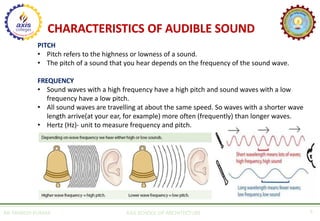
PITCH
• Pitch refers to the highness or lowness of a sound.
• The pitch of a sound that you hear depends on the frequency of the sound wave.
FREQUENCY
• Sound waves with a high frequency have a high pitch and sound waves with a low
frequency have a low pitch.
• All sound waves are travelling at about the same speed. So waves with a shorter wave
length arrive(at your ear, for example) more often (frequently) than longer waves.
• Hertz (Hz)- unit to measure frequency and pitch.
AR. MANISH KUMAR AXIS SCHOOL OF ARCHITECTURE 6
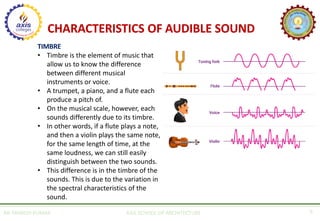
TIMBRE
• Timbre is the element of music that
allow us to know the difference
between different musical
instruments or voice.
• A trumpet, a piano, and a flute each
produce a pitch of.
• On the musical scale, however, each
sounds differently due to its timbre.
• In other words, if a flute plays a note,
and then a violin plays the same note,
for the same length of time, at the
same loudness, we can still easily
distinguish between the two sounds.
• This difference is in the timbre of the
sounds. This is due to the variation in
the spectral characteristics of the
sound.
CHARACTERISTICS OF AUDIBLE SOUND
AR. MANISH KUMAR AXIS SCHOOL OF ARCHITECTURE 7
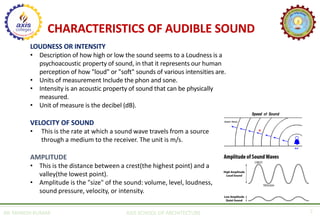
LOUDNESS OR INTENSITY
• Description of how high or low the sound seems to a Loudness is a
psychoacoustic property of sound, in that it represents our human
perception of how "loud" or "soft" sounds of various intensities are.
• Units of measurement Include the phon and sone.
• Intensity is an acoustic property of sound that can be physically
measured.
• Unit of measure is the decibel (dB).
VELOCITY OF SOUND
• This is the rate at which a sound wave travels from a source
through a medium to the receiver. The unit is m/s.
AMPLITUDE
• This is the distance between a crest(the highest point) and a
valley(the lowest point).
• Amplitude is the "size" of the sound: volume, level, loudness,
sound pressure, velocity, or intensity.
CHARACTERISTICS OF AUDIBLE SOUND
AR. MANISH KUMAR AXIS SCHOOL OF ARCHITECTURE 8
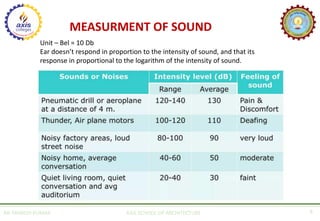
MEASURMENT OF SOUND
Unit – Bel = 10 Db
Ear doesn’t respond in proportion to the intensity of sound, and that its
response in proportional to the logarithm of the intensity of sound.
BEHAVIOR OF AUDIBLE SOUND IN ENCLOSURES?
AR. MANISH KUMAR AXIS SCHOOL OF ARCHITECTURE 9
• An enclosed space is a room or area bounded on every of its sides.
• The materials for enclosure may be classified into two:
• Those that allow sound rays to pass through and
• Those that do not allow sound rays to pass through.
On encountering barriers posed by the enclosure, sound
waves are likely to behave in the following ways:
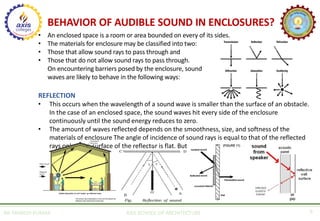
REFLECTION
• This occurs when the wavelength of a sound wave is smaller than the surface of an obstacle.
In the case of an enclosed space, the sound waves hit every side of the enclosure
continuously until the sound energy reduces to zero.
• The amount of waves reflected depends on the smoothness, size, and softness of the
materials of enclosure The angle of incidence of sound rays is equal to that of the reflected
rays only if the surface of the reflector is flat. But when it is curved, the angles are different.
BEHAVIOR OF AUDIBLE SOUND IN ENCLOSURES?
AR. MANISH KUMAR AXIS SCHOOL OF ARCHITECTURE 10
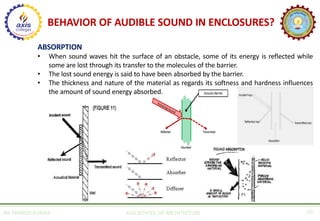
ABSORPTION
• When sound waves hit the surface of an obstacle, some of its energy is reflected while
some are lost through its transfer to the molecules of the barrier.
• The lost sound energy is said to have been absorbed by the barrier.
• The thickness and nature of the material as regards its softness and hardness influences
the amount of sound energy absorbed.
BEHAVIOR OF AUDIBLE SOUND IN ENCLOSURES?
AR. MANISH KUMAR AXIS SCHOOL OF ARCHITECTURE 11
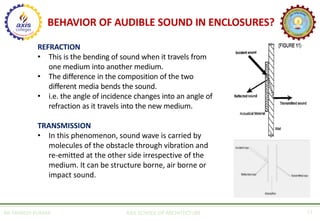
REFRACTION
• This is the bending of sound when it travels from
one medium into another medium.
• The difference in the composition of the two
different media bends the sound.
• i.e. the angle of incidence changes into an angle of
refraction as it travels into the new medium.
TRANSMISSION
• In this phenomenon, sound wave is carried by
molecules of the obstacle through vibration and
re-emitted at the other side irrespective of the
medium. It can be structure borne, air borne or
impact sound.
AR. MANISH KUMAR AXIS SCHOOL OF ARCHITECTURE 12
THANK YOU
Presented by Ar. Manish Kumar, Assistant Professor in
Architecture Department at Axis Institute of
Architecture

Module-1-Building Acoustics(Introduction)(Unit-1).pdf

  • 1.
    ARCHITECTURAL SERVICES –V (ACOUSTICS)(RAR – 806) MODULE-1 – BUILDING ACOUSTICS (INTRODUCTION) AR. MANISH KUMAR AXIS SCHOOL OF ARCHITECTURE 1
  • 2.
    CONTENTS TERMINOLOGY AND UNIT CHARACTERISTICSOF AUDIBLE SOUND- 1. PROPAGATION 2. VELOCITY 3. FREQUENCY 4. PITCH 5. QUALITY/TIMBRE 6. LOUDNESS 7. INTENSITY BEHAVIOR OF AUDIBLE SOUND IN ENCLOSURES 1. REFLECTION 2. ABSORPTION 3. REFRACTION 4. TRANSMISSION OF SOUND AR. MANISH KUMAR AXIS SCHOOL OF ARCHITECTURE 2 ▪ ▪ ▪
  • 3.
    INTRODUCTION WHAT IS ACOUSTIC? ▪The branch of physics that is concerned with the study of sound is known as acoustics. ▪ The science that deals with the study of sound and its production, transmission, and effects. ▪ The study of acoustics has been fundamental to many developments in the arts, science, technology, music, biology etc. WHAT IS SOUND? • Sound can be described as a disturbance or turbulance which passes through a physical medium in the form of longitudinal waves from a source to a receiver causing a sensation of hearing. • This medium will be solid, fluid or gas. • The speed of sound through these different media differs due to their molecular composition IN SIMPLE DEFINITION • Sound is any vibration (wave) travelling through the air or other medium which can be heard when it reaches a persons ear. AR. MANISH KUMAR AXIS SCHOOL OF ARCHITECTURE 3
  • 4.
    CHARACTERISTICS OF AUDIBLESOUND AR. MANISH KUMAR AXIS SCHOOL OF ARCHITECTURE 4 PROPAGATION Sound is a sequence of waves of pressure which propagates through compressible media such as air or water. (Sound can propagate through solids as well, but there are additional modes of propagation). During their propagation, waves can be reflected, refracted, or attentuated by the medium. The purpose of this experiment is to examine what effect the characteristics of the medium have on sound. All media have three properties which affect the behavior of sound propagation: • A relationship between density and pressure. This relationship, affected by temperature, determines the speed of sound within the medium. • The motion of the medium itself, e.g., wind. Independent of the motion of sound through the medium, if the medium is moving, the sound is further transported. • The viscosity of the medium. This determines the rate at which sound is attenuated. For many media, such as air or water, attenuation due to viscosity is negligible.
  • 5.
    CHARACTERISTICS OF AUDIBLESOUND AR. MANISH KUMAR AXIS SCHOOL OF ARCHITECTURE 5 PITCH • Pitch refers to the highness or lowness of a sound. • The pitch of a sound that you hear depends on the frequency of the sound wave. FREQUENCY • Sound waves with a high frequency have a high pitch and sound waves with a low frequency have a low pitch. • All sound waves are travelling at about the same speed. So waves with a shorter wave length arrive(at your ear, for example) more often (frequently) than longer waves. • Hertz (Hz)- unit to measure frequency and pitch.
  • 6.
    AR. MANISH KUMARAXIS SCHOOL OF ARCHITECTURE 6 TIMBRE • Timbre is the element of music that allow us to know the difference between different musical instruments or voice. • A trumpet, a piano, and a flute each produce a pitch of. • On the musical scale, however, each sounds differently due to its timbre. • In other words, if a flute plays a note, and then a violin plays the same note, for the same length of time, at the same loudness, we can still easily distinguish between the two sounds. • This difference is in the timbre of the sounds. This is due to the variation in the spectral characteristics of the sound. CHARACTERISTICS OF AUDIBLE SOUND
  • 7.
    AR. MANISH KUMARAXIS SCHOOL OF ARCHITECTURE 7 LOUDNESS OR INTENSITY • Description of how high or low the sound seems to a Loudness is a psychoacoustic property of sound, in that it represents our human perception of how "loud" or "soft" sounds of various intensities are. • Units of measurement Include the phon and sone. • Intensity is an acoustic property of sound that can be physically measured. • Unit of measure is the decibel (dB). VELOCITY OF SOUND • This is the rate at which a sound wave travels from a source through a medium to the receiver. The unit is m/s. AMPLITUDE • This is the distance between a crest(the highest point) and a valley(the lowest point). • Amplitude is the "size" of the sound: volume, level, loudness, sound pressure, velocity, or intensity. CHARACTERISTICS OF AUDIBLE SOUND
  • 8.
    AR. MANISH KUMARAXIS SCHOOL OF ARCHITECTURE 8 MEASURMENT OF SOUND Unit – Bel = 10 Db Ear doesn’t respond in proportion to the intensity of sound, and that its response in proportional to the logarithm of the intensity of sound.
  • 9.
    BEHAVIOR OF AUDIBLESOUND IN ENCLOSURES? AR. MANISH KUMAR AXIS SCHOOL OF ARCHITECTURE 9 • An enclosed space is a room or area bounded on every of its sides. • The materials for enclosure may be classified into two: • Those that allow sound rays to pass through and • Those that do not allow sound rays to pass through. On encountering barriers posed by the enclosure, sound waves are likely to behave in the following ways: REFLECTION • This occurs when the wavelength of a sound wave is smaller than the surface of an obstacle. In the case of an enclosed space, the sound waves hit every side of the enclosure continuously until the sound energy reduces to zero. • The amount of waves reflected depends on the smoothness, size, and softness of the materials of enclosure The angle of incidence of sound rays is equal to that of the reflected rays only if the surface of the reflector is flat. But when it is curved, the angles are different.
  • 10.
    BEHAVIOR OF AUDIBLESOUND IN ENCLOSURES? AR. MANISH KUMAR AXIS SCHOOL OF ARCHITECTURE 10 ABSORPTION • When sound waves hit the surface of an obstacle, some of its energy is reflected while some are lost through its transfer to the molecules of the barrier. • The lost sound energy is said to have been absorbed by the barrier. • The thickness and nature of the material as regards its softness and hardness influences the amount of sound energy absorbed.
  • 11.
    BEHAVIOR OF AUDIBLESOUND IN ENCLOSURES? AR. MANISH KUMAR AXIS SCHOOL OF ARCHITECTURE 11 REFRACTION • This is the bending of sound when it travels from one medium into another medium. • The difference in the composition of the two different media bends the sound. • i.e. the angle of incidence changes into an angle of refraction as it travels into the new medium. TRANSMISSION • In this phenomenon, sound wave is carried by molecules of the obstacle through vibration and re-emitted at the other side irrespective of the medium. It can be structure borne, air borne or impact sound.
  • 12.
    AR. MANISH KUMARAXIS SCHOOL OF ARCHITECTURE 12 THANK YOU Presented by Ar. Manish Kumar, Assistant Professor in Architecture Department at Axis Institute of Architecture