Retuning Your Value Proposition
Lisa Dennis, President
Knowledgence Associates
Agenda
1. “Standard” to “Customer-Driven” value
propositions
2. Defining the customer objective
3. Framing your offer with specifics
4. Create action in the customer’s mind
5. Drafting a value proposition that is retuned
for the economy
© 2015 Knowledgence Associates, All Rights Reserved
Economy is Challenging!!
 Putting pressure on a variety of marketing &
sales factors:
– Price
– Perception of value
– How you communicate
with prospects
& customers
– Your current
Value Proposition
may be ready to blow!
© 2015 Knowledgence Associates, All Rights Reserved
Opportunity to Retune
 Now is the time to “retune” for the economy
Refocused Communication
Strategy for Tactics for
Defining Increased
Value Response© 2015 Knowledgence Associates, All Rights Reserved
What is a
Value Proposition?
© 2015 Knowledgence Associates, All Rights Reserved
Basic Value Proposition Defined
Clear and succinct statement
indicating the specific value
of a service or product or offer
to a specific audience in order
to differentiate its value
© 2015 Knowledgence Associates, All Rights Reserved
Putting an “Economy” Spin on It
Customer-focused description of value
that demonstrates your knowledge about
the customer’s experience or challenge
and your specific offer to address it,
underscored by what differentiates
your offer from any other.
© 2015 Knowledgence Associates, All Rights Reserved
Insert Your
Own Face
Here!
What if I was your customer?
© 2015 Knowledgence Associates, All Rights Reserved
Value Propositions
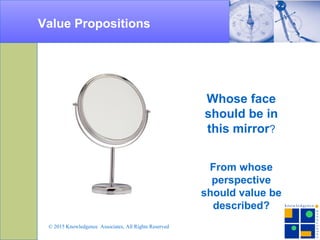
Whose face
should be in
this mirror?
From whose
perspective
should value be
described?
© 2015 Knowledgence Associates, All Rights Reserved
Value Propositions
It’s NOT about your
company and your
offer – it’s about the
customer seeing
themselves.
Insert
Customer
Here
Whose face should
be in this mirror?
From whose
perspective should
value be described?
© 2015 Knowledgence Associates, All Rights Reserved
3 Types of Value Propositions
 Benefits Driven
 Alternative Driven
 Customer Driven
FUNCTION
Does this
And this
And this
BENEFIT
# 1
# 2
# 3
FEATURE
# 1
# 2
# 3
© 2015 Knowledgence Associates, All Rights Reserved
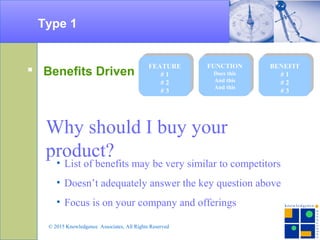
Type 1
 Benefits Driven
FUNCTION
Does this
And this
And this
BENEFIT
# 1
# 2
# 3
FEATURE
# 1
# 2
# 3
Why should I buy your
product?• List of benefits may be very similar to competitors
• Doesn’t adequately answer the key question above
• Focus is on your company and offerings
© 2015 Knowledgence Associates, All Rights Reserved
Type 1
Benefits Driven
FUNCTION
Does this
And this
And this
BENEFIT
# 1
# 2
# 3
FEATURE
# 1
# 2
# 3
Approach
• Requires product
knowledge
• List all benefits you
believe will be delivered
to the customer
• Lots of benefits = value
• Easy to construct
Challenges
• Feature/Benefit confusion
• Based on product-centric
assumptions
• Doesn’t require much
customer knowledge
• May not actually be a valid
benefit to customer
© 2015 Knowledgence Associates, All Rights Reserved
Type 2
 Alternatives Driven
Why should I buy your product
instead of your competitor’s?
• Without knowledge of customer’s needs, can’t
figure out what are TRULY differentiating points
• Focus is on YOU and your competitor
© 2015 Knowledgence Associates, All Rights Reserved
Type 2
Alternatives Driven
Approach
• Acknowledges customer
alternatives & differentiates
• Takes the customer question
to the next level
• Requires product knowledge
• Requires detailed
understanding of competitor
offering
Challenges
• Differentiation doesn’t
automatically communicate value
• Doesn’t require much customer
knowledge
• Assumes differentiators must have
value to customer
• Which point(s) of difference is
most important to customer?
© 2015 Knowledgence Associates, All Rights Reserved
Type 3
 Customer Driven
What is most important for me to
consider in making a decision?
• What’s different, what’s comparable and what’s
unclear about all offers
• Need to know what customer actually values
© 2015 Knowledgence Associates, All Rights Reserved
Type 3
Customer Driven
Approach
• Focus on customer-defined
value
• Isolates key points of
difference & 1 required
competitor similarity
• Requires product knowledge
• Requires competitor
knowledge
• Requires defining value to
customer
Challenges
• Needs to be simple but powerful
• Assumptions are not credible
• Have to know what matters most
to the customer
• Value has to be provable
• Need to put in customer terms
• Less is more
© 2015 Knowledgence Associates, All Rights Reserved
Here’s what counts:
 KNOWING who the customer is for your offer
 UNDERSTANDING what they care about
 SPEAKING in their language
 CREATING the right message for the customer
 LINKING your offer to their objective
 LEAD WITH THE CUSTOMER,
NOT YOUR PRODUCT OR SERVICE!
© 2015 Knowledgence Associates, All Rights Reserved
Pitfalls
Don’t Assume that:
 You know our customer’s goals, motives,
and needs
 Your customer understands your goals,
motives and efforts
Beware:
 “Telling everything you know”
© 2015 Knowledgence Associates, All Rights Reserved
Format and Language Shift
Offer Centric
 Offer description
 Why you need it
 Why IT’S THE BEST
OFFER!
Customer Centric
 Customer experience
or situation
 Our offer for THAT
experience or situation
 Why THIS OFFER
rather than other
options
From To
© 2015 Knowledgence Associates, All Rights Reserved
The “Secret Sauce”
 Communicating your company’s “story” in
customer language
 More easily persuaded by things that are familiar or
similar to us
 Don’t let prospects figure out if your product or
service is a fit BY THEMSELVES
© 2015 Knowledgence Associates, All Rights Reserved
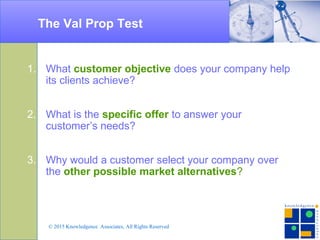
The Val Prop Test
1. What customer objective does your company help
its clients achieve?
2. What is the specific offer to answer your
customer’s needs?
3. Why would a customer select your company over
the other possible market alternatives?
© 2015 Knowledgence Associates, All Rights Reserved
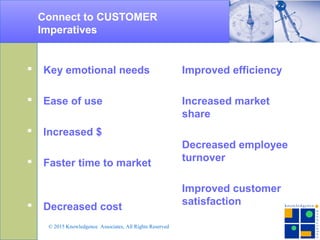
Connect to CUSTOMER
Imperatives
 Key emotional needs
 Ease of use
 Increased $
 Faster time to market
 Decreased cost
 Improved efficiency
 Increased market
share
 Decreased employee
turnover
 Improved customer
satisfaction
© 2015 Knowledgence Associates, All Rights Reserved
Telling a Story
 Connect the value proposition of your
project, product, program to one of these
concerns
 Communicate how your offer addresses
their concern in specific terms
 Attach to proof (testimonials, 3rd
party quote,
survey results, case study, white paper)
© 2015 Knowledgence Associates, All Rights Reserved
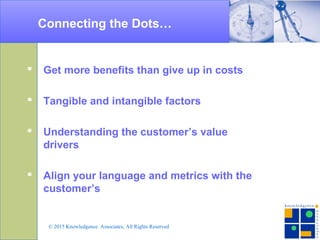
Connecting the Dots…
 Get more benefits than give up in costs
 Tangible and intangible factors
 Understanding the customer’s value
drivers
 Align your language and metrics with the
customer’s
© 2015 Knowledgence Associates, All Rights Reserved
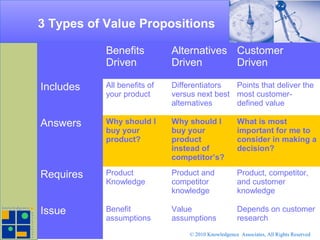
3 Types of Value Propositions
Benefits
Driven
Alternatives
Driven
Customer
Driven
Includes All benefits of
your product
Differentiators
versus next best
alternatives
Points that deliver the
most customer-
defined value
Answers Why should I
buy your
product?
Why should I
buy your
product
instead of
competitor’s?
What is most
important for me to
consider in making a
decision?
Requires Product
Knowledge
Product and
competitor
knowledge
Product, competitor,
and customer
knowledge
Issue Benefit
assumptions
Value
assumptions
Depends on customer
research
© 2010 Knowledgence Associates, All Rights Reserved
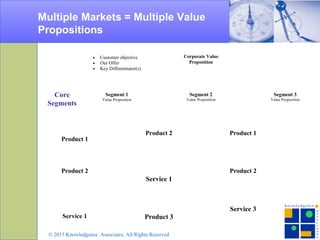
Multiple Markets = Multiple Value
Propositions
Corporate Value
Proposition
Segment 1
Value Proposition
Segment 2
Value Proposition
Product 1
Product 2
Product 2
• Customer objective
• Our Offer
• Key Differentiator(s)
Segment 3
Value Proposition
Product 1
Product 2
Core
Segments
Service 1
Product 3Service 1
Service 3
© 2015 Knowledgence Associates, All Rights Reserved
Beware of…
 Making it all about your product or service
 Making statements that are generic
 Using 1 value proposition for all customer
segments or all products
 Not offering proof
 Sounding too esoteric or generic
 Using too much industry lingo
© 2015 Knowledgence Associates, All Rights Reserved
“So What” Standard Descriptors
 Most advanced
 Rated best-in-class or “best-of-breed”
 We’re number 1
 We’re the “one-stop-shop” for all your needs
 Offer a full suite of services
 Reduce costs and improve efficiencies
 The industry leader
 Customer-Focused
© 2015 Knowledgence Associates, All Rights Reserved
Strong Value Propositions
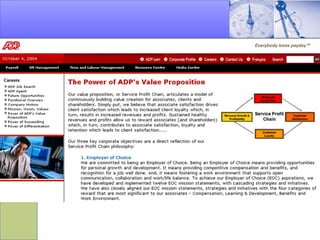
• Center on customer’s experience, not product or service
• Communicate customer benefits, not product or service
• Focus on uniqueness and specifics, not generalities
• Include external and internal drivers
• Cover both qualitative and quantitative factors
• Are both believable & demonstrable
© 2015 Knowledgence Associates, All Rights Reserved
Connecting the Dots…
 Understanding the customer’s value
drivers
 Align your language and metrics with the
customer’s
 Get more benefits than give up in costs
 Tangible and intangible factors
© 2015 Knowledgence Associates, All Rights Reserved
Consider ALL the Buying
Stages
 Which stage are you speaking to?

 Can’t speak to them all at once!
LoyaltyPurchase
PreferenceConsiderationAwareness
© 2015 Knowledgence Associates, All Rights Reserved
Validation – Fleshing it Out
Value Drivers:
 What are the most important values to the
customer that we can address?
Quantification:
 How do we quantify the value in a real or
measurable way?
Proof:
 How do we validate this in a believable
manner?
© 2015 Knowledgence Associates, All Rights Reserved
Making Value Driver Choices
Select a type, communicate it in customer
language, quantify it and offer proof.
AnalysisAnalysisRegulationsRegulationsChallengesChallengesObjectivesObjectives
NegotiationValidationEducationJustification
© 2015 Knowledgence Associates, All Rights Reserved
Extends the Value Proposition
 Forces discipline of figuring out what ARE
the key value drivers for our customer?
 If you can’t quantify it…is it important? Is it
real?
 Proof is about credibility – which is about 3rd
party validation. Quotes, testimonials,
Outside Studies, Tests, Reviews, Surveys.
© 2015 Knowledgence Associates, All Rights Reserved
 Customer Objective
 Offer

Differentiator(s)
Value Drivers
Quantification
Proof
© 2015 Knowledgence Associates, All Rights Reserved
3 Types of Value Propositions
Benefits
Driven
Alternatives
Driven
Customer
Driven
Includes All benefits of
your product
Differentiators
versus next best
alternatives
Points that deliver the
most customer-
defined value
Answers Why should I
buy your
product?
Why should I
buy your
product
instead of
competitor’s?
What is most
important for me to
consider in making a
decision?
Requires Product
Knowledge
Product and
competitor
knowledge
Product, competitor,
and customer
knowledge
Issue Benefit
assumptions
Value
assumptions
Depends on customer
research
© 2015 Knowledgence Associates, All Rights Reserved
Thank you!
 Lisa Dennis
 President
 Knowledgence Associates
 Ldennis@knowledgence.com
 O: 617-661-8250
 M: 617- 901-7366
Knowledgence Offer
360 Degrees of the Customer
Strategies & Tactics for Marketing, Sales
and Service
By Lisa Dennis, Charles Dennis and Lori
Richardson
Marketing, Sales and Customer Service are
three disciplines that all overlap at the same
point: the customer. All customer touch points
should be integrated with each other, a theory
that makes perfect sense in the abstract, but is
hard to do in the reality. Presents strategies &
tactics to keep the customer promise.
Price: $19.00
Go to:
http://www.knowledgence.com/Ondemand.htm
Available Today!

Retuning Your Value Proposition

  • 1.
    Retuning Your ValueProposition Lisa Dennis, President Knowledgence Associates
  • 2.
    Agenda 1. “Standard” to“Customer-Driven” value propositions 2. Defining the customer objective 3. Framing your offer with specifics 4. Create action in the customer’s mind 5. Drafting a value proposition that is retuned for the economy © 2015 Knowledgence Associates, All Rights Reserved
  • 3.
    Economy is Challenging!! Putting pressure on a variety of marketing & sales factors: – Price – Perception of value – How you communicate with prospects & customers – Your current Value Proposition may be ready to blow! © 2015 Knowledgence Associates, All Rights Reserved
  • 4.
    Opportunity to Retune Now is the time to “retune” for the economy Refocused Communication Strategy for Tactics for Defining Increased Value Response© 2015 Knowledgence Associates, All Rights Reserved
  • 5.
    What is a ValueProposition? © 2015 Knowledgence Associates, All Rights Reserved
  • 6.
    Basic Value PropositionDefined Clear and succinct statement indicating the specific value of a service or product or offer to a specific audience in order to differentiate its value © 2015 Knowledgence Associates, All Rights Reserved
  • 7.
    Putting an “Economy”Spin on It Customer-focused description of value that demonstrates your knowledge about the customer’s experience or challenge and your specific offer to address it, underscored by what differentiates your offer from any other. © 2015 Knowledgence Associates, All Rights Reserved
  • 8.
    Insert Your Own Face Here! Whatif I was your customer? © 2015 Knowledgence Associates, All Rights Reserved
  • 9.
    Value Propositions Whose face shouldbe in this mirror? From whose perspective should value be described? © 2015 Knowledgence Associates, All Rights Reserved
  • 10.
    Value Propositions It’s NOTabout your company and your offer – it’s about the customer seeing themselves. Insert Customer Here Whose face should be in this mirror? From whose perspective should value be described? © 2015 Knowledgence Associates, All Rights Reserved
  • 11.
    3 Types ofValue Propositions  Benefits Driven  Alternative Driven  Customer Driven FUNCTION Does this And this And this BENEFIT # 1 # 2 # 3 FEATURE # 1 # 2 # 3 © 2015 Knowledgence Associates, All Rights Reserved
  • 12.
    Type 1  BenefitsDriven FUNCTION Does this And this And this BENEFIT # 1 # 2 # 3 FEATURE # 1 # 2 # 3 Why should I buy your product?• List of benefits may be very similar to competitors • Doesn’t adequately answer the key question above • Focus is on your company and offerings © 2015 Knowledgence Associates, All Rights Reserved
  • 13.
    Type 1 Benefits Driven FUNCTION Doesthis And this And this BENEFIT # 1 # 2 # 3 FEATURE # 1 # 2 # 3 Approach • Requires product knowledge • List all benefits you believe will be delivered to the customer • Lots of benefits = value • Easy to construct Challenges • Feature/Benefit confusion • Based on product-centric assumptions • Doesn’t require much customer knowledge • May not actually be a valid benefit to customer © 2015 Knowledgence Associates, All Rights Reserved
  • 17.
    Type 2  AlternativesDriven Why should I buy your product instead of your competitor’s? • Without knowledge of customer’s needs, can’t figure out what are TRULY differentiating points • Focus is on YOU and your competitor © 2015 Knowledgence Associates, All Rights Reserved
  • 18.
    Type 2 Alternatives Driven Approach •Acknowledges customer alternatives & differentiates • Takes the customer question to the next level • Requires product knowledge • Requires detailed understanding of competitor offering Challenges • Differentiation doesn’t automatically communicate value • Doesn’t require much customer knowledge • Assumes differentiators must have value to customer • Which point(s) of difference is most important to customer? © 2015 Knowledgence Associates, All Rights Reserved
  • 20.
    Type 3  CustomerDriven What is most important for me to consider in making a decision? • What’s different, what’s comparable and what’s unclear about all offers • Need to know what customer actually values © 2015 Knowledgence Associates, All Rights Reserved
  • 21.
    Type 3 Customer Driven Approach •Focus on customer-defined value • Isolates key points of difference & 1 required competitor similarity • Requires product knowledge • Requires competitor knowledge • Requires defining value to customer Challenges • Needs to be simple but powerful • Assumptions are not credible • Have to know what matters most to the customer • Value has to be provable • Need to put in customer terms • Less is more © 2015 Knowledgence Associates, All Rights Reserved
  • 26.
    Here’s what counts: KNOWING who the customer is for your offer  UNDERSTANDING what they care about  SPEAKING in their language  CREATING the right message for the customer  LINKING your offer to their objective  LEAD WITH THE CUSTOMER, NOT YOUR PRODUCT OR SERVICE! © 2015 Knowledgence Associates, All Rights Reserved
  • 27.
    Pitfalls Don’t Assume that: You know our customer’s goals, motives, and needs  Your customer understands your goals, motives and efforts Beware:  “Telling everything you know” © 2015 Knowledgence Associates, All Rights Reserved
  • 28.
    Format and LanguageShift Offer Centric  Offer description  Why you need it  Why IT’S THE BEST OFFER! Customer Centric  Customer experience or situation  Our offer for THAT experience or situation  Why THIS OFFER rather than other options From To © 2015 Knowledgence Associates, All Rights Reserved
  • 29.
    The “Secret Sauce” Communicating your company’s “story” in customer language  More easily persuaded by things that are familiar or similar to us  Don’t let prospects figure out if your product or service is a fit BY THEMSELVES © 2015 Knowledgence Associates, All Rights Reserved
  • 30.
    The Val PropTest 1. What customer objective does your company help its clients achieve? 2. What is the specific offer to answer your customer’s needs? 3. Why would a customer select your company over the other possible market alternatives? © 2015 Knowledgence Associates, All Rights Reserved
  • 31.
    Connect to CUSTOMER Imperatives Key emotional needs  Ease of use  Increased $  Faster time to market  Decreased cost  Improved efficiency  Increased market share  Decreased employee turnover  Improved customer satisfaction © 2015 Knowledgence Associates, All Rights Reserved
  • 32.
    Telling a Story Connect the value proposition of your project, product, program to one of these concerns  Communicate how your offer addresses their concern in specific terms  Attach to proof (testimonials, 3rd party quote, survey results, case study, white paper) © 2015 Knowledgence Associates, All Rights Reserved
  • 33.
    Connecting the Dots… Get more benefits than give up in costs  Tangible and intangible factors  Understanding the customer’s value drivers  Align your language and metrics with the customer’s © 2015 Knowledgence Associates, All Rights Reserved
  • 34.
    3 Types ofValue Propositions Benefits Driven Alternatives Driven Customer Driven Includes All benefits of your product Differentiators versus next best alternatives Points that deliver the most customer- defined value Answers Why should I buy your product? Why should I buy your product instead of competitor’s? What is most important for me to consider in making a decision? Requires Product Knowledge Product and competitor knowledge Product, competitor, and customer knowledge Issue Benefit assumptions Value assumptions Depends on customer research © 2010 Knowledgence Associates, All Rights Reserved
  • 35.
    Multiple Markets =Multiple Value Propositions Corporate Value Proposition Segment 1 Value Proposition Segment 2 Value Proposition Product 1 Product 2 Product 2 • Customer objective • Our Offer • Key Differentiator(s) Segment 3 Value Proposition Product 1 Product 2 Core Segments Service 1 Product 3Service 1 Service 3 © 2015 Knowledgence Associates, All Rights Reserved
  • 36.
    Beware of…  Makingit all about your product or service  Making statements that are generic  Using 1 value proposition for all customer segments or all products  Not offering proof  Sounding too esoteric or generic  Using too much industry lingo © 2015 Knowledgence Associates, All Rights Reserved
  • 37.
    “So What” StandardDescriptors  Most advanced  Rated best-in-class or “best-of-breed”  We’re number 1  We’re the “one-stop-shop” for all your needs  Offer a full suite of services  Reduce costs and improve efficiencies  The industry leader  Customer-Focused © 2015 Knowledgence Associates, All Rights Reserved
  • 38.
    Strong Value Propositions •Center on customer’s experience, not product or service • Communicate customer benefits, not product or service • Focus on uniqueness and specifics, not generalities • Include external and internal drivers • Cover both qualitative and quantitative factors • Are both believable & demonstrable © 2015 Knowledgence Associates, All Rights Reserved
  • 39.
    Connecting the Dots… Understanding the customer’s value drivers  Align your language and metrics with the customer’s  Get more benefits than give up in costs  Tangible and intangible factors © 2015 Knowledgence Associates, All Rights Reserved
  • 40.
    Consider ALL theBuying Stages  Which stage are you speaking to?   Can’t speak to them all at once! LoyaltyPurchase PreferenceConsiderationAwareness © 2015 Knowledgence Associates, All Rights Reserved
  • 41.
    Validation – Fleshingit Out Value Drivers:  What are the most important values to the customer that we can address? Quantification:  How do we quantify the value in a real or measurable way? Proof:  How do we validate this in a believable manner? © 2015 Knowledgence Associates, All Rights Reserved
  • 42.
    Making Value DriverChoices Select a type, communicate it in customer language, quantify it and offer proof. AnalysisAnalysisRegulationsRegulationsChallengesChallengesObjectivesObjectives NegotiationValidationEducationJustification © 2015 Knowledgence Associates, All Rights Reserved
  • 43.
    Extends the ValueProposition  Forces discipline of figuring out what ARE the key value drivers for our customer?  If you can’t quantify it…is it important? Is it real?  Proof is about credibility – which is about 3rd party validation. Quotes, testimonials, Outside Studies, Tests, Reviews, Surveys. © 2015 Knowledgence Associates, All Rights Reserved
  • 44.
     Customer Objective Offer  Differentiator(s) Value Drivers Quantification Proof © 2015 Knowledgence Associates, All Rights Reserved
  • 45.
    3 Types ofValue Propositions Benefits Driven Alternatives Driven Customer Driven Includes All benefits of your product Differentiators versus next best alternatives Points that deliver the most customer- defined value Answers Why should I buy your product? Why should I buy your product instead of competitor’s? What is most important for me to consider in making a decision? Requires Product Knowledge Product and competitor knowledge Product, competitor, and customer knowledge Issue Benefit assumptions Value assumptions Depends on customer research © 2015 Knowledgence Associates, All Rights Reserved
  • 46.
    Thank you!  LisaDennis  President  Knowledgence Associates  Ldennis@knowledgence.com  O: 617-661-8250  M: 617- 901-7366
  • 47.
    Knowledgence Offer 360 Degreesof the Customer Strategies & Tactics for Marketing, Sales and Service By Lisa Dennis, Charles Dennis and Lori Richardson Marketing, Sales and Customer Service are three disciplines that all overlap at the same point: the customer. All customer touch points should be integrated with each other, a theory that makes perfect sense in the abstract, but is hard to do in the reality. Presents strategies & tactics to keep the customer promise. Price: $19.00 Go to: http://www.knowledgence.com/Ondemand.htm Available Today!

Editor's Notes

  • #6 Flip chart audience response
  • #9 What if I was your customer at your company? What’s important to me do you think? You’ve got it – me, me, me, the world according to me, Let’s talk about you, what do you think of me Your external customers feel this way, and your internal customers feel this way And truth be told – you feel this way too!
  • #28 Assumptions about your customer’s goals, motives, and needs Assumptions about the level of your customer’s understanding of your goals, motives and efforts Beware of “telling everything you know” because most of your customers are not interested
  • #32 These are real business drivers – the over all drivers of your company’s business – and you must couch your VP in these terms