“How does your customer
define value..? ”
Understand customer value so you
can focus on what value to deliver...
© Mark Hocknell 2017Customer Value
In collaboration with PurposefulCX
Meetup and Fishburners Brisbane
Mark Hocknell
Overview
• Customer Centric approach to Business
• Customer Portfolios and profit
– Customer spend and advocacy
• Business Alignment with Customer Intent
– Customer Groups
• Customer Value
© Mark Hocknell 2017Customer Value
The Customer Centric approach
to Business
Reject the industrial age models and
structures that are now superseded
Customer Value © Mark Hocknell 2017
Customer Centric Business
• Early commerce was relationship based
• Industrial age focused on making things –
production and distribution
• Today:
– Digital Age
– Relationship Age
– Connection Economy
– Experience Economy
Customer Value © Mark Hocknell 2017
This signals a change.
We can’t keep using the
industrial age business models
and thinking.
The customer centric approach
to business is matched to this
new age.
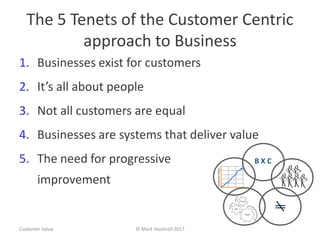
The 5 Tenets of the Customer Centric
approach to Business
1. Businesses exist for customers
2. It’s all about people
3. Not all customers are equal
4. Businesses are systems that deliver value
5. The need for progressive
improvement
Customer Value © Mark Hocknell 2017
CustomerValue
B X C
===
Customer portfolios and profit
Customer spend and advocacy
The Two-way Value Exchange
Customer Value © Mark Hocknell 2017
Customer portfolios and value
Key takeaways
• Customer portfolio is the net sum value for the
business
• Not all customers are equal
– In how they gain value from the business
– Or in how they reciprocate value (spend/advocacy)
– Correlation between the Two-way Exchange of value an
advocacy (positive word of mouth)
• Businesses embody the 80/20 principle
• Customer portfolios are created by the business
– through implicit and explicit action
– a focus on revenue or product sales only
Customer Value © Mark Hocknell 2017
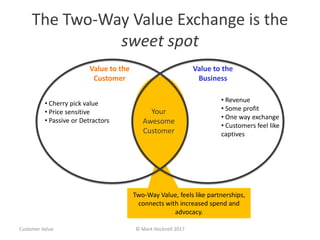
Two-Way Value, feels like partnerships,
connects with increased spend and
advocacy.
The Two-Way Value Exchange is the
sweet spot
Customer Value © Mark Hocknell 2017
Value to the
Business
Value to the
Customer
• Revenue
• Some profit
• One way exchange
• Customers feel like
captives
• Cherry pick value
• Price sensitive
• Passive or Detractors
Your
Awesome
Customer
Business Alignment with
Customer Intent
Businesses are systems that deliver value for
customers
Customer Groups
Customer Value
Customer Value © Mark Hocknell 2017
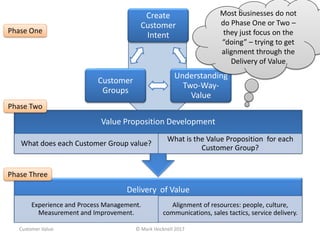
Create
Customer
Intent
Understanding
Two-Way-
Value
Customer
Groups
Delivery of Value
Experience and Process Management.
Measurement and Improvement.
Alignment of resources: people, culture,
communications, sales tactics, service delivery.
Value Proposition Development
What does each Customer Group value?
What is the Value Proposition for each
Customer Group?
Phase One
Phase Three
Phase Two
© Mark Hocknell 2017Customer Value
Most businesses do not
do Phase One or Two –
they just focus on the
“doing” – trying to get
alignment through the
Delivery of Value
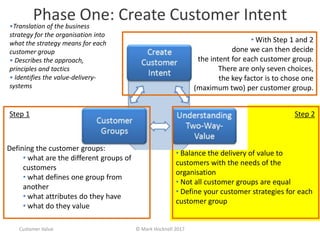
Phase One: Create Customer Intent
Defining the customer groups:
• what are the different groups of
customers
• what defines one group from
another
• what attributes do they have
• what do they value
Step 2
• Balance the delivery of value to
customers with the needs of the
organisation
• Not all customer groups are equal
• Define your customer strategies for each
customer group
Step 1
• With Step 1 and 2
done we can then decide
the intent for each customer group.
There are only seven choices,
the key factor is to chose one
(maximum two) per customer group.
•Translation of the business
strategy for the organisation into
what the strategy means for each
customer group
• Describes the approach,
principles and tactics
• Identifies the value-delivery-
systems
Customer Value © Mark Hocknell 2017
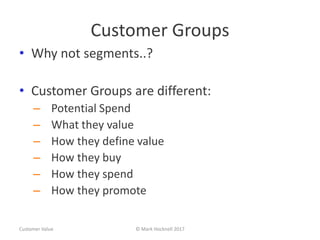
Customer Groups
• Why not segments..?
• Customer Groups are different:
– Potential Spend
– What they value
– How they define value
– How they buy
– How they spend
– How they promote
Customer Value © Mark Hocknell 2017
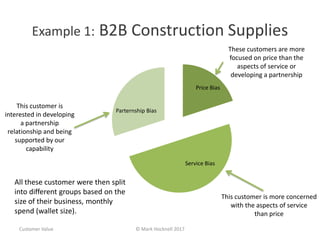
Example 1: B2B Construction Supplies
Price Bias
Service Bias
Parternship Bias
These customers are more
focused on price than the
aspects of service or
developing a partnership
This customer is more concerned
with the aspects of service
than price
This customer is
interested in developing
a partnership
relationship and being
supported by our
capability
Customer Value © Mark Hocknell 2017
All these customer were then split
into different groups based on the
size of their business, monthly
spend (wallet size).
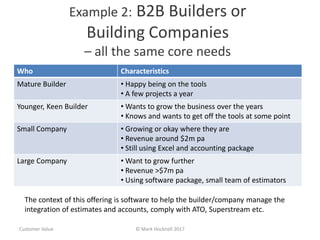
Example 2: B2B Builders or
Building Companies
– all the same core needs
Who Characteristics
Mature Builder • Happy being on the tools
• A few projects a year
Younger, Keen Builder • Wants to grow the business over the years
• Knows and wants to get off the tools at some point
Small Company • Growing or okay where they are
• Revenue around $2m pa
• Still using Excel and accounting package
Large Company • Want to grow further
• Revenue >$7m pa
• Using software package, small team of estimators
Customer Value © Mark Hocknell 2017
The context of this offering is software to help the builder/company manage the
integration of estimates and accounts, comply with ATO, Superstream etc.
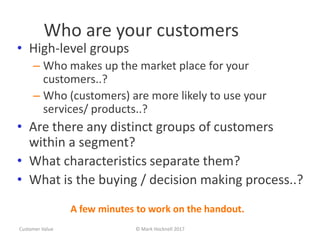
Who are your customers
• High-level groups
– Who makes up the market place for your
customers..?
– Who (customers) are more likely to use your
services/ products..?
• Are there any distinct groups of customers
within a segment?
• What characteristics separate them?
• What is the buying / decision making process..?
Customer Value © Mark Hocknell 2017
A few minutes to work on the handout.
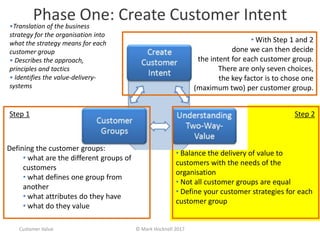
Phase One: Create Customer Intent
Defining the customer groups:
• what are the different groups of
customers
• what defines one group from
another
• what attributes do they have
• what do they value
Step 2
• Balance the delivery of value to
customers with the needs of the
organisation
• Not all customer groups are equal
• Define your customer strategies for each
customer group
Step 1
• With Step 1 and 2
done we can then decide
the intent for each customer group.
There are only seven choices,
the key factor is to chose one
(maximum two) per customer group.
•Translation of the business
strategy for the organisation into
what the strategy means for each
customer group
• Describes the approach,
principles and tactics
• Identifies the value-delivery-
systems
Customer Value © Mark Hocknell 2017
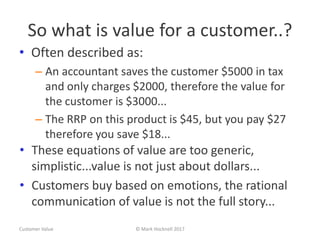
So what is value for a customer..?
• Often described as:
– An accountant saves the customer $5000 in tax
and only charges $2000, therefore the value for
the customer is $3000...
– The RRP on this product is $45, but you pay $27
therefore you save $18...
Customer Value © Mark Hocknell 2017
• These equations of value are too generic,
simplistic...value is not just about dollars...
• Customers buy based on emotions, the rational
communication of value is not the full story...
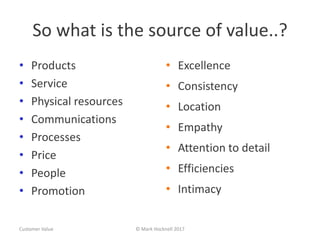
So what is the source of value..?
• Products
• Service
• Physical resources
• Communications
• Processes
• Price
• People
• Promotion
• Excellence
• Consistency
• Location
• Empathy
• Attention to detail
• Efficiencies
• Intimacy
Customer Value © Mark Hocknell 2017
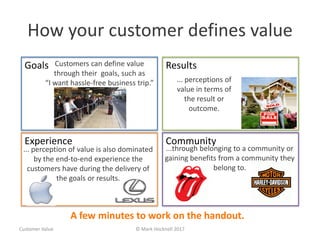
How your customer defines value
Customer Value © Mark Hocknell 2017
Goals Results
Experience Community
Customers can define value
through their goals, such as
“I want hassle-free business trip.”
...through belonging to a community or
gaining benefits from a community they
belong to.
... perception of value is also dominated
by the end-to-end experience the
customers have during the delivery of
the goals or results.
... perceptions of
value in terms of
the result or
outcome.
A few minutes to work on the handout.
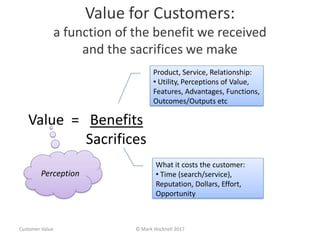
Value for Customers:
a function of the benefit we received
and the sacrifices we make
Value = Benefits
Sacrifices
© Mark Hocknell 2017
What it costs the customer:
• Time (search/service),
Reputation, Dollars, Effort,
Opportunity
Product, Service, Relationship:
• Utility, Perceptions of Value,
Features, Advantages, Functions,
Outcomes/Outputs etc
Customer Value
Perception
Customer Value © Mark Hocknell 2017
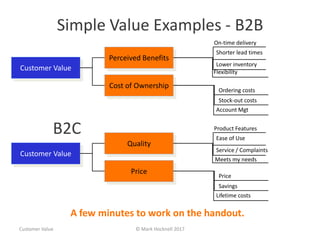
Simple Value Examples - B2B
Customer Value
Cost of Ownership
Perceived Benefits
On-time delivery
Shorter lead times
Flexibility
Lower inventory
Ordering costs
Stock-out costs
Account Mgt
B2C
Customer Value
Price
Quality
Product Features
Ease of Use
Meets my needs
Service / Complaints
Price
Savings
Lifetime costs
A few minutes to work on the handout.
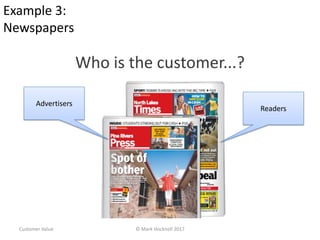
Who is the customer...?
Advertisers
Readers
© Mark Hocknell 2017Customer Value
Example 3:
Newspapers
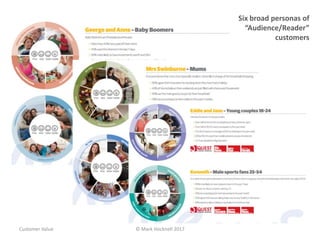
Six broad personas of
“Audience/Reader”
customers
© Mark Hocknell 2017Customer Value
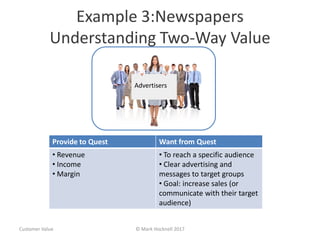
Example 3:Newspapers
Understanding Two-Way Value
© Mark Hocknell 2017
Advertisers
Provide to Quest Want from Quest
• Revenue
• Income
• Margin
• To reach a specific audience
• Clear advertising and
messages to target groups
• Goal: increase sales (or
communicate with their target
audience)
Customer Value
Example 3: Newspapers
Understanding Two-Way Value
© Mark Hocknell 2017
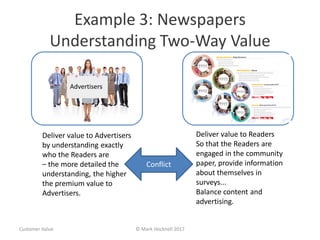
Advertisers
Deliver value to Readers
So that the Readers are
engaged in the community
paper, provide information
about themselves in
surveys...
Balance content and
advertising.
Deliver value to Advertisers
by understanding exactly
who the Readers are
– the more detailed the
understanding, the higher
the premium value to
Advertisers.
Conflict
Customer Value
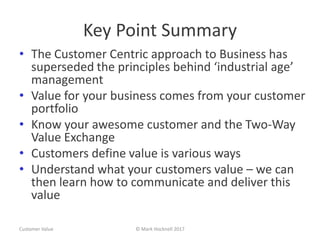
Key Point Summary
• The Customer Centric approach to Business has
superseded the principles behind ‘industrial age’
management
• Value for your business comes from your customer
portfolio
• Know your awesome customer and the Two-Way
Value Exchange
• Customers define value is various ways
• Understand what your customers value – we can
then learn how to communicate and deliver this
value
Customer Value © Mark Hocknell 2017
“What does your
customer value..?”
© Mark Hocknell 2017Customer Value
Get in touch:
www.markhocknell.com
Mark@markhocknell.com
LinkedIn
WHY:
• We are on a mission to rid the world of management thinking that belongs to the
previous century
• We are here to apply the tenets of the customer centric approach to business, and
reap the benefits of higher profitability and engagement (with people – customers and
employees)
WHAT:
• Workshops and engagements, consulting and coaching
• Monthly email newsletter with key insights
• Customer Centric Business on YouTube
How:
• Collaborative adventures in learning

How does your customer define value July 2017 for slide share

  • 1.
    “How does yourcustomer define value..? ” Understand customer value so you can focus on what value to deliver... © Mark Hocknell 2017Customer Value In collaboration with PurposefulCX Meetup and Fishburners Brisbane Mark Hocknell
  • 2.
    Overview • Customer Centricapproach to Business • Customer Portfolios and profit – Customer spend and advocacy • Business Alignment with Customer Intent – Customer Groups • Customer Value © Mark Hocknell 2017Customer Value
  • 3.
    The Customer Centricapproach to Business Reject the industrial age models and structures that are now superseded Customer Value © Mark Hocknell 2017
  • 4.
    Customer Centric Business •Early commerce was relationship based • Industrial age focused on making things – production and distribution • Today: – Digital Age – Relationship Age – Connection Economy – Experience Economy Customer Value © Mark Hocknell 2017 This signals a change. We can’t keep using the industrial age business models and thinking. The customer centric approach to business is matched to this new age.
  • 5.
    The 5 Tenetsof the Customer Centric approach to Business 1. Businesses exist for customers 2. It’s all about people 3. Not all customers are equal 4. Businesses are systems that deliver value 5. The need for progressive improvement Customer Value © Mark Hocknell 2017 CustomerValue B X C ===
  • 6.
    Customer portfolios andprofit Customer spend and advocacy The Two-way Value Exchange Customer Value © Mark Hocknell 2017
  • 7.
    Customer portfolios andvalue Key takeaways • Customer portfolio is the net sum value for the business • Not all customers are equal – In how they gain value from the business – Or in how they reciprocate value (spend/advocacy) – Correlation between the Two-way Exchange of value an advocacy (positive word of mouth) • Businesses embody the 80/20 principle • Customer portfolios are created by the business – through implicit and explicit action – a focus on revenue or product sales only Customer Value © Mark Hocknell 2017
  • 8.
    Two-Way Value, feelslike partnerships, connects with increased spend and advocacy. The Two-Way Value Exchange is the sweet spot Customer Value © Mark Hocknell 2017 Value to the Business Value to the Customer • Revenue • Some profit • One way exchange • Customers feel like captives • Cherry pick value • Price sensitive • Passive or Detractors Your Awesome Customer
  • 9.
    Business Alignment with CustomerIntent Businesses are systems that deliver value for customers Customer Groups Customer Value Customer Value © Mark Hocknell 2017
  • 10.
    Create Customer Intent Understanding Two-Way- Value Customer Groups Delivery of Value Experienceand Process Management. Measurement and Improvement. Alignment of resources: people, culture, communications, sales tactics, service delivery. Value Proposition Development What does each Customer Group value? What is the Value Proposition for each Customer Group? Phase One Phase Three Phase Two © Mark Hocknell 2017Customer Value Most businesses do not do Phase One or Two – they just focus on the “doing” – trying to get alignment through the Delivery of Value
  • 11.
    Phase One: CreateCustomer Intent Defining the customer groups: • what are the different groups of customers • what defines one group from another • what attributes do they have • what do they value Step 2 • Balance the delivery of value to customers with the needs of the organisation • Not all customer groups are equal • Define your customer strategies for each customer group Step 1 • With Step 1 and 2 done we can then decide the intent for each customer group. There are only seven choices, the key factor is to chose one (maximum two) per customer group. •Translation of the business strategy for the organisation into what the strategy means for each customer group • Describes the approach, principles and tactics • Identifies the value-delivery- systems Customer Value © Mark Hocknell 2017
  • 12.
    Customer Groups • Whynot segments..? • Customer Groups are different: – Potential Spend – What they value – How they define value – How they buy – How they spend – How they promote Customer Value © Mark Hocknell 2017
  • 13.
    Example 1: B2BConstruction Supplies Price Bias Service Bias Parternship Bias These customers are more focused on price than the aspects of service or developing a partnership This customer is more concerned with the aspects of service than price This customer is interested in developing a partnership relationship and being supported by our capability Customer Value © Mark Hocknell 2017 All these customer were then split into different groups based on the size of their business, monthly spend (wallet size).
  • 14.
    Example 2: B2BBuilders or Building Companies – all the same core needs Who Characteristics Mature Builder • Happy being on the tools • A few projects a year Younger, Keen Builder • Wants to grow the business over the years • Knows and wants to get off the tools at some point Small Company • Growing or okay where they are • Revenue around $2m pa • Still using Excel and accounting package Large Company • Want to grow further • Revenue >$7m pa • Using software package, small team of estimators Customer Value © Mark Hocknell 2017 The context of this offering is software to help the builder/company manage the integration of estimates and accounts, comply with ATO, Superstream etc.
  • 15.
    Who are yourcustomers • High-level groups – Who makes up the market place for your customers..? – Who (customers) are more likely to use your services/ products..? • Are there any distinct groups of customers within a segment? • What characteristics separate them? • What is the buying / decision making process..? Customer Value © Mark Hocknell 2017 A few minutes to work on the handout.
  • 16.
    Phase One: CreateCustomer Intent Defining the customer groups: • what are the different groups of customers • what defines one group from another • what attributes do they have • what do they value Step 2 • Balance the delivery of value to customers with the needs of the organisation • Not all customer groups are equal • Define your customer strategies for each customer group Step 1 • With Step 1 and 2 done we can then decide the intent for each customer group. There are only seven choices, the key factor is to chose one (maximum two) per customer group. •Translation of the business strategy for the organisation into what the strategy means for each customer group • Describes the approach, principles and tactics • Identifies the value-delivery- systems Customer Value © Mark Hocknell 2017
  • 17.
    So what isvalue for a customer..? • Often described as: – An accountant saves the customer $5000 in tax and only charges $2000, therefore the value for the customer is $3000... – The RRP on this product is $45, but you pay $27 therefore you save $18... Customer Value © Mark Hocknell 2017 • These equations of value are too generic, simplistic...value is not just about dollars... • Customers buy based on emotions, the rational communication of value is not the full story...
  • 18.
    So what isthe source of value..? • Products • Service • Physical resources • Communications • Processes • Price • People • Promotion • Excellence • Consistency • Location • Empathy • Attention to detail • Efficiencies • Intimacy Customer Value © Mark Hocknell 2017
  • 19.
    How your customerdefines value Customer Value © Mark Hocknell 2017 Goals Results Experience Community Customers can define value through their goals, such as “I want hassle-free business trip.” ...through belonging to a community or gaining benefits from a community they belong to. ... perception of value is also dominated by the end-to-end experience the customers have during the delivery of the goals or results. ... perceptions of value in terms of the result or outcome. A few minutes to work on the handout.
  • 20.
    Value for Customers: afunction of the benefit we received and the sacrifices we make Value = Benefits Sacrifices © Mark Hocknell 2017 What it costs the customer: • Time (search/service), Reputation, Dollars, Effort, Opportunity Product, Service, Relationship: • Utility, Perceptions of Value, Features, Advantages, Functions, Outcomes/Outputs etc Customer Value Perception
  • 21.
    Customer Value ©Mark Hocknell 2017 Simple Value Examples - B2B Customer Value Cost of Ownership Perceived Benefits On-time delivery Shorter lead times Flexibility Lower inventory Ordering costs Stock-out costs Account Mgt B2C Customer Value Price Quality Product Features Ease of Use Meets my needs Service / Complaints Price Savings Lifetime costs A few minutes to work on the handout.
  • 22.
    Who is thecustomer...? Advertisers Readers © Mark Hocknell 2017Customer Value Example 3: Newspapers
  • 23.
    Six broad personasof “Audience/Reader” customers © Mark Hocknell 2017Customer Value
  • 24.
    Example 3:Newspapers Understanding Two-WayValue © Mark Hocknell 2017 Advertisers Provide to Quest Want from Quest • Revenue • Income • Margin • To reach a specific audience • Clear advertising and messages to target groups • Goal: increase sales (or communicate with their target audience) Customer Value
  • 25.
    Example 3: Newspapers UnderstandingTwo-Way Value © Mark Hocknell 2017 Advertisers Deliver value to Readers So that the Readers are engaged in the community paper, provide information about themselves in surveys... Balance content and advertising. Deliver value to Advertisers by understanding exactly who the Readers are – the more detailed the understanding, the higher the premium value to Advertisers. Conflict Customer Value
  • 26.
    Key Point Summary •The Customer Centric approach to Business has superseded the principles behind ‘industrial age’ management • Value for your business comes from your customer portfolio • Know your awesome customer and the Two-Way Value Exchange • Customers define value is various ways • Understand what your customers value – we can then learn how to communicate and deliver this value Customer Value © Mark Hocknell 2017
  • 27.
    “What does your customervalue..?” © Mark Hocknell 2017Customer Value Get in touch: www.markhocknell.com Mark@markhocknell.com LinkedIn WHY: • We are on a mission to rid the world of management thinking that belongs to the previous century • We are here to apply the tenets of the customer centric approach to business, and reap the benefits of higher profitability and engagement (with people – customers and employees) WHAT: • Workshops and engagements, consulting and coaching • Monthly email newsletter with key insights • Customer Centric Business on YouTube How: • Collaborative adventures in learning