jerrs ranging     fiiom the basic meLa-       Now considrr a diffcrrnt    situation,
phor to the choice of background          one I have witnessed first-hand        over
color. The team .just barely has time     the past few months: a development
to incorporatr    these comments into a   team spends weeks designing         an in-
rwiscd     design    brforr committing    terface.    During   the first few days,
                                          they construct     a paper prototype      of
                                          their initial thinking about all aspects
                                          of the design, and test it with typical
         by Marc Rettig                   representatives     of the user commu-
nity. One of them “plays computer,”                      The Problems with Hi-Fi                                    In contrast,      the hand-made           ap-
moving components             of the paper in-           For years developers      have used ev-                pearance of a paper or acetate proto-
terface around          on the table in re-              erything from demo-builders       to mul-              type forces users to think about con-
sponse to the users’ actions. The oth-                   timedia tools to high-level    languages               tent rather than appearance.
ers observe and take notes. After the                    to build prototypes.   Lo-fi proponents                l Developers     resist changes. They are
tests they take a week to distill lessons                call these “hi-h prototypes.”       They               attached t” their work because it was
from their observations,             redesign the        have their place: selling an idea, test-               so hard to implement.          Spend enough
interface, and retest with several new                   ing look-and-feel,   detailed proof-of-                time crafting something          and you are
users. This process continues until, at                  concept, testing changes to an exist-                  likely to fall in love with it. Knowing
the end of the time allotted for inter-                  ing system, and so forth. I’m not sug-                 this, team members           may feel reluc-
face design,        the team has revised                 gesting   we should      stop building                 tant t” suggest that their colleague
their design four times and tested it                    them. But they also have problems.                     should make drastic changes to the
with many typical users.                                                                                        lovely looking,       weeks-in-the-making
    This technique-building                  proto-      l Heji    ~ro@#~e.i take too long to budd              software prototype.          They would bc
types on paper and testing them with                     andchange. Even with high-level tools,                 less hesitant to suggest redrawing              a
real users-is        called low-fidelity pro-            a fully functional      prototype       can take       sketch that took an hour to create.
totyping     or “lo-t7         for short. The            weeks to create. I have seen teams                     . A @,tot@e in software can .sel e$mLa-
value of promtyping            is widely recog-          build a complete working lo-Ii proto-                  lions thrill wzll be hard to change. Proto-
nized, but as thr first situation exenl-                 type in four hours. The goal is to get                 typing tools let you do wonderful
plilies, that value is not always gained                 through as many iterations as you can                  things in a (relatively) short time. You
in practice. If that has brrn your ex-                   during     the design        phase,      because       can make something           that looks like a
perience,     you might want t” try lo-C                 each iteration means improvement.                 If   finished product,        fooling testers and
promtyping,          which       requires      little    testing flushes out problems with the                  even management           into thinking how
more in the way of implementation                        basic metaphor        or control structure             far you are along. If it tests well, you
skills than the ones you learned                    in   in a design, changing           the prototype          may wind up spending             time on “re-
kindergarten.                                            can again take weeks. This is what                     verse     damage       control,”     handling
     The idea oflo-fi prototyping            (a.k.a.     Debbie Hix and Rex Hartson,                     re-    questions     about your sudden lack of
“paper prototypes”)           has been around            searchers     and faculty members                at    progress.
a long time. So long, in fact, that                      Virginia Tech, call the “Software de-                  l A single bug in a hi-/i protolype fun

nmre than one person in the CHI                          veloper’s dilemma.”         You can’t evalu-           bring a lest lo n comfilele halt. To test
community        expressed        surprise when          ate an interaction      design until after it          effectively, your prototype        needs to be
 I said I was planning            to write a col-        is built, but after building, changes t”               complete and robust enough for some-
umn on the subject. But I see this as a                  the design are difficult.                              one TV try to do something               useful
wonderfully       simple and effective tool                  Paper    prototypes,       on the       other      with it. Even with the coolest of high-
 that has somehow failed to come int”                    hand, are extremely           fast to develop          level tools, building a prototype is still
general use in the software commu-                       and the technique           is very easy to            essentially a programming           exercise-
 nity. I say this based on the success of                learn. It is the fastest of the so-called              and we all know how hard it can he t”
the teams I’ve watched over the past                     rapid     prototyping       techniques.         To     get all the bugs out of a program. On
several months together with the fact                    make a broad generalization,                inter-     the other hand, 1 often see teams cor-
that this is the first commercial              proj-     face designers       spend 95% of their                recting “hugs” in a paper prototype
ect where I’ve seen paper prototypes                     time thinking       about the design and               while the test is in progress.
employed.                                                anly 5% thinking about the mechan-
     Paper prototyping           is potentially      a   ics of thr t”“l. Software-based              tools,    A Trojan Meme
breakthrough          idea for organizations             no matter how well executed, rcversc                   The spread of lo-6 design through
that have never tried it, since it allows                this ratio.                                            my current project started with a visit
you to demonstrate             the behavior         of   l Reuiewm       and L&en lend lo commcnl               from Jared Spool (with User Inter-
an interface       very early in develop-                on “f;l nndfin~~h”rsua         You are trying          face Engineering      in Andover,   Mass.).
ment, and test designs with real users.                  m get feedback on the big things: the                  He and his associate presented          the
 If quality is partially a function of the               flow of the conversation,           the general        basic ideas, then put us to work in
 number of iterations and reftnements                    layout of the controls,          the terminol-         four trams to design and build a pro-
a design undergoes           before it hits the          ogy, the expressiveness          and power of          totype of an automated        menu for a
street, lo-fi prototyping          is a technique        the basic metaphor.        With a slick soft-          fast food restaurant.     For three hours
,that can dramatically         increase quality.         ware prototype,       you are just as likely           we discussed, designed, sketched and
 It is fast, it brings results early in de-              t” hear criticisms about your choice of                glued, then ran the results in a face-
velopment       (when it is relatively cheap             fonts, color combinations,           and button        off competition   with “real users” and
 to make changes), and allows a team                     sires. On the back side of the same                    a “real task.” That is, we brought
 to try far more ideas than they could                   coin, developers        easily become           ob-    people    in from elsewhere        in the
 with high-fidelity        prototypes.         Lo-fi     sessed with the prettiness-power               of a    building   and told them, “you have
 prototyping      helps you apply Fudd’s                 good tool, and spend               their hours         $4.92. Order as much food as you
 first law of creativity: “To get a good                 choosing colors instead of coming up                   can.” The designs were measured          by
 idra, grt lots of ideas.”                               with new ideas.                                        how quickly and efficiently         people
Lo-fi prototyping works because it effectively educates
developers to have a concern for usability and formative evalu-
ation, and because it maximizes the number of times you get to
        refine your design before you must commit to code.
could use the interfaces         without   once after the product is complete.         l  Various adhesives. Tape: clear, col-
coaching from the designers.         Be-   With summary evaluation you find            ored, double-backed,        pin stripin
tween tests, each team had a few min-      out how well you did, but you find          tape, whatever. Glue sticks, and most
utes to refine their interface.            out too late to make substantial            importantly, Post-It glue-a       stick of
   We were all impressed with the re-      changes.                                    the kind of glue that’s on the back of
suits of the exercise. In about six           Lo-ii prototyping works because it       those sticky yellow notes. Rolls of
hours we had learned the technique,        effectivelv educates dewlowers       to     white correction tape arc great for
designed an interface and built a          have a Concern for usability and            button labels and hurriedly written
model of it, conducted tests, and          formative evaluation, and because it        field contents.
measurably improved the original           maximizes the number of times you           l Various      markers-colored        pens
design. That was four months ago,          get to refine your design before you        and pencils, highlighters, tine and
and now we have scores of people           must commit to code. To make the            thick markers, pastels.
working on lo-ti designs, refining         most of these advantages, the proto-        l Lots of sticky note pads of various

them through repeated tests with ac-       typing effort needs to be carefully         sires and colors.
tual “sers. Interface     sketches are     planned and followed by adequate            l Acetate sheets--the    kind you USCIO
lying all over the place, scans are put    testing and evaluation. (It also helps      make overhead presentations.           Hix
on the network for peer review, and        to have someone who can enthusias-          and Hartson swear by these as the
terms like “affordance” and “mental        tically champion the idea.) Hix and         primary construction        material for
model” are common parlance.                Hartson have an excellent chapter on        lo-ii interfaces.
   I call this a “Trojan meme” instead     formative evaluation in their book,         l See what you find in the architrc-

ofjust a “selfish mcme” because it did     Develofing User Interfam If you plan        ture section. They have sheets of rub-
more than reproduce itself through         to adopt any of these techniques, I         on texture, for example, which could
the department. (A meme is an idea-        recommend you read their book.              give you an instant shading pattern.
the mental equivalent of a gene, and          The rest of this is drawn from our       l Scissors,    X-act” knives, straight-
selfish ones try to replicate them-        experience over dozens of designs           edges, Band-Aids.
selves in as many minds as possible.)      and scores of tests, notes from Jared
As it spread, it served as a vehicle for   Spool’s workshop,       and Hix and            Just like kindergartners,   lo-6 dr-
spreading a general appreciation of        Hartson’s book.                             signers sometimes find inspiration in
the value of usability design: develop-                                                the materials at hand. So go ahead-
ers saw first-hand the difference in       Building a Lo-F1 Prototype                  buy that package of colored construct
people’s reactions to successive re-       I. Assemble a kit. In this decadent         tion paper. The worst that can hap-
finements in their designs. Within         age of too many computers and too           pen is you won’t USC it. Eventually
days of designing an interface, they       few paint brushes, it might be hard to      your tram will develop their own con-
saw exactly how their work was per-        get all the materials you need by rum-      struction methods, and settle on a
ceived by people just like those who       maging through the supply closet in         list of essentials    for their     lo-ii
will eventually be using their prod-       the copy room. Make a trip to the of-       construction kit.
uct. The value of two important laws       fice supply store, or better yet, the art   2. Set a deadline. There is a terrific
of interaction design was memorably        supply store, and buy enough school         temptation to think long and hard
demonstrated:      “Know Your User,”       supplies to excite the creative im-         about each aspect of the interface be-
and “You Aren’t Your User.”                pulses of your team. Here’s a shop-         fore you commit anything to paper.
   Testing for iterative refinement is     ping list:                                  How should you arrange the menus?
known in the interface design com-                                                     What should be in a dialog box, what
munity as “formative evaluation,”          l White, unlined,   heavy paper that is     should be in menus, and what should
meaning you are evaluating your de-        bigger than letter size (11 by I7           be in a tool palette? When you are
sign while it is still in its formative    inches is nice), and heavy enough to        faced with a blank sheet of paper,
stages. Testing is used as a kind of       endure the rigors of repeated testing       these kinds of decisions crowd your
natural selection for ideas, helping       and revision.                               thoughts all at once. “Wait,” you
your design evolve toward a form           l Hundreds      of 5-by-&inch    cards.     think, ?ve haven’t thought about this
that will survive in the wilds of the      These come in handy as construction         enough!”
user community. This is in contrast to     material, and later you’ll use them by         That’s exactly the point: no matter
“summary evaluation,” which is done        the score for note taking during tests.     how hard you think about it, you
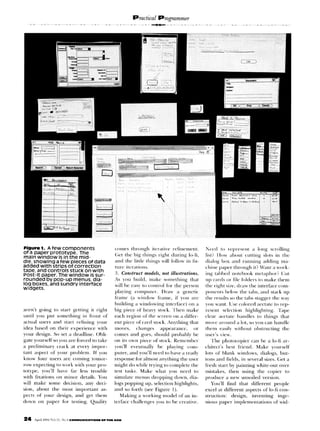
Ciawe I. Afewcomponents
Of a paper prototvpe.  The
main window is in the mid-
dle, showing a few Pieces of data
added with strips Of Correction
tape. and controls stuck on with
Post-It paper. The window is sur-
rounded by POP-UP menus, dia-
log boxes, and sundry interface
widgets.
gets, producing large amo”“ts of            preparation that will help lo-ii proto-    by the intrusion of a new system into
data, or rendering artistic and attrac-     typing become a normal part of your        their work (perhaps justifiably!), or
tive designs. Exploit these talenu and      design process. Preparing a widget         there may be a competitive situation
divide the labor accordingly.               library, writing down guidelines, and      that makes your employer reluctant
   Construct     a first version com-       taking time to train people will make      to expose “ew ideas outside the walls
pletely by hand. Sketch the widgets,        everyone     more   enthusiastic   and     of your building.
hand-letter    the labels. Don’t eve”       productive.                                    Since you are looking for appro-
worry about “sing a straightedge at                                                    priate knowledge and skills, not job
first. Just get the ideas down on           Preparing for a Test                       titles, you can often get by with “sur-
paper. Test small details on one an-        However much care you take in              rogate users”-people       who fit the
other, or drag people in from the hall      building your prototype, the tests will    same profile as your actual clients,
for quick tests of alternative solutions.   be ineffective unless you prepare well     but free from whatever association
   Of course, hand-draw” sketches,          for them. Be sure to attend to the fol-    that prevents you from testing with
no matter bow carefully done, may           lowing matters.                            the clients themselves. I’ve heard of
not be appropriate for some testing                                                    all kinds of tricks for attracting peo-
situations. For example, a customer          1. Select your trsers. Before you start   ple to the test. Spool says he’s done
may be willing to let you test your         designing, you should do enough            everything from running ads in the
design with actual users. They may          user and task analysis to understand       newspaper to recruiting university
understand the transience of the pro-       the people who will he using your          students to contacting       local user
totype, but you still want to make a        software--their      educational    and    groups. Anything to avoid using ac-
good impression. You want to look           training background,      knowledge of     tual customers, employees, or friends
sharp.                                      computers, their familiarity with the      and family. (The latter may be acces-
   Some of the teams on my project          domain, typical tasks involved in          sible, but there are a lot of things
have made remarkably           attractive   their job, and so on. Based on this        about sharing ties in the same social
paper interfaces using components           study, you can look for pools of po-       web that can conspire to damage a
created with drawing software, then         tential testers for your prototype.        usability test. For example, testers
printed on a laser printer. Some of         With a good user profile on band,          who know you or the project may
them build up a familiar look with          you can develop a questionnaire that       skew the results by trying hard to
elements taken from screen captures.        will help to choose the best represen-     please you or do what they think you
To facilitate this kind of thing, they      tative users from available candidates.    expect them to do.)
set up a library of lo-ti widget images:        If would seem reasonable to ar-            Finally, remember     that no two
blank buttons of all sizes, window and      range it so the people testing your        people are the same, and your prod-
dialog frames, scroll bars, entry tields,   prototype are the same people who          uct’s users may be a diverse group.
and so on. People print these out, re-      will be using the final product. But       Try to recruit testers that represent
size them on the photocopier, and           bona fide members of the user com-         the whole range of characteristics in
make them part of their standard lo-t7      munity may be hard to corral for the       your target audience. Our practice
kit. Or they resize them on the com-        time it takes to run a test, and using     has been to conduct at least one
puter, add labels, and print o”t a cm-      them may not be the best idea in the
tom part for their work in progress.        long run. Be sensitive to the political
   This is a” example of the kind of        climate. People may feel threatened        elgure2.   A lo-fl testing   session
Practical        Progmmmer
                        ..    .e     _..    bb    _L.    ~__ -w..                                 ..-.

mund of resting in our off& with                  the only team member who is allowed                     the sessions) so it points down over
surrogates,      then go t” the field fog         to speak freely during the test. Facili-                the user’s shoulder t” lo”k at the in-
testing    with the m”st typical end              tating means three things: giving the                   terface and the hands moving over it.
users we can find.                                user instructions,          encouraging         the     No ““e’s face ever appears on tape.
2. Prepare test scenarios. Write a set            user t” express his or her thoughts                         During     the test, the Facilitator
of scenarios, preferably       drawn fl-om        during the test, and making sure ev-                    hands written tasks t” the user one at
task analysis, describing      the product        crything gets donr on time. This is a                   a time. These must be very clear and
during use in a typical work situati”n.           difficult enough job that the facili-                   detailed. As the person works on each
Design your prototype         to support a        tat”r should not be expected t” take                    task, the facilitator tries t” elicit the
few of these scenarios, narrowing           the   notes during a session.                                 user’s thr,ughts      without influencing
scope of your &orts f” a reasonably               l Compulw. One tram            member acts as           his or her choicer. “What are you
small set of functions,          but broad        the “computer.”         He or she knows the             thinking    right now?” “What quca-
enough t” allow meaningful          tests.        application I”gic thowughly,           and sus-         ti”ns are “n your mind?” “Are you
    If possible, ask someone t” review            tains the illusion that the paper pi”-                  confused about what you’re seeing?”
the scenarios and sample data and                 totype behaves similar to a real com-                       While this is going on, the rest of
tell you whether they look realistic. In          puter      (with      an     unusually        slow      the tram members “bsrrve and take
our experience,        people find a lo-fi        response       time). A pointing           fingel-      notes, and may occasionally interject
interface more engaging-more             real-    serves as a cursor, and expressions                     a question.       But they must never
istic-if   it shows data that looks famil-        like,       “I        ‘YP’       ‘half-silvered         laugh, gape, say “a-ha.” nudge one
iar and we ask them t” perform real-              bicuspidon         in that field” substitute            another,    “r “then-wise display their
istic tasks. This helps draw them into            for keyboard           entry.    If the use,.           reaction to what’s happening        to their
the “let’s pretend you’re really using            touches a control, the computer                  in-    careful design. This kind of thing can
a cnmputer at your job” world, which              ranges the prototype          t” simulate the           intimidate or humiliate users. ruining
leads to better tests. On the other               response,      taking care not t” explain               the arlationship     and spoiling the test.
hand, unrealistic scenari”s and data              anything other than the bebavi”~- of                    It can be terribly difficult to keep still
can severely damage the credibility of            the interface.                                          while the user spends           IO minutea
your design.                                      l Obsuwrs.        The rest of the tram                  using all the wrong conools for all the
3. Practice. Just as a bug in a soft-             members quietly take notes “n s-by-                     wnmg reasons. You will feel a com-
ware prototype        can ruin a test se,-        X-inch index cards, writing one ob-                     pelling urge to explain the de+             t”
sion, so can a bug in a lo-fi prototype.          servation prr card. If they think “1 a                  your users. Don’t give in.
That bug could be a missing compw                 recommended           solwi”n, they write it                When the hour is over, we spend a
“em, a misunderstanding         “n the pan        on the same card that record,                   the      IO-minute debriefing       session asking
“f the person playing “computer,”            “I   problem.                                                questions,      gathering     imp,-essions,
even excessive hesitation and c”nf&                    Since all of these r”les can be ex-                and expressing      our thanks.
Sian because the team is unfamiliar-              hausting, we rotate them among the
with how to conduct          a tat. So to         tram when we amduct                more than            Evaluating ReSultS
avoid embarrassment,          conduct      xv-    OFF session a day (and we very “lien                    I.“-fi “1 hi-Ii, prrnotyping    is worthleas
eral dry runs belore you test with                schedule low sessions in a day).                        unless information        is gathered      and
people from outside your team. Each                   Typical tat sessions usually last a                 the product is relined based on you)
team member should be comfortable                 little wee- an haul-, and go through                    findings. As I wr”te earlier, Hix and
with his or her role, and you need I”             three phases: getting ready, conduct-                   Harts””     nicety cover the details of
make SUE you have the supplies and                ing the test, and debriefing.         We begin          gathering and analyzing trst data. We
equipment        needed    TV gather gaod         with greetings,          introductiwr.           ire-   spend quite a bit of time (at least a
information.                                      frrshmrnts       and general ire-bl-eaking,             day per iteration) sorting and priori-
                                                  trying our very best to assuw people                    tizing the n”tr cards we wr”tr during
Conducting a Test                                 that the test is confidenti         the results         the test sessions.      Ow methr,d          in-
We find it takes four pcoplc t” get tbr           will remain         anonymous,      and their           volves arranging the paper prototype
mat “ut of a test session (see Figure             supervisor      won’t hear a w”rd about                 “n a big table. then piling the n”tc
2). and that their activities fall int”           whether or not they “got it.” people                    cards next t” its relevant          interface
four essential roles:                             often say things like, “Am I flunking                   component.       Then      team members
                                                  the test? Am I getting it right?” To                    divide the labor ofgoing through the
l   Greeler. Much the same as the usher           which we anwet-, “Don’t worry, the                      piles t” summarize      and prioritize rhc
in a church,     thr greeter   welc”mes           qurstion     is whether       or not we are             problems.
users and tries t” put them at ease.              flunking. The interface is on trial, not                    These sorted piles inform a written
We have some forms we ask people t”               you. If you fail t” understand             some-        report on findings from the test, and
lill out-an     experience   profile, for         thing or can’t complete            one of the           form the agrnda of a merting t” dis-
example--a     job the greeter handles            tasks, that’s a sign of trouble with the                cuss recommended           changes     f” the
while other team members are setting              design, not a lack of intelligence               on     design. The team warks through the
up for the test.                                  your part.”                                             piles    and     agrees      “n   suggested
l Facililnlor. Once the test is set up,                While this is going “n, someone                    changes, which are written on Post-It
the facilitator takes the lead, and is            positkms a video camera (we tape all                    n”tes and affixed directly to the rele-
,...
     L      _.   ,..       .   .   .   .    .     LL    _.b.              >


van, part of the paper prototype.
Constructing    the revised prototype
becomes     a procrss   of taking each
component,    and following the recom-
mendations    that were stuck to it.


Hix, who for years has been teaching
courses and workshops            in interface
design, says that people consistently
enter the tint lo-f, exercise with skep-
ticism. After trying it they invariably
say something        to the extent of, “I
can’t believe how much we learned
from this!” If this column is the first
place you have heard about the lo4
technique, one danger is that you will
set aside this magazine            with just
enough      skepticism      that,   however
much interest I’ve managed to create,
you will fail to actually try it.
    Having seen other skeptics con-
verted, I’m confident in recommend-
ing this technique.        If you already
have a working high-fidelity           proto-
type, it probably isn’t worth abandon-
ing that course to switch to lo-L But if
you are in the very early stages of de-
sign and exploring        broad questions,
or if you need to learn more now,
lo-fi prototyping      is just the tool to
pick up. 0


Ku&l,     J. and knee.                     s.   Twn,y-two           ups
for a happier,            healthirr prototype.                 lnlerar.
I, I “a”.              ,994). 35-4”.

Rettig onprototyping

  • 1.
    jerrs ranging fiiom the basic meLa- Now considrr a diffcrrnt situation, phor to the choice of background one I have witnessed first-hand over color. The team .just barely has time the past few months: a development to incorporatr these comments into a team spends weeks designing an in- rwiscd design brforr committing terface. During the first few days, they construct a paper prototype of their initial thinking about all aspects of the design, and test it with typical by Marc Rettig representatives of the user commu-
  • 2.
    nity. One ofthem “plays computer,” The Problems with Hi-Fi In contrast, the hand-made ap- moving components of the paper in- For years developers have used ev- pearance of a paper or acetate proto- terface around on the table in re- erything from demo-builders to mul- type forces users to think about con- sponse to the users’ actions. The oth- timedia tools to high-level languages tent rather than appearance. ers observe and take notes. After the to build prototypes. Lo-fi proponents l Developers resist changes. They are tests they take a week to distill lessons call these “hi-h prototypes.” They attached t” their work because it was from their observations, redesign the have their place: selling an idea, test- so hard to implement. Spend enough interface, and retest with several new ing look-and-feel, detailed proof-of- time crafting something and you are users. This process continues until, at concept, testing changes to an exist- likely to fall in love with it. Knowing the end of the time allotted for inter- ing system, and so forth. I’m not sug- this, team members may feel reluc- face design, the team has revised gesting we should stop building tant t” suggest that their colleague their design four times and tested it them. But they also have problems. should make drastic changes to the with many typical users. lovely looking, weeks-in-the-making This technique-building proto- l Heji ~ro@#~e.i take too long to budd software prototype. They would bc types on paper and testing them with andchange. Even with high-level tools, less hesitant to suggest redrawing a real users-is called low-fidelity pro- a fully functional prototype can take sketch that took an hour to create. totyping or “lo-t7 for short. The weeks to create. I have seen teams . A @,tot@e in software can .sel e$mLa- value of promtyping is widely recog- build a complete working lo-Ii proto- lions thrill wzll be hard to change. Proto- nized, but as thr first situation exenl- type in four hours. The goal is to get typing tools let you do wonderful plilies, that value is not always gained through as many iterations as you can things in a (relatively) short time. You in practice. If that has brrn your ex- during the design phase, because can make something that looks like a perience, you might want t” try lo-C each iteration means improvement. If finished product, fooling testers and promtyping, which requires little testing flushes out problems with the even management into thinking how more in the way of implementation basic metaphor or control structure far you are along. If it tests well, you skills than the ones you learned in in a design, changing the prototype may wind up spending time on “re- kindergarten. can again take weeks. This is what verse damage control,” handling The idea oflo-fi prototyping (a.k.a. Debbie Hix and Rex Hartson, re- questions about your sudden lack of “paper prototypes”) has been around searchers and faculty members at progress. a long time. So long, in fact, that Virginia Tech, call the “Software de- l A single bug in a hi-/i protolype fun nmre than one person in the CHI veloper’s dilemma.” You can’t evalu- bring a lest lo n comfilele halt. To test community expressed surprise when ate an interaction design until after it effectively, your prototype needs to be I said I was planning to write a col- is built, but after building, changes t” complete and robust enough for some- umn on the subject. But I see this as a the design are difficult. one TV try to do something useful wonderfully simple and effective tool Paper prototypes, on the other with it. Even with the coolest of high- that has somehow failed to come int” hand, are extremely fast to develop level tools, building a prototype is still general use in the software commu- and the technique is very easy to essentially a programming exercise- nity. I say this based on the success of learn. It is the fastest of the so-called and we all know how hard it can he t” the teams I’ve watched over the past rapid prototyping techniques. To get all the bugs out of a program. On several months together with the fact make a broad generalization, inter- the other hand, 1 often see teams cor- that this is the first commercial proj- face designers spend 95% of their recting “hugs” in a paper prototype ect where I’ve seen paper prototypes time thinking about the design and while the test is in progress. employed. anly 5% thinking about the mechan- Paper prototyping is potentially a ics of thr t”“l. Software-based tools, A Trojan Meme breakthrough idea for organizations no matter how well executed, rcversc The spread of lo-6 design through that have never tried it, since it allows this ratio. my current project started with a visit you to demonstrate the behavior of l Reuiewm and L&en lend lo commcnl from Jared Spool (with User Inter- an interface very early in develop- on “f;l nndfin~~h”rsua You are trying face Engineering in Andover, Mass.). ment, and test designs with real users. m get feedback on the big things: the He and his associate presented the If quality is partially a function of the flow of the conversation, the general basic ideas, then put us to work in number of iterations and reftnements layout of the controls, the terminol- four trams to design and build a pro- a design undergoes before it hits the ogy, the expressiveness and power of totype of an automated menu for a street, lo-fi prototyping is a technique the basic metaphor. With a slick soft- fast food restaurant. For three hours ,that can dramatically increase quality. ware prototype, you are just as likely we discussed, designed, sketched and It is fast, it brings results early in de- t” hear criticisms about your choice of glued, then ran the results in a face- velopment (when it is relatively cheap fonts, color combinations, and button off competition with “real users” and to make changes), and allows a team sires. On the back side of the same a “real task.” That is, we brought to try far more ideas than they could coin, developers easily become ob- people in from elsewhere in the with high-fidelity prototypes. Lo-fi sessed with the prettiness-power of a building and told them, “you have prototyping helps you apply Fudd’s good tool, and spend their hours $4.92. Order as much food as you first law of creativity: “To get a good choosing colors instead of coming up can.” The designs were measured by idra, grt lots of ideas.” with new ideas. how quickly and efficiently people
  • 3.
    Lo-fi prototyping worksbecause it effectively educates developers to have a concern for usability and formative evalu- ation, and because it maximizes the number of times you get to refine your design before you must commit to code. could use the interfaces without once after the product is complete. l Various adhesives. Tape: clear, col- coaching from the designers. Be- With summary evaluation you find ored, double-backed, pin stripin tween tests, each team had a few min- out how well you did, but you find tape, whatever. Glue sticks, and most utes to refine their interface. out too late to make substantial importantly, Post-It glue-a stick of We were all impressed with the re- changes. the kind of glue that’s on the back of suits of the exercise. In about six Lo-ii prototyping works because it those sticky yellow notes. Rolls of hours we had learned the technique, effectivelv educates dewlowers to white correction tape arc great for designed an interface and built a have a Concern for usability and button labels and hurriedly written model of it, conducted tests, and formative evaluation, and because it field contents. measurably improved the original maximizes the number of times you l Various markers-colored pens design. That was four months ago, get to refine your design before you and pencils, highlighters, tine and and now we have scores of people must commit to code. To make the thick markers, pastels. working on lo-ti designs, refining most of these advantages, the proto- l Lots of sticky note pads of various them through repeated tests with ac- typing effort needs to be carefully sires and colors. tual “sers. Interface sketches are planned and followed by adequate l Acetate sheets--the kind you USCIO lying all over the place, scans are put testing and evaluation. (It also helps make overhead presentations. Hix on the network for peer review, and to have someone who can enthusias- and Hartson swear by these as the terms like “affordance” and “mental tically champion the idea.) Hix and primary construction material for model” are common parlance. Hartson have an excellent chapter on lo-ii interfaces. I call this a “Trojan meme” instead formative evaluation in their book, l See what you find in the architrc- ofjust a “selfish mcme” because it did Develofing User Interfam If you plan ture section. They have sheets of rub- more than reproduce itself through to adopt any of these techniques, I on texture, for example, which could the department. (A meme is an idea- recommend you read their book. give you an instant shading pattern. the mental equivalent of a gene, and The rest of this is drawn from our l Scissors, X-act” knives, straight- selfish ones try to replicate them- experience over dozens of designs edges, Band-Aids. selves in as many minds as possible.) and scores of tests, notes from Jared As it spread, it served as a vehicle for Spool’s workshop, and Hix and Just like kindergartners, lo-6 dr- spreading a general appreciation of Hartson’s book. signers sometimes find inspiration in the value of usability design: develop- the materials at hand. So go ahead- ers saw first-hand the difference in Building a Lo-F1 Prototype buy that package of colored construct people’s reactions to successive re- I. Assemble a kit. In this decadent tion paper. The worst that can hap- finements in their designs. Within age of too many computers and too pen is you won’t USC it. Eventually days of designing an interface, they few paint brushes, it might be hard to your tram will develop their own con- saw exactly how their work was per- get all the materials you need by rum- struction methods, and settle on a ceived by people just like those who maging through the supply closet in list of essentials for their lo-ii will eventually be using their prod- the copy room. Make a trip to the of- construction kit. uct. The value of two important laws fice supply store, or better yet, the art 2. Set a deadline. There is a terrific of interaction design was memorably supply store, and buy enough school temptation to think long and hard demonstrated: “Know Your User,” supplies to excite the creative im- about each aspect of the interface be- and “You Aren’t Your User.” pulses of your team. Here’s a shop- fore you commit anything to paper. Testing for iterative refinement is ping list: How should you arrange the menus? known in the interface design com- What should be in a dialog box, what munity as “formative evaluation,” l White, unlined, heavy paper that is should be in menus, and what should meaning you are evaluating your de- bigger than letter size (11 by I7 be in a tool palette? When you are sign while it is still in its formative inches is nice), and heavy enough to faced with a blank sheet of paper, stages. Testing is used as a kind of endure the rigors of repeated testing these kinds of decisions crowd your natural selection for ideas, helping and revision. thoughts all at once. “Wait,” you your design evolve toward a form l Hundreds of 5-by-&inch cards. think, ?ve haven’t thought about this that will survive in the wilds of the These come in handy as construction enough!” user community. This is in contrast to material, and later you’ll use them by That’s exactly the point: no matter “summary evaluation,” which is done the score for note taking during tests. how hard you think about it, you
  • 4.
    Ciawe I. Afewcomponents Ofa paper prototvpe. The main window is in the mid- dle, showing a few Pieces of data added with strips Of Correction tape. and controls stuck on with Post-It paper. The window is sur- rounded by POP-UP menus, dia- log boxes, and sundry interface widgets.
  • 5.
    gets, producing largeamo”“ts of preparation that will help lo-ii proto- by the intrusion of a new system into data, or rendering artistic and attrac- typing become a normal part of your their work (perhaps justifiably!), or tive designs. Exploit these talenu and design process. Preparing a widget there may be a competitive situation divide the labor accordingly. library, writing down guidelines, and that makes your employer reluctant Construct a first version com- taking time to train people will make to expose “ew ideas outside the walls pletely by hand. Sketch the widgets, everyone more enthusiastic and of your building. hand-letter the labels. Don’t eve” productive. Since you are looking for appro- worry about “sing a straightedge at priate knowledge and skills, not job first. Just get the ideas down on Preparing for a Test titles, you can often get by with “sur- paper. Test small details on one an- However much care you take in rogate users”-people who fit the other, or drag people in from the hall building your prototype, the tests will same profile as your actual clients, for quick tests of alternative solutions. be ineffective unless you prepare well but free from whatever association Of course, hand-draw” sketches, for them. Be sure to attend to the fol- that prevents you from testing with no matter bow carefully done, may lowing matters. the clients themselves. I’ve heard of not be appropriate for some testing all kinds of tricks for attracting peo- situations. For example, a customer 1. Select your trsers. Before you start ple to the test. Spool says he’s done may be willing to let you test your designing, you should do enough everything from running ads in the design with actual users. They may user and task analysis to understand newspaper to recruiting university understand the transience of the pro- the people who will he using your students to contacting local user totype, but you still want to make a software--their educational and groups. Anything to avoid using ac- good impression. You want to look training background, knowledge of tual customers, employees, or friends sharp. computers, their familiarity with the and family. (The latter may be acces- Some of the teams on my project domain, typical tasks involved in sible, but there are a lot of things have made remarkably attractive their job, and so on. Based on this about sharing ties in the same social paper interfaces using components study, you can look for pools of po- web that can conspire to damage a created with drawing software, then tential testers for your prototype. usability test. For example, testers printed on a laser printer. Some of With a good user profile on band, who know you or the project may them build up a familiar look with you can develop a questionnaire that skew the results by trying hard to elements taken from screen captures. will help to choose the best represen- please you or do what they think you To facilitate this kind of thing, they tative users from available candidates. expect them to do.) set up a library of lo-ti widget images: If would seem reasonable to ar- Finally, remember that no two blank buttons of all sizes, window and range it so the people testing your people are the same, and your prod- dialog frames, scroll bars, entry tields, prototype are the same people who uct’s users may be a diverse group. and so on. People print these out, re- will be using the final product. But Try to recruit testers that represent size them on the photocopier, and bona fide members of the user com- the whole range of characteristics in make them part of their standard lo-t7 munity may be hard to corral for the your target audience. Our practice kit. Or they resize them on the com- time it takes to run a test, and using has been to conduct at least one puter, add labels, and print o”t a cm- them may not be the best idea in the tom part for their work in progress. long run. Be sensitive to the political This is a” example of the kind of climate. People may feel threatened elgure2. A lo-fl testing session
  • 6.
    Practical Progmmmer .. .e _.. bb _L. ~__ -w.. ..-. mund of resting in our off& with the only team member who is allowed the sessions) so it points down over surrogates, then go t” the field fog to speak freely during the test. Facili- the user’s shoulder t” lo”k at the in- testing with the m”st typical end tating means three things: giving the terface and the hands moving over it. users we can find. user instructions, encouraging the No ““e’s face ever appears on tape. 2. Prepare test scenarios. Write a set user t” express his or her thoughts During the test, the Facilitator of scenarios, preferably drawn fl-om during the test, and making sure ev- hands written tasks t” the user one at task analysis, describing the product crything gets donr on time. This is a a time. These must be very clear and during use in a typical work situati”n. difficult enough job that the facili- detailed. As the person works on each Design your prototype to support a tat”r should not be expected t” take task, the facilitator tries t” elicit the few of these scenarios, narrowing the notes during a session. user’s thr,ughts without influencing scope of your &orts f” a reasonably l Compulw. One tram member acts as his or her choicer. “What are you small set of functions, but broad the “computer.” He or she knows the thinking right now?” “What quca- enough t” allow meaningful tests. application I”gic thowughly, and sus- ti”ns are “n your mind?” “Are you If possible, ask someone t” review tains the illusion that the paper pi”- confused about what you’re seeing?” the scenarios and sample data and totype behaves similar to a real com- While this is going on, the rest of tell you whether they look realistic. In puter (with an unusually slow the tram members “bsrrve and take our experience, people find a lo-fi response time). A pointing fingel- notes, and may occasionally interject interface more engaging-more real- serves as a cursor, and expressions a question. But they must never istic-if it shows data that looks famil- like, “I ‘YP’ ‘half-silvered laugh, gape, say “a-ha.” nudge one iar and we ask them t” perform real- bicuspidon in that field” substitute another, “r “then-wise display their istic tasks. This helps draw them into for keyboard entry. If the use,. reaction to what’s happening to their the “let’s pretend you’re really using touches a control, the computer in- careful design. This kind of thing can a cnmputer at your job” world, which ranges the prototype t” simulate the intimidate or humiliate users. ruining leads to better tests. On the other response, taking care not t” explain the arlationship and spoiling the test. hand, unrealistic scenari”s and data anything other than the bebavi”~- of It can be terribly difficult to keep still can severely damage the credibility of the interface. while the user spends IO minutea your design. l Obsuwrs. The rest of the tram using all the wrong conools for all the 3. Practice. Just as a bug in a soft- members quietly take notes “n s-by- wnmg reasons. You will feel a com- ware prototype can ruin a test se,- X-inch index cards, writing one ob- pelling urge to explain the de+ t” sion, so can a bug in a lo-fi prototype. servation prr card. If they think “1 a your users. Don’t give in. That bug could be a missing compw recommended solwi”n, they write it When the hour is over, we spend a “em, a misunderstanding “n the pan on the same card that record, the IO-minute debriefing session asking “f the person playing “computer,” “I problem. questions, gathering imp,-essions, even excessive hesitation and c”nf& Since all of these r”les can be ex- and expressing our thanks. Sian because the team is unfamiliar- hausting, we rotate them among the with how to conduct a tat. So to tram when we amduct more than Evaluating ReSultS avoid embarrassment, conduct xv- OFF session a day (and we very “lien I.“-fi “1 hi-Ii, prrnotyping is worthleas eral dry runs belore you test with schedule low sessions in a day). unless information is gathered and people from outside your team. Each Typical tat sessions usually last a the product is relined based on you) team member should be comfortable little wee- an haul-, and go through findings. As I wr”te earlier, Hix and with his or her role, and you need I” three phases: getting ready, conduct- Harts”” nicety cover the details of make SUE you have the supplies and ing the test, and debriefing. We begin gathering and analyzing trst data. We equipment needed TV gather gaod with greetings, introductiwr. ire- spend quite a bit of time (at least a information. frrshmrnts and general ire-bl-eaking, day per iteration) sorting and priori- trying our very best to assuw people tizing the n”tr cards we wr”tr during Conducting a Test that the test is confidenti the results the test sessions. Ow methr,d in- We find it takes four pcoplc t” get tbr will remain anonymous, and their volves arranging the paper prototype mat “ut of a test session (see Figure supervisor won’t hear a w”rd about “n a big table. then piling the n”tc 2). and that their activities fall int” whether or not they “got it.” people cards next t” its relevant interface four essential roles: often say things like, “Am I flunking component. Then team members the test? Am I getting it right?” To divide the labor ofgoing through the l Greeler. Much the same as the usher which we anwet-, “Don’t worry, the piles t” summarize and prioritize rhc in a church, thr greeter welc”mes qurstion is whether or not we are problems. users and tries t” put them at ease. flunking. The interface is on trial, not These sorted piles inform a written We have some forms we ask people t” you. If you fail t” understand some- report on findings from the test, and lill out-an experience profile, for thing or can’t complete one of the form the agrnda of a merting t” dis- example--a job the greeter handles tasks, that’s a sign of trouble with the cuss recommended changes f” the while other team members are setting design, not a lack of intelligence on design. The team warks through the up for the test. your part.” piles and agrees “n suggested l Facililnlor. Once the test is set up, While this is going “n, someone changes, which are written on Post-It the facilitator takes the lead, and is positkms a video camera (we tape all n”tes and affixed directly to the rele-
  • 7.
    ,... L _. ,.. . . . . . LL _.b. > van, part of the paper prototype. Constructing the revised prototype becomes a procrss of taking each component, and following the recom- mendations that were stuck to it. Hix, who for years has been teaching courses and workshops in interface design, says that people consistently enter the tint lo-f, exercise with skep- ticism. After trying it they invariably say something to the extent of, “I can’t believe how much we learned from this!” If this column is the first place you have heard about the lo4 technique, one danger is that you will set aside this magazine with just enough skepticism that, however much interest I’ve managed to create, you will fail to actually try it. Having seen other skeptics con- verted, I’m confident in recommend- ing this technique. If you already have a working high-fidelity proto- type, it probably isn’t worth abandon- ing that course to switch to lo-L But if you are in the very early stages of de- sign and exploring broad questions, or if you need to learn more now, lo-fi prototyping is just the tool to pick up. 0 Ku&l, J. and knee. s. Twn,y-two ups for a happier, healthirr prototype. lnlerar. I, I “a”. ,994). 35-4”.