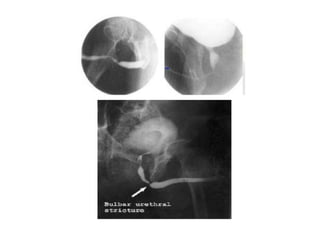
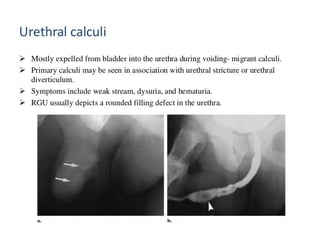
RETROGRADE
URETHROGRAPHY
• Some institutes prefer not to use local anaesthetic while
inserting the Foley’s as it is hypothesized to cause mucosal
edema, increased permeability, vascular stasis and poor
retention of the balloon which may slip out during the
study.
• RGU is not a physiologic examination.
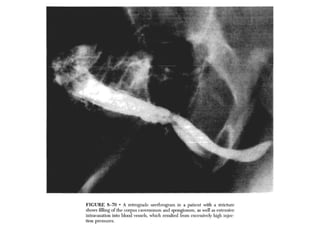
• The increased pressure used to inject the contrast into the
urethra can cause marked urethrovascular, lymphatic and
peri-urethral extravasation esp in cases of inflammation
and stricture.
• Hence antibiotic cover against gram negative sepsis is
indicated for the same
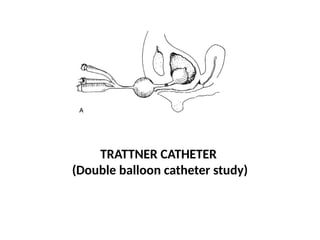
TRATTNER CATHETER
(Double balloon catheter study)
FUHRMAN et al
• Demonstrated that cystography in patients who presented
with gross hematuria associated with pelvic fractures
yielded positive results
• Cystography for pelvic fractures not associated with gross
hematuria could be omitted with no significant loss of
diagnostic ability with a large monetary saving and no
compromise in care.
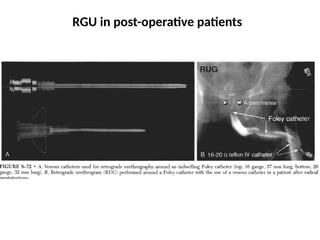
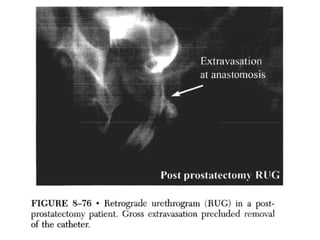
RGU in post-operative patients
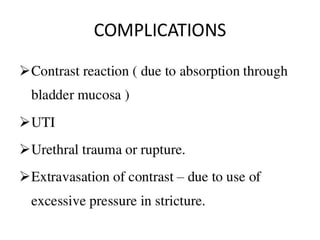
1) UTI
• 6% incidence
• Avoid in active infections and immediately after
vesicourethral instrumentation (McAlister et al)
2) Reaction to contrast medium
• Incidence of 0.26% (Weese et al)
• Absorption through the bladder wall or inflamed or
damaged urethral lining (Dewan et al)
• Premedication with IV fluids is a reasonable approach
in patients with significant prior reaction to contrast.
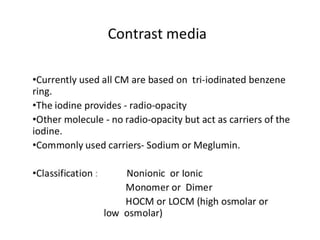
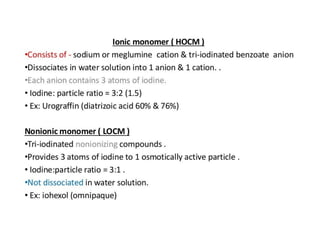
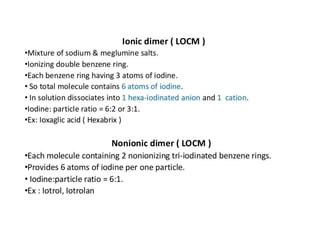
• In children with VP shunts, always use non-ionic
contrast media
• Use diluted solutions (10-20%)

retrograde urethrogram presentation 1 ppt

  • 1.
  • 21.
    • Some institutesprefer not to use local anaesthetic while inserting the Foley’s as it is hypothesized to cause mucosal edema, increased permeability, vascular stasis and poor retention of the balloon which may slip out during the study. • RGU is not a physiologic examination. • The increased pressure used to inject the contrast into the urethra can cause marked urethrovascular, lymphatic and peri-urethral extravasation esp in cases of inflammation and stricture. • Hence antibiotic cover against gram negative sepsis is indicated for the same
  • 28.
  • 40.
    FUHRMAN et al •Demonstrated that cystography in patients who presented with gross hematuria associated with pelvic fractures yielded positive results • Cystography for pelvic fractures not associated with gross hematuria could be omitted with no significant loss of diagnostic ability with a large monetary saving and no compromise in care.
  • 46.
  • 49.
    1) UTI • 6%incidence • Avoid in active infections and immediately after vesicourethral instrumentation (McAlister et al) 2) Reaction to contrast medium • Incidence of 0.26% (Weese et al) • Absorption through the bladder wall or inflamed or damaged urethral lining (Dewan et al) • Premedication with IV fluids is a reasonable approach in patients with significant prior reaction to contrast. • In children with VP shunts, always use non-ionic contrast media • Use diluted solutions (10-20%)