THE FUTURE OF FREEDOM
How to break free in the new
world of retirement.
The Freedom and Choice changes of 6 April 2015, or F-Day, heralded an
unprecedented change to the retirement market. More broadly, F-Day is
increasingly seen as the catalyst for a fundamental transformation of the
pension industry.
In PA’s second Freedom and Choice Provider Survey all participants
see this transformation as an opportunity. 25% are only now embarking
on this strategic journey, with a further 67% saying they still have
‘further to go’.
At PA Consulting, we’ve looked five years ahead, and envisage a very
different retirement market to what we see today: a market with new
entrants with core capabilities in leveraging data, digital innovation and
agile delivery. For existing players we’ve seen further consolidation,
as providers with scale gain a clear margin advantage; and most
importantly, we’ve seen better engaged customers, proactively thinking
about their financial future and, on the whole, making sensible decisions.
THE FUTURE OF FREEDOM
Introduction.
32 THE FUTURE OF FREEDOM THE FUTURE OF FREEDOM
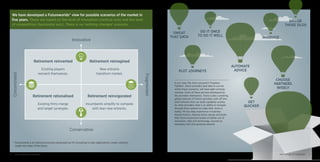
We have developed a Futureworlds* view for possible scenarios of the market in
five years. These are based on the level of innovation (vertical axis) and the level
of competition (horizontal axis). There is no ‘nothing changes’ scenario.
* Futureworlds is an interactive process developed by PA Consulting to help organisations create coherent,
insight-led views of the future.
Retirement reinvented
Existing players
reinvent themselves.
Concentrated
Innovative
Conservative
Fragmented
Retirement rationalised
Existing firms merge
and target synergies.
Retirement reimagined
New entrants
transform market.
Retirement reinvigorated
Incumbents simplify to compete
with lean new entrants.
In our view, the most successful ‘Freedom
Fighters’, those providers best able to survive
within these scenarios, will have eight winning
mantras. Some of these are best developed by
the providers themselves. There is also a growing,
global network of Fintech providers with off-the-
shelf software that can build capability quickly.
So what providers need is an ability to navigate
through these options to make their vision a
reality. PA has deep experience in business
transformation, helping clients design and build
their future businesses based on better use of
innovation, data and technology, sourced as
necessary from this growing network.
CHOOSE
PARTNERS
WISELY
AUTOMATE
ADVICEPLOT JOURNEYS
SWEAT
THAT DATA
DO IT ONCE
TO DO IT WELL
BRIDGE
THOSE SILOS
INNOVATE
GET
QUICKER
54 THE FUTURE OF FREEDOM THE FUTURE OF FREEDOM
Looking outside financial services, the consumer
success stories of recent years have one thing in
common: the effective use of data.
The growth in Amazon, eBay, the turnaround of BA,
the success of high street retailers, Burberry and L’Oreal,
all reflect the highly effective use of data to understand
the needs of the individual and provide an increasingly
personalised experience.
In contrast, our survey highlighted that many retirement
providers still have a long path to trek before they can
use data effectively to understand their customers, and
act on that understanding. 85% of survey participants still
lack the ability to provide basic customer information
from one system. Customers with multiple policies
are often referred across multiple teams to gather the
information the company needs.
How can a provider that lacks that single view of
the customer hope to paint a rounded picture of
each individual’s circumstances and deliver a
tailored experience?
Effective Customer Relationship Management (CRM) is
certainly not a new concept. However, it has traditionally
been hard to make the business case for connecting
legacy platforms to such solutions in the world of
pensions. post F-Day, the benefit case for CRM has been
boosted by the need to engage with all customers, and
the way that the cost of achieving that single view has
been reduced by Fintech firms such as Facility Live,
which uses search engine technology to index data held
in legacy platforms and pull together a central view.
SWEAT THAT DATA
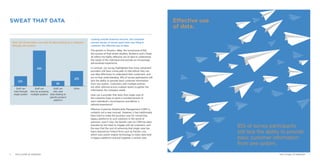
Only 15% of providers can view all data relating to a customer
through one system.
85% of survey participants
still lack the ability to provide
basic customer information
from one system.
Effective use
of data.
15%
54%
8%
23%
Staff can
view through
single system
Staff can
view by accessing
multiple systems
Staff can
only view
data relating to
specific product
platform
Other
76 THE FUTURE OF FREEDOM THE FUTURE OF FREEDOM
Having the data to enable the detailed
knowledge of the customer’s needs has
become more critical because the nature
of the ‘retirement journey’ has changed
so fundamentally.
Until 2014, retirement providers across
the UK spent their time (and no small
amount of money) tweaking the content
of ‘wake up packs’, illustrations and
application forms to comply with the
latest industry codes and regulatory
requirements. But the fundamental route
from pension accumulation to annuity
(or occasionally, trivial commutation)
remained the norm for over 90% of
customers.
PLOT THE JOURNEYS
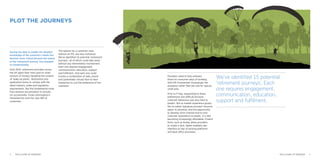
The options for a customer, even
without an IFA, are now numerous.
We’ve identified 15 potential ‘retirement
journeys’, all of which could take place
without any intermediary involvement.
Each one requires engagement,
communication, education, support
and fulfilment. And each one could
involve a combination of web, phone
and (potentially virtual) face-to-face
interaction to suit the preference of the
customer.
Providers need to fully embrace
direct-to-consumer ways of working,
with IFA involvement increasingly the
exception rather than the rule for typical,
small pots.
Prior to F-Day, responding to those
preferences was difficult because
customer behaviour was very hard to
predict. But as market experience grows,
the so-called ‘signature journeys’ become
easier to prioritise, and the opportunity
to develop omni-channel end-to-end
customer experience increases. It is also
becoming increasingly affordable: Fintech
firms, such as Avoka, allow providers
to create a slick, tablet-enabled user
interface on top of existing platforms
and back office processes.
We’ve identified 15 potential
‘retirement journeys’. Each
one requires engagement,
communication, education,
support and fulfilment.
98 THE FUTURE OF FREEDOM THE FUTURE OF FREEDOM
DO IT ONCE TO DO IT WELL
Historically, it has been difficult to make
the business case for delivering the type
of retirement journeys described earlier.
There are two reasons for this. Firstly, many
pension providers still manage books of
customers across several platforms. Whilst
some have swept this problem under the carpet
by separating their front and back books, the
retirement communications sent to customers,
and the processes to support their maturity,
are largely duplicated across each one of those
platforms. This significantly multiplies the cost
of making any output changes. Is also explains
why the ABI’s Code of Conduct on Retirement
Choices, which sought to improve these journeys,
was often crudely implemented, leading to little
improvement for consumers. Secondly, there
was never a huge upside to fixing the journey
anyway. As demonstrated by many closed book
providers, it was possible to invest very little
in the customer experience, but still rely on a
steady flow of annuity profit. Then there was the
risk that engaging your customers about their
options might make them even more likely to
shop around and go elsewhere.
This approach no longer stacks up.
With the option of taking cash, and generally
increased consumer awareness, most providers
are now realising that investing in that customer
relationship is worthwhile.
Implementing that improved experience will
always be more efficient if it can be delivered in
one place rather than several, and there are two
distinct routes to achieving that. The first is to
hide the multiple platforms behind a single front
end that facilitates the customer experience.
A more radical approach is to move policy
holders onto a single, newer platform, ultimately
closing down the older platforms, reducing the
operational cost as well as the cost of change.
This is not a new idea, but the cost of building
Freedom and Choice into all old platforms, the
upside benefit from improving the customer
experience, and the availability of tools from
vendors such as CTC, means that it is now a
good time to reconsider options.
Implementing improved
experience will be more
efficient if it can be
delivered in one place.
1110 THE FUTURE OF FREEDOM THE FUTURE OF FREEDOM
AUTOMATE ADVICE
In this new world, providers need to take
another look at the provision of advice.
Post RDR, face to face advice has become the
preserve of wealthy clients. Simplified advice
is the FCA’s answer to addressing the resulting
advice gap, but few providers (Just Retirement,
including a deployment at Phoenix Life, being
the leader) have embraced the opportunity. It
is clear that one of the problems with simplified
advice is that there aren’t always simple
customers on the receiving end.
Robo-advice has become a ubiquitous term in
recent months as a possible answer. Despite
being a growing industry in the US, it remains
in its infancy in the UK. However, a number of
wealth managers, e.g. Investec (due to launch by
end of 2015), have recently made forays into this
space to compete with the likes of Nutmeg,
an execution only DFM service.
The question is whether robo-advisers can ever
offer a satisfactory solution when faced with
complex needs. And even if the advice can be
effectively automated, can a user experience be
found that doesn’t intimidate the lay person?
We believe the challenge of simplified advice can
be resolved by emerging technologies. Artificial
intelligence engines will improve the ability to
deal with different customer needs. And the
user experience will improve beyond recognition
with the likes of virtual reality, gamification and
avatars (ie virtual assistants). Data capture (an
existing deterrent) will also become easier as
existing consumer databases evolve into data
that can integrated into the robo-advice process.
Artificial intelligence engines
will improve the ability to deal
with different customer needs.
And the user experience will
improve beyond recognition
with the likes of virtual reality,
gamification and avatars.
1312 THE FUTURE OF FREEDOM THE FUTURE OF FREEDOM
INNOVATE
Innovation is critical to success in the new
world. Yet innovation and financial services
have rarely hit it off, and the increased level
of regulatory scrutiny and personal
accountability in recent years has hardly
improved the relationship.
In this context, genuine innovation, based on an
objective understanding of consumer needs and
a ‘what if we started with nothing’ mentality, has
been rare.
Under Freedom and Choice however, behaviours
are starting to change – 50% of our survey
participants now have a distinct innovation
capability, focussed on developing post
F-Day propositions.
Replicating how other industries innovate is
a good place to start. PA Consulting has seen
how applying the same techniques used to
innovate in areas as diverse as foetal heart-rate
monitors and beer can widgets to its clients in
financial services can be very effective. Some
providers excluded the traditional ‘lifers’ from the
development of its Freedom and Choice-ready
digital guidance tools, choosing instead to focus
on ‘new blood’.
Above all, successful innovation, whatever the
sector, must be rooted in customer insight,
testing the innovations with the customer at
the earliest opportunity and, in a step that is
often neglected, actually listening to what those
customers say.
50% of our survey
participants now have
a distinct innovation
function.
1514 THE FUTURE OF FREEDOM THE FUTURE OF FREEDOM
BRIDGE THOSE SILOS
83%
42%
A tour around the executive teams of the
UK’s leading pension providers makes for
a fascinating study in organisational design.
There are no two approaches the same,
albeit few of them remain static long enough
to actually make the comparison. The split
between OldCo and NewCo to improve
shareholder value, risk and a focus on growth
has been challenged by the reforms. A customer
centric view doesn’t easily follow their internal
demarcation lines and firms may have to
reassess their organisational design.
17% of firms surveyed have a top level split
between front and back books. Their challenge,
post F-Day, is accountability for the retirement
journeys of those back book customers. That
means asking the questions: When does the
retirement journey start? Who is accountable
for complaints related to accessing cash?
Who benefits from a retirement deferral?
42% of firms use channel (typically corporate,
intermediary and direct) as their top level split.
But why should a corporate customer with no
employer-based at retirement advice provision
need a different retirement journey to someone
who bought through an intermediary that has
long since parted company with them? And what
happens to customers with multiple pots from
multiple channels?
There are other approaches (splitting distribution
from product, or pre- from post-retirement), but
no easy answer, especially where the end-to-end
retirement business is too big as a proportion of
the overall firm to put it all under one executive.
In our view, the appointment of a ‘retirement
champion’, with a remit that cuts across the P&L
silos and drives consistency (where appropriate)
in proposition and underlying architecture, would
be an effective addition to the organisation.
of firms surveyed changed their
organisation as a result of the changes.
of firms use channel
as their top level split
1716 THE FUTURE OF FREEDOM THE FUTURE OF FREEDOM
CHOOSE THOSE PARTNERS WISELY
Gearing up for the post F-day business
transformation can be daunting.
In firms where the cost of changing content
on an output can run into millions, the idea
of launching a fundamentally new product,
or delivering a digital proposition that actually
speaks to underlying product platforms in any
transactional way, feels like another world. And
the response from the portfolio director to a
request for a seamless, omni-channel experience
where customers switch from online to phone
and back, with the occasional co-browse and
video conference is likely to be ‘come back
next year.’
Yet there are manageable solutions available.
Increasingly, these technologies are available
off-the-shelf, with a relatively straightforward
integration and flexible customisation overhead.
From user-interface enablers such as Avoka
and Vizolution, to workflow innovators and
verification automators such as Experian, there
are myriad options out there for partnering,
cutting both cost and time out of the
transformation process.
This, however, underlines that to be successful,
providers will need a strong ability to choose
the right partners. Deciding where to be ‘good
enough’ rather than market leading is key.
Removing unnecessary procurement hoops
to minimise time to launch and management
overhead will also help. Equally, encouraging
insular proposition leaders to look outside
their business, into a global market of
Fintech providers is essential.
Increasingly, manageable solutions
and technologies are available
off-the-shelf, with a relatively
straightforward integration and
flexible customisation overhead.
1918 THE FUTURE OF FREEDOM THE FUTURE OF FREEDOM
GET QUICKER
There are a number of techniques and processes
that can help the sector transform itself and
we are seeing an increasing enthusiasm within
Financial Services providers for adopting Agile.
In our survey 67% of providers embraced an
Agile approach to respond to the reforms within
challenging timescales. This is perhaps not
surprising as Agile (done well) can be quicker
and cheaper, and research suggests Agile
projects are three times more likely to succeed
than traditional waterfall projects.
This can all sound too good to be true. It is
important to recognise that there are barriers to
adoption and, in our experience, some clients
find it challenging to implement Agile at scale.
Agile requires a significant change for both
an organisation and its individual employees,
including not just IT but crucially the business too.
Another challenge is that Agile is no longer just a
‘methodology’ but it is a culture in its own right.
Very often organisations get way laid by focusing
simply on Agile adoption (practices, tools and
techniques). To be successful organisations need
to implement Agile transformation in a way
which fundamentally changes their structure
and approach.
67% of providers have
embraced a more agile
approach as a result
of the freedom and
choice changes.
Agile can be quicker and
cheaper, and research suggests
Agile projects are three times
more likely to succeed than
traditional Waterfall projects.
2120 THE FUTURE OF FREEDOM THE FUTURE OF FREEDOM
WE MAKE THE DIFFERENCE
PA is a consulting, technology and innovation
firm. We define success as achieving exceptional
results that have a lasting impact on businesses,
communities and individuals worldwide. This
principle has remained the cornerstone of our
ethos for over 70 years — and it continues to
underpin everything we do.
Our clients choose us because we challenge
convention to find the solutions that really work
— in practice, not just on paper. Then we roll up
our sleeves and get the job done.
In the changing world of retirement, we are
the fitness coach to the successful freedom
fighters. We bring a pedigree in innovation to a
market that sorely needs it. We inject rigour into
business design and partner selection, making
omni-channel customer experiences a reality.
And we can make change quicker, in a market
attracting agile new entrants.
Our team of Retirement specialists boasts several
decades of industry and consulting experience,
as well as a healthy mix of tech savvy ‘bright
young things’ bringing a new perspective. We
know what it’s like to be fire-fighting today’s
issues whilst shaping the future, and we know
how hard it is to look outside the building
when the inside requires your daily attention.
We’ve identified four areas where we know we
can make the difference in the Freedom and
Choice market. To find out more, please visit
www.paconsulting.com or call 020 7333 6171.
Innovation
PA’s heritage in innovation is unique. Our track record in
technology innovation is extensive, and its application within
financial services is already tried and tested. We’ve pulled
together our best facilitators and developed an innovation
approach specifically tailored to the opportunities in the
retirement market post F-Day. Typically the approach is
centred on a 1-2 day executive-level workshop at our
Technology Centre outside Cambridge.
Regulatory support
We recognise that the retirement market has been, and will
probably continue to be, a regulatory minefield. Planning
your path through often unclear, changing rules in advice
and guidance is one of several challenges that the industry
faces. PA works extensively with the PRA and FCA, as well
as other governmental bodies in the retirement space. Our
unique insights into the minds of the regulators means we can
better inform and assist industry players in both delivery and
assurance activities.
Customer data hub
Data is key to understanding your customers and delivering
a tailored experience to them. PA’s team of data scientists is
adept at providing both analysis and deployable analytical
tools to do this, using a pragmatic approach that delivers
benefits quickly. In particular, our customer data hub can read
data from multiple existing systems, combine with external
data (including social) and provide a single customer view, all
for the fraction of the cost of a full CRM implementation. Our
clients are using such deployments to map the journeys of their
customers through different channels and systems. Similarly,
we can help you select from a range of innovative vendors such
as FacilityLive, who apply semantic search approaches to index
and present customer data from multiple sources. And we also
have a special relationship with Google, developing enterprise
cloud solutions and maximising the opportunities from
Google Analytics.
Customer-centric business design
Retirement providers across the UK agree that creating a
compelling customer experience is essential for success
post F-Day. PA’s Business Design approach was developed
in conjunction with Henley Business School, where we
have trained over 200 consultants since its inception
in 2012. It provides a proven framework for identifying
target customer segments, designing a needs-based
experience and then defining the process, people and
technology components that enable its delivery. Key to
this is a capability-based assessment of sourcing options
which, combined with our extensive network of Fintech
relationships, can provide the blueprint for your
future business.
2322 THE FUTURE OF FREEDOM THE FUTURE OF FREEDOM
Neil Loney
Partner
neil.loney@paconsulting.com
For any further questions you may have please contact us:
To find out more, please visit www.paconsulting.com
or call one of our experts on 020 7333 6171.
Kevin O’Shaughnessy
Partner
kevin.o’shaughnessy@paconsulting.com
Vaughan Jenkins
Partner
vaughan.jenkins@paconsulting.com
Mike Teall
Managing Consultant
michael.teall@paconsulting.com
70 YEARS OF
UNCONSTRAINED
THINKING AND
EXCEPTIONAL
RESULTS
2524 THE FUTURE OF FREEDOM THE FUTURE OF FREEDOM
PA’s Freedom unfolds survey was
conducted between 22 May and
5 June 2015, encompassing 13
leading LifeCo retirement providers.
The results of the survey are available
in full to all participants. All responses
are fully anonymised.
To find out more please contact
michael.teall@paconsulting.com or call 020 7333 6171.
2726 THE FUTURE OF FREEDOM THE FUTURE OF FREEDOM
DSP2099-1
Corporate headquarters
123 Buckingham Palace Road
London SW1W 9SR
United Kingdom
+44 20 7730 9000
paconsulting.com
This document has been prepared by PA
on the basis of information supplied by
the client and that which is available in
the public domain. No representation or
warranty is given as to the achievement
or reasonableness of future projections
or the assumptions underlying them,
management targets, valuation, opinions,
prospects or returns, if any. Except where
otherwise indicated, the document speaks
as at the date hereof.
© PA Knowledge Limited 2015.
All rights reserved.
This document is confidential to the
organisation named herein and may
not be reproduced, stored in a retrieval
system, or transmitted in any form or
by any means, electronic, mechanical,
photocopying or otherwise without the
written permission of PA Consulting Group.
In the event that you receive this
document in error, you should return it to
PA Consulting Group, 123 Buckingham
Palace Road, London SW1W 9SR.
PA accepts no liability whatsoever should
an unauthorised recipient of this document
act on its contents.
We are an employee-owned firm of over 2,500 people,
operating globally from offices across North America,
Europe, the Nordics, the Gulf and Asia Pacific.
We are experts in energy, financial services, life sciences
and healthcare, manufacturing, government and public
services, defence and security, telecommunications,
transport and logistics.
Our deep industry knowledge together with skills in
management consulting, technology and innovation
allows us to challenge conventional thinking and deliver
exceptional results with lasting impact.

retirement bookletFINAL@100615

  • 1.
    THE FUTURE OFFREEDOM How to break free in the new world of retirement.
  • 2.
    The Freedom andChoice changes of 6 April 2015, or F-Day, heralded an unprecedented change to the retirement market. More broadly, F-Day is increasingly seen as the catalyst for a fundamental transformation of the pension industry. In PA’s second Freedom and Choice Provider Survey all participants see this transformation as an opportunity. 25% are only now embarking on this strategic journey, with a further 67% saying they still have ‘further to go’. At PA Consulting, we’ve looked five years ahead, and envisage a very different retirement market to what we see today: a market with new entrants with core capabilities in leveraging data, digital innovation and agile delivery. For existing players we’ve seen further consolidation, as providers with scale gain a clear margin advantage; and most importantly, we’ve seen better engaged customers, proactively thinking about their financial future and, on the whole, making sensible decisions. THE FUTURE OF FREEDOM Introduction. 32 THE FUTURE OF FREEDOM THE FUTURE OF FREEDOM
  • 3.
    We have developeda Futureworlds* view for possible scenarios of the market in five years. These are based on the level of innovation (vertical axis) and the level of competition (horizontal axis). There is no ‘nothing changes’ scenario. * Futureworlds is an interactive process developed by PA Consulting to help organisations create coherent, insight-led views of the future. Retirement reinvented Existing players reinvent themselves. Concentrated Innovative Conservative Fragmented Retirement rationalised Existing firms merge and target synergies. Retirement reimagined New entrants transform market. Retirement reinvigorated Incumbents simplify to compete with lean new entrants. In our view, the most successful ‘Freedom Fighters’, those providers best able to survive within these scenarios, will have eight winning mantras. Some of these are best developed by the providers themselves. There is also a growing, global network of Fintech providers with off-the- shelf software that can build capability quickly. So what providers need is an ability to navigate through these options to make their vision a reality. PA has deep experience in business transformation, helping clients design and build their future businesses based on better use of innovation, data and technology, sourced as necessary from this growing network. CHOOSE PARTNERS WISELY AUTOMATE ADVICEPLOT JOURNEYS SWEAT THAT DATA DO IT ONCE TO DO IT WELL BRIDGE THOSE SILOS INNOVATE GET QUICKER 54 THE FUTURE OF FREEDOM THE FUTURE OF FREEDOM
  • 4.
    Looking outside financialservices, the consumer success stories of recent years have one thing in common: the effective use of data. The growth in Amazon, eBay, the turnaround of BA, the success of high street retailers, Burberry and L’Oreal, all reflect the highly effective use of data to understand the needs of the individual and provide an increasingly personalised experience. In contrast, our survey highlighted that many retirement providers still have a long path to trek before they can use data effectively to understand their customers, and act on that understanding. 85% of survey participants still lack the ability to provide basic customer information from one system. Customers with multiple policies are often referred across multiple teams to gather the information the company needs. How can a provider that lacks that single view of the customer hope to paint a rounded picture of each individual’s circumstances and deliver a tailored experience? Effective Customer Relationship Management (CRM) is certainly not a new concept. However, it has traditionally been hard to make the business case for connecting legacy platforms to such solutions in the world of pensions. post F-Day, the benefit case for CRM has been boosted by the need to engage with all customers, and the way that the cost of achieving that single view has been reduced by Fintech firms such as Facility Live, which uses search engine technology to index data held in legacy platforms and pull together a central view. SWEAT THAT DATA Only 15% of providers can view all data relating to a customer through one system. 85% of survey participants still lack the ability to provide basic customer information from one system. Effective use of data. 15% 54% 8% 23% Staff can view through single system Staff can view by accessing multiple systems Staff can only view data relating to specific product platform Other 76 THE FUTURE OF FREEDOM THE FUTURE OF FREEDOM
  • 5.
    Having the datato enable the detailed knowledge of the customer’s needs has become more critical because the nature of the ‘retirement journey’ has changed so fundamentally. Until 2014, retirement providers across the UK spent their time (and no small amount of money) tweaking the content of ‘wake up packs’, illustrations and application forms to comply with the latest industry codes and regulatory requirements. But the fundamental route from pension accumulation to annuity (or occasionally, trivial commutation) remained the norm for over 90% of customers. PLOT THE JOURNEYS The options for a customer, even without an IFA, are now numerous. We’ve identified 15 potential ‘retirement journeys’, all of which could take place without any intermediary involvement. Each one requires engagement, communication, education, support and fulfilment. And each one could involve a combination of web, phone and (potentially virtual) face-to-face interaction to suit the preference of the customer. Providers need to fully embrace direct-to-consumer ways of working, with IFA involvement increasingly the exception rather than the rule for typical, small pots. Prior to F-Day, responding to those preferences was difficult because customer behaviour was very hard to predict. But as market experience grows, the so-called ‘signature journeys’ become easier to prioritise, and the opportunity to develop omni-channel end-to-end customer experience increases. It is also becoming increasingly affordable: Fintech firms, such as Avoka, allow providers to create a slick, tablet-enabled user interface on top of existing platforms and back office processes. We’ve identified 15 potential ‘retirement journeys’. Each one requires engagement, communication, education, support and fulfilment. 98 THE FUTURE OF FREEDOM THE FUTURE OF FREEDOM
  • 6.
    DO IT ONCETO DO IT WELL Historically, it has been difficult to make the business case for delivering the type of retirement journeys described earlier. There are two reasons for this. Firstly, many pension providers still manage books of customers across several platforms. Whilst some have swept this problem under the carpet by separating their front and back books, the retirement communications sent to customers, and the processes to support their maturity, are largely duplicated across each one of those platforms. This significantly multiplies the cost of making any output changes. Is also explains why the ABI’s Code of Conduct on Retirement Choices, which sought to improve these journeys, was often crudely implemented, leading to little improvement for consumers. Secondly, there was never a huge upside to fixing the journey anyway. As demonstrated by many closed book providers, it was possible to invest very little in the customer experience, but still rely on a steady flow of annuity profit. Then there was the risk that engaging your customers about their options might make them even more likely to shop around and go elsewhere. This approach no longer stacks up. With the option of taking cash, and generally increased consumer awareness, most providers are now realising that investing in that customer relationship is worthwhile. Implementing that improved experience will always be more efficient if it can be delivered in one place rather than several, and there are two distinct routes to achieving that. The first is to hide the multiple platforms behind a single front end that facilitates the customer experience. A more radical approach is to move policy holders onto a single, newer platform, ultimately closing down the older platforms, reducing the operational cost as well as the cost of change. This is not a new idea, but the cost of building Freedom and Choice into all old platforms, the upside benefit from improving the customer experience, and the availability of tools from vendors such as CTC, means that it is now a good time to reconsider options. Implementing improved experience will be more efficient if it can be delivered in one place. 1110 THE FUTURE OF FREEDOM THE FUTURE OF FREEDOM
  • 7.
    AUTOMATE ADVICE In thisnew world, providers need to take another look at the provision of advice. Post RDR, face to face advice has become the preserve of wealthy clients. Simplified advice is the FCA’s answer to addressing the resulting advice gap, but few providers (Just Retirement, including a deployment at Phoenix Life, being the leader) have embraced the opportunity. It is clear that one of the problems with simplified advice is that there aren’t always simple customers on the receiving end. Robo-advice has become a ubiquitous term in recent months as a possible answer. Despite being a growing industry in the US, it remains in its infancy in the UK. However, a number of wealth managers, e.g. Investec (due to launch by end of 2015), have recently made forays into this space to compete with the likes of Nutmeg, an execution only DFM service. The question is whether robo-advisers can ever offer a satisfactory solution when faced with complex needs. And even if the advice can be effectively automated, can a user experience be found that doesn’t intimidate the lay person? We believe the challenge of simplified advice can be resolved by emerging technologies. Artificial intelligence engines will improve the ability to deal with different customer needs. And the user experience will improve beyond recognition with the likes of virtual reality, gamification and avatars (ie virtual assistants). Data capture (an existing deterrent) will also become easier as existing consumer databases evolve into data that can integrated into the robo-advice process. Artificial intelligence engines will improve the ability to deal with different customer needs. And the user experience will improve beyond recognition with the likes of virtual reality, gamification and avatars. 1312 THE FUTURE OF FREEDOM THE FUTURE OF FREEDOM
  • 8.
    INNOVATE Innovation is criticalto success in the new world. Yet innovation and financial services have rarely hit it off, and the increased level of regulatory scrutiny and personal accountability in recent years has hardly improved the relationship. In this context, genuine innovation, based on an objective understanding of consumer needs and a ‘what if we started with nothing’ mentality, has been rare. Under Freedom and Choice however, behaviours are starting to change – 50% of our survey participants now have a distinct innovation capability, focussed on developing post F-Day propositions. Replicating how other industries innovate is a good place to start. PA Consulting has seen how applying the same techniques used to innovate in areas as diverse as foetal heart-rate monitors and beer can widgets to its clients in financial services can be very effective. Some providers excluded the traditional ‘lifers’ from the development of its Freedom and Choice-ready digital guidance tools, choosing instead to focus on ‘new blood’. Above all, successful innovation, whatever the sector, must be rooted in customer insight, testing the innovations with the customer at the earliest opportunity and, in a step that is often neglected, actually listening to what those customers say. 50% of our survey participants now have a distinct innovation function. 1514 THE FUTURE OF FREEDOM THE FUTURE OF FREEDOM
  • 9.
    BRIDGE THOSE SILOS 83% 42% Atour around the executive teams of the UK’s leading pension providers makes for a fascinating study in organisational design. There are no two approaches the same, albeit few of them remain static long enough to actually make the comparison. The split between OldCo and NewCo to improve shareholder value, risk and a focus on growth has been challenged by the reforms. A customer centric view doesn’t easily follow their internal demarcation lines and firms may have to reassess their organisational design. 17% of firms surveyed have a top level split between front and back books. Their challenge, post F-Day, is accountability for the retirement journeys of those back book customers. That means asking the questions: When does the retirement journey start? Who is accountable for complaints related to accessing cash? Who benefits from a retirement deferral? 42% of firms use channel (typically corporate, intermediary and direct) as their top level split. But why should a corporate customer with no employer-based at retirement advice provision need a different retirement journey to someone who bought through an intermediary that has long since parted company with them? And what happens to customers with multiple pots from multiple channels? There are other approaches (splitting distribution from product, or pre- from post-retirement), but no easy answer, especially where the end-to-end retirement business is too big as a proportion of the overall firm to put it all under one executive. In our view, the appointment of a ‘retirement champion’, with a remit that cuts across the P&L silos and drives consistency (where appropriate) in proposition and underlying architecture, would be an effective addition to the organisation. of firms surveyed changed their organisation as a result of the changes. of firms use channel as their top level split 1716 THE FUTURE OF FREEDOM THE FUTURE OF FREEDOM
  • 10.
    CHOOSE THOSE PARTNERSWISELY Gearing up for the post F-day business transformation can be daunting. In firms where the cost of changing content on an output can run into millions, the idea of launching a fundamentally new product, or delivering a digital proposition that actually speaks to underlying product platforms in any transactional way, feels like another world. And the response from the portfolio director to a request for a seamless, omni-channel experience where customers switch from online to phone and back, with the occasional co-browse and video conference is likely to be ‘come back next year.’ Yet there are manageable solutions available. Increasingly, these technologies are available off-the-shelf, with a relatively straightforward integration and flexible customisation overhead. From user-interface enablers such as Avoka and Vizolution, to workflow innovators and verification automators such as Experian, there are myriad options out there for partnering, cutting both cost and time out of the transformation process. This, however, underlines that to be successful, providers will need a strong ability to choose the right partners. Deciding where to be ‘good enough’ rather than market leading is key. Removing unnecessary procurement hoops to minimise time to launch and management overhead will also help. Equally, encouraging insular proposition leaders to look outside their business, into a global market of Fintech providers is essential. Increasingly, manageable solutions and technologies are available off-the-shelf, with a relatively straightforward integration and flexible customisation overhead. 1918 THE FUTURE OF FREEDOM THE FUTURE OF FREEDOM
  • 11.
    GET QUICKER There area number of techniques and processes that can help the sector transform itself and we are seeing an increasing enthusiasm within Financial Services providers for adopting Agile. In our survey 67% of providers embraced an Agile approach to respond to the reforms within challenging timescales. This is perhaps not surprising as Agile (done well) can be quicker and cheaper, and research suggests Agile projects are three times more likely to succeed than traditional waterfall projects. This can all sound too good to be true. It is important to recognise that there are barriers to adoption and, in our experience, some clients find it challenging to implement Agile at scale. Agile requires a significant change for both an organisation and its individual employees, including not just IT but crucially the business too. Another challenge is that Agile is no longer just a ‘methodology’ but it is a culture in its own right. Very often organisations get way laid by focusing simply on Agile adoption (practices, tools and techniques). To be successful organisations need to implement Agile transformation in a way which fundamentally changes their structure and approach. 67% of providers have embraced a more agile approach as a result of the freedom and choice changes. Agile can be quicker and cheaper, and research suggests Agile projects are three times more likely to succeed than traditional Waterfall projects. 2120 THE FUTURE OF FREEDOM THE FUTURE OF FREEDOM
  • 12.
    WE MAKE THEDIFFERENCE PA is a consulting, technology and innovation firm. We define success as achieving exceptional results that have a lasting impact on businesses, communities and individuals worldwide. This principle has remained the cornerstone of our ethos for over 70 years — and it continues to underpin everything we do. Our clients choose us because we challenge convention to find the solutions that really work — in practice, not just on paper. Then we roll up our sleeves and get the job done. In the changing world of retirement, we are the fitness coach to the successful freedom fighters. We bring a pedigree in innovation to a market that sorely needs it. We inject rigour into business design and partner selection, making omni-channel customer experiences a reality. And we can make change quicker, in a market attracting agile new entrants. Our team of Retirement specialists boasts several decades of industry and consulting experience, as well as a healthy mix of tech savvy ‘bright young things’ bringing a new perspective. We know what it’s like to be fire-fighting today’s issues whilst shaping the future, and we know how hard it is to look outside the building when the inside requires your daily attention. We’ve identified four areas where we know we can make the difference in the Freedom and Choice market. To find out more, please visit www.paconsulting.com or call 020 7333 6171. Innovation PA’s heritage in innovation is unique. Our track record in technology innovation is extensive, and its application within financial services is already tried and tested. We’ve pulled together our best facilitators and developed an innovation approach specifically tailored to the opportunities in the retirement market post F-Day. Typically the approach is centred on a 1-2 day executive-level workshop at our Technology Centre outside Cambridge. Regulatory support We recognise that the retirement market has been, and will probably continue to be, a regulatory minefield. Planning your path through often unclear, changing rules in advice and guidance is one of several challenges that the industry faces. PA works extensively with the PRA and FCA, as well as other governmental bodies in the retirement space. Our unique insights into the minds of the regulators means we can better inform and assist industry players in both delivery and assurance activities. Customer data hub Data is key to understanding your customers and delivering a tailored experience to them. PA’s team of data scientists is adept at providing both analysis and deployable analytical tools to do this, using a pragmatic approach that delivers benefits quickly. In particular, our customer data hub can read data from multiple existing systems, combine with external data (including social) and provide a single customer view, all for the fraction of the cost of a full CRM implementation. Our clients are using such deployments to map the journeys of their customers through different channels and systems. Similarly, we can help you select from a range of innovative vendors such as FacilityLive, who apply semantic search approaches to index and present customer data from multiple sources. And we also have a special relationship with Google, developing enterprise cloud solutions and maximising the opportunities from Google Analytics. Customer-centric business design Retirement providers across the UK agree that creating a compelling customer experience is essential for success post F-Day. PA’s Business Design approach was developed in conjunction with Henley Business School, where we have trained over 200 consultants since its inception in 2012. It provides a proven framework for identifying target customer segments, designing a needs-based experience and then defining the process, people and technology components that enable its delivery. Key to this is a capability-based assessment of sourcing options which, combined with our extensive network of Fintech relationships, can provide the blueprint for your future business. 2322 THE FUTURE OF FREEDOM THE FUTURE OF FREEDOM
  • 13.
    Neil Loney Partner neil.loney@paconsulting.com For anyfurther questions you may have please contact us: To find out more, please visit www.paconsulting.com or call one of our experts on 020 7333 6171. Kevin O’Shaughnessy Partner kevin.o’shaughnessy@paconsulting.com Vaughan Jenkins Partner vaughan.jenkins@paconsulting.com Mike Teall Managing Consultant michael.teall@paconsulting.com 70 YEARS OF UNCONSTRAINED THINKING AND EXCEPTIONAL RESULTS 2524 THE FUTURE OF FREEDOM THE FUTURE OF FREEDOM
  • 14.
    PA’s Freedom unfoldssurvey was conducted between 22 May and 5 June 2015, encompassing 13 leading LifeCo retirement providers. The results of the survey are available in full to all participants. All responses are fully anonymised. To find out more please contact michael.teall@paconsulting.com or call 020 7333 6171. 2726 THE FUTURE OF FREEDOM THE FUTURE OF FREEDOM
  • 15.
    DSP2099-1 Corporate headquarters 123 BuckinghamPalace Road London SW1W 9SR United Kingdom +44 20 7730 9000 paconsulting.com This document has been prepared by PA on the basis of information supplied by the client and that which is available in the public domain. No representation or warranty is given as to the achievement or reasonableness of future projections or the assumptions underlying them, management targets, valuation, opinions, prospects or returns, if any. Except where otherwise indicated, the document speaks as at the date hereof. © PA Knowledge Limited 2015. All rights reserved. This document is confidential to the organisation named herein and may not be reproduced, stored in a retrieval system, or transmitted in any form or by any means, electronic, mechanical, photocopying or otherwise without the written permission of PA Consulting Group. In the event that you receive this document in error, you should return it to PA Consulting Group, 123 Buckingham Palace Road, London SW1W 9SR. PA accepts no liability whatsoever should an unauthorised recipient of this document act on its contents. We are an employee-owned firm of over 2,500 people, operating globally from offices across North America, Europe, the Nordics, the Gulf and Asia Pacific. We are experts in energy, financial services, life sciences and healthcare, manufacturing, government and public services, defence and security, telecommunications, transport and logistics. Our deep industry knowledge together with skills in management consulting, technology and innovation allows us to challenge conventional thinking and deliver exceptional results with lasting impact.