RARA
Retinoic Acid Receptor Alpha
Taylor Beard
Big Picture
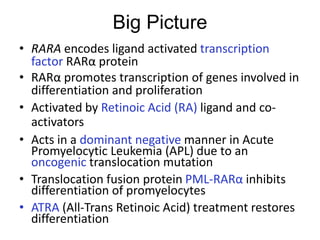
• RARA encodes ligand activated transcription
factor RARα protein
• RARα promotes transcription of genes involved in
differentiation and proliferation
• Activated by Retinoic Acid (RA) ligand and co-
activators
• Acts in a dominant negative manner in Acute
Promyelocytic Leukemia (APL) due to an
oncogenic translocation mutation
• Translocation fusion protein PML-RARα inhibits
differentiation of promyelocytes
• ATRA (All-Trans Retinoic Acid) treatment restores
differentiation
RARA Protein Structure
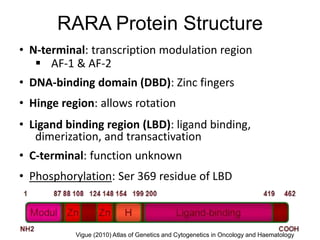
• N-terminal: transcription modulation region
 AF-1 & AF-2
• DNA-binding domain (DBD): Zinc fingers
• Hinge region: allows rotation
• Ligand binding region (LBD): ligand binding,
dimerization, and transactivation
• C-terminal: function unknown
• Phosphorylation: Ser 369 residue of LBD
Vigue (2010) Atlas of Genetics and Cytogenetics in Oncology and Haematology
RARα Function
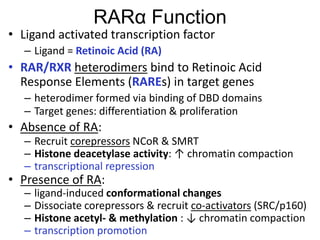
• Ligand activated transcription factor
– Ligand = Retinoic Acid (RA)
• RAR/RXR heterodimers bind to Retinoic Acid
Response Elements (RAREs) in target genes
– heterodimer formed via binding of DBD domains
– Target genes: differentiation & proliferation
• Absence of RA:
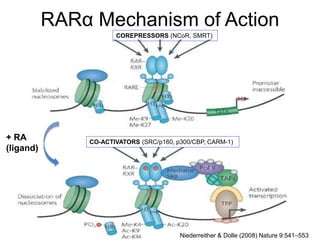
– Recruit corepressors NCoR & SMRT
– Histone deacetylase activity: ↑ chromatin compaction
– transcriptional repression
• Presence of RA:
– ligand-induced conformational changes
– Dissociate corepressors & recruit co-activators (SRC/p160)
– Histone acetyl- & methylation : ↓ chromatin compaction
– transcription promotion
RARα Mechanism of Action
COREPRESSORS (NCoR, SMRT)
CO-ACTIVATORS (SRC/p160, p300/CBP, CARM-1)
+ RA
(ligand)
Niederreither & Dolle (2008) Nature 9:541–553
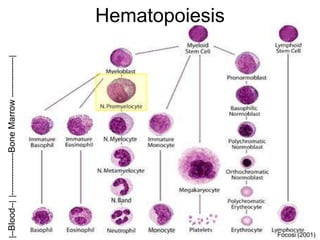
Hematopoiesis|----------------BoneMarrow---------------||--Blood--|
Focosi (2001)
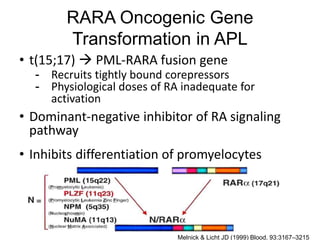
RARA Oncogenic Gene
Transformation in APL
• t(15;17)  PML-RARA fusion gene
- Recruits tightly bound corepressors
- Physiological doses of RA inadequate for
activation
• Dominant-negative inhibitor of RA signaling
pathway
• Inhibits differentiation of promyelocytes
Melnick & Licht JD (1999) Blood. 93:3167–3215
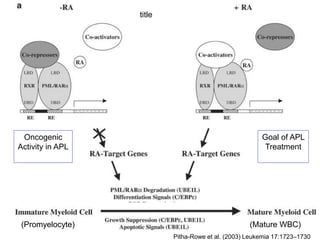
Oncogenic
Activity in APL
Goal of APL
Treatment
title
(Promyelocyte) (Mature WBC)
Pitha-Rowe et al. (2003) Leukemia 17:1723–1730
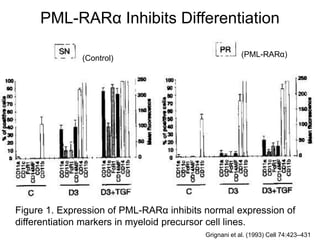
PML-RARα Inhibits Differentiation
Figure 1. Expression of PML-RARα inhibits normal expression of
differentiation markers in myeloid precursor cell lines.
(Control) (PML-RARα)
Grignani et al. (1993) Cell 74:423–431
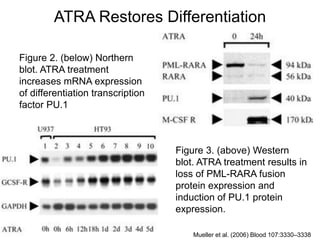
ATRA Restores Differentiation
Figure 2. (below) Northern
blot. ATRA treatment
increases mRNA expression
of differentiation transcription
factor PU.1
Figure 3. (above) Western
blot. ATRA treatment results in
loss of PML-RARA fusion
protein expression and
induction of PU.1 protein
expression.
Mueller et al. (2006) Blood 107:3330–3338
Acute Promyelocytic Leukemia (APL)
• A type of acute myeloid leukemia - AML M3
• Deficiency of mature WBCs and excess of promyelocytes
• Incidence
– Rare: 5% of all AML cases
– Higher in Italy and the Americas
• Risk factors
– No known environmental risk factors
– Any age (mean 40-50 yrs); equal in M/F
• Symptoms: the ‘classic triad’
– Fatigue
– Bruising and bleeding
– Infections and weight loss
• Prognosis
– 5 year survival rate: 58.5%
APL Treatment
• Substitution Therapy
– Stabilize bleeding tendency
• All-Trans-Retinoic Acid (ATRA)
– Promotes differentiation via PML-RARα cleavage
and degradation
• Chemotherapy
– Eliminates existing tumor cells
• Arsenic Trioxide (ATO)
– Degrades PML-RARα via a different pathway than
ATRA
References
• Bastien J, Rochette-Egly C. 2004. Nuclear retinoid receptors and the transcription of retinoid-target genes
Gene. Gene 328:1–16.
• Focosi D. 2001. Physiology of adult homo sapiens - blood (haematology : plasma, blood cells, and
coagulation) and lymph [Internet]. Available from:
http://www.ufrgs.br/imunovet/molecular_immunology/blood.html
• Grignani Francesco, Ferucci PF, Testa U, Talamo G, Fagioli M, Alcalay M, Mencarelli A, Grignani Fausto,
Peschle C, Nicholetti I, et al. 1993. The acute promyelocytic leukemia-specific PML-RARα fusion protein
inhibits differentiation and promotes survival of myeloid precursor cells Cell. Cell 74:423–431.
• Lingfelder E, Niederwieser D, Platzbecker U, Schlenk RF, Wörmann J. 2012. Acute Promyelocytic Leukemia
(APL) [Internet]. (onkopedia, editor.). Available from: https://www.onkopedia-
guidelines.info/en/onkopedia/guidelines/acute-promyelocytic-leukemia-
apl/@@view/html/index.html#ID0EG
• Melnick A, Licht JD. 1999. Deconstructing a Disease: RARα, Its Fusion Partners, and Their Roles in the
Pathogenesis of Acute Promyelocytic Leukemia Blood. Blood 93:3167–3215.
• Mueller BU, Pabst T, Fos J, Fey MF, Asou N, Buergi U, Tenen DG. 2006. ATRA resolves the differentiation
block in t(15;17) acute myeloid leukemia by restoring PU.1 expression Blood. Blood 107:3330–3338.
• Niederreither K, Dolle P. 2008. Retinoic acid in development: towards an integrated view Nature Reviews
Genetics. Nature 9:541–553.
• Pitha-Rowe I, Petty WJ, Kitaweeran S, Dmitrovsky E. 2003. Retinoid target genes in acute promyelocytic
leukemia Leukemia. Leukemia 17:1723–1730.
• Vigue F. 2010. RARA (Retinoic acid receptor, alpha) [Internet]. (Atlas of Genetics and Cytogenetics in
Oncology and Haematology, editor.). Available from:
http://atlasgeneticsoncology.org/Genes/RARAID46.html

Retinoic Acid Receptor Alpha

  • 1.
    RARA Retinoic Acid ReceptorAlpha Taylor Beard
  • 2.
    Big Picture • RARAencodes ligand activated transcription factor RARα protein • RARα promotes transcription of genes involved in differentiation and proliferation • Activated by Retinoic Acid (RA) ligand and co- activators • Acts in a dominant negative manner in Acute Promyelocytic Leukemia (APL) due to an oncogenic translocation mutation • Translocation fusion protein PML-RARα inhibits differentiation of promyelocytes • ATRA (All-Trans Retinoic Acid) treatment restores differentiation
  • 3.
    RARA Protein Structure •N-terminal: transcription modulation region  AF-1 & AF-2 • DNA-binding domain (DBD): Zinc fingers • Hinge region: allows rotation • Ligand binding region (LBD): ligand binding, dimerization, and transactivation • C-terminal: function unknown • Phosphorylation: Ser 369 residue of LBD Vigue (2010) Atlas of Genetics and Cytogenetics in Oncology and Haematology
  • 4.
    RARα Function • Ligandactivated transcription factor – Ligand = Retinoic Acid (RA) • RAR/RXR heterodimers bind to Retinoic Acid Response Elements (RAREs) in target genes – heterodimer formed via binding of DBD domains – Target genes: differentiation & proliferation • Absence of RA: – Recruit corepressors NCoR & SMRT – Histone deacetylase activity: ↑ chromatin compaction – transcriptional repression • Presence of RA: – ligand-induced conformational changes – Dissociate corepressors & recruit co-activators (SRC/p160) – Histone acetyl- & methylation : ↓ chromatin compaction – transcription promotion
  • 5.
    RARα Mechanism ofAction COREPRESSORS (NCoR, SMRT) CO-ACTIVATORS (SRC/p160, p300/CBP, CARM-1) + RA (ligand) Niederreither & Dolle (2008) Nature 9:541–553
  • 6.
  • 7.
    RARA Oncogenic Gene Transformationin APL • t(15;17)  PML-RARA fusion gene - Recruits tightly bound corepressors - Physiological doses of RA inadequate for activation • Dominant-negative inhibitor of RA signaling pathway • Inhibits differentiation of promyelocytes Melnick & Licht JD (1999) Blood. 93:3167–3215
  • 8.
    Oncogenic Activity in APL Goalof APL Treatment title (Promyelocyte) (Mature WBC) Pitha-Rowe et al. (2003) Leukemia 17:1723–1730
  • 9.
    PML-RARα Inhibits Differentiation Figure1. Expression of PML-RARα inhibits normal expression of differentiation markers in myeloid precursor cell lines. (Control) (PML-RARα) Grignani et al. (1993) Cell 74:423–431
  • 10.
    ATRA Restores Differentiation Figure2. (below) Northern blot. ATRA treatment increases mRNA expression of differentiation transcription factor PU.1 Figure 3. (above) Western blot. ATRA treatment results in loss of PML-RARA fusion protein expression and induction of PU.1 protein expression. Mueller et al. (2006) Blood 107:3330–3338
  • 11.
    Acute Promyelocytic Leukemia(APL) • A type of acute myeloid leukemia - AML M3 • Deficiency of mature WBCs and excess of promyelocytes • Incidence – Rare: 5% of all AML cases – Higher in Italy and the Americas • Risk factors – No known environmental risk factors – Any age (mean 40-50 yrs); equal in M/F • Symptoms: the ‘classic triad’ – Fatigue – Bruising and bleeding – Infections and weight loss • Prognosis – 5 year survival rate: 58.5%
  • 12.
    APL Treatment • SubstitutionTherapy – Stabilize bleeding tendency • All-Trans-Retinoic Acid (ATRA) – Promotes differentiation via PML-RARα cleavage and degradation • Chemotherapy – Eliminates existing tumor cells • Arsenic Trioxide (ATO) – Degrades PML-RARα via a different pathway than ATRA
  • 13.
    References • Bastien J,Rochette-Egly C. 2004. Nuclear retinoid receptors and the transcription of retinoid-target genes Gene. Gene 328:1–16. • Focosi D. 2001. Physiology of adult homo sapiens - blood (haematology : plasma, blood cells, and coagulation) and lymph [Internet]. Available from: http://www.ufrgs.br/imunovet/molecular_immunology/blood.html • Grignani Francesco, Ferucci PF, Testa U, Talamo G, Fagioli M, Alcalay M, Mencarelli A, Grignani Fausto, Peschle C, Nicholetti I, et al. 1993. The acute promyelocytic leukemia-specific PML-RARα fusion protein inhibits differentiation and promotes survival of myeloid precursor cells Cell. Cell 74:423–431. • Lingfelder E, Niederwieser D, Platzbecker U, Schlenk RF, Wörmann J. 2012. Acute Promyelocytic Leukemia (APL) [Internet]. (onkopedia, editor.). Available from: https://www.onkopedia- guidelines.info/en/onkopedia/guidelines/acute-promyelocytic-leukemia- apl/@@view/html/index.html#ID0EG • Melnick A, Licht JD. 1999. Deconstructing a Disease: RARα, Its Fusion Partners, and Their Roles in the Pathogenesis of Acute Promyelocytic Leukemia Blood. Blood 93:3167–3215. • Mueller BU, Pabst T, Fos J, Fey MF, Asou N, Buergi U, Tenen DG. 2006. ATRA resolves the differentiation block in t(15;17) acute myeloid leukemia by restoring PU.1 expression Blood. Blood 107:3330–3338. • Niederreither K, Dolle P. 2008. Retinoic acid in development: towards an integrated view Nature Reviews Genetics. Nature 9:541–553. • Pitha-Rowe I, Petty WJ, Kitaweeran S, Dmitrovsky E. 2003. Retinoid target genes in acute promyelocytic leukemia Leukemia. Leukemia 17:1723–1730. • Vigue F. 2010. RARA (Retinoic acid receptor, alpha) [Internet]. (Atlas of Genetics and Cytogenetics in Oncology and Haematology, editor.). Available from: http://atlasgeneticsoncology.org/Genes/RARAID46.html

Editor's Notes

  • #4 Hinge region allows rotation of DBD for conformational changes Ligand binding region (LBD): ligand binding pocket, main dimerization domain, ligand-dependent transactivation function LBD contains consensus phosphorylation sites. Upon activation of PKA signaling
  • #5 Found primarily in nucleus, where it binds as a heterodimer to RXR. The RAR/RXR heterodimers bind to RAREs RAREs exist in the promoters of various large retinoid-target genes with a variety of functions heterodimer binding consists of the 2nd Zn finger in the DBD of RXR to the 1st or 2nd Zn finger of RAR each corepressor interacts via two box motifs with the LBDs of both RXR and RAR corepressor complexes result in histone deacetylase activity  increases interaction between N-terminal histone tails w/ nucleosomal DNA co-acivators: de-compact chromatin & facilitate positioning of transcriptional machinery include primarily SRC/p160 family proteins, also p300/CBP, and CARM-1
  • #7 What is a promyelocyte? A promyelocyte is a precursor to granulocytes – neutrophils, eosinophils, and basophils in other words, a stage between stem cell and white blood cell Exist in the bone marrow
  • #8 Translocation with one of these genes (figure). Will focus on PML because it is the most common and most studied
  • #9 Left: oncogenic activity in APL (differentiation, growth suppression, apoptotic signals) Right: goal of treatment; note: diagram does not depict the mechanism of treatment. Takeaway = we want to induce transcription of target genes.
  • #10 Tested expression of differentiation antigens (CD11a,CD11b, CD11c, CD14, and FcRI) corresponding to functionally relevant proteins of mature monocytes (WBCs). Myeloid precursor U937 cells typically undergo differentiation under the influence of 1,25 dihydroxy vitamin D3 (D3), transforming growth factor Beta1 (TGF) and RA. In control (left panel – SN), D3 and D3+TGF induced expression of differentiation markers. In PML-RARα cells (right panel – PR), D3 and D3+TGF did not induce expression of most of the differentiation markers. Note: PML-RARα was inserted into cells using a recombinant retrovirus.
  • #11 ATRA = all-trans retinoic acid (a derivative of RA). ATRA degrades PML-RARalpha. Figure 2: U937 – myeloid leukemic cell line without PML-RARA HT93 – cells are derived from PML-RARA-positive blasts of a patient with APL PU.1 – a transcription factor crucial for hematopoiesis (promyelocyte differentiation) GCSF-R – granulocyte colony-stimulating factor receptor (another indicator of differentiation) GADPH – RNA loading control Figure 3: cells harvested before and after ATRA treatment. PML-RARA antiserum RARA antiserum PU.1 antibody M-CSF R receptor antibody (M-CSF R = an important PU.1 target gene)
  • #12 Also reduces production of red blood cells and platelets Incidence still don’t know what causes APL Rare: APL is 5% of AML; AML <25% of leukemia; leukemia ~ 3.3% of all cancer. Boils down to ~0.04% of all cancer in U.S. Risk factors Age: less common for children under 10. also not known to be hereditary APL affects how your blood cells function, resulting in symptoms known as the classic triad fatigue – caused by anemia (low red blood cell count) bruising and bleeding – caused by low platelet count more prone to bruising bleeding from mucous membranes (gums, wounds, the gut) into the brain  may cause headaches and difficulty speaking or moving parts of body infections and weight loss – low WBC count When diagnosed, nearly all patients have at least 1 of 3. 50% diagnosed show 3/3 symptoms.
  • #13 Substitution = blood infusion of clotting factors ATRA is a derivative of Retinoic Acid (RA) ATRA can induce complete remission Combination ATRA + chemotherapy = complete remission rates > 90% ATO not yet authorized for primary therapy in studies, remission rates 80-90% may deem chemotherapy dispensable good for relapse after ATRA treatment But, serious side effects APL differentiation syndrome hyperleukocytosis: risk of serious bleeding electrolyte shifts esp. of K and Mg