COMPARATIVE ANALYSIS OF SHEAR
STRENGTH PARAMETERS OF THE SOIL WITH
AND WITHOUT VEGETATION COVER
SUPERVISOR : Dr. SADAF QASIM
GROUP MEMBERS
• SHAHRUKH AHMED (CE-14210)
• HAFIZ JAMSHEED ALAM (CE-14217)
• MUHAMMAD OWAIS KHAN (CE-14255)
• SYED ARIZ ALI (CE-14256)
• SYED DANISH FARID (CE-14259)
PRESENTATION OUTLINE
 Introduction
 Background
 Objectives
 Methodology
 Results
 Conclusion
 References
INTRODUCTION
The necessity of improving the engineering properties of soil has been recognized
for as long as construction has existed.
Soil derived its shear strength from two parameters called shear strength parameters.
They are cohesion and angle of internal friction.
One of the most important and the most complicated engineering properties of soil is
its ability to resist sliding along internal surface within a mass.
The stability of slopes is important in the design of such excavations as open pits,
quarries, and foundations, and in natural slopes forming cliffs, valley sides, and
reservoirs, where movement may have serious consequences.
Therefore to fulfill engineering requirements soil needs to be stabilized.
INTRODUCTION
Soil stabilization can be explained as the alteration of the soil properties by different
means in order to enhance the engineering quality of the soil.
Slope stability is the potential of soil covered slopes to withstand and undergo
movement. Stability is determined by the balance of shear stress and shear strength.
Triggering factors of a slope failure can be climatic events which can then make a
slope unstable, leading to mass movements.
The field of slope stability encompasses static and dynamic stability of slopes of
earth and rock-fill dams, slopes of other types of embankments, excavated slopes,
and natural slopes in soil and soft rock.
BACKGROUND
Slope stability problems have been faced throughout history when men and women or
nature has disrupted the delicate balance of natural soil slopes.
Furthermore, the increasing demand for engineered cut and fill slopes on construction
projects has also increased the need to understand investigative tools, and stabilization
methods to solve slope stability problems.
The primary purpose of slope stability analysis is to contribute to the safe and
economic design of excavations, embankments, earth dams, landfills, and spoil heaps.
So the project emphasizes on the pattern and time of slope failure due to seepage,
observe the change in shear strength parameters and to minimize the chances of
failure and to maximize the time to fail the slope.
OBJECTIVE
 To review applications of vegetation as slope stabilization.
 To observe the failure pattern of the slope due to the seepage in slopes with and
without vegetation cover.
 To investigate the change in shear strength parameters of the soil before and after
slope failure.
 To increase the stability of the soil by providing vegetation cover on the surface of
the slope.
METHODOLOGY
Materials
Experimental setup
Testing procedure
MATERIALS
Sand
Clay
Water
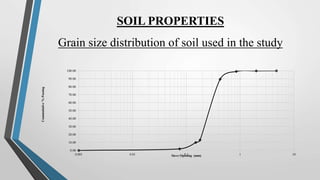
SOIL PROPERTIES
Grain size distribution of soil used in the study
0.00
10.00
20.00
30.00
40.00
50.00
60.00
70.00
80.00
90.00
100.00
0.001 0.01 0.1 1 10
Cummulative
%
Passing
Sieve Opening (mm)
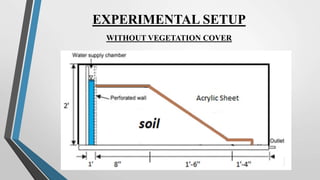
EXPERIMENTAL SETUP
WITHOUT VEGETATION COVER
EXPERIMENTAL SETUP
WITHOUT VEGETATION COVER
EXPERIMENTAL SETUP
WITHOUT VEGETATION COVER
EXPERIMENTAL SETUP
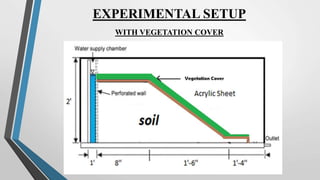
WITH VEGETATION COVER
EXPERIMENTAL SETUP
WITH VEGETATION COVER
EXPERIMENTAL SETUP
WITH VEGETATION COVER
METHODOLOGY
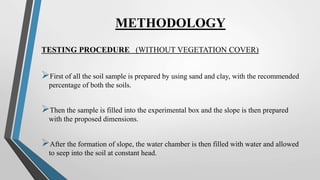
TESTING PROCEDURE (WITHOUT VEGETATION COVER)
First of all the soil sample is prepared by using sand and clay, with the recommended
percentage of both the soils.
Then the sample is filled into the experimental box and the slope is then prepared
with the proposed dimensions.
After the formation of slope, the water chamber is then filled with water and allowed
to seep into the soil at constant head.
METHODOLOGY
TESTING PROCEDURE (WITHOUT VEGETATION COVER)
As the water seeps into the soil, the degree of saturation of the soil will increase so it
creates more pore water pressure which tends the slope to fail.
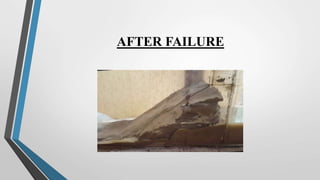
After slope failure the failure pattern and the time taken by the slope to fail were
observed.
The shear strength parameter of the soil after failure were measured in order to
compare it with the shear strength of soil before the failure.
METHODOLOGY
TESTING PROCEDURE (WITH VEGETATION COVER)
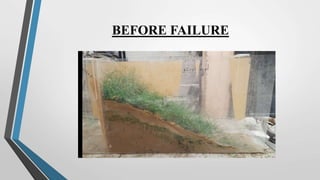
 The same procedure is then revised with the vegetation cover
After the preparation of the slope the grasses were grown on the surface
of the slope
The slope then leaved for thirty days so the roots may reached to its
maximum depth
Then water chamber is filled with water and allow the water to seep into
the soil
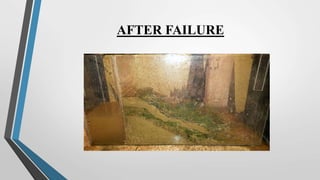
After the failure of the slope, time taken by the slope to fail, type of
failure and shear strength parameter of the soil were measured
RESULTS
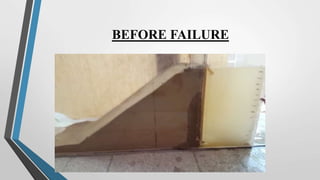
BEFORE FAILURE
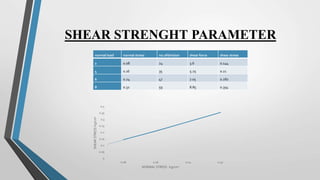
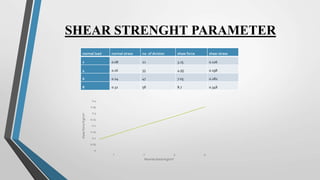
SHEAR STRENGHT PARAMETER
normal load normal stress no.ofdivision shear force shear stress
2 0.08 24 3.6 0.144
4 0.16 35 5.25 0.21
6 0.24 47 7.05 0.282
8 0.32 59 8.85 0.354
0
0.05
0.1
0.15
0.2
0.25
0.3
0.35
0.4
0.08 0.16 0.24 0.32
SHEAR
STRESS
Kg/cm
2
NORMAL STRESS Kg/cm2
AFTER FAILURE
SHEAR STRENGHT PARAMETER
normal load normal stress no. of division shear force shear stress
2 0.08 21 3.15 0.126
4 0.16 33 4.95 0.198
6 0.24 47 7.05 0.282
8 0.32 58 8.7 0.348
0
0.05
0.1
0.15
0.2
0.25
0.3
0.35
0.4
1 2 3 4
shear
force
Kg/cm
2
Normal stress Kg/cm2
BEFORE FAILURE
SHEAR STRENGHT PARAMETER
normal load normal stress no. of division shear force shear stress
2 0.08 24 3.6 0.144
4 0.16 35 5.25 0.21
6 0.24 47 7.05 0.282
8 0.32 59 8.85 0.354
0
0.05
0.1
0.15
0.2
0.25
0.3
0.35
0.4
0.08 0.16 0.24 0.32
SHEAR
STRESS
Kg/cm
2
NORMAL STRESS Kg/cm2
AFTER FAILURE
SHEAR STRENGHT PARAMETER
normal load normal stress no. of division shear force shear stress
2 0.08 35 5.25 0.21
4 0.16 45 6.75 0.27
6 0.24 57 8.55 0.342
8 0.32 70 10.5 0.42
0
0.05
0.1
0.15
0.2
0.25
0.3
0.35
0.4
0.45
-0.05 0 0.05 0.1 0.15 0.2 0.25 0.3 0.35
CONCLUSION
TYPE OF FAILURE
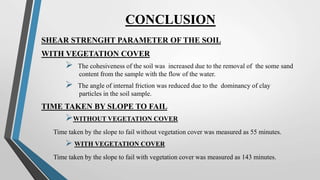
 Translational Failure (slope without vegetation cover)
 Translational Failure (slope with vegetation cover)
SHEAR STRENGHT PARAMETER OF THE SOIL
WITHOUT VEGETATION COVER
 The cohesiveness of the soil was reduced due to the removal of the some
clay content from the sample with the flow of the water.
 The angle of internal friction was increased due to the dominancy of sand
particles in the soil sample.
CONCLUSION
SHEAR STRENGHT PARAMETER OF THE SOIL
WITH VEGETATION COVER
 The cohesiveness of the soil was increased due to the removal of the some sand
content from the sample with the flow of the water.
 The angle of internal friction was reduced due to the dominancy of clay
particles in the soil sample.
TIME TAKEN BY SLOPE TO FAIL
WITHOUT VEGETATION COVER
Time taken by the slope to fail without vegetation cover was measured as 55 minutes.
 WITH VEGETATION COVER
Time taken by the slope to fail with vegetation cover was measured as 143 minutes.
REFERENCES
 Orense, R. P., Shimoma, S., Maeda, K., & Towhata, I. (2004). Instrumented model
slope failure due to water seepage. Journal of Natural Disaster Science, 26(1), 15-
26.
 Gray, D. H. (1995). Influence of vegetation on the stability of slopes. Paper
presented at the VEGETATION AND SLOPES: STABILISATION, PROTECTION
AND ECOLOGY. Proceedings of the international conference held at the university
museum, oxford, 29-30 september 1994.
 Kazmi, D., Qasim, S., Harahap, I., Baharom, S., Imran, M., & Moin, S. (2017). A
study on the contributing factors of major landslides in Malaysia. Civil Engineering
Journal, 2(12), 669-678.
THANKYOU
QUESTION AND ANSWER SESSION

G-23 Final PRESENTATION.pptx

  • 3.
    COMPARATIVE ANALYSIS OFSHEAR STRENGTH PARAMETERS OF THE SOIL WITH AND WITHOUT VEGETATION COVER SUPERVISOR : Dr. SADAF QASIM
  • 4.
    GROUP MEMBERS • SHAHRUKHAHMED (CE-14210) • HAFIZ JAMSHEED ALAM (CE-14217) • MUHAMMAD OWAIS KHAN (CE-14255) • SYED ARIZ ALI (CE-14256) • SYED DANISH FARID (CE-14259)
  • 5.
    PRESENTATION OUTLINE  Introduction Background  Objectives  Methodology  Results  Conclusion  References
  • 6.
    INTRODUCTION The necessity ofimproving the engineering properties of soil has been recognized for as long as construction has existed. Soil derived its shear strength from two parameters called shear strength parameters. They are cohesion and angle of internal friction. One of the most important and the most complicated engineering properties of soil is its ability to resist sliding along internal surface within a mass. The stability of slopes is important in the design of such excavations as open pits, quarries, and foundations, and in natural slopes forming cliffs, valley sides, and reservoirs, where movement may have serious consequences. Therefore to fulfill engineering requirements soil needs to be stabilized.
  • 7.
    INTRODUCTION Soil stabilization canbe explained as the alteration of the soil properties by different means in order to enhance the engineering quality of the soil. Slope stability is the potential of soil covered slopes to withstand and undergo movement. Stability is determined by the balance of shear stress and shear strength. Triggering factors of a slope failure can be climatic events which can then make a slope unstable, leading to mass movements. The field of slope stability encompasses static and dynamic stability of slopes of earth and rock-fill dams, slopes of other types of embankments, excavated slopes, and natural slopes in soil and soft rock.
  • 8.
    BACKGROUND Slope stability problemshave been faced throughout history when men and women or nature has disrupted the delicate balance of natural soil slopes. Furthermore, the increasing demand for engineered cut and fill slopes on construction projects has also increased the need to understand investigative tools, and stabilization methods to solve slope stability problems. The primary purpose of slope stability analysis is to contribute to the safe and economic design of excavations, embankments, earth dams, landfills, and spoil heaps. So the project emphasizes on the pattern and time of slope failure due to seepage, observe the change in shear strength parameters and to minimize the chances of failure and to maximize the time to fail the slope.
  • 9.
    OBJECTIVE  To reviewapplications of vegetation as slope stabilization.  To observe the failure pattern of the slope due to the seepage in slopes with and without vegetation cover.  To investigate the change in shear strength parameters of the soil before and after slope failure.  To increase the stability of the soil by providing vegetation cover on the surface of the slope.
  • 10.
  • 11.
  • 12.
    SOIL PROPERTIES Grain sizedistribution of soil used in the study 0.00 10.00 20.00 30.00 40.00 50.00 60.00 70.00 80.00 90.00 100.00 0.001 0.01 0.1 1 10 Cummulative % Passing Sieve Opening (mm)
  • 13.
  • 14.
  • 15.
  • 16.
  • 17.
  • 18.
  • 19.
    METHODOLOGY TESTING PROCEDURE (WITHOUTVEGETATION COVER) First of all the soil sample is prepared by using sand and clay, with the recommended percentage of both the soils. Then the sample is filled into the experimental box and the slope is then prepared with the proposed dimensions. After the formation of slope, the water chamber is then filled with water and allowed to seep into the soil at constant head.
  • 20.
    METHODOLOGY TESTING PROCEDURE (WITHOUTVEGETATION COVER) As the water seeps into the soil, the degree of saturation of the soil will increase so it creates more pore water pressure which tends the slope to fail. After slope failure the failure pattern and the time taken by the slope to fail were observed. The shear strength parameter of the soil after failure were measured in order to compare it with the shear strength of soil before the failure.
  • 21.
    METHODOLOGY TESTING PROCEDURE (WITHVEGETATION COVER)  The same procedure is then revised with the vegetation cover After the preparation of the slope the grasses were grown on the surface of the slope The slope then leaved for thirty days so the roots may reached to its maximum depth Then water chamber is filled with water and allow the water to seep into the soil After the failure of the slope, time taken by the slope to fail, type of failure and shear strength parameter of the soil were measured
  • 22.
  • 23.
  • 24.
    SHEAR STRENGHT PARAMETER normalload normal stress no.ofdivision shear force shear stress 2 0.08 24 3.6 0.144 4 0.16 35 5.25 0.21 6 0.24 47 7.05 0.282 8 0.32 59 8.85 0.354 0 0.05 0.1 0.15 0.2 0.25 0.3 0.35 0.4 0.08 0.16 0.24 0.32 SHEAR STRESS Kg/cm 2 NORMAL STRESS Kg/cm2
  • 25.
  • 26.
    SHEAR STRENGHT PARAMETER normalload normal stress no. of division shear force shear stress 2 0.08 21 3.15 0.126 4 0.16 33 4.95 0.198 6 0.24 47 7.05 0.282 8 0.32 58 8.7 0.348 0 0.05 0.1 0.15 0.2 0.25 0.3 0.35 0.4 1 2 3 4 shear force Kg/cm 2 Normal stress Kg/cm2
  • 27.
  • 28.
    SHEAR STRENGHT PARAMETER normalload normal stress no. of division shear force shear stress 2 0.08 24 3.6 0.144 4 0.16 35 5.25 0.21 6 0.24 47 7.05 0.282 8 0.32 59 8.85 0.354 0 0.05 0.1 0.15 0.2 0.25 0.3 0.35 0.4 0.08 0.16 0.24 0.32 SHEAR STRESS Kg/cm 2 NORMAL STRESS Kg/cm2
  • 29.
  • 30.
    SHEAR STRENGHT PARAMETER normalload normal stress no. of division shear force shear stress 2 0.08 35 5.25 0.21 4 0.16 45 6.75 0.27 6 0.24 57 8.55 0.342 8 0.32 70 10.5 0.42 0 0.05 0.1 0.15 0.2 0.25 0.3 0.35 0.4 0.45 -0.05 0 0.05 0.1 0.15 0.2 0.25 0.3 0.35
  • 31.
    CONCLUSION TYPE OF FAILURE Translational Failure (slope without vegetation cover)  Translational Failure (slope with vegetation cover) SHEAR STRENGHT PARAMETER OF THE SOIL WITHOUT VEGETATION COVER  The cohesiveness of the soil was reduced due to the removal of the some clay content from the sample with the flow of the water.  The angle of internal friction was increased due to the dominancy of sand particles in the soil sample.
  • 32.
    CONCLUSION SHEAR STRENGHT PARAMETEROF THE SOIL WITH VEGETATION COVER  The cohesiveness of the soil was increased due to the removal of the some sand content from the sample with the flow of the water.  The angle of internal friction was reduced due to the dominancy of clay particles in the soil sample. TIME TAKEN BY SLOPE TO FAIL WITHOUT VEGETATION COVER Time taken by the slope to fail without vegetation cover was measured as 55 minutes.  WITH VEGETATION COVER Time taken by the slope to fail with vegetation cover was measured as 143 minutes.
  • 33.
    REFERENCES  Orense, R.P., Shimoma, S., Maeda, K., & Towhata, I. (2004). Instrumented model slope failure due to water seepage. Journal of Natural Disaster Science, 26(1), 15- 26.  Gray, D. H. (1995). Influence of vegetation on the stability of slopes. Paper presented at the VEGETATION AND SLOPES: STABILISATION, PROTECTION AND ECOLOGY. Proceedings of the international conference held at the university museum, oxford, 29-30 september 1994.  Kazmi, D., Qasim, S., Harahap, I., Baharom, S., Imran, M., & Moin, S. (2017). A study on the contributing factors of major landslides in Malaysia. Civil Engineering Journal, 2(12), 669-678.
  • 34.