RETAINING YOUR BEST CUSTOMERS
KEY CONCEPTS Understanding  Sales Demand Cycle Identifying your  SCA Increasing sales to  existing customers Guarding your  energy
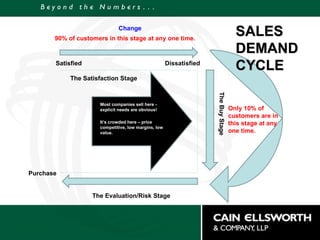
Most companies sell here -  explicit needs are obvious! It’s crowded here – price competitive, low margins, low value. The Satisfaction Stage Purchase Satisfied Dissatisfied The Buy Stage The Evaluation/Risk Stage Only 10% of customers are in this stage at any one time. 90% of customers in this stage at any one time. Change SALES DEMAND CYCLE
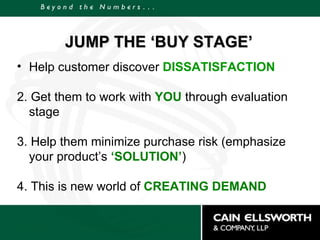
JUMP THE ‘BUY STAGE’ Help customer discover  DISSATISFACTION 2. Get them to work with  YOU   through evaluation stage 3. Help them minimize purchase risk (emphasize your product’s  ‘SOLUTION’ ) 4. This is new world of  CREATING DEMAND
SUSTAINABLE COMPETITIVE ADVANTAGE (SCA) WHAT IS SCA? That feature about your product or service that sets you apart from your competitors. WHY IS IT IMPORTANT? Your SCA should drive your marketing strategy & become key in helping you ‘jump’ the Buy Stage.
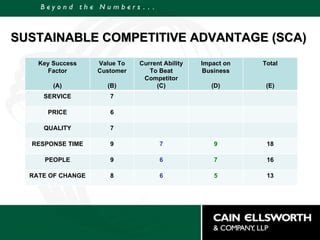
SUSTAINABLE COMPETITIVE ADVANTAGE (SCA) Key Success Factor (A) Value To Customer (B) Current Ability To Beat Competitor (C) Impact on Business (D) Total (E) SERVICE 7 PRICE 6 QUALITY 7 RESPONSE TIME 9 7 9 18 PEOPLE 9 6 7 16 RATE OF CHANGE 8 6 5 13
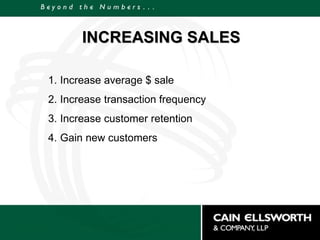
INCREASING SALES Increase average $ sale Increase transaction frequency Increase customer retention Gain new customers
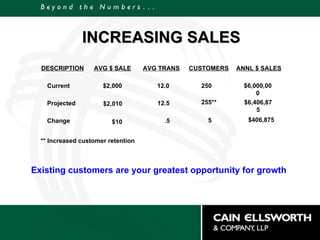
INCREASING SALES DESCRIPTION Current Projected Change AVG $ SALE AVG TRANS $2,000 12.0 CUSTOMERS ANNL $ SALES 250 $6,000,000 $2,010 $10 12.5 .5 255** 5 $6,406,875 $406,875 ** Increased customer retention Existing customers are your greatest opportunity for growth
CUSTOMER-CENTERED MARKETING Loyalty Ladder:  A way to segment your customers Contact Program:  An essential sales tool
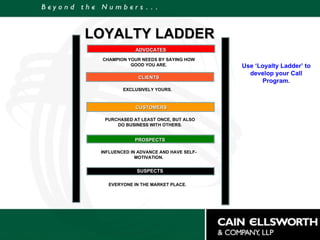
ADVOCATES CLIENTS PROSPECTS SUSPECTS CHAMPION YOUR NEEDS BY SAYING HOW GOOD YOU ARE. EXCLUSIVELY YOURS. PURCHASED AT LEAST ONCE, BUT ALSO DO BUSINESS WITH OTHERS. INFLUENCED IN ADVANCE AND HAVE SELF-MOTIVATION. EVERYONE IN THE MARKET PLACE. LOYALTY LADDER CUSTOMERS Use ‘Loyalty Ladder’ to develop your Call Program.
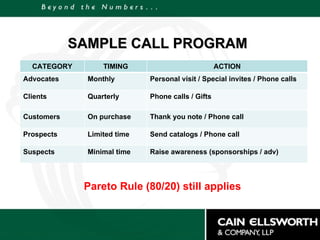
SAMPLE CALL PROGRAM Pareto Rule (80/20) still applies CATEGORY TIMING ACTION Advocates Monthly Personal visit / Special invites / Phone calls Clients Quarterly Phone calls / Gifts Customers On purchase Thank you note / Phone call Prospects Limited time Send catalogs / Phone call Suspects Minimal time Raise awareness (sponsorships / adv)
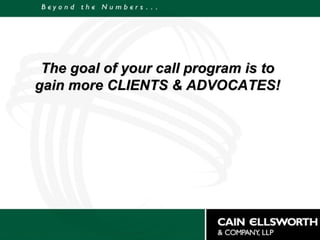
The goal of your call program is to gain more CLIENTS & ADVOCATES!
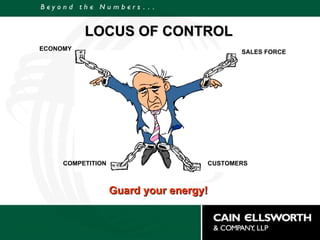
CUSTOMERS COMPETITION SALES FORCE ECONOMY Guard your energy! LOCUS OF CONTROL
SUMMARY Jump the ‘Buy Stage’ Leverage your SCA Concentrate on existing customers Guard your energy
“ We were born to succeed, not to fail.” Henry David Thoreau
“ The way to get started is to stop talking and begin doing.” Walt Disney
Growth & Profit Solutions (GPS) A division of Cain Ellsworth & Co., LLP Mark J. Ellsworth, CPA Matthew R. Heemstra, CPA

Retaining Your Best Customers

  • 1.
  • 2.
    KEY CONCEPTS Understanding Sales Demand Cycle Identifying your SCA Increasing sales to existing customers Guarding your energy
  • 3.
    Most companies sellhere - explicit needs are obvious! It’s crowded here – price competitive, low margins, low value. The Satisfaction Stage Purchase Satisfied Dissatisfied The Buy Stage The Evaluation/Risk Stage Only 10% of customers are in this stage at any one time. 90% of customers in this stage at any one time. Change SALES DEMAND CYCLE
  • 4.
    JUMP THE ‘BUYSTAGE’ Help customer discover DISSATISFACTION 2. Get them to work with YOU through evaluation stage 3. Help them minimize purchase risk (emphasize your product’s ‘SOLUTION’ ) 4. This is new world of CREATING DEMAND
  • 5.
    SUSTAINABLE COMPETITIVE ADVANTAGE(SCA) WHAT IS SCA? That feature about your product or service that sets you apart from your competitors. WHY IS IT IMPORTANT? Your SCA should drive your marketing strategy & become key in helping you ‘jump’ the Buy Stage.
  • 6.
    SUSTAINABLE COMPETITIVE ADVANTAGE(SCA) Key Success Factor (A) Value To Customer (B) Current Ability To Beat Competitor (C) Impact on Business (D) Total (E) SERVICE 7 PRICE 6 QUALITY 7 RESPONSE TIME 9 7 9 18 PEOPLE 9 6 7 16 RATE OF CHANGE 8 6 5 13
  • 7.
    INCREASING SALES Increaseaverage $ sale Increase transaction frequency Increase customer retention Gain new customers
  • 8.
    INCREASING SALES DESCRIPTIONCurrent Projected Change AVG $ SALE AVG TRANS $2,000 12.0 CUSTOMERS ANNL $ SALES 250 $6,000,000 $2,010 $10 12.5 .5 255** 5 $6,406,875 $406,875 ** Increased customer retention Existing customers are your greatest opportunity for growth
  • 9.
    CUSTOMER-CENTERED MARKETING LoyaltyLadder: A way to segment your customers Contact Program: An essential sales tool
  • 10.
    ADVOCATES CLIENTS PROSPECTSSUSPECTS CHAMPION YOUR NEEDS BY SAYING HOW GOOD YOU ARE. EXCLUSIVELY YOURS. PURCHASED AT LEAST ONCE, BUT ALSO DO BUSINESS WITH OTHERS. INFLUENCED IN ADVANCE AND HAVE SELF-MOTIVATION. EVERYONE IN THE MARKET PLACE. LOYALTY LADDER CUSTOMERS Use ‘Loyalty Ladder’ to develop your Call Program.
  • 11.
    SAMPLE CALL PROGRAMPareto Rule (80/20) still applies CATEGORY TIMING ACTION Advocates Monthly Personal visit / Special invites / Phone calls Clients Quarterly Phone calls / Gifts Customers On purchase Thank you note / Phone call Prospects Limited time Send catalogs / Phone call Suspects Minimal time Raise awareness (sponsorships / adv)
  • 12.
    The goal ofyour call program is to gain more CLIENTS & ADVOCATES!
  • 13.
    CUSTOMERS COMPETITION SALESFORCE ECONOMY Guard your energy! LOCUS OF CONTROL
  • 14.
    SUMMARY Jump the‘Buy Stage’ Leverage your SCA Concentrate on existing customers Guard your energy
  • 15.
    “ We wereborn to succeed, not to fail.” Henry David Thoreau
  • 16.
    “ The wayto get started is to stop talking and begin doing.” Walt Disney
  • 17.
    Growth & ProfitSolutions (GPS) A division of Cain Ellsworth & Co., LLP Mark J. Ellsworth, CPA Matthew R. Heemstra, CPA

Editor's Notes

  • #2 <number><number>
  • #3 <number>
  • #4 Satisfaction Stage – 90% of Customers Here-- slowly moving from satisfied  dissatisfied-- will not chg until something disturbs them  DISSATISFACTION-- pain becomes acute  to Buy StageBuy Stage – 10% of Customers Here-- Become proactive-- Investigate alts-- Channel toward 1 prod or svcEvaluation/Risk Stage -- Evaluate purch risk-- “Will I be happy?”-- Movement toward actual purch<number>
  • #5 HOW TO INCREASE SALES:New customers – more difficultIncrease average $SaleIncrease transaction frequencyInrease customer retention** Existing customers represent the greatest opportunity for growth.<number>
  • #6 6
  • #7 -- High value to customer-- Ability to beat competitor-- High impact on your businessReview SCA formally at least annually.6
  • #8 6
  • #9 6
  • #10 6
  • #11 Key to customer centered marketing. (“Loyalty still does count.”)PARETO RULE (80/20)-- 80% of sales  20% of customers-- 80% of profits  20% of customers-- 80% of problems  20% of customers11
  • #12 11
  • #13 11
  • #14 What separates ‘Winners’ from ‘Losers’? Degree to which you feel you control your own destiny.EXAMPLES:-- “Our competitors low-balled us & drove us out of business.”= Externally Focused  Blame external factors for failures. Focused on Problems.-- “We didn’t do a good job of listening to our customers and lost business as a result.”= Internally Focused: Feel they can influence the issues around them. Focused on Solutions.Those with ‘External” focus will find it most difficult to change. They will drain your energy if you let them.GUARD YOUR ENERGY.11
  • #15 15
  • #16 15
  • #17 15