LESSON 2
CUSTOMER
RELATIONSHIP:
CUSTOMER
SERVICE
ABM 12 -
PRINCIPLES OF MARKETING
CUSTOMER
-DRIVEN
MARKETING
CUSTOMER
-Is a person or organization that transacts with
business person or business organization to buy
goods or services for monetary or other valuable
consideration.
What is the
end goal of a
business?
Acquiring customers and
keeping customers is the
end goal of businesses
because customers create
demand.
Because customers have
varying needs and
preferences over time,
organizations must be able to
offer products and services at
the time when customers
need them. Marketers cannot
force the customers to buy
any products or services that
the company offers.
Instead, consumer needs and
wants must be understood
and anticipated, as well as be
satisfied adequately and
exceedingly. Companies must
predict customer needs.
CUSTOMER SERVICE
-Is the process of ensuring customer satisfaction
with a product or service.
Customer service can take on
many forms - salesperson
assistance, product delivery,
technical advice, help desks,
or other means. It involves
activities designed to
enhance customer
satisfaction, or the perception
that a product has met or
exceeded expectations.
This perception can be
shaped and influenced by the
level and type of service that
customers receive before,
during, and after the actual
phase.
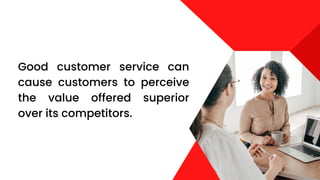
Good customer service can
cause customers to perceive
the value offered superior
over its competitors.
This is because a customer
not only buys a product and
service, but also the entire
purchase or shopping
experience.
CREATING A
CUSTOMER
SERVICE
PROGRAM
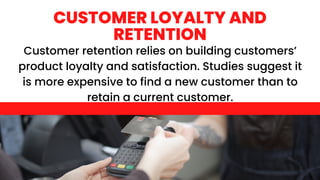
Customer retention relies on building customers’
product loyalty and satisfaction. Studies suggest it
is more expensive to find a new customer than to
retain a current customer.
CUSTOMER LOYALTY AND
RETENTION
Satisfied customers are loyal
customers. Loyal customers
tell others and advertise the
benefits of your products and
services. This is an important
additional marketing tool for
your business.
Having loyal customers:
Creates great word-of-mouth
referral (potentially reducing
advertising costs)
Means repeat business
Increases their chances of
staying with your business
Creates more stable demand
for your services and products
Having Loyal Customers:
May reduce the negative
reactions by customers when
there is a breakdown in the
delivery of your product or
service
Steps for Creating an
Effective Customer
Service Program
Establishing a successful customer
service program in your business
requires commitment from yourself
and your staff. You need to plan it,
develop it, implement it and sustain
it. It also involves training and
feedback.
Steps to take:
1 Think about what your
customers need.
2 Plan how you will meet their
needs. Write a document
outlining the program’s aims,
details, and how it will be
implemented throughout your
business.
Steps to take:
3 Deliver training to your staff,
including training for any new
systems.
4 Implement the program,
making sure all staff are
confident with it.
5 Sustain the program by
reviewing changing customer
needs and feedback.
Steps to take:
6 Encourage and support staff
throughout a staff recognition
program.
If your program is working
well, it will keep your
customers happy, which in
return, will mean higher profits
for you.
YOUR
CUSTOMER
SERVICE
PROGRAM
Your people need to work together to put the needs of
the customer first. Staff should treat customers as
individual and listen to their comments, complaints and
requests - this all adds up to a great customer service
attitude.
STAFF
Importantly, your staff should thank customers to
ensure that they feel valued, important and
needed.
STAFF
Your staff are the first point of
contact for your customers, so it is
important that they:
1 Have the right attitude
2 Are well-trained
3 Enjoy their work
4 Contribute to improvements
5 Advocate your business
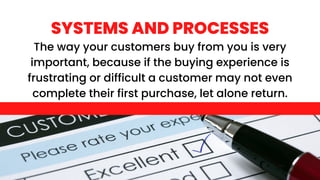
The way your customers buy from you is very
important, because if the buying experience is
frustrating or difficult a customer may not even
complete their first purchase, let alone return.
SYSTEMS AND PROCESSES
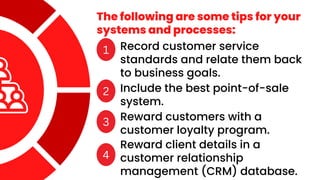
The following are some tips for your
systems and processes:
1 Record customer service
standards and relate them back
to business goals.
2 Include the best point-of-sale
system.
3 Reward customers with a
customer loyalty program.
4
Reward client details in a
customer relationship
management (CRM) database.
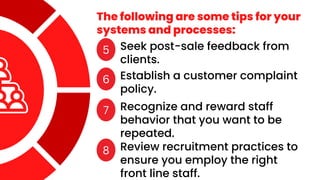
The following are some tips for your
systems and processes:
5 Seek post-sale feedback from
clients.
6 Establish a customer complaint
policy.
7 Recognize and reward staff
behavior that you want to be
repeated.
8 Review recruitment practices to
ensure you employ the right
front line staff.
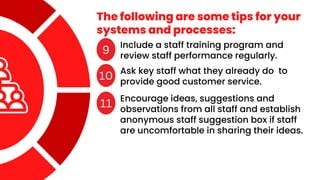
The following are some tips for your
systems and processes:
9
Include a staff training program and
review staff performance regularly.
10
Ask key staff what they already do to
provide good customer service.
11
Encourage ideas, suggestions and
observations from all staff and establish
anonymous staff suggestion box if staff
are uncomfortable in sharing their ideas.
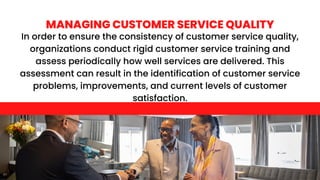
In order to ensure the consistency of customer service quality,
organizations conduct rigid customer service training and
assess periodically how well services are delivered. This
assessment can result in the identification of customer service
problems, improvements, and current levels of customer
satisfaction.
MANAGING CUSTOMER SERVICE QUALITY
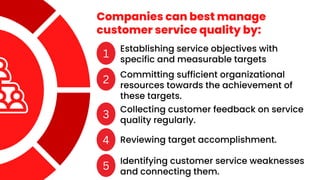
Companies can best manage
customer service quality by:
1
Establishing service objectives with
specific and measurable targets
2
Committing sufficient organizational
resources towards the achievement of
these targets.
3
Collecting customer feedback on service
quality regularly.
4 Reviewing target accomplishment.
5
Identifying customer service weaknesses
and connecting them.
Organizations must
constantly bear in mind that it
is better to exceed customer
service expectations than to
simply fulfill or underachieve
them.
How can organizations make their customer service stand out?
How can they protect their services from being duplicated by
competitors? For physical products, differentiation can be
easily undertaken and protected through patents. That is,
however, not the case with services.
MANAGING CUSTOMER SERVICE DIFFERENTIATION
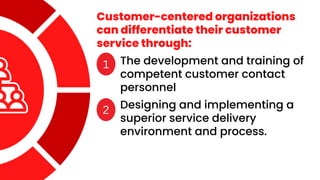
Customer-centered organizations
can differentiate their customer
service through:
1 The development and training of
competent customer contact
personnel
2 Designing and implementing a
superior service delivery
environment and process.
CUSTOMER
RELATIONSHIP
MANAGEMENT
(CRM)
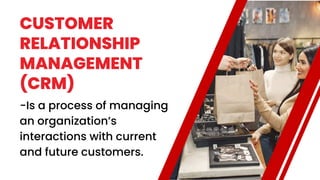
-Is a process of managing
an organization’s
interactions with current
and future customers.
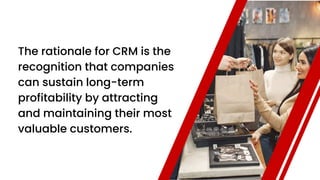
The rationale for CRM is the
recognition that companies
can sustain long-term
profitability by attracting
and maintaining their most
valuable customers.
CUSTOMER LIFETIME
VALUE (CLV)
-Is the forecasted sales or
profits that a company can
derive from the entire span
of the future relationship
with a particular customer.
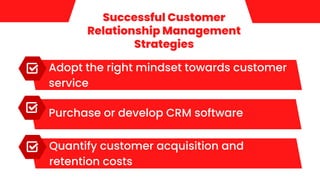
Successful Customer
Relationship Management
Strategies
Adopt the right mindset towards customer
service
Purchase or develop CRM software
Quantify customer acquisition and
retention costs
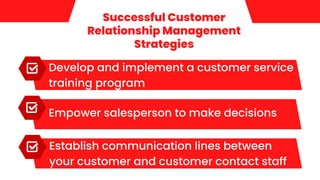
Successful Customer
Relationship Management
Strategies
Develop and implement a customer service
training program
Empower salesperson to make decisions
Establish communication lines between
your customer and customer contact staff
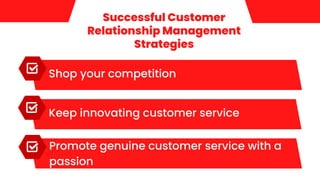
Successful Customer
Relationship Management
Strategies
Shop your competition
Keep innovating customer service
Promote genuine customer service with a
passion
Any
Questions?
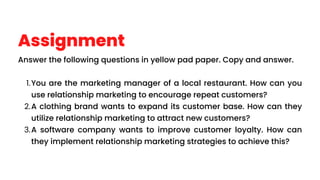
Assignment
Answer the following questions in yellow pad paper. Copy and answer.
You are the marketing manager of a local restaurant. How can you
use relationship marketing to encourage repeat customers?
1.
A clothing brand wants to expand its customer base. How can they
utilize relationship marketing to attract new customers?
2.
A software company wants to improve customer loyalty. How can
they implement relationship marketing strategies to achieve this?
3.
Seatwork
Find a pair and develop a relationship marketing plan for a company
operating in your assigned industry (telecommunications, retail, and
hospitality)
1.
Consider your target market, customer needs and appropriate
relationship marketing strategies
2.
Highlight key elements about customer service in your plan and
justify your choice.
3.
THANK YOU
FOR YOUR ATTENTION

MARKETING -POWERPOINT- PRESENTATION. PPT

  • 1.
  • 2.
  • 3.
    CUSTOMER -Is a personor organization that transacts with business person or business organization to buy goods or services for monetary or other valuable consideration.
  • 4.
    What is the endgoal of a business?
  • 5.
    Acquiring customers and keepingcustomers is the end goal of businesses because customers create demand.
  • 6.
    Because customers have varyingneeds and preferences over time, organizations must be able to offer products and services at the time when customers need them. Marketers cannot force the customers to buy any products or services that the company offers.
  • 7.
    Instead, consumer needsand wants must be understood and anticipated, as well as be satisfied adequately and exceedingly. Companies must predict customer needs.
  • 8.
    CUSTOMER SERVICE -Is theprocess of ensuring customer satisfaction with a product or service.
  • 9.
    Customer service cantake on many forms - salesperson assistance, product delivery, technical advice, help desks, or other means. It involves activities designed to enhance customer satisfaction, or the perception that a product has met or exceeded expectations.
  • 10.
    This perception canbe shaped and influenced by the level and type of service that customers receive before, during, and after the actual phase.
  • 11.
    Good customer servicecan cause customers to perceive the value offered superior over its competitors.
  • 12.
    This is becausea customer not only buys a product and service, but also the entire purchase or shopping experience.
  • 14.
  • 15.
    Customer retention relieson building customers’ product loyalty and satisfaction. Studies suggest it is more expensive to find a new customer than to retain a current customer. CUSTOMER LOYALTY AND RETENTION
  • 16.
    Satisfied customers areloyal customers. Loyal customers tell others and advertise the benefits of your products and services. This is an important additional marketing tool for your business.
  • 17.
    Having loyal customers: Createsgreat word-of-mouth referral (potentially reducing advertising costs) Means repeat business Increases their chances of staying with your business Creates more stable demand for your services and products
  • 18.
    Having Loyal Customers: Mayreduce the negative reactions by customers when there is a breakdown in the delivery of your product or service
  • 19.
    Steps for Creatingan Effective Customer Service Program Establishing a successful customer service program in your business requires commitment from yourself and your staff. You need to plan it, develop it, implement it and sustain it. It also involves training and feedback.
  • 20.
    Steps to take: 1Think about what your customers need. 2 Plan how you will meet their needs. Write a document outlining the program’s aims, details, and how it will be implemented throughout your business.
  • 21.
    Steps to take: 3Deliver training to your staff, including training for any new systems. 4 Implement the program, making sure all staff are confident with it. 5 Sustain the program by reviewing changing customer needs and feedback.
  • 22.
    Steps to take: 6Encourage and support staff throughout a staff recognition program.
  • 23.
    If your programis working well, it will keep your customers happy, which in return, will mean higher profits for you.
  • 24.
  • 25.
    Your people needto work together to put the needs of the customer first. Staff should treat customers as individual and listen to their comments, complaints and requests - this all adds up to a great customer service attitude. STAFF
  • 26.
    Importantly, your staffshould thank customers to ensure that they feel valued, important and needed. STAFF
  • 27.
    Your staff arethe first point of contact for your customers, so it is important that they: 1 Have the right attitude 2 Are well-trained 3 Enjoy their work 4 Contribute to improvements 5 Advocate your business
  • 28.
    The way yourcustomers buy from you is very important, because if the buying experience is frustrating or difficult a customer may not even complete their first purchase, let alone return. SYSTEMS AND PROCESSES
  • 29.
    The following aresome tips for your systems and processes: 1 Record customer service standards and relate them back to business goals. 2 Include the best point-of-sale system. 3 Reward customers with a customer loyalty program. 4 Reward client details in a customer relationship management (CRM) database.

  • 30.
    The following aresome tips for your systems and processes: 5 Seek post-sale feedback from clients. 6 Establish a customer complaint policy. 7 Recognize and reward staff behavior that you want to be repeated. 8 Review recruitment practices to ensure you employ the right front line staff.
  • 31.
    The following aresome tips for your systems and processes: 9 Include a staff training program and review staff performance regularly. 10 Ask key staff what they already do to provide good customer service. 11 Encourage ideas, suggestions and observations from all staff and establish anonymous staff suggestion box if staff are uncomfortable in sharing their ideas.
  • 32.
    In order toensure the consistency of customer service quality, organizations conduct rigid customer service training and assess periodically how well services are delivered. This assessment can result in the identification of customer service problems, improvements, and current levels of customer satisfaction. MANAGING CUSTOMER SERVICE QUALITY
  • 33.
    Companies can bestmanage customer service quality by: 1 Establishing service objectives with specific and measurable targets 2 Committing sufficient organizational resources towards the achievement of these targets. 3 Collecting customer feedback on service quality regularly. 4 Reviewing target accomplishment. 5 Identifying customer service weaknesses and connecting them.
  • 34.
    Organizations must constantly bearin mind that it is better to exceed customer service expectations than to simply fulfill or underachieve them.
  • 35.
    How can organizationsmake their customer service stand out? How can they protect their services from being duplicated by competitors? For physical products, differentiation can be easily undertaken and protected through patents. That is, however, not the case with services. MANAGING CUSTOMER SERVICE DIFFERENTIATION
  • 36.
    Customer-centered organizations can differentiatetheir customer service through: 1 The development and training of competent customer contact personnel 2 Designing and implementing a superior service delivery environment and process.
  • 37.
    CUSTOMER RELATIONSHIP MANAGEMENT (CRM) -Is a processof managing an organization’s interactions with current and future customers.
  • 38.
    The rationale forCRM is the recognition that companies can sustain long-term profitability by attracting and maintaining their most valuable customers.
  • 39.
    CUSTOMER LIFETIME VALUE (CLV) -Isthe forecasted sales or profits that a company can derive from the entire span of the future relationship with a particular customer.
  • 40.
    Successful Customer Relationship Management Strategies Adoptthe right mindset towards customer service Purchase or develop CRM software Quantify customer acquisition and retention costs
  • 41.
    Successful Customer Relationship Management Strategies Developand implement a customer service training program Empower salesperson to make decisions Establish communication lines between your customer and customer contact staff
  • 42.
    Successful Customer Relationship Management Strategies Shopyour competition Keep innovating customer service Promote genuine customer service with a passion
  • 43.
  • 44.
    Assignment Answer the followingquestions in yellow pad paper. Copy and answer. You are the marketing manager of a local restaurant. How can you use relationship marketing to encourage repeat customers? 1. A clothing brand wants to expand its customer base. How can they utilize relationship marketing to attract new customers? 2. A software company wants to improve customer loyalty. How can they implement relationship marketing strategies to achieve this? 3.
  • 45.
    Seatwork Find a pairand develop a relationship marketing plan for a company operating in your assigned industry (telecommunications, retail, and hospitality) 1. Consider your target market, customer needs and appropriate relationship marketing strategies 2. Highlight key elements about customer service in your plan and justify your choice. 3.
  • 46.