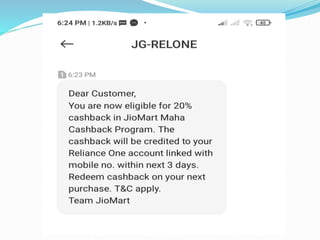
Consumer Perception
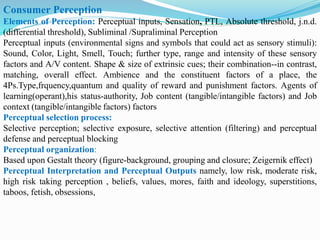
Elements of Perception: Perceptual inputs, Sensation, PTL, Absolute threshold, j.n.d.
(differential threshold), Subliminal /Supraliminal Perception
Perceptual inputs (environmental signs and symbols that could act as sensory stimuli):
Sound, Color, Light, Smell, Touch; further type, range and intensity of these sensory
factors and A/V content. Shape & size of extrinsic cues; their combination--in contrast,
matching, overall effect. Ambience and the constituent factors of a place, the
4Ps.Type,frquency,quantum and quality of reward and punishment factors. Agents of
learning(operant),his status-authority, Job content (tangible/intangible factors) and Job
context (tangible/intangible factors) factors
Perceptual selection process:
Selective perception; selective exposure, selective attention (filtering) and perceptual
defense and perceptual blocking
Perceptual organization:
Based upon Gestalt theory (figure-background, grouping and closure; Zeigernik effect)
Perceptual Interpretation and Perceptual Outputs namely, low risk, moderate risk,
high risk taking perception , beliefs, values, mores, faith and ideology, superstitions,
taboos, fetish, obsessions,
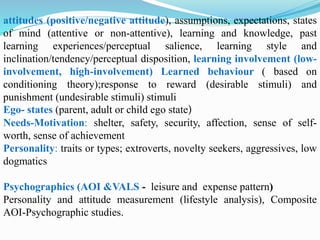
attitudes (positive/negative attitude), assumptions, expectations, states
of mind (attentive or non-attentive), learning and knowledge, past
learning experiences/perceptual salience, learning style and
inclination/tendency/perceptual disposition, learning involvement (low-
involvement, high-involvement) Learned behaviour ( based on
conditioning theory);response to reward (desirable stimuli) and
punishment (undesirable stimuli) stimuli
Ego- states (parent, adult or child ego state)
Needs-Motivation: shelter, safety, security, affection, sense of self-
worth, sense of achievement
Personality: traits or types; extroverts, novelty seekers, aggressives, low
dogmatics
Psychographics (AOI &VALS - leisure and expense pattern)
Personality and attitude measurement (lifestyle analysis), Composite
AOI-Psychographic studies.
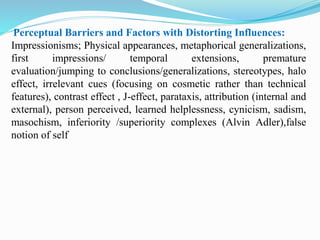
Perceptual Barriers and Factors with Distorting Influences:
Impressionisms; Physical appearances, metaphorical generalizations,
first impressions/ temporal extensions, premature
evaluation/jumping to conclusions/generalizations, stereotypes, halo
effect, irrelevant cues (focusing on cosmetic rather than technical
features), contrast effect , J-effect, parataxis, attribution (internal and
external), person perceived, learned helplessness, cynicism, sadism,
masochism, inferiority /superiority complexes (Alvin Adler),false
notion of self
PERCEIVED QUALITY
Context: In a buyer’s market, a product is defined as a set of features/attributes as
expected by customers. This is how Crosby has defined ‘Quality’; a set of expectations
by relevant end-users. The customer may have rational/irrational expectations and bases
to evaluate product/service features however, as stated above all his perceptions and
considerations must be taken into account beforehand towards developing a
product/service package as an appropriate ‘solution’ that may finally and fully leave
him satisfied (SIVA approach; Chekitan Dev & Don Schultz,2005).
The following content helps develop an insight into how most customers usually
perceive product features and quality.
.Consumers make use of intrinsic or/and extrinsic cues to evaluate product/service
quality. Intrinsic cues concern physical characteristics of the product itself, such as size,
color, flavor,/taste aroma etc. Supposed to have intrinsic relationship to the product
quality. While extrinsic cues include bases such as price-tag, packaging, advertising,
brand image, manufacturer’s image, retail store image, county of origin, even peer
pressure.
.Consumers like to believe that they base their evaluations of product quality on
intrinsic cues, because that enables them to justify their product decisions (either
positive or negative) as being “rational” or “objective” product choices but more often
than not the physical characteristics they use to judge quality have no intrinsic
relationship to the product’s quality.For example, many consumers who claim that they
buy a particular brand due to its superior taste often fail to identify that brand in ‘blind
taste tests’.
.Studies also indicate that in the absence of actual experience with the product
consumers often evaluate the quality of a product on the basis of cues extrinsic/external
to the product itself.
.Many consumers use country-of-origin stereotypes such as “Made in U.S.A./ Japan
/Germany” label to evaluate products. According to a study even many Americans
prefer foreign goods to domestic products.
PERCEIVED QUALITY OF SERVICES
Services are intangible, variable, perishable, and simultaneously produced and
consumed. This is how most customers usually perceive service features and quality:
.Consumers are unable to compare services side-by-side as they do with competing
products.
.Consumers rely majorly on surrogate cues (extrinsic cues) to evaluate service quality.
For example, in evaluating a doctor’s services ,they note the quality of the office,
examine room furnishings, the number (and source) of framed degrees on the wall, the
pleasantness of the receptionist, and the professionalism of the nurse among others; all
contribute to the consumer’s overall evaluation of service quality.
.Unlike products when services are standardized (to reduce variability) the downside of
it may lead to loss of customized services, which many costumers may value e.g.,
waiter services, personal grooming, class instructions etc.
.Unlike products, which are first produced, then sold, and then consumed, most services
are first sold, then produced and consumed simultaneously. This means there is very
little or no scope to improve upon a deficient service. This makes customers relatively
more sensitive and finicky towards services than the products.
.The customer’s perception towards service quality is also holistic and if anything
wrong goes wrong even with a single component then the overall satisfaction is
adversely affected.
.Ensuring consistency in services during ‘rush/peak demand hours’ is another major
challenge. So try change demand pattern to distribute services more equally over time.
For example, early bird dinner options. Following a visibly transparent queuing pattern
and order is a must. Filling the consumer’s time meaningfully in as much pleasant way
is equally important to reduce the perceived waiting time and the consequent negative
service evaluation.
.Some researchers believe that the consumer's evaluation of service quality is a function
of magnitude and direction of the gap between the customer’s expectations of services
and his assessment (perception) of the ‘service actually delivered’. His assessment is
based on his expectations, and his expectations are in turn based on his ‘past
experiences’ and ‘his own background'. For example a newcomer assessing a
university’s service quality. His expectations must be exceeded for his positive view of
the university. Some researchers believe that service quality perceptions are a function
of the gap between ‘perceived performance’ and a combination of expectations and
desires. The former is measured through the SERVQUAL scale while the latter is
through SERVPERF scale
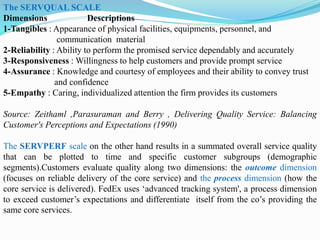
The SERVQUAL SCALE
Dimensions Descriptions
1-Tangibles : Appearance of physical facilities, equipments, personnel, and
communication material
2-Reliability : Ability to perform the promised service dependably and accurately
3-Responsiveness : Willingness to help customers and provide prompt service
4-Assurance : Knowledge and courtesy of employees and their ability to convey trust
and confidence
5-Empathy : Caring, individualized attention the firm provides its customers
Source: Zeithaml ,Parasuraman and Berry , Delivering Quality Service: Balancing
Customer's Perceptions and Expectations (1990)
The SERVPERF scale on the other hand results in a summated overall service quality
that can be plotted to time and specific customer subgroups (demographic
segments).Customers evaluate quality along two dimensions: the outcome dimension
(focuses on reliable delivery of the core service) and the process dimension (how the
core service is delivered). FedEx uses ‘advanced tracking system', a process dimension
to exceed customer’s expectations and differentiate itself from the co’s providing the
same core services.
Researchers (Zeithaml, Parasuraman and Berry (Journal of Marketing 58; Jan 1994)
have integrated product and service quality into an overall ‘Transaction Satisfaction
index’ on the premise that there is a service aspect (intangibles) to every product and
product aspect (tangibles) to every service. TS is a function of Evaluation of Service
Quality (SQ) , Evaluation of Product Quality (PQ) and Evaluation of Price(P). For
example, satisfaction with a retail purchase would also include evaluation of services
(helpfulness and efficiency) by the sales person, and pleasantness of the surroundings
among other things.
A study of the relationship between service quality, consumer satisfaction , and
purchase intentions found that perceptions of high service quality and high service
satisfaction result in a very high level of purchase intentions (Taylor,1997). According
to Zeithaml, Parasuraman and Berry (Journal of Marketing 60, April 1996) service
quality is a major determinant to favorable behavioral intentions else the customers
defect. Favorable behavioral intentions lead to – ongoing revenue, increased spending,
price premiums and referred customers.
PERCEIVED PRICES:
Price is a means to a manufacturer/service provider to raise revenue so as to recover his
expenses profitably. To a customer it’s a sacrifice of his purchasing power that he is
willing to undertake against an alternate use or future use of that money. The customer
thus obviously tries to maximize his value-for-money and economic benefits and
minimize his sense of loss and opportunity cost. It is in fact an important factor that
affects his final satisfaction level and future purchase intentions of a
brand/product/service or from a particular store/place. A customer may evaluate the
whole product/service package or/and individual features (tangibles/intangibles or
both) economically before arriving at the final price figure willing to be paid off. But
how rational and competent he is in the process of assessing product/service features is
a subject of query and interest. Studies and pricing trends show that the marketers quite
often play with the customer’s perception of prices. There are numerous examples to
suggest an unfair play with regard to pricing wherein customers end up paying more
than they should. Some examples of such pricing measures include the following:
Status -goods pricing, reference pricing --showroom pricing, odd tag pricing. Promotion
pricing like psychological discounts, Discriminating pricing - product form pricing,
image pricing, location and time pricing. Product mix pricing-product bundled pricing,
product line pricing, optional feature product pricing, captive product pricing, and two
part pricing among others.
# Internal Reference Price : It’s the price (or price range) consumer retrieves from his
memory to judge the value and believability of any advertised (external) price deal. It
has a range with lower and outer limits. If a price-tag falls within this limit, he willingly
assimilates it. Therefore, in a way IRP is the consumer’s acceptance range of prices. If a
price-tag is plausibly low, it is clearly accepted and if a price-tag is plausibly high as it
is pitched at the outermost limit of IRP, a consumer still believes it. But if the price is
implausibly high as it is set beyond the IRP he obviously contrasts it and perceives it as
much negatively.
IRP is a relevant participating variable also in Acquisition-Transaction Utility.
According to the acquisition utility theory a consumer evaluates economically (??) the
product utility (tangible/intangible features) that forms his perceived economic gain or
loss with a purchase; thus acquisition utility is a function of product utility and
purchase price. Whereas according to the Transaction Utility theory the perceived
pleasure or displeasure associated with the financial aspect of the purchase is
determined by the difference between the internal reference price (IRP) and the
purchase price. For example, if the IRP of a consumer for a hand-set is $100 and the
set is sale-priced at $100,he receives no transaction utility. For a positive transaction
utility, which would increase the total utility the consumer experiences with the
purchase either the IRP is increased, or the sales price is decreased(JoCM 10,1-
1993).However, as per another study the transaction utility is significant only when the
consumer is certain about the consistency in quality(Urbany et al.,1997) .
Interestingly consumer’ own reference price called the IRP is usually not formed on a
rational basis, it’s rather on the basis of what marketers may have already advertised
externally in the past. That means higher advertised prices (external reference
price) leads to higher internal reference price (Grewal et al., JoM 62 –April
1988).And the outermost limit of the IRP; the consumer’s price acceptance/tolerance
range at time t1 is also subsequently pushed up in time t2 .
But every time marketers pitch prices beyond IRP, they have to play very cleverly and
subtly with different marketing-mix by creating enough provisions within the different
‘P’s for minimizing any negative effects and active or passive resistance to the new
price-tag resulting thereof. For instance, a marketer may advertise a product
aggressively with an element of glamour or attraction in it to get the new price tag
assimilated (mentally absorbed).He may reposition the product/brand, employ promo-
tools, play with the notions of overall quality, may add more tangible/intangible features
and harp on the new price-feature ratio. Factors like remodeling of the store, or a new
posh location of the old store or sometimes even just a new packaging would makeover
the entire product in the mind of the consumers and get the new price limit across their
mind justifiably with least bitter feelings on the transaction utility score.
The following findings are quite relevant in this context of understanding as how the
marketing-mix elements of ‘brands quality’ and ‘advertisements’ relative to competition
influence the consumer perception w.r.t. pricing and help define/redefine the final price
tag.
1-Brands with average relative quality but high relative ad budgets were able to charge
premium prices. Consumers were willing to pay high prices for known products than
unknown products.
2-Brands with high relative quality and high relative ad obtained the highest price.
Conversely, brands with low quality and low ad charged the lowest prices.
3-The positive relationship between high prices and high ads held most strongly at the
later stages of the PLC for market leaders.
Sometimes marketers push up the IRPs also by setting the reference price at the highest
price recently offered for identical or comparable merchandise. This does not create
much ill-will.
Still better, if the consumers are made to assimilate the new price tag gradually by
pitching it below their ‘differential threshold’ or j.n.d.
In high inflation economies it is also quite easier for marketers now a days to justify any
price increase through attributing it externally on national or international government
/non govt. bodies/ stirred up events.
RELATIONSHIP BETWEEN PERCEIVED PRICE / PERCEIVED QUALITY
A number of studies prove that generally customers rely on price (an extrinsic cue) as
an indicator of product quality. According to one study when consumers have little
information, or have little confidence in their own ability to make a choice on other
grounds they use price as a surrogate indicator of quality. Several studies have
interestingly shown that consumers attribute different qualities to identical products that
carry different price labels. Naturally, some ads deliberately emphasize a high price to
underscore the marketer's claim of quality. Price declines as a factor in product selection
when the consumer is familiar with a brand name or has an experience with a
product/service. Other studies as mentioned earlier show that consumers using a
price/quality relationship actually rely on expensive brand names as an indicator of
quality, without relying on price per se.As a result better brands with even average
quality are able to fetch premium prices.
.According to an important study (Dodds,Munroe,and Grewal, JoM 28 Aug-1991) both
brand and store information have a positive effect on ‘perceived quality’ and also on
‘perceived product value’ and ‘willingness to buy’.[‘Perceived Product Value’ is a
trade-off that goes on in the mind of the consumer between the product’s perceived
benefits (or quality) and the perceived sacrifice (both monetary and non-monetary) –
required to acquire it].While price as usual has a positive effect on perceived quality but
a negative effect on perceived product value and the willingness to buy. Segment
characteristics (background variables such as age and income) have also been shown to
affect perception of value.
RETAIL STORE IMAGE
The image of retail store affects the perceived quality of product it stores. For instance,
even an average quality product can be perceived to be of high quality, if it placed in an
up market store/mall and can fetch premium prices (called reference pricing).On the
contrary if the same merchandise or some merchandise of even better quality is placed
in a low-image store, it is likely to be perceived low and would fetch low price. The
image of place therefore is usually factored in by the buyers while evaluating the
quality of a product/service. So much so that consumers generally prefer to buy certain
type of products/services from particular places only and do not mind the prices and
sometimes even other costs such as travel time due to distance factor, waiting time,
billing time etc unless there is an equally better or far better alternative option available
around. Post consumption if the customer is happy/satisfied with the product/ service,
then the image of the store also further improves in his mind. This happens even in case
of those stores that trade in multiple brands. However keeping in view the association
between the image of store and brand and reinforcement of the image of store and brand
following the consumption of the brand-- exclusive brand stores or/and VMS are in
vogue across the world.
.In the context of studying the association between price, product quality, and store
image in case of multi-brand stores there is a unique observation that if a low-priced
store carries a brand with a high-priced image, then the image of the store improves (the
less favorable image becomes enhanced at the expense of the more favorable
image),while the image of the brand erodes and vice-versa.
In the context of sales pricing(discount/promo tools) stores that offer ‘frequency of
price advantage’ (small discount on large number of items) over ‘magnitude of price
advantage’ (large discounts on a smaller number of items) come to be perceived as
stores offering ‘lower prices’ and thus as ‘better value-pricing avenues’ (JoCR 21 Sep-
1994).In another study stores offering frequent price specials are perceived to be more
‘competitive’ but the constant use of sales price is harmful to the store’s image in the
long run.
Impact of Store Environment and its Constituent Factors on
Perceived Product/Service Quality:
.In one study bank customers considered the following attributes important towards a
conducive service environment namely, privacy (visual and verbal),
effiiency/convenience, ambient background, social conditions, and aesthetics.
In another study [Dhruv ,Baker et al. Journal of the Academy of Marketing Science 22
– 4(1994)]consumer perceptions were found to be heavily influenced by ‘ambient
factors (such as the number, type, and behaviour of other customers within the store and
the sales personnel) than by store design features.
.In addition to the other environmental/ambient factors as mentioned above in specific
cases showroom displays and merchandising also greatly influence consumer
perception.
Companies also debate the worth of the institutional advertising vis a vis the product advertising
in terms of its individual or joint impact on the consumer perception. Many prefer an integral an
complementary communication program.’
PERCEIVED RISK
It is defined in terms of the uncertainty faced by the consumers when they cannot foresee the
consequences of their purchase decisions (related to either purchase of products/services, prices,
brands or place)
Interestingly, a consumer may perceive risk when it is not there or may not see any risk when it is
actually there. There are different types of risks that consumers may perceive in different
situations.
Functional Risk: the risk that the product will not perform as expected.(“Will the new electric
car perform a full day without needing to be recharged?”)
Financial Risk: the product will not be worth its cost.(“Will the new laptop become obsolescent
before the year is over?”)
Physical Risk: the risk to self and others that the product may pose.(“is a cell phone really safe
or does it emit harmful radiation?”)
Psychological Risk: the risk that may bruise the consumers own ego.(“Will I be embarrassed to
invite my friends to this tiny apartment?”)
Social Risk: the risk a poor product choice may result in social embarrassment.(“Will my peers
laugh at my new smart watch?”)
Time Risk: the risk that the time spent in product search may be wasted if the product does not
perform as expected.(“Will I have to go through the entire process of shopping all over again?”)
Perception of Risk Varies
The amount of risk perceived depends on the specific consumer, the product category,
the specific product, the situation, and the culture.
.Individuals with low-risk perceptibility (high risk takers) are described as ‘broad
categorizers’ as they prefer to try a ‘large number of alternatives’ from which they
could make the final choice. In fact, more than making the final selection they are
interested in trying out a wide range of alternatives. Probably their low sensitivity to
risk and aggressive bio-chemistry push them to explore one option after the other. The
personality of hi-caffeine takers, giant roller-coaster riders, speed racers, or roulette
players is way different from that of those, who are low on the consumption of these
activities. On the contrary, the described as ‘narrow categorizers' tend to be more
choosy or fussy high-risk perceivers (low risk takers) in their product selection and
tend to limit their choices in order to make a safe selection. Their product search and
evaluation process is more intensive and deeper than being extensive and wider. One
study points out that although ‘risk preference’ may be a stable personality trait,
however, ‘experience’ plays a mediating role in influencing risk perception. For
example, individuals who have made good money in the stock market are more likely to
continue investing (despite risk in scrips and the bourses) than those who have lost
money.
.Consumers may perceive greater risk(functional, financial and time risk) in buying hi-
tech than low-tech gadgets. There could also be greater risk perceived in a specific
product under a product category. Consumers generally perceive more risks in service
decisions (physical, social, and psychological risks) than product decisions.
.Consumers may perceive traditional off-line purchases to be safer than on-line
purchases. High-risk perceivers tend to buy less from on-line stores despite sharp
increase in on-line usages in the recent times due to positive purchase experiences and
WOM.
Culture is yet another factor that affects risk perception. Many Americans feel insecure
in shopping centers because of high rate of crimes at parking lots and acts of carjacking.
Consumer risk perceptions of one country cannot be generalized upon other countries
without additional studies.
How Consumers Handle Risks
Consumers try reduce risk by various means:
By Seeking information: If the perceived risk is higher , they spend more time over
generating information through ‘different sources’ about the product alternatives.
Consumers Stick to Brand Loyalty : Brand loyalty becomes a means to reduce
uncertainty in further purchases. High-risk perceivers are more likely to be brand loyal
and less likely to try new and innovative products compared to low-risk perceivers.
Consumers Go by Brand Image: Brand image becomes a guarantee for assured
quality,reliabilty,and service. No wonder, companies assert this element in their
promotion campaigns.
Consumers Rely on Store Image: When there is no other means of information
consumers trust a reputable store in product selection. The store also provides with
product trial facility, assurance of service, return privileges, and adjustment in case of
dissatisfaction.
Consumers Tend to Buy the Most Expensive Model: When in doubt consumers think
that the higher the price tag, the better the quality.
Consumers Seek Reassurance: They seek reassurance through money-back
guarantees, government and private laboratory test results,warranties,and prepurchase
trial. For example, it is less likely that anyone may buy a newly launched car without a
test drive. High -risk perceivers seek greater reassurance. Therefore, marketers may
employ a number of measures to induce buying among such buyers such as a well
known brand name(sometime achieved through licensing),distribution through well
known retail stores, informative advertising, publicity stories in the media,imaprtial
test-results, free trials, and money-back guarantee schemes.
Are consumers rational or irrational and can their behavior be
influenced?
EXAMPLES OF CONSUMER IRRATIONALITIES: A consumer as a
psychological man is not largely capable of being rational as opposed to the economic
man. He is not likely to calculate all possible brand/product attributes and analyze its
possible consequences quite accurately and mathematically prior to purchase . He can
only ‘satisfice’ his objectives, can never maximize his utility. (Simon, H. (1947, 1957)
Theory of bounded rationality in Administrative behavior.
As investors we buy shares when prices rise and sell when fall. While the science says
the opposite. Still worse we keep betting on stocks even after we experience losses. We
avert risk in general and take very little risk only in an emergency (Kahneman, Daniel,
and Amos Tversky, prospect theory, 1979) while we all want to maximize our return at
the same time. We invest less in stocks and more in fixed instruments that have at times
negative NPV. We perceive insurance policies as safe investment options fearing we
will die though the life expectancy (as HDI index) may be much higher in that
population in that very socio-economic stratum.
As consumers we choose different food with different tastes and
looks even if the nutritional value might be the same. We prefer
same object but with different colors, designs and looks be it cars or
clothes. We may buy even cell phones and computers on the basis of
color and looks. We think higher advertisement is a mark of quality
and end up buying brands with moderate quality but higher
frequency of advertisement. We pay differently for different
packaging, different locality or timings even if the content is same.
We may buy sth just because sth else is offered free. Sometimes buy
sth not because we need it but just because it’s cheap and end up
losing most of it thru pilferage or wastage. We buy on rumors
thinking it may run scarce. Buy sth just because it is convenient to
pick. Buy sth on overtly emotional basis. People buy revolvers and
guns for self defense knowing the fact that in more than 90%
chances we end up using them to kill some one close or even
oneself.
We try to satisfy status and ego needs that by definition can never
be satisfied unless overcome thru self actualization and self
transcendence (Maslow) and working for the larger good. In reality
most people buy goods for ego needs under illusion and
demonstration effect from the reference group and role models.
-Scientists also report numerous cognitive and personal biases in a
consumer’s own decision making process .That may include inertia
w.r.t welcoming new facts, info, technology, (Everett Rogers
,Ogburn and Nimkoff, Geoffrey Moore) harboring stereotypes and
halo effects, impressionism, group think, cynicism, masochism,
inferiority /superiority complex ,false notion of self underestimating
uncertainty and the illusion of control and faulty generalizations etc
TWO REFERENCES ON BEHAVIORAL INFLUENCE:
An example under (Kahneman, and Amos T, 1979) quoted in 1981 Science paper “The
Prospect theory Framing of Decisions and the Psychology of Choice”
Imagine that the U.S is preparing for the outbreak of an unusual Asian disease which is
expected to kill 600 people. Two alternative programs to combat the disease have been
proposed.
Program A- A projected 200 people will be saved.
Program B- There is 1/3 probability that 600 will be saved and 2/3 probability that no
one is saved.
72% chose program A, preferring the certain saving of 200 lives, though outcomes are
same in both cases. The researchers then restated the problem: this time with
Program C- 400 people die and with
Program D-1/3 chance that no one dies and 2/3 chance that 600 people die this time.
78% chose D –despite identical outcomes in both cases.
Conclusion: Since people are generally risk averse hence in the first case, they chose
program A to B as B had element of apparent risk but if exposed to risk more people
can take risk though to a minimum level only as program C looked riskier than program
D.
Moreover the experiment shows that people do not calculate actual outcomes
logically-- they rather get influenced by the framing of the options.
Conclusion: Since people are generally risk averse hence in the first case, they chose program A
to B as B had element of apparent risk but if exposed to risk more people can take risk though to
a minimum level only as program C looked riskier than program D.
Moreover the experiment shows that people do not calculate actual outcomes logically--
they rather get influenced by the framing of the options.
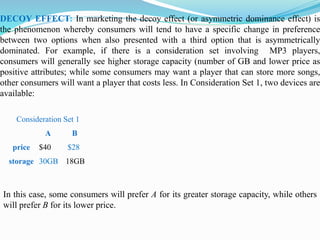
DECOY EFFECT: In marketing the decoy effect (or asymmetric dominance effect) is
the phenomenon whereby consumers will tend to have a specific change in preference
between two options when also presented with a third option that is asymmetrically
dominated. For example, if there is a consideration set involving MP3 players,
consumers will generally see higher storage capacity (number of GB and lower price as
positive attributes; while some consumers may want a player that can store more songs,
other consumers will want a player that costs less. In Consideration Set 1, two devices are
available:
Consideration Set 1
A B
price $40 $28
storage 30GB 18GB
In this case, some consumers will prefer A for its greater storage capacity, while others
will prefer B for its lower price.
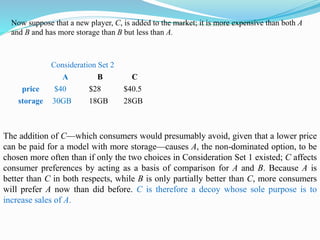
Consideration Set 2
A B C
price $40 $28 $40.5
storage 30GB 18GB 28GB
The addition of C—which consumers would presumably avoid, given that a lower price
can be paid for a model with more storage—causes A, the non-dominated option, to be
chosen more often than if only the two choices in Consideration Set 1 existed; C affects
consumer preferences by acting as a basis of comparison for A and B. Because A is
better than C in both respects, while B is only partially better than C, more consumers
will prefer A now than did before. C is therefore a decoy whose sole purpose is to
increase sales of A.
Now suppose that a new player, C, is added to the market; it is more expensive than both A
and B and has more storage than B but less than A.
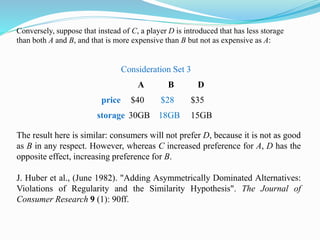
Consideration Set 3
A B D
price $40 $28 $35
storage 30GB 18GB 15GB
The result here is similar: consumers will not prefer D, because it is not as good
as B in any respect. However, whereas C increased preference for A, D has the
opposite effect, increasing preference for B.
J. Huber et al., (June 1982). "Adding Asymmetrically Dominated Alternatives:
Violations of Regularity and the Similarity Hypothesis". The Journal of
Consumer Research 9 (1): 90ff.
Conversely, suppose that instead of C, a player D is introduced that has less storage
than both A and B, and that is more expensive than B but not as expensive as A:
consumer perception study material unit iii.pptx

consumer perception study material unit iii.pptx

  • 2.
    Consumer Perception Elements ofPerception: Perceptual inputs, Sensation, PTL, Absolute threshold, j.n.d. (differential threshold), Subliminal /Supraliminal Perception Perceptual inputs (environmental signs and symbols that could act as sensory stimuli): Sound, Color, Light, Smell, Touch; further type, range and intensity of these sensory factors and A/V content. Shape & size of extrinsic cues; their combination--in contrast, matching, overall effect. Ambience and the constituent factors of a place, the 4Ps.Type,frquency,quantum and quality of reward and punishment factors. Agents of learning(operant),his status-authority, Job content (tangible/intangible factors) and Job context (tangible/intangible factors) factors Perceptual selection process: Selective perception; selective exposure, selective attention (filtering) and perceptual defense and perceptual blocking Perceptual organization: Based upon Gestalt theory (figure-background, grouping and closure; Zeigernik effect) Perceptual Interpretation and Perceptual Outputs namely, low risk, moderate risk, high risk taking perception , beliefs, values, mores, faith and ideology, superstitions, taboos, fetish, obsessions,
  • 3.
    attitudes (positive/negative attitude),assumptions, expectations, states of mind (attentive or non-attentive), learning and knowledge, past learning experiences/perceptual salience, learning style and inclination/tendency/perceptual disposition, learning involvement (low- involvement, high-involvement) Learned behaviour ( based on conditioning theory);response to reward (desirable stimuli) and punishment (undesirable stimuli) stimuli Ego- states (parent, adult or child ego state) Needs-Motivation: shelter, safety, security, affection, sense of self- worth, sense of achievement Personality: traits or types; extroverts, novelty seekers, aggressives, low dogmatics Psychographics (AOI &VALS - leisure and expense pattern) Personality and attitude measurement (lifestyle analysis), Composite AOI-Psychographic studies.
  • 4.
    Perceptual Barriers andFactors with Distorting Influences: Impressionisms; Physical appearances, metaphorical generalizations, first impressions/ temporal extensions, premature evaluation/jumping to conclusions/generalizations, stereotypes, halo effect, irrelevant cues (focusing on cosmetic rather than technical features), contrast effect , J-effect, parataxis, attribution (internal and external), person perceived, learned helplessness, cynicism, sadism, masochism, inferiority /superiority complexes (Alvin Adler),false notion of self
  • 5.
    PERCEIVED QUALITY Context: Ina buyer’s market, a product is defined as a set of features/attributes as expected by customers. This is how Crosby has defined ‘Quality’; a set of expectations by relevant end-users. The customer may have rational/irrational expectations and bases to evaluate product/service features however, as stated above all his perceptions and considerations must be taken into account beforehand towards developing a product/service package as an appropriate ‘solution’ that may finally and fully leave him satisfied (SIVA approach; Chekitan Dev & Don Schultz,2005). The following content helps develop an insight into how most customers usually perceive product features and quality. .Consumers make use of intrinsic or/and extrinsic cues to evaluate product/service quality. Intrinsic cues concern physical characteristics of the product itself, such as size, color, flavor,/taste aroma etc. Supposed to have intrinsic relationship to the product quality. While extrinsic cues include bases such as price-tag, packaging, advertising, brand image, manufacturer’s image, retail store image, county of origin, even peer pressure.
  • 6.
    .Consumers like tobelieve that they base their evaluations of product quality on intrinsic cues, because that enables them to justify their product decisions (either positive or negative) as being “rational” or “objective” product choices but more often than not the physical characteristics they use to judge quality have no intrinsic relationship to the product’s quality.For example, many consumers who claim that they buy a particular brand due to its superior taste often fail to identify that brand in ‘blind taste tests’. .Studies also indicate that in the absence of actual experience with the product consumers often evaluate the quality of a product on the basis of cues extrinsic/external to the product itself. .Many consumers use country-of-origin stereotypes such as “Made in U.S.A./ Japan /Germany” label to evaluate products. According to a study even many Americans prefer foreign goods to domestic products.
  • 7.
    PERCEIVED QUALITY OFSERVICES Services are intangible, variable, perishable, and simultaneously produced and consumed. This is how most customers usually perceive service features and quality: .Consumers are unable to compare services side-by-side as they do with competing products. .Consumers rely majorly on surrogate cues (extrinsic cues) to evaluate service quality. For example, in evaluating a doctor’s services ,they note the quality of the office, examine room furnishings, the number (and source) of framed degrees on the wall, the pleasantness of the receptionist, and the professionalism of the nurse among others; all contribute to the consumer’s overall evaluation of service quality. .Unlike products when services are standardized (to reduce variability) the downside of it may lead to loss of customized services, which many costumers may value e.g., waiter services, personal grooming, class instructions etc. .Unlike products, which are first produced, then sold, and then consumed, most services are first sold, then produced and consumed simultaneously. This means there is very little or no scope to improve upon a deficient service. This makes customers relatively more sensitive and finicky towards services than the products.
  • 8.
    .The customer’s perceptiontowards service quality is also holistic and if anything wrong goes wrong even with a single component then the overall satisfaction is adversely affected. .Ensuring consistency in services during ‘rush/peak demand hours’ is another major challenge. So try change demand pattern to distribute services more equally over time. For example, early bird dinner options. Following a visibly transparent queuing pattern and order is a must. Filling the consumer’s time meaningfully in as much pleasant way is equally important to reduce the perceived waiting time and the consequent negative service evaluation. .Some researchers believe that the consumer's evaluation of service quality is a function of magnitude and direction of the gap between the customer’s expectations of services and his assessment (perception) of the ‘service actually delivered’. His assessment is based on his expectations, and his expectations are in turn based on his ‘past experiences’ and ‘his own background'. For example a newcomer assessing a university’s service quality. His expectations must be exceeded for his positive view of the university. Some researchers believe that service quality perceptions are a function of the gap between ‘perceived performance’ and a combination of expectations and desires. The former is measured through the SERVQUAL scale while the latter is through SERVPERF scale
  • 9.
    The SERVQUAL SCALE DimensionsDescriptions 1-Tangibles : Appearance of physical facilities, equipments, personnel, and communication material 2-Reliability : Ability to perform the promised service dependably and accurately 3-Responsiveness : Willingness to help customers and provide prompt service 4-Assurance : Knowledge and courtesy of employees and their ability to convey trust and confidence 5-Empathy : Caring, individualized attention the firm provides its customers Source: Zeithaml ,Parasuraman and Berry , Delivering Quality Service: Balancing Customer's Perceptions and Expectations (1990) The SERVPERF scale on the other hand results in a summated overall service quality that can be plotted to time and specific customer subgroups (demographic segments).Customers evaluate quality along two dimensions: the outcome dimension (focuses on reliable delivery of the core service) and the process dimension (how the core service is delivered). FedEx uses ‘advanced tracking system', a process dimension to exceed customer’s expectations and differentiate itself from the co’s providing the same core services.
  • 10.
    Researchers (Zeithaml, Parasuramanand Berry (Journal of Marketing 58; Jan 1994) have integrated product and service quality into an overall ‘Transaction Satisfaction index’ on the premise that there is a service aspect (intangibles) to every product and product aspect (tangibles) to every service. TS is a function of Evaluation of Service Quality (SQ) , Evaluation of Product Quality (PQ) and Evaluation of Price(P). For example, satisfaction with a retail purchase would also include evaluation of services (helpfulness and efficiency) by the sales person, and pleasantness of the surroundings among other things. A study of the relationship between service quality, consumer satisfaction , and purchase intentions found that perceptions of high service quality and high service satisfaction result in a very high level of purchase intentions (Taylor,1997). According to Zeithaml, Parasuraman and Berry (Journal of Marketing 60, April 1996) service quality is a major determinant to favorable behavioral intentions else the customers defect. Favorable behavioral intentions lead to – ongoing revenue, increased spending, price premiums and referred customers.
  • 11.
    PERCEIVED PRICES: Price isa means to a manufacturer/service provider to raise revenue so as to recover his expenses profitably. To a customer it’s a sacrifice of his purchasing power that he is willing to undertake against an alternate use or future use of that money. The customer thus obviously tries to maximize his value-for-money and economic benefits and minimize his sense of loss and opportunity cost. It is in fact an important factor that affects his final satisfaction level and future purchase intentions of a brand/product/service or from a particular store/place. A customer may evaluate the whole product/service package or/and individual features (tangibles/intangibles or both) economically before arriving at the final price figure willing to be paid off. But how rational and competent he is in the process of assessing product/service features is a subject of query and interest. Studies and pricing trends show that the marketers quite often play with the customer’s perception of prices. There are numerous examples to suggest an unfair play with regard to pricing wherein customers end up paying more than they should. Some examples of such pricing measures include the following: Status -goods pricing, reference pricing --showroom pricing, odd tag pricing. Promotion pricing like psychological discounts, Discriminating pricing - product form pricing, image pricing, location and time pricing. Product mix pricing-product bundled pricing, product line pricing, optional feature product pricing, captive product pricing, and two part pricing among others.
  • 12.
    # Internal ReferencePrice : It’s the price (or price range) consumer retrieves from his memory to judge the value and believability of any advertised (external) price deal. It has a range with lower and outer limits. If a price-tag falls within this limit, he willingly assimilates it. Therefore, in a way IRP is the consumer’s acceptance range of prices. If a price-tag is plausibly low, it is clearly accepted and if a price-tag is plausibly high as it is pitched at the outermost limit of IRP, a consumer still believes it. But if the price is implausibly high as it is set beyond the IRP he obviously contrasts it and perceives it as much negatively. IRP is a relevant participating variable also in Acquisition-Transaction Utility. According to the acquisition utility theory a consumer evaluates economically (??) the product utility (tangible/intangible features) that forms his perceived economic gain or loss with a purchase; thus acquisition utility is a function of product utility and purchase price. Whereas according to the Transaction Utility theory the perceived pleasure or displeasure associated with the financial aspect of the purchase is determined by the difference between the internal reference price (IRP) and the purchase price. For example, if the IRP of a consumer for a hand-set is $100 and the set is sale-priced at $100,he receives no transaction utility. For a positive transaction utility, which would increase the total utility the consumer experiences with the purchase either the IRP is increased, or the sales price is decreased(JoCM 10,1- 1993).However, as per another study the transaction utility is significant only when the consumer is certain about the consistency in quality(Urbany et al.,1997) .
  • 13.
    Interestingly consumer’ ownreference price called the IRP is usually not formed on a rational basis, it’s rather on the basis of what marketers may have already advertised externally in the past. That means higher advertised prices (external reference price) leads to higher internal reference price (Grewal et al., JoM 62 –April 1988).And the outermost limit of the IRP; the consumer’s price acceptance/tolerance range at time t1 is also subsequently pushed up in time t2 . But every time marketers pitch prices beyond IRP, they have to play very cleverly and subtly with different marketing-mix by creating enough provisions within the different ‘P’s for minimizing any negative effects and active or passive resistance to the new price-tag resulting thereof. For instance, a marketer may advertise a product aggressively with an element of glamour or attraction in it to get the new price tag assimilated (mentally absorbed).He may reposition the product/brand, employ promo- tools, play with the notions of overall quality, may add more tangible/intangible features and harp on the new price-feature ratio. Factors like remodeling of the store, or a new posh location of the old store or sometimes even just a new packaging would makeover the entire product in the mind of the consumers and get the new price limit across their mind justifiably with least bitter feelings on the transaction utility score.
  • 14.
    The following findingsare quite relevant in this context of understanding as how the marketing-mix elements of ‘brands quality’ and ‘advertisements’ relative to competition influence the consumer perception w.r.t. pricing and help define/redefine the final price tag. 1-Brands with average relative quality but high relative ad budgets were able to charge premium prices. Consumers were willing to pay high prices for known products than unknown products. 2-Brands with high relative quality and high relative ad obtained the highest price. Conversely, brands with low quality and low ad charged the lowest prices. 3-The positive relationship between high prices and high ads held most strongly at the later stages of the PLC for market leaders. Sometimes marketers push up the IRPs also by setting the reference price at the highest price recently offered for identical or comparable merchandise. This does not create much ill-will. Still better, if the consumers are made to assimilate the new price tag gradually by pitching it below their ‘differential threshold’ or j.n.d. In high inflation economies it is also quite easier for marketers now a days to justify any price increase through attributing it externally on national or international government /non govt. bodies/ stirred up events.
  • 15.
    RELATIONSHIP BETWEEN PERCEIVEDPRICE / PERCEIVED QUALITY A number of studies prove that generally customers rely on price (an extrinsic cue) as an indicator of product quality. According to one study when consumers have little information, or have little confidence in their own ability to make a choice on other grounds they use price as a surrogate indicator of quality. Several studies have interestingly shown that consumers attribute different qualities to identical products that carry different price labels. Naturally, some ads deliberately emphasize a high price to underscore the marketer's claim of quality. Price declines as a factor in product selection when the consumer is familiar with a brand name or has an experience with a product/service. Other studies as mentioned earlier show that consumers using a price/quality relationship actually rely on expensive brand names as an indicator of quality, without relying on price per se.As a result better brands with even average quality are able to fetch premium prices. .According to an important study (Dodds,Munroe,and Grewal, JoM 28 Aug-1991) both brand and store information have a positive effect on ‘perceived quality’ and also on ‘perceived product value’ and ‘willingness to buy’.[‘Perceived Product Value’ is a trade-off that goes on in the mind of the consumer between the product’s perceived benefits (or quality) and the perceived sacrifice (both monetary and non-monetary) – required to acquire it].While price as usual has a positive effect on perceived quality but a negative effect on perceived product value and the willingness to buy. Segment characteristics (background variables such as age and income) have also been shown to affect perception of value.
  • 16.
    RETAIL STORE IMAGE Theimage of retail store affects the perceived quality of product it stores. For instance, even an average quality product can be perceived to be of high quality, if it placed in an up market store/mall and can fetch premium prices (called reference pricing).On the contrary if the same merchandise or some merchandise of even better quality is placed in a low-image store, it is likely to be perceived low and would fetch low price. The image of place therefore is usually factored in by the buyers while evaluating the quality of a product/service. So much so that consumers generally prefer to buy certain type of products/services from particular places only and do not mind the prices and sometimes even other costs such as travel time due to distance factor, waiting time, billing time etc unless there is an equally better or far better alternative option available around. Post consumption if the customer is happy/satisfied with the product/ service, then the image of the store also further improves in his mind. This happens even in case of those stores that trade in multiple brands. However keeping in view the association between the image of store and brand and reinforcement of the image of store and brand following the consumption of the brand-- exclusive brand stores or/and VMS are in vogue across the world. .In the context of studying the association between price, product quality, and store image in case of multi-brand stores there is a unique observation that if a low-priced store carries a brand with a high-priced image, then the image of the store improves (the less favorable image becomes enhanced at the expense of the more favorable image),while the image of the brand erodes and vice-versa.
  • 17.
    In the contextof sales pricing(discount/promo tools) stores that offer ‘frequency of price advantage’ (small discount on large number of items) over ‘magnitude of price advantage’ (large discounts on a smaller number of items) come to be perceived as stores offering ‘lower prices’ and thus as ‘better value-pricing avenues’ (JoCR 21 Sep- 1994).In another study stores offering frequent price specials are perceived to be more ‘competitive’ but the constant use of sales price is harmful to the store’s image in the long run. Impact of Store Environment and its Constituent Factors on Perceived Product/Service Quality: .In one study bank customers considered the following attributes important towards a conducive service environment namely, privacy (visual and verbal), effiiency/convenience, ambient background, social conditions, and aesthetics. In another study [Dhruv ,Baker et al. Journal of the Academy of Marketing Science 22 – 4(1994)]consumer perceptions were found to be heavily influenced by ‘ambient factors (such as the number, type, and behaviour of other customers within the store and the sales personnel) than by store design features. .In addition to the other environmental/ambient factors as mentioned above in specific cases showroom displays and merchandising also greatly influence consumer perception.
  • 18.
    Companies also debatethe worth of the institutional advertising vis a vis the product advertising in terms of its individual or joint impact on the consumer perception. Many prefer an integral an complementary communication program.’ PERCEIVED RISK It is defined in terms of the uncertainty faced by the consumers when they cannot foresee the consequences of their purchase decisions (related to either purchase of products/services, prices, brands or place) Interestingly, a consumer may perceive risk when it is not there or may not see any risk when it is actually there. There are different types of risks that consumers may perceive in different situations. Functional Risk: the risk that the product will not perform as expected.(“Will the new electric car perform a full day without needing to be recharged?”) Financial Risk: the product will not be worth its cost.(“Will the new laptop become obsolescent before the year is over?”) Physical Risk: the risk to self and others that the product may pose.(“is a cell phone really safe or does it emit harmful radiation?”) Psychological Risk: the risk that may bruise the consumers own ego.(“Will I be embarrassed to invite my friends to this tiny apartment?”) Social Risk: the risk a poor product choice may result in social embarrassment.(“Will my peers laugh at my new smart watch?”) Time Risk: the risk that the time spent in product search may be wasted if the product does not perform as expected.(“Will I have to go through the entire process of shopping all over again?”)
  • 19.
    Perception of RiskVaries The amount of risk perceived depends on the specific consumer, the product category, the specific product, the situation, and the culture. .Individuals with low-risk perceptibility (high risk takers) are described as ‘broad categorizers’ as they prefer to try a ‘large number of alternatives’ from which they could make the final choice. In fact, more than making the final selection they are interested in trying out a wide range of alternatives. Probably their low sensitivity to risk and aggressive bio-chemistry push them to explore one option after the other. The personality of hi-caffeine takers, giant roller-coaster riders, speed racers, or roulette players is way different from that of those, who are low on the consumption of these activities. On the contrary, the described as ‘narrow categorizers' tend to be more choosy or fussy high-risk perceivers (low risk takers) in their product selection and tend to limit their choices in order to make a safe selection. Their product search and evaluation process is more intensive and deeper than being extensive and wider. One study points out that although ‘risk preference’ may be a stable personality trait, however, ‘experience’ plays a mediating role in influencing risk perception. For example, individuals who have made good money in the stock market are more likely to continue investing (despite risk in scrips and the bourses) than those who have lost money. .Consumers may perceive greater risk(functional, financial and time risk) in buying hi- tech than low-tech gadgets. There could also be greater risk perceived in a specific product under a product category. Consumers generally perceive more risks in service
  • 20.
    decisions (physical, social,and psychological risks) than product decisions. .Consumers may perceive traditional off-line purchases to be safer than on-line purchases. High-risk perceivers tend to buy less from on-line stores despite sharp increase in on-line usages in the recent times due to positive purchase experiences and WOM. Culture is yet another factor that affects risk perception. Many Americans feel insecure in shopping centers because of high rate of crimes at parking lots and acts of carjacking. Consumer risk perceptions of one country cannot be generalized upon other countries without additional studies. How Consumers Handle Risks Consumers try reduce risk by various means: By Seeking information: If the perceived risk is higher , they spend more time over generating information through ‘different sources’ about the product alternatives. Consumers Stick to Brand Loyalty : Brand loyalty becomes a means to reduce uncertainty in further purchases. High-risk perceivers are more likely to be brand loyal and less likely to try new and innovative products compared to low-risk perceivers. Consumers Go by Brand Image: Brand image becomes a guarantee for assured quality,reliabilty,and service. No wonder, companies assert this element in their promotion campaigns.
  • 21.
    Consumers Rely onStore Image: When there is no other means of information consumers trust a reputable store in product selection. The store also provides with product trial facility, assurance of service, return privileges, and adjustment in case of dissatisfaction. Consumers Tend to Buy the Most Expensive Model: When in doubt consumers think that the higher the price tag, the better the quality. Consumers Seek Reassurance: They seek reassurance through money-back guarantees, government and private laboratory test results,warranties,and prepurchase trial. For example, it is less likely that anyone may buy a newly launched car without a test drive. High -risk perceivers seek greater reassurance. Therefore, marketers may employ a number of measures to induce buying among such buyers such as a well known brand name(sometime achieved through licensing),distribution through well known retail stores, informative advertising, publicity stories in the media,imaprtial test-results, free trials, and money-back guarantee schemes.
  • 22.
    Are consumers rationalor irrational and can their behavior be influenced? EXAMPLES OF CONSUMER IRRATIONALITIES: A consumer as a psychological man is not largely capable of being rational as opposed to the economic man. He is not likely to calculate all possible brand/product attributes and analyze its possible consequences quite accurately and mathematically prior to purchase . He can only ‘satisfice’ his objectives, can never maximize his utility. (Simon, H. (1947, 1957) Theory of bounded rationality in Administrative behavior. As investors we buy shares when prices rise and sell when fall. While the science says the opposite. Still worse we keep betting on stocks even after we experience losses. We avert risk in general and take very little risk only in an emergency (Kahneman, Daniel, and Amos Tversky, prospect theory, 1979) while we all want to maximize our return at the same time. We invest less in stocks and more in fixed instruments that have at times negative NPV. We perceive insurance policies as safe investment options fearing we will die though the life expectancy (as HDI index) may be much higher in that population in that very socio-economic stratum.
  • 23.
    As consumers wechoose different food with different tastes and looks even if the nutritional value might be the same. We prefer same object but with different colors, designs and looks be it cars or clothes. We may buy even cell phones and computers on the basis of color and looks. We think higher advertisement is a mark of quality and end up buying brands with moderate quality but higher frequency of advertisement. We pay differently for different packaging, different locality or timings even if the content is same. We may buy sth just because sth else is offered free. Sometimes buy sth not because we need it but just because it’s cheap and end up losing most of it thru pilferage or wastage. We buy on rumors thinking it may run scarce. Buy sth just because it is convenient to pick. Buy sth on overtly emotional basis. People buy revolvers and guns for self defense knowing the fact that in more than 90% chances we end up using them to kill some one close or even oneself.
  • 24.
    We try tosatisfy status and ego needs that by definition can never be satisfied unless overcome thru self actualization and self transcendence (Maslow) and working for the larger good. In reality most people buy goods for ego needs under illusion and demonstration effect from the reference group and role models. -Scientists also report numerous cognitive and personal biases in a consumer’s own decision making process .That may include inertia w.r.t welcoming new facts, info, technology, (Everett Rogers ,Ogburn and Nimkoff, Geoffrey Moore) harboring stereotypes and halo effects, impressionism, group think, cynicism, masochism, inferiority /superiority complex ,false notion of self underestimating uncertainty and the illusion of control and faulty generalizations etc
  • 25.
    TWO REFERENCES ONBEHAVIORAL INFLUENCE: An example under (Kahneman, and Amos T, 1979) quoted in 1981 Science paper “The Prospect theory Framing of Decisions and the Psychology of Choice” Imagine that the U.S is preparing for the outbreak of an unusual Asian disease which is expected to kill 600 people. Two alternative programs to combat the disease have been proposed. Program A- A projected 200 people will be saved. Program B- There is 1/3 probability that 600 will be saved and 2/3 probability that no one is saved. 72% chose program A, preferring the certain saving of 200 lives, though outcomes are same in both cases. The researchers then restated the problem: this time with Program C- 400 people die and with Program D-1/3 chance that no one dies and 2/3 chance that 600 people die this time. 78% chose D –despite identical outcomes in both cases. Conclusion: Since people are generally risk averse hence in the first case, they chose program A to B as B had element of apparent risk but if exposed to risk more people can take risk though to a minimum level only as program C looked riskier than program D. Moreover the experiment shows that people do not calculate actual outcomes logically-- they rather get influenced by the framing of the options.
  • 26.
    Conclusion: Since peopleare generally risk averse hence in the first case, they chose program A to B as B had element of apparent risk but if exposed to risk more people can take risk though to a minimum level only as program C looked riskier than program D. Moreover the experiment shows that people do not calculate actual outcomes logically-- they rather get influenced by the framing of the options.
  • 27.
    DECOY EFFECT: Inmarketing the decoy effect (or asymmetric dominance effect) is the phenomenon whereby consumers will tend to have a specific change in preference between two options when also presented with a third option that is asymmetrically dominated. For example, if there is a consideration set involving MP3 players, consumers will generally see higher storage capacity (number of GB and lower price as positive attributes; while some consumers may want a player that can store more songs, other consumers will want a player that costs less. In Consideration Set 1, two devices are available: Consideration Set 1 A B price $40 $28 storage 30GB 18GB In this case, some consumers will prefer A for its greater storage capacity, while others will prefer B for its lower price.
  • 28.
    Consideration Set 2 AB C price $40 $28 $40.5 storage 30GB 18GB 28GB The addition of C—which consumers would presumably avoid, given that a lower price can be paid for a model with more storage—causes A, the non-dominated option, to be chosen more often than if only the two choices in Consideration Set 1 existed; C affects consumer preferences by acting as a basis of comparison for A and B. Because A is better than C in both respects, while B is only partially better than C, more consumers will prefer A now than did before. C is therefore a decoy whose sole purpose is to increase sales of A. Now suppose that a new player, C, is added to the market; it is more expensive than both A and B and has more storage than B but less than A.
  • 29.
    Consideration Set 3 AB D price $40 $28 $35 storage 30GB 18GB 15GB The result here is similar: consumers will not prefer D, because it is not as good as B in any respect. However, whereas C increased preference for A, D has the opposite effect, increasing preference for B. J. Huber et al., (June 1982). "Adding Asymmetrically Dominated Alternatives: Violations of Regularity and the Similarity Hypothesis". The Journal of Consumer Research 9 (1): 90ff. Conversely, suppose that instead of C, a player D is introduced that has less storage than both A and B, and that is more expensive than B but not as expensive as A: