Retail Lighting Guide
Lighting for Results:
The goals of any interior retail lighting system are often the same: to attract and guide customers, to help them
evaluate merchandise and to assist them in quickly and easily completing the sale. If done correctly, lighting has
been proven to increase merchandise sales.
The Guiding Light
While lighting must attract customers to the retail space, it must enable customers to read signage and move
throughout the store. The quantity and quality of the illumination will create a lasting impression and will help
Customers decide whether they want to return to the store in the future to shop.
The Buying Decision
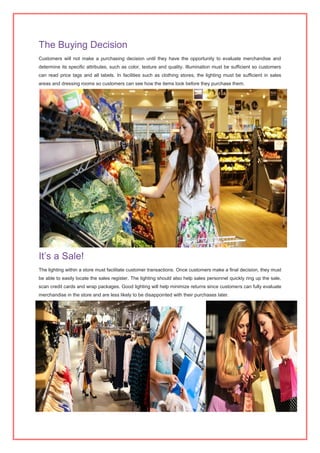
Customers will not make a purchasing decision until they have the opportunity to evaluate merchandise and
determine its specific attributes, such as color, texture and quality. Illumination must be sufficient so customers
can read price tags and all labels. In facilities such as clothing stores, the lighting must be sufficient in sales
areas and dressing rooms so customers can see how the items look before they purchase them.
It’s a Sale!
The lighting within a store must facilitate customer transactions. Once customers make a final decision, they must
be able to easily locate the sales register. The lighting should also help sales personnel quickly ring up the sale,
scan credit cards and wrap packages. Good lighting will help minimize returns since customers can fully evaluate
merchandise in the store and are less likely to be disappointed with their purchases later.
A Selling Combination
Retail environments are likely to appear more attractive, exciting and inviting when they combine accent with
ambient lighting. Referred to as “general” lighting, the ambient light system provides a diffuse layer of uniform
illumination throughout the store. Luminaries’ used for ambient lighting typically have broad distributions and are
arranged symmetrically. Accent lighting can emphasize product shape, colour, texture and finish and help create
contrast between merchandise and its background. Spotlights and track lighting are ideal for accent lighting
because they can be controlled and directed to provide required focal lighting, directing eyes to specific displays
or other areas. The ratio between accent and ambient lighting should be a least five to one, with a maximum of
10 to 1.
Colour Rendering and Temperature
Colour is a powerful merchandising tool. Shoppers must be able to determine the exact colours of merchandise
whether they are selecting clothing, furniture, automobiles, packaged goods, or food.
Noise:
It is imperative that retail stores are comfortable to shop in, including background noise. A ballast that hums or
music that is played too loud is disturbing to a customer. They will choose not to spend much time in that store.
Electronic ballasts and potted ballasts are virtually noise-free allowing the customer to concentrate on the
merchandise, not the noise.
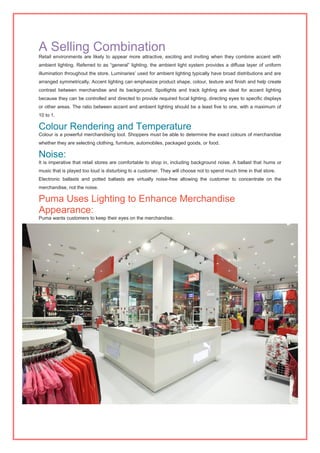
Puma Uses Lighting to Enhance Merchandise
Appearance:
Puma wants customers to keep their eyes on the merchandise.
Lighting Store Spaces
Entrances:
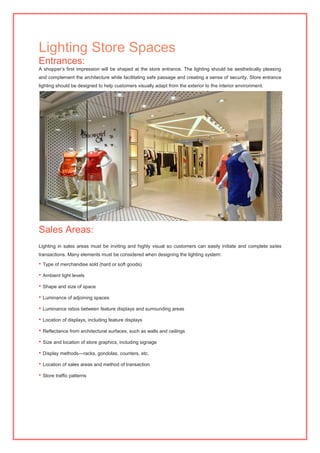
A shopper’s first impression will be shaped at the store entrance. The lighting should be aesthetically pleasing
and complement the architecture while facilitating safe passage and creating a sense of security. Store entrance
lighting should be designed to help customers visually adapt from the exterior to the interior environment.
Sales Areas:
Lighting in sales areas must be inviting and highly visual so customers can easily initiate and complete sales
transactions. Many elements must be considered when designing the lighting system:
• Type of merchandise sold (hard or soft goods)
• Ambient light levels
• Shape and size of space
• Luminance of adjoining spaces
• Luminance ratios between feature displays and surrounding areas
• Location of displays, including feature displays
• Reflectance from architectural surfaces, such as walls and ceilings
• Size and location of store graphics, including signage
• Display methods—racks, gondolas, counters, etc.
• Location of sales areas and method of transaction
• Store traffic patterns

Retail lighting guide

  • 1.
    Retail Lighting Guide Lightingfor Results: The goals of any interior retail lighting system are often the same: to attract and guide customers, to help them evaluate merchandise and to assist them in quickly and easily completing the sale. If done correctly, lighting has been proven to increase merchandise sales. The Guiding Light While lighting must attract customers to the retail space, it must enable customers to read signage and move throughout the store. The quantity and quality of the illumination will create a lasting impression and will help Customers decide whether they want to return to the store in the future to shop.
  • 2.
    The Buying Decision Customerswill not make a purchasing decision until they have the opportunity to evaluate merchandise and determine its specific attributes, such as color, texture and quality. Illumination must be sufficient so customers can read price tags and all labels. In facilities such as clothing stores, the lighting must be sufficient in sales areas and dressing rooms so customers can see how the items look before they purchase them. It’s a Sale! The lighting within a store must facilitate customer transactions. Once customers make a final decision, they must be able to easily locate the sales register. The lighting should also help sales personnel quickly ring up the sale, scan credit cards and wrap packages. Good lighting will help minimize returns since customers can fully evaluate merchandise in the store and are less likely to be disappointed with their purchases later.
  • 3.
    A Selling Combination Retailenvironments are likely to appear more attractive, exciting and inviting when they combine accent with ambient lighting. Referred to as “general” lighting, the ambient light system provides a diffuse layer of uniform illumination throughout the store. Luminaries’ used for ambient lighting typically have broad distributions and are arranged symmetrically. Accent lighting can emphasize product shape, colour, texture and finish and help create contrast between merchandise and its background. Spotlights and track lighting are ideal for accent lighting because they can be controlled and directed to provide required focal lighting, directing eyes to specific displays or other areas. The ratio between accent and ambient lighting should be a least five to one, with a maximum of 10 to 1. Colour Rendering and Temperature Colour is a powerful merchandising tool. Shoppers must be able to determine the exact colours of merchandise whether they are selecting clothing, furniture, automobiles, packaged goods, or food. Noise: It is imperative that retail stores are comfortable to shop in, including background noise. A ballast that hums or music that is played too loud is disturbing to a customer. They will choose not to spend much time in that store. Electronic ballasts and potted ballasts are virtually noise-free allowing the customer to concentrate on the merchandise, not the noise. Puma Uses Lighting to Enhance Merchandise Appearance: Puma wants customers to keep their eyes on the merchandise.
  • 4.
    Lighting Store Spaces Entrances: Ashopper’s first impression will be shaped at the store entrance. The lighting should be aesthetically pleasing and complement the architecture while facilitating safe passage and creating a sense of security. Store entrance lighting should be designed to help customers visually adapt from the exterior to the interior environment. Sales Areas: Lighting in sales areas must be inviting and highly visual so customers can easily initiate and complete sales transactions. Many elements must be considered when designing the lighting system: • Type of merchandise sold (hard or soft goods) • Ambient light levels • Shape and size of space • Luminance of adjoining spaces • Luminance ratios between feature displays and surrounding areas • Location of displays, including feature displays • Reflectance from architectural surfaces, such as walls and ceilings • Size and location of store graphics, including signage • Display methods—racks, gondolas, counters, etc. • Location of sales areas and method of transaction • Store traffic patterns