Retail: Lessons Learned
from the Original Data-
Driven Business and
Future Directions
Presenters:
Marilyn Craig, Senior Director, WW Sales &
Marketing Planning and Analysis, Logitech
Terence Craig, CEO/CTO, PatternBuilders
Before We Dive In… A Legal Disclaimer
 The views and opinions expressed by Marilyn
Craig in this presentation are hers and do not
necessarily reflect the opinion or any
endorsement from her employer, Logitech.
 PatternBuilders is stuck with Terence’s opinion,
whether they like it or not.
 Examples of analysis performed within this
presentation are only examples. No actual data
was harmed in making this presentation.
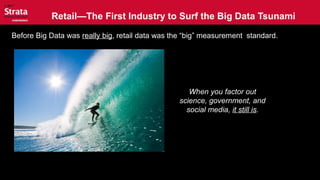
Retail—The First Industry to Surf the Big Data Tsunami
Before Big Data was really big, retail data was the “big” measurement standard.
When you factor out
science, government, and
social media, it still is.
t
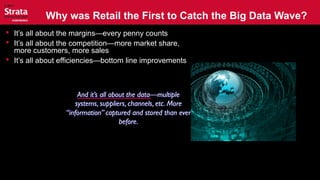
Why was Retail the First to Catch the Big Data Wave?
 It’s all about the margins—every penny counts
 It’s all about the competition—more market share,
more customers, more sales
 It’s all about efficiencies—bottom line improvements
Retail is Not Just a Big DataRetail is Not Just a Big Data
Surfer, But aSurfer, But a Technology DriverTechnology Driver
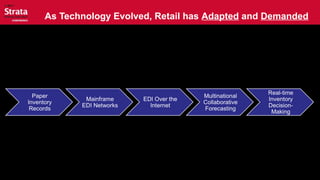
As Technology Evolved, Retail has Adapted and Demanded
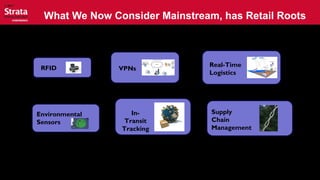
What We Now Consider Mainstream, has Retail Roots
RFID VPNs
In-
Transit
Tracking
Real-Time
Logistics
Supply
Chain
Management
Environmental
Sensors
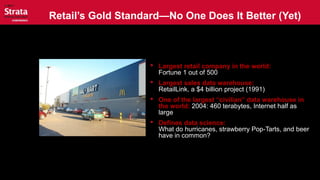
Retail’s Gold Standard—No One Does It Better (Yet)
 Largest retail company in the world:
Fortune 1 out of 500
 Largest sales data warehouse:
RetailLink, a $4 billion project (1991)
 One of the largest “civilian” data warehouse in
the world: 2004: 460 terabytes, Internet half as
large
 Defines data science:
What do hurricanes, strawberry Pop-Tarts, and beer
have in common?
What Keeps Retail Operating on the Technology Edge?
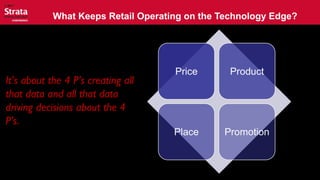
It’s about the 4 P’s creating all
that data and all that data
driving decisions about the 4
P’s.
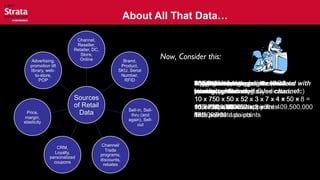
About All That Data…
3 years of historical data
for comparison
10 x 750 x 50 x 52 x 3 =
58,500,000 data points
4 regions to segregate the data
10 x 750 x 50 x 52 x 3 x 7 x 4 =
1,638,000,000 data points
50 states to segregate the data
10 x 750 x 50 x 52 x 3 x 7 x 4 x 50 =
81,900,000,000 data points
7 types of data to monitor (POS,
Inventory, Marketing, Syndicated, etc)
10 x 750 x 50 x 52 x 3 x 7 = 409,500,000
data points
8 categories to aggregate the data
10 x 750 x 50 x 52 x 3 x 7 x 4 x 50 x 8 =
655,200,000,000 data points
10 Retailers
to monitor
10 data points
750 Stores per
retailer to monitor
10 x 750 = 7500
data points
50 products per
store to monitor
10 x 750 x 50 =
375,000 data points
52 weeks of data per
year for trend analysis
10 x 750 x 50 x 52 =
19,500,000 data points
Now, Consider this:
655 Billion+ data points involved with
managing the retail sales channel
But Nothing Remains the Same…
Where do we go from here?
The Future: Look Out!
Cheap, big analytics is going to
change the world.
It’s a Brave New World…
The old rule: new shelf spaces = more sales
The new rule: it’s all about analytic-driven efficiencies
The slow down in new storefronts means growth (and
profitability) will come from efficiencies.
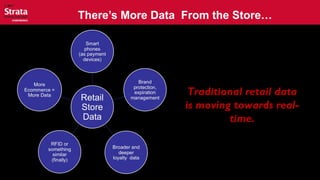
There’s More Data From the Store…
Traditional retail dataTraditional retail data
is moving towards real-is moving towards real-
time.time.
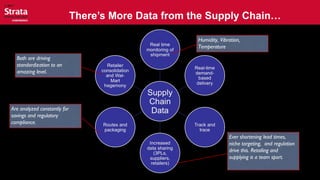
There’s More Data from the Supply Chain…
Humidity, Vibration,
Temperature,
Ever shortening lead times,
niche targeting, and regulation
drive this. Retailing and
supplying is a team sport.
Are analyzed constantly for
savings and regulatory
compliance.
Both are driving
standardization to an
amazing level.
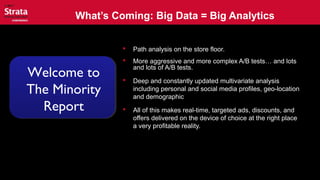
What’s Coming: Big Data = Big Analytics
 Path analysis on the store floor.
 More aggressive and more complex A/B tests… and lots
and lots of A/B tests.
 Deep and constantly updated multivariate analysis
including personal and social media profiles, geo-location
and demographic
 All of this makes real-time, targeted ads, discounts, and
offers delivered on the device of choice at the right place
a very profitable reality.
Welcome to
The Minority
Report
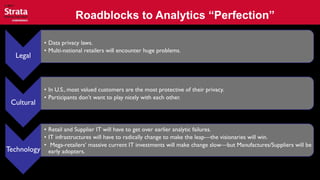
Roadblocks to Analytics “Perfection”
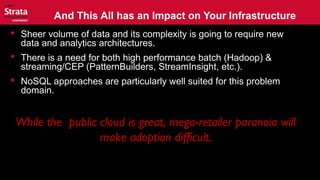
And This All has an Impact on Your Infrastructure
 Sheer volume of data and its complexity is going to require new
data and analytics architectures.
 There is a need for both high performance batch (Hadoop) &
streaming/CEP (PatternBuilders, StreamInsight, etc.).
 NoSQL approaches are particularly well suited for this problem
domain.
While the public cloud is great, mega-retailer paranoia will
make adoption difficult.
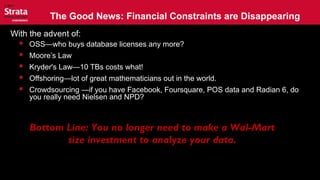
The Good News: Financial Constraints are Disappearing
With the advent of:
 OSS—who buys database licenses any more?
 Moore’s Law
 Kryder's Law—10 TBs costs what!
 Offshoring—lot of great mathematicians out in the world.
 Crowdsourcing —if you have Facebook, Foursquare, POS data and Radian 6, do
you really need Nielsen and NPD?
Bottom Line: You no longer need to make a Wal-MartBottom Line: You no longer need to make a Wal-Mart
size investment to analyze your data.size investment to analyze your data.
Questions???
Feel free to contact us…
 Marilyn Craig
- MCraig@logitech.com
- LinkedIn:
 Terence Craig
- Terence@patternbuilders.com
- www.twitter.com/terencecraig
- blog.patternbuilders.com

Retail lessons learned from the first data driven business and future directions presentation 1

  • 1.
    Retail: Lessons Learned fromthe Original Data- Driven Business and Future Directions Presenters: Marilyn Craig, Senior Director, WW Sales & Marketing Planning and Analysis, Logitech Terence Craig, CEO/CTO, PatternBuilders
  • 2.
    Before We DiveIn… A Legal Disclaimer  The views and opinions expressed by Marilyn Craig in this presentation are hers and do not necessarily reflect the opinion or any endorsement from her employer, Logitech.  PatternBuilders is stuck with Terence’s opinion, whether they like it or not.  Examples of analysis performed within this presentation are only examples. No actual data was harmed in making this presentation.
  • 3.
    Retail—The First Industryto Surf the Big Data Tsunami Before Big Data was really big, retail data was the “big” measurement standard. When you factor out science, government, and social media, it still is. t
  • 4.
    Why was Retailthe First to Catch the Big Data Wave?  It’s all about the margins—every penny counts  It’s all about the competition—more market share, more customers, more sales  It’s all about efficiencies—bottom line improvements
  • 5.
    Retail is NotJust a Big DataRetail is Not Just a Big Data Surfer, But aSurfer, But a Technology DriverTechnology Driver
  • 6.
    As Technology Evolved,Retail has Adapted and Demanded
  • 7.
    What We NowConsider Mainstream, has Retail Roots RFID VPNs In- Transit Tracking Real-Time Logistics Supply Chain Management Environmental Sensors
  • 8.
    Retail’s Gold Standard—NoOne Does It Better (Yet)  Largest retail company in the world: Fortune 1 out of 500  Largest sales data warehouse: RetailLink, a $4 billion project (1991)  One of the largest “civilian” data warehouse in the world: 2004: 460 terabytes, Internet half as large  Defines data science: What do hurricanes, strawberry Pop-Tarts, and beer have in common?
  • 9.
    What Keeps RetailOperating on the Technology Edge? It’s about the 4 P’s creating all that data and all that data driving decisions about the 4 P’s.
  • 10.
    About All ThatData… 3 years of historical data for comparison 10 x 750 x 50 x 52 x 3 = 58,500,000 data points 4 regions to segregate the data 10 x 750 x 50 x 52 x 3 x 7 x 4 = 1,638,000,000 data points 50 states to segregate the data 10 x 750 x 50 x 52 x 3 x 7 x 4 x 50 = 81,900,000,000 data points 7 types of data to monitor (POS, Inventory, Marketing, Syndicated, etc) 10 x 750 x 50 x 52 x 3 x 7 = 409,500,000 data points 8 categories to aggregate the data 10 x 750 x 50 x 52 x 3 x 7 x 4 x 50 x 8 = 655,200,000,000 data points 10 Retailers to monitor 10 data points 750 Stores per retailer to monitor 10 x 750 = 7500 data points 50 products per store to monitor 10 x 750 x 50 = 375,000 data points 52 weeks of data per year for trend analysis 10 x 750 x 50 x 52 = 19,500,000 data points Now, Consider this: 655 Billion+ data points involved with managing the retail sales channel
  • 11.
    But Nothing Remainsthe Same… Where do we go from here?
  • 12.
    The Future: LookOut! Cheap, big analytics is going to change the world.
  • 13.
    It’s a BraveNew World… The old rule: new shelf spaces = more sales The new rule: it’s all about analytic-driven efficiencies The slow down in new storefronts means growth (and profitability) will come from efficiencies.
  • 14.
    There’s More DataFrom the Store… Traditional retail dataTraditional retail data is moving towards real-is moving towards real- time.time.
  • 15.
    There’s More Datafrom the Supply Chain… Humidity, Vibration, Temperature, Ever shortening lead times, niche targeting, and regulation drive this. Retailing and supplying is a team sport. Are analyzed constantly for savings and regulatory compliance. Both are driving standardization to an amazing level.
  • 16.
    What’s Coming: BigData = Big Analytics  Path analysis on the store floor.  More aggressive and more complex A/B tests… and lots and lots of A/B tests.  Deep and constantly updated multivariate analysis including personal and social media profiles, geo-location and demographic  All of this makes real-time, targeted ads, discounts, and offers delivered on the device of choice at the right place a very profitable reality. Welcome to The Minority Report
  • 17.
    Roadblocks to Analytics“Perfection”
  • 18.
    And This Allhas an Impact on Your Infrastructure  Sheer volume of data and its complexity is going to require new data and analytics architectures.  There is a need for both high performance batch (Hadoop) & streaming/CEP (PatternBuilders, StreamInsight, etc.).  NoSQL approaches are particularly well suited for this problem domain. While the public cloud is great, mega-retailer paranoia will make adoption difficult.
  • 19.
    The Good News:Financial Constraints are Disappearing With the advent of:  OSS—who buys database licenses any more?  Moore’s Law  Kryder's Law—10 TBs costs what!  Offshoring—lot of great mathematicians out in the world.  Crowdsourcing —if you have Facebook, Foursquare, POS data and Radian 6, do you really need Nielsen and NPD? Bottom Line: You no longer need to make a Wal-MartBottom Line: You no longer need to make a Wal-Mart size investment to analyze your data.size investment to analyze your data.
  • 20.
    Questions??? Feel free tocontact us…  Marilyn Craig - MCraig@logitech.com - LinkedIn:  Terence Craig - Terence@patternbuilders.com - www.twitter.com/terencecraig - blog.patternbuilders.com

Editor's Notes

  • #3 Scales of Justice image: This file is licensed under the Creative Commons Attribution-Share Alike 3.0 Unported license. You are free: to share – to copy, distribute and transmit the work to remix – to adapt the work Under the following conditions: attribution – You must attribute the work in the manner specified by the author or licensor (but not in any way that suggests that they endorse you or your use of the work). share alike – If you alter, transform, or build upon this work, you may distribute the resulting work only under the same or similar license to this one.
  • #7 Above each of the sections, want to put the technology enablers.
  • #8 Free Images: Environmental Sensors: Anemometer Insides, Creative Commons Attribution-ShareAlike: photo taken by Barney Livingston, (barnoid), January 18, 2009, using Canon EOS 40D. VPNs: Creative Commons Attribution-ShareAlike: credit to Digital Inspirations Real-Time Logistics: Permission is granted to copy, distribute and/or modify this document under the terms of the GNU Free Documentation License, Version 1.2 or any later version published by the Free Software Foundation; with no Invariant Sections, no Front-Cover Texts, and no Back-Cover Texts. A copy of the license is included in the section entitled GNU Free Documentation License. http://commons.wikimedia.org/wiki/File:Geolocation.png Supply Chain Management: Creative Commons Attribution-ShareAlike: credit to spaceamoeba, photo taken on August 8, 2005 using a Canon EOS Digital Rebel. http://www.flickr.com/photos/spaceamoeba/32477423/in/datetaken/
  • #9 Wal*Mart Photo--http://commons.wikimedia.org/wiki/File:Wal_Mart_SLP.jpg I, the copyright holder of this work, release this work into the public domain. This applies worldwide.In some countries this may not be legally possible; if so:I grant anyone the right to use this work for any purpose, without any conditions, unless such conditions are required by law. Public domainPublic domainfalsefalse
  • #13 The Jetsons: Creative Commons, Attribution ShareAlike, photo credit: James Vaughan, taken on Dec. 31, 2009