Guide to Data Monetization
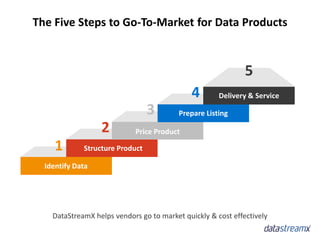
The Five Steps to Go-To-Market for Data Products
Identify Data
Structure Product
Price Product
Prepare Listing
Delivery & Service
1
2
3
4
5
DataStreamX helps vendors go to market quickly & cost effectively
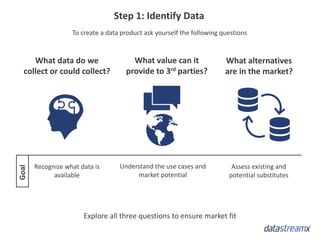
Step 1: Identify Data
To create a data product ask yourself the following questions
What data do we
collect or could collect?
What value can it
provide to 3rd parties?
What alternatives
are in the market?
Recognize what data is
available
Understand the use cases and
market potential
Assess existing and
potential substitutes
Explore all three questions to ensure market fit
Goal
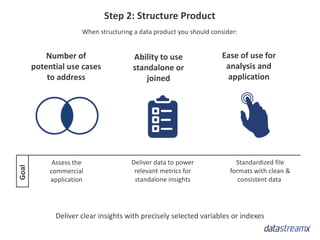
Step 2: Structure Product
When structuring a data product you should consider:
Number of
potential use cases
to address
Ability to use
standalone or
joined
Ease of use for
analysis and
application
Assess the
commercial
application
Deliver data to power
relevant metrics for
standalone insights
Standardized file
formats with clean &
consistent data
Deliver clear insights with precisely selected variables or indexes
Goal
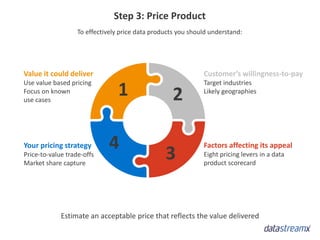
Step 3: Price Product
To effectively price data products you should understand:
1
4
3
2
Factors affecting its appeal
Eight pricing levers in a data
product scorecard
Customer’s willingness-to-pay
Target industries
Likely geographies
Value it could deliver
Use value based pricing
Focus on known
use cases
Your pricing strategy
Price-to-value trade-offs
Market share capture
Estimate an acceptable price that reflects the value delivered
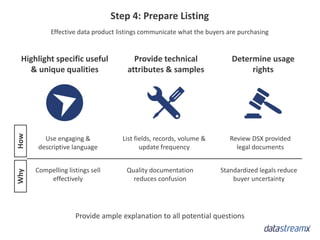
Step 4: Prepare Listing
Effective data product listings communicate what the buyers are purchasing
Highlight specific useful
& unique qualities
Provide technical
attributes & samples
Determine usage
rights
Use engaging &
descriptive language
List fields, records, volume &
update frequency
Review DSX provided
legal documents
Compelling listings sell
effectively
Quality documentation
reduces confusion
Standardized legals reduce
buyer uncertainty
Provide ample explanation to all potential questions
WhyHow
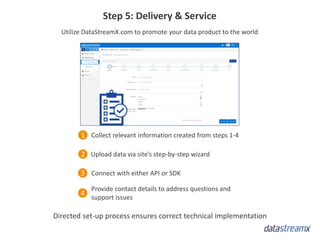
Step 5: Delivery & Service
Utilize DataStreamX.com to promote your data product to the world
Directed set-up process ensures correct technical implementation
Collect relevant information created from steps 1-4
Upload data via site’s step-by-step wizard
Connect with either API or SDK
Provide contact details to address questions and
support issues
1
2
3
4
The global marketplace for commercial data
datastreamx.com
linkedin.com/company/datastreamx
@DataStreamX_PLC

Guide to Data Monetization

  • 1.
    Guide to DataMonetization
  • 2.
    The Five Stepsto Go-To-Market for Data Products Identify Data Structure Product Price Product Prepare Listing Delivery & Service 1 2 3 4 5 DataStreamX helps vendors go to market quickly & cost effectively
  • 3.
    Step 1: IdentifyData To create a data product ask yourself the following questions What data do we collect or could collect? What value can it provide to 3rd parties? What alternatives are in the market? Recognize what data is available Understand the use cases and market potential Assess existing and potential substitutes Explore all three questions to ensure market fit Goal
  • 4.
    Step 2: StructureProduct When structuring a data product you should consider: Number of potential use cases to address Ability to use standalone or joined Ease of use for analysis and application Assess the commercial application Deliver data to power relevant metrics for standalone insights Standardized file formats with clean & consistent data Deliver clear insights with precisely selected variables or indexes Goal
  • 5.
    Step 3: PriceProduct To effectively price data products you should understand: 1 4 3 2 Factors affecting its appeal Eight pricing levers in a data product scorecard Customer’s willingness-to-pay Target industries Likely geographies Value it could deliver Use value based pricing Focus on known use cases Your pricing strategy Price-to-value trade-offs Market share capture Estimate an acceptable price that reflects the value delivered
  • 6.
    Step 4: PrepareListing Effective data product listings communicate what the buyers are purchasing Highlight specific useful & unique qualities Provide technical attributes & samples Determine usage rights Use engaging & descriptive language List fields, records, volume & update frequency Review DSX provided legal documents Compelling listings sell effectively Quality documentation reduces confusion Standardized legals reduce buyer uncertainty Provide ample explanation to all potential questions WhyHow
  • 7.
    Step 5: Delivery& Service Utilize DataStreamX.com to promote your data product to the world Directed set-up process ensures correct technical implementation Collect relevant information created from steps 1-4 Upload data via site’s step-by-step wizard Connect with either API or SDK Provide contact details to address questions and support issues 1 2 3 4
  • 8.
    The global marketplacefor commercial data datastreamx.com linkedin.com/company/datastreamx @DataStreamX_PLC