• Cognizant 20-20 Insights

Retail Analytics: Game Changer
for Customer Loyalty
By leveraging analytics tools and models, retailers can boost
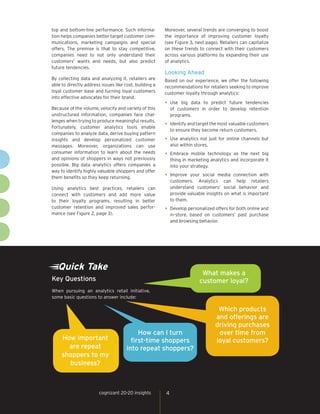
customer loyalty by creating a personalized shopping experience
that customizes offers to needs.
In these times of economic uncertainty and
decreasing margins, retailers must improve
their approach to driving traffic and sales. With
increased mobility and always-connected capabilities, shoppers today can easily research competitive offerings, even while standing in a store
aisle. As such, they are less likely to remain loyal
to a brand and more likely to be swayed by factors
like price, availability and the opinions of others
in their social networks. And with increased social
media adoption, they are also likely to report
on their experience, both the positive and the
negative.
Because of these trends, retailers are working
harder than ever to improve both customer
traffic and customer loyalty by mining volumes
of data and using analytics to uncover valuable
insights and turning those insights into loyaltyinducing strategies. Retailers now realize that
loyalty programs in the current market need
to go beyond mere rewards, points and general
discounts, and move toward creating a personalized shopping experience that recognizes individual customers, offers personalized treatment and
caters to individual customer needs. Analytics is
a key tool in helping to achieve these objectives
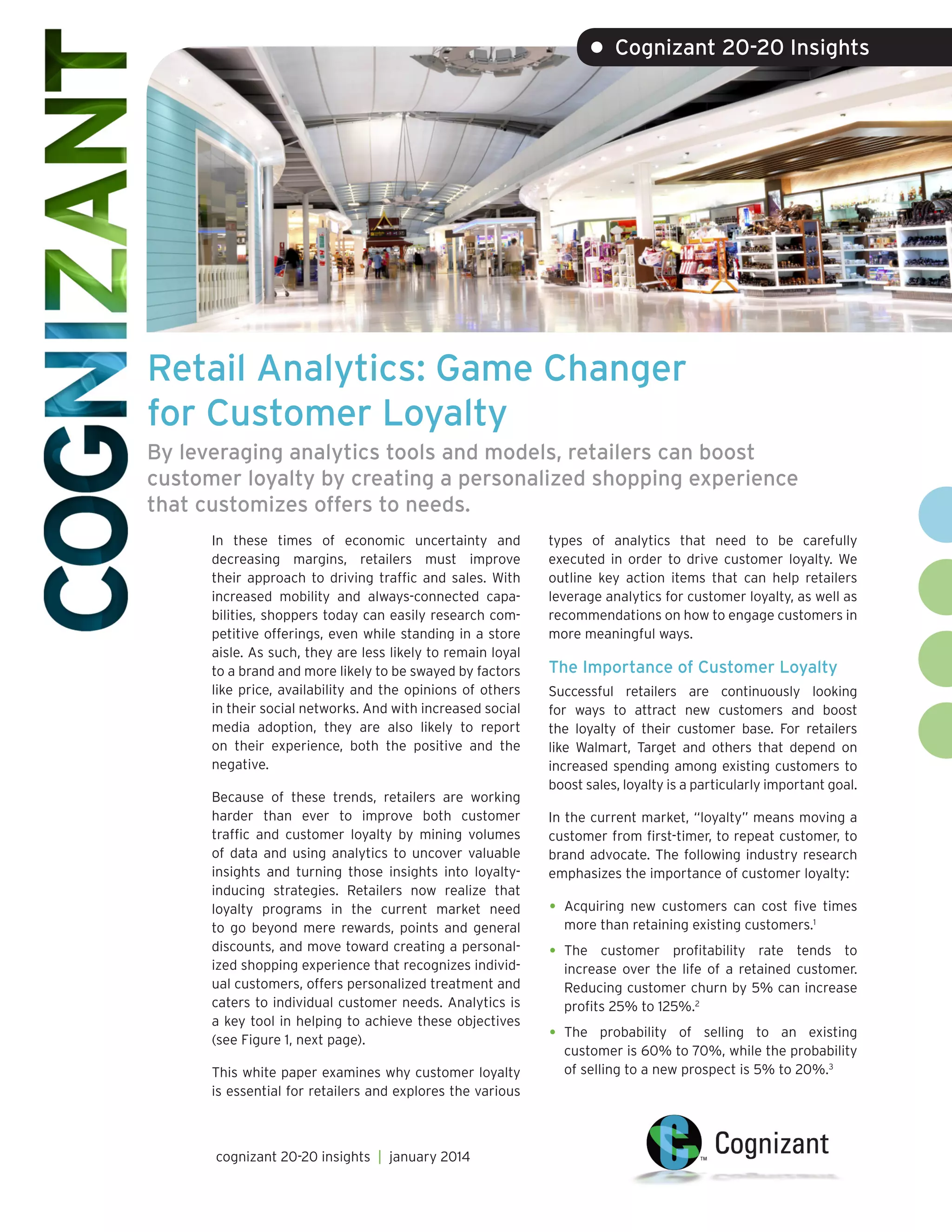
(see Figure 1, next page).
This white paper examines why customer loyalty
is essential for retailers and explores the various

cognizant 20-20 insights | january 2014

types of analytics that need to be carefully
executed in order to drive customer loyalty. We
outline key action items that can help retailers
leverage analytics for customer loyalty, as well as
recommendations on how to engage customers in
more meaningful ways.

The Importance of Customer Loyalty
Successful retailers are continuously looking
for ways to attract new customers and boost
the loyalty of their customer base. For retailers
like Walmart, Target and others that depend on
increased spending among existing customers to
boost sales, loyalty is a particularly important goal.
In the current market, “loyalty” means moving a
customer from first-timer, to repeat customer, to
brand advocate. The following industry research
emphasizes the importance of customer loyalty:

•	 Acquiring new customers can cost five times
more than retaining existing customers.1

•	 The

customer profitability rate tends to
increase over the life of a retained customer.
Reducing customer churn by 5% can increase
profits 25% to 125%.2

•	 The

probability of selling to an existing
customer is 60% to 70%, while the probability
of selling to a new prospect is 5% to 20%.3
Turning Data Insights into Revenue

Internet

predicting customer reactions to a given
product and can be leveraged to improve
basket size, increase the value of the basket
and switch the customer to a better and more
profitable offering.

•	 Descriptive

Mobile

models quantify relationships
in data and classify customers or prospects
into groups. Unlike predictive models that
focus on the behavior of a single customer,
descriptive models identify the relationship
between customers and products, such as how
customers in the 10-12 age group will react to a
new type of candy. By identifying the relationships between consumer groups and products,
businesses can perform suitable mapping to
upsell and increase basket size.

Social Media

Call Center

E-mail

Location

Retailers can leverage these models to transform
retail into “analytical retail.” The opportunity
to achieve competitive advantage in customer
loyalty from this approach is enormous. With
these analytics tools, retailers can:

Analytical
Models
True Insights

•	 Identify their most profitable target customer

base through customer segmentation and
profiling.

Targeted In-Market Action
Plan

Attract &
Engage

Retain

Improved Business Results
(Increase in Revenue)

•	 Develop

close relationships with customers
based on a deep understanding of their
behaviors, predicting future behavior and identifying their needs.

•	 Deliver

targeted advertising, promotions and
product offers to customers that meet their
individual needs and motivate them to buy.

•	 Tailor pricing strategies that provide competi-

Figure 1

tive prices while maintaining profit margins.

•	 Almost

70% of the identifiable reasons why
customers typically leave companies have
nothing to do with the product. The prevailing
reason for switching is poor quality of service.4

Analytics in Customer Loyalty
Analytics is the science of analyzing and discovering meaningful patterns in data. Analytics
tools can help retailers connect with customers
at every stage of the lifecycle by turning these
patterns into valuable insights that describe,
predict and improve business performance. Two
types of analytics are being used by businesses
today:

•	 Predictive

models analyze past performance
to assess the likelihood that a customer will
exhibit a specific behavior in order to improve
marketing effectiveness. This can help in

cognizant 20-20 insights

•	 Maximize marketing investments and allocation
across various media and marketing channels.

While retailers are pursuing some of these
goals already, analytics enables them to delve
more deeply into the data and utilize predictive
and descriptive analytics tools to derive more
valuable customer insights. In this way, analytics
plays an important role in retaining and acquiring
customers, improving loyalty and driving revenue
and profitability.

Overcoming Loyalty Challenges
Retailers currently have access to so much and
so many varieties of transaction and customer
data that it has become a challenge to mine and
convert it into logical and useful insights. Data
is gathered across channels, as consumers shop
and make purchasing decisions both in-store and

2
online; research and learn about brands online
and via social media; and evaluate and test brands
in the store.
To collect all this data, retailers use two methods:

•	 In-store

analytics: This is one area where
physical monitoring of customers can reveal
valuable information. Some of the capabilities used include video-tracking customer
movements, recognition technology to
determine gender and identifying unique
visitors across multiple store visits. This can
help retailers improve the customer’s store
experience and identify hot products and areas
of the store.

•	 Online

analytics: This is used to collect
and analyze online customer information. Commonly used tools are social media
monitoring tools, mobile device usage and Web
searches to track individual online movement,
brand sentiment and shopping patterns. This

helps track customer satisfaction levels and
personalized services to customers.
Increasing numbers of companies are using the
information they collect to understand their
customers better, and then capitalize on that
information. These businesses are attempting to
make sense of the vast amounts of data generated
through personal, societal and industrial interactions, such as social media, mobile devices, geolocation, media, digital sensors, point of sale and
automation. The vast amount of data collected is
often termed big data.
By examining big data, companies can:

•	 Create successful customer loyalty and
retention programs.

•	 Personalize consumer interactions in
meaningful ways.

Both of these goals are crucial to improving
customer loyalty and thereby driving improved

Best Practices in Customer Loyalty Analytics
Goal
Accurate Data
Collection

Customer
Segmentation

Best Practices

•	 Decide the exact nature of data to be obtained.
•	 Ensure identical data is collected at every touchpoint.
•	 Identify any third-party data sources to be used.
•	 Build a customer data hub to ensure data accuracy.
•	 Be aware of customer privacy concerns.
•	 Profile customers based on demographics and behavioral data.
•	 Understand customer preferences and frequency of transactions based on past behavior.
•	 Depending on segmentation results, identify suitable plans and action items to be mapped
and executed for each segment.

•	 Develop answers to three questions: Will a customer leave? Is he worth retaining? How to
retain him?

•	 Ensure consistent customer treatment across all channels: in-store, Web, e-mail, direct
Multi-channel
Approach

mail, phone.

•	 Track the frequency with which customers use every channel to prioritize channels.
•	 Explore the potential of mobile services (promotions, purchases, redemptions) to increase
customer spend and reduce cost of promotions.

Harnessing
Social Media

•	 Use social media to understand customer needs, brand perception, complaints.
•	 Manage customer satisfaction and sentiment by actively responding to concerns raised on

Promotions
Management

•	 Provide personalized messaging instead of mass mailers.
•	 Ensure offers and promotions are not repeatedly sent to customers.
•	 Ensure swift response to customer queries. Personalize every experience of the customer

social networks.

with the organization.

Partner
Management

•	 Allow the customer to not only choose products/services of partners, but also freely
exchange points in another loyalty program.

•	 Capture detailed customer transaction details across partners.

Figure 2

cognizant 20-20 insights

3
top and bottom-line performance. Such information helps companies better target customer communications, marketing campaigns and special
offers. The premise is that to stay competitive,
companies need to not only understand their
customers’ wants and needs, but also predict
future tendencies.

Moreover, several trends are converging to boost
the importance of improving customer loyalty
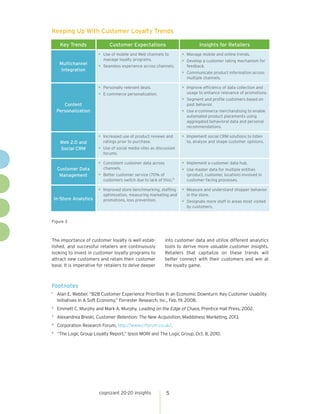
(see Figure 3, next page). Retailers can capitalize
on these trends to connect with their customers
across various platforms by expanding their use
of analytics.

By collecting data and analyzing it, retailers are
able to directly address issues like cost, building a
loyal customer base and turning loyal customers
into effective advocates for their brand.

Based on our experience, we offer the following
recommendations for retailers seeking to improve
customer loyalty through analytics:

Because of the volume, velocity and variety of this
unstructured information, companies face challenges when trying to produce meaningful results.
Fortunately, customer analytics tools enable
companies to analyze data, derive buying pattern
insights and develop personalized customer
messages. Moreover, organizations can use
consumer information to learn about the needs
and opinions of shoppers in ways not previously
possible. Big data analytics offers companies a
way to identify highly valuable shoppers and offer
them benefits so they keep returning.
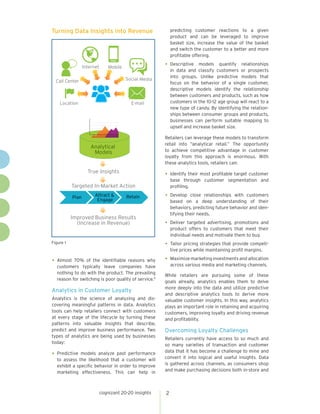
Using analytics best practices, retailers can
connect with customers and add more value
to their loyalty programs, resulting in better
customer retention and improved sales performance (see Figure 2, page 3).

Looking Ahead

•	 Use

big data to predict future tendencies
of customers in order to develop retention
programs.

•	 Identify and target the most valuable customers
to ensure they become return customers.

•	 Use analytics not just for online channels but
also within stores.

•	 Embrace

mobile technology as the next big
thing in marketing analytics and incorporate it
into your strategy.

•	 Improve

your social media connection with
customers. Analytics can help retailers
understand customers’ social behavior and
provide valuable insights on what is important
to them.

•	 Develop personalized offers for both online and
in-store, based on customers’ past purchase
and browsing behavior.

Quick Take

What makes a
customer loyal?

Key Questions
When pursuing an analytics retail initiative,
some basic questions to answer include:

How important
are repeat
shoppers to my
business?

How can I turn
first-time shoppers
into repeat shoppers?

cognizant 20-20 insights

4

Which products
and offerings are
driving purchases
over time from
loyal customers?
Keeping Up With Customer Loyalty Trends
Key Trends

Customer Expectations

Insights for Retailers

•	 Use of mobile and Web channels to
Multichannel
Integration

manage loyalty programs.

•	 Seamless experience across channels.

•	 Manage mobile and online trends.
•	 Develop a customer rating mechanism for
feedback.

•	 Communicate product information across
multiple channels.

•	 Personally relevant deals.
•	 E-commerce personalization.

•	 Improve efficiency of data collection and

usage to enhance relevance of promotions.

•	 Segment and profile customers based on

Content
Personalization

past behavior.

•	 Use e-commerce merchandising to enable
automated product placements using
aggregated behavioral data and personal
recommendations.

Web 2.0 and
Social CRM

Customer Data
Management

•	 Increased use of product reviews and
ratings prior to purchase.

•	

•	 Implement social CRM solutions to listen

to, analyze and shape customer opinions.

Use of social media sites as discussion
forums.

•	 Consistent customer data across

•	 Implement a customer data hub.
•	 Use master data for multiple entities

channels.

•	 Better customer service (70% of

customers switch due to lack of this).5

(product, customer, location) involved in
customer-facing processes.

•	 Improved store benchmarking, staffing •	 Measure and understand shopper behavior
In-Store Analytics

optimization, measuring marketing and
promotions, loss prevention.

in the store.

•	 Designate more staff in areas most visited
by customers.

Figure 3

The importance of customer loyalty is well established, and successful retailers are continuously
looking to invest in customer loyalty programs to
attract new customers and retain their customer
base. It is imperative for retailers to delve deeper

into customer data and utilize different analytics
tools to derive more valuable customer insights.
Retailers that capitalize on these trends will
better connect with their customers and win at
the loyalty game.

Footnotes
1	

Alan E. Webber, “B2B Customer Experience Priorities In an Economic Downturn: Key Customer Usability
Initiatives In A Soft Economy,” Forrester Research, Inc., Feb. 19, 2008.

2	

Emmett C. Murphy and Mark A. Murphy, Leading on the Edge of Chaos, Prentice Hall Press, 2002.

3	

Alexandrea Breski, Customer Retention: The New Acquisition, Madddness Marketing, 2013.

4	

Corporation Research Forum, http://www.crforum.co.uk/.

5	

“The Logic Group Loyalty Report,” Ipsos MORI and The Logic Group, Oct. 8, 2010.

cognizant 20-20 insights

5
About the Authors
Samir Gupta is a Consultant in Cognizant’s Business Consulting Practice, with over four years of experience
in retail consulting and IT processes. He has worked for retailers such as Walmart, 7-Eleven, HEB and
Family Dollar. Samir has an M.B.A. from XLRI, Jamshedpur, and engineering from NIT Trichy. He can be
reached at Samir.Gupta@cognizant.com.
Nishant Kumar is a Manager in Cognizant’s Business Consulting Practice, with over 10 years of experience
in the merchandising and supply chain space. He has extensive experience in advising companies in the
retail and manufacturing space. Nishant’s current areas of interest include merchandising integrated
planning, supply chain visibility and traceability, and supply chain compliance. He has an M.B.A from S.P.
Jain Institute of Management and Research. He can be reached at Nishant.Kumar2@cognizant.com.

About Cognizant
Cognizant (NASDAQ: CTSH) is a leading provider of information technology, consulting, and business process outsourcing services, dedicated to helping the world’s leading companies build stronger businesses. Headquartered in
Teaneck, New Jersey (U.S.), Cognizant combines a passion for client satisfaction, technology innovation, deep industry
and business process expertise, and a global, collaborative workforce that embodies the future of work. With over 50
delivery centers worldwide and approximately 166,400 employees as of September 30, 2013, Cognizant is a member of
the NASDAQ-100, the S&P 500, the Forbes Global 2000, and the Fortune 500 and is ranked among the top performing
and fastest growing companies in the world. Visit us online at www.cognizant.com or follow us on Twitter: Cognizant.

World Headquarters

European Headquarters

India Operations Headquarters

500 Frank W. Burr Blvd.
Teaneck, NJ 07666 USA
Phone: +1 201 801 0233
Fax: +1 201 801 0243
Toll Free: +1 888 937 3277
Email: inquiry@cognizant.com

1 Kingdom Street
Paddington Central
London W2 6BD
Phone: +44 (0) 20 7297 7600
Fax: +44 (0) 20 7121 0102
Email: infouk@cognizant.com

#5/535, Old Mahabalipuram Road
Okkiyam Pettai, Thoraipakkam
Chennai, 600 096 India
Phone: +91 (0) 44 4209 6000
Fax: +91 (0) 44 4209 6060
Email: inquiryindia@cognizant.com

©
­­ Copyright 2014, Cognizant. All rights reserved. No part of this document may be reproduced, stored in a retrieval system, transmitted in any form or by any
means, electronic, mechanical, photocopying, recording, or otherwise, without the express written permission from Cognizant. The information contained herein is
subject to change without notice. All other trademarks mentioned herein are the property of their respective owners.

Retail Analytics: Game Changer for Customer Loyalty

  • 1.
    • Cognizant 20-20Insights Retail Analytics: Game Changer for Customer Loyalty By leveraging analytics tools and models, retailers can boost customer loyalty by creating a personalized shopping experience that customizes offers to needs. In these times of economic uncertainty and decreasing margins, retailers must improve their approach to driving traffic and sales. With increased mobility and always-connected capabilities, shoppers today can easily research competitive offerings, even while standing in a store aisle. As such, they are less likely to remain loyal to a brand and more likely to be swayed by factors like price, availability and the opinions of others in their social networks. And with increased social media adoption, they are also likely to report on their experience, both the positive and the negative. Because of these trends, retailers are working harder than ever to improve both customer traffic and customer loyalty by mining volumes of data and using analytics to uncover valuable insights and turning those insights into loyaltyinducing strategies. Retailers now realize that loyalty programs in the current market need to go beyond mere rewards, points and general discounts, and move toward creating a personalized shopping experience that recognizes individual customers, offers personalized treatment and caters to individual customer needs. Analytics is a key tool in helping to achieve these objectives (see Figure 1, next page). This white paper examines why customer loyalty is essential for retailers and explores the various cognizant 20-20 insights | january 2014 types of analytics that need to be carefully executed in order to drive customer loyalty. We outline key action items that can help retailers leverage analytics for customer loyalty, as well as recommendations on how to engage customers in more meaningful ways. The Importance of Customer Loyalty Successful retailers are continuously looking for ways to attract new customers and boost the loyalty of their customer base. For retailers like Walmart, Target and others that depend on increased spending among existing customers to boost sales, loyalty is a particularly important goal. In the current market, “loyalty” means moving a customer from first-timer, to repeat customer, to brand advocate. The following industry research emphasizes the importance of customer loyalty: • Acquiring new customers can cost five times more than retaining existing customers.1 • The customer profitability rate tends to increase over the life of a retained customer. Reducing customer churn by 5% can increase profits 25% to 125%.2 • The probability of selling to an existing customer is 60% to 70%, while the probability of selling to a new prospect is 5% to 20%.3
  • 2.
    Turning Data Insightsinto Revenue Internet predicting customer reactions to a given product and can be leveraged to improve basket size, increase the value of the basket and switch the customer to a better and more profitable offering. • Descriptive Mobile models quantify relationships in data and classify customers or prospects into groups. Unlike predictive models that focus on the behavior of a single customer, descriptive models identify the relationship between customers and products, such as how customers in the 10-12 age group will react to a new type of candy. By identifying the relationships between consumer groups and products, businesses can perform suitable mapping to upsell and increase basket size. Social Media Call Center E-mail Location Retailers can leverage these models to transform retail into “analytical retail.” The opportunity to achieve competitive advantage in customer loyalty from this approach is enormous. With these analytics tools, retailers can: Analytical Models True Insights • Identify their most profitable target customer base through customer segmentation and profiling. Targeted In-Market Action Plan Attract & Engage Retain Improved Business Results (Increase in Revenue) • Develop close relationships with customers based on a deep understanding of their behaviors, predicting future behavior and identifying their needs. • Deliver targeted advertising, promotions and product offers to customers that meet their individual needs and motivate them to buy. • Tailor pricing strategies that provide competi- Figure 1 tive prices while maintaining profit margins. • Almost 70% of the identifiable reasons why customers typically leave companies have nothing to do with the product. The prevailing reason for switching is poor quality of service.4 Analytics in Customer Loyalty Analytics is the science of analyzing and discovering meaningful patterns in data. Analytics tools can help retailers connect with customers at every stage of the lifecycle by turning these patterns into valuable insights that describe, predict and improve business performance. Two types of analytics are being used by businesses today: • Predictive models analyze past performance to assess the likelihood that a customer will exhibit a specific behavior in order to improve marketing effectiveness. This can help in cognizant 20-20 insights • Maximize marketing investments and allocation across various media and marketing channels. While retailers are pursuing some of these goals already, analytics enables them to delve more deeply into the data and utilize predictive and descriptive analytics tools to derive more valuable customer insights. In this way, analytics plays an important role in retaining and acquiring customers, improving loyalty and driving revenue and profitability. Overcoming Loyalty Challenges Retailers currently have access to so much and so many varieties of transaction and customer data that it has become a challenge to mine and convert it into logical and useful insights. Data is gathered across channels, as consumers shop and make purchasing decisions both in-store and 2
  • 3.
    online; research andlearn about brands online and via social media; and evaluate and test brands in the store. To collect all this data, retailers use two methods: • In-store analytics: This is one area where physical monitoring of customers can reveal valuable information. Some of the capabilities used include video-tracking customer movements, recognition technology to determine gender and identifying unique visitors across multiple store visits. This can help retailers improve the customer’s store experience and identify hot products and areas of the store. • Online analytics: This is used to collect and analyze online customer information. Commonly used tools are social media monitoring tools, mobile device usage and Web searches to track individual online movement, brand sentiment and shopping patterns. This helps track customer satisfaction levels and personalized services to customers. Increasing numbers of companies are using the information they collect to understand their customers better, and then capitalize on that information. These businesses are attempting to make sense of the vast amounts of data generated through personal, societal and industrial interactions, such as social media, mobile devices, geolocation, media, digital sensors, point of sale and automation. The vast amount of data collected is often termed big data. By examining big data, companies can: • Create successful customer loyalty and retention programs. • Personalize consumer interactions in meaningful ways. Both of these goals are crucial to improving customer loyalty and thereby driving improved Best Practices in Customer Loyalty Analytics Goal Accurate Data Collection Customer Segmentation Best Practices • Decide the exact nature of data to be obtained. • Ensure identical data is collected at every touchpoint. • Identify any third-party data sources to be used. • Build a customer data hub to ensure data accuracy. • Be aware of customer privacy concerns. • Profile customers based on demographics and behavioral data. • Understand customer preferences and frequency of transactions based on past behavior. • Depending on segmentation results, identify suitable plans and action items to be mapped and executed for each segment. • Develop answers to three questions: Will a customer leave? Is he worth retaining? How to retain him? • Ensure consistent customer treatment across all channels: in-store, Web, e-mail, direct Multi-channel Approach mail, phone. • Track the frequency with which customers use every channel to prioritize channels. • Explore the potential of mobile services (promotions, purchases, redemptions) to increase customer spend and reduce cost of promotions. Harnessing Social Media • Use social media to understand customer needs, brand perception, complaints. • Manage customer satisfaction and sentiment by actively responding to concerns raised on Promotions Management • Provide personalized messaging instead of mass mailers. • Ensure offers and promotions are not repeatedly sent to customers. • Ensure swift response to customer queries. Personalize every experience of the customer social networks. with the organization. Partner Management • Allow the customer to not only choose products/services of partners, but also freely exchange points in another loyalty program. • Capture detailed customer transaction details across partners. Figure 2 cognizant 20-20 insights 3
  • 4.
    top and bottom-lineperformance. Such information helps companies better target customer communications, marketing campaigns and special offers. The premise is that to stay competitive, companies need to not only understand their customers’ wants and needs, but also predict future tendencies. Moreover, several trends are converging to boost the importance of improving customer loyalty (see Figure 3, next page). Retailers can capitalize on these trends to connect with their customers across various platforms by expanding their use of analytics. By collecting data and analyzing it, retailers are able to directly address issues like cost, building a loyal customer base and turning loyal customers into effective advocates for their brand. Based on our experience, we offer the following recommendations for retailers seeking to improve customer loyalty through analytics: Because of the volume, velocity and variety of this unstructured information, companies face challenges when trying to produce meaningful results. Fortunately, customer analytics tools enable companies to analyze data, derive buying pattern insights and develop personalized customer messages. Moreover, organizations can use consumer information to learn about the needs and opinions of shoppers in ways not previously possible. Big data analytics offers companies a way to identify highly valuable shoppers and offer them benefits so they keep returning. Using analytics best practices, retailers can connect with customers and add more value to their loyalty programs, resulting in better customer retention and improved sales performance (see Figure 2, page 3). Looking Ahead • Use big data to predict future tendencies of customers in order to develop retention programs. • Identify and target the most valuable customers to ensure they become return customers. • Use analytics not just for online channels but also within stores. • Embrace mobile technology as the next big thing in marketing analytics and incorporate it into your strategy. • Improve your social media connection with customers. Analytics can help retailers understand customers’ social behavior and provide valuable insights on what is important to them. • Develop personalized offers for both online and in-store, based on customers’ past purchase and browsing behavior. Quick Take What makes a customer loyal? Key Questions When pursuing an analytics retail initiative, some basic questions to answer include: How important are repeat shoppers to my business? How can I turn first-time shoppers into repeat shoppers? cognizant 20-20 insights 4 Which products and offerings are driving purchases over time from loyal customers?
  • 5.
    Keeping Up WithCustomer Loyalty Trends Key Trends Customer Expectations Insights for Retailers • Use of mobile and Web channels to Multichannel Integration manage loyalty programs. • Seamless experience across channels. • Manage mobile and online trends. • Develop a customer rating mechanism for feedback. • Communicate product information across multiple channels. • Personally relevant deals. • E-commerce personalization. • Improve efficiency of data collection and usage to enhance relevance of promotions. • Segment and profile customers based on Content Personalization past behavior. • Use e-commerce merchandising to enable automated product placements using aggregated behavioral data and personal recommendations. Web 2.0 and Social CRM Customer Data Management • Increased use of product reviews and ratings prior to purchase. • • Implement social CRM solutions to listen to, analyze and shape customer opinions. Use of social media sites as discussion forums. • Consistent customer data across • Implement a customer data hub. • Use master data for multiple entities channels. • Better customer service (70% of customers switch due to lack of this).5 (product, customer, location) involved in customer-facing processes. • Improved store benchmarking, staffing • Measure and understand shopper behavior In-Store Analytics optimization, measuring marketing and promotions, loss prevention. in the store. • Designate more staff in areas most visited by customers. Figure 3 The importance of customer loyalty is well established, and successful retailers are continuously looking to invest in customer loyalty programs to attract new customers and retain their customer base. It is imperative for retailers to delve deeper into customer data and utilize different analytics tools to derive more valuable customer insights. Retailers that capitalize on these trends will better connect with their customers and win at the loyalty game. Footnotes 1 Alan E. Webber, “B2B Customer Experience Priorities In an Economic Downturn: Key Customer Usability Initiatives In A Soft Economy,” Forrester Research, Inc., Feb. 19, 2008. 2 Emmett C. Murphy and Mark A. Murphy, Leading on the Edge of Chaos, Prentice Hall Press, 2002. 3 Alexandrea Breski, Customer Retention: The New Acquisition, Madddness Marketing, 2013. 4 Corporation Research Forum, http://www.crforum.co.uk/. 5 “The Logic Group Loyalty Report,” Ipsos MORI and The Logic Group, Oct. 8, 2010. cognizant 20-20 insights 5
  • 6.
    About the Authors SamirGupta is a Consultant in Cognizant’s Business Consulting Practice, with over four years of experience in retail consulting and IT processes. He has worked for retailers such as Walmart, 7-Eleven, HEB and Family Dollar. Samir has an M.B.A. from XLRI, Jamshedpur, and engineering from NIT Trichy. He can be reached at Samir.Gupta@cognizant.com. Nishant Kumar is a Manager in Cognizant’s Business Consulting Practice, with over 10 years of experience in the merchandising and supply chain space. He has extensive experience in advising companies in the retail and manufacturing space. Nishant’s current areas of interest include merchandising integrated planning, supply chain visibility and traceability, and supply chain compliance. He has an M.B.A from S.P. Jain Institute of Management and Research. He can be reached at Nishant.Kumar2@cognizant.com. About Cognizant Cognizant (NASDAQ: CTSH) is a leading provider of information technology, consulting, and business process outsourcing services, dedicated to helping the world’s leading companies build stronger businesses. Headquartered in Teaneck, New Jersey (U.S.), Cognizant combines a passion for client satisfaction, technology innovation, deep industry and business process expertise, and a global, collaborative workforce that embodies the future of work. With over 50 delivery centers worldwide and approximately 166,400 employees as of September 30, 2013, Cognizant is a member of the NASDAQ-100, the S&P 500, the Forbes Global 2000, and the Fortune 500 and is ranked among the top performing and fastest growing companies in the world. Visit us online at www.cognizant.com or follow us on Twitter: Cognizant. World Headquarters European Headquarters India Operations Headquarters 500 Frank W. Burr Blvd. Teaneck, NJ 07666 USA Phone: +1 201 801 0233 Fax: +1 201 801 0243 Toll Free: +1 888 937 3277 Email: inquiry@cognizant.com 1 Kingdom Street Paddington Central London W2 6BD Phone: +44 (0) 20 7297 7600 Fax: +44 (0) 20 7121 0102 Email: infouk@cognizant.com #5/535, Old Mahabalipuram Road Okkiyam Pettai, Thoraipakkam Chennai, 600 096 India Phone: +91 (0) 44 4209 6000 Fax: +91 (0) 44 4209 6060 Email: inquiryindia@cognizant.com © ­­ Copyright 2014, Cognizant. All rights reserved. No part of this document may be reproduced, stored in a retrieval system, transmitted in any form or by any means, electronic, mechanical, photocopying, recording, or otherwise, without the express written permission from Cognizant. The information contained herein is subject to change without notice. All other trademarks mentioned herein are the property of their respective owners.