Restructuring Case Study
BUSINESS VALUATION &
FINANCIAL ADVISORY SERVICES
www.mercercapital.com
MERCER CAPITAL
Authored by: Jeff K. Davis, CFA
jeffdavis@mercercapital.com
Taryn E. Burgess, CFA, ABV
burgesst@mercercapital.com
September 2020
BUSINESS VALUATION &
FINANCIAL ADVISORY SERVICES
Overview of Case Study
2
Neiman Marcus Bankruptcy Case Study
© 2020 Mercer Capital
Mercer Capital is a business valuation and financial advisory firm. For more information, visit mercercapital.com.
Neiman Marcus Group, Inc. (“Neiman Marcus” or “Company”) is a Dallas, Texas-based holding company
that operates four retail brands: Neiman Marcus, Bergdorf Goodman, Last Call (clearance centers), and
Horchow (home furnishings). Unlike other department store chains, such as JCPenney and Macy’s that
cater to the mass market, Neiman Marcus’s target market is the top 2% of U.S. earners.
Among the notable developments over the last 15 years were two private equity transactions that
burdened the Company with a significant debt load and one well-timed acquisition. The debt and
acquisition figured prominently in the May 7, 2020 bankruptcy filing in which the company sought to
reorganize under Chapter 11 with the backing of most creditors.
The Neiman Marcus chapter 11 bankruptcy raises multiple valuation issues:
• Fraudulent Conveyance (Asset Stripping)
and solvency related to pre-filing
distributions
• Liquidation vs. Going Concern Value
• Value of the Company once it emerges
from Chapter 11
• Allocation of Enterprise Value to Secure
and Unsecured Creditors
• Fresh Start Accounting
Since 1982, we have provided thousands of
valuation opinions for corporations of all sizes in
a wide variety of industries. Mercer Capital’s
comprehensive suite of valuation and corporate
advisory services for companies in the midst of
restructuring and/or bankruptcy include:
• Pre-Bankruptcy Planning / Reorganization
Plan Assessment
• Distressed M&A Advisory / Fairness
Opinions
• Solvency Analysis and Opinions
• Expert Witness Testimony
• Fresh Start Accounting
Mercer Capital is one of the largest
independent business valuation and
financial advisory firms in the nation.
BUSINESS VALUATION &
FINANCIAL ADVISORY SERVICES
Iconic Luxury
Retailer to Indebted
Morass
BUSINESS VALUATION &
FINANCIAL ADVISORY SERVICES
History
4
The iconic Neiman Marcus department store was established in 1907 in Dallas. Neiman Marcus prospered as oil wealth in Texas fueled demand for luxury goods. Neiman
Marcus merged with Broadway-Hale Stores (later rechristened Carter Hawley Hale Stores, Inc.) in the late 1960s.
Additional stores were opened outside of Texas in Atlanta, South Florida, and other wealthy enclaves around the U.S. except for New York where Bergdorf Goodman
(acquired in the 1970s) operated two stores.
Neiman Marcus Bankruptcy Case Study
© 2020 Mercer Capital
Mercer Capital is a business valuation and financial advisory firm. For more information, visit mercercapital.com.
Neiman Marcus with Bergdorf
Goodman was partially spun out as a
public company (remaining shares
spun in 1999).
The Company was acquired via a $5
billion LBO engineered by Texas
Pacific Group and Warburg Pincus.
The PE-owners sought an IPO after
rebounding from The Great Financial
Crisis. Instead, Neiman Marcus was
acquired for $6 billion by Ares
Management and the Canada
Pension Plan Investment Board
(“CPPIB”).
Neiman Marcus acquired MyTheresa, a
German luxury e-commerce retailer with
annual revenues of $130 million for $182
million of cash consideration.
Neiman Marcus filed an S-1 in anticipation of
being a public company again. The
registration statement was withdrawn due to
weak investor demand.
The entity that held the shares of MyTheresa
(MyT Holding Co.) was transferred via a
series of dividends to the Neiman Marcus
holding company directly controlled by Ares
and CPPIB, placing the interest out of the
reach of Creditors.
Although Neiman Marcus’ common shares had
not been publicly traded since 2005, the
Company filed with the SEC because its debt was
registered. During June 2019, the Company
deregistered upon an exchange of new notes and
preferred equity for the registered notes. S&P
described the restructuring as a selective default
because debt investors received less than
promised with the original securities
1987
2005
2013
2014
2015
2018
BUSINESS VALUATION &
FINANCIAL ADVISORY SERVICES
Historical Financials
5
LTM
8/1/15 7/30/16 7/29/17 7/28/18 4/27/19 4/28/18 4/27/19
Income Statement Items ($M)
Revenue $5,095 $4,949 $4,706 $4,900 $4,688 $3,768 $3,556
Pretax Income 28 (547) (749) (211) (242) (89) (120)
Interest 290 286 296 307 322 230 245
Amortization 137 111 104 98 95 73 70
Depreciation 210 251 250 239 225 181 167
Impairment 0 466 511 0 0 0 0
EBITDA $665 $567 $412 $433 $400 $395 $362
Capex 270 301 205 175 197 110 132
EBITDA - Capex $395 $266 $207 $258 $203 $285 $230
EBITDA Margin 13.1% 11.5% 8.8% 8.8% 8.5% 10.5% 10.2%
EBITDA-Capex 7.8% 5.4% 4.4% 5.3% 4.3% 7.6% 6.5%
9 Months EndedFiscal Years Ended LTM
8/1/15 7/30/16 7/29/17 7/28/18 4/27/19 4/28/18 4/27/19
Balance Sheet Items ($M)
Cash 73 64 49 39 39 39 39
Other Current Assets 126 147 185 158 335 164 335
Inventory 1,155 1,125 1,154 1,116 1,065 1,180 1,065
Fixed Assets (net) 1,478 1,588 1,587 1,570 1,534 1,567 1,534
Favorable Leases 1,040 986 931 879 841 892 841
Other Assets 17 17 16 45 41 45 41
Intangible Assets 4,831 4,330 3,782 3,739 3,504 3,762 3,504
Total Assets $8,720 $8,257 $7,704 $7,546 $7,359 $7,649 $7,359
Current Liabilities 837 811 774 831 722 797 722
Other Liabilities 1,884 1,890 1,758 1,304 1,320 1,356 1,320
Debt 4,585 4,613 4,705 4,652 4,940 4,667 4,940
Equity $1,414 $943 $467 $759 $377 $829 $377
Financial Ratios ($M)
Tangible Equity (4,457) (4,373) (4,246) (3,859) (3,968) (3,825) (3,968)
Debt / EBITDA 6.9x 8.1x 11.4x 10.7x 12.4x 8.9x 10.2x
EBITDA / Int Exp 2.3x 2.0x 1.4x 1.4x 1.2x 1.7x 1.5x
Source: Neiman Marcus Group LTD LLC 10-K and 10-Qs (NM deregistered 6/21/19)
Fiscal Years Ended 9 Months Ended
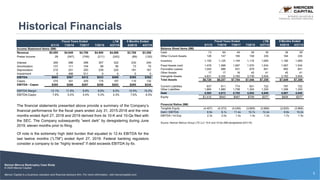
The financial statements presented above provide a summary of the Company’s
financial performance for the fiscal years ended July 31, 2015-2018 and the nine
months ended April 27, 2018 and 2019 derived from its 10-K and 10-Qs filed with
the SEC. The Company subsequently “went dark” by deregistering during June
2019, eleven months prior to filing.
Of note is the extremely high debt burden that equated to 12.4x EBITDA for the
last twelve months (“LTM”) ended April 27, 2019. Federal banking regulators
consider a company to be “highly levered” if debt exceeds EBITDA by 6x.
Neiman Marcus Bankruptcy Case Study
© 2020 Mercer Capital
Mercer Capital is a business valuation and financial advisory firm. For more information, visit mercercapital.com.
BUSINESS VALUATION &
FINANCIAL ADVISORY SERVICES
High Debt Burden Compared to Peers
Neiman Marcus has struggled with a high debt load since the LBO in 2005, which has been
magnified by the disruptive impact of online retailing on department stores.
• EBITDA declined from $665 million in FY2015 to $400 million in the LTM period ended
April 27, 2019, the last quarter in which the Company filed with the SEC.
• The EBITDA margin declined by > 1/3 from 13.1% to 8.5% over the same time.
• Debt equated to 12.4x LTM EBITDA and covered interest expense by 1.2x.
By way of reference, the debt/EBITDA and EBITDA/interest ratios for Ralph Lauren (NYSE:
RL) for the fiscal year ended March 30, 2019 were 1.0x and 47.1x, while the respective ratios
for Dillard’s (NYSE: DDS) were 1.2x and 9.9x for the fiscal year ended February 2, 2019.
Moody’s downgraded the Company’s corporate credit rating to B3 from B2 in October 2013
with the acquisition by Ares and CPPIB. Moody’s also established an initial rating of Caa2 for
unsecured notes issued to finance the acquisition. By the time the notes were deregistered,
Moody’s had reduced the corporate rating to Caa3 and notes to Ca.
Moody’s defines Caa as obligations that “are judged to be of poor standing and are subject to
very high credit risk,” and Ca as obligations that are “highly speculative and are likely in, or
very near, default, with some prospect of recovery in principal and interest.”
6
Source: S&P Global Market Intelligence
0.0x 2.0x 4.0x 6.0x 8.0x 10.0x 12.0x 14.0x
Ralph Lauren
Dillard's
Neiman Marcus
Debt to EBITDA
0.0x 10.0x 20.0x 30.0x 40.0x 50.0x
Ralph Lauren
Dillard's
Neiman Marcus
EBITDA to Interest Expense
Neiman Marcus Bankruptcy Case Study
© 2020 Mercer Capital
Mercer Capital is a business valuation and financial advisory firm. For more information, visit mercercapital.com.
BUSINESS VALUATION &
FINANCIAL ADVISORY SERVICES
At the time of bankruptcy, Neiman Marcus generated about one-third of its
sales (about $1.5 billion) online. MyTheresa accounted for about $500 million
of the online sales, up from $238 million in 1Q17 when certain subsidiaries
that held MyTheresa were designated “unrestricted subsidiaries” by the
Company.
While MyTheresa’s sales increased, the legacy department store business
declined as the Company struggled to connect with younger affluent
customers who favored online start-up boutiques and had little inclination to
shop in a department store.
• E-commerce sales as a portion of total retail sales have doubled over
the last five years to about 12% in 2019.
• The move to work from home (“WFH”) and social distancing practices
born of COVID-19 in early 2020 have accelerated the trend such that
the pre-COVID-19 projection of e-commerce sales rising to 15% by
2020 will likely prove to be significantly conservative.
7
Competition Amidst the Rise of E-commerce
Neiman Marcus Bankruptcy Case Study
© 2020 Mercer Capital
Mercer Capital is a business valuation and financial advisory firm. For more information, visit mercercapital.com.
BUSINESS VALUATION &
FINANCIAL ADVISORY SERVICES
Neiman Marcus
Files for
Bankruptcy
Source: Business Insider
Neiman Marcus is closing
another department store,
bringing its total closings to
22 locations.
BUSINESS VALUATION &
FINANCIAL ADVISORY SERVICES
Bankruptcy Filing
9
The initial plan called for creditors to convert $4 billion of $5 billion of debt into equity. The plan does not provide for mass store closures or asset sales, although the Last Call
clearance stores will close. As noted, the bankruptcy filing follows a restructuring in June 2019 that entailed:
• An exchange of all but $137 million of $960 million of 8.0% cash pay and $656 million of 8.75%/9.50% PIK Toggle unsecured notes for $1.2 billion of (i) 8.0% and
8.75% third lien Company notes and (ii) $250 million of Series A preferred equity in MyT Holding Co., a US-based entity that holds the German corporate entity that
operates MyTheresa;
• The issuance of $550 million of new second-lien 6.0% cash pay/8.0% PIK notes due 2024 with a limited senior secured claim of $200 million from MyT Holding Co.
and other MyT affiliates;
• A partial paydown of the first-lien term loan facility at par with the proceeds of the second lien notes; and,
• An exchange for the remaining $2.2 billion first-lien credit facility with a new facility and an extension of the maturity to October 2023.
The restructuring did not (apparently) materially impact the Company’s $900 million asset-based credit facility of which $455 million was drawn as of April 2019; or the first lien
$125 million debentures due in 2028.
Neiman Marcuse filed on May 7, 2020 for chapter 11 bankruptcy protection. The COVID-19 induced shutdown of the economy was the final nail in the coffin. The shutdown
forced major furloughs and the closing of its stores in accordance with various local shelter-in-place regulations. Other recent retail bankruptcies include: Lord & Taylor, Men’s
Warehouse, Ann Taylor, Brooks Brothers, Lucky Brands, and J. Crew with many more expected to file.
Neiman Marcus Bankruptcy Case Study
© 2020 Mercer Capital
Mercer Capital is a business valuation and financial advisory firm. For more information, visit mercercapital.com.
BUSINESS VALUATION &
FINANCIAL ADVISORY SERVICES
Bankruptcy Filing
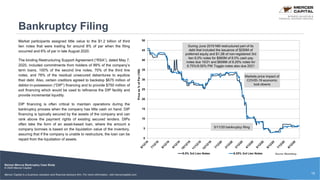
Market participants assigned little value to the $1.2 billion of third
lien notes that were trading for around 8% of par when the filing
occurred and 6% of par in late August 2020.
The binding Restructuring Support Agreement (“RSA”), dated May 7,
2020, included commitments from holders of 99% of the company’s
term loans, 100% of the second line notes, 70% of the third line
notes, and 78% of the residual unsecured debentures to equitize
their debt. Also, certain creditors agreed to backstop $675 million of
debtor-in-possession (“DIP”) financing and to provide $750 million of
exit financing which would be used to refinance the DIP facility and
provide incremental liquidity.
DIP financing is often critical to maintain operations during the
bankruptcy process when the company has little cash on hand. DIP
financing is typically secured by the assets of the company and can
rank above the payment rights of existing secured lenders. DIPs
often take the form of an asset-based loan, where the amount a
company borrows is based on the liquidation value of the inventory,
assuring that if the company is unable to restructure, the loan can be
repaid from the liquidation of assets.
10
Neiman Marcus Bankruptcy Case Study
© 2020 Mercer Capital
Mercer Capital is a business valuation and financial advisory firm. For more information, visit mercercapital.com.
0
5
10
15
20
25
30
35
40
45
50
Priceas%ofPar(100)
8.0% 3rd Lien Notes 8.25% 3rd Lien Notes Source: Bloomberg
During June 2019 NM restructured part of its
debt that included the issuance of $250M of
preferred equity and $1.2B of non-registered 3rd
lien 8.0% notes for $960M of 8.0% cash pay
notes due 10/21 and $656M of 8.25% notes for
8.75%/9.50% PIK Toggle notes also due 2021
5/11/20 bankruptcy filing
Markets price impact of
COVID-19 economic
lock-downs
BUSINESS VALUATION &
FINANCIAL ADVISORY SERVICES
Bankruptcy Path: Chapter 7 vs. Chapter 11
11
Federal law governs the bankruptcy process. Broadly, a company will either
reorganize under Chapter 11 or liquidate under Chapter 7.
A Chapter 7 filing typically is made when a business has an exceedingly large
debt combined with underlying operations that have deteriorated such that a
reorganized business has little value. Under Chapter 7, the company stops all
operations. A U.S. bankruptcy court will appoint a trustee to oversee the
liquidation of assets with the proceeds used to pay creditors after legal and
administrative costs are covered. Unresolved debts are then “discharged,” and
the corporate entity is dissolved.
Under Chapter 11, the business continues to operate, often with the same
management and board who will exert some control over the process as “debtor
in possession” operators. Once a Chapter 11 filing occurs, the debtor must
obtain approval from the bankruptcy court for most decisions related to asset
sales, financings, and the like.
Most public companies and substantive private ones, such as Neiman Marcus, file
under Chapter 11. If successful, the company emerges with a manageable debt load
and new owners. If unsuccessful, creditors will move to have the petition dismissed
or convert to a Chapter 7 to liquidate.
Most Chapter 11 filings are voluntary, but sometimes creditors can force an
involuntary filing. Normally, a debtor has four months after filing to propose a
reorganization plan. Once the exclusivity period ends creditors can propose a
competing plan.
Neiman Marcus Bankruptcy Case Study
© 2020 Mercer Capital
Mercer Capital is a business valuation and financial advisory firm. For more information, visit mercercapital.com.
BUSINESS VALUATION &
FINANCIAL ADVISORY SERVICES
Bankruptcy Path: Chapter 7 vs. Chapter 11 (cont.)
12
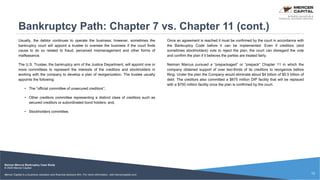
Usually, the debtor continues to operate the business; however, sometimes the
bankruptcy court will appoint a trustee to oversee the business if the court finds
cause to do so related to fraud, perceived mismanagement and other forms of
malfeasance.
The U.S. Trustee, the bankruptcy arm of the Justice Department, will appoint one or
more committees to represent the interests of the creditors and stockholders in
working with the company to develop a plan of reorganization. The trustee usually
appoints the following:
• The “official committee of unsecured creditors”;
• Other creditors committee representing a distinct class of creditors such as
secured creditors or subordinated bond holders; and,
• Stockholders committee.
Once an agreement is reached it must be confirmed by the court in accordance with
the Bankruptcy Code before it can be implemented. Even if creditors (and
sometimes stockholders) vote to reject the plan, the court can disregard the vote
and confirm the plan if it believes the parties are treated fairly.
Neiman Marcus pursued a “prepackaged” or “prepack” Chapter 11 in which the
company obtained support of over two-thirds of its creditors to reorganize before
filing. Under the plan the Company would eliminate about $4 billion of $5.5 billion of
debt. The creditors also committed a $675 million DIP facility that will be replaced
with a $750 million facility once the plan is confirmed by the court.
Neiman Marcus Bankruptcy Case Study
© 2020 Mercer Capital
Mercer Capital is a business valuation and financial advisory firm. For more information, visit mercercapital.com.
BUSINESS VALUATION &
FINANCIAL ADVISORY SERVICES
The Role of
Valuation in
Bankruptcy
BUSINESS VALUATION &
FINANCIAL ADVISORY SERVICES
The Role of Valuation in Bankruptcy
Valuation issues are interwound in bankruptcy proceedings, especially in Chapter 11 filings when a company seeks to reorganize. Creditors and the debtor will hire legal and
financial advisors to develop a reorganization plan the maximizes value and produces a reorganized company that has a reasonable likelihood of producing sufficient cash
flows to cover its obligations.
There are typically three valuation considerations for companies restructuring though Chapter 11 Bankruptcy:
1. Companies must prove that a Chapter 11 Restructuring is in the “best interest” of its stakeholders;
2. A cash flow test must prove that post-reorganization the debtor will be able to fund obligations; and,
3. “Fresh Start Accounting” must be adopted in which the balance sheet is restated to fair value.
Sometimes, as is the case with Neiman Marcus, there is a fourth valuation-related issue that deals with certain transactions that may render a company insolvent.
14
Neiman Marcus Bankruptcy Case Study
© 2020 Mercer Capital
Mercer Capital is a business valuation and financial advisory firm. For more information, visit mercercapital.com.
BUSINESS VALUATION &
FINANCIAL ADVISORY SERVICES
Side Story: Fraudulent Conveyance
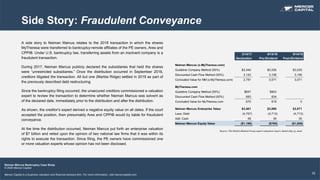
A side story to Neiman Marcus relates to the 2018 transaction in which the shares
MyTheresa were transferred to bankruptcy-remote affiliates of the PE owners, Ares and
CPPIB. Under U.S. bankruptcy law, transferring assets from an insolvent company is a
fraudulent transaction.
During 2017, Neiman Marcus publicly declared the subsidiaries that held the shares
were “unrestricted subsidiaries.” Once the distribution occurred in September 2018,
creditors litigated the transaction. All but one (Marble Ridge) settled in 2019 as part of
the previously described debt restructuring.
Since the bankruptcy filing occurred, the unsecured creditors commissioned a valuation
expert to review the transaction to determine whether Neiman Marcus was solvent as
of the declared date, immediately prior to the distribution and after the distribution.
As shown, the creditor's expert derived a negative equity value on all dates. If the court
accepted the position, then presumably Ares and CPPIB would by liable for fraudulent
conveyance.
At the time the distribution occurred, Neiman Marcus put forth an enterprise valuation
of $7 billion and relied upon the opinion of two national law firms that it was within its
rights to execute the transaction. Since filing, the PE owners have commissioned one
or more valuation experts whose opinion has not been disclosed.
15
Neiman Marcus Bankruptcy Case Study
© 2020 Mercer Capital
Mercer Capital is a business valuation and financial advisory firm. For more information, visit mercercapital.com.
3/14/17 9/14/18 9/14/18
Declaration Pre-Dividend Post-Dividend
Neiman Marcus (x-MyTheresa.com)
Guideline Company Method (50%) $2,440 $3,035 $3,035
Discounted Cash Flow Method (50%) 3,142 3,106 3,106
Concluded Value for NM (x-MyTheresa.com) 2,791 3,071 3,071
MyTheresa.com
Guideline Company Method (50%) $657 $803
Discounted Cash Flow Method (50%) 683 834
Concluded Value for MyTheresa.com 670 819 0
Neiman Marcus Enterprise Value $3,461 $3,889 $3,071
Less: Debt (4,707) (4,713) (4,713)
Add: Cash 48 39 35
Neiman Marcus Equity Value ($1,198) ($785) ($1,608)
Source: The Michel-Shaked Group expert valuation report, dated July 15, 2020
BUSINESS VALUATION &
FINANCIAL ADVISORY SERVICES
Side Story: Fraudulent Conveyance
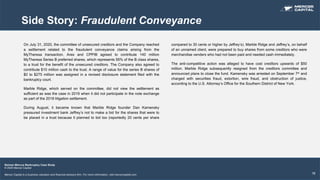
On July 31, 2020, the committee of unsecured creditors and the Company reached
a settlement related to the fraudulent conveyance claims arising from the
MyTheresa transaction. Ares and CPPIB agreed to contribute 140 million
MyTheresa Series B preferred shares, which represents 56% of the B class shares,
to a trust for the benefit of the unsecured creditors. The Company also agreed to
contribute $10 million cash to the trust. A range of value for the series B shares of
$0 to $275 million was assigned in a revised disclosure statement filed with the
bankruptcy court.
Marble Ridge, which served on the committee, did not view the settlement as
sufficient as was the case in 2019 when it did not participate in the note exchange
as part of the 2018 litigation settlement.
During August, it became known that Marble Ridge founder Dan Kamensky
pressured investment bank Jeffrey’s not to make a bid for the shares that were to
be placed in a trust because it planned to bid too (reportedly 20 cents per share
compared to 30 cents or higher by Jeffrey’s). Marble Ridge and Jeffrey’s, on behalf
of an unnamed client, were prepared to buy shares from some creditors who were
merchandise venders who had not been paid and needed cash immediately.
The anti-competitive action was alleged to have cost creditors upwards of $50
million. Marble Ridge subsequently resigned from the creditors committee and
announced plans to close the fund. Kamensky was arrested on September 7th and
charged with securities fraud, extortion, wire fraud, and obstruction of justice,
according to the U.S. Attorney’s Office for the Southern District of New York.
16
Neiman Marcus Bankruptcy Case Study
© 2020 Mercer Capital
Mercer Capital is a business valuation and financial advisory firm. For more information, visit mercercapital.com.
BUSINESS VALUATION &
FINANCIAL ADVISORY SERVICES
Best Interest Test
A best interest test must show that the reorganization value is higher than the liquidation value of the company, to ensure that the creditors in Chapter 11 receive at least as
much under the restructuring plan as they would in a Chapter 7 liquidation.
In the case of Neiman Marcus, the liquidation versus reorganization valuation analysis was a formality because most unsecured creditors and the Company agreed to a
prepackaged plan subject to resolution of such items as the MyTheresa shares. Nonetheless, we summarize both for illustration purposes.
17
Neiman Marcus Bankruptcy Case Study
© 2020 Mercer Capital
Mercer Capital is a business valuation and financial advisory firm. For more information, visit mercercapital.com.
BUSINESS VALUATION &
FINANCIAL ADVISORY SERVICES
Liquidation Analysis
A rough calculation of Neiman Marcus’ liquidation value is included below, based
on balance sheet data from April 2019 (the most current figures available).
Substantial value in a liquidation analysis depends upon what an investor would be
willing to pay for the rights to the Neiman Marcus name, customer lists, and
proprietary IP code.
The recovery ratio applied to Neiman Marcus’ inventory is higher than typical
recovery ratios across the broader apparel industry since much of Neiman’s
inventory is designer goods. Nonetheless, the analysis implies creditors would face
a significant haircut in a Chapter 7 liquidation scenario.
18
Book Value Low End High End
Cash $129 100% $129 100% $129
ABL Segregated Cash 50 100% 50 100% 50
Accounts Receivable 45 82% 37 100% 45
Merchandise Inventory 900 94% 846 104% 936
Prepaids & Other Deposits 50 25% 13 50% 25
Intellectual Property 125 50% 63 100% 125
Net Fixed Assets NA NA 381 NA 476
Other Assets 88 0% 0 5% 4
Avoidance Actions NA NA 0 NA 275
Assets to be Liquidated $1,387 $1,518 $2,065
Accrued Payroll & Benefits $16 100% $16 100% $16
Other Current Liabilities 20 100% 20 100% 20
Other Priority & Admin Claims 39 120% 47 100% 39
Chapter 7 Trustee Fees Variable 100% 25 100% 28
Wind Down Expenses 121 115% 139 100% 121
Admin Claims & Liq Costs $196 $247 $224
Proceeds after Wind Down $1,271 $1,841
Range of Liquidation Value
Book Value Low End High End
Pre-Petition ABL Facility $765 100% $765 100% $765
Pre-Petition FILO Facility 102 100% 102 100% 102
DIP Term Loan 531 76% 404 100% 531
Amended Term Loan 2,255 0% 0 7% 167
2013 Term Loan Stub 13 0% 0 7% 1
7.125% First Lien Debentures 129 0% 0 0% 0
14.0% PIK 2nd Lien Notes 606 0% 0 0% 0
3rd Lien Notes (8.0% / 8.75%) 1,285 0% 0 0% 0
Estimated Secured Claims $5,686 $1,271 $1,566
Estimated Secured Recovery % 22% 28%
Proceeds for General Unsecured Creditors $0 $276
General Unsecured Creditors' Claims 5,288 4,848
Estimated Unsecured Recovery % 0% 6%
Range of Liquidation Value
Source: Disclosure Statement for the Debtors’ First Amended Joint Plan of Reorganization Pursuant to
Chapter 11 of the Bankruptcy Code, dated 8/4/20 and Mercer Capital
Neiman Marcus Bankruptcy Case Study
© 2020 Mercer Capital
Mercer Capital is a business valuation and financial advisory firm. For more information, visit mercercapital.com.
BUSINESS VALUATION &
FINANCIAL ADVISORY SERVICES
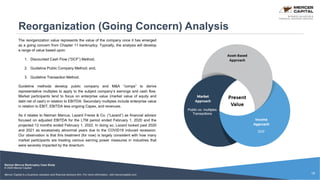
Reorganization (Going Concern) Analysis
The reorganization value represents the value of the company once it has emerged
as a going concern from Chapter 11 bankruptcy. Typically, the analysis will develop
a range of value based upon:
1. Discounted Cash Flow (“DCF”) Method;
2. Guideline Public Company Method; and,
3. Guideline Transaction Method.
Guideline methods develop public company and M&A “comps” to derive
representative multiples to apply to the subject company’s earnings and cash flow.
Market participants tend to focus on enterprise value (market value of equity and
debt net of cash) in relation to EBITDA. Secondary multiples include enterprise value
in relation to EBIT, EBITDA less ongoing Capex, and revenues.
As it relates to Neiman Marcus, Lazard Freres & Co. (“Lazard”) as financial advisor
focused on adjusted EBITDA for the LTM period ended February 1, 2020 and the
projected 12 months ended February 1, 2022. In doing so, Lazard looked past 2020
and 2021 as excessively abnormal years due to the COVID19 induced recession.
Our observation is that this treatment (for now) is largely consistent with how many
market participants are treating various earning power measures in industries that
were severely impacted by the downturn.
19
Neiman Marcus Bankruptcy Case Study
© 2020 Mercer Capital
Mercer Capital is a business valuation and financial advisory firm. For more information, visit mercercapital.com.
BUSINESS VALUATION &
FINANCIAL ADVISORY SERVICES
Discounted Cash Flow Methodology
20
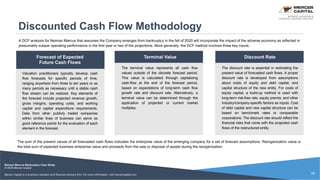
A DCF analysis for Neiman Marcus that assumes the Company emerges from bankruptcy in the fall of 2020 will incorporate the impact of the adverse economy as reflected in
presumably subpar operating performance in the first year or two of the projections. More generally, the DCF method involves three key inputs.
Valuation practitioners typically develop cash
flow forecasts for specific periods of time,
ranging anywhere from three to ten years or as
many periods as necessary until a stable cash
flow stream can be realized. Key elements of
the forecast include projected revenue growth,
gross margins, operating costs, and working
capital and capital expenditure requirements.
Data from other publicly traded companies
within similar lines of business can serve as
good reference points for the evaluation of each
element in the forecast.
Forecast of Expected
Future Cash Flows
The terminal value represents all cash flow
values outside of the discrete forecast period.
This value is calculated through capitalizing
cash-flow at the end of the forecast period,
based on expectations of long-term cash flow
growth rate and discount rate. Alternatively, a
terminal value can be determined through the
application of projected or current market
multiples.
Terminal Value
The discount rate is essential in estimating the
present value of forecasted cash flows. A proper
discount rate is developed from assumptions
about costs of equity and debt capital, and
capital structure of the new entity. For costs of
equity capital, a build-up method is used with
long-term risk-free rate, equity premia, and other
industry/company-specific factors as inputs. Cost
of debt capital and new capital structure can be
based on benchmark rates or comparable
corporations. The discount rate should reflect the
financial risks that come with the projected cash
flows of the restructured entity.
Discount Rate
The sum of the present values of all forecasted cash flows indicates the enterprise value of the emerging company for a set of forecast assumptions. Reorganization value is
the total sum of expected business enterprise value and proceeds from the sale or disposal of assets during the reorganization.
Neiman Marcus Bankruptcy Case Study
© 2020 Mercer Capital
Mercer Capital is a business valuation and financial advisory firm. For more information, visit mercercapital.com.
BUSINESS VALUATION &
FINANCIAL ADVISORY SERVICES
Neiman Marcus’ Hypothetical DCF Value
21
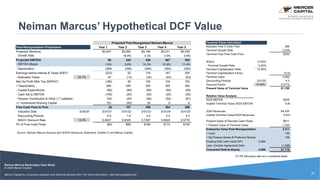
Projected Post-Reorganized Neiman Marcus
Post-Reorganization Projections Year 1 Year 2 Year 3 Year 4 Year 5
Projected Revenue $3,407 $3,982 $4,148 $4,271 $4,435
Growth Rate 16.9% 4.2% 3.0% 3.8%
Projected EBITDA 66 342 429 467 505
EBITDA Margin 1.9% 8.6% 10.3% 10.9% 11.4%
- Depreciation (289) (290) (294) (300) (300)
Earnings before Interest & Taxes (EBIT) (223) 52 135 167 205
- Estimated Taxes 25.7% 57 (13) (35) (43) (53)
Net Op Profit After Tax (NOPAT) (166) 39 100 124 152
+ Depreciation 289 290 294 300 300
- Capital Expenditures (96) (98) (99) (95) (95)
- Cash Adj to EBITDA (140) (20) (20) (20) (20)
- Pension Contribution & Other LT Liabilities (45) (44) (49) (54) (57)
+/- Incremental Working Capital 153 (60) 30 9 6
Free Cash Flow to Firm (5) 107 256 264 286
Valuation Date 9/30/20 3/31/21 3/31/22 3/31/23 3/31/24 3/31/25
Discounting Periods 0.5 1.5 2.5 3.5 4.5
WACC Discount Rate 13.0% 0.9407 0.8325 0.7367 0.6520 0.5770
PV of Free Cash Flows ($4) $89 $189 $172 $165
Present Value of Discrete Cash Flows $611
+ Present Value of Terminal Value 1,700 Calculated below
Enterprise Value Post-Reorganization 2,311
+ Cash 129
+ MyTheresa Series B Preferred Shares 138
Existing Debt (with Initial DIP) 5,686
Less: Creditor Agreement Debt (1,398)
Converted Debt-to-Equity 4,288 $1,179 27.5% Recovery rate on a combined basis
Source: Neiman Marcus forecast (per 8/4/20 Disclosure Statement, Exhibit C) and Mercer Capital
Present Value of Discrete Cash Flows $611
+ Present Value of Terminal Value 1,700
Enterprise Value Post-Reorganization 2,311
+ Cash 129
+ MyTheresa Series B Preferred Shares 138
Existing Debt (with Initial DIP) 5,686
Less: Creditor Agreement Debt (1,398)
Converted Debt-to-Equity 4,288 $1,179
27.5% Recovery rate on a combined basis
Terminal Value Calculation
Adjusted Year 5 Cash Flow 286
Terminal Growth Rate 3.00%
Terminal Year Free Cash Flow $295
WACC 13.00%
- Terminal Growth Rate -3.00%
Terminal Capitalization Rate 10.00%
Terminal Capitalization Factor 10.0x
Terminal Value 2,950
Discounting Periods 3/31/25 4.5
Discount Factor 13.00% 0.5770
Present Value of Terminal Value $1,700
Relative Value Analysis
2024 EBITDA $505
Implied Terminal Value /2024 EBITDA 5.8x
2024 Revenues $4,435
Implied Terminal Value/2024 Revenues 0.67x
Neiman Marcus Bankruptcy Case Study
© 2020 Mercer Capital
Mercer Capital is a business valuation and financial advisory firm. For more information, visit mercercapital.com.
BUSINESS VALUATION &
FINANCIAL ADVISORY SERVICES
Cash Flow Test & Fresh Start Accounting
Cash Flow Test
The second valuation hurdle Neiman Marcus will have to jump is a cash flow test.
The cash flow test determines the feasibility of the reorganization plan and the
solvency of future operations. Since a discounted cash flow analysis is typically
used to determine reorganization value, the projected cash flows from this analysis
are compared to future interest and principal payments due.
Additionally, the cash flow test details the impact of cash flows on the balance
sheet of the restructured entity, entailing modeling changes in the asset base and
in the debt obligations of and equity interests in the company. Therefore, the DCF
valuation and cash flow tests go together because the amount of debt that is
converted to equity creates cash flow capacity to service the remaining debt. If the
cash flow model suggests solvent operations for the foreseeable future, the
reorganization plan is typically considered viable.
Fresh Start Accounting
When emerging from bankruptcy in the case of going concern, fresh-start
accounting could be required to allot a portion of the reorganization value to
specific intangible assets. The fair value measurement of these assets requires the
use of multi-period excess earnings method or other techniques of purchase price
allocations.
22
Neiman Marcus Bankruptcy Case Study
© 2020 Mercer Capital
Mercer Capital is a business valuation and financial advisory firm. For more information, visit mercercapital.com.
BUSINESS VALUATION &
FINANCIAL ADVISORY SERVICES
Conclusion
BUSINESS VALUATION &
FINANCIAL ADVISORY SERVICES
Conclusion
Neiman Marcus plans to eliminate about $4 billion of over $5 billion of debt and
$200 million of annual interest expense in a reorganization plan that was approved
by U.S. bankruptcy judge David Jones in September 2020.
The plan will transfer the bulk of ownership to the first lien creditors, including
PIMCO, Davidson Kempner Capital Management and Sixth Street Partners.
PIMCO will be the largest shareholder with three of seven board seats.
Other creditors will receive, in effect, a few pennies to upwards of one-third of what
they were owed depending in part on the value of MyTheresa Class B preferred
shares that were contributed to a trust for the benefit of unsecured creditors. Also,
the Company’s term loan lenders, second lien and third lien note holders waived
their right to assert deficiency claims and thereby eliminated upwards of $3.3 billion
of additional claims in the general unsecured claims pool (now limited to $340 to
$435 million).
Lazard estimated the value of the reorganized Company upon exit from bankruptcy
to approximate $2.0 billion to $2.5 billion on an enterprise basis with the equity
valued at $800 million to $1.3 billion.
Creditors and the Company negotiated a plan that has presumably maximized (or
nearly so) value to each creditor class based upon the priority of their claims. We
were not privy to the analysis each class produced and how their views of the
various analyses, relative negotiating strength and the like, drove the settlement.
Ultimately, the performance of the reorganized Neiman Marcus will determine the
eventual amount recovered by creditors to the extent shares are not sold
immediately.
Some creditors would be expected to sell the shares immediately, while others who
have flexibility to hold equity interests and have a favorable view of the reorganized
company’s prospects may wait to potentially realize a greater recovery.
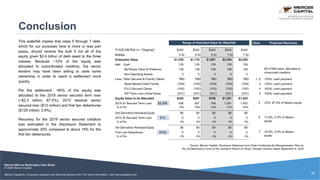
On the following page we have constructed a waterfall analysis which we compare
with the actual settlement. We assume a range of enterprise values based upon
multiples of projected FY22 EBITDA, or $342 million, and compare the residual
equity after each claimant class is settled to provide perspective on the creditors’
recovery.
24
Neiman Marcus Bankruptcy Case Study
© 2020 Mercer Capital
Mercer Capital is a business valuation and financial advisory firm. For more information, visit mercercapital.com.
BUSINESS VALUATION &
FINANCIAL ADVISORY SERVICES
Conclusion
25
Source: Mercer Capital; Disclosure Statement and Order Confirming the Reorganization Plan by
the US Bankruptcy Court of the Southern District of Texas, Houston Division dated September 4, 2020
This waterfall implies that class 5 through 7 debt,
which for our purposes here is more or less pari
passu, should receive the bulk if not all of the
equity given $2.4 billion of debt owed to the three
classes. Because ~10% of the equity was
allocated to subordinated creditors, the senior
lenders may have been willing to cede some
ownership in order to reach a settlement more
quickly.
Per the settlement, ~90% of the equity was
allocated to the 2019 senior secured term loan
(~$2.3 billion; 87.5%), 2013 residual senior
secured loan ($13 million) and first lien debentures
($129 million; 2.8%).
Recovery for the 2019 senior secured creditors
was estimated in the Disclosure Statement to
approximate 33% compared to about 19% for the
first lien debentures.
Class Projected Recovery
FY22E EBITDA (+/- "Ongoing") $342 $342 $342 $342 $342
Multiple 4.5x 5.0x 5.5x 7.0x 7.5x
Enterprise Value $1,539 $1,710 $1,881 $2,394 $2,565
Add: Cash 129 129 129 129 129
MyTeresa Class B Preferred 138 138 138 138 138
Non-Operating Assets 0 0 0 0 0
Less: Other Secured & Priority Claims TBD TBD TBD TBD TBD 1, 2 100%; cash payment
Asset Backed Debt Facility (749) (749) (749) (749) (749) 3 100%; cash payment
FILO Secured Claims (100) (100) (100) (100) (100) 4 100%; cash payment
DIP Term Loan (Initial Draw) (531) (531) (531) (531) (531) 4 100%; cash payment
Equity Value to be Allocated $426 $597 $768 $1,281 $1,452
2019 Sr Secured Term Loan $2,255 426 597 768 1,281 1,452 5
% of Par 19% 26% 34% 57% 64%
2nd Derivative Residual Equity $0 $0 $0 $0 $0
2013 Sr Secured Term Loan $13 0 0 0 0 0 6
% of Par 0% 0% 0% 0% 0%
3rd Derivative Residual Equity $0 $0 $0 $0 $0
First Lien Debentures $129 0 0 0 0 0 7
% of Par 0% 0% 0% 0% 0%
Range of Assumed Value for Waterfall
33%; 87.5% of Newco equity
12.8%; 0.2% of Newco
equity
18.8%; 2.8% of Newco
equity
$0-275M value, allocated to
unsecured creditors
Neiman Marcus Bankruptcy Case Study
© 2020 Mercer Capital
Mercer Capital is a business valuation and financial advisory firm. For more information, visit mercercapital.com.
BUSINESS VALUATION &
FINANCIAL ADVISORY SERVICES
Conclusion
26
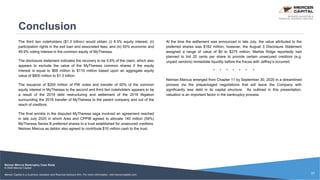
Interests in MyTheresa also impacted projected
recoveries for the junior and unsecured creditors,
a byproduct of the litigation to settle the fraudulent
conveyance claims related to the 2018 transaction.
The second lien noteholders ($606 million) would
obtain (i) 1.0% equity interest; (ii) seven-year
warrants to purchase up to 25% of the re-
organized equity at an agreed upon strike price;
(iii) participation rights in the exit loan and
associated fees; and (iv) an economic interest in
MyTheresa in the form of $200 million of 7.5% PIK
notes.
The disclosure statement indicates the recovery
equates to less than 2% of what is owed to the
second lien note holders, which appears to
exclude whatever value is attributable to the PIK
notes because 1% of the Newco equity would
equate to $800 thousand to $1.3 million of value
based upon a range of equity value of $800 million
to $1.3 billion.
Class Projected Recovery
4th Derivative Residual Equity $0 $0 $0 $0 $0
Second Lien Notes $606 0 0 0 0 0 8
% of Par 0% 0% 0% 0% 0%
5th Derivative Residual Equity $0 $0 $0 $0 $0
Third Lien Notes $1,228 0 0 0 0 0 9
% of Par 0% 0% 0% 0% 0%
6th Derivative Residual Equity $0 $0 $0 $0 $0
Unsecured Notes $137 0 0 0 0 0 10
% of Par 0% 0% 0% 0% 0%
7th Derivative Residual Equity $0 $0 $0 $0 $0
General Unsecured Claims $387 0 0 0 0 0 11
% of Par 0% 0% 0% 0% 0%
Residual Value to NM Equity Holders $0 $0 $0 $0 $0
* Claims reflect contractual amounts, accrued interest where applicable and other projected amounts
2%-34; Liquidation of trust w
$10M cash from NM and
MYT Series B preferred
shares worth estimated $0-
$275M; claims < $50k to be
paid in full in cash
1.4%; 1% of Newco equity,
7yr warrant for 25% equity;
and $200M of MyT 7.5% PIK
notes (2L MyT Distribution)
5.6%; 8.5% of Newco equity
and 49.9% of MyT common
(3L MyT Distribution)
Range of Assumed Value for Waterfall
Source: Mercer Capital; Disclosure Statement and Order Confirming the Reorganization Plan by
the US Bankruptcy Court of the Southern District of Texas, Houston Division dated September 4, 2020
Neiman Marcus Bankruptcy Case Study
© 2020 Mercer Capital
Mercer Capital is a business valuation and financial advisory firm. For more information, visit mercercapital.com.
BUSINESS VALUATION &
FINANCIAL ADVISORY SERVICES
Conclusion
27
The third lien noteholders ($1.3 billion) would obtain (i) 8.5% equity interest; (ii)
participation rights in the exit loan and associated fees; and (iii) 50% economic and
49.9% voting interest in the common equity of MyTheresa.
The disclosure statement indicates the recovery to be 5.6% of the claim, which also
appears to exclude the value of the MyTheresa common shares if the equity
interest is equal to $68 million to $110 million based upon an aggregate equity
value of $800 million to $1.3 billion.
The issuance of $200 million of PIK notes and transfer of 50% of the common
equity interest in MyTheresa to the second and third lien noteholders appears to be
a result of the 2019 debt restructuring and settlement of the 2018 litigation
surrounding the 2018 transfer of MyTheresa to the parent company and out of the
reach of creditors.
The final wrinkle in the disputed MyTheresa saga involved an agreement reached
in late July 2020 in which Ares and CPPIB agreed to allocate 140 million (56%)
MyTheresa Series B preferred shares to a trust established for unsecured creditors.
Neiman Marcus as debtor also agreed to contribute $10 million cash to the trust.
At the time the settlement was announced in late July, the value attributed to the
preferred shares was $162 million; however, the August 3 Disclosure Statement
assigned a range of value of $0 to $275 million. Marble Ridge reportedly had
planned to bid 20 cents per share to provide certain unsecured creditors (e.g.
unpaid vendors) immediate liquidity before the fracas with Jeffrey’s occurred.
* * * * * * *
Neiman Marcus emerged from Chapter 11 by September 30, 2020 in a streamlined
process via the prepackaged negotiations that will leave the Company with
significantly less debt in its capital structure. As outlined in this presentation,
valuation is an important factor in the bankruptcy process.
Neiman Marcus Bankruptcy Case Study
© 2020 Mercer Capital
Mercer Capital is a business valuation and financial advisory firm. For more information, visit mercercapital.com.
BUSINESS VALUATION &
FINANCIAL ADVISORY SERVICES
Nicholas J. Heinz, ASA
heinzn@mercercapital.com
901.685.2120
Timothy R. Lee, ASA
leet@mercercapital.com
901.322.9740
Jeff K. Davis, CFA
jeffdavis@mercercapital.com
615.345.0350
Travis W. Harms, CFA, CPA/ABV
harmst@mercercapital.com
901.322.9760
Bryce Erickson, ASA, MRICS
ericksonb@mercercapital.com
214.468.8400
Corporate Restructuring Advisory Group
28
Jay D. Wilson, Jr., CFA, ASA, CBA
wilsonj@mercercapital.com
467.778.5860
J. David Smith, ASA, CFA
smithd@mercercapital.com
832.432.1011
Taryn E. Burgess, CFA, ABV
burgesst@mercercapital.com
901.322.9757
John T. (Tripp) Crews III
crewst@mercercapital.com
901.322.9735
Neiman Marcus Bankruptcy Case Study
© 2020 Mercer Capital
Mercer Capital is a business valuation and financial advisory firm. For more information, visit mercercapital.com.
www.mercercapital.com

Restructuring Case Study - Neiman Marcus

  • 1.
    Restructuring Case Study BUSINESSVALUATION & FINANCIAL ADVISORY SERVICES www.mercercapital.com MERCER CAPITAL Authored by: Jeff K. Davis, CFA jeffdavis@mercercapital.com Taryn E. Burgess, CFA, ABV burgesst@mercercapital.com September 2020
  • 2.
    BUSINESS VALUATION & FINANCIALADVISORY SERVICES Overview of Case Study 2 Neiman Marcus Bankruptcy Case Study © 2020 Mercer Capital Mercer Capital is a business valuation and financial advisory firm. For more information, visit mercercapital.com. Neiman Marcus Group, Inc. (“Neiman Marcus” or “Company”) is a Dallas, Texas-based holding company that operates four retail brands: Neiman Marcus, Bergdorf Goodman, Last Call (clearance centers), and Horchow (home furnishings). Unlike other department store chains, such as JCPenney and Macy’s that cater to the mass market, Neiman Marcus’s target market is the top 2% of U.S. earners. Among the notable developments over the last 15 years were two private equity transactions that burdened the Company with a significant debt load and one well-timed acquisition. The debt and acquisition figured prominently in the May 7, 2020 bankruptcy filing in which the company sought to reorganize under Chapter 11 with the backing of most creditors. The Neiman Marcus chapter 11 bankruptcy raises multiple valuation issues: • Fraudulent Conveyance (Asset Stripping) and solvency related to pre-filing distributions • Liquidation vs. Going Concern Value • Value of the Company once it emerges from Chapter 11 • Allocation of Enterprise Value to Secure and Unsecured Creditors • Fresh Start Accounting Since 1982, we have provided thousands of valuation opinions for corporations of all sizes in a wide variety of industries. Mercer Capital’s comprehensive suite of valuation and corporate advisory services for companies in the midst of restructuring and/or bankruptcy include: • Pre-Bankruptcy Planning / Reorganization Plan Assessment • Distressed M&A Advisory / Fairness Opinions • Solvency Analysis and Opinions • Expert Witness Testimony • Fresh Start Accounting Mercer Capital is one of the largest independent business valuation and financial advisory firms in the nation.
  • 3.
    BUSINESS VALUATION & FINANCIALADVISORY SERVICES Iconic Luxury Retailer to Indebted Morass
  • 4.
    BUSINESS VALUATION & FINANCIALADVISORY SERVICES History 4 The iconic Neiman Marcus department store was established in 1907 in Dallas. Neiman Marcus prospered as oil wealth in Texas fueled demand for luxury goods. Neiman Marcus merged with Broadway-Hale Stores (later rechristened Carter Hawley Hale Stores, Inc.) in the late 1960s. Additional stores were opened outside of Texas in Atlanta, South Florida, and other wealthy enclaves around the U.S. except for New York where Bergdorf Goodman (acquired in the 1970s) operated two stores. Neiman Marcus Bankruptcy Case Study © 2020 Mercer Capital Mercer Capital is a business valuation and financial advisory firm. For more information, visit mercercapital.com. Neiman Marcus with Bergdorf Goodman was partially spun out as a public company (remaining shares spun in 1999). The Company was acquired via a $5 billion LBO engineered by Texas Pacific Group and Warburg Pincus. The PE-owners sought an IPO after rebounding from The Great Financial Crisis. Instead, Neiman Marcus was acquired for $6 billion by Ares Management and the Canada Pension Plan Investment Board (“CPPIB”). Neiman Marcus acquired MyTheresa, a German luxury e-commerce retailer with annual revenues of $130 million for $182 million of cash consideration. Neiman Marcus filed an S-1 in anticipation of being a public company again. The registration statement was withdrawn due to weak investor demand. The entity that held the shares of MyTheresa (MyT Holding Co.) was transferred via a series of dividends to the Neiman Marcus holding company directly controlled by Ares and CPPIB, placing the interest out of the reach of Creditors. Although Neiman Marcus’ common shares had not been publicly traded since 2005, the Company filed with the SEC because its debt was registered. During June 2019, the Company deregistered upon an exchange of new notes and preferred equity for the registered notes. S&P described the restructuring as a selective default because debt investors received less than promised with the original securities 1987 2005 2013 2014 2015 2018
  • 5.
    BUSINESS VALUATION & FINANCIALADVISORY SERVICES Historical Financials 5 LTM 8/1/15 7/30/16 7/29/17 7/28/18 4/27/19 4/28/18 4/27/19 Income Statement Items ($M) Revenue $5,095 $4,949 $4,706 $4,900 $4,688 $3,768 $3,556 Pretax Income 28 (547) (749) (211) (242) (89) (120) Interest 290 286 296 307 322 230 245 Amortization 137 111 104 98 95 73 70 Depreciation 210 251 250 239 225 181 167 Impairment 0 466 511 0 0 0 0 EBITDA $665 $567 $412 $433 $400 $395 $362 Capex 270 301 205 175 197 110 132 EBITDA - Capex $395 $266 $207 $258 $203 $285 $230 EBITDA Margin 13.1% 11.5% 8.8% 8.8% 8.5% 10.5% 10.2% EBITDA-Capex 7.8% 5.4% 4.4% 5.3% 4.3% 7.6% 6.5% 9 Months EndedFiscal Years Ended LTM 8/1/15 7/30/16 7/29/17 7/28/18 4/27/19 4/28/18 4/27/19 Balance Sheet Items ($M) Cash 73 64 49 39 39 39 39 Other Current Assets 126 147 185 158 335 164 335 Inventory 1,155 1,125 1,154 1,116 1,065 1,180 1,065 Fixed Assets (net) 1,478 1,588 1,587 1,570 1,534 1,567 1,534 Favorable Leases 1,040 986 931 879 841 892 841 Other Assets 17 17 16 45 41 45 41 Intangible Assets 4,831 4,330 3,782 3,739 3,504 3,762 3,504 Total Assets $8,720 $8,257 $7,704 $7,546 $7,359 $7,649 $7,359 Current Liabilities 837 811 774 831 722 797 722 Other Liabilities 1,884 1,890 1,758 1,304 1,320 1,356 1,320 Debt 4,585 4,613 4,705 4,652 4,940 4,667 4,940 Equity $1,414 $943 $467 $759 $377 $829 $377 Financial Ratios ($M) Tangible Equity (4,457) (4,373) (4,246) (3,859) (3,968) (3,825) (3,968) Debt / EBITDA 6.9x 8.1x 11.4x 10.7x 12.4x 8.9x 10.2x EBITDA / Int Exp 2.3x 2.0x 1.4x 1.4x 1.2x 1.7x 1.5x Source: Neiman Marcus Group LTD LLC 10-K and 10-Qs (NM deregistered 6/21/19) Fiscal Years Ended 9 Months Ended The financial statements presented above provide a summary of the Company’s financial performance for the fiscal years ended July 31, 2015-2018 and the nine months ended April 27, 2018 and 2019 derived from its 10-K and 10-Qs filed with the SEC. The Company subsequently “went dark” by deregistering during June 2019, eleven months prior to filing. Of note is the extremely high debt burden that equated to 12.4x EBITDA for the last twelve months (“LTM”) ended April 27, 2019. Federal banking regulators consider a company to be “highly levered” if debt exceeds EBITDA by 6x. Neiman Marcus Bankruptcy Case Study © 2020 Mercer Capital Mercer Capital is a business valuation and financial advisory firm. For more information, visit mercercapital.com.
  • 6.
    BUSINESS VALUATION & FINANCIALADVISORY SERVICES High Debt Burden Compared to Peers Neiman Marcus has struggled with a high debt load since the LBO in 2005, which has been magnified by the disruptive impact of online retailing on department stores. • EBITDA declined from $665 million in FY2015 to $400 million in the LTM period ended April 27, 2019, the last quarter in which the Company filed with the SEC. • The EBITDA margin declined by > 1/3 from 13.1% to 8.5% over the same time. • Debt equated to 12.4x LTM EBITDA and covered interest expense by 1.2x. By way of reference, the debt/EBITDA and EBITDA/interest ratios for Ralph Lauren (NYSE: RL) for the fiscal year ended March 30, 2019 were 1.0x and 47.1x, while the respective ratios for Dillard’s (NYSE: DDS) were 1.2x and 9.9x for the fiscal year ended February 2, 2019. Moody’s downgraded the Company’s corporate credit rating to B3 from B2 in October 2013 with the acquisition by Ares and CPPIB. Moody’s also established an initial rating of Caa2 for unsecured notes issued to finance the acquisition. By the time the notes were deregistered, Moody’s had reduced the corporate rating to Caa3 and notes to Ca. Moody’s defines Caa as obligations that “are judged to be of poor standing and are subject to very high credit risk,” and Ca as obligations that are “highly speculative and are likely in, or very near, default, with some prospect of recovery in principal and interest.” 6 Source: S&P Global Market Intelligence 0.0x 2.0x 4.0x 6.0x 8.0x 10.0x 12.0x 14.0x Ralph Lauren Dillard's Neiman Marcus Debt to EBITDA 0.0x 10.0x 20.0x 30.0x 40.0x 50.0x Ralph Lauren Dillard's Neiman Marcus EBITDA to Interest Expense Neiman Marcus Bankruptcy Case Study © 2020 Mercer Capital Mercer Capital is a business valuation and financial advisory firm. For more information, visit mercercapital.com.
  • 7.
    BUSINESS VALUATION & FINANCIALADVISORY SERVICES At the time of bankruptcy, Neiman Marcus generated about one-third of its sales (about $1.5 billion) online. MyTheresa accounted for about $500 million of the online sales, up from $238 million in 1Q17 when certain subsidiaries that held MyTheresa were designated “unrestricted subsidiaries” by the Company. While MyTheresa’s sales increased, the legacy department store business declined as the Company struggled to connect with younger affluent customers who favored online start-up boutiques and had little inclination to shop in a department store. • E-commerce sales as a portion of total retail sales have doubled over the last five years to about 12% in 2019. • The move to work from home (“WFH”) and social distancing practices born of COVID-19 in early 2020 have accelerated the trend such that the pre-COVID-19 projection of e-commerce sales rising to 15% by 2020 will likely prove to be significantly conservative. 7 Competition Amidst the Rise of E-commerce Neiman Marcus Bankruptcy Case Study © 2020 Mercer Capital Mercer Capital is a business valuation and financial advisory firm. For more information, visit mercercapital.com.
  • 8.
    BUSINESS VALUATION & FINANCIALADVISORY SERVICES Neiman Marcus Files for Bankruptcy Source: Business Insider Neiman Marcus is closing another department store, bringing its total closings to 22 locations.
  • 9.
    BUSINESS VALUATION & FINANCIALADVISORY SERVICES Bankruptcy Filing 9 The initial plan called for creditors to convert $4 billion of $5 billion of debt into equity. The plan does not provide for mass store closures or asset sales, although the Last Call clearance stores will close. As noted, the bankruptcy filing follows a restructuring in June 2019 that entailed: • An exchange of all but $137 million of $960 million of 8.0% cash pay and $656 million of 8.75%/9.50% PIK Toggle unsecured notes for $1.2 billion of (i) 8.0% and 8.75% third lien Company notes and (ii) $250 million of Series A preferred equity in MyT Holding Co., a US-based entity that holds the German corporate entity that operates MyTheresa; • The issuance of $550 million of new second-lien 6.0% cash pay/8.0% PIK notes due 2024 with a limited senior secured claim of $200 million from MyT Holding Co. and other MyT affiliates; • A partial paydown of the first-lien term loan facility at par with the proceeds of the second lien notes; and, • An exchange for the remaining $2.2 billion first-lien credit facility with a new facility and an extension of the maturity to October 2023. The restructuring did not (apparently) materially impact the Company’s $900 million asset-based credit facility of which $455 million was drawn as of April 2019; or the first lien $125 million debentures due in 2028. Neiman Marcuse filed on May 7, 2020 for chapter 11 bankruptcy protection. The COVID-19 induced shutdown of the economy was the final nail in the coffin. The shutdown forced major furloughs and the closing of its stores in accordance with various local shelter-in-place regulations. Other recent retail bankruptcies include: Lord & Taylor, Men’s Warehouse, Ann Taylor, Brooks Brothers, Lucky Brands, and J. Crew with many more expected to file. Neiman Marcus Bankruptcy Case Study © 2020 Mercer Capital Mercer Capital is a business valuation and financial advisory firm. For more information, visit mercercapital.com.
  • 10.
    BUSINESS VALUATION & FINANCIALADVISORY SERVICES Bankruptcy Filing Market participants assigned little value to the $1.2 billion of third lien notes that were trading for around 8% of par when the filing occurred and 6% of par in late August 2020. The binding Restructuring Support Agreement (“RSA”), dated May 7, 2020, included commitments from holders of 99% of the company’s term loans, 100% of the second line notes, 70% of the third line notes, and 78% of the residual unsecured debentures to equitize their debt. Also, certain creditors agreed to backstop $675 million of debtor-in-possession (“DIP”) financing and to provide $750 million of exit financing which would be used to refinance the DIP facility and provide incremental liquidity. DIP financing is often critical to maintain operations during the bankruptcy process when the company has little cash on hand. DIP financing is typically secured by the assets of the company and can rank above the payment rights of existing secured lenders. DIPs often take the form of an asset-based loan, where the amount a company borrows is based on the liquidation value of the inventory, assuring that if the company is unable to restructure, the loan can be repaid from the liquidation of assets. 10 Neiman Marcus Bankruptcy Case Study © 2020 Mercer Capital Mercer Capital is a business valuation and financial advisory firm. For more information, visit mercercapital.com. 0 5 10 15 20 25 30 35 40 45 50 Priceas%ofPar(100) 8.0% 3rd Lien Notes 8.25% 3rd Lien Notes Source: Bloomberg During June 2019 NM restructured part of its debt that included the issuance of $250M of preferred equity and $1.2B of non-registered 3rd lien 8.0% notes for $960M of 8.0% cash pay notes due 10/21 and $656M of 8.25% notes for 8.75%/9.50% PIK Toggle notes also due 2021 5/11/20 bankruptcy filing Markets price impact of COVID-19 economic lock-downs
  • 11.
    BUSINESS VALUATION & FINANCIALADVISORY SERVICES Bankruptcy Path: Chapter 7 vs. Chapter 11 11 Federal law governs the bankruptcy process. Broadly, a company will either reorganize under Chapter 11 or liquidate under Chapter 7. A Chapter 7 filing typically is made when a business has an exceedingly large debt combined with underlying operations that have deteriorated such that a reorganized business has little value. Under Chapter 7, the company stops all operations. A U.S. bankruptcy court will appoint a trustee to oversee the liquidation of assets with the proceeds used to pay creditors after legal and administrative costs are covered. Unresolved debts are then “discharged,” and the corporate entity is dissolved. Under Chapter 11, the business continues to operate, often with the same management and board who will exert some control over the process as “debtor in possession” operators. Once a Chapter 11 filing occurs, the debtor must obtain approval from the bankruptcy court for most decisions related to asset sales, financings, and the like. Most public companies and substantive private ones, such as Neiman Marcus, file under Chapter 11. If successful, the company emerges with a manageable debt load and new owners. If unsuccessful, creditors will move to have the petition dismissed or convert to a Chapter 7 to liquidate. Most Chapter 11 filings are voluntary, but sometimes creditors can force an involuntary filing. Normally, a debtor has four months after filing to propose a reorganization plan. Once the exclusivity period ends creditors can propose a competing plan. Neiman Marcus Bankruptcy Case Study © 2020 Mercer Capital Mercer Capital is a business valuation and financial advisory firm. For more information, visit mercercapital.com.
  • 12.
    BUSINESS VALUATION & FINANCIALADVISORY SERVICES Bankruptcy Path: Chapter 7 vs. Chapter 11 (cont.) 12 Usually, the debtor continues to operate the business; however, sometimes the bankruptcy court will appoint a trustee to oversee the business if the court finds cause to do so related to fraud, perceived mismanagement and other forms of malfeasance. The U.S. Trustee, the bankruptcy arm of the Justice Department, will appoint one or more committees to represent the interests of the creditors and stockholders in working with the company to develop a plan of reorganization. The trustee usually appoints the following: • The “official committee of unsecured creditors”; • Other creditors committee representing a distinct class of creditors such as secured creditors or subordinated bond holders; and, • Stockholders committee. Once an agreement is reached it must be confirmed by the court in accordance with the Bankruptcy Code before it can be implemented. Even if creditors (and sometimes stockholders) vote to reject the plan, the court can disregard the vote and confirm the plan if it believes the parties are treated fairly. Neiman Marcus pursued a “prepackaged” or “prepack” Chapter 11 in which the company obtained support of over two-thirds of its creditors to reorganize before filing. Under the plan the Company would eliminate about $4 billion of $5.5 billion of debt. The creditors also committed a $675 million DIP facility that will be replaced with a $750 million facility once the plan is confirmed by the court. Neiman Marcus Bankruptcy Case Study © 2020 Mercer Capital Mercer Capital is a business valuation and financial advisory firm. For more information, visit mercercapital.com.
  • 13.
    BUSINESS VALUATION & FINANCIALADVISORY SERVICES The Role of Valuation in Bankruptcy
  • 14.
    BUSINESS VALUATION & FINANCIALADVISORY SERVICES The Role of Valuation in Bankruptcy Valuation issues are interwound in bankruptcy proceedings, especially in Chapter 11 filings when a company seeks to reorganize. Creditors and the debtor will hire legal and financial advisors to develop a reorganization plan the maximizes value and produces a reorganized company that has a reasonable likelihood of producing sufficient cash flows to cover its obligations. There are typically three valuation considerations for companies restructuring though Chapter 11 Bankruptcy: 1. Companies must prove that a Chapter 11 Restructuring is in the “best interest” of its stakeholders; 2. A cash flow test must prove that post-reorganization the debtor will be able to fund obligations; and, 3. “Fresh Start Accounting” must be adopted in which the balance sheet is restated to fair value. Sometimes, as is the case with Neiman Marcus, there is a fourth valuation-related issue that deals with certain transactions that may render a company insolvent. 14 Neiman Marcus Bankruptcy Case Study © 2020 Mercer Capital Mercer Capital is a business valuation and financial advisory firm. For more information, visit mercercapital.com.
  • 15.
    BUSINESS VALUATION & FINANCIALADVISORY SERVICES Side Story: Fraudulent Conveyance A side story to Neiman Marcus relates to the 2018 transaction in which the shares MyTheresa were transferred to bankruptcy-remote affiliates of the PE owners, Ares and CPPIB. Under U.S. bankruptcy law, transferring assets from an insolvent company is a fraudulent transaction. During 2017, Neiman Marcus publicly declared the subsidiaries that held the shares were “unrestricted subsidiaries.” Once the distribution occurred in September 2018, creditors litigated the transaction. All but one (Marble Ridge) settled in 2019 as part of the previously described debt restructuring. Since the bankruptcy filing occurred, the unsecured creditors commissioned a valuation expert to review the transaction to determine whether Neiman Marcus was solvent as of the declared date, immediately prior to the distribution and after the distribution. As shown, the creditor's expert derived a negative equity value on all dates. If the court accepted the position, then presumably Ares and CPPIB would by liable for fraudulent conveyance. At the time the distribution occurred, Neiman Marcus put forth an enterprise valuation of $7 billion and relied upon the opinion of two national law firms that it was within its rights to execute the transaction. Since filing, the PE owners have commissioned one or more valuation experts whose opinion has not been disclosed. 15 Neiman Marcus Bankruptcy Case Study © 2020 Mercer Capital Mercer Capital is a business valuation and financial advisory firm. For more information, visit mercercapital.com. 3/14/17 9/14/18 9/14/18 Declaration Pre-Dividend Post-Dividend Neiman Marcus (x-MyTheresa.com) Guideline Company Method (50%) $2,440 $3,035 $3,035 Discounted Cash Flow Method (50%) 3,142 3,106 3,106 Concluded Value for NM (x-MyTheresa.com) 2,791 3,071 3,071 MyTheresa.com Guideline Company Method (50%) $657 $803 Discounted Cash Flow Method (50%) 683 834 Concluded Value for MyTheresa.com 670 819 0 Neiman Marcus Enterprise Value $3,461 $3,889 $3,071 Less: Debt (4,707) (4,713) (4,713) Add: Cash 48 39 35 Neiman Marcus Equity Value ($1,198) ($785) ($1,608) Source: The Michel-Shaked Group expert valuation report, dated July 15, 2020
  • 16.
    BUSINESS VALUATION & FINANCIALADVISORY SERVICES Side Story: Fraudulent Conveyance On July 31, 2020, the committee of unsecured creditors and the Company reached a settlement related to the fraudulent conveyance claims arising from the MyTheresa transaction. Ares and CPPIB agreed to contribute 140 million MyTheresa Series B preferred shares, which represents 56% of the B class shares, to a trust for the benefit of the unsecured creditors. The Company also agreed to contribute $10 million cash to the trust. A range of value for the series B shares of $0 to $275 million was assigned in a revised disclosure statement filed with the bankruptcy court. Marble Ridge, which served on the committee, did not view the settlement as sufficient as was the case in 2019 when it did not participate in the note exchange as part of the 2018 litigation settlement. During August, it became known that Marble Ridge founder Dan Kamensky pressured investment bank Jeffrey’s not to make a bid for the shares that were to be placed in a trust because it planned to bid too (reportedly 20 cents per share compared to 30 cents or higher by Jeffrey’s). Marble Ridge and Jeffrey’s, on behalf of an unnamed client, were prepared to buy shares from some creditors who were merchandise venders who had not been paid and needed cash immediately. The anti-competitive action was alleged to have cost creditors upwards of $50 million. Marble Ridge subsequently resigned from the creditors committee and announced plans to close the fund. Kamensky was arrested on September 7th and charged with securities fraud, extortion, wire fraud, and obstruction of justice, according to the U.S. Attorney’s Office for the Southern District of New York. 16 Neiman Marcus Bankruptcy Case Study © 2020 Mercer Capital Mercer Capital is a business valuation and financial advisory firm. For more information, visit mercercapital.com.
  • 17.
    BUSINESS VALUATION & FINANCIALADVISORY SERVICES Best Interest Test A best interest test must show that the reorganization value is higher than the liquidation value of the company, to ensure that the creditors in Chapter 11 receive at least as much under the restructuring plan as they would in a Chapter 7 liquidation. In the case of Neiman Marcus, the liquidation versus reorganization valuation analysis was a formality because most unsecured creditors and the Company agreed to a prepackaged plan subject to resolution of such items as the MyTheresa shares. Nonetheless, we summarize both for illustration purposes. 17 Neiman Marcus Bankruptcy Case Study © 2020 Mercer Capital Mercer Capital is a business valuation and financial advisory firm. For more information, visit mercercapital.com.
  • 18.
    BUSINESS VALUATION & FINANCIALADVISORY SERVICES Liquidation Analysis A rough calculation of Neiman Marcus’ liquidation value is included below, based on balance sheet data from April 2019 (the most current figures available). Substantial value in a liquidation analysis depends upon what an investor would be willing to pay for the rights to the Neiman Marcus name, customer lists, and proprietary IP code. The recovery ratio applied to Neiman Marcus’ inventory is higher than typical recovery ratios across the broader apparel industry since much of Neiman’s inventory is designer goods. Nonetheless, the analysis implies creditors would face a significant haircut in a Chapter 7 liquidation scenario. 18 Book Value Low End High End Cash $129 100% $129 100% $129 ABL Segregated Cash 50 100% 50 100% 50 Accounts Receivable 45 82% 37 100% 45 Merchandise Inventory 900 94% 846 104% 936 Prepaids & Other Deposits 50 25% 13 50% 25 Intellectual Property 125 50% 63 100% 125 Net Fixed Assets NA NA 381 NA 476 Other Assets 88 0% 0 5% 4 Avoidance Actions NA NA 0 NA 275 Assets to be Liquidated $1,387 $1,518 $2,065 Accrued Payroll & Benefits $16 100% $16 100% $16 Other Current Liabilities 20 100% 20 100% 20 Other Priority & Admin Claims 39 120% 47 100% 39 Chapter 7 Trustee Fees Variable 100% 25 100% 28 Wind Down Expenses 121 115% 139 100% 121 Admin Claims & Liq Costs $196 $247 $224 Proceeds after Wind Down $1,271 $1,841 Range of Liquidation Value Book Value Low End High End Pre-Petition ABL Facility $765 100% $765 100% $765 Pre-Petition FILO Facility 102 100% 102 100% 102 DIP Term Loan 531 76% 404 100% 531 Amended Term Loan 2,255 0% 0 7% 167 2013 Term Loan Stub 13 0% 0 7% 1 7.125% First Lien Debentures 129 0% 0 0% 0 14.0% PIK 2nd Lien Notes 606 0% 0 0% 0 3rd Lien Notes (8.0% / 8.75%) 1,285 0% 0 0% 0 Estimated Secured Claims $5,686 $1,271 $1,566 Estimated Secured Recovery % 22% 28% Proceeds for General Unsecured Creditors $0 $276 General Unsecured Creditors' Claims 5,288 4,848 Estimated Unsecured Recovery % 0% 6% Range of Liquidation Value Source: Disclosure Statement for the Debtors’ First Amended Joint Plan of Reorganization Pursuant to Chapter 11 of the Bankruptcy Code, dated 8/4/20 and Mercer Capital Neiman Marcus Bankruptcy Case Study © 2020 Mercer Capital Mercer Capital is a business valuation and financial advisory firm. For more information, visit mercercapital.com.
  • 19.
    BUSINESS VALUATION & FINANCIALADVISORY SERVICES Reorganization (Going Concern) Analysis The reorganization value represents the value of the company once it has emerged as a going concern from Chapter 11 bankruptcy. Typically, the analysis will develop a range of value based upon: 1. Discounted Cash Flow (“DCF”) Method; 2. Guideline Public Company Method; and, 3. Guideline Transaction Method. Guideline methods develop public company and M&A “comps” to derive representative multiples to apply to the subject company’s earnings and cash flow. Market participants tend to focus on enterprise value (market value of equity and debt net of cash) in relation to EBITDA. Secondary multiples include enterprise value in relation to EBIT, EBITDA less ongoing Capex, and revenues. As it relates to Neiman Marcus, Lazard Freres & Co. (“Lazard”) as financial advisor focused on adjusted EBITDA for the LTM period ended February 1, 2020 and the projected 12 months ended February 1, 2022. In doing so, Lazard looked past 2020 and 2021 as excessively abnormal years due to the COVID19 induced recession. Our observation is that this treatment (for now) is largely consistent with how many market participants are treating various earning power measures in industries that were severely impacted by the downturn. 19 Neiman Marcus Bankruptcy Case Study © 2020 Mercer Capital Mercer Capital is a business valuation and financial advisory firm. For more information, visit mercercapital.com.
  • 20.
    BUSINESS VALUATION & FINANCIALADVISORY SERVICES Discounted Cash Flow Methodology 20 A DCF analysis for Neiman Marcus that assumes the Company emerges from bankruptcy in the fall of 2020 will incorporate the impact of the adverse economy as reflected in presumably subpar operating performance in the first year or two of the projections. More generally, the DCF method involves three key inputs. Valuation practitioners typically develop cash flow forecasts for specific periods of time, ranging anywhere from three to ten years or as many periods as necessary until a stable cash flow stream can be realized. Key elements of the forecast include projected revenue growth, gross margins, operating costs, and working capital and capital expenditure requirements. Data from other publicly traded companies within similar lines of business can serve as good reference points for the evaluation of each element in the forecast. Forecast of Expected Future Cash Flows The terminal value represents all cash flow values outside of the discrete forecast period. This value is calculated through capitalizing cash-flow at the end of the forecast period, based on expectations of long-term cash flow growth rate and discount rate. Alternatively, a terminal value can be determined through the application of projected or current market multiples. Terminal Value The discount rate is essential in estimating the present value of forecasted cash flows. A proper discount rate is developed from assumptions about costs of equity and debt capital, and capital structure of the new entity. For costs of equity capital, a build-up method is used with long-term risk-free rate, equity premia, and other industry/company-specific factors as inputs. Cost of debt capital and new capital structure can be based on benchmark rates or comparable corporations. The discount rate should reflect the financial risks that come with the projected cash flows of the restructured entity. Discount Rate The sum of the present values of all forecasted cash flows indicates the enterprise value of the emerging company for a set of forecast assumptions. Reorganization value is the total sum of expected business enterprise value and proceeds from the sale or disposal of assets during the reorganization. Neiman Marcus Bankruptcy Case Study © 2020 Mercer Capital Mercer Capital is a business valuation and financial advisory firm. For more information, visit mercercapital.com.
  • 21.
    BUSINESS VALUATION & FINANCIALADVISORY SERVICES Neiman Marcus’ Hypothetical DCF Value 21 Projected Post-Reorganized Neiman Marcus Post-Reorganization Projections Year 1 Year 2 Year 3 Year 4 Year 5 Projected Revenue $3,407 $3,982 $4,148 $4,271 $4,435 Growth Rate 16.9% 4.2% 3.0% 3.8% Projected EBITDA 66 342 429 467 505 EBITDA Margin 1.9% 8.6% 10.3% 10.9% 11.4% - Depreciation (289) (290) (294) (300) (300) Earnings before Interest & Taxes (EBIT) (223) 52 135 167 205 - Estimated Taxes 25.7% 57 (13) (35) (43) (53) Net Op Profit After Tax (NOPAT) (166) 39 100 124 152 + Depreciation 289 290 294 300 300 - Capital Expenditures (96) (98) (99) (95) (95) - Cash Adj to EBITDA (140) (20) (20) (20) (20) - Pension Contribution & Other LT Liabilities (45) (44) (49) (54) (57) +/- Incremental Working Capital 153 (60) 30 9 6 Free Cash Flow to Firm (5) 107 256 264 286 Valuation Date 9/30/20 3/31/21 3/31/22 3/31/23 3/31/24 3/31/25 Discounting Periods 0.5 1.5 2.5 3.5 4.5 WACC Discount Rate 13.0% 0.9407 0.8325 0.7367 0.6520 0.5770 PV of Free Cash Flows ($4) $89 $189 $172 $165 Present Value of Discrete Cash Flows $611 + Present Value of Terminal Value 1,700 Calculated below Enterprise Value Post-Reorganization 2,311 + Cash 129 + MyTheresa Series B Preferred Shares 138 Existing Debt (with Initial DIP) 5,686 Less: Creditor Agreement Debt (1,398) Converted Debt-to-Equity 4,288 $1,179 27.5% Recovery rate on a combined basis Source: Neiman Marcus forecast (per 8/4/20 Disclosure Statement, Exhibit C) and Mercer Capital Present Value of Discrete Cash Flows $611 + Present Value of Terminal Value 1,700 Enterprise Value Post-Reorganization 2,311 + Cash 129 + MyTheresa Series B Preferred Shares 138 Existing Debt (with Initial DIP) 5,686 Less: Creditor Agreement Debt (1,398) Converted Debt-to-Equity 4,288 $1,179 27.5% Recovery rate on a combined basis Terminal Value Calculation Adjusted Year 5 Cash Flow 286 Terminal Growth Rate 3.00% Terminal Year Free Cash Flow $295 WACC 13.00% - Terminal Growth Rate -3.00% Terminal Capitalization Rate 10.00% Terminal Capitalization Factor 10.0x Terminal Value 2,950 Discounting Periods 3/31/25 4.5 Discount Factor 13.00% 0.5770 Present Value of Terminal Value $1,700 Relative Value Analysis 2024 EBITDA $505 Implied Terminal Value /2024 EBITDA 5.8x 2024 Revenues $4,435 Implied Terminal Value/2024 Revenues 0.67x Neiman Marcus Bankruptcy Case Study © 2020 Mercer Capital Mercer Capital is a business valuation and financial advisory firm. For more information, visit mercercapital.com.
  • 22.
    BUSINESS VALUATION & FINANCIALADVISORY SERVICES Cash Flow Test & Fresh Start Accounting Cash Flow Test The second valuation hurdle Neiman Marcus will have to jump is a cash flow test. The cash flow test determines the feasibility of the reorganization plan and the solvency of future operations. Since a discounted cash flow analysis is typically used to determine reorganization value, the projected cash flows from this analysis are compared to future interest and principal payments due. Additionally, the cash flow test details the impact of cash flows on the balance sheet of the restructured entity, entailing modeling changes in the asset base and in the debt obligations of and equity interests in the company. Therefore, the DCF valuation and cash flow tests go together because the amount of debt that is converted to equity creates cash flow capacity to service the remaining debt. If the cash flow model suggests solvent operations for the foreseeable future, the reorganization plan is typically considered viable. Fresh Start Accounting When emerging from bankruptcy in the case of going concern, fresh-start accounting could be required to allot a portion of the reorganization value to specific intangible assets. The fair value measurement of these assets requires the use of multi-period excess earnings method or other techniques of purchase price allocations. 22 Neiman Marcus Bankruptcy Case Study © 2020 Mercer Capital Mercer Capital is a business valuation and financial advisory firm. For more information, visit mercercapital.com.
  • 23.
    BUSINESS VALUATION & FINANCIALADVISORY SERVICES Conclusion
  • 24.
    BUSINESS VALUATION & FINANCIALADVISORY SERVICES Conclusion Neiman Marcus plans to eliminate about $4 billion of over $5 billion of debt and $200 million of annual interest expense in a reorganization plan that was approved by U.S. bankruptcy judge David Jones in September 2020. The plan will transfer the bulk of ownership to the first lien creditors, including PIMCO, Davidson Kempner Capital Management and Sixth Street Partners. PIMCO will be the largest shareholder with three of seven board seats. Other creditors will receive, in effect, a few pennies to upwards of one-third of what they were owed depending in part on the value of MyTheresa Class B preferred shares that were contributed to a trust for the benefit of unsecured creditors. Also, the Company’s term loan lenders, second lien and third lien note holders waived their right to assert deficiency claims and thereby eliminated upwards of $3.3 billion of additional claims in the general unsecured claims pool (now limited to $340 to $435 million). Lazard estimated the value of the reorganized Company upon exit from bankruptcy to approximate $2.0 billion to $2.5 billion on an enterprise basis with the equity valued at $800 million to $1.3 billion. Creditors and the Company negotiated a plan that has presumably maximized (or nearly so) value to each creditor class based upon the priority of their claims. We were not privy to the analysis each class produced and how their views of the various analyses, relative negotiating strength and the like, drove the settlement. Ultimately, the performance of the reorganized Neiman Marcus will determine the eventual amount recovered by creditors to the extent shares are not sold immediately. Some creditors would be expected to sell the shares immediately, while others who have flexibility to hold equity interests and have a favorable view of the reorganized company’s prospects may wait to potentially realize a greater recovery. On the following page we have constructed a waterfall analysis which we compare with the actual settlement. We assume a range of enterprise values based upon multiples of projected FY22 EBITDA, or $342 million, and compare the residual equity after each claimant class is settled to provide perspective on the creditors’ recovery. 24 Neiman Marcus Bankruptcy Case Study © 2020 Mercer Capital Mercer Capital is a business valuation and financial advisory firm. For more information, visit mercercapital.com.
  • 25.
    BUSINESS VALUATION & FINANCIALADVISORY SERVICES Conclusion 25 Source: Mercer Capital; Disclosure Statement and Order Confirming the Reorganization Plan by the US Bankruptcy Court of the Southern District of Texas, Houston Division dated September 4, 2020 This waterfall implies that class 5 through 7 debt, which for our purposes here is more or less pari passu, should receive the bulk if not all of the equity given $2.4 billion of debt owed to the three classes. Because ~10% of the equity was allocated to subordinated creditors, the senior lenders may have been willing to cede some ownership in order to reach a settlement more quickly. Per the settlement, ~90% of the equity was allocated to the 2019 senior secured term loan (~$2.3 billion; 87.5%), 2013 residual senior secured loan ($13 million) and first lien debentures ($129 million; 2.8%). Recovery for the 2019 senior secured creditors was estimated in the Disclosure Statement to approximate 33% compared to about 19% for the first lien debentures. Class Projected Recovery FY22E EBITDA (+/- "Ongoing") $342 $342 $342 $342 $342 Multiple 4.5x 5.0x 5.5x 7.0x 7.5x Enterprise Value $1,539 $1,710 $1,881 $2,394 $2,565 Add: Cash 129 129 129 129 129 MyTeresa Class B Preferred 138 138 138 138 138 Non-Operating Assets 0 0 0 0 0 Less: Other Secured & Priority Claims TBD TBD TBD TBD TBD 1, 2 100%; cash payment Asset Backed Debt Facility (749) (749) (749) (749) (749) 3 100%; cash payment FILO Secured Claims (100) (100) (100) (100) (100) 4 100%; cash payment DIP Term Loan (Initial Draw) (531) (531) (531) (531) (531) 4 100%; cash payment Equity Value to be Allocated $426 $597 $768 $1,281 $1,452 2019 Sr Secured Term Loan $2,255 426 597 768 1,281 1,452 5 % of Par 19% 26% 34% 57% 64% 2nd Derivative Residual Equity $0 $0 $0 $0 $0 2013 Sr Secured Term Loan $13 0 0 0 0 0 6 % of Par 0% 0% 0% 0% 0% 3rd Derivative Residual Equity $0 $0 $0 $0 $0 First Lien Debentures $129 0 0 0 0 0 7 % of Par 0% 0% 0% 0% 0% Range of Assumed Value for Waterfall 33%; 87.5% of Newco equity 12.8%; 0.2% of Newco equity 18.8%; 2.8% of Newco equity $0-275M value, allocated to unsecured creditors Neiman Marcus Bankruptcy Case Study © 2020 Mercer Capital Mercer Capital is a business valuation and financial advisory firm. For more information, visit mercercapital.com.
  • 26.
    BUSINESS VALUATION & FINANCIALADVISORY SERVICES Conclusion 26 Interests in MyTheresa also impacted projected recoveries for the junior and unsecured creditors, a byproduct of the litigation to settle the fraudulent conveyance claims related to the 2018 transaction. The second lien noteholders ($606 million) would obtain (i) 1.0% equity interest; (ii) seven-year warrants to purchase up to 25% of the re- organized equity at an agreed upon strike price; (iii) participation rights in the exit loan and associated fees; and (iv) an economic interest in MyTheresa in the form of $200 million of 7.5% PIK notes. The disclosure statement indicates the recovery equates to less than 2% of what is owed to the second lien note holders, which appears to exclude whatever value is attributable to the PIK notes because 1% of the Newco equity would equate to $800 thousand to $1.3 million of value based upon a range of equity value of $800 million to $1.3 billion. Class Projected Recovery 4th Derivative Residual Equity $0 $0 $0 $0 $0 Second Lien Notes $606 0 0 0 0 0 8 % of Par 0% 0% 0% 0% 0% 5th Derivative Residual Equity $0 $0 $0 $0 $0 Third Lien Notes $1,228 0 0 0 0 0 9 % of Par 0% 0% 0% 0% 0% 6th Derivative Residual Equity $0 $0 $0 $0 $0 Unsecured Notes $137 0 0 0 0 0 10 % of Par 0% 0% 0% 0% 0% 7th Derivative Residual Equity $0 $0 $0 $0 $0 General Unsecured Claims $387 0 0 0 0 0 11 % of Par 0% 0% 0% 0% 0% Residual Value to NM Equity Holders $0 $0 $0 $0 $0 * Claims reflect contractual amounts, accrued interest where applicable and other projected amounts 2%-34; Liquidation of trust w $10M cash from NM and MYT Series B preferred shares worth estimated $0- $275M; claims < $50k to be paid in full in cash 1.4%; 1% of Newco equity, 7yr warrant for 25% equity; and $200M of MyT 7.5% PIK notes (2L MyT Distribution) 5.6%; 8.5% of Newco equity and 49.9% of MyT common (3L MyT Distribution) Range of Assumed Value for Waterfall Source: Mercer Capital; Disclosure Statement and Order Confirming the Reorganization Plan by the US Bankruptcy Court of the Southern District of Texas, Houston Division dated September 4, 2020 Neiman Marcus Bankruptcy Case Study © 2020 Mercer Capital Mercer Capital is a business valuation and financial advisory firm. For more information, visit mercercapital.com.
  • 27.
    BUSINESS VALUATION & FINANCIALADVISORY SERVICES Conclusion 27 The third lien noteholders ($1.3 billion) would obtain (i) 8.5% equity interest; (ii) participation rights in the exit loan and associated fees; and (iii) 50% economic and 49.9% voting interest in the common equity of MyTheresa. The disclosure statement indicates the recovery to be 5.6% of the claim, which also appears to exclude the value of the MyTheresa common shares if the equity interest is equal to $68 million to $110 million based upon an aggregate equity value of $800 million to $1.3 billion. The issuance of $200 million of PIK notes and transfer of 50% of the common equity interest in MyTheresa to the second and third lien noteholders appears to be a result of the 2019 debt restructuring and settlement of the 2018 litigation surrounding the 2018 transfer of MyTheresa to the parent company and out of the reach of creditors. The final wrinkle in the disputed MyTheresa saga involved an agreement reached in late July 2020 in which Ares and CPPIB agreed to allocate 140 million (56%) MyTheresa Series B preferred shares to a trust established for unsecured creditors. Neiman Marcus as debtor also agreed to contribute $10 million cash to the trust. At the time the settlement was announced in late July, the value attributed to the preferred shares was $162 million; however, the August 3 Disclosure Statement assigned a range of value of $0 to $275 million. Marble Ridge reportedly had planned to bid 20 cents per share to provide certain unsecured creditors (e.g. unpaid vendors) immediate liquidity before the fracas with Jeffrey’s occurred. * * * * * * * Neiman Marcus emerged from Chapter 11 by September 30, 2020 in a streamlined process via the prepackaged negotiations that will leave the Company with significantly less debt in its capital structure. As outlined in this presentation, valuation is an important factor in the bankruptcy process. Neiman Marcus Bankruptcy Case Study © 2020 Mercer Capital Mercer Capital is a business valuation and financial advisory firm. For more information, visit mercercapital.com.
  • 28.
    BUSINESS VALUATION & FINANCIALADVISORY SERVICES Nicholas J. Heinz, ASA heinzn@mercercapital.com 901.685.2120 Timothy R. Lee, ASA leet@mercercapital.com 901.322.9740 Jeff K. Davis, CFA jeffdavis@mercercapital.com 615.345.0350 Travis W. Harms, CFA, CPA/ABV harmst@mercercapital.com 901.322.9760 Bryce Erickson, ASA, MRICS ericksonb@mercercapital.com 214.468.8400 Corporate Restructuring Advisory Group 28 Jay D. Wilson, Jr., CFA, ASA, CBA wilsonj@mercercapital.com 467.778.5860 J. David Smith, ASA, CFA smithd@mercercapital.com 832.432.1011 Taryn E. Burgess, CFA, ABV burgesst@mercercapital.com 901.322.9757 John T. (Tripp) Crews III crewst@mercercapital.com 901.322.9735 Neiman Marcus Bankruptcy Case Study © 2020 Mercer Capital Mercer Capital is a business valuation and financial advisory firm. For more information, visit mercercapital.com.
  • 29.