Concepts

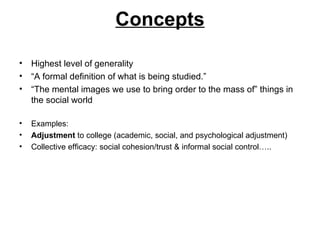
• Highest level of generality
• “A formal definition of what is being studied.”
• “The mental images we use to bring order to the mass of” things in
  the social world

•   Examples:
•   Adjustment to college (academic, social, and psychological adjustment)
•   Collective efficacy: social cohesion/trust & informal social control…..
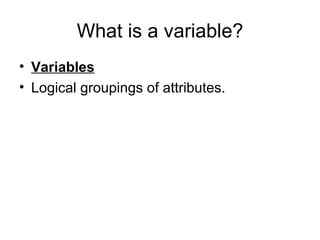
What is a variable?
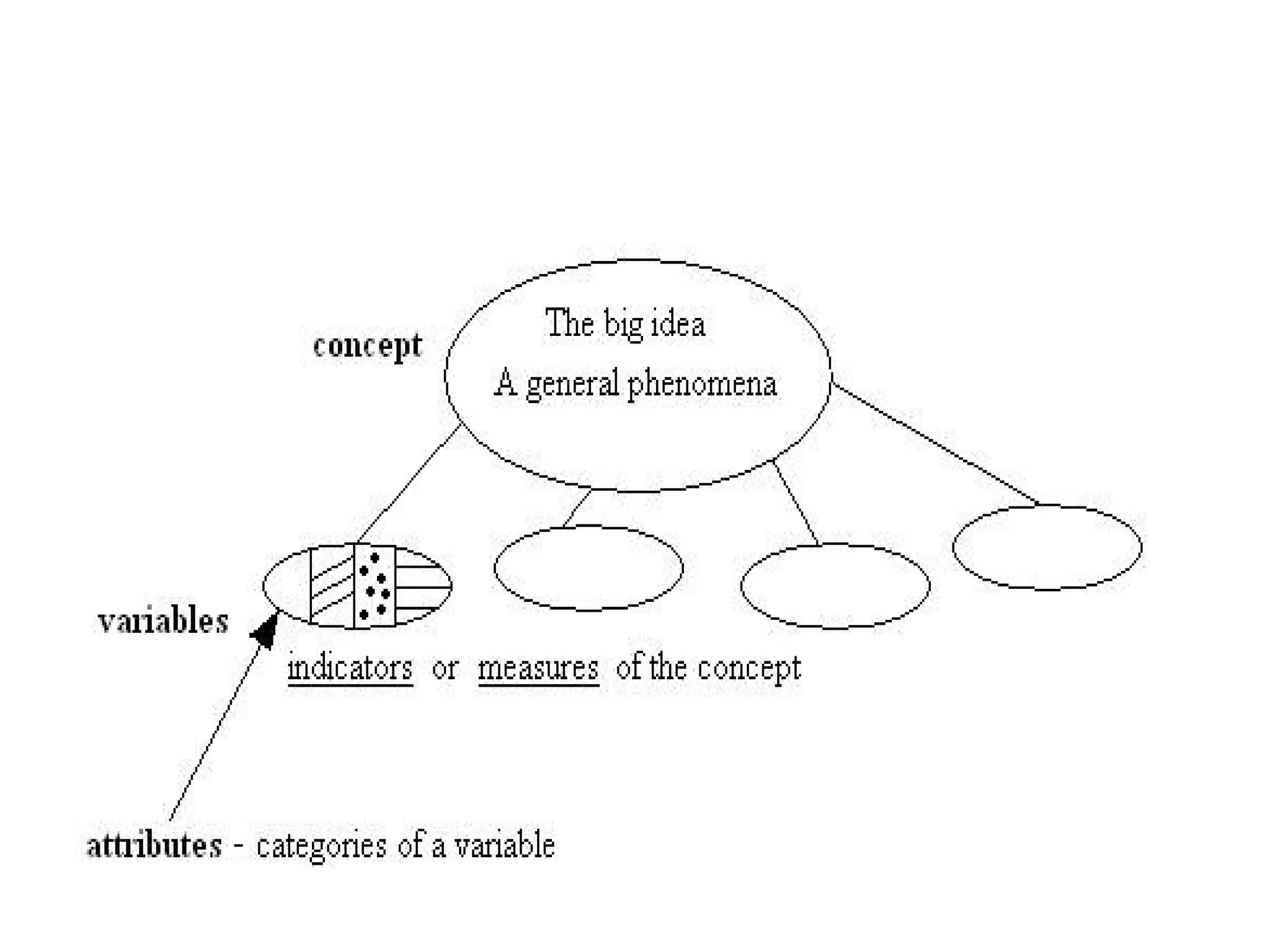
• Variables
• Logical groupings of attributes.
What is a variable?
• Example: To measure adjustment, you can think of questions such
  as the following:

• Academic: Are you doing in your work? Are you attending your
  classes?
  Social: Have you made any friends? What degree of social life do
  you have?
• 3. Attributes The categories of a variable

• Example: The attributes of the variable,
  religion….
Making an argument
• Relationship between two or variables

• Example: Is low voter turnout explained by
  the educational levels of the population?

  – Do you buy the relationship exists?
  – How will you support your case?
Statistic

• Categories of one VAR are related to
  the categories of another
Causal
• 0ne variable is the cause, and the other
  variable is the effect.
Causal
• Causal variable -- independent variable

• "effect" variable --dependent variable.
  – The dependent variable (attitude or behavior)
  – The independent variable (age, income,
    race..)
Causal relationship

• differences in one VAR explain differences in the
  other VAR


                                                      10
Four types of social research
•    Descriptive Research: research that defines and describes
     social phenomena
•     Example: Shows frequencies (how many are doing something)

•    Focus is on describing some phenomenon…..
Four types of social research
•       Exploratory Research: investigation of social phenomena
        without expectations

•       Meanings
    –      actions and issues.

•       Large amounts (unstructured information)

•       New direction of inquiry
Four types of social research

• Explanatory Research

•   research that identifies causes and effects of social phenomena

• Goal: predict how one thing will change when another.
Four types of social research
Evaluation Research: research that determines
the effects of a social program or other type of
intervention. How effect is a particular program?

–Is our smoking prevention program working?
–Is our needle exchange program working?
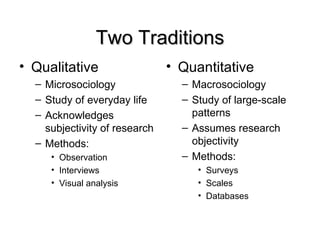
Two Traditions
• Qualitative                  • Quantitative
  – Microsociology               – Macrosociology
  – Study of everyday life       – Study of large-scale
  – Acknowledges                   patterns
    subjectivity of research     – Assumes research
  – Methods:                       objectivity
     • Observation               – Methods:
     • Interviews                   • Surveys
     • Visual analysis              • Scales
                                    • Databases
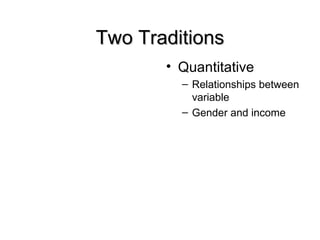
Two Traditions
       • Quantitative
         – Relationships between
           variable
         – Gender and income
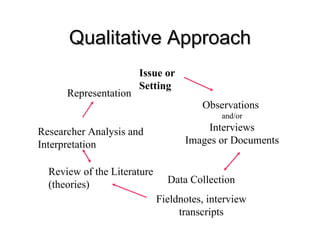
Qualitative Approach
                       Issue or
                       Setting
      Representation
                                       Observations
                                            and/or

Researcher Analysis and                Interviews
Interpretation                     Images or Documents

  Review of the Literature
  (theories)                   Data Collection
                             Fieldnotes, interview
                                  transcripts
Qualitative
• interactions, behaviors, and attitudes
  – narrative representations
Qualitative
• Researcher does the analysis through
  careful, ongoing “readings” of data
Value of Qualitative Research
• Debated within discipline for decades


• “legitimacy” as a science
A Striking Difference
• Qualitative researchers: enter a setting (the
  field) and spend significant amounts of time
  (often years) interviewing and observing.
  – They are known by their subjects and come to know
    their subjects well.


• Quantitative researchers: don’t meet their
  subjects. Data is often collected through other
  organizations (e.g., U.S. Census) or through
  mail surveys.
Research Design and theory
• Quant: Theory -> hypothesis -> DATA
  (deductive)

• Qual: Data – Take findings and then link to
  theory (inductive)

Lecture handout[ april 5th

  • 2.
    Concepts • Highest levelof generality • “A formal definition of what is being studied.” • “The mental images we use to bring order to the mass of” things in the social world • Examples: • Adjustment to college (academic, social, and psychological adjustment) • Collective efficacy: social cohesion/trust & informal social control…..
  • 3.
    What is avariable? • Variables • Logical groupings of attributes.
  • 4.
    What is avariable? • Example: To measure adjustment, you can think of questions such as the following: • Academic: Are you doing in your work? Are you attending your classes? Social: Have you made any friends? What degree of social life do you have?
  • 5.
    • 3. AttributesThe categories of a variable • Example: The attributes of the variable, religion….
  • 6.
    Making an argument •Relationship between two or variables • Example: Is low voter turnout explained by the educational levels of the population? – Do you buy the relationship exists? – How will you support your case?
  • 7.
    Statistic • Categories ofone VAR are related to the categories of another
  • 8.
    Causal • 0ne variableis the cause, and the other variable is the effect.
  • 9.
    Causal • Causal variable-- independent variable • "effect" variable --dependent variable. – The dependent variable (attitude or behavior) – The independent variable (age, income, race..)
  • 10.
    Causal relationship • differencesin one VAR explain differences in the other VAR 10
  • 11.
    Four types ofsocial research • Descriptive Research: research that defines and describes social phenomena • Example: Shows frequencies (how many are doing something) • Focus is on describing some phenomenon…..
  • 12.
    Four types ofsocial research • Exploratory Research: investigation of social phenomena without expectations • Meanings – actions and issues. • Large amounts (unstructured information) • New direction of inquiry
  • 13.
    Four types ofsocial research • Explanatory Research • research that identifies causes and effects of social phenomena • Goal: predict how one thing will change when another.
  • 14.
    Four types ofsocial research Evaluation Research: research that determines the effects of a social program or other type of intervention. How effect is a particular program? –Is our smoking prevention program working? –Is our needle exchange program working?
  • 15.
    Two Traditions • Qualitative • Quantitative – Microsociology – Macrosociology – Study of everyday life – Study of large-scale – Acknowledges patterns subjectivity of research – Assumes research – Methods: objectivity • Observation – Methods: • Interviews • Surveys • Visual analysis • Scales • Databases
  • 16.
    Two Traditions • Quantitative – Relationships between variable – Gender and income
  • 17.
    Qualitative Approach Issue or Setting Representation Observations and/or Researcher Analysis and Interviews Interpretation Images or Documents Review of the Literature (theories) Data Collection Fieldnotes, interview transcripts
  • 18.
    Qualitative • interactions, behaviors,and attitudes – narrative representations
  • 19.
    Qualitative • Researcher doesthe analysis through careful, ongoing “readings” of data
  • 20.
    Value of QualitativeResearch • Debated within discipline for decades • “legitimacy” as a science
  • 21.
    A Striking Difference •Qualitative researchers: enter a setting (the field) and spend significant amounts of time (often years) interviewing and observing. – They are known by their subjects and come to know their subjects well. • Quantitative researchers: don’t meet their subjects. Data is often collected through other organizations (e.g., U.S. Census) or through mail surveys.
  • 22.
    Research Design andtheory • Quant: Theory -> hypothesis -> DATA (deductive) • Qual: Data – Take findings and then link to theory (inductive)