International Journal of Power Electronics and Drive Systems (IJPEDS)
Vol. 13, No. 4, December 2022, pp. 2079~2085
ISSN: 2088-8694, DOI: 10.11591/ijpeds.v13.i4.pp2079-2085  2079
Journal homepage: http://ijpeds.iaescore.com
Restoration of a new age power distribution system
Moazzam Haidari, Vivek Kumar
Department of Electrical Engineering Saharsa College of Engineering, Saharsa, India
Article Info ABSTRACT
Article history:
Received Mar 3, 2022
Revised Aug 26, 2022
Accepted Sep 19, 2022
The new age transformed distribution system became the most popular
content in the literature. In that regard a simulation is attempted for the load
flow with dynamically changing system data. Any topic of interest like
electrical vehicle, distributed generators, FACTS devices were generalized
and considered as an element and placed at different possible locations to
observe their effect. The outcomes of the work were generalized to re-consider
on site. As the power industry is undergoing a drastic change throughout the
world. Restoration of a distribution system along with switching sequence has
become a challenging task. In the last half of the twentieth century, analysis
of transmission system was the prime concern and faced many challenges to
power engineers. The chosen equivalent IEEE 33-bus electric power
distribution system has been considered to analyze the system properties such
as its maximum capacity, operating limits, restoration issues. The placement
of static var compensator (SVC) was experimented for each and every bus.
Considering the minimization of total power loss as a prime objective, the best
location was found. This analysis also suggested a ranking of different buses
and can be helpful in deciding the switching sequence, provided in case of
fault, weak area clustering is done. So, congestion is managed in this
distribution system.
Keywords:
Radial distribution systems
Ranking of buses
Restoration
Switching sequence
Voltage stability
Weak area clustering
This is an open access article under the CC BY-SA license.
Corresponding Author:
Moazzam Haidari
Department of Electrical Engineering, Saharsa College of Engineering, Saharsa-852201, India
Email: moazzam53211@gmail.com
1. INTRODUCTION
The problem of switching sequence to restore a distribution system after a fault occurs, is still under
analysis, in the literature, and is considered a novel and one of the most appropriate areas related to the efficient
operation of radial distribution power systems. In this context, the main objective is to refurbish the largest
number of out-of-service areas in an efficient way. In order to isolate a fault, switching operations are
performed to de-energize a certain portion of the electrical system and tie-lines are switched-on. The main
objective in this connection is to restore the largest number of disconnected loads in such a way so that the
constraints of electrical distribution system operation are not violated. These constraints include the restrictions
of load flow related to Kirchhoff’s laws, current capacity of feeders, voltage limits of nodes and capacity of
substations.
With the advent of metaverse, electrical engineers are trying to find some job in the newly created
world with their simulations. But we should not forget that the ultimate power is in our hands in terms of real
power and reactive power. Placement of SVC at different buses is a very simple example to illustrate the
reactive power dependence of any system considered. Binary digital world is having only two digits zero and
one which created everything. Similarly, we have real power and reactive power which can create a different
world with different language. Placement of SVC at different buses to control reactive power and hence voltage
stability control is something like an upgrading for the above discussed technology.
 ISSN: 2088-8694
Int J Pow Elec & Dri Syst, Vol. 13, No. 4, December 2022: 2079-2085
2080
Curcic et al. [1] presents a review of the main characteristics of the key publications up to 1996. The
authors have shown that there are two fundamental objectives of the restoration problem. The first one is to
restore the maximum possible demand of the fault effected region and the second one is to implement the
restoration process at the earliest. In most of the earlier works loss minimization and load balancing between
feeders are not considered in the restoration process and that makes this work a novel attempt.
Romeno et al. [2] presented a comprehensive mathematical model has been proposed for the solution
of restoration problem in balanced radial distribution system. The authors have shown that the mixed integer
second-order conic model can be solved proficiently using commercial solved and the proposed model and
proposed solution can be used offline or online, depending upon time needed to solve the problem. But they
pointed out that the problem of verdict the sequence of switching operation is still under investigation.
A direct approach for unbalanced three phase distribution load flow solution is proposed in reference [3]. The
authors have developed two matrices from the topological characteristics of distribution system and these two
matrices are combined to form a direct approach for answering load flow problems. The authors have also
shown that the proposed method is suitable for large-scale distribution systems. Suliman [4] discussed voltage
profile enhancement in distribution network using static synchronous compensator STATCOM.
An efficient hybrid approach for volt/var control in distribution system with switching limits on tap a
shunt has been presented in reference [5]. The approach mentioned combines the strengths of a gradient
technique and a metaheuristic technique. It has been shown that the proposed method is 30-35 times faster and
is more accurate than the conventional genetic algorithm. But all distribution transformers are not provided
with tap setting facility hence in order to avoid the confusion applying SVC is a better alternative.
Arya et al. [6] present an algorithm for rescheduling reactive power control variable so as to have an
adequate load capability margin for current operating point has been described. The coordinated aggregation-
based particle swarm optimization technique has been used to minimize the total reactive power loss. The
control variables are similar as in the reference [5] therefore this paper helps in understanding the loss
minimization issue. But a mathematical approach is always more consistent than a soft computing. Hence in
the projected work a mathematical approach is adopted for SVC placement. Zabaiou et al. [7] given the idea
of preventive control approach for voltage stability improvement using voltage stability constrained optimal
power flow based on static line voltage stability indices. Patil and Karajgi [8] developed a technique for an
optimal placement of multiple FACTS devices using PSO and CSA algorithms. Abdullah et al. [9] enhanced
the stability of power system using optimal location of FACTS devices. Gupta et al. [10] presented mitigation
of congestion in a power system and role of FACTS devices, in [11] application of voltage stability index for
congestion management is discussed whereas [12] presents a comparative analysis of different power delivery
systems using voltage stability index.
Dolatabadi [13] presented an enhanced IEEE 33 bus benchmark test system for distribution system
studies where presence of electrical vehicle is taken into consideration. Distributed coordination of electric
vehicle providing v2g regulation services [14], [15]. Hatziargyriou [16] presented a guest editorial special
section on microgrids for sustainable energy system. A multiagent system for controlled charging of a large
population of electric [17], Dilek et al. [18] presented a simultaneous phase balancing at substations and
switches with time varying load patterns. Lin et al. [19], reported an expert system for three phase balancing
of distribution feeder, Tewari et al. [20] gave the concepts of coordinated control of OLTC and energy storage
for voltage regulation in distribution network with high PV penetration, Lotfi et al. [21] studied the impact of
feeder reconfiguration on automated distribution network with respect to resilience concept, Ansari et al. [22]
discussed the planning for distribution system with grey wolf optimization method, Bhatt and Chandel [23]
presented an intelligent water drop approach for simultaneous reconfiguration and DG integration in
distribution system, Kim et al. [24] presented an advanced power distribution system configuration for smart
grid. Ghadban et al. [25] purposed an assessment of voltage stability based on power transfer stability index
using computational intelligence models. Hinda and Khiat [26] gave the idea of real-time simulation of static
synchronous condenser (STATCOM) for compensation of reactive power, whereas a study of reconfiguration
of power distribution systems considering reliability and power loss was discussed by Amanulla et al. [27].
After reviewing the relevant literature, it is observed that there is no proposal for switching sequence for
restoration. Solving it using static var compensator (SVC) is a noble attempt. It can be easily adopted to the
restoration problem.
2. POWER FLOW WITH SVC
Reactance of SVC can be adjusted either by using firing angle limits or reactance limits. With the help
of SVC non-linear power equations and the linearized equations, used in Teng’s method is derived. The current
drawn by SVC can be written as (1).
Int J Pow Elec & Dri Syst ISSN: 2088-8694 
Restoration of a new age power distribution system (Moazzam Haidari)
2081
𝐼𝑆𝑉𝐶 = j𝐵𝑆𝑉𝐶𝑉𝐾 (1)
The reactive power drawn and injected at the bus is (2).
𝑄𝑆𝑉𝐶 = 𝑄𝐾 = −𝑉𝐾
2
𝐵𝑆𝑉𝐶 (2)
The linearized equation is given as (3).
[
∆𝑃𝐾
∆𝑄𝐾
]
(𝑖)
= [
0 0
0 𝑄𝐾
]
(𝑖)
[
∆𝑄𝐾
∆ 𝐵𝑆𝑉𝐶 𝐵𝑆𝑉𝐶
⁄
]
(𝑖)
(3)
Where the equivalent susceptanceB_SVC is susceptance and is taken to be state variable. The variable shunt
susceptanceB_SVC is updated accordingly, at the end of (1) iteration.
𝐵𝑆𝑉𝐶
(𝑖)
= 𝐵𝑆𝑉𝑐
(𝑖−1)
+ (
∆𝐵𝑆𝑉𝐶
𝐵𝑆𝑉𝐶
)
(𝑖)
𝐵𝑆𝑉𝐶
(𝑖−1)
(4)
It is compulsory to maintain the magnitude of nodal voltage at the specified value. Here, the changing
susceptance represents the total SVC susceptance. When the level of compensation has been determined, the
firing angle of the thyristor can be calculated. The SVC susceptance and thyristor firing angle are non-linearly
related. Hence, the additional calculation requires an iterative solution.
Standard IEEE 33-bus radial distribution system is considered for the analysis. Figure 1. Shows the
single line diagram of the system chosen. This system is radial type distribution feeder having the base voltage
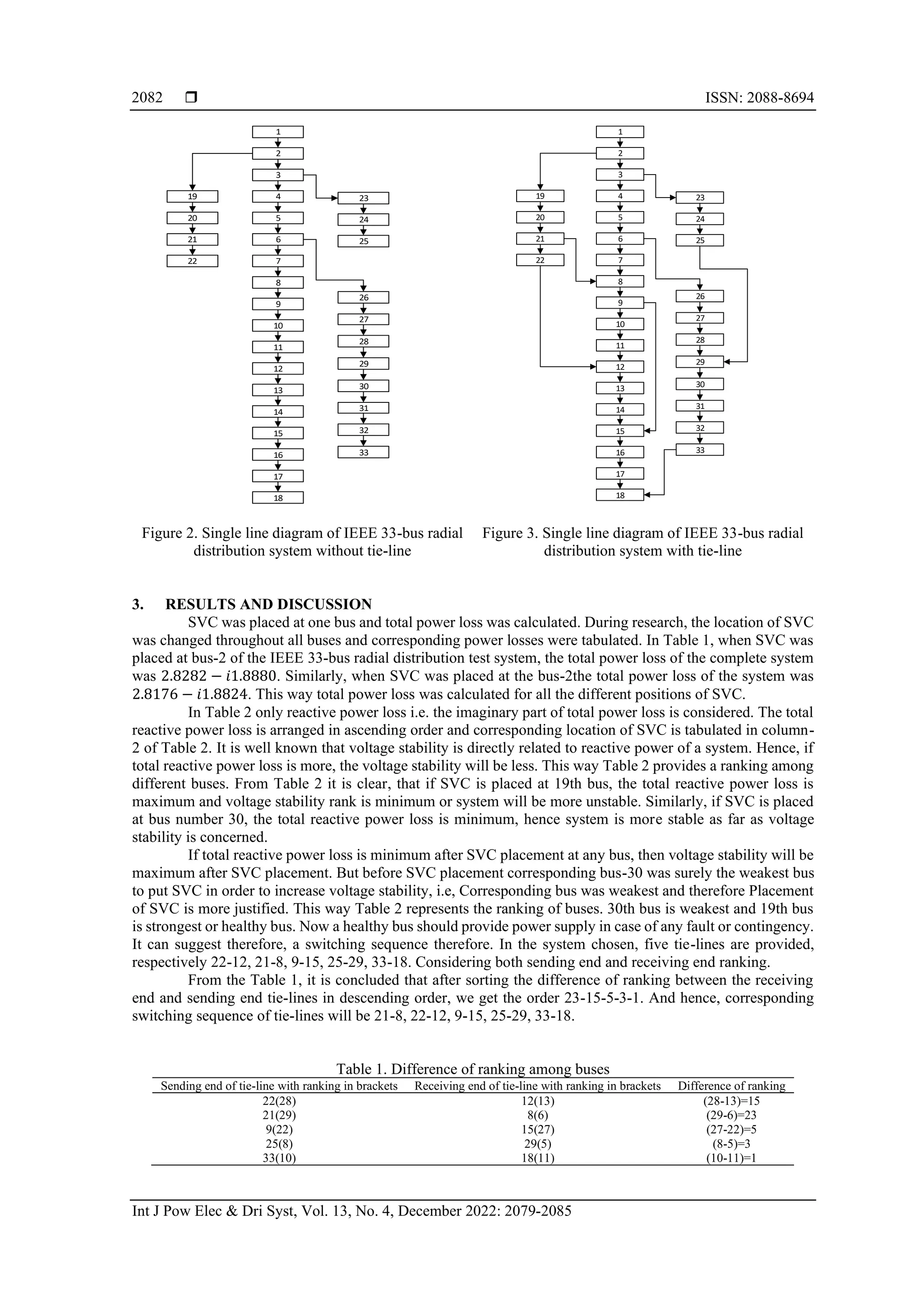
12 kV-66 kV and base apparent power 100 MVA. It consists of 32 distribution lines and one slack bus. Figure 2
shows the same IEEE 33-busradial distribution system without all tie-lines provided and Figure 3 shows the
same IEEE 33-busradial distribution system with all tie-lines provided. Five different tie lines provided are 22-
12, 21-8, 9-15, 25-29 and 33-18. These tie-lines can be connected in case of fault according to the type and
condition of the fault. Representation of simulation of two buses is shown below in Figure 1 for illustration
purpose, which can be integrated up to 33 bus system as shown in Figure 2 and Figure 3. A direct approach for
distribution system load flow proposed by Teng [3] is used in this work. This power flow method is robust for
distribution system because of its fast convergence.
Figure 1. Simulation of radial distribution system with two buses
 ISSN: 2088-8694
Int J Pow Elec & Dri Syst, Vol. 13, No. 4, December 2022: 2079-2085
2082
1
2
3
4
5
6
7
8
9
10
11
12
13
14
15
16
17
18
23
24
25
26
27
28
29
30
31
32
33
19
20
21
22
1
2
3
4
5
6
7
8
9
10
11
12
13
14
15
16
17
18
23
24
25
26
27
28
29
30
31
32
33
19
20
21
22
Figure 2. Single line diagram of IEEE 33-bus radial
distribution system without tie-line
Figure 3. Single line diagram of IEEE 33-bus radial
distribution system with tie-line
3. RESULTS AND DISCUSSION
SVC was placed at one bus and total power loss was calculated. During research, the location of SVC
was changed throughout all buses and corresponding power losses were tabulated. In Table 1, when SVC was
placed at bus-2 of the IEEE 33-bus radial distribution test system, the total power loss of the complete system
was 2.8282 − 𝑖1.8880. Similarly, when SVC was placed at the bus-2the total power loss of the system was
2.8176 − 𝑖1.8824. This way total power loss was calculated for all the different positions of SVC.
In Table 2 only reactive power loss i.e. the imaginary part of total power loss is considered. The total
reactive power loss is arranged in ascending order and corresponding location of SVC is tabulated in column-
2 of Table 2. It is well known that voltage stability is directly related to reactive power of a system. Hence, if
total reactive power loss is more, the voltage stability will be less. This way Table 2 provides a ranking among
different buses. From Table 2 it is clear, that if SVC is placed at 19th bus, the total reactive power loss is
maximum and voltage stability rank is minimum or system will be more unstable. Similarly, if SVC is placed
at bus number 30, the total reactive power loss is minimum, hence system is more stable as far as voltage
stability is concerned.
If total reactive power loss is minimum after SVC placement at any bus, then voltage stability will be
maximum after SVC placement. But before SVC placement corresponding bus-30 was surely the weakest bus
to put SVC in order to increase voltage stability, i.e, Corresponding bus was weakest and therefore Placement
of SVC is more justified. This way Table 2 represents the ranking of buses. 30th bus is weakest and 19th bus
is strongest or healthy bus. Now a healthy bus should provide power supply in case of any fault or contingency.
It can suggest therefore, a switching sequence therefore. In the system chosen, five tie-lines are provided,
respectively 22-12, 21-8, 9-15, 25-29, 33-18. Considering both sending end and receiving end ranking.
From the Table 1, it is concluded that after sorting the difference of ranking between the receiving
end and sending end tie-lines in descending order, we get the order 23-15-5-3-1. And hence, corresponding
switching sequence of tie-lines will be 21-8, 22-12, 9-15, 25-29, 33-18.
Table 1. Difference of ranking among buses
Sending end of tie-line with ranking in brackets Receiving end of tie-line with ranking in brackets Difference of ranking
22(28) 12(13) (28-13)=15
21(29) 8(6) (29-6)=23
9(22) 15(27) (27-22)=5
25(8) 29(5) (8-5)=3
33(10) 18(11) (10-11)=1
Int J Pow Elec & Dri Syst ISSN: 2088-8694 
Restoration of a new age power distribution system (Moazzam Haidari)
2083
Figure 4 shows the voltage profile of different buses in basic configuration. In this figure there is no
tie- line connected between the buses of the system. Figure 5 shows the voltage profile of different buses when
the system is fully meshed. Table 2 shows the total power loss when SVC is placed at different buses. Total
power loss is calculated at each bus. Table 3 shows the total reactive power loss in ascending order and at
corresponding ranking of the buses. Figure 6 and Figure 7 indicate thattotal real and reactive power loss
respectively are least when SVC is placed at 29th
bus.
Figure 4. A plot between number of buses
and voltage magnitude without tie-line
Figure 5. A plot between number of buses and
voltage magnitude in fully meshed condition
Table 2. Total power loss when SVC placed at
different buses
Table 3. Total reactive power loss in ascending order and
corresponding ranking of the buses
SVC Placed at Buses Total Power Loss
1. -
2. 2.8282 - 1.8880i
3. 2.8176 - 1.8824i
4. 2.7822 - 1.8640i
5. 2.8123 - 1.8797i
6. 2.8151 - 1.8792i
7. 2.6886 - 1.7911i
8. 2.6781 - 1.7870i
9. 2.8093 - 1.8746i
10. 2.8069 - 1.8729i
11. 2.7860 - 1.8589i
12. 2.7745 - 1.8514i
13. 2.7694 - 1.8477i
14. 2.6707 - 1.7803i
15. 2.8254 - 1.8854i
16. 2.8007 - 1.8683i
17. 2.7996 - 1.8673i
18. 2.7508 - 1.8339i
19. 2.8296 - 1.8886i
20. 2.8281 - 1.8873i
21. 2.8279 - 1.8870i
22. 2.8278 - 1.8869i
23. 2.8098 - 1.8779i
24. 2.7203 - 1.8266i
25. 2.7178 - 1.8250i
26. 2.8060 - 1.8736i
27. 2.8041 - 1.8726i
28. 2.8073 - 1.8734i
29. 2.6800 - 1.7853i
30. 1.9022 - 1.2761i
31. 2.6626 - 1.7739i
32. 2.5841 - 1.7204i
33. 2.7415 - 1.8276i
Total Reactive Power
Loss
Corresponding
Buses
Ranking of
buses
1.2761 30 1
1.7204 32 2
1.7739 31 3
1.7803 14 4
1.7853 29 5
1.7870 8 6
1.7911 7 7
1.8250 25 8
1.8266 24 9
1.8276 33 10
1.8339 18 11
1.8477 13 12
1.8514 12 13
1.8589 11 14
1.8640 4 15
1.8673 17 16
1.8683 16 17
1.8726 27 18
1.8729 10 19
1.8734 28 20
1.8736 26 21
1.8746 9 22
1.8779 23 23
1.8792 6 24
1.8797 5 25
1.8824 3 26
1.8854 15 27
1.8869 22 28
1.8870 21 29
1.8873 20 30
1.8880 2 31
1.8886 19 32
 ISSN: 2088-8694
Int J Pow Elec & Dri Syst, Vol. 13, No. 4, December 2022: 2079-2085
2084
Figure 6. Total real power loss when SVC is placed
at different buses
Figure 7. Total reactive power loss when SVC is
placed at different buses
4. CONCLUSION
In this paper, a comprehensive analysis of different locations for SVC placement is analyzed to rank
the buses which in turn suggested the switching sequence for any restoration problem. Test results show
excellent performance with regard to the voltage stability issue. The proposed solution can be developed for
offline or online applications. Finally, we consider this work to be an initial proposal that can lead to further
research in related objectives such as switching sequence based on: i) transient stability and ii) economic
aspects.
The classical thirty-three bus system has been enhanced by several extensions such as distribution of
generators, FACTS devices, branches with switches and systems with energy storage capacities. It provides a
resolution for online testing and analysis of voltage profile. Numerous data for reconfiguration have been
tabulated for this work which helps in compensation of reactive power and switching of branch provides many
opportunities a modern power distribution system. Appropriate simulations tried their best to generate a good
database for further studies.
REFERENCES
[1] S. S Curcic, C. S. Ozveren, L. Crowe, and P. K. L. Lo, “Electric power distribution network restortation: A Survey of papers and a
review of the restoration problem,” Electrical Power System Restoration, vol. 35, pp. 73-86, 1996, doi: 10.1016/0378-
7796(95)00991-4.
[2] R. Romeno, J. F. Franco, F. B. Leao, M. J. Rider, and E. S. de Souza, “A New mathematical model for the restoration problem in
balanced radial distribution systems,” IEEE Transaction Power Systems, vol. 31, no. 2, 2016, doi: 10.1109/TPWRS.2015.2418160.
[3] J.-H. Teng, “A direct approach for distribution system load flow solutions,” IEEE Transactions on Power Delivery, vol. 18. no. 3,
pp. 882−887, July 2003, doi: 10.1109/TPWRD.2003.813818.
[4] M. Y. Suliman, “Voltage profile enhancement in distribution network using static synchronous compensator STATCOM,”
International Journal of Electrical and Computer Engineering (IJECE), vol. 10, no. 4, pp. 3367−3374, August 2020, doi:
10.11591/ijece.v10i4.pp3367-3374.
[5] A. Mohapatra, P. R. Bijwe, and B. K. Panigrahi, “An efficient hybrid approach for volt/var control in distribution systems,” IEEE
Transactions on Power Delivery, vol. 29, no. 4, 2014, doi: 10.1109/TPWRD.2014.2306845.
[6] L. D. Arya, S. C. Choube, M. Shrivastav, D. P. Kothari, “Loadability margin enhancement using co-ordinated aggregation based
Particle Swarm Optimization (PSO),” Electric Power and Energy systems, vol. 32, pp. 975-984, 2010, doi:
10.1016/j.ijepes.2010.02.007.
[7] T. Zabaiou, L. A. Dessaint, and I. Kamwa, “Preventive control approach for voltage stability improvement using voltage stability
constrained optimal power flow based on static line voltage stability indices,” IET Generation, Transmission & Distribution, vol.
8, Iss. 5, pp. 924-934, 2014, doi: 10.1049/iet-gtd.2013.0724.
[8] B. Patil and S. B. Karajgi, “Optimized placement of multiple FACTS devices using PSO and CSA algorithms,” International
Journal of Electrical and Computer Engineering (IJECE), vol. 10, no. 4, pp. 3350−3357, August 2020, doi:
10.11591/ijece.v10i4.pp3350-3357.
[9] A. N. Abdullah, A. M. Ghadhban, H. S. Hameed, and H. I. Hussein, “Enhancement the stability of power system using optimal
location of FACTS devices,” Indonesian Journal of Electrical Engineering and Computer Science (IJEECS), vol. 18, no. 2,
pp. 648−65, May 2020, doi: 10.11591/ijeecs.v18.i2.pp648-655.
[10] M. Gupta, V. Kumar, G. K. Banerjee, and N. K. Sharma, “Mitigating congestion in a power system and role of FACTS devices,”
Hindawi Publishing Corporation, vol. 2017, 2017, doi: 10.1155/2017/4862428.
[11] M. Gupta, V. Kumar, N. K. Sharma, and G. K. Banerjee, “Application of voltage stability index for congestion management,” in
Proceedings of 2nd International Conference on Intelligent Computing and Applications, 2017, pp. 253−264, doi: 10.1007/978-
981-10-1645-5_22.
Int J Pow Elec & Dri Syst ISSN: 2088-8694 
Restoration of a new age power distribution system (Moazzam Haidari)
2085
[12] V. Kumar, M. Gupta, N. K. Sharma, and G. K. Banerjee, “Comparative analysis of different power delivery systems using voltage
stability index,” in 2nd IEEE International Conference on Innovative Applications of Computational Intelligence on Power, Energy
and Controls with their Impact on Humanity (CIPECH-16), 18th-19th November, 2016, pp. 166−169, doi:
10.1109/CIPECH.2016.7918757.
[13] S. H. Dolatabadi, M. Ghorbanian, and P. Siano, “An enhanced IEEE 33 bus benchmark test system for distribution system studies,”
Submitted to IEEE Transaction Power Systems, vol. 33, no. 03, November 2020, doi: 10.1109/TPWRS.2020.3038030.
[14] E. L. Karfopoulos, K. A. Panourgias, and N. D. Hatziargyriou, “Distributed coordination of electric vehicles providing v2g
regulation services,” IEEE Trans. Power Syst., vol. 31, no. 4, pp. 2834–2846, July 2016, doi: 10.1109/TPWRS.2015.2472957.
[15] E. L. Karfopoulos and N. D. Hatziargyriou, “Distributed coordination of electric vehicles providing v2g services,” IEEE Trans.
Power Syst., vol. 31, no. 1, pp. 329–338, Jan 2016, doi: 10.1109/TPWRS.2015.2395723.
[16] N. Hatziargyriou, “Guest editorial special section on microgrids for sustainable energy systems,” IEEE Trans. Sustain. Energy,
vol. 5, no. 4, pp. 1309–1309, Oct 2014, doi: 10.1109/TSTE.2014.2351891.
[17] E. L. Karfopoulos, and N. D. Hatziargyriou, “A multi-agent system for controlled charging of a large population of electric
vehicles,” IEEE Trans. Power Syst., vol. 28, no. 2, pp. 1196–1204, May 2013, doi: 10.1109/TPWRS.2012.2211624.
[18] M. Dilek, R. P. Broadwater, J. C. Thompson, and R. Seqiun, “Simultaneous phase balancing at substations and switches with time-
varying load patterns,” IEEE Trans. Power Syst., vol. 16, no. 4, pp. 922–928, 2001, doi: 10.1109/59.962447.
[19] C. Lin, C. Chen, H. Chuang, M. Huang, and C. Huang, “An expert system for three-phase balancing of distribution feeders,” IEEE
Trans. Power Syst., vol. 23, no. 3, pp. 1488–1496, 2008, doi: 10.1109/TPWRS.2008.926472.
[20] T. Tewari, A. Mohapatra and S. Anand, “Coordinated control of oltc and energy storage for voltage regulation in distribution
network with high PV penetration,” IEEE Trans. Sustain. Energy, vol. 12, no. 1, pp. 262-272, Jan. 2021, doi:
10.1109/TSTE.2020.2991017.
[21] H. Lotfi, A. A. Shojaei, V. Kouhdaragh, and I. S. Amiri, “The impact of feeder reconfiguration on automated distribution network
with respect to resilience concept,” SN Appl. Sci. 2, Article No. 1590, 2020, DOI: 10.1007/s42452-020-03429-z.
[22] M. M. Ansari et al., “Planning for distribution system with grey wolf optimization method,” J. Electr. Eng. Technol, vol. 15,
pp.1485–1499, 2020, doi: 10.1007/s42835-020-00419-4.
[23] Bhatt, N., Chandel, A.K, “An intelligent water drop approach for simultaneous reconfiguration and DG integration in distribution
system,” Energy Syst, 2022, doi: 10.1007/s12667-022-00521-8.
[24] J. Kim, S. Cho, and H. Shin, “Advanced power distribution system configuration for smart grid,” IEEE Trans. Smart Grid, vol. 4,
no. 1, pp. 353–358, 2013, doi: 10.1109/TSG.2012.2233771.
[25] A. M. Ghadban, G. A. Salman, and H. I. Hussein, “Assessment of voltage stability based on power transfer stability index using
computational intelligence models,” International Journal of Electrical and Computer Engineering (IJECE), vol. 11, no. 4, pp.
2790−2797, August 2021, doi: 10.11591/ijece.v11i4.pp2790-2797.
[26] A. Hinda and M. Khiat, “Real-time simulation of static synchronous condenser (STATCOM) for compensation of reactive power,”
International Journal of Electrical and Computer Engineering (IJECE), vol. 10, no .6, pp. 5599−5608, December 2020, doi:
10.11591/ijece.v10i6.pp5599-5608.
[27] B. Amanulla, S. Chakrabarti and S. N. Singh, “Reconfiguration of power distribution systems considering reliability and power
loss,” in IEEE Transactions on Power Delivery, vol. 27, no. 2, pp. 918−926, April 2012, doi: 10.1109/TPWRD.2011.2179950.
BIOGRAPHIES OF AUTHORS
Moazzam Haidari received his M Tech and B Tech from Aligarh Muslim
University, Aligarh India in the year 2014 and 2012 respectively and is presently working as
an assistant Professor in the department of Electrical Engineering at Saharsa College of
Engineering, Saharsa under the Department of Science and Technology government of Bihar.
M Haidari has about 6 years of academic and industries experience. He has also worked with
Indian railway in 2016 and Bihar State Power Holding in 2017. His area of interest includes
Modern control systems, recent trends in Power systems Optimizations & Control. He can be
contacted at email: moazzam53211@gmail.com.
Vivek Kumar is an assistant professor at Saharsa College of Engineering,
Saharsa, in Electrical Engineering Department. Currently he is pursuing another Master’s
degree from IIT Kanpur in a different area Derivative and Risk Management in online mode.
He earned a B.Tech degree in Electrical Engineering from Dr. MGR Educational and
Research Institute, Chennai, an M.Tech degree in Power System from SRM University,
Chennai and a Ph.D in Electrical Engineering from IFTM University, Moradabad. Earlier he
worked as an Assistant Professor at IFTM University, Moradabad, Naraina Vidyapeeth,
Kanpur and ACT College of Engineering, Kanchipuram, India. His areas of interest include
Voltage stability, Optimization Techniques and Power System Control. He can be contacted
at email: electricalvivek@gmail.com.

Restoration of a new age power distribution system

  • 1.
    International Journal ofPower Electronics and Drive Systems (IJPEDS) Vol. 13, No. 4, December 2022, pp. 2079~2085 ISSN: 2088-8694, DOI: 10.11591/ijpeds.v13.i4.pp2079-2085  2079 Journal homepage: http://ijpeds.iaescore.com Restoration of a new age power distribution system Moazzam Haidari, Vivek Kumar Department of Electrical Engineering Saharsa College of Engineering, Saharsa, India Article Info ABSTRACT Article history: Received Mar 3, 2022 Revised Aug 26, 2022 Accepted Sep 19, 2022 The new age transformed distribution system became the most popular content in the literature. In that regard a simulation is attempted for the load flow with dynamically changing system data. Any topic of interest like electrical vehicle, distributed generators, FACTS devices were generalized and considered as an element and placed at different possible locations to observe their effect. The outcomes of the work were generalized to re-consider on site. As the power industry is undergoing a drastic change throughout the world. Restoration of a distribution system along with switching sequence has become a challenging task. In the last half of the twentieth century, analysis of transmission system was the prime concern and faced many challenges to power engineers. The chosen equivalent IEEE 33-bus electric power distribution system has been considered to analyze the system properties such as its maximum capacity, operating limits, restoration issues. The placement of static var compensator (SVC) was experimented for each and every bus. Considering the minimization of total power loss as a prime objective, the best location was found. This analysis also suggested a ranking of different buses and can be helpful in deciding the switching sequence, provided in case of fault, weak area clustering is done. So, congestion is managed in this distribution system. Keywords: Radial distribution systems Ranking of buses Restoration Switching sequence Voltage stability Weak area clustering This is an open access article under the CC BY-SA license. Corresponding Author: Moazzam Haidari Department of Electrical Engineering, Saharsa College of Engineering, Saharsa-852201, India Email: moazzam53211@gmail.com 1. INTRODUCTION The problem of switching sequence to restore a distribution system after a fault occurs, is still under analysis, in the literature, and is considered a novel and one of the most appropriate areas related to the efficient operation of radial distribution power systems. In this context, the main objective is to refurbish the largest number of out-of-service areas in an efficient way. In order to isolate a fault, switching operations are performed to de-energize a certain portion of the electrical system and tie-lines are switched-on. The main objective in this connection is to restore the largest number of disconnected loads in such a way so that the constraints of electrical distribution system operation are not violated. These constraints include the restrictions of load flow related to Kirchhoff’s laws, current capacity of feeders, voltage limits of nodes and capacity of substations. With the advent of metaverse, electrical engineers are trying to find some job in the newly created world with their simulations. But we should not forget that the ultimate power is in our hands in terms of real power and reactive power. Placement of SVC at different buses is a very simple example to illustrate the reactive power dependence of any system considered. Binary digital world is having only two digits zero and one which created everything. Similarly, we have real power and reactive power which can create a different world with different language. Placement of SVC at different buses to control reactive power and hence voltage stability control is something like an upgrading for the above discussed technology.
  • 2.
     ISSN: 2088-8694 IntJ Pow Elec & Dri Syst, Vol. 13, No. 4, December 2022: 2079-2085 2080 Curcic et al. [1] presents a review of the main characteristics of the key publications up to 1996. The authors have shown that there are two fundamental objectives of the restoration problem. The first one is to restore the maximum possible demand of the fault effected region and the second one is to implement the restoration process at the earliest. In most of the earlier works loss minimization and load balancing between feeders are not considered in the restoration process and that makes this work a novel attempt. Romeno et al. [2] presented a comprehensive mathematical model has been proposed for the solution of restoration problem in balanced radial distribution system. The authors have shown that the mixed integer second-order conic model can be solved proficiently using commercial solved and the proposed model and proposed solution can be used offline or online, depending upon time needed to solve the problem. But they pointed out that the problem of verdict the sequence of switching operation is still under investigation. A direct approach for unbalanced three phase distribution load flow solution is proposed in reference [3]. The authors have developed two matrices from the topological characteristics of distribution system and these two matrices are combined to form a direct approach for answering load flow problems. The authors have also shown that the proposed method is suitable for large-scale distribution systems. Suliman [4] discussed voltage profile enhancement in distribution network using static synchronous compensator STATCOM. An efficient hybrid approach for volt/var control in distribution system with switching limits on tap a shunt has been presented in reference [5]. The approach mentioned combines the strengths of a gradient technique and a metaheuristic technique. It has been shown that the proposed method is 30-35 times faster and is more accurate than the conventional genetic algorithm. But all distribution transformers are not provided with tap setting facility hence in order to avoid the confusion applying SVC is a better alternative. Arya et al. [6] present an algorithm for rescheduling reactive power control variable so as to have an adequate load capability margin for current operating point has been described. The coordinated aggregation- based particle swarm optimization technique has been used to minimize the total reactive power loss. The control variables are similar as in the reference [5] therefore this paper helps in understanding the loss minimization issue. But a mathematical approach is always more consistent than a soft computing. Hence in the projected work a mathematical approach is adopted for SVC placement. Zabaiou et al. [7] given the idea of preventive control approach for voltage stability improvement using voltage stability constrained optimal power flow based on static line voltage stability indices. Patil and Karajgi [8] developed a technique for an optimal placement of multiple FACTS devices using PSO and CSA algorithms. Abdullah et al. [9] enhanced the stability of power system using optimal location of FACTS devices. Gupta et al. [10] presented mitigation of congestion in a power system and role of FACTS devices, in [11] application of voltage stability index for congestion management is discussed whereas [12] presents a comparative analysis of different power delivery systems using voltage stability index. Dolatabadi [13] presented an enhanced IEEE 33 bus benchmark test system for distribution system studies where presence of electrical vehicle is taken into consideration. Distributed coordination of electric vehicle providing v2g regulation services [14], [15]. Hatziargyriou [16] presented a guest editorial special section on microgrids for sustainable energy system. A multiagent system for controlled charging of a large population of electric [17], Dilek et al. [18] presented a simultaneous phase balancing at substations and switches with time varying load patterns. Lin et al. [19], reported an expert system for three phase balancing of distribution feeder, Tewari et al. [20] gave the concepts of coordinated control of OLTC and energy storage for voltage regulation in distribution network with high PV penetration, Lotfi et al. [21] studied the impact of feeder reconfiguration on automated distribution network with respect to resilience concept, Ansari et al. [22] discussed the planning for distribution system with grey wolf optimization method, Bhatt and Chandel [23] presented an intelligent water drop approach for simultaneous reconfiguration and DG integration in distribution system, Kim et al. [24] presented an advanced power distribution system configuration for smart grid. Ghadban et al. [25] purposed an assessment of voltage stability based on power transfer stability index using computational intelligence models. Hinda and Khiat [26] gave the idea of real-time simulation of static synchronous condenser (STATCOM) for compensation of reactive power, whereas a study of reconfiguration of power distribution systems considering reliability and power loss was discussed by Amanulla et al. [27]. After reviewing the relevant literature, it is observed that there is no proposal for switching sequence for restoration. Solving it using static var compensator (SVC) is a noble attempt. It can be easily adopted to the restoration problem. 2. POWER FLOW WITH SVC Reactance of SVC can be adjusted either by using firing angle limits or reactance limits. With the help of SVC non-linear power equations and the linearized equations, used in Teng’s method is derived. The current drawn by SVC can be written as (1).
  • 3.
    Int J PowElec & Dri Syst ISSN: 2088-8694  Restoration of a new age power distribution system (Moazzam Haidari) 2081 𝐼𝑆𝑉𝐶 = j𝐵𝑆𝑉𝐶𝑉𝐾 (1) The reactive power drawn and injected at the bus is (2). 𝑄𝑆𝑉𝐶 = 𝑄𝐾 = −𝑉𝐾 2 𝐵𝑆𝑉𝐶 (2) The linearized equation is given as (3). [ ∆𝑃𝐾 ∆𝑄𝐾 ] (𝑖) = [ 0 0 0 𝑄𝐾 ] (𝑖) [ ∆𝑄𝐾 ∆ 𝐵𝑆𝑉𝐶 𝐵𝑆𝑉𝐶 ⁄ ] (𝑖) (3) Where the equivalent susceptanceB_SVC is susceptance and is taken to be state variable. The variable shunt susceptanceB_SVC is updated accordingly, at the end of (1) iteration. 𝐵𝑆𝑉𝐶 (𝑖) = 𝐵𝑆𝑉𝑐 (𝑖−1) + ( ∆𝐵𝑆𝑉𝐶 𝐵𝑆𝑉𝐶 ) (𝑖) 𝐵𝑆𝑉𝐶 (𝑖−1) (4) It is compulsory to maintain the magnitude of nodal voltage at the specified value. Here, the changing susceptance represents the total SVC susceptance. When the level of compensation has been determined, the firing angle of the thyristor can be calculated. The SVC susceptance and thyristor firing angle are non-linearly related. Hence, the additional calculation requires an iterative solution. Standard IEEE 33-bus radial distribution system is considered for the analysis. Figure 1. Shows the single line diagram of the system chosen. This system is radial type distribution feeder having the base voltage 12 kV-66 kV and base apparent power 100 MVA. It consists of 32 distribution lines and one slack bus. Figure 2 shows the same IEEE 33-busradial distribution system without all tie-lines provided and Figure 3 shows the same IEEE 33-busradial distribution system with all tie-lines provided. Five different tie lines provided are 22- 12, 21-8, 9-15, 25-29 and 33-18. These tie-lines can be connected in case of fault according to the type and condition of the fault. Representation of simulation of two buses is shown below in Figure 1 for illustration purpose, which can be integrated up to 33 bus system as shown in Figure 2 and Figure 3. A direct approach for distribution system load flow proposed by Teng [3] is used in this work. This power flow method is robust for distribution system because of its fast convergence. Figure 1. Simulation of radial distribution system with two buses
  • 4.
     ISSN: 2088-8694 IntJ Pow Elec & Dri Syst, Vol. 13, No. 4, December 2022: 2079-2085 2082 1 2 3 4 5 6 7 8 9 10 11 12 13 14 15 16 17 18 23 24 25 26 27 28 29 30 31 32 33 19 20 21 22 1 2 3 4 5 6 7 8 9 10 11 12 13 14 15 16 17 18 23 24 25 26 27 28 29 30 31 32 33 19 20 21 22 Figure 2. Single line diagram of IEEE 33-bus radial distribution system without tie-line Figure 3. Single line diagram of IEEE 33-bus radial distribution system with tie-line 3. RESULTS AND DISCUSSION SVC was placed at one bus and total power loss was calculated. During research, the location of SVC was changed throughout all buses and corresponding power losses were tabulated. In Table 1, when SVC was placed at bus-2 of the IEEE 33-bus radial distribution test system, the total power loss of the complete system was 2.8282 − 𝑖1.8880. Similarly, when SVC was placed at the bus-2the total power loss of the system was 2.8176 − 𝑖1.8824. This way total power loss was calculated for all the different positions of SVC. In Table 2 only reactive power loss i.e. the imaginary part of total power loss is considered. The total reactive power loss is arranged in ascending order and corresponding location of SVC is tabulated in column- 2 of Table 2. It is well known that voltage stability is directly related to reactive power of a system. Hence, if total reactive power loss is more, the voltage stability will be less. This way Table 2 provides a ranking among different buses. From Table 2 it is clear, that if SVC is placed at 19th bus, the total reactive power loss is maximum and voltage stability rank is minimum or system will be more unstable. Similarly, if SVC is placed at bus number 30, the total reactive power loss is minimum, hence system is more stable as far as voltage stability is concerned. If total reactive power loss is minimum after SVC placement at any bus, then voltage stability will be maximum after SVC placement. But before SVC placement corresponding bus-30 was surely the weakest bus to put SVC in order to increase voltage stability, i.e, Corresponding bus was weakest and therefore Placement of SVC is more justified. This way Table 2 represents the ranking of buses. 30th bus is weakest and 19th bus is strongest or healthy bus. Now a healthy bus should provide power supply in case of any fault or contingency. It can suggest therefore, a switching sequence therefore. In the system chosen, five tie-lines are provided, respectively 22-12, 21-8, 9-15, 25-29, 33-18. Considering both sending end and receiving end ranking. From the Table 1, it is concluded that after sorting the difference of ranking between the receiving end and sending end tie-lines in descending order, we get the order 23-15-5-3-1. And hence, corresponding switching sequence of tie-lines will be 21-8, 22-12, 9-15, 25-29, 33-18. Table 1. Difference of ranking among buses Sending end of tie-line with ranking in brackets Receiving end of tie-line with ranking in brackets Difference of ranking 22(28) 12(13) (28-13)=15 21(29) 8(6) (29-6)=23 9(22) 15(27) (27-22)=5 25(8) 29(5) (8-5)=3 33(10) 18(11) (10-11)=1
  • 5.
    Int J PowElec & Dri Syst ISSN: 2088-8694  Restoration of a new age power distribution system (Moazzam Haidari) 2083 Figure 4 shows the voltage profile of different buses in basic configuration. In this figure there is no tie- line connected between the buses of the system. Figure 5 shows the voltage profile of different buses when the system is fully meshed. Table 2 shows the total power loss when SVC is placed at different buses. Total power loss is calculated at each bus. Table 3 shows the total reactive power loss in ascending order and at corresponding ranking of the buses. Figure 6 and Figure 7 indicate thattotal real and reactive power loss respectively are least when SVC is placed at 29th bus. Figure 4. A plot between number of buses and voltage magnitude without tie-line Figure 5. A plot between number of buses and voltage magnitude in fully meshed condition Table 2. Total power loss when SVC placed at different buses Table 3. Total reactive power loss in ascending order and corresponding ranking of the buses SVC Placed at Buses Total Power Loss 1. - 2. 2.8282 - 1.8880i 3. 2.8176 - 1.8824i 4. 2.7822 - 1.8640i 5. 2.8123 - 1.8797i 6. 2.8151 - 1.8792i 7. 2.6886 - 1.7911i 8. 2.6781 - 1.7870i 9. 2.8093 - 1.8746i 10. 2.8069 - 1.8729i 11. 2.7860 - 1.8589i 12. 2.7745 - 1.8514i 13. 2.7694 - 1.8477i 14. 2.6707 - 1.7803i 15. 2.8254 - 1.8854i 16. 2.8007 - 1.8683i 17. 2.7996 - 1.8673i 18. 2.7508 - 1.8339i 19. 2.8296 - 1.8886i 20. 2.8281 - 1.8873i 21. 2.8279 - 1.8870i 22. 2.8278 - 1.8869i 23. 2.8098 - 1.8779i 24. 2.7203 - 1.8266i 25. 2.7178 - 1.8250i 26. 2.8060 - 1.8736i 27. 2.8041 - 1.8726i 28. 2.8073 - 1.8734i 29. 2.6800 - 1.7853i 30. 1.9022 - 1.2761i 31. 2.6626 - 1.7739i 32. 2.5841 - 1.7204i 33. 2.7415 - 1.8276i Total Reactive Power Loss Corresponding Buses Ranking of buses 1.2761 30 1 1.7204 32 2 1.7739 31 3 1.7803 14 4 1.7853 29 5 1.7870 8 6 1.7911 7 7 1.8250 25 8 1.8266 24 9 1.8276 33 10 1.8339 18 11 1.8477 13 12 1.8514 12 13 1.8589 11 14 1.8640 4 15 1.8673 17 16 1.8683 16 17 1.8726 27 18 1.8729 10 19 1.8734 28 20 1.8736 26 21 1.8746 9 22 1.8779 23 23 1.8792 6 24 1.8797 5 25 1.8824 3 26 1.8854 15 27 1.8869 22 28 1.8870 21 29 1.8873 20 30 1.8880 2 31 1.8886 19 32
  • 6.
     ISSN: 2088-8694 IntJ Pow Elec & Dri Syst, Vol. 13, No. 4, December 2022: 2079-2085 2084 Figure 6. Total real power loss when SVC is placed at different buses Figure 7. Total reactive power loss when SVC is placed at different buses 4. CONCLUSION In this paper, a comprehensive analysis of different locations for SVC placement is analyzed to rank the buses which in turn suggested the switching sequence for any restoration problem. Test results show excellent performance with regard to the voltage stability issue. The proposed solution can be developed for offline or online applications. Finally, we consider this work to be an initial proposal that can lead to further research in related objectives such as switching sequence based on: i) transient stability and ii) economic aspects. The classical thirty-three bus system has been enhanced by several extensions such as distribution of generators, FACTS devices, branches with switches and systems with energy storage capacities. It provides a resolution for online testing and analysis of voltage profile. Numerous data for reconfiguration have been tabulated for this work which helps in compensation of reactive power and switching of branch provides many opportunities a modern power distribution system. Appropriate simulations tried their best to generate a good database for further studies. REFERENCES [1] S. S Curcic, C. S. Ozveren, L. Crowe, and P. K. L. Lo, “Electric power distribution network restortation: A Survey of papers and a review of the restoration problem,” Electrical Power System Restoration, vol. 35, pp. 73-86, 1996, doi: 10.1016/0378- 7796(95)00991-4. [2] R. Romeno, J. F. Franco, F. B. Leao, M. J. Rider, and E. S. de Souza, “A New mathematical model for the restoration problem in balanced radial distribution systems,” IEEE Transaction Power Systems, vol. 31, no. 2, 2016, doi: 10.1109/TPWRS.2015.2418160. [3] J.-H. Teng, “A direct approach for distribution system load flow solutions,” IEEE Transactions on Power Delivery, vol. 18. no. 3, pp. 882−887, July 2003, doi: 10.1109/TPWRD.2003.813818. [4] M. Y. Suliman, “Voltage profile enhancement in distribution network using static synchronous compensator STATCOM,” International Journal of Electrical and Computer Engineering (IJECE), vol. 10, no. 4, pp. 3367−3374, August 2020, doi: 10.11591/ijece.v10i4.pp3367-3374. [5] A. Mohapatra, P. R. Bijwe, and B. K. Panigrahi, “An efficient hybrid approach for volt/var control in distribution systems,” IEEE Transactions on Power Delivery, vol. 29, no. 4, 2014, doi: 10.1109/TPWRD.2014.2306845. [6] L. D. Arya, S. C. Choube, M. Shrivastav, D. P. Kothari, “Loadability margin enhancement using co-ordinated aggregation based Particle Swarm Optimization (PSO),” Electric Power and Energy systems, vol. 32, pp. 975-984, 2010, doi: 10.1016/j.ijepes.2010.02.007. [7] T. Zabaiou, L. A. Dessaint, and I. Kamwa, “Preventive control approach for voltage stability improvement using voltage stability constrained optimal power flow based on static line voltage stability indices,” IET Generation, Transmission & Distribution, vol. 8, Iss. 5, pp. 924-934, 2014, doi: 10.1049/iet-gtd.2013.0724. [8] B. Patil and S. B. Karajgi, “Optimized placement of multiple FACTS devices using PSO and CSA algorithms,” International Journal of Electrical and Computer Engineering (IJECE), vol. 10, no. 4, pp. 3350−3357, August 2020, doi: 10.11591/ijece.v10i4.pp3350-3357. [9] A. N. Abdullah, A. M. Ghadhban, H. S. Hameed, and H. I. Hussein, “Enhancement the stability of power system using optimal location of FACTS devices,” Indonesian Journal of Electrical Engineering and Computer Science (IJEECS), vol. 18, no. 2, pp. 648−65, May 2020, doi: 10.11591/ijeecs.v18.i2.pp648-655. [10] M. Gupta, V. Kumar, G. K. Banerjee, and N. K. Sharma, “Mitigating congestion in a power system and role of FACTS devices,” Hindawi Publishing Corporation, vol. 2017, 2017, doi: 10.1155/2017/4862428. [11] M. Gupta, V. Kumar, N. K. Sharma, and G. K. Banerjee, “Application of voltage stability index for congestion management,” in Proceedings of 2nd International Conference on Intelligent Computing and Applications, 2017, pp. 253−264, doi: 10.1007/978- 981-10-1645-5_22.
  • 7.
    Int J PowElec & Dri Syst ISSN: 2088-8694  Restoration of a new age power distribution system (Moazzam Haidari) 2085 [12] V. Kumar, M. Gupta, N. K. Sharma, and G. K. Banerjee, “Comparative analysis of different power delivery systems using voltage stability index,” in 2nd IEEE International Conference on Innovative Applications of Computational Intelligence on Power, Energy and Controls with their Impact on Humanity (CIPECH-16), 18th-19th November, 2016, pp. 166−169, doi: 10.1109/CIPECH.2016.7918757. [13] S. H. Dolatabadi, M. Ghorbanian, and P. Siano, “An enhanced IEEE 33 bus benchmark test system for distribution system studies,” Submitted to IEEE Transaction Power Systems, vol. 33, no. 03, November 2020, doi: 10.1109/TPWRS.2020.3038030. [14] E. L. Karfopoulos, K. A. Panourgias, and N. D. Hatziargyriou, “Distributed coordination of electric vehicles providing v2g regulation services,” IEEE Trans. Power Syst., vol. 31, no. 4, pp. 2834–2846, July 2016, doi: 10.1109/TPWRS.2015.2472957. [15] E. L. Karfopoulos and N. D. Hatziargyriou, “Distributed coordination of electric vehicles providing v2g services,” IEEE Trans. Power Syst., vol. 31, no. 1, pp. 329–338, Jan 2016, doi: 10.1109/TPWRS.2015.2395723. [16] N. Hatziargyriou, “Guest editorial special section on microgrids for sustainable energy systems,” IEEE Trans. Sustain. Energy, vol. 5, no. 4, pp. 1309–1309, Oct 2014, doi: 10.1109/TSTE.2014.2351891. [17] E. L. Karfopoulos, and N. D. Hatziargyriou, “A multi-agent system for controlled charging of a large population of electric vehicles,” IEEE Trans. Power Syst., vol. 28, no. 2, pp. 1196–1204, May 2013, doi: 10.1109/TPWRS.2012.2211624. [18] M. Dilek, R. P. Broadwater, J. C. Thompson, and R. Seqiun, “Simultaneous phase balancing at substations and switches with time- varying load patterns,” IEEE Trans. Power Syst., vol. 16, no. 4, pp. 922–928, 2001, doi: 10.1109/59.962447. [19] C. Lin, C. Chen, H. Chuang, M. Huang, and C. Huang, “An expert system for three-phase balancing of distribution feeders,” IEEE Trans. Power Syst., vol. 23, no. 3, pp. 1488–1496, 2008, doi: 10.1109/TPWRS.2008.926472. [20] T. Tewari, A. Mohapatra and S. Anand, “Coordinated control of oltc and energy storage for voltage regulation in distribution network with high PV penetration,” IEEE Trans. Sustain. Energy, vol. 12, no. 1, pp. 262-272, Jan. 2021, doi: 10.1109/TSTE.2020.2991017. [21] H. Lotfi, A. A. Shojaei, V. Kouhdaragh, and I. S. Amiri, “The impact of feeder reconfiguration on automated distribution network with respect to resilience concept,” SN Appl. Sci. 2, Article No. 1590, 2020, DOI: 10.1007/s42452-020-03429-z. [22] M. M. Ansari et al., “Planning for distribution system with grey wolf optimization method,” J. Electr. Eng. Technol, vol. 15, pp.1485–1499, 2020, doi: 10.1007/s42835-020-00419-4. [23] Bhatt, N., Chandel, A.K, “An intelligent water drop approach for simultaneous reconfiguration and DG integration in distribution system,” Energy Syst, 2022, doi: 10.1007/s12667-022-00521-8. [24] J. Kim, S. Cho, and H. Shin, “Advanced power distribution system configuration for smart grid,” IEEE Trans. Smart Grid, vol. 4, no. 1, pp. 353–358, 2013, doi: 10.1109/TSG.2012.2233771. [25] A. M. Ghadban, G. A. Salman, and H. I. Hussein, “Assessment of voltage stability based on power transfer stability index using computational intelligence models,” International Journal of Electrical and Computer Engineering (IJECE), vol. 11, no. 4, pp. 2790−2797, August 2021, doi: 10.11591/ijece.v11i4.pp2790-2797. [26] A. Hinda and M. Khiat, “Real-time simulation of static synchronous condenser (STATCOM) for compensation of reactive power,” International Journal of Electrical and Computer Engineering (IJECE), vol. 10, no .6, pp. 5599−5608, December 2020, doi: 10.11591/ijece.v10i6.pp5599-5608. [27] B. Amanulla, S. Chakrabarti and S. N. Singh, “Reconfiguration of power distribution systems considering reliability and power loss,” in IEEE Transactions on Power Delivery, vol. 27, no. 2, pp. 918−926, April 2012, doi: 10.1109/TPWRD.2011.2179950. BIOGRAPHIES OF AUTHORS Moazzam Haidari received his M Tech and B Tech from Aligarh Muslim University, Aligarh India in the year 2014 and 2012 respectively and is presently working as an assistant Professor in the department of Electrical Engineering at Saharsa College of Engineering, Saharsa under the Department of Science and Technology government of Bihar. M Haidari has about 6 years of academic and industries experience. He has also worked with Indian railway in 2016 and Bihar State Power Holding in 2017. His area of interest includes Modern control systems, recent trends in Power systems Optimizations & Control. He can be contacted at email: moazzam53211@gmail.com. Vivek Kumar is an assistant professor at Saharsa College of Engineering, Saharsa, in Electrical Engineering Department. Currently he is pursuing another Master’s degree from IIT Kanpur in a different area Derivative and Risk Management in online mode. He earned a B.Tech degree in Electrical Engineering from Dr. MGR Educational and Research Institute, Chennai, an M.Tech degree in Power System from SRM University, Chennai and a Ph.D in Electrical Engineering from IFTM University, Moradabad. Earlier he worked as an Assistant Professor at IFTM University, Moradabad, Naraina Vidyapeeth, Kanpur and ACT College of Engineering, Kanchipuram, India. His areas of interest include Voltage stability, Optimization Techniques and Power System Control. He can be contacted at email: electricalvivek@gmail.com.