International Journal of Power Electronics and Drive Systems (IJPEDS)
Vol. 13, No. 3, September 2022, pp. 1295~1304
ISSN: 2088-8694, DOI: 10.11591/ijpeds.v13.i3.pp1295-1304  1295
Journal homepage: http://ijpeds.iaescore.com
Assessment of field oriented induction machine control strategy
using new generation of inverters in BB36000 locomotive
Hamid Chaikhy1,2
, Mouna Es-saadi3
, Mohamed Khafallah3
1
Department of Electrical and Energy Engineering, National Engineering School of Applied Sciences, University Chouaib Doukkali,
El Jadida, Morocco
2
Laboratory of Engineering Sciences for Energy, University Chouaib Doukkali, El Jadida, Morocco
3
Laboratory of Energy and Electrical Systems, National School of Electricity and Mechanics, University Hassan II,
Casablanca, Morocco
Article Info ABSTRACT
Article history:
Received Apr 26, 2022
Revised Jun 3, 2022
Accepted Jun 20, 2022
Due to their excellent characteristics; Reaching high voltage inverters by
using lower voltage switches, reduced output current distortion, dv/dt, and
switching losses decrease, efficiency rise, multilevel inverters are an
interesting alternative to the two-level inverters especially in traction
applications. Many studies compared both topologies, but this work compare
performances of Field oriented control strategy using two levels and neutral
point piloted three levels inverter supplied by space pulse width modulation.
Based on real parameters, this work shows that this efficient multilevel
inverter reduces current distortion and torque ripples in a manner to reduces
the size and cost of all railway traction systems chosen for this work.
Keywords:
Field oriented control
Neutral point piloted inverter
Railway traction
Space pulse width modulation
This is an open access article under the CC BY-SA license.
Corresponding Author:
Hamid Chaikhy
Department of Electrical and Energy Engineering, National Engineering School of Applied Sciences
University Chouaib Doukkali
Route d’azzemour, Nationale N1, Elhaouzia BP: 116 El Jadida 24002, Marocco
Email: chaikhy.hamid@gmail.com
1. INTRODUCTION
In the United States, more than 25% of total greenhouse emissions are due to the transportation
sector 50% reduction in this ratio will give an important reduction in total greenhouse gas emissions [1]-[3].
Due to their reduced greenhouse emissions and reduced reliance on fossil fuels, electric vehicles (EVs) are
the best alternative vehicles in this critical environmental context. Even, EVs do not produce any emissions;
the generation of electricity can still produce emissions. However, compared to internal combustion engine
vehicles (ICEVs), EVs still produce 50% lower of greenhouse emissions. EVs are offering many
opportunities, but they also face many challenges, particularly concerning the battery of EVs. The
unavailability of chargers and their high cost compared to the ICEVs, the limited energy density of batteries,
slow recharging compared to the refueling of ICEVs are the major limitations to a huge expansion of that
environmentally friendly transportation mean [4]. To reduce the recharging time, many works try to increase
the Evs' battery voltage. Higher DC-link voltage enables extreme fast charging and decreases the cable size
and weight [5]-[7]. However, it needs new requirements regarding the inverter, devices or structure needs to
be improved in such a manner to withstand high voltages [8]. Because of its higher electromagnetic
interference, the use of two levels inverter can damage the electric motor. Although, its reduced conduction
losses, two levels inverter presents important switching losses. Hence, the inverter efficiency decreases [9].
Numerous industrials used higher input voltages inverters by moving to 1200 V and 1700 V IGBTs and
 ISSN:2088-8694
Int J Pow Elec & Dri Syst, Vol. 13, No. 3, September 2022: 1295-1304
1296
MOSFETS [6], [7], [10], [11]. Even though high voltages switch inverters could attain high voltages, high
switching losses and high dv/dt are maintained in two levels inverter. Due to their excellent characteristics,
the multilevel inverter can be a very attractive alternative to the two levels inverter for traction applications.
Reaching high voltage inverters by using lower voltage switches, reduced output current distortion, dv/dt and
switching losses decrease, and efficiency rise are the main opportunities offered by multilevel inverters to the
new traction applications [12]-[14]. Many comparisons between two levels and multilevel inverters have
been made in the literature. Thanks to the multilevel inverter, efficiency is improved in standard driving
cycles [15], [16], costs of the two systems are compared [13], [15]. Thanks to the lower filter and battery cost
in the case of multilevel drive, the overall system is cheaper even if the cost of a multilevel inverter is softly
higher than two levels inverter. The previous studies have studied topologies. Anyway, another aspect of
multilevel traction drives that need to be investigated and compared: Performances of control strategies. This
work aims to show the performances improvement of a conventional Field oriented induction machine
control strategy in both steady-state and transient conditions by using neutral point piloted three levels
inverter NPP, instead of two levels inverter controlled by space pulse width modulation. Very used in
Moroccan railways, BB 36000 is the locomotive chosen to be improved in this work. Using real parameters,
very interesting simulations results are obtained and discussed after explaining the principle off field-oriented
control (FOC) and net primary production (NPP) inverter.
2. PRINCIPLE OF DFOC STRATEGY FOR INDUCTION MACHINE USING TWO LEVELS
INVERTER
FOC is a method of controlling a rotating field machine in such a manner to attain independent
control over the torque and the flux components of the stator current [17]. It makes it possible to control the
induction machine like the control of a separately excited DC machine, and hence it enables the use of
induction motors in applications requiring high-dynamic performance, where traditionally only DC drives
were applied. The concept of FOC applied to induction motor drives, allows us to perform fast and fully
decoupled control of torque and flux [18]. To obtain such a decoupled control, FOC algorithms need to know
the rotor flux angular position to correctly align the stator current vector. As a consequence, it is possible to
control torque and rotor flux in a DC machine control fashion, by acting on two separated components of the
stator current isd and isqin (1).
Figure 1. Orientation of the rotor field to d axis of the (d,q) reference
After applying the rotor field rotation, Figure 1, 𝜓𝑟𝑑
^
= 𝜓𝑟
^
and𝜓𝑟𝑞
^
= 0 . Induction machine (IM)
relations becomes then:
{
𝜓𝑟𝑑 =
𝑀
1+𝑝𝑇𝑟
𝑖𝑠𝑑
𝑇𝑒 = 𝑛𝑝
𝑀
𝐿𝑟
𝜓𝑟𝑖𝑠𝑞
(1)
before the determination of rotor flux, angular position is required before applying this orientation. Direct
field-oriented control (DFOC) and indirect field-oriented control (IFOC) are the two methods used to obtain
this position.
Using (2), 𝜓𝑟
^
and𝑇𝑒
^
are estimated using 𝑖𝑠𝑑and 𝑖𝑠𝑞 respectively, and are compared to 𝜓𝑟
∗
and 𝑇𝑒
∗
. As
shown in Figure 2 torque and flux are directly controlled in DFOC.
Int J Pow Elec & Dri Syst ISSN:2088-8694 
Assessement of field oriented induction machine control strategy using new generation…(Hamid Chaikhy)
1297
{
𝑣𝑠𝑑 = [(𝑅𝑠 + 𝑝𝜎𝔏𝑠)
(1+𝑇𝑟𝑝)
ℳ
+
ℳ
𝔏𝑟𝑝
] 𝜓𝑟𝑑 − 𝑤𝑠𝔏𝑠𝜎𝑖𝑠𝑞
𝑣𝑠𝑞 = (𝑅𝑠 + 𝑝𝜎𝔏𝑠)
𝑇𝑒
𝑝
𝑀
𝐿𝑟
𝜓𝑟𝑑
+ 𝑤𝑠𝔏𝑠𝜎𝑖𝑠𝑑 + 𝑤𝑠
ℳ
𝔏𝑟
𝜓𝑟
𝜓𝑟 =
𝑀
1+𝑝𝑇𝑟
𝑖𝑠𝑑
𝑇𝑒 = 𝑛𝑝
𝑀
𝐿𝑟
𝜓𝑟𝑖𝑠𝑞
𝜃𝑠 = ∫(𝑛𝑝Ω +
𝑀
𝑇𝑟
𝑖𝑠𝑞
∗
𝜓𝑟𝑑
∗ )𝑑𝑡
(2)
Figure 2 shows the control strategy scheme of DFOC.
Figure 2. Direct Field oriented control strategy scheme of IM using two levels inverter
To ensure decoupled control for torque and flux, compensation terms femd and femq (3) are added to
obtain a d and q axes completely independent.
{
𝑓𝑒𝑚𝑑 = 𝑤𝑠𝔏𝑠𝜎𝑖𝑠𝑞
𝑓𝑒𝑚𝑞 = 𝑤𝑠𝔏𝑠𝜎𝑖𝑠𝑑 + 𝑤𝑠
ℳ
𝔏𝑟
𝜓𝑟
(3)
In (2) shows that how position θs and voltages vsq, vsd are calculated. Using Park position θs, vsq, and vsd are
transformed and injected to the two levels inverter. A sinusoidal pulse width modulation is used to control this
inverter Figure 3. In SPWM modulation, pulses resulting from the comparison between a sinusoidal reference
signal and triangular carrier are injected to the switches, to obtain two voltage levels [19].
Figure 3. Principle of the SPWM two levels control strategy
 ISSN:2088-8694
Int J Pow Elec & Dri Syst, Vol. 13, No. 3, September 2022: 1295-1304
1298
3. IMPROVEMENT OF DFOC STRATEGY FOR IM
To improve performances given by the classical structures with two voltages levels, multilevel
conversion structures constitute an interesting solution. For medium voltage high power applications such as
railway traction, the cost of semiconductor devices is increased. Multilevel structures offer a reduction of the
voltage stress that compensates for the increased number of devices. Also, by lowering the total harmonic
content, these structures offer the advantage of reducing the size of the output filter and then the cost of the
overall system. Moreover, torque ripples for motor drive applications will be reduced. Even if, NPC inverters
have a wide industrial spread mostly in medium voltage applications. They have disadvantages; like unequal
switches losses distribution. To solve this problem, three levels NPP (3L_NPP) inverter is the multilevel
inverter chosen to be used to replace the two levels inverter [20]-[23].
3.1. Principle of the 3L_NPP inverter
As shown in Figure 4, two capacitors that have the same capacitance are used to divide equally the
voltage and obtain two voltage levels. Each leg of the 3L-NPP inverter contains two head-to-tail connected
and clamped IGBTs and four other vertical IGBTs, each IGBT has an antiparallel connected diode. To obtain
the three voltage levels, switches are following switching states as shown in Table 1. Figure 5 shows the two
carriers sinusoidal pulse width modulation (SPWM) control strategy used for one leg of the NPP
inverter [24], [25].The following Figure6 shows the output voltages of the inverter simulated in
MATLAB/Simulink where the three voltage levels are observed.
Figure 4. Structure of a 3L_NPP inverter brush Figure 5. SPWM of the 3L_NPP inverter
Table 1. Basic switching of the three levels NPP inverter
Voltage Va T2+ T1+ TC+ T2- T1- TC-
Vdc/2 1 1 1 0 0 0
0 0 0 1 0 0 1
-Vdc/2 0 0 0 1 1 1
Figure 6. Output voltages of the five levels NPC inverter
Int J Pow Elec & Dri Syst ISSN:2088-8694 
Assessement of field oriented induction machine control strategy using new generation…(Hamid Chaikhy)
1299
3.2. Improvement of DFOC strategy 3L_NPP inverter
To improve the transient and steady-state performances of DFOC strategy for IM, to reduce voltage
stress in semiconductors and to avoid unequal junction temperature distribution which confines the inverter
maximum output power especially for high power applications, instead of the two levels inverter and 3L_NPC
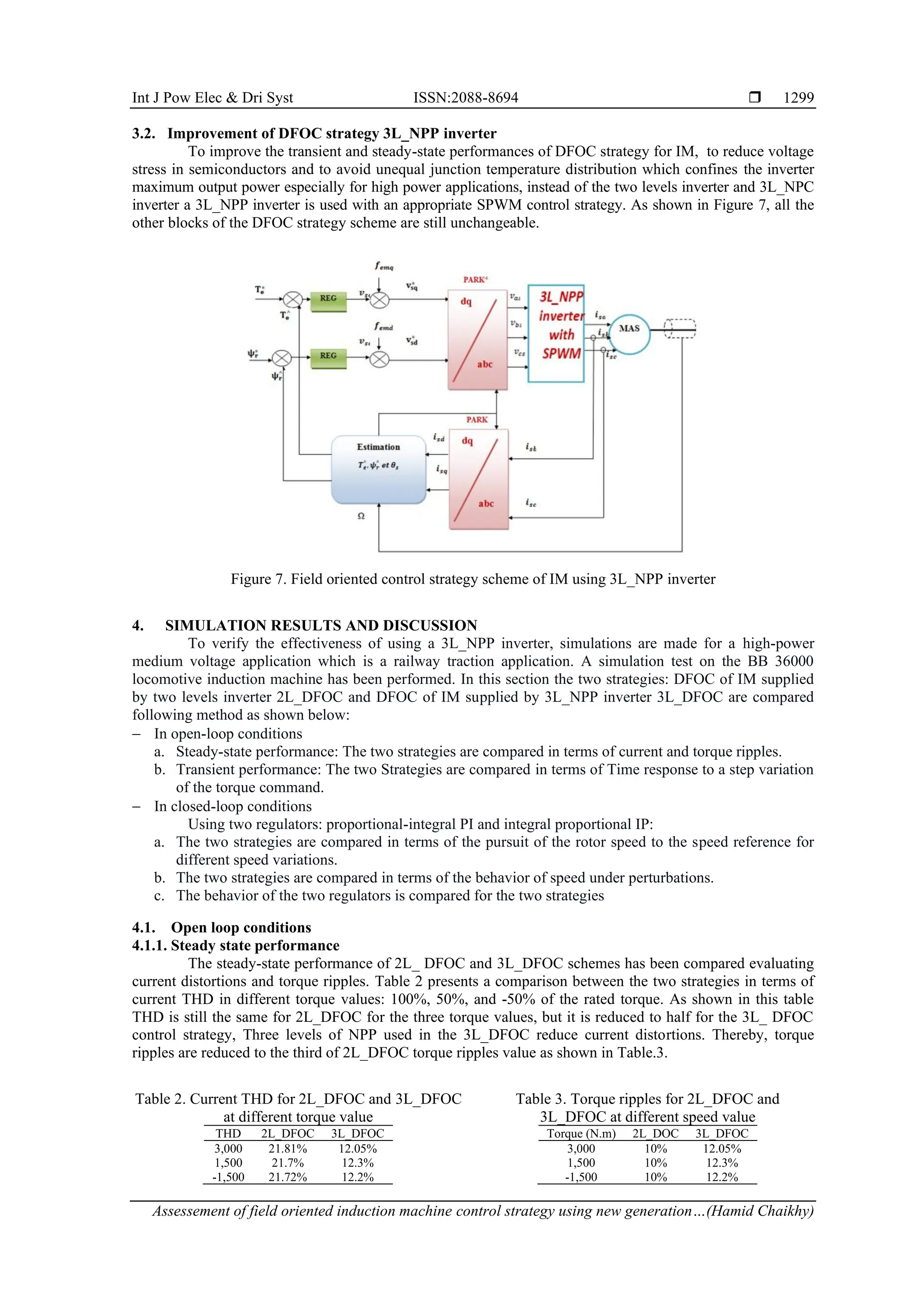
inverter a 3L_NPP inverter is used with an appropriate SPWM control strategy. As shown in Figure 7, all the
other blocks of the DFOC strategy scheme are still unchangeable.
Figure 7. Field oriented control strategy scheme of IM using 3L_NPP inverter
4. SIMULATION RESULTS AND DISCUSSION
To verify the effectiveness of using a 3L_NPP inverter, simulations are made for a high-power
medium voltage application which is a railway traction application. A simulation test on the BB 36000
locomotive induction machine has been performed. In this section the two strategies: DFOC of IM supplied
by two levels inverter 2L_DFOC and DFOC of IM supplied by 3L_NPP inverter 3L_DFOC are compared
following method as shown below:
− In open-loop conditions
a. Steady-state performance: The two strategies are compared in terms of current and torque ripples.
b. Transient performance: The two Strategies are compared in terms of Time response to a step variation
of the torque command.
− In closed-loop conditions
Using two regulators: proportional-integral PI and integral proportional IP:
a. The two strategies are compared in terms of the pursuit of the rotor speed to the speed reference for
different speed variations.
b. The two strategies are compared in terms of the behavior of speed under perturbations.
c. The behavior of the two regulators is compared for the two strategies
4.1. Open loop conditions
4.1.1. Steady state performance
The steady-state performance of 2L_ DFOC and 3L_DFOC schemes has been compared evaluating
current distortions and torque ripples. Table 2 presents a comparison between the two strategies in terms of
current THD in different torque values: 100%, 50%, and -50% of the rated torque. As shown in this table
THD is still the same for 2L_DFOC for the three torque values, but it is reduced to half for the 3L_ DFOC
control strategy, Three levels of NPP used in the 3L_DFOC reduce current distortions. Thereby, torque
ripples are reduced to the third of 2L_DFOC torque ripples value as shown in Table.3.
Table 2. Current THD for 2L_DFOC and 3L_DFOC
at different torque value
Table 3. Torque ripples for 2L_DFOC and
3L_DFOC at different speed value
THD 2L_DFOC 3L_DFOC
3,000 21.81% 12.05%
1,500 21.7% 12.3%
-1,500 21.72% 12.2%
Torque (N.m) 2L_DOC 3L_DFOC
3,000 10% 12.05%
1,500 10% 12.3%
-1,500 10% 12.2%
 ISSN:2088-8694
Int J Pow Elec & Dri Syst, Vol. 13, No. 3, September 2022: 1295-1304
1300
4.1.2. Transient performance
For 3,000 (N.m), 1,500 (N.m) and -1,500 (N.m) torque values, time response still the same and
equal to 5.6 ms. For both 2L_DFOC and 3L_DFOC. This result shows that transient performances still the
same even if two levels inverters is replaced by a 3L_NPP inverter Table 4.
Table. 4. Time response for 2L_DFOC and 3L_DFOC at different torque value
Torque (N.m) 2L_DFOC 3L_DFOC
3,000 5.6 ms
1,500 5.6 ms
-1,500 5.6 ms
4.2. Closed loop conditions
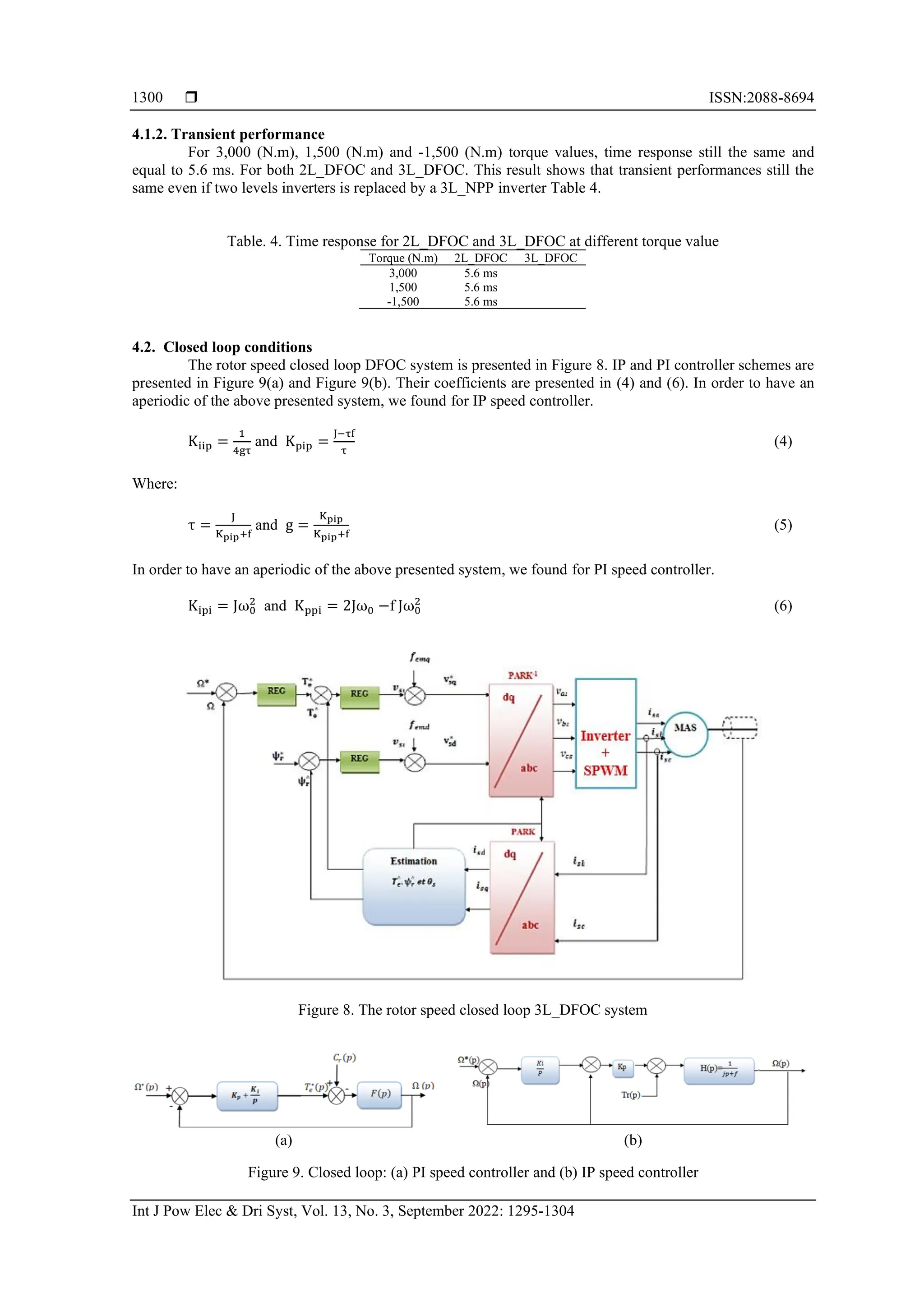
The rotor speed closed loop DFOC system is presented in Figure 8. IP and PI controller schemes are
presented in Figure 9(a) and Figure 9(b). Their coefficients are presented in (4) and (6). In order to have an
aperiodic of the above presented system, we found for IP speed controller.
Kiip =
1
4gτ
and Kpip =
J−τf
τ
(4)
Where:
τ =
J
Kpip+f
and g =
Kpip
Kpip+f
(5)
In order to have an aperiodic of the above presented system, we found for PI speed controller.
Kipi = Jω0
2
and Kppi = 2Jω0 −f Jω0
2
(6)
Figure 8. The rotor speed closed loop 3L_DFOC system
(a) (b)
Figure 9. Closed loop: (a) PI speed controller and (b) IP speed controller
Int J Pow Elec & Dri Syst ISSN:2088-8694 
Assessement of field oriented induction machine control strategy using new generation…(Hamid Chaikhy)
1301
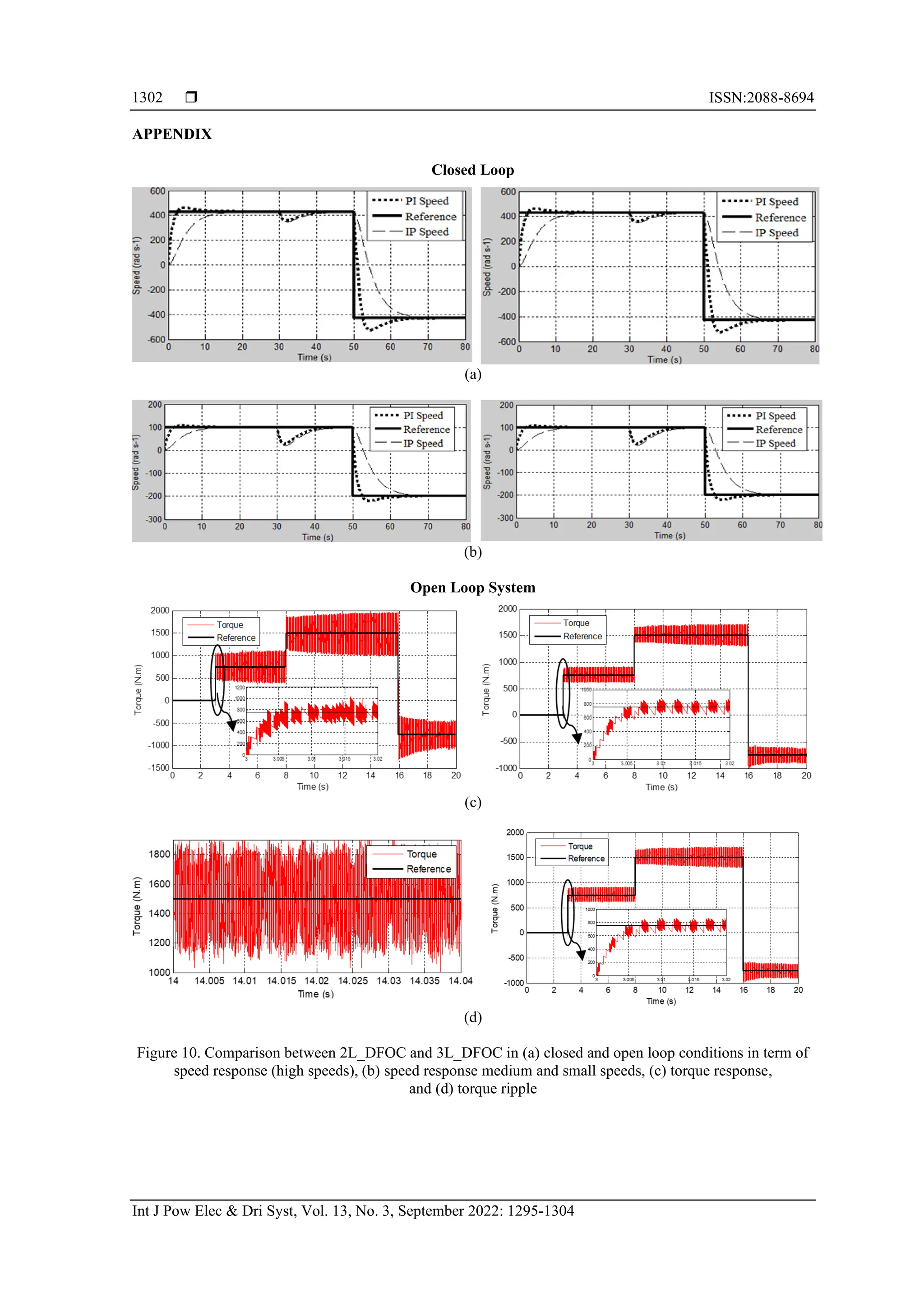
As shown in Figures 10(a) and 10(b) (see Appendix), for both 2L_DFOC and 3L_DFOC strategy,
the rotor speed reference is varying from 430 rd.s-1 (rated speed) to -430 rd.s-1, and from 100 rd.s-1 (rated
speed) to -200 rd.s-1; rotor speed is following the rotor speed reference for high, medium, and small speed.
Even with applying a torque load variation from 0N.m to 1,500 N.m at the 30s to the two closed-loop
systems, this perturbation is directly rejected. Then, for 2L_DFOC and 3L_DFOC, rotor speeds follow again
their references after 10s. Both IP and PI controller presents good steady-state performances, but IP
controller presents better transient performance especially in the pursuit of reference. Finally, a detailed
comparison between 2L_DFOC and 3L_DFOC is summarized in Table 5.
4.3. Results discussion
Using real parameters of BB 36000 locomotive, simulation results presented below show
performances improvement of the FOC using NPP inverter. As presented in Figures 10(c) and 10(d) (see
Appendix), 3L_FOC reduces noticeably torque ripples in a manner to offer quiet and more relaxed journeys.
Also, in addition to his interesting efficiency compared to two levels inverter, Figures 10(e) and 10(f) (see
Appendix) shows that the use of three levels NPP inverter decreases current distortion to half, hence the size
and then the cost of the output filter and the overall system is reduced. Finally, as shown in the Table 5,
3L_NPP inverter is reaching high voltage inverters by using two times lower voltage switches Vdc
2
instead of
Vdc for two levels inverter. Table 6 gives values of all coefficients and simulation parameters.
Table 5. Detailed comparison between 2L_DFOC and 3L_DFOC
Performances 2L_DFOC 3L_DFOC
Structure simple complex
Off-state voltage Vdc Vdc
2
Complexity of implementation simple complex
Current distortions Not good (Around21.94%) Good (Around 12.05%)
Torque ripples More (∆Te=300 Nm) Less((∆Te=100 Nm)
Response to a torque step variation Fast(5.6 ms) Fast(5.6 ms)
Pursuit of the rotor speed Very good Very good
Behavior ofspeed under perturbations Good Good
Table 6. Induction machine and simulation parameters
Parameter Signification
Machine parameters Rs=0.029 Stator resistance (Ω)
Rr=0.022 Rotor resistance (Ω)
M=0.035 Mutual inductance (H)
Ls=0.00059 Stator inductance (H)
Lr=0.00059 Rotor inductance (H)
J= 63,87 Factor of inertia (Kg.m2
)
f=0.0000155 Coefficient of friction
p=2 Number of pole pairs
Simulation parameters P=1.5 Rated power (MW)
Vdc=4391 DC bus voltage (V)
Fpwm=2000 Pulse width modulation frequency (Hz)
C nom=3000 Rated torque (N.m)
Ω nom=435 Rated speed (rad/s )
Kppi=9,6, Kipi=4,6 Integral and proportional coefficients
5. CONCLUSION
This work presents a detailed comparison between 2L_DFOC and 3L_DFOC using an NPP inverter.
The two strategies used a high power application: railway traction with real parameters of BB 36000, to
present performances in both open and closed-loop conditions. As presented 3L_FOC reduces noticeably
torque ripples in a manner to offer quiet and more relaxed journeys. Also, the use of three levels of NPP
inverter decreases current distortion to half, hence the size and then the cost of the output filter and the
overall system is reduced. The aim of our future work is to improve 3L_DFOC by using space vector
modulation instead of SPWM control of the NPP inverter.
 ISSN:2088-8694
Int J Pow Elec & Dri Syst, Vol. 13, No. 3, September 2022: 1295-1304
1302
APPENDIX
Closed Loop
(a)
(b)
Open Loop System
(c)
(d)
Figure 10. Comparison between 2L_DFOC and 3L_DFOC in (a) closed and open loop conditions in term of
speed response (high speeds), (b) speed response medium and small speeds, (c) torque response,
and (d) torque ripple
Int J Pow Elec & Dri Syst ISSN:2088-8694 
Assessement of field oriented induction machine control strategy using new generation…(Hamid Chaikhy)
1303
(e)
(f)
Figure 10. Comparison between 2L_DFOC and 3L_DFOC in (e) current distortions and (f) THD current
(continue)
REFERENCES
[1] M. Muratori et al., “The rise of electric vehicles-2020 status and future expectations,” IOP Science, vol. 3, no. 2, Jan. 2021, doi:
10.1088/2516-1083/abe0ad.
[2] M. Broy, “Challenges in automotive software engineering,” in ICSE’06:Proceedings of the 28th international conference on
Software engineering, May 2006 pp. 33-42, doi: 10.1145/1134285.1134292.
[3] J. Cao, X. Chen, R. Qiu, and S. hou, “Electric vehicle industry sustainable development with a stakeholder engagement system,”
Technoloy in Society, vol. 67, Nov. 2021, doi: 10.1016/j.techsoc.2021.101771.
[4] A. Tomaszewska et al., “Lithium ion battery fast charging: A review,” eTransportation, vol. 1, Aug. 2019, doi:
10.1016/j.etran.2019.100011.
[5] M. Mosaraf , A. Hossain , A. Ullah, M. Shahad , S. Shahnewaz, M. Shafiul, T. Jamal, H. Ahmed, “Integration of Large-Scale
Electric Vehicles into Utility Grid: An Efficient Approach for Impact Analysis and Power Quality Assessment,” Sustainability,
vol. 13, no. 19, pp. 1-18, Oct. 2021, doi: 10.3390/su131910943.
[6] O. Heidrich, G.nHill, M. Neaimeh, Y. Huebner, P. Blythe, R. Dawson, “How do cities support electric vehicles and what
difference does it make?,” Technological Forecasting and Social Change, vol. 123, pp. 17-23, Oct. 2017, doi:
10.1016/j.techfore.2017.05.026.
[7] C. Jung, “Power Up with 800-V Systems: The benefits of upgrading voltage power for battery-electric passenger vehicles,” in
IEEE Electrification Magazine, vol. 5, no. 1, pp. 53-58, Mar. 2017, doi: 10.1109/MELE.2016.2644560.
[8] D. Ronanki, A. Kelkar, and S. S. Williamson, “Extreme fast charging technology-Prospects to enhance sustainable electric
transportation,”Energies, vol. 12, no. 19, p. 3721, Sep. 2019, doi: 10.3390/en12193721.
[9] N. Soualhi, A. Makouf, N. Nait-Said, and S. Hamada, “Comparison between a Two-Level and Three-Level Inverter fed Induction
Motor including Losses and Efficiency,”in 4th International Conference on Advanced Systems and Emergent Technologies
(IC_ASET), 2020, pp. 89-94, doi: 10.1109/IC_ASET49463.2020.9318310.
[10] H. Tu, H. Feng, S. Srdic, and S. Lukic, “Extreme Fast Charging of Electric Vehicles: A Technology Overview,” in IEEE
Transactions on Transportation Electrification, vol. 5, no. 4, pp. 861-878, Dec. 2019, doi: 10.1109/TTE.2019.2958709.
[11] K. Zhang, J. Yang, C. Liu, J. Wang, and D. Yao, “Dynamic Characteristics of a Traction Drive System in High-Speed Train
Based on Electromechanical Coupling Modeling under Variable Conditions,” Energies, vol. 15, Feb. 2022, doi:
10.3390/en15031202.
[12] A. Choudhury, P. Pillay and S. S. Williamson, "Comparative Analysis Between Two-Level and Three-Level DC/AC Electric
Vehicle Traction Inverters Using a Novel DC-Link Voltage Balancing Algorithm," in IEEE Journal of Emerging and Selected
Topics in Power Electronics, vol. 2, no. 3, pp. 529-540, Sep. 2014, doi: 10.1109/JESTPE.2014.2310140.
[13] R. Teichmann and S. Bernet, "A comparison of three-level converters versus two-level converters for low-voltage drives, traction,
and utility applications," in IEEE Transactions on Industry Applications, vol. 41, no. 3, pp. 855-865, May-June 2005, doi:
10.1109/TIA.2005.847285.
[14] L. Dorn-Gomba, J. Ramoul, J. Reimers, and A. Emadi, "Power Electronic Converters in Electric Aircraft: Current Status,
Challenges, and Emerging Technologies," in IEEE Transactions on Transportation Electrification, vol. 6, no. 4, pp. 1648-1664,
Dec. 2020, doi: 10.1109/TTE.2020.3006045.
[15] F. Chang, O. Ilina, M. Lienkamp, and L. Voss, "Improving the Overall Efficiency of Automotive Inverters Using a Multilevel
Converter Composed of Low Voltage Si mosfets," in IEEE Transactions on Power Electronics, vol. 34, no. 4, pp. 3586-3602,
April 2019, doi: 10.1109/TPEL.2018.2854756.
 ISSN:2088-8694
Int J Pow Elec & Dri Syst, Vol. 13, No. 3, September 2022: 1295-1304
1304
[16] M. Quraan, P. Tricoli, S. D’Arco and L. Piegari, "Efficiency Assessment of Modular Multilevel Converters for Battery Electric
Vehicles," in IEEE Transactions on Power Electronics, vol. 32, no. 3, pp. 2041-2051, March 2017, doi:
10.1109/TPEL.2016.2557579.
[17] K. Hasse, “On the dynamics of speed control of a static AC drive with squirrel cage induction machine,” Ph.D. dissertation, Tech.
Hochschule Darmstradt, Germany, 1969.
[18] R. Garg, P. Mahajan, N. Gupta, H.Saroa, “A comparative study between field oriented control and direct torque control of AC
traction motor,” in International Conference on Recent Advances and Innovations in Engineering, May. 2014, doi:
10.1109/ICRAIE.2014.6909201.
[19] H. Chaikhy, M.Khafallah, A. Saad, M. Es-Saadi, and K. Chikh, “Evaluation des performances des commandes vectorielles de la
machine à induction,”Revue de génie industriel, vol. 6, pp. 23-32, Jan. 2011.
[20] V. Guennegues, B. Gollentz, F. Meibody-Tabar, S. Rael, and L. Leclere, "A converter topology for high speed motor drive
applications," 2009 13th European Conference on Power Electronics and Applications, 2009, pp. 1-8.
[21] J. I. Leon, S. Vazquez and L. G. Franquelo, "Multilevel converters: Control and modulation techniques for their operation and
industrial applications", Proc. IEEE, vol. 105, no. 11, pp. 2066-2081, Nov. 2017, doi: 10.1109/JPROC.2017.2726583.
[22] V. Gennegues, “Contribution à l'étude des convertisseurs multiniveaux destinés aux applications moteurs rapides,” M.S. thesis,
Univ. Lorraine, Lorraine, Suisse, 2009.
[23] V. Guennegues, B. Gollentz, L. Leclere, F. Meibody-Tabar, and S. Raël, “Selective harmonic elimination PWM applied to H-
bridge topology in high speed applications”, in International Conference on Power Engineering, Energy and Electrical Drives,
May. 2009, doi: 10.1109/POWERENG.2009.4915189.
[24] W. Brumsickle, D. Divan, and T. Lipo, “Reduced switching stress in high-voltage IGBT inverters via a three-level structure," in
APEC 98 Thirteenth Annual Applied Power Electronics Conference and Exposition, Aug. 1998, doi: 10.1109/APEC.1998.653944.
[25] H. Akagi, “Multilevel Converters: Fundamental Circuits and Systems ,” in Proceedings of the IEEE, vol. 105, no. 11, Nov. 2017,
doi: 10.1109/JPROC.2017.2682105.
BIOGRAPHIES OF AUTHORS
Hamid Chaikhy was born in Morocco in 1975. He received M. Sc. Degree
from University of Ibn Zohr, Agadir in 2005. In 2013, he received Doctorate degree from
the Department of Electrical Engineering at the National School of Electricity and
Mechanics (ENSEM), Hassan II University, Casablanca. His current research interests are
the areas of field-oriented control and motor drives. He can be contacted at email:
chaikhy.hamid@gmail.com.
Mouna Es-Saadi was born in Morocco in 1985. In 2018, she received,
Doctorate degree from the Department of Electrical Engineering at the National School of
Electricity and Mechanics (ENSEM), Hassan II University, Casablanca. In 2009, she
received her diploma at Electrical engineering from the national school of applied sciences,
Cadi Ayyad university, Marrakech. His current research interests are the areas of energy
efficiency, applications of power electronics and motor drives. She can be contacted at
email: mounaessaadi2@gmail.com.
Mohamed Khafallah was born in Morocco in 1964. He received B.Sc., M.Sc.
and Doctorate degrees from Hassan II University of Casablanca, in 1989, 1991 and 1995
respectively, all in Electrical Engineering. In 1995 he joined the National High School of
Electricity and Mechanics (ENSEM), Hassan II University of Casablanca, Morocco, where
he is currently professor tutor in the Department Electrical Engineering and chief of
Laboratory Energy and Electricals Systems (LESE). His main research interests the
application of power electronics converters, motor drives and renewable energy. He has
published a lot of research papers in international journals, conference proceedings as well
as chapters of books. He can be contacted at email: m.khafallah@ensem.ac.ma.

Assessment of field oriented induction machine control strategy using new generation of inverters in BB36000 locomotive

  • 1.
    International Journal ofPower Electronics and Drive Systems (IJPEDS) Vol. 13, No. 3, September 2022, pp. 1295~1304 ISSN: 2088-8694, DOI: 10.11591/ijpeds.v13.i3.pp1295-1304  1295 Journal homepage: http://ijpeds.iaescore.com Assessment of field oriented induction machine control strategy using new generation of inverters in BB36000 locomotive Hamid Chaikhy1,2 , Mouna Es-saadi3 , Mohamed Khafallah3 1 Department of Electrical and Energy Engineering, National Engineering School of Applied Sciences, University Chouaib Doukkali, El Jadida, Morocco 2 Laboratory of Engineering Sciences for Energy, University Chouaib Doukkali, El Jadida, Morocco 3 Laboratory of Energy and Electrical Systems, National School of Electricity and Mechanics, University Hassan II, Casablanca, Morocco Article Info ABSTRACT Article history: Received Apr 26, 2022 Revised Jun 3, 2022 Accepted Jun 20, 2022 Due to their excellent characteristics; Reaching high voltage inverters by using lower voltage switches, reduced output current distortion, dv/dt, and switching losses decrease, efficiency rise, multilevel inverters are an interesting alternative to the two-level inverters especially in traction applications. Many studies compared both topologies, but this work compare performances of Field oriented control strategy using two levels and neutral point piloted three levels inverter supplied by space pulse width modulation. Based on real parameters, this work shows that this efficient multilevel inverter reduces current distortion and torque ripples in a manner to reduces the size and cost of all railway traction systems chosen for this work. Keywords: Field oriented control Neutral point piloted inverter Railway traction Space pulse width modulation This is an open access article under the CC BY-SA license. Corresponding Author: Hamid Chaikhy Department of Electrical and Energy Engineering, National Engineering School of Applied Sciences University Chouaib Doukkali Route d’azzemour, Nationale N1, Elhaouzia BP: 116 El Jadida 24002, Marocco Email: chaikhy.hamid@gmail.com 1. INTRODUCTION In the United States, more than 25% of total greenhouse emissions are due to the transportation sector 50% reduction in this ratio will give an important reduction in total greenhouse gas emissions [1]-[3]. Due to their reduced greenhouse emissions and reduced reliance on fossil fuels, electric vehicles (EVs) are the best alternative vehicles in this critical environmental context. Even, EVs do not produce any emissions; the generation of electricity can still produce emissions. However, compared to internal combustion engine vehicles (ICEVs), EVs still produce 50% lower of greenhouse emissions. EVs are offering many opportunities, but they also face many challenges, particularly concerning the battery of EVs. The unavailability of chargers and their high cost compared to the ICEVs, the limited energy density of batteries, slow recharging compared to the refueling of ICEVs are the major limitations to a huge expansion of that environmentally friendly transportation mean [4]. To reduce the recharging time, many works try to increase the Evs' battery voltage. Higher DC-link voltage enables extreme fast charging and decreases the cable size and weight [5]-[7]. However, it needs new requirements regarding the inverter, devices or structure needs to be improved in such a manner to withstand high voltages [8]. Because of its higher electromagnetic interference, the use of two levels inverter can damage the electric motor. Although, its reduced conduction losses, two levels inverter presents important switching losses. Hence, the inverter efficiency decreases [9]. Numerous industrials used higher input voltages inverters by moving to 1200 V and 1700 V IGBTs and
  • 2.
     ISSN:2088-8694 Int JPow Elec & Dri Syst, Vol. 13, No. 3, September 2022: 1295-1304 1296 MOSFETS [6], [7], [10], [11]. Even though high voltages switch inverters could attain high voltages, high switching losses and high dv/dt are maintained in two levels inverter. Due to their excellent characteristics, the multilevel inverter can be a very attractive alternative to the two levels inverter for traction applications. Reaching high voltage inverters by using lower voltage switches, reduced output current distortion, dv/dt and switching losses decrease, and efficiency rise are the main opportunities offered by multilevel inverters to the new traction applications [12]-[14]. Many comparisons between two levels and multilevel inverters have been made in the literature. Thanks to the multilevel inverter, efficiency is improved in standard driving cycles [15], [16], costs of the two systems are compared [13], [15]. Thanks to the lower filter and battery cost in the case of multilevel drive, the overall system is cheaper even if the cost of a multilevel inverter is softly higher than two levels inverter. The previous studies have studied topologies. Anyway, another aspect of multilevel traction drives that need to be investigated and compared: Performances of control strategies. This work aims to show the performances improvement of a conventional Field oriented induction machine control strategy in both steady-state and transient conditions by using neutral point piloted three levels inverter NPP, instead of two levels inverter controlled by space pulse width modulation. Very used in Moroccan railways, BB 36000 is the locomotive chosen to be improved in this work. Using real parameters, very interesting simulations results are obtained and discussed after explaining the principle off field-oriented control (FOC) and net primary production (NPP) inverter. 2. PRINCIPLE OF DFOC STRATEGY FOR INDUCTION MACHINE USING TWO LEVELS INVERTER FOC is a method of controlling a rotating field machine in such a manner to attain independent control over the torque and the flux components of the stator current [17]. It makes it possible to control the induction machine like the control of a separately excited DC machine, and hence it enables the use of induction motors in applications requiring high-dynamic performance, where traditionally only DC drives were applied. The concept of FOC applied to induction motor drives, allows us to perform fast and fully decoupled control of torque and flux [18]. To obtain such a decoupled control, FOC algorithms need to know the rotor flux angular position to correctly align the stator current vector. As a consequence, it is possible to control torque and rotor flux in a DC machine control fashion, by acting on two separated components of the stator current isd and isqin (1). Figure 1. Orientation of the rotor field to d axis of the (d,q) reference After applying the rotor field rotation, Figure 1, 𝜓𝑟𝑑 ^ = 𝜓𝑟 ^ and𝜓𝑟𝑞 ^ = 0 . Induction machine (IM) relations becomes then: { 𝜓𝑟𝑑 = 𝑀 1+𝑝𝑇𝑟 𝑖𝑠𝑑 𝑇𝑒 = 𝑛𝑝 𝑀 𝐿𝑟 𝜓𝑟𝑖𝑠𝑞 (1) before the determination of rotor flux, angular position is required before applying this orientation. Direct field-oriented control (DFOC) and indirect field-oriented control (IFOC) are the two methods used to obtain this position. Using (2), 𝜓𝑟 ^ and𝑇𝑒 ^ are estimated using 𝑖𝑠𝑑and 𝑖𝑠𝑞 respectively, and are compared to 𝜓𝑟 ∗ and 𝑇𝑒 ∗ . As shown in Figure 2 torque and flux are directly controlled in DFOC.
  • 3.
    Int J PowElec & Dri Syst ISSN:2088-8694  Assessement of field oriented induction machine control strategy using new generation…(Hamid Chaikhy) 1297 { 𝑣𝑠𝑑 = [(𝑅𝑠 + 𝑝𝜎𝔏𝑠) (1+𝑇𝑟𝑝) ℳ + ℳ 𝔏𝑟𝑝 ] 𝜓𝑟𝑑 − 𝑤𝑠𝔏𝑠𝜎𝑖𝑠𝑞 𝑣𝑠𝑞 = (𝑅𝑠 + 𝑝𝜎𝔏𝑠) 𝑇𝑒 𝑝 𝑀 𝐿𝑟 𝜓𝑟𝑑 + 𝑤𝑠𝔏𝑠𝜎𝑖𝑠𝑑 + 𝑤𝑠 ℳ 𝔏𝑟 𝜓𝑟 𝜓𝑟 = 𝑀 1+𝑝𝑇𝑟 𝑖𝑠𝑑 𝑇𝑒 = 𝑛𝑝 𝑀 𝐿𝑟 𝜓𝑟𝑖𝑠𝑞 𝜃𝑠 = ∫(𝑛𝑝Ω + 𝑀 𝑇𝑟 𝑖𝑠𝑞 ∗ 𝜓𝑟𝑑 ∗ )𝑑𝑡 (2) Figure 2 shows the control strategy scheme of DFOC. Figure 2. Direct Field oriented control strategy scheme of IM using two levels inverter To ensure decoupled control for torque and flux, compensation terms femd and femq (3) are added to obtain a d and q axes completely independent. { 𝑓𝑒𝑚𝑑 = 𝑤𝑠𝔏𝑠𝜎𝑖𝑠𝑞 𝑓𝑒𝑚𝑞 = 𝑤𝑠𝔏𝑠𝜎𝑖𝑠𝑑 + 𝑤𝑠 ℳ 𝔏𝑟 𝜓𝑟 (3) In (2) shows that how position θs and voltages vsq, vsd are calculated. Using Park position θs, vsq, and vsd are transformed and injected to the two levels inverter. A sinusoidal pulse width modulation is used to control this inverter Figure 3. In SPWM modulation, pulses resulting from the comparison between a sinusoidal reference signal and triangular carrier are injected to the switches, to obtain two voltage levels [19]. Figure 3. Principle of the SPWM two levels control strategy
  • 4.
     ISSN:2088-8694 Int JPow Elec & Dri Syst, Vol. 13, No. 3, September 2022: 1295-1304 1298 3. IMPROVEMENT OF DFOC STRATEGY FOR IM To improve performances given by the classical structures with two voltages levels, multilevel conversion structures constitute an interesting solution. For medium voltage high power applications such as railway traction, the cost of semiconductor devices is increased. Multilevel structures offer a reduction of the voltage stress that compensates for the increased number of devices. Also, by lowering the total harmonic content, these structures offer the advantage of reducing the size of the output filter and then the cost of the overall system. Moreover, torque ripples for motor drive applications will be reduced. Even if, NPC inverters have a wide industrial spread mostly in medium voltage applications. They have disadvantages; like unequal switches losses distribution. To solve this problem, three levels NPP (3L_NPP) inverter is the multilevel inverter chosen to be used to replace the two levels inverter [20]-[23]. 3.1. Principle of the 3L_NPP inverter As shown in Figure 4, two capacitors that have the same capacitance are used to divide equally the voltage and obtain two voltage levels. Each leg of the 3L-NPP inverter contains two head-to-tail connected and clamped IGBTs and four other vertical IGBTs, each IGBT has an antiparallel connected diode. To obtain the three voltage levels, switches are following switching states as shown in Table 1. Figure 5 shows the two carriers sinusoidal pulse width modulation (SPWM) control strategy used for one leg of the NPP inverter [24], [25].The following Figure6 shows the output voltages of the inverter simulated in MATLAB/Simulink where the three voltage levels are observed. Figure 4. Structure of a 3L_NPP inverter brush Figure 5. SPWM of the 3L_NPP inverter Table 1. Basic switching of the three levels NPP inverter Voltage Va T2+ T1+ TC+ T2- T1- TC- Vdc/2 1 1 1 0 0 0 0 0 0 1 0 0 1 -Vdc/2 0 0 0 1 1 1 Figure 6. Output voltages of the five levels NPC inverter
  • 5.
    Int J PowElec & Dri Syst ISSN:2088-8694  Assessement of field oriented induction machine control strategy using new generation…(Hamid Chaikhy) 1299 3.2. Improvement of DFOC strategy 3L_NPP inverter To improve the transient and steady-state performances of DFOC strategy for IM, to reduce voltage stress in semiconductors and to avoid unequal junction temperature distribution which confines the inverter maximum output power especially for high power applications, instead of the two levels inverter and 3L_NPC inverter a 3L_NPP inverter is used with an appropriate SPWM control strategy. As shown in Figure 7, all the other blocks of the DFOC strategy scheme are still unchangeable. Figure 7. Field oriented control strategy scheme of IM using 3L_NPP inverter 4. SIMULATION RESULTS AND DISCUSSION To verify the effectiveness of using a 3L_NPP inverter, simulations are made for a high-power medium voltage application which is a railway traction application. A simulation test on the BB 36000 locomotive induction machine has been performed. In this section the two strategies: DFOC of IM supplied by two levels inverter 2L_DFOC and DFOC of IM supplied by 3L_NPP inverter 3L_DFOC are compared following method as shown below: − In open-loop conditions a. Steady-state performance: The two strategies are compared in terms of current and torque ripples. b. Transient performance: The two Strategies are compared in terms of Time response to a step variation of the torque command. − In closed-loop conditions Using two regulators: proportional-integral PI and integral proportional IP: a. The two strategies are compared in terms of the pursuit of the rotor speed to the speed reference for different speed variations. b. The two strategies are compared in terms of the behavior of speed under perturbations. c. The behavior of the two regulators is compared for the two strategies 4.1. Open loop conditions 4.1.1. Steady state performance The steady-state performance of 2L_ DFOC and 3L_DFOC schemes has been compared evaluating current distortions and torque ripples. Table 2 presents a comparison between the two strategies in terms of current THD in different torque values: 100%, 50%, and -50% of the rated torque. As shown in this table THD is still the same for 2L_DFOC for the three torque values, but it is reduced to half for the 3L_ DFOC control strategy, Three levels of NPP used in the 3L_DFOC reduce current distortions. Thereby, torque ripples are reduced to the third of 2L_DFOC torque ripples value as shown in Table.3. Table 2. Current THD for 2L_DFOC and 3L_DFOC at different torque value Table 3. Torque ripples for 2L_DFOC and 3L_DFOC at different speed value THD 2L_DFOC 3L_DFOC 3,000 21.81% 12.05% 1,500 21.7% 12.3% -1,500 21.72% 12.2% Torque (N.m) 2L_DOC 3L_DFOC 3,000 10% 12.05% 1,500 10% 12.3% -1,500 10% 12.2%
  • 6.
     ISSN:2088-8694 Int JPow Elec & Dri Syst, Vol. 13, No. 3, September 2022: 1295-1304 1300 4.1.2. Transient performance For 3,000 (N.m), 1,500 (N.m) and -1,500 (N.m) torque values, time response still the same and equal to 5.6 ms. For both 2L_DFOC and 3L_DFOC. This result shows that transient performances still the same even if two levels inverters is replaced by a 3L_NPP inverter Table 4. Table. 4. Time response for 2L_DFOC and 3L_DFOC at different torque value Torque (N.m) 2L_DFOC 3L_DFOC 3,000 5.6 ms 1,500 5.6 ms -1,500 5.6 ms 4.2. Closed loop conditions The rotor speed closed loop DFOC system is presented in Figure 8. IP and PI controller schemes are presented in Figure 9(a) and Figure 9(b). Their coefficients are presented in (4) and (6). In order to have an aperiodic of the above presented system, we found for IP speed controller. Kiip = 1 4gτ and Kpip = J−τf τ (4) Where: τ = J Kpip+f and g = Kpip Kpip+f (5) In order to have an aperiodic of the above presented system, we found for PI speed controller. Kipi = Jω0 2 and Kppi = 2Jω0 −f Jω0 2 (6) Figure 8. The rotor speed closed loop 3L_DFOC system (a) (b) Figure 9. Closed loop: (a) PI speed controller and (b) IP speed controller
  • 7.
    Int J PowElec & Dri Syst ISSN:2088-8694  Assessement of field oriented induction machine control strategy using new generation…(Hamid Chaikhy) 1301 As shown in Figures 10(a) and 10(b) (see Appendix), for both 2L_DFOC and 3L_DFOC strategy, the rotor speed reference is varying from 430 rd.s-1 (rated speed) to -430 rd.s-1, and from 100 rd.s-1 (rated speed) to -200 rd.s-1; rotor speed is following the rotor speed reference for high, medium, and small speed. Even with applying a torque load variation from 0N.m to 1,500 N.m at the 30s to the two closed-loop systems, this perturbation is directly rejected. Then, for 2L_DFOC and 3L_DFOC, rotor speeds follow again their references after 10s. Both IP and PI controller presents good steady-state performances, but IP controller presents better transient performance especially in the pursuit of reference. Finally, a detailed comparison between 2L_DFOC and 3L_DFOC is summarized in Table 5. 4.3. Results discussion Using real parameters of BB 36000 locomotive, simulation results presented below show performances improvement of the FOC using NPP inverter. As presented in Figures 10(c) and 10(d) (see Appendix), 3L_FOC reduces noticeably torque ripples in a manner to offer quiet and more relaxed journeys. Also, in addition to his interesting efficiency compared to two levels inverter, Figures 10(e) and 10(f) (see Appendix) shows that the use of three levels NPP inverter decreases current distortion to half, hence the size and then the cost of the output filter and the overall system is reduced. Finally, as shown in the Table 5, 3L_NPP inverter is reaching high voltage inverters by using two times lower voltage switches Vdc 2 instead of Vdc for two levels inverter. Table 6 gives values of all coefficients and simulation parameters. Table 5. Detailed comparison between 2L_DFOC and 3L_DFOC Performances 2L_DFOC 3L_DFOC Structure simple complex Off-state voltage Vdc Vdc 2 Complexity of implementation simple complex Current distortions Not good (Around21.94%) Good (Around 12.05%) Torque ripples More (∆Te=300 Nm) Less((∆Te=100 Nm) Response to a torque step variation Fast(5.6 ms) Fast(5.6 ms) Pursuit of the rotor speed Very good Very good Behavior ofspeed under perturbations Good Good Table 6. Induction machine and simulation parameters Parameter Signification Machine parameters Rs=0.029 Stator resistance (Ω) Rr=0.022 Rotor resistance (Ω) M=0.035 Mutual inductance (H) Ls=0.00059 Stator inductance (H) Lr=0.00059 Rotor inductance (H) J= 63,87 Factor of inertia (Kg.m2 ) f=0.0000155 Coefficient of friction p=2 Number of pole pairs Simulation parameters P=1.5 Rated power (MW) Vdc=4391 DC bus voltage (V) Fpwm=2000 Pulse width modulation frequency (Hz) C nom=3000 Rated torque (N.m) Ω nom=435 Rated speed (rad/s ) Kppi=9,6, Kipi=4,6 Integral and proportional coefficients 5. CONCLUSION This work presents a detailed comparison between 2L_DFOC and 3L_DFOC using an NPP inverter. The two strategies used a high power application: railway traction with real parameters of BB 36000, to present performances in both open and closed-loop conditions. As presented 3L_FOC reduces noticeably torque ripples in a manner to offer quiet and more relaxed journeys. Also, the use of three levels of NPP inverter decreases current distortion to half, hence the size and then the cost of the output filter and the overall system is reduced. The aim of our future work is to improve 3L_DFOC by using space vector modulation instead of SPWM control of the NPP inverter.
  • 8.
     ISSN:2088-8694 Int JPow Elec & Dri Syst, Vol. 13, No. 3, September 2022: 1295-1304 1302 APPENDIX Closed Loop (a) (b) Open Loop System (c) (d) Figure 10. Comparison between 2L_DFOC and 3L_DFOC in (a) closed and open loop conditions in term of speed response (high speeds), (b) speed response medium and small speeds, (c) torque response, and (d) torque ripple
  • 9.
    Int J PowElec & Dri Syst ISSN:2088-8694  Assessement of field oriented induction machine control strategy using new generation…(Hamid Chaikhy) 1303 (e) (f) Figure 10. Comparison between 2L_DFOC and 3L_DFOC in (e) current distortions and (f) THD current (continue) REFERENCES [1] M. Muratori et al., “The rise of electric vehicles-2020 status and future expectations,” IOP Science, vol. 3, no. 2, Jan. 2021, doi: 10.1088/2516-1083/abe0ad. [2] M. Broy, “Challenges in automotive software engineering,” in ICSE’06:Proceedings of the 28th international conference on Software engineering, May 2006 pp. 33-42, doi: 10.1145/1134285.1134292. [3] J. Cao, X. Chen, R. Qiu, and S. hou, “Electric vehicle industry sustainable development with a stakeholder engagement system,” Technoloy in Society, vol. 67, Nov. 2021, doi: 10.1016/j.techsoc.2021.101771. [4] A. Tomaszewska et al., “Lithium ion battery fast charging: A review,” eTransportation, vol. 1, Aug. 2019, doi: 10.1016/j.etran.2019.100011. [5] M. Mosaraf , A. Hossain , A. Ullah, M. Shahad , S. Shahnewaz, M. Shafiul, T. Jamal, H. Ahmed, “Integration of Large-Scale Electric Vehicles into Utility Grid: An Efficient Approach for Impact Analysis and Power Quality Assessment,” Sustainability, vol. 13, no. 19, pp. 1-18, Oct. 2021, doi: 10.3390/su131910943. [6] O. Heidrich, G.nHill, M. Neaimeh, Y. Huebner, P. Blythe, R. Dawson, “How do cities support electric vehicles and what difference does it make?,” Technological Forecasting and Social Change, vol. 123, pp. 17-23, Oct. 2017, doi: 10.1016/j.techfore.2017.05.026. [7] C. Jung, “Power Up with 800-V Systems: The benefits of upgrading voltage power for battery-electric passenger vehicles,” in IEEE Electrification Magazine, vol. 5, no. 1, pp. 53-58, Mar. 2017, doi: 10.1109/MELE.2016.2644560. [8] D. Ronanki, A. Kelkar, and S. S. Williamson, “Extreme fast charging technology-Prospects to enhance sustainable electric transportation,”Energies, vol. 12, no. 19, p. 3721, Sep. 2019, doi: 10.3390/en12193721. [9] N. Soualhi, A. Makouf, N. Nait-Said, and S. Hamada, “Comparison between a Two-Level and Three-Level Inverter fed Induction Motor including Losses and Efficiency,”in 4th International Conference on Advanced Systems and Emergent Technologies (IC_ASET), 2020, pp. 89-94, doi: 10.1109/IC_ASET49463.2020.9318310. [10] H. Tu, H. Feng, S. Srdic, and S. Lukic, “Extreme Fast Charging of Electric Vehicles: A Technology Overview,” in IEEE Transactions on Transportation Electrification, vol. 5, no. 4, pp. 861-878, Dec. 2019, doi: 10.1109/TTE.2019.2958709. [11] K. Zhang, J. Yang, C. Liu, J. Wang, and D. Yao, “Dynamic Characteristics of a Traction Drive System in High-Speed Train Based on Electromechanical Coupling Modeling under Variable Conditions,” Energies, vol. 15, Feb. 2022, doi: 10.3390/en15031202. [12] A. Choudhury, P. Pillay and S. S. Williamson, "Comparative Analysis Between Two-Level and Three-Level DC/AC Electric Vehicle Traction Inverters Using a Novel DC-Link Voltage Balancing Algorithm," in IEEE Journal of Emerging and Selected Topics in Power Electronics, vol. 2, no. 3, pp. 529-540, Sep. 2014, doi: 10.1109/JESTPE.2014.2310140. [13] R. Teichmann and S. Bernet, "A comparison of three-level converters versus two-level converters for low-voltage drives, traction, and utility applications," in IEEE Transactions on Industry Applications, vol. 41, no. 3, pp. 855-865, May-June 2005, doi: 10.1109/TIA.2005.847285. [14] L. Dorn-Gomba, J. Ramoul, J. Reimers, and A. Emadi, "Power Electronic Converters in Electric Aircraft: Current Status, Challenges, and Emerging Technologies," in IEEE Transactions on Transportation Electrification, vol. 6, no. 4, pp. 1648-1664, Dec. 2020, doi: 10.1109/TTE.2020.3006045. [15] F. Chang, O. Ilina, M. Lienkamp, and L. Voss, "Improving the Overall Efficiency of Automotive Inverters Using a Multilevel Converter Composed of Low Voltage Si mosfets," in IEEE Transactions on Power Electronics, vol. 34, no. 4, pp. 3586-3602, April 2019, doi: 10.1109/TPEL.2018.2854756.
  • 10.
     ISSN:2088-8694 Int JPow Elec & Dri Syst, Vol. 13, No. 3, September 2022: 1295-1304 1304 [16] M. Quraan, P. Tricoli, S. D’Arco and L. Piegari, "Efficiency Assessment of Modular Multilevel Converters for Battery Electric Vehicles," in IEEE Transactions on Power Electronics, vol. 32, no. 3, pp. 2041-2051, March 2017, doi: 10.1109/TPEL.2016.2557579. [17] K. Hasse, “On the dynamics of speed control of a static AC drive with squirrel cage induction machine,” Ph.D. dissertation, Tech. Hochschule Darmstradt, Germany, 1969. [18] R. Garg, P. Mahajan, N. Gupta, H.Saroa, “A comparative study between field oriented control and direct torque control of AC traction motor,” in International Conference on Recent Advances and Innovations in Engineering, May. 2014, doi: 10.1109/ICRAIE.2014.6909201. [19] H. Chaikhy, M.Khafallah, A. Saad, M. Es-Saadi, and K. Chikh, “Evaluation des performances des commandes vectorielles de la machine à induction,”Revue de génie industriel, vol. 6, pp. 23-32, Jan. 2011. [20] V. Guennegues, B. Gollentz, F. Meibody-Tabar, S. Rael, and L. Leclere, "A converter topology for high speed motor drive applications," 2009 13th European Conference on Power Electronics and Applications, 2009, pp. 1-8. [21] J. I. Leon, S. Vazquez and L. G. Franquelo, "Multilevel converters: Control and modulation techniques for their operation and industrial applications", Proc. IEEE, vol. 105, no. 11, pp. 2066-2081, Nov. 2017, doi: 10.1109/JPROC.2017.2726583. [22] V. Gennegues, “Contribution à l'étude des convertisseurs multiniveaux destinés aux applications moteurs rapides,” M.S. thesis, Univ. Lorraine, Lorraine, Suisse, 2009. [23] V. Guennegues, B. Gollentz, L. Leclere, F. Meibody-Tabar, and S. Raël, “Selective harmonic elimination PWM applied to H- bridge topology in high speed applications”, in International Conference on Power Engineering, Energy and Electrical Drives, May. 2009, doi: 10.1109/POWERENG.2009.4915189. [24] W. Brumsickle, D. Divan, and T. Lipo, “Reduced switching stress in high-voltage IGBT inverters via a three-level structure," in APEC 98 Thirteenth Annual Applied Power Electronics Conference and Exposition, Aug. 1998, doi: 10.1109/APEC.1998.653944. [25] H. Akagi, “Multilevel Converters: Fundamental Circuits and Systems ,” in Proceedings of the IEEE, vol. 105, no. 11, Nov. 2017, doi: 10.1109/JPROC.2017.2682105. BIOGRAPHIES OF AUTHORS Hamid Chaikhy was born in Morocco in 1975. He received M. Sc. Degree from University of Ibn Zohr, Agadir in 2005. In 2013, he received Doctorate degree from the Department of Electrical Engineering at the National School of Electricity and Mechanics (ENSEM), Hassan II University, Casablanca. His current research interests are the areas of field-oriented control and motor drives. He can be contacted at email: chaikhy.hamid@gmail.com. Mouna Es-Saadi was born in Morocco in 1985. In 2018, she received, Doctorate degree from the Department of Electrical Engineering at the National School of Electricity and Mechanics (ENSEM), Hassan II University, Casablanca. In 2009, she received her diploma at Electrical engineering from the national school of applied sciences, Cadi Ayyad university, Marrakech. His current research interests are the areas of energy efficiency, applications of power electronics and motor drives. She can be contacted at email: mounaessaadi2@gmail.com. Mohamed Khafallah was born in Morocco in 1964. He received B.Sc., M.Sc. and Doctorate degrees from Hassan II University of Casablanca, in 1989, 1991 and 1995 respectively, all in Electrical Engineering. In 1995 he joined the National High School of Electricity and Mechanics (ENSEM), Hassan II University of Casablanca, Morocco, where he is currently professor tutor in the Department Electrical Engineering and chief of Laboratory Energy and Electricals Systems (LESE). His main research interests the application of power electronics converters, motor drives and renewable energy. He has published a lot of research papers in international journals, conference proceedings as well as chapters of books. He can be contacted at email: m.khafallah@ensem.ac.ma.