Smart IT Engineering Ltd. RESTful Web Services Imran M Yousuf Smart IT Engineering Ltd.
Smart IT Engineering Ltd. What's not covered Comparison between various Web Service technologies
Hands on tutorial on how code a RESTful WS
Details of how HTTP works
Details on various media formats
Smart IT Engineering Ltd. What to expect REST Definition
Discussion on its constraints
WWW RESTful Web Service Resource Oriented Architecture (ROA)
Constraints of ROA
Examples
Smart IT Engineering Ltd. What to expect A Design Case Study
Questions
Smart IT Engineering Ltd. What is REST RE presentational  S tate  T ransfer
Proposed by  Dr. Roy Thomas Fielding  in his PhD dissertation titled -  “Architectural Styles and the Design of Network-based Software Architectures”
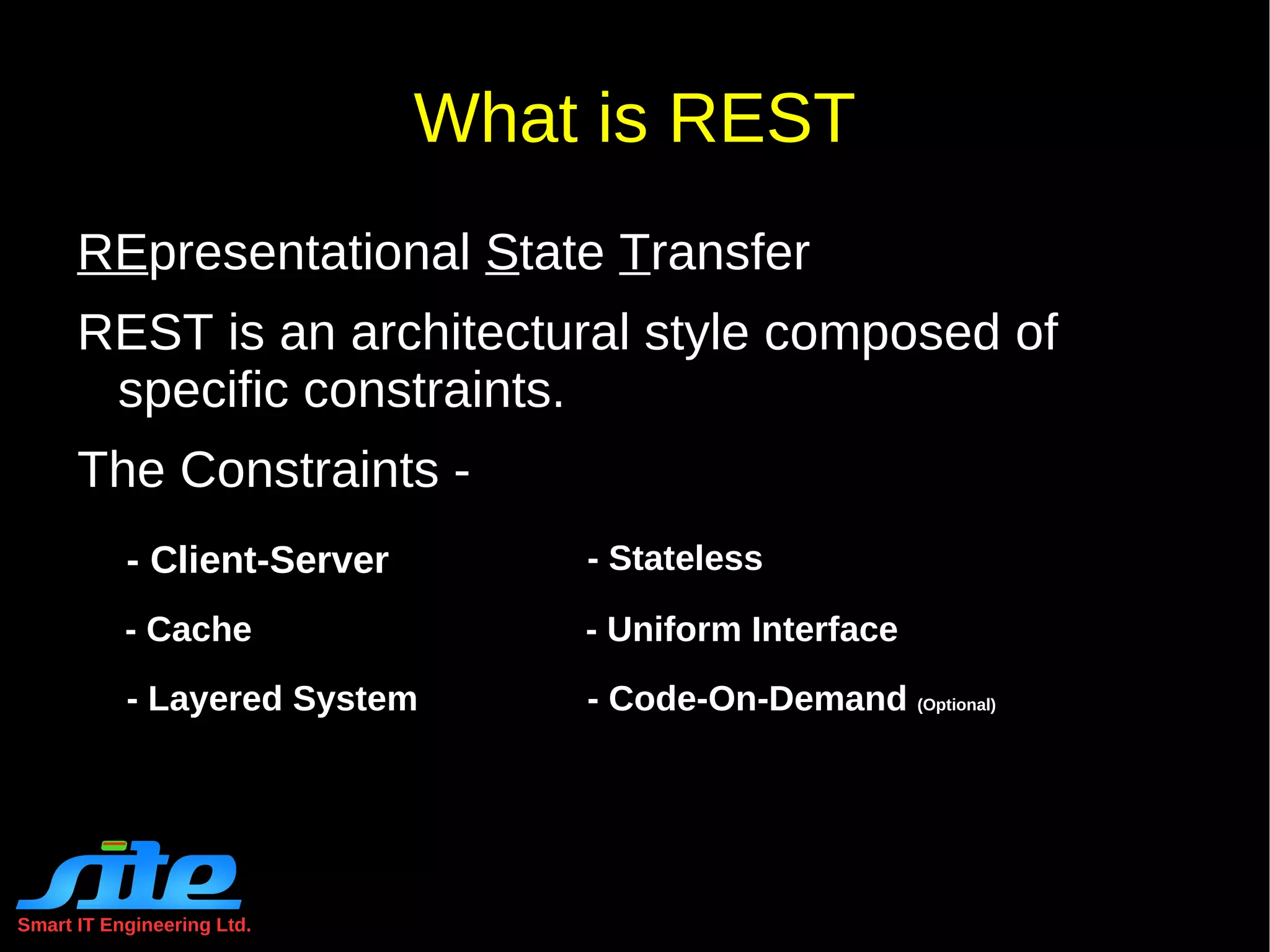
Smart IT Engineering Ltd. What is REST RE presentational  S tate  T ransfer
REST is an architectural style composed of specific constraints.
The Constraints -  - Client-Server - Stateless - Cache - Uniform Interface - Layered System - Code-On-Demand  (Optional)
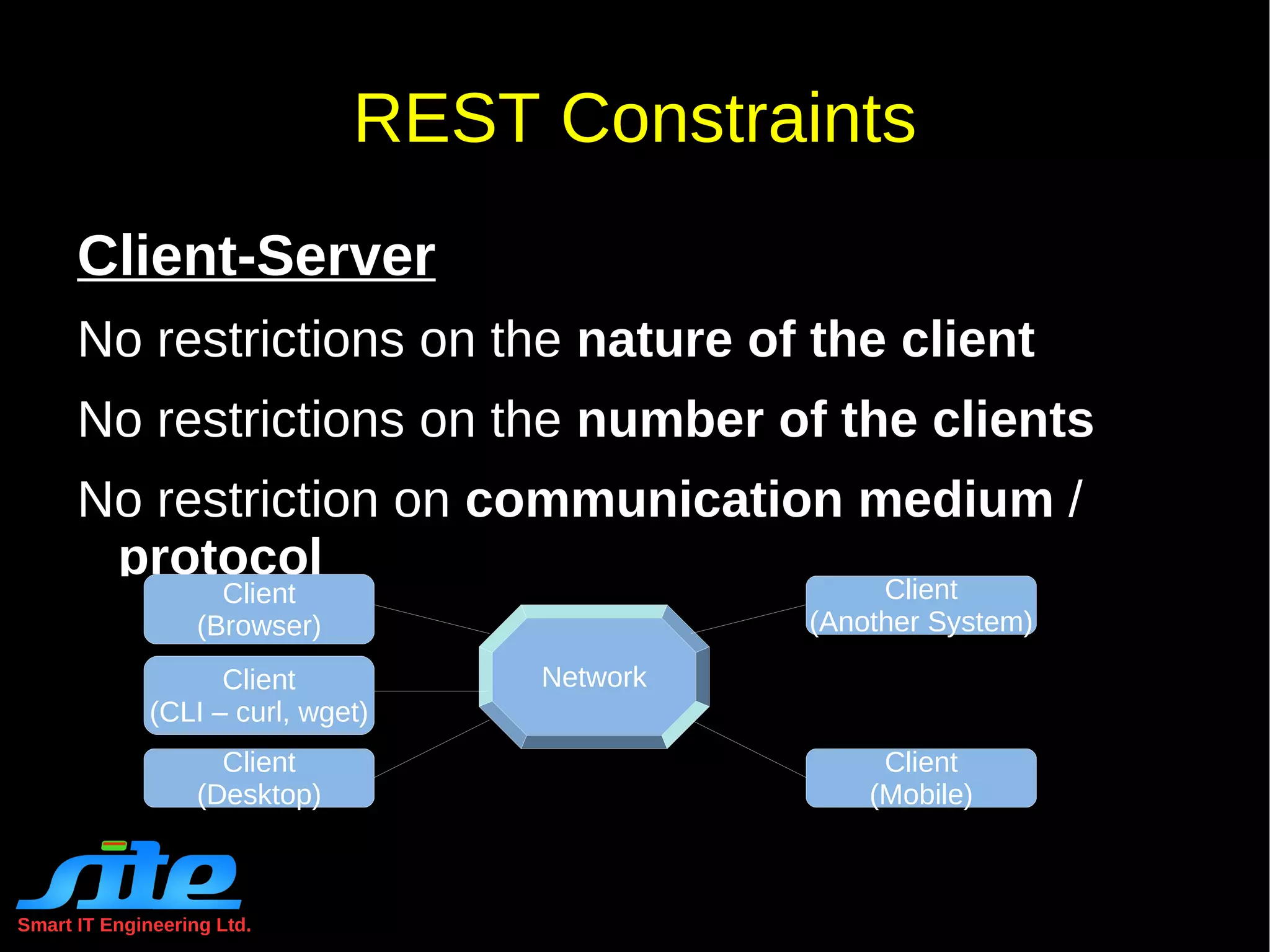
Smart IT Engineering Ltd. REST Constraints Client-Server No restrictions on the  nature of the client
No restrictions on the  number of the clients
No restriction on  communication medium  /  protocol Client (Browser) Client (CLI – curl, wget) Client (Desktop) Network Client (Mobile) Client (Another System)
Smart IT Engineering Ltd. REST Constraints Client-Server Separate data storage concerns
Improve user interface portability across multiple platforms
Improve scalability by simplifying server components
Components evolve independently
Smart IT Engineering Ltd. REST Constraints Stateless “ ... each request from client to server must contain all of the information necessary to understand the request, and cannot take advantage of any stored context on the server.” Advantages Visibility Reliability Scalability
Smart IT Engineering Ltd. REST Constraints Cache “ ...  the data within a response to a request be implicitly or explicitly labeled as cacheable or non-cacheable. If a response is cacheable, then a client cache is given the right to reuse that response data for later, equivalent requests.” Advantages Efficient Scalability Performance
Smart IT Engineering Ltd. REST Constraints Layered System The layered system style or also popularly referred to as n-layer system allows an architecture to be composed of hierarchical layers by constraining component behavior such that each component cannot "see" beyond the immediate layer with which they are interacting. Code-On-Demand Allows client functionality to be extended by downloading and executing code in the form of  applets  or  scripts . This simplifies clients by reducing the number of features required to be pre-implemented.
Smart IT Engineering Ltd. REST Constraints Uniform Interface Central distinguishing feature of REST Involves  four  constraints to define 'uniform interface' for REST systems. Identification of  resources
Manipulation of  resources  through representations
Self-descriptive messages
HATEOAS  ( H ypermedia  A s  T he  E ngine  O f  A pplication  S tate)
Smart IT Engineering Ltd. REST Constraints Uniform Interface - Resource Any  concept  that might be the target of an web-author's  hypertext reference  must fit within the definition of a resource.
A resource is a  conceptual mapping  to a  set of entities , not the entity that corresponds to the mapping at any particular point in time.
If compared of Object Oriented aproach,  Object  if  referrrable  is a resource.
Examples of resources would Books, A Book, An Author, Authors, Authors of a Book, A Publisher, Categories of a Book, A Category etc.
Smart IT Engineering Ltd. REST Constraints Uniform Interface – Representations & Messages A representation is a sequence of bytes describing a resource in a particular format.
Other  commonly used  but  less precise  names for a representation include: document, file, and HTTP message entity, instance, or variant.
Message consists of control data, metadata, messages and in some cases hyperlinks to resources.
Examples: Images (image/jpg, image/png, etc.), Markups (text/html, application/xml etc.) and more.
Smart IT Engineering Ltd. REST Constraints Uniform Interface – HATEOAS A hypermedia in each server response will contain links that correspond to all the actions that the client can currently perform.
Therefore, dependent on the current application state, every server response describes the new actions that are available.
The server can change the range of allowable responses in a dynamic way, and a client should adapt its behavior to these changes.
A client of a RESTful application need only know a  single fixed URL  to access it.
Smart IT Engineering Ltd. REST Constraints Uniform Interface – HATEOAS All future actions should be  discoverable dynamically  from  hypermedia  links included in the representations of the resources that are returned from that URL.
The link  relations  should be  standardized , so that the client knows what selecting that state transition means.
Standardized media types  are also expected to be understood by any client that might use the API.
Application state  transitions are driven  by a  combination of the known processing rules  for each media type, client selection from the server-provided choices in representations received, and the user's manipulation of those representations. Thus interactions are driven by  hypermedia .
Smart IT Engineering Ltd. REST What is the biggest known RESTful System on planet Earth?
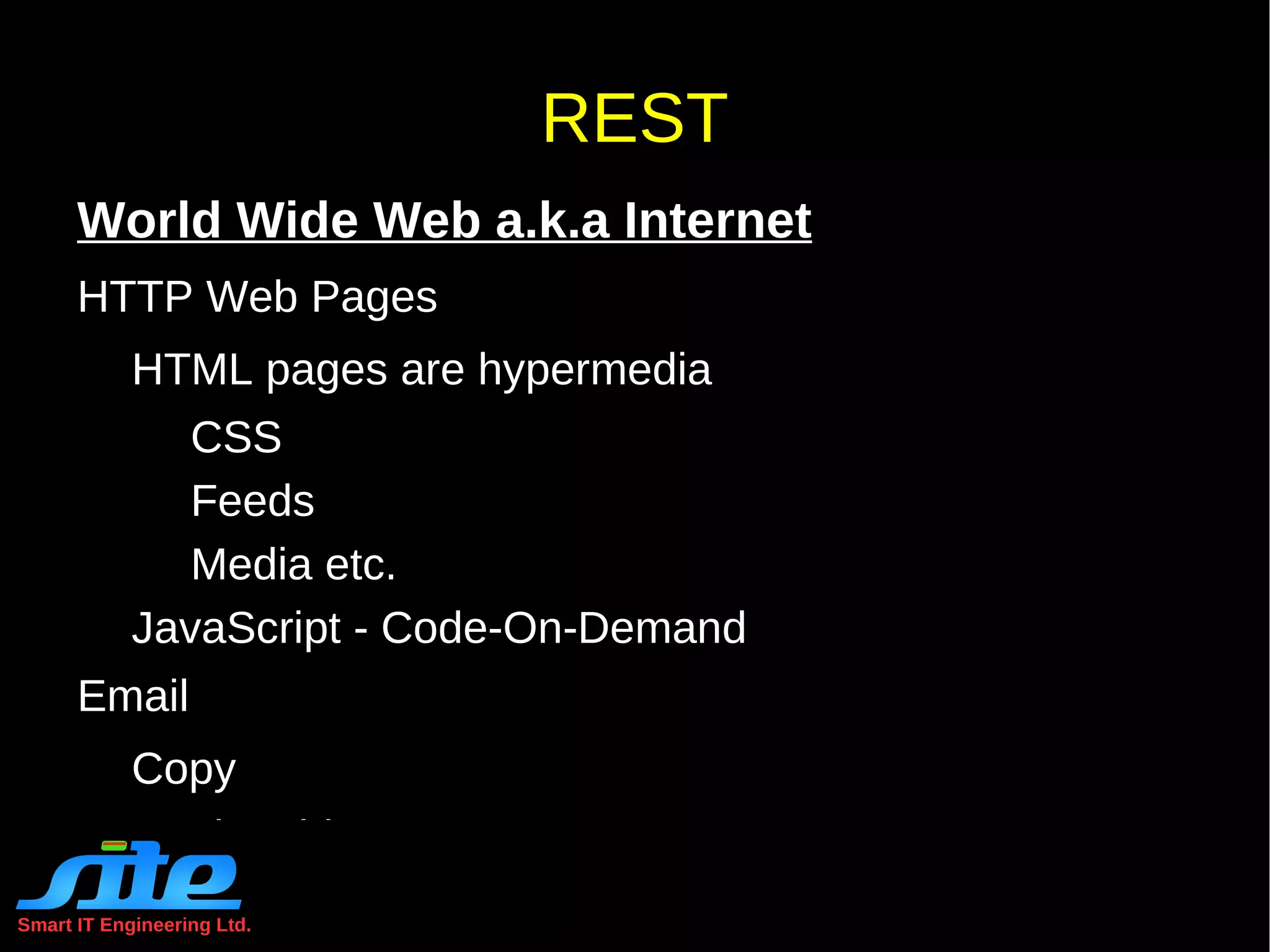
Smart IT Engineering Ltd. REST World Wide Web a.k.a Internet HTTP Web Pages HTML pages are hypermedia CSS

RESTful Web Services

  • 1.
    Smart IT EngineeringLtd. RESTful Web Services Imran M Yousuf Smart IT Engineering Ltd.
  • 2.
    Smart IT EngineeringLtd. What's not covered Comparison between various Web Service technologies
  • 3.
    Hands on tutorialon how code a RESTful WS
  • 4.
    Details of howHTTP works
  • 5.
    Details on variousmedia formats
  • 6.
    Smart IT EngineeringLtd. What to expect REST Definition
  • 7.
    Discussion on itsconstraints
  • 8.
    WWW RESTful WebService Resource Oriented Architecture (ROA)
  • 9.
  • 10.
  • 11.
    Smart IT EngineeringLtd. What to expect A Design Case Study
  • 12.
  • 13.
    Smart IT EngineeringLtd. What is REST RE presentational S tate T ransfer
  • 14.
    Proposed by Dr. Roy Thomas Fielding in his PhD dissertation titled - “Architectural Styles and the Design of Network-based Software Architectures”
  • 15.
    Smart IT EngineeringLtd. What is REST RE presentational S tate T ransfer
  • 16.
    REST is anarchitectural style composed of specific constraints.
  • 17.
    The Constraints - - Client-Server - Stateless - Cache - Uniform Interface - Layered System - Code-On-Demand (Optional)
  • 18.
    Smart IT EngineeringLtd. REST Constraints Client-Server No restrictions on the nature of the client
  • 19.
    No restrictions onthe number of the clients
  • 20.
    No restriction on communication medium / protocol Client (Browser) Client (CLI – curl, wget) Client (Desktop) Network Client (Mobile) Client (Another System)
  • 21.
    Smart IT EngineeringLtd. REST Constraints Client-Server Separate data storage concerns
  • 22.
    Improve user interfaceportability across multiple platforms
  • 23.
    Improve scalability bysimplifying server components
  • 24.
  • 25.
    Smart IT EngineeringLtd. REST Constraints Stateless “ ... each request from client to server must contain all of the information necessary to understand the request, and cannot take advantage of any stored context on the server.” Advantages Visibility Reliability Scalability
  • 26.
    Smart IT EngineeringLtd. REST Constraints Cache “ ... the data within a response to a request be implicitly or explicitly labeled as cacheable or non-cacheable. If a response is cacheable, then a client cache is given the right to reuse that response data for later, equivalent requests.” Advantages Efficient Scalability Performance
  • 27.
    Smart IT EngineeringLtd. REST Constraints Layered System The layered system style or also popularly referred to as n-layer system allows an architecture to be composed of hierarchical layers by constraining component behavior such that each component cannot "see" beyond the immediate layer with which they are interacting. Code-On-Demand Allows client functionality to be extended by downloading and executing code in the form of applets or scripts . This simplifies clients by reducing the number of features required to be pre-implemented.
  • 28.
    Smart IT EngineeringLtd. REST Constraints Uniform Interface Central distinguishing feature of REST Involves four constraints to define 'uniform interface' for REST systems. Identification of resources
  • 29.
    Manipulation of resources through representations
  • 30.
  • 31.
    HATEOAS (H ypermedia A s T he E ngine O f A pplication S tate)
  • 32.
    Smart IT EngineeringLtd. REST Constraints Uniform Interface - Resource Any concept that might be the target of an web-author's hypertext reference must fit within the definition of a resource.
  • 33.
    A resource isa conceptual mapping to a set of entities , not the entity that corresponds to the mapping at any particular point in time.
  • 34.
    If compared ofObject Oriented aproach, Object if referrrable is a resource.
  • 35.
    Examples of resourceswould Books, A Book, An Author, Authors, Authors of a Book, A Publisher, Categories of a Book, A Category etc.
  • 36.
    Smart IT EngineeringLtd. REST Constraints Uniform Interface – Representations & Messages A representation is a sequence of bytes describing a resource in a particular format.
  • 37.
    Other commonlyused but less precise names for a representation include: document, file, and HTTP message entity, instance, or variant.
  • 38.
    Message consists ofcontrol data, metadata, messages and in some cases hyperlinks to resources.
  • 39.
    Examples: Images (image/jpg,image/png, etc.), Markups (text/html, application/xml etc.) and more.
  • 40.
    Smart IT EngineeringLtd. REST Constraints Uniform Interface – HATEOAS A hypermedia in each server response will contain links that correspond to all the actions that the client can currently perform.
  • 41.
    Therefore, dependent onthe current application state, every server response describes the new actions that are available.
  • 42.
    The server canchange the range of allowable responses in a dynamic way, and a client should adapt its behavior to these changes.
  • 43.
    A client ofa RESTful application need only know a single fixed URL to access it.
  • 44.
    Smart IT EngineeringLtd. REST Constraints Uniform Interface – HATEOAS All future actions should be discoverable dynamically from hypermedia links included in the representations of the resources that are returned from that URL.
  • 45.
    The link relations should be standardized , so that the client knows what selecting that state transition means.
  • 46.
    Standardized media types are also expected to be understood by any client that might use the API.
  • 47.
    Application state transitions are driven by a combination of the known processing rules for each media type, client selection from the server-provided choices in representations received, and the user's manipulation of those representations. Thus interactions are driven by hypermedia .
  • 48.
    Smart IT EngineeringLtd. REST What is the biggest known RESTful System on planet Earth?
  • 49.
    Smart IT EngineeringLtd. REST World Wide Web a.k.a Internet HTTP Web Pages HTML pages are hypermedia CSS
  • 50.
  • 51.
    Media etc. JavaScript- Code-On-Demand Email Copy
  • 52.
  • 53.
  • 54.
    Smart IT EngineeringLtd. REST Questions?
  • 55.
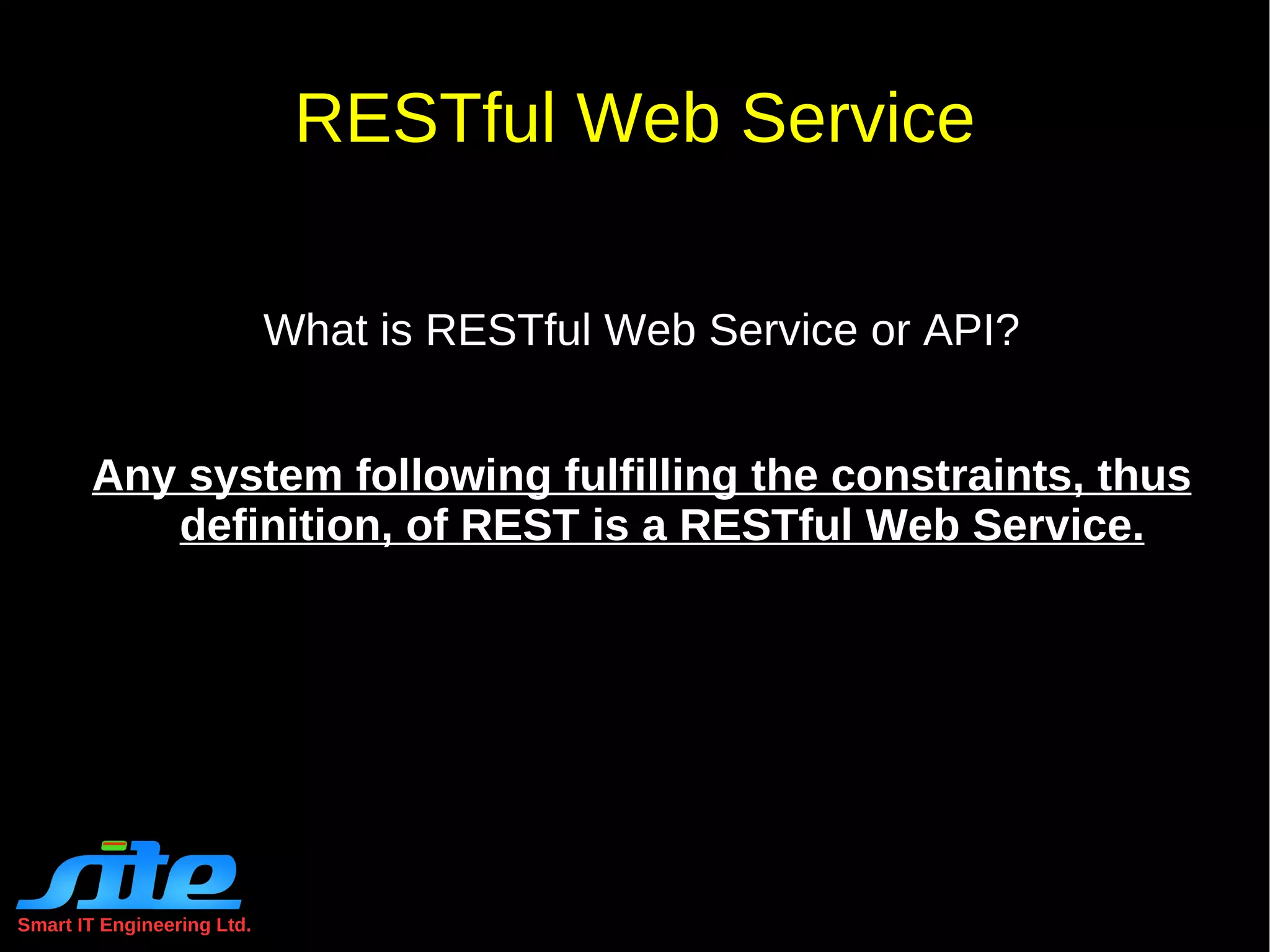
    Smart IT EngineeringLtd. RESTful Web Service What is RESTful Web Service or API? Any system following fulfilling the constraints, thus definition, of REST is a RESTful Web Service.
  • 56.
    Smart IT EngineeringLtd. RESTful Web Service RESTful Web Service system communicates over HTTP protocol
  • 57.
    RESTful Web Servicedesign and architecture grows around resource .
  • 58.
    All WWW sitesare inherently REST-like and can easily be RESTful hence RESTful Web Service; e.g. Google Search Engine.
  • 59.
    Web Service notonly consists of either HTML markups, CSS and JavaScript, or other media formats, but may consist both
  • 60.
    Smart IT EngineeringLtd. Resource Oriented Architecture Introduced in the book “RESTful Web Services”
  • 61.
    Resource-Oriented Architecture isabout REST-ful system with the technologies of the Web
  • 62.
    Smart IT EngineeringLtd. ROA - Resource A Resource is anything, a concept, that is worth having a URI to linked to. E.g. http://basis.com.bd/softexpo/2011/
  • 63.
    A URI isa name and address of a resource.
  • 64.
    A Resource mayhave many URIs but needs to have at least one .
  • 65.
    A Resource mayhave one or more representations; i.e. it may not have any representations at all.
  • 66.
    Smart IT EngineeringLtd. ROA - Resource Having a nice URI is not mendatory as in REST clients do not form URIs rather discover them. So it is indifferent to have basis.com.bd/softexpo/2011/ instead of basis.com.bd/abc/def as long as they name and address the same resource.
  • 67.
    It does nothurt to have readable URIs
  • 68.
    If Resource hasmultiple variants, i.e. combination of media format (atom xml, html etc.), encoding (ASCII, UTF-8 etc.) and language (en-US, bn etc.), besides supporting content negotiation, URI for each variant is beneficial for external linking.
  • 69.
    Smart IT EngineeringLtd. ROA - Resource HTTP Hints Content negotiation for representation in HTTP is done through request headers – Accept, Accept-Encoding, Accept-Language
  • 70.
    Use Vary header in response in case a URI support multiple representations
  • 71.
    Use Location header in response to specify the exact URI to the variant in case of nice URIs.
  • 72.
    Smart IT EngineeringLtd. ROA - Features Key Features of ROA Addressability
  • 73.
  • 74.
    Links & ConnectednessThe Uniform Interface
  • 75.
  • 76.
    Smart IT EngineeringLtd. ROA - Addressability If an application exposes all conceivable or interesting aspects of its data set as resources then it is addressable.
  • 77.
    IOW an addressableapplication exposes URI for every bit of information it can conceivably serve
  • 78.
    This usually refersto infinite URIs
  • 79.
    Consider a searchresource, e.g. Google Search, A paginated atom feed of all books of a bookstore etc.
  • 80.
    Smart IT EngineeringLtd. ROA - Statelessnes Same as that of REST
  • 81.
    Introducing Application Stateand Resource State.
  • 82.
    Application State resideson client side ensuring every request can be treated individually by the server without considering the past requests from the client
  • 83.
    Resource State isdata that makes up the resource. It resides server side and in case of write-able resource can be modified through its representation
  • 84.
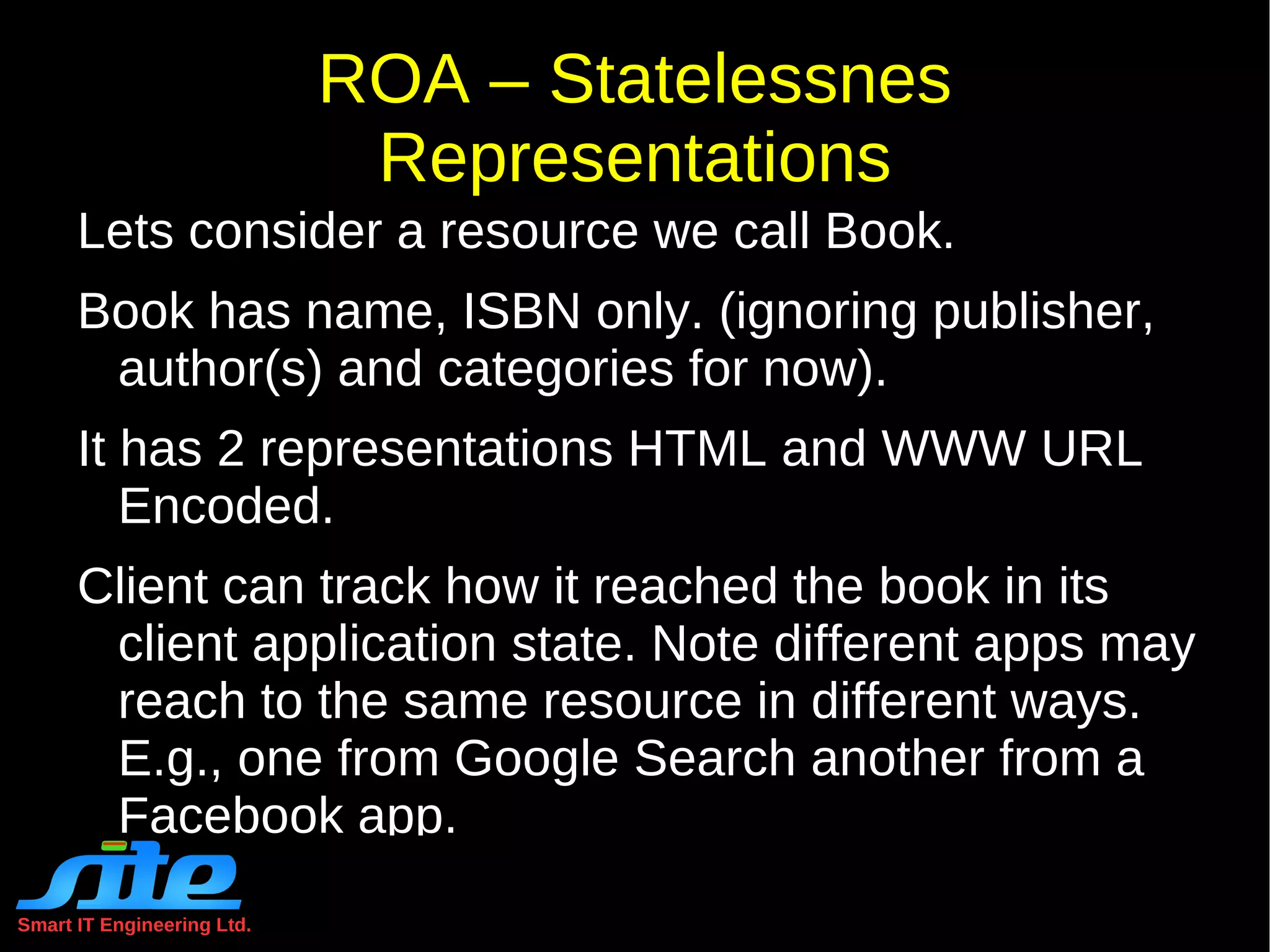
    Smart IT EngineeringLtd. ROA – Statelessnes Representations Lets consider a resource we call Book.
  • 85.
    Book has name,ISBN only. (ignoring publisher, author(s) and categories for now).
  • 86.
    It has 2representations HTML and WWW URL Encoded.
  • 87.
    Client can trackhow it reached the book in its client application state. Note different apps may reach to the same resource in different ways. E.g., one from Google Search another from a Facebook app.
  • 88.
    The resource state,i.e. the current name and ISBN resides on the server side and is indifferent for any client.
  • 89.
    Clients receive therepresentations of the resource and provides the server with the same to edit its information.
  • 90.
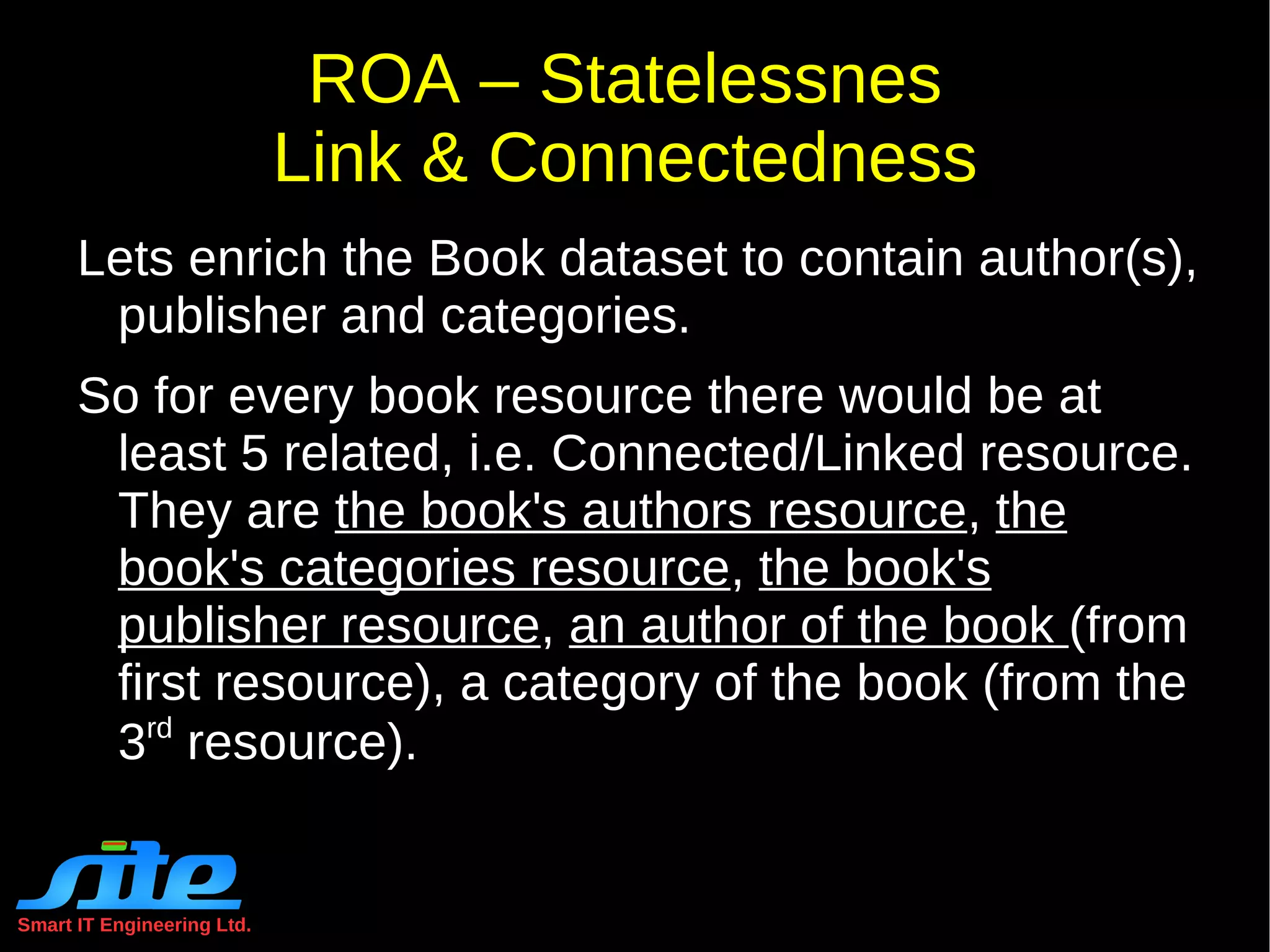
    Smart IT EngineeringLtd. ROA – Statelessnes Link & Connectedness Lets enrich the Book dataset to contain author(s), publisher and categories.
  • 91.
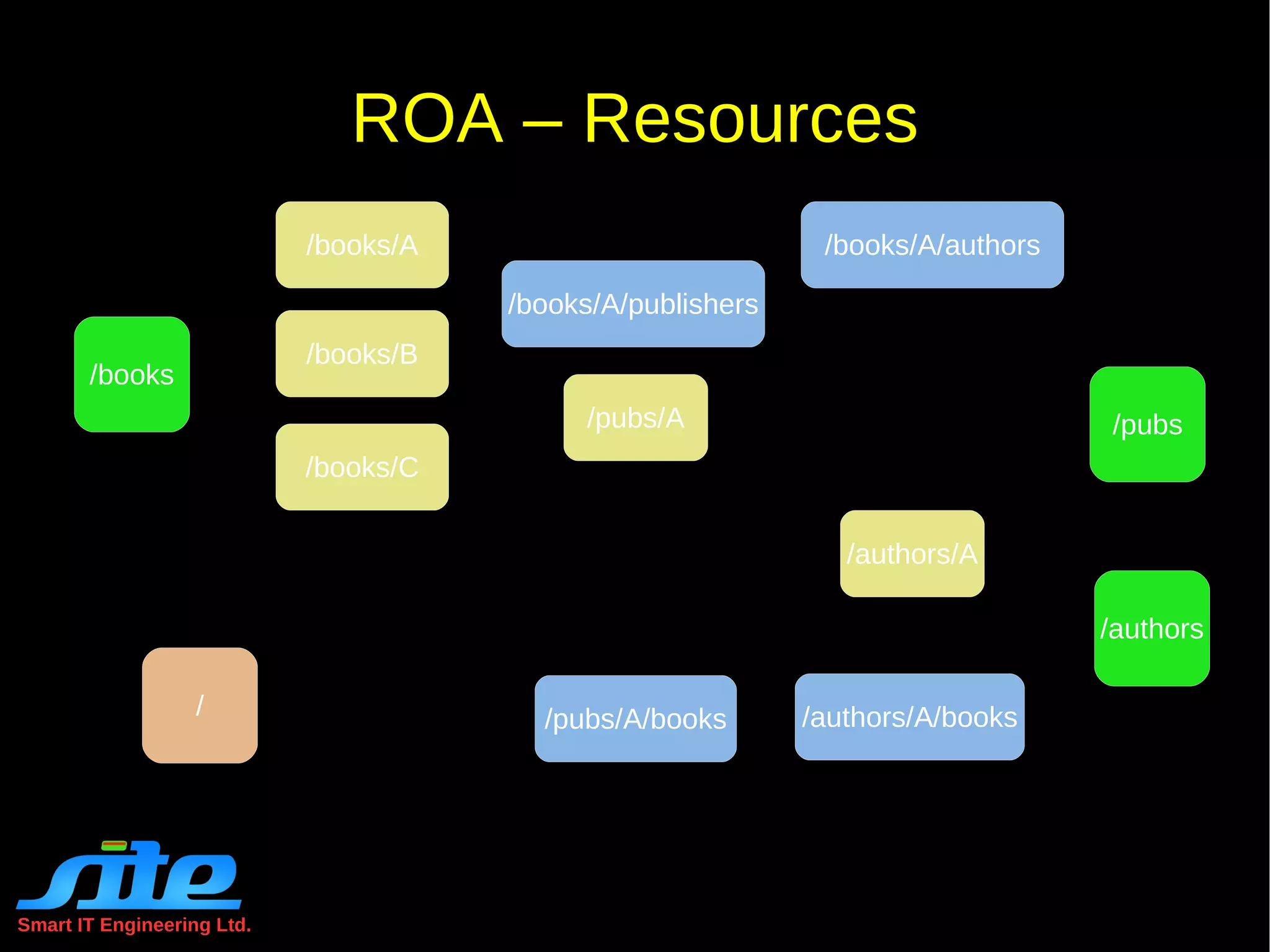
    So for everybook resource there would be at least 5 related, i.e. Connected/Linked resource. They are the book's authors resource , the book's categories resource , the book's publisher resource , an author of the book (from first resource), a category of the book (from the 3 rd resource).
  • 92.
    Smart IT EngineeringLtd. ROA – Resources /books /books/A /books/B /books/C /books/A/authors /books/A/publishers /pubs/A /authors/A /pubs/A/books /authors/A/books /pubs /authors /
  • 93.
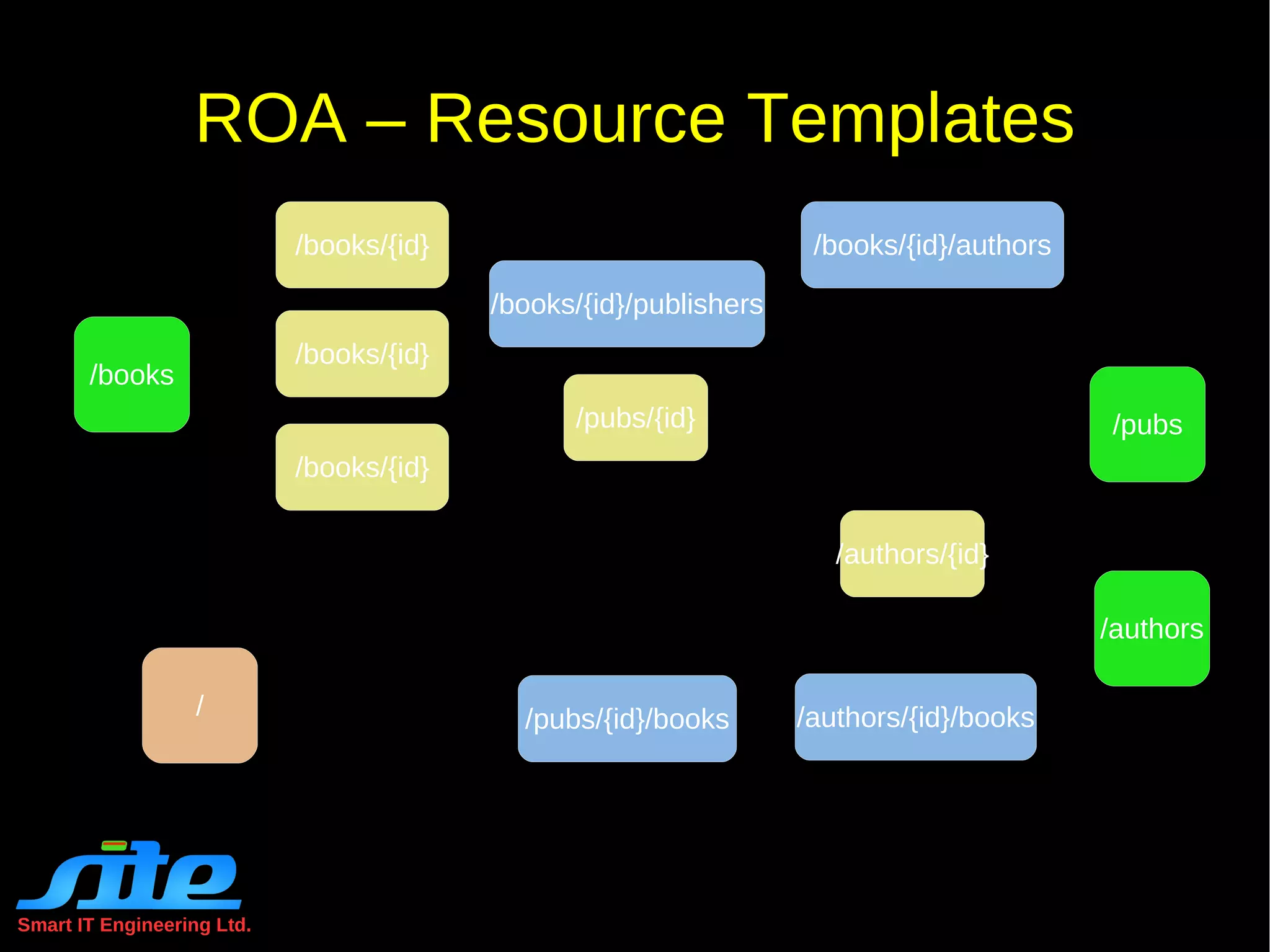
    Smart IT EngineeringLtd. ROA – Resource Templates /books /books/{id} /books/{id} /books/{id} /books/{id}/authors /books/{id}/publishers /pubs/{id} /authors/{id} /pubs/{id}/books /authors/{id}/books /pubs /authors /
  • 94.
    Smart IT EngineeringLtd. ROA – The Uniform Interface Specifies the generic definition of Uniform Interface from REST
  • 95.
    The specifics arein context to HTTP
  • 96.
    It basically followsthe HTTP specification, does not change any definition but restricts on some of the operations usually performed
  • 97.
    IMPORTANT –It remains same across all RESTful WS Providers, reducing learning curve.
  • 98.
    Smart IT EngineeringLtd. ROA – The Uniform Interface Methods GET – To read resources. Query parameters can be used to restrict the scope of the data set
  • 99.
    PUT – To create a resource if the URI is known or replace (completely) the current state of the resource
  • 100.
    DELETE – Delete the current resource. Might not actually physically delete the data just change the state.
  • 101.
    Smart IT EngineeringLtd. ROA – The Uniform Interface Methods POST – Has multiple functions Create sub-ordinate resource
  • 102.
    Append state data to current resource, i.e. partially update the state of the resource
  • 103.
    Submit data tosome background process, e.g. POST to search data. The first 2 are uniform but the last is not and is advisable to avoid
  • 104.
    In overloading POSTwith 2 ops one should consider breaking the resource to avoid overloading.
  • 105.
    Smart IT EngineeringLtd. ROA – The Uniform Interface Headers For pre-condition based locking Entity Tag – ETag & If-Match
  • 106.
    Last Modified Date– Last-Modified & If-Unmodified-Since
  • 107.
    Implementation specific Clientside caching Last Modified Date & Entity Tag for conditional GET using If-Modified-Since and If-None-Match
  • 108.
    Cache-Control headerfor controlling cache
  • 109.
    Use Vary to support variants. Use Location to redirect or point to the permanent URI
  • 110.
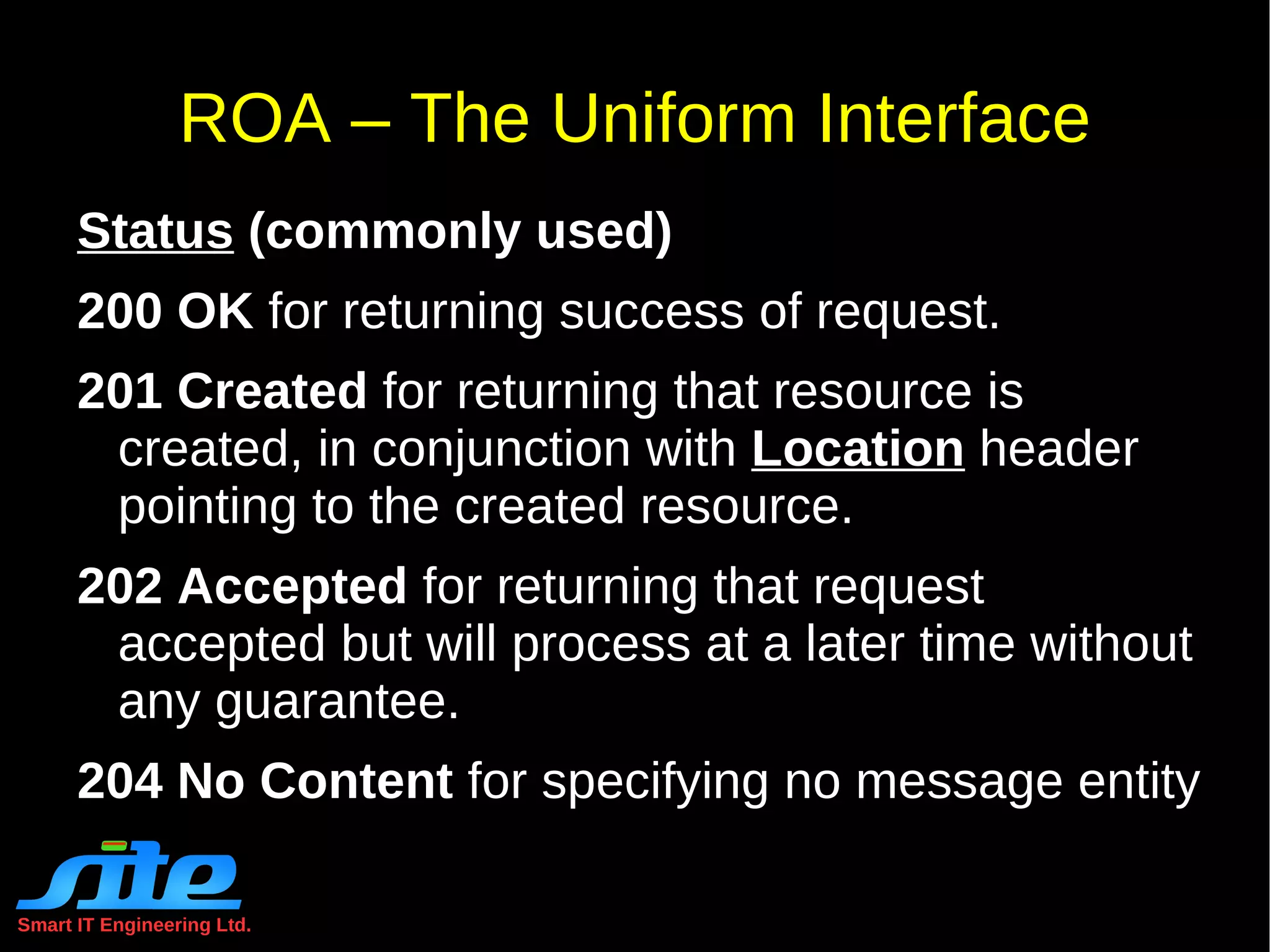
    Smart IT EngineeringLtd. ROA – The Uniform Interface Status (commonly used) 200 OK for returning success of request.
  • 111.
    201 Created for returning that resource is created, in conjunction with Location header pointing to the created resource.
  • 112.
    202 Accepted for returning that request accepted but will process at a later time without any guarantee.
  • 113.
    204 No Content for specifying no message entity
  • 114.
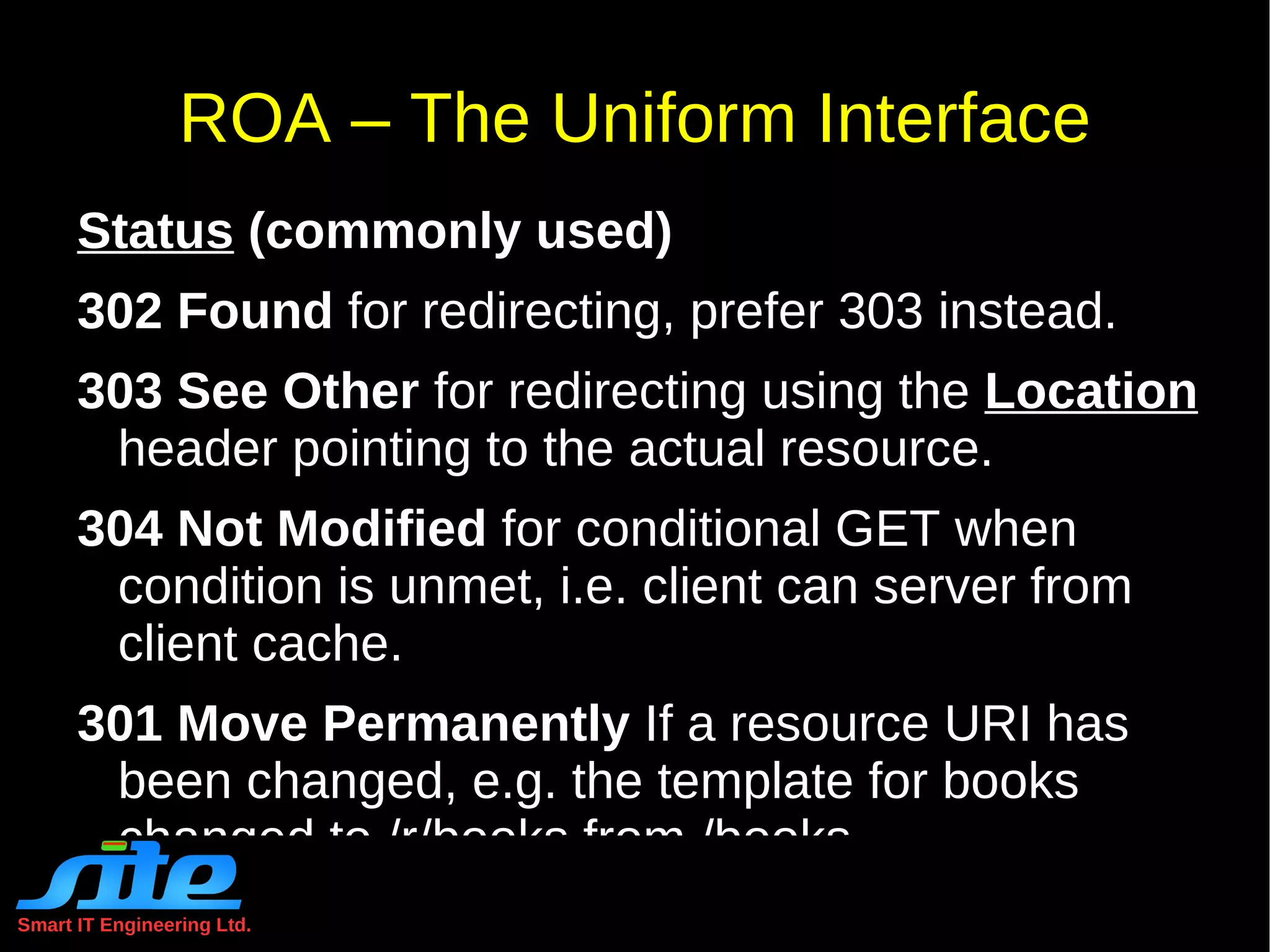
    Smart IT EngineeringLtd. ROA – The Uniform Interface Status (commonly used) 302 Found for redirecting, prefer 303 instead.
  • 115.
    303 See Other for redirecting using the Location header pointing to the actual resource.
  • 116.
    304 Not Modified for conditional GET when condition is unmet, i.e. client can server from client cache.
  • 117.
    301 Move Permanently If a resource URI has been changed, e.g. the template for books changed to /r/books from /books.
  • 118.
    Smart IT EngineeringLtd. ROA – The Uniform Interface Status (commonly used) 400 Bad Request when request information is sufficient to process the data, e.g. required field of an HTML Form is missing.
  • 119.
    401 Unauthorized and 403 Forbidden for authentication and authorization failures respectively.
  • 120.
    404 Not Found for not being able to resolve the URI to a resuorce.
  • 121.
    406 Not Acceptable If none variants requested can be served by the server
  • 122.
    412 Preconditioned Failed if the conditions in request not met. Useful lock like feature in case of updates.
  • 123.
    415 Unsupported MediaType when request entity is not recognized by server for processing.
  • 124.
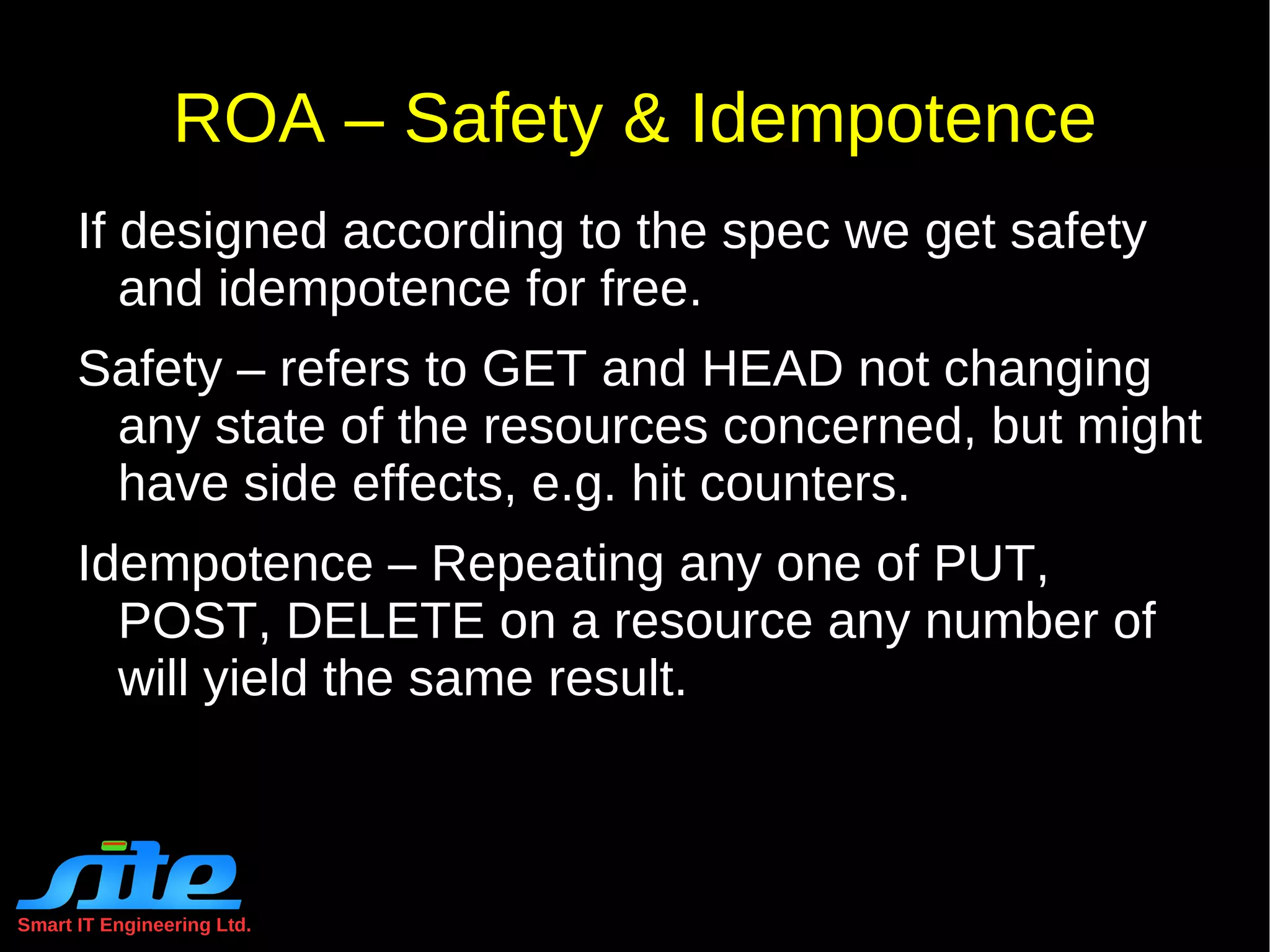
    Smart IT EngineeringLtd. ROA – Safety & Idempotence If designed according to the spec we get safety and idempotence for free.
  • 125.
    Safety – refersto GET and HEAD not changing any state of the resources concerned, but might have side effects, e.g. hit counters.
  • 126.
    Idempotence – Repeatingany one of PUT, POST, DELETE on a resource any number of will yield the same result.
  • 127.
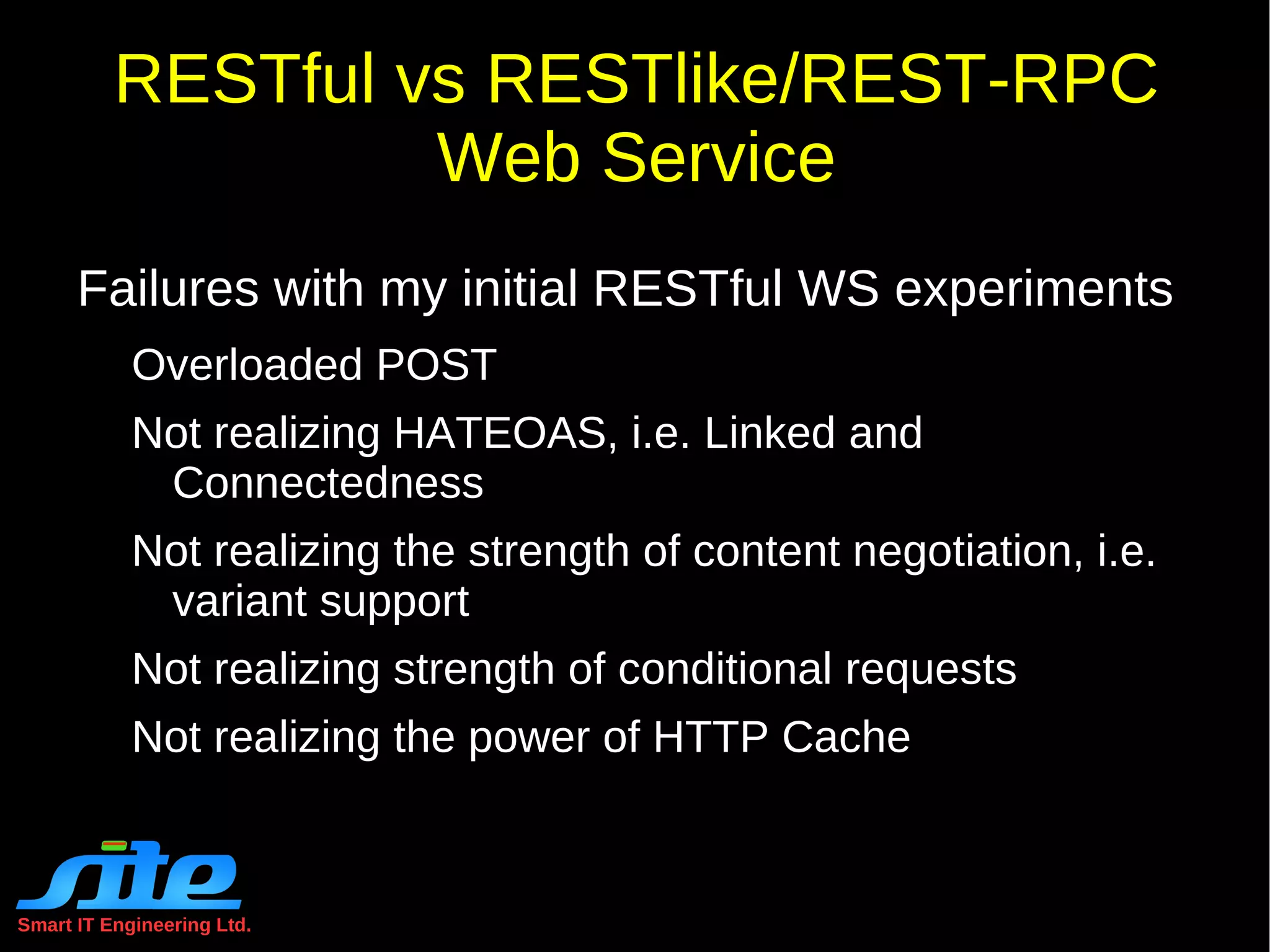
    Smart IT EngineeringLtd. RESTful vs RESTlike/REST-RPC Web Service Failures with my initial RESTful WS experiments Overloaded POST
  • 128.
    Not realizing HATEOAS,i.e. Linked and Connectedness
  • 129.
    Not realizing thestrength of content negotiation, i.e. variant support
  • 130.
    Not realizing strengthof conditional requests
  • 131.
    Not realizing thepower of HTTP Cache
  • 132.
    Smart IT EngineeringLtd. RESTful Web Services & ROA Questions?
  • 133.
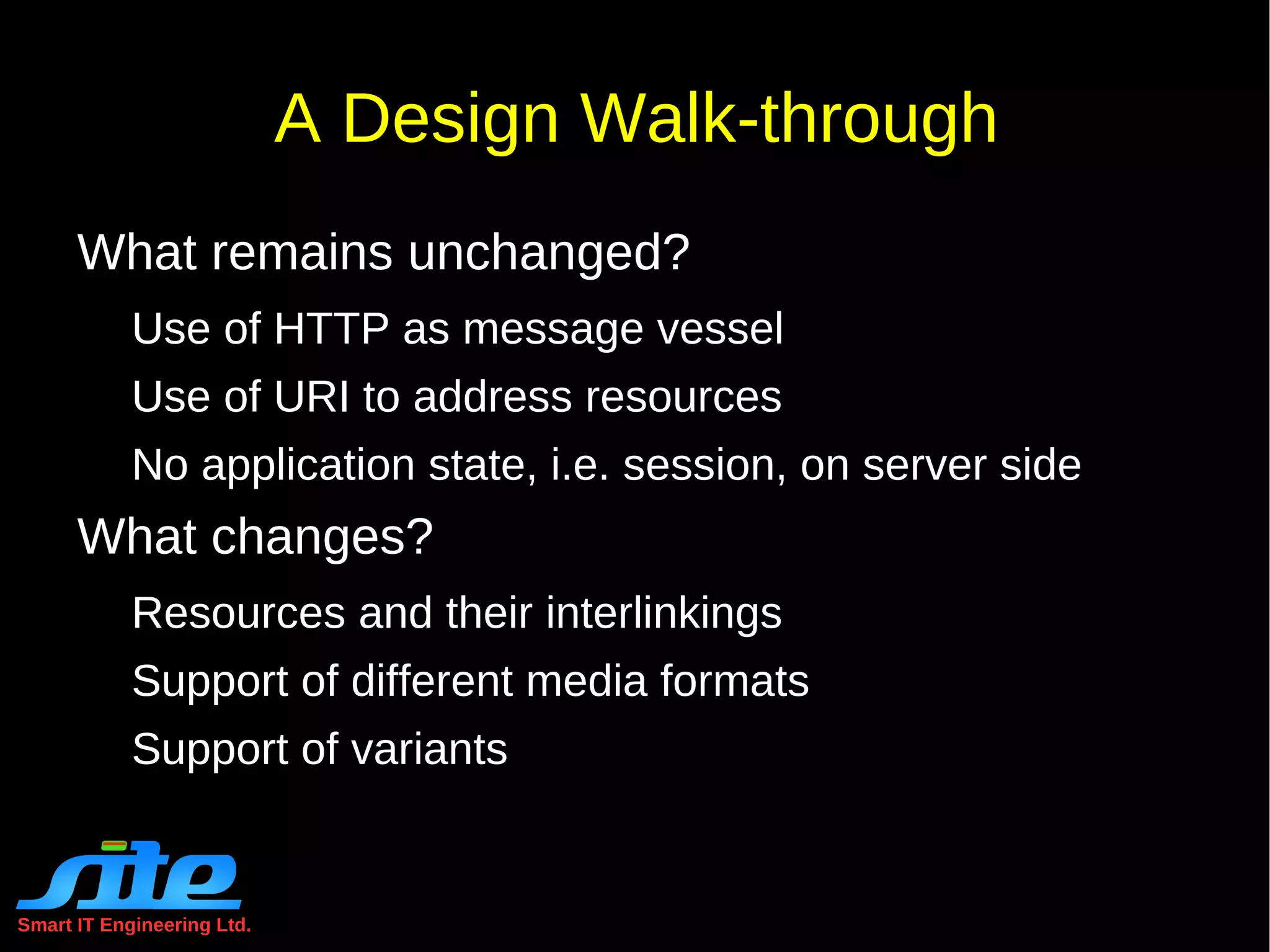
    Smart IT EngineeringLtd. A Design Walk-through What remains unchanged? Use of HTTP as message vessel
  • 134.
    Use of URIto address resources
  • 135.
    No application state,i.e. session, on server side What changes? Resources and their interlinkings
  • 136.
    Support of differentmedia formats
  • 137.
  • 138.
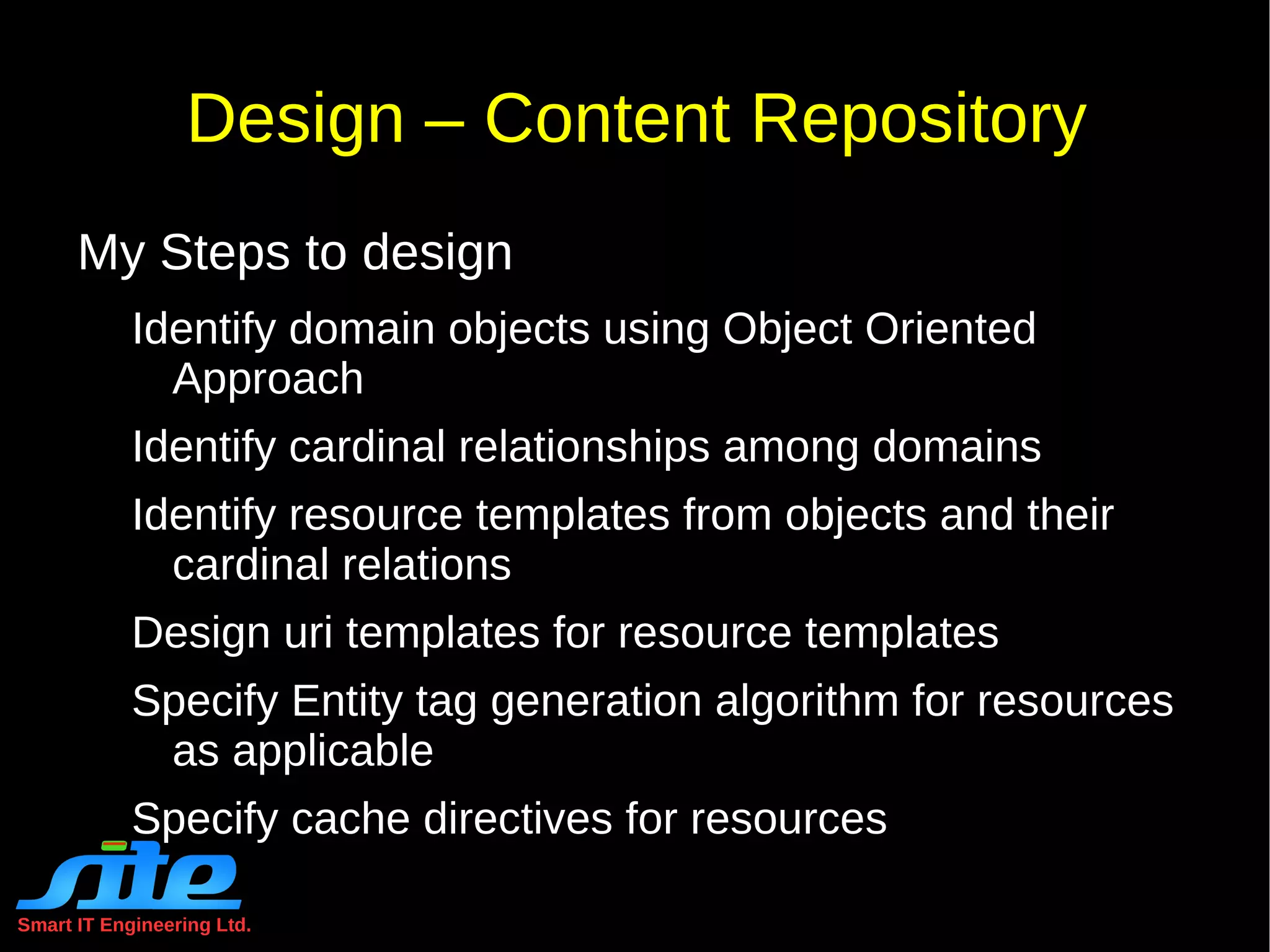
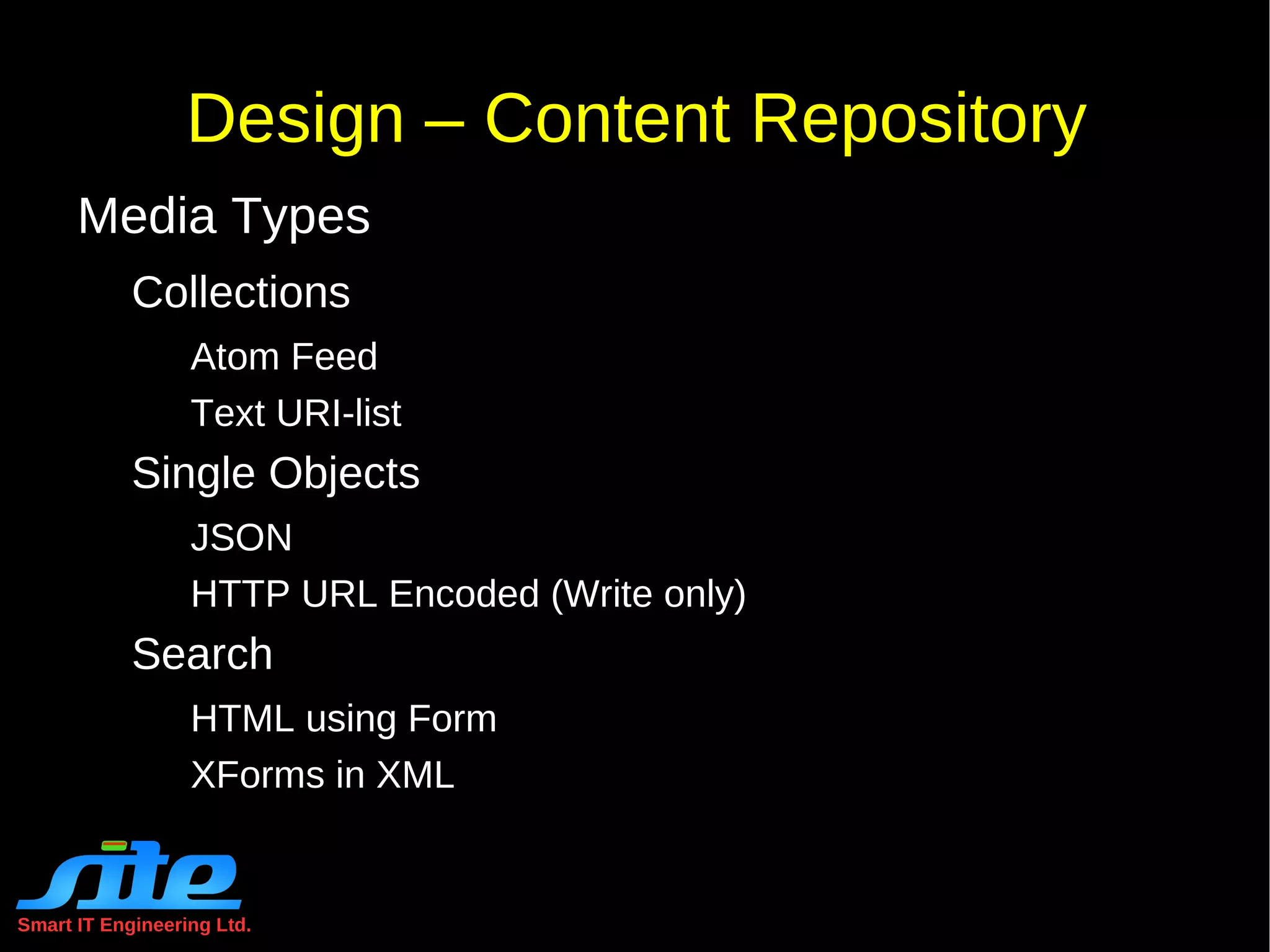
    Smart IT EngineeringLtd. Design – Content Repository My Steps to design Identify domain objects using Object Oriented Approach
  • 139.
  • 140.
    Identify resource templatesfrom objects and their cardinal relations
  • 141.
    Design uri templatesfor resource templates
  • 142.
    Specify Entity taggeneration algorithm for resources as applicable
  • 143.
  • 144.
    Choose supporting mediatypes for resources
  • 145.
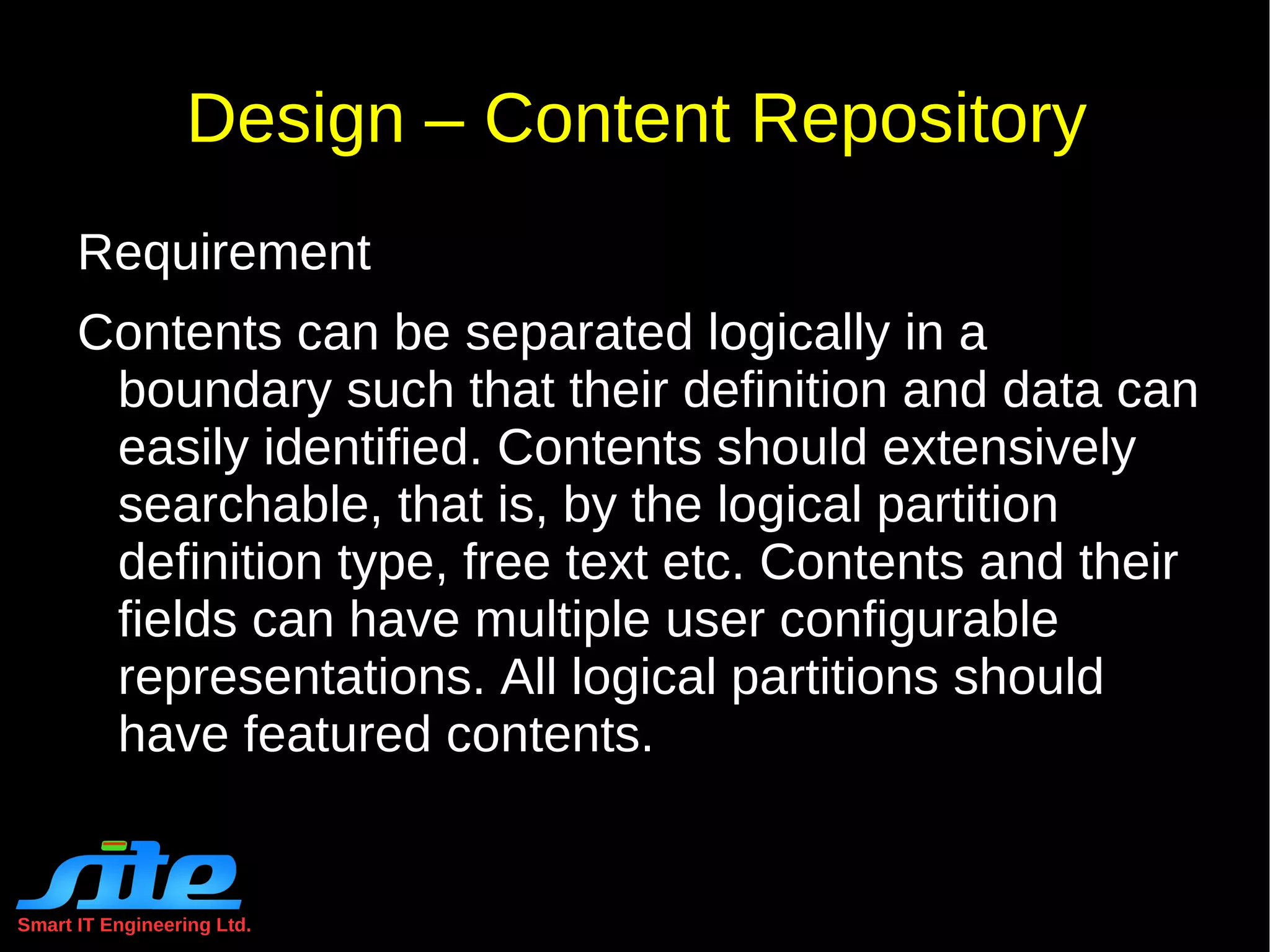
    Smart IT EngineeringLtd. Design – Content Repository Requirement
  • 146.
    Contents can beseparated logically in a boundary such that their definition and data can easily identified. Contents should extensively searchable, that is, by the logical partition definition type, free text etc. Contents and their fields can have multiple user configurable representations. All logical partitions should have featured contents.
  • 147.
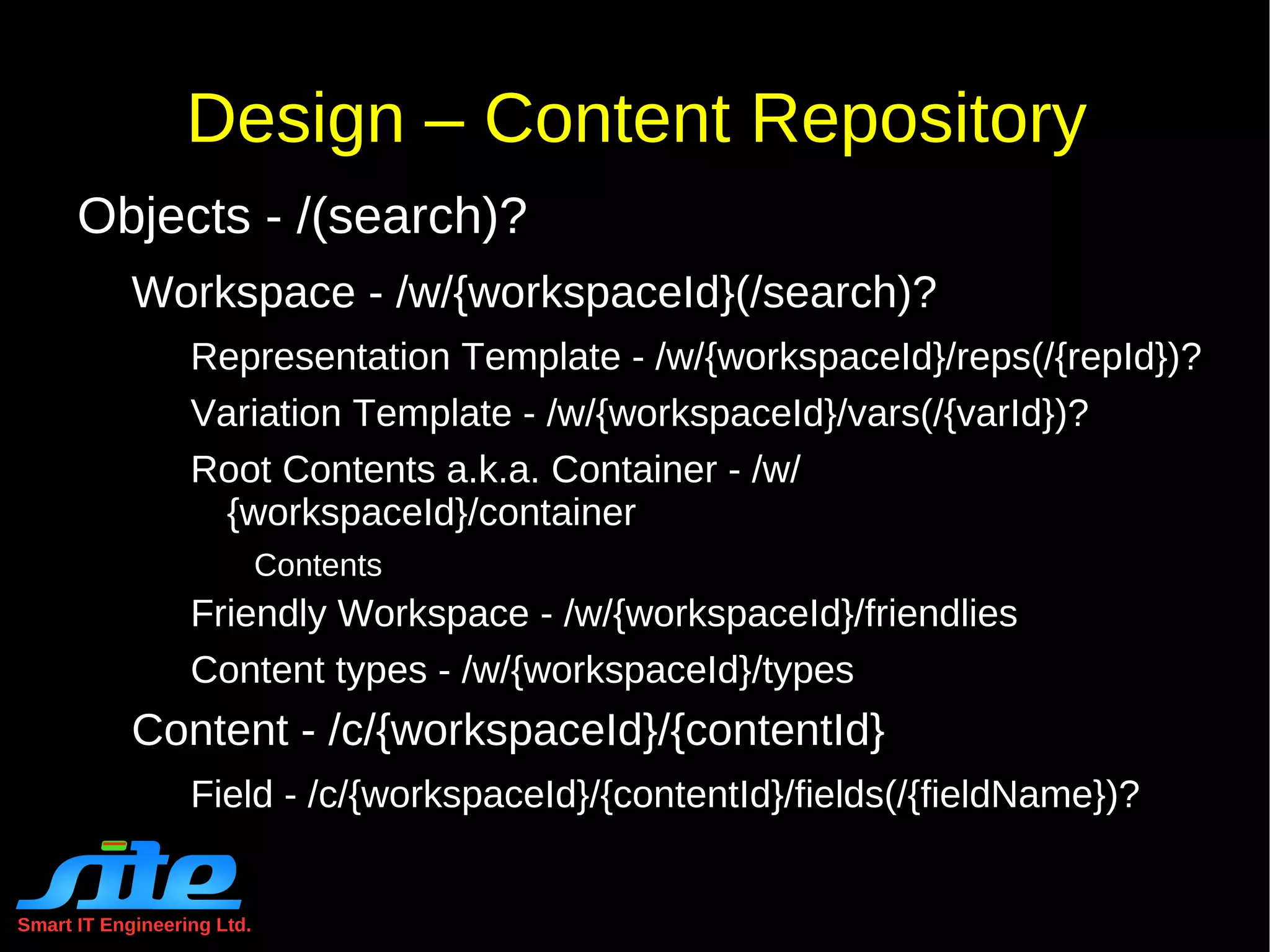
    Smart IT EngineeringLtd. Design – Content Repository Objects - /(search)? Workspace - /w/{workspaceId}(/search)? Representation Template - /w/{workspaceId}/reps(/{repId})?
  • 148.
    Variation Template -/w/{workspaceId}/vars(/{varId})?
  • 149.
    Root Contents a.k.a.Container - /w/{workspaceId}/container Contents Friendly Workspace - /w/{workspaceId}/friendlies
  • 150.
    Content types -/w/{workspaceId}/types Content - /c/{workspaceId}/{contentId} Field - /c/{workspaceId}/{contentId}/fields(/{fieldName})? Variation - /c/{workspaceId}/{contentId}/fields/{fieldName}/{varId} Representation - /c/{workspaceId}/{contentId}/fields(/{repId})? Content Type -/t/{workspaceId}/{contentTypeId}(/search)?
  • 151.
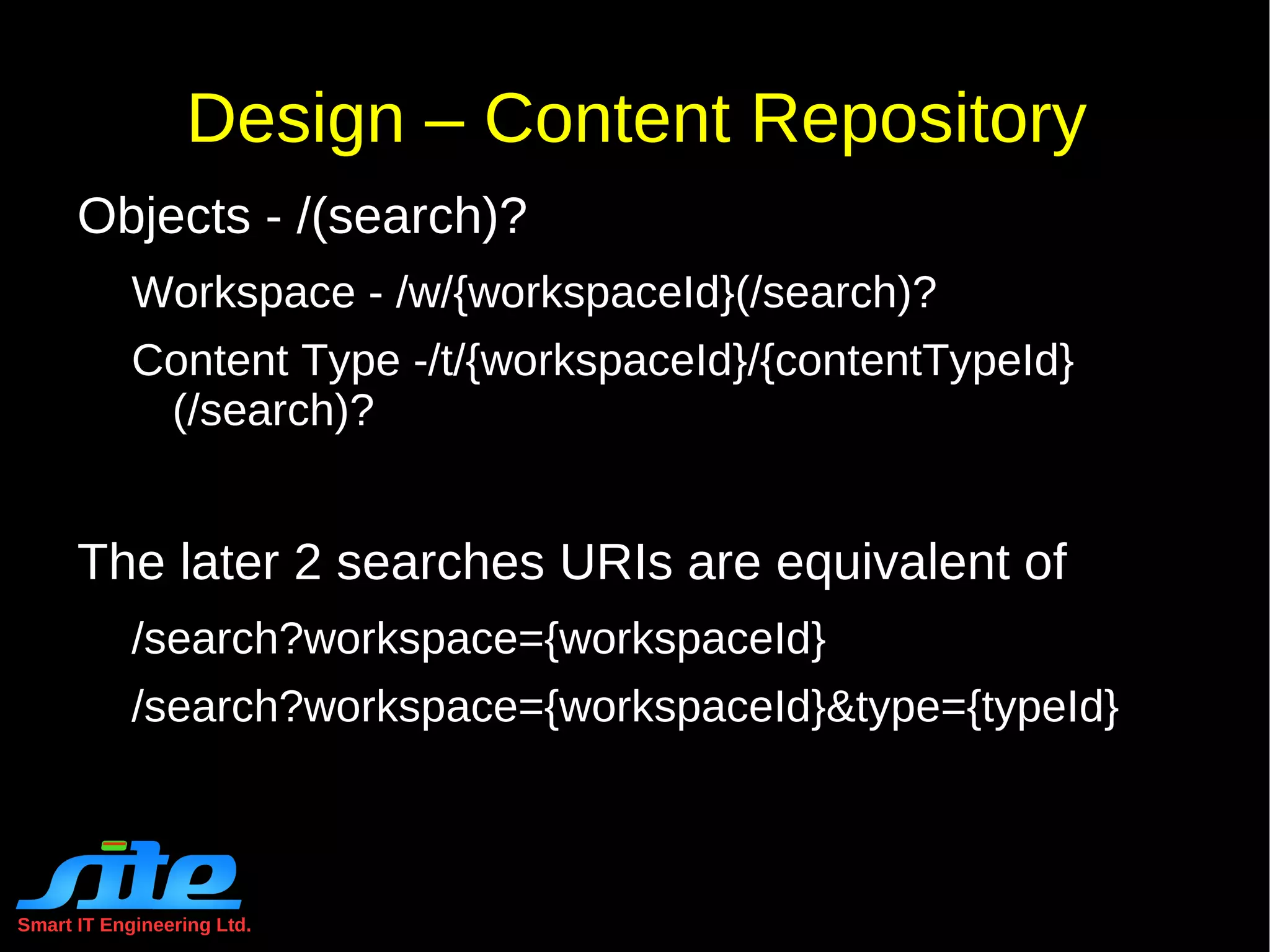
    Smart IT EngineeringLtd. Design – Content Repository Objects - /(search)? Workspace - /w/{workspaceId}(/search)?
  • 152.
    Content Type -/t/{workspaceId}/{contentTypeId}(/search)?The later 2 searches URIs are equivalent of /search?workspace={workspaceId}
  • 153.
  • 154.
    Smart IT EngineeringLtd. Design – Content Repository Media Types Collections Atom Feed
  • 155.
  • 156.
    HTTP URL Encoded(Write only) Search HTML using Form
  • 157.
  • 158.
    Open Search Description(my only preference)
  • 159.
    Smart IT EngineeringLtd. Design Questions? [email_address]