Green Building Strategies
These slides are part of a free webcast from restaurant development + design
Magazine.
Go to Slide 9 for a link to the webcast, if it’s still available on demand.
Today’s Objectives
Define what green building means in today’s
restaurant industry.
Explore the impact of LEED and other certification
processes.
Discuss how to make informed decisions when trying
to go green.
Answer your questions!
Meet Our Panelists
John Herth
Dunkin’ Brands
Steve Starr
Starrdesign
Joe Vajda
Aria Group Architects
Discover EcoSmart Cooking
The only energy management suite engineered specifically for foodservice.
Learn more at www.frankeamericas.com
Find out more at
RustbeltReclamation.com
trimarkusa.com
For complete details about this webcast visit:
http://rddmag.com/greenbuilding
Defining Green Building
 Minimize the environmental impact during construction and the
operation of the building.
 Accomplish this during the design phase.
 Includes the surrounding areas.
Restaurants Are Starting to Respond
 Restaurants are very energy-intensive businesses
 Supermarkets have been the leaders in sustainable design
 Shorter horizons make restaurants resistant to implementing certain
technologies, practices
Achievement in Sustainable Buildings
One Company’s Approach to Green Building
DD Green Achievement is a certification
specifically designed for a new Dunkin’
Donuts location to further encourage, assist
and promote a measurable level of
sustainability and energy efficiency.
It’s optional, not required.
Defining DD Green Achievement
DD Green
All requirements met
12 additional strategy points
DD Green Elite
All requirements met
20 optional strategy points
Defining DD Green Achievement
 Site Development
(2) Requirements
(6) Optional Strategies
 Store Efficiency
(3) Requirements
(8) Optional Strategies
 Healthy Indoors
(2) Requirements
(3) Optional Strategies
 Sustainable Operations
(3) Requirements
(5) Optional Strategies
 Innovation & Community
(1) Requirements
(4) Optional Strategies
The DD Green Details
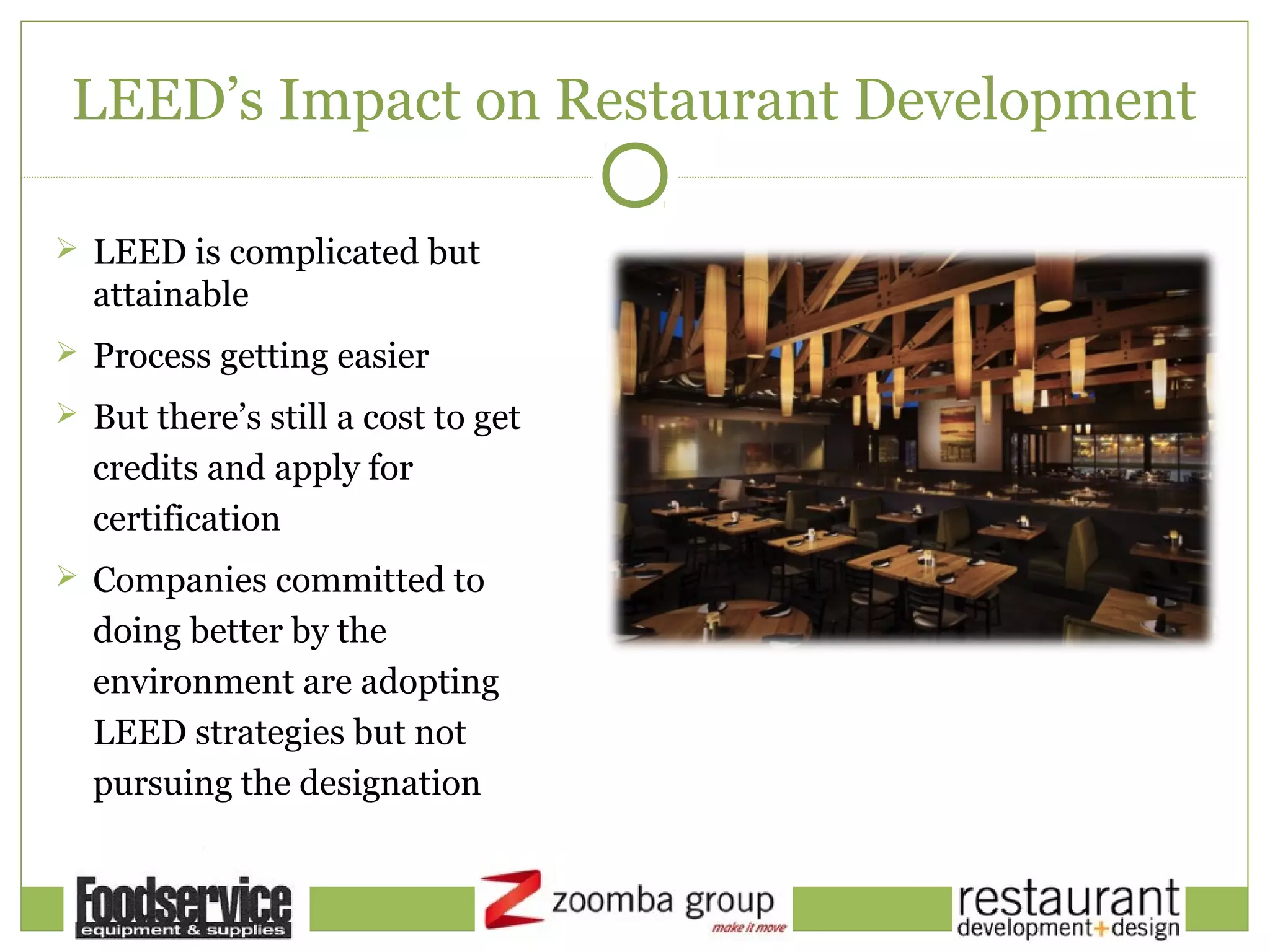
LEED’s Impact on Restaurant Development
 LEED is complicated but
attainable
 Process getting easier
 But there’s still a cost to get
credits and apply for
certification
 Companies committed to
doing better by the
environment are adopting
LEED strategies but not
pursuing the designation
LEED’s Impact on Restaurant Development
 LEED for Retail impacts restaurants the most
 Restaurants can achieve some return on their investment
 Other types of certification starting to emerge
Why DD Green Achievement?
Existing certifications are challenging
Dunkin’ specific
Create excitement for franchises
Must be affordable
No third party involvement
Make it challenging yet achievable
Track utility usage
Underwriters Laboratory Environmental
“Validation”
Engaging Franchisees With DD Green
Franchisee participation
varies
Costs must provide a
return on investment
Worked with existing
partners to implement
greener practices
What are the benefits of DD Green ?
Franchisee
Reduction in Energy
and Water Usage
Waste Stream
Reduction
Healthier Air Quality
Reduced Carbon
Footprint and
Emissions
Utility Cost
Savings
Potential
Increased Profits
Shows
Commitment to
Sustainability
Environment
A Checklist for Getting Started
 Determine how
green the project
should be
 Use LEED as your
guide
 Work from the
outside in
 Explore the
impact of specific
steps
Getting Started
 Understand how the building orientation impacts layout
 Strive for solar efficiency
 Maximize passive measures
 Locally source materials
Passive Steps Can Be Aggressive
A combination of items
will get you to your goal:
Reflective roofs
Landscaping that is
appropriate for
the climate and
requires less water
Low-flow plumbing
fixtures
Source locally
 Approach can
vary if it’s a new
build project or if
you are working
in an existing
space
 Minimize
construction
waste
 Be more modular
Construction Considerations for
Green Builds
Green Building and the Bigger Picture
 Dunkin’ Brands wants to drive sustainability in everything we do.
 Small individual footprints but collectively we are big.
Making Informed Decisions
 How do the finishes speak to the target market?
 How do certain choices impact energy consumption?
 Some choices seem harmless but carry a big impact.
Making Informed Decisions
 LED lighting: an easy
choice
 Use recycled
materials or
adaptively reuse
materials
 Look to provide
natural solutions to
standard features
Questions from the Audience
Closing Thoughts from Our Panelists
John Herth
Dunkin’ Brands
Steve Starr
Starrdesign
Joe Vajda
Aria Group Architects
John’s Cup of Wisdom
 Do what’s right for your
business case and model
 Implement strategies that make
you efficient from day one
 Having a structured program
can build excitement
Steve’s Do’s and Don’ts
 DO look at your facility
holistically
 DO look closely at your systems
and understand how they
interrelate to one another
 DON’T look at your systems
individually because you will miss
opportunities.
Joe’s Take on Tech
 Some technologies may not meet
the high demand of a restaurant
environment.
 Technology is not a panacea. You
can solve plenty using simple
measures.
 Be thoughtful in your approach
and don’t wait until the last
minute.
Future Webcast Ideas
We are listening, too!
Send your ideas for future webcasts to:
Joe Carbonara
joe@zoombagroup.com
You may download the slides from the toolbar below.
A link to the CEU quiz will be sent when the webcast archive goes live.
Thanks for Listening
Visit Us Online at:
www.rddmag.com
Follow Us on Twitter:
@RDDmag

restaurant development + design: green building strategies

  • 1.
    Green Building Strategies Theseslides are part of a free webcast from restaurant development + design Magazine. Go to Slide 9 for a link to the webcast, if it’s still available on demand.
  • 2.
    Today’s Objectives Define whatgreen building means in today’s restaurant industry. Explore the impact of LEED and other certification processes. Discuss how to make informed decisions when trying to go green. Answer your questions!
  • 3.
    Meet Our Panelists JohnHerth Dunkin’ Brands Steve Starr Starrdesign Joe Vajda Aria Group Architects
  • 4.
  • 6.
    The only energymanagement suite engineered specifically for foodservice. Learn more at www.frankeamericas.com
  • 7.
    Find out moreat RustbeltReclamation.com
  • 8.
  • 9.
    For complete detailsabout this webcast visit: http://rddmag.com/greenbuilding
  • 10.
    Defining Green Building Minimize the environmental impact during construction and the operation of the building.  Accomplish this during the design phase.  Includes the surrounding areas.
  • 11.
    Restaurants Are Startingto Respond  Restaurants are very energy-intensive businesses  Supermarkets have been the leaders in sustainable design  Shorter horizons make restaurants resistant to implementing certain technologies, practices
  • 12.
    Achievement in SustainableBuildings One Company’s Approach to Green Building
  • 13.
    DD Green Achievementis a certification specifically designed for a new Dunkin’ Donuts location to further encourage, assist and promote a measurable level of sustainability and energy efficiency. It’s optional, not required. Defining DD Green Achievement
  • 14.
    DD Green All requirementsmet 12 additional strategy points DD Green Elite All requirements met 20 optional strategy points Defining DD Green Achievement
  • 15.
     Site Development (2)Requirements (6) Optional Strategies  Store Efficiency (3) Requirements (8) Optional Strategies  Healthy Indoors (2) Requirements (3) Optional Strategies  Sustainable Operations (3) Requirements (5) Optional Strategies  Innovation & Community (1) Requirements (4) Optional Strategies The DD Green Details
  • 16.
    LEED’s Impact onRestaurant Development  LEED is complicated but attainable  Process getting easier  But there’s still a cost to get credits and apply for certification  Companies committed to doing better by the environment are adopting LEED strategies but not pursuing the designation
  • 17.
    LEED’s Impact onRestaurant Development  LEED for Retail impacts restaurants the most  Restaurants can achieve some return on their investment  Other types of certification starting to emerge
  • 18.
    Why DD GreenAchievement? Existing certifications are challenging Dunkin’ specific Create excitement for franchises Must be affordable No third party involvement Make it challenging yet achievable Track utility usage Underwriters Laboratory Environmental “Validation”
  • 19.
    Engaging Franchisees WithDD Green Franchisee participation varies Costs must provide a return on investment Worked with existing partners to implement greener practices
  • 20.
    What are thebenefits of DD Green ? Franchisee Reduction in Energy and Water Usage Waste Stream Reduction Healthier Air Quality Reduced Carbon Footprint and Emissions Utility Cost Savings Potential Increased Profits Shows Commitment to Sustainability Environment
  • 21.
    A Checklist forGetting Started  Determine how green the project should be  Use LEED as your guide  Work from the outside in  Explore the impact of specific steps
  • 22.
    Getting Started  Understandhow the building orientation impacts layout  Strive for solar efficiency  Maximize passive measures  Locally source materials
  • 23.
    Passive Steps CanBe Aggressive A combination of items will get you to your goal: Reflective roofs Landscaping that is appropriate for the climate and requires less water Low-flow plumbing fixtures Source locally
  • 24.
     Approach can varyif it’s a new build project or if you are working in an existing space  Minimize construction waste  Be more modular Construction Considerations for Green Builds
  • 26.
    Green Building andthe Bigger Picture  Dunkin’ Brands wants to drive sustainability in everything we do.  Small individual footprints but collectively we are big.
  • 27.
    Making Informed Decisions How do the finishes speak to the target market?  How do certain choices impact energy consumption?  Some choices seem harmless but carry a big impact.
  • 28.
    Making Informed Decisions LED lighting: an easy choice  Use recycled materials or adaptively reuse materials  Look to provide natural solutions to standard features
  • 29.
  • 30.
    Closing Thoughts fromOur Panelists John Herth Dunkin’ Brands Steve Starr Starrdesign Joe Vajda Aria Group Architects
  • 31.
    John’s Cup ofWisdom  Do what’s right for your business case and model  Implement strategies that make you efficient from day one  Having a structured program can build excitement
  • 32.
    Steve’s Do’s andDon’ts  DO look at your facility holistically  DO look closely at your systems and understand how they interrelate to one another  DON’T look at your systems individually because you will miss opportunities.
  • 33.
    Joe’s Take onTech  Some technologies may not meet the high demand of a restaurant environment.  Technology is not a panacea. You can solve plenty using simple measures.  Be thoughtful in your approach and don’t wait until the last minute.
  • 34.
    Future Webcast Ideas Weare listening, too! Send your ideas for future webcasts to: Joe Carbonara joe@zoombagroup.com You may download the slides from the toolbar below. A link to the CEU quiz will be sent when the webcast archive goes live.
  • 35.
    Thanks for Listening VisitUs Online at: www.rddmag.com Follow Us on Twitter: @RDDmag

Editor's Notes

  • #5 Alto-Shaam is committed to providing energy-efficient cooking solutions for kitchens throughout the world. The company engineers its products with its EcoSmart® philosophy to provide its customers with a high return on investment while still protecting our world’s natural resources.
  • #6 Crossville is the leading American manufacturer of beautiful, sustainable porcelain tile. From third party-certified processes and industry-changing recycling initiatives to a full range of certified green products and support for design professionals, Crossville’s the trusted choice for responsibly created tile.
  • #7 GoSmartEnergy is Franke’s easy-to-manage network of energy solutions engineered specifically for foodservice. Choose any or all of HVAC and lighting control; variable ventilation; refrigeration control; and more, for energy savings of up to 20%.
  • #8 Rustbelt Reclamation designs, crafts and markets innovative, exceptional quality furniture and installations. All offerings are handcrafted within the United States utilizing locally sourced, upcycled materials - that benefit the local and global community through sustainability and the preservation of our Nation’s history.
  • #9 TriMark is the country’s largest provider of foodservice equipment, supplies and design services. Countless restaurants rely on TriMark’s expertise to realize their vision for success; from design/build to supply distribution, TriMark is there every step of the way. We are TriMark, and we bring it! Visit trimarkusa.com to learn more.
  • #11  JC: The term green means different things to different people. So, in your own words, Joe, what does green mean to you?   Joe’s response to include: It means building a building by minimizing any effects, damages etc. on the environment. Minimize that through design. It includes the surrounding areas Minimize the impact of the building on the environment itself. There’s so much waste in construction and there’s a lot of energy use/waste by commercial building.  
  • #12 JC: What’s interesting to note is that despite the strength of the farm to table movement, which emphasizes local and sustainably produced ingredients, it seems many restaurants have been slow to embrace green building. Is that your experience, Steve?   Steve’s response to include: Green restaurants are kind of an oxymoron because per square foot restaurants are such enormous energy users. Compared to other similar venues, like supermarkets or even food courts, standalone restaurants have been slow to adopt sustainable design practices. Given the shorter horizon of restaurants they have been more resistant to implementing sustainable practices, unless it has been reflected in ROI somewhere else, namely marketing and repair and maintenance. Supermarkets have been world leaders in sustainable design practices. They have seen the return from energy management. They have a longer lifespan and time horizon. So their ROI can be longer. This has allowed them to be pioneers in the area of energy management. And this was the case long before LEED and other energy management systems were in place. Supermarkets adopted these practices because they made so much sense. But restaurants are starting to approach design from a more sustainable manner.   Also reference this is a LEED Platinum Food Court at Stockton University Campus Center
  • #13 JC: And one company that’s starting to embrace greener design is Dunkin’ Donuts. John, please describe Dunkin’s approach.   John’s response to include: For us, it was important to define what being green means to us And that conversation got us to LEED certify some projects in Fla. – three total We felt prototype was fairly sustainable and efficient but wanted to learn how it stacks up against LEED buildings Found that LEED was not the best fit for small building types like ours. Plus franchisees can be cost conscious at initial investment. So decided to create our own green certification – DD Green Achievement Created some components and strategies stores could implement and earn recognition. Has meaning. Can properly say the store is more energy efficient, water efficient, reduces amount of trash, healthier air quality The net result is these things are great for the environment and even lowers costs. Part of the DD Green can show an ROI – really wanted a measurable level of sustainability Optional program for DD franchisees but goal is to have 100 certified stores by end of 2016. Has 18 certified and another 25 in the works
  • #14 John’s comments: So decided to create our own green certification – DD Green Achievement Created some components and strategies stores could implement and earn recognition. Has meaning. Can properly say the store is more energy efficient, water efficient, reduces amount of trash, healthier air quality The net result is these things are great for the environment and even lowers costs. Part of the DD Green can show an ROI – really wanted a measurable level of sustainability Optional program for DD franchisees but goal is to have 100 certified stores by end of 2016. Has 18 certified and another 25 in the works
  • #15 There are two achievements that a Franchisee can acquire. DD Green and DD Green Elite. DD Green <CLICK> - 12 points + required DD Elite <CLICK> – 20 points + required <CLICK> Required vs. optional 1-3 required strategies in each Stage, several optional (3-8 worth 1-2 points each) that can be implemented to earn DD Green Achievement In all, 11 Required strategies, 24 Optional strategies with a possible point total of 37 Very doable, challenging but attainable
  • #16   JC: Can you share some of the specifications for DD Green? John’s response to include: The program consist of 5 different categories that follow the development of the restaurant Within the 5 categories, there are some required and some optional strategies. Development, store efficiency (LEDs in 80 percent of the fixtures, low flow water fixtures and high efficiency A/C) A number of these things are becoming industry standard Do not want to compromise the in-store experience. Some people thought the first one would look or act different. But the core pieces that make it more energy efficient and sustainable are embedded. So it did not have to look any different to the guests. There are two achievements that a Franchisee can acquire. DD Green and DD Green Elite. DD Green <CLICK> - 12 points + required DD Elite <CLICK> – 20 points + required <CLICK> Required vs. optional 1-3 required strategies in each Stage, several optional (3-8 worth 1-2 points each) that can be implemented to earn DD Green Achievement In all, 11 Required strategies, 24 Optional strategies with a possible point total of 37 Very doable, challenging but attainable
  • #17 JC: LEED is an interesting part of today’s green build conversation. On the one hand, it’s a highly recognizable symbol for conservation. On the other hand, it takes some doing to achieve LEED status.   Joe V: LEED…it’s complicated but attainable It’s challenging but not as difficult as it might seem 7 to 10 years ago it was a lot more difficult. Change in thinking across the country and this is a more common thought process Owners struggle because there’s an additional cost to get credits, etc. More clients are adopting Leed standards as part of their approach. Water savings. And codes are getting closer to Leed specs. (Lighting is an example). Companies are committed to being better to the environment. Part of their culture, not their marketing. And they will implement those practices across other projects
  • #18 Steve to add: LEED for retail was one of the last parts to be adopted by the USGBC. And that’s what impacts restaurants most. It was very difficult to achieve because restaurants are such high energy users in such a small footprint Once the recession hit, people got tight about the money they were spending and the USGBC got more restrictive about what it took to earn LEED. So it was a perfect storm. Costs too much and took too long to do it. At the same time, lots of restaurants started to follow the guidelines and skip getting certified. There is some return on investment so long as you don’t overlay the administrative component. One example, seen here, is Brixx Wood Fired Pizza. This chain follows LEED guidelines, but doesn’t go through the certification process. Other types of certification are starting to emerge. Not as well known or prominent as LEED but do represent another option.
  • #19 JC: And that takes us back to Dunkin’s DD Green initiative. John, why don’t you walk us through why your company decided to create its own designation?   John’s response to include: Wanted something that is Dunkin specific that allows us to apply what we have learned Also needed something to create some excitement among the franchisees but also has to be affordable. Initial investment costs are important for the franchisees and the costs of building a location keeps going up Having no third party involvement helps keep costs inline Has 38 construction managers that help franchisees develop their plans and then certify for DD Green. Has a checklist they review to verify they did what they committed to doing. As part of the verification, they submit utility bills to track progress compared to non DD Green Stores. Went to UL’s environmental group, who evaluated the program and achieved a favorable validation.
  • #20 JC: And can you describe how you rolled this out to your franchisees?   John’s answers to include: Have varying levels of franchisees. Some new with a few stores, older or experienced franchisees with multiple locations. There are certain levels of engagement and commitment to sustainability. The biggest challenge was educating them about the benefits of the program. Yes, they want to know the estimated costs. But have to balance that with the benefits and return on investment. Franchisees have a very complicated business to run and they have to keep an on their pocket book. The beauty of the program is that we worked within the people who were already involved in a project but it goes all the way down to the architects, national contractors and so forth. So everyone who has been involved with this has worked with us for years. So it does not take a special type of material or product that came from outside of our existing vendor network. So that made it flow so much better.  
  • #21 John continues by outlining the benefits DD outlined to its franchisees
  • #22 JC: How do you suggest someone designing a new restaurant get started?   Joe V’s response to include: Use the LEED guidelines, credits and pre-requisites to start. Go from the outside of the building and work your way inside. How green and sustainable you want to be? The low-hanging fruit is any easy discussion. Some things happen by wrought and save a lot of money. Really explore the impact of specific steps and explain them all. This can help address specific operational issues before the business is up and running. Can help minimize costly retrofits or trying to squeeze features in there that don’t fit. Makes the building easier for the employees to use the building.
  • #23   Steve’s response to include: First thing we do is look at its solar orientation. What parts of the building are facing north, south, east and west? You get significantly amounts of natural light depending on how the building faces. Southern facing glass, for example, will get the most heat gain in southern climates. Consider how the orientation of the space impacts the overall layout Try to understand this so we don’t have to take remedial action to address this. For example, Zoes Kitchen Ground-up prototype, seen here, responds architecturally to solar orientation. Then the project has to be solar efficient. If the majority of your windows face south, one way to create sustainable design is to use awnings and canopies to block the sun/reduce the heat during the summer months. It works well in the winter, though, because if designed right you can get some of that direct southern sun. Do have to take into account comfort glare, though. These are examples of passive measures, meaning there’s nothing really mechanical to it. Not adding to the building or its systems. Solar panels on the roof would be considered an active approach. Look for as many passive opportunities as possible. Use locally sourced materials over those that require significant shipping and transportation.
  • #24 JC: Joe, what are some other passive steps? Joe V adds: Other passive, design-related steps can include: Reflective roofs rather than those that absorb energy Landscaping: use something that uses less water and more appropriate for the climate Can even position the trees to block the sun to keep the space cool in the summer. In the winter, the lack of leaves can help bring in sun. Plumbing fixtures: flow of water efficiency and savings Materials: Use more locally sourced materials that reduces fuel consumption and creation of ozone depleting gases. Use more natural materials that don’t require more energy to produce. Electricity: had a project in Corpus Christi and was a LEED building. So had benchmark savings for this. 34 percent savings. From an architectural standpoint, we often think we don’t have a big impact. But LED lighting has had a huge impact on this. And today you can use it in the BOH, too. Some LED fixtures have the same output and directional output as fluorescent bulbs. Use high efficiency roof top units. And high efficient equipment It’s a combination of items that helps make it green/more efficient. The kitchen is one of the biggest challenges. Water savings better than electricity in the kitchen – washer, three compartment sinks, etc.
  • #25   JC: And there are some construction considerations to take into account, too. Right, Joe?   Joe V’s response to include: Here are some construction considerations that can help Are we going into an existing space? Or a new one? Construction waste is an important issue. A lot of materials go into the garbage that can be re-used. Happens because we don’t know what to do with it. Now seeing warehouses that will take leftover construction materials and hold them. People can buy them as they need it for projects. Also need to recycle materials when possible. Use regional suppliers Be more modular in our approach. Design so you don’t need to cut everything to get to the proper wall dimension. Use 10 foot wall studs and design to that. JC: So it seems to me that there’s lots of ways to get started but the biggest mistake is waiting until after the restaurant is built to begin thinking about lessening the environmental impact.  Joe V: You need to plan these things from the start and they can make a difference Once you are in the building and try to save energy it can be challenging.  
  • #26 Joe V to add a quick comment on using reclaimed materials in design
  • #27   JC: How does the DD Green program fit into the bigger picture at Dunkin? John’s response to include: Corporate social responsibility group wants to drive sustainability through everything we do. We have a big footprint globally, in building, packaging, food sourcing, etc. Where it fit for us, our foot print may be small but we collectively we are big. Lots of new stores, remodel existing ones and so forth.  
  • #28   JC: Lots of design elements and finishes promise to help make a restaurant more environmentally friendly. When designing a facility, how do you design which items make the most sense? Steve’s response to include: Every restaurant design is an opportunity to communicate specific ideas and messages about the brand to its customers. When we look at specific materials and finishes, in addition to whether it is a recycled item, we look at what other message does it send to the target audience. That’s where marketing comes into play. For example, seen here is the Tupelo Honey Cafe – in Arlington Va. It features reclaimed wood, low VOC paint, LEED lighting and locally sourced materials It’s important to understand the impact some choices will have on energy consumption. For example, large windows or doors which open up to outside spaces. In a restaurant that has an enormous energy impact On the surface, it seems harmless. But it impacts how you heat and cool the restaurant. It’s seen as green because you are bringing nature into the restaurant. So it’s double-edged sword.  
  • #29   JC: But other choices can have a significant impact on a restaurant’s environmental footprint, right? Steve’s response to include: One example is an LED lighting system Significantly easier on repair and maintenance, lowers carbon foot print. Also, recycled materials, reclaimed materials, adaptive re-use of existing buildings Instead of putting up a brick wall to block off a dumpster, put up a green screen to provide a more natural solution, Restaurants are now adopting these solutions more because customers desire to feel the way they spend their money is with brands that are good stewards of the environment. So this is often driving by marketing desire than an interest in being more environmentally friendly  
  • #32 JC: Let’s close by sharing some advice or key lessons you have learned over the years. John, why don’t you begin?   John’s comments to include: You have to do what’s right for your business case and model If an already established certification works for your business model, great. If not, then investigate something that works for you. Whether you are a franchise organization or if you develop your own stores, do what’s right for you. You may even do something totally new and custom. This works for us and helps us drive a level of sustainability that we would not have achieved with any other existing program. Implement the strategies that make you efficient from day one and those factors that helped you earn your certification will help you maintain it. So maintain those elements. Having a structured program helps build excitement.
  • #33 JC: Steve, you had a few “Do’s and Don’ts” you would like to share with the audience, don’t you? Steve’s response to include: DO look at your facility holistically. DO look at your systems and how they interrelate with one another. DON’T look at your systems individually. Example, look at the impact of a high performance glazing system, not just on storefront appearance but also your need to heat and cool. This also impacts your HVAC load. DON’T look at these individually because they impact one another. Same in the back of the house. Look at kitchen exhaust hoods and the makeup air required to work properly. By looking at things holistically, you can have a big impact without a big price tag.
  • #34 JC: And Joe, you had a few thoughts on technology:   Joe’s response to include: Implementing new technologies that may not meet the high demand environment of a restaurant. Know the difference between an office building and a restaurant and how that impacts technology. Not everything is solved by technology. You can accomplish a lot through simple measures. Be thoughtful in your approach. Don’t wait to the last minute. There’s a lot that restaurant owners can do that make a lot of difference. They are simple, straightforward and concise things. But you have to do them during the design process.