Robert C. Newcomer   [email_address]   The Lang Legal Group LLC   404.320.0990 Business, environmental and real estate litigation and counseling. LEED-AP Member, Sustainable Atlanta Green Building Taskforce.  Urban Land Institute Co-Chair, Sustainability - Community Assistance  Sub-committee Member, Technical Advisory Panel Committee Director, Green Chamber of the South.
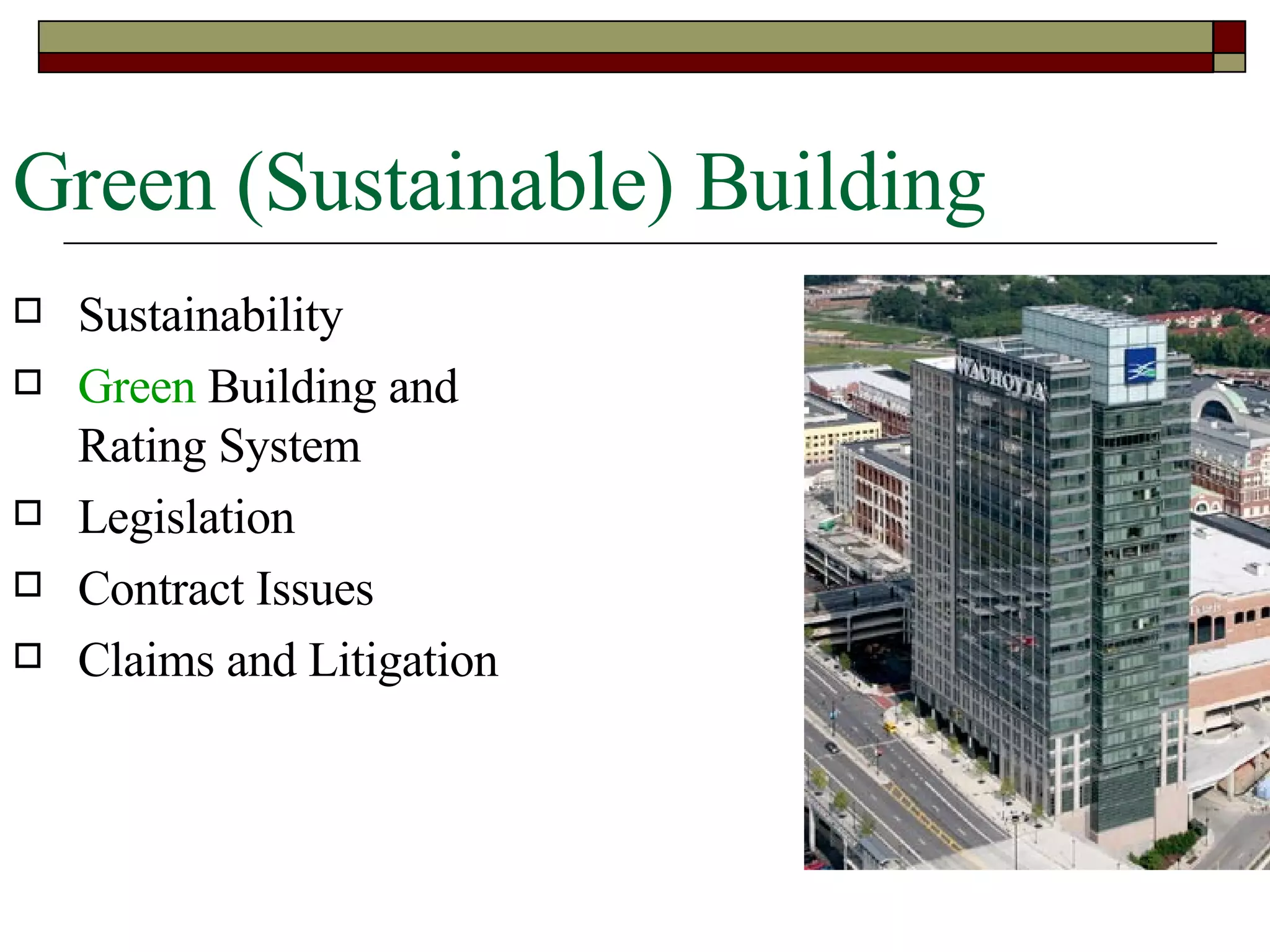
Green (Sustainable) Building Sustainability Green  Building and Rating System  Legislation Contract Issues Claims and Litigation
Sustainability “ To meet the needs of the present without compromising the ability of future generations to meet their own needs.”  - Brundtland Commission   Green building is the practice of creating structures and using processes that are environmentally responsible and resource-efficient throughout a building's life-cycle from siting to design, construction, operation, maintenance, renovation and deconstruction.”  - EPA (Green Building Workgroup)
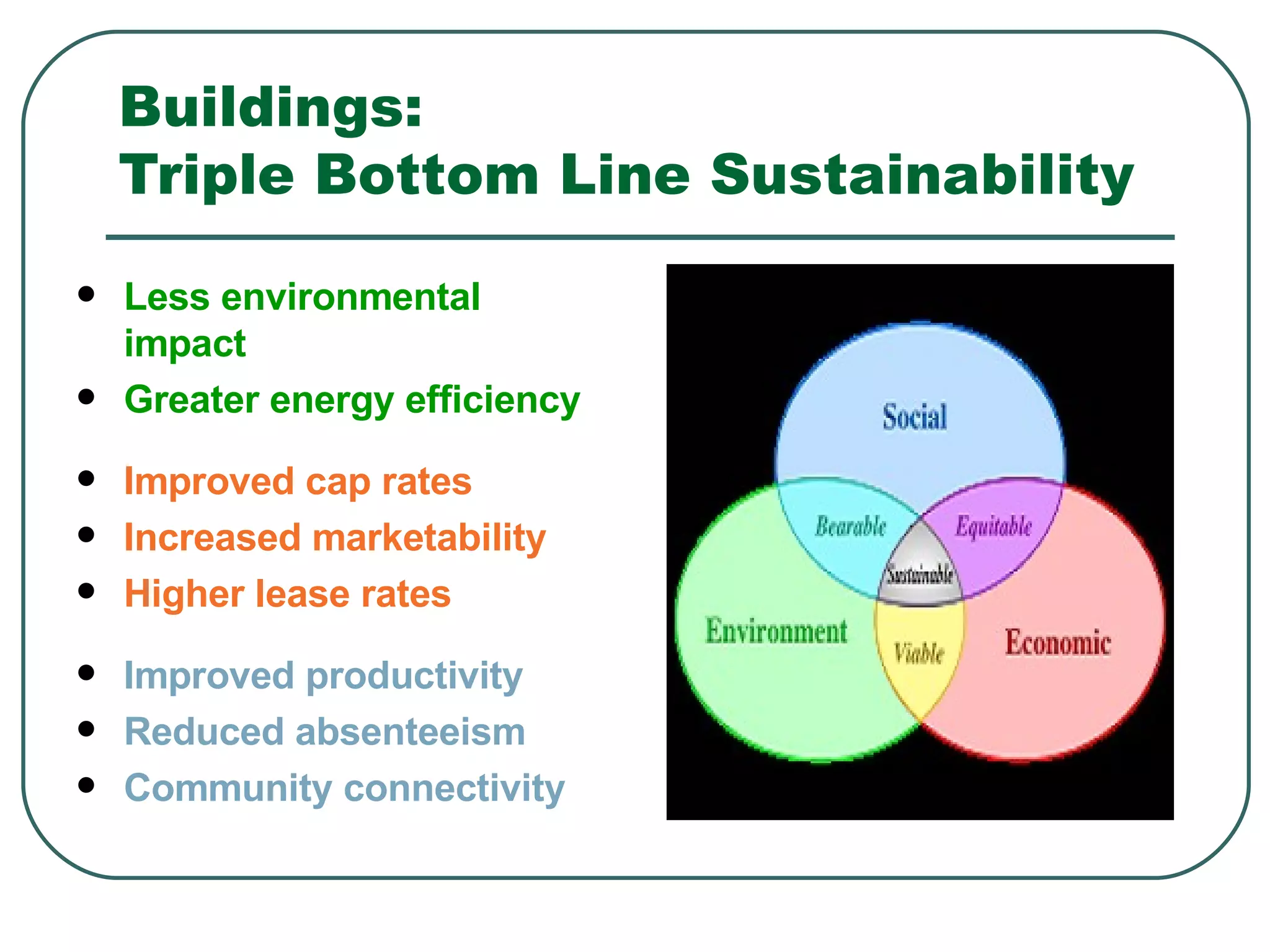
Buildings:  Triple Bottom Line Sustainability Less environmental impact  Greater energy efficiency Improved cap rates Increased marketability Higher lease rates Improved productivity Reduced absenteeism Community connectivity
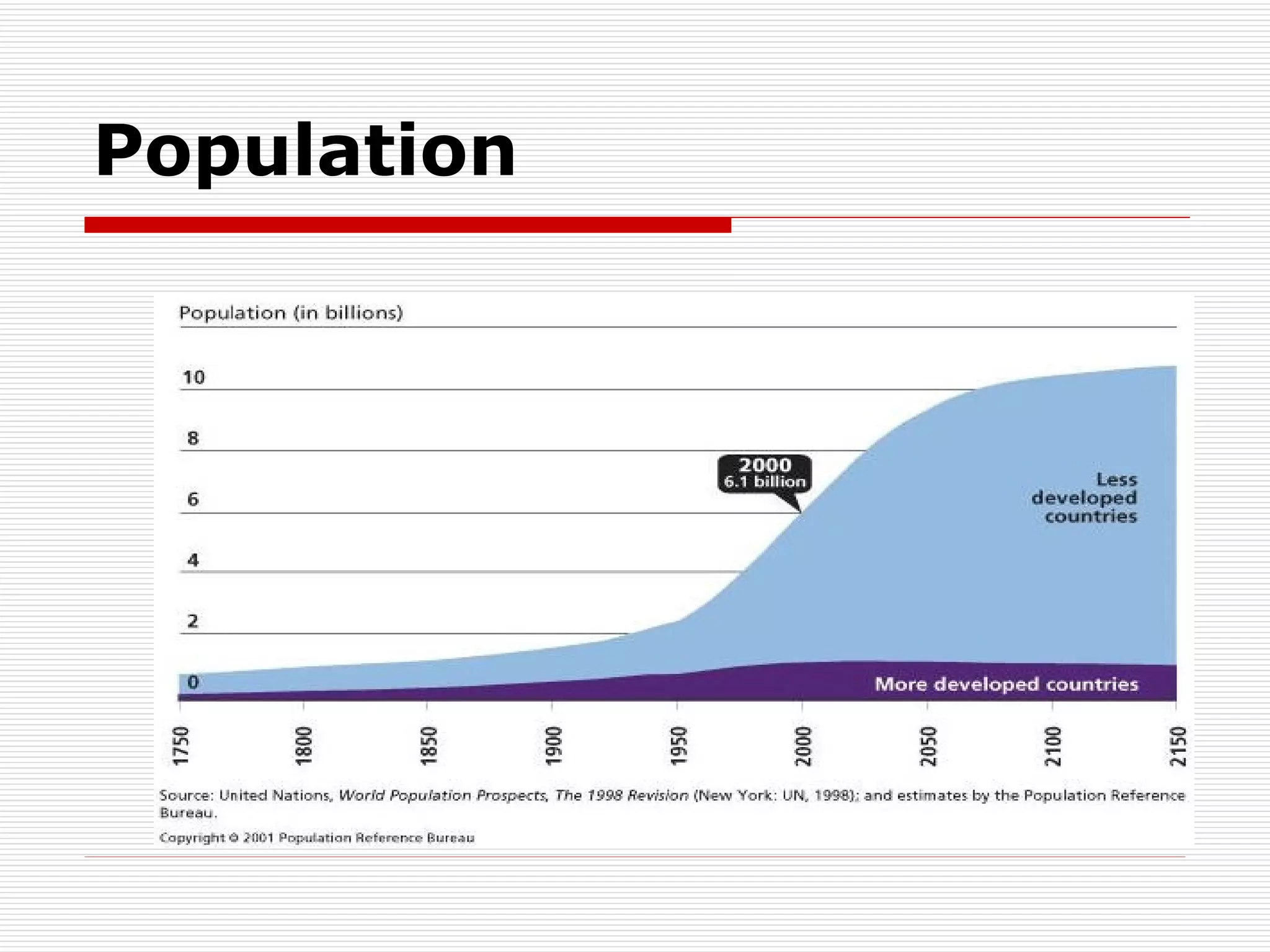
Population
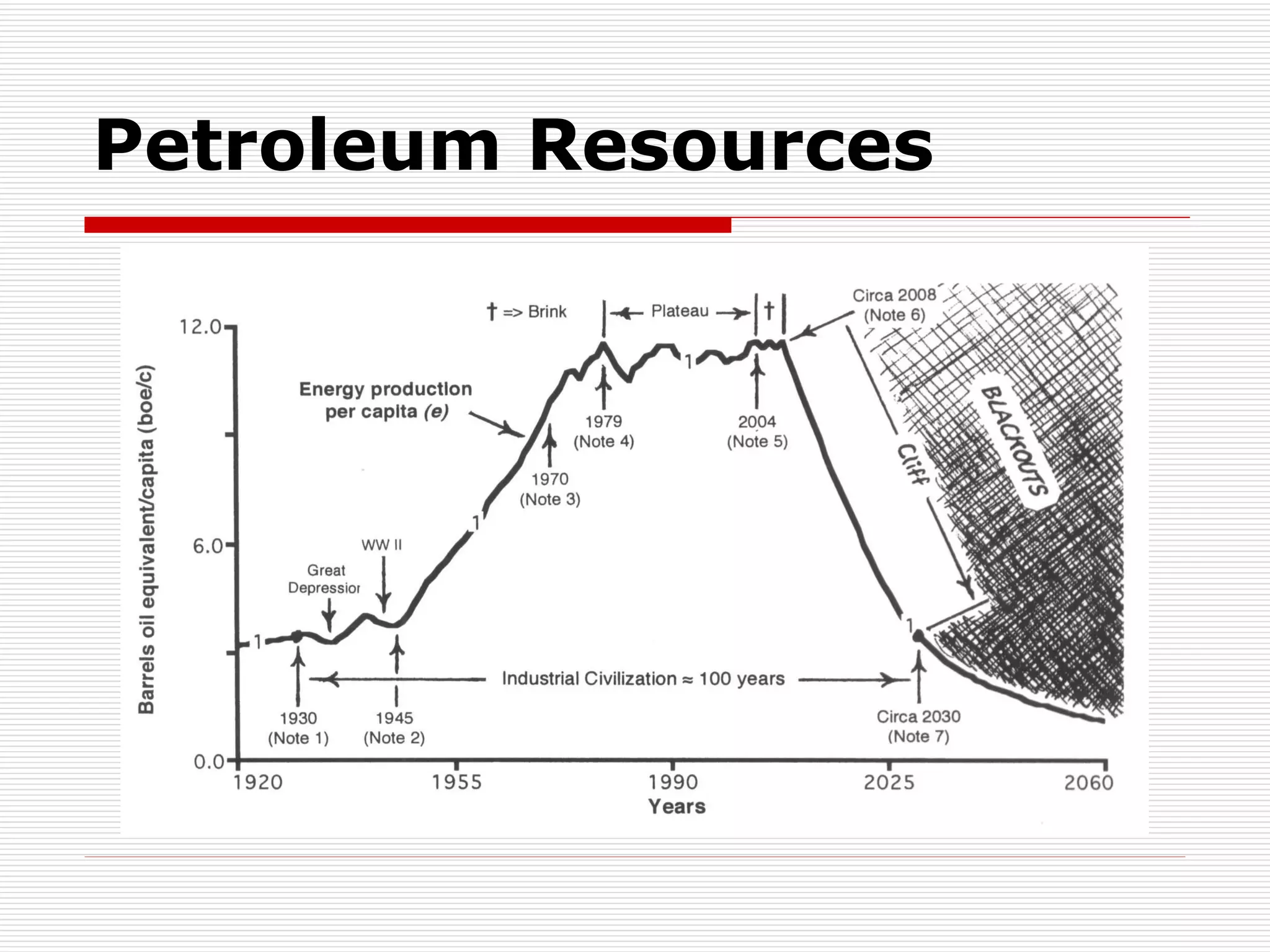
Petroleum Resources
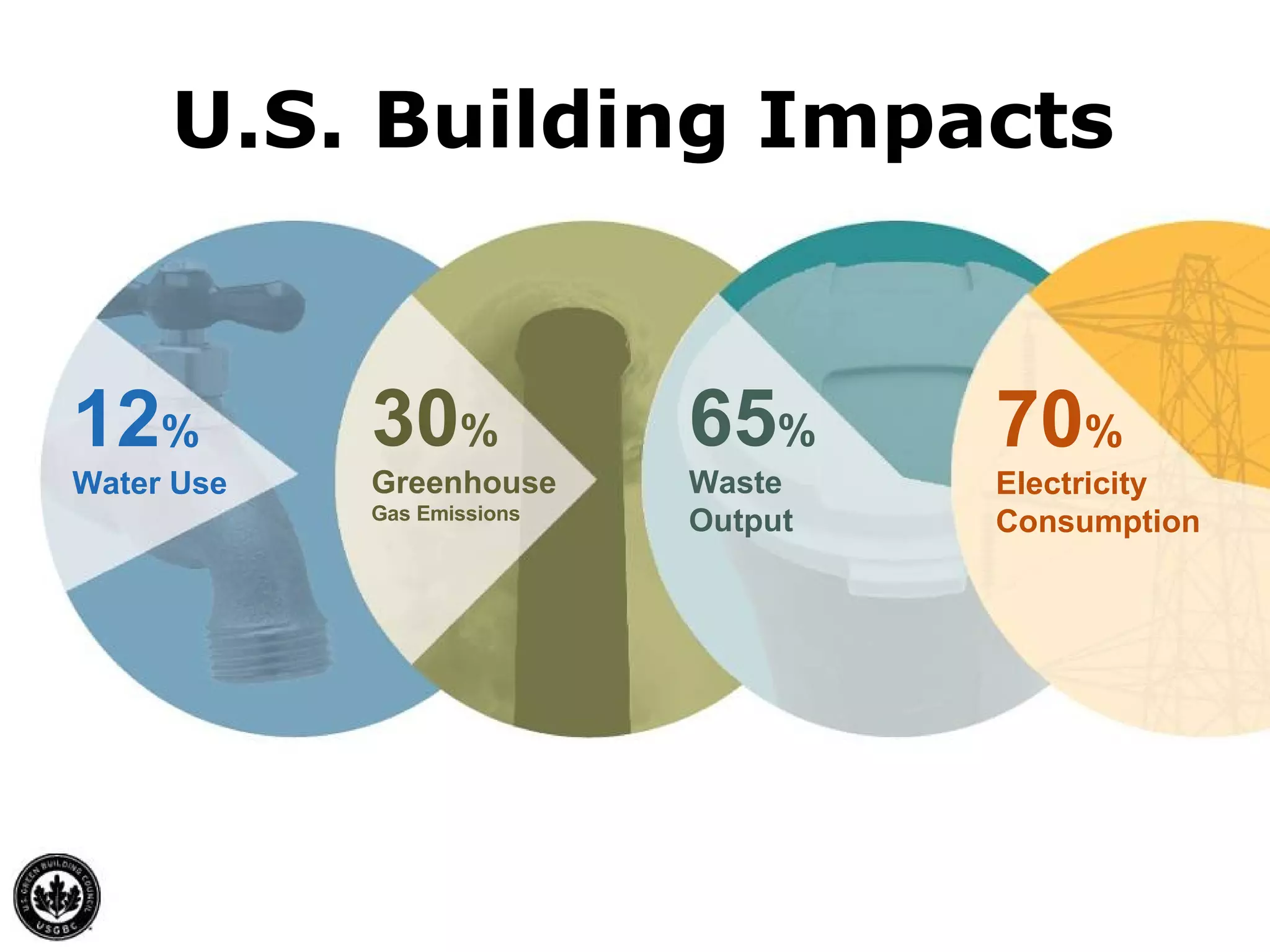
U.S. Building Impacts Test 12 % Water Use 30 % Greenhouse Gas Emissions 65 % Waste Output 70 % Electricity Consumption
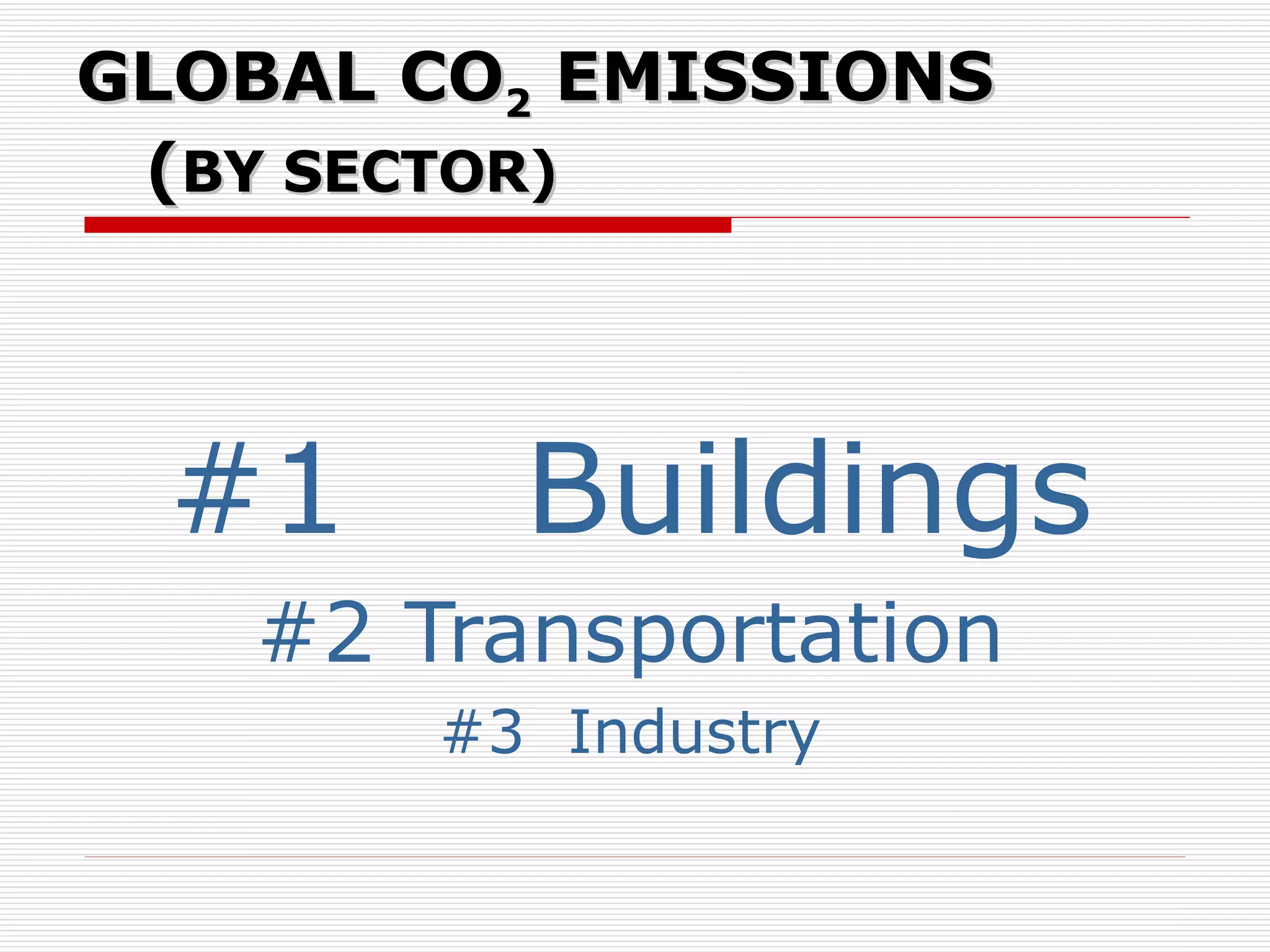
GLOBAL CO 2  EMISSIONS   ( BY SECTOR) #1  Buildings #2 Transportation #3  Industry
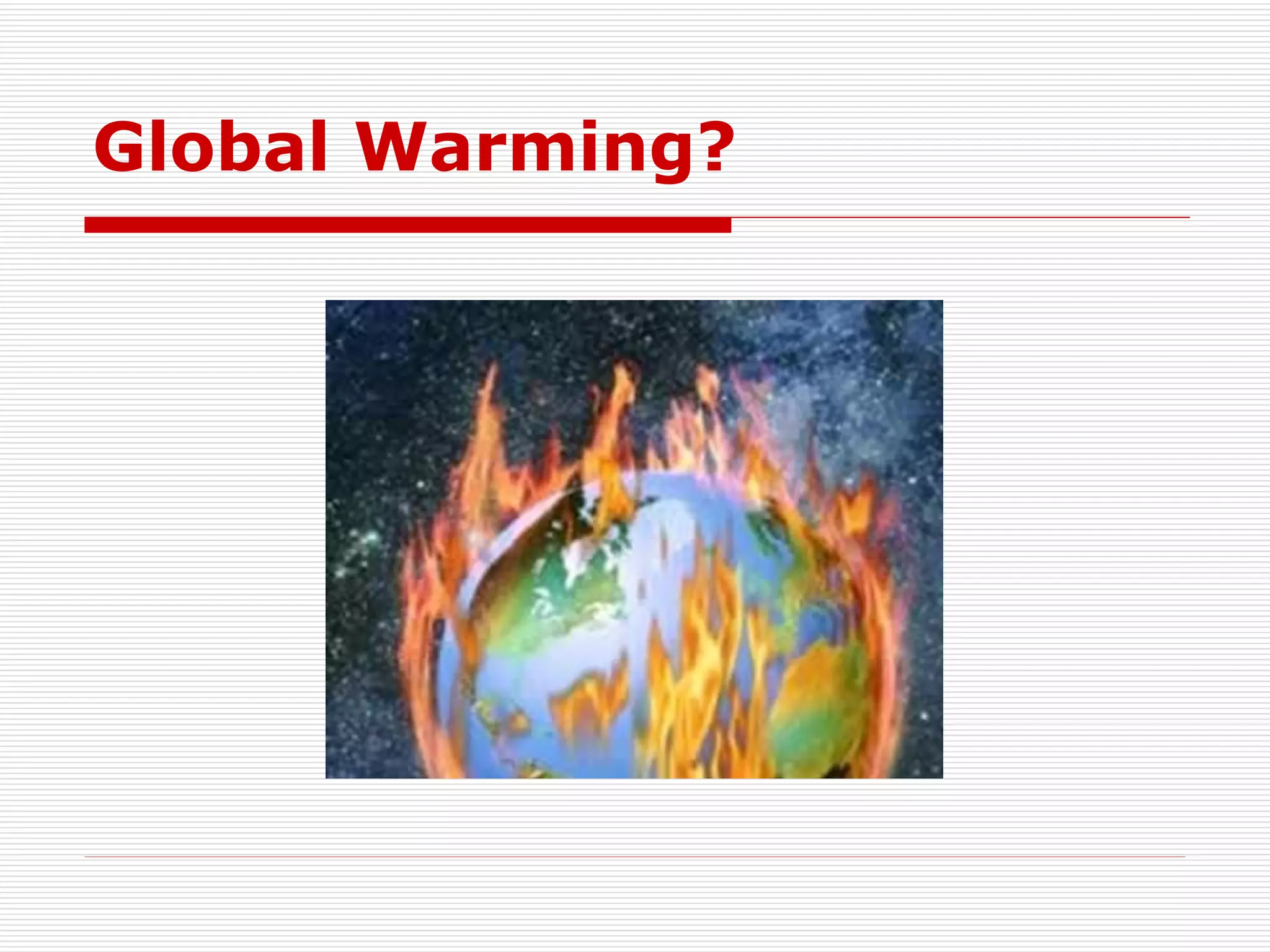
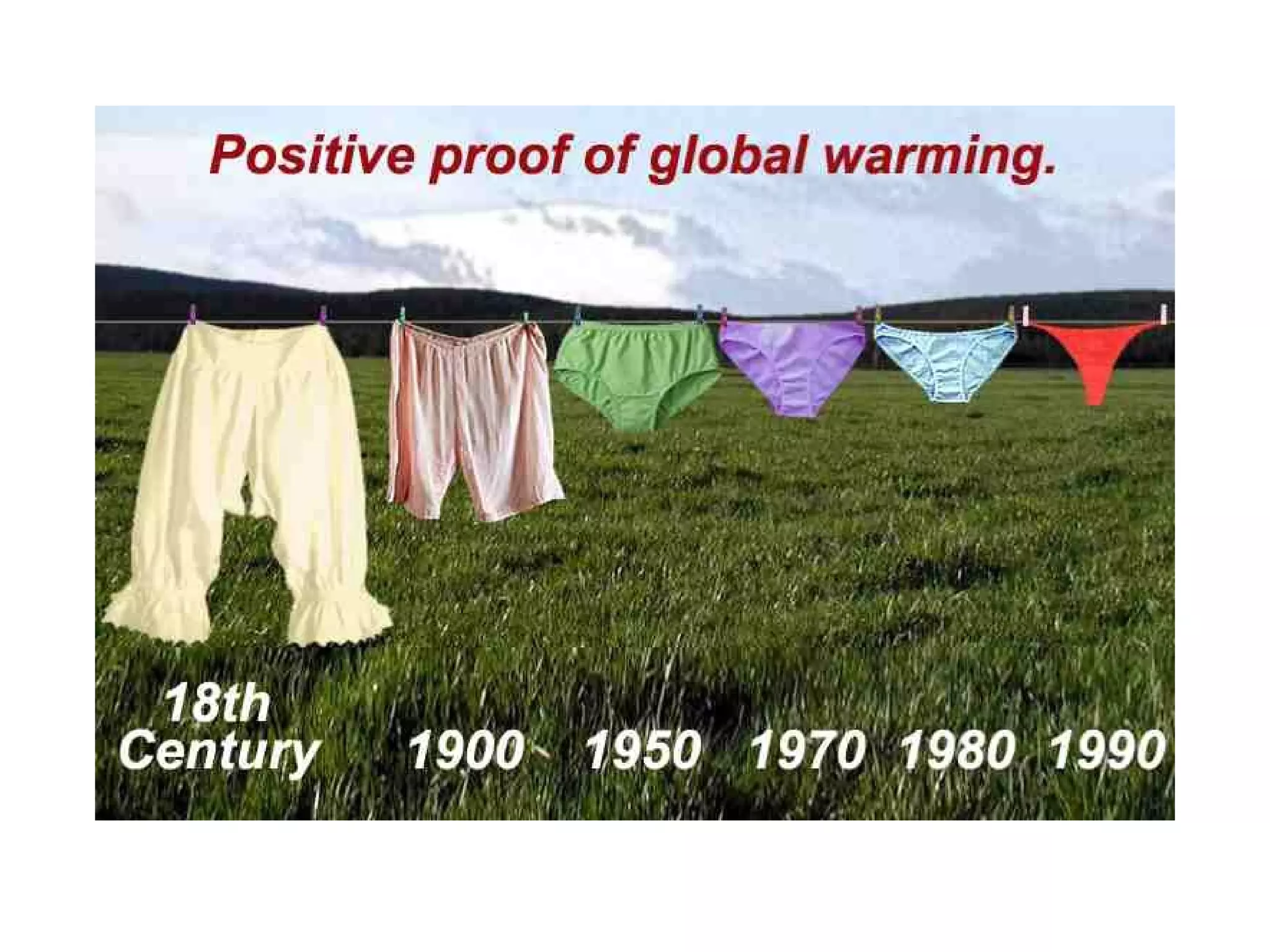
Global Warming?
Scientific Evidence
Carbon-based regulation . . . ? Massachusetts v EPA (2007)  EPA “Endangerment Finding” Six heat-trapping gases are pollutants that endanger public health and welfare.   Proposed mandatory reporting of greenhouse gases emissions  (April 2009) Federal regulation . . .  Cap & trade, carbon tax, ??? Implications for real estate . . . ???
“ LEAP” to Zero Carbon: Energy efficiency (reaction to 1970s oil crises) Green (environmentally responsive) Sustainable (holistic) High Performance (accountable) Carbon Neutral
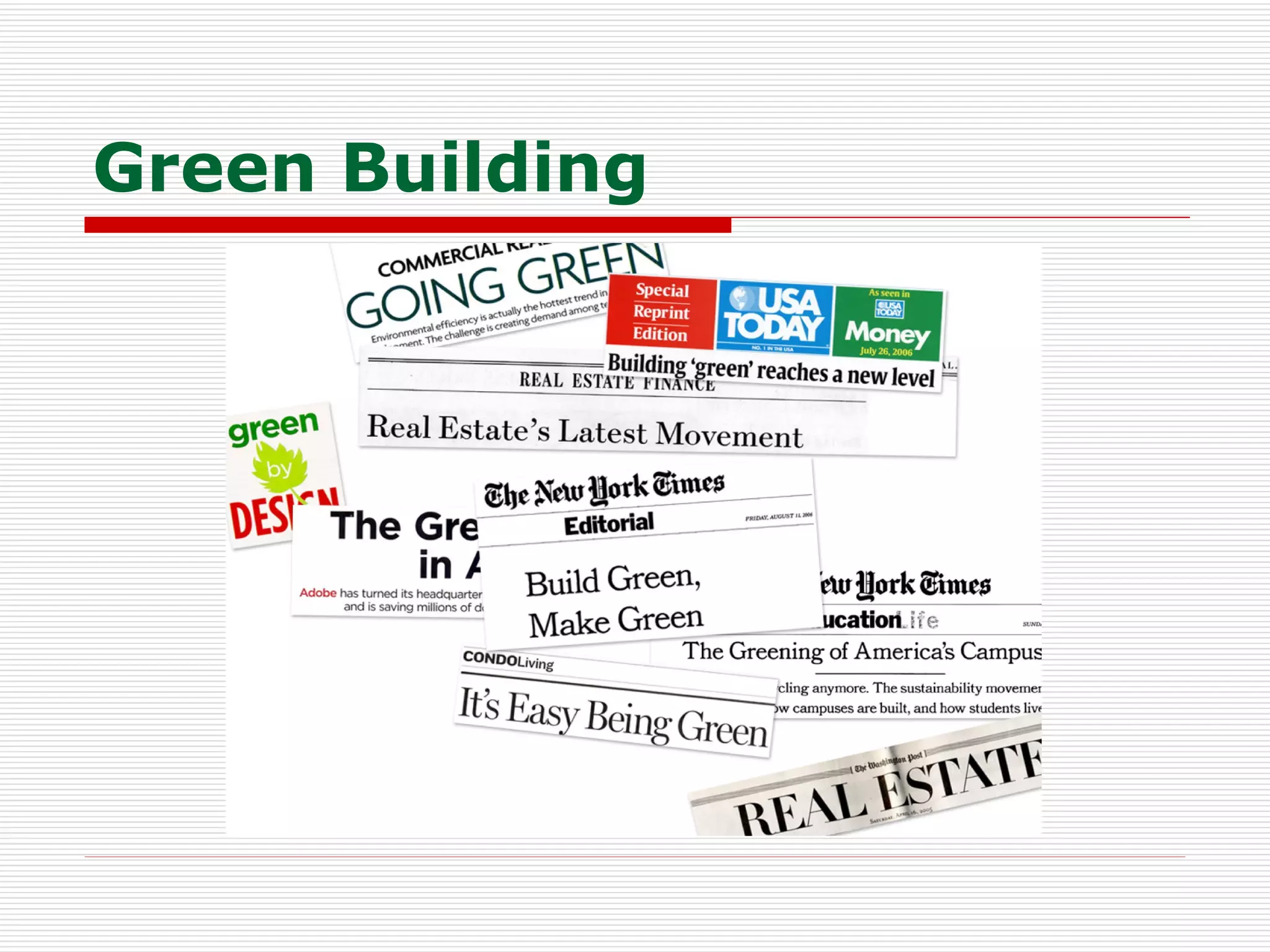
Green Building
 
LEED-NC Rating System Sustainable Sites   14 total points (1 prerequisite + 14 credits) Water Efficiency  5 total points (no prerequisites + 5 credits)  Earth & Atmosphere 17 total points (3 prerequisites + 6 credits)  Materials & Resources 13 total points (1 prerequisite + 13 credits)  Indoor Environmental Air Quality 15 total points (2 prerequisites + 15 credits)  Innovation in Design  5 total points (no prerequisites + 5 credits)   _____________________________________ 7 prerequisites + 58 credits (69 total points)
LEED  “Certification” Register project Satisfy all prerequisites  Complete online submittals and documentation for credits to be sought Respond to questions Retain back up data and documentation.
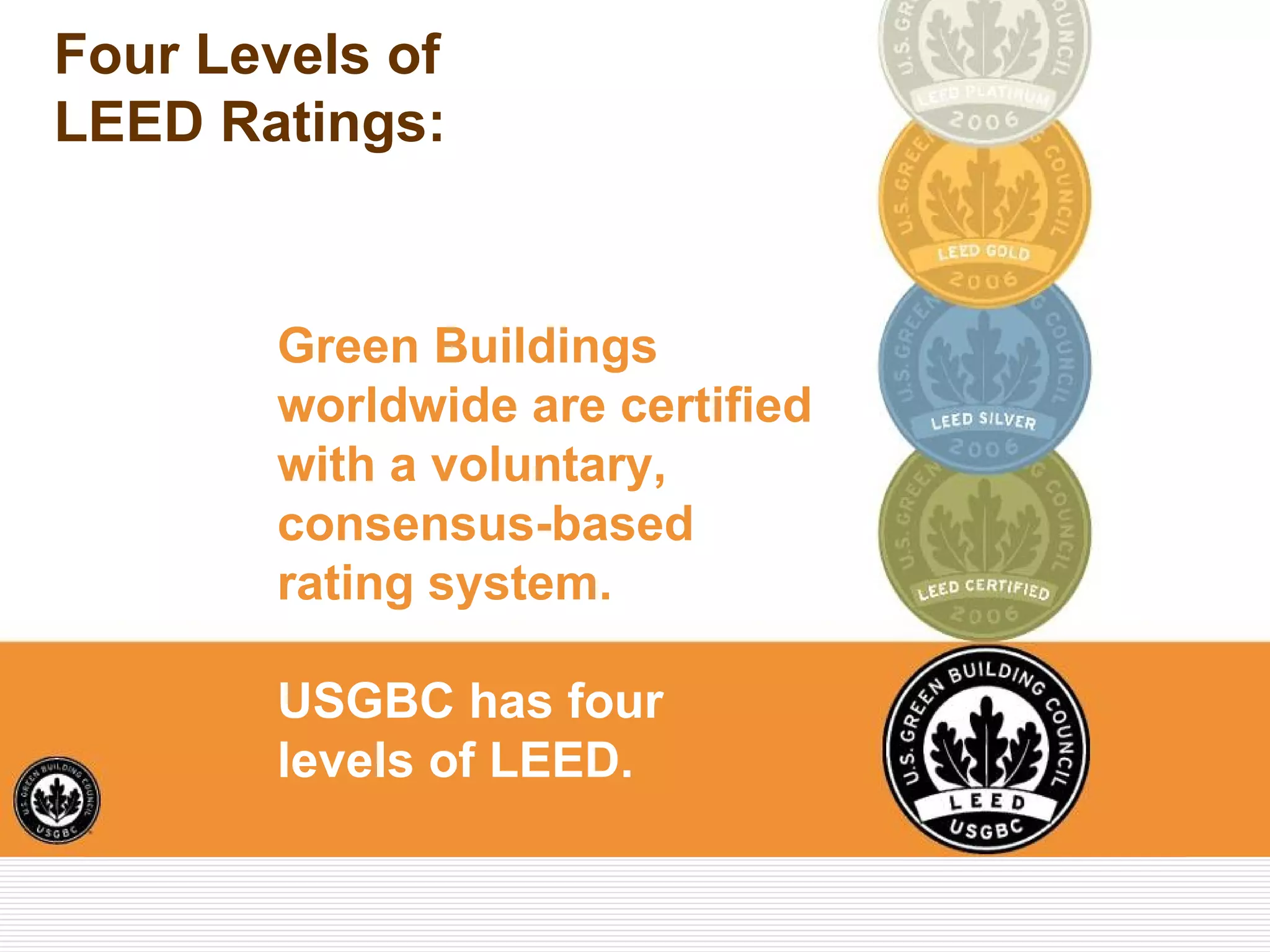
Four Levels of LEED Ratings:   Green Buildings  worldwide are certified with a voluntary, consensus-based  rating system.   USGBC has four  levels of LEED.
 
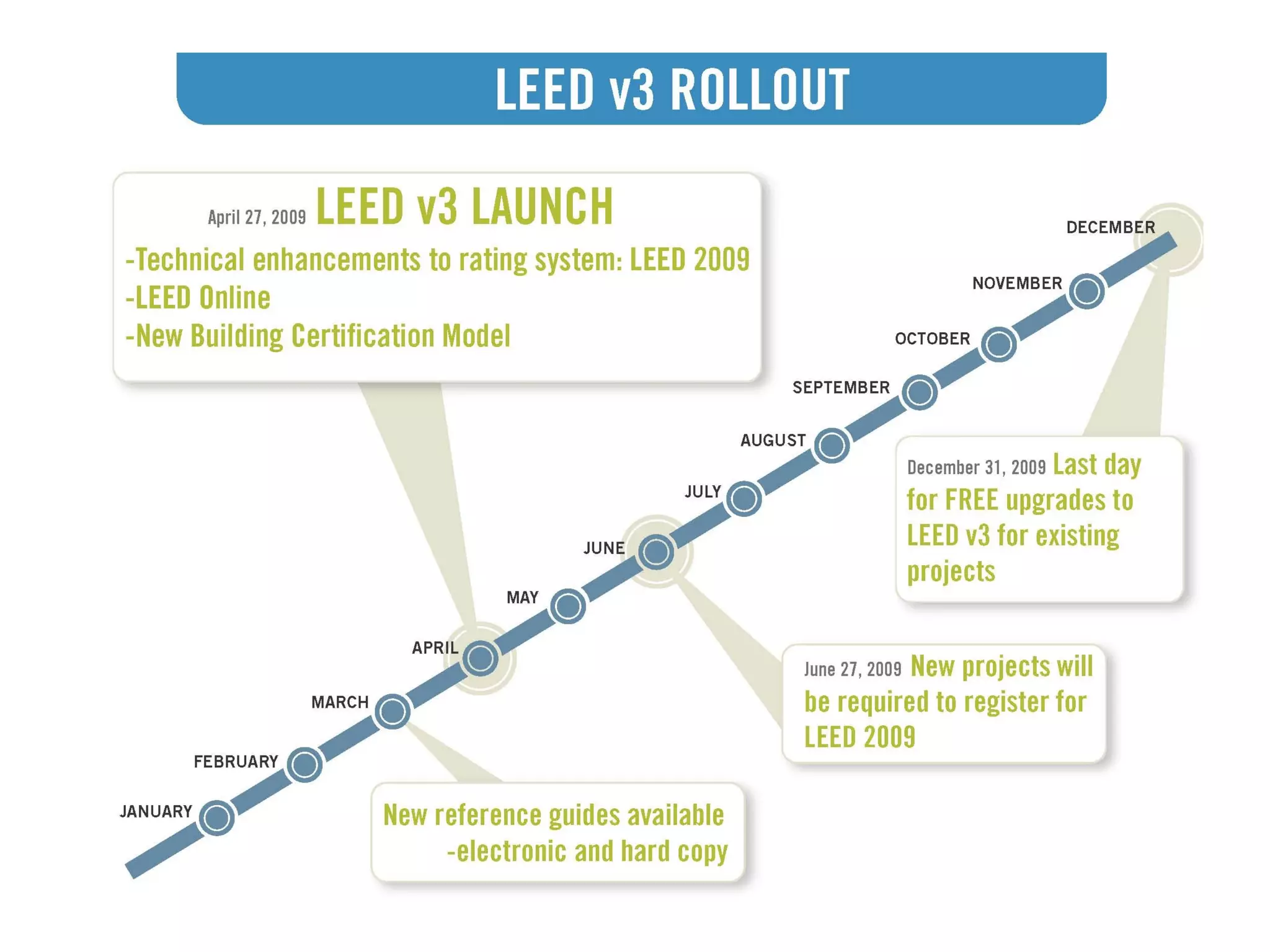
LEEDv3 Rollout


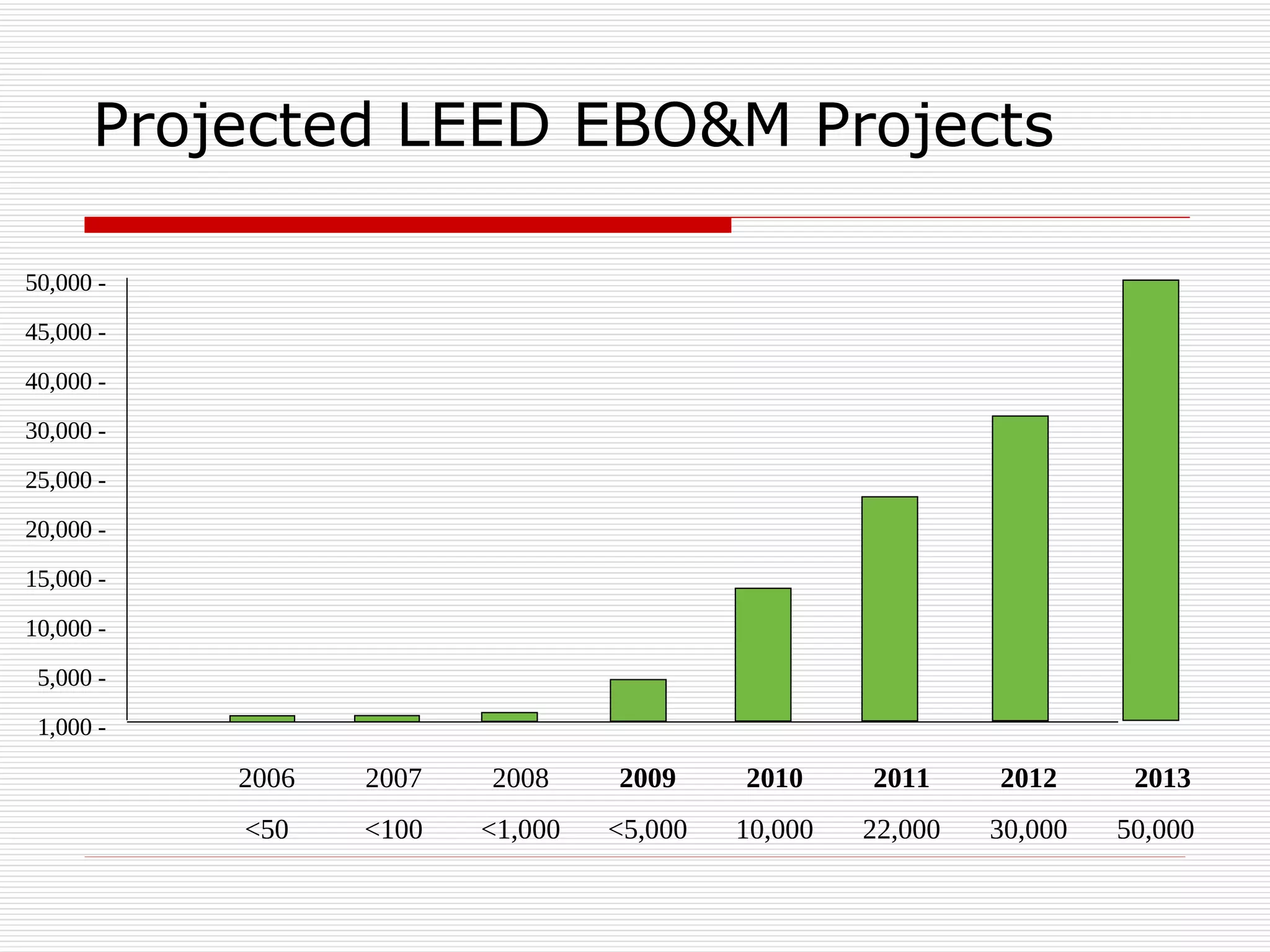
Projected LEED EBO&M Projects 2006 2007 2008 2009 2010 2011 2012   2013 <50 <100 <1,000 <5,000 10,000 22,000 30,000 50,000 50,000 - 45,000 - 40,000 - 30,000 - 25,000 - 20,000 - 15,000 - 10,000 - 5,000 - 1,000 -
 
 
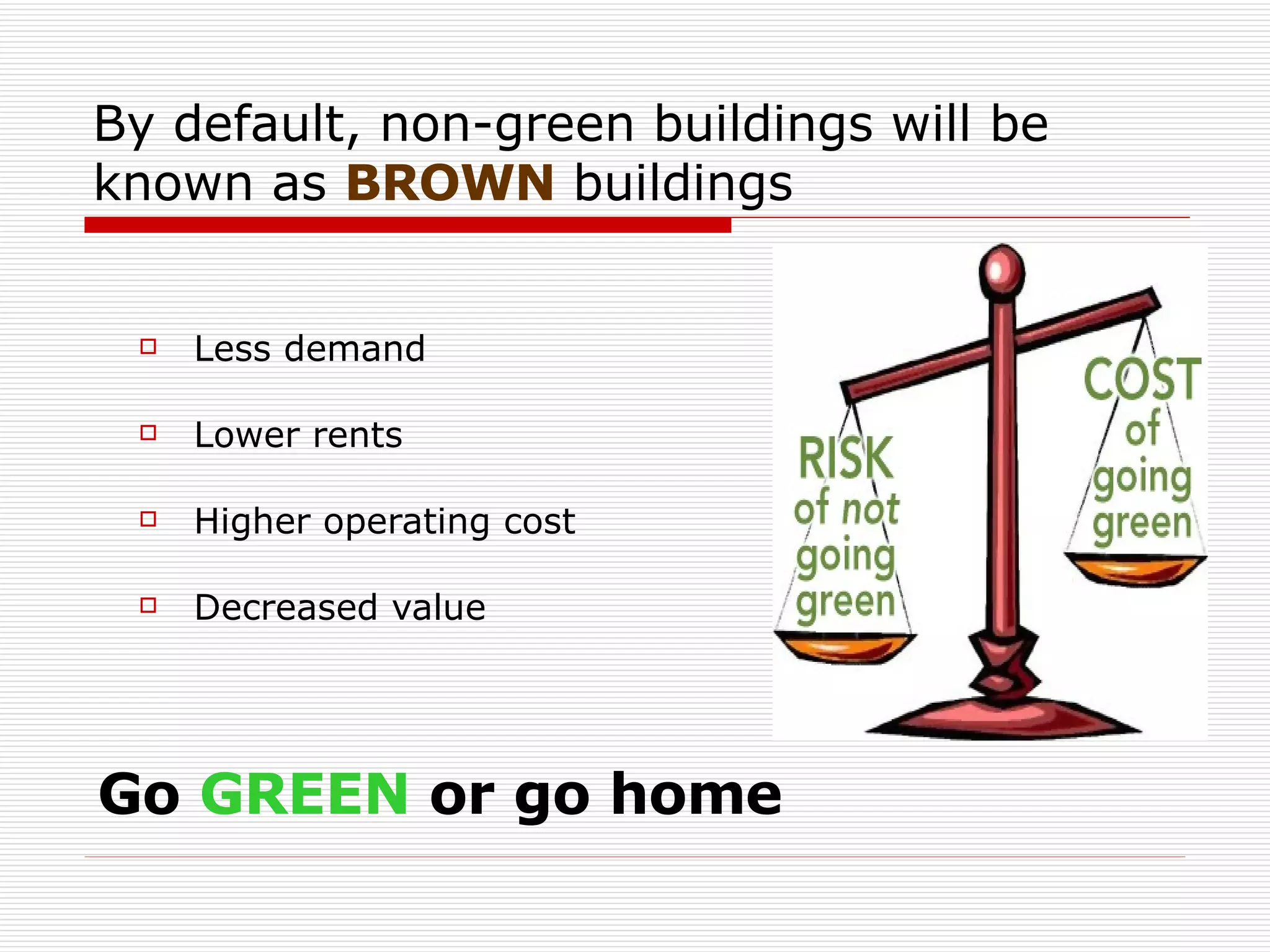
By default, non-green buildings will be known as  BROWN  buildings Less demand  Lower rents Higher operating cost  Decreased value Go  GREEN  or go home
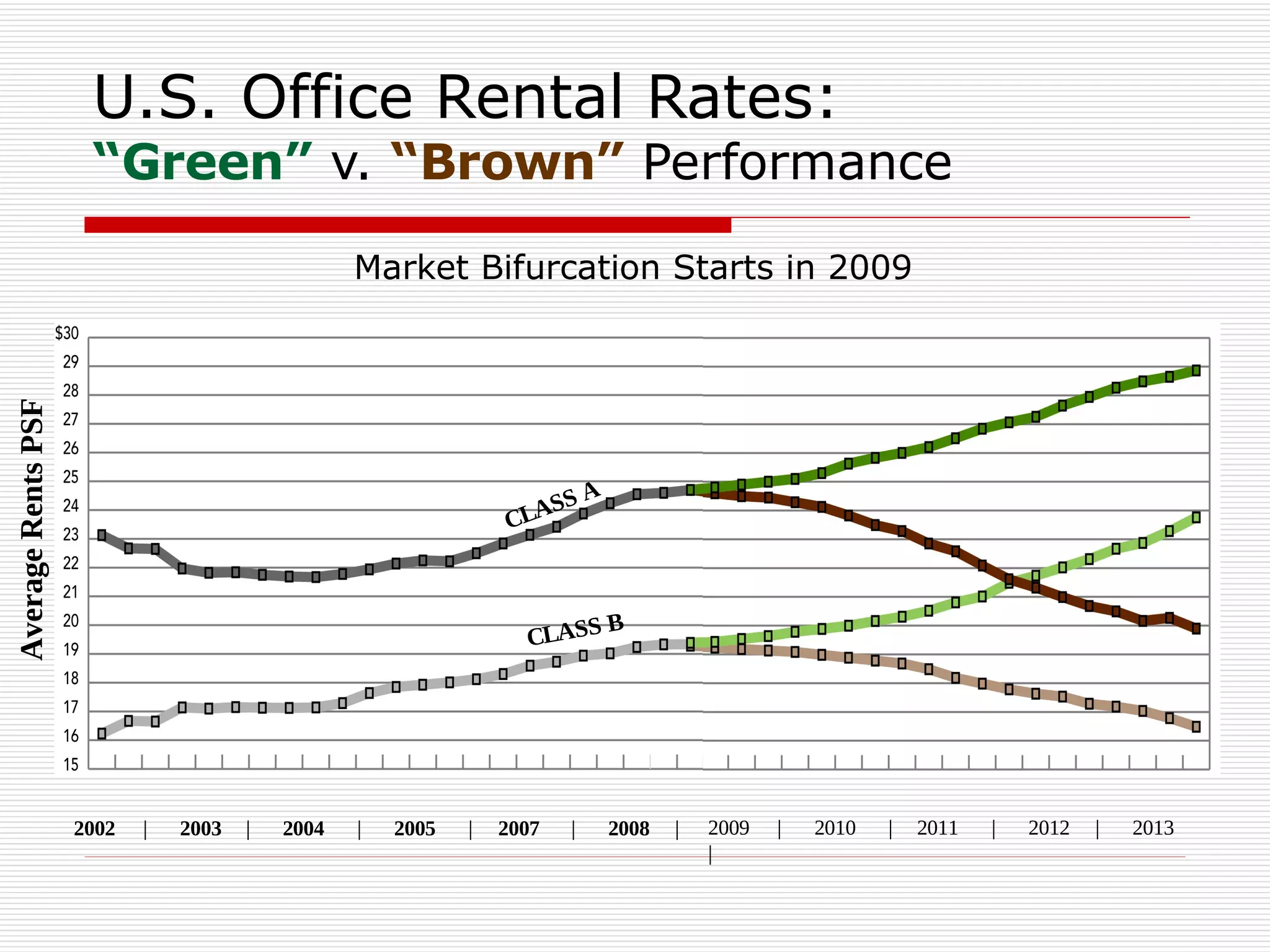
U.S. Office Rental Rates: “Green”  v.  “Brown”  Performance Market Bifurcation Starts in 2009 Average Rents PSF 2009 | 2010 | 2011 | 2012 | 2013 | 2002 | 2003 | 2004 | 2005 | 2007 | 2008 | CLASS A CLASS B
Green Building  Legislation   Federal (growing support and incentives) States  Cities  Chamblee and Doraville  Conyers Atlanta (proposed)
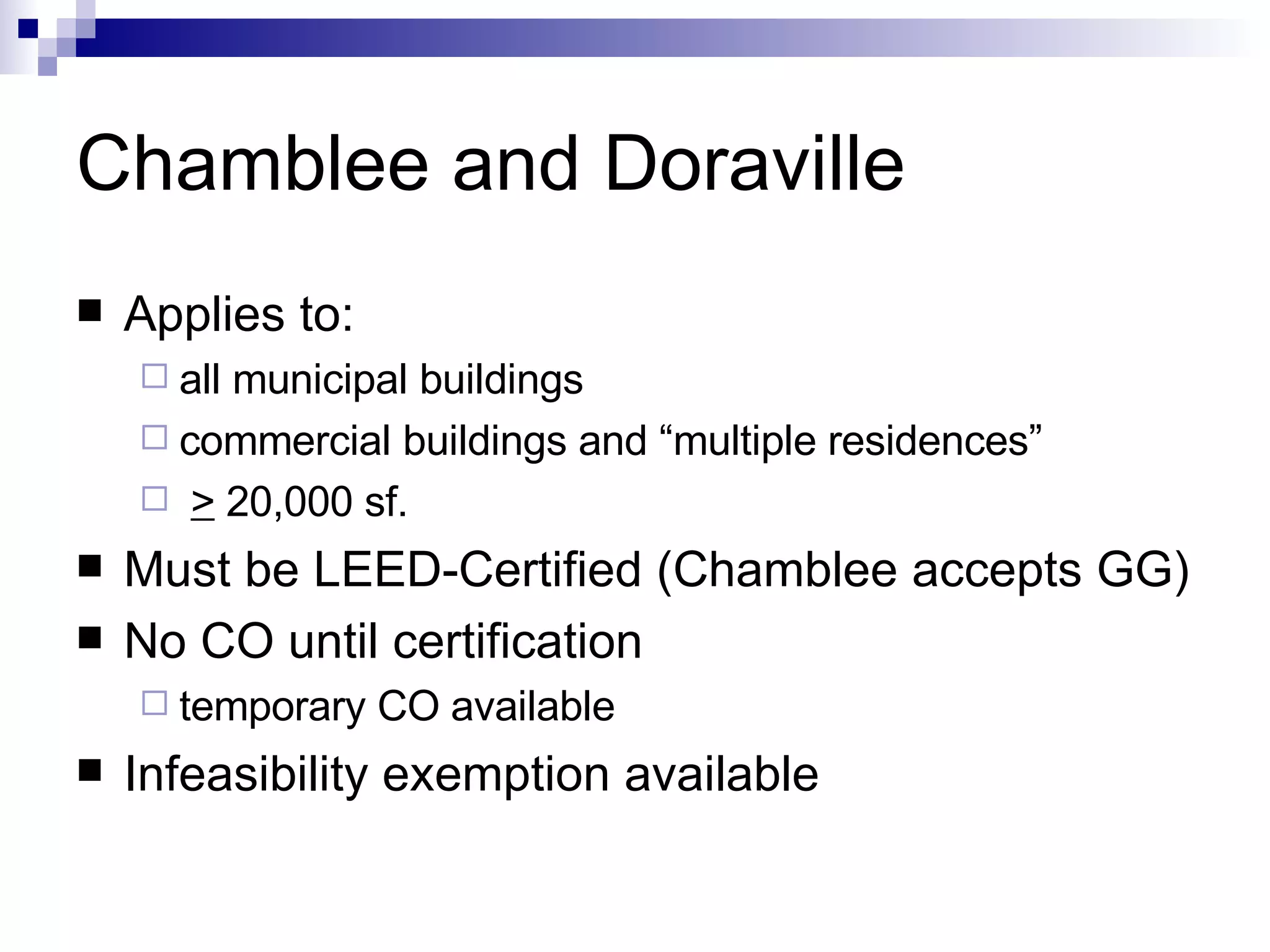
Chamblee and Doraville Applies to: all municipal buildings commercial buildings and “multiple residences” >  20,000 sf.  Must be LEED-Certified (Chamblee accepts GG) No CO until certification  temporary CO available Infeasibility exemption available
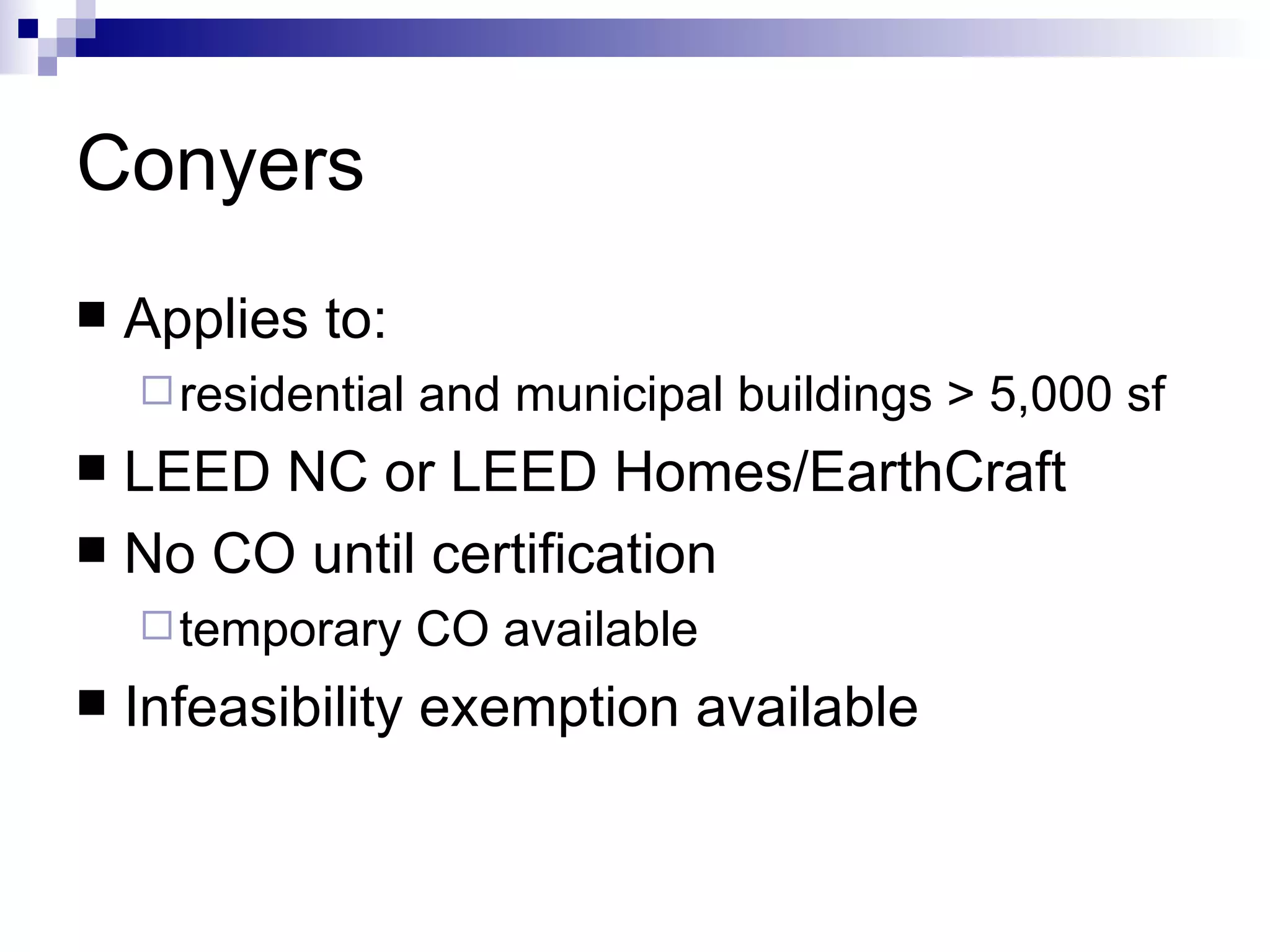
Conyers Applies to:  residential and municipal buildings > 5,000 sf LEED NC or LEED Homes/EarthCraft No CO until certification  temporary CO available Infeasibility exemption available
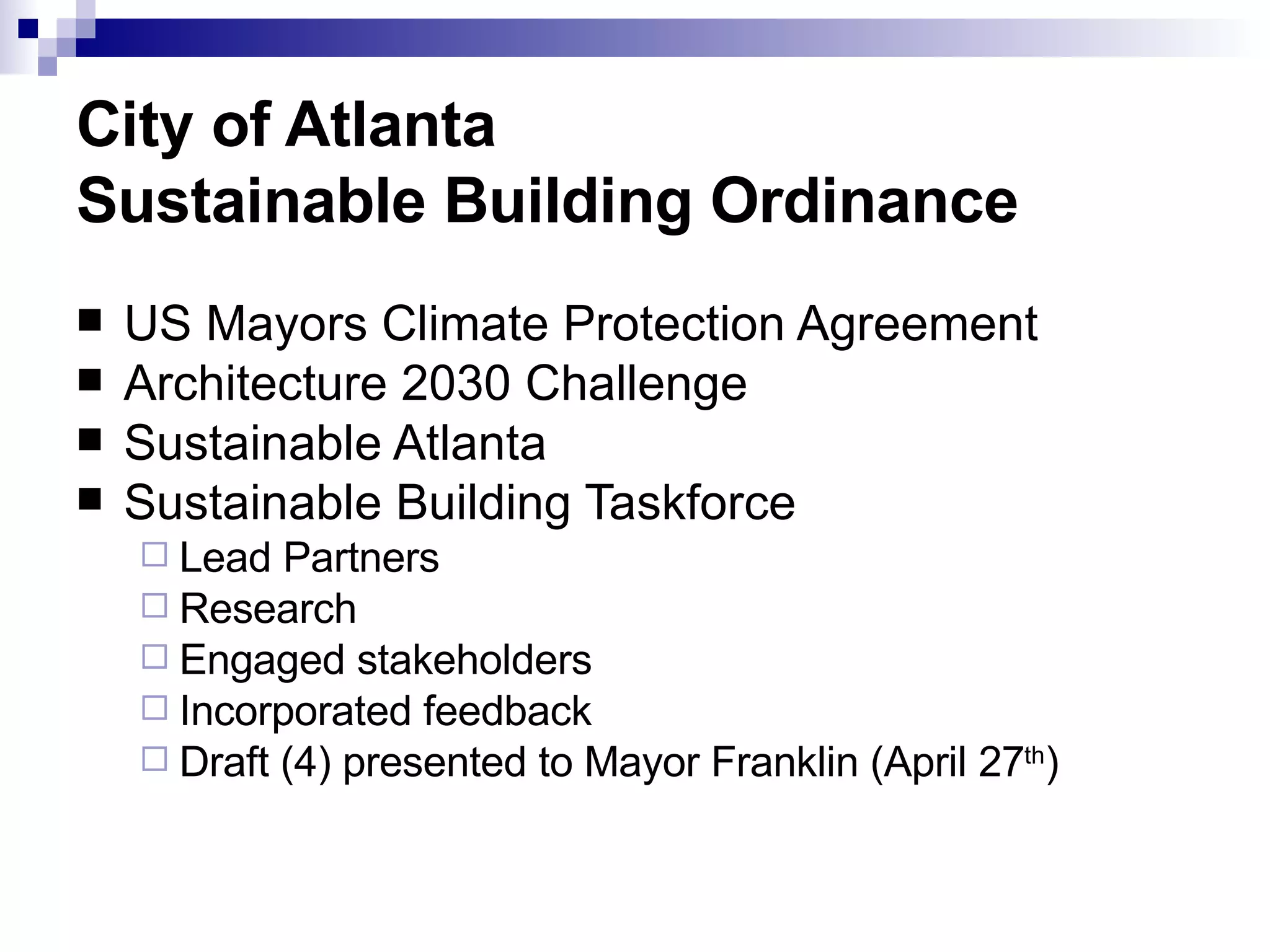
City of Atlanta Sustainable Building Ordinance US Mayors Climate Protection Agreement Architecture 2030 Challenge Sustainable Atlanta  Sustainable Building Taskforce  Lead Partners Research Engaged stakeholders  Incorporated feedback  Draft (4) presented to Mayor Franklin (April 27 th )
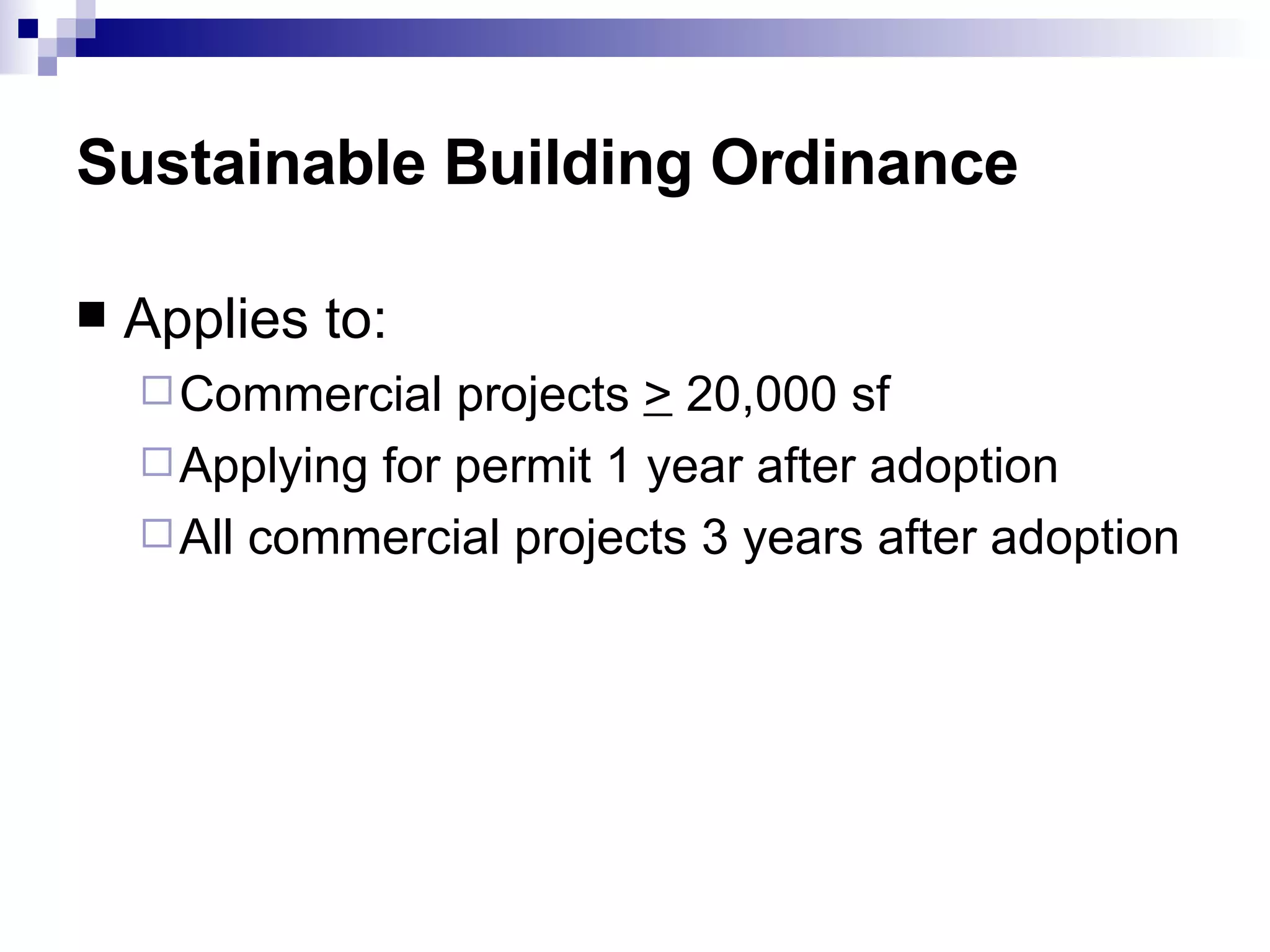
Sustainable Building Ordinance Applies to:  Commercial projects  >  20,000 sf  Applying for permit 1 year after adoption  All commercial projects 3 years after adoption
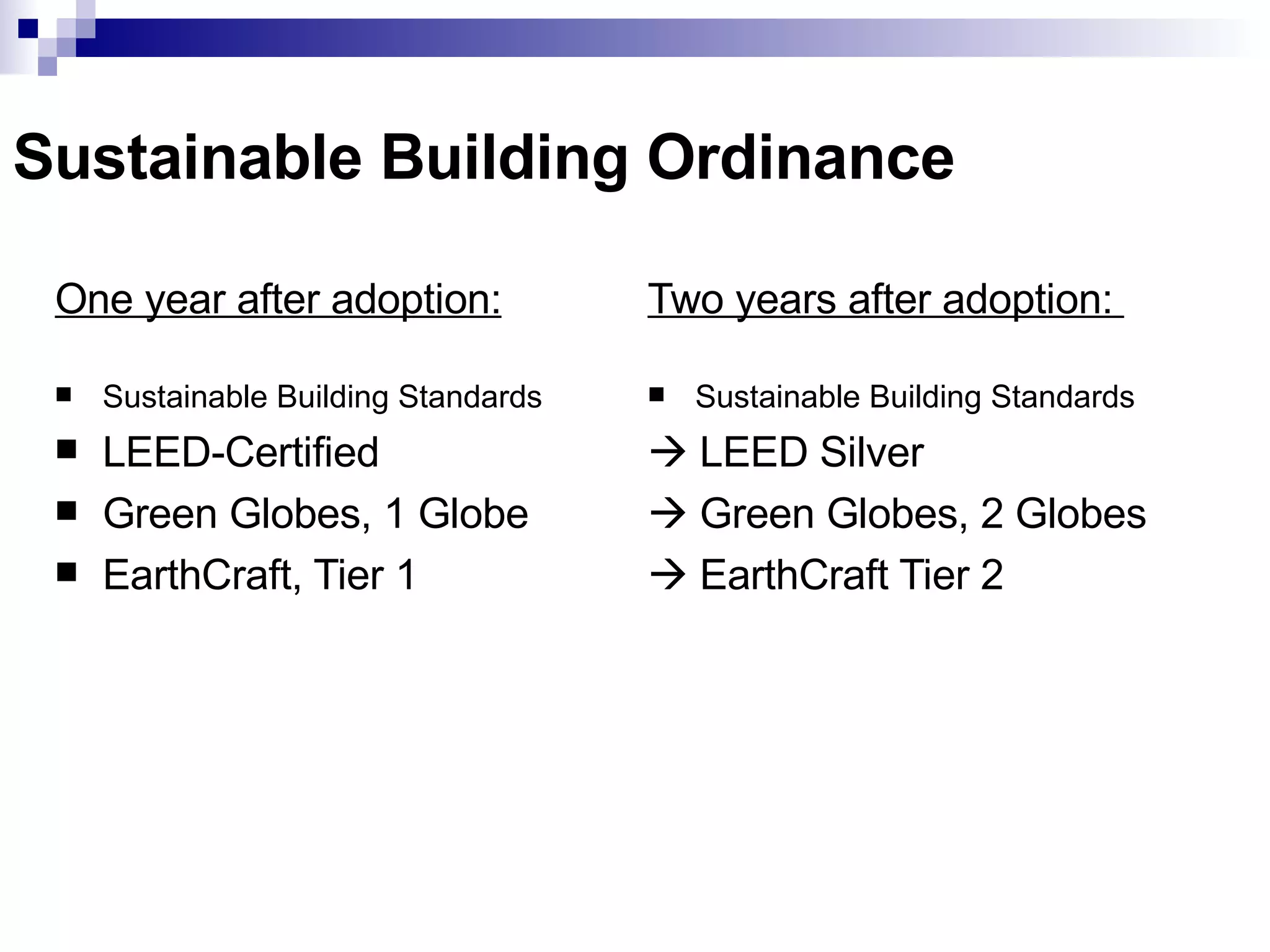
Sustainable Building Ordinance Two years after adoption:  Sustainable Building Standards     LEED Silver    Green Globes, 2 Globes    EarthCraft Tier 2 One year after adoption:   Sustainable Building Standards LEED-Certified  Green Globes, 1 Globe EarthCraft, Tier 1
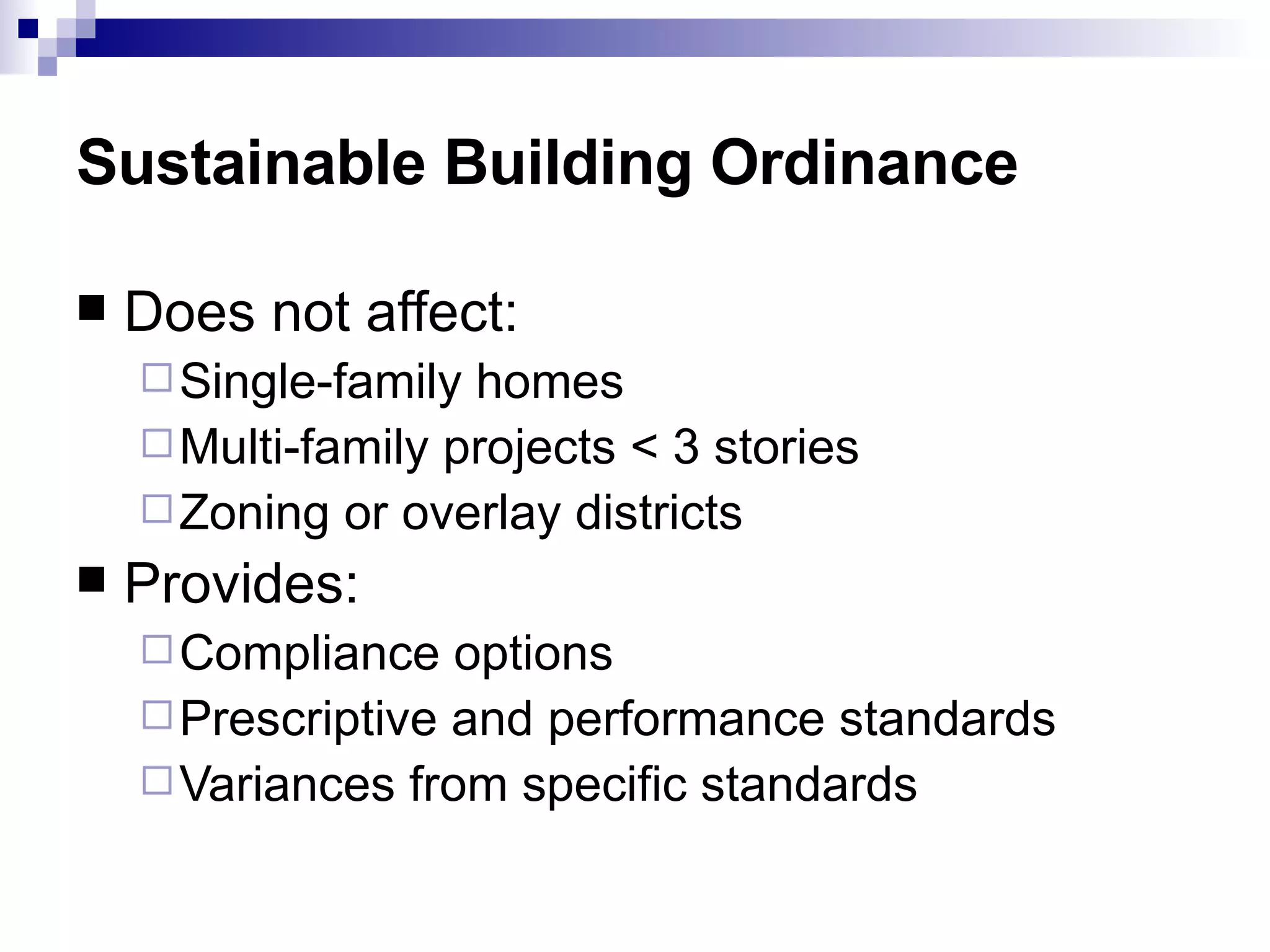
Sustainable Building Ordinance Does not affect:  Single-family homes Multi-family projects < 3 stories Zoning or overlay districts Provides:  Compliance options  Prescriptive and performance standards  Variances from specific standards
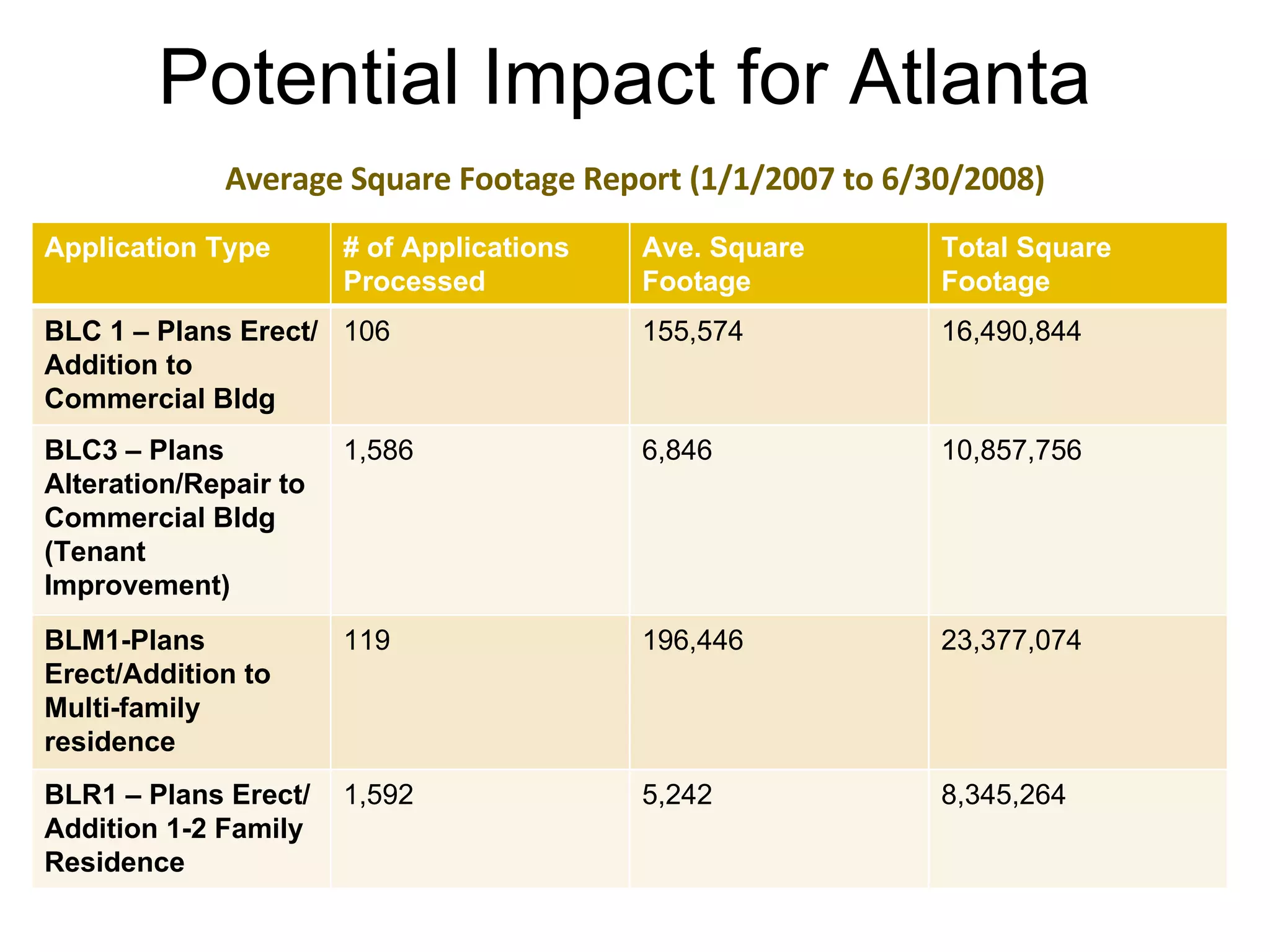
Potential Impact for Atlanta Average Square Footage Report (1/1/2007 to 6/30/2008) Application Type # of Applications Processed Ave. Square Footage Total Square Footage BLC 1 – Plans Erect/Addition to Commercial Bldg 106 155,574 16,490,844 BLC3 – Plans Alteration/Repair to Commercial Bldg (Tenant Improvement) 1,586 6,846 10,857,756 BLM1-Plans Erect/Addition to Multi-family residence 119 196,446 23,377,074 BLR1 – Plans Erect/Addition 1-2 Family Residence 1,592 5,242 8,345,264
Green Building  Legal Issues:   Certified or “Certifiable”?  Development and construction Permitting and incentives Financing Marketing  green Leasing  Buying and selling  green buildings
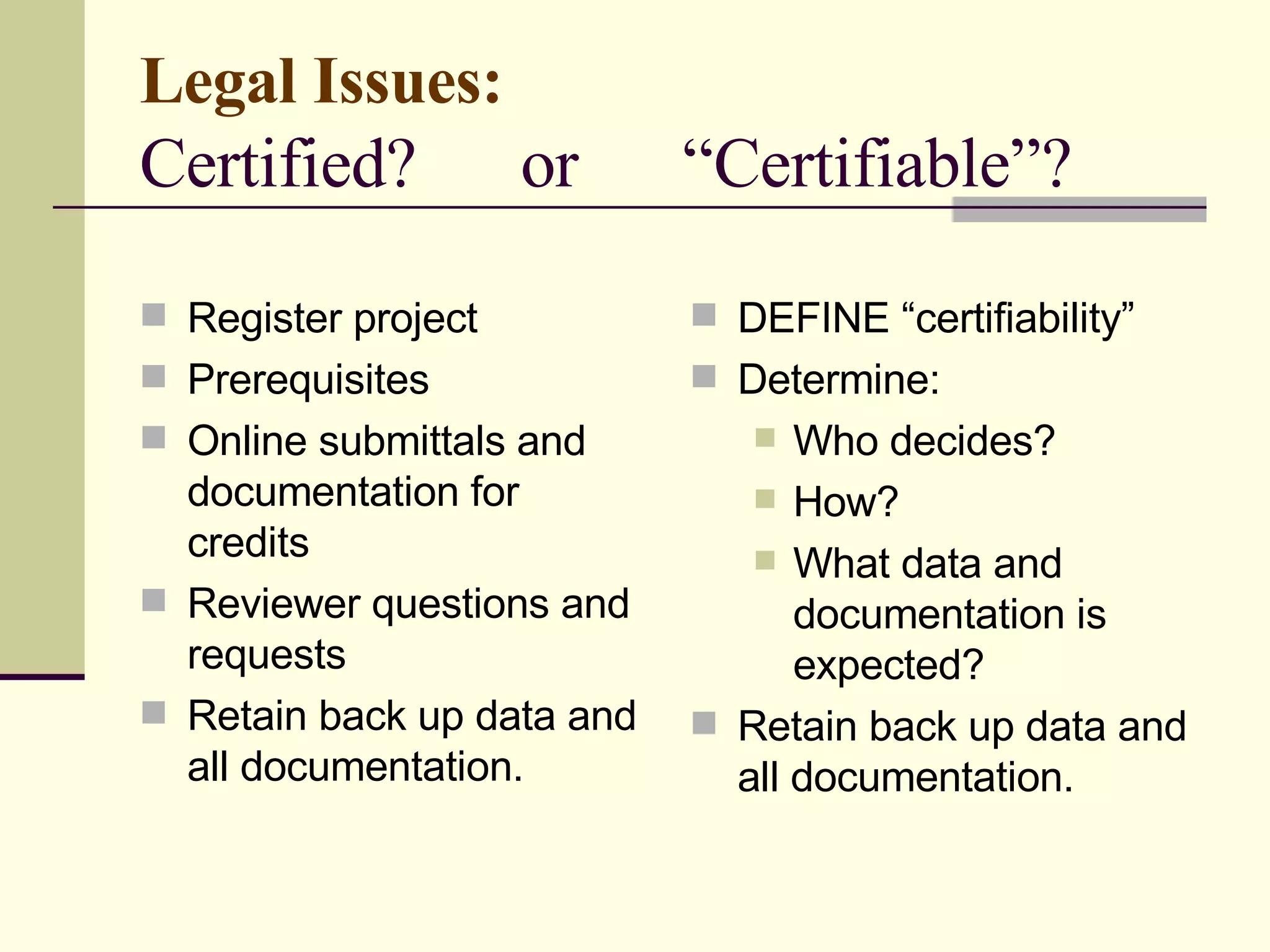
Legal Issues:   Certified?  or  “Certifiable”? Register project Prerequisites  Online submittals and documentation for credits Reviewer questions and requests Retain back up data and all documentation. DEFINE “certifiability” Determine:  Who decides?  How?  What data and documentation is expected?  Retain back up data and all documentation.
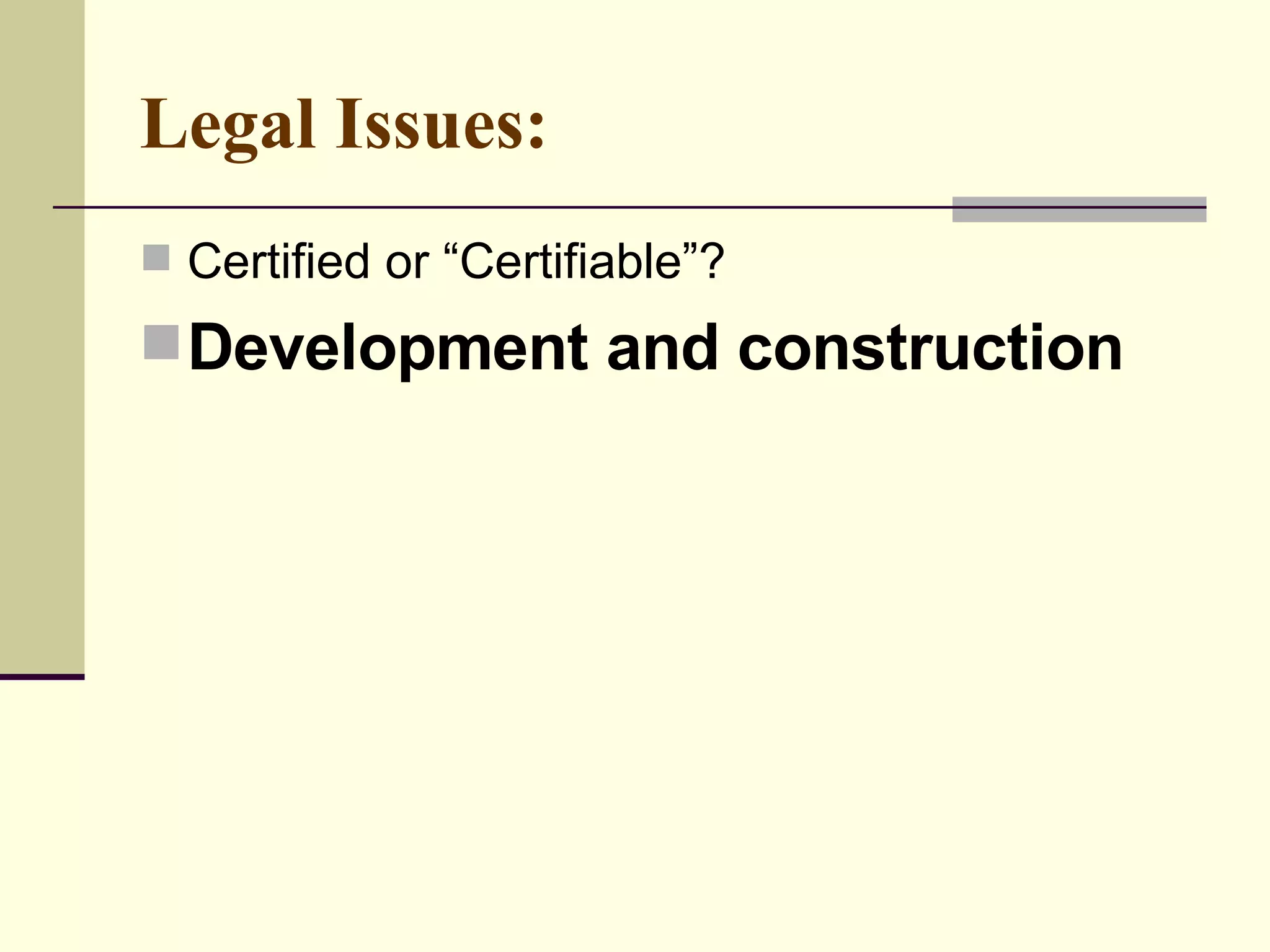
Legal Issues:   Certified or “Certifiable”?  Development and construction
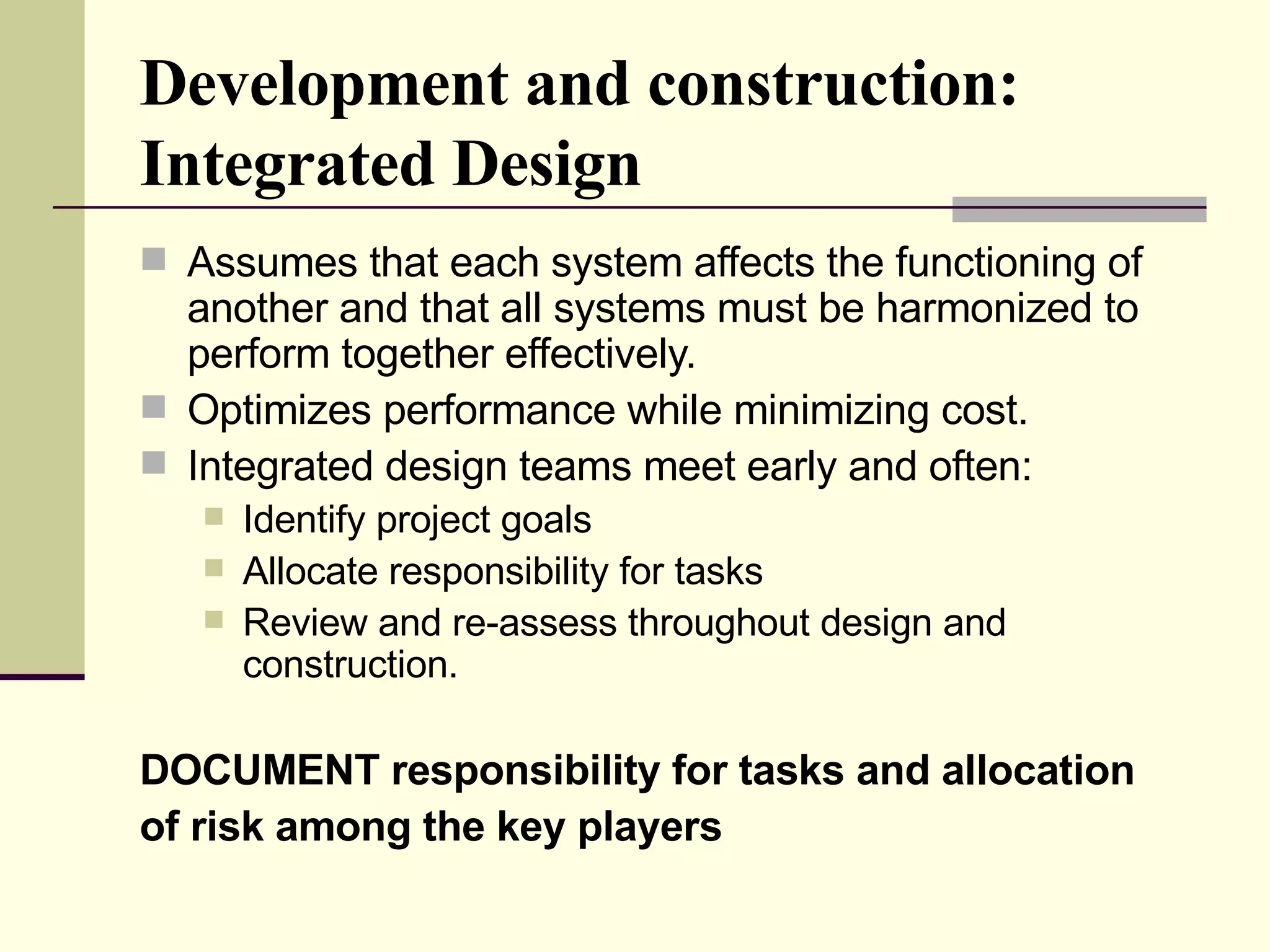
Development and construction:  Integrated Design Assumes that each system affects the functioning of another and that all systems must be harmonized to perform together effectively. Optimizes performance while minimizing cost. Integrated design teams meet early and often:  Identify project goals  Allocate responsibility for tasks  Review and re-assess throughout design and construction.  DOCUMENT responsibility for tasks and allocation of risk among the key players
Development and construction:  Contract issues Legal and financial incentives or requirements? Contract conditions:   Green features must be verifiable and verified. Sustainability goals for construction must be met.  Risk that green features will hinder building performance must be minimized. Client must be protected if problems arise.
Managing Risk in  Green  Buildings: Assemble experienced green project team  Identify sustainability goals and green attributes Document responsibility and allocate risk among key participants For new green products or technologies:  Review technical data and warranties Research product manufacturer  Seek additional guarantees  Certification consultant review/approval of change orders, material substitutions and construction practice changes  Request, collect and retain data and documentation.
Legal Issues:   Certified or “Certifiable”?  Development and construction Permitting and incentives
Permitting and Incentives Zoning, building and development codes Homeowner/Community Associations
Legal Issues:   Certified or “Certifiable”?  Development and construction Permitting and incentives Financing
Financing Appraisal Lender initiatives and incentives
Legal Issues:   Certified or “Certifiable”?  Development and construction Permitting and incentives Financing  Marketing  green
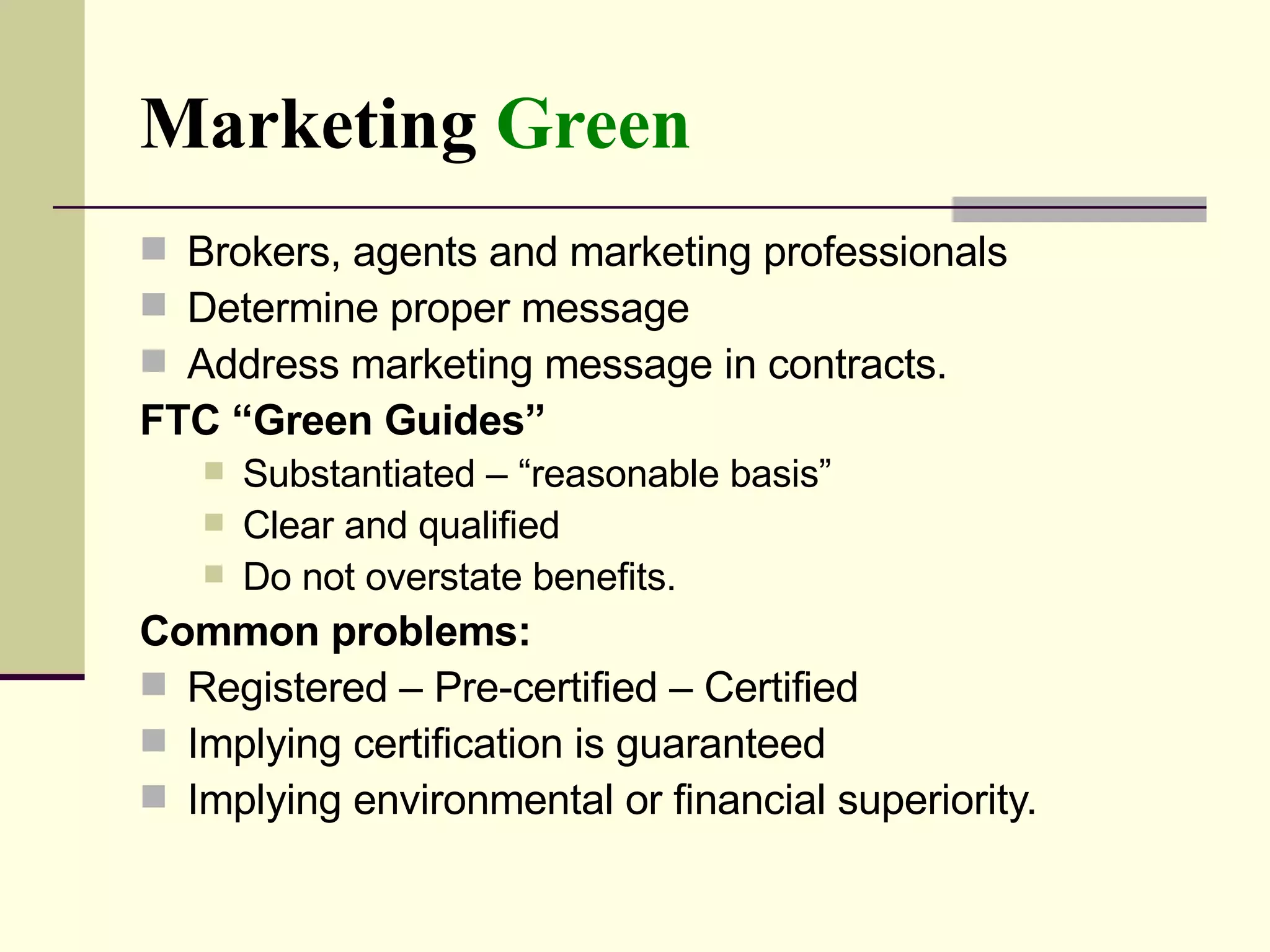
Marketing  Green Brokers, agents and marketing professionals Determine proper message  Address marketing message in contracts.  FTC “Green Guides”   Substantiated – “reasonable basis” Clear and qualified Do not overstate benefits. Common problems:  Registered – Pre-certified – Certified  Implying certification is guaranteed  Implying environmental or financial superiority.
Legal Issues:   Certified or “Certifiable”?  Development and construction Permitting and incentives Financing  Marketing  green Green  Leasing
Green  Leasing Identify  green  features  Tenant (LL) acceptance of restrictions or limited regulation of its operations Tenant (LL) compliance with requirements  Remedies and damages  Tenant (LL) payments to cover cost.  Tenant (LL) data collection and reporting
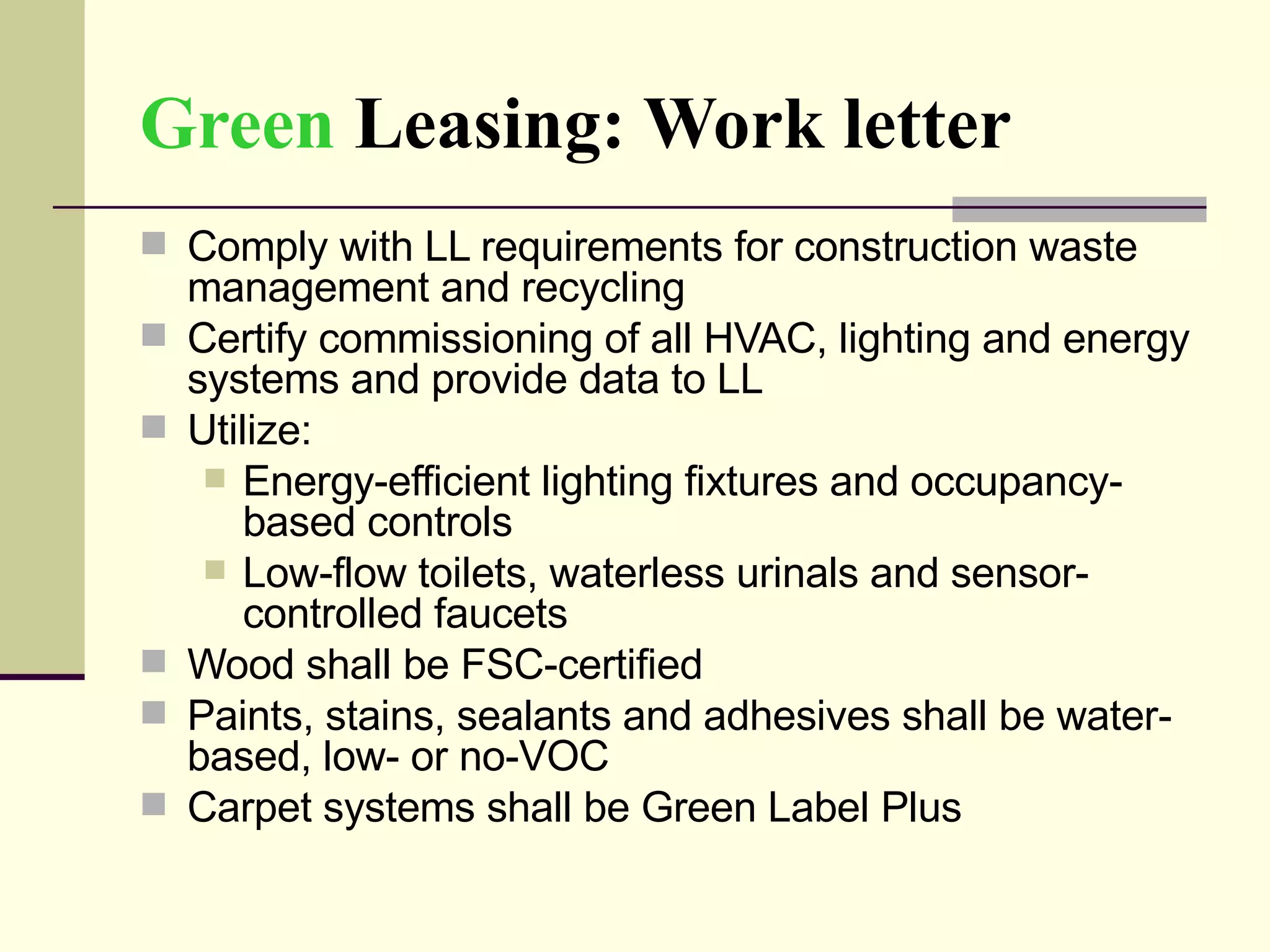
Green   Leasing: Work letter Comply with LL requirements for construction waste management and recycling Certify commissioning of all HVAC, lighting and energy systems and provide data to LL  Utilize:  Energy-efficient lighting fixtures and occupancy-based controls Low-flow toilets, waterless urinals and sensor-controlled faucets Wood shall be FSC-certified Paints, stains, sealants and adhesives shall be water-based, low- or no-VOC Carpet systems shall be Green Label Plus
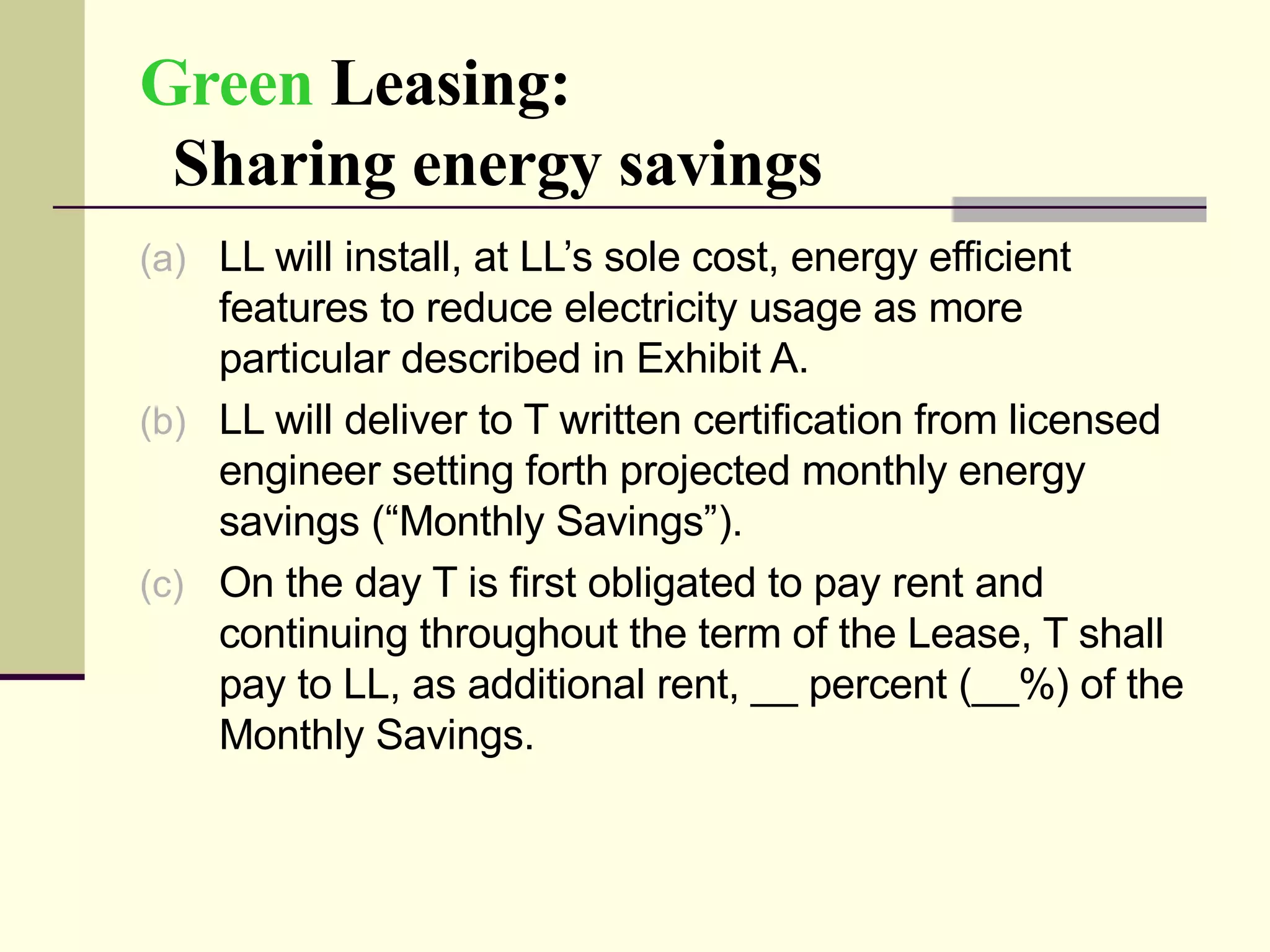
Green  Leasing:   Sharing energy savings LL will install, at LL’s sole cost, energy efficient features to reduce electricity usage as more particular described in Exhibit A. LL will deliver to T written certification from licensed engineer setting forth projected monthly energy savings (“Monthly Savings”). On the day T is first obligated to pay rent and continuing throughout the term of the Lease, T shall pay to LL, as additional rent, __ percent (__%) of the Monthly Savings.
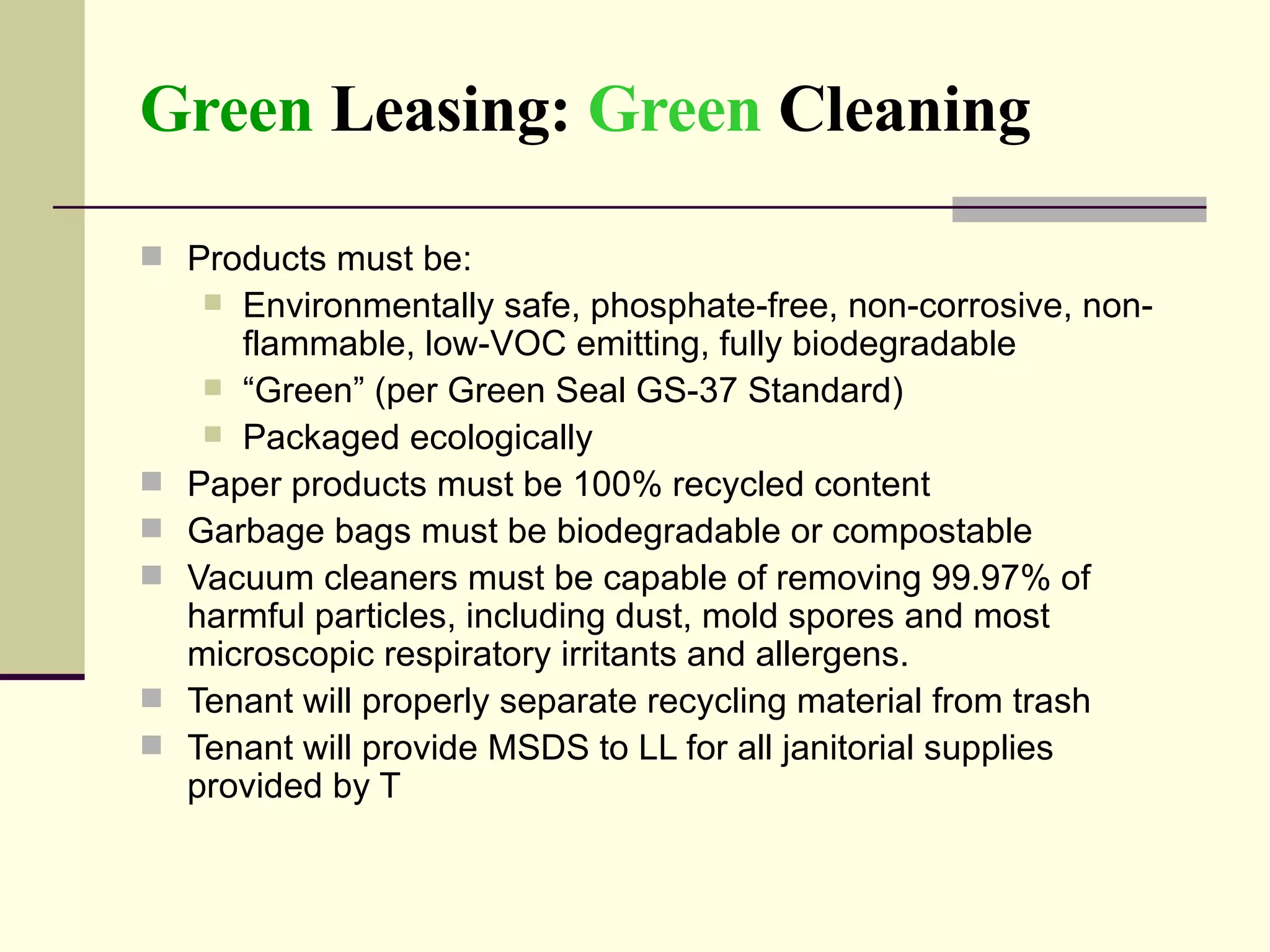
Green  Leasing:  Green  Cleaning Products must be:  Environmentally safe, phosphate-free, non-corrosive, non-flammable, low-VOC emitting, fully biodegradable “ Green” (per Green Seal GS-37 Standard) Packaged ecologically  Paper products must be 100% recycled content  Garbage bags must be biodegradable or compostable Vacuum cleaners must be capable of removing 99.97% of harmful particles, including dust, mold spores and most microscopic respiratory irritants and allergens.  Tenant will properly separate recycling material from trash Tenant will provide MSDS to LL for all janitorial supplies provided by T
Green  Leasing: Double-edged Sword? T may have additional claims against LL under quiet enjoyment provision  LL may be held to higher standard for the green features and building performance.
Legal Issues:   Certified or “Certifiable”?  Development and construction Permitting and incentives Marketing  green Green  Leasing  Buying and selling  green  buildings
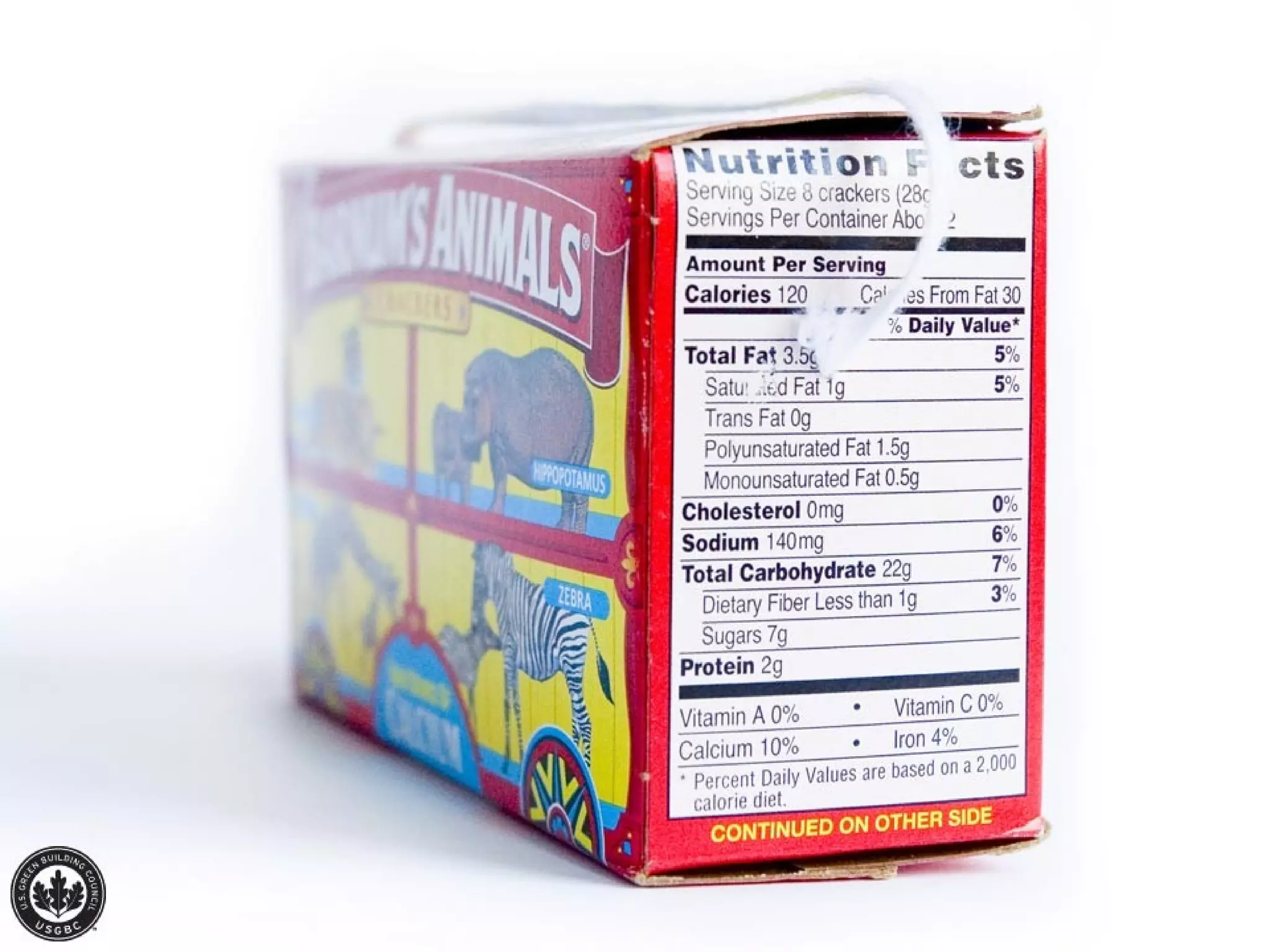
Buying and Selling  Green  Buildings LEED-NC is no guarantee of performance Buyers will demand information
Test
 
Green  Claims and Litigation Claim scenarios  Litigation Shaw Dev. v. Southern Bldrs  AHRI v. City of Albuquerque
Green  Claims and Litigation Architect agreed that design would achieve LEED-Gold.  Developer advertised that building would reduce operating costs and provide healthier indoor environment.  Building failed to achieve Gold certification due to budget and scheduling problems.  Developer sued claiming Architect had guaranteed the certification level.
Green  Claims and Litigation Following installation of a green roof, structural instability resulted in water infiltration causing significant damage. Structural engineer claimed that he had not been provided the proper information related to the green roof.  Contract with structural engineer limited its liability to an amount less than the cost to repair.
Green  Claims and Litigation Law firm hired an architect to design sustainable office space.  The architect, in reliance on information provided by manufacturers, incorporated products into the design.  Local press investigated the products and claimed they were not as “green” as advertised.  Law firm sued Architect claiming its reputation was damaged.
Green  Claims and Litigation County government required recycling of construction materials.  Architect agreed to monitor construction services.  Construction contractor decided that recycling caused excessive delays and that declining price for recycled materials justified dumping construction waste in another state.  County took action against Owner, and Owner sued Architect for failing to properly monitor construction services.
Green  Claims and Litigation Shaw Dev. v. Southern Bldrs AHRI v. City of Albuquerque
QUESTIONS?
Robert C. Newcomer The Lang Legal Group LLC [email_address]   404.320.0990

Green Building Intro and Legal Issues

  • 1.
    Robert C. Newcomer [email_address] The Lang Legal Group LLC 404.320.0990 Business, environmental and real estate litigation and counseling. LEED-AP Member, Sustainable Atlanta Green Building Taskforce. Urban Land Institute Co-Chair, Sustainability - Community Assistance Sub-committee Member, Technical Advisory Panel Committee Director, Green Chamber of the South.
  • 2.
    Green (Sustainable) BuildingSustainability Green Building and Rating System Legislation Contract Issues Claims and Litigation
  • 3.
    Sustainability “ Tomeet the needs of the present without compromising the ability of future generations to meet their own needs.” - Brundtland Commission Green building is the practice of creating structures and using processes that are environmentally responsible and resource-efficient throughout a building's life-cycle from siting to design, construction, operation, maintenance, renovation and deconstruction.” - EPA (Green Building Workgroup)
  • 4.
    Buildings: TripleBottom Line Sustainability Less environmental impact Greater energy efficiency Improved cap rates Increased marketability Higher lease rates Improved productivity Reduced absenteeism Community connectivity
  • 5.
  • 6.
  • 7.
    U.S. Building ImpactsTest 12 % Water Use 30 % Greenhouse Gas Emissions 65 % Waste Output 70 % Electricity Consumption
  • 8.
    GLOBAL CO 2 EMISSIONS ( BY SECTOR) #1 Buildings #2 Transportation #3 Industry
  • 9.
  • 10.
  • 11.
    Carbon-based regulation .. . ? Massachusetts v EPA (2007) EPA “Endangerment Finding” Six heat-trapping gases are pollutants that endanger public health and welfare. Proposed mandatory reporting of greenhouse gases emissions (April 2009) Federal regulation . . . Cap & trade, carbon tax, ??? Implications for real estate . . . ???
  • 12.
    “ LEAP” toZero Carbon: Energy efficiency (reaction to 1970s oil crises) Green (environmentally responsive) Sustainable (holistic) High Performance (accountable) Carbon Neutral
  • 13.
  • 14.
  • 15.
    LEED-NC Rating SystemSustainable Sites 14 total points (1 prerequisite + 14 credits) Water Efficiency 5 total points (no prerequisites + 5 credits) Earth & Atmosphere 17 total points (3 prerequisites + 6 credits) Materials & Resources 13 total points (1 prerequisite + 13 credits) Indoor Environmental Air Quality 15 total points (2 prerequisites + 15 credits) Innovation in Design 5 total points (no prerequisites + 5 credits) _____________________________________ 7 prerequisites + 58 credits (69 total points)
  • 16.
    LEED “Certification”Register project Satisfy all prerequisites Complete online submittals and documentation for credits to be sought Respond to questions Retain back up data and documentation.
  • 17.
    Four Levels ofLEED Ratings: Green Buildings worldwide are certified with a voluntary, consensus-based rating system. USGBC has four levels of LEED.
  • 18.
  • 19.
  • 20.
  • 21.
  • 22.
  • 23.
  • 24.
  • 25.
  • 26.
  • 27.
    Projected LEED EBO&MProjects 2006 2007 2008 2009 2010 2011 2012 2013 <50 <100 <1,000 <5,000 10,000 22,000 30,000 50,000 50,000 - 45,000 - 40,000 - 30,000 - 25,000 - 20,000 - 15,000 - 10,000 - 5,000 - 1,000 -
  • 28.
  • 29.
  • 30.
    By default, non-greenbuildings will be known as BROWN buildings Less demand Lower rents Higher operating cost Decreased value Go GREEN or go home
  • 31.
    U.S. Office RentalRates: “Green” v. “Brown” Performance Market Bifurcation Starts in 2009 Average Rents PSF 2009 | 2010 | 2011 | 2012 | 2013 | 2002 | 2003 | 2004 | 2005 | 2007 | 2008 | CLASS A CLASS B
  • 32.
    Green Building Legislation Federal (growing support and incentives) States Cities Chamblee and Doraville Conyers Atlanta (proposed)
  • 33.
    Chamblee and DoravilleApplies to: all municipal buildings commercial buildings and “multiple residences” > 20,000 sf. Must be LEED-Certified (Chamblee accepts GG) No CO until certification temporary CO available Infeasibility exemption available
  • 34.
    Conyers Applies to: residential and municipal buildings > 5,000 sf LEED NC or LEED Homes/EarthCraft No CO until certification temporary CO available Infeasibility exemption available
  • 35.
    City of AtlantaSustainable Building Ordinance US Mayors Climate Protection Agreement Architecture 2030 Challenge Sustainable Atlanta Sustainable Building Taskforce Lead Partners Research Engaged stakeholders Incorporated feedback Draft (4) presented to Mayor Franklin (April 27 th )
  • 36.
    Sustainable Building OrdinanceApplies to: Commercial projects > 20,000 sf Applying for permit 1 year after adoption All commercial projects 3 years after adoption
  • 37.
    Sustainable Building OrdinanceTwo years after adoption: Sustainable Building Standards  LEED Silver  Green Globes, 2 Globes  EarthCraft Tier 2 One year after adoption: Sustainable Building Standards LEED-Certified Green Globes, 1 Globe EarthCraft, Tier 1
  • 38.
    Sustainable Building OrdinanceDoes not affect: Single-family homes Multi-family projects < 3 stories Zoning or overlay districts Provides: Compliance options Prescriptive and performance standards Variances from specific standards
  • 39.
    Potential Impact forAtlanta Average Square Footage Report (1/1/2007 to 6/30/2008) Application Type # of Applications Processed Ave. Square Footage Total Square Footage BLC 1 – Plans Erect/Addition to Commercial Bldg 106 155,574 16,490,844 BLC3 – Plans Alteration/Repair to Commercial Bldg (Tenant Improvement) 1,586 6,846 10,857,756 BLM1-Plans Erect/Addition to Multi-family residence 119 196,446 23,377,074 BLR1 – Plans Erect/Addition 1-2 Family Residence 1,592 5,242 8,345,264
  • 40.
    Green Building Legal Issues: Certified or “Certifiable”? Development and construction Permitting and incentives Financing Marketing green Leasing Buying and selling green buildings
  • 41.
    Legal Issues: Certified? or “Certifiable”? Register project Prerequisites Online submittals and documentation for credits Reviewer questions and requests Retain back up data and all documentation. DEFINE “certifiability” Determine: Who decides? How? What data and documentation is expected? Retain back up data and all documentation.
  • 42.
    Legal Issues: Certified or “Certifiable”? Development and construction
  • 43.
    Development and construction: Integrated Design Assumes that each system affects the functioning of another and that all systems must be harmonized to perform together effectively. Optimizes performance while minimizing cost. Integrated design teams meet early and often: Identify project goals Allocate responsibility for tasks Review and re-assess throughout design and construction. DOCUMENT responsibility for tasks and allocation of risk among the key players
  • 44.
    Development and construction: Contract issues Legal and financial incentives or requirements? Contract conditions: Green features must be verifiable and verified. Sustainability goals for construction must be met. Risk that green features will hinder building performance must be minimized. Client must be protected if problems arise.
  • 45.
    Managing Risk in Green Buildings: Assemble experienced green project team Identify sustainability goals and green attributes Document responsibility and allocate risk among key participants For new green products or technologies: Review technical data and warranties Research product manufacturer Seek additional guarantees Certification consultant review/approval of change orders, material substitutions and construction practice changes Request, collect and retain data and documentation.
  • 46.
    Legal Issues: Certified or “Certifiable”? Development and construction Permitting and incentives
  • 47.
    Permitting and IncentivesZoning, building and development codes Homeowner/Community Associations
  • 48.
    Legal Issues: Certified or “Certifiable”? Development and construction Permitting and incentives Financing
  • 49.
    Financing Appraisal Lenderinitiatives and incentives
  • 50.
    Legal Issues: Certified or “Certifiable”? Development and construction Permitting and incentives Financing Marketing green
  • 51.
    Marketing GreenBrokers, agents and marketing professionals Determine proper message Address marketing message in contracts. FTC “Green Guides” Substantiated – “reasonable basis” Clear and qualified Do not overstate benefits. Common problems: Registered – Pre-certified – Certified Implying certification is guaranteed Implying environmental or financial superiority.
  • 52.
    Legal Issues: Certified or “Certifiable”? Development and construction Permitting and incentives Financing Marketing green Green Leasing
  • 53.
    Green LeasingIdentify green features Tenant (LL) acceptance of restrictions or limited regulation of its operations Tenant (LL) compliance with requirements Remedies and damages Tenant (LL) payments to cover cost. Tenant (LL) data collection and reporting
  • 54.
    Green Leasing: Work letter Comply with LL requirements for construction waste management and recycling Certify commissioning of all HVAC, lighting and energy systems and provide data to LL Utilize: Energy-efficient lighting fixtures and occupancy-based controls Low-flow toilets, waterless urinals and sensor-controlled faucets Wood shall be FSC-certified Paints, stains, sealants and adhesives shall be water-based, low- or no-VOC Carpet systems shall be Green Label Plus
  • 55.
    Green Leasing: Sharing energy savings LL will install, at LL’s sole cost, energy efficient features to reduce electricity usage as more particular described in Exhibit A. LL will deliver to T written certification from licensed engineer setting forth projected monthly energy savings (“Monthly Savings”). On the day T is first obligated to pay rent and continuing throughout the term of the Lease, T shall pay to LL, as additional rent, __ percent (__%) of the Monthly Savings.
  • 56.
    Green Leasing: Green Cleaning Products must be: Environmentally safe, phosphate-free, non-corrosive, non-flammable, low-VOC emitting, fully biodegradable “ Green” (per Green Seal GS-37 Standard) Packaged ecologically Paper products must be 100% recycled content Garbage bags must be biodegradable or compostable Vacuum cleaners must be capable of removing 99.97% of harmful particles, including dust, mold spores and most microscopic respiratory irritants and allergens. Tenant will properly separate recycling material from trash Tenant will provide MSDS to LL for all janitorial supplies provided by T
  • 57.
    Green Leasing:Double-edged Sword? T may have additional claims against LL under quiet enjoyment provision LL may be held to higher standard for the green features and building performance.
  • 58.
    Legal Issues: Certified or “Certifiable”? Development and construction Permitting and incentives Marketing green Green Leasing Buying and selling green buildings
  • 59.
    Buying and Selling Green Buildings LEED-NC is no guarantee of performance Buyers will demand information
  • 60.
  • 61.
  • 62.
    Green Claimsand Litigation Claim scenarios Litigation Shaw Dev. v. Southern Bldrs AHRI v. City of Albuquerque
  • 63.
    Green Claimsand Litigation Architect agreed that design would achieve LEED-Gold. Developer advertised that building would reduce operating costs and provide healthier indoor environment. Building failed to achieve Gold certification due to budget and scheduling problems. Developer sued claiming Architect had guaranteed the certification level.
  • 64.
    Green Claimsand Litigation Following installation of a green roof, structural instability resulted in water infiltration causing significant damage. Structural engineer claimed that he had not been provided the proper information related to the green roof. Contract with structural engineer limited its liability to an amount less than the cost to repair.
  • 65.
    Green Claimsand Litigation Law firm hired an architect to design sustainable office space. The architect, in reliance on information provided by manufacturers, incorporated products into the design. Local press investigated the products and claimed they were not as “green” as advertised. Law firm sued Architect claiming its reputation was damaged.
  • 66.
    Green Claimsand Litigation County government required recycling of construction materials. Architect agreed to monitor construction services. Construction contractor decided that recycling caused excessive delays and that declining price for recycled materials justified dumping construction waste in another state. County took action against Owner, and Owner sued Architect for failing to properly monitor construction services.
  • 67.
    Green Claimsand Litigation Shaw Dev. v. Southern Bldrs AHRI v. City of Albuquerque
  • 68.
  • 69.
    Robert C. NewcomerThe Lang Legal Group LLC [email_address] 404.320.0990