K.VARUN KUMAR
ESSENTIAL KITCHEN EQUIPMENTS REQUIRED
IN A KITCHEN
KITCHEN EQUIPMENT
Culinary Terminology
 Mise en place-”to put in place”…doing whatever is necessary to be ready
for your culinary operation (tools
 Work flow- planned movement of food and kitchen staff as food is
prepared
 Work lines- geometric arrangements of equipment
 Work sections- combination of workstations in a kitchen
 Workstation- a work area containing equipment and tools needed for
accomplishing a specific set of culinary tasks
 Conduction- how well pots and pans transfer heat from the burner or oven
to the food they contain.
 Smallwares- the pots, pans, and other hand tools used to prepare food
 Pot- a cooking container that is as tall, or taller, than it is wide
 Pan- a cooking container that is wider than it is tall
 Preventive Maintenance Schedule- a list of tasks to be performed to
ensure that equipment stays in proper working order.

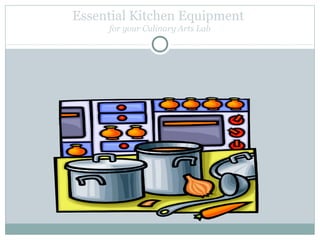
Essential Kitchen Equipment
for your Culinary Arts Lab
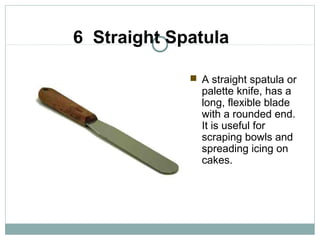
6 Straight Spatula
 A straight spatula or
palette knife, has a
long, flexible blade
with a rounded end.
It is useful for
scraping bowls and
spreading icing on
cakes.
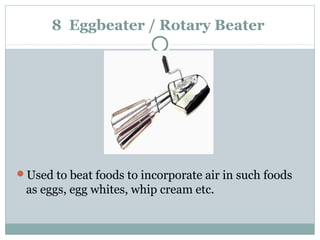
8 Eggbeater / Rotary Beater
Used to beat foods to incorporate air in such foods
as eggs, egg whites, whip cream etc.
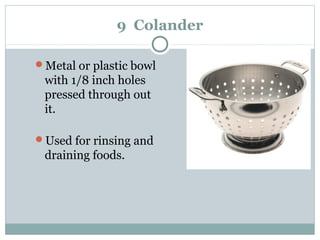
9 Colander
Metal or plastic bowl
with 1/8 inch holes
pressed through out
it.
Used for rinsing and
draining foods.
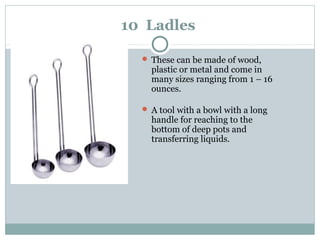
10 Ladles
 These can be made of wood,
plastic or metal and come in
many sizes ranging from 1 – 16
ounces.
 A tool with a bowl with a long
handle for reaching to the
bottom of deep pots and
transferring liquids.
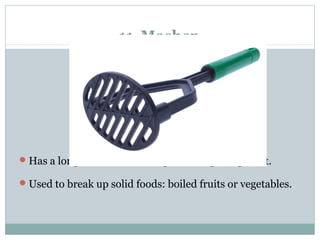
11 Masher
Has a long handle and has a grid and openings to it.
Used to break up solid foods: boiled fruits or vegetables.
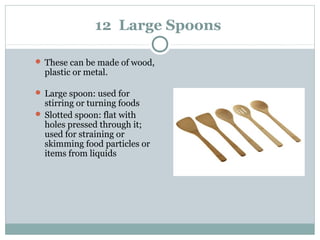
12 Large Spoons
 These can be made of wood,
plastic or metal.
 Large spoon: used for
stirring or turning foods
 Slotted spoon: flat with
holes pressed through it;
used for straining or
skimming food particles or
items from liquids
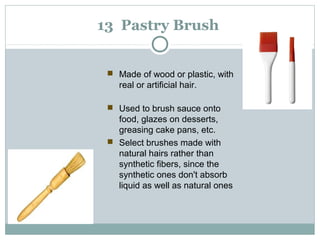
13 Pastry Brush
 Made of wood or plastic, with
real or artificial hair.
 Used to brush sauce onto
food, glazes on desserts,
greasing cake pans, etc.
 Select brushes made with
natural hairs rather than
synthetic fibers, since the
synthetic ones don't absorb
liquid as well as natural ones
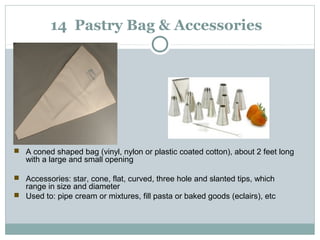
14 Pastry Bag & Accessories

 A coned shaped bag (vinyl, nylon or plastic coated cotton), about 2 feet long
with a large and small opening
 Accessories: star, cone, flat, curved, three hole and slanted tips, which
range in size and diameter
 Used to: pipe cream or mixtures, fill pasta or baked goods (eclairs), etc
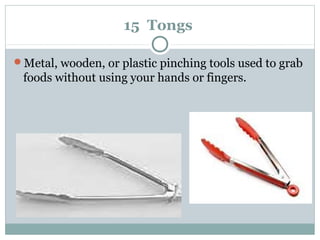
15 Tongs
Metal, wooden, or plastic pinching tools used to grab
foods without using your hands or fingers.
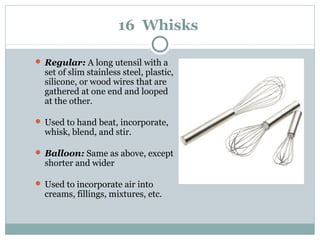
16 Whisks
 Regular: A long utensil with a
set of slim stainless steel, plastic,
silicone, or wood wires that are
gathered at one end and looped
at the other.
 Used to hand beat, incorporate,
whisk, blend, and stir.
 Balloon: Same as above, except
shorter and wider
 Used to incorporate air into
creams, fillings, mixtures, etc.
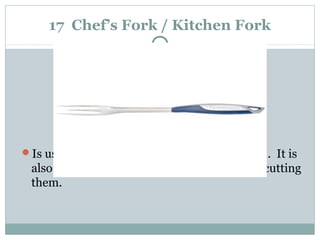
17 Chef’s Fork / Kitchen Fork
Is used to lift and turn meat and other foods . It is
also used to hold larger pieces of food when cutting
them.
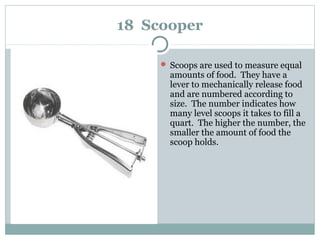
18 Scooper
 Scoops are used to measure equal
amounts of food. They have a
lever to mechanically release food
and are numbered according to
size. The number indicates how
many level scoops it takes to fill a
quart. The higher the number, the
smaller the amount of food the
scoop holds.
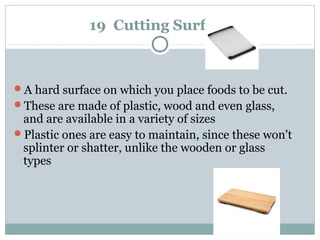
19 Cutting Surface
A hard surface on which you place foods to be cut.
These are made of plastic, wood and even glass,
and are available in a variety of sizes
Plastic ones are easy to maintain, since these won't
splinter or shatter, unlike the wooden or glass
types
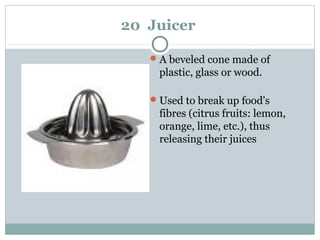
20 Juicer
A beveled cone made of
plastic, glass or wood.
Used to break up food's
fibres (citrus fruits: lemon,
orange, lime, etc.), thus
releasing their juices
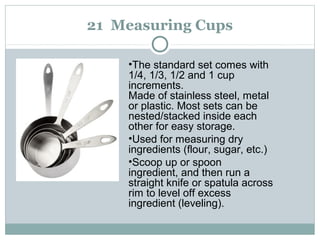
21 Measuring Cups
•The standard set comes with
1/4, 1/3, 1/2 and 1 cup
increments.
Made of stainless steel, metal
or plastic. Most sets can be
nested/stacked inside each
other for easy storage.
•Used for measuring dry
ingredients (flour, sugar, etc.)
•Scoop up or spoon
ingredient, and then run a
straight knife or spatula across
rim to level off excess
ingredient (leveling).
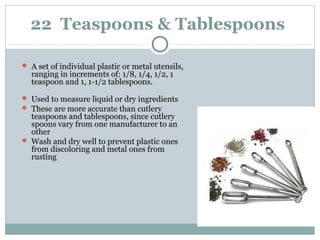
22 Teaspoons & Tablespoons
 A set of individual plastic or metal utensils,
ranging in increments of: 1/8, 1/4, 1/2, 1
teaspoon and 1, 1-1/2 tablespoons.
 Used to measure liquid or dry ingredients
 These are more accurate than cutlery
teaspoons and tablespoons, since cutlery
spoons vary from one manufacturer to an
other
 Wash and dry well to prevent plastic ones
from discoloring and metal ones from
rusting
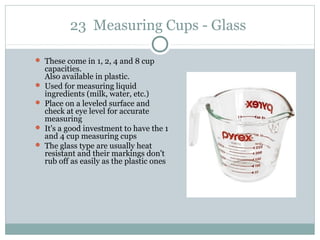
23 Measuring Cups - Glass
 These come in 1, 2, 4 and 8 cup
capacities.
Also available in plastic.
 Used for measuring liquid
ingredients (milk, water, etc.)
 Place on a leveled surface and
check at eye level for accurate
measuring
 It's a good investment to have the 1
and 4 cup measuring cups
 The glass type are usually heat
resistant and their markings don't
rub off as easily as the plastic ones
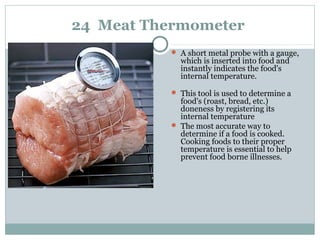
24 Meat Thermometer
 A short metal probe with a gauge,
which is inserted into food and
instantly indicates the food's
internal temperature.
 This tool is used to determine a
food's (roast, bread, etc.)
doneness by registering its
internal temperature
 The most accurate way to
determine if a food is cooked.
Cooking foods to their proper
temperature is essential to help
prevent food borne illnesses.
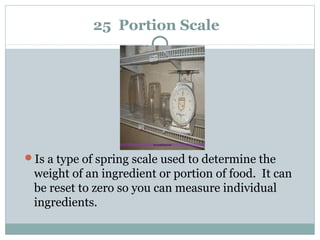
25 Portion Scale
Is a type of spring scale used to determine the
weight of an ingredient or portion of food. It can
be reset to zero so you can measure individual
ingredients.
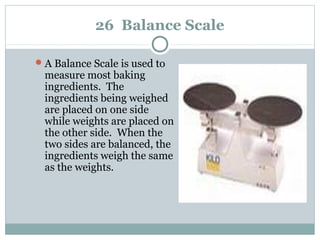
26 Balance Scale
A Balance Scale is used to
measure most baking
ingredients. The
ingredients being weighed
are placed on one side
while weights are placed on
the other side. When the
two sides are balanced, the
ingredients weigh the same
as the weights.
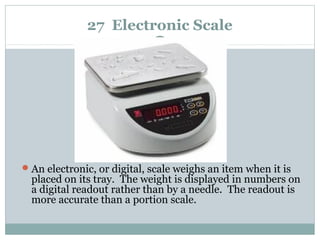
27 Electronic Scale
An electronic, or digital, scale weighs an item when it is
placed on its tray. The weight is displayed in numbers on
a digital readout rather than by a needle. The readout is
more accurate than a portion scale.
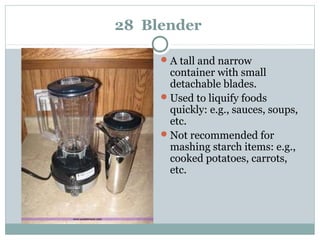
28 Blender
A tall and narrow
container with small
detachable blades.
Used to liquify foods
quickly: e.g., sauces, soups,
etc.
Not recommended for
mashing starch items: e.g.,
cooked potatoes, carrots,
etc.
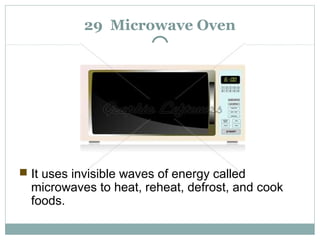
29 Microwave Oven
 It uses invisible waves of energy called
microwaves to heat, reheat, defrost, and cook
foods.
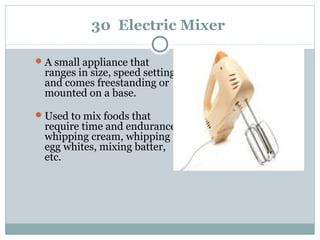
30 Electric Mixer
A small appliance that
ranges in size, speed settings
and comes freestanding or
mounted on a base.
Used to mix foods that
require time and endurance:
whipping cream, whipping
egg whites, mixing batter,
etc.
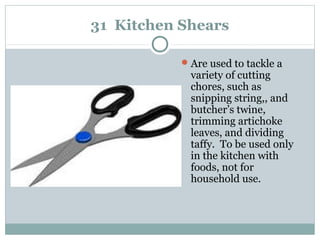
31 Kitchen Shears
Are used to tackle a
variety of cutting
chores, such as
snipping string,, and
butcher’s twine,
trimming artichoke
leaves, and dividing
taffy. To be used only
in the kitchen with
foods, not for
household use.
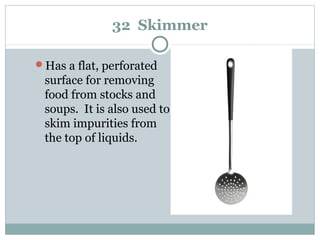
32 Skimmer
Has a flat, perforated
surface for removing
food from stocks and
soups. It is also used to
skim impurities from
the top of liquids.
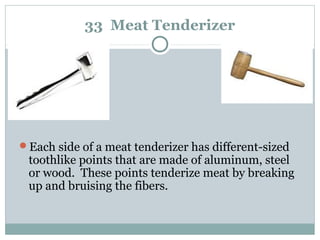
33 Meat Tenderizer
Each side of a meat tenderizer has different-sized
toothlike points that are made of aluminum, steel
or wood. These points tenderize meat by breaking
up and bruising the fibers.
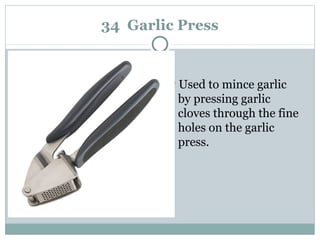
34 Garlic Press
Used to mince garlic
by pressing garlic
cloves through the fine
holes on the garlic
press.
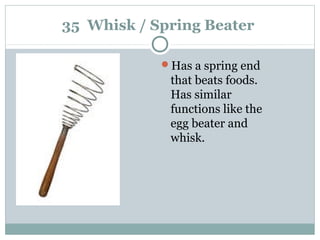
35 Whisk / Spring Beater
Has a spring end
that beats foods.
Has similar
functions like the
egg beater and
whisk.
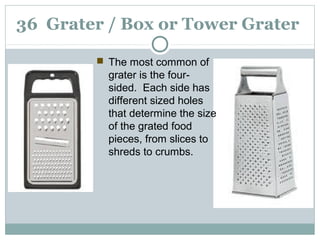
36 Grater / Box or Tower Grater
 The most common of
grater is the four-
sided. Each side has
different sized holes
that determine the size
of the grated food
pieces, from slices to
shreds to crumbs.
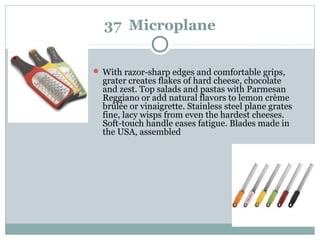
37 Microplane
 With razor-sharp edges and comfortable grips,
grater creates flakes of hard cheese, chocolate
and zest. Top salads and pastas with Parmesan
Reggiano or add natural flavors to lemon crème
brûlée or vinaigrette. Stainless steel plane grates
fine, lacy wisps from even the hardest cheeses.
Soft-touch handle eases fatigue. Blades made in
the USA, assembled
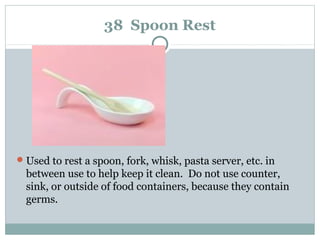
38 Spoon Rest
Used to rest a spoon, fork, whisk, pasta server, etc. in
between use to help keep it clean. Do not use counter,
sink, or outside of food containers, because they contain
germs.
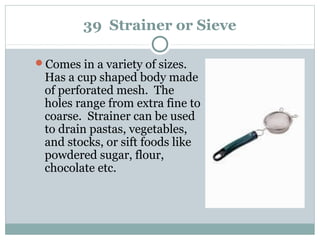
39 Strainer or Sieve
Comes in a variety of sizes.
Has a cup shaped body made
of perforated mesh. The
holes range from extra fine to
coarse. Strainer can be used
to drain pastas, vegetables,
and stocks, or sift foods like
powdered sugar, flour,
chocolate etc.
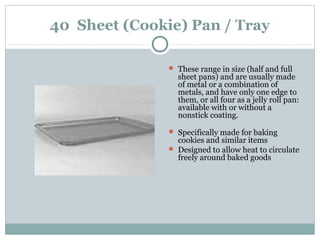
40 Sheet (Cookie) Pan / Tray
 These range in size (half and full
sheet pans) and are usually made
of metal or a combination of
metals, and have only one edge to
them, or all four as a jelly roll pan:
available with or without a
nonstick coating.
 Specifically made for baking
cookies and similar items
 Designed to allow heat to circulate
freely around baked goods
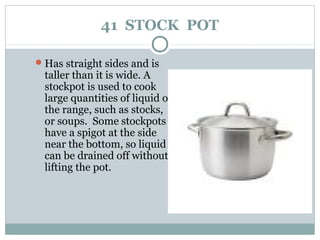
41 STOCK POT
Has straight sides and is
taller than it is wide. A
stockpot is used to cook
large quantities of liquid on
the range, such as stocks,
or soups. Some stockpots
have a spigot at the side
near the bottom, so liquid
can be drained off without
lifting the pot.
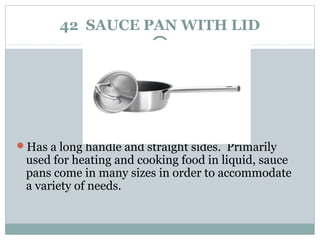
42 SAUCE PAN WITH LID
Has a long handle and straight sides. Primarily
used for heating and cooking food in liquid, sauce
pans come in many sizes in order to accommodate
a variety of needs.
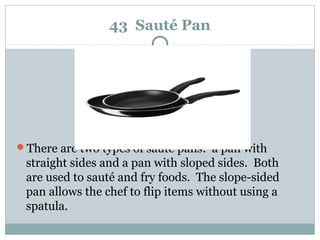
43 Sauté Pan
There are two types of sauté pans: a pan with
straight sides and a pan with sloped sides. Both
are used to sauté and fry foods. The slope-sided
pan allows the chef to flip items without using a
spatula.
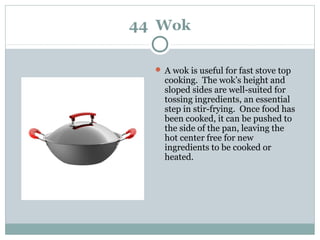
44 Wok
 A wok is useful for fast stove top
cooking. The wok’s height and
sloped sides are well-suited for
tossing ingredients, an essential
step in stir-frying. Once food has
been cooked, it can be pushed to
the side of the pan, leaving the
hot center free for new
ingredients to be cooked or
heated.
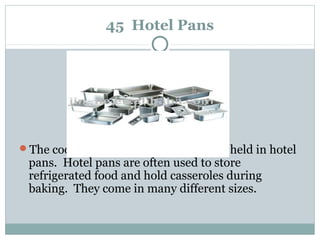
45 Hotel Pans
The cooked foods in a steam table are held in hotel
pans. Hotel pans are often used to store
refrigerated food and hold casseroles during
baking. They come in many different sizes.
Cooking Equipment
COOKING EQUIPMENT
Rangetops
 Open Elements
 Flattop/Heavy-Duty Flattop
 Induction Cooktops
Ovens
 Conventional ovens
 Convection ovens
 Revolving ovens (reel ovens)
 Slow-cook-and-hold ovens
 Combination steamer ovens
 Barbecue ovens (smoke ovens)
 Infrared ovens (reconstituting
ovens)
 Wood-burning ovens
 Microwave ovens
 Broilers and Salamanders
 Overhead broilers
 Heavy-duty broilers
 Salamander
 Grills
 Gas
 Electric
 Charcoal
Griddles, Rotisseries, Deep Fryers, and Tilting Skillets
 Griddles
 Flat, smooth heated surfaces
 Rotisseries
 Cook by turning foods slowly in front of a heating element
 Deep fryers
 Standard deep fryers
 Automatic fryers
 Pressure fryers
 Tilting skillet
 Tilting brazier
 Tilting fry pan
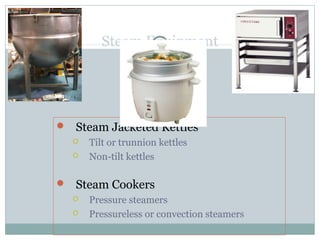
Steam Equipment
 Steam Jacketed Kettles
 Tilt or trunnion kettles
 Non-tilt kettles
 Steam Cookers
 Pressure steamers
 Pressureless or convection steamers
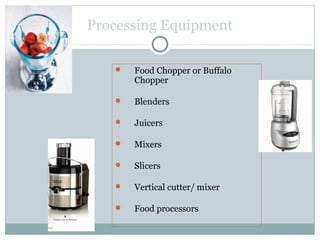
Processing Equipment
 Food Chopper or Buffalo
Chopper
 Blenders
 Juicers
 Mixers
 Slicers
 Vertical cutter/ mixer
 Food processors
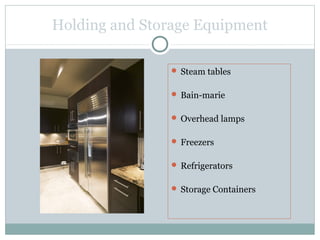
Holding and Storage Equipment
 Steam tables
 Bain-marie
 Overhead lamps
 Freezers
 Refrigerators
 Storage Containers
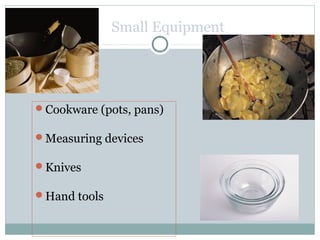
Small Equipment
Cookware (pots, pans)
Measuring devices
Knives
Hand tools
Cookware
 Metal and Heat Conduction
 Copper
 Aluminum
 Anodized aluminum
 Stainless steel
 Cast iron
 Ceramics and glass
 Plastic
 Enamelware
 Nonstick coatings
Measuring and Portioning Devices
Scales
 Balance scale
 Electronic scale
 Portion scale
Volume measures
Measuring cups
Ladles
Portion scoops
Thermometers
COMMERCIAL KITCHEN EQUIPMENT
RECEIVING & STORAGE
 Cold Storage Area
 Dry Storage Area
 Counter Scale
 Floor Scale
 Hanging Scale
 Platform Scale
 Infrared Thermometer
 Low Boy
 Portable Refrigeration Cart
 Reach-In
 Walk-In
 Undercounter reach-in
 Refrigerated drawer
HOLDING & SERVICE
Chafing Dish
Heat Lamp
Holding Cabinets
Hot Plate
Hotel Pans
Plate Cover
Service Cart
Sneeze Guards
Steam Table
Tray Stands
COMMERCIAL KITCHEN EQUIPMENT
PREPARATION & COOKING
 Blender
 Broiler
 Buffalo Chopper
 Combination Steamer Oven
 Convection Oven
 Convection Steamer
 Countertop Blender
 Countertop Mixer
 Deck Oven
 Deep-Fat Fryer
 Flattop Range
 Food Chopper
 Food Processor
 Freestanding Mixer
 Griddle
 Immersion Blender
 Meat Grinder
 Meat Slicer
 Mixer
 Open-Burner Range
 Planetary Mixer
 Pressure Steamer
 Ring-Top Range
 Salamander
 Smoker
 Spiral Mixer
 Steam-Jacketed Kettle
 Tilting Kettle
 Swiss Braiser
 Vertical Chopping Machine (VCM)
 Food Chopper
 Food Slicer
 Deep-Fat Fryer
 Charbroiler/Grill
 Broiler/Salamander
 Ice Machine
 Dish Machine
KITCHEN EQUIPMENT
ASSIGNMENT
THANK YOU

REssential kitchen equipments...varun

  • 1.
    K.VARUN KUMAR ESSENTIAL KITCHENEQUIPMENTS REQUIRED IN A KITCHEN
  • 2.
    KITCHEN EQUIPMENT Culinary Terminology Mise en place-”to put in place”…doing whatever is necessary to be ready for your culinary operation (tools  Work flow- planned movement of food and kitchen staff as food is prepared  Work lines- geometric arrangements of equipment  Work sections- combination of workstations in a kitchen  Workstation- a work area containing equipment and tools needed for accomplishing a specific set of culinary tasks  Conduction- how well pots and pans transfer heat from the burner or oven to the food they contain.  Smallwares- the pots, pans, and other hand tools used to prepare food  Pot- a cooking container that is as tall, or taller, than it is wide  Pan- a cooking container that is wider than it is tall  Preventive Maintenance Schedule- a list of tasks to be performed to ensure that equipment stays in proper working order. 
  • 3.
    Essential Kitchen Equipment foryour Culinary Arts Lab
  • 4.
    6 Straight Spatula A straight spatula or palette knife, has a long, flexible blade with a rounded end. It is useful for scraping bowls and spreading icing on cakes.
  • 5.
    8 Eggbeater /Rotary Beater Used to beat foods to incorporate air in such foods as eggs, egg whites, whip cream etc.
  • 6.
    9 Colander Metal orplastic bowl with 1/8 inch holes pressed through out it. Used for rinsing and draining foods.
  • 7.
    10 Ladles  Thesecan be made of wood, plastic or metal and come in many sizes ranging from 1 – 16 ounces.  A tool with a bowl with a long handle for reaching to the bottom of deep pots and transferring liquids.
  • 8.
    11 Masher Has along handle and has a grid and openings to it. Used to break up solid foods: boiled fruits or vegetables.
  • 9.
    12 Large Spoons These can be made of wood, plastic or metal.  Large spoon: used for stirring or turning foods  Slotted spoon: flat with holes pressed through it; used for straining or skimming food particles or items from liquids
  • 10.
    13 Pastry Brush Made of wood or plastic, with real or artificial hair.  Used to brush sauce onto food, glazes on desserts, greasing cake pans, etc.  Select brushes made with natural hairs rather than synthetic fibers, since the synthetic ones don't absorb liquid as well as natural ones
  • 11.
    14 Pastry Bag& Accessories   A coned shaped bag (vinyl, nylon or plastic coated cotton), about 2 feet long with a large and small opening  Accessories: star, cone, flat, curved, three hole and slanted tips, which range in size and diameter  Used to: pipe cream or mixtures, fill pasta or baked goods (eclairs), etc
  • 12.
    15 Tongs Metal, wooden,or plastic pinching tools used to grab foods without using your hands or fingers.
  • 13.
    16 Whisks  Regular:A long utensil with a set of slim stainless steel, plastic, silicone, or wood wires that are gathered at one end and looped at the other.  Used to hand beat, incorporate, whisk, blend, and stir.  Balloon: Same as above, except shorter and wider  Used to incorporate air into creams, fillings, mixtures, etc.
  • 14.
    17 Chef’s Fork/ Kitchen Fork Is used to lift and turn meat and other foods . It is also used to hold larger pieces of food when cutting them.
  • 15.
    18 Scooper  Scoopsare used to measure equal amounts of food. They have a lever to mechanically release food and are numbered according to size. The number indicates how many level scoops it takes to fill a quart. The higher the number, the smaller the amount of food the scoop holds.
  • 16.
    19 Cutting Surface Ahard surface on which you place foods to be cut. These are made of plastic, wood and even glass, and are available in a variety of sizes Plastic ones are easy to maintain, since these won't splinter or shatter, unlike the wooden or glass types
  • 17.
    20 Juicer A beveledcone made of plastic, glass or wood. Used to break up food's fibres (citrus fruits: lemon, orange, lime, etc.), thus releasing their juices
  • 18.
    21 Measuring Cups •Thestandard set comes with 1/4, 1/3, 1/2 and 1 cup increments. Made of stainless steel, metal or plastic. Most sets can be nested/stacked inside each other for easy storage. •Used for measuring dry ingredients (flour, sugar, etc.) •Scoop up or spoon ingredient, and then run a straight knife or spatula across rim to level off excess ingredient (leveling).
  • 19.
    22 Teaspoons &Tablespoons  A set of individual plastic or metal utensils, ranging in increments of: 1/8, 1/4, 1/2, 1 teaspoon and 1, 1-1/2 tablespoons.  Used to measure liquid or dry ingredients  These are more accurate than cutlery teaspoons and tablespoons, since cutlery spoons vary from one manufacturer to an other  Wash and dry well to prevent plastic ones from discoloring and metal ones from rusting
  • 20.
    23 Measuring Cups- Glass  These come in 1, 2, 4 and 8 cup capacities. Also available in plastic.  Used for measuring liquid ingredients (milk, water, etc.)  Place on a leveled surface and check at eye level for accurate measuring  It's a good investment to have the 1 and 4 cup measuring cups  The glass type are usually heat resistant and their markings don't rub off as easily as the plastic ones
  • 21.
    24 Meat Thermometer A short metal probe with a gauge, which is inserted into food and instantly indicates the food's internal temperature.  This tool is used to determine a food's (roast, bread, etc.) doneness by registering its internal temperature  The most accurate way to determine if a food is cooked. Cooking foods to their proper temperature is essential to help prevent food borne illnesses.
  • 22.
    25 Portion Scale Isa type of spring scale used to determine the weight of an ingredient or portion of food. It can be reset to zero so you can measure individual ingredients.
  • 23.
    26 Balance Scale ABalance Scale is used to measure most baking ingredients. The ingredients being weighed are placed on one side while weights are placed on the other side. When the two sides are balanced, the ingredients weigh the same as the weights.
  • 24.
    27 Electronic Scale Anelectronic, or digital, scale weighs an item when it is placed on its tray. The weight is displayed in numbers on a digital readout rather than by a needle. The readout is more accurate than a portion scale.
  • 25.
    28 Blender A talland narrow container with small detachable blades. Used to liquify foods quickly: e.g., sauces, soups, etc. Not recommended for mashing starch items: e.g., cooked potatoes, carrots, etc.
  • 26.
    29 Microwave Oven It uses invisible waves of energy called microwaves to heat, reheat, defrost, and cook foods.
  • 27.
    30 Electric Mixer Asmall appliance that ranges in size, speed settings and comes freestanding or mounted on a base. Used to mix foods that require time and endurance: whipping cream, whipping egg whites, mixing batter, etc.
  • 28.
    31 Kitchen Shears Areused to tackle a variety of cutting chores, such as snipping string,, and butcher’s twine, trimming artichoke leaves, and dividing taffy. To be used only in the kitchen with foods, not for household use.
  • 29.
    32 Skimmer Has aflat, perforated surface for removing food from stocks and soups. It is also used to skim impurities from the top of liquids.
  • 30.
    33 Meat Tenderizer Eachside of a meat tenderizer has different-sized toothlike points that are made of aluminum, steel or wood. These points tenderize meat by breaking up and bruising the fibers.
  • 31.
    34 Garlic Press Usedto mince garlic by pressing garlic cloves through the fine holes on the garlic press.
  • 32.
    35 Whisk /Spring Beater Has a spring end that beats foods. Has similar functions like the egg beater and whisk.
  • 33.
    36 Grater /Box or Tower Grater  The most common of grater is the four- sided. Each side has different sized holes that determine the size of the grated food pieces, from slices to shreds to crumbs.
  • 34.
    37 Microplane  Withrazor-sharp edges and comfortable grips, grater creates flakes of hard cheese, chocolate and zest. Top salads and pastas with Parmesan Reggiano or add natural flavors to lemon crème brûlée or vinaigrette. Stainless steel plane grates fine, lacy wisps from even the hardest cheeses. Soft-touch handle eases fatigue. Blades made in the USA, assembled
  • 35.
    38 Spoon Rest Usedto rest a spoon, fork, whisk, pasta server, etc. in between use to help keep it clean. Do not use counter, sink, or outside of food containers, because they contain germs.
  • 36.
    39 Strainer orSieve Comes in a variety of sizes. Has a cup shaped body made of perforated mesh. The holes range from extra fine to coarse. Strainer can be used to drain pastas, vegetables, and stocks, or sift foods like powdered sugar, flour, chocolate etc.
  • 37.
    40 Sheet (Cookie)Pan / Tray  These range in size (half and full sheet pans) and are usually made of metal or a combination of metals, and have only one edge to them, or all four as a jelly roll pan: available with or without a nonstick coating.  Specifically made for baking cookies and similar items  Designed to allow heat to circulate freely around baked goods
  • 38.
    41 STOCK POT Hasstraight sides and is taller than it is wide. A stockpot is used to cook large quantities of liquid on the range, such as stocks, or soups. Some stockpots have a spigot at the side near the bottom, so liquid can be drained off without lifting the pot.
  • 39.
    42 SAUCE PANWITH LID Has a long handle and straight sides. Primarily used for heating and cooking food in liquid, sauce pans come in many sizes in order to accommodate a variety of needs.
  • 40.
    43 Sauté Pan Thereare two types of sauté pans: a pan with straight sides and a pan with sloped sides. Both are used to sauté and fry foods. The slope-sided pan allows the chef to flip items without using a spatula.
  • 41.
    44 Wok  Awok is useful for fast stove top cooking. The wok’s height and sloped sides are well-suited for tossing ingredients, an essential step in stir-frying. Once food has been cooked, it can be pushed to the side of the pan, leaving the hot center free for new ingredients to be cooked or heated.
  • 42.
    45 Hotel Pans Thecooked foods in a steam table are held in hotel pans. Hotel pans are often used to store refrigerated food and hold casseroles during baking. They come in many different sizes.
  • 43.
  • 44.
    COOKING EQUIPMENT Rangetops  OpenElements  Flattop/Heavy-Duty Flattop  Induction Cooktops Ovens  Conventional ovens  Convection ovens  Revolving ovens (reel ovens)  Slow-cook-and-hold ovens  Combination steamer ovens  Barbecue ovens (smoke ovens)  Infrared ovens (reconstituting ovens)  Wood-burning ovens  Microwave ovens  Broilers and Salamanders  Overhead broilers  Heavy-duty broilers  Salamander  Grills  Gas  Electric  Charcoal
  • 45.
    Griddles, Rotisseries, DeepFryers, and Tilting Skillets  Griddles  Flat, smooth heated surfaces  Rotisseries  Cook by turning foods slowly in front of a heating element  Deep fryers  Standard deep fryers  Automatic fryers  Pressure fryers  Tilting skillet  Tilting brazier  Tilting fry pan
  • 46.
    Steam Equipment  SteamJacketed Kettles  Tilt or trunnion kettles  Non-tilt kettles  Steam Cookers  Pressure steamers  Pressureless or convection steamers
  • 47.
    Processing Equipment  FoodChopper or Buffalo Chopper  Blenders  Juicers  Mixers  Slicers  Vertical cutter/ mixer  Food processors
  • 48.
    Holding and StorageEquipment  Steam tables  Bain-marie  Overhead lamps  Freezers  Refrigerators  Storage Containers
  • 49.
    Small Equipment Cookware (pots,pans) Measuring devices Knives Hand tools
  • 50.
    Cookware  Metal andHeat Conduction  Copper  Aluminum  Anodized aluminum  Stainless steel  Cast iron  Ceramics and glass  Plastic  Enamelware  Nonstick coatings
  • 51.
    Measuring and PortioningDevices Scales  Balance scale  Electronic scale  Portion scale Volume measures Measuring cups Ladles Portion scoops Thermometers
  • 52.
    COMMERCIAL KITCHEN EQUIPMENT RECEIVING& STORAGE  Cold Storage Area  Dry Storage Area  Counter Scale  Floor Scale  Hanging Scale  Platform Scale  Infrared Thermometer  Low Boy  Portable Refrigeration Cart  Reach-In  Walk-In  Undercounter reach-in  Refrigerated drawer HOLDING & SERVICE Chafing Dish Heat Lamp Holding Cabinets Hot Plate Hotel Pans Plate Cover Service Cart Sneeze Guards Steam Table Tray Stands
  • 53.
    COMMERCIAL KITCHEN EQUIPMENT PREPARATION& COOKING  Blender  Broiler  Buffalo Chopper  Combination Steamer Oven  Convection Oven  Convection Steamer  Countertop Blender  Countertop Mixer  Deck Oven  Deep-Fat Fryer  Flattop Range  Food Chopper  Food Processor  Freestanding Mixer  Griddle  Immersion Blender  Meat Grinder  Meat Slicer  Mixer  Open-Burner Range  Planetary Mixer  Pressure Steamer  Ring-Top Range  Salamander  Smoker  Spiral Mixer  Steam-Jacketed Kettle  Tilting Kettle  Swiss Braiser  Vertical Chopping Machine (VCM)  Food Chopper  Food Slicer  Deep-Fat Fryer  Charbroiler/Grill  Broiler/Salamander  Ice Machine  Dish Machine
  • 54.