The management of severe
hypoxaemic respiratory failure
in critical care
Simon Baudouin
Senior Lecturer in Critical Care
University of Newcastle
 Conventional definitions
◦ Type 1 PaO2 < 8 kPa on air
◦ Type 2 PaO2 < 8 kPa on air & PaCo2 > 6 kPa
 Not helpful!
◦ Ultimately all severely ill patients become hypercapnic
without intervention
 Acute
 Chronic
 Acute on chronic
 Reach ITU v intubate in EAU
Respiratory failure
 Hypoxaemia – V/Q mismatch & shunt
 Hypercapnia
◦ Hypoventilation
◦ Increase in deadspace ventilation
◦ V/Q mismatch
Respiratory Failure - pathophysiology
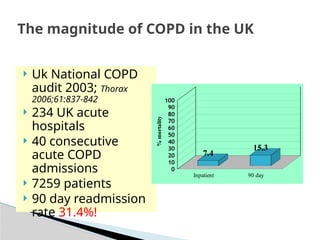
The magnitude of COPD in the UK
 Uk National COPD
audit 2003; Thorax
2006;61:837-842
 234 UK acute
hospitals
 40 consecutive
acute COPD
admissions
 7259 patients
 90 day readmission
rate 31.4%!
Inpatient 90 day
0
10
20
30
40
50
60
70
80
90
100
7.4
15.3
%
mortality
The magnitude of COPD in the UK
 16-47% hypercapnia
 Half will need ventilatory support
- Plant et al, Thorax, 2000; 55: 550-554
- 1 year survey in Leeds
 983 admissions
 2.2% ICU admissions
 73% hospital mortality in ICU
admissions
70 NIV patients/year/250,000
population
Aetiology of Respiratory
failure
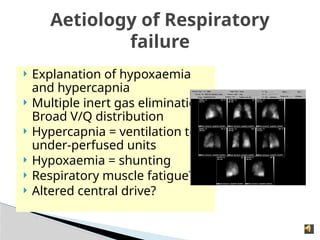
 Explanation of hypoxaemia
and hypercapnia
 Multiple inert gas elimination
Broad V/Q distribution
 Hypercapnia = ventilation to
under-perfused units
 Hypoxaemia = shunting
 Respiratory muscle fatigue?
 Altered central drive?
Oxygen treatment
 Hypoxaemia is usually correctable with low
flow O2
 The optimal target SaO2 is unknown
> 90% - O2 dissociation curve
> 85% (ARDS net)
 One small study (n = 36) 6.6hPa v 9.0 hPa
- no difference (underpowered)
 High flow O2 will worsen Hypercapnia
 Change to controlled O2 will reduce PaCO2
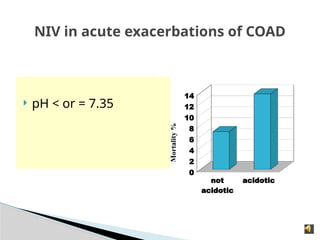
NIV in acute exacerbations of COAD
 pH < or = 7.35
not
acidotic
acidotic
0
2
4
6
8
10
12
14
Mortality
%
NIV Standard
0
5
10
15
20
25
30
NIV Standard
0
5
10
15
20
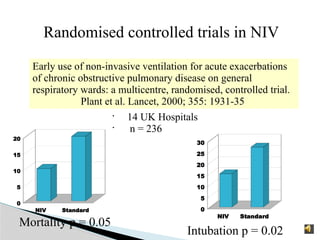
Randomised controlled trials in NIV
Early use of non-invasive ventilation for acute exacerbations
of chronic obstructive pulmonary disease on general
respiratory wards: a multicentre, randomised, controlled trial.
Plant et al. Lancet, 2000; 355: 1931-35
•
14 UK Hospitals
•
n = 236
Mortality p = 0.05
Intubation p = 0.02
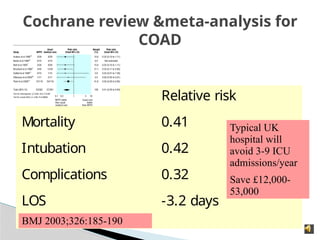
Cochrane review &meta-analysis for
COAD
Relative risk
Mortality 0.41
Intubation 0.42
Complications 0.32
LOS -3.2 days
BMJ 2003;326:185-190
Typical UK
hospital will
avoid 3-9 ICU
admissions/year
Save £12,000-
53,000
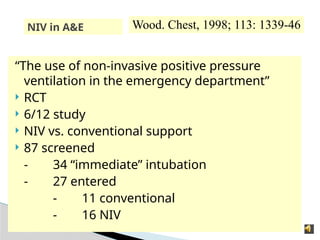
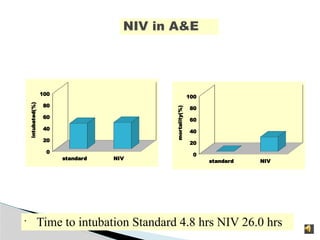
NIV in A&E
“The use of non-invasive positive pressure
ventilation in the emergency department”
 RCT
 6/12 study
 NIV vs. conventional support
 87 screened
- 34 “immediate” intubation
- 27 entered
- 11 conventional
- 16 NIV
Wood. Chest, 1998; 113: 1339-46
•
Time to intubation Standard 4.8 hrs NIV 26.0 hrs
NIV in A&E
standard NIV
0
20
40
60
80
100
intubated(%)
standard NIV
0
20
40
60
80
100
mortality(%)
Critical Care for All?
•
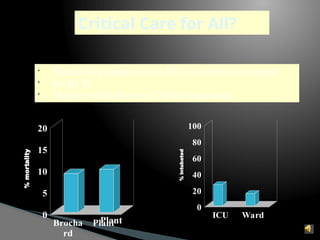
Should all patients receive NIV in a critical care area?
•
No RCTs
•
Majority of trials are in Critical Care areas
Brocha
rd
Plant
0
5
10
15
20
%
mortality
ICU Ward
0
20
40
60
80
100
%
intubated
Plant
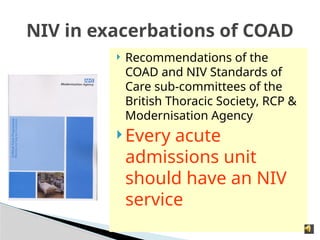
NIV in exacerbations of COAD
 Recommendations of the
COAD and NIV Standards of
Care sub-committees of the
British Thoracic Society, RCP &
Modernisation Agency
 Every acute
admissions unit
should have an NIV
service
Predicting outcome with NIV
- Failure rate 7-50%
- delay intubation
 Acidosis
 APACHE II
- Indications for HDU admission
 For intubation if NIV fails
 Initial pH 7.25 or less
 Worsening pH on NIV
Indications for intubation
 Patient choice
 Failure of NIV
 Usually obvious clinically
◦ Fatigued “awful looking” patient
◦ Worsening hypercapnia and LOC
◦ A&E arrest/peri-arrest situation
Longer-term issues
 Patient/ventilator interactions
 Weaning
 Tracheostomy
 Nutrition
 The “unweanable” patient
Weaning
 Rapid trial of extubation (onto NIV)
 Early tracheostomy
 Regular Sedation cessation
 Weaning protocols
 A little progress every day!
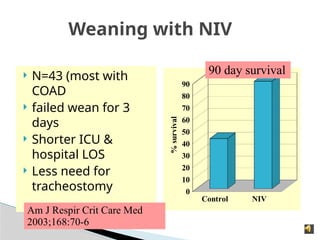
Weaning with NIV
 N=43 (most with
COAD
 failed wean for 3
days
 Shorter ICU &
hospital LOS
 Less need for
tracheostomy
Control NIV
0
10
20
30
40
50
60
70
80
90
%
survival
90 day survival
Am J Respir Crit Care Med
2003;168:70-6
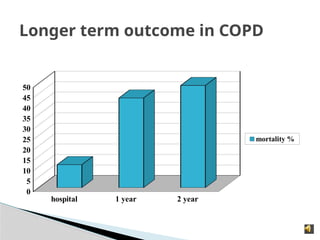
Longer term outcome in COPD
hospital 1 year 2 year
0
5
10
15
20
25
30
35
40
45
50
mortality %
Summary
 COPD admissions will increase
 NIV is effective in both survival and prevention
of intubation
 Outcome of ventilation in COPD is no worse
than in other conditions
 Patient choice and informed decisions
 Previously fit 24 year old women
 First pregnancy
 No problems until week 35
 “Cough and cold”
 “Shivery”
 Increasingly breathless over 24
hours
 Brought to maternity ward by
husband
 Clearly very unwell
 SaO2 air 79%
 RR 35/min
 Crackles ++
 Foetus alive
 Critical Care outreach called
The new 21st
century critical care
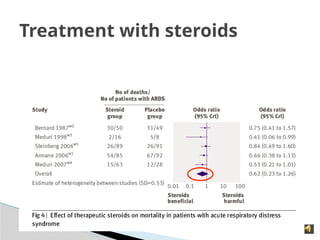
Treatment with steroids
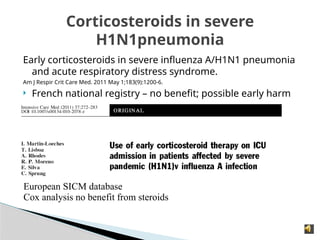
Early corticosteroids in severe influenza A/H1N1 pneumonia
and acute respiratory distress syndrome.
Am J Respir Crit Care Med. 2011 May 1;183(9):1200-6.
 French national registry – no benefit; possible early harm
Corticosteroids in severe
H1N1pneumonia
European SICM database
Cox analysis no benefit from steroids
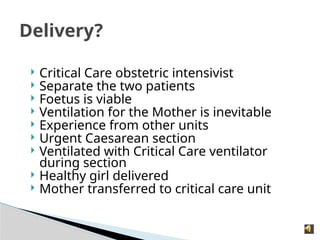
 Critical Care obstetric intensivist
 Separate the two patients
 Foetus is viable
 Ventilation for the Mother is inevitable
 Experience from other units
 Urgent Caesarean section
 Ventilated with Critical Care ventilator
during section
 Healthy girl delivered
 Mother transferred to critical care unit
Delivery?
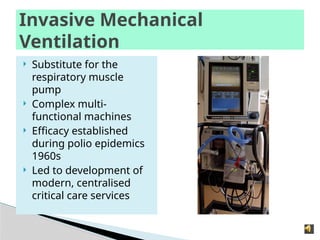
Invasive Mechanical
Ventilation
 Substitute for the
respiratory muscle
pump
 Complex multi-
functional machines
 Efficacy established
during polio epidemics
1960s
 Led to development of
modern, centralised
critical care services
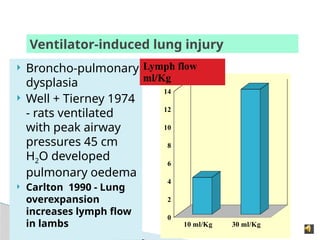
Ventilator-induced lung injury
10 ml/Kg 30 ml/Kg
0
2
4
6
8
10
12
14
 Broncho-pulmonary
dysplasia
 Well + Tierney 1974
- rats ventilated
with peak airway
pressures 45 cm
H2O developed
pulmonary oedema
 Carlton 1990 - Lung
overexpansion
increases lymph flow
in lambs
Lymph flow
ml/Kg
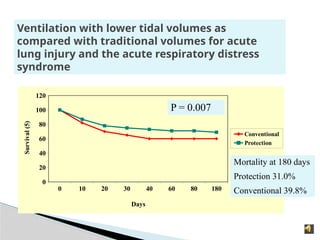
Ventilation with lower tidal volumes as
compared with traditional volumes for acute
lung injury and the acute respiratory distress
syndrome
0 10 20 30 40 60 80 180
0
20
40
60
80
100
120
Conventional
Protection
Days
Survival
(5)
Mortality at 180 days
Protection 31.0%
Conventional 39.8%
P = 0.007
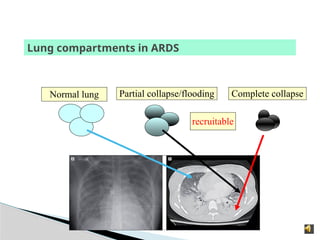
Lung compartments in ARDS
Normal lung Partial collapse/flooding Complete collapse
recruitable
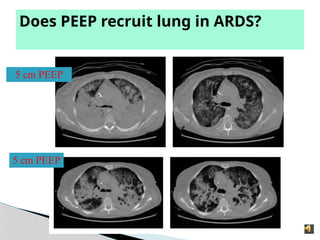
Does PEEP recruit lung in ARDS?
5 cm PEEP
5 cm PEEP
Fluid management in ARDS
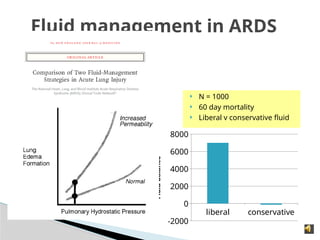
 N = 1000
 60 day mortality
 Liberal v conservative fluid
liberal conservative
-2000
0
2000
4000
6000
8000
Fluid
balance
Fluid management in ARDS
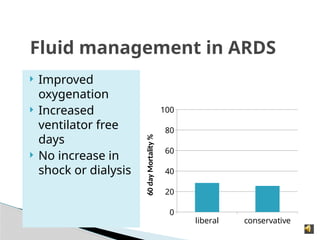
 Improved
oxygenation
 Increased
ventilator free
days
 No increase in
shock or dialysis
liberal conservative
0
20
40
60
80
100
60
day
Mortality
%
Lower PEEP Higher PEEP
0
20
40
60
80
100
Percentage
mortality
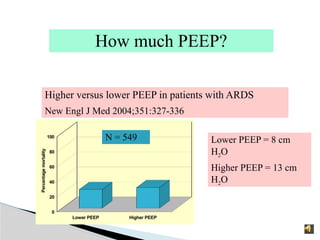
N = 549
How much PEEP?
Higher versus lower PEEP in patients with ARDS
New Engl J Med 2004;351:327-336
Lower PEEP = 8 cm
H2O
Higher PEEP = 13 cm
H2O
 Often improves oxygenation
 Proposed mechanisms
- recruitment of dorsal collapsed lung units
- improved respiratory mechanics
- increased secretion drainage
- decreased injury from mechanical forces
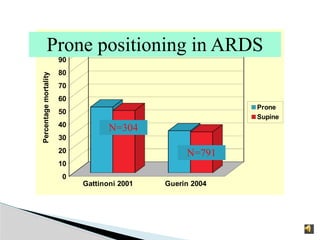
Prone positioning in ARDS
Gattinoni 2001 Guerin 2004
0
10
20
30
40
50
60
70
80
90
100
Prone
Supine
Percentage
mortality
Prone positioning in ARDS
N=304
N=791
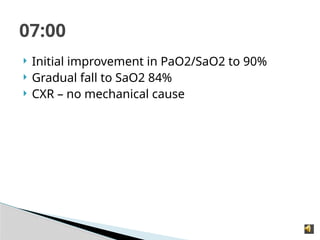
 Initial improvement in PaO2/SaO2 to 90%
 Gradual fall to SaO2 84%
 CXR – no mechanical cause
07:00
 Rescue = desperation
 Rescue = no high grade evidence
 Rescue = risks as well as possible
benefits
◦ Oscillator ventilation
◦ ECMO
“Rescue therapy in ARDS”
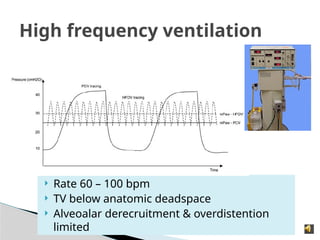
 Rate 60 – 100 bpm
 TV below anatomic deadspace
 Alveoalar derecruitment & overdistention
limited
High frequency ventilation
• Large, multi-centre RCT
• Conventional v high frequency ventilation
• Complete recruitment 2012
•
Over 800 patients
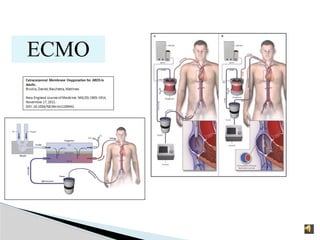
ECMO
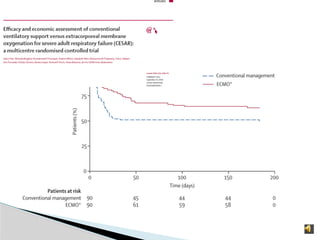
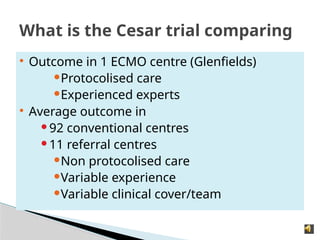
 Outcome in 1 ECMO centre (Glenfields)
Protocolised care
Experienced experts
 Average outcome in
92 conventional centres
11 referral centres
Non protocolised care
Variable experience
Variable clinical cover/team
What is the Cesar trial comparing
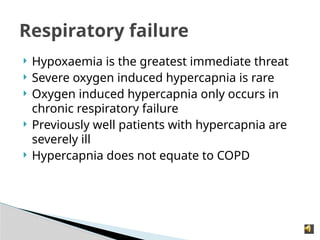
 Hypoxaemia is the greatest immediate threat
 Severe oxygen induced hypercapnia is rare
 Oxygen induced hypercapnia only occurs in
chronic respiratory failure
 Previously well patients with hypercapnia are
severely ill
 Hypercapnia does not equate to COPD
Respiratory failure

respiratory_failure_2013_compressed.pptx

  • 1.
    The management ofsevere hypoxaemic respiratory failure in critical care Simon Baudouin Senior Lecturer in Critical Care University of Newcastle
  • 2.
     Conventional definitions ◦Type 1 PaO2 < 8 kPa on air ◦ Type 2 PaO2 < 8 kPa on air & PaCo2 > 6 kPa  Not helpful! ◦ Ultimately all severely ill patients become hypercapnic without intervention  Acute  Chronic  Acute on chronic  Reach ITU v intubate in EAU Respiratory failure
  • 3.
     Hypoxaemia –V/Q mismatch & shunt  Hypercapnia ◦ Hypoventilation ◦ Increase in deadspace ventilation ◦ V/Q mismatch Respiratory Failure - pathophysiology
  • 4.
    The magnitude ofCOPD in the UK  Uk National COPD audit 2003; Thorax 2006;61:837-842  234 UK acute hospitals  40 consecutive acute COPD admissions  7259 patients  90 day readmission rate 31.4%! Inpatient 90 day 0 10 20 30 40 50 60 70 80 90 100 7.4 15.3 % mortality
  • 5.
    The magnitude ofCOPD in the UK  16-47% hypercapnia  Half will need ventilatory support - Plant et al, Thorax, 2000; 55: 550-554 - 1 year survey in Leeds  983 admissions  2.2% ICU admissions  73% hospital mortality in ICU admissions 70 NIV patients/year/250,000 population
  • 6.
    Aetiology of Respiratory failure Explanation of hypoxaemia and hypercapnia  Multiple inert gas elimination Broad V/Q distribution  Hypercapnia = ventilation to under-perfused units  Hypoxaemia = shunting  Respiratory muscle fatigue?  Altered central drive?
  • 7.
    Oxygen treatment  Hypoxaemiais usually correctable with low flow O2  The optimal target SaO2 is unknown > 90% - O2 dissociation curve > 85% (ARDS net)  One small study (n = 36) 6.6hPa v 9.0 hPa - no difference (underpowered)  High flow O2 will worsen Hypercapnia  Change to controlled O2 will reduce PaCO2
  • 9.
    NIV in acuteexacerbations of COAD  pH < or = 7.35 not acidotic acidotic 0 2 4 6 8 10 12 14 Mortality %
  • 10.
    NIV Standard 0 5 10 15 20 25 30 NIV Standard 0 5 10 15 20 Randomisedcontrolled trials in NIV Early use of non-invasive ventilation for acute exacerbations of chronic obstructive pulmonary disease on general respiratory wards: a multicentre, randomised, controlled trial. Plant et al. Lancet, 2000; 355: 1931-35 • 14 UK Hospitals • n = 236 Mortality p = 0.05 Intubation p = 0.02
  • 11.
    Cochrane review &meta-analysisfor COAD Relative risk Mortality 0.41 Intubation 0.42 Complications 0.32 LOS -3.2 days BMJ 2003;326:185-190 Typical UK hospital will avoid 3-9 ICU admissions/year Save £12,000- 53,000
  • 12.
    NIV in A&E “Theuse of non-invasive positive pressure ventilation in the emergency department”  RCT  6/12 study  NIV vs. conventional support  87 screened - 34 “immediate” intubation - 27 entered - 11 conventional - 16 NIV Wood. Chest, 1998; 113: 1339-46
  • 13.
    • Time to intubationStandard 4.8 hrs NIV 26.0 hrs NIV in A&E standard NIV 0 20 40 60 80 100 intubated(%) standard NIV 0 20 40 60 80 100 mortality(%)
  • 14.
    Critical Care forAll? • Should all patients receive NIV in a critical care area? • No RCTs • Majority of trials are in Critical Care areas Brocha rd Plant 0 5 10 15 20 % mortality ICU Ward 0 20 40 60 80 100 % intubated Plant
  • 16.
    NIV in exacerbationsof COAD  Recommendations of the COAD and NIV Standards of Care sub-committees of the British Thoracic Society, RCP & Modernisation Agency  Every acute admissions unit should have an NIV service
  • 17.
    Predicting outcome withNIV - Failure rate 7-50% - delay intubation  Acidosis  APACHE II - Indications for HDU admission  For intubation if NIV fails  Initial pH 7.25 or less  Worsening pH on NIV
  • 18.
    Indications for intubation Patient choice  Failure of NIV  Usually obvious clinically ◦ Fatigued “awful looking” patient ◦ Worsening hypercapnia and LOC ◦ A&E arrest/peri-arrest situation
  • 19.
    Longer-term issues  Patient/ventilatorinteractions  Weaning  Tracheostomy  Nutrition  The “unweanable” patient
  • 20.
    Weaning  Rapid trialof extubation (onto NIV)  Early tracheostomy  Regular Sedation cessation  Weaning protocols  A little progress every day!
  • 21.
    Weaning with NIV N=43 (most with COAD  failed wean for 3 days  Shorter ICU & hospital LOS  Less need for tracheostomy Control NIV 0 10 20 30 40 50 60 70 80 90 % survival 90 day survival Am J Respir Crit Care Med 2003;168:70-6
  • 22.
    Longer term outcomein COPD hospital 1 year 2 year 0 5 10 15 20 25 30 35 40 45 50 mortality %
  • 23.
    Summary  COPD admissionswill increase  NIV is effective in both survival and prevention of intubation  Outcome of ventilation in COPD is no worse than in other conditions  Patient choice and informed decisions
  • 24.
     Previously fit24 year old women  First pregnancy  No problems until week 35  “Cough and cold”  “Shivery”  Increasingly breathless over 24 hours  Brought to maternity ward by husband  Clearly very unwell  SaO2 air 79%  RR 35/min  Crackles ++  Foetus alive  Critical Care outreach called The new 21st century critical care
  • 25.
  • 26.
    Early corticosteroids insevere influenza A/H1N1 pneumonia and acute respiratory distress syndrome. Am J Respir Crit Care Med. 2011 May 1;183(9):1200-6.  French national registry – no benefit; possible early harm Corticosteroids in severe H1N1pneumonia European SICM database Cox analysis no benefit from steroids
  • 27.
     Critical Careobstetric intensivist  Separate the two patients  Foetus is viable  Ventilation for the Mother is inevitable  Experience from other units  Urgent Caesarean section  Ventilated with Critical Care ventilator during section  Healthy girl delivered  Mother transferred to critical care unit Delivery?
  • 28.
    Invasive Mechanical Ventilation  Substitutefor the respiratory muscle pump  Complex multi- functional machines  Efficacy established during polio epidemics 1960s  Led to development of modern, centralised critical care services
  • 29.
    Ventilator-induced lung injury 10ml/Kg 30 ml/Kg 0 2 4 6 8 10 12 14  Broncho-pulmonary dysplasia  Well + Tierney 1974 - rats ventilated with peak airway pressures 45 cm H2O developed pulmonary oedema  Carlton 1990 - Lung overexpansion increases lymph flow in lambs Lymph flow ml/Kg
  • 30.
    Ventilation with lowertidal volumes as compared with traditional volumes for acute lung injury and the acute respiratory distress syndrome 0 10 20 30 40 60 80 180 0 20 40 60 80 100 120 Conventional Protection Days Survival (5) Mortality at 180 days Protection 31.0% Conventional 39.8% P = 0.007
  • 31.
    Lung compartments inARDS Normal lung Partial collapse/flooding Complete collapse recruitable
  • 32.
    Does PEEP recruitlung in ARDS? 5 cm PEEP 5 cm PEEP
  • 33.
    Fluid management inARDS  N = 1000  60 day mortality  Liberal v conservative fluid liberal conservative -2000 0 2000 4000 6000 8000 Fluid balance
  • 34.
    Fluid management inARDS  Improved oxygenation  Increased ventilator free days  No increase in shock or dialysis liberal conservative 0 20 40 60 80 100 60 day Mortality %
  • 35.
    Lower PEEP HigherPEEP 0 20 40 60 80 100 Percentage mortality N = 549 How much PEEP? Higher versus lower PEEP in patients with ARDS New Engl J Med 2004;351:327-336 Lower PEEP = 8 cm H2O Higher PEEP = 13 cm H2O
  • 36.
     Often improvesoxygenation  Proposed mechanisms - recruitment of dorsal collapsed lung units - improved respiratory mechanics - increased secretion drainage - decreased injury from mechanical forces Prone positioning in ARDS
  • 37.
    Gattinoni 2001 Guerin2004 0 10 20 30 40 50 60 70 80 90 100 Prone Supine Percentage mortality Prone positioning in ARDS N=304 N=791
  • 38.
     Initial improvementin PaO2/SaO2 to 90%  Gradual fall to SaO2 84%  CXR – no mechanical cause 07:00
  • 39.
     Rescue =desperation  Rescue = no high grade evidence  Rescue = risks as well as possible benefits ◦ Oscillator ventilation ◦ ECMO “Rescue therapy in ARDS”
  • 40.
     Rate 60– 100 bpm  TV below anatomic deadspace  Alveoalar derecruitment & overdistention limited High frequency ventilation
  • 41.
    • Large, multi-centreRCT • Conventional v high frequency ventilation • Complete recruitment 2012 • Over 800 patients
  • 42.
  • 44.
     Outcome in1 ECMO centre (Glenfields) Protocolised care Experienced experts  Average outcome in 92 conventional centres 11 referral centres Non protocolised care Variable experience Variable clinical cover/team What is the Cesar trial comparing
  • 45.
     Hypoxaemia isthe greatest immediate threat  Severe oxygen induced hypercapnia is rare  Oxygen induced hypercapnia only occurs in chronic respiratory failure  Previously well patients with hypercapnia are severely ill  Hypercapnia does not equate to COPD Respiratory failure

Editor's Notes

  • #42 The iLA-system. A passive femoro-femoral shunt flow generated by the arterial pressure passes a lung assist device (in the box), in which an oxygen flow is inserted. Reproduced with permission from Zimmerman and colleagues.47 © The Board of Management and Trustees of the British Journal of Anaesthesia 2005. All rights reserved. For Permissions, please email: journals.permissions@oxfordjournals.org.