Management of
Resistant
Hypertension
Dr. Keerti Kori
Introduction
 Hypertension is world’s leading risk factor for CVD, stroke, disability and death.
 hypertension was defined as resistant to treatment when appropriate lifestyle
measures and treatment with optimal or best tolerated doses of three or more
drugs (a Thiazide/Thiazide-like diuretic, an RAS-blocker and a CCB) fail to lower
office BP to <140/90mm Hg.
 A large proportion of hypertensive adults, still fail to achieve their recomended BP
treatment targets.
 These individuals remain at increased risk for target organ damage, morbidity and
mortality despite ongoing anti-hypertensive drug therapy.
Alberto Zanchetti.
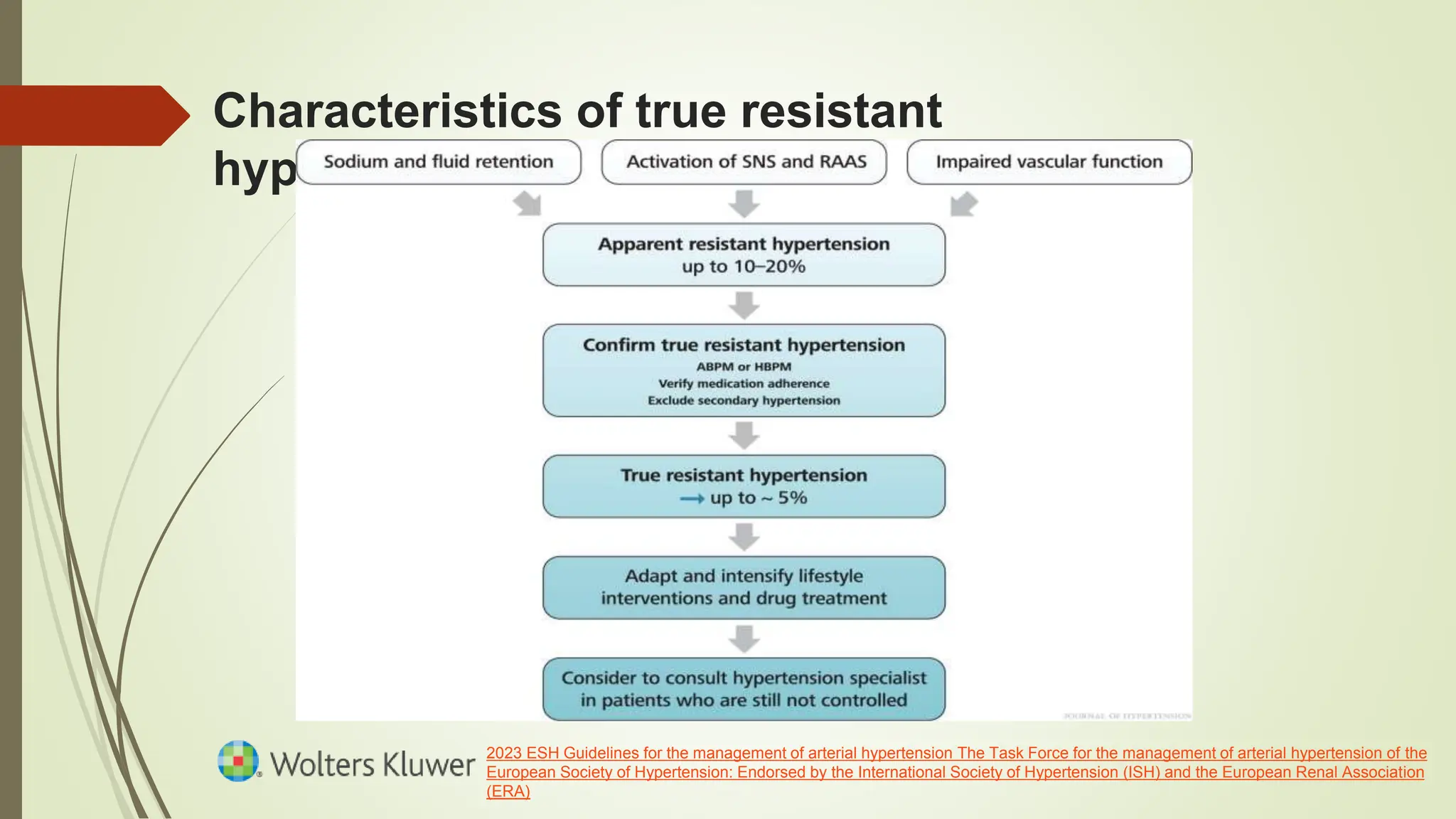
Characteristics of true resistant
hypertension.
2023 ESH Guidelines for the management of arterial hypertension The Task Force for the management of arterial hypertension of the
European Society of Hypertension: Endorsed by the International Society of Hypertension (ISH) and the European Renal Association
(ERA)
Management Algorithm
2023 ESH Guidelines for the management of arterial hypertension The Task Force
for the management of arterial hypertension of the European Society of
Hypertension: Endorsed by the International Society of Hypertension (ISH) and the
European Renal Association (ERA)
CKD (eGFR 15–29
ml/min/1.73 m2)
and poorly controlled
hypertension, showed an
about roughly 10 mmHg 24-h
SBP reduction with
chlortalidone versus placebo,
and the BP-lowering effect
was particularly evident in
patients already on loop
diuretics
 Selective nonsteroidal MRAs such as finerenone (approved for the treatment in diabetic kidney disease)
 Esaxerenone (approved for the treatment of hypertension in Japan),
 Ocedurenone (KBP-5074, in development for resistant hypertension in CKD) ,0.25–0.50 mg/day reduced
BP in patients with resistant hypertension and stage 3b/4 CKD with a higher incidence of hyperkalemia at
the highest dose
 Finally, the use of selective aldosterone synthase inhibitors such as baxdrostat has been shown to
effectively lower BP in patients with resistant hypertension in a phase 2 trial.
 When spironolactone and other MRAs are not tolerated or contraindicated (i.e. in CKD stage 4,
eGFR <30 ml/min),bisoprolol (5–10 mg/day), doxazosin extended release (4–8 mg/day)
or a centrally acting agent such as the alpha adrenergic receptor agonists (clonidine, 0.1–0.3
mg twice a day) can be used as alternatives
 In obese patients,GLP1 receptor agonists can reduce body weight [759], modestly lower BP and improve
CV prognosis in patients with type 2 diabetes or with established CVD
 Bariatric surgery can lower BP, CV risk factors and risk of CV events in severely obese patients and may,
thus, reduce the burden of antihypertensive medication when these patients have resistant
hypertension
 In patients eligible for treatment with SGLT2is their use may add a moderate BP-lowering effect to the
background antihypertensive therapy for resistant hypertensive patients
 Finally, compared with valsartan alone, the sacubitril–valsartan combination did not lower
hospitalization for HF and death in patients with HFpEF , but did reduce significantly the NYHA class of
the patients
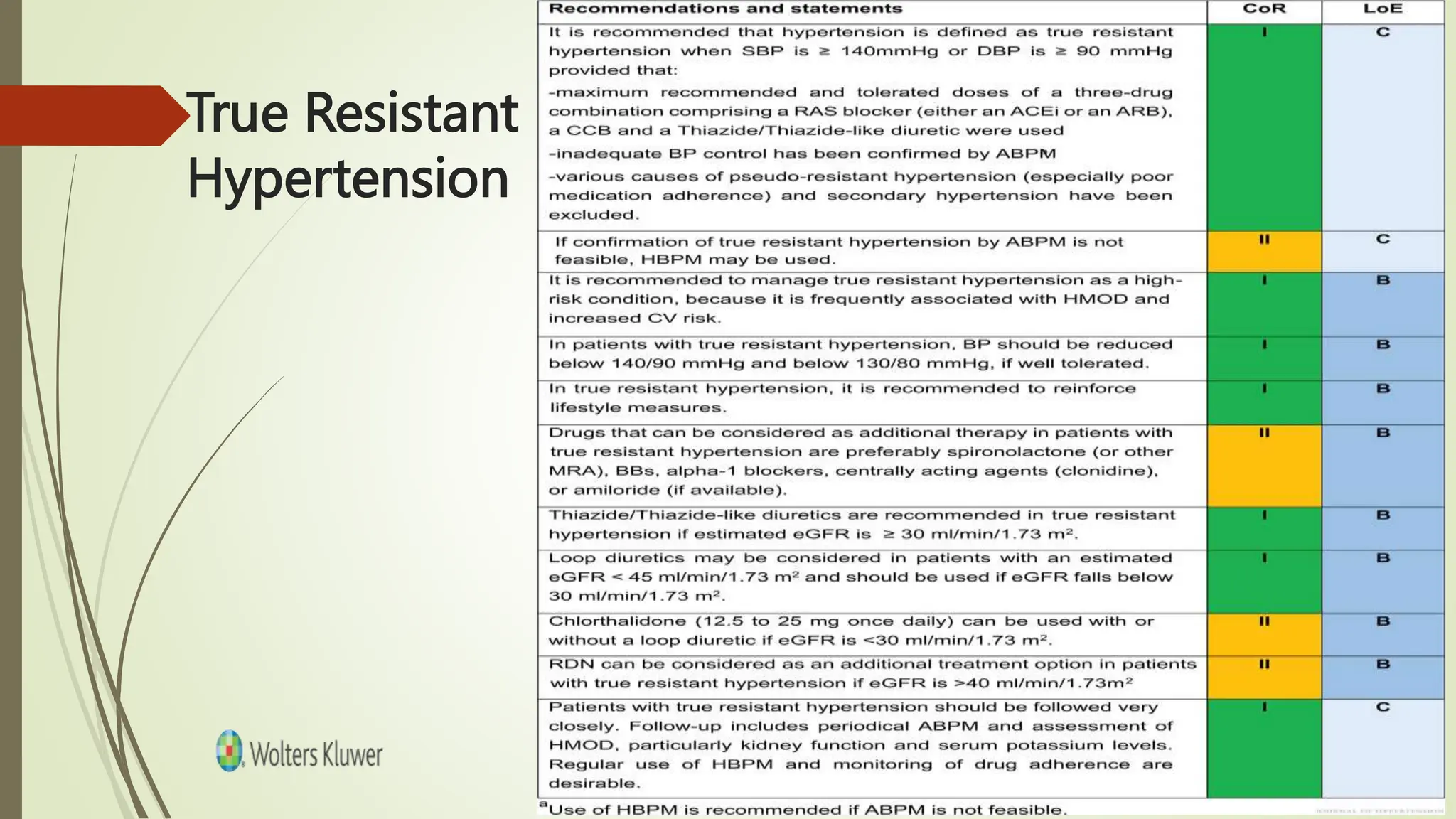
True Resistant
Hypertension
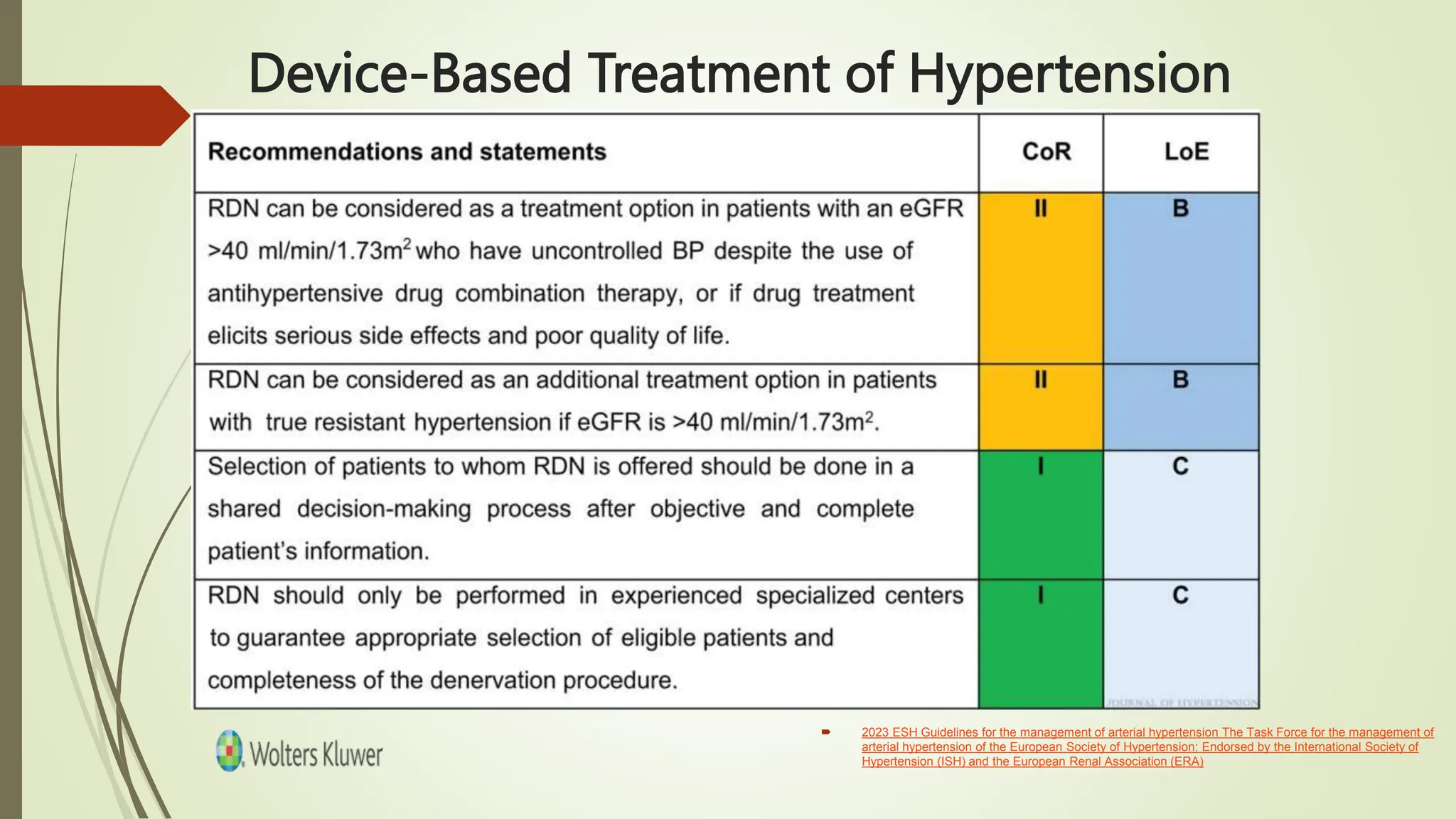
Device-Based Treatment of Hypertension
 2023 ESH Guidelines for the management of arterial hypertension The Task Force for the management of
arterial hypertension of the European Society of Hypertension: Endorsed by the International Society of
Hypertension (ISH) and the European Renal Association (ERA)
Carotid baroreceptor stimulation
 Stretch-sensitive baroreceptors located in the carotid sinus and the aortic arch are involved in
short-term and long-term BP regulation.
 Carotid baroreceptor stimulation was associated with a reduction of sympathetic nerve activity
in studies on hypertensive patients
 The first-generation bilateral electrical stimulation device (Rheos, CVRx) was tested in a double-
blind, randomized, sham-controlled pivotal trial, which included 265 patients with resistant
hypertension [798].
 At 6 months, the office BP fall was significantly larger in the treatment group compared with the
sham group. However, the study failed to meet two of the five co-primary endpoints, and safety
was not established.
 In a small, noncontrolled, open-label, first-in-human CALM-FIM study, 30 patients underwent
implantation of the MobiusHD system (Vascular Dynamics). At 6 months, there were significant
reductions in both office and ambulatory BP compared with baseline, which appeared to be
maintained through 36 months
Other device-based treatments
 ROX CONTROL HTN trial- fixed diameter iliac arteriovenous anastomosis with a
catheter-based device (ROX coupler; ROX Medical) was investigated in resistant
hypertension to lower peripheral vascular resistance
Withdrawal of BP-lowering drugs
Drug class Effects of abrupt withdrawal
CCBs • Risk of angina
BBs • Risk of angina and other complications
in CAD patients
Centrally acting agents • Sympathetic overactivity (nervousness,
tachycardia, headache, agitation and
nausea for 36–72 h after drug cessation)
• Rapid rebound BP increase even above
pretreatment levels
• Angina and other complications in
CAD patients
Diuretics • Fluid retention, edema, HF
decompensation
Resistant Hypertension Management. 2024pptx

Resistant Hypertension Management. 2024pptx

  • 1.
  • 2.
    Introduction  Hypertension isworld’s leading risk factor for CVD, stroke, disability and death.  hypertension was defined as resistant to treatment when appropriate lifestyle measures and treatment with optimal or best tolerated doses of three or more drugs (a Thiazide/Thiazide-like diuretic, an RAS-blocker and a CCB) fail to lower office BP to <140/90mm Hg.  A large proportion of hypertensive adults, still fail to achieve their recomended BP treatment targets.  These individuals remain at increased risk for target organ damage, morbidity and mortality despite ongoing anti-hypertensive drug therapy.
  • 3.
  • 4.
    Characteristics of trueresistant hypertension. 2023 ESH Guidelines for the management of arterial hypertension The Task Force for the management of arterial hypertension of the European Society of Hypertension: Endorsed by the International Society of Hypertension (ISH) and the European Renal Association (ERA)
  • 5.
  • 7.
    2023 ESH Guidelinesfor the management of arterial hypertension The Task Force for the management of arterial hypertension of the European Society of Hypertension: Endorsed by the International Society of Hypertension (ISH) and the European Renal Association (ERA) CKD (eGFR 15–29 ml/min/1.73 m2) and poorly controlled hypertension, showed an about roughly 10 mmHg 24-h SBP reduction with chlortalidone versus placebo, and the BP-lowering effect was particularly evident in patients already on loop diuretics
  • 8.
     Selective nonsteroidalMRAs such as finerenone (approved for the treatment in diabetic kidney disease)  Esaxerenone (approved for the treatment of hypertension in Japan),  Ocedurenone (KBP-5074, in development for resistant hypertension in CKD) ,0.25–0.50 mg/day reduced BP in patients with resistant hypertension and stage 3b/4 CKD with a higher incidence of hyperkalemia at the highest dose  Finally, the use of selective aldosterone synthase inhibitors such as baxdrostat has been shown to effectively lower BP in patients with resistant hypertension in a phase 2 trial.  When spironolactone and other MRAs are not tolerated or contraindicated (i.e. in CKD stage 4, eGFR <30 ml/min),bisoprolol (5–10 mg/day), doxazosin extended release (4–8 mg/day) or a centrally acting agent such as the alpha adrenergic receptor agonists (clonidine, 0.1–0.3 mg twice a day) can be used as alternatives
  • 9.
     In obesepatients,GLP1 receptor agonists can reduce body weight [759], modestly lower BP and improve CV prognosis in patients with type 2 diabetes or with established CVD  Bariatric surgery can lower BP, CV risk factors and risk of CV events in severely obese patients and may, thus, reduce the burden of antihypertensive medication when these patients have resistant hypertension  In patients eligible for treatment with SGLT2is their use may add a moderate BP-lowering effect to the background antihypertensive therapy for resistant hypertensive patients  Finally, compared with valsartan alone, the sacubitril–valsartan combination did not lower hospitalization for HF and death in patients with HFpEF , but did reduce significantly the NYHA class of the patients
  • 10.
  • 11.
    Device-Based Treatment ofHypertension  2023 ESH Guidelines for the management of arterial hypertension The Task Force for the management of arterial hypertension of the European Society of Hypertension: Endorsed by the International Society of Hypertension (ISH) and the European Renal Association (ERA)
  • 12.
    Carotid baroreceptor stimulation Stretch-sensitive baroreceptors located in the carotid sinus and the aortic arch are involved in short-term and long-term BP regulation.  Carotid baroreceptor stimulation was associated with a reduction of sympathetic nerve activity in studies on hypertensive patients  The first-generation bilateral electrical stimulation device (Rheos, CVRx) was tested in a double- blind, randomized, sham-controlled pivotal trial, which included 265 patients with resistant hypertension [798].  At 6 months, the office BP fall was significantly larger in the treatment group compared with the sham group. However, the study failed to meet two of the five co-primary endpoints, and safety was not established.
  • 13.
     In asmall, noncontrolled, open-label, first-in-human CALM-FIM study, 30 patients underwent implantation of the MobiusHD system (Vascular Dynamics). At 6 months, there were significant reductions in both office and ambulatory BP compared with baseline, which appeared to be maintained through 36 months
  • 14.
    Other device-based treatments ROX CONTROL HTN trial- fixed diameter iliac arteriovenous anastomosis with a catheter-based device (ROX coupler; ROX Medical) was investigated in resistant hypertension to lower peripheral vascular resistance
  • 15.
    Withdrawal of BP-loweringdrugs Drug class Effects of abrupt withdrawal CCBs • Risk of angina BBs • Risk of angina and other complications in CAD patients Centrally acting agents • Sympathetic overactivity (nervousness, tachycardia, headache, agitation and nausea for 36–72 h after drug cessation) • Rapid rebound BP increase even above pretreatment levels • Angina and other complications in CAD patients Diuretics • Fluid retention, edema, HF decompensation