Resilience
Disruption of the Balance
The process of restoring balance can lead to four possible
outcomes:
• Resilient reintegration – where disruption leads to stronger
protective factors and individuals being more well-balanced
than ever
• Homeostatic reintegration- where individuals “just get over”
the disruption with no real change in protective factors or
balance
• Reintegration with loss – where individuals regain their
balance but with reduced protective factors and greater
vulnerability to further imbalance
• Dysfunctional reintegration - remaining imbalanced and
relying on destructive coping strategies such as substance
abuse to deal with the stress of imbalance (Vitelli, 2013)
Psychological Resilience
What is Resilience?
Resilience is the process of adapting well
in the face of adversity, trauma, tragedy,
threats or significant sources of stress —
such as family and relationship
problems, serious health problems or
workplace and financial stressors. It
means "bouncing back" from difficult
experiences.
(American Psychological Association, 2015)
The factors associated with resilience are
usually classified as protective factors that
help insulate people from adverse
situations and promotive factors that
actually make people better able to cope.
There are different levels of resilience and
it is best seen as something that can
develop over time based on level of
exposure to traumatic situations (Vitelli,
2013).
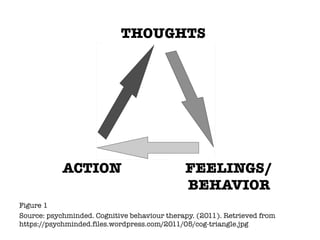
Thoughts + Behaviors + Actions = Resilience
(American Psychological Association, 2015)
ACTION
Figure 1
Source: psychminded. Cognitive behaviour therapy. (2011). Retrieved from
https://psychminded.files.wordpress.com/2011/05/cog-triangle.jpg
THOUGHTS
FEELINGS/
BEHAVIOR
Factors of Resilience
• The capacity to make realistic plans and
take steps to carry them out.
• A positive view of yourself and confidence
in your strengths and abilities.
• Skills in communication and problem
solving.
• The capacity to manage strong feelings
and impulses.
(American Psychological Association, 2015)
10 Ways to Build Resilience
1. Make connections.
2. Avoid seeing crises and insurmountable
problems.
3. Move toward your goals.
4. Take decisive actions.
5. Look for opportunities for self-discovery.
6. Nurture a positive view of yourself.
7. Keep things in perspective.
8. Maintain a hopeful outlook.
9. Take care of yourself.
10.Additional ways of strengthening resilience.
(American Psychological Association, 2015)
Learning from your Past
• What kinds of events have been most stressful for me?
• How have those events typically affected me?
• Have I found it helpful to think of important people in my
life when I am distressed?
• To whom have I reached out for support in working
through a traumatic or stressful experience?
• What have I learned about myself and my interactions
with others during difficult times?
• Has it been helpful for me to assist someone else going
through a similar experience?
• Have I been able to overcome obstacles, and if so, how?
• What has helped make me feel more hopeful about the
future?
(American Psychological Association, 2015)
Staying Flexible
• Letting yourself experience strong emotions,
and also realizing when you may need to avoid
experiencing them at times in order to
continue functioning.
• Stepping forward and taking action to deal
with your problems and meet the demands of
daily living, and also stepping back to rest and
reenergize yourself.
• Spending time with loved ones to gain support
and encouragement, and also nurturing
yourself.
• Relying on others, and also relying on
yourself.
(American Psychological Association, 2015)
Reference
• American Psychological Association.
(2015). The road to resilience.
Retrieved from
http://www.apa.org/helpcenter/road-
resilience.aspx
• Vitelly, R. (2013). Learning to be
resilient. Retrieved from
https://www.psychologytoday.com/blog
/media-spotlight/201305/learning-be-
resilient

Resilience

  • 1.
  • 2.
    Disruption of theBalance The process of restoring balance can lead to four possible outcomes: • Resilient reintegration – where disruption leads to stronger protective factors and individuals being more well-balanced than ever • Homeostatic reintegration- where individuals “just get over” the disruption with no real change in protective factors or balance • Reintegration with loss – where individuals regain their balance but with reduced protective factors and greater vulnerability to further imbalance • Dysfunctional reintegration - remaining imbalanced and relying on destructive coping strategies such as substance abuse to deal with the stress of imbalance (Vitelli, 2013)
  • 3.
  • 4.
    What is Resilience? Resilienceis the process of adapting well in the face of adversity, trauma, tragedy, threats or significant sources of stress — such as family and relationship problems, serious health problems or workplace and financial stressors. It means "bouncing back" from difficult experiences. (American Psychological Association, 2015)
  • 5.
    The factors associatedwith resilience are usually classified as protective factors that help insulate people from adverse situations and promotive factors that actually make people better able to cope. There are different levels of resilience and it is best seen as something that can develop over time based on level of exposure to traumatic situations (Vitelli, 2013).
  • 6.
    Thoughts + Behaviors+ Actions = Resilience (American Psychological Association, 2015)
  • 7.
    ACTION Figure 1 Source: psychminded.Cognitive behaviour therapy. (2011). Retrieved from https://psychminded.files.wordpress.com/2011/05/cog-triangle.jpg THOUGHTS FEELINGS/ BEHAVIOR
  • 8.
    Factors of Resilience •The capacity to make realistic plans and take steps to carry them out. • A positive view of yourself and confidence in your strengths and abilities. • Skills in communication and problem solving. • The capacity to manage strong feelings and impulses. (American Psychological Association, 2015)
  • 9.
    10 Ways toBuild Resilience 1. Make connections. 2. Avoid seeing crises and insurmountable problems. 3. Move toward your goals. 4. Take decisive actions. 5. Look for opportunities for self-discovery. 6. Nurture a positive view of yourself. 7. Keep things in perspective. 8. Maintain a hopeful outlook. 9. Take care of yourself. 10.Additional ways of strengthening resilience. (American Psychological Association, 2015)
  • 10.
    Learning from yourPast • What kinds of events have been most stressful for me? • How have those events typically affected me? • Have I found it helpful to think of important people in my life when I am distressed? • To whom have I reached out for support in working through a traumatic or stressful experience? • What have I learned about myself and my interactions with others during difficult times? • Has it been helpful for me to assist someone else going through a similar experience? • Have I been able to overcome obstacles, and if so, how? • What has helped make me feel more hopeful about the future? (American Psychological Association, 2015)
  • 11.
    Staying Flexible • Lettingyourself experience strong emotions, and also realizing when you may need to avoid experiencing them at times in order to continue functioning. • Stepping forward and taking action to deal with your problems and meet the demands of daily living, and also stepping back to rest and reenergize yourself. • Spending time with loved ones to gain support and encouragement, and also nurturing yourself. • Relying on others, and also relying on yourself. (American Psychological Association, 2015)
  • 12.
    Reference • American PsychologicalAssociation. (2015). The road to resilience. Retrieved from http://www.apa.org/helpcenter/road- resilience.aspx • Vitelly, R. (2013). Learning to be resilient. Retrieved from https://www.psychologytoday.com/blog /media-spotlight/201305/learning-be- resilient