ELECTRIFICATION AND
ARCHITECTURAL ILLUMINATION
MODULE 1
Electrification in building
• Imagine yourself in the most fabulous building in the
world. Now take away the lighting, heating and
ventilation, the lifts and escalators,, plumbing, power
supply and energy management systems, the security
and safety systems...and you are left with a cold, dark,
uninhabitable shell. „
• Everything inside a building which makes it safe and
comfortable to be in comes under the title of 'Building
Services'. A building must do what it was designed to do -
not just provide shelter but also be an environment where
people can live, work and achieve
Classification of materials
Conductors
Conductors are the materials which have very high
Conductivity
• Examples: Silver, Copper, Gold, Aluminum etc.
Insulating Materials
The conductivity of insulating materials is very low.
Example:- Plastics, Ceramics, PVC etc.
Semiconductors
Semiconductors are have the conductivity between
conductors and insulators
Example: Germanium, Silicon, Gallium Arsenic etc
Commonly used terminology
• Current: Its flow of electrons through a conductor .
Represented by letter by I and its unit Ampere (A).
There are two types of currents
1)A.C (Alternating current)
2)D.C ( Direct current)
• Voltage: it’s the potential difference between the 2
ends of the conductor. Represented by letter by V
and its unit Volt(V).
• Resistance: it’s the opposition to the flow of
current. Represented by letter by R and its unit
ohm(Ώ).
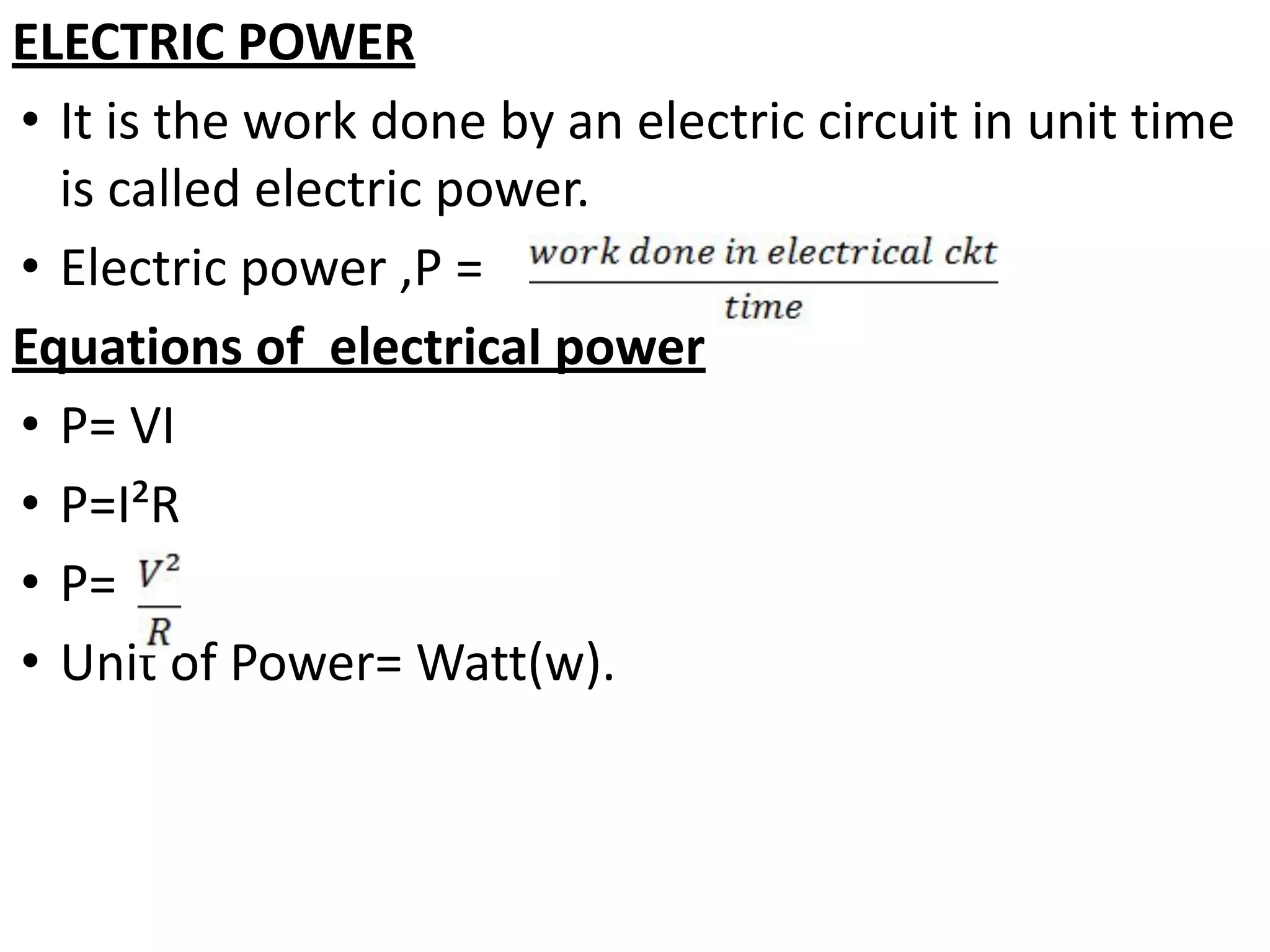
ELECTRIC POWER
• It is the work done by an electric circuit in unit time
is called electric power.
• Electric power ,P =
Equations of electrical power
• P= VI
• P=I²R
• P=
• Unit of Power= Watt(w).
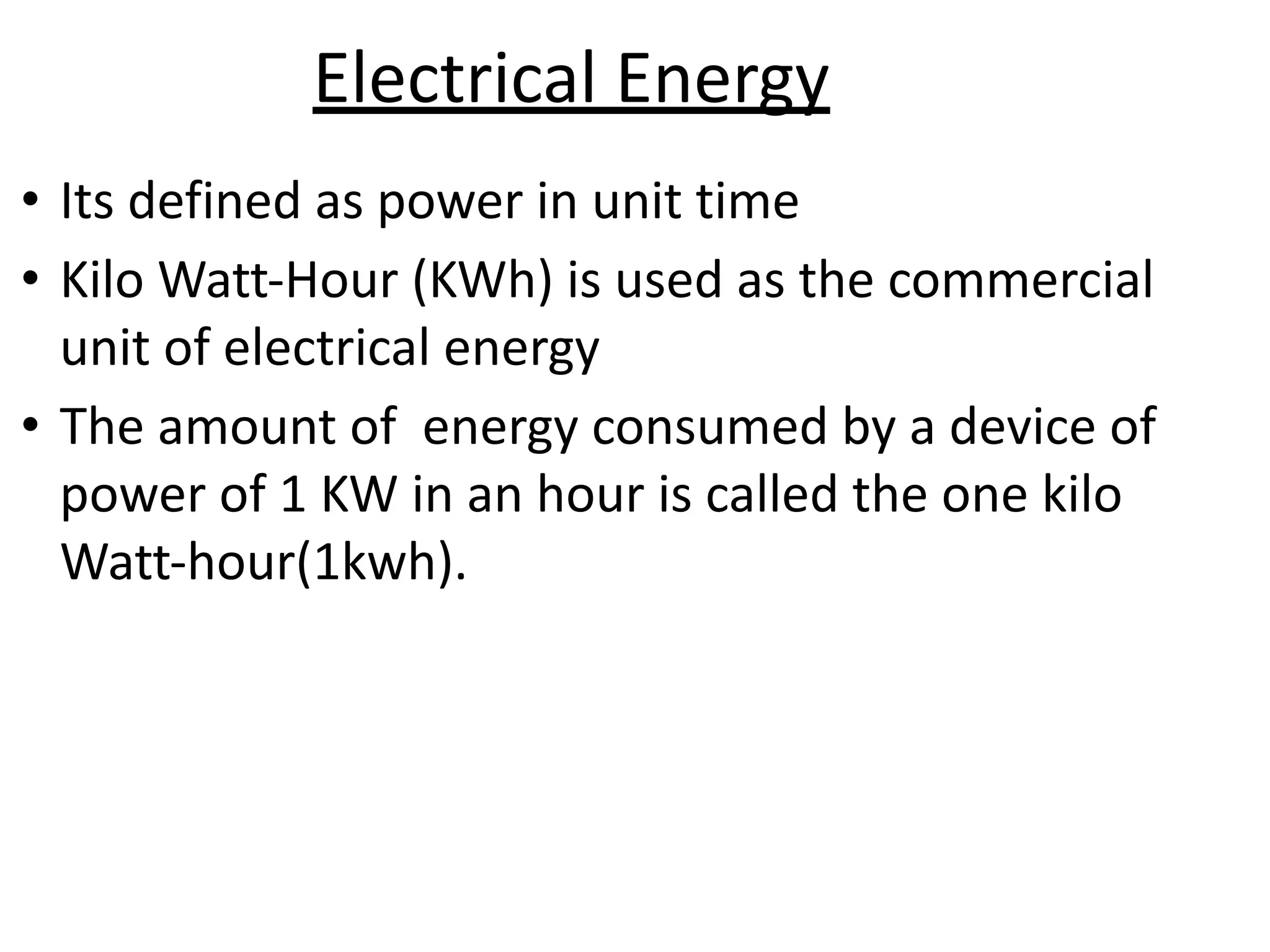
Electrical Energy
• Its defined as power in unit time
• Kilo Watt-Hour (KWh) is used as the commercial
unit of electrical energy
• The amount of energy consumed by a device of
power of 1 KW in an hour is called the one kilo
Watt-hour(1kwh).
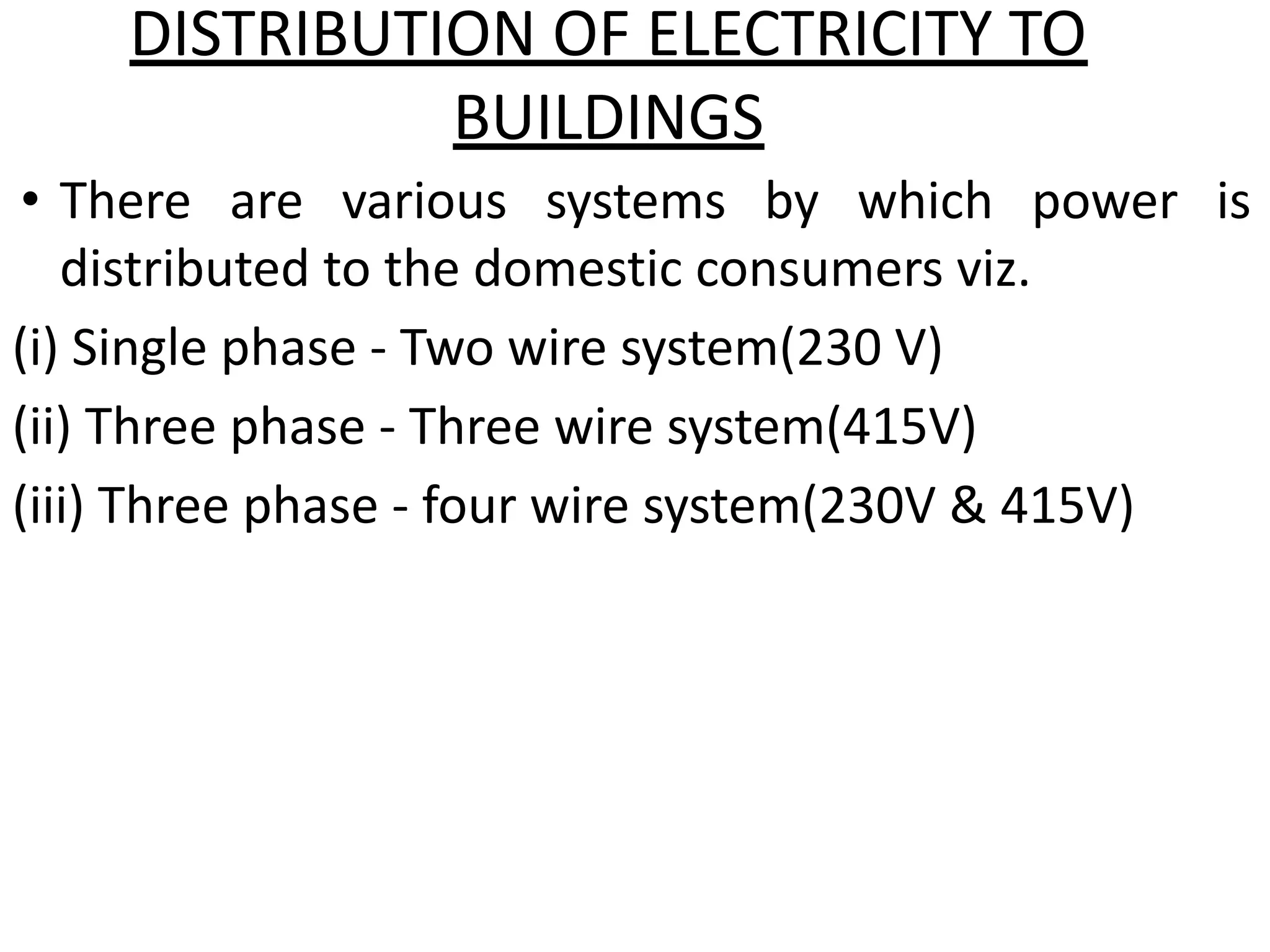
DISTRIBUTION OF ELECTRICITY TO
BUILDINGS
• There are various systems by which power is
distributed to the domestic consumers viz.
(i) Single phase - Two wire system(230 V)
(ii) Three phase - Three wire system(415V)
(iii) Three phase - four wire system(230V & 415V)
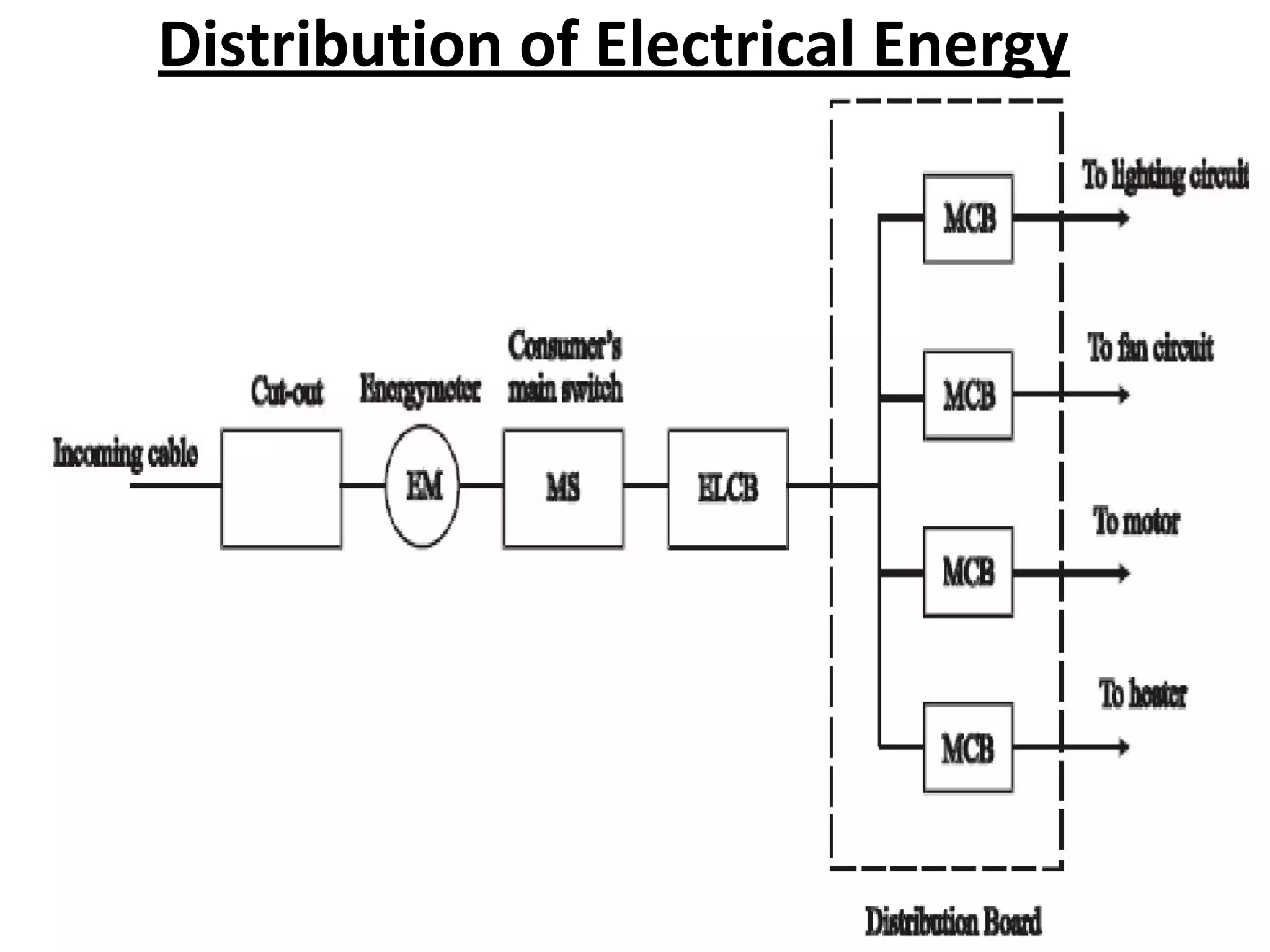
Distribution of Electrical Energy
Following are the important components of a circuit
of an installation.
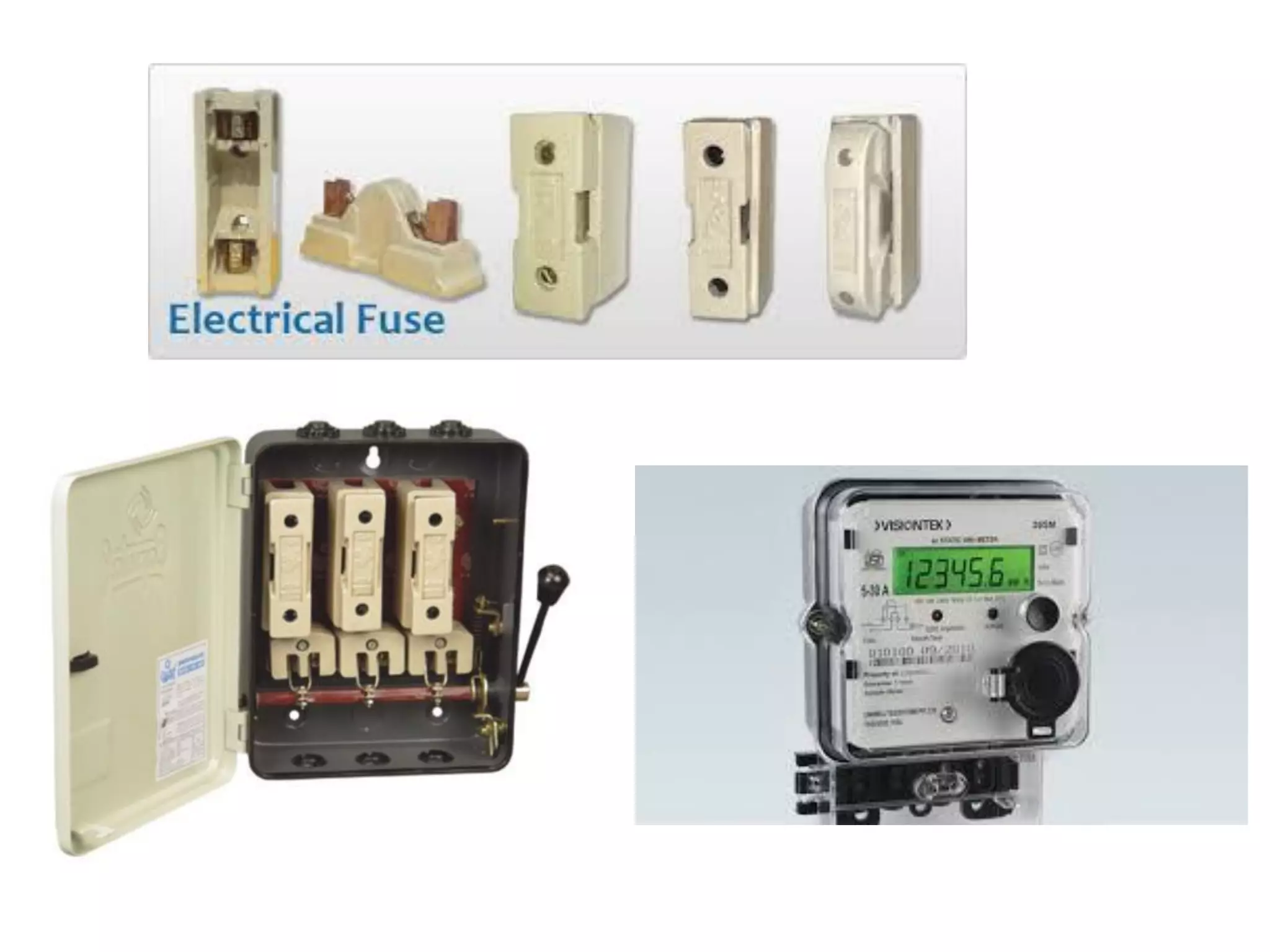
1. Incoming cable or service main
2. Cut-out
3. Energy meters
4. Main switch
5. ELCB
6. MCB
• This incoming cable from the feeder pole is
connected to the energy meters through supply
authority’s cut-out
• The energy meter and cut-outs are the property of
the suppliers and are properly sealed by the
supplies at the time of installation
• .After the energy meter, the consumer’s distribution
starts and the supply cables are entirely under the
control of consumer.
• After the energy meter, the consumer must provide
a main switch which would control the complete
lighting and power circuit of the building.
• Main switches are normally available in the
following types.
(a) Double pole iron clad main switch
(b) Triple pole iron clad main switch
(c) Triple pole iron clad main switch with neutral link
(TPNIC)
• DPIC is used for controlling single phase 2-wire
circuits. This is normally used in domestic wiring
• TPIC switch is used for controlling 3-phase power in
3-wire system. This is normally used for industrial
installations
• TPNIC switch is used for controlling a 3-phase power
with 4-wire systems
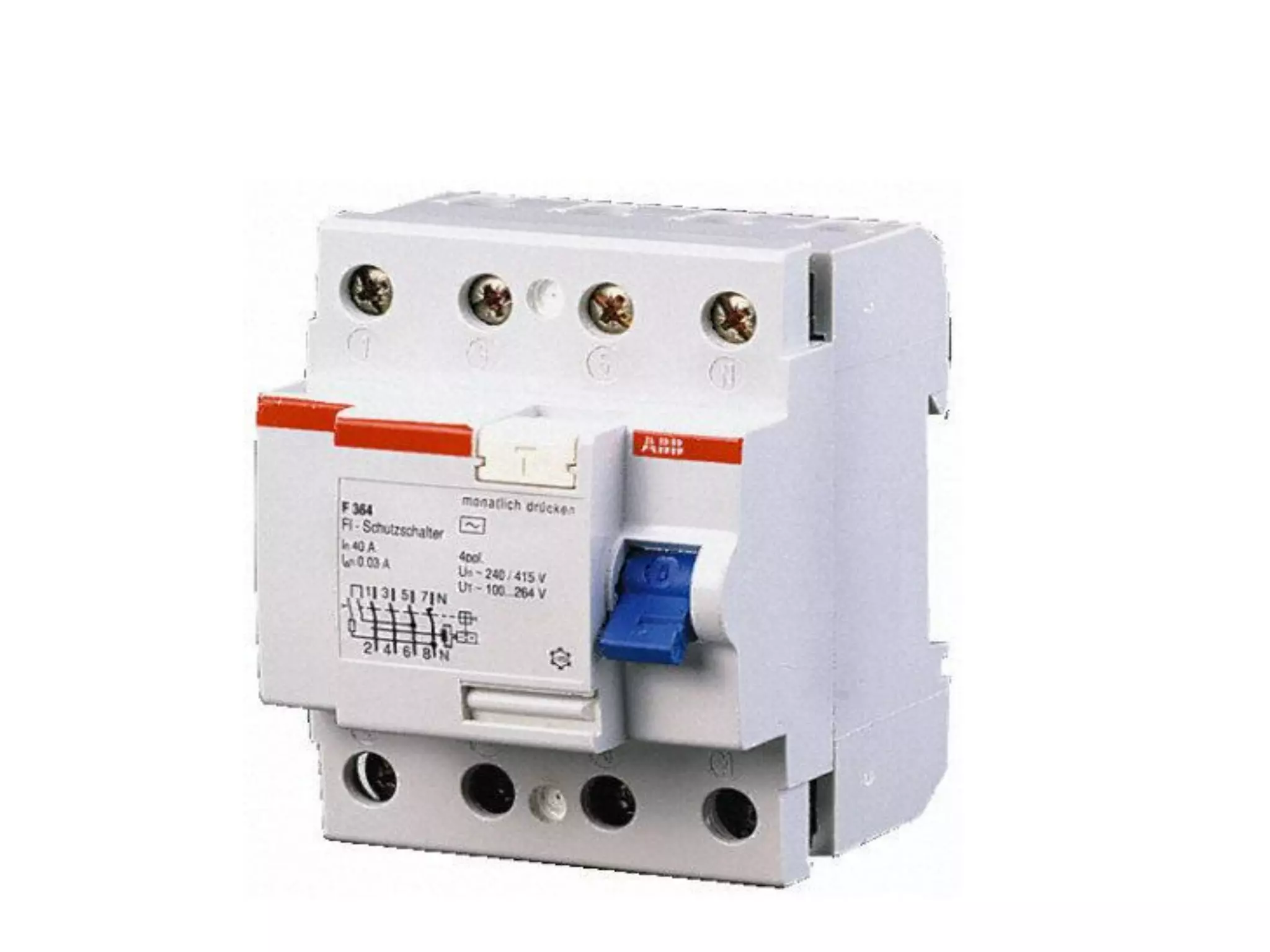
Earth Leakage Circuit Breaker (ELCB)
• Conductor carrying current should be well
insulated, Weakness and leakage of insulation may
result in electric shock and other accidents
• When the phase is thus connected to the metal
body of the appliance, current flows from this body
to the earth through the earth wire, This is called
earth leakage
• Earth leakage circuit breaker opens the circuit and
cut off the power supply, even when there is very
little earth leakage
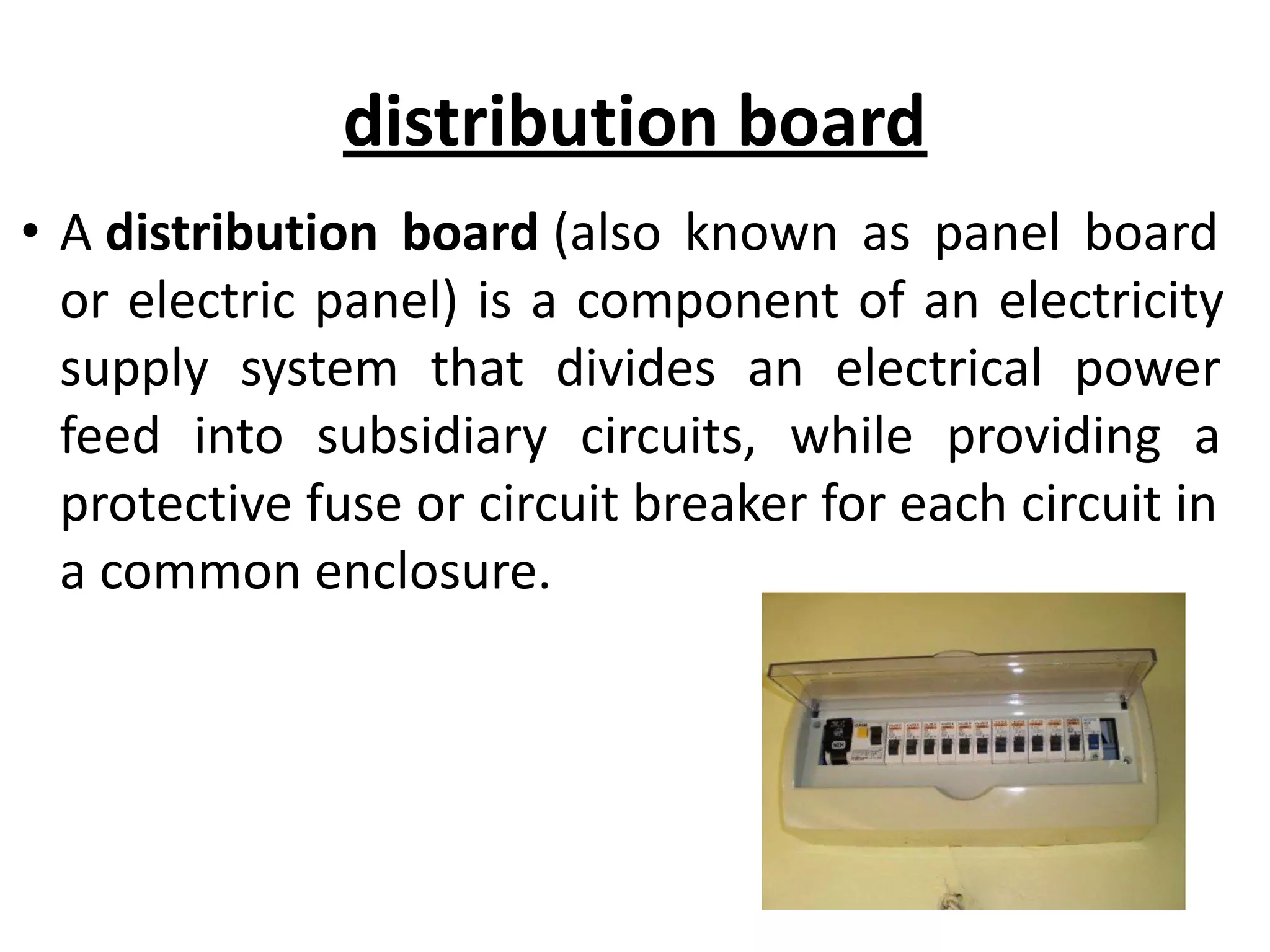
distribution board
• A distribution board (also known as panel board
or electric panel) is a component of an electricity
supply system that divides an electrical power
feed into subsidiary circuits, while providing a
protective fuse or circuit breaker for each circuit in
a common enclosure.
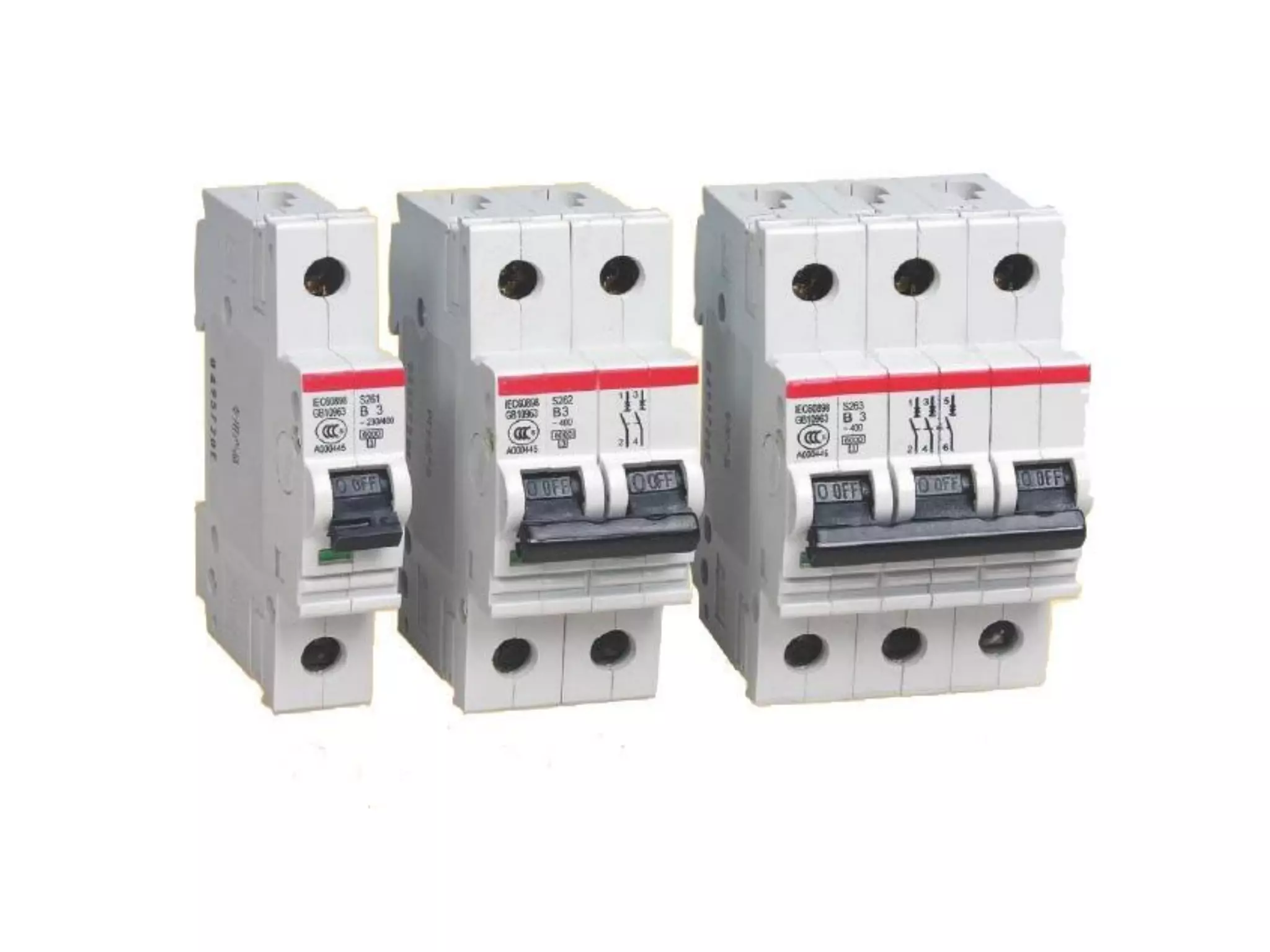
Miniature Circuit Breaker (MCB)
• Miniature circuit breaker (MCB is connected) is the
circuit to prevent the accidents due to short circuit
or over current
• Now day miniature circuit breakers are used for
domestic and commercial wiring instead of fuses
• MCB can be put ‘On’ or ‘Off’ by moving the handle
‘up’ and ‘down’. MCB with different current carrying
capacity is available
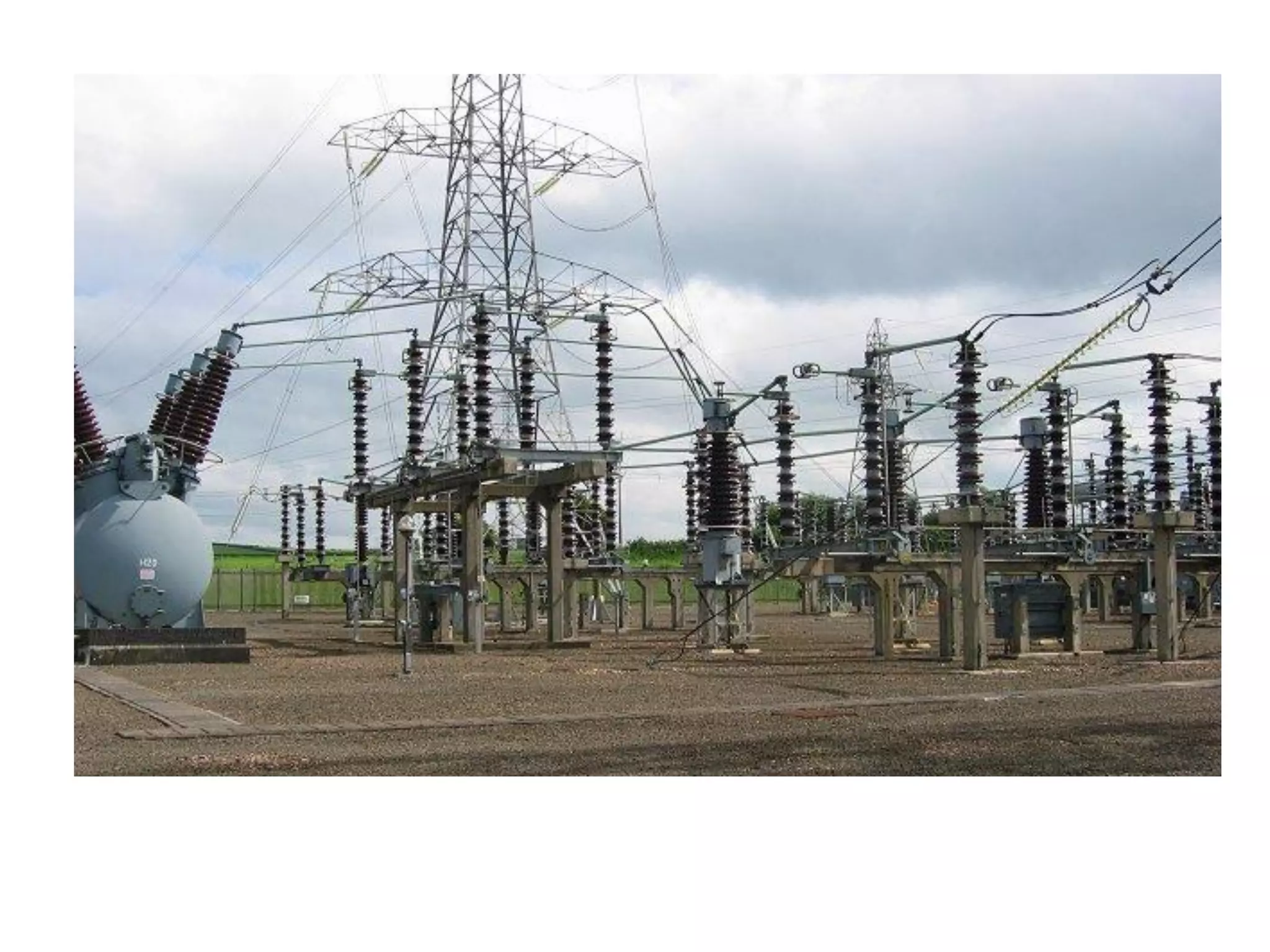
FAMILIRIZATION OF SUB STATION
• A substation may be define as an assembly of
various electrical apparatus installed to perform
any one or two or all of the following operation
1. To transform high to low voltage or vice-versa
(voltage transformation).
2. To switch on and off the power lines (switching)
3. To convert AC to DC or vice-versa (power
conversion)
4. To convert frequency from one value to other
(frequency converter/changer)
OPERATION
• The generation of electricity in power/generating
station is taking place at faraway places from
consumer
• For this reasons, the generated voltage .i.e. at 11kv
220kv or 400kv and transmitted to load centre in
India
• At load centre the high voltage is stepped down to
11kv or 440/230v and distributed to consumers.
• These voltage transformations are carried out at
sub-stations.
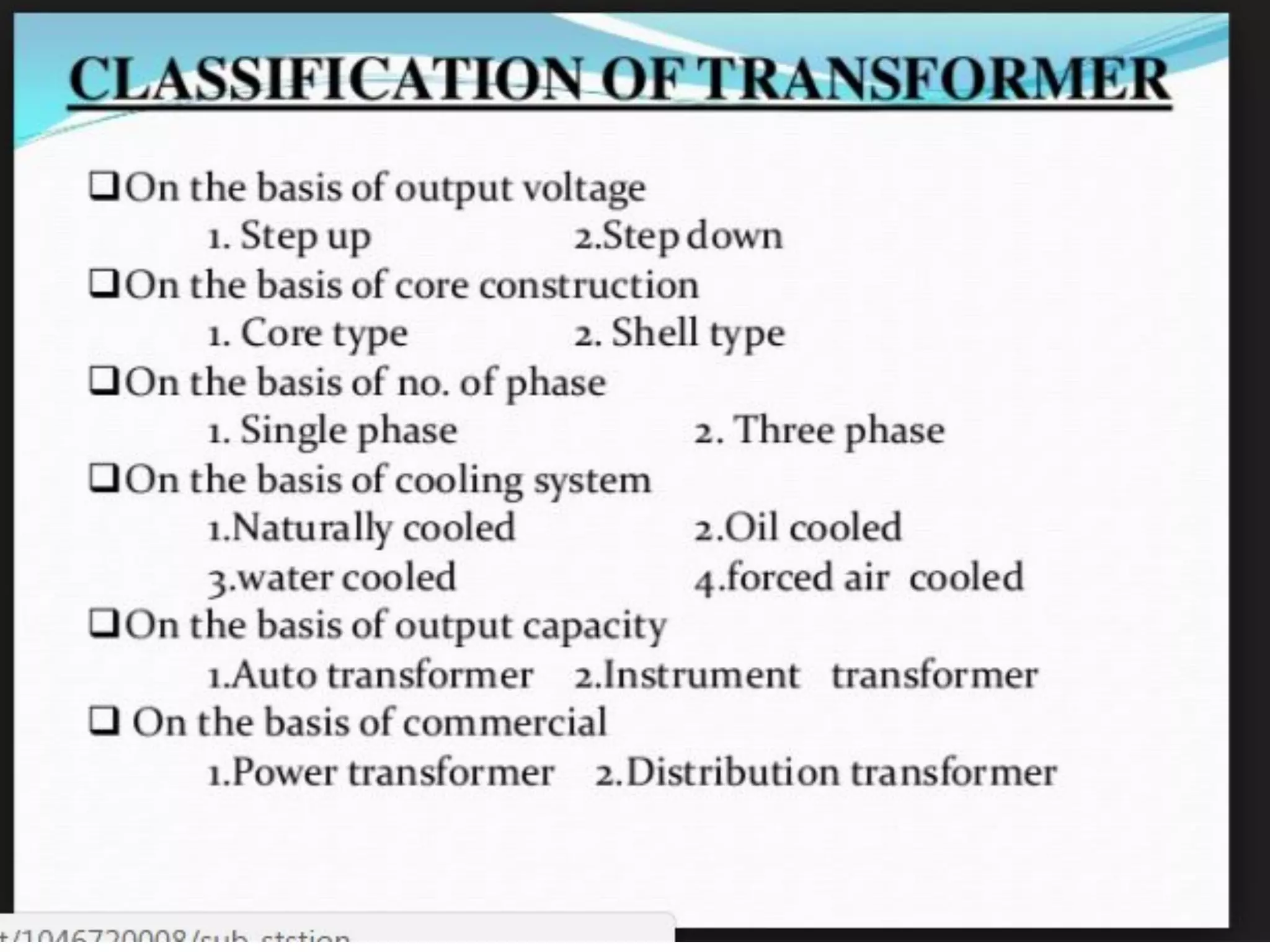
Classification of substation
i. On basis of nature of duties;- classified into three.
1. Step-up or primary substation;- such substation are usually
associated with generating station for stepping up of generated
voltage and transmitted to load centre economically.
2. Primary Grid Substation;- This substation lowered the value of
primary stepped up voltages. The output of the primary grid
substation acts as the input of the secondary substations. The
secondary substation is used for stepping down the input voltage to
more lowered for further transmission.
3. Step down or distribution substation;- such substation are located
at load centre where primary distribution voltage is stepped down
to secondary distribution voltage like 415/240v.
2.Based on service required
• Transformer substation;- transformer installed on
such substation to transform power from one
voltage to another level.
• Switching substation;- switching operation carried
out in power line without transforming the voltage.
• Converting substation;- for converting ac to dc or
vice- versa or converting frequency high to low or
vice-versa.
3.On basis of operating voltage
• High voltage substation (HV SUB.);- involving and
operating voltage between 11kv and 132kv.
• Extra high voltage substation (EHV);- 132KV-400KV.
• Ultra high voltage substation (UHV substation);-
above 400KV.
4. On basis of design
a) Indoor type substation;-
• In such substation the apparatus is installed within the substation building.
• Usually for 11kv and can be increased up to 33kv or 66kv.
• It also preventing contaminating with impurities
b) Outdoor substation:
• they are two type,
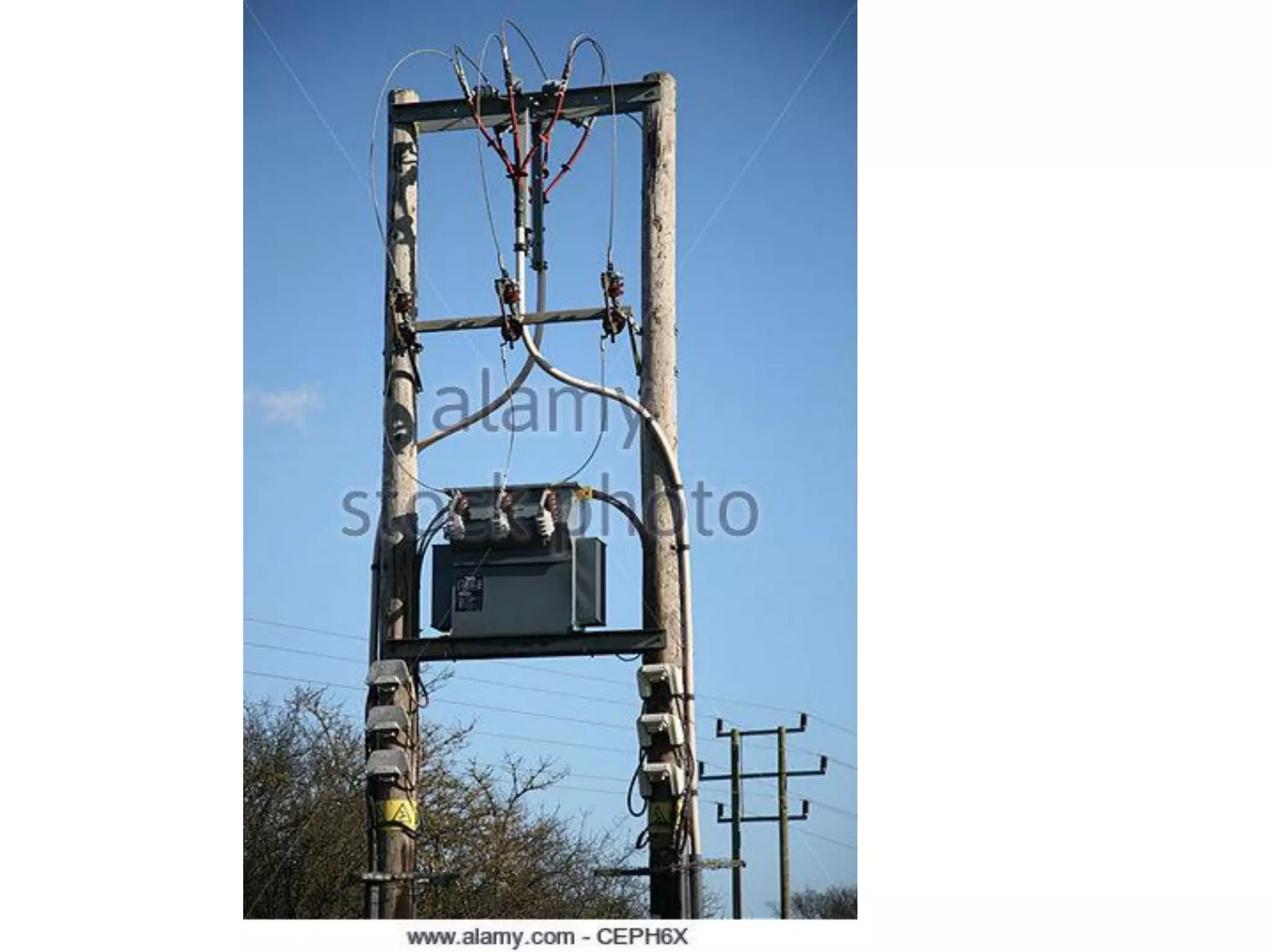
1.Pole mounted substation;-
• Such substation is installed for distribution of power in localities.
• These may be 2-pole or H-pole and 4-pole structure with suitable
platforms.
• Transformers of capacity up to 25 KVA, 125KVA and above 125KVA
(but up to 250KVA).
2.Foundation mounted or plinth mounted substation;-
• For transformers of capacity above 250 KVA, the transformers are too
heavy for pole mounting
• Such substation is usually for voltage of 33kv and above.
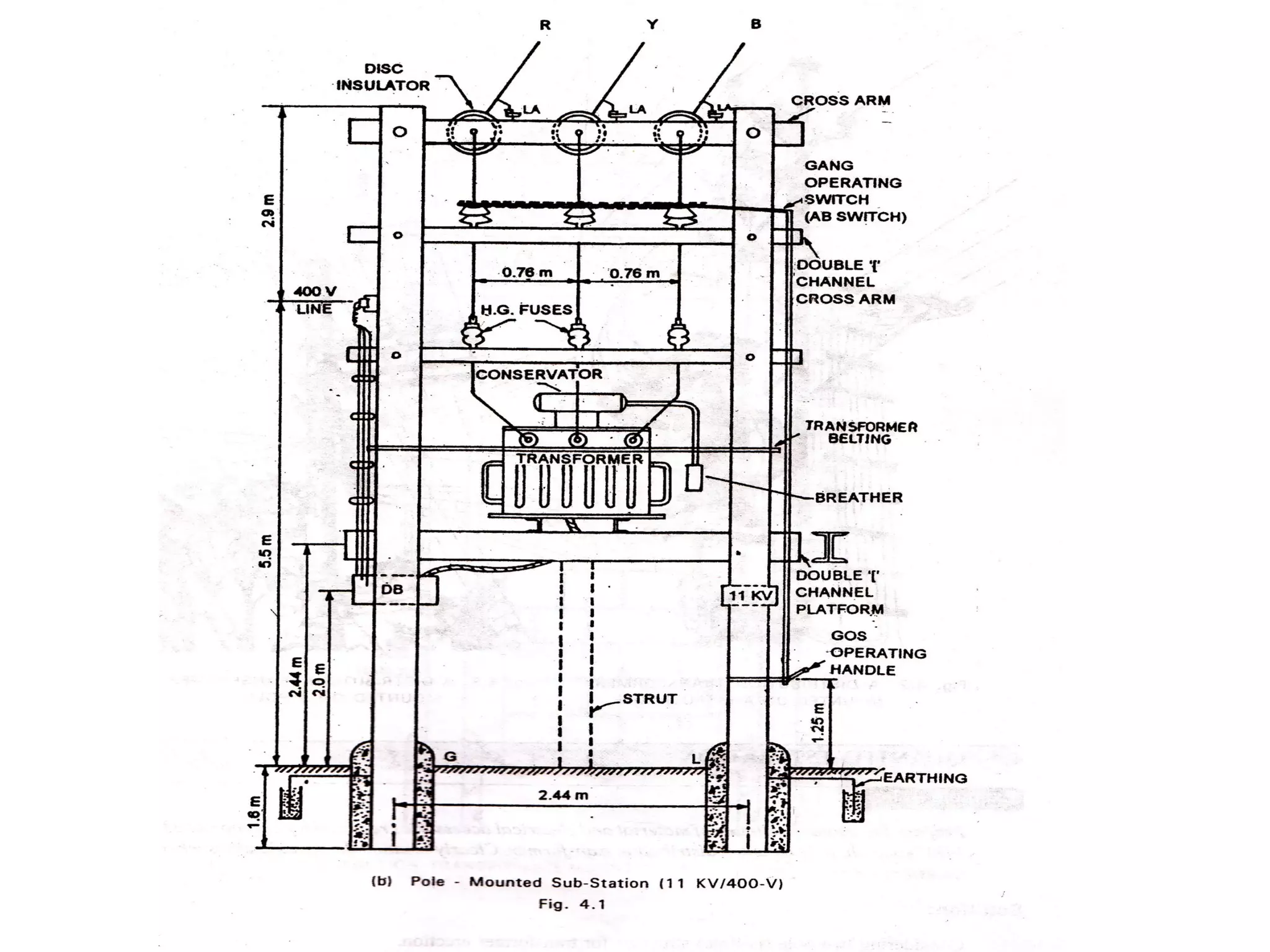
COMPONENTS OF SUBSTATION
1. Poles-steel or PSCC poles :are required to carry the
transformer
2. Transformer;- 11/0.4kv 3-phase step down
(distribution) transformer.
3. Transformer platform;- MS channels are used for
platform preparation.
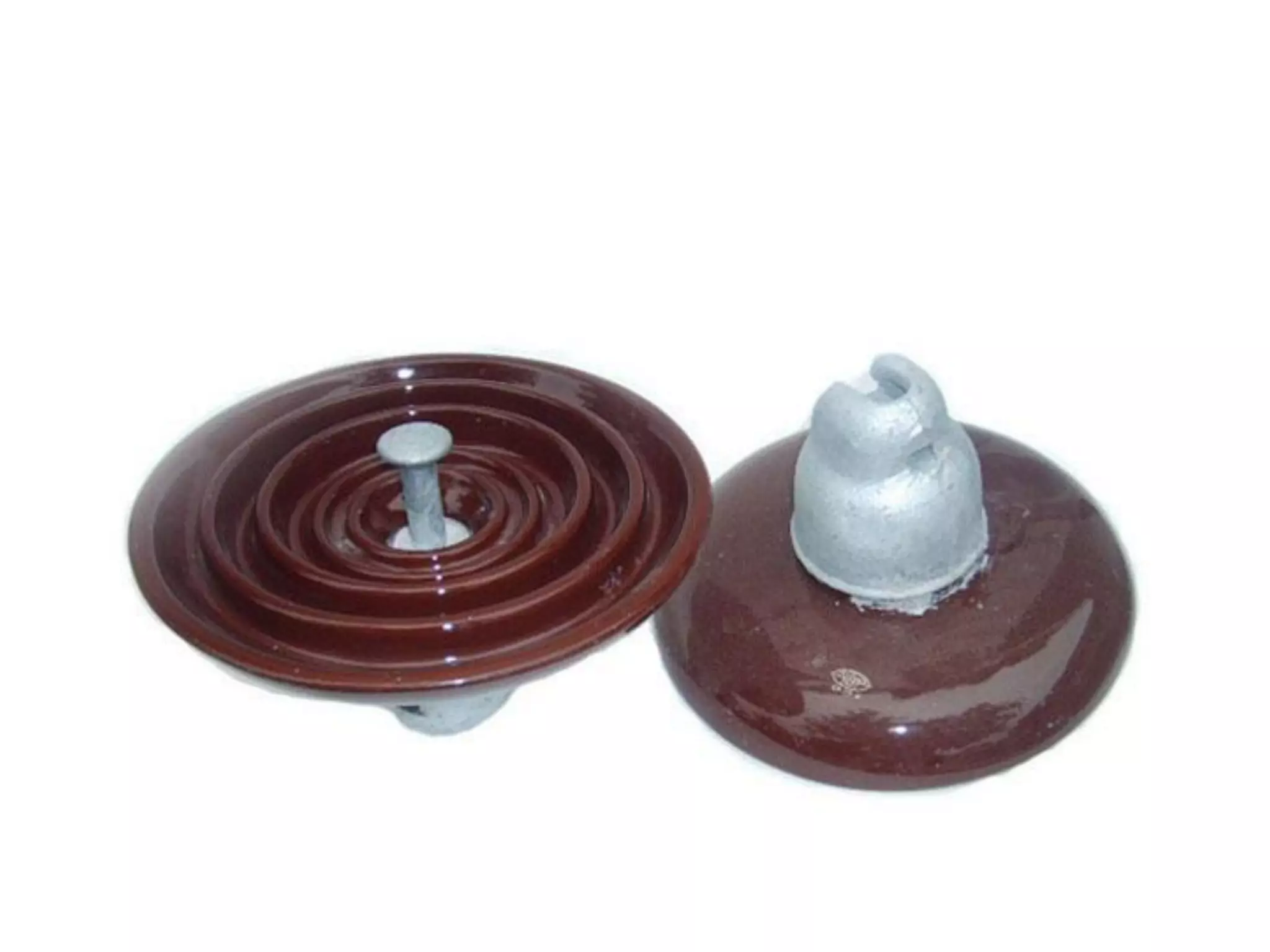
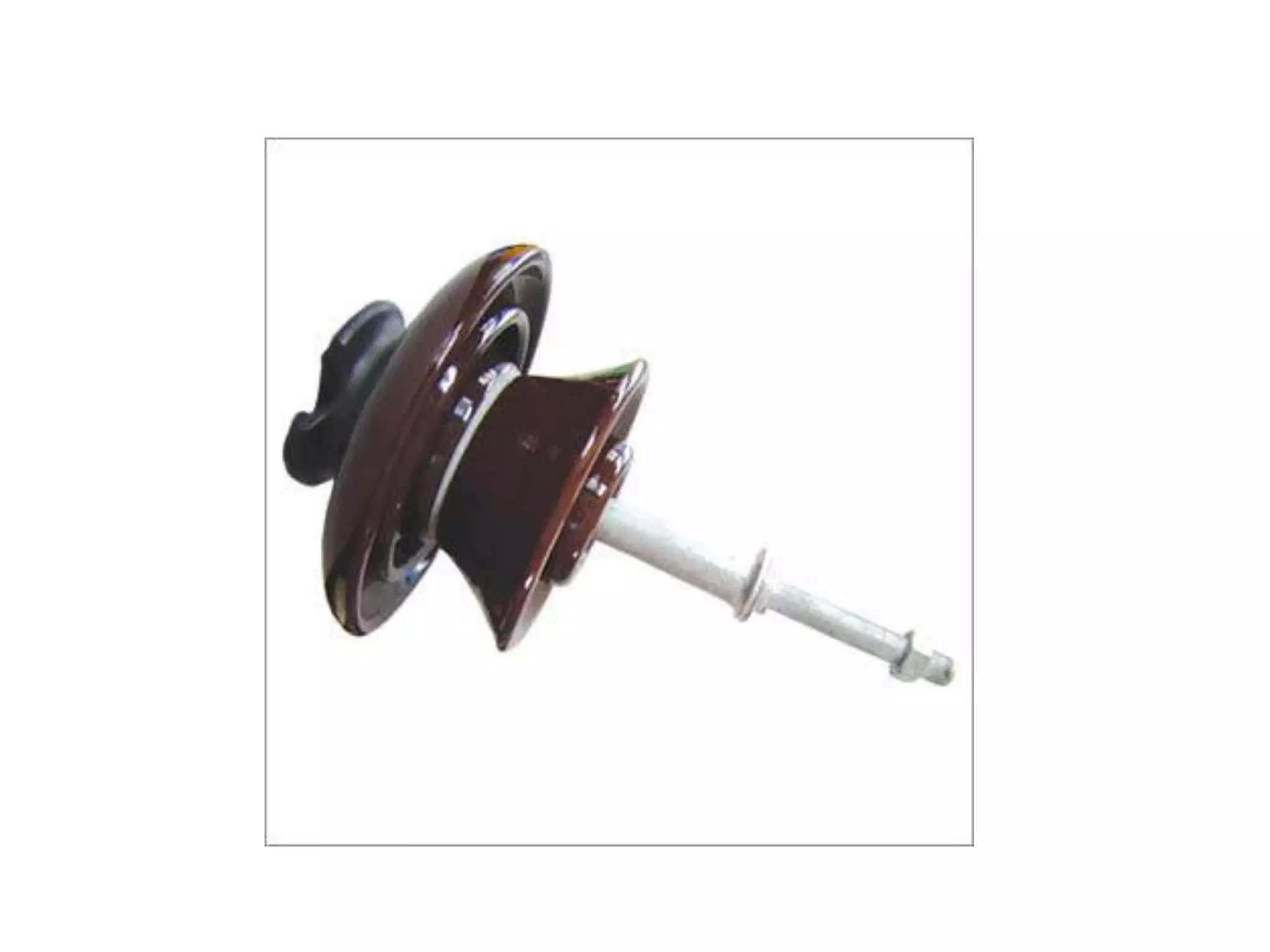
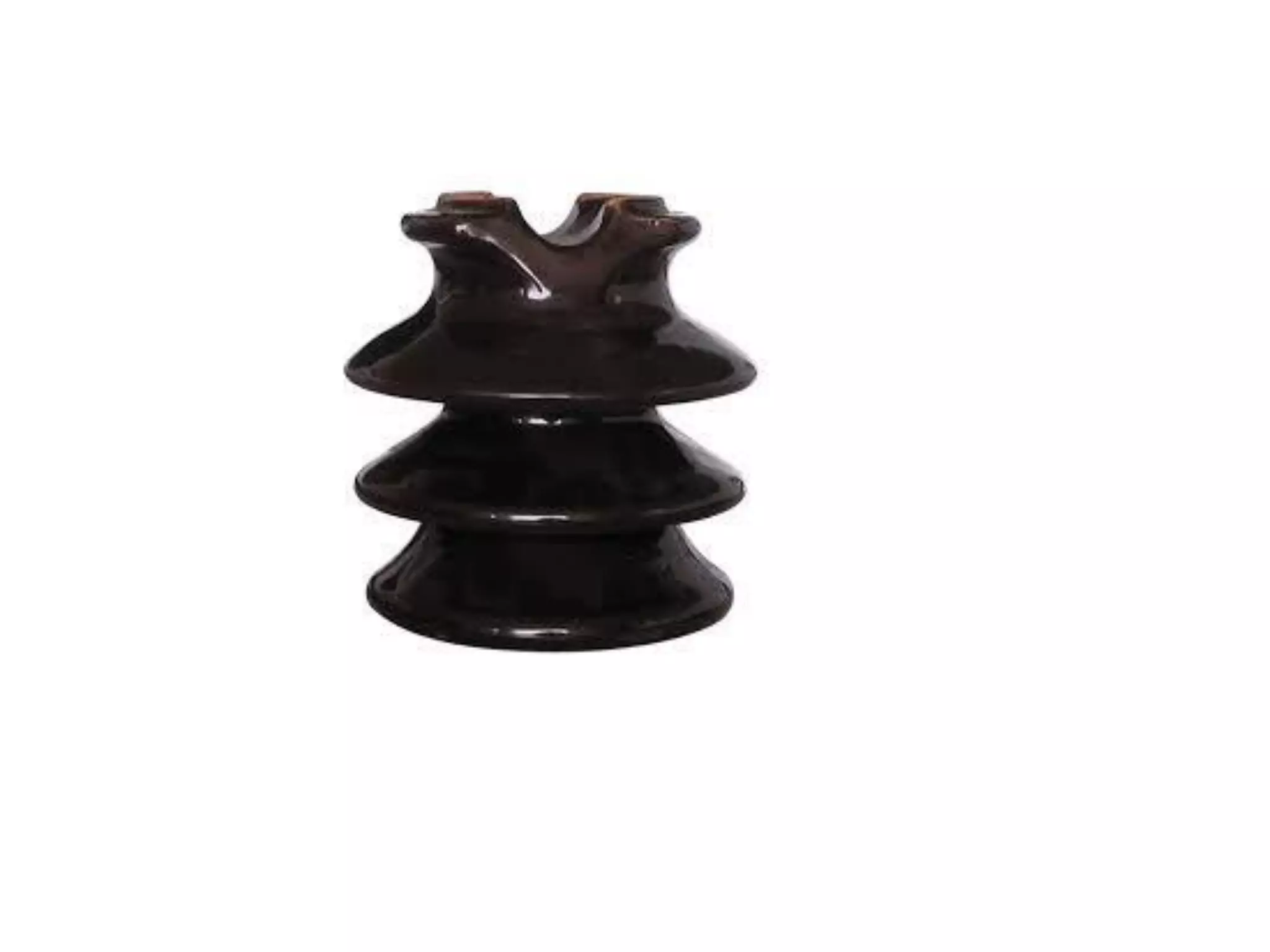
4. Insulator;- pin type or disc type insulator are used.
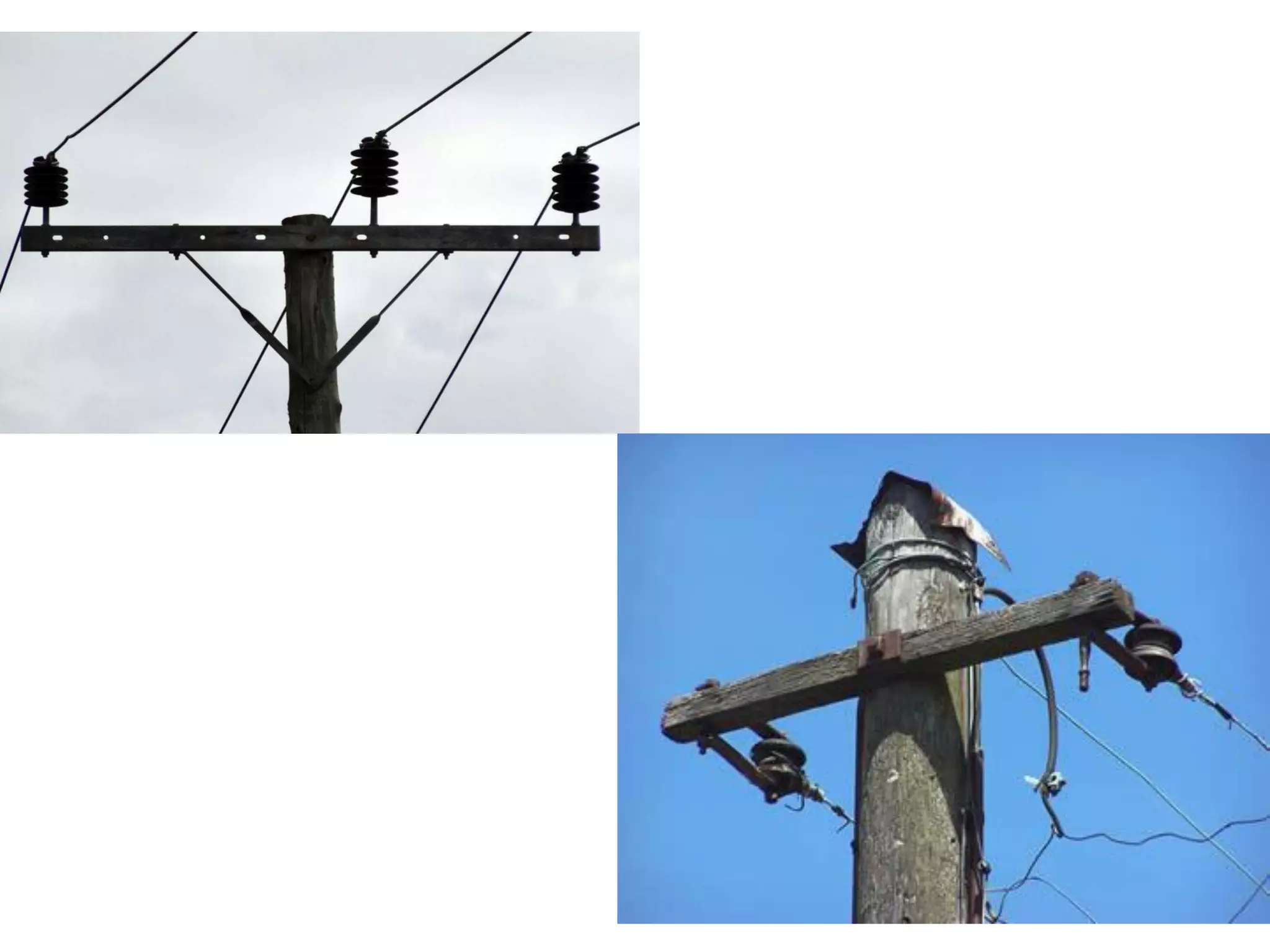
5. Cross arms;- to erect the insulators, gang operating
switch, fuses and distribution box etc. , the MS
cross arms are required.
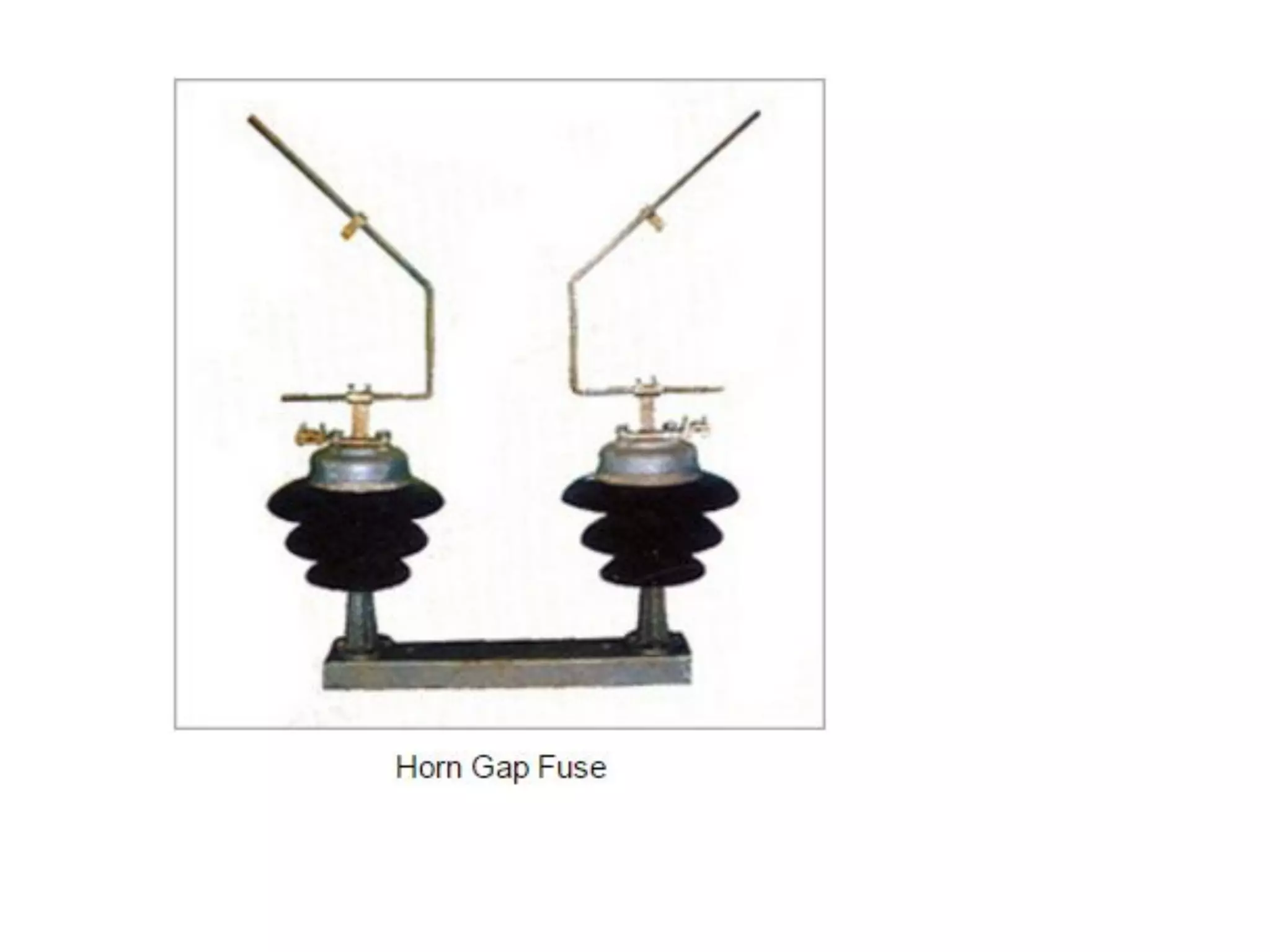
6. Fuses;- horn gap or drop out fuses are usually provided
on 11kv side.
7. Gang operating switch (GO switch);- used for ON and
OFF of 11kv line
8. Distribution box;- the consumer are supplied through
distribution box
9. Anti climbing device;- a barbed wire wound round the
pole to prevent the climbing of un authorised persons
0. Earthing;- as per IE rule the pole mounted substation
should be earthed at two or more places.
1. Danger plate;- are for cautions to the public.
2. Lighting arrester;- LA are provided on 11kv line to
protect the transformer and associated equipments
from lighting
switchgear
• In an electric power system, switchgear is the
combination of electrical disconnect
switches, fuses or circuit breakers used to control,
protect and isolate electrical equipment
TRANSFORMER
• The Transformer is basically a very simple device. It
mainly consists of a core, windings and insulations.
The windings are wound over the laminated
magnetic core
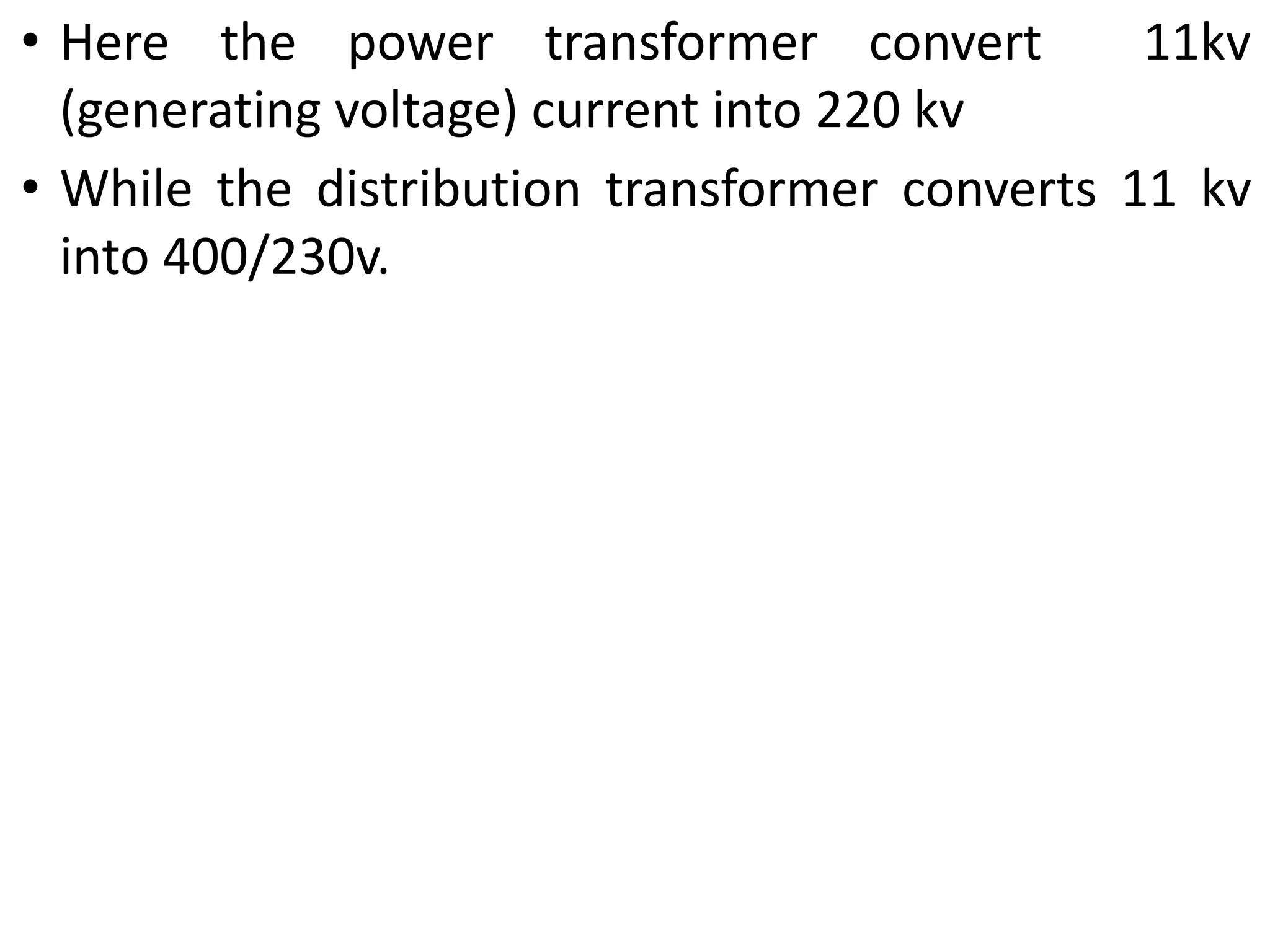
• Here the power transformer convert 11kv
(generating voltage) current into 220 kv
• While the distribution transformer converts 11 kv
into 400/230v.
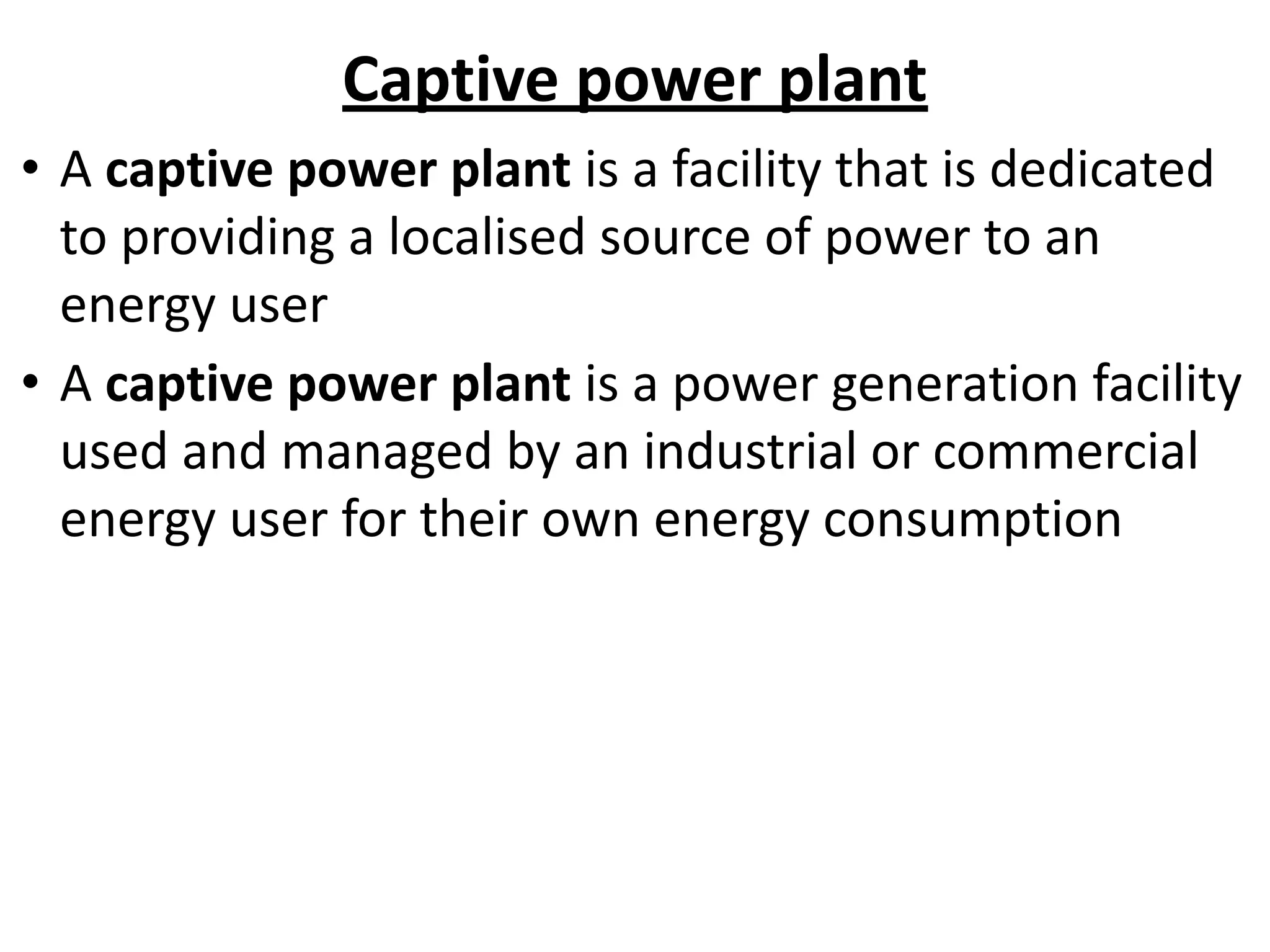
Captive power plant
• A captive power plant is a facility that is dedicated
to providing a localised source of power to an
energy user
• A captive power plant is a power generation facility
used and managed by an industrial or commercial
energy user for their own energy consumption
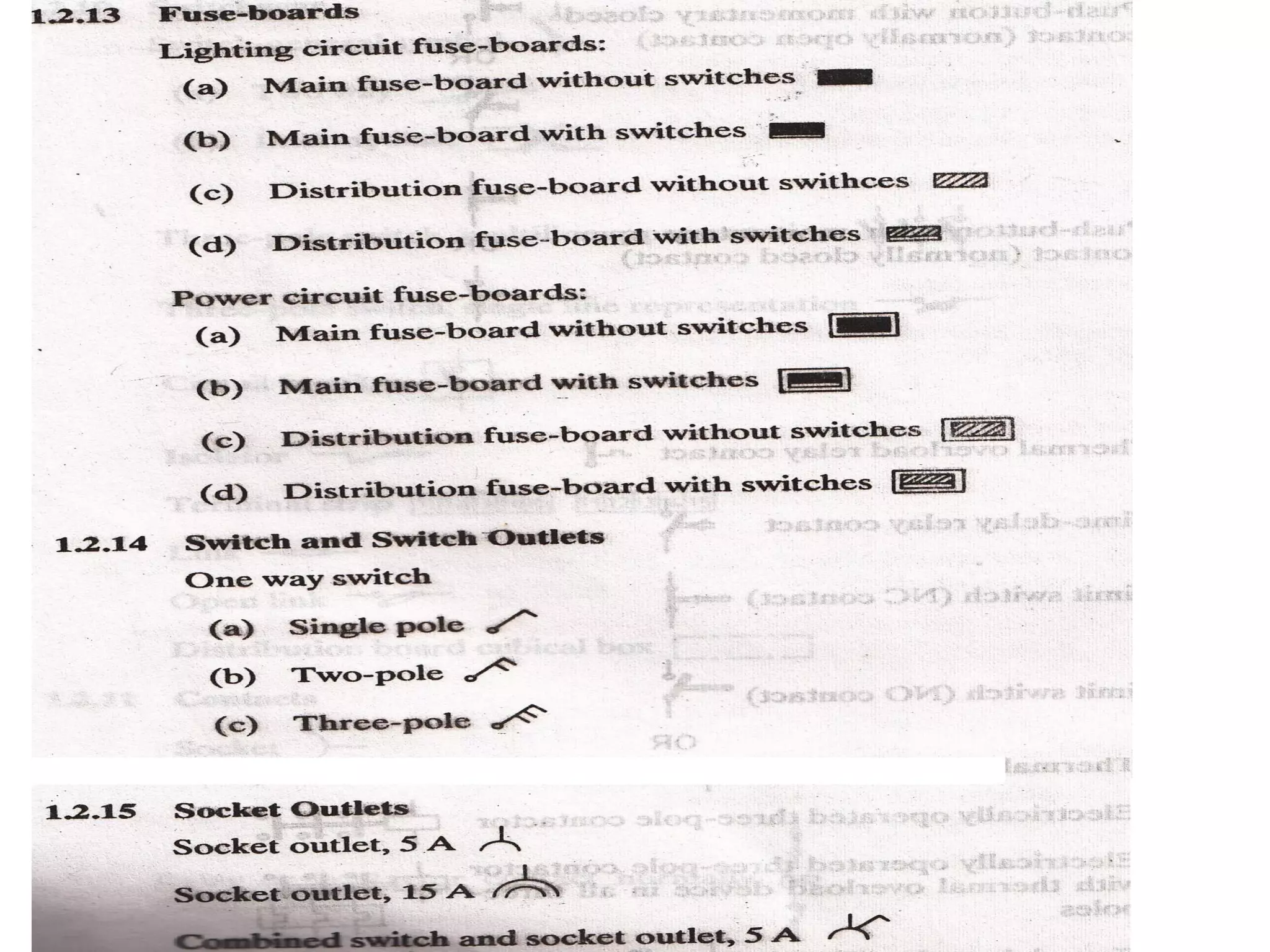
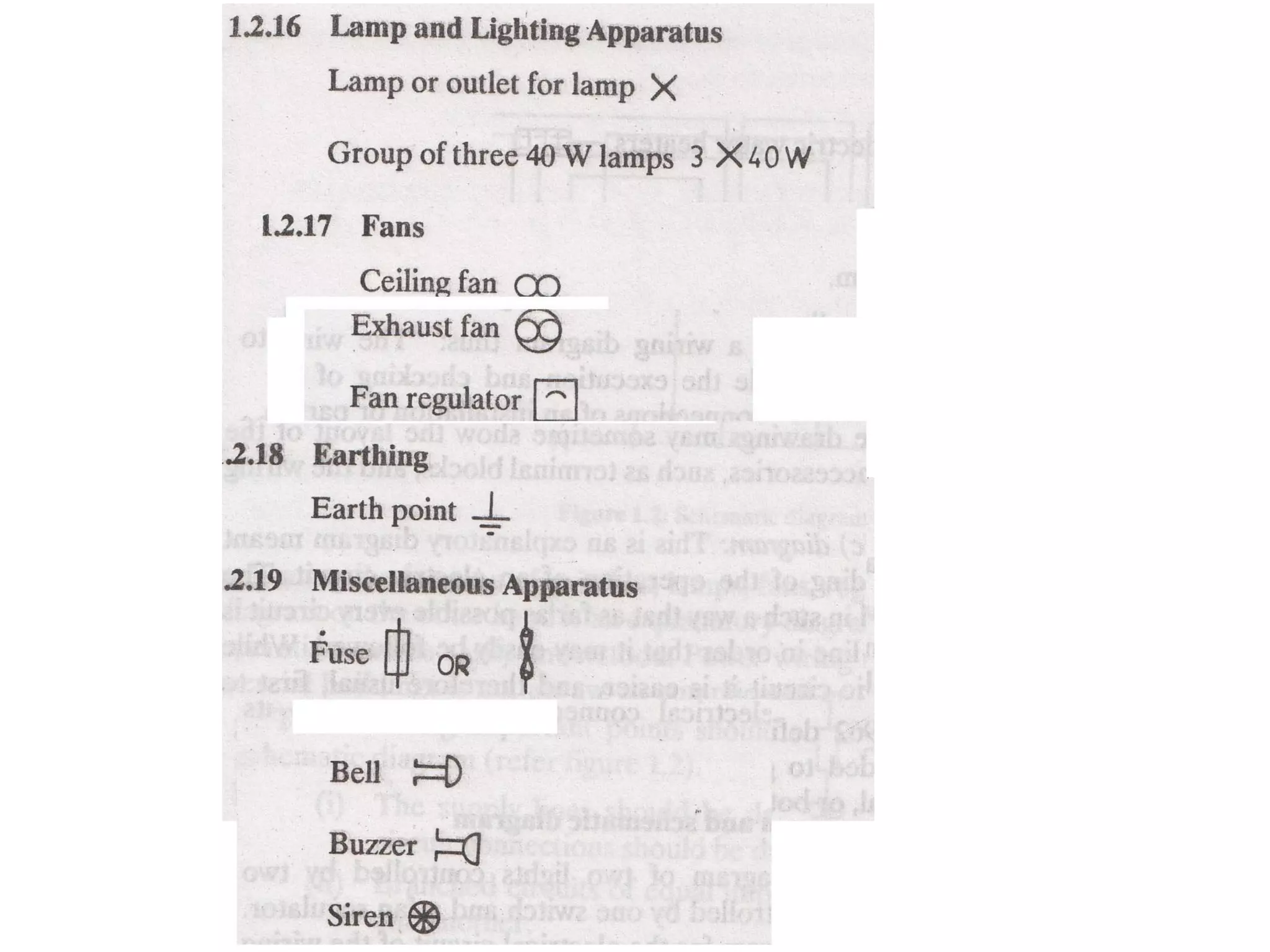
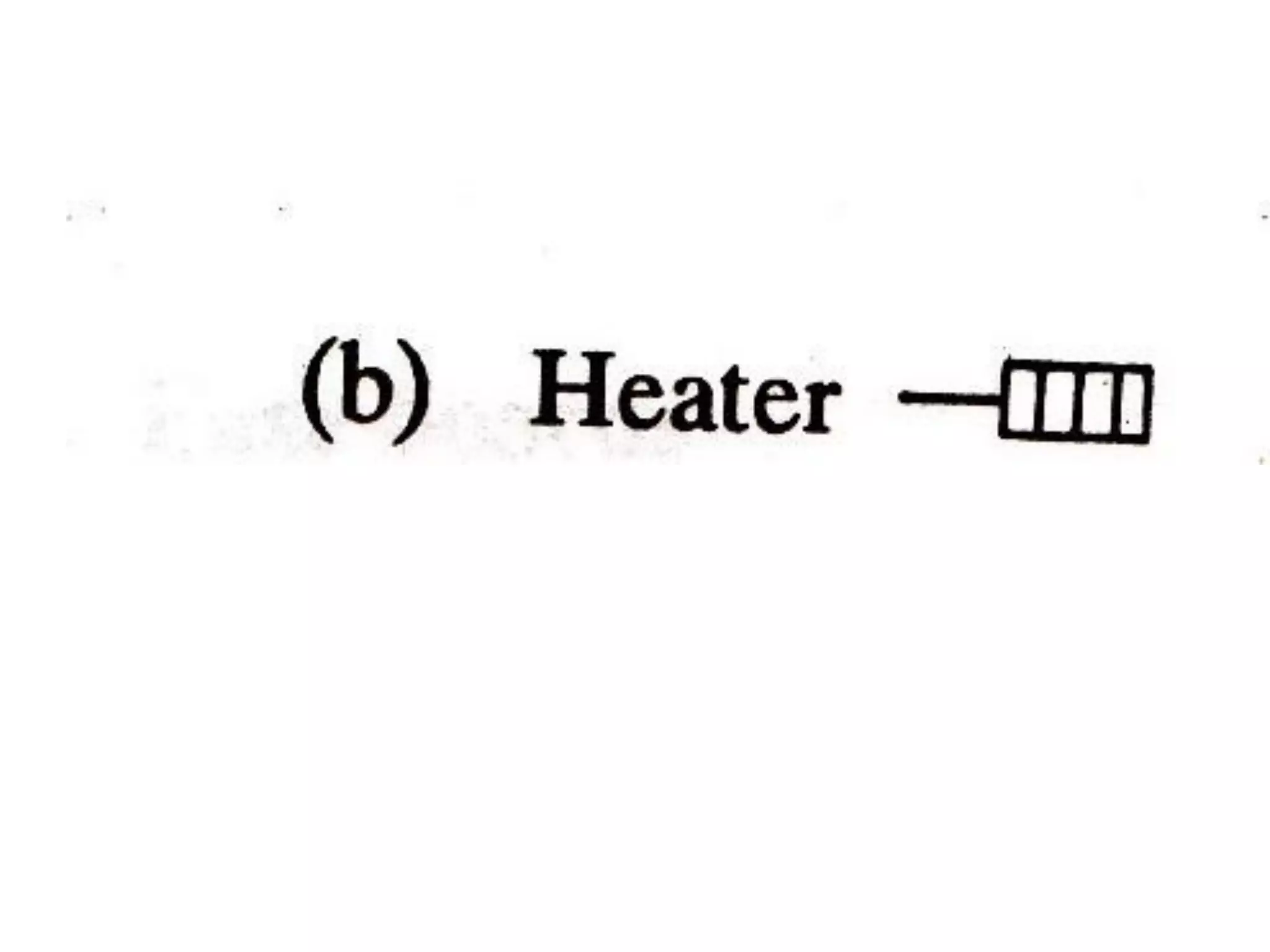
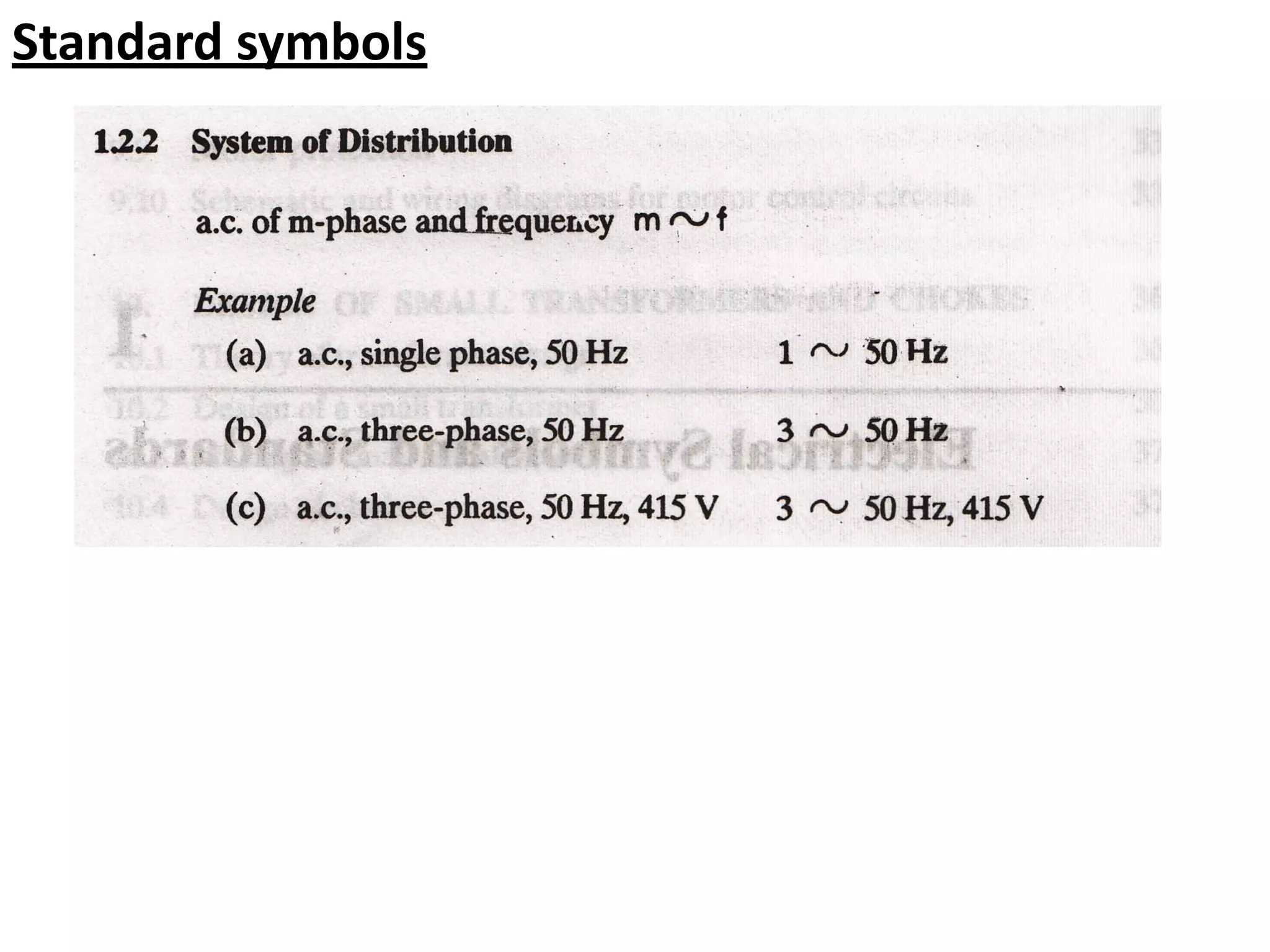
Standard symbols
Electrical system in multistoried commercial and
industrial buildings
Electric service and supply
• For supplying power from the distribution line to
consumer cables or over head lines can be used
.such a cable or overhead line is called a service
line
• Electricity supply authority supplies power to
small consumers through low voltage
(415V/240V) three phase four wire distributors.
• Large consumers are supplied at higher voltage
(11kv or 33 kv etc.) through three wire high
voltage feeders, and such in cases the consumer
has his own step down transformer to obtain the
required voltage.
Various installation
1. Small residential installation
• For a house Or a such installation a single phase
supply can be taken, main switch and fuse board is
connected and then final circuits are connected to
it
2. Medium installation
For a medium installation ,i.e. a building in which
there are different power and lighting requirement
,a three phase supply would be given. So we use 3
phase 4 wire system.
3. Large installation
• In the case of a large building, for example a factory
in which there may be several hundred kilowatt of
motor loads or multistoried buildings in which
there are several thousands of light point, and a
number of other items like a room coolers
air conditioners etc.
• So that the Load may be too high to be taken from
the supply authority's low tension service
• In such cases a substation will be required on the
premises of consumer for transforming the supply
from the given high voltage (11KV or 33KV) to the
required voltage.
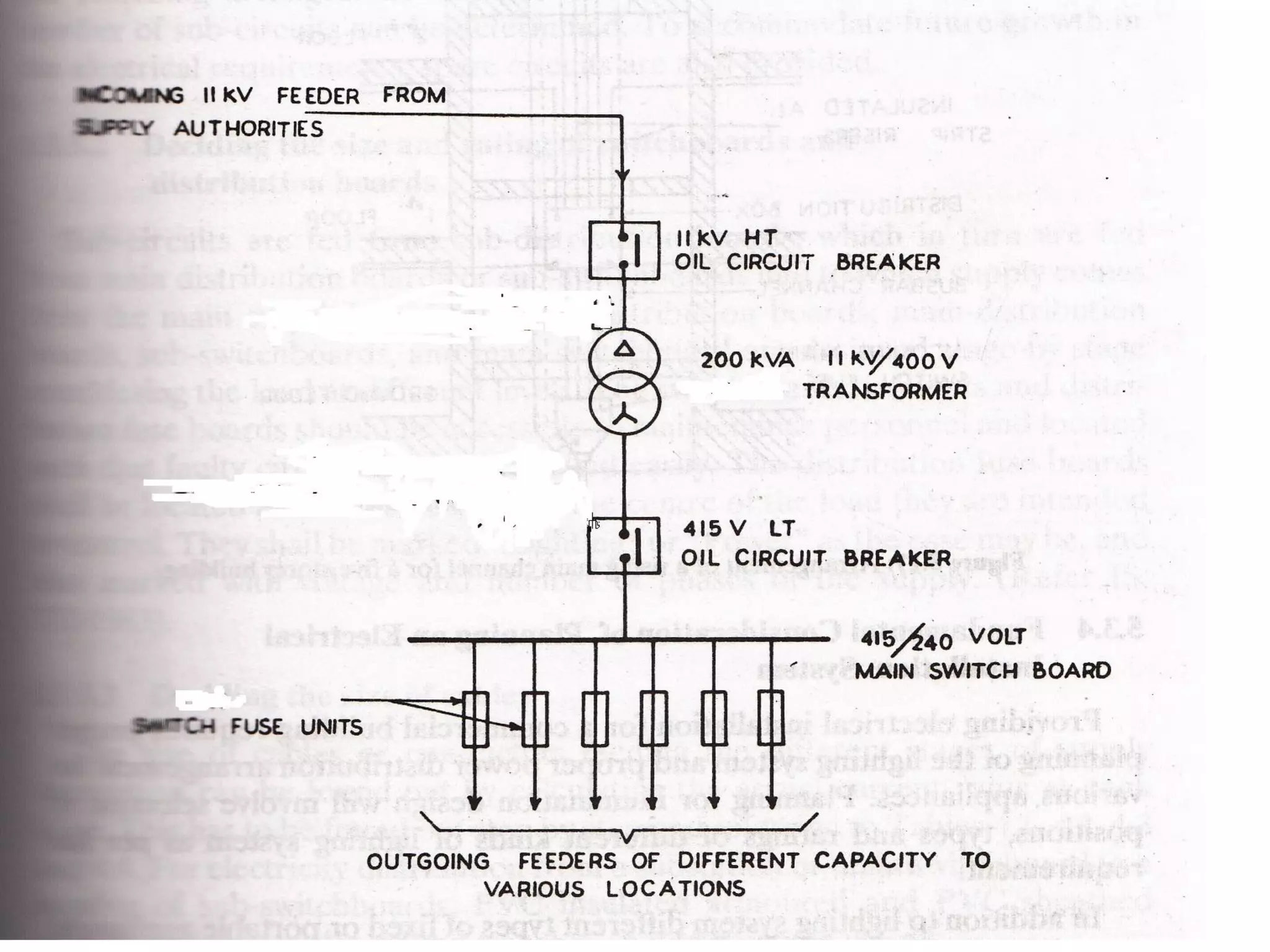
• At the substation the incoming high-voltage is
stepped down
• In this substation supply at high voltage is received
and connected through circuit breakers to the
transformer and from where to a low voltage main
switch board.
• From this switch board supply is distributed to the
various parts of the building.
• The position of substation can be as near to the
load as possible
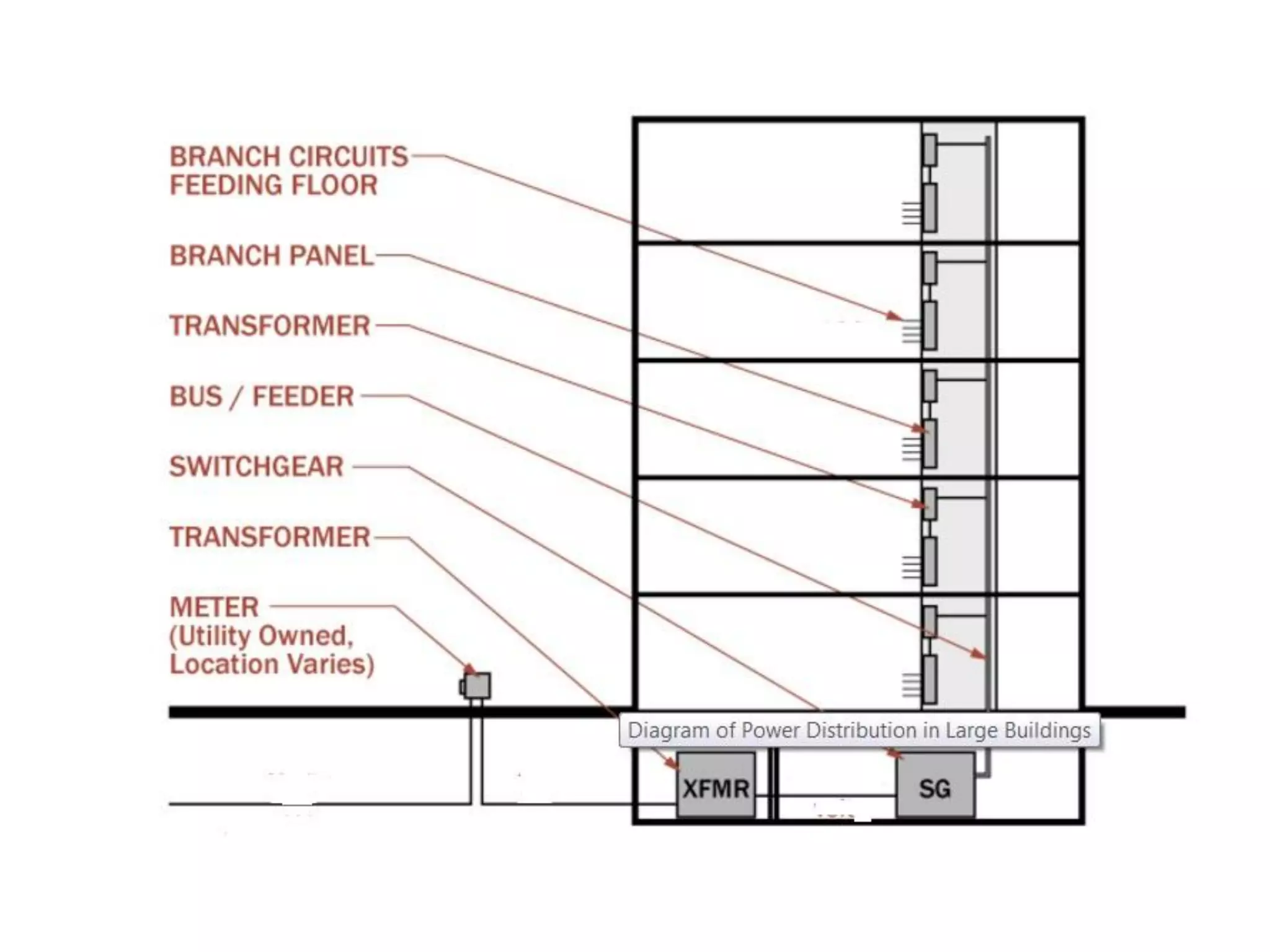
• Such an arrangement for low voltage distribution is
shown in figure.
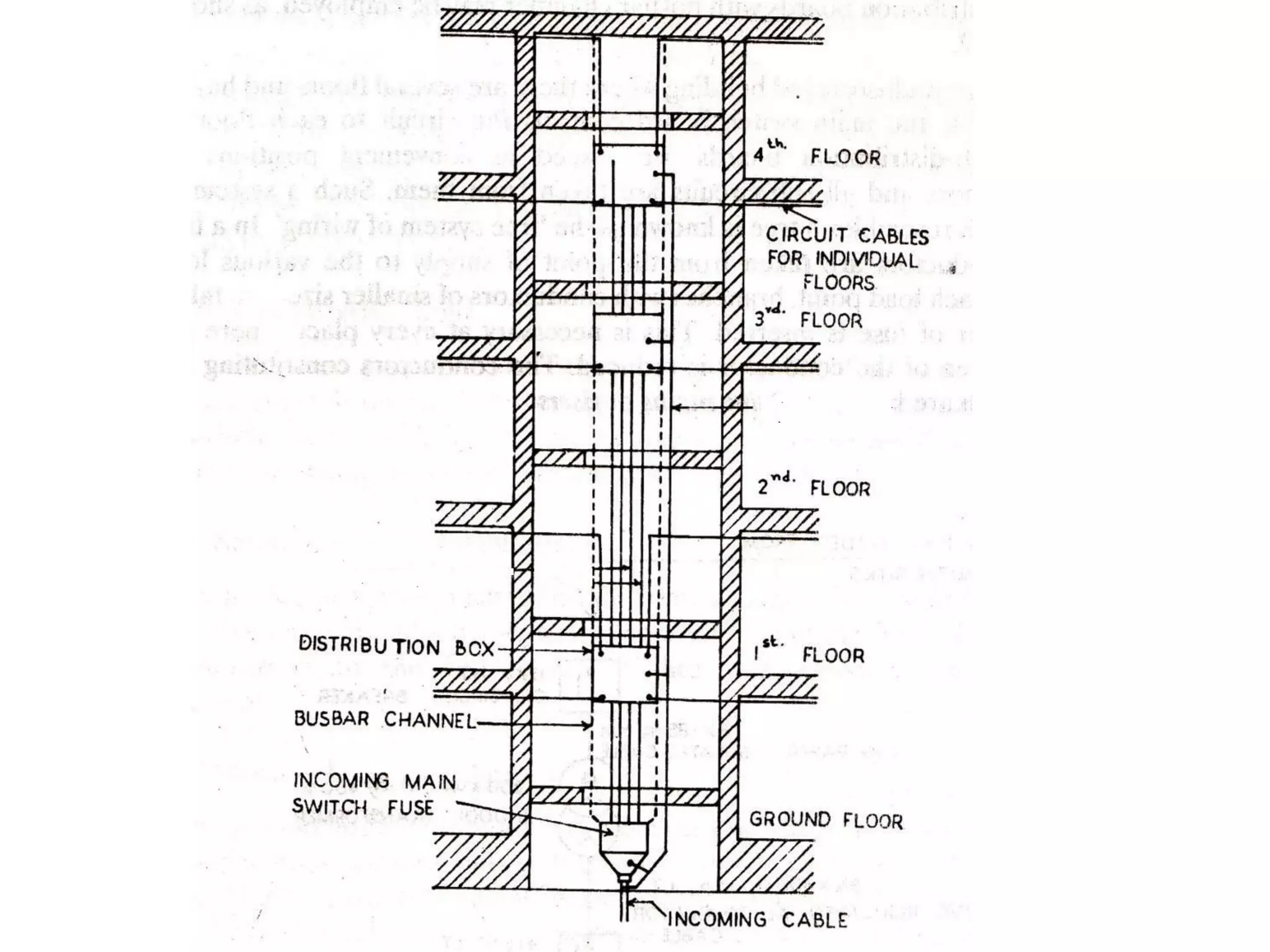
• For a large multistoried building where there are
several floors and having Many circuits, The main
switchboard controls the circuit to each floor or
section
• Sub distribution boards are placed in convenient
positions on different floors and all sub circuits are
taken from them
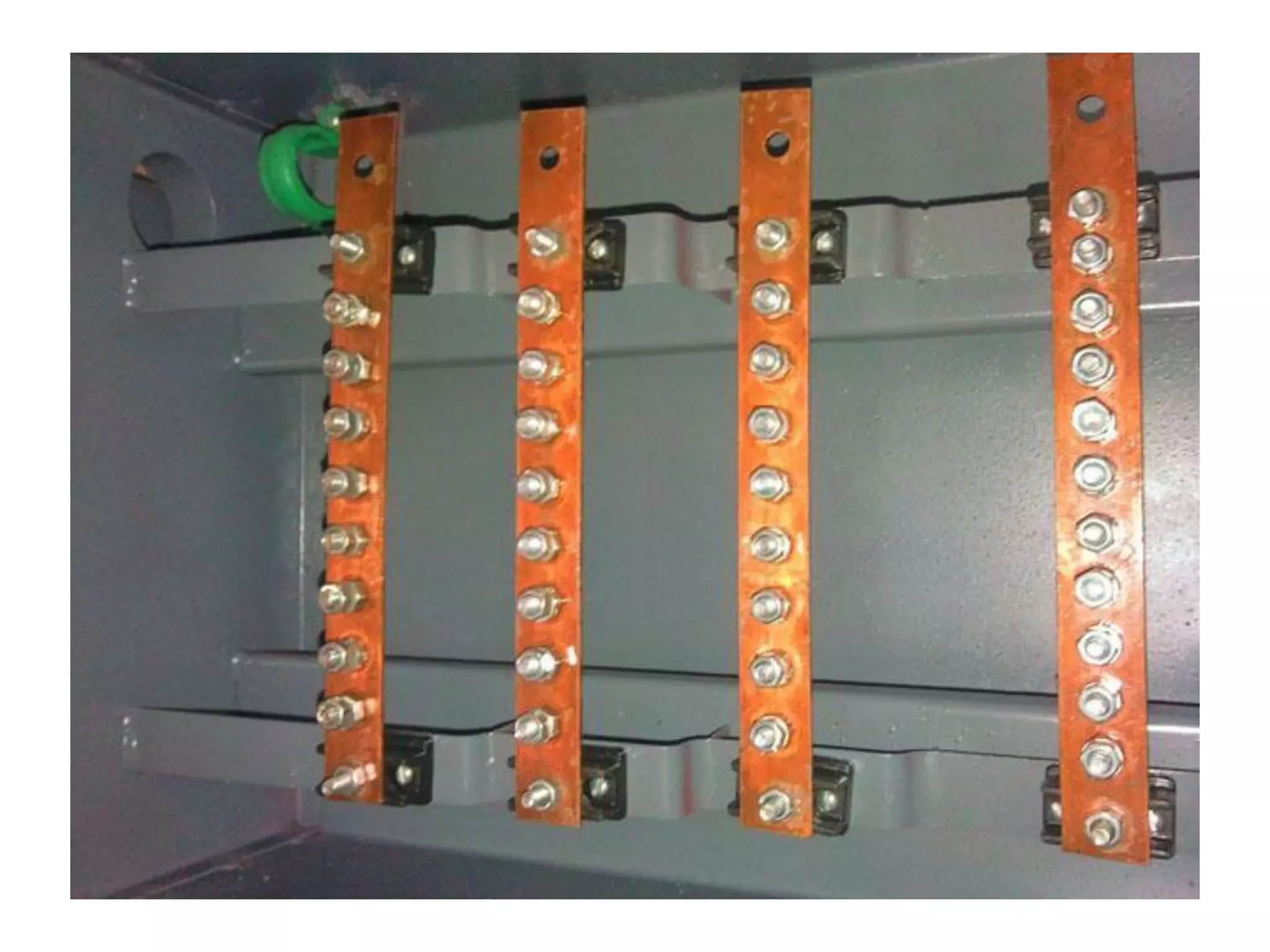
• in other case we use a vertical bus bar through out
the building in a totally enclosed channel. As shown
in figure
DESIGN CONSIDERATION OF ELECTRICAL
INSTALLATION IN COMMERCIAL BUILDINGS
1.Deciding the number of sub circuits
• Total load in commercial building is calculated by
taking into consideration the general lighting
load, the motor load and other power load
• Then the total load is calculated after that the
number of sub circuit and its size is determined
• The load on the each light-fan sub circuit shall be
restricted to 800 watts or 10 outlets
• The load in each power circuit is restricted into
3000 watts or 2 outlets
• By using these criteria, the number of sub circuit
is determined.
2.Deciding the size and rating of switch boards
and distribution boards
• The sub-distribution boards, main distribution
board and switch board are designed stage by
stage considering the load at different level
• the switch board and distribution fuse board
should be accessible to maintenance personnel
and faulty circuit is easily located .
• 3.Deciding the size of cable
• The size of cable or conductor feeding the
different stages of supply connection can be
found out by calculating the actual current
value at each stage.
• Choose the suitable cable or conductor according
to the current value passed through it ,By using
the standard size chart of different conducting
material .
4.Deciding the size of conduit
• The size of conduit is determined from the size of
the cables and the number of cable to be drawn
through it
• The conduit size is stated in terms of its outer
diameter
• By using standard chart we can determine the
correct size of conduit required
• Step by Step Procedure of Multistory building
Distribution System
1. Firstly connect the three-phase energy meter as
shown in fig
2. Connect the MCCB (Moulded Case circuit Breaker) as
three pole main switch to the incoming three phases
(R, Y, B) from 3-phase energy meter
3. Now connect the outgoing phases (R, Y, B) from
MCCB (Moulded Case circuit Breaker) to the DP
(Double Pole MCB) , RCD (Residual-current device)
SP (Single Pole MCBs and load) of each storey, as
shown in fig)
4. Also connect the Neutral wires to RCDs and then to
neutral links and then to specific loads (as shown in
fig)
5.Then connect all loads with Earth link and earth
link must be connected to the earth electrode
6. Use the main breaker with proper rating i.e.
which carry the total load current of all
distribution boards of each storey but install the
breaker in Sub distribution board according to
that desired storey i.e. fans, lights etc in one
storey and so on for other storey.
EXECUTION
• The execution of entire electrical Installation should be carried
out under the guidance and supervision of competent electrical
engineer/through licensed electrical contractor;
• The electrical contractor should decide his sequence of work in
consultation with the architect in such a manner that it will not
affect/conflict with working of other agencies
• At the end of work the electrical contractor should check and test
the entire electrical installation work and get it approved from the
electrical supply company.
• The electrical contractor should submit his test report and
completion certificate in required forms for consumer meter and
permanent electric supply connections to the buildings.
Safety consideration in design and installation
• Disconnect the power source before servicing,
repairing or installing electrical equipments and
installation.
• Also use the proper cable in size with this proper
calculation method
• Never try to work on electricity without proper
guidance and care
• Work with electricity only in presence of those
persons who has good knowledge and practical work
to deal with electricity
• Read all instruction and cautions and follow them
strictly.
• Wrong use of information or try any circuit in wrong
format will cause great damages,! Be careful because
it’s all about electricity and electricity is too
dangerous

illumination.pptx.pdf

  • 1.
  • 2.
    Electrification in building •Imagine yourself in the most fabulous building in the world. Now take away the lighting, heating and ventilation, the lifts and escalators,, plumbing, power supply and energy management systems, the security and safety systems...and you are left with a cold, dark, uninhabitable shell. „ • Everything inside a building which makes it safe and comfortable to be in comes under the title of 'Building Services'. A building must do what it was designed to do - not just provide shelter but also be an environment where people can live, work and achieve
  • 3.
    Classification of materials Conductors Conductorsare the materials which have very high Conductivity • Examples: Silver, Copper, Gold, Aluminum etc. Insulating Materials The conductivity of insulating materials is very low. Example:- Plastics, Ceramics, PVC etc. Semiconductors Semiconductors are have the conductivity between conductors and insulators Example: Germanium, Silicon, Gallium Arsenic etc
  • 4.
    Commonly used terminology •Current: Its flow of electrons through a conductor . Represented by letter by I and its unit Ampere (A). There are two types of currents 1)A.C (Alternating current) 2)D.C ( Direct current) • Voltage: it’s the potential difference between the 2 ends of the conductor. Represented by letter by V and its unit Volt(V). • Resistance: it’s the opposition to the flow of current. Represented by letter by R and its unit ohm(Ώ).
  • 5.
    ELECTRIC POWER • Itis the work done by an electric circuit in unit time is called electric power. • Electric power ,P = Equations of electrical power • P= VI • P=I²R • P= • Unit of Power= Watt(w).
  • 6.
    Electrical Energy • Itsdefined as power in unit time • Kilo Watt-Hour (KWh) is used as the commercial unit of electrical energy • The amount of energy consumed by a device of power of 1 KW in an hour is called the one kilo Watt-hour(1kwh).
  • 7.
    DISTRIBUTION OF ELECTRICITYTO BUILDINGS • There are various systems by which power is distributed to the domestic consumers viz. (i) Single phase - Two wire system(230 V) (ii) Three phase - Three wire system(415V) (iii) Three phase - four wire system(230V & 415V)
  • 8.
  • 9.
    Following are theimportant components of a circuit of an installation. 1. Incoming cable or service main 2. Cut-out 3. Energy meters 4. Main switch 5. ELCB 6. MCB
  • 10.
    • This incomingcable from the feeder pole is connected to the energy meters through supply authority’s cut-out • The energy meter and cut-outs are the property of the suppliers and are properly sealed by the supplies at the time of installation • .After the energy meter, the consumer’s distribution starts and the supply cables are entirely under the control of consumer. • After the energy meter, the consumer must provide a main switch which would control the complete lighting and power circuit of the building.
  • 11.
    • Main switchesare normally available in the following types. (a) Double pole iron clad main switch (b) Triple pole iron clad main switch (c) Triple pole iron clad main switch with neutral link (TPNIC) • DPIC is used for controlling single phase 2-wire circuits. This is normally used in domestic wiring • TPIC switch is used for controlling 3-phase power in 3-wire system. This is normally used for industrial installations • TPNIC switch is used for controlling a 3-phase power with 4-wire systems
  • 13.
    Earth Leakage CircuitBreaker (ELCB) • Conductor carrying current should be well insulated, Weakness and leakage of insulation may result in electric shock and other accidents • When the phase is thus connected to the metal body of the appliance, current flows from this body to the earth through the earth wire, This is called earth leakage • Earth leakage circuit breaker opens the circuit and cut off the power supply, even when there is very little earth leakage
  • 15.
    distribution board • Adistribution board (also known as panel board or electric panel) is a component of an electricity supply system that divides an electrical power feed into subsidiary circuits, while providing a protective fuse or circuit breaker for each circuit in a common enclosure.
  • 16.
    Miniature Circuit Breaker(MCB) • Miniature circuit breaker (MCB is connected) is the circuit to prevent the accidents due to short circuit or over current • Now day miniature circuit breakers are used for domestic and commercial wiring instead of fuses • MCB can be put ‘On’ or ‘Off’ by moving the handle ‘up’ and ‘down’. MCB with different current carrying capacity is available
  • 18.
    FAMILIRIZATION OF SUBSTATION • A substation may be define as an assembly of various electrical apparatus installed to perform any one or two or all of the following operation 1. To transform high to low voltage or vice-versa (voltage transformation). 2. To switch on and off the power lines (switching) 3. To convert AC to DC or vice-versa (power conversion) 4. To convert frequency from one value to other (frequency converter/changer)
  • 19.
    OPERATION • The generationof electricity in power/generating station is taking place at faraway places from consumer • For this reasons, the generated voltage .i.e. at 11kv 220kv or 400kv and transmitted to load centre in India • At load centre the high voltage is stepped down to 11kv or 440/230v and distributed to consumers. • These voltage transformations are carried out at sub-stations.
  • 20.
    Classification of substation i.On basis of nature of duties;- classified into three. 1. Step-up or primary substation;- such substation are usually associated with generating station for stepping up of generated voltage and transmitted to load centre economically. 2. Primary Grid Substation;- This substation lowered the value of primary stepped up voltages. The output of the primary grid substation acts as the input of the secondary substations. The secondary substation is used for stepping down the input voltage to more lowered for further transmission. 3. Step down or distribution substation;- such substation are located at load centre where primary distribution voltage is stepped down to secondary distribution voltage like 415/240v.
  • 22.
    2.Based on servicerequired • Transformer substation;- transformer installed on such substation to transform power from one voltage to another level. • Switching substation;- switching operation carried out in power line without transforming the voltage. • Converting substation;- for converting ac to dc or vice- versa or converting frequency high to low or vice-versa.
  • 23.
    3.On basis ofoperating voltage • High voltage substation (HV SUB.);- involving and operating voltage between 11kv and 132kv. • Extra high voltage substation (EHV);- 132KV-400KV. • Ultra high voltage substation (UHV substation);- above 400KV.
  • 24.
    4. On basisof design a) Indoor type substation;- • In such substation the apparatus is installed within the substation building. • Usually for 11kv and can be increased up to 33kv or 66kv. • It also preventing contaminating with impurities b) Outdoor substation: • they are two type, 1.Pole mounted substation;- • Such substation is installed for distribution of power in localities. • These may be 2-pole or H-pole and 4-pole structure with suitable platforms. • Transformers of capacity up to 25 KVA, 125KVA and above 125KVA (but up to 250KVA). 2.Foundation mounted or plinth mounted substation;- • For transformers of capacity above 250 KVA, the transformers are too heavy for pole mounting • Such substation is usually for voltage of 33kv and above.
  • 26.
    COMPONENTS OF SUBSTATION 1.Poles-steel or PSCC poles :are required to carry the transformer 2. Transformer;- 11/0.4kv 3-phase step down (distribution) transformer. 3. Transformer platform;- MS channels are used for platform preparation. 4. Insulator;- pin type or disc type insulator are used. 5. Cross arms;- to erect the insulators, gang operating switch, fuses and distribution box etc. , the MS cross arms are required.
  • 27.
    6. Fuses;- horngap or drop out fuses are usually provided on 11kv side. 7. Gang operating switch (GO switch);- used for ON and OFF of 11kv line 8. Distribution box;- the consumer are supplied through distribution box 9. Anti climbing device;- a barbed wire wound round the pole to prevent the climbing of un authorised persons 0. Earthing;- as per IE rule the pole mounted substation should be earthed at two or more places. 1. Danger plate;- are for cautions to the public. 2. Lighting arrester;- LA are provided on 11kv line to protect the transformer and associated equipments from lighting
  • 34.
    switchgear • In anelectric power system, switchgear is the combination of electrical disconnect switches, fuses or circuit breakers used to control, protect and isolate electrical equipment
  • 35.
    TRANSFORMER • The Transformeris basically a very simple device. It mainly consists of a core, windings and insulations. The windings are wound over the laminated magnetic core
  • 37.
    • Here thepower transformer convert 11kv (generating voltage) current into 220 kv • While the distribution transformer converts 11 kv into 400/230v.
  • 38.
    Captive power plant •A captive power plant is a facility that is dedicated to providing a localised source of power to an energy user • A captive power plant is a power generation facility used and managed by an industrial or commercial energy user for their own energy consumption
  • 39.
  • 43.
    Electrical system inmultistoried commercial and industrial buildings Electric service and supply • For supplying power from the distribution line to consumer cables or over head lines can be used .such a cable or overhead line is called a service line • Electricity supply authority supplies power to small consumers through low voltage (415V/240V) three phase four wire distributors. • Large consumers are supplied at higher voltage (11kv or 33 kv etc.) through three wire high voltage feeders, and such in cases the consumer has his own step down transformer to obtain the required voltage.
  • 44.
    Various installation 1. Smallresidential installation • For a house Or a such installation a single phase supply can be taken, main switch and fuse board is connected and then final circuits are connected to it 2. Medium installation For a medium installation ,i.e. a building in which there are different power and lighting requirement ,a three phase supply would be given. So we use 3 phase 4 wire system.
  • 45.
    3. Large installation •In the case of a large building, for example a factory in which there may be several hundred kilowatt of motor loads or multistoried buildings in which there are several thousands of light point, and a number of other items like a room coolers air conditioners etc. • So that the Load may be too high to be taken from the supply authority's low tension service • In such cases a substation will be required on the premises of consumer for transforming the supply from the given high voltage (11KV or 33KV) to the required voltage.
  • 46.
    • At thesubstation the incoming high-voltage is stepped down • In this substation supply at high voltage is received and connected through circuit breakers to the transformer and from where to a low voltage main switch board. • From this switch board supply is distributed to the various parts of the building. • The position of substation can be as near to the load as possible • Such an arrangement for low voltage distribution is shown in figure.
  • 48.
    • For alarge multistoried building where there are several floors and having Many circuits, The main switchboard controls the circuit to each floor or section • Sub distribution boards are placed in convenient positions on different floors and all sub circuits are taken from them • in other case we use a vertical bus bar through out the building in a totally enclosed channel. As shown in figure
  • 52.
    DESIGN CONSIDERATION OFELECTRICAL INSTALLATION IN COMMERCIAL BUILDINGS 1.Deciding the number of sub circuits • Total load in commercial building is calculated by taking into consideration the general lighting load, the motor load and other power load • Then the total load is calculated after that the number of sub circuit and its size is determined • The load on the each light-fan sub circuit shall be restricted to 800 watts or 10 outlets • The load in each power circuit is restricted into 3000 watts or 2 outlets • By using these criteria, the number of sub circuit is determined.
  • 53.
    2.Deciding the sizeand rating of switch boards and distribution boards • The sub-distribution boards, main distribution board and switch board are designed stage by stage considering the load at different level • the switch board and distribution fuse board should be accessible to maintenance personnel and faulty circuit is easily located .
  • 54.
    • 3.Deciding thesize of cable • The size of cable or conductor feeding the different stages of supply connection can be found out by calculating the actual current value at each stage. • Choose the suitable cable or conductor according to the current value passed through it ,By using the standard size chart of different conducting material .
  • 55.
    4.Deciding the sizeof conduit • The size of conduit is determined from the size of the cables and the number of cable to be drawn through it • The conduit size is stated in terms of its outer diameter • By using standard chart we can determine the correct size of conduit required
  • 56.
    • Step byStep Procedure of Multistory building Distribution System 1. Firstly connect the three-phase energy meter as shown in fig 2. Connect the MCCB (Moulded Case circuit Breaker) as three pole main switch to the incoming three phases (R, Y, B) from 3-phase energy meter 3. Now connect the outgoing phases (R, Y, B) from MCCB (Moulded Case circuit Breaker) to the DP (Double Pole MCB) , RCD (Residual-current device) SP (Single Pole MCBs and load) of each storey, as shown in fig) 4. Also connect the Neutral wires to RCDs and then to neutral links and then to specific loads (as shown in fig)
  • 57.
    5.Then connect allloads with Earth link and earth link must be connected to the earth electrode 6. Use the main breaker with proper rating i.e. which carry the total load current of all distribution boards of each storey but install the breaker in Sub distribution board according to that desired storey i.e. fans, lights etc in one storey and so on for other storey.
  • 59.
    EXECUTION • The executionof entire electrical Installation should be carried out under the guidance and supervision of competent electrical engineer/through licensed electrical contractor; • The electrical contractor should decide his sequence of work in consultation with the architect in such a manner that it will not affect/conflict with working of other agencies • At the end of work the electrical contractor should check and test the entire electrical installation work and get it approved from the electrical supply company. • The electrical contractor should submit his test report and completion certificate in required forms for consumer meter and permanent electric supply connections to the buildings.
  • 60.
    Safety consideration indesign and installation • Disconnect the power source before servicing, repairing or installing electrical equipments and installation. • Also use the proper cable in size with this proper calculation method • Never try to work on electricity without proper guidance and care • Work with electricity only in presence of those persons who has good knowledge and practical work to deal with electricity • Read all instruction and cautions and follow them strictly. • Wrong use of information or try any circuit in wrong format will cause great damages,! Be careful because it’s all about electricity and electricity is too dangerous