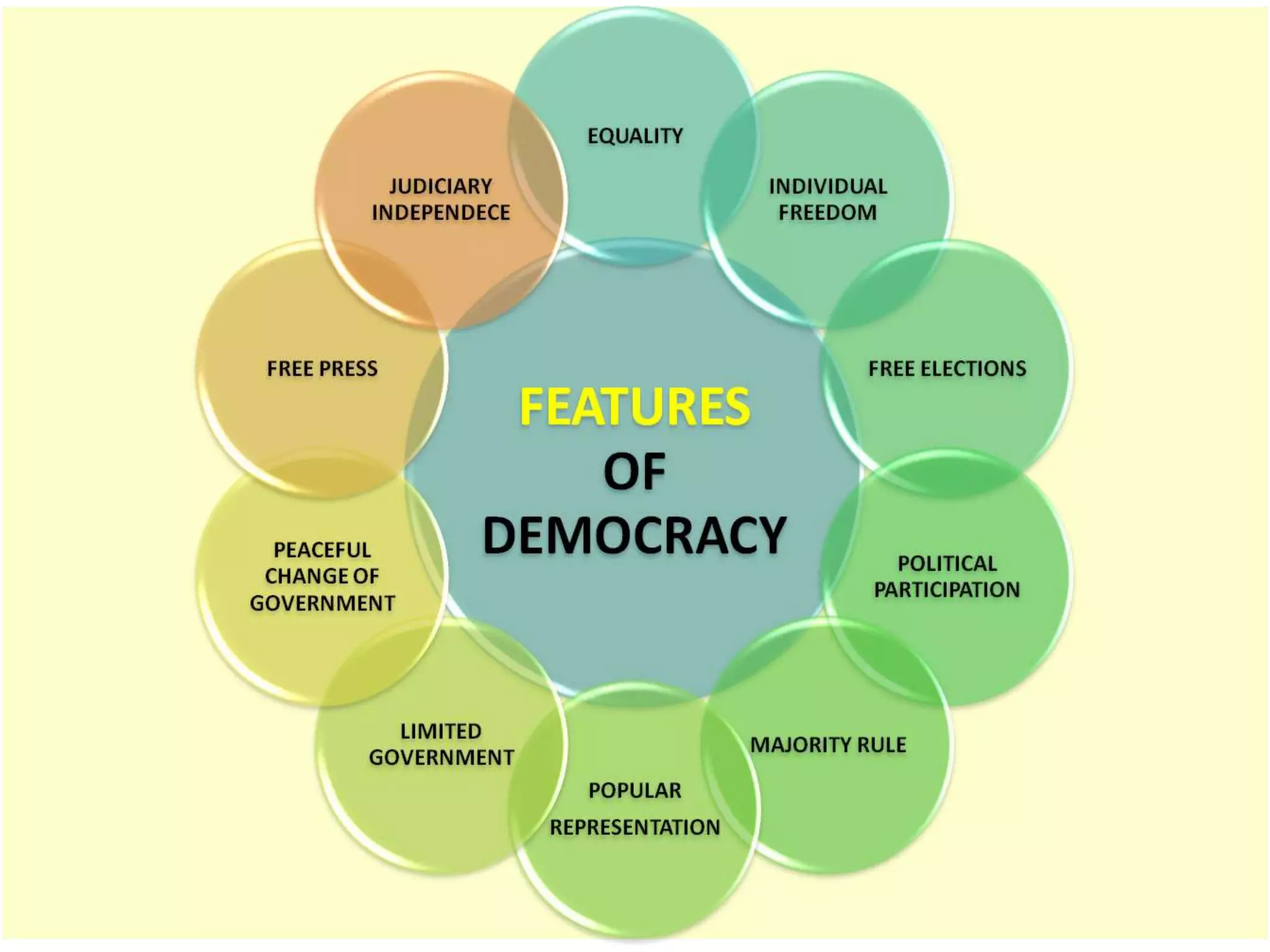
DEMOCRACY
RESHMA .A
SOCIAL SCIENCE
INTRODUCTION
• The term originates from
the Greek δημοκρατία (dēmokratía) "rule of the people“.
• which was found from (demos) "people" and (krátos)
"power" or "rule“.
• Democracy contrasts with forms of government where
power is either held by an individual, as in an absolute
monarchy, or where power is held by a small number of
individuals, as in an oligarchy.
• The original design of democracy did not really take
account of the scale of population growth that has taken
place in the last century.
PRINCIPLE
• The fundamental principle of democracy is that the governing
power is exercised based on the judgment of all adult citizens,
in choosing who is going to be responsible for making
decisions on their behalf.
• This is done through a free and fair election process with each
adult citizen casting only one vote for their chosen candidate.
• A democracy is represented in many different forms
throughout the world, depending on the amount of each
individual’s participation in that countries form of it.
• A democracy in its roots is the theory that the majority
decides how a group of people should deal with a particular
issue.
CONCEPT
• The Democracy Barometer is a new index of democracy.
• It aims to overcome the conceptual and methodological
shortcomings of existing measures, in order to measure
the subtle differences in the quality of established
democracies.
• The Democracy Barometer is therefore based on a middle
range concept of democracy, embracing liberal as well as
participatory ideas of democracy, which illuminate the
phenomenon from different perspectives).
• It consists of a stepwise theoretical deduction of
fundamental elements of democracy
• The starting point is the premise that a democratic system
tries to establish a good balance between the normative,
interdependent values of freedom and equality and that
this requires control.
ADVANTAGES OF
DEMOCRACY
• It protects the interest of citizens.
• It prevents monopoly of authority.. It makes for a
responsible and stable administration
• It brings a feeling of obligation towards the citizens.
• It imparts political education to the people
• It helps make good citizens.
• It allows a little chance of revolution.
• It allows a little chance of revolution
• It promotes change.
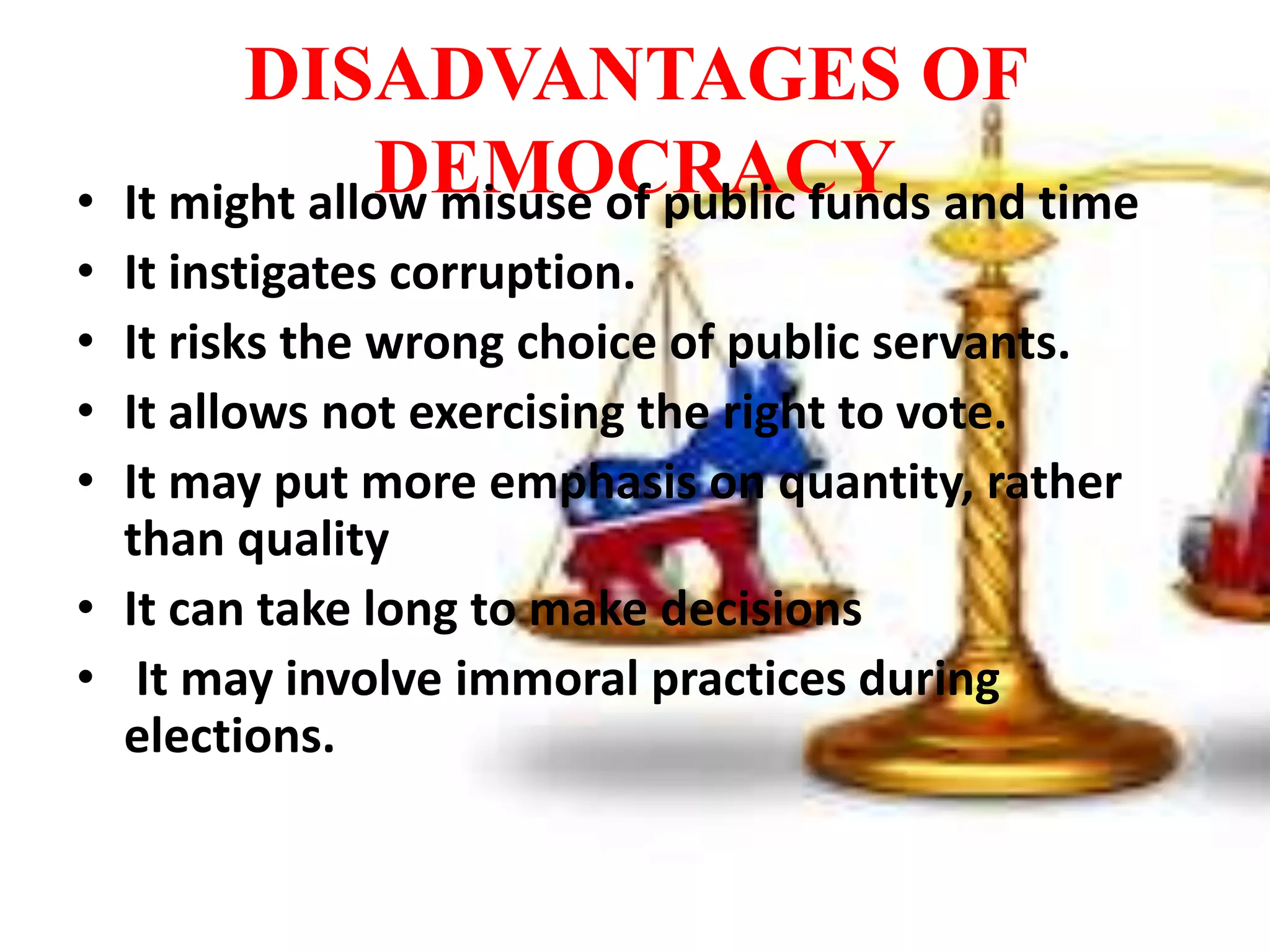
DISADVANTAGES OF
DEMOCRACY• It might allow misuse of public funds and time
• It instigates corruption.
• It risks the wrong choice of public servants.
• It allows not exercising the right to vote.
• It may put more emphasis on quantity, rather
than quality
• It can take long to make decisions
• It may involve immoral practices during
elections.
Reshma democracy
Reshma democracy
Reshma democracy
Reshma democracy

Reshma democracy

  • 2.
  • 3.
    INTRODUCTION • The termoriginates from the Greek δημοκρατία (dēmokratía) "rule of the people“. • which was found from (demos) "people" and (krátos) "power" or "rule“. • Democracy contrasts with forms of government where power is either held by an individual, as in an absolute monarchy, or where power is held by a small number of individuals, as in an oligarchy. • The original design of democracy did not really take account of the scale of population growth that has taken place in the last century.
  • 4.
    PRINCIPLE • The fundamentalprinciple of democracy is that the governing power is exercised based on the judgment of all adult citizens, in choosing who is going to be responsible for making decisions on their behalf. • This is done through a free and fair election process with each adult citizen casting only one vote for their chosen candidate. • A democracy is represented in many different forms throughout the world, depending on the amount of each individual’s participation in that countries form of it. • A democracy in its roots is the theory that the majority decides how a group of people should deal with a particular issue.
  • 5.
    CONCEPT • The DemocracyBarometer is a new index of democracy. • It aims to overcome the conceptual and methodological shortcomings of existing measures, in order to measure the subtle differences in the quality of established democracies. • The Democracy Barometer is therefore based on a middle range concept of democracy, embracing liberal as well as participatory ideas of democracy, which illuminate the phenomenon from different perspectives). • It consists of a stepwise theoretical deduction of fundamental elements of democracy • The starting point is the premise that a democratic system tries to establish a good balance between the normative, interdependent values of freedom and equality and that this requires control.
  • 6.
    ADVANTAGES OF DEMOCRACY • Itprotects the interest of citizens. • It prevents monopoly of authority.. It makes for a responsible and stable administration • It brings a feeling of obligation towards the citizens. • It imparts political education to the people • It helps make good citizens. • It allows a little chance of revolution. • It allows a little chance of revolution • It promotes change.
  • 7.
    DISADVANTAGES OF DEMOCRACY• Itmight allow misuse of public funds and time • It instigates corruption. • It risks the wrong choice of public servants. • It allows not exercising the right to vote. • It may put more emphasis on quantity, rather than quality • It can take long to make decisions • It may involve immoral practices during elections.