S.I.E.S College of Arts, Science and
Commerce
Foundation Course - I
- Rushabh Sheth
 Introduction – What is Reservation?
 History of Reservation – Ancient Times, Pre-Independence, Post-
Independence
 Reservation in India
 Reservation Today
 Accurate ways of using Reservation in today’s times
INDEX
What is
Reservation…
INTRODUCTION
 The system of RESERVATION IN INDIA is comprising series of
measures, such as reserving access to seats in the various legislatures,
to government jobs, and to enrollment in higher educational institutions.
 The reservation nourishes the historically disadvantaged castes and
tribes, listed as Scheduled castes and Scheduled tribes by the
government of India and also those designated as Other Backwards
Classes.
 Caste Reservation is an affirmative action program with fixed quotas.
 India has three main disadvantaged groups:
1. SCHEDULED TRIBES:
These are tribals with little access to education when we got
independence.
2. SCHEDULED CASTES:
These were among the most ill-treated communities historically.
3. OTHER BACKWARDS CASTES:
These are a motley of castes that were usually at the bottom of Indian
caste pyramid.
History of Reservation System
Ancient Times, Pre – Independence & Post
Independence
Reservation : Ancient times
 The Hindu society was divided into 4 Classes which were Brahmins,
Kshatriyas, Vaishyas, and Shudras in the descending order of their hierarchy.
The fifth class : The Untouchables.
 Mythological Epics of India : Mahabharata Karna being raised by Kunti who
was Shudra.
 This classification was also one kind of reservation where some people were
given every facilities and allowed every privileges while some others where
denied almost everything​.
Reservation : Pre - Independence
 In 1932, Ramsay Macdonald introduced Communal Award-
which is creating separate constituencies for Sikhs, Anglo-
Indians, Muslims, Dalits, Christians.
 Communal Award was welcomed by Dalit icon Ambedkar, but
was rejected by Gandhi ji.
 Eg. Kolhapur- 1901
Reservation : Post - Independence
 Dr. Ambedkar
 V.P Singh’s amendment : 27% OBC, 22.5% SC/ST’s
 Other Reservations :
a) 33% for Women,
b) Kashmiri Migrants,
c) Physically handicapped,
d) Families of Freedom Fighters,
Reservation system in
India
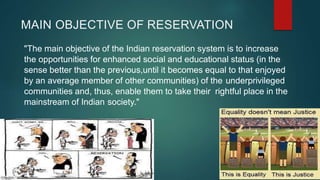
MAIN OBJECTIVE OF RESERVATION
"The main objective of the Indian reservation system is to increase
the opportunities for enhanced social and educational status (in the
sense better than the previous,until it becomes equal to that enjoyed
by an average member of other communities) of the underprivileged
communities and, thus, enable them to take their rightful place in the
mainstream of Indian society."
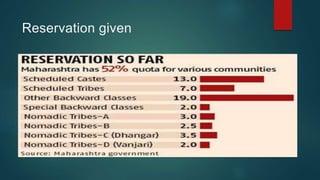
Reservation given
Caste Based Reservation
Gender Based Reservation
Religion Based Reservation
RESERVATION
TODAY
IN FAVOUR OF RESERVATION
 It is a boon for general students.
Since we have to do hard work extreme hard work. It strengthen our core ,
our soul.
It gives a feeling of superiority in society. I.e. we are officially declared
higher status people. ( higher in logic ,brain ,grasping ability from ages)
when we go for interview for private companies we don't have to prove
much as the interviewer already feels "look general . no support from
government.he is self made man. Perfect ! “
- Achintya Tiwari
AGAINST RESERVATION
 Let’s take an example.
 A and B were friends.
 A belonged to the unreserved category and B belonged to the reserved
category.
 Both of them had almost the same qualification and credentials.
 Infact, they both had access to the same resources, financially.
 Both of them appeared for a Government job.
 B got selected and A was rejected.
 A was disappointed . He joined a low paying private job just for a meagre 10k.
 B became a government officer and earned 20k.
- Shrishti Jain
Accurate ways of using
Reservation in India.
Fair, Just, Honest Reservation.
 Reservation should be only given on basis of actual
need of it.
 It should be given to those who are in need of
financial aid.
 Reservation should not be given on the basis of
caste, creed, religion etc as he/she was not born in
that with his/her wish in that position.
 If god doesn’t discriminate, Why should we?
How should we bring about a change
?
 The caste system was created a while back, and thus
has its own faults.
 We as a new generation should work towards creating a
fair caste system that helps the needy and isn’t misused.
 The caste system must not be applied for by somebody
who doesn’t need it.
 He/she must work towards their own future and not rely
on Caste system for their growth.
Who is it actually made for ?
 When the caste system was made it was made to
bring equality and create a just environment free of
bias.
 Today, The system is misused and has brought more
inequality.
 It is to be given only to those who cannot afford
education or basic facilities and not to those who
don’t deserve it.
Thank you

Reservation In India PPT

  • 1.
    S.I.E.S College ofArts, Science and Commerce Foundation Course - I - Rushabh Sheth
  • 3.
     Introduction –What is Reservation?  History of Reservation – Ancient Times, Pre-Independence, Post- Independence  Reservation in India  Reservation Today  Accurate ways of using Reservation in today’s times INDEX
  • 4.
  • 5.
    INTRODUCTION  The systemof RESERVATION IN INDIA is comprising series of measures, such as reserving access to seats in the various legislatures, to government jobs, and to enrollment in higher educational institutions.  The reservation nourishes the historically disadvantaged castes and tribes, listed as Scheduled castes and Scheduled tribes by the government of India and also those designated as Other Backwards Classes.  Caste Reservation is an affirmative action program with fixed quotas.
  • 6.
     India hasthree main disadvantaged groups: 1. SCHEDULED TRIBES: These are tribals with little access to education when we got independence. 2. SCHEDULED CASTES: These were among the most ill-treated communities historically. 3. OTHER BACKWARDS CASTES: These are a motley of castes that were usually at the bottom of Indian caste pyramid.
  • 7.
    History of ReservationSystem Ancient Times, Pre – Independence & Post Independence
  • 8.
    Reservation : Ancienttimes  The Hindu society was divided into 4 Classes which were Brahmins, Kshatriyas, Vaishyas, and Shudras in the descending order of their hierarchy. The fifth class : The Untouchables.  Mythological Epics of India : Mahabharata Karna being raised by Kunti who was Shudra.  This classification was also one kind of reservation where some people were given every facilities and allowed every privileges while some others where denied almost everything​.
  • 9.
    Reservation : Pre- Independence  In 1932, Ramsay Macdonald introduced Communal Award- which is creating separate constituencies for Sikhs, Anglo- Indians, Muslims, Dalits, Christians.  Communal Award was welcomed by Dalit icon Ambedkar, but was rejected by Gandhi ji.  Eg. Kolhapur- 1901
  • 10.
    Reservation : Post- Independence  Dr. Ambedkar  V.P Singh’s amendment : 27% OBC, 22.5% SC/ST’s  Other Reservations : a) 33% for Women, b) Kashmiri Migrants, c) Physically handicapped, d) Families of Freedom Fighters,
  • 11.
  • 12.
    MAIN OBJECTIVE OFRESERVATION "The main objective of the Indian reservation system is to increase the opportunities for enhanced social and educational status (in the sense better than the previous,until it becomes equal to that enjoyed by an average member of other communities) of the underprivileged communities and, thus, enable them to take their rightful place in the mainstream of Indian society."
  • 13.
  • 14.
    Caste Based Reservation GenderBased Reservation Religion Based Reservation
  • 15.
  • 16.
    IN FAVOUR OFRESERVATION  It is a boon for general students. Since we have to do hard work extreme hard work. It strengthen our core , our soul. It gives a feeling of superiority in society. I.e. we are officially declared higher status people. ( higher in logic ,brain ,grasping ability from ages) when we go for interview for private companies we don't have to prove much as the interviewer already feels "look general . no support from government.he is self made man. Perfect ! “ - Achintya Tiwari
  • 17.
    AGAINST RESERVATION  Let’stake an example.  A and B were friends.  A belonged to the unreserved category and B belonged to the reserved category.  Both of them had almost the same qualification and credentials.  Infact, they both had access to the same resources, financially.  Both of them appeared for a Government job.  B got selected and A was rejected.  A was disappointed . He joined a low paying private job just for a meagre 10k.  B became a government officer and earned 20k. - Shrishti Jain
  • 19.
    Accurate ways ofusing Reservation in India.
  • 20.
    Fair, Just, HonestReservation.  Reservation should be only given on basis of actual need of it.  It should be given to those who are in need of financial aid.  Reservation should not be given on the basis of caste, creed, religion etc as he/she was not born in that with his/her wish in that position.  If god doesn’t discriminate, Why should we?
  • 21.
    How should webring about a change ?  The caste system was created a while back, and thus has its own faults.  We as a new generation should work towards creating a fair caste system that helps the needy and isn’t misused.  The caste system must not be applied for by somebody who doesn’t need it.  He/she must work towards their own future and not rely on Caste system for their growth.
  • 22.
    Who is itactually made for ?  When the caste system was made it was made to bring equality and create a just environment free of bias.  Today, The system is misused and has brought more inequality.  It is to be given only to those who cannot afford education or basic facilities and not to those who don’t deserve it.
  • 23.