Primary and
Secondary
Audience Survey
‘What is your age?’
For this task, I carried out a series of
paper surveys where I asked 7
different questions. The surveys were
handed out to people of various ages
and gender’s, so that my research was
not biased. The first question featured
in my survey was ‘what is your age?’.
This question was asked for me to
establish what type of age ranges liked
what kind of films, as well as making
sure I had varied ages in my research.
Unfortunately, more 13 to 17 year olds
completed our survey, therefore our
survey was partially biased. However,
from this research we can conduct that
13 to 17 year olds are more likely to be
interested in ‘Coming Of Age films’.
Therefore we should adapt our
opening sequence to this particular
audience. Also, by using different age
groups, we were able to reach
conclusions about our secondary
audience as well as our primary.
‘What is your favourite film
genre?’
The second question I asked was
‘What is your favourite film
genre?’. The genre’s we
mentioned were: Thriller, Comedy,
Romance, Romantic comedy,
Adventure and Drama. When
looking at the answers to this
question, it became clear that
adventure and comedy were
people’s most favourite genres.
This suggests that when creating
my opening scene, I should keep
these genre’s in mind in order to
engage our primary and secondary
audience, making our sequence
more successful.
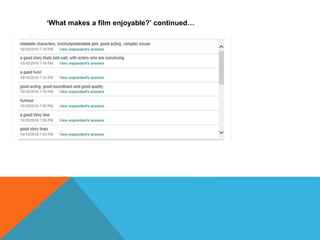
‘What makes a film
enjoyable?’
Next, we asked our
participants what they enjoy
about films in order to establish
what my audience like in a film.
The answers we received
stated that they liked films that
include ‘good
actors/actresses’, ‘good story
lines’ and ‘relatable
characters’, as well as a ‘good
sound track’.
This information suggests that
in our opening sequence we
need to make sure that there is
a good soundtrack, characters
that our audience can relate
too, and a good plot that both
our primary and secondary
audience will enjoy. This will
ensure our opening sequence
is successful.
‘What makes a film enjoyable?’ continued…
‘What don’t you enjoy about
films?’
Our next question was ‘what
don’t you enjoy about
films?’. We asked our
participants this so that we
could gather information on
which codes and conventions
our audience dislike certain
films. Some of the answers we
received stated that ‘clichés’
were a huge thing people
disliked, along with predictable
plots, cliff hangers and
violence.
This taught us that in our
opening sequence, we must
make sure we do not include
any clichés, cliff hangers or
violence in order to engage
our primary and secondary
audience.
‘What don’t you enjoy about films’ continued…
‘What coming of age films have you
seen?’
Next, we gave our participants a list of
‘coming of age’ films we had already looked
at as part of our research, and asked them
to circle the ones they had seen. From this
we learnt that the most popular film was
‘Grease’, followed by ‘Juno’ and ‘Mean
Girls’. The least popular of the films were
‘The 400 blows’ and ‘Heavenly Creatures’.
Asking our participants this question taught
us which films had a larger fan base. Also
this means that we can look at these
opening sequences and evaluate what
makes the sequence successful.
‘From the list, which films
did you enjoy and why?’
Finally, we asked our
participants which of the
films from our list they
enjoyed and why. We learnt
that the majority of
participants enjoyed
‘American pie’ because of its
humour. This suggests that
to keep our primary and
secondary audience
engaged, we must include
humour, as comedy appears
to be very successful in
films.
‘Which films did you enjoy and why?’ continued…

Research task

  • 1.
  • 2.
    ‘What is yourage?’ For this task, I carried out a series of paper surveys where I asked 7 different questions. The surveys were handed out to people of various ages and gender’s, so that my research was not biased. The first question featured in my survey was ‘what is your age?’. This question was asked for me to establish what type of age ranges liked what kind of films, as well as making sure I had varied ages in my research. Unfortunately, more 13 to 17 year olds completed our survey, therefore our survey was partially biased. However, from this research we can conduct that 13 to 17 year olds are more likely to be interested in ‘Coming Of Age films’. Therefore we should adapt our opening sequence to this particular audience. Also, by using different age groups, we were able to reach conclusions about our secondary audience as well as our primary.
  • 3.
    ‘What is yourfavourite film genre?’ The second question I asked was ‘What is your favourite film genre?’. The genre’s we mentioned were: Thriller, Comedy, Romance, Romantic comedy, Adventure and Drama. When looking at the answers to this question, it became clear that adventure and comedy were people’s most favourite genres. This suggests that when creating my opening scene, I should keep these genre’s in mind in order to engage our primary and secondary audience, making our sequence more successful.
  • 4.
    ‘What makes afilm enjoyable?’ Next, we asked our participants what they enjoy about films in order to establish what my audience like in a film. The answers we received stated that they liked films that include ‘good actors/actresses’, ‘good story lines’ and ‘relatable characters’, as well as a ‘good sound track’. This information suggests that in our opening sequence we need to make sure that there is a good soundtrack, characters that our audience can relate too, and a good plot that both our primary and secondary audience will enjoy. This will ensure our opening sequence is successful.
  • 5.
    ‘What makes afilm enjoyable?’ continued…
  • 6.
    ‘What don’t youenjoy about films?’ Our next question was ‘what don’t you enjoy about films?’. We asked our participants this so that we could gather information on which codes and conventions our audience dislike certain films. Some of the answers we received stated that ‘clichés’ were a huge thing people disliked, along with predictable plots, cliff hangers and violence. This taught us that in our opening sequence, we must make sure we do not include any clichés, cliff hangers or violence in order to engage our primary and secondary audience.
  • 7.
    ‘What don’t youenjoy about films’ continued…
  • 8.
    ‘What coming ofage films have you seen?’ Next, we gave our participants a list of ‘coming of age’ films we had already looked at as part of our research, and asked them to circle the ones they had seen. From this we learnt that the most popular film was ‘Grease’, followed by ‘Juno’ and ‘Mean Girls’. The least popular of the films were ‘The 400 blows’ and ‘Heavenly Creatures’. Asking our participants this question taught us which films had a larger fan base. Also this means that we can look at these opening sequences and evaluate what makes the sequence successful.
  • 9.
    ‘From the list,which films did you enjoy and why?’ Finally, we asked our participants which of the films from our list they enjoyed and why. We learnt that the majority of participants enjoyed ‘American pie’ because of its humour. This suggests that to keep our primary and secondary audience engaged, we must include humour, as comedy appears to be very successful in films.
  • 10.
    ‘Which films didyou enjoy and why?’ continued…