Research Review Forms – Student NameResearch Review Forms
TemplateResearch Review Form #1
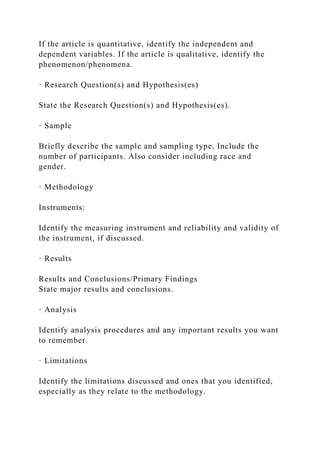
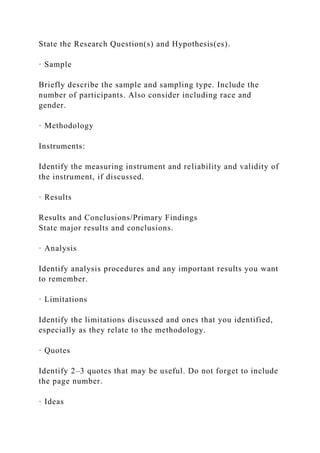
· APA Reference
· Type of Research
Please specify the type of research (e.g., quantitative,
qualitative, meta-analysis) and research design, if applicable
(e.g., correlational design, causal comparative design,
phenomenology).
· Independent and Dependent Variables or Variable of Interest
(if applicable)
If the article is quantitative, identify the independent and
dependent variables. If the article is qualitative, identify the
phenomenon/phenomena.
· Research Question(s) and Hypothesis(es)
State the Research Question(s) and/or Hypothesis(es).
Example: There is no stated hypothesis. 2 research questions are
proposed: (a) “What is the relationship between the sense of
community and student learning?” and (b) “Do the sense of
community and learning differ by culture in an asynchronous
learning network (ALN) environment?” It is implied that the
researchers believe that culture will influence the students’
sense of community and learning. It is implied that there will be
an achievement gap between African-American students and
Caucasian students participating in online courses.
· Sample
Briefly describe the sample and sampling type. Include the
number of participants. Also consider including race and
gender.
Example: The subjects were 108 educators (96 females, 12
males; 40 African Americans, 64 Caucasians, 4 others) enrolled
in an online Doctor of Education program. The convenience
sample was taken from 4 course sections, which had a 96%
volunteer rate.
· Methodology
Instruments:
Identify the measuring instrument and reliability and validity of
the instrument, if discussed.
Example: The Classroom Community Scale (CCS; Rovai, 2002)
was used to measure social community (connectedness) and
learning community (learning and satisfaction). As purported,
the CCS has high construct validity.
· Results
Results and Conclusions/Primary Findings:
State major results and conclusions.
Example: For the correlational design, the results suggested a
positive correlation between all 3 community variables and the
2 learning variables in the ALN environment. Since the findings
indicated that there was a weak relationship between perceived
learning and course grades, this suggests the learning variables
captured 2 different aspects of student learning. In addition,
results revealed large variability of classroom community
among the students sampled in the 4 course sections. This
indicated that individual traits of students may impact feelings
about social community. For the causal-comparative, the results
revealed that the African-American group scored significantly
lower than the Caucasian group on each of the 5 dependent
variables. This suggests that there is an achievement gap
between African-Americans and Caucasians in graduate ALN
programs. This gap also extended to the sense of community.
· Analysis
Identify analysis procedures and any important results you want
to remember.
Example: Pearson bivariate correlations for the 5 variables were
all significant at the .05 level. Using canonical correlation, the
2 subscales of the Classroom Community Scale and the mean
number of messages posted each week to the online courses’
group discussion boards were found to be related significantly
(p < .001) to perceived learning and total points earned in the
course with both pairs of canonical variates included; with the
first pair of canonical variates removed, there was no
significance (p =.06). The only significant relationship between
the 2 sets of variables existed in the first pair of canonical
variates.
· Limitations
Identify the limitations discussed and ones that you identified,
especially as they relate to the methodology.
Example: Limitations are discussed. The findings of this study
have limited generalizability. The gender and race of the
professor, as well as the pedagogy used by that professor, may
not be representative of other professors and other settings.
Cause and effect relationships were neither studied nor
confirmed.
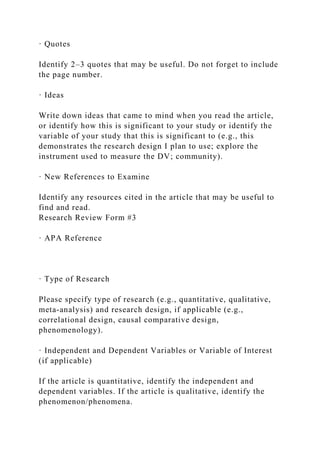
· Quotes
Identify 2–3 quotes that may be useful. Do not forget to include
the page number.
· Ideas
Write down ideas that came to mind when you read the article,
or identify how this is significant to your study or identify the
variable of your study that this is significant to (e.g., this
demonstrates the research design I plan to use; explore the
instrument used to measure the DV; community).
· New References to Examine
Identify any resources cited in the article that may be useful to
find and read.
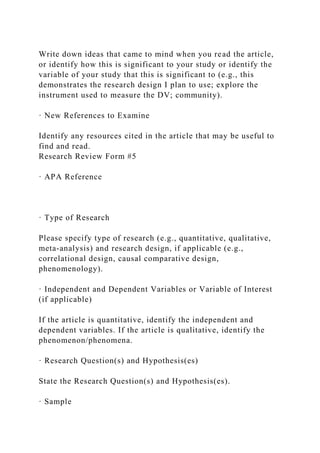
Research Review Form #2
· APA Reference
· Type of Research
Please specify type of research (e.g., quantitative, qualitative,
meta-analysis) and research design, if applicable (e.g.,
correlational design, causal comparative design,
phenomenology).
· Independent and Dependent Variables or Variable of Interest
(if applicable)
If the article is quantitative, identify the independent and
dependent variables. If the article is qualitative, identify the
phenomenon/phenomena.
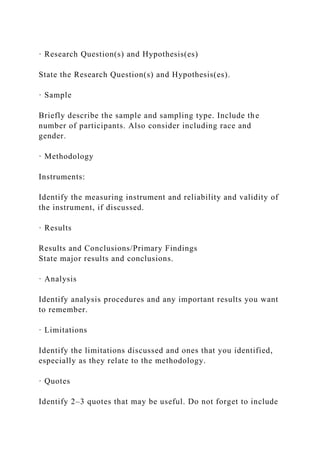
· Research Question(s) and Hypothesis(es)
State the Research Question(s) and Hypothesis(es).
· Sample
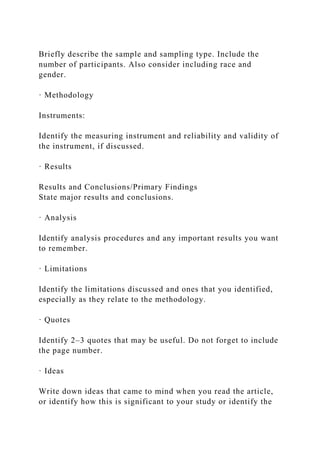
Briefly describe the sample and sampling type. Include the
number of participants. Also consider including race and
gender.
· Methodology
Instruments:
Identify the measuring instrument and reliability and validity of
the instrument, if discussed.
· Results
Results and Conclusions/Primary Findings
State major results and conclusions.
· Analysis
Identify analysis procedures and any important results you want
to remember.
· Limitations
Identify the limitations discussed and ones that you identified,
especially as they relate to the methodology.
· Quotes
Identify 2–3 quotes that may be useful. Do not forget to include
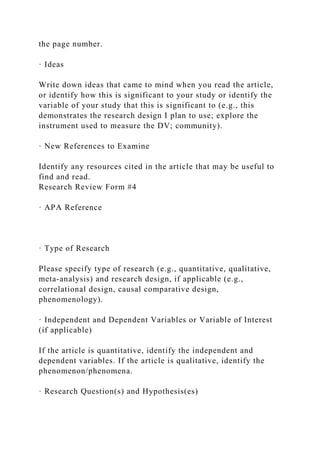
the page number.
· Ideas
Write down ideas that came to mind when you read the article,
or identify how this is significant to your study or identify the
variable of your study that this is significant to (e.g., this
demonstrates the research design I plan to use; explore the
instrument used to measure the DV; community).
· New References to Examine
Identify any resources cited in the article that may be useful to
find and read.
Research Review Form #3
· APA Reference
· Type of Research
Please specify type of research (e.g., quantitative, qualitative,
meta-analysis) and research design, if applicable (e.g.,
correlational design, causal comparative design,
phenomenology).
· Independent and Dependent Variables or Variable of Interest
(if applicable)
If the article is quantitative, identify the independent and
dependent variables. If the article is qualitative, identify the
phenomenon/phenomena.
· Research Question(s) and Hypothesis(es)
State the Research Question(s) and Hypothesis(es).
· Sample
Briefly describe the sample and sampling type. Include the
number of participants. Also consider including race and
gender.
· Methodology
Instruments:
Identify the measuring instrument and reliability and validity of
the instrument, if discussed.
· Results
Results and Conclusions/Primary Findings
State major results and conclusions.
· Analysis
Identify analysis procedures and any important results you want
to remember.
· Limitations
Identify the limitations discussed and ones that you identified,
especially as they relate to the methodology.
· Quotes
Identify 2–3 quotes that may be useful. Do not forget to include
the page number.
· Ideas
Write down ideas that came to mind when you read the article,
or identify how this is significant to your study or identify the
variable of your study that this is significant to (e.g., this
demonstrates the research design I plan to use; explore the
instrument used to measure the DV; community).
· New References to Examine
Identify any resources cited in the article that may be useful to
find and read.
Research Review Form #4
· APA Reference
· Type of Research
Please specify type of research (e.g., quantitative, qualitative,
meta-analysis) and research design, if applicable (e.g.,
correlational design, causal comparative design,
phenomenology).
· Independent and Dependent Variables or Variable of Interest
(if applicable)
If the article is quantitative, identify the independent and
dependent variables. If the article is qualitative, identify the
phenomenon/phenomena.
· Research Question(s) and Hypothesis(es)
State the Research Question(s) and Hypothesis(es).
· Sample
Briefly describe the sample and sampling type. Include the
number of participants. Also consider including race and
gender.
· Methodology
Instruments:
Identify the measuring instrument and reliability and validity of
the instrument, if discussed.
· Results
Results and Conclusions/Primary Findings
State major results and conclusions.
· Analysis
Identify analysis procedures and any important results you want
to remember.
· Limitations
Identify the limitations discussed and ones that you identified,
especially as they relate to the methodology.
· Quotes
Identify 2–3 quotes that may be useful. Do not forget to include
the page number.
· Ideas
Write down ideas that came to mind when you read the article,
or identify how this is significant to your study or identify the
variable of your study that this is significant to (e.g., this
demonstrates the research design I plan to use; explore the
instrument used to measure the DV; community).
· New References to Examine
Identify any resources cited in the article that may be useful to
find and read.
Research Review Form #5
· APA Reference
· Type of Research
Please specify type of research (e.g., quantitative, qualitative,
meta-analysis) and research design, if applicable (e.g.,
correlational design, causal comparative design,
phenomenology).
· Independent and Dependent Variables or Variable of Interest
(if applicable)
If the article is quantitative, identify the independent and
dependent variables. If the article is qualitative, identify the
phenomenon/phenomena.
· Research Question(s) and Hypothesis(es)
State the Research Question(s) and Hypothesis(es).
· Sample
Briefly describe the sample and sampling type. Include the
number of participants. Also consider including race and
gender.
· Methodology
Instruments:
Identify the measuring instrument and reliability and validity of
the instrument, if discussed.
· Results
Results and Conclusions/Primary Findings
State major results and conclusions.
· Analysis
Identify analysis procedures and any important results you want
to remember.
· Limitations
Identify the limitations discussed and ones that you identified,
especially as they relate to the methodology.
· Quotes
Identify 2–3 quotes that may be useful. Do not forget to include
the page number.
· Ideas
Write down ideas that came to mind when you read the article,
or identify how this is significant to your study or identify the
variable of your study that this is significant to (e.g., this
demonstrates the research design I plan to use; explore the
instrument used to measure the DV; community).
· New References to Examine
Identify any resources cited in the article that may be useful to
find and read.
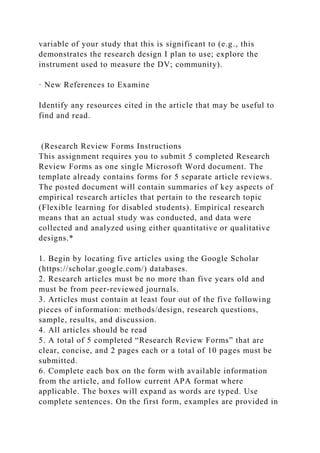
(Research Review Forms Instructions
This assignment requires you to submit 5 completed Research
Review Forms as one single Microsoft Word document. The
template already contains forms for 5 separate article reviews.
The posted document will contain summaries of key aspects of
empirical research articles that pertain to the research topic
(Flexible learning for disabled students). Empirical research
means that an actual study was conducted, and data were
collected and analyzed using either quantitative or qualitative
designs.*
1. Begin by locating five articles using the Google Scholar
(https://scholar.google.com/) databases.
2. Research articles must be no more than five years old and
must be from peer-reviewed journals.
3. Articles must contain at least four out of the five following
pieces of information: methods/design, research questions,
sample, results, and discussion.
4. All articles should be read
5. A total of 5 completed “Research Review Forms” that are
clear, concise, and 2 pages each or a total of 10 pages must be
submitted.
6. Complete each box on the form with available information
from the article, and follow current APA format where
applicable. The boxes will expand as words are typed. Use
complete sentences. On the first form, examples are provided in
the boxes.

Research Review Forms – Student NameResearch Review Forms Template.docx

  • 1.
    Research Review Forms– Student NameResearch Review Forms TemplateResearch Review Form #1 · APA Reference · Type of Research Please specify the type of research (e.g., quantitative, qualitative, meta-analysis) and research design, if applicable (e.g., correlational design, causal comparative design, phenomenology). · Independent and Dependent Variables or Variable of Interest (if applicable) If the article is quantitative, identify the independent and dependent variables. If the article is qualitative, identify the phenomenon/phenomena. · Research Question(s) and Hypothesis(es) State the Research Question(s) and/or Hypothesis(es). Example: There is no stated hypothesis. 2 research questions are proposed: (a) “What is the relationship between the sense of community and student learning?” and (b) “Do the sense of community and learning differ by culture in an asynchronous learning network (ALN) environment?” It is implied that the researchers believe that culture will influence the students’ sense of community and learning. It is implied that there will be an achievement gap between African-American students and Caucasian students participating in online courses.
  • 2.
    · Sample Briefly describethe sample and sampling type. Include the number of participants. Also consider including race and gender. Example: The subjects were 108 educators (96 females, 12 males; 40 African Americans, 64 Caucasians, 4 others) enrolled in an online Doctor of Education program. The convenience sample was taken from 4 course sections, which had a 96% volunteer rate. · Methodology Instruments: Identify the measuring instrument and reliability and validity of the instrument, if discussed. Example: The Classroom Community Scale (CCS; Rovai, 2002) was used to measure social community (connectedness) and learning community (learning and satisfaction). As purported, the CCS has high construct validity. · Results Results and Conclusions/Primary Findings: State major results and conclusions. Example: For the correlational design, the results suggested a positive correlation between all 3 community variables and the 2 learning variables in the ALN environment. Since the findings indicated that there was a weak relationship between perceived learning and course grades, this suggests the learning variables captured 2 different aspects of student learning. In addition,
  • 3.
    results revealed largevariability of classroom community among the students sampled in the 4 course sections. This indicated that individual traits of students may impact feelings about social community. For the causal-comparative, the results revealed that the African-American group scored significantly lower than the Caucasian group on each of the 5 dependent variables. This suggests that there is an achievement gap between African-Americans and Caucasians in graduate ALN programs. This gap also extended to the sense of community. · Analysis Identify analysis procedures and any important results you want to remember. Example: Pearson bivariate correlations for the 5 variables were all significant at the .05 level. Using canonical correlation, the 2 subscales of the Classroom Community Scale and the mean number of messages posted each week to the online courses’ group discussion boards were found to be related significantly (p < .001) to perceived learning and total points earned in the course with both pairs of canonical variates included; with the first pair of canonical variates removed, there was no significance (p =.06). The only significant relationship between the 2 sets of variables existed in the first pair of canonical variates. · Limitations Identify the limitations discussed and ones that you identified, especially as they relate to the methodology. Example: Limitations are discussed. The findings of this study have limited generalizability. The gender and race of the professor, as well as the pedagogy used by that professor, may not be representative of other professors and other settings.
  • 4.
    Cause and effectrelationships were neither studied nor confirmed. · Quotes Identify 2–3 quotes that may be useful. Do not forget to include the page number. · Ideas Write down ideas that came to mind when you read the article, or identify how this is significant to your study or identify the variable of your study that this is significant to (e.g., this demonstrates the research design I plan to use; explore the instrument used to measure the DV; community). · New References to Examine Identify any resources cited in the article that may be useful to find and read. Research Review Form #2 · APA Reference · Type of Research Please specify type of research (e.g., quantitative, qualitative, meta-analysis) and research design, if applicable (e.g., correlational design, causal comparative design, phenomenology). · Independent and Dependent Variables or Variable of Interest (if applicable)
  • 5.
    If the articleis quantitative, identify the independent and dependent variables. If the article is qualitative, identify the phenomenon/phenomena. · Research Question(s) and Hypothesis(es) State the Research Question(s) and Hypothesis(es). · Sample Briefly describe the sample and sampling type. Include the number of participants. Also consider including race and gender. · Methodology Instruments: Identify the measuring instrument and reliability and validity of the instrument, if discussed. · Results Results and Conclusions/Primary Findings State major results and conclusions. · Analysis Identify analysis procedures and any important results you want to remember. · Limitations Identify the limitations discussed and ones that you identified, especially as they relate to the methodology.
  • 6.
    · Quotes Identify 2–3quotes that may be useful. Do not forget to include the page number. · Ideas Write down ideas that came to mind when you read the article, or identify how this is significant to your study or identify the variable of your study that this is significant to (e.g., this demonstrates the research design I plan to use; explore the instrument used to measure the DV; community). · New References to Examine Identify any resources cited in the article that may be useful to find and read. Research Review Form #3 · APA Reference · Type of Research Please specify type of research (e.g., quantitative, qualitative, meta-analysis) and research design, if applicable (e.g., correlational design, causal comparative design, phenomenology). · Independent and Dependent Variables or Variable of Interest (if applicable) If the article is quantitative, identify the independent and dependent variables. If the article is qualitative, identify the phenomenon/phenomena.
  • 7.
    · Research Question(s)and Hypothesis(es) State the Research Question(s) and Hypothesis(es). · Sample Briefly describe the sample and sampling type. Include the number of participants. Also consider including race and gender. · Methodology Instruments: Identify the measuring instrument and reliability and validity of the instrument, if discussed. · Results Results and Conclusions/Primary Findings State major results and conclusions. · Analysis Identify analysis procedures and any important results you want to remember. · Limitations Identify the limitations discussed and ones that you identified, especially as they relate to the methodology. · Quotes Identify 2–3 quotes that may be useful. Do not forget to include
  • 8.
    the page number. ·Ideas Write down ideas that came to mind when you read the article, or identify how this is significant to your study or identify the variable of your study that this is significant to (e.g., this demonstrates the research design I plan to use; explore the instrument used to measure the DV; community). · New References to Examine Identify any resources cited in the article that may be useful to find and read. Research Review Form #4 · APA Reference · Type of Research Please specify type of research (e.g., quantitative, qualitative, meta-analysis) and research design, if applicable (e.g., correlational design, causal comparative design, phenomenology). · Independent and Dependent Variables or Variable of Interest (if applicable) If the article is quantitative, identify the independent and dependent variables. If the article is qualitative, identify the phenomenon/phenomena. · Research Question(s) and Hypothesis(es)
  • 9.
    State the ResearchQuestion(s) and Hypothesis(es). · Sample Briefly describe the sample and sampling type. Include the number of participants. Also consider including race and gender. · Methodology Instruments: Identify the measuring instrument and reliability and validity of the instrument, if discussed. · Results Results and Conclusions/Primary Findings State major results and conclusions. · Analysis Identify analysis procedures and any important results you want to remember. · Limitations Identify the limitations discussed and ones that you identified, especially as they relate to the methodology. · Quotes Identify 2–3 quotes that may be useful. Do not forget to include the page number. · Ideas
  • 10.
    Write down ideasthat came to mind when you read the article, or identify how this is significant to your study or identify the variable of your study that this is significant to (e.g., this demonstrates the research design I plan to use; explore the instrument used to measure the DV; community). · New References to Examine Identify any resources cited in the article that may be useful to find and read. Research Review Form #5 · APA Reference · Type of Research Please specify type of research (e.g., quantitative, qualitative, meta-analysis) and research design, if applicable (e.g., correlational design, causal comparative design, phenomenology). · Independent and Dependent Variables or Variable of Interest (if applicable) If the article is quantitative, identify the independent and dependent variables. If the article is qualitative, identify the phenomenon/phenomena. · Research Question(s) and Hypothesis(es) State the Research Question(s) and Hypothesis(es). · Sample
  • 11.
    Briefly describe thesample and sampling type. Include the number of participants. Also consider including race and gender. · Methodology Instruments: Identify the measuring instrument and reliability and validity of the instrument, if discussed. · Results Results and Conclusions/Primary Findings State major results and conclusions. · Analysis Identify analysis procedures and any important results you want to remember. · Limitations Identify the limitations discussed and ones that you identified, especially as they relate to the methodology. · Quotes Identify 2–3 quotes that may be useful. Do not forget to include the page number. · Ideas Write down ideas that came to mind when you read the article, or identify how this is significant to your study or identify the
  • 12.
    variable of yourstudy that this is significant to (e.g., this demonstrates the research design I plan to use; explore the instrument used to measure the DV; community). · New References to Examine Identify any resources cited in the article that may be useful to find and read. (Research Review Forms Instructions This assignment requires you to submit 5 completed Research Review Forms as one single Microsoft Word document. The template already contains forms for 5 separate article reviews. The posted document will contain summaries of key aspects of empirical research articles that pertain to the research topic (Flexible learning for disabled students). Empirical research means that an actual study was conducted, and data were collected and analyzed using either quantitative or qualitative designs.* 1. Begin by locating five articles using the Google Scholar (https://scholar.google.com/) databases. 2. Research articles must be no more than five years old and must be from peer-reviewed journals. 3. Articles must contain at least four out of the five following pieces of information: methods/design, research questions, sample, results, and discussion. 4. All articles should be read 5. A total of 5 completed “Research Review Forms” that are clear, concise, and 2 pages each or a total of 10 pages must be submitted. 6. Complete each box on the form with available information from the article, and follow current APA format where applicable. The boxes will expand as words are typed. Use complete sentences. On the first form, examples are provided in
  • 13.