RESEARCH TOOLS
for work group
3 5 - 4 5
M a l e
3 5 - 4 2
F e m a l e
D a t a t a k e n f r o m t h r o u g h
q u o t e s
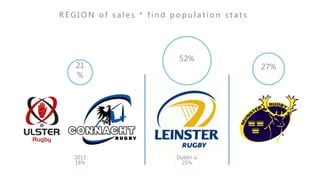
27%
52%
21
%
2013
18%
Dublin is
25%
R E G I O N o f s a l e s * f i n d p o p u l a t i o n s t a t s
They still
enjoy a good
party,
just not in
their house!
They no
longer desire
to share
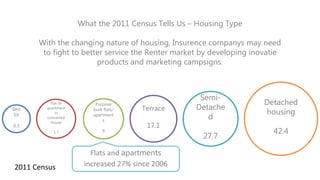
Detached
housing
42.4
Semi-
Detache
d
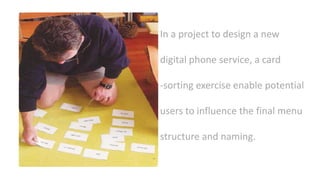
27.7
Terrace
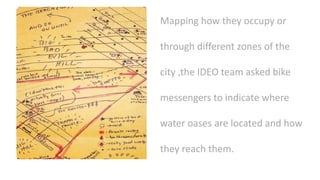
17.1
Purpose
built flats/
apartment
s
9
Flat or
apartment
in
converted
house
1.7
Bed
Sit
0.3
What the 2011 Census Tells Us – Housing Type
With the changing nature of housing, Insurence companys may need
to fight to better service the Renter market by developing inovatie
products and marketing campsigns.
Flats and apartments
increased 27% since 20062011 Census
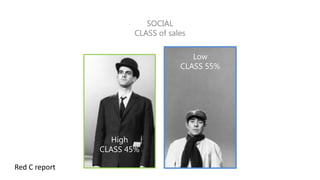
SOCIAL
CLASS of sales
High
CLASS 45%
Low
CLASS 55%
Red C report
They are first
time buyers
who are
starting to
Put their
mark on the
premises.
They are taking
relationships
seriously
If they have a
partner, they
may be married
And have kids.
They want a safe
castle,
And that
includes it being
insured.
They may have
had an
experience with
a car insurance
policy that was
cheap and
unforgiving
A
percentage of the
market may not
be buying on
price but rather
service and
support in mind.
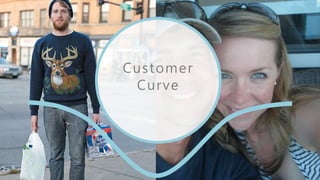
Customer
Curve
While insurers were maintaining their product centricity, consumers changed in other ways.
Consumers were more or less a uniform group 20 years ago, with price sensitivity versus service
orientation lying on a Gaussian curve.
Today this bell curve has completely flipped, leaving a market with significant populations of
consumers at both ends of the commodity pricing versus premium quality spectrum. As a result,
the classic mass market is diminished although still pursued
H om e in su ran ce
n eeds t o in n ovat e
on premiu m qu alit y
rat h er t h an price as
t h eir cu st om ers
receive th is level
from all t h eir ot h er
produ ct s an d
services.
Research
Methods
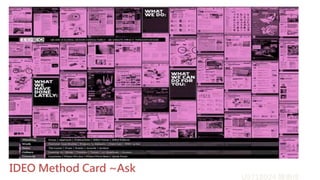
IDEO Method Card ~Ask
U9718024 陳俋伶
Cultural Probes
HOW: Assemble a camera journal kit
(camera, film, notebook, instructions)
and distribute it to participants within one or
across many cultures.
WHY:To collect and evaluate
perceptions and behaviors within
or across cultures.
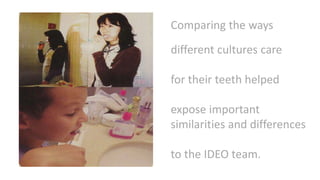
Comparing the ways
different cultures care
for their teeth helped
expose important
similarities and differences
to the IDEO team.
Unfocused Group
HOW: Assemble a diverse group of individuals in
a workshop to use a stimulating range of materials
and create things that are relevant to your project.
WHY: Encourages rich, creative, and
divergent contributions from potential users, releases
“inhibitions, and opens
up new thinking.
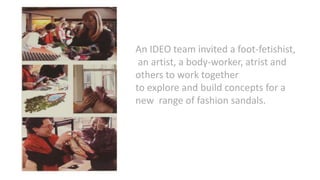
An IDEO team invited a foot-fetishist,
an artist, a body-worker, atrist and
others to work together
to explore and build concepts for a
new range of fashion sandals.
Word-Concept Association
HOW: Ask people to associate descriptive words with different
design
concepts or features in order to show
how they perceive and value the issues.
WHY:Clustering users' perceptions
helps to evaluate and prioritize design
features and concepts.
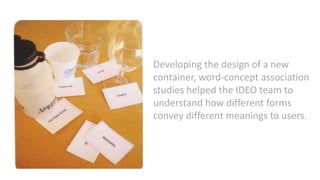
Developing the design of a new
container, word-concept association
studies helped the IDEO team to
understand how different forms
convey different meanings to users.
Camera Journal
HOW: Ask potential users to keep a written and
visual diary of their impressions, circumstances,
and activities related to
the product.
WHY: This rich self-conducted notation technique is
useful for prompting users
to reveal points of view and patterns of behavior.
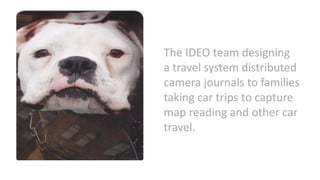
The IDEO team designing
a travel system distributed
camera journals to families
taking car trips to capture
map reading and other car
travel.
Collage
HOW: Ask participants to build.
collage from a provided collection of mages. and to
explain the significance of the mages and
arrangements they choose.
WHY:This illustrates participants’ understanding and
perceptions of issues and helps them verbalize
complex or unimagined themes.
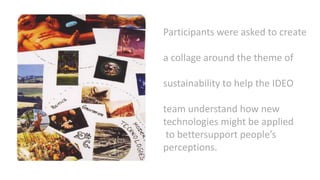
Participants were asked to create
a collage around the theme of
sustainability to help the IDEO
team understand how new
technologies might be applied
to bettersupport people’s
perceptions.
Card Sort
HOW: On separate cards, name possible
features, functions, or design attributes.
Ask people to organize the cards spatially, in
ways that make sense to them.
WHY: This helps to expose people's mental
models of a device or system.
Their organization reveals expectations and
priorities about the intended functions.
In a project to design a new
digital phone service, a card
-sorting exercise enable potential
users to influence the final menu
structure and naming.
Cognitive Maps
HOW.:ask participants to map an
existing or virtual space and show
how they navigate it
WHY: This s a useful way to discover
the significant elements, pathways.
and other special behavior associated
with a real or virtual environment.
Mapping how they occupy or
through different zones of the
city ,the IDEO team asked bike
messengers to indicate where
water oases are located and how
they reach them.
Five Whys?
HOW: Ask 'Why?" questions in
response to five consecutive answers.
WHY: This exercise forces people to
examine and express the underlying
reasons for their behavior and attitude
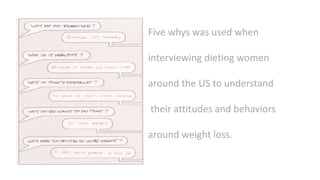
Five whys was used when
interviewing dieting women
around the US to understand
their attitudes and behaviors
around weight loss.
Foreign Correspondents
HOW: Request input from coworkers
and contacts in other countries and
conduct across·cultural study to derive
basic international design principle.
WHY: This is a good way to illustrate
the varied cultural and environmental
contexts in which products are used.
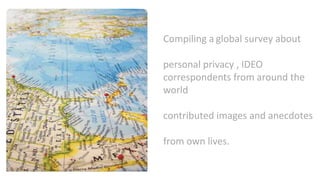
Compiling a global survey about
personal privacy , IDEO
correspondents from around the
world
contributed images and anecdotes
from own lives.
Narration
HOW: As they perform a process
or execute a specific task, ask participants
to describe aloud what they are thinking.
WHY: This is a useful way to reach
users' motivations, concerns, perceptions,
and reasoning.
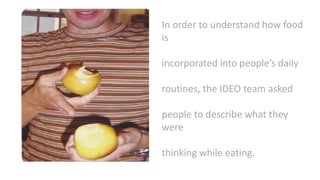
In order to understand how food
is
incorporated into people’s daily
routines, the IDEO team asked
people to describe what they
were
thinking while eating.
Extreme User Interviews
HOW: Identify individuals why are extremely
familiar or completely unfamiliar with the
product and ask them to evaluate their
experience using it.
WHY: These individuals are often able to
highlight key issues of the design problem
and provide insights for design improvements.
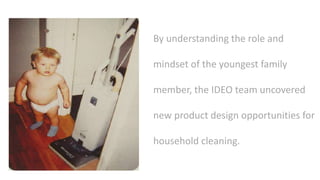
By understanding the role and
mindset of the youngest family
member, the IDEO team uncovered
new product design opportunities for
household cleaning.
Conceptual Landscape
HOW: Diagram, sketch, or map the
aspects of abstract social and behavioral
constructs or phenomena.
WHY: This is a helpful way to understand
people's mental models of the issues related
to the design problem.
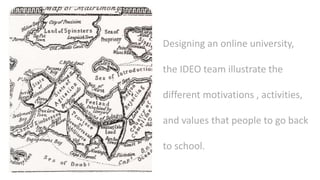
Designing an online university,
the IDEO team illustrate the
different motivations , activities,
and values that people to go back
to school.
Draw the Experience
HOW: Ask participants to visualize an
experience through drawings and diagrams.
WHY:This can be a good way to
debunk assumptions and reveal how
people conceive of and order their
experiences or activities.
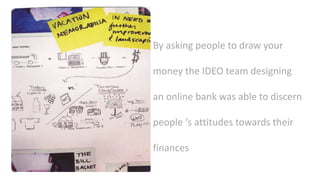
By asking people to draw your
money the IDEO team designing
an online bank was able to discern
people ‘s attitudes towards their
finances
Surveys & Questionnaires
HOW: Ask a series of targeted
questions in order to ascertain
particular characteristics and
perceptions of users.
WHY: This is a quick way to elicit
answers from a large number of
people.
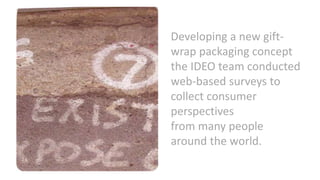
Developing a new gift-
wrap packaging concept
the IDEO team conducted
web-based surveys to
collect consumer
perspectives
from many people
around the world.

Research Process for Home Insurance

  • 1.
  • 2.
    3 5 -4 5 M a l e 3 5 - 4 2 F e m a l e D a t a t a k e n f r o m t h r o u g h q u o t e s
  • 3.
    27% 52% 21 % 2013 18% Dublin is 25% R EG I O N o f s a l e s * f i n d p o p u l a t i o n s t a t s
  • 4.
    They still enjoy agood party, just not in their house!
  • 5.
  • 6.
    Detached housing 42.4 Semi- Detache d 27.7 Terrace 17.1 Purpose built flats/ apartment s 9 Flat or apartment in converted house 1.7 Bed Sit 0.3 Whatthe 2011 Census Tells Us – Housing Type With the changing nature of housing, Insurence companys may need to fight to better service the Renter market by developing inovatie products and marketing campsigns. Flats and apartments increased 27% since 20062011 Census
  • 7.
    SOCIAL CLASS of sales High CLASS45% Low CLASS 55% Red C report
  • 8.
    They are first timebuyers who are starting to Put their mark on the premises.
  • 9.
  • 10.
    If they havea partner, they may be married And have kids.
  • 11.
    They want asafe castle, And that includes it being insured.
  • 12.
    They may have hadan experience with a car insurance policy that was cheap and unforgiving
  • 13.
    A percentage of the marketmay not be buying on price but rather service and support in mind.
  • 14.
  • 15.
    While insurers weremaintaining their product centricity, consumers changed in other ways. Consumers were more or less a uniform group 20 years ago, with price sensitivity versus service orientation lying on a Gaussian curve. Today this bell curve has completely flipped, leaving a market with significant populations of consumers at both ends of the commodity pricing versus premium quality spectrum. As a result, the classic mass market is diminished although still pursued
  • 16.
    H om ein su ran ce n eeds t o in n ovat e on premiu m qu alit y rat h er t h an price as t h eir cu st om ers receive th is level from all t h eir ot h er produ ct s an d services.
  • 17.
  • 19.
    IDEO Method Card~Ask U9718024 陳俋伶
  • 20.
    Cultural Probes HOW: Assemblea camera journal kit (camera, film, notebook, instructions) and distribute it to participants within one or across many cultures. WHY:To collect and evaluate perceptions and behaviors within or across cultures.
  • 21.
    Comparing the ways differentcultures care for their teeth helped expose important similarities and differences to the IDEO team.
  • 22.
    Unfocused Group HOW: Assemblea diverse group of individuals in a workshop to use a stimulating range of materials and create things that are relevant to your project. WHY: Encourages rich, creative, and divergent contributions from potential users, releases “inhibitions, and opens up new thinking.
  • 23.
    An IDEO teaminvited a foot-fetishist, an artist, a body-worker, atrist and others to work together to explore and build concepts for a new range of fashion sandals.
  • 24.
    Word-Concept Association HOW: Askpeople to associate descriptive words with different design concepts or features in order to show how they perceive and value the issues. WHY:Clustering users' perceptions helps to evaluate and prioritize design features and concepts.
  • 25.
    Developing the designof a new container, word-concept association studies helped the IDEO team to understand how different forms convey different meanings to users.
  • 26.
    Camera Journal HOW: Askpotential users to keep a written and visual diary of their impressions, circumstances, and activities related to the product. WHY: This rich self-conducted notation technique is useful for prompting users to reveal points of view and patterns of behavior.
  • 27.
    The IDEO teamdesigning a travel system distributed camera journals to families taking car trips to capture map reading and other car travel.
  • 28.
    Collage HOW: Ask participantsto build. collage from a provided collection of mages. and to explain the significance of the mages and arrangements they choose. WHY:This illustrates participants’ understanding and perceptions of issues and helps them verbalize complex or unimagined themes.
  • 29.
    Participants were askedto create a collage around the theme of sustainability to help the IDEO team understand how new technologies might be applied to bettersupport people’s perceptions.
  • 30.
    Card Sort HOW: Onseparate cards, name possible features, functions, or design attributes. Ask people to organize the cards spatially, in ways that make sense to them. WHY: This helps to expose people's mental models of a device or system. Their organization reveals expectations and priorities about the intended functions.
  • 31.
    In a projectto design a new digital phone service, a card -sorting exercise enable potential users to influence the final menu structure and naming.
  • 32.
    Cognitive Maps HOW.:ask participantsto map an existing or virtual space and show how they navigate it WHY: This s a useful way to discover the significant elements, pathways. and other special behavior associated with a real or virtual environment.
  • 33.
    Mapping how theyoccupy or through different zones of the city ,the IDEO team asked bike messengers to indicate where water oases are located and how they reach them.
  • 34.
    Five Whys? HOW: Ask'Why?" questions in response to five consecutive answers. WHY: This exercise forces people to examine and express the underlying reasons for their behavior and attitude
  • 35.
    Five whys wasused when interviewing dieting women around the US to understand their attitudes and behaviors around weight loss.
  • 36.
    Foreign Correspondents HOW: Requestinput from coworkers and contacts in other countries and conduct across·cultural study to derive basic international design principle. WHY: This is a good way to illustrate the varied cultural and environmental contexts in which products are used.
  • 37.
    Compiling a globalsurvey about personal privacy , IDEO correspondents from around the world contributed images and anecdotes from own lives.
  • 38.
    Narration HOW: As theyperform a process or execute a specific task, ask participants to describe aloud what they are thinking. WHY: This is a useful way to reach users' motivations, concerns, perceptions, and reasoning.
  • 39.
    In order tounderstand how food is incorporated into people’s daily routines, the IDEO team asked people to describe what they were thinking while eating.
  • 40.
    Extreme User Interviews HOW:Identify individuals why are extremely familiar or completely unfamiliar with the product and ask them to evaluate their experience using it. WHY: These individuals are often able to highlight key issues of the design problem and provide insights for design improvements.
  • 41.
    By understanding therole and mindset of the youngest family member, the IDEO team uncovered new product design opportunities for household cleaning.
  • 42.
    Conceptual Landscape HOW: Diagram,sketch, or map the aspects of abstract social and behavioral constructs or phenomena. WHY: This is a helpful way to understand people's mental models of the issues related to the design problem.
  • 43.
    Designing an onlineuniversity, the IDEO team illustrate the different motivations , activities, and values that people to go back to school.
  • 44.
    Draw the Experience HOW:Ask participants to visualize an experience through drawings and diagrams. WHY:This can be a good way to debunk assumptions and reveal how people conceive of and order their experiences or activities.
  • 45.
    By asking peopleto draw your money the IDEO team designing an online bank was able to discern people ‘s attitudes towards their finances
  • 46.
    Surveys & Questionnaires HOW:Ask a series of targeted questions in order to ascertain particular characteristics and perceptions of users. WHY: This is a quick way to elicit answers from a large number of people.
  • 47.
    Developing a newgift- wrap packaging concept the IDEO team conducted web-based surveys to collect consumer perspectives from many people around the world.