Research options for studying
tenure security
Anne M Larson
What are the components
      of security?
Tenure security

 Assurance versus content of rights   (Sjaastad and
 Bromley, 2000)

 • Ex. Weak rights, temporary rights

 Security as perception
  • But what if people don’t perceive a
    threat?

 Security/ insecurity as combination
  • Presence or absence of conflict
  • Perception
  • Potential threats:
    - Exclusion rights and capacity to exclude
      in practice
GCS REDD Village Survey
     Questionnaire
Area in conflict
Is
any
of
the
land
in
the
village
under
dispute?
1=yes;
0=no.

If
‘no’
end
this
section.

                   If
the
answer
to
question
2
is
1
(yes):
                   What
is
the
total
area
of
village
land
              under
dispute?
                   Indicate
the
amount
in
hectares.
                   ‐8=
does
not
apply
(no
land
under
              dispute);
‐9=respondent
does
not
know

                                      If
the
answer
to
question
2
is
1
(yes):
                                      Please
explain
the
nature
of
the
dispute.

                                 
    ‐8=
does
not
apply
(no
land
under
                                 dispute);
9=respondent
does
not
know
Perception of security
Introduction:
We are going to ask you some questions about tenure security
 over land in the village…

Define security:
By tenure security, we mean your confidence that the
 households in this village will continue to be able to use, at
 least for the next 25 years, the land and forests you now
 use and benefit from...
Perception questions

 Q. Please give us your opinion, as a
  community, on the issue of tenure security
  with regard to specific land tenure areas in
  the village. [Definition here]

 Q. Please explain the main reasons for
  insecurity.
Exclusion rights

Introduction:

We want to know about your ability to exclude unwanted
 users of your village lands and resources. We realize there
 may be outsiders who you welcome into your community,
 but here we are going to focus only on people or companies
 you would like to prevent from using your forest resources.
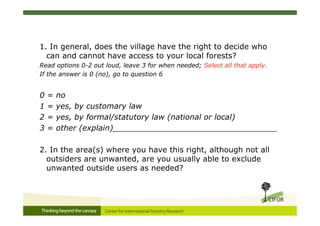
1. In general, does the village have the right to decide who
  can and cannot have access to your local forests?
Read options 0-2 out loud, leave 3 for when needed; Select all that apply.
If the answer is 0 (no), go to question 6


0   =   no
1   =   yes, by customary law
2   =   yes, by formal/statutory law (national or local)
3   =   other (explain)__________________________________

2. In the area(s) where you have this right, although not all
  outsiders are unwanted, are you usually able to exclude
  unwanted outside users as needed?
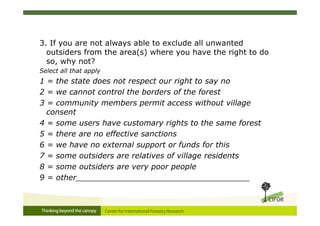
3. If you are not always able to exclude all unwanted
  outsiders from the area(s) where you have the right to do
  so, why not?
Select all that apply
1 = the state does not respect our right to say no
2 = we cannot control the borders of the forest
3 = community members permit access without village
  consent
4 = some users have customary rights to the same forest
5 = there are no effective sanctions
6 = we have no external support or funds for this
7 = some outsiders are relatives of village residents
8 = some outsiders are very poor people
9 = other____________________________________
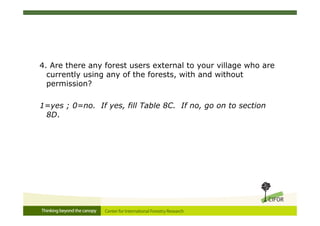
4. Are there any forest users external to your village who are
  currently using any of the forests, with and without
  permission?

1=yes ; 0=no. If yes, fill Table 8C. If no, go on to section
 8D.
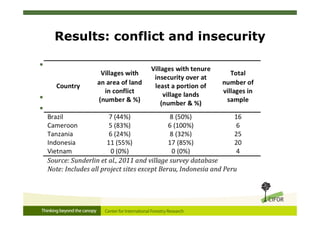
Results: conflict and insecurity

 List 1
  • List 1.1
  • List 1.2
 List 2
 List 3
Results: Exclusion rights
                                and practice

                           (                      (                                                                                              (
                                                                                             )*++,- ./(0 1. &. (
                     )*++,- ./(        ;,/*/(" <(%1 .(&*-1 % =(           )*++, -. /(
                                                                                                %1 */(# /. (*/(         )*++,-. /(            ?" %, +(
                     0*%1 (% 1. (        5$ # 67 .& (8(9:(             0 *% 1(3# && .$ %(
                                                                                                >& "1 *7 *% .4 (       #$ , 7+. (%" (
                     & *- 1% (% "(                                     .2% .& $, +(# /.(                                                  $# 6 7 .& (" <(
    !" # $% &' (                                                                            5$ # 67 .& (8 (9("< (       . 23+#4 . (
                     .23+# 4. (       ! # /%" 6A(       B "& 6, +(       "< (<" & ./%/(                                                   @*++,- ./(*$ (
                                     3#/%" 6 ,& '(        +,0 (                               % 1 "/. (0*%1 (       . 2%. &$ ,+(#/. &/(    /, 6> +.!
                    " # %/*4. &/(                                       5$ #6 7 .& (8 (
                                          +, 0(                                                  3# && .$ %(        5$ # 6 7. &(8 (9: (
                   5$ # 67 . &(8 (                                            9:(
                                                                                             .2 %. &$ ,+(# /.: (
                         9:(
!" #$%&'            ( )'*+ +, -'     ( )'*+ +, -'        ('*., -'        (( '*./ , -'            0 '*) 0, -'            1'*( /, -'             ( .'
2# 34 "5 56 '       . '*(7 7, -'     . '*(7 7, -'       ('*(8 , -'        1'*07 , -'            1 '* (7 7, -'           ('*( 8, -'              .'
9#6 $#6 %# '        : )'*/ ., -'     ( /'*8 ., -'       0'*:7 , -'       (( '*)) , -'            8 '*. ), -'            1'*( ., -'             : 0'
;6 < 56 4=%#'       ( /'*/ 0, -'     ( 8'*+ 0, -'       1'*(0 , -'       (+ '*/7 , -'            0 '*: +, -'            +'*) 7, -'             : 7'
>%4 ?6 #3 '         ) '*(7 7, -'      7 ''*7, - '      ) '*( 77 , -'      :'*07 , -'              7'*7 , -'              7'*7, -'               )'
!             *
Some
villages
selected
both
              Note:
Includes
all
project
sites
except
Berau,
Indonesia
and
Peru
              Source:
Sunderlin
et
al.,
2011
and
village
survey
database
Research options for studying tenure security

Research options for studying tenure security

  • 1.
    Research options forstudying tenure security Anne M Larson
  • 2.
    What are thecomponents of security?
  • 3.
    Tenure security  Assuranceversus content of rights (Sjaastad and Bromley, 2000) • Ex. Weak rights, temporary rights  Security as perception • But what if people don’t perceive a threat?  Security/ insecurity as combination • Presence or absence of conflict • Perception • Potential threats: - Exclusion rights and capacity to exclude in practice
  • 4.
    GCS REDD VillageSurvey Questionnaire
  • 5.
    Area in conflict Is
any
of
the
land
in
the
village
under dispute? 1=yes;
0=no.

If
‘no’
end
this
section. If
the
answer
to
question
2
is
1
(yes): What
is
the
total
area
of
village
land under
dispute? Indicate
the
amount
in
hectares. ‐8=
does
not
apply
(no
land
under dispute);
‐9=respondent
does
not
know If
the
answer
to
question
2
is
1
(yes): Please
explain
the
nature
of
the
dispute. 
 ‐8=
does
not
apply
(no
land
under dispute);
9=respondent
does
not
know
  • 6.
    Perception of security Introduction: Weare going to ask you some questions about tenure security over land in the village… Define security: By tenure security, we mean your confidence that the households in this village will continue to be able to use, at least for the next 25 years, the land and forests you now use and benefit from...
  • 7.
    Perception questions  Q.Please give us your opinion, as a community, on the issue of tenure security with regard to specific land tenure areas in the village. [Definition here]  Q. Please explain the main reasons for insecurity.
  • 9.
    Exclusion rights Introduction: We wantto know about your ability to exclude unwanted users of your village lands and resources. We realize there may be outsiders who you welcome into your community, but here we are going to focus only on people or companies you would like to prevent from using your forest resources.
  • 10.
    1. In general,does the village have the right to decide who can and cannot have access to your local forests? Read options 0-2 out loud, leave 3 for when needed; Select all that apply. If the answer is 0 (no), go to question 6 0 = no 1 = yes, by customary law 2 = yes, by formal/statutory law (national or local) 3 = other (explain)__________________________________ 2. In the area(s) where you have this right, although not all outsiders are unwanted, are you usually able to exclude unwanted outside users as needed?
  • 11.
    3. If youare not always able to exclude all unwanted outsiders from the area(s) where you have the right to do so, why not? Select all that apply 1 = the state does not respect our right to say no 2 = we cannot control the borders of the forest 3 = community members permit access without village consent 4 = some users have customary rights to the same forest 5 = there are no effective sanctions 6 = we have no external support or funds for this 7 = some outsiders are relatives of village residents 8 = some outsiders are very poor people 9 = other____________________________________
  • 12.
    4. Are thereany forest users external to your village who are currently using any of the forests, with and without permission? 1=yes ; 0=no. If yes, fill Table 8C. If no, go on to section 8D.
  • 14.
    Results: conflict andinsecurity  List 1 • List 1.1 • List 1.2  List 2  List 3
  • 15.
    Results: Exclusion rights and practice ( ( ( )*++,- ./(0 1. &. ( )*++,- ./( ;,/*/(" <(%1 .(&*-1 % =( )*++, -. /( %1 */(# /. (*/( )*++,-. /( ?" %, +( 0*%1 (% 1. ( 5$ # 67 .& (8(9:( 0 *% 1(3# && .$ %( >& "1 *7 *% .4 ( #$ , 7+. (%" ( & *- 1% (% "( .2% .& $, +(# /.( $# 6 7 .& (" <( !" # $% &' ( 5$ # 67 .& (8 (9("< ( . 23+#4 . ( .23+# 4. ( ! # /%" 6A( B "& 6, +( "< (<" & ./%/( @*++,- ./(*$ ( 3#/%" 6 ,& '( +,0 ( % 1 "/. (0*%1 ( . 2%. &$ ,+(#/. &/( /, 6> +.! " # %/*4. &/( 5$ #6 7 .& (8 ( +, 0( 3# && .$ %( 5$ # 6 7. &(8 (9: ( 5$ # 67 . &(8 ( 9:( .2 %. &$ ,+(# /.: ( 9:( !" #$%&' ( )'*+ +, -' ( )'*+ +, -' ('*., -' (( '*./ , -' 0 '*) 0, -' 1'*( /, -' ( .' 2# 34 "5 56 ' . '*(7 7, -' . '*(7 7, -' ('*(8 , -' 1'*07 , -' 1 '* (7 7, -' ('*( 8, -' .' 9#6 $#6 %# ' : )'*/ ., -' ( /'*8 ., -' 0'*:7 , -' (( '*)) , -' 8 '*. ), -' 1'*( ., -' : 0' ;6 < 56 4=%#' ( /'*/ 0, -' ( 8'*+ 0, -' 1'*(0 , -' (+ '*/7 , -' 0 '*: +, -' +'*) 7, -' : 7' >%4 ?6 #3 ' ) '*(7 7, -' 7 ''*7, - ' ) '*( 77 , -' :'*07 , -' 7'*7 , -' 7'*7, -' )' ! *
Some
villages
selected
both Note:
Includes
all
project
sites
except
Berau,
Indonesia
and
Peru Source:
Sunderlin
et
al.,
2011
and
village
survey
database