Muhammad Haris
GiS-12-16
Overview
• Introduction
• Types of Methods
Qualitative Research
Quantitative Research
• Qualitative Research
• Quantitative Research
Social surveys/Questionaires
Focus group surveys
Interview
Observation
• Compare and Contrast
Introduction
• It is a particular way of studying something in order to
discover new information about it or understand it better.
• In any form of research you will either count the things
od talk to people.
TYPES OF METHODS
Following are the two types of research methods:
Qualitative Research:
It is primary an exploratory research which involves looking in-depth
at non-numerical data.
It is derived from the word quality which means that this method
takes a deep, quality look at a phenomena.
Quantitative Research:
It looks at the patterns in numeric data.
As the name suggests that, it is concerned with trying to quantify the
things.
It asks questions such as “How Long”, “How Many” and “the degree
of Which” etc.
QUALITATIVE RESEARCH
Qualitative methods are generally associated with the evaluation of
social dimensions. Qualitative methods provide results that are usually
rich and detailed, offering ideas and concepts to inform your research.
Qualitative methods can tell you how people feel and what they think,
but cannot tell you how many of the target population feel or think that
way as quantitative methods can.
Quantitative methods are research techniques that are used to gather
quantitative data, data that can be sorted, classified, measured. This
following section outlines the core quantitative research methods used
in social research. It has the following types:
Social surveys
Focus group surveys
Interviews
Observations
QUANTITATIVE RESEARCH
SOCIAL SURVEYS
It serves as a basis of very large proportion of the
research.
It is very useful in getting information on the topics like
attitudes and believes. Info on these aspects is very
difficult to obtain from a large population by any other
mean.
This method is used to obtain information about events
that took place in past and exist only in the memories of
resource person.
It is relatively easy to get people to participate.
FOCUS GROUP SURVEYS
A best approach to collect anecdotal data from a large
group of persons at a time.
Might generate more ideas than individual interviews.
Does not demands the participants to be literate.
Relies on oral communication.
BUT
Requires Staff and time.
Special equipments to record.
Requires strong facilitation to guide discussion.
INTERVIEW
Best way to get anecdotal data from an individual.
Helpful to probe and explore questions.
Participants do not need to be able to read or write.
BUT
Requires Staff and time.
Special equipments to record and transcribe information.
OBSERVATION
Excellent approach to cover behavior.
Useful technique when there are observable products and
outcomes.
BUT
Requires staff & time to observe and record observation.
Researcher can not ask question during observation.
Follow-up iinterview can be conducted to verify
observation.
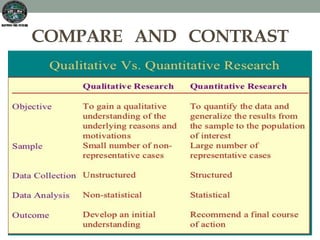
COMPARE AND CONTRAST
QUESTIONS
Research Methods

Research Methods

  • 1.
  • 2.
    Overview • Introduction • Typesof Methods Qualitative Research Quantitative Research • Qualitative Research • Quantitative Research Social surveys/Questionaires Focus group surveys Interview Observation • Compare and Contrast
  • 3.
    Introduction • It isa particular way of studying something in order to discover new information about it or understand it better. • In any form of research you will either count the things od talk to people.
  • 4.
    TYPES OF METHODS Followingare the two types of research methods: Qualitative Research: It is primary an exploratory research which involves looking in-depth at non-numerical data. It is derived from the word quality which means that this method takes a deep, quality look at a phenomena. Quantitative Research: It looks at the patterns in numeric data. As the name suggests that, it is concerned with trying to quantify the things. It asks questions such as “How Long”, “How Many” and “the degree of Which” etc.
  • 5.
    QUALITATIVE RESEARCH Qualitative methodsare generally associated with the evaluation of social dimensions. Qualitative methods provide results that are usually rich and detailed, offering ideas and concepts to inform your research. Qualitative methods can tell you how people feel and what they think, but cannot tell you how many of the target population feel or think that way as quantitative methods can.
  • 6.
    Quantitative methods areresearch techniques that are used to gather quantitative data, data that can be sorted, classified, measured. This following section outlines the core quantitative research methods used in social research. It has the following types: Social surveys Focus group surveys Interviews Observations QUANTITATIVE RESEARCH
  • 7.
    SOCIAL SURVEYS It servesas a basis of very large proportion of the research. It is very useful in getting information on the topics like attitudes and believes. Info on these aspects is very difficult to obtain from a large population by any other mean. This method is used to obtain information about events that took place in past and exist only in the memories of resource person. It is relatively easy to get people to participate.
  • 8.
    FOCUS GROUP SURVEYS Abest approach to collect anecdotal data from a large group of persons at a time. Might generate more ideas than individual interviews. Does not demands the participants to be literate. Relies on oral communication. BUT Requires Staff and time. Special equipments to record. Requires strong facilitation to guide discussion.
  • 9.
    INTERVIEW Best way toget anecdotal data from an individual. Helpful to probe and explore questions. Participants do not need to be able to read or write. BUT Requires Staff and time. Special equipments to record and transcribe information.
  • 10.
    OBSERVATION Excellent approach tocover behavior. Useful technique when there are observable products and outcomes. BUT Requires staff & time to observe and record observation. Researcher can not ask question during observation. Follow-up iinterview can be conducted to verify observation.
  • 11.
  • 12.