Research Methodology
in
Social Sciences
Mr. Resty Hezron C. Damaso, LPT
Social Studies Teacher
What is research?
 Research is defined as human activity based on intellectual
application in the investigation of matter.
 The primary purpose for applied research is discovering,
interpreting, and the development of methods and systems for
the advancement of human knowledge on a wide variety of
issues.
 It is an exercise through which we learn the art of researching
a topic, thinking critically about that topic, and to coherently
express our understanding, analysis and conclusions
about the topic to someone that may or may not be as
informed on the subject as we are.
Purpose of Research
 Research can be driven by curiosity, it could contribute to
knowledge and understanding.
 It could highlight and help solve socio economic problems.
 It could also lead to self development.a
 To inform policy making.
 To address a specific problem or question.
 Any discipline that needs to establish itself in the academia
and grow needs to focus on research.
Research Design
 Research comprises of defining and redefining problems.
 Formulating hypothesis and suggesting solutions.
 Collecting, organizing and evaluating data,
 Making deductions and reaching conclusions
 Carefully testing the conclusions to determine whether they
fit in the formulated hypothesis or not.
Purpose of research- summing up
To develop new theories,
concepts and tools for the study
of unknown phenomena,
analytical study
To find ways to
solve a
problem
Development
of Knowledge
Classification
of Data
Welfare of
Humanity
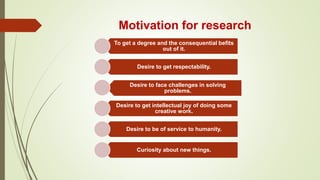
Motivation for research
To get a degree and the consequential befits
out of it.
Desire to get respectability.
Desire to face challenges in solving
problems.
Desire to get intellectual joy of doing some
creative work.
Desire to be of service to humanity.
Curiosity about new things.
Significance of research
A career for students.
Source of Livelihood for
Professionals.
Outlet of new ideas for
Philosophers and thinkers.
Generalization of new theories
for intellectuals and analysts.
A simple picture of integrating visions
Social sciences
and humanities
Natural sciences
engineering
medicine
Law
society
A common picture
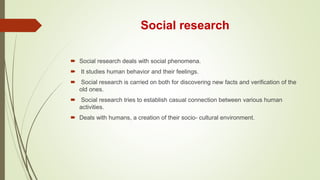
Social research
 Social research deals with social phenomena.
 It studies human behavior and their feelings.
 Social research is carried on both for discovering new facts and verification of the
old ones.
 Social research tries to establish casual connection between various human
activities.
 Deals with humans, a creation of their socio- cultural environment.
Objectives of Social Research
 The aim of social research is to discover new facts and verifying or testing old
facts.
 It tries to understand the human behavior and its interaction with the environment.
 It tries to find out the casual connection between human activities and natural laws
governing them.
Methods, Methodology and
Epistemology
 While methods, methodology and epistemology are all connected and
interrelated as research concepts, they are separate and distinct terms that
refer to different aspects of research as process
 Methods are the tools and techniques used to gather evidence, information
and data. Methods are the research practices chosen by the researcher, be it
qualitative or quantitative methods.
 Methodology addresses theoretical questions about the study of research
and how research is done.
 Epistemology concerns theories about knowledge construction by
questioning whose knowledge is validated and what constitutes knowledge. It
is the philosophy of knowing, the construction and authentication of certain
forms of knowledge.
Kinds of Legal Research
 Descriptive and Analytical Legal Research.
 Applied and Pure Legal Research.
 Quantitative and Qualitative Legal Research.
 Conceptual and Empirical Legal Research.
Sources of Information
 Primary Sources. The sources that contain authoritative records of law made by
law making bodies is a primary source. They can be legislation, rules, regulations,
orders, bye-laws by delegated authorities, and the authoritative decisions of the
courts.
 Secondary Sources. The secondary sources are the one that refer and relate to
the law while not being themselves primary sources, for example, legal
commentaries, abstracts, dictionaries, encyclopedia and index.
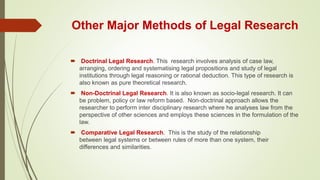
Other Major Methods of Legal Research
 Doctrinal Legal Research. This research involves analysis of case law,
arranging, ordering and systematising legal propositions and study of legal
institutions through legal reasoning or rational deduction. This type of research is
also known as pure theoretical research.
 Non-Doctrinal Legal Research. It is also known as socio-legal research. It can
be problem, policy or law reform based. Non-doctrinal approach allows the
researcher to perform inter disciplinary research where he analyses law from the
perspective of other sciences and employs these sciences in the formulation of the
law.
 Comparative Legal Research. This is the study of the relationship
between legal systems or between rules of more than one system, their
differences and similarities.
The Process of Legal Research
 Choosing a focal point of Research.
 Review of Literature.
 Formulation of Hypothesis.
 Research Design.
 Data Collection.
 Data Analysis.
 Interpretation of Data.
 Report- writing.
Major problems in Legal Research
 Cultural problems.
 Structural and procedural problems (for example, unsympathetic attitude of
authorities.)
 Lack of resources, (for example, Access, money etc.)
 Incompetence (For example inadequate planning etc.)
 Lack of networking and forums
Methods and Research Techniques
Certain methods and research
techniques are associated with
difference research processes.
Qualitative research strategies
traditionally include ethnographies,
fieldwork, participant observation,
content analysis, interviews and oral
histories
Quantitative methods typically
include questionnaires, surveys,
studying rates, variables and
relationships between social factors.
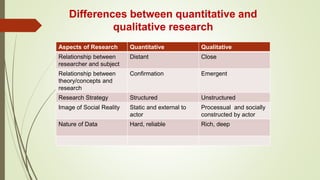
Differences between quantitative and
qualitative research
Aspects of Research Quantitative Qualitative
Relationship between
researcher and subject
Distant Close
Relationship between
theory/concepts and
research
Confirmation Emergent
Research Strategy Structured Unstructured
Image of Social Reality Static and external to
actor
Processual and socially
constructed by actor
Nature of Data Hard, reliable Rich, deep
Types of Qualitative Data
 Interviews
 Observations
 Documents
What are the Social Sciences about?
The Social Sciences engage in the scientific study of human behaviour
the main focus is the study of social interaction, social groups and society.
Social sciences comprise various disciplines: Economics, Sociology, Psychology, Anthropology,
Political Science, Cultural Studies, etc.
 The social scientific research method is designed to answer questions or solve
puzzles empirically
 Theory and observation are used to develop a hypothesis
 Evidence (i.e., data) is used to test the validity of the hypothesis
 The hypothesis links theories with expected evidence
 Data analysis can take many different forms
 Quantitative: typically takes the form of statistical analysis
 Qualitative: typically takes the form of case studies
 There is an important role for all types of research
Social Science research
 Make an observation
 “Twitter appears to have played an important role in the recent election, based upon
anecdotal media reports and personal observations.”
 Formulate a hypothesis
 “Twitter increases flows of information and raises the informational awareness of voters
about topics related to elections.”
 Make a prediction based on the hypothesis
 “The more that a news story is mentioned on Twitter, the more aware that voters will be
about that news story.”
 Find appropriate data to test this prediction
 What data would we need to investigate this claim?
A Simple Example
Why study Historical Method?
. Wright-Mills: “Every social science – or, better, every well
considered social study – requires an historical scope of
conception and a full use of historical materials.”
(The Sociological Imagination, 1959, p. 145).
Without some understanding of the past and of historical processes,
one can only hope for an impoverished understanding of the present.
Heraclitus – ‘You cannot step into the
same river twice’.
Like a river, social life is never static
or fixed, but is constantly changing, so
everything is always in motion, in flux.
Importance of Historical research
 "Everything must be recaptured and relocated in the general framework of
history, so that despite the difficulties, the fundamental paradoxes and
contradictions, we may respect the unity of history which is also the unity
of life.” Fernand Braudel
 "Who controls the past controls the future; who controls the present
controls the past." George Orwell
 "Historical knowledge is the knowledge of what mind has done in the past,
and at the same time it is the redoing of this, the perpetuation of past acts
in the present." R.G. Collingwood
 "Each age tries to form its own conception of the past. Each age writes
the history of the past anew with reference to the conditions uppermost in
its own time." Frederick Jackson Turner
Some tensions of historical research
History consists of:
• facts?
• interpretations?
• myths?
Understanding ideal:
• objective?
• subjective?
Historical past:
• unchangeable?
• changeable?
Purpose of historian:
• record?
• describe?
• understand?
• draw a lesson?
Sources fro Historical Research
 Historical Literature
Historical resources may include library materials, special collections, and
museum collections. They are often the most effective means of gaining
information.
Archival Literature
Materials in archives are useful for studying cultural processes through
time and finding specific material from original documents.
Oral Histories and Traditions
Oral histories help gain insight into an event or situation by gathering
personal accounts from informants who recall events, places, or incidents.
Traditions are information and beliefs handed down through generations
by word of mouth or by example. An understanding of oral traditions is
often key in communicating with different cultures.
Emphasis on Research
 Recorded facts (human actions, legislative acts, etc.) - e.g.
accreditation, rules, adopted and changed during certain period in the
past
 Reflected facts - e.g. actually practiced teaching methods as
reflected in the appropriate theories and/or narratives of that time
 Human ideas, feelings and attitudes (recorded and reflected,
but always in need of interpretation) - e.g. educational theories
 Historical patterns, which, conjecturally, are staying behind
the visible chains of historical facts and invisible (although interpretable
changes in human ideas, feelings and attitudes
 Actual historical research always embraces, at least to some
extent, all of the above - although accents may be quite
different
Researching Societies of the
Past
Historical social research can be roughly divided into 2 broad
approaches:
i) ‘Social’ History (macro)
Focuses upon historical changes in social structure and broad structural
transformations.
ii) ‘Cultural’ History (micro)
A more ethnographic approach focussing upon the details of
everyday lives in past societies and the way that people have created
meaning
And viewed their worlds.
Central topics of concern for ‘second
wave’ historical sociologists were:
● The relationship between social classes and the state.
● The comparative dynamics of state-formation.
● The relative importance of politics and economics in structural social
transformation.
● The comparative dynamics of revolutionary social change.
So the ‘second wave’ was a combination of political-economic
analysis, structural (macro) sociology, and comparative historical analysis.
►This approach was called into question by the ‘cultural turn’, with its new
understandings of time and its emphasis on non-class-based social
identities such as ethnicity, gender and sexuality.
New ‘Cultural History’
New understandings of ‘time’ have emerged.
Rather than an objective force moving forward in a linear process outside
of society, providing a framework in which society is located, the concept of
time has come to be seen as the product of social and cultural processes, and
even as ‘socially constructed’.
New scepticism concerning claims about ‘the
past’:
The notion of historical research as a process of discovering ‘how things
really were’ has been widely challenged. Instead ‘the past’ is increasingly seen as a
narrative which is constructed through historical writing.
Feminist research
 the focus of feminist research is its strong commitment to changing the status of women in
modern societies, to studying women, and to employing female feminist researchers.
 feminist research is research on women, by women and for
 Women and research done with a feminist perspective.
 In summary, this emancipatory nature of feminist research is depicted in the way this
research is done.
Feminist Research is often classified in the
“qualitative research” family because:
 It is used to generate new knowledge.
 It’s purpose is to create social change.
 It argues against the “top-down,” hierarchal relationships associated with male-
dominated knowledge by minimizing the social distance between researcher and
subject. Respondents often participate in the research process.
 It focuses on the position in society of research subjects and the researcher.
 The perspectives or standpoint of the subject and researcher are central in data
collection and analysis.
The term standpoint refers to
 The perspectives or lived experiences of the researcher and his or her subjects.
 These perspectives vary based on the location of individuals in the social structure.
Are their perspectives different from those with privileged positions in society. Is
this standpoint associated with oppression based on social class, ethnicity/race,
gender, sexual orientation etc. or some combination of these attributes.
Steps to qualitative research
 Decide on a question you want to study.
 A good research question needs to be clear, specific and achievable. To do
qualitative research, your question should explore reasons for why people do
things or believe in something.
Background study
 Do a background literature review. A literature review can help you find out what
others have found about your question.
 Doing this may help you to focus your question more specifically.
 A literature review will also help you to become better informed about the topic you
are choosing and help you to determine if there is a need for your question to be
answered.
Qualitative research methodology
 Ethnography – Ethnography is the study of human interaction and communities
through direct participation and observation within the community you wish to
study.
 Phenomenology – Phenomenology is the study of the subjective experiences of
others. It researches the world through the eyes of another person by discovering
how they interpret their experiences.
 Grounded Theory – The purpose of grounded theory is to develop theory based
on the data collected. It looks at specific information and derives theories and
reasons for the phenomena.
 Case Study Research – This method of qualitative study is an in-depth study a
specific individual or phenomena in its existing context.
Data Collection
 Direct observation – Direct observation of a situation or your research subjects
can occur through video tape playback or through live observation through a one
way mirror. In direct observation, you are making specific observations of a
situation without influencing or participating in any way.
 Participant observation – Participant observation is the immersion of the
researcher in the community or situation being studied. This form of data collection
tends to be more time consuming, as you need to participate fully in the community
in order to know whether your observations are valid.
 Interviews – Unstructured interviews with research subjects is a form of data
collection in which you allow your respondents to answer freely. The interviewer
can probe and explore topics as they come up.
 Participant observation – Participant observation is the immersion of the
researcher in the community or situation being studied. This form of data collection
tends to be more time consuming, as you need to participate fully in the community
in order to know whether your observations are valid.
 Interviews – Unstructured interviews with research subjects is a form of data
collection in which you allow your respondents to answer freely. The interviewer
can probe and explore topics as they come up.
 Surveys– Written questionnaires and open ended surveys about ideas, perceptions
and thoughts is another way in which you can collect data for your qualitative research.
 Focus groups – Structured or unstructured focus groups allows for interaction
between more participants and the interviewer about your topic. This form of data
collection can be efficient as it involves more than one respondent at a time.
 Analyze your data. Once you have collected your data, you can begin to analyze it
and come up with answers and theories to your research question. Coding – Identify
themes, ideas and patterns in your data
 Statistics – You can analyze your data using statistics. Descriptive statistics simply
describe what the data is showing while inferential statistics tries to formulate
conclusions beyond the data.
 Narrative analysis – Narrative analysis focuses on speech and content, such as
grammar, word usage, story themes, meanings of situations, the social, cultural
and political context of the narrative.
 Content analysis – Content analysis looks at texts or series of texts and looks for
themes and meanings by looking at frequencies of words.
 Prepare your report. When preparing the report on your qualitative research,
keep in mind the audience for whom you are writing and also the formatting
guidelines of the research journal you wish to submit your research to. You will
want to make sure that your purpose for your research question is compelling and
that you explain your research methodology and analysis in detail.
Thank You

RESEARCH METHODOLOGY

  • 1.
    Research Methodology in Social Sciences Mr.Resty Hezron C. Damaso, LPT Social Studies Teacher
  • 2.
    What is research? Research is defined as human activity based on intellectual application in the investigation of matter.  The primary purpose for applied research is discovering, interpreting, and the development of methods and systems for the advancement of human knowledge on a wide variety of issues.  It is an exercise through which we learn the art of researching a topic, thinking critically about that topic, and to coherently express our understanding, analysis and conclusions about the topic to someone that may or may not be as informed on the subject as we are.
  • 3.
    Purpose of Research Research can be driven by curiosity, it could contribute to knowledge and understanding.  It could highlight and help solve socio economic problems.  It could also lead to self development.a  To inform policy making.  To address a specific problem or question.  Any discipline that needs to establish itself in the academia and grow needs to focus on research.
  • 4.
    Research Design  Researchcomprises of defining and redefining problems.  Formulating hypothesis and suggesting solutions.  Collecting, organizing and evaluating data,  Making deductions and reaching conclusions  Carefully testing the conclusions to determine whether they fit in the formulated hypothesis or not.
  • 5.
    Purpose of research-summing up To develop new theories, concepts and tools for the study of unknown phenomena, analytical study To find ways to solve a problem Development of Knowledge Classification of Data Welfare of Humanity
  • 6.
    Motivation for research Toget a degree and the consequential befits out of it. Desire to get respectability. Desire to face challenges in solving problems. Desire to get intellectual joy of doing some creative work. Desire to be of service to humanity. Curiosity about new things.
  • 7.
    Significance of research Acareer for students. Source of Livelihood for Professionals. Outlet of new ideas for Philosophers and thinkers. Generalization of new theories for intellectuals and analysts.
  • 8.
    A simple pictureof integrating visions Social sciences and humanities Natural sciences engineering medicine Law society A common picture
  • 9.
    Social research  Socialresearch deals with social phenomena.  It studies human behavior and their feelings.  Social research is carried on both for discovering new facts and verification of the old ones.  Social research tries to establish casual connection between various human activities.  Deals with humans, a creation of their socio- cultural environment.
  • 10.
    Objectives of SocialResearch  The aim of social research is to discover new facts and verifying or testing old facts.  It tries to understand the human behavior and its interaction with the environment.  It tries to find out the casual connection between human activities and natural laws governing them.
  • 11.
    Methods, Methodology and Epistemology While methods, methodology and epistemology are all connected and interrelated as research concepts, they are separate and distinct terms that refer to different aspects of research as process  Methods are the tools and techniques used to gather evidence, information and data. Methods are the research practices chosen by the researcher, be it qualitative or quantitative methods.  Methodology addresses theoretical questions about the study of research and how research is done.  Epistemology concerns theories about knowledge construction by questioning whose knowledge is validated and what constitutes knowledge. It is the philosophy of knowing, the construction and authentication of certain forms of knowledge.
  • 12.
    Kinds of LegalResearch  Descriptive and Analytical Legal Research.  Applied and Pure Legal Research.  Quantitative and Qualitative Legal Research.  Conceptual and Empirical Legal Research.

  • 13.
    Sources of Information Primary Sources. The sources that contain authoritative records of law made by law making bodies is a primary source. They can be legislation, rules, regulations, orders, bye-laws by delegated authorities, and the authoritative decisions of the courts.  Secondary Sources. The secondary sources are the one that refer and relate to the law while not being themselves primary sources, for example, legal commentaries, abstracts, dictionaries, encyclopedia and index.
  • 14.
    Other Major Methodsof Legal Research  Doctrinal Legal Research. This research involves analysis of case law, arranging, ordering and systematising legal propositions and study of legal institutions through legal reasoning or rational deduction. This type of research is also known as pure theoretical research.  Non-Doctrinal Legal Research. It is also known as socio-legal research. It can be problem, policy or law reform based. Non-doctrinal approach allows the researcher to perform inter disciplinary research where he analyses law from the perspective of other sciences and employs these sciences in the formulation of the law.  Comparative Legal Research. This is the study of the relationship between legal systems or between rules of more than one system, their differences and similarities.
  • 15.
    The Process ofLegal Research  Choosing a focal point of Research.  Review of Literature.  Formulation of Hypothesis.  Research Design.  Data Collection.  Data Analysis.  Interpretation of Data.  Report- writing.
  • 16.
    Major problems inLegal Research  Cultural problems.  Structural and procedural problems (for example, unsympathetic attitude of authorities.)  Lack of resources, (for example, Access, money etc.)  Incompetence (For example inadequate planning etc.)  Lack of networking and forums
  • 17.
    Methods and ResearchTechniques Certain methods and research techniques are associated with difference research processes. Qualitative research strategies traditionally include ethnographies, fieldwork, participant observation, content analysis, interviews and oral histories Quantitative methods typically include questionnaires, surveys, studying rates, variables and relationships between social factors.
  • 18.
    Differences between quantitativeand qualitative research Aspects of Research Quantitative Qualitative Relationship between researcher and subject Distant Close Relationship between theory/concepts and research Confirmation Emergent Research Strategy Structured Unstructured Image of Social Reality Static and external to actor Processual and socially constructed by actor Nature of Data Hard, reliable Rich, deep
  • 19.
    Types of QualitativeData  Interviews  Observations  Documents
  • 20.
    What are theSocial Sciences about? The Social Sciences engage in the scientific study of human behaviour the main focus is the study of social interaction, social groups and society. Social sciences comprise various disciplines: Economics, Sociology, Psychology, Anthropology, Political Science, Cultural Studies, etc.
  • 21.
     The socialscientific research method is designed to answer questions or solve puzzles empirically  Theory and observation are used to develop a hypothesis  Evidence (i.e., data) is used to test the validity of the hypothesis  The hypothesis links theories with expected evidence  Data analysis can take many different forms  Quantitative: typically takes the form of statistical analysis  Qualitative: typically takes the form of case studies  There is an important role for all types of research Social Science research
  • 22.
     Make anobservation  “Twitter appears to have played an important role in the recent election, based upon anecdotal media reports and personal observations.”  Formulate a hypothesis  “Twitter increases flows of information and raises the informational awareness of voters about topics related to elections.”  Make a prediction based on the hypothesis  “The more that a news story is mentioned on Twitter, the more aware that voters will be about that news story.”  Find appropriate data to test this prediction  What data would we need to investigate this claim? A Simple Example
  • 23.
    Why study HistoricalMethod? . Wright-Mills: “Every social science – or, better, every well considered social study – requires an historical scope of conception and a full use of historical materials.” (The Sociological Imagination, 1959, p. 145). Without some understanding of the past and of historical processes, one can only hope for an impoverished understanding of the present. Heraclitus – ‘You cannot step into the same river twice’. Like a river, social life is never static or fixed, but is constantly changing, so everything is always in motion, in flux.
  • 24.
    Importance of Historicalresearch  "Everything must be recaptured and relocated in the general framework of history, so that despite the difficulties, the fundamental paradoxes and contradictions, we may respect the unity of history which is also the unity of life.” Fernand Braudel  "Who controls the past controls the future; who controls the present controls the past." George Orwell  "Historical knowledge is the knowledge of what mind has done in the past, and at the same time it is the redoing of this, the perpetuation of past acts in the present." R.G. Collingwood  "Each age tries to form its own conception of the past. Each age writes the history of the past anew with reference to the conditions uppermost in its own time." Frederick Jackson Turner
  • 25.
    Some tensions ofhistorical research History consists of: • facts? • interpretations? • myths? Understanding ideal: • objective? • subjective? Historical past: • unchangeable? • changeable? Purpose of historian: • record? • describe? • understand? • draw a lesson?
  • 26.
    Sources fro HistoricalResearch  Historical Literature Historical resources may include library materials, special collections, and museum collections. They are often the most effective means of gaining information. Archival Literature Materials in archives are useful for studying cultural processes through time and finding specific material from original documents. Oral Histories and Traditions Oral histories help gain insight into an event or situation by gathering personal accounts from informants who recall events, places, or incidents. Traditions are information and beliefs handed down through generations by word of mouth or by example. An understanding of oral traditions is often key in communicating with different cultures.
  • 27.
    Emphasis on Research Recorded facts (human actions, legislative acts, etc.) - e.g. accreditation, rules, adopted and changed during certain period in the past  Reflected facts - e.g. actually practiced teaching methods as reflected in the appropriate theories and/or narratives of that time  Human ideas, feelings and attitudes (recorded and reflected, but always in need of interpretation) - e.g. educational theories  Historical patterns, which, conjecturally, are staying behind the visible chains of historical facts and invisible (although interpretable changes in human ideas, feelings and attitudes  Actual historical research always embraces, at least to some extent, all of the above - although accents may be quite different
  • 28.
    Researching Societies ofthe Past Historical social research can be roughly divided into 2 broad approaches: i) ‘Social’ History (macro) Focuses upon historical changes in social structure and broad structural transformations. ii) ‘Cultural’ History (micro) A more ethnographic approach focussing upon the details of everyday lives in past societies and the way that people have created meaning And viewed their worlds.
  • 29.
    Central topics ofconcern for ‘second wave’ historical sociologists were: ● The relationship between social classes and the state. ● The comparative dynamics of state-formation. ● The relative importance of politics and economics in structural social transformation. ● The comparative dynamics of revolutionary social change. So the ‘second wave’ was a combination of political-economic analysis, structural (macro) sociology, and comparative historical analysis. ►This approach was called into question by the ‘cultural turn’, with its new understandings of time and its emphasis on non-class-based social identities such as ethnicity, gender and sexuality.
  • 30.
    New ‘Cultural History’ Newunderstandings of ‘time’ have emerged. Rather than an objective force moving forward in a linear process outside of society, providing a framework in which society is located, the concept of time has come to be seen as the product of social and cultural processes, and even as ‘socially constructed’. New scepticism concerning claims about ‘the past’: The notion of historical research as a process of discovering ‘how things really were’ has been widely challenged. Instead ‘the past’ is increasingly seen as a narrative which is constructed through historical writing.
  • 31.
    Feminist research  thefocus of feminist research is its strong commitment to changing the status of women in modern societies, to studying women, and to employing female feminist researchers.  feminist research is research on women, by women and for  Women and research done with a feminist perspective.  In summary, this emancipatory nature of feminist research is depicted in the way this research is done.
  • 32.
    Feminist Research isoften classified in the “qualitative research” family because:  It is used to generate new knowledge.  It’s purpose is to create social change.  It argues against the “top-down,” hierarchal relationships associated with male- dominated knowledge by minimizing the social distance between researcher and subject. Respondents often participate in the research process.  It focuses on the position in society of research subjects and the researcher.  The perspectives or standpoint of the subject and researcher are central in data collection and analysis.
  • 33.
    The term standpointrefers to  The perspectives or lived experiences of the researcher and his or her subjects.  These perspectives vary based on the location of individuals in the social structure. Are their perspectives different from those with privileged positions in society. Is this standpoint associated with oppression based on social class, ethnicity/race, gender, sexual orientation etc. or some combination of these attributes.
  • 34.
    Steps to qualitativeresearch  Decide on a question you want to study.  A good research question needs to be clear, specific and achievable. To do qualitative research, your question should explore reasons for why people do things or believe in something.
  • 35.
    Background study  Doa background literature review. A literature review can help you find out what others have found about your question.  Doing this may help you to focus your question more specifically.  A literature review will also help you to become better informed about the topic you are choosing and help you to determine if there is a need for your question to be answered.
  • 36.
    Qualitative research methodology Ethnography – Ethnography is the study of human interaction and communities through direct participation and observation within the community you wish to study.  Phenomenology – Phenomenology is the study of the subjective experiences of others. It researches the world through the eyes of another person by discovering how they interpret their experiences.  Grounded Theory – The purpose of grounded theory is to develop theory based on the data collected. It looks at specific information and derives theories and reasons for the phenomena.  Case Study Research – This method of qualitative study is an in-depth study a specific individual or phenomena in its existing context.
  • 37.
    Data Collection  Directobservation – Direct observation of a situation or your research subjects can occur through video tape playback or through live observation through a one way mirror. In direct observation, you are making specific observations of a situation without influencing or participating in any way.  Participant observation – Participant observation is the immersion of the researcher in the community or situation being studied. This form of data collection tends to be more time consuming, as you need to participate fully in the community in order to know whether your observations are valid.  Interviews – Unstructured interviews with research subjects is a form of data collection in which you allow your respondents to answer freely. The interviewer can probe and explore topics as they come up.
  • 38.
     Participant observation– Participant observation is the immersion of the researcher in the community or situation being studied. This form of data collection tends to be more time consuming, as you need to participate fully in the community in order to know whether your observations are valid.  Interviews – Unstructured interviews with research subjects is a form of data collection in which you allow your respondents to answer freely. The interviewer can probe and explore topics as they come up.
  • 39.
     Surveys– Writtenquestionnaires and open ended surveys about ideas, perceptions and thoughts is another way in which you can collect data for your qualitative research.  Focus groups – Structured or unstructured focus groups allows for interaction between more participants and the interviewer about your topic. This form of data collection can be efficient as it involves more than one respondent at a time.  Analyze your data. Once you have collected your data, you can begin to analyze it and come up with answers and theories to your research question. Coding – Identify themes, ideas and patterns in your data  Statistics – You can analyze your data using statistics. Descriptive statistics simply describe what the data is showing while inferential statistics tries to formulate conclusions beyond the data.
  • 40.
     Narrative analysis– Narrative analysis focuses on speech and content, such as grammar, word usage, story themes, meanings of situations, the social, cultural and political context of the narrative.  Content analysis – Content analysis looks at texts or series of texts and looks for themes and meanings by looking at frequencies of words.  Prepare your report. When preparing the report on your qualitative research, keep in mind the audience for whom you are writing and also the formatting guidelines of the research journal you wish to submit your research to. You will want to make sure that your purpose for your research question is compelling and that you explain your research methodology and analysis in detail.
  • 41.

Editor's Notes

  • #9 Kommentera vanliga uttalade förväntningar att samhällsvetenskap (och humaniora) skall nå ut mer i samhället och dessutom ”läggas till” problem, lösningar och forskning som identifieras inom naturvetenskap, teknik och medicin