Research Abstracts of the Studies conducted


                                                                                        Abstracts of Research Studies Conducted

                                                                                       by Teacher Education Institutions in India

                                                                                                       Volume II

                                                                                         D.R. Goel, Chhaya Goel, R.L. Madhavi

                                                                         CASE, The M.S. University of Baroda, Vadodara - 390 002


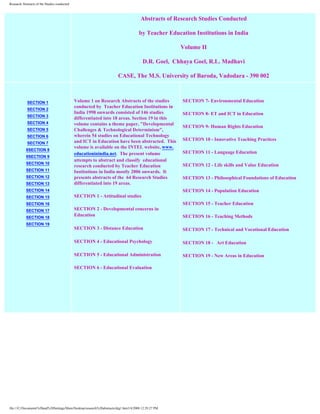
            SECTION 1                         Volume 1 on Research Abstracts of the studies            SECTION 7- Environmental Education
                                              conducted by Teacher Education Institutions in
            SECTION 2
                                              India 1998 onwards consisted of 146 studies              SECTION 8- ET and ICT in Education
            SECTION 3
                                              differentiated into 18 areas. Section 19 in this
            SECTION 4                         volume contains a theme paper, "Developmental
                                                                                                       SECTION 9- Human Rights Education
            SECTION 5                         Challenges & Technological Determinism",
            SECTION 6                         wherein 54 studies on Educational Technology
                                              and ICT in Education have been abstracted. This          SECTION 10 - Innovative Teaching Practices
            SECTION 7
                                              volume is available on the INTEL website, www.
            8SECTION 8
                                              educationinindia.net. The present volume                 SECTION 11 - Language Education
            9SECTION 9
                                              attempts to abstract and classify educational
            SECTION 10                                                                                 SECTION 12 - Life skills and Value Education
                                              research conducted by Teacher Education
            SECTION 11                        Institutions in India mostly 2006 onwards. It
            SECTION 12                        presents abstracts of the 64 Research Studies            SECTION 13 - Philosophical Foundations of Education
            SECTION 13                        differentiated into 19 areas.
            SECTION 14                                                                                 SECTION 14 - Population Education
            SECTION 15                        SECTION 1 - Attitudinal studies
            SECTION 16                                                                                 SECTION 15 - Teacher Education
            SECTION 17                        SECTION 2 - Developmental concerns in
            SECTION 18
                                              Education                                                SECTION 16 - Teaching Methods
            SECTION 19
                                              SECTION 3 - Distance Education                           SECTION 17 - Technical and Vocational Education

                                              SECTION 4 - Educational Psychology                       SECTION 18 - Art Education

                                              SECTION 5 - Educational Administration                   SECTION 19 - New Areas in Education

                                              SECTION 6 - Educational Evaluation


file:///C|/Documents%20and%20Settings/Main/Desktop/research%20abstracts/drg1.htm3/4/2008 12:29:27 PM
Section 1


                                                             Section 1
                                      Attitudes of Students and Teachers


Studies on various factors influencing the attitudes of teachers and students towards various
educational aspects are presented here. Various researches done so far are given in the tabular form.


   Sr. No.                                       Study Title                                                   Investigator ID
                 A study of impact of Computer Education on the                                  Archana Kumari, 2000, Lucknow
       1.
                 Scientific Attitude of Students                                                 University, Lucknow
                 Gender and Occupational Stereotypes of Student’s
                 Attitudes in Science and Their School                                           Mr. H.S. Shishodia 2003,
       2.                                                                                        Barakatullah Vishwavidyalaya,
                 Achievements in Biology and Physical Science ( A
                                                                                                 Bhopal (M.P.)
                 Developmental Study)
                 A Study of Some Factors Influencing Attitude
                 Towards Energy Education and its Relationship                                   Mrs. Bhavna, 2005, Dr. Ram
       3.                                                                                        Manohar Lohia Avadh
                 with Academic Qualifications and Personality
                                                                                                 University, Faizabad, Uttar
                 Characteristics of Secondary School Teachers in                                 Pradesh, India.
                 Devi Patan Region (Uttar Pradesh)
                 TEACHERS’ AND ADOLESCENT STUDENTS’
                 ATTITUDE TOWARDS CO-EDUCATION
                 ( Teachers’ and Adolescent Students’ Attitude                                   Mrs. Swalehakhatoon Sagir
       4.                                                                                        Pathan, 2005,University of
                 Towards Self, Same-Sex, Opposite-Sex, Teachers,
                                                                                                 Pune, Pune
                 Parents and Colleges in a few Single-Sex and Co-
                 Educational Junior Colleges in Pune City)
                 A Study of the Attitude towards School, Aspirations
                 and Educational Problems of Truant and Non-Truant                               Satish Kumar,2007, Kurukshetra
       5.
                 Students of the Government High Schools of Haryana                              University, Kurukshetra
                 in the context of their Academic Achievement
                 A Comparative Study of Primary Teachers
                 Competencies, Attitude and Their Performance                                    Syeeda Shanavaz, 2007,
       6.
                 Belonging to DPEP and Non-DPEP Districts of                                     University of Mysore , Mysore
                 Karnataka


file:///C|/Documents%20and%20Settings/Main/Desktop/research%20abstracts/section1.htm (1 of 2)3/4/2008 12:29:28 PM
Section 1


                 Influence of Motivation, Competence and Aptitude of                             Kambhampati Prasad, 2007,
       7.
                 the Teachers on their English Teaching Ability                                  University of Mysore, Mysore
                 Impact of an Intervention Programme on Awareness
                 Levels and Attitudes of High School Students,                                   Sandeep Berwal, 2007,
       8.                                                                                        Kurukshetra University,
                 Teachers and Administrators Towards Pupils with
                                                                                                 Kurukshetra
                 Disabilities in Inclusive Settings

                                                                                <Previous>                      <Next>


file:///C|/Documents%20and%20Settings/Main/Desktop/research%20abstracts/section1.htm (2 of 2)3/4/2008 12:29:28 PM
Section 2


                                                             Section 2
                                   Developmental Concerns in Education
Studies related to various aspects of developmental concerns of education like status of education of
tribals, survey of educational status of different localities etc. are included in this section. various titles
in this section are as follows.


Sr. No.                              Study Title                               Investigator ID
            A Study of Quality of Life of the Tribals of Keonjhar
                                                                      Kartikeswar Roul, 2006, Utkal
    1.      District in Orissa in Relation to Educational Development
                                                                      University, Bhubaneswar
            Programme
            A Study of the Effects of different educational Programs Mr. Gajanan Sahebrao Nare,
    2.                                                                2006, Sant Gadge Baba
            on the development of Personality of Primary Students
                                                                      Amaravati Vidyapeeth, Amravati
            A Study of DPEP Intervention in Tribal Education at       Das, B.C. University of
    3.
            Primary Stage and Its Effectiveness in Orissa,            Allahabad, Allahabad, 2006
            Evaluation of Self Help Group (SHG) Interventions on      Suryamani Mishra, 2007,
    4.
            Women's Education                                         University of Lucknow, Lucknow
            A Follow-up Study of Alumni of Vivekanand College of Anju Sharma, 2007, Kurukshetra
    5.
            Education Lakhanpur                                       University, Kurukshetra,
            UCHCHA SHIKSHA KEE LABHARTHI KE ROOP Krishna Gupta, 2007, Banasthali
    6.      MEY BHARTIYA MAHILA (Indian Woman as a                    Vidyapeeth, Banasthali,
            Beneficiary of Higher Education)                          Rajasthan
            Evaluation Study of Role and Functions of Haryana
                                                                                                 Mukesh, 2007, Kurukshetra
    7.      School Board of Education Towards Improving Secondary
                                                                                                 University, Kurukshetra
            Education in the State
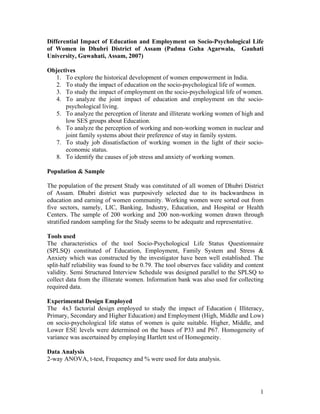
            Differential Impact of Education and Employment on                                   Padma Guha Agarwala, 2007,
    8.      Socio-Psychological Life of Women in Dhubri District of                              Gauhati University, Guwahati,
            Assam                                                                                Assam
            “Shiksha Se Virat Grameen Mahilayon Ki Samshayon Ka                                  Ranjana Mishra, 2007, Dr. Ram
    9.      Ek Adhyyan (Pratap Janpad Ke Patti Tehseel Kee                                       Manohar Lohiya Avadh
            Mahilaon Ka Ek Adhyyan)”                                                             Vishwavidyalaya, Faizabad


file:///C|/Documents%20and%20Settings/Main/Desktop/research%20abstracts/section2.htm (1 of 2)3/4/2008 12:29:28 PM
Section 2


                                            <Previous>                  <Next>


file:///C|/Documents%20and%20Settings/Main/Desktop/research%20abstracts/section2.htm (2 of 2)3/4/2008 12:29:28 PM
Section 3


                                                            Section 3
                                                     Distance Education
Researches related to problems, issues and status of non-formal education at different places related to
different disciplines are presented here. Various studies under this heading are as follows.


 Sr. No.                                      Study Title                                                   Investigator ID
     1.
             Status of non-formal education in the district of Jalna- A Sudhakar Bhimrao Gaikwad,
                                                                        2002, Dr. BAMU University,
             Critical Study
                                                                        Aurangabad
     2.                                                                                         Mrs. Bimla Kapoor, 2004, Indira
             Development of an Evaluation Model for Nursing
                                                                                                Gandhi National Open
             Programme through Distance Mode
                                                                                                University, New Delhi)


                                                                       <Previous>                     <Next>


file:///C|/Documents%20and%20Settings/Main/Desktop/research%20abstracts/section_3.htm3/4/2008 12:29:28 PM
Section 4


                                                             Section 4
                                                   Education Psychology
Researches conducted in psychology field has brought tremendous changes in to the education
discipline. All the processes of class room interaction, teacher-student interaction have undergone
drastic changes due to this. Many new trends in the methods and approaches like student centered
approach, cooperative learning, active learning etc. are brought into the learning environments all over
the world. Different researches related to adjustment, mental health, attitude formation due to
environmental effect etc. are presented here.


    Sr.No.                                        Study Title                                                   Investigator ID
                   Impact of an intervention programme in the
        1.         remediation of reading difficulties among children                               Anjana, 2006, Kurukshetra
                                                                                                   University, Kurukshetra
                   with learning disabilities

                   Development of An Enneagram Educational
                   Programme for Enhancing Emotional Intelligence of                               Eve Justina Romould,
        2.                                                                                         2006CASE, MSU, Baroda
                   Student Teachers


                   Effectiveness of Inductive Thinking Model of                                    Annapurna Prusty, Utkal
        3.         Teaching on Learners’                                                           University, Bhubaneswar,
                   Achievement in Social Studies                                                   Orissa, 2006


                   Study of Personality Traits and Academic                                        Ashok Kumar Parida,
        4.         Achievement in Relation to Socio-Metric Status of                               Kurukshetra University,
                   Tribal Students in Varying School Settings                                      Kurukshetra, 2007


                   Life Satisfaction of Primary School Teachers in                                 Baljeet Kaur, Punjab University,
        5.         Relation to Psycho Social Factors                                               Chandigarh, 2007


                   Alienation, Frustration and Mental Health in Relation
                   to Emotional Intelligence of College-Students with    Rambir, Kurukshetra University,
        6.                                                               Kurukshetra, 2007
                   Visual Impairment and Normal Vision


                         <Previous>                  <Next>

file:///C|/Documents%20and%20Settings/Main/Desktop/research%20abstracts/section_4.htm (1 of 2)3/4/2008 12:29:29 PM
Section 4


file:///C|/Documents%20and%20Settings/Main/Desktop/research%20abstracts/section_4.htm (2 of 2)3/4/2008 12:29:29 PM
Section 5


                                                              Section 5
                                               Educational Administration
Educational Administration is the backbone for the process of teaching learning. All through
administration has to keep on changing with the needs and aspirations of the society to bring in the
reforms into the system and to manage it properly. Related to this aspect several researches regarding
leadership qualities, problems and issues related to management of education are presented here in the
tabular form.


  Sr.No.                             Study Title                                                                 Investigator ID
               A Study of Educational Management Practices in
               Secondary Schools and their Implications for In-Service                             Jeremiah Mutuku Kalai, 2006,
      1.
               Training of Head Teachers: A Survey of Kitui and                                    University of Pune
               Machakos Districts, Kenya
                                                                                                   Uddhab Charan Barik, 2007,
               A Study of the Administrative Organizations of Primary                              Utkal University, Bhubaneswar,
      2.
               Education System in Orissa                                                          Orissa,

               A Study of Work-Efficiency in Relation to Different                                 Kompal Wadhawan, 2007,
      3.       Work-Environment Models as Perceived by University                                  Kurukshetra University,
               Faculty                                                                             Kurukshetra

               A Study of the Organizational Commitment of Primary                                 Phra Kantawee Kaewpang, 2007,
      4.                                                                                           Kurukshetra University,
               School Administrators in Thailand
                                                                                                   Kurukshetra


                                                      <Previous>                 <Next>


 file:///C|/Documents%20and%20Settings/Main/Desktop/research%20abstracts/section_5.htm (1 of 2)3/4/2008 12:29:29 PM
Section 5


file:///C|/Documents%20and%20Settings/Main/Desktop/research%20abstracts/section_5.htm (2 of 2)3/4/2008 12:29:29 PM
Section 6


                                                                Section 6
                                                  Educational Evaluation
New ideas are being thought of evaluating the outcomes of educational process. Particularly when
process aspect is being given much importance now a days several radical thoughts of evaluation are
being put into research for bringing in expected results. Appraisal of teachers, remedial programmes
are occupying much importance in the process of educational evaluation. Different studies related to
these aspects are presented here.


    Sr. No.                                      Study Title                                                   Investigator ID
                   Study of Effectiveness of Remedial Programme for
                                                                                                 Ms. Archana Srivastava, 2004,
        1.         Improving Disability and Achievement in
                                                                                                 Vikram University, Ujjain
                   Mathematics of Class VII Students
                                                                                                 Shrirang Baburao Kshirsagar,
        2..        Evaluation of Teacher by Students                                             University of Pune, Pune, 2006

                   Preparation and Try-Out of a Remedial Course in
                                                                                                 Govind Vyavahare, 2007, S. P.
        3.         English for Graduate Learners Who Make Glaring
                                                                                                 University, Gujarat
                   Errors in Writing


                               <Previous>                   <Next>


file:///C|/Documents%20and%20Settings/Main/Desktop/research%20abstracts/section_6.htm (1 of 2)3/4/2008 12:29:29 PM
Section 6


file:///C|/Documents%20and%20Settings/Main/Desktop/research%20abstracts/section_6.htm (2 of 2)3/4/2008 12:29:29 PM
Section 7


                                                             Section 7
                                                Environmental Education
With industrialization one problem that cropped up is pollution of environment worldwide causing
concerns among people to protect planet earth for survival of all species living on it. Discussions on
several forums came to a conclusion to introduce this issue in form of curriculum in formal system, so
that an awareness is generated from earlier days so that people develop a proper, healthy, and useful
living style that helps in reducing the pollution. With this intention now a days 'Environmental
Education' is introduced in formal educational system from primary level itself. Various aspects of
research done so far related to this education are presented here.


   Sr. No.                                      Study Title                                                    Investigator ID
                  Attitude Towards Environment and Perception of
       1.                                                                                        Mrs. Anu Radha, 2005, Punjab
                  Environmental Education Among Student- Teachers
                                                                                                 University, Chandigarh
                  and Teacher- Educators
                  Effectiveness of an Instructional package in
                                                                                                 Sharma Sumita, 2005,
       2.         Environmental studies among students of
                                                                                                 CASE, MSU, Baroda
                  standard VII
                  A Study of Emotional Proficiency of Adolescent                                 Gunjan, Banasthali Vidyapith,
       3.
                  Students                                                                       2006, Rajasthan


                                                                                      <Previous>                     <Next>


file:///C|/Documents%20and%20Settings/Main/Desktop/research%20abstracts/section_7.htm (1 of 2)3/4/2008 12:29:29 PM
Section 7


file:///C|/Documents%20and%20Settings/Main/Desktop/research%20abstracts/section_7.htm (2 of 2)3/4/2008 12:29:29 PM
Section 8


                                                              Section 8
                                                 ET and ICT in Education

Evolution in the field of Communication Technology has brought in tremendous changes for using
Educational Technology in teaching learning. Particularly Computer has occupied a prominent place in
the technological aspect of teaching learning process with its potential design, aiding in carrying on the
process efficiently with more visual effects and also sophistication in software and hardware with time
and evolution of internet and world wide web. Researches on use of ICT in education has occupied an
important place in Educational research in recent times and is a flourishing field with more and more
applications are being added with improvements in technology with changing times. Different
researches undertaken about use of ICT for efficient teaching learning are presented here.


 Sr.No.                                 Study Title                                                       Investigator ID
             Development of Multimedia Instructional System                           Mr. Anil Tanaji Patil, 2006, Shivaji
   1.
             on Computer Education for B.Ed. Pupil Teachers                           University, Kolhapur
             Development and Tryout of Self-Learning
             Materials in English subject on the unit of    Mr. Gautam A. Panchal, 2006, V.N. South
   2.
             ‘Active and Passive Voice’ for the Students of Gujarat University, Surat.
             Standard-XII
             A Study of the Relative Effectiveness of
                                                                                      S. Jayaraman, 2006, University of Madras,
             Computer Based Multimedia Learning Packages
   3.                                                                                 Engineering Education
             on Performance and Behavioural Outcomes of
             Students of Different Age Groups
             A Study of the Effectiveness of Computer Based                           Sunil Kumar Agarwal, DAVV, Indore ,
   4.        Learning Material on the Selected Chapters of                            2007
             Std. X Science
             Development of Multimedia Instructional System
                                                                                      Vishnu Pandurang Shikhare, Shivaji
   5.        on Educational Technology for B.Ed. Pupil
                                                                                      University, Kolhapur, 2007
             Teachers
             Development of Self-Learning Material and its
                                                                                      Basanta Gogoi, Dibrugarh University,
   6.        Effectiveness for Teaching General Science to
                                                                                      Dibrugarh, Assam, 2007
             Class IX Students of Assam State


 file:///C|/Documents%20and%20Settings/Main/Desktop/research%20abstracts/section_8.htm (1 of 2)3/4/2008 12:29:30 PM
Section 8

                                  <Previous>                     <Next>


file:///C|/Documents%20and%20Settings/Main/Desktop/research%20abstracts/section_8.htm (2 of 2)3/4/2008 12:29:30 PM
Section 9


                                                            Section 9
                                               Human Rights Education
Spread of democratic attitudes and establishment of democratic governments all over the world
resulted in more concentrated thinking over protecting human dignity and preventing human abuse
basing on race, caste, region and many other things. In the present world of conflicts and severe
competition concepts of human rights have gained importance again. The present section presents
researches related to the curriculum regarding human rights education.

    Sr.No.                                      Study Title                                                 Investigator ID
                  Development of a Curriculum Framework on Human
                                                                   Swarnaprava Sahoo, 2002, Utkal
       1.         Rights Education for the children below fourteen
                                                                   University, Bhubaneshwar
                  years of age


                            <Previous>                    <Next>


file:///C|/Documents%20and%20Settings/Main/Desktop/research%20abstracts/section_9.htm3/4/2008 12:29:30 PM
Section 10


                                                           Section 10
                                           Innovative Teaching Methods
Improvements in technology, changing thinking patterns about students' learning, active learning and
constructivist approaches domination in the teaching learning process are bringing in radical changes
in the role of teacher in classrooms. Teacher has to be a facilitator of knowledge in present days, as
students have many other channels of getting information, knowledge about content. This made
teacher to employ innovative ways of teaching than using traditional lecture methods. Teacher has to
use different approaches where student will come to know about different channels of getting
information related to content. This also caters to the needs of individual differences existing in the
classroom. Various approaches adopted by researchers regarding this aspect are presented here.


   Sr. No.                                      Study Title                                                  Investigator ID
       1.         Educational Innovations in the Primary Schools of                             Ashwin Kumar D. Trivedi, 2003,
                  Gujarat State : A Status Survey                                               South Gujarat University, Surat


                                                                                    <Previous>                      <Next>


file:///C|/Documents%20and%20Settings/Main/Desktop/research%20abstracts/section_10.htm3/4/2008 12:29:30 PM
Section 11


                                                           Section 11
                                                     Language Education
In a multi lingual country like India, language education has tremendous importance. Many
committees and commissions have commented on these points and stressed on a need to evolve a
proper framework for language education in the country. Various formulas have been thought of with
partial success in implementation. The present section presents the views of different researchers
related to language education matters in education.


      Sr. No.                                      Study Title                                                 Investigator ID
                        A Comparative Study of Difficulties in English
             1.                                                                                  Fr. P.P. Joseph, 2005,
                        Learning faced by different categories of school
                                                                                                 Barkatullah University, Bhopal
                        students in Bhopal
                        English Language Competence of Teachers and
             2.                                                                                  Mr. Umer Farooque, 2005, S.L.
                        Students’ Achievement in English Medium
                                                                                                 P., University of Mysore, Mysore
                        Primary Schools of Kannur District
                        Study of the Impact of Teaching Strategies in
                        English in Developing Creativity among IX        Shamayel Rezwana,
             3.         Standard Students of Bangalore City with special 2007Bangalore University,
                        reference to Sex, Intelligence and Socio-        Bangalore
                        Economic Status


                                                                                   <Previous>                         <Next>


file:///C|/Documents%20and%20Settings/Main/Desktop/research%20abstracts/section_11.htm (1 of 2)3/4/2008 12:29:30 PM
Section 11


file:///C|/Documents%20and%20Settings/Main/Desktop/research%20abstracts/section_11.htm (2 of 2)3/4/2008 12:29:30 PM
Section 12


                                                           Section 12
                                         Life Skills and Value Education
Never returning process of globalization, emphasis on human rights, democratization of working
environments have influenced educational systems to think about providing training in life skills and
values for students in formal educational setting. To cope with the fast changing world order, to
accustom with the changing working atmosphere, to cope with the pressures of daily life - certain life
skills and values are very important. Training about these if gets started early in life, it is likely to lead
towards a better future life style. The present section presents researches related to such aspects.

 Sr. No.                                       Study Title                                                     Investigator ID
              A Critical Study of Secondary School Curriculum with
              reference to Developing Skills for Crisis Management                               Mr. Sainath Pandurang Shenoy,
     1.
                                                                                                 2005, University of Mumbai,
              among Students of selected English Medium High
                                                                                                 Mumbai
              Schools of Mumbai
     2.       Effect of Inductive Thinking Strategy on English                                   Suman Dalal, 2005, KUK,
              Language Development and Concept Formation                                         Kurukshetra
              A Study of Some Determiners of Democratic Values
     3.                                                                                          Alok Gardia, BHU, 2007
              Among Higher Secondary Students
              A Study of Personal Values of Senior Secondary School
                                                                    Anshu Narad, Punjab University,
     4.       Students in Relation to School Environment and Home
                                                                    2007
              Environment
              A Comparative Study of Values, Intelligence and
                                                                                                 Malti, Mahatma Gandhi Kashi
     5.       Academic Achievement of Students of UP, CBSE, and
                                                                                                 Vidyapith, Varanasi, 2007
              ICSE Board Schools
              Value Patterns of School Teachers in Relation to Life                              Rajinder Toong, Punjab
     6.
              Satisfaction and Personality Dimensions                                            University, 2007


                                                                                  <Previous>                          <Next>


file:///C|/Documents%20and%20Settings/Main/Desktop/research%20abstracts/section_12.htm (1 of 2)3/4/2008 12:29:31 PM
Section 12


file:///C|/Documents%20and%20Settings/Main/Desktop/research%20abstracts/section_12.htm (2 of 2)3/4/2008 12:29:31 PM
Section 13


                                                           Section 13
                                 Philosophical Foundations of Education
When we say that philosophy is a way of life, a mental disposition, an opinion we possess about a
thing, education also needs to have a proper philosophical foundation to shape it according to the
needs of society. Because education is nothing but proper socialization of child according to the
requirements of society. From ancient days several views are expressed about the educational process
that have undergone changes and adopted with certain modifications till today. The present section
deals with some of these aspects.


    Sr. No.                                       Study Title                                                  Investigator ID

                   Educational and Psychological Implications of                                 Ms. Sunita Singh, 2006, Dr.
        1.                                                                                       Rammanohar Lohiya Avadh
                   Shrimadbhagvatgita
                                                                                                 Vishwavidyalaya, Faizabad
                   Analytical Study of Value Education in                                        Kumari Shobhna Purushottam
        2.         ‘GramGeeta’ of Respected National Saint Tukdoji                               Saoji, 2006, Sant Gadge Baba
                   Maharaj                                                                       Amravati Vidyapeeth
                   Assertion of Traditional Yoga in Human Health and Mansi Bera, Pune University,
        3.
                   Value Education                                   2007


file:///C|/Documents%20and%20Settings/Main/Desktop/research%20abstracts/section_13.htm (1 of 2)3/4/2008 12:29:31 PM
Section 13


                                                      <Previous>                     <Next>


file:///C|/Documents%20and%20Settings/Main/Desktop/research%20abstracts/section_13.htm (2 of 2)3/4/2008 12:29:31 PM
Section 14


                                                           Section 14
                                                   Population Education
Improvements in Science and Technology and medicinal fields has increased the life expectancy rate
of human beings. This has resulted in environmental pollution as a result of population explosion.
Many attempts are being made by formal and non-formal education systems to make people aware of
this important aspect for peaceful survival of species on earth. In the present section studies related to
researches conducted on this aspect are presented.


     Sr. No.                                      Study Title                                                Investigator ID
                     A Study of the Knowledge and Attitude of
                     Students and Teachers and the Awareness of
                     Parents towards Population Education in Higher                             Pradeep Kumar Agrawal , 2002,
         1.                                                                                     Rani Durgavati University,
                     Secondary School Curriculum with respect to the
                                                                                                Jabalpur
                     ongoing Efforts being made by various
                     Organizations


                                                                                    <Previous>                    <Next>


file:///C|/Documents%20and%20Settings/Main/Desktop/research%20abstracts/section_14.htm3/4/2008 12:29:31 PM
Section 15


                                                           Section 15
                                                      Teacher Education
To keep the process of teaching learning at a proper pace in school system there is a need to design
proper teaching preparation programme. The present section deals with different issues related to this
aspect.


   Sr. No.                                       Study Title                                                   Investigator ID
       1.         A Study of the Functional Education Component of
                                                                                                 Ameena Ahmed, 1999, MSU,
                  Rural Development Project-9 ( RDP-9) in four
                                                                                                 Baroda
                  districts of Bangladesh
       2.
                  Development of teacher Education in Rajasthan Post- Kamlesh Banu, 2002, Dr. B.R.
                  Independence, its present status and problems       Ambedkar University, Agra

                  Preparation of A Creativity Program for Pre-Service
                                                                       Satish P. Pathak, CASE, MSU,
       3.         Teacher Trainees at Primary Level and A Study of Its
                                                                       2002
                  Effectiveness
                  Teacher Education in Portuguese Goa (1841-1961):                               Richard Cabral, University of
       4.
                  An Historical Perspective                                                      Pune, Pune, 2007


                                                              <Previous>                           <Next>


file:///C|/Documents%20and%20Settings/Main/Desktop/research%20abstracts/section_15.htm (1 of 2)3/4/2008 12:29:31 PM
Section 15


file:///C|/Documents%20and%20Settings/Main/Desktop/research%20abstracts/section_15.htm (2 of 2)3/4/2008 12:29:31 PM
Section 16


                                                           Section 16
                                                      Teaching Methods
For ease of transaction, curriculum is divided into different subjects, regarding teaching of which
different teaching methods are devised like Science method, Mathematics Method, English method
etc. The present section presents some studies conducted related to this matter.


  Sr. No.                                      Study Title                                                   Investigator ID
                A Study of the Status and Development of Science                                Mr. Khriesamhalie Pienyu,
      1.        Education at High and Higher Secondary School                                   2004, University of Nagaland,
                Level in Nagaland since its Statehood                                           Kohima


                                                             <Previous>                              <Next>


file:///C|/Documents%20and%20Settings/Main/Desktop/research%20abstracts/section_16.htm3/4/2008 12:29:31 PM
Section 17


                                                           Section 17
                                     Technical and Vocational Education
Many commissions and committees on education have talked about designing a proper technical and
vocational education systems to improve the employment opportunities for the people and to cater to
the middle level employment needs of the society. But the attempts regarding this matter still are not
successful to full extent. Some researches related to technical and vocational education are presented
here.


    Sr. No.                                      Study Title                                                   Investigator ID

                   A Comparative Study of the System of Technical
                                                                                                 Ajit Ram Rao Thete, 1999, Dr.
        1.         Education in Germany and India with special
                                                                                                 BAMU, Aurangabad
                   reference to Maharashtra State
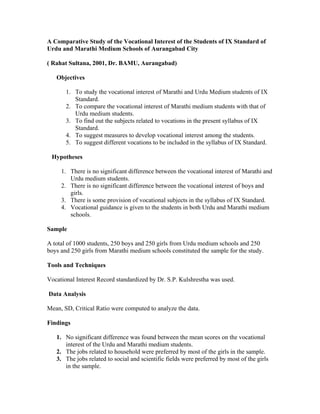
                   A Comparative Study of the Vocational Interest of
                                                                                                 Rahat Sultana, 2001, Dr.
        2.         the Students of IX Standard of Urdu and Marathi
                                                                                                 BAMU, Aurangabad
                   Medium Schools of Aurangabad City


file:///C|/Documents%20and%20Settings/Main/Desktop/research%20abstracts/section_17.htm (1 of 2)3/4/2008 12:29:32 PM
Section 17


                                                                          <Previous>                          <Next>


file:///C|/Documents%20and%20Settings/Main/Desktop/research%20abstracts/section_17.htm (2 of 2)3/4/2008 12:29:32 PM
Section 18


                                                           Section 18
                                                          Art Education


Studies related to art education area are presented here. Researches done on curriculum development
are given in the tabular form.


   Sr. No.                           Study Title                                                        Investigator ID
                 Development of Art Education Curriculum at the                                O.P. Parameswaran, CASE,
       1.
                 Secondary School Level                                                        MSU, 2001


                                                                               <Previous>                    <Next>


file:///C|/Documents%20and%20Settings/Main/Desktop/research%20abstracts/section_18.htm3/4/2008 12:29:32 PM
Section 19


                                                          Section 19
                                                New Areas in Education


With changing situations in society several new areas are being experimented in education. The
present section is dealing with researches related to such aspects.


   Sr. No.                            Study Title                                                       Investigator ID
                 Effect of Yoga Training Programme on the Physical                             Yoginder, Kurukshetra
       1.
                 and Mental Health of School Students                                          University, 2007

                                                                              <Previous>                       <Next>


file:///C|/Documents%20and%20Settings/Main/Desktop/research%20abstracts/section%2019.htm3/4/2008 12:29:32 PM
A study of impact of Computer Education on the Scientific Attitude of Students

(Archana Kumari, 2000, Lucknow University, Lucknow)

Objectives

   1. To compare the scientific attitude of students studying computer education with
       that of those students not studying computer education.
   2. To study the role of gender in the development of scientific attitude of students.
   3. To study the role of SES in the development of scientific attitude of students.
   4. To study the role of Education of Mother in the development of scientific attitude
       of students.
   5. To study the role of IQ in the development of scientific attitude of students.
   6. To study the role of family structure in the development of scientific attitude of
       students.
   7. To study the role of medium of instruction in the development of scientific
       attitude of students.
   8. To study the role of anxiety level in the development of scientific attitude of
       students.
   9. To study the role of adjustment in the development of scientific attitude of
       students.
   10. To study the role of computer facilities in the development of scientific attitude of
       students.

Sample

A sample of 572 students of class VIII was selected through random sampling (Computer
Education: 308, Non-Computer Education: 264)

Tools and Techniques

SES Scale by Kuppuswamy, Raven’s Progressive Matrices, IPAT by Cattel, and
Adjustment Inventory by Mittal were used for the study.

Data Analysis

t-test was used for data analysis.

Findings

   1. Computer Education has been found non-effective in the development of
      scientific attitude of the students.
   2. Sex has not been found affecting the development of scientific attitude
      significantly.
3. SES has been found affecting the development of scientific attitude significantly.
   The average SES students have been found to develop scientific attitude at a
   significantly higher level.
4. The Education of mothers has been found to affect the development of scientific
   attitude among children significantly.
5. Positive correlation has been found between IQ and Scientific attitude.
6. The structure of family ( Joint and Nuclear) and anxiety level have not been found
   affecting the development of scientific attitude.
7. The students of Hindi medium have been found to have higher scientific attitude
   than the English medium students.
8. The students of higher adjustment have been found to have higher scientific
   attitude.
9. The students with higher computer education facilities have been found with
   higher scientific attitude.
Gender and Occupational Stereotypes of Student’s Attitudes in Science and Their
School Achievements in Biology and Physical Science (A Developmental Study)

Mr. H.S. Shishodia, 2003, Barakatullah Vishwavidyalaya, Bhopal (M.P.)

Objectives:

   1. To develop a test of stereotyping well suited to Indian Conditions.
   2. To develop a test of achievement in physical and biological sciences for class VII,
      VIII, IX and X.
   3. To develop an attitude scale to measure attitude of students towards science.
   4. How do gender stereotypes correlate with their career preferences?
   5. How do gender stereotypes correlate with their attitudes towards Science?
   6. How do gender stereotypes of students correlate with their cognitive measure in
      biological sciences?
   7. How do gender stereotypes of students correlate with their achievement in
      physical sciences?
   8. How do gender stereotypes of students correlate with their achievement in
      biology with the advancement in their each year age count from 12 to 15 years?
   9. How do students’ gender stereotypes and their attitude in science influence their
      achievement in biology?


Research Design: It is a descriptive normative survey.

Sample of the Study: 376 students, 178 boys and 198 girls drawn from three schools
from Standards VII, VIII and X in the age range 12+ to 15+ constituted the sample for
the study.

Tools and Techniques: Occupation Stereotype Inventory by Allison and Kelley, and Sex
Stereotype Test by Allison have been well adapted for the Study. The investigator has
constructed the Tests of Biology and Physical Sciences. The investigator developed
attitude Scale for studying attitude in Science.

Findings of the Study: The investigator has arrived at the following findings:

   •   The gender image of science has been found masculine rather than feminine.
   •   Masculine-self and feminine-self have been found to go with similar sex_career
       preferences.
   •   Feminine Self and Masculine Self have been found to be bipolar psychological
       tendencies as evinced by significantly negative correlations obtained between
       Feminine Self and Masculine Self of boys and girls for 12 years of children to 15
       years of children.
   •   The feeling of Masculine Self increases with the advancement of the age of the
       child.
   •   Appearance of achievement motivation for Science at 15+ is commendable.
•   At 12+ the students are found to merge with a strong negative feeling between
    Masculine Self and Feminine Self which gradually dilutes with adolescence. This
    bipolar attitude is diluted a little by 15+.
•   The career preferences of Feminine Self boys and girls consistently maintain a
    significantly negative correlation with Career Preference for Masculine courses
    from 12 to 15 years of children. The age or education does not counteract this
    relationship.
•   The Masculine Self of boys which was found significantly cohesive for Career
    Preferences for Masculine and Career Preferences for Feminine at 12+ develops
    aversion for CPF by 14+ but gets it diluted by 15+.
•   The Masculine Self attraction for Masculine Career Preferences, consistently
    strengthens with age. This persistence denotes the increase of masculine self both
    in boys and girls.
•   The BST and PST relationship has been found highly significant at all age counts
    from 12+ to 15+.
•   The significantly high positive correlation obtained between MS and ATS of boys
    defines science as of masculine nature. Such a picture has been found ill defined
    in case of girls.
•   There has been found high positive correlation between boys MS and FS, but no
    such relationship has been found in case of girls.
•   The significant correlations secured by girls between FS and CPF and MS and
    CPM relate to girls Psychological Self intermixed with their Biological Self. Only
    stronger girls have been found to have affinity with masculine jobs, but their MS
    and FS are distinctly identified.
•   The cultural context of boys and girls does construct their attitudes, gender and
    occupational stereotypes.
•   Both boys and girls have been found to have a highly significant positive attitude
    towards science much above the average count.
•   The mean score differences of MS of boys and MS of girls as also the FS of girls
    and FS of boys have been found significant at .01 level.
•   The mean score differences of CPF of boys and CPF of girls as also the CPM of
    girls and CPM of boys have been found significant at .01 level.
•   Girls have been found to have an edge over boys proclaiming feminine nature of
    biological subjects.

AT 12+ level

•   Bi-modal functions of FS and MS, FS and CPM were identified. Another finding
    that FS goes with CPF was natural.
•   MS goes with CPM was also found natural. But Masculine Self of boys with
    higher achievement in Biology inverts the feminine nature of biology.
•   CPF goes with CPM. This denounces the masculine and feminine discrimination
    of the careers.
•   The positive correlation found between BST and PST, explains cognitive
    functions of child behaviour.
AT 13+ level
   • The CPF have been found repulsive to boys with high positive attitude in Science.
   • A strange change was observed at 13+ level that MS goes with FS. They are no
      more bi-polar.
   • MS boys preference for masculine careers was natural.
   • Boys CPF was found to go with the CPM as the continuity of 12+ age boys
      attitude.
   • BST and PST were found similar cognitive functions that go together.

   AT 14+ level

   •   Boys at 14+ seemed to endorse no positive correlation with any of the variables.
   •   For 14+ boys also FS and MS were not found bi-polar, but bi-modal.
   •   CPF and CPM, as also BST and PST were found indiscriminate functions.

   AT 15+ level

       •   Boys attitude again seems functional that defines bi-polarity between ATS and
           FS.
       •   Discriminations begin only FS boys make preferences for CPF and MS for
           CPM. This is adolescents characteristic where sex ( Biological) awareness is
           more acute.
       •   Boys at 15 find no difference between masculine and feminine career
           preferences .They are seen making preference for both.
       •   The male character of boys at 15+ is more distinct. The boys who make
           significant preferences for masculine career preferences score poorly in
           Biology.
       •   The Biology and Physical Sciences are not distinct is similarly looked as boys
           at 12,13 and 14.


Similar findings were found for girls. The comparative study of boys and girls
developmental trends stands on mean scores at 12+, 13+, 14+ and 15+. The attributes
gathered from matrix analysis for lively boys, masculine boys, feminine boys, sex-type
boys and similarly girls have their significant implications for the field.

       The study has answered many questions, and raised many more questions such as
follows:
       Are the gender stereotypes still there in subject choice?
       Are the gender stereotypes still there in Career choice?
       What is the level of interaction between the biological self and psychological
       self?
       What all are the determinants of subject choice?
       What all are the determinants of occupation choice?
The occupation choice is more of a function of progressively developmental
phenomenon of gender differentiation as, lively, masculine, and feminine and
sex-type or independent of these?
Can a person be distinctively labeled as masculine, feminine, lively, sex-type
or all these are role specific, all in one.
What is the relative status of feminine self and masculine self 15+ onwards?
Persons with which type of self out of lively, masculine, feminine and sex-type
are relatively more successful as doctors, engineers, lawyers, teachers,
businessmen, actors, and sales representatives?
Which all are the determinants of school achievement in Biology and
Physical Sciences?
Which are the essential attributes of scientific attitude?
What is the concept of “Ardh-Nareshwar”?
What is the concept of “Human-Animal”?
How do we differentiate lively and ugly self?
What is sex-type and what is sex-independent?
What finally is the thesis of the present study?
What specifically are the implications of the present study?
A Study of Some Factors Influencing Attitude Towards Energy Education and
its Relationship with Academic Qualifications and Personality Characteristics of
Secondary School Teachers in Devi Patan Region (Uttar Pradesh)

Mrs. Bhavna, 2005, Dr. Ram Manohar Lohia Avadh University, Faizabad, Uttar
Pradesh, India

Objectives:
  1. To compare the attitude of urban and rural teachers towards energy education.
  2. To compare the attitude of male and female teachers towards energy
      education.
  3. To compare the attitude of Arts, Science and Commerce teachers towards
      energy education.
  4. To compare the attitude of General, OBC and SC/ST teachers towards energy
      education.
  5. To compare the attitude of teachers of different economic status towards
      energy education.
  6. To compare the attitude of teachers of different age groups towards energy
      education.
  7. To compare the attitude of teachers different academic qualifications towards
      energy education.
  8. To compare the extent of relationship between attitude towards energy
      education and personality characteristics of teachers.

   Sample of the study:
   The sample for the study has been drawn employing suitable sampling techniques.
   Multistage sampling has been done. The unit of sampling initially was school
   whose total population was 640. Out of these schools the investigator has selected
   5% of the schools from all the 4 districts of Devi Patan Region. In present sample
   there were 32 schools- 19 boys, 13 girls; 21 rural and 11 urban. All the teachers in
   the selected schools constituted the subjects for the Study.

   Tools:
   The Attitude Scale constructed through Likert’s Method by the Investigator and
   the Meenakshi Personality Inventory form the tools.

   Data Analysis:
   The data have been suitably analyzed through Mean Scores, SDs and Critical
   Ratio.

   Findings of the Study:
   The study has come out with meaningful findings as follows:

          1. There was no significant difference between attitudes of rural and
             urban teachers towards energy education.
2. There was no significant difference between attitudes of male and
     female teachers towards energy education.
  3. There was no significant difference between attitudes of Arts, Science
     and Commerce teachers towards energy education.
  4. There was no significant difference between attitudes of General, OBC,
     and SC/ST teachers towards energy education.
  5. There was no significant difference between attitudes of teachers of
     different economic status towards energy education.
  6. There was no significant difference in the attitudes of teachers of
     different age groups towards energy education.
  7. There was no significant difference in the attitudes of teachers of
     different academic qualifications towards energy education.
  8. There was no significant relationship between attitude towards Energy
     Education and Personality Characteristics of Teachers.

The study raises many questions, such as, follows:
       Do all the Secondary School Teachers have same Attitude towards
       Energy Education?
       None of the null hypotheses has been rejected. What does it mean?
       What could be the variables other than those considered by the
       investigator which might be influencing attitude of the teachers
       towards Energy Education?
       How to incorporate energy education concepts in the curricula at
       various levels? Suggest a Strategic Action Plan.
       How to realize Energy Education at the Field level through
       Educational Institutions?
       Having conducted this Study how the Problem Solving capabilities of
       the Scholar have increased?
       How do we differentiate delimitations and limitations of a study?
TEACHERS’ AND ADOLESCENT STUDENTS’ ATTITUDE TOWARDS CO-
EDUCATION ( Teachers’ and Adolescent Students’ Attitude Towards Self,
Same-Sex, Opposite-Sex, Teachers, Parents and Colleges in a few Single-Sex and
Co-Educational Junior Colleges in Pune City)

Mrs. Swalehakhatoon Sagir Pathan, 2005, University of Pune, Pune

Objectives:
  1. To study the relationship between the type of college (Single-sex/Co-
      educational) and students’ attitude towards self, opposite-sex, teachers,
      parents and colleges to ascertain students’ attitude towards co-education.
  2. To study the relationship between the sex ( Boys/Girls) of the student and
      his/her attitude towards self, opposite-sex, teachers, parents and colleges to
      ascertain students’ attitude towards co-education.
  3. To study the relationship between the religion of the student ( Hindu/Muslim/
      Christian) and his/her attitude towards self, opposite-sex, teachers, parents and
      colleges to ascertain students’ attitude towards co-education.

   Research Design: It is a survey type study.

   Variables considered: The type of institution (co-education/single-sex), sex of
   the student (boy/girl), and religion of the student (Hindu/Muslim/Christian) have
   been considered as independent variables, whereas, attitude of students towards
   self, opposite sex, teachers, parents and colleges has been considered as
   dependent variable.

   Sample of the study: Three co-educational colleges, two single-sex girls’
   colleges, and three single-sex boys’ colleges were selected purposively for the
   investigation. The study was limited to Junior Colleges as “Adolescent” students
   were the focus of attention. The samples of 1106 students- 599 single-sex ( 309
   boys & 290 girls), 466 co-educational ( 240 boys & 226 girls), and 41 non-Indians
   ( 31 boys and 10 girls), 118 teachers- 45 from single-sex boys ( 24 male and 21
   female), 34 from single-sex girls ( 3 male & 31 female), 39 from co-educational (
   13 male & 26 female) have been well drawn. A sample of 1065 students has been
   drawn for the study on the basis of type of institution and religion- 539 Hindu (
   250 single-sex & 289 co-education), 427 Muslim- (271 single-sex & 156 co-
   education), 99 Christian ( 77 single-sex & 22 co-education). 41 non-Indians ( 20
   single-sex boys, 10 single-sex girls & 11 co-educational boys) have been drawn
   for the study. The classification of Indian and non-Indians on the basis of religion,
   considered for the study is Muslims 459 ( 421 Indians & 38 non-Indian), Christian
   106 ( 103 Indian & 3 non-Indian). Also, the Heads of the Institutes, the Vice-
   Principals and the Supervisors of the Junior College participated in the study.

   Tools and techniques: questionnaire-cum-attitude scale, and questionnaires The
   data have been suitably analyzed employing Critical Ratio and content analysis.


                                                                                      1
Findings of the study:

   1. The pupils from Single-sex institutions had an unfavorable attitude towards
       themselves as compared to the pupils from co-educational institutions.
   2. The pupils from Co-educational institutions had a positive attitude towards
       opposite-sex as compared to the pupils from Single-sex institutions.
   3. The pupils from Co-educational institutions had a positive attitude towards
       teachers as compared to the pupils from Single-sex institutions.
   4. The pupils from Co-educational institutions had a better and positive attitude
       towards parents as compared to the pupils from Single-sex institutions.
   5. The pupils from Co-educational institutions had a favorable attitude towards
       the system of Co-education as compared to the pupils from Single-sex
       institutions.
   6. Boys had a positive attitude towards themselves as compared to Girls.
   7. Girls had a negative attitude towards the opposite-sex as compared to Boys.
   8. Boys had a negative attitude towards male teachers as compared to Girls.
   9. Girls had favorable attitude towards female teachers as compared to Boys.
   10. Boys had positive attitude towards parents as compared to Girls.
   11. Boys had positive attitude towards the system of Co-education as compared to
       Girls.
   12. Hindu pupils from Co-education institutions had a positive attitude towards
       themselves as compared to Hindu pupils from Single-sex institutions.
   13. Hindu pupils from Single-sex institutions had a negative attitude towards
       opposite-sex as compared as Hindu pupils from Co-education institutions.
   14. Hindu pupils from Co-education institutions had a negative attitude towards
       male teachers as compared to Hindu pupils from Single-sex institutions.
   15. Hindu pupils from Single-sex institutions had a negative attitude towards
       parents as compared to Hindu pupils from Co-education institutions.
   16. Hindu pupils from Co-education institutions had a positive attitude towards
       the system of Co-education as compared to Hindu pupils from Single-sex
       institutions.
   17. Muslim pupils from Co-education institutions and Single-sex institutions had
       a negative attitude towards themselves.
   18. Muslim pupils from Co-education institutions had a positive attitude towards
       the opposite-sex as compared to Muslim pupils from Single-sex institutions.
   19. Muslim pupils from Co-education institutions had a negative attitude towards
       male teachers as compared to Muslim pupils from Single-sex institutions.
   20. Muslim pupils from Co-education institutions and Single-sex institutions had
       a negative attitude towards parents.
   21. Muslim pupils from Co-education institutions had a positive attitude towards
       the system of Co-education as compared to Muslim pupils from Single sex
       institutions.
   22. Christian pupils from Co-education institutions had a negative attitude
       towards themselves as compared to Christian pupils from Single-sex
       institutions.


                                                                                  2
23. Christian pupils from Single-sex institutions had a negative attitude towards
    the opposite-sex as compared to Christian pupils from Co-education
    institutions.
24. Christian pupils from Single-sex institutions had an unfavorable attitude
    towards teachers as compared to Christian pupils from Co-education
    institutions.
25. Christian pupils from Co-education institutions and Single-sex institutions had
    a negative attitude towards parents.
26. Christian pupils from Single-sex institutions had an unfavorable attitude
    towards Co-education as compared to Christian pupils from Co-education
    institutions.
27. Non-Indian Muslim pupils had a positive attitude towards themselves as
    compared to Indian Muslim pupils.
28. Non-Indian Muslim pupils and Indian Muslim pupils had a positive attitude
    towards the opposite-sex.
29. Non-Indian Muslim pupils and Indian Muslim pupils had a positive attitude
    towards teachers.
30. Non-Indian Muslim pupils and Indian Muslim pupils had a positive attitude
    towards parents.
31. Non-Indian Muslim pupils had a positive attitude towards the system of Co-
    education as compared to Indian Muslim pupils.
32. Teachers from o-education institutions had a negative attitude towards
    themselves as compared teachers from Single-sex institutions.
33. Teachers from Co-education institutions had a negative attitude towards
    pupils as compared to teachers from Single-sex institutions.
34. Teachers from Co-education institutions had a positive attitude towards male
    teachers as compared teachers from Single-sex institutions.
35. While seeking permission to open a college, the management applies for a Co-
    education college.
36. 72% teachers were in favour of Co-education whereas 27.9% teachers were
    not in favour of Co-education.
37. 79.6% students were in favour of Co-education whereas 20% of the students
    were not in favour of Co-education.
38. Both boys and girls from Co-education Junior Colleges had significantly
    higher and better attitude towards self, opposite sex, teachers, parents and
    college as compared to Boys and girls from Single-sex Junior Colleges.
39. Boys had a significantly favourable attitude towards self, opposite-sex,
    teachers, parents and college as compared to females.
40. Hindu pupils from Co-education institutions had a significantly better attitude
    towards self, opposite-sex and college as compared to Hindu Pupils from
    single-sex Institutions.
41. Hindu Pupils from Co-education institutions had a significantly unfavorable
    Attitude towards male teaches as compared to Hindu students from Single-sex
    Institutions.
42. Hindu boys and girls from Co-education institutions had significantly
    unfavourable attitude towards parents as compared Hindu boys and girls from


                                                                                 3
single-sex institutions.
   43. Christian boys and girls from Co-education institutions had a significantly
        unfavorable attitude towards self as compared self as compared to Christian
        boys and girls from Single-sex institutions.
   44. Christian boys and girls from Co-education institutions had a significantly
        Better attitude towards opposite-sex, teachers, parents and the system of
        Co-education as compared to Christian boys and girls from Single-sex
        institutions.
    45. Muslim boys and girls from Co-education Junior Colleges had a
         significantly unfavorable attitude towards self and male teachers as
         compared to Muslim boys and Girls from Single-sex Junior Colleges.
     46. Muslim boys and girls from Co-education Junior Colleges had a
          significantly better Attitude towards opposite-sex and teachers in general as
          compared to Muslim boys and Girls from Single-sex Junior colleges.
     47. Muslim boys and girls had a significantly unfavorable attitude towards
           parents and the System of co-education as compared to Muslim boys and
           girls from co-education Junior colleges.
     48. Non-Indian Muslims had a significantly better attitude towards self as
           compared to Indian Muslims.
     49. Non-Indian Muslims had a significantly favourable attitude towards the
           system of single-sex as compared to Indian Muslims.
     50. Large number of teachers from Co-education institutions as well Single-sex
           institutions favour system of Co-education.

A large majority of the teachers and students from co-education institutions, as well
as, single sex institutions have been found in favour of co-education. Most non-
Indians were found in favour of co-education. Hindu and Muslim students from co-
education institutions were found to have un-favourable attitudes towards their
parents. Boys and girls from co-education institutions differed in their attitude
towards self, opposite sex, teachers, parents and the college as compared to boys and
girls from single-sex institutions. Male pupils were found to have more conflicts with
their father as compared to girls, whereas, girls were reported to have more conflicts
with their mothers tan their fathers. Hindu and Muslim pupils were fund to have
unfavorable attitude towards male teachers. Muslim pupils were found to have
negative attitude towards co-education. The atmosphere of co-educational colleges
was found better than single-sex colleges. The findings have been interpreted by the
investigator meaningfully. The Researcher’s impressions and recommendations are
valuable.


                                                                                      4
A Study of the Attitude towards School, Aspirations and Educational Problems
of Truant and Non-Truant Students of the Government High Schools of
Haryana in the context of their Academic Achievement (Satish Kumar,
Kurukshetra University, Kurukshetra, 2007)

Objectives of the Study

         1. To study the attitude of Truant and Non-Truant Students of Government
            High Schools of Ambala Division of Haryana towards their School.
         2. To study the attitude of low achiever Truant and Non-Truant Students of
            Government High Schools of Ambala Division of Haryana towards their
            School.
         3. To study the Aspiration Levels of Truant and Non-Truant Students of
            Government High Schools of Ambala Division of Haryana towards their
            School.
         4. To study the Aspiration Levels of low achiever Truant and Non-Truant
            Students of Government High Schools of Ambala Division of Haryana
            towards their School.
         5. To study the Educational Problems of Truant and Non-Truant Students
            of Government High Schools of Ambala Division of Haryana towards
            their School.
         6. To study the Educational Problems of low achiever Truant and Non-
            Truant Students of Government High Schools of Ambala Division of
            Haryana towards their School.
         7. To study the Severe/Complex Educational Problems of Truant and Non-
            Truant Students of Government High Schools of Ambala Division of
            Haryana towards their School.
         8. To study the Severe/Complex Educational Problems of low achiever
            Truant and Non-Truant Students of Government High Schools of
            Ambala Division of Haryana towards their School.


Research Method Used

              Survey method has been used for the Study.

Sample for the Study
             A total of 25 schools was selected, 5 from each district of Ambala
        Division of Haryana State, through random selection using lottery method.
        Then all those students of Std IX who played truant were selected
        purposively. Thus a sample of 153 truants was selected. A sample of Std. IX
        non-truant 153 students was also selected, purposively.


                                                                                 1
Tools Used for the Study
              Attitude towards School by Mr. P. Singh, Meerut University, Meerut,
        Aspiration Lelvel Test by Mr. V.P. Shrma & Ms. Anuradha Gupta, R.S.
        University, Raipur, and Problem Check List by Dr. S.S. Srivastava, have
        been well established. For representatives of the Academic Achievement ,
        Std. VIII Achievement Scores of the Students were considered.

Data Analysis Techniques Used
        ‘t’-test was employed for data analysis.

Findings of the Study

            1. The truant students were found to have negative attitude towards the
                School, whereas, the non-truants were found to have positive attitude
                towards the School.
            2. The truant students were found to have low aspiration towards the
                School, whereas, the non-truants were found to have high aspiration
                towards the School.
            3. The aspiration level of above average achiever non-truant students of
                Ambala Division was found higher than that of above average
                achiever truants, whereas, the aspiration level of below average
                achiever truant students was found higher than that of below
                average achiever non-truants.
            4. The physical development of truant students of Ambala Division was
                found higher than that of non-truant students.
            5. The truant students were largely found from poor economic
                background families, though, there were some truants having rich
                family background, also. The non-truant students were largely found
                from moderate economic family background.
            6. The truant students were found to have relatively low Psycho- Social
                background than non-truant students.
            7. The truants were relatively found facing more of educational
                problems.
            8. The economic, residential and employment problems of truant
                students of Ambala Division were found greater than that of the
                non-truants.
            9. The truant students were found taking more of interest in social and
                recreational activities than non-truant students.
            10. The truant students were found to be facing more of vocational and
                educational problems than non-truants.
            11. The truant students were found to be facing more of severe problems
                and a variety of those, than the non-truant students.


                                                                                   2
The investigator has tried to build a theory of properties in the context of students,
both, truants and non-truants in terms of many factors, such as, health and physical
development problems, economic and employment problems, social and recreational
activities, sex, marriage and romanticism, decency & discipline, heath status of the
family, privacy of parents, desire of self support, vocation and education problems,
difficulties related to school subjects, intelligibility of the textbooks, problems of
overwork and capacity, unhealthy home classroom and school climates, and child
labour.


The Study refocuses us on the states of secondary school students, both, truants and
non-truants. There are unhealthy homes, lifeless schools and sick societies. What, if a
child deviates as a result of wonderful interaction of self, home, school, society and
environment? The Study has very well described the reality through organized search
and research. The basic question is what if a child deviates from the educational
social norms in search of a meaningful peaceful abode?

Emerging Questions
   1. Are attitudes, aspirations and achievement inter-related?
   2. What is the relationship amongst Education and Attitudes, Aspirations and
      Achievement?
   3. If a child has unhealthy home & lifeless school where will the child go?
   4. Which of the two causes truancy more, economically rich or economically
      poor home?
   5. Students with extremely low scholastic achievement, as well as, those with
      extremely high achievement are likely to play truant? Why?
   6. Was not it a difficult task to identify the truants for the sample?
   7. Progressively, the number of truants is likely to increase significantly. Reflect
   8. What is the emerging Thesis of the Study?


                                                                                      3
A Comparative Study of Primary Teachers Competencies, Attitude and Their
Performance Belonging to DPEP and Non-DPEP Districts of Karnataka (
Syeeda Shanavaz, University of Mysore, Mysore, 2007)

Objectives of the Study

   1. To compare the primary school teachers competencies in DPEP and non-
       DPEP districts of Karnataka.
   2. To compare the primary school teachers competencies in DPEP and non-
       DPEP districts of Karnataka in relation to their teaching experience, gender,
       area, type of school and type of training.
   3. To compare the attitudes of primary school teachers in DPEP and non-DPEP
       districts of Karnataka.
   4. To find out the differences if any in the attitudes of primary school teachers in
       DPEP and non-DPEP districts of Karnataka in relation to their teaching
       experience, gender, area, type of school and type of training.
   5. To compare the performance of primary school teachers in DPEP and non-
       DPEP districts of Karnataka.
   6. To find out the differences if any in the performance of primary school
       teachers in DPEP and non-DPEP districts of Karnataka in relation to their
       teaching experience, gender, area, type of school and type of training.
   7. To find out the differences if any in the performance of fifth standard students
       in English Language of DPEP and non-DPEP districts of Karnataka.
   8. To find out the differences if any in the performance of third standard students
       in Mathematics subject of DPEP and non-DPEP districts of Karnataka.
   9. To find out the impact of training for primary school teachers in DPEP
       districts in relation to their gender, area and type of school.
   10. To compare the overall performance of primary school teachers of both DPEP
       and non-DPEP districts in relation to their attitudes and teachers
       competencies.
   11. To find out the performance of non-DPEP teachers in relation to their attitudes
       and teachers competencies.
   12. To find out the performance of DPEP teachers in relation to their attitudes and
       teachers competencies.


Sample for the Study
The samples of 250 teachers and 250 students from each one of the two locales,
namely, Mysore and Coorg have been drawn employing suitable sampling
techniques.

Tools Used for the Study
Teacher Competency Scale, Program Evaluation Scale and Performance Schedule,
Teacher Attitude Scale, Achievement Tests have been used.
Data Analysis Techniques Employed
 Two way ANOVA, t-test, Stepwise Regression have been employed for data
analysis in addition to the measures of central tendency and variability.

Findings of the Study
     1. Non-DPEP teachers were found better in teaching competencies than the
         teachers of DPEP districts.
     2. Teachers having different length of experience do not differ in their teaching
         competencies.
     3. Male teachers were found to have better teaching competencies than female
         teachers.
     4. Teachers from urban & rural areas have not shown any significant
         difference in their total competency scores.
     5. There is no significant difference in the teaching competencies of teachers
         working in government and non-government schools.
     6. Teachers from different types of training from DPEP and non-DPEP
         districts have not shown any significant difference in their total competency.
     7. Teachers working in DPEP and non-DPEP districts do not differ
         significantly in their teaching attitude.
     8. There has been found no significant differences in the Teaching Attitude of
         Teachers having different length of teaching experience.
     9. Both male and female teachers exhibit same kind of attitudes towards
         teaching.
     10. No significant difference was observed in the teaching attitude of teachers
         hailing from different localities.
     11. Irrespective of the status of teachers working in government and non-
         government schools either in DPEP or non-DPEP districts, no significant
         difference was found in their Teaching Attitudes.
     12. Whatever may be the type of training received the teaching attitude was
         found same.
     13. Non-DPEP teachers obtained significantly high score as compared to DPEP
         teachers in different types of performance.
     14. Teaching performance was found independent of the length of service.
     15. Male and Female Teachers did not differ in their total Performance.
     16. There is no significant difference in the total teaching performance of
         teachers from urban and rural areas.
     17. There is no significant difference in the performance of government and
         non-government school teachers of DPEP and non-DPEP districts of
         Karnataka.
     18. Chaitnya Program has been found to be greater effective than any other
         training programs.
     19. Students show difference in their performance in both grammar and
         comprehension in DPEP and non-DPEP districts of Karnataka State. Better
         performance in the comprehension test is observed as compared to grammar
         test both in the DPEP and non-DPEP districts.
     20. Performance of boys and girls in both grammar and comprehension is good.
21. Students belonging to rural and urban areas do not differ in their language
        performance.
    22. Non-government school students have shown better language performance
        than students of government schools both in DPEP and non-DPEP districts.
    23. Students in non-DPEP district have performed well , both in basic concepts
        and basic operations in mathematics as compared to the DPEP district.
    24. In non-DPEP districts , both boys and girls have shown better performance
        as compared to DPEP district.
    25. Rural children have shown better performance than the urban children
        especially in Coorg (non-DPEP) district.
    26. Performance of non-government school students is better in Mysore (
        DPEP) district, whereas, performance of government school students is
        better in Coorg ( non-DPEP) district.
    27. DPEP training was found affecting the performance of teachers independent
        of the length of their service.
    28. Both male and female teachers have given equal performance as impact of
        DPEP training.
    29. Performance of teachers in both rural and urban areas was found equally
        good as a result of DPEP training.
    30. No significant difference was found in the performance of teachers in
        government and non-government schools as a result of DPEP training.
    31. Teaching & Teacher Relation with Fellow Teachers out of eight selected
        factors were found to be the better predictors of their performance in both
        DPEP and non-DPEP districts.
Emerging Questions

   1. How is it that as a whole the status of Non-DPEP Primary Teachers has been
      found largely better than that of the DPEP Primary Teachers?
   2. Which are the Correlates of Teaching Attitude?
   3. The performance in grammar has not been found so appealing. Why so?
   4. On which factors the performance in mathematics depends?
   5. Rural children have shown better performance than the urban children
      especially in Coorg (non-DPEP) district. How so?
   6. Performance of non-government school students is better in Mysore ( DPEP)
      district, whereas, performance of government school students is better in
      Coorg ( non-DPEP) district. Can we account for it?
   7. How to determine the relative predictivity of various factors for Teaching
      Performance?
   8. How are the Teaching Competencies, Attitude towards Teaching and
      Teaching Performance related?
Impact of an Intervention Programme on Awareness Levels and Attitudes of
High School Students, Teachers and Administrators Towards Pupils with
Disabilities in Inclusive Settings (Sandeep Berwal, KUK, 2007)

Objectives
  1. To gain an understanding with respect to the level of awareness and attitudes
      of high school students, teachers and administrators towards pupils with
      disabilities in inclusive settings.
  2. To design an intervention programme to enhance the level of awareness and
      make positive changes in the attitudes of students , teachers and administrators
      towards pupils with disabilities in inclusive settings.
  3. To implement the intervention programme to provide awareness and
      information and change attitude of students, teachers and administrators about
      pupils with disabilities in inclusive settings.
  4. To study the impact of intervention programme on the awareness and and
      attitudes of high school students, teachers and administrators towards pupils
      with disabilities in inclusive settings.

Hypothesis

   1. The students, teachers and administrators have significantly low level of
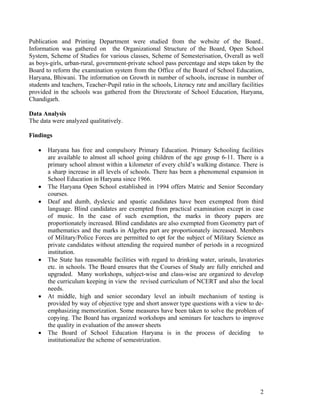
      awareness about persons with disabilities.
   2. The students, teachers and administrators have significantly biased attitude
      towards persons with disabilities.
   3. The intervention programme will have a significant positive impact on the
      awareness of students, teachers and administrators.
   4. The intervention programme will have a significant positive impact on the
      attitude of students, teachers and administrators.

Experimental Design Employed
Pre-test/Post- test one group experimental design has been suitably employed for the
Study. Four types of impairments- loco-motor, visual, hearing and speech have been
considered for the study. A total sample of 250 Students, 25 Teachers and 10
Administrators was drawn from five High Schools, where inclusive programmes are
in progress from Hamirpur district of Himachal Pradesh. The sample has been drawn
employing suitable sampling techniques. The Students, Teachers and Administrators,
each, are equally distributed against the five schools. Variables, namely, age,
willingness to cooperate, place of residence and educational level were controlled to
the extent possible. So, an attempt was made to observe the validity of the
experiment. The experimental treatment was given for a period of 20 days @ one
hour per day.


The intervention programme right from Day-1 to Day-20 , the investigator taking off
with a lecture on “People’s similarities and differences” supplemented with three


                                                                                    1
dolls-Radha with cerebral Palsy, Shivani with Visual Difficulty, and Anu with
Hearing impairment, followed with statistics on persons with disabilities in India
followed by discussion on meaning, causes and prevention of disabilities, video
presentation “Dishayen” developed by the NCERT & discussion , motivational talk
on inclusion of students with disabilities in regular classroom by the researcher, video
presentation “Inclusive Education: Making it Happen’ developed by the Ministry of
Social Justice and Empowerment, GOI, Activity on Inclusion and discussion, lectures
on concession and facilities provided by the Government to persons with disabilities
and Constitutional and Legal Safeguards for them, success stories of persons with
disabilities, activity and lecture on “Interacting with Persons with Disabilities”,
Video presentations on “ Behaviour Management” and “Inclusive Education: Best
Practices” , both, for teachers developed by the Ministry of Social Justice and
Empowerment, Government of India followed with discussion, lectures by the
researcher on “Tips to Keep Eyes Healthy”, “Tips for Proper Speech Development”
and “How to take Care of Ears”, Speech and Essay Writing competition for Students,
Games/Sports competition for Students and discussion thereof, has been very well
designed and systematically conducted.

Tools Employed
Self constructed “Awareness about Disability” questionnaire and “Attitude Scales”
were used as Instruments to collect data. The characteristics of the tools have been
well established.

Data Analysis
Suitable statistical techniques, namely, t-testy and Chi Square test were employed for
data analysis.

Findings

   1. The Students were found to have a low level of awareness about pupils with
      disabilities before the intervention programme.
   2. The Teachers and Administrators were found to have a moderate level of
      awareness about pupils with disabilities before the intervention programme.
   3. The intervention programme has had a significant positive impact on the
      awareness level of students.
   4. The intervention programme has had a significant positive impact on the
      overall, as well as, dimension wise levels of awareness of students towards
      pupils with difficulties in inclusive settings.
   5. The intervention programme has had a significant positive impact on the
      overall, as well as, dimension wise levels of awareness of Administrators and
      Teachers towards pupils with difficulties in inclusive settings.
   6. The intervention programme was found to have a significant positive impact
      in changing the attitudes of students towards pupils with disabilities.
   7. The intervention programme was found to have a significant positive impact
      in changing the attitudes of students towards pupils with disabilities in
      inclusive setting.


                                                                                      2
8. The impact of the intervention programme on the attitudes of students was
      seen when it was observed that students’ perception with regard to
      abilities/achievement of children with special needs changed significantly
      after the application of the intervention programme.
  9. Students’ attitude towards facilities/services provided to students with
      disabilities before the intervention programme were somewhat negative.
      There was a positive significant change in their attitudes after exposure to the
      intervention programme.
  10. With regard to students’ attitudes towards behavioural /disciplinary outcome,
      the impact of intervention was found to be healthy, though the margin of pre-
      test and post-test scores was not large.
  11. The intervention programme has been found to have a significant positive
      impact in changing the teachers’ and administrators’ attitude towards
      inclusion.
  12. The intervention programme has been found to have a significant positive
      impact in changing the teachers’ and administrators’ attitude towards
      curriculum and pedagogy for pupils with disabilities.
  13. The overall impact of the intervention programme with regard to “ Attitude
      Towards Services/Facilities for Students with disabilities” on teachers and
      administrators was found to be significant.
  14. Both teachers and administrators have shown their reservations about the
      cognitive abilities of the students with disabilities. However, a majority of the
      teachers and administrators agreed that with respect to the level of
      intelligence, disabled and non-disabled are equal.
  15. It is found that the intervention programme has played a critical role in
      changing the attitudes of teachers and administrators with regard to
      behavioural and disciplinary problems in a positive direction. However,
      majority of the teachers (68%) even after their exposure to the intervention
      programme opined that students with disabilities get easily upset in
      comparison to their able-bodied peers.
  16. The intervention programme has been found to have a significant positive
      impact to change the attitudes of teachers and administrators with respect to
      pupils with disabilities.

Emerging Questions
  1. To what extent the Inclusive Education Programmes for Pupils with
     Disabilities are successful in Himachal Pradesh?
  2. Which attributed should be developed in Students, Teachers and
     Administrators to identify with the problems of Pupils due to Disabilities?
  3. How do we differentiate Awareness, Interest, Values and Attitudes?
  4. How did the investigator observe the internal validity of the experiment
     conducted by him?
  5. How is it that inspite of the increasing sensitivity, we have not yet been
     successful in evolving suitable Curricula & Pedagogy for Pupils with
     Disabilities, more so for inclusive settings?


                                                                                     3
6. How to bridge the gaps between our awareness and attitudes towards Pupils
   with disabilities?
7. What should be our action plan for realizing the objectives of inclusive
   education?


                                                                          4
A Study of Quality of Life of the Tribals of Keonjhar District in Orissa in
Relation to Educational Development Programme

(Kartikeswar Roul, 2006, Utkal University, Bhubaneswar)

Objectives of the Study
  1. To study the quality of life of the tribal of Keonjhar District.
  2. To find out the differences in quality of life among different tribes of
      Keonjhar District.
  3. To identify the aspects of quality of life affecting the status of various tribes of
      Keonjhar district.
  4. To analyse the effect of educational status of tribal communities on quality of
      life.
  5. To critically examine the role of various educational measures to improve the
      quality of life of the tribals of Keonjhar District.
  6. To formulate strategies to improve the quality of life of the tribals of Keonjhar
      District.

Hypotheses of the study

   1. There is no significant difference in the quality of life of the different tribes of
      Keonjhar.
   2. Status of quality of life of various tribes of Keonjhar District does not affect
      significantly.
   3. There is no significant effect of educational development on the quality of life
      of various tribes of Keonjhar District.
   4. There is no significant role of various measures in the improvement of quality
      of life of tribals of Keonjhar district.
   5. Manipulation of various factors does not affect the quality of life of tribals of
      Keonjhar district.

Research Method Used
The analytical description survey method has been suitably employed for the study.

Sample
The study has been well delimited to four tribal blocks of Keonjhar district, namely,
Ghatagaon, Harichandanpur, Banspal and Telkoi. It has been further delimited to four
communities, namely, Kolha, Santal, Juanga and Bhuyan of 24 tribal villages. Out of
13 blocks of Keonjhar district 4 blocks have been selected randomly for the study.
480 tribal households have been selected employing stratified random sampling.

Tools used for the Study
 Identification of the Tribal Communities Survey Schedule, Village Survey Schedule,
Tribal Household Interview Schedule, Educational Development Programme
Information Schedule and Tribal Household Observation Schedulewere the tools
used.


                                                                                        1
Data Analysis Techniques used
Percentage analysis, mean analysis and graphical representation have been done
suitably. Qualitative analysis has also been done, wherever required.

Findings of the Study
   • Large sections of the families ( 54.38%) of Kolha, Santal, Juanga and Bhuyan
      tribes were the medium size family having 4 to 6 members. However, Kolha
      and Santal were having more small size family ( 1 to 3 members) than Juanga
      and Bhuyan households.
   • Majority of tribal people (66.51%) were found illiterate. In four tribes it was
      greater. Females were more illiterate (72.73%) than male population of the
      tribals. Juang and Bhuyan tribes were found educationally backward as
      compared to Kolha and Santal tribes.
   • Wage earning, cultivation, forest product collection, hunting and fishing were
      the major occupation of the 85.42% of tribal households. Occupational status
      of Kolha and Santal Tribes were found better than that of Juanga and Bhuyan
      Tribes.
   • Food habits of about 50% of tribal households were not satisfactory. But food
      habits of Kolha and Santal Tribes were found better than that of Juanga and
      Bhuyan Tribes.
   • The majority of tribal households were using traditional source of energy,
      such as, firewood, cow dung cakes, and kerosene because of lack of
      purchasing power, lack of supply of other sources, less awareness about
      sources of energy.
   • The social system of tribal households was based on the beliefs of magic and
      rituals , compulsory marriage, patriarchal family, child marriage, community
      living, organization of youth dormitory, more importance to priests in their
      society, role of astrologer-cum-sorcery in society life, prohibition of marriage
      in same clan. Kolha and Santal communities were found comparatively
      civilized to some extent and free from blind belief than Juang and Bhuyan
      communities.
   • More than 50% of Kolha and Santal households were applying new
      technologies in cutivation, fishing, food gathering, food processing, hunting
      and preparation of houses, whereas, approximately 25% of Juanga and 30% of
      Bhuyan households were found using new technologies in different
      productions, processing and preparation activities.
   • Necessary amenities and services, such as, road, schooling facility, drinking
      water, housing, supply of electricity, plantation, health services and drainage
      system etc. had been provided to sample tribal areas of Keonjhar district
      through socio-economic development programmes,
   • All tribal communities had received benefits from educational programmes,
      income generating activities, non-formal training, awareness programme,
      social forestry, housing scheme, health programme of NGOs of sample areas
      of Keonjhar district.


                                                                                    2
•   More number of Educational Development Programs were implemented in
       different villages of Ghatgaon and Harichandanpur blocks in comparison to
       Bansapal and Telkoi blocks.
   •   The level of living, population dynamics, and socio-political system, process
       of development and availability of resources are the major indicators of
       quality of life. All these indicators are invariably affecting the quality of life
       of the tribals of Keonjhar district.
   •   Kolha and Santal were found having higher status of quality of life in
       comarison to Juanga and Bhuyan. There is significant difference in the quality
       of life of the different tribes of Keonjhar district.
   •   Educational status scores of Kolha and Santal were higher than Juanga and
       Bhuyan tribes. Also, the status of quality of life of Kolha and Santal Tribes
       was found higher than that of Juanga and Bhuyan Tribes. So there has been
       found a positive significant effect of educational development on the quality
       of life of various tribes of Keonjhar district.
   •   Kolha and Santal communities availed of more educational facilities from
       different Educational Development Programmes in comparison to Juanga and
       Bhuyan Communities. There has bben found a positive effect of Educational
       Development Programmes on quality of life. So, there is a significant role of
       educational measures on improvement of quality of life of the tribals of
       Keonjhar district.

Emerging Theses
The emerging Theses are that there is a significant difference in the profiles and
quality of life of different tribal communities. The compatible Educational
Development Programmes and Quality of Life Improvement Measures can
significantly contribute in the enhancement of Quality of Life of the Tribal.


                                                                                       3
A Study of the Effects of different educational Programs on the development of
Personality of Primary Students

(Mr. Gajanan Sahebrao Nare, 2006, Sant Gadge Baba Amaravati Vidyapeeth,
Amravati)

Objectives of the Study:

   1. To appraise the Educational Programs conducted in the Primary Schools.
   2. To study the effects of various Educational Programs on the personality of
      students of Primary Schools.
   3. To study the factors impeding the various Educational Programs in the Primary
      Schools.
   4. To suggest the remedial measures for implementing the various Educational
      Programs in the Primary Schools.
   5. To study the causes of the drawbacks in conducting the educational programs in
      the Primary Schools.

Methodology Employed:

The Survey method has been suitably employed for the study.

Sample for the Study:

The study has been conducted on 500 selected schools of Akola District. The sample is
constituted of 500 Principals, 500 Teachers, and 50 Experts.

Tools Used:

The characteristics of the tools constructed by the investigator, namely, Questionnaires
and Interview Schedule have been well established.

Data Collection

The data from the Principals and Teachers were gathered systematically through the
respective questionnaires, whereas, the data from the Experts were collected through the
Interview Schedule.

Data Analysis

The data have been analyzed through frequencies and % responses.

Findings of the Study:

The Study has arrived at quite meaningful findings as follows:


                                                                                      1
Responses of Teachers:

   1. In most of the Primary Schools the components of the achievement of objectives
       are included in the Primary School.
   2. It is observed that to achieve the various objectives various educational programs
       are essential.
   3. Educational programs are essential for developing human values, like, culture,
       patriotism, scientific attitude, moral and ethical values and respect for labour.
   4. It is understood from the teachers that the educational programs are conducted on
       large scale in most of the schools. In a large majority of the schools a variety of
       programs are conducted, namely, teaching & practical work of language, history
       & Geography, and Mathematics & Science.
   5. Various educational programs are conducted effectively. Educational tour is a
       supplementary to education program in a large majority (93.8%) of primary
       schools.
   6. Film-shows are organized by 44.3% schools, Group discussions in 54.8% schools,
       competitions in 80.4% schools, visit to mega projects in 83.4% schools, whereas,
       cleanliness drives of environment are organized in 89% schools.
   7. Book-Banks are organized in 98% schools, welfare schemes in 90% schools, co-
       operative stores in 85%, whereas, Student Organizations are organized in 75%
       schools.
   8. Implementation of co-curricular activities was found to be contributing to the
       values related to human life, namely, character building, national values, values of
       democracy, ethical value, self discipline and Scientific Attitude.
   9. A large majority (96.78%) of teachers have responded that development in the
       Personality of the students is observed due to the effective implementation of
       these Educational Programs.
   10. Co-curricular programs have also been found contributing to the development of
       the Personality of the students.
   11. To study the effect of curriculum 100% schools use conduction theory and
       practical exams, 82% oral exams, 44.5% questionnaire, 38% occasional or
       phenomenal notes, whereas, 78.42% use checklist.
   12. Educational Programs have been found developing many qualities in students,
       namely, Emotional development(73.4%), Leadership quality(89.5%), self
       confidence(91.3%0, physical ability(78.5%), development of different Art forms
       (95%), communication skills (85%), feeling of team work (98%), and
       participation in curricular activities (87%).
   13. Most significant problems in the organization of the Educational Programs have
       been identified as financial (98%), excessive class strength (87.45%), lack of
       participation of students (93%).
   14. 8% of the parents have been found identifying greatly with the educational
       development programme, 46% moderately whereas 12% have been found having
       negative attitude towards the educational development programmes. It seems that
       the parents were not so motivated towards the Educational Development
       Programme.


                                                                                         2
15. 24.5% of the teachers have been found very co-operative with respect to
       educational development programmes, 36% co-operative, whereas, 22.6% to
       some extent. It seems the teachers were not found so motivated towards the
       educational development programmes.
   16. A large majority of the teachers (71.43%) have responded that there is a lack of
       infrastructural facilities which impedes the functioning of the Educational
       Development Programmes. (EDP)
   17. Due to large strength of students they are not in a position to take full benefit of
       the EDPs. 37% of the teachers have fully agreed to this statement, whereas 48%
       to some extent.
   18. 34.66% of the students have been found to be associating with the EDPs
       willingly, whereas, 62.34% unwillingly.
   19. The major causes of the unwillingness of students as identified by the teachers are
       – excessive study load (93%), lack of teaching aids (87%), economic constraints
       (86%), time constraints (83%), and TV attraction (64%)
   20. The teachers have suggested that to improve upon the functioning of EDPs
       teacher should be given additional time, money, and study credits to the students
       and added weightage to the teachers.

Responses of Principals:

   1. 84% of the principals think that there is a direct relationship between EDPs and
       the personality development of the students.
   2. As per the responses of 87.14% of principals the EDPs are subject related,
       93.38% subject supplementary, and 79.45% general.
   3. The headmasters think that only 18% of the teachers are genuinely interested in
       EDPs.
   4. A large majority of the principals (62.8%) are fully interested in the EDPs,
       whereas, the remaining 23.82% not so interested.
   5. The principals think that 44.14% of the students participate fully in the EDPs,
       whereas, 43.60% to some extent.
   6. As per the responses of the principals 33.39% of the teachers are de-motivated
       towards the EDPs, 44.31% associate with the EDPs due to the fear of punishment,
       whereas, 4.15% are really interested in EDPs.
   7. 97% of the principals think that there is no wastage of time due to EDPs
   8. The principals think that it seems that the benefits of the various policies of the
       government are more or less sort
   9. The information regarding the EDPs is gathered from the Education Department
       as responded by 64% of the Principals, whereas, 33% of the Principals have been
       found to receive it from other educational institutions.
   10. As per the responses of the principals the necessary material for organizing the
       EDPs is not available in 88% of the schools
   11. To meet the necessary material requirement for organizing EDPs 37% of the
       principals request the parents, 43% request to the rural donors, 12% to the
       teachers, whereas 8% depends upon the administration.


                                                                                         3
12. 58.12% of the institutions co-operate more or less, 29.15% not at all, whereas,
       only 1.32% co-operate fully.
   13. A large majority of the principals think that economic factor is the most impeding
       factor in the organization of EDPs.

Findings on the basis of Interviews:

   1. There is a need of changing the mentality of students, parents and teachers with
      respect to EDPs.
   2. The EDP should be integrated with the school time table.
   3. The EDP should be corresponding to the different standard of the students.
   4. While employing the teachers it should be ensured that they have necessary
      attributes for organizing the EDPs.
   5. The training of teachers of various subjects should be made compulsory with
      respect to use of EDPs.
   6. Language club, Science club, debating club, playing club etc. should be
      established to enhance the participation of students.
   7. There should be some programmes for the parents also.
   8. Creativity is a must for enhancement of personality. So, the focus the some of the
      programmes should be on creativity.
   9. The participation of students, teachers, and parents can be enhanced by organizing
      the educational development programme of their interest.

Findings based on Activities of the Schools:

   1. There should be training on skating and other games, because it enhances self-
      confidence and develops the personality of the students
   2. The skill of communication should be developed by organizing educational
      development programmes
   3. There should be programmes on performing arts and expression to develop body
      language
   4. There should be added focus on yoga and breathing exercise


                                                                                       4
A Study of DPEP Intervention in Tribal Education at Primary Stage and Its
Effectiveness in Orissa, D.Phil, Education, University of Allahabad, Allahabad,
2006

Das, B.C.

The major objectives of the study were:
 1.    To study the meaningful experiences and perceptions of education functionaries,
       teachers, community leaders and tribal parents about DPEP intervention and school
       functioning.
 2.    To ascertain the availability and utilization of infrastructure facilities in DPEP
       schools working for tribal population.
 3.    To study the effectiveness of DPEP intervention in terns of universal enrolment,
       attendance, achievement and retention of tribal children.
 4.    To study the motivation of tribal children in schooling process under DPEP
       intervention.
 5.    To study the effect of DPEP intervention on teachers’ competencies in relation to
       quality improvement in teaching-learning activities and school management.
 6.    To study the nature of community participation in school management under DPEP
       intervention.
 7.    To develop futures scenario of educational expansion among tribal children.
       The study has been conducted applying three approaches viz., case study, cross
sectional survey and longitudinal trend and cohort studies in integrated form. The DPEP
programme was evaluated through a model frame work of wholistic evalution for primary
education system. The population of the study covered three tribal districts of Orissa viz.,
Rayagada, Gajapati and Kalahandi. Purposive sampling procedures have been adopted in
selecting the sample. The sample for the study comprised of 18 tribal concentrated villages
from three tribal districts of Orissa, 18 primary schools operating therein, 57 education
functionaries, 34 teachers, 180 parents, 36 community leaders and 100 children. About 25
experts and education functionaries were involved in development of futures scenario of
educational expansion among tribal children. The study was conducted in three phases.
Phase I involved exploring DPEP interventions from the field. Phase II involved indepth
case studies and cross case analysis. Phase III involved the development of futures
scenario of educational expansion among tribal children. Interview Guides, Participant
observation and record surveys were employed for data collection. Data were analyzed
qualitatively using content analysis, growth rate and trend and cohort analysis techniques.
Major findings of the study reads as :
  1.     The DPEP has been successfully providing new primary schools as well as
         infrastructure developments of existing school along with provision of free text
         books, appointment of teachers and hostel facility for girls.
2.   The community participation has been found to be encouraging through
     organization of enrolment campaigns, participation of village education committee
     members in school management.
3.   In-service teacher training programme has been a key feature for the
     empowerment of teachers. However teacher absentism and their lack of
     acquaintance with tribal culture and language were found as major barriers of
     schooling.
4.   The status of enrolment of tribal children has been found as high as 75 to 82 per
     cent with marginal (23.28 per cent) retention in residential sevashram primary
     school. There has been improvement in children’s achievement at class III and V
     stages during DPEP operation than prior DPEP operation. The sevashram school
     was found better than the achievement, attendance and retention of children of
     other types of schools.
5.   DPEP has brought significant impact on motivation of children in majority of
     cases (59 per cent). This has also been reflected in terms of parents’ interest in
     their children’s education, children’s self-study cleanliness, discipline and work
     oriented experiences of children.
6.   Village development, residential facility and easy accessibility are positively
     associated with school participation of tribal children as well as participation of
     teachers and the community in school management.
7.   In spite of teachers’ significant efforts in making classroom activities continuous
     and active, there remains predominance of textbook method and rote memory
     oriented learning practices. In rare cases the activity based classroom transaction
     has been practiced.
8.   The futures scenario of education of tribal children is associated with sincere
     interventions in educational programmes at local level, provision of infrastructural
     and educational technology support with proper networking facilities and
     encouraging participation of tribal community members in school management..
9.   As a whole DPEP intervention in tribal villages has brought positive effect in
     terms of criteria of enhancement of enrolment of target group learners (girls’
     enrolment growth rate having higher than that of boys); better retention of boys
     and girls in residential sevashram schools in comparison to other schools;
     increasing rate of achievement in comparison to that of pre DPEP operation;
     higher rate of involvement of community in school management and appointment
     of teachers in the schools. However, major constraints remain with regard to
     irrelevant school curriculum, teacher absenteeism, monotonous teaching learning
     processes and negligible monitoring and supervision of school practices by
     appropriate authorities of tribal districts.


                                          2
Evaluation of Self Help Group (SHG) Interventions on Women’s Education (
Suryamani Mishra, University of Lucknow, Lucknow, 2007)

Objectives of the Study

            1. To study the process of formation of SHGs for Women;
            2. To assess the extent of democratic functioning of SHGs;
            3. To assess the awareness of the SHG members on the problems of their
               community and means to address them;
            4. To find out the efforts/achievements made by the SHGs in tackling
               issues affecting community;
            5. To assess the activities of SHGs in promoting education of members
               and their children;
            6. To assess activities of SHGs on women’s empowerment education;
               and
            7. To study improvement in the life skill education of SHG members.

Study Type
It is a descriptive Study.

Sample for the Study
The samples of 125 SHG members and 125 non-SHG Women have been suitably
drawn employing multi-stage random sampling. Descriptive analysis of the data has
been done in most of the cases. % analysis and in some cases significance of
difference between percentages has been done.

Findings of the Study
   1. All the SHGs were formed with facilitation of an animator, all members of the
      SHGs joined the group on their own interest, and all SHGs do not function on
      democratic principles.
   2. All the SHGs were found aware of the problems of their community and 20 %
      of them address community issues through their network.
   3. Activities of the SHGs did not promote education of group members and their
      children.
   4. Education level of SHG Women on 9 aspects out of the 14 aspects studied
      was found better than that of the non-SHG Women.
   5. Education level of SHG Women on all aspects of Life Skill Education studied
      was found higher than that of non-SHG Women.

The emerging Thesis of the Study is “ Self insurance, self assurance, self realization,
self expression, self help, and self reliance promoted through SHG intervention made
women set their attitude to acquire knowledge, develop interest, understanding and
skills on a lot of aspects of Empowerment Education and Life Skills Education”. The
Study has presented 17 action points for strengthening SHG interventions on
Women’s Education.
A Follow-up Study of Alumni of Vivekanand College of Education Lakhanpur (
Anju Sharma, KUK, 2007)

Objectives of the Study

1.    To study the background and present status of alumni regarding

                    i.   Educational status at the time of entry into the B.Ed. College.
                   ii.   Motivation for joining the B.Ed. Course.
                  iii.   Up-gradation of educational status during service.
                  iv.    Outstanding achievement in academic field and co-curricular
                         activities.
                    v.   Socio-Economic Status of the family.
                   vi.   Present Professional status of the alumni.
                  vii.   Level of satisfaction in the present job.
                 viii.   Level of adjustment in professional, home, social and
                         economic areas.
                   ix.   Job mobility.

     2. To find out the perceptions of alumni of Vivekanand College of Education,
        Lakhanpur, regarding

           i.   Quality of instructions in the College and quality of the feedback on
                classroom assignments.
          ii.   Accessibility and responsiveness of teachers outside the class.
         iii.   Role of B.Ed. course in enhancing their enquiry/research skills and
                ability to use multi-media technology in the classroom.
         iv.    Use of teaching methods and technology learnt during B.Ed. in day to
                day teaching.
          v.    Utility of child Psychology in their present profession.
         vi.    Opinion about the most beneficial and least beneficial compulsory
                papers in B.Ed. and the optional papers which could be made
                compulsory.
         vii.   Organization of curricular/co-curricular activities in the college and in
                their schools.

     3. To study the opinion of alumni regarding:
                    i. Corporal punishment to the students.
                   ii. Academic environment, infrastructure facilities, salary and
                        working hours in their present profession.
                  iii. Contribution of B.Ed. course in living a better life.
                  iv. Course contents (curriculum) of B.Ed. course of University
                        of Jammu.
                   v.   Suggestions to improve B.Ed. Programme of University of
                        Jammu.


                                                                                       1
Nature of the Study
It is a follow-up Study of B.Ed. Graduates of one of the Rural Area College in J&K,
namely, Vivekananda College of Education, Lakhanpur which was started in 1995.

Sample for the Study
106 accessible B.Ed. graduates of the College during 1998 to 2004 constituted the
sample of the Study.

Tool Used for the Study
Questionnaire was used for the study.

Data Analysis

The data have been analyzed suitably through frequencies and percentage responses.

Findings of the Study

   •   A large number of B.Ed. graduates of this college acquired M.Ed. degree after
       leaving the college. In all, about 70% students improved their qualification
       after doing B.Ed.
   •   A large number of alumni were employed in teaching profession. Only a small
       percentage were in other professions.
   •   Highest percentage of alumni of the college were employed as school
       teachers, followed by a less number as college lecturers.
   •   A majority of the alumni joined the present profession through open
       competition. Only a few graduates entered through reservation or
       recommendation.
   •   Highest percentage of the alumni were employed in temporary/ contractual
       basis followed by a lesser percentage employed in regular jobs.
   •   Larger % of the employed alumni were found in private jobs, followed by a
       lesser number in government and semi-government jobs.
   •   Highest % of alumni were found to have limited job satisfaction in their
       present profession followed by a lesser number having high to moderate job
       satisfaction.
   •   A large % of the alumni felt that they have high professional adjustment, high
       home adjustment, high school adjustment, but only a limited economic
       adjustment.
   •   A majority of the alumni had not changed their jobs/profession. If at all it was
       done, then it was done due to promotion or earn more.
   •   A majority of the alumni were satisfied with the accessibility and
       responsiveness of teachers outside the class during their study in the College.
   •   A majority of the alumni felt that the B.Ed. course enhanced their
       enquiry/research skills to a moderate extent.
   •   A large majority of the alumni felt that the B.Ed. course enhanced their ability
       to use multi-media technology in the classroom from moderate to a limited
       extent only.


                                                                                     2
•   Most of the alumni used very much to moderately the strategies/methods
      learnt during B.Ed. in their day to day teaching.
  •   A vast majority of the alumni found Educational Psychology Paper most
      beneficial in their profession, whereas, Educational Philosophy the least
      beneficial. They found their knowledge of Learner Psychology acquired
      during B.Ed. quite useful.
  •   Lecture method was found to be most used by a large number of Alumni for
      educational instructions.
  •   While a majority of the alumni did not organize any co-curricular activity
      during the B.Ed. course, yet their participation in organizing such activities in
      their teaching profession showed a more favourable response.
  •   Maximum alumni were only moderately satisfied with the academic
      environment, infrastructure facilities, salary and working hours in their
      present profession. A large number of alumni were found to have limited
      satisfaction with the salary drawn by them.
  •   A majority of alumni were of the opinion that B.Ed. course had only
      moderately helped them in living a better life.
  •   A large majority of the B.Ed. graduates of the college opined that B.Ed.
      course of the University of Jammu should include more of practical work. A
      lesser % of alumni suggested for having more days of teaching practice and
      project work in B.Ed.


Emerging Questions

  1) What could be the various ways of establishing continuous communication
     with the alumni?
  2) How to find out the status of all the alumni of the College?
  3) The alumni have been found to value Educational Philosophy lesser than
     Educational Psychology. What should it be attributed to?
  4) How to enhance the quality of instruction at B.Ed. level?
  5) How to enhance the level of satisfaction of the alumni with respect to
     academic environment and working conditions at their work place?
  6) How to control the economic exploitation of the alumni?
  7) How to make the communication between the Parent Institution and Alumni
     greater functional?
  8) How to strengthen the Alumni Associations in the Teacher Education
     Institutions?


                                                                                     3
“UCHCHA SHIKSHA KEE LABHARTHI KE ROOP MEY BHARTIYA
MAHILA (Indian Woman as a Beneficiary of Higher Education)” (Krishna
Gupta, Banasthali Vidyapeeth, Banasthali, Rajasthan, 2007)

Objectives of the Study

   1. To study the trend of women enrolment in General Higher Education State-
      wise in terms of

                    i.   Faculty (Art, Science, Commerce)
                   ii.   Level (Graduate, Post-Graduate)
                  iii.   Caste Category (SC, ST, General Caste)

   2. To present a scenario of Indian Woman as a beneficiary of Higher Education.

Sample for the Study

All the women students ( SC, ST, & General Category) enrolled in General Higher
Education ( Art, Science and Commerce) from 1990-91 to 2003-04 offered by all the
Deemed , State and Central Universities in India constituted the sample for the Study.
Evidently the sample is contextual.

Data Collection
The data have been accessed from the valid sources, namely, Annual Reports of the
UGC and Various Records during 1990-91 to 2003-2004., Census Reports of 1991
and 2001, and Published Selected Educational Data by the MHRD and various
Records from 1990-91 to 2003-04. The Study is based on descriptive and nominal
data. The characteristics of all the tools constructed for data collection have been
well established by the investigator.

The plight of the Investigator from Pillar to Post in searching data and cooperation of
the Field ought to be placed on record. All the agencies, particularly, the apex
agencies need to have reliable, valid and complete data. The efforts of the
Investigator and cooperation of the Field in cross validation of data are remarkable.

Data Analysis
The data have been analyzed descriptively and in terms of related quotient
percentages. The graphical presentation showing the number of women per hundred
men enrolled in General Higher Education during 1990-91 and 2003-04 presents a
comprehensive scenario State-wise.
Findings

   1. The % enrollment of Women in the NE States of India (Arunanchal Pradesh,
       Assam, Manipur, Meghalya, Mizoram, Nagaland, Sikkim and Tripura) was
       highest in Arts Faculty and lowest in Commerce Faculty. The % enrollment of
       Women in the Commerce Faculty was found to be lowest in Tripura.
   2. % enrollment of women in Arts Faculty has been found highest in Bihar,
       Orissa and West-Bengal, whereas, lowest in Commerce out of all the Eastern
       States in India ( Andeman & Nicibar Ice Lands, Bihar, Zharkhand, Orissa and
       West Bengal). The % enrolment of women in Science has been found highest
       in A & N, whereas, lowest in Commerce.
   3. Of the Nortern States of India, namely, Chandigarh, Delhi, J&K, Haryana,
       HP, Punjab, Rajasthan UP and Uttrakhnad, the % enrolment of Women in
       Science Faculty has been found to be highest, whereas, in the remaining States
       it has found highest in Art and Commerce. Women have been found to be
       least interested in Commerce in these States.
   4. In Western States ( Chhatisgarh, Daman & Deev, Dadra & Nagar Haveli, Goa,
       Gujarat, MP & Maharashtra) % enrolment of Women has been found to be
       highest in Art Faculty, whereas, almost equal in Science and Commerce.
   5. Of the Southern States (AP, Kernataka, Kerala, Lakshadvip, Pondicherry, &
       Tamil Nadu) the % enrolment of Women in Art Faculty has been found to be
       highest in Tamil Nadu and Pondicherry, highest in Science Faculty in
       Kernataka and Kerala, whereas, highest in Commerce in AP. The status in
       Lakshdvip is similar to that of Kerala, the data being merged.
   6. The highest % enrolment of Women has been found in Art Faculty and
       lowest in Science. But progressively increased % enrolment is observed in
       Science & Commerce.
   7. Generally the % enrolment of Women is higher at Graduation level than at PG
       level, but in some of the States it is reverse.
   8. PG Education was not found in the States of Mizoram, Sikkim, Daman &
       Deev. There is a need of establishing Colleges and Universities in these States
       and Lakshadvip & Dadra & Nagar Haveli for Higher Education of Women.
   9. The % enrolment of women of ST category has been found to be highest in
       all the States of NE except Manipur, Assam and Tripura. The population of
       SC Women being very low in Mizoram and Nagaland there is rare enrolment
       of SC category women in General Higher Education. Also, the enrolment of
       General category women is too low. The % enrolment of General category
       women is highest in Manipur, whereas, Assam and Tripura have observed
       almost equal enrolment of women of all the three categories in General higher
       Education.
   10. The % enrolment of SC category Women have been found to be lowest in all
       the Eastern States, except Andeman & Nicobar Dvip Samooh. The %
       enrolment of General Category women is highest in the Eastern States,
       irrespective of the higher population of the SC in some States.
11. The % enrolment of General category women was found highest in Northern
    States. Irrespective of the very low population of ST women in Chandigarh
    and Delhi some of these women have enrolled in General Higher Education.
    Not even a single candidate has enrolled of ST category in J&K, Haryana &
    Punjab. There is rare enrolment of ST women in General Higher Education in
    HP, Rajasthan, UP and Uttrakhand. It is a matter of further research to find
    that with Zero population of ST women in Delhi State as per 1991 and 2001
    census, how some enrolments appeared in Higher Education, whereas,
    irrespective of 10.9% ST population in J &K as per 2001 census, how is it
    that no one enrolled for General Higher Education.
12. Of the Western States no enrolment of Women has been found in General
    Higher Education in Dadra & Nagar Haveli. The enrolment of General
    Category women has been found to be highest in General Higher Education in
    rest of the Western States except Daman & Deev. The % enrolment of SC
    women has been found to be highest in General Higher Education in Daman
    & Deev. The ST women have been found to be the least beneficiary of
    General Higher Education in these States.
13. The % enrolment of the General category women has been found to be highest
    in General Higher Education, irrespective of the higher population of SC
    women in some of these States.
14. The rate of increase of % enrolment of women in higher Education has been
    found to be highest in Arunanchal Pradesh, whereas, negative in West
    Bengal.
15. The variation in growth rate of women enrollment in higher education in
    different States may be attributed to the rate of establishment of Higher
    Education Institutions and Social Status of Women. In addition to
    Educational, Social and Economic factors it may also be attributed to the
    internal policy of the States.
Evaluation Study of Role and Functions of Haryana School Board of Education Towards
Improving Secondary Education in the State (Mukesh, KUK, 2007)

Objectives
  1. To analyze the existing framework , system of administration and functions of Haryana
      School Board of Education in terms of:
  • Sensitization to access and equity issues in Secondary Education, especially from
      provision for regulation and recognition of schools.
  • Provisions and practices for ensuring quality of education across disparities, concerns
      and efforts for maintaining standards.

   2. To study the Board results in terms of

   • Registration and Pass percentage.
   • Measures for improving the standards.

   3. To study the functioning of Board in terms of

   •   Curriculum.
   •   Scheme of semesterisation.

   4. To make suggestions and recommendations for future perspective and role of
      Haryana School Education Board as an academic changes agent to meet the
      institutional development needs of school education.

   Research Method Employed
   The Case Study method has been suitably employed for this Evaluative Study. The
   Evaluation Criteria have been well differentiated into four major aspects, namely,
   sensitization to access and equity issues in secondary education, ensuring quality education
   against disparities, measures for improving standards and quality functioning.

   Sample
   Purposive sampling technique has been employed for data collection. Interview schedule has
   been well designed and the following functionaries and beneficiaries were interviewed,
   namely, Chairman-1, Secretary-1, Directors-2, Deputy Directors-5, lower level
   functionaries-20, School heads-20, Teachers-100, Students-200 and Parents-100.

   Data Collection
   The data were collected systematically on the Act of Board of School Education, Haryana, in
   terms of Objectives of the Board, Powers and Duties of the Officers of the Board, Board
   Meetings, Constitution of Board Fund and Affiliation Regulations. Functions of various
   branches of the Board, namely, Academic wing, Enrollment , Examination, Computer,
   Accounts, Maintenance, and Administration Branches, Legal and P.W.O Cells and


                                                                                             1
Publication and Printing Department were studied from the website of the Board..
Information was gathered on the Organizational Structure of the Board, Open School
System, Scheme of Studies for various classes, Scheme of Semesterisation, Overall as well
as boys-girls, urban-rural, government-private school pass percentage and steps taken by the
Board to reform the examination system from the Office of the Board of School Education,
Haryana, Bhiwani. The information on Growth in number of schools, increase in number of
students and teachers, Teacher-Pupil ratio in the schools, Literacy rate and ancillary facilities
provided in the schools was gathered from the Directorate of School Education, Haryana,
Chandigarh.

Data Analysis
The data were analyzed qualitatively.

Findings

   •   Haryana has free and compulsory Primary Education. Primary Schooling facilities
       are available to almost all school going children of the age group 6-11. There is a
       primary school almost within a kilometer of every child’s walking distance. There is
       a sharp increase in all levels of schools. There has been a phenomenal expansion in
       School Education in Haryana since 1966.
   •   The Haryana Open School established in 1994 offers Matric and Senior Secondary
       courses.
   •   Deaf and dumb, dyslexic and spastic candidates have been exempted from third
       language. Blind candidates are exempted from practical examination except in case
       of music. In the case of such exemption, the marks in theory papers are
       proportionately increased. Blind candidates are also exempted from Geometry part of
       mathematics and the marks in Algebra part are proportionately increased. Members
       of Military/Police Forces are permitted to opt for the subject of Military Science as
       private candidates without attending the required number of periods in a recognized
       institution.
   •   The State has reasonable facilities with regard to drinking water, urinals, lavatories
       etc. in schools. The Board ensures that the Courses of Study are fully enriched and
       upgraded. Many workshops, subject-wise and class-wise are organized to develop
       the curriculum keeping in view the revised curriculum of NCERT and also the local
       needs.
   •   At middle, high and senior secondary level an inbuilt mechanism of testing is
       provided by way of objective type and short answer type questions with a view to de-
       emphasizing memorization. Some measures have been taken to solve the problem of
       copying. The Board has organized workshops and seminars for teachers to improve
       the quality in evaluation of the answer sheets
   •   The Board of School Education Haryana is in the process of deciding to
       institutionalize the scheme of semestrization.


                                                                                               2
The investigator has made some meaningful recommendations on access and equity, school
curriculum, scheme of vocationalization, introduction of applied subjects, system of evaluation,
guidance and counseling facilities, feedback mechanism, research and school development
programmes.


Emerging Questions
   1) How did the investigator identify the problem for the Study?
   2) What are the strengths and limitations of the School Board of Education, Haryana?
   3) How the Haryana School Board of Education Observes the relevance and quality of
      School Curriculum?
   4) If a sizeable number of candidates fail at School level then to whom should it be
      attributed to?
           a. Candidates
           b. Teachers
           c. Parents
           d. Community
           e. School
           f. School Board
           g. All the above
           h. Any other
   5) What have been the causes of copying menace in the School Board Examinations? Are
      increasing the number of pages in the answer scripts or Flying Squads the real solutions?
   6) Has Haryana School Board of Education really solved the drinking water problem of the
      schools in the belts having excessive fluorides in water?
   7) What is the Teacher Transfer policy of Haryana State? How does it affect School
      Education?
   8) Which Innovations in Evaluation of Answer Scripts have been implemented by the
      Haryana School Board of Education ?


                                                                                              3
4
Differential Impact of Education and Employment on Socio-Psychological Life
of Women in Dhubri District of Assam (Padma Guha Agarwala, Gauhati
University, Guwahati, Assam, 2007)

Objectives
  1. To explore the historical development of women empowerment in India.
  2. To study the impact of education on the socio-psychological life of women.
  3. To study the impact of employment on the socio-psychological life of women.
  4. To analyze the joint impact of education and employment on the socio-
      psychological living.
  5. To analyze the perception of literate and illiterate working women of high and
      low SES groups about Education.
  6. To analyze the perception of working and non-working women in nuclear and
      joint family systems about their preference of stay in family system.
  7. To study job dissatisfaction of working women in the light of their socio-
      economic status.
  8. To identify the causes of job stress and anxiety of working women.

Population & Sample

The population of the present Study was constituted of all women of Dhubri District
of Assam. Dhubri district was purposively selected due to its backwardness in
education and earning of women community. Working women were sorted out from
five sectors, namely, LIC, Banking, Industry, Education, and Hospital or Health
Centers. The sample of 200 working and 200 non-working women drawn through
stratified random sampling for the Study seems to be adequate and representative.

Tools used
The characteristics of the tool Socio-Psychological Life Status Questionnaire
(SPLSQ) constituted of Education, Employment, Family System and Stress &
Anxiety which was constructed by the investigator have been well established. The
split-half reliability was found to be 0.79. The tool observes face validity and content
validity. Semi Structured Interview Schedule was designed parallel to the SPLSQ to
collect data from the illiterate women. Information bank was also used for collecting
required data.

Experimental Design Employed
The 4x3 factorial design employed to study the impact of Education ( Illiteracy,
Primary, Secondary and Higher Education) and Employment (High, Middle and Low)
on socio-psychological life status of women is quite suitable. Higher, Middle, and
Lower ESE levels were determined on the bases of P33 and P67. Homogeneity of
variance was ascertained by employing Hartlett test of Homogeneity.

Data Analysis
2-way ANOVA, t-test, Frequency and % were used for data analysis.


                                                                                      1
Findings

   1. There was a downfall of women status and equality in education as compared
      to men from the Vedic period to subsequent periods later on, namely,
      Buddhist Era, Muslim Rule, and the British Rule till the Independence of the
      Country.
   2. Post-Independence India witnessed the rapid growth of education to and for
      women due to attempts made in this context through manifold Committees,
      Commissions and National Policy on Education (1968 & 1986). The 5-year
      plan in this context is a phase to phase evolving strategy in the field of
      women’s empowerment.
   3. Women empowerment is a necessity for socio-cultural, economic and political
      modernization of India.
   4. Education has significant impact on the socio-psychological life staus of
      working women. It reveals that

           a) Working women possessing education irrespective of any level
               (primary, secondary or higher) enjoy superior socio-psychological life
               status to their illiterate working counterparts.
           b) No significant difference in the socio-psychological life status is
               noticed between working women having primary and secondary
               educational qualifications. However, more differences are observed in
               socio-psychological life status of working women belonging to other
               educational groups.
   5. Earning due to employment of working women in private or public sectors
       influences their socio-psychological living significantly.
   6. Interaction result between education and earning on socio-psychological life
       status of working women is positive and significant.
   7. Literate working women of different sorts ( primary to higher learners) have
       strong desire for further education irrespective of their amounts of earnings
       (high or low).
   8. Illiterate working women have reluctance for further education.
   9. Majority of women from both the working and non-working (housewives)
       groups prefer to continue their stay in the same family system.
   10. Job stress and anxiety are experienced by more than majority of working
       women of all types of income groups.


                                                                                   2
“Shiksha Se Virat Grameen Mahilayon Ki Samshayon Ka Ek Adhyyan (Pratap
Janpad Ke Patti Tehseel Kee Mahilaon Ka Ek Adhyyan)”(Ranjana Mishra, Dr.
       Ram Manohar Lohiya Avadh Vishwavidyalaya, Faizabad, 2007)

Objectives
  1. To find out the causes of deprivation of education of rural women .
  2. To find out the level of family adjustment of uneducated rural women.
  3. To study the social and emotional adjustment of educationally deprived rural
      women.
  4. To find out the attitude of illiterate women towards the education of their
      children.
  5. To study the attitude of illiterate women towards literate women.
  6. To study the views of illiterate rural women towards national welfare policies.
  7. To study the attitude of educationally deprived women towards aims of life.
  8. To find out the capacity of educationally deprived women to take social
      decisions.
  9. To study the adjustment problems of illiterate women in nuclear educated and
      socially joint families.
  10. To study the problems of elected illiterate women on the reserved seats in the
      present “Panchayatiraj Organization

Nature of Study
It is an exploratory Study.

Sample
A purposive sample of 300 illiterate women, including General, Backward, and
Reserved categories was drawn for the study from all the three developmental blocks,
namely, Devsara, Patti, and Magrora of Pratapgadh district.

Tools used
The data were collected by the investigator through interview schedules and Public
Records.

Data Analysis
The data have been suitably analyzed through frequencies and % responses.

Findings

       65% of the illiterate women feel ashamed, 30 % feel disrespected, whereas,
       5% feel at a loss in the presence of literate women.
       84% of the illiterate women are of the view that the literate women do not
       value their work, whereas, 16% feel that they value their work.
       84% of the illiterate women have responded that the literate women do not
       seek their opinion.
       68% of the illiterate women have responded that they feel jealous of the
       literate women.


                                                                                  1
91% of the illiterate women have responded that they are facing economic
problems.
84% of the illiterate women face difficulties in keeping accounts of the
domestic expenditure.
81% of the illiterate women have accepted that they do not know the ways of
domestic savings.
48% of the illiterate women have responded that they do not keep their
accounts in banks, whereas, 44% have responded that they have to seek the
help of others for keeping their accounts in banks.
56% of the illiterate women have responded that they are not in a position to
observe accounts of the money given by them on loan.
92 % of the illiterate women have responded that they face difficulties in
translating their family responsibilities.
75% of the illiterate women have responded that they are not given
importance in their families.
64% of the illiterate women have responded that they are occupied with their
domestic work, due to which they have to face problems.
76% of the illiterate women have responded that the behaviour of their
husband is not good.
58% of the illiterate women have responded that they have to go by the
opinions of their husband. Their opinions are not given importance.
80 % of the illiterate women have responded that their husband indulge in
“Mar-Peet”.
64% of the illiterate women have responded that they share their health status
with women community only.
55% of the illiterate women have to depend on others for the injections of
their children, whereas, 25% are negligent towards the injections.
65% of the illiterate women have responded that they are not aware of the
ways of family planning.
67% of the illiterate women have responded that they are not aware of the
modern ways of “Bandhyakaran”. 40% of the illiterate women take
“Bandhyakaran” for economic profit.
84% of the illiterate women have responded that they observe blind faith.
80% of the illiterate women have responded that they do not utter the name of
their husband.
76% of the illiterate women have responded that they abstain from social
functions.
83% of the illiterate women have accepted that education is the only mean for
building better future of the children.
57% of the illiterate women have responded that if their daughter is educated
then there will not be any problem for her marriage.
62% of the illiterate women have responded, that had they been literate, they
would have served.
98% of the illiterate women have responded that education is a must for self
support.


                                                                            2
58% of the illiterate women are even now interested in Education and they
want to Study.
76% of the illiterate women have responded that though they want to study,
but they are not sharing their desire with their husband.
55% of the illiterate women have responded that they could not be literate
because of “ Ladki Hai, Padhkar Kya Karegi” thinking of parents.
55% of the illiterate women have responded that their early marriage can be
attributed for their illiteracy.
97% of the illiterate women do not give importance to early marriage.
80% of the illiterate women have realized that “Perda” impedes integration
into the community life.
55% of the illiterate women have responded that they could not be educated
because of the indifference of their parents towards education.


                                                                         3
Status of non-formal education in the district of Jalna- A Critical Study

(Sudhakar Bhimrao Gaikwad, 2002, Dr. BAMU University, Aurangabad)

 Objectives
   1. To find out the educational achievement of dropouts and beginners.
   2. To suggest remedies for the improvement of NFE Centres.

 Hypotheses

     1. The drop outs in NFE have better performance in examination and in transition
        of life in comparison to out of school children in NFE.
     2. High achievers in the NFE have the same educational status as the formal
        school achievers.

 Sample

All NFE Centres of Jalna district and Taluka place.

Tools
Achievement tests on language and arithmetic prepared by the investigator.

Data analysis

t-test was used for data analysis.

Findings

   1. Status of students of NFE Centres has been found inferior to formal students on
      language and mathematics.
   2. Status of drop out students has been found inferior to that of beginner students on
      language and mathematics.
“Development of an Evaluation Model for Nursing Programme through
Distance Mode”

(Mrs. Bimla Kapoor, 2004, Indira Gandhi National Open University, New Delhi)

Objectives:

   1. To construct a set of evaluation criteria for the development of a programme
      evaluation model.
   2. To develop a programme evaluation model for the nursing programme
      through distance education.
   3. To determine empirical validation of the programme evaluation model of the
      B.Sc. Nursing Programme at IGNOU.

Research Design:
The study is developmental- cum- survey in nature. It has been systematically
conducted in three steps, namely, construction of a set of evaluation criteria for the
development of PEM, development of PEM for the nursing programme through
distance education, and empirical validation of PEM by testing on the B.Sc. Nursing
Programme of the IGNOU.

Sample of the Study:
The sample of 30 experts from the field of general education and nursing education
seems to be adequate and reasonably representative for the purpose.

Tools and Techniques:
Evaluation Criteria Checklist and PEM Checklist are used. Tools for the empirical
validation of PEM, namely, Record Checklist, Opinionnaire for learners and
Opinionnaire for Academic Counselors were constructed.

Data Analysis:
The data have been analyzed by using frequencies and percentage responses for
evaluation criteria, comments on the development of PEM, opinion of learners and
Academic Counselors on the opinionnaire. Qualitative analysis was done for the open
ended responses obtained from learners, Academic Counselors, and experts. Data
obtained from records were discussed in conjunction with the data collected through
opinionnaires. Chi square was suitably used for testing the significance of differences
in the responses of learners and academic counselors.

Findings of the Study:
The study has come out with quite meaningful findings as follows.

       All the 30 experts were found to have 87 to 100% agreement on most of the
       items on the evaluation criteria. Some of the statements were reorganized,
       particularly, on philosophy and objectives of the programme, where the
       agreement was 80-83%. Statement on the entrance test having agreement of


                                                                                     1
50% respondents was deleted. Suggestions on the reorganization of the items
on the type of learning material and evaluation were incorporated. Guidelines
were developed as suggested by experts.
There was 100% agreement by experts on most of the items on the PEM.
Data were available on the philosophy, purpose and objectives of the nursing
programme. Provision of physical, clinical, laboratory, hostel, secretarial and
budgetary facilities was made. Records were also available for various
committees, faculty and their selection criteria. Information on the
characteristics of learners, their admission and selection policies, and
organization of curriculum, evaluation strategies, and outcome evaluation was
also available in the records.
74% of the learners worked as staff nurses, 10% were nurse administrators,
8% nurse educators, and 7% ward sisters. An analysis of the data on the gap in
continuing education was worked out. 32% of the learners had a gap of 2 to 9
years, 36% had a gap of 10 to 17 years, whereas, 10% had a gap of 26 to 33
years.
A majority of the learners affirmed that the course, both, theory and practical
helped realize the course objectives. They found the nursing course quite
comprehensive. The practical manual was found to have all the important
skills. The classroom and clinical facilities were found adequate. However,
the contents in psychiatric nursing need to be increased. There is a need to
improve upon the mechanisms of selection procedures in the course. There is
a need of improving upon the adequacy and management of learning
resources, namely, books and audio-video facilities. The SLM was readily
available.
Most of the learners agreed that the counseling sessions were useful in
clarifying their doubts. 41% of the learners disagreed with the adequacy of
counseling hours on mental health nursing. The disagreement was also
expressed on information obtained on teleconference, national TV
programme, and facilities at the Study Center for telephone and fax during
teleconference sessions.
Most of the learners agreed that the clinical facilities were adequate. The area
of least agreement was the number of hours allocated for clinical experience
during B.Sc. Nursing Programmes.
Feedback on Assignments was found inadequate. There is a need to workout
stronger information mechanisms for re-registration, re-admission and
electronic media.
46% of the Academic Counselors were found to have specialization in mental
health and psychiatric nursing. On an average the respondents were found to
have 15 years of teaching experience and 18 years of clinical experience.
Most of the Academic Counselors opined that SLM in the mental health
nursing course of theory included all the major components adequately. There
was 85% agreement in the areas of community health nursing classification
and causes of mental disorders, substance abuse and alcoholism and trends in
psychiatric nursing. However, on legal aspects in psychiatric nursing,


                                                                              2
agreement was 77% which was least comparing to the other items in the
       areas.
       A large majority of the Academic Counselors were found to have healthy
       opinion towards the program with respect to nursing skills, programme
       guide/instructional manual, and facilities at PSCs. However, they indicated
       inadequacy of books in the libraries and use of AV Programmes of IGNOU
       learners.
       57% of the Academic Counselors disagreed that the number of hours devoted
       to counseling in the course were adequate.
       Most of the Academic Counselors agreed that the feedback was provided on
       assignments, self activities and supervised activities.
       The nurses were found to have favourable opinion towards the Nursing
       Programme. However, they were of the view that the counseling hours need
       to be increased, because very little is learnt about mental health nursing
       during the GNM syllabus. Clinical contact lessons should be increased as
       many skills could not be learnt. These sessions should be in mental hospitals
       rather than a psychiatric unit of general hospitals.
       Assignment feedback should be timely and adequate. Assignments should be
       returned by the Academic Counselors before the TEE. Proper dispatch record
       of the assignments is required. Self and supervised activities must be checked
       on time. Marks of self and supervised activities should be sent by PSC to SR
       & E division on time. Learners also stressed the need to start M.Sc. Nursing
       through DE.
       The grade cards should be completed in time in terms of assignment, self and
       supervised activities.
       The results of TEE should be declared in time and the degrees should be
       provided in time, particularly, to facilitate admission to higher education.
       Management of student welfare needs to be improved. A control room should
       be set up for immediate handling of problems of students. Reply to telephone
       calls and letters should be prompt.

The study concludes that the evaluation criteria constructed for the development of
PEM for nursing programme through DE could be formulated on the bases of criteria
used in other studies. The components included in the PEM can be used for
evaluating the nursing programme through distance education and by accreditation
organizations. PEM can be used for evaluating the nursing programme with the help
of record checklist. The findings from the opinion of Academic Counselors and
Learners reveal that the responses could be elicited from both the groups. The PEM
was found to be quite usable.

Emerging questions to be addressed

       How do we differentiate proposition and assumption? Assumptions are neither
       tested by the time those are made nor testable at that point of time. So, the
       statement “The structural programme evaluation model will provide
       guidelines for evaluating a nursing programme through distance mode” rather


                                                                                   3
than an assumption seems to be a proposition in the form of a belief which has
been tested by the investigator. Is not it?

What is the significance of computing central tendency in the context of the
following statements?: Their mean age was 40.3 years : The mean gap in
resuming education was 14.8 years.

Which factors were considered by the investigator while revising the
Programme Evaluation Checklist on the bases of the views of the experts?


Which are the essential attributes of the Programme Evaluation Model which
render it as a model?

What do you mean by standardization of the PEM?


Are you satisfied by the Methodology used for the study? Substantiate your
stand.

What are your suggestions for improving upon the Nursing Programme?


What could be the various quality control mechanisms for Nursing
Programme in addition to PEM?


                                                                            4
Impact of an intervention programme in the remediation of reading difficulties
among children with learning disabilities

Mrs. Anjana, 2006, Kurukshetra University, Kurukshetra

The problem- “Impact of an intervention programme in the remediation of reading
difficulties among children with learning disabilities” has been well identified by the
investigator. The study is based on a sound conceptual framework. The related
literature has been reviewed comprehensively. All the five objectives of the study
have been well enunciated as follows:

    1. To identify children with learning disabilities.
    2. To find the prevalence rate of reading/learning disabled children.
    3. To design an intervention programme.
    4. To study the impact of the intervention programme in remediating the reading
       difficulties among children with learning disabilities.
    5. To find out the difference between Level-I and Level-II of DTRD.

The hypothesis of the study has been well formulated in the directional form on the
bases of the objectives of the study and the review of the related literature. The study
has employed a compatible pre-test post-test Experimental Research design involving
three operational stages as identification, treatment and post-testing. A sample of 40
subjects in the age group 8-10 years of grade IV was purposively selected from three
English Medium schools of Panipat town in Haryana. The sample seems to be
adequate and representative. All the tools used for the study, namely, the mean of the
previous achievement scores of the last three terminals, Teacher’s Observation
Checklist, Malin’s Intelligence Test for Indian Children ( MISIC) and the Diagnostic
Test for Reading Disorders ( DTRD), and the Treatment tool based on the items listed
in DTRD are quite suitable and appealing. Descriptive statistics- mean, SD, and
inferential statistics‘t’-ratio were employed for data analysis.

The study is quite revealing as follows:

   1. The prevalence rate of learning disability in reading among grade IV students
      has been found to be 8.68%. This rate varies from 8.29% to 9.60%.
   2. The intervening program in the remediation of reading difficulties among
      children with learning disabilities has been found to be effective in improving
      reading skills.
   3. The intervention program was found effective with respect to Sound Symbol
      Association (S SA).
   4. The intervention program did not have significant effect so far as Blending of
      Sound (BS) is concerned.
   5. The intervention program was found effective with respect to Phonic Analysis
      (PA).
   6. The intervention program was not found to be effective with respect to Visual
      Conditioning (VC).


                                                                                      1
7. The intervention program was found effective with respect to Semantic
    Closure (SC).
8. The intervention program was found effective with respect to Lexical
    Processing (LP).
9. The intervention program was found effective with respect to Language
    Internalization (LI).
10. The intervention program was not found to be effective with respect to Copy
    Writing (CW).
11. The intervention program was found to be effective with respect to Grapheme
    Phoneme Association (GPA).
12. The intervention program did not have any effect with respect to Verbal
    Phonetic Coding (VPC).
13. The intervention program was found to be effective with respect to Phonemic
    Synthesis (PS).
14. The intervention program was found to be effective with respect to Verbal
    Visual Correspondence (VVC).
15. The intervention program was not found to be effective with respect to Verbal
    Memory (VM).
16. The intervention program was found to be effective with respect to Listening
    Comprehension (LC).
17. The intervention program had made significant impact so far as Reading
    Comprehension- Aloud (RCA) is concerned.
18. The intervention program was found to be effective with respect to Reading
    Comprehension-Silent (RCS).
19. It has been found that the control group had better performance at Level-I than
    at Level-II on DTRD in pre-test.
20. The control group was found to have better ability at Level-I than at Level-II
    on DTRD in post-test.
21. It has been found that the experimental group had better performance at
    Level-I than at Level-II on DTRD in pre-test.
22. It has been found that the experimental group had better performance at
    Level-I than at Level-II on DTRD in post-test.


                                                                                 2
Development of an Enneagram Educational Programme for Enhancing Emotional
Intelligence of Student Teachers

Eve Justina Romould, CASE, MSU, 2006

Objectives of the Study

   1. To develop an Enneagram Educational Programme for Student –Teachers.
   2. To implement the developed Educational Programme on the sample of Student-
      Teachers.
   3. To assess the effectiveness of the above stated programme on the following
      competencies of emotional intelligence.
                   i. Stress Level
                  ii. Emotional Self-Awareness
                iii. Emotional Expression
                 iv. Emotional Awareness of others
                  v.  Intentionality
                 vi. Creativity
                vii. Resilience
              viii. Interpersonal Connections
                 ix. Constructive Discontent
                  x.  Compassion
                 xi. Outlook
                xii. Trust Radius
              xiii. Integrity
               xiv.   General Health
                xv.   Quality of Life
               xvi. Relationship Quotient
              xvii. Optimal Performance

   4. To help the Student-Teachers to understand their own teaching style by making
      use of knowledge of Enneagram.

   Hypotheses of the Study

      1. There will not be a significant difference between the mean scores for
         emotional intelligence of experimental group and control group.
      2. There will not be a significant difference between the mean scores for stress
         level, one of the components of EQ, of the Experimental Group and Control
         Group.
      3. There will not be a significant difference between the mean scores for
         emotional self-awareness, one of the components of EQ, of the Experimental
         Group and Control Group.
      4. There will not be a significant difference between the mean scores for
         emotional expression, one of the components of EQ, of the Experimental
         Group and Control Group.
5. There will not be a significant difference between the mean scores for
    emotional awareness of others, one of the components of EQ, of the
    Experimental Group and Control Group.
6. There will not be a significant difference between the mean scores for
    intentionality, one of the components of EQ, of the Experimental Group and
    Control Group.
7. There will not be a significant difference between the mean scores for
    creativity, one of the components of EQ, of the Experimental Group and
    Control Group.
8. There will not be a significant difference between the mean scores for
    resilience, one of the components of EQ, of the Experimental Group and
    Control Group.
9. There will not be a significant difference between the mean scores for
    interpersonal connections, one of the components of EQ, of the Experimental
    Group and Control Group.
10. There will not be a significant difference between the mean scores for
    constructive discontene, one of the components of EQ, of the Experimental
    Group and Control Group.
11. There will not be a significant difference between the mean scores for
    compassion, one of the components of EQ, of the Experimental Group and
    Control Group.
12. There will not be a significant difference between the mean scores for
    outlook, one of the components of EQ, of the Experimental Group and
    Control Group.
13. There will not be a significant difference between the mean scores for Trust
    Radius, one of the components of EQ, of the Experimental Group and Control
    Group.
14. There will not be a significant difference between the mean scores for
    Integrity, one of the components of EQ, of the Experimental Group and
    Control Group.
15. There will not be a significant difference between the mean scores for general
    health, one of the components of EQ, of the Experimental Group and Control
    Group.
16. There will not be a significant difference between the mean scores for quality
    of life, one of the components of EQ, of the Experimental Group and Control
    Group.
17. There will not be a significant difference between the mean scores for
    relationship quotient, one of the components of EQ, of the Experimental
    Group and Control Group.
18. There will not be a significant difference between the mean scores for optimal
    performance, one of the components of EQ, of the Experimental Group and
    Control Group.
19. Enneagram Educational Programme would have no impact on the Student-
    Teachers in the understanding of their own teaching style.
Nature of the Study

It is a developmental-cum- experimental Study.

Tools and Techniques employed for the study:

In the development phase the intervention program was developed. The tools which were
used for the study were translated from English to Hindi, to facilitate the interaction of
the participants with the intervention program. An interview guide and a reaction scale
were constructed by the investigator. For pre-test and post-test emotional intelligence
test (Schutte et al. 1998) and EQ Map were used to assess the levels of different
components of EQ and EQ as a whole. The EQ Map, taken for this study consists of 17
scales measuring the various components of EQ. These are, Life Events, Emotional Self-
awareness, Emotional Expression, Emotional Awareness of Others, Intentionality,
Creativity, Resilience, Inter-personal Connections, Constructive Discontent, Compassion,
Outlook, Trust Radius, Integrity, General Health, Quality of Life, Relationship Quotient,
and Optimal Performance.

Sample:

The sample for the implementation phase consisted of forty student teachers. The
investigator has employed the 2-stage random sampling technique. One group of twenty
student teachers from one B.Ed. College formed experimental group. And the other
group of twenty student teachers from another B.Ed. College formed control group.

Data Collection:

Both the groups were administered pre-test and post-test on emotional intelligence scale
and EQ Map. The experimental group was given an Enneagram Educational Program
consisting of 23 sessions, totaling to 34 hours, spread over a span of 3 months. The
educational program consisted of input sessions on the theory of Enneagram, group
activities, group sharing, attention practices, self-reflections, individual and group
exercises and discussion and home assignments. The participants were trained to identify
the Enneagram personality types of the people and bring transformation in their own
personality, communication and teaching styles.

Data Analysis:

The data were analyzed through ANCOVA. Along with quantitative data, some
qualitative data were also collected with the help of interview technique, observation,
reaction scale and anecdotal records. These data were content analyzed to examine the
effectiveness of the intervention program in terms of emotional intelligence components
taken for the study. The data through reaction scale were subjected to percentage
analysis, which indicated the usefulness and effectiveness of the Enneagram Educational
Program in the enhancement of the emotional intelligence of the participants. Also the
data were analyzed to get the perception of the student teachers on various teaching styles
related to personality types and to find out the common elements of their teachings and
interactions in the classroom of a particular Enneagram personality type.

Findings of the Study:

   i.      The developed modules for the Enneagram Educational Program were found
           to be successful in terms of raising the EQ level of the student teachers.
   ii.     All the student teachers gave highly favorable opinion and reaction and
           showed a great interest towards the Enneagram Educational Program.
   iii.    A significant difference was found between the mean scores for stress level,
           one of the components of the EQ, of the experimental group and the control
           group in the pre and post – interventional administration of the scale.
   iv.     A significant difference was found between the mean scores for emotional
           self-awareness, one of the components of the EQ, of the experimental group
           and the control group in the pre and post – interventional administration of the
           scale.
   v.      A significant difference was found between the mean scores for emotional
           expression, one of the components of the EQ, of the experimental group and
           the control group in the pre and post – interventional administration of the
           scale.
   vi.     A significant difference was found between the mean scores for emotional
           awareness of others, one of the components of the EQ, of the experimental
           group and the control group in the pre and post – interventional administration
           of the scale.
   vii.    A significant difference was found between the mean scores for intentionality,
           one of the components of the EQ, of the experimental group and the control
           group in the pre and post – interventional administration of the scale.
   viii.   A significant difference was found between the mean scores for creativity, one
           of the components of the EQ, of the experimental group and the control group
           in the pre and post – interventional administration of the scale.
   ix.     A significant difference was found between the mean scores for resilience,
           one of the components of the EQ, of the experimental group and the control
           group in the pre and post – interventional administration of the scale.
   x.      A significant difference was found between the mean scores for interpersonal
           connection, one of the components of the EQ, of the experimental group and
           the control group in the pre and post – interventional administration of the
           scale.
   xi.     A significant difference was found between the mean scores for constructive
           discontent, one of the components of the EQ, of the experimental group and
           the control group in the pre and post – interventional administration of the
           scale.
   xii.    A significant difference was found between the mean scores for compassion,
           one of the components of the EQ, of the experimental group and the control
           group in the pre and post – interventional administration of the scale.
xiii.  A significant difference was found between the mean scores for outlook, one
       of the components of the EQ, of the experimental group and the control group
       in the pre and post – interventional administration of the scale.
xiv. A significant difference was found between the mean scores for trust radius,
       one of the components of the EQ, of the experimental group and the control
       group in the pre and post – interventional administration of the scale.
xv.    A significant difference was found between the mean scores for integrity, one
       of the components of the EQ, of the experimental group and the control group
       in the pre and post – interventional administration of the scale.
xvi. A significant difference was found between the mean scores for general
       health, one of the outcomes of the EQ, of the experimental group and the
       control group in the pre and post – interventional administration of the scale.
xvii. A significant difference was found between the mean scores for quality of life,
       one of the outcomes of the EQ, of the experimental group and the control
       group in the pre and post – interventional administration of the scale.
xviii. A significant difference was found between the mean scores for relationship
       quotient, one of the indicators of the EQ, of the experimental group and the
       control group in the pre and post – interventional administration of the scale.
xix. No significant difference was found between the mean scores for optimal
       performance, one of the outcomes of the EQ, of the experimental group and
       the control group in the pre and post – interventional administration of the
       scale.
xx.    Observation and interview of the student teachers revealed that a
       transformational change has taken place in the participants of the intervention
       program. The changes included their attitudes towards their students and
       friends, increase in their positive outlook and resilience, improvements in their
       relationships and communication style. The participants reported that they
       were able to apply the Enneagram knowledge to understand their students and
       their learning patterns and also they were able to understand their teaching
       styles and integrate them in their teaching.
Effectiveness of Inductive Thinking Model of Teaching on Learners’
Achievement in Social Studies

Annapurna Prusty, Utkal University, Bhubaneswar, Orissa, 2006

Objectives of the Study

   1. To assess the effectiveness of Inductive Thinking Model of Teaching (ITMT)
      on learners’ achievement in three subject areas of Social Studies. The sub-
      objectives under this major objective were;

                   i. To assess the effectiveness of Inductive Thinking Model of
                      Teaching (ITMT) on learners’ achievement in Geography.
                 ii. To assess the effectiveness of Inductive Thinking Model of
                      Teaching (ITMT) on learners’ achievement in History.
                iii. To assess the effectiveness of Inductive Thinking Model of
                      Teaching (ITMT) on learners’ achievement in Civics.
   2. To compare the impact of Inductive Thinking Model of Teaching (ITMT) and
      Traditional Method of Teaching on Learners’ achievement in Social Studies.
      This objective was constituted of the following three sub-objectives;

                   i.   To compare the impact of Inductive Thinking Model     of
                        Teaching (ITMT) and Traditional Method of Teaching    on
                        learners’ achievement in Geography.
                  ii.   To compare the impact of Inductive Thinking Model     of
                        Teaching (ITMT) and Traditional Method of Teaching    on
                        learners’ achievement in History.
                 iii.   To compare the impact of Inductive Thinking Model     of
                        Teaching (ITMT) and Traditional Method of Teaching    on
                        learners’ achievement in Civics.

   3. To compare the impact of Inductive Thinking Model of Teaching (ITMT) and
      Traditional Method of Teaching on learners’ inductive reasoning ability.

   4. To compare the impact of Inductive Thinking Model of Teaching (ITMT) and
      Traditional Method of Teaching on learners’ creative thinking ability.

   5.   To compare the impact of Inductive Thinking Model of Teaching (ITMT) and
        Traditional Method of Teaching on learners’ concept attainment ability.

   Hypotheses of the Study
     1. The adjusted mean achievement score on Geography of the learners taught
         through Inductive Thinking Model of Teaching (ITMT) does not differ
         significantly from that of the learners taught through the traditional
         method of teaching.


                                                                               1
2. The adjusted mean achievement score on History of the learners taught
      through Inductive Thinking Model of Teaching (ITMT) does not differ
      significantly from that of the learners taught through the traditional
      method of teaching.
   3. The adjusted mean achievement score on Civics of the learners taught
      through Inductive Thinking Model of Teaching (ITMT) does not differ
      significantly from that of the learners taught through the traditional
      method of teaching.
   4. The adjusted mean score on Inductive Reasoning of the learners taught
      through Inductive Thinking Model of Teaching (ITMT) does not differ
      significantly from that of the learners taught through the traditional
      method of teaching.
   5. The adjusted mean score on creative thinking of the learners taught
      through Inductive Thinking Model of Teaching (ITMT) does not differ
      significantly from that of the learners taught through the traditional
      method of teaching.
   6. The adjusted mean score on concept attainment ability of the learners
      taught through Inductive Thinking Model of Teaching (ITMT) does not
      differ significantly from that of the learners taught through the traditional
      method of teaching.

Research Design Employed
Quasi Experimental – pre-test post-test experimental control group design has
been well employed for the study.

Sample for the Study
190 8th Std. students of the 4 selected schools out of 9 Oriya medium high schools
of Sambalpur Municipal area, affiliated to BSE, Orissa constituted the sample for
the pilot study. All the 35 students of Std. VIII of Budharaja High School
constituted the Experimental Group for the final study, whereas, all the 34
students of Std. VIII of Zilla School constituted the control Group for the final
study.

Tools used
The characteristics of all the tools constructed by the investigator, namely, 3
comprehensive tests, 18 learning assessment tests, on Geography, History and
Civics, the Inductive Reasoning Test (IRT) and Concept Attainment Test (CAT)
in parallel forms have been well established. The Verbal Test of Creative
Thinking ( Mehdi, 1985) has been well selected for measuring Creative Ability.

Data Analysis Techniques Employed
Compatible statistical techniques have been employed for data analysis, namely,
Mean, SD, Skewness, Kurtosis, Percentiles and ANCOVA.


                                                                                 2
Findings of the Study

   1. ITMT was found to be effective on learners’ achievement in three subject
      areas of Social Studies, namely, Geography, History and Civics.
   2. Impact of ITMT was found to be better than that of traditional method of
      teaching on learners’ achievement in Geography.
   3. Impact of ITMT was found to be better than that of traditional method of
      teaching on learners’ achievement in History.
   4. Impact of ITMT was found to be better than that of traditional method of
      teaching on learners’ achievement in Civics.
   5. Impact of ITMT was found to be better than that of traditional method of
      teaching on learners’ Inductive Reasoning Ability.
   6. Impact of ITMT was found to be better than that of traditional method of
      teaching in enhancing learners’ Concept Attainment Ability.
   7. No significant difference was found in the impact of ITMT and
      Traditional Method of Teaching in enhancing the Learners’ Creative
      Ability.


                                                                            3
Study of Personality Traits and Academic Achievement in Relation to Socio-
Metric Status of Tribal Students in Varying School Settings ( Ashok Kumar
Parida, KUK, 2007)

Objectives of the Study

   1. To identify the Populars and Rejectees Tribal Students studying in different
      type of schools.
   2. To find out the difference between the personality traits of the Populars and
      Rejectees Tribal Students studying in different type of schools.
   3. To find out the difference between the academic achievement of the Populars
      and Rejectees Tribal Students studying in different type of schools.
   4. To find out the relationship between personality traits and socio-metric status
      of Tribal Students studying in different type of schools.
   5. To find out the relationship between academic achievement and socio-metric
      status of Tribal Students studying in different type of schools.

   Research Method Employed
   Descriptive Survey method has been suitably employed for the Study.

   Sample
   A sample of 90 Tribal Students, 30 from each of the three types of schools,
   namely, Ashram Schools, Government Schools, and Aided High Schools was
   selected purposively, from Kandhamal district of Orissa.

   Tools Used for the Study
   Oriya version of Cattel’s (1968) Jr. High School Personality Questionnaire, Form-
   A adopted by B.B. Mishra (1989) and the Socio-Metric Questionnare developed
   by the Investigator were used for the Study.

    Data Analysis

   The marks obtained by the students in their 9th class examination were taken as
   Academic Achievement of the Students. Percentage, t-test and Product Moment
   Correlation were suitably used to analyze the data.

   Findings

      1. With respect to first socio-metric criterion , that is, sitting in the classroom
         , Populars in the Ashram Schools have been found to have high mean
         scores on all seven Personality Factors, that is, Factor A (reserved vs,
         outgoing), B( less intelligent vs. more intelligent), E(obedient vs.
         assertive), F(sober vs. happy-go-lucky), G(expedient vs. conscientious),
         H(shy vs. venturesome) and Q2(group dependent vs. self-sufficient) than
         their counterpart Rejectees. Rest of the difference between socio-metric


                                                                                       1
status derived from first socio-metric criterion and personality factors C,D,
     I, J, O, Q3 and Q4 are insignificant.
2.   With respect to second socio-metric criterion , that is, to work with ,
     Populars in the Ashram Schools have been found to have high mean
     scores on all six Personality Factors, that is, Factor A (reserved vs,
     outgoing), B( less intelligent vs. more intelligent), E(obedient vs.
     assertive), F(sober vs. happy-go-lucky), H(shy vs. venturesome) and
     Q2(group dependent vs. self-sufficient) than their counterpart Rejectees.
     Rest of the difference between socio-metric status derived from first socio-
     metric criterion and personality factors C, D, G, I, J, O, Q3 and Q4 are
     insignificant.
3.   With respect to second socio-metric criterion , that is, to play with ,
     Populars in the Ashram Schools have been found to have high mean
     scores on all seven Personality Factors, that is, Factor A (reserved vs,
     outgoing), B( less intelligent vs. more intelligent), E(obedient vs.
     assertive), F(sober vs. happy-go-lucky), G(expedient vs. conscientious),
     H(shy vs. venturesome) and Q2(group dependent vs. self-sufficient) than
     their counterpart Rejectees. Rest of the difference between socio-metric
     status derived from first socio-metric criterion and personality factors C,
     D, I, J, O, Q3 and Q4 are insignificant.
4.   With respect to first socio-metric criterion , that is, sitting in the classroom
     , Populars in the Government High Schools have been found to have high
     mean scores on all seven Personality Factors, that is, Factor A (reserved
     vs, outgoing), B( less intelligent vs. more intelligent), E(obedient vs.
     assertive), F(sober vs. happy-go-lucky), G(expedient vs. conscientious),
     H(shy vs. venturesome) and Q2(group dependent vs. self-sufficient) than
     their counterpart Rejectees. Rest of the difference between socio-metric
     status derived from first socio-metric criterion and personality factors C,D,
     I, J, O, Q3 and Q4 are insignificant.
5.   With respect to second socio-metric criterion , that is, to work with ,
     Populars in the Government High Schools have been found to have high
     mean scores on all six Personality Factors, that is, Factor A (reserved vs,
     outgoing), B( less intelligent vs. more intelligent), E(obedient vs.
     assertive), F(sober vs. happy-go-lucky), H(shy vs. venturesome), and
     Q2(group dependent vs. self-sufficient) than their counterpart Rejectees.
     Rest of the difference between socio-metric status derived from first socio-
     metric criterion and personality factors C, D, G, I, J, O, Q3 and Q4 are
     insignificant.
6.   With respect to second socio-metric criterion , that is, to play with ,
     Populars in the Government High Schools have been found to have high
     mean scores on all seven Personality Factors, that is, Factor A (reserved
     vs, outgoing), B( less intelligent vs. more intelligent), E(obedient vs.
     assertive), F(sober vs. happy-go-lucky), G(expedient vs. conscientious),
     H(shy vs. venturesome) and Q2(group dependent vs. self-sufficient) than
     their counterpart Rejectees. Rest of the difference between socio-metric


                                                                                   2
status derived from first socio-metric criterion and personality factors C,
    D, I, J, O, Q3 and Q4 are insignificant.
7. With respect to first socio-metric criterion , that is, sitting in the classroom
    , Populars in the Aided High Schools have been found to have high mean
    scores on all seven Personality Factors, that is, Factor A (reserved vs,
    outgoing), B( less intelligent vs. more intelligent), E(obedient vs.
    assertive), F(sober vs. happy-go-lucky), G( expedient vs. conscientious,
    H(shy vs. venturesome) and Q2(group dependent vs. self-sufficient) than
    their counterpart Rejectees. Rest of the difference between socio-metric
    status derived from first socio-metric criterion and personality factors C,
    D, I, J, O, Q3 and Q4 are insignificant.
8. With respect to second socio-metric criterion , that is, to work with ,
    Populars in the Aided High Schools have been found to have high mean
    scores on all six Personality Factors, that is, Factor A (reserved vs,
    outgoing), B( less intelligent vs. more intelligent), E(obedient vs.
    assertive), F(sober vs. happy-go-lucky), H(shy vs. venturesome), and
    Q2(group dependent vs. self-sufficient) than their counterpart Rejectees.
    Rest of the difference between socio-metric status derived from first socio-
    metric criterion and personality factors C, D, G, I, J, O, Q3 and Q4 are
    insignificant.
9. With respect to second socio-metric criterion , that is, to play with ,
    Populars in the Aided High Schools have been found to have high mean
    scores on all six Personality Factors, that is, Factor A (reserved vs,
    outgoing), B( less intelligent vs. more intelligent), E(obedient vs.
    assertive), F(sober vs. happy-go-lucky), H(shy vs. venturesome) and
    Q2(group dependent vs. self-sufficient) than their counterpart Rejectees.
    Rest of the difference between socio-metric status derived from first socio-
    metric criterion and personality factors C, D, G, I, J, O, Q3 and Q4 are
    insignificant.
10. Populars in Ashram Schools have been found to score significantly higher
    scores on all the three socio-metric criteria as compared to their
    counterpart Rejectees.
11. Populars in Government High Schools have been found to score
    significantly higher scores on all the three socio-metric criteria as
    compared to their counterpart Rejectees.
12. Populars in Aided High Schools have been found to score significantly
    higher scores on all the three socio-metric criteria as compared to their
    counterpart Rejectees.
13. Outgoing, more intelligent, assertive, happy-go-lucky, and group
    dependent persons in Ashram Schools scored high on the measures of
    socio-metric status on the first socio-metric criterion, that is, sitting in the
    classroom.
14. Outgoing, more intelligent, assertive,, happy-go-lucky, socially bold and
    conscientious, group dependent and relaxed persons of the Ashram
    Schools scored high on the measures of socio-metric status, on the second
    socio-metric criterion, that is, to work with.


                                                                                  3
15. Outgoing, more intelligent, assertive, happy-go-lucky, conscientious,
         venturesome, group dependent and relaxed persons of the Ashram Schools
         scored high on the measures of socio-metric status, on the third socio-
         metric criterion, that is, to play with.
     16. Outgoing, more intelligent, assertive, happy-go-lucky, group dependent ,
         and relaxed persons in Government High Schools scored high on the
         measures of socio-metric status on the first socio-metric criterion, that is,
         sitting in the classroom.
     17. Outgoing, more intelligent, assertive, happy-go-lucky, socially bold and
         conscientious, group dependent and relaxed persons of the Government
         High Schools scored high on the measures of socio-metric status, on the
         second socio-metric criterion, that is, to work with.
     18. Outgoing, more intelligent, assertive, happy-go-lucky, conscientious,
         venturesome, group dependent and relaxed persons of the Government
         High Schools scored high on the measures of socio-metric status, on the
         third socio-metric criterion, that is, to play with.
     19. Outgoing, more intelligent, assertive, happy-go-lucky, group dependent ,
         and relaxed persons in Aided High Schools scored high on the measures of
         socio-metric status on the first socio-metric criterion, that is, sitting in the
         classroom.
     20. Outgoing, more intelligent, assertive, happy-go-lucky, socially bold and
         conscientious, group dependent and relaxed persons of the Aided High
         Schools scored high on the measures of socio-metric status, on the second
         socio-metric criterion, that is, to work with.
     21. Outgoing, more intelligent, assertive, happy-go-lucky, conscientious,
         venturesome, group dependent and relaxed persons of the Aided High
         Schools scored high on the measures of socio-metric status, on the third
         socio-metric criterion, that is, to play with.
     22. Students from the Ashram Schools who scored high on the measures of
         academic achievement also scored high on socio-metric status.
     23. Students from the Government High Schools who scored high on the
         measures of academic achievement also scored high on socio-metric
         status.
     24. Students from the Aided High Schools who scored high on the measures
         of academic achievement also scored high on socio-metric status.
Emerging Questions
  1. Which social attributes are required amongst classmates, playmates and work
     mates?
  2. How the terms Populars and Rejectees were operationalised in the context of
     the present Study?
  3. How to identify the social attributes? Who should administer a socio-meter?
  4. Which of the three types of schools, namely, Ashram Schools, Government
     High Schools, and Aided High Schools are better for Tribal Education?
  5. Which are the emerging Theses in the context of Personality Traits of Tribal
     Students, Academic Achievement, Socio-Metric Status and Schooling?
  6. Which are the Policy Implications of the Study?


                                                                                       4
Life Satisfaction of Primary School Teachers in Relation to Psycho Social
Factors (Baljeet Kaur, Punjab University, Chandigarh, 2007)

Objectives of the Study
  1. To find out the differences among primary school teachers at three levels of
      life satisfaction (High, Average and Low) with respect to
           a. Personality;
           b. Intelligence; and
           c. Mental health.

   2. To find out the differences among government primary school teachers at
      three levels of life satisfaction (High, Average and Low) with respect to
           a. Personality;
           b. Intelligence; and
           c. Mental health.
   3. To find out the differences among private primary school teachers at three
      levels of life satisfaction (High, Average and Low) with respect to
           a. Personality;
           b. Intelligence; and
           c. Mental health.
   4. To find out the differences among male and female primary school teachers at
      three levels of life satisfaction (High, Average and Low) with respect to
           a. Personality;
           b. Intelligence; and
           c. Mental health.
   5. To find out the differences among male and female government primary
      school teachers at three levels of life satisfaction (High, Average and Low)
      with respect to
           a. Personality;
           b. Intelligence; and
           c. Mental health.
   6. To find out the differences among male and female private primary school
      teachers at three levels of life satisfaction (High, Average and Low) with
      respect to
           a. Personality;
           b. Intelligence; and
           c. Mental health.
   7. To find out the differences among primary school teachers at three levels of
      life satisfaction (High, Average and Low) with respect to
           a. Socio-economic status; and
           b. modernization

   8. To find out the differences among government primary school teachers at
      three levels of life satisfaction (High, Average and Low) with respect to
          a. Socio-economic status; and
          b. Modernization.


                                                                                1
9. To find out the differences among private primary school teachers at three
    levels of life satisfaction (High, Average and Low) with respect to
        a. Socio-economic status; and
        b. Modernization.
10. To find out the differences among male and female primary school teachers at
    three levels of life satisfaction (High, Average and Low) with respect to
        a. Socio-economic status; and
        b. Modernization.

11. To find out the differences among male and female government primary
    school teachers at three levels of life satisfaction (High, Average and Low)
    with respect to
         a. Socio-economic status; and
         b. Modernization.
12. To find out the differences among male and female private primary school
    teachers at three levels of life satisfaction (High, Average and Low) with
    respect to
         a. Socio-economic status; and
         b. Modernization.
13. (a) To find out the relationship of life satisfaction with psycho factors, such
    as, personality, intelligence, and mental health of primary school teachers.
    (b) To find out the relationship of psycho factors, such as, personality,
        intelligence, and mental health of primary school teachers with high level
        of life satisfaction.
     © To find out the relationship of psycho factors, such as, personality,
        intelligence, and mental health of primary school teachers with average
        level of life satisfaction.
     (d) To find out the relationship of psycho factors, such as, personality,
        intelligence, and mental health of primary school teachers with low level
        of life satisfaction.
14. (a) To find out the relationship of life satisfaction with social factors, such
         as, socio-economic status and modernization of primary school teachers.
    (b) To find out the relationship of social factors, such as, socio-economic
        status , and modernization of primary school teachers with high level
        of life satisfaction.
     © To find out the relationship of social factors, such as, socio-economic
        status, and modernization of primary school teachers with average
        level of life satisfaction.
     (d) To find out the relationship of social psycho factors, such as, socio-
          economic status, and modernization of primary school teachers with low
          level of life satisfaction.

15. (a) To find out certain predictors which will forecast the variance towards life
    satisfaction among government and primary school teachers to be contributed
    by psycho factors, such as, personality, intelligence and mental hygiene.


                                                                                   2
(b) To find out certain predictors which will forecast the variance towards
       high level life satisfaction among government and primary school teachers to
       be contributed by psycho factors, such as, personality, intelligence and mental
       hygiene.

       (c) To find out certain predictors which will forecast the variance towards
       average level of life satisfaction among government and primary school
       teachers to be contributed by psycho factors, such as, personality, intelligence
       and mental hygiene.

       (d) To find out certain predictors which will forecast the variance towards low
       level of life satisfaction among government and primary school teachers to be
       contributed by psycho factors, such as, personality, intelligence and mental
        hygiene.

   16. (a) To find out certain predictors which will forecast the variance towards life
       satisfaction among government and primary school teachers to be contributed
       by social factors, such as, socio-economic status and modernization.

      (b) To find out certain predictors which will forecast the variance towards high
       level of life satisfaction among government and primary school teachers to be
       contributed by social factors, such as, socio-economic status and
       modernization.

      (c) To find out certain predictors which will forecast the variance towards
       average level of life satisfaction among government and primary school
       teachers to be contributed by social factors, such as, socio-economic status
       and modernization.

      (d) To find out certain predictors which will forecast the variance towards low
      level of life satisfaction among government and primary school teachers to be
      contributed by social factors, such as, socio-economic status and
      modernization.

Method Employed for the Study

The descriptive survey has been suitably employed for the present study.

Sample for the Study
   250 male and 250 female primary school teachers drawn randomly from
   Ludhiana district in Punjab, finally constituted the sample for the study.

Tools used
   Life Satisfaction Scale ( Alam and Ramji Srivastava , 1996), Maudsley
   Personality Inventory (Jalota and Kapoor, 1975), The Group Test of General
   Mental Ability (Jalota, 1973), Mental Health Check List ( Kumar, 1990), SES


                                                                                        3
Scale (Bhardwaj, 2000), and the Modernization Scale ( Singh, Tripathi and Lal,
1979) were used for the Study.

Data Analysis
Mean, SD, t-ratios, bivariate correlation , and multiple correlations were used for
data analysis.

Findings of the Study

    1) There exist no significant mean differences in the personality (
       neuroticism and extraversion dimensions) of primary school teachers at
       three levels of life satisfaction.
    2) There exists significant difference in the intelligence of primary school
       teachers at high and low levels of life satisfaction. Primary school
       teachers with high level of life satisfaction possess higher intelligence as
       compared to those with low level of life satisfaction. The intelligence of
       primary school teachers with high and average, as well as, average and
       low levels of life satisfaction does not differ significantly.
    3) There exist no significant mean differences in the mental health of
       primary school teachers at three levels of life satisfaction.
    4) There exist no significant mean differences in neuroticism dimension of
       personality of government primary school teachers at different levels of
       life satisfaction. The extraversion dimension of personality of primary
       school teachers with high and low level of life satisfaction differs
       significantly. It implies that government primary school teachers with
       high level of life satisfaction have more extraversion than those of with
       low level of life satisfaction.
    5) There exists no significant mean difference in intelligence of primary
       school teachers with high and average, as well as, high and low levels of
       life satisfaction. The intelligence of government primary school teachers
       with average and low level of life satisfaction differs significantly.
    6) There exists no significant mean differences in the mental health of
       government primary school teachers at three levels of life satisfaction.
    7) There exists no significant mean differences in the neuroticism and
       extraversion dimensions of personality of private primary school
       teachers at three levels of life satisfaction.
    8) There exists significant mean difference in the intelligence of private
       primary school teachers at high and low levels of life satisfaction. Private
       Primary school teachers with high level of life satisfaction possess higher
       intelligence as compared to those with low level of life satisfaction. The
       intelligence of private primary school teachers with high and average, as
       well as, average and low levels of life satisfaction does not differ
       significantly.
    9) There exist significant mean differences in the mental health of private
       primary school teachers at average and low, as well as, low and high level


                                                                                 4
of life satisfaction, but there is no significant difference in the mental
    health of teachers with high and average level of life satisfaction.
10) There exist no significant gender differences in the neuroticism dimension
    of personality at the three levels of life satisfaction. The extraversion of
    male and female teachers differ significantly. The female teachers with
    high level of life satisfaction are more extraverts than male teachers.
11) There exists no significant mean difference in intelligence of male and
    female primary school teachers at high and average levels of life
    satisfaction. Further, the mean intelligence quotients of female primary
    school teachers with low level of life satisfaction is higher than that of
    male teachers with the same level of satisfaction.
12) There exists no significant mean differences in the mental health of male
    and female primary school teachers at three levels of life satisfaction.
13) There exists no significant mean difference in the neuroticism dimension
    of personality of male and female government primary school teachers
    with high, average and low levels of life satisfaction. There exist
    significant mean differences in the extraversion of personality of male
    and female government primary school teachers at high and low levels of
    life satisfaction. This indicates that female teachers with high level, as
    well as, low level of life satisfaction are more extraverts than their male
    counterparts.
14) There exist significant mean difference in the intelligence of government
    male and female primary school teachers with low level of life
    satisfaction. The intelligence of female teachers with low level of life
    satisfaction levels is higher than the male teachers, that is, female teachers
    of government primary schools with low level of life satisfaction possess
    higher intelligence as compared to the male primary school teachers but
    the intelligence of government male and female primary school teachers
    at high and average level of life satisfaction does not differ significantly.
15) There exists no significant mean difference in intelligence of male and
    female government primary school teachers at three levels of life
    satisfaction.
16) There exists no significant mean difference in personality of male and
    female private primary school teachers at three levels of life satisfaction.
    The male and female private primary school teachers have similar level of
    neuroticism and extraversion at different levels of life satisfaction.
17) There exists significant mean differences in intelligence quotients of male
    and female private primary school teachers with low and average levels of
    life satisfaction. The intelligence of male teachers with average level of
    life satisfaction is higher than that of female private primary school
    teachers with average level of life satisfaction. Further, the intelligence of
    female primary school teachers with low levels of life satisfaction is
    higher than male teachers with low level of life satisfaction.
18) There exist no significant mean differences in mental health of male and
    female private primary school teachers with high and average levels of
    life satisfaction. Further, female teachers with low level of life


                                                                                5
satisfaction possess good mental health as compared to their male counter
   parts.

19) There exist no significant mean differences in SES of primary school
    teachers at three levels of life satisfaction.
20) There exist no significant mean differences in modernization of primary
    school teachers at three levels of life satisfaction.
21) There exist no significant mean differences in SES of government
    primary school teachers with high and average, as well as, low and high
    level of life satisfaction. But, the SES of government primary school
    teachers with average and low levels of life satisfaction differs
    significantly. The government primary school teachers with average level
    of life satisfaction have higher SES as compared to government primary
    school teachers with low level of life satisfaction.
22) There exist no significant mean differences in modernization of
    government primary school teachers with high and average, as well as,
    low and high level of life satisfaction. But, the modernization of
    government primary school teachers with average and low levels of life
    satisfaction differs significantly. The government primary school teachers
    with average level of life satisfaction have higher modernization as
    compared to government primary school teachers with low level of life
    satisfaction.
23) There exist no significant mean differences in SES of private primary
    school teachers at three levels of life satisfaction.
24) There exist no significant mean differences in modernization of private
    primary school teachers at high and average, average and low, low and
    high level of life satisfaction.
25) There exist no significant mean differences in SES of male and female
    primary school teachers at low, as well as, average levels of life
    satisfaction. The SES of female primary school teachers is higher than
    that of male teachers with high level of life satisfaction.
26) There exist significant mean differences in the modernization of male and
    female primary school teachers at three levels of life satisfaction. Male
    primary school teachers have been found to be more modern than their
    female counterparts.
27) There exist no significant mean differences in SES of male and female
    government primary school teachers at high as well as average level of
    life satisfaction. But there exist significant mean differences in SES of
    male and female government primary school teachers at low level of life
    satisfaction. The SES of male government primary school teachers with
    low level of life satisfaction is higher than female teachers with the same
    level of life satisfaction.
28) There exist no significant mean differences in the modernization of male
    and female government primary school teachers at high as well as
    average level of life satisfaction. But there exist significant mean
    differences in the modernization of male and female government primary


                                                                             6
school teachers at low level of life satisfaction. The modernization of
    male government primary school teachers with low level of life
    satisfaction is higher than female teachers with the same level of life
    satisfaction.
29) There exist no significant mean differences in the SES of male and female
    primary school teachers at high as well as low level of life satisfaction.
    But there exist significant mean differences in the SES of male and
    female government primary school teachers at average level of life
    satisfaction. The modernization of male government primary school
    teachers with average level of life satisfaction is higher than female
    teachers with the same level of life satisfaction.
30) There exist no significant mean differences in the modernization of male
    and female primary school teachers at high as well as low levels of life
    satisfaction. But there exist significant mean differences in the
    modernization of male and female primary school teachers at average
    level of life satisfaction. The modernization of male primary school
    teachers with average level of life satisfaction is higher than female
    teachers with the same level of life satisfaction.
31) There exists a positive and significant relationship between life
    satisfaction and intelligence of primary school teachers as well as
    between mental health and extroversion of primary school teachers. This
    suggests that teachers with high intelligence have high life satisfaction.
    Further, mentally healthy teachers have high score on extroversion
    dimension of personality.
32) There exists a negative but non-significant relationship between high
    level of life satisfaction and neuroticism. Further, there exists positive and
    significant relationship between high level of life satisfaction and mental
    health as well as between intelligence and extraversion dimension of
    personality of primary school teachers.
33) There exists negative and significant relationship between neuroticism
    and intelligence and intelligence, as well as, between neuroticism and
    mental health of primary school teachers with average level of life
    satisfaction.
34) There exists no relationship of low level of life satisfaction with
    neuroticism, of neuroticism with extraversion, intelligence and mental
    health of primary school teachers.
35) There exists a positive but non- significant relationship between life
    satisfaction and SES. Further, modernization does not have any
    significant relationship with life satisfaction
36) There exists a positive but non significant relationship between SES and
    high level of life satisfaction of primary school teachers. Further,
    modernization is not found to be related to SES.
37) There exists no relationship of average level of life satisfaction with SES
    and modernization.
38) There exists no relationship of low level of life satisfaction with SES and
    modernization.


                                                                                7
39) It was found that all the four independent psycho variables, that is,
    personality extraversion, personality neuroticism, intelligence and mental
    health are the causal significant factors in the variance of life satisfaction
    among school teachers of government and primary schools, but the
    personality extraversion and neuroticism was not significant factor in the
    variance of life satisfaction among the primary school teachers.
40) It was found that all the four independent psycho variables, that is,
    personality extraversion, personality neuroticism, intelligence and mental
    health are the causal significant factors in the variance of high level life
    satisfaction among school teachers of government and primary schools.
    While the personality extraversion and intelligence were not significant
    contributors. However, the contribution of other factors cannot be ruled
    out.
41) It was found that all the four independent psycho variables, that is,
    personality extraversion, personality neuroticism, intelligence and mental
    health are the causal significant factors in the variance of average level of
    life satisfaction among school teachers of government and primary
    schools, but the personality extraversion is not a significant contributor.
    There may be contribution of other factors also.
42) It was found that all the four independent psycho variables, that is,
    personality extraversion, personality neuroticism, intelligence and mental
    health are the causal significant factors in the variance of low level of life
    satisfaction among school teachers of government and primary schools.
    But the personality extraversion and intelligence are not the significant
    contributors. There may be some other variables which are responsible
    for the unexplained variance of life satisfaction.
43) It was found that the social factors , that is, SES and modernization are
    the causal significant factors in the variance of life satisfaction among
    school teachers of government and private schools, while, modernization
    is not a significant contributor.
44) It was found that out of two, only one social variable SES, is the causal
    significant factor in the variance of high level of life satisfaction, while,
    modernization is the causal not significant factor in the variance of high
    level of life satisfaction among school teachers of government and private
    schools. The unexplained variance may be attributed to some other
    factors.
45) It was found that out of two, only one social variable SES, is the causal
    significant factor in the variance of average level of life satisfaction,
    while, modernization is the causal not significant factor in the variance of
    average level of life satisfaction among school teachers of government
    and private schools. The unexplained variance may be attributed to some
    other factors.
46) It was found that out of two, only one social variable SES, is the causal
    significant factor in the variance of low level of life satisfaction, while,
    modernization is the causal not significant factor in the variance of low
    level of life satisfaction among school teachers of government and private


                                                                                8
schools. The unexplained variance may be attributed to some other
          factors.
The emerging Thesis of the Study is that High Intelligence, Extraversion and Sound
Mental Health contribute to High level of Life Satisfaction of the Primary School
Teachers.


Emerging Questions

   1. Life Satisfaction is a Construct of many Components. What could be the
      components other than Zest versus Apathy, Resolution and Fortitude,
      Goodness of Fit, Positive Self-Concept & Mood Tone?
   2. How is it that the hypotheses have been formulated in the directional form
      rather than null form?
   3. What are the salient features of the Modernization Scale employed by the
      investigator?
   4. Modernization has been found causal but not significant factor in the variance
      of life satisfaction among primary school teachers of government and private
      schools. What does it mean?
   5. Of the Psycho Social Factors considered by the investigator which factor has
      been found most significantly positively related to Life Satisfaction?
   6. There has been found positive but non-significant correlation between socio-
      economic status and modernization? What does it mean?
   7. What should be done to enhance the Life Satisfaction of Primary School
      Teachers in the context of Psycho Social Factors?


                                                                                  9
Alienation, Frustration and Mental Health in Relation to Emotional Intelligence
of College-Students with Visual Impairment and Normal Vision (Rambir, KUK,
2007)

Objectives of the Study

     1. To study the alienation, frustration, mental health and            emotional
         intelligence of college students with visual impairment.
     2. To study the alienation, frustration, mental health and            emotional
         intelligence of college students with normal vision.
     3. To study the relationship of alienation, frustration and mental health with
         emotional intelligence of college students with visual impairment and
         normal vision.
     4. To study the contribution of five dimensions of emotional intelligence , viz.,
         self awareness, managing emotions, motivating oneself, empathy and
         handling relationships to alienation among college students.
     5. To study the contribution of five dimensions of emotional intelligence , viz.,
         self awareness, managing emotions, motivating oneself, empathy and
         handling relationships to frustration among college students.
     6. To study the contribution of five dimensions of emotional intelligence , viz.,
         self awareness, managing emotions, motivating oneself, empathy and
         handling relationships to mental health among college students.
     7. To study the difference in alienation, frustration, mental health and
         emotional intelligence of college students with visual impairment and
         normal vision.
     8. To study the difference in alienation, frustration, mental health and
         emotional intelligence of male and female college students with normal
         vision.
     9. To study the difference in alienation, frustration, mental health and
         emotional intelligence of male and female college students with visual
         impairment.
     10. To study the difference in alienation, frustration, mental health and
         emotional intelligence of college students with congenital and adventitious
         visual impairment.
     11. To study the difference in alienation, frustration, mental health and
         emotional intelligence of college students with total blindness and partial
         vision.
     12. To study the difference in alienation among college students in relation to
         status of vision, sex and their interaction.
     13. To study the difference in frustration among college students in relation to
         status of vision, sex and their interaction.
     14. To study the difference in mental health of college students in relation to
         status of vision, sex and their interaction.
     15. To study the difference in emotional intelligence of college students in
         relation to status of vision, sex and their interaction.
Nature of the Study
The investigator has conducted a relationship study.

Variables Considered
Emotional Intelligence has been considered as Independent variable, whereas,
Alienation ( Powerlessness, Isolation, Self-Estrangement, Meaninglessness and
Normlessness ), Frustration ( Aggression, Resignation, Fixation, and
Regression), Mental Health ( Positive Self- Evaluation, Perception of Reality,
Integration of Personality, Autonomy, Group Oriented Attitudes and
Environmental Mastery) have been considered Dependent Variables.

Sample
Purposive Sampling Technique was well employed to select 400 College
Students from Delhi, 200 with Visual Impairment and 200 with Normal Vision
( 160 male and 40 female, each).

Tools Employed
The characteristics of all the tools used for the Study, namely, Student
Alienation Scale (SAS) by Sharma R.R., Reaction to Frustration Scale (RFS) by
Dixit B.M. and Srivastava D.N., Mental Health Inventory (MHI) by Jagdish and
Srivastava, A.K., and Emotional Intelligence Scale (EIS) by Rambir, the
Investigator of the present study, have been well established.

Data Analysis
Product Moment Correlation, Multiple Regression, t- test and ANOVA have
been suitably employed for data analysis.

Findings

   1. There was negative substantial and significant relationship between
      alienation and emotional intelligence. All the dimensions of Emotional
      Intelligence, viz., self-awareness, managing emotions, motivating one
      self, empathy and handling relationship were negatively and
      significantly related to alienation. Emotional Intelligence was negatively
      and significantly related to all the five dimensions of alienation, namely,
      powerlessness, isolation, self-estrangement, meaninglessness and norm-
      lessness.
   2. There was negative substantial and significant relationship between
      frustration and emotional intelligence. All the dimensions of Emotional
      Intelligence, viz., self-awareness, managing emotions, motivating one
      self, empathy and handling relationship were negatively and
      significantly related to frustration. Emotional Intelligence was
      negatively and significantly related to all the four dimensions of
      frustration, namely, aggression, resignation, fixation and regression.
   3. There was a positive, substantial and significant relationship between
      mental health and emotional intelligence. All the five dimensions of
Emotional Intelligence, viz., self-awareness, managing emotions,
    motivating one self, empathy and handling relationship were positively
    and significantly related to mental health. Emotional Intelligence was
    positively and significantly related to all the six dimensions of mental
    health, namely, positive self evaluation, perception of reality, integration
    of personality, autonomy, group oriented attitude and environmental
    mastery.
4. For every unit increase in self-awareness, managing emotions,
    motivating oneself, empathy and handling relationship, Alienation
    decreases by .54, .22, .08, .44 and .40, respectively.
5. For every unit increase in self-awareness, managing emotions,
    motivating oneself, empathy and handling relationship, Frustration
    decreases by .90, .48, .09, .72 and .65, respectively.
6. For every unit increase in self-awareness, managing emotions,
    motivating oneself, empathy and handling relationship, Mental Health
    increases by 1.16, .47, .32, .83 and .67, respectively.
7. Alienation and its dimensions among college students with normal
    vision were less than the alienation and its dimensions among college
    students with visual impairment.
8. Frustration and its dimensions among college students with normal
    vision were less than the Frustration and its dimensions among college
    students with visual impairment.
9. Mental Health and its dimensions among college students with normal
    vision were more than the Mental Health and its dimensions among
    college students with visual impairment.
10. Emotional Intelligence and its dimensions among college students with
    normal vision were more than the Emotional Intelligence and its
    dimensions among college students with visual impairment.
11. Male and female college students with NV do not differ significantly in
    terms of alienation and its all the five dimensions , viz., powerlessness,
    isolation, self estrangement, meaninglessness and normlessness.
12. Male and female college students with NV do not differ significantly in
    terms of frustration and its all the five dimensions , viz., aggression,
    resignation, fixation and regression.
13. Male and female college students with NV do not differ significantly in
    terms of Mental Health and its all the five dimensions , viz., positive self
    evaluation, perception of reality, integration of personality, autonomy,
    environmental mastery. However, male college students with normal
    vision were found better on group oriented attitude.
14. Male college students with NV are better than the female college
    students with NV on emotional intelligence and its three dimensions,
    viz., Managing Emotions, Empathy and handling relationship. However,
    these two groups do not differ significantly with regard to other two
    remaining dimensions of emotional intelligence, viz., self awareness and
    motivating oneself.
15. Male and female college students with VI do not differ significantly in
    terms of alienation and four of its dimensions , viz., powerlessness,
    isolation, self estrangement and normlessness.However male college
    students wit VI were found better on meaninglessness.
16. Male college students with VI were found better than female college
    students with VI on frustration and its one dimension, viz., resignation.
    However these two groups do not differ significantly ith regard to three
    dimensions of frustration, viz., aggression, fixation and regression.
17. Male college students with VI were found better than female college
    students with VI on mental health and its four dimensions, viz., positive
    self evaluation, perception of reality, autonomy and environmental
    mastery. However these two groups do not differ significantly with
    regard to two dimensions of mental health, viz., integration of
    personality and group oriented attitude.
18. Male college students with VI were found better than female college
    students with VI on emotional intelligence and its all the five
    dimensions, viz., self-awareness, managing emotions, motivating one
    self, empathy and handling relationship.
19. College students with congenital and adventitious VI do not differ
    significantly in terms of alienation and its all the dimensions , viz.,
    powerlessness, isolation, self estrangement, meaninglessness and
    normlessness.
20. College students with congenital and adventitious VI do not differ
    significantly with regard to frustration and its all the dimensions, viz.,
    aggression, resignation, fixation, and regression.
21. College students with congenital and adventitious VI do not differ
    significantly in terms of mental health and its all the six dimensions,
    viz., positive self evaluation, perception of reality, integration of
    personality, autonomy, environmental mastery, and group oriented
    attitude.
22. College students with congenital and adventitious VI do not differ
    significantly with regard to emotional intelligence and its all the
    dimensions, viz., self awareness, managing emotions, motivating one
    self, empathy and handling relationships.
23. Totally blind and partially seeing college students do not differ
    significantly in terms of alienation and its all the dimensions , viz.,
    powerlessness, isolation, self estrangement, meaninglessness and
    normlessness.
24. Totally blind and partially seeing college students do not differ
    significantly with regard to frustration and its all the dimensions, viz.,
    aggression, resignation, fixation, and regression.
25. Totally blind and partially seeing college students do not differ
    significantly in terms of mental health and its all the six dimensions,
    viz., positive self evaluation, perception of reality, integration of
    personality, autonomy, environmental mastery, and group oriented
    attitude.
26. Totally blind and partially seeing college students do not differ
    significantly with regard to emotional intelligence and its all the
    dimensions, viz., self awareness, managing emotions, motivating one
    self, empathy and handling relationships.
27. Status of vision had significant effect on alienation and its all the five
    dimensions, viz., powerlessness, isolation, self estrangement,
    meaninglessness and normlessness. Sex had no effect on alienation and
    its four dimensions, viz., powerlessness, isolation, self estrangement and
    normlessness. However, sex had significant effect on one dimension of
    the alienation, that is, meaninglessness. Status of vision and sex had no
    significant interaction effect on alienation and its all the five dimensions,
    viz., powerlessness, isolation, self estrangement, meaninglessness and
    normlessness.
28. Status of vision had significant effect on frustration and its all the four
    dimensions, viz., aggression, resignation, fixation and regression. Sex
    had significant effect on frustration and its two dimensions, viz.,
    resignation and fixation. However, sex had no significant effect on two
    dimensions of frustration, viz., aggression and regression. Status of
    vision and sex had no significant interaction effect on frustration and its
    three dimensions, viz., aggression, fixation and regression. However,
    status of vision and sex had significant interaction effects on one
    dimension of frustration, that is, resignation.
29. Status of vision had significant effect on mental health and its all the six
    dimensions, viz., positive self evaluation, perception of reality,
    integration of personality, autonomy, environmental mastery, and group
    oriented attitude. Sex had significant effect on mental health and its
    three dimensions, viz., positive self evaluation, autonomy, group
    oriented attitude. However, sex had no significant effect on three
    dimensions of mental health, viz., integration of personality, perception
    of reality and environmental mastery. Status of vision and sex had no
    significant interaction effect on mental health and its all the six
    dimensions, viz., positive self evaluation, perception of reality,
    integration of personality, autonomy, environmental mastery, and group
    oriented attitude.
30. Status of vision had significant effect on emotional intelligence and its
    all the dimensions, viz., self awareness, managing emotions, motivating
    one self, empathy and handling relationships. Sex had significant effect
    on emotional intelligence and its all the dimensions, viz., self awareness,
    managing emotions, motivating one self, empathy and handling
    relationships. Status of vision and sex had significant interaction effect
    on emotional intelligence and its all the dimensions, viz., self awareness,
    managing emotions, motivating one self, empathy and handling
    relationships.
Some of the emerging theses of the Study are that Visual Impairment adversely
affects alienation, frustration, mental health and emotional intelligence. Further
female college students with visual impairment were more alienated and frustrated
than their male counterparts and scored less on mental health and emotional
intelligence. Alienation, frustration and mental health have been found to have
significant relationship with emotional intelligence.


Emerging Questions

   1. How did the investigator identify the Problem?
   2. Which are the salient features of the Emotional Intelligence Scale constructed
      by the investigator?
   3. How a large number of hypotheses have been formulated in directional form?
   4. The female college students with visual impairment have been found to be
      more alienated and frustrated than the male students. What could such a state
      be attributed to?
   5. How the mathematical equations with respect to reduction of alienation and
      frustration and enhancement of mental health be applied in life like situations?
   6. How to enhance the emotional intelligence of college students?
   7. What are the implications of the present Study for the related functionaries?
A Study of Educational Management Practices in Secondary Schools and their
Implications for In-Service Training of Head Teachers: A Survey of Kitui and
Machakos Districts, Kenya

Jeremiah Mutuku Kalai, 2006, University of Pune

Objectives of the Study
   1. To find out whether significant differences existed in Secondary Schools’
       Educational Management Practices’ Mean Scores in

           a)   Curricular Design and Planning and School Categories;
           b)   Curricular Transaction and Evaluation and School Categories;
           c)   Research, Development and Extension and School Categories;
           d)   Infrastructure and Learning Resources and School Categories;
           e)   Students’ Support and Progression and School Categories;
           f)   School Management and Organization and School Categories.

    2. To find out whether significant differences existed in Secondary Schools’
       Educational Management Practices’ Mean Scores in schools under Head
       Teachers exposed to Management Training and those who lacked such exposure
       by Kenya Education Staff Institute ( KESI) in

           a)   Curricular Design and Planning
           b)   Curricular Transaction and Evaluation
           c)   Research, Development and Extension
           d)   Infrastructure and Learning Resources
           e)   Students’ Support and Progression
           f)   School Management and Organization

Nature of the Study

The Study has suitably employed the descriptive Survey method.

Sample

The Study has focused on 168 Secondary Schools in Machakos and Kitui districts that
had candidate classes in twelfth grade (form four) for the previous three years before the
research was conducted, that is, 2001 to 2003. A stratified random sample of 110 schools
was drawn ( Private Schools-20, District Schools-45 and Provincial Schools-45) for the
Study. Eighty-eight schools under Head Teachers exposed to management training by
Kenya Education Staff Institute (KESI) and 22 schools under Head Teachers not exposed
to training by the KESI were contacted for the purpose of the Study.


                                                                                        1
Tools & Techniques

Self-Appraisal Report, validated through a pilot study, Teachers’ Service Commission
Form “A” used to authenticate information obtained through Self-Appraisal
Questionnaire, Observation of School Plant and Interaction with the students in
counseling sessions were the tools & techniques used for the study.

Data Analysis Techniques Employed

The Statistical Package for Social Sciences (SPSS version 11.5) has been suitably used to
generate frequency tables, percentage scores, Mean Scores, Test Results and case
summaries as per the rating norms of the National Assessment and Accreditation
Council, with some modifications. One Way ANOVA and ‘t’ test were respectively used
to analyze the data with respect to Objectives 1 and 2. Schools with Institutional score of
>=55 were rated as satisfactory in management practices.

Findings of the Study

   1. There has been found a significant difference in Secondary Schools’ Educational
      Management Practices on all the six criteria based on school categories. Such
      differences were evident in pair wise comparison of group means among school
      categories.
   2. Significant differences existed between Curricular Design and Planning,
      Curricular Transaction and Evaluation, Research, Development and Extension,
      Infrastructure and Learning Resources, Students’ Support and Progression, and
      School Management and Organization scores between schools under head
      teachers exposed to management training by the KESI and those who lacked such
      management training.
   3. On the basis of ratings of the management practices on the six management tasks
      the order from highest to the lowest was found as

          1) Student Support and Progression
          2) Curriculum Transaction and Evaluation
          3) School Organization and Management
          4) Curriculum Design and Planning
          5) Research, Development and Extension
          6) Infrastructure and Learning Resources
   4. None of the schools scored below 55% in overall rating. Two Schools (1.8%)
      scored 55-59, 15 schools (13.6%) scored 60-64 (C+), 34 schools scored (30.9%)
      scored 65-69 (C++), 21 schools ( 19.1%) scored from 70-74 (B), 26 schools
      (23.6%) scored 75-79 (B+), whereas, 12 schools (10.9%) scored 80-84 ( B++).


                                                                                         2
Recommendations

          Only a few schools have been found offering special education for the gifted
          students and students with hearing and sight difficulties & physical
          challenges. The study recommends provision for special education in all the
          schools by having necessary infrastructure as well as adopting the right
          attitude towards the students.
          To nurture gifted students in areas of their giftedness, the Ministry of
          Education, Science and Technology (Kenya) needs to appoint trained officers
          in Guidance and Counseling to coordinate and streamline counseling services
          from the school level to the national level.
          Head Teachers should play roles of being professional mentors as well as
          giving Departmental Heads the mandate to induct and guide their
          professional Colleagues.
          There should be formulation of comprehensive Quality Education Service
          Guidelines (QESG) for assessing the quality of educational programs on a
          regular basis by Ministry of Education. The assessment can adopt a Self-
          Appraisal Report approach, validation by a team of external assessors,
          preferably, practicing head teachers who are in charge of schools that are
          highly reputed for their high quality educational programs. It can serve as a
          basis for arriving at School Excellence Index (SEI).
          In-service training for Head Teachers should incorporate among other aspects
          school-based planning, financial management, dealing with giftedness among
          students, management of human resources, school community relations and
          labour legislation in relation to educational institutions.
          The Kenya Education Staff Institute and Universities that have Departments
          of Educational Administration, Planning and Curriculum Development
          should consider offering advanced courses in financial management and
          organizational behaviour and dynamics. This among other things should
          focus resource mobilization, entrepreneurial approaches to management of
          finances, Educational management, policy and legal aspects of Education.


Emerging Questions

   1. How is it, that, the infrastructure and learning resources; and Research
      Development and Extension are relatively less emphasized in the selected
      schools?
   2. How the secondary schools differing significantly in Educational Management
      Practices learn through the experiences of each other?
   3. On the bases of the prevailing Educational Management Practices in the
      Secondary Schools how to design a suitable program for the Principals?
   4. What possibly could be the factors for School Excellence Index?
   5. Are the six criteria considered for assessment comprehensive enough?
   6. What should be the characteristics of autonomous, creative administrators?


                                                                                     3
A Study of the Administrative Organizations of Primary Education System in
Orissa (Uddhab Charan Barik, Utkal University, Bhubaneswar, Orissa, 2007)

Objectives of the Study

   1. To collect information regarding manpower, recruitment procedure of
      appointment of Headmasters, Assistant Teachers for Primary Schools.
   2. To analyze the curriculum provided for the primary school children.
   3. To collect information regarding the teaching-learning materials used by the
      teachers in classroom situation.
   4. To study the methods of teaching followed by the teachers in primary schools
      to teach the pupils.
   5. To study the mode of payment of salary of the teachers.
   6. To study the administrative procedure by which the teachers are governed.
   7. To study the examination system adopted in these institutions.
   8. To suggest remedial measures to strengthen and systematize the Primary
      Education Programme in the State of Orissa.

Research Method Employed
Survey method has been suitably employed for the Study.

Sample for the Study

A sample of 4200 Primary Schools was drawn for the study on the basis of systematic
random sampling out of a population of 42605 different categories of Primary
Schools in Orissa.

Tools & Techniques Used
Observation Schedule, Questionnaire, Interview Schedule, and Proformas were used
for the Study.

Data Analysis Techniques Employed
The data have been suitably analyzed through frequencies and % responses.

Findings of the Study
   1. Majority of the Headmasters, Assistant Teachers, Members of VEC and Sub-
      Inspectors of Schools were in the age group of 49-53.
   2. Most of the respondents were from general castes, whereas, the representation
      from the Scheduled Castes and Scheduled Tribes was very less. The number
      of female respondents was lesser than that of male respondents.
   3. A majority of the Headmasters and Assistant Teachers were trained.
   4. The Sub Inspectors of Schools were adequately qualified, whereas, the
      members of the VEC were less qualified.
   5. Some of the Headmasters were selected on the basis of Seniority, whereas, the
      others on the basis of merit.
   6. The prevalent curriculum needs modifications.


                                                                                 1
7. Most of the schools were found deficient in physical facilities.
8. The schools were not found to have adequate teaching-learning material.
9. Majority of the respondents were found in favour of implementation of
    dynamic methods of teaching.
10. The implementation of mid-day meal programme, as well as, coordination
    amongst Govt. agencies needed improvement.
11. Inadequate supervision and administrative control were considered major
    barriers.


                                                                         2
A Study of Work-Efficiency in Relation to Different Work-Environment Models
as Perceived by University Faculty ( Kompal Wadhawan, KUK, 2007)

The Study is based on a sound conceptual framework. Chapter 1 “The Problem”
opens with discussion on the purpose of the study. A thorough attempt has been
made to determine the aims/objectives of modern university education. The study has
been well justified. The objectives of the study have been well enunciated , which are:
To study Work-Efficiency in relation to Work-Environment models highlighted by
votaries of (1) the “Classical “ School of Thought; (2) “Human Relations” School of
Thought; (3) the “Behavioural” School of Thought; and to identify the “Extrinsic”
and “Intrinsic” work-environment parameters linked with work efficiency.

        Chapter 2 thoroughly dwells on “ The Classical Work- Environment Model: A
critical Review of Researches”. It mainly converges on Classical/Traditional/
Universalist School of Thought. The investigator finds its roots in the works of F.W.
Taylor (USA), Henri Fayol ( France), Max Weber (Germany), Luther Gulick (USA)
and Lyndall Urwic (England). The investigator labels it functionally as “gospel of
efficiency”.

        Chapter 3 is on the analysis, interpretation and revelations of Hawthorne
Experiments in the context of Human Relations Model. This chapter discusses the
Hawthorne ( Chicago) experiments carried in the Western Electric Company as it was
experiencing great deal of work dissatisfaction. The focus is on human attitude to
one’s juniors, respect for the individual, and the democratization of management. The
role of good supervision, employee consultation, incentives, employee behaviour,
employee motives, training for management and supervision are pin-pointed.

        Chapter 4 and 5 deal with “The Behavioural Science Models: an Evaluation of
Seminal Researches”. This chapter includes the theories of A.H. Maslow, Frede-rick
Herzberg, and Victor Vroom. This chapter brings out, that, whereas the exponents of
Human Relations Model put emphasis on the individual’s social interactions for
increasing work-efficiency; the behavioural scientists came to grip with the
motivational problems of stimulating the individual’s creative, spontaneous, and
innovative behaviour at work. In chapter 5 , while examining the models of
leadership attitude the discussion is on McGregor’s famous theory X/Y. The
implications of theory Z and contingency approach have been evaluated. Participatory
Model too comes for discussion. The chapter 6 is on the “ Review of Recent Related
Literature.”


      The investigator identified the following motivating parameters linked with
work –efficiency after reviewing the seminal works of three work-environment
models:
1. The “classical” or “traditional” Model
          i. Selection based on scientific criteria;
         ii. Initiation and training of the recruited;
       iii. Development of an employee to his greatest efficiency and prosperity;
        iv. Monetary reward and scale of pay;
         v.  Job security;
        vi. Working hours;
       vii. Working conditions;
      viii. University organization structure conducive to work efficiency.

   2. The “Human Relations” Model
      ix.   Inter-personal relations;
      x.    Leadership; style of supervision;
      xi.   Participation in decision making;
      xii.  Channels of communication.

   3. The “Behavioural Science” Model
      xiii. Self-esteem (pride in job, advancement in status and skills and sense
            of achievement)
      xiv. Recognition (credit for the work done)
      xv.   Opportunity to use one’s ideas without let or hindrance and taking
            action independently
      xvi. Opportunity for self actualization (personal growth and development)
      xvii. “Extrinsic” and “Intrinsic” motivators linked with work-efficiency.

        “ Research Design and Methodology Along With Analysis and Interpretation
“ is chapter 7. The sample of 300 respondents ( 100 Professors, 100 Readers, and 100
Lecturers) has been drawn from KUK and MDU employing suitable sampling
technique. Non-Directive Interview Schedule has been well constructed. Content
analysis and survey research method were suitably used for the present study.
Frequencies, Percentages and Chi-Square Values were computed for data analysis.

        Chapter 8 of the Study is on Discussion of the Results, whereas, chapter 9 is a
recapitulation along with suggestions for applicability in the existing university
functioning.

The Study reveals that

       The teaching as a profession is not preceded by a vocational growth process as
       in the case with the medicos and engineers.
       For all the 300 respondents there was no difference in the importance which
       they attached to “Extrinsic” and “Intrinsic” motivators linked with the work-
       efficiency. Rather “ monetary gains” was given top priority followed by job
       security, good superiors, working conditions, and hours of work. For
       increasing work-efficiency of the faculty “extrinsic” and “intrinsic”
       motivators cannot be divided into water tight compartments as hypothesized
by Herzberg. For our respondents both categories of motivators motivate them
       for higher performance.
       The university faculty perceived that relations of the superiors, participation in
       decision making, recruitment, staff meetings, in-service training, attending
       professional conferences, suggestion system, performance appraisal,
       orientation of the new staff members have positive effect on work-efficiency.
       Supervisor’s style of supervision, craving for recognition, encouraging
       initiatives on the part of juniors, giving credit for the work done, listening to
       the difficulties of the juniors, keeping staff informed about policies and
       practices, and involving the staff in work has been found to increase work-
       efficiency.
       In the situations as prevailing in the Universities in India, the employee-
       centered or democratic style of supervision is conducive to work efficiency.

                  The present study highlights that there is a strong correlation between
motivational parameters and work-efficiency. All the three work-environment models
have been found to contribute to work-efficiency as perceived by the University
Faculty. The study recapitulates that the as the educational organizations have grown
in size and complexity, they have assumed the basic characteristics of a bureaucratic
model. The university administration can increase work-efficiency of the personnel
by making provision for their development. The study reveals that one of the major
sources of partiality in treatment on the part of the administrators as pointed out by
the respondents is revealed in the matter of promotions/appointments. Attempts to
remedy this situation may be made by planning a fair system of appointments and
promotions based on merit-cum-seniority. The administrators must be the role models
for integrity, courage, discipline, hard work, fair play and welfare.


Emerging Questions
   1) How did the Investigator Identify the Problem?
   2) What is the basic difference in KUK and MDU?
   3) What is the relative contribution of the considered work-environment models
      to the work-efficiency?
   4) 64% of the Professors would like to take up university Registrar-ship leaving
      their teaching assignment. How do we account for such a finding?
   5) 42.63% of the respondents have expressed dissatisfaction with the recruitment
      policy of their respective universities. Statistically, there is no significant
      difference between those who feel satisfied and those who have dissatisfied.
      But, is not the dissatisfaction alarming?
   6) How the psychological and social rather than material factors affect the work-
      efficiency?
   7) How to fuse the individual and the organization in such a way that both
      simultaneously obtain optimum self-actualization?
   8) How to increase the work-efficiency of the Universities?
A Study of the Organizational Commitment of Primary School Administrators
in Thailand ( Phra Kantawee Kaewpang, KUK, 2007)

Objectives of the Study
  1. To find out levels of organizational commitment of primary school
      administrators of Phayao Province ( Thailand).
  2. To study the differences between organizational commitment of primary
      school administrators and primary school instructors of Phayao Province (
      (Thailand).
  3. To study the relationship between educational level and experiences of
      administrators to organizational commitment ( Thailand).

Research Method Employed
The investigator has suitably employed exploratory survey for the study.

Sample for the Study
The sample for the study has been appropriately drawn through multistage sampling
by employing Yamane Grid. The sample consisted of 400 functionaries, that is, 100
administrators and 300 instructors.
Tool used
The characteristics of the questionnaire constructed and used for the study have been
well established.

Data Analysis
The data have been analyzed employing statistical techniques, namely, Mean, SD, t-
test, Pearson’s Correlation and One way ANOVA.

Findings

        1. A large number of the school administrators ( 78%) and school instructors
           (94.3%) were found to have working experience of more than 16 years.
        2. Educational assignments in curriculum and curriculum utilization of
           administrators and instructors, under the Office of Primary Education
           Commission, Phayao Province are higher level.
        3. Educational assignments in teaching and learning process of
           administrators and instructors, under the Office of Primary Education
           Commission, Phayao Province are medium level.
        4. Educational assignments in learning media of administrators and
           instructors, under the Office of Primary Education Commission, Phayao
           Province are medium level.
        5. Educational assignments in measurement & evaluation of school
           administrators and instructors, under the Office of Primary Education
           Commission, Phayao Province are medium level, but that of instructors
           are at higher level.
6. The whole image of fundamental educational; assignment in library work
    of school administrator subjected to the Office of Primary Education
    Commission, Phayao Province is in the medium level.
7. The fundamental educational assignment in educational supervision of
    school administrator subjected to the Office of Primary Education
    Commission, Phayao Province is in the medium level.
8. The fundamental educational assignment in Educational seminar and
    conference of school administrator subjected to the Office of Primary
    Education Commission, Phayao Province is in the medium level. But the
    instructor is in high level.
9. The fundamental educational assignment in over all concept of school
    administrator subjected to the Office of Primary Education Commission,
    Phayao Province is in the medium level, school administrator and
    instructor are in the medium level.
10. The comparison of educational work assignment of school administrator
    subjected to the office of Primary Education Commission , Phayao
    Province, between education and working experience found that the
    Master’s Degree and the Bachelor’s Degree are in high level, but
    Doctoral degree is in medium level.
11. The comparison of educational work assignment of school administrator
    subjected to the office of Primary Education Commission , Phayao
    Province, between teaching and learning process found that the Master’s
    Degree is in high level, but and the Bachelor’s Degree and Doctoral
    degree are in medium level.
12. The comparison of educational work assignment of school administrator
    subjected to the office of Primary Education Commission , Phayao
    Province, in curriculum accessory and educational media found that the
    Bachelor’s Degree, Master’s Degree and Doctoral degree are in medium
    level.
13. The comparison of educational work assignment of school administrator
    subjected to the office of Primary Education Commission , Phayao
    Province, in measurement and evaluation found that the Bachelor’s
    Degree, Master’s Degree and Doctoral degree are in high level.
14. The comparison of educational work assignment of school administrator
    subjected to the office of Primary Education Commission , Phayao
    Province, in library management found that the Master’s Degree and
    Doctoral degree are in high level, but the Bachelor’s Degree is in medium
    level.
15. The comparison of educational work assignment of school administrator
    subjected to the office of Primary Education Commission , Phayao
    Province, in internal supervision found that the Bachelor’s Degree,
    Master’s Degree and Doctoral degree are in medium level.
16. The comparison of educational work assignment of school administrator
    subjected to the office of Primary Education Commission , Phayao
    Province, in educational seminar and conference found that the Master’s
Degree is in high level, whereas, Doctoral Degree and the Bachelor’s
          Degree are in medium level.


       17. The comparison of educational work assignment of school administrator
           subjected to the office of Primary Education Commission , Phayao
           Province, in over all concept of school administrator found that the
           Master’s Degree is in high level, whereas, Doctoral Degree and the
           Bachelor’s Degree are in medium level.
       18. The comparison of educational work assignment of school administrators
           in curriculum and curriculum utilization by school administrators with
           varying work experience was found high.
       19. The educational work assignments of school administrators and
           instructors in learning and teaching process, curriculum accessory and
           educational media, measurement and evaluation, internal supervision, and
           educational seminar and conference were found to be at moderate levels.


Emerging Questions
  1.  How did the investigator identify the Problem for the Study?
  2.  How do we differentiate assumption and hypothesis?
  3.  Research has its own language. Reflect.
  4.  Which one of the following areas is relatively most difficult for the
      Educational Administrators and how?
      Curriculum Designing and Development
      Teaching-Learning Process
      Internal Supervision
      Seminars and Conferences
      Measurement and Evaluation
  5. What is the relative contribution of Education and Work Experience of an
      Administrator to Organizational Commitment?
  6. Which variables other than Educational Qualification and Work Experience of
      the Educational Administrators contribute to Organizational Commitment?
  7. Primary School Instructors have been found doing better in some of the areas
      than the Administrators? How do we account for it?
  8. Which are the emerging Theses of the Study?
  9. How do we differentiate responsibility power, professional power,
      communication power, judicial power, confederate power, agreement power
      and individual power?
  10. How can research contribute to Educational Administration, Educational
      Instruction and Organizational Commitment?
Study of Effectiveness of Remedial Programme for Improving Disability and
Achievement in Mathematics of Class VII Students

(Ms. Archana Srivastava, 2004, Vikram University, Ujjain)

Different Variables considered:
Remedial programme developed by the investigator is independent variable, whereas,
disability in mathematics as a construct of many specified factors has been considered
as dependent variable.

Sample of the Study:
The samples of 150 and 519 students for the study have been properly drawn
employing suitable sampling techniques.

Tools and Techniques:
Standard Progressive Matrices ( J.C. Raven), SES Scale ( S.P. Kulsreshtha), and
Diagnostic Test in Mathematical Disability ( DTMD), and Achievement Test in
Mathematics ( ATM), both developed by the investigator were the tools used for the
study.

Research Design:
Pre-test Post-test Control Group Design was suitably employed for the study. The
time distribution for the pre-test was SPM-30 minutes, DTMD-60 minutes, ATM-45
minutes, and SESS-30 minutes. Treatment time for both the experimental and control
group was 15 to 30 days. The post-test time distribution was DTMD-60 minutes and
ATM-45 minutes.

Data Analysis:
Percentage, t-test and ANCOVA were the statistical techniques appropriately used for
the study.

Findings of the Study:

The study has come out with meaningful findings as follows:

       The Diagnostic Test in Mathematical Disability ( DTMD) was found to be
       reliable and valid.
       The percentage of Standard VII students with General Mathematical Ability
       and Mathematical Disability varied from school to school.
       The mental ability of students having mathematical disability was found
       higher than that of general mathematical ability.
       The increase in achievement in mathematics of the students with mathematical
       disability was found to be significantly higher than the increase in
       achievement in mathematics of the students with general mathematical ability
       after remedial treatment.


                                                                                    1
The remedial treatment reduced the mathematical disability of the students
significantly.
The remedial treatment increase the mathematical achievement of the
experimental group significantly.
The remedial treatment increased the mathematics learning abilities of the
experimental group significantly.
The remedial treatment was not found to have different effects on male and
female students.
The remedial treatment and gender were not found to have significant
interactive effects on mathematical disability.
As a result of the interaction effect of Mathematical Disability Remedial
Treatment and Gender the girls of the experimental group were found to be
significantly higher than the girls of control group on time orientation.
As a result of the interaction effect of Mathematical Disability Remedial
Treatment and Gender the boys of the experimental group were found to be
significantly higher than the boys of control group on algebraic ability.
No significant difference was found in the General and Reserved categories of
students on remedial treatment on mathematical disability in the context of
caste.
No significant effect of Remedial programme on mathematical disability and
caste was found on mathematical disability.
The reserved cateogory was found to observe higher level of visual
discrimination than General category on treatment through Remedial
programme on mathematical disability.
There was significant interactive effect of the remedial programme and SES in
lowering the mathematical disability of both the middle and lower SES
groups. The gain of the experimental group was found significantly higher
than that of control group with respect to middle SES.
The rate of gain of the lower SES group on listening-speaking co-ordination
was found significantly higher than that of middle SES group on treatment
through the remedial programme.
The rate of gain of the lower SES group on algebraic ability was found
significantly higher than that of middle SES group on treatment through the
remedial programme.
There was found to be a significant interactive effect of remedial programme
and SES on the visual discrimination ability as well as number concept of
both the middle SES and Lower SES groups, but the gain of the lower SES
was comparatively more significant.
The education of mother and its interaction with the remedial programme
were found to have no significant effect on the mathematical disability of
children, but it was found to have significant effect on the time orientation of
experimental group and its mathematical achievement than that of control
group.
The education of father and its interaction with the remedial programme were
found to have no significant effect on the mathematical disability of children.


                                                                              2
Evaluation of Teacher by Students

Shrirang Baburao Kshirsagar, University of Pune, Pune, 2006

Objectives of the Study
   1. To study the opinion of the teachers about Students’ Evaluation of Teacher
       (SET).
   2. To study the opinion of the students about SET.
   3. To find out the percentage of the teachers willing to accept students’
       evaluation of teacher.
   4. To find the reasons behind teachers’ resistance towards SET.
   5. To study merits and limitations of SET.
   6. To develop a Scale for ‘Students’ Evaluation of The Teaching of a Teacher’.
   7. To study validity and reliability of the scale developed for ‘ Students’
       Evaluation of the Teaching of a Teacher.

Hypotheses
  1. Majority of the Teachers show their consent for SET.
  2. Majority of the teachers are of the opinion that B.Ed. students are able to
      evaluate their teachers.
  3. Majority of the teachers are of the opinion that they should be ranked on the
      basis of SET.
  4. Majority of the teachers are of the opinion that introduction of SET would be
      vexatious.
  5. Majority of the teachers are of the opinion that SET would be useful in getting
      feedback to the teachers themselves and the college administration.
  6. Majority of the teachers are afraid of the SET.
  7. Majority of the Students show their consent for SET.
  8. Majority of the Students are of the opinion that B.Ed. students are able to
      evaluate their teachers.
  9. Majority of the Students are of the opinion that teachers should be ranked on
      the basis of SET.
  10. Majority of the Students are of the opinion that introduction of SET would be
      vexatious to Teachers.
  11. Majority of the Students are of the opinion that SET would be useful in
      providing feedback to the teachers and the college administration.
  12. There are no significant differences in the mean percent marks of teachers in
      three evaluations done by students.
  13. The correlation coefficient between marks of teachers in the three evaluations
      are significant.
  14. The Evaluation of the Teaching Scale developed by the Researcher is a valid
      tool for Students’ Evaluation of Teaching of a Teacher.
  15. The Evaluation of the Teaching Scale is a reliable measure of Students’
      Evaluation of Teaching Performance of a Teacher in terms of the selected
      dimensions of the Scale.


                                                                                  1
Sample for the Study
The samples of 94 teachers out of a total of 167 teachers teaching in the 14 affiliated
Colleges of Education of Pune University during 2002-03 was drawn employing
cluster sampling. Similarly, a sample of 756 students was drawn from the population
of 1680 students. Apart from the above two samples four more samples were drawn
as follows:

   1. Sample of teachers and students for evaluation of teaching during 2002-03 in
      VPCOE by using initial format of the EVTG scale developed by the
      Researcher. For this purpose all the 16 teachers and 146 students of the
      VPCOE were chosen by incidental sampling method.
   2. A purposive sample of 15 teachers and 20 students was selected for data
      collection through interviews.
   3. A sample of 20 students was selected by incidental sampling from among the
      300 students of VPCOE for brain storming program on evaluation of teacher
      by students.
   4. For studying validity and reliability of the Evaluation of Teaching Scale, 37
      students of the English medium division of the Tilak College of Education,
      Pune-30 were selected by purposive sampling.

Tools Employed
Questionnaires, interview schedules, Brainstorming Program, Evaluation of Teaching
( EVTG ) Scale have been employed by the investigator. R.C. Deva (RCD) Scale has
been suitably selected for establishing validity and reliability of EVTG Scale.

Statistical Techniques Employed
The statistical techniques, namely, percentage, arithmetic mean, Karl Pearson’s
Product Moment Correlation, t-test, Z-test and Normality test have been appropriately
employed.

Procedure of the Study
The procedure of the study has been systematically divided into four steps, namely,
the survey through questionnaire Q1 & Q2, Interviews, Brainstorming and
Development and Administration of EVTG Scale.

Findings of the Study
      1. Majority of the teachers have shown their consent and willingness for
          Students’ Evaluation of Teacher (SET).
      2. Teachers and Students are of the opinion that B.Ed. Teachers must be
          evaluated by B.Ed. Students.
      3. Teachers and Students are of the opinion that B.Ed. Students are able to
          evaluate their Teachers.
      4. Teachers and Students are of the opinion that teachers should be rated and
          ranked through SET.
      5. Students and Teachers expressed that SET would develop in Teachers an
          Attitude towards quality teaching.


                                                                                     2
6. Teachers have recommended SET only once, while, Students are of the
    view that SET should be two times in an academic year.
7. According to Students and Teachers SET would motivate the Teachers. It
    would also be useful to the Teachers and the College Administration to
    provide feedback for improvement in the system.
8. Teachers and Students both have the expression that the exercise of SET
    would be vexatious to the teachers.
9. Majority of the teachers are not afraid of being evaluated by students.
10. The greatest advantage of SET , according to 85.1% teachers and 90.1%
    students in survey, is that the teachers will get guidance for improving the
    quality of their teaching.
11. According to teachers and students teaching, particularly, ‘classroom
    teaching’ is the most important aspects of teacher function to be included
    in SET.
12. The brainstorming program has enabled to provide additional inputs and
    ideas about SET.
13. The unwillingness, if any, on the part of teachers to undergo through SET
    is mainly because of their three concerns:

       a) The students may not evaluate teachers properly.
       b) The college administration may not take students’ evaluation of
          teacher in a right spirit.
       c) SET may be misused against the Teachers.

14. The major advantage of SET according to students and teachers are:

       a) The teachers will get guidance in improving the quality of their
          teaching.
       b) SET will develop in teachers an attitude towards quality teaching.
       c) SET would enable to know the areas in which a teacher’s
          performance is low. This would further facilitate the teachers and
          administration to take appropriate steps for improving quality of
          teacher’s work.
       d) SET would inculcate a spirit of commitment and dedication among
          teachers.
       e) Because of SET College administration would be more vigilant
          about the professional development of the teachers.

15. From the point of view of teachers the prominent limitations of SET
    are:

   a) SET will develop a feeling of superiority complex in some of the
      teachers; while a feeling of inferiority complex in some others.
   b) The College administration may not take this evaluation in the right
      spirit.
   c) The teachers would be more indulgent about the students.


                                                                              3
d) Students will take undue advantage of SET.

16. EVTG Scale has been found a valid and reliable measure of students’
    evaluation of teaching performance of teacher in terms of the selected
   dimensions of the scale.


The Study concludes that, if taken positively and constructively, SET may
work as an instrument of Total Quality transformation.


                                                                             4
Preparation and Try-Out of a Remedial Course in English for Graduate
Learners Who Make Glaring Errors in Writing ( Govind Vyavahare, S.P.
University, 2007)

Objectives of the Study

       1. To design a pre-test to determine and select students who had low
          proficiency in English.
       2. To introduce teaching of formal grammar to promote conceptual clarity
          among the learners.
       3. To use the mother tongue of learners to establish rapport and to facilitate
          learning of L2.
       4. To use reading materials and activities that were intellectually appealing
          and catching the fancy of adult learners.
       5. To evolve techniques that would promote learner autonomy and thereby
          enhance learner confidence.
       6. To design research tools to get feedback from experts and learners.
       7. To construct a post-test to find out the learning outcome.


Research Methodology Employed & Findings

The pre-test was well designed on grammar, vocabulary, reading comprehension and
writing. The characteristics of all the tools used for the Study were well established.

The Pilot Project was very well conducted on 21 selected students of the H.M. Patel
Institute of English Training and Research, whereas, the Final Experiment was
conducted on 27 Students. The data were suitably analyzed through ‘t’-test. The
training was not found to improve the necessary skills of the Students in the Pilot
Project, whereas, the training was found significantly effective in the Final
Experiment. There was found a highly significant improvement in Grammar and
Writing Skills but there was no significant improvement in Vocabulary and Reading
Skills.

The Questionnaire for the ELT Experts included items on Size & Composition of the
Class, Concept of Remedial Teaching, Prioritizing Skills, Teaching Formal Grammar,
Use of First Language, Use of Translation, Language Practice, Communicative Tasks,
Teacher’s Role and Treatment of Errors. A total of 18 Experts were suitably selected
for the purpose. Majority of the Experts in India have favoured communicative
language teaching approach. Most of them preferred small classes and flexible seating
arrangement. They were for students of both sexes with different background and
caliber. They understood that remedial teaching is giving more language exposure
and teaching the whole language in a new way. They believed that language practice
was given best through communicative tasks. However, there were certain departures
from the CLT approach. Many of them were for teaching of formal grammar, use of


                                                                                     1
mother tongue, and translation. The researcher has attributed these departures from
CLT approach to multilingual contexts and lack of L2 exposure in India.

Analysis of the Personal Interviews of the subjects, observation comments of the
experts and feedback given by the students is quite revealing:

   1. The group was homogeneous culturally- one State, one language, one culture.
      Socially however, it was heterogeneous- different regions, different castes,
      different economic conditions. Most of the Students had completed their
      undergraduate studies from colleges in semi-urban areas. The use of English
      was rather less in those areas. The students were weak in all the areas- speech,
      grammar, writing, spelling and even in reading. They were acutely aware of
      their inability to speak fluently and accurately in English. There were found
      gaps in the teaching styles and learning styles. Most of the students wanted
      student-student and student-teacher interaction instead of the conventional
      teacher-student interaction.
   2. The motivation of the students for attending the remedial course was fairly
      high.
   3. Teacher’s attitude and involvement in teaching was up to the mark.
   4. The reading materials were adequate and meaningful for the students.
      However, the use of teaching aids was minimal. Teacher could have used
      some aids to enhance student motivation.
   5. The speech and writing tasks were found quite appreciable.
   6. The learners were excited about the use of communicative tasks. Except,
      initial inhibitions, the students increasingly participated enthusiastically and
      talked on the spot. The researcher motivated the learners using L1 and
      interesting materials.
   7. The error correction technique was found to have a positive impact on the
      learners. Peer prompting also helped error reduction.
   8. Students were found to react positively towards the Remedial Program. Their
      feedback is quite satisfying.


    With all the Main and Nurturant Effects the Remedial Course in English for
Graduate Learners who make Glaring Errors in Writing has been found reasonably
appealing. The patience and perseverance of the Investigator in dealing with such a
complex problem needs to be placed on record. The Glaring Errors in English is a
function of innumerous factors, such as, origin, culture, and conditions. Every non-
native language has these difficulties. What to talk of non-natives even the natives
commit glaring errors, those who do not have language related acculturation. Trans-
creation rather than translation is required. Drill and Practice become more
meaningful with due background of epistemology.


                                                                                    2
Attitude towards Environment and Perception of Environmental Education
among Student- Teachers and Teacher- Educators

(Mrs. Anu Radha, 2005, Punjab University, Chandigarh)

Objectives of the Study:
All the thirteen objectives of the study have been well enunciated cutting across
development and standardization of tools on perception of environmental education,
and Environmental awareness, comparison of the attitudes of student teachers and
teacher educators towards environment, their perceptions towards environmental
education, and environmental awareness, difference in the attitude of teacher
educators towards environment in relation to the location of the college and their
teaching subject, difference in the attitude of student teachers towards environment
in relation to their residence, gender and subject, difference in the perception of
environmental education among teacher educators in relation to the location of the
college and their teaching subject, difference in the perception of environmental
education among student teachers in relation to their residence, gender and subject,
difference in the environmental awareness of teacher educators in relation to the
location of the college and their teaching subject, difference in the environmental
awareness of student teachers in relation to their residence, gender and subject,
correlation between attitude of student teachers towards environment and perception
of environmental education, attitude towards environment and environmental
awareness, and perception of environmental education and environmental awareness,
and correlation between attitude of teacher educators towards environment and
perception of environmental education, attitude towards environment and
environmental awareness, and perception of environmental education and
environmental awareness.

Research Method:
The descriptive survey method has been well employed for the study.

Sample of the Study:
Stratified random sampling technique has been appropriately used to draw a sample
of 300 student- teachers and 108 teacher educators from the colleges of education in
Punjab and Chandigarh.

Tools and Techniques:
Taj Environmental Attitude Scale (Haseen Taj, 2001), and Perception of student-
teachers and teacher- educators regarding environmental education, and
environmental awareness scale developed by the investigator have been used for the
study.

Data Analysis:
Descriptive statistics, t-test, ANOVA, and Pearson’s Product Moment Method of
correlation have been suitably employed for data analysis.


                                                                                  1
Findings of the Study:
The study has come out with quite meaningful findings as follows:
       Teacher-Educators possess more favourable attitude towards environment
       than student teachers.
       However, teacher- educators teaching social science, language, and science in
       Colleges of Education located either in urban or rural areas did not show any
       marked difference in their attitude towards environment.
       Female student teachers have been found to have higher positive attitude
       towards environment than male student teachers.
       Rural and urban student teachers were not found to differ in their attitude
       towards environment.
       Student teachers from science stream were found to have a favourable attitude
       towards environment followed by social science and language student-
       teachers.
       Rural male and rural female; rural and urban student teachers opting social
       science and science were not found to have much difference in their attitude
       towards environment. Similarly urban student-teachers of social science,
       language and science subjects and rural student teachers of social science and
       science were found alike in their attitude towards environment.
       As compared to student- teachers the teacher-educators were found to
       perceive environmental education more favourably. But teacher- educators
       teaching social science, language and science in Colleges of Education
       located either in urban or rural areas did not show any marked difference in
       their perception of environmental education.
       Student teachers from urban areas perceive EE more favourably than student
       teachers from rural areas. Similarly, urban female teachers perceive EE more
       favourably than rural female and urban male student teachers. Overall, female
       student teachers have been found to have an upper edge in their perception of
       EE than the male student teachers.
       Male and female student- teachers opting for Science or Social Science were
       found to perceive EE in an alike manner.
       Science student- teachers perceive EE more favourably than social science
       and language student- teachers.
       Female student- teachers of science, social science and language stream have
       been found to have same perception of EE.
       Female urban language student teachers as compared to female rural language
       student teachers have better perception of EE.
       Teacher- Educators have higher Environmental Awareness than Student-
       Teachers. However, teacher- educators teaching social science, science, and
       languages were not found to differ significantly on their Environmental
       Awareness.
       Male and female student teachers almost have the same environmental
       awareness but student- teachers residing in urban areas are more aware of
       their environment than rural areas.
       Science student- teachers have significantly more awareness of their
       environment than social science and language student teachers.


                                                                                   2
No significant difference was observed in environmental awareness of urban
   and rural student- teachers opting for social studies; urban and rural student
   teachers opting for science; urban social science and urban language; rural
   social science and rural science student teachers.
   Environmental awareness and perception of environmental education have
   significant correlation with each other. Both student teachers and teacher
   educators having higher EA have better perception of EE.
   Environmental Awareness and Attitude towards Environment have also been
   found significantly correlated to each other.
   Student teachers and teacher educators bearing high attitude towards
   environment have been found to have favourable perception of the
   Environmental Education.

It is an enriching study which has answered many questions. Also the study raises
many questions, such as,

       Is attitude towards environment inclusive of environmental awareness?
       How to inculcate environment ethics values? Suggest an action plan.
       What should be the forms and modes of Environmental Education?
       What is the utility of Environmental Education offered at B.Ed. level?
       What could be the possible roles of Colleges of Education in the context
       of Environment?


                                                                               3
“Effectiveness of an Instructional package in Environmental studies among students
of standard VII”.

Sharma Sumita, 2005, CASE, MSU, Baroda

The study was conducted to prepare an Instructional Package on environmental studies,
to teach environmental studies with the prepared instructional package to students of Std.
VII and to determine the effectiveness of the instructional package in promoting better
understanding of the environment. It was a case study research involving Std.VII A of
St.Xavier’s High School, Gandhinagar. Pre-test, Post-test, and Structured Interview
schedule were employed for the study. Single group, Pre-test –treatment – post-test
design was employed. The instructional package was found effective in promoting a
better understanding of the environment. The analysis of the responses of the students
through the interview schedule revealed an increased sensitivity towards environmental
concerns and a better understanding of the environment.
A Study of Emotional Proficiency of Adolescent Students ( Gunjan, Banasthali
Vidyapith, Rajasthan, 2006)

Objectives of the Study

   1. To study the emotional proficiency of the adolescent students in the context of
      their various environments.
   2. To study the emotional proficiency of the adolescent students in the context of
      their various school managements.
   3. To study the emotional proficiency of the adolescent students in the context of
      their various school types.
   4. To study the emotional proficiency of the adolescent students in the context of
      their gender.

Research Method Employed
Normative Survey method has been well employed for the Study.

Sample for the Study
The sample of 1250 students has been well drawn from 50 schools of Bheelwada
District employing compatible sampling techniques, namely, randomization and
purposive.

Tools used for the Study
The characteristics of the tools used for the study, namely, Personal Information
Schedule constructed by the Investigator and Emotional Proficiency Tool ( Dr. Harish
Sharma & Dr. Rajiv Lochan Bhardwaj) have been well established.

Data Analysis Techniques Employed
Mean, Standard Deviation and t Value have been computed to analyze the data.

Findings of the Study

   1. The urban male students have been found to have significantly higher
      emotional proficiency than rural male students on four aspects, namely b, c, d,
      & e, whereas, no significant difference has been found on the aspect “a”.
   2. No significant difference has been found on the mean achievement scores of
      Urban and Rural girl Students on the 5 aspects of Emotional Efficiency.
   3. The private school male students have been found to have significantly higher
      emotional proficiency than government school male students on three aspects,
      namely b, c, & e, whereas, no significant difference has been found on the
      aspects a and d.
   4. The private school female students have been found to have significantly
      higher emotional proficiency than government school female students on four
      aspects, namely a, b, c, & d, whereas, no significant difference has been found
      on the aspect ‘e’.


                                                                                   1
5. The single sex school male students have been found to have significantly
    higher emotional proficiency than coeducation school male students on two
    aspects, namely b & c, whereas, no significant difference has been found on
    the aspects a , d & e.
6. The single sex school female students have been found to have significantly
    higher emotional proficiency than coeducation school female students on the
    aspect ‘c’, whereas, the coeducation school female students have been found
    to have significantly higher emotional proficiency than single sex school
    female students on the aspect ‘e’. No significant difference has been found on
    the aspects a, b & d.
7. The urban male and female students have been found to differ significantly in
    their emotional proficiency on all the five aspects of emotional proficiency in
    favour of male students.
8. The rural male and female students have been found to differ significantly in
    their emotional proficiency on four aspects of emotional proficiency, namely,
    b, c, d & e in favour of male students, whereas, no significant difference was
    found on the aspect ‘a’.
9. The private school male and female students have been found to differ
    significantly in their emotional proficiency on the aspect ‘e’ of emotional
    proficiency, in favour of male students, whereas, no significant difference was
    found on the remaining four aspect, namely, a, b. c & d.
10. No significant difference has been found in the emotional proficiency of the
    male and female students of government schools on all the five aspects.
11. No significant difference has been found in the emotional proficiency of the
    male and female students of coeducation schools on all the five aspects.
12. Significant difference has been found in the emotional proficiency of the male
    and female students of single sex schools on two aspects, namely, b & d in
    favour of male students, whereas, no significant difference has been found on
    the remaining three aspects.
13. The male students of coeducation schools have been found significantly
    higher on emotional proficiency on two aspects, namely, b & e than female
    students of single sex schools, whereas, no significant difference has been
    found on the remaining three aspects.
14. The male students of single sex schools have been found to have higher
    emotional proficiency than the female students of coeducation schools on
    three aspects, namely, a, c & d, whereas, female students of coeducation
    schools have been found significantly higher than male students of single sex
    school on the aspect ‘e’. No significant difference has been found on the
    aspect ‘b’.


                                                                                 2
Development of Multimedia Instructional System on Computer Education for
B.Ed. Pupil Teachers

Mr. Anil Tanaji Patil, 2006, Shivaji University, Kolhapur

The problem- “Development of Multimedia Instructional System on Computer
Education for B.Ed. Pupil Teachers” has been well identified by the investigator.
The Study is based on a sound conceptual framework. The related literature has been
reviewed comprehensively. All the seven objectives of the Study have been well
enunciated as follows:

   1. To analyze the conventional approach of teaching Computer Education.
   2. To plan multimedia instructional system for Computer Education.
   3. To design and construct multimedia instructional system for Computer
      Education.
   4. To test the effectiveness of the constructed multimedia instructional system.
   5. To compare the effectiveness of constructed multimedia instructional system
      with the conventional system of instruction.
   6. To validate multimedia instructional system in terms of their effectiveness
      over conventional system of instruction.
   7. To equip the pupil teachers and teacher-educators with reliable system to
      overcome the difficulties in theory course of Computer Education Instruction.

All the research hypotheses and null hypotheses have been well formulated as
follows:

Research Hypotheses

   1. The present setting of teaching of computer education in B.Ed. Colleges is
      unsatisfactory for better learning of the pupil-teachers.
   2. An instructional system for computer education through multimedia
      technology can be planned, designed and constructed.
   3. The male pupil-teachers and female pupil-teachers perform differently on
      achievement in their groups irrespective of the system used in instructing
      them.
   4. The male pupil-teachers perform differently on achievement irrespective of
      the system used in instructing them.
   5. The female pupil-teachers perform differently on achievement irrespective of
      the system used in instructing them.
   6. The conventional instructional system and the developed multimedia
      instructional system for computer education differ in their effectiveness on the
      performance in achievement of the total pupil-teachers.
   7. The male pupil-teachers and female pupil-teachers perform differently in
      retention of achievement in their groups irrespective of the system used in
      instructing them.
8. The male pupil- teachers perform differently in retention of achievement
       irrespective of the system used in instructing them.
   9. The female pupil- teachers perform differently in retention of achievement
       irrespective of the system used in instructing them.
   10. The conventional instructional system and the developed instructional system
       for computer education differ in their effectiveness on the performance in the
       retention of achievement of the total pupil-teachers.

Null Hypotheses

   11. There is no significant difference between the performance of the pupil-
       teachers of control and experimental group in pre-test.
   12. There is no significant difference between the performance of the pupil-
       teachers of control and experimental group in post-test.
   13. There is no significant difference between the performance of the pupil-
       teachers from control group in pre over post-testing.
   14. There is no significant difference between the performance of the pupil-
       teachers from experimental group in pre over post-testing.
   15. There is no significant difference between the gains in achievement in terms
       of scores in pre over post test of the pupil teachers from control and
       experimental group.
   16. There is no significant difference between the performance of the pupil-
       teachers from control and experimental group in retention test.

The Research Procedure designed by the investigator for the study is logical. After
ascertaining the needs in the context of the Computer Education, the Multimedia
Instructional System was well designed and developed. Authoring software
Macromedia Director 7 seems to be quite compatible for the purpose. Alpha testing
was done to further develop the system through the expertise available. The pilot
testing of the prototype was done through two group pre-test post-test design (
20(12+8), & 20(12+8)). Final implementation of the Multimedia Instructional System
was done on a sample of 64 pupil-teachers ( 32(20+12),32(20+12)), employing
Solomon four group Experimental design.

The Study has arrived at quite meaningful findings as follows:

   1. The present setting of teaching of computer education in B.Ed. Colleges was
      found unsatisfactory.
   2. It was found feasible to design, develop and implement a computer based
      Multimedia Instruction System for the Computer Education.
   3. No significant difference was found between the performance of the pupil-
      teachers of control and experimental group on pre-test.
   4. Significant difference was found between the performance of the pupil
      teachers of control group and experimental group on post-test.
   5. Significant difference was found between the performance of the pupil
      teachers of control group from pre-test to post-test.
6. There is significant difference between the performance of the pupil- teachers
      of experimental group from pre-test to post-test.
   7. There is significant difference between the gains in achievement in terms of
      scores in pre-test and post-test of the pupil- teachers from pre to post test.
   8. There is significant difference between the performance of the pupil-teachers
      from control and experimental groups in retention test.


It is an interesting and appealing Study, which has very evidently demonstrated its
utility. However, the following questions can be addressed during further studies
being carried out-.

    1. What is the relative significance of the Standard Error of the difference
       between the two Means & Standard Error of the difference between the two
       Standard Deviations?
    2. Should the focus of any investigator be central tendency or variability or both
       & why?
    3. How do we differentiate a Prototype and fully functional Multimedia
       Instruction System?
    4. What is the utility of Solomon Four Group Experimental Design in the
       context of the present study?
    5. How gender has been considered as active variable in the context of the
       present study?
Development and Tryout of Self-Learning Materials in English subject on the unit
of ‘Active and Passive Voice’ for the Students of Standard-XII

Mr. Gautam A. Panchal, 2006, V.N. South Gujarat University, Surat

Objectives:
All the 44 objectives of the study have been well enunciated as follows:
    1. To compare the mean achievement scores of the students on simple tense on pre-
        test and post-test.
    2. To compare the mean achievement scores of the students on continuous tense on
        pre-test and post-test.
    3. To compare the mean achievement scores of the students on perfect tense on pre-
        test and post-test.
    4. To compare the mean achievement scores of the students on simple modal
        auxiliaries on pre-test and post-test.
    5. To compare the mean achievement scores of the students on perfect modal
        auxiliaries on pre-test and post-test.
    6. To compare the mean achievement scores of the students on infinitive on pre-test
        and post-test.
    7. To compare the mean achievement scores of the students on participle on pre-
        test and post-test.
    8. To compare the mean achievement scores of the students on causal construction
        on pre-test and post-test.
    9. To compare the mean achievement scores of the students on imperative sentence
        on pre-test and post-test.
    10. To compare the mean achievement scores of the students on active and passive
        voice on pre-test and post-test.
    11. To compare the mean gain scores of experimental and control groups on simple
        tense.
    12. To compare the mean gain scores of experimental and control groups on
        continuous tense.
    13. To compare the mean gain scores of experimental and control groups on perfect
        tense.
    14. To compare the mean gain scores of experimental and control groups on simple
        modal auxiliaries.
    15. To compare the mean gain scores of experimental and control groups on perfect
        modal auxiliaries.
    16. To compare the mean gain scores of experimental and control groups on
        infinitive.
    17. To compare the mean gain scores of experimental and control groups on
        participle.
    18. To compare the mean gain scores of experimental and control groups on causal
        construction.
    19. To compare the mean gain scores of experimental and control groups on
        imperative sentence.


                                                                                     1
20. To compare the mean gain scores of experimental and control groups on active
    and passive voice.
21. To compare the mean gain scores of the students on simple tense.
22. To compare the mean gain scores of the students on continuous tense.
23. To compare the mean gain scores of the students on perfect tense.
24. To compare the mean gain scores of the students on simple modal auxiliaries.
25. To compare the mean gain scores of the students on perfect modal auxiliaries.
26. To compare the mean gain scores of the students on infinitives.
27. To compare the mean gain scores of the students on participle.
28. To compare the mean gain scores of the students on causal construction.
29. To compare the mean gain scores of the students on imperative sentence.
30. To compare the mean gain scores of the students among the experimental groups
    of all the four schools on active and passive voice.
31. To compare the mean scores of achievement on main criterion test at pre-test and
    retention test stages of the students on active and passive voice.
32. To study the influence of gender, level of IQ and their interaction on achievement
    in active and passive voice of the students learnt through self learning materials
    by considering pre-achievement scores on active and passive voice as covariate.
33. To study the influence of gender, stream and their interaction on achievement in
    active and passive voice of the students learnt through self learning materials by
    considering pre-achievement scores on active and passive voice as covariate.
34. To study the influence of gender, area and their interaction on achievement in
    active and passive voice of the students learnt through self learning materials by
    considering pre-achievement scores on active and passive voice as covariate.
35. To study the influence of level of IQ, stream and their interaction on achievement
    in active and passive voice of the students learnt through self learning materials
    by considering pre-achievement scores on active and passive voice as covariate.
36. To study the influence of level of IQ, area and their interaction on achievement in
    active and passive voice of the students learnt through self learning materials by
    considering pre-achievement scores on active and passive voice as covariate.
37. To study the influence of stream, area and their interaction on achievement in
    active and passive voice of the students learnt through self learning materials by
    considering pre-achievement scores on active and passive voice as covariate.
38. To study the influence of gender, level of IQ and their interaction on
    achievement in active and passive voice of the students learnt through self
    learning materials by considering IQ scores as covariate.
39. To study the influence of gender, stream and their interaction on achievement in
    active and passive voice of the students learnt through self learning materials by
    considering IQ scores as covariate.
40. To study the influence of gender, area and their interaction on achievement in
    active and passive voice of the students learnt through self learning materials by
    considering IQ scores as covariate.
41. To study the influence of level of IQ, stream and their interaction on achievement
    in active and passive voice of the students learnt through self learning materials
    by considering IQ scores as covariate.


                                                                                     2
42. To study the influence of level of IQ, area and their interaction on achievement in
       active and passive voice of the students learnt through self learning materials by
       considering IQ scores as covariate.
   43. To study the influence of stream, area and their interaction on achievement in
       active and passive voice of the students learnt through self learning materials by
       considering IQ scores as covariate.
   44. To get the opinions of the students regarding Self-Learning Materials on Active
       and Passive Voice.

All the 43 hypotheses have been well formulated in null form.

Tools Prepared:

The Self-Learning Material on the topic of Active and Passive has been well developed.

Research Design:

Experimental Group Control Group pre-test post-test design, as well as, single group pre-
test post-test design have been suitably employed for the Study.

Sample:

A sample of 192 students has been drawn using compatible sampling techniques. Two
pre-experimental groups were constituted, each having 32 students, one from Rural Area,
whereas, the other one from Urban area, wherein, the sample units were duly distributed
as Science Stream and General Stream, Boys and Girls. Similarly, one experimental
group and one control group were constituted from urban area, whereas, another set of
experimental and control groups was constituted from rural area, each having 32 students,
distributed fairly stream-wise and gender-wise.

Tools and techniques:

Desai Verbal and Non-Verbal Group Intelligence Test, and the Sub-Criterion Tests, Main
Criterion Test, and Opinionnaire constructed by the investigator were used for the Study.
The characteristics of all the tools used for the study were well established. The data have
been gathered systematically.

Data analysis

Correlated t-value, Independent t-value, ANOVA, ANCOVA, and Chi-square have been
suitably used for data analysis.

The Study has arrived at quite meaningful findings as follows:

   •   Students were found to have well understood Simple Tense, Continuous Tense,
       Perfect Tense, Simple Modal Auxiliaries, Perfect Modal Auxiliaries, Infinitive,


                                                                                          3
Participle, Causal Construction and Imperative Sentence through self learning
    material as evident through the pre-test and post-test status through mean
    achievement on respective sub-criterion tests.
•   Students were found to have well understood Active and Passive Voice through
    self learning material.
•   For both the schools of rural and urban areas, Learning through Self-Learning
    Material and Traditional Teaching was found almost equal on Simple Tense,
    Continuous Tense, Perfect Tense, Simple Modal Auxiliaries, Perfect Modal
    Auxiliaries and participle, as no significant difference has been reported on the
    mean gain scores. No significant difference was found in the mean scores on
    Learning on Infinitive through Self Learning Material in urban areas , whereas, it
    was found significant in rural areas. No significant difference was found in the
    mean scores on Learning on causal construction through Self Learning Material
    in rural areas , whereas, it was found significant in urban areas.
•   Learning on Active and Passive Voice through Self Learning Material has been
    reported significantly greater in urban as well as rural areas as compared to that of
    control groups.
•   There has been found a significant difference among the mean gain scores of
    students on Simple Tense taught through Self Learning Material in all the four
    selected schools. Similar has been found the status on Continuous Tense and
    Perfect Tense. No significant differences have been found among the mean gain
    scores of students on Simple Modal Auxiliaries, Perfect Modal Auxiliaries,
    Infinitive, Participle, Causal Construction and Imperative Sentence.
•   No significant differences have found among the mean gain scores of students on
    Active and Passive Voice taught through Self Learning Materials in all the four
    schools.
•   Students of the two selected schools have been found to gain significantly greater
    on Active and Passive Voice as evident through the retention test.
•   The Hypothesis that “ There is no significant influence of gender, level of IQ and
    their interaction on achievement in Active and Passive Voice of the students
    learnt through Self-Learning Materials by considering pre-achievement in Active
    and Passive Voice as covariate” has been rejected at .05 level.
•   The Self-Learning Material has been found to have greater impact on the students
    of General Stream than that of the Science Stream.
•   The Self-Learning Material has been found to have greater impact on the students
    of urban area than that of the rural area.
•   The Hypothesis that “ There is no significant influence of level of IQ, stream and
    their interaction on achievement in Active and Passive Voice of the students
    learnt through Self-Learning Materials by considering pre-achievement in Active
    and Passive Voice as covariate” has been rejected at .05 level.
•   The Hypothesis that “ There is no significant influence of level of IQ, stream and
    their interaction on achievement in Active and Passive Voice of the students
    learnt through Self-Learning Materials by considering pre-achievement in Active
    and Passive Voice as covariate” has been rejected at .05 level.
•   The Hypothesis that “ There is no significant influence of level of IQ, area and
    their interaction on achievement in Active and Passive Voice of the students


                                                                                       4
learnt through Self-Learning Materials by considering pre-achievement in Active
    and Passive Voice as covariate” has been rejected at .05 level.
•   The self- learning material has been found to have better impact on the students of
    General Stream than that of the Science Stream. It has been found to have better
    impact on the students of urban area than that of the rural area.
•   Gender, level of IQ and the interaction between the gender and level of IQ have
    been found to have no significant effect on the mean achievement of the students
    on Active and Passive Voice learnt through Self-Learning Materials.
•   The self-learning material has been found to have a better impact on boys than
    girls. It has been found to have a better impact on the students of general stream
    than that of science stream. There has been found a significant interaction effect
    of the gender and stream on the mean scores on main criterion test at post-test
    stages.
•   The self-learning material has been found to have a better impact on the students
    of urban area than that of the rural area.
•    The self-learning material has been found to have a better impact on the students
    of average level than that of higher level.
•   There has been found a significant effect of the interaction of level of IQ and area
    on the mean scores on main criterion test at post-test stages.
•   There has been found a significant effect of the interaction of stream and area on
    the mean scores on main criterion test at post-test stages.
•   The students have been found to have favourable opinion on the self-learning
    material.


                                                                                      5
A Study of the Relative Effectiveness of Computer Based Multimedia Learning
Packages on Performance and Behavioural Outcomes of Students of Different
Age Groups

( S. Jayaraman, 2006, University of Madras, Engineering Education)

Objectives of the Study

       1. To identify hard topics, perceived by the teachers and students of class V,
          VIII and XI for developing Packages.
       2. To develop three multimedia packages separately each for

             a) Class V on the lesson “Vazhvatharkaka”.
             b) Class VIII on the lesson “Mechanics”.
             c) Class XI on the part of lesson “Kinematics”.
       3. To study the relative effectiveness of the CBMMLP in facilitating the
          learning of various concepts in hard topics.
       4. To study and compare the gain percentage of different age groups of
          Students.
       5. To study the relative performance and the behaviour of the different age
          groups of students.

Research Methodology

   1) Identification of the hard subjects for class 5,8 and 11.
   2) Selection of concepts for developing Computer Based Multi Media Learning
      Package (CBMMLP).
   3) Developing the CBMMLP.
   4) Alpha Testing of CBMMLP.
   5) Field tryout of CBMMLP.
   6) Validation of the CBMMLP.
   7) Analysis of the data collected.
   8) Interpretation and arriving at thesis and recommendations.

Research Design

The researcher has suitably employed Quasi-Experimental design using pre-test and
post-test for experimental group and post-test for the control group. A demographic
survey has also been used to assess the characteristics of the subjects and the
comparability of the groups.


                                                                                     1
Sample for the Study

The samples have been drawn employing compatible sampling technique. The
samples have been drawn from Std. V, Std. VIII & Std. XI. Class V students have
been selected for being most visually preferred, whereas, class VIII & class XI
students have been selected for having auditory preference. The experimental groups
are constituted of 104 students ( V-31,VIII-37 & XI-36), whereas, control groups are
constituted of 92 students ( V-31, VIII-31 & XI-30).

Variables of the Study
The independent variables in this study are the three CBMMLP, whereas, the
dependent variable Learning Outcomes in terms of learners’ performance in recall
and application in specific content area facts, concepts, principles and procedures.
Learners’ attitude (dependent variable) has been measured through the comparative
satisfaction towards the CBMMLP.

Tools Employed
Various tools, namely, Pre and Post Achievement Tests, Three different Survey
Instruments to identify the Hard topics, Students’ Characteristics Measure,
Satisfaction Survey each one for all grades and Inventory Tool to find out the attitude
towards computers have been well constructed. The characteristics of all the tools
have been thoroughly established.

Data Analysis Technique Used
One way ANOVA has been appropriately employed for data analysis. Reconciliation
techniques have also been used for data analysis.

Findings of the Study

   1. The CBMMLP prepared specifically for the particular concepts are
      significantly effective for all the age groups of students. There has been found
      a higher usage by higher age group students.
   2. The relative effectiveness of the CBMMLP is significant for all the age groups
      of students who are studying class V, class VIII and class XI. The
      performance of the students who have learnt through CBMMLP is higher than
      the performance of the students who have not learnt through CBMMLP.
   3. The analysis of the effect size reveals that it varies between class V, class
      VIII, and class XI, which is, 4.20, 2.83 and 4.72 respectively. These effect
      sizes are considered as large and educationally significant.
   4. Higher age group students have been found to have more positive attitude
      towards CBMMLP than the lower age group students.
   5. The higher age group students have been found more auditory preferred than
      the lower age group students, whereas, the lower age group students have
      been found more visually preferred.


                                                                                     2
6. Higher age group of students have been found satisfied more in the interaction
      with the CBMMLP. Also, 74.2% of class XI students were found having prior
      knowledge of the computer. 75% of the class V students could not express
      either their satisfaction or about their prior knowledge.

Emerging Questions

       I. Is it established that lower the age higher is the preference for visual
          stimuli and higher is the age higher is the preference for audio stimuli?

      II. Assumptions are neither tested nor testable at a given point of time. Justify
          the assumptions of the present study.

     III. Can the Intervening Variables be identified and their effects estimated? If
          yes, then to what extent?

     IV. Is CBMMLP really an independent variable in the context of the present
         study?

      V. What could be the reasons for perceiving the hard topics as hard?

     VI. How were the Story Boards of CBMMLP for various Standards designed?

    VII. How were the characteristics of Achievement Tests established?

   VIII. What were the behavioural outcomes of students of different age groups
         by interacting with the CBMMLP?

     IX. There is an emerging view that the “Technology is Mechanizing
         Education.” What are the reflections of the investigator?

      X. What finally is the emerging Thesis of the Study?


                                                                                     3
A Study of the Effectiveness of Computer Based Learning Material on the
Selected Chapters of Std. X Science ( Sunil Kumar Agarwal, DAVV, Indore,
2007)

Objectives of the Study

   1. To compare the mean achievement scores at pre-teaching and post-teaching
       levels through the Computer Based Learning Material (CBLM).
   2. To study the effect of Treatment, Intelligence and their interaction on the
       achievement of Std. X Students when the pre-test achievement scores are
       considered as covariate.
   3. To study the effect of Treatment, Intelligence and their interaction on the
       achievement of Std. X Students when the computer awareness scores are
       considered as covariate.
   4. To study the effect of Treatment, Computer Awareness and their interaction
       on the achievement of Std. X Students when the Intelligence scores are
       considered as covariate.
   5. To study the effect of Treatment, Computer Awareness and their interaction
       on the achievement of Std. X Students when the pre-test achievement scores
       are considered as covariate.
   6. To study the effect of Treatment, Intelligence and their interaction on the
       scientific attitude of Std. X Students when the computer awareness scores are
       considered as covariate.
   7. To study the effect of Treatment, Computer Awareness and their interaction
       on the scientific attitude of Std. X Students when the Intelligence scores are
       considered as covariate.
   8. To study the effect of Treatment, Intelligence and their interaction on the
       Scientific Reasoning of Std. X Students when the computer awareness scores
       are considered as covariate.
   9. To study the effect of Treatment, Computer Awareness and their interaction
       on the Scientific Reasoning of Std. X Students when the Intelligence scores
       are considered as covariate.
   10. To study the reactions of Std. X Students on teaching through CBLM.


Experimental Design Employed for the Study

        Pre-test, post-test, experimental & control group design has been employed
for the study.

Sample for the Study
       A sample of 167 Std. X students ( Experimental Group-88 & Control Group-
79) has been suitably drawn for the Study through systematic random sampling.


                                                                                   1
Treatment
       The teaching on the selected chapters for both the groups was spread over 18
weeks, @ of 40 minutes per day. Finally, the treatment was given to 80 selected
students, @ 2 students per computer.

Tools Used for the Study
        Scientific Attitude Scale, Scientific Reasoning Test, Reaction Scale, and the
tests were used for the Study.

Data Analysis

        Correlated ‘t’-test, Two-Way ANCOVA and Percentages were employed for
the Study.

Findings of the Study

           1. There was found a significant gain in achievement of the students
               through CBLM.
           2. The achievement of the experimented group was found significantly
               higher than that of the controlled group.
           3. The achievement of the students was found to be independent of their
               intelligence and computer awareness.
           4. The achievement of the students was found to be independent of the
               interaction between treatment & intelligence and treatment &
               computer awareness.
           5. The scientific attitude of the students was found independent of the
               treatment, intelligence and computer awareness.
           6. The scientific attitude of the students was found independent of the
               interaction between treatment & intelligence and treatment &
               computer awareness.
           7. The scientific reasoning of the experimented group was found
               significantly higher than that of the controlled group.
           8. The scientific reasoning of the students was found to be independent
               of their intelligence and computer awareness.
           9. The scientific reasoning of the students was found to be independent
               of the interaction between treatment &intelligence and treatment &
               computer awareness..
           10. The reactions of the students were largely found positive towards the
               CBLM.


                                                                                   2
Development of Multimedia Instructional System on Educational Technology for
B.Ed. Pupil Teachers( Vishnu Pandurang Shikhare, Shivaji University,
Kolhapur, 2007)

Objectives
  1. To analyze the conventional approach of teaching Educational Teaching.
  2. To plan Multimedia Instructional System for Educational Technology.
  3. To design and construct Multimedia Instructional System on Educational
      Technology.
  4. To test the effectiveness of constructed Multimedia Instructional System.
  5. To compare the effectiveness of constructed multimedia instructional system
      with the conventional system of instruction.
  6. To validate multimedia instructional system in terms of their effectiveness
      over conventional system of instruction.
  7. To equip the pupil teachers and teacher-educators with reliable system to
      overcome the difficulties in instruction of theory course of Educational
      Technology.


Sample
The investigator designed a multimedia instructional system (MIS) on the bases of
gathering data from all the teacher educators (50) teaching ET in 26 Colleges of
Education affiliated to Shivaji University, Kolhapur and Solapur University, Solapur
through a questionnaire constructed by him, and interviews with 20% (10) randomly
selected teacher-educators out of these. The investigator then developed and
constructed the MIS systematically by planning activity matrices, application scripts,
flow charts, program storyboards, multimedia building blocks through suitable
software. Alpha testing was done on the 10 teacher-educators. Focus Group Testing
was done on 120 ( 30 male and 30 female from each College of Education) pupil-
teachers selected randomly from D.P.B. College of Education, Solapur and College of
Education, Barshi in the year 2005-06 out of a total of 160 pupil teachers.

Experimental Design Employed
The Soloman 4 Group experimental design was very well employed in pilot study.
The MIS was further developed accordingly. The experimental implementation was
done on the sample of 120 pupil teachers from the above mentioned Colleges of
Education in the year 2006-07, again employing the Soloman 4 Group Experimental
Design. A pre-test of 50 marks was administered on the sample. The experimental
group was instructed by using the MIS, while the control group was instructed by
using Conventional Instructional System. A post-test of 50 marks was administered
on the experimental as well as control groups just after the treatment and also to test
retention.


                                                                                     1
Tools used
The characteristics of all the tools constructed for the Study, namely, Questionnaire,
Evaluation Forms, and Achievement Tests have been well established.

Data Analysis
The data have been analyzed with the help of appropriate statistical and non-
statistical techniques. F-test and t-test have been used for data analysis.

Findings
   1. The present setting of Teaching of Educational Technology in B.Ed. Colleges
      is unsatisfactory for learning of the Pupil-Teachers.
   2. An instructional system for ET instruction through multimedia technology can
      be planned, designed and constructed.
   3. There is no significant difference between the performance of Pupil Teachers
      of Control and Experimental Groups.
   4. There is significant difference between the performance of Pupil-Teachers of
      Control and Experimental Groups in Post-Test. It shows that the mean
      achievement of the Pupil-Teachers of the Experimental Group was
      significantly greater than the mean achievement of the Control Group on ET.
   5. There is significant difference in the performance of the Pupil-Teachers of
      Control Group from pre over post testing. It reveals that the Conventional
      Instructional System was found quite effective.
   6. There is significant difference in the performance of the Pupil-Teachers of
      Experimental Group from pre over post testing. It reveals that the Multimedia
      Instructional System was found quite effective.
   7. There is significant difference between the gains in achievement in terms of
      mean scores in pre over posttest of the Pupil-Teachers from Control and
      Experimental Group. It reveals that the Multimedia Instructional System was
      found more effective than the Conventional Instructional System.
   8. There is significant difference between the performance of the pupil-teachers
      from Control and Experimental Group in retention test.


                                                                                    2
Development of Self-Learning Material and its Effectiveness for Teaching
General Science to Class IX Students of Assam State (Basanta Gogoi, Dibrugarh
University, Dibrugarh, Assam, 2007)

Objectives of the Study
  1. To develop self-learning material in general science for class IX students.
  2. To develop a criterion test in general science for class IX students.
  3. To develop a reaction scale towards the developed self learning material.
  4. To study the effectiveness of self-learning material in terms of performance
      on criterion test and reaction towards self-learning material.
  5. To compare the mean performance scores of students taught through the
      developed self learning material with those taught through the traditional
      method taking intelligence as a covariate.
  6. To compare the mean scientific reasoning scores of students taught through
      the developed self learning material with those taught through the traditional
      method taking intelligence as a covariate.
  7. To compare the scientific attitude scores of students taught through the
      developed self learning material with those taught through the traditional
      method taking intelligence as a covariate.
  8. To compare the reactions of male and female students towards the developed
      self learning material.
  9. To study the reactions of students towards the developed self learning
      material.

Sample for the Study
A sample of class IX 58 students of Sapatia High School, Sapatia, Assam was
selected as sample for the study.

Research Design Employed
 The study has employed non-equivalent control group design, each of the
Experimental and Control Groups constituted of 29 students. Teaching through the
Self Learning Material (SLM), Teaching Through the Traditional Method were
considered as Independent variables, whereas, Gender was considered as Moderator
variable. Dependent variables were Performance on the Criterion Test, Scientific
Reasoning, Scientific Attitude and Reactions of the students. Intelligence was
considered as Covariate.

Tools used

Criterion Test, Reaction Scale, Scientific Reasoning Test (Mahapatra, 1993),
Scientific Attitude Scale (Srivastava, 1997), and Intelligence Test ( Asthana &
Verma, 1989) were used for the study.


                                                                                  1
Development of the Self Learning Material
The Self Learning Material was well developed on the selected four units, namely,
Accurate Measurement, Motion, Work, Power & Energy, and Heat of General
Science prescribed by SEBA for class IX students.

Treatment
The entire process of treatment to the Experimental Group was through 34 periods,
each 40 minutes. The Control Group was taught through the Traditional Method.

Data Analysis

The data were analyzed by employing suitable statistical techniques, namely, t-test,
%, Chi-Square, and ANCOVA.

Findings

   1. The developed Self Learning Material was found to be Effective in terms of
      performance of the students on the criterion tests, and their reactions towards
      the SLM.
   2. The performance of the students taught through the developed SLM was
      found to be significantly better than those taught through the traditional
      method when students’ performance scores were adjusted with respect to
      intelligence.
   3. The developed SLM was found to be significantly better than the traditional
      method in terms of development of scientific reasoning ability of students
      when their mean scores were adjusted with respect to intelligence.
   4. The developed SLM was not found to have any significant positive effect on
      scientific attitude scores of the students when compared with the traditional
      method taking intelligence as a covariate.
   5. There was no significant difference in the reactions of male and female
      students towards the developed SLM.


                                                                                   2
Development of a Curriculum Framework on Human Rights Education for the
children below fourteen years of age

( Swarnaprava Sahoo, 2002, Utkal University)

Objectives

 The study focuses on the basic human right issues concerning the in-school children and
out of school children, below the age of 14 years with reference to their locality and sex.
Also, an attempt has been made to develop a curriculum framework of human rights
education adapted to the children below the age of 14 years.

Sample
        Survey Research Design was employed for Objective 1 and Case Study design for
Objective 2. For objective 1 the samples for the study consist of 400 children, 200
parents, and 94 teachers drawn through quota sampling, quota sampling and incidental
sampling techniques, respectively, appropriately. An individual out-of-school child,
selected for the study of human rights issues, is considered as a case in this study. Six
children- one each from urban slum boy, urban slum girl, rural boy, rural girl, tribal boy,
and tribal girl were selected for the study. These children were selected on the bases of
ease of access by the investigator.

Tools

The tools of qualitative research, for example, structured interviews, observations and
Focus Group Discussions were used to collect data from multiple sources. Extensive field
visits by the investigator helped to explore the ground realities in respect of human rights
of the children.

Data Analysis
The data have been analyzed through frequencies, percentage responses and content
analysis.

Findings

   •    A majority of the school children belonging to urban and rural areas are provided
        with adequate nutrition, clothing and housing, whereas, a majority of the children
        belonging to urban slums and tribal areas are deprived of these facilities. There is
        no wide variation between the boys and girls studying at elementary level in their
        enjoyment of right to nutrition, clothing and housing. The main cause of
        deprivation in urban and rural areas is poverty which results from price rise and
        high cost of living, whereas, in urban slums and tribal areas it is poverty which
        results mainly from addiction of parents to country liquor.
   •    Majority of the tribal children- both boys and girls do not attend school regularly (
        61.29% boys and 68.42% girls), mainly due to the poverty of their parents.
        Teacher absenteeism has also been found responsible for this. The percentage of
children attending schools regularly in urban areas ( 93.33% boys and 90.91%
    girls) is much higher as compared to that of urban slums, rural and tribal areas.
    The quality of instruction at elementary school level has been largely reported to
    be poor resulting in dissatisfaction. A majority of the children, parents and
    teachers have been found to be satisfied with the educational facilities available.
    The support of the parents in the matter of education of their ward has been
    reported to be relatively poor in tribal areas.
•   Majority of the children belonging to tribal areas are deprived of their human
    right to health care, mainly due to poverty. Urban school children constitute the
    most advantaged with regard to enjoyment of right to health care, as compared to
    their counterparts belonging to urban slums, rural and tribal areas. Variation in the
    enjoyment of right to health care, between boys and girls has been found not
    significant across the localities. Poverty of parents, lack of awareness among the
    parents, distance between home and health center and negligence of teachers have
    been found some of the important factors often responsible for deprivation of
    school children from their right to health care. Due to unhygienic conditions in
    slums the slum children frequently suffer from anaemia, skin diseases, and
    malaria fever. A majority of the tribal people prefer to consult Disari instead of
    doctor for all types of diseases. This has been attributed to distance of the health
    center from home and/or poverty.
•   The school children of tribal areas and urban slums suffer more from economic
    exploitation as compared to their urban and rural counterparts. 52.83% of boys as
    compared to 38.83% of girls have been reported to be the victims of economic
    exploitation. Corporal punishment at home is a matter of concern for children
    belonging to urban slums.
•   A majority of the tribal children have been reported to enjoy recreational and
    cultural rights more than the children in the urban area, urban slums and rural
    areas. In urban areas curricular pressures exerted by the parents and teachers,
    whereas, in rural areas and urban slums the pressures exerted by the poverty
    impede their recreational and cultural rights. The percentage of boys reported to
    enjoy this right has been found invariably higher than that of girls.
•   Discrimination on the bases of gender, caste/tribe or socio economic status of the
    parents has been found to have negligible existence in tribal areas. It is however a
    matter of great concern in urban areas, urban slums and rural areas.
•   Education of tribal children, including girl child is not encouraged or supported
    by their parents despite interest of the children to pursue. Unemployment de-
    motivates the parents in tribal areas to send their children to school. Tribal parents
    have been reported to favour education of boys more as compared to girls. There
    is however no gender discrimination in other aspects of life. Poverty is the main
    factor which deprives the tribal children of most of their basic human rights.
•   Education of girl child is not encouraged in rural areas even in upper caste
    Brahmin families.
•   A curriculum framework has been well designed on human rights education for
    the children below the age of 14 years.
Educational Innovations in the Primary Schools of Gujarat State : A Status
Survey

(Ashwin Kumar D. Trivedi, 2003, South Gujarat University, Surat)

   Objectives

      1. To study the educational innovations in the primary schools of Gujarat
         State.

   Sample

       All the primary schools of Gujarat State constitute the population for the study.
   Twenty-eight Primary Education Officers, 600 teachers drawn 300 from each of
   Municipal Corporation and District Panchayat organized schools and 62 BRC Co-
   ordinators constituted the samples for the study. The Investigator has used
   purposive sampling and cluster sampling for selecting the samples.

   Tools and Techniques

   Information Schedule, Interview Schedule and Questionnaire constructed by the
   investigator were used for the study.

   Data Analysis
       The data collected with respect to the different Innovative Programmes in
   Gujarat State, namely, Mid Day Meals, Education for the Handicapped, IPTT-ITV,
   ‘Tarang Ullas’, ‘ Shala Praveshotsav’, Alternate Schooling, Mobile Schooling,
   Computer Aided Teaching, and ‘Serva Shiksha Abhiyan’ have been analysed
   through statistical techniques, namely, Standard Error of Percentage, Critical Ratio.
   Average weightage has also been employed wherever required.

   Findings

                    The Study has revealed the status of Educational Innovations in
   the Primary Schools of Gujarat State. Also, suggestions have been made for the
   improvement of the innovations.
A Comparative Study of Difficulties in English Learning faced by different
categories of school students in Bhopal

(Fr. P.P. Joseph, 2005, Barkatullah University, Bhopal)

Objectives of the study:

   1. To ascertain the difficulties in English language learning being experienced by
      students of Class V and VI, studying in English and Hindi medium schools of
      Bhopal.
   2. To identify the levels of difficulties between different groups of students
      studying in English and Hindi medium schools and to assess variation of
      difficulty level among the groups.
   3. To analyze, interpret and diagnose the factors influencing the level of
      difficulty between the school students.
   4. To make an evaluation of the findings and to draw conclusions about the
      difficulties in English learning as perceived by the students themselves,
      teachers, parents and school administration.
   5. To suggest viable measures for improvement of English learning among the
      students of the target groups.

Research Method:
The investigator has employed sound research methodology for the study.

Sample of the Study:
The samples of 800 students, 80 teachers, 20 administrators and 400 parents have
been drawn from 20 randomly selected schools from all the schools in Bhopal city
using suitable sampling techniques.

Tools and Techniques:
Scholastic Achievement Test, and Questionnaires for Students, Teachers,
Administrators and Parents have been used.

Medium of Education, Management of the School, Board, Gender of the students,
occupation and education of parents have been considered as independent variables,
whereas, Scholastic Achievement has been considered as dependent variable. The
hard spots and problem areas affecting learning of English were studied
systematically comparing the learning difficulties Board-wise, Medium-wise,
Management-wise and Gender-wise.

Data Analysis:
Suitable statistical techniques, such as, Mean, SD, ANOVA have been employed for
parameter-wise comparison differentiating Scholastic Achievement into Meaning,
Articles, Spelling, Comprehension, Antonyms, Syntax, Transformation of sentences,
Tenses, Plurals, and Writing Paragraph.


                                                                                   1
Findings of the Study:
The induced method of teaching in English designed, developed and implemented by
the investigator has been found effective in bringing desired changes among the
students as evident through the “t” values. Perceptions of Students, Teachers,
Administrators and Parents on difficulties in English language learning and remedial
measures have been studied analytically and systematically.

       The Investigator may address questions, such as, follows:

       How do we differentiate Assumptions and Propositions?
       How was the internal validity of the Research observed by the investigator?
       Having a matrix of Lexical, Grammar, Phonetics into LSRW, which cells are
       relatively more difficult for English Language Learning?
       Which are the emerging theses of the Study?


                                                                                  2
English Language Competence of Teachers and Students’ Achievement in
English Medium Primary Schools of Kannur District

(Mr. Umer Farooque S.L.P., 2005, University of Mysore, Mysore)

Objectives of the Study:

   1. To measure the English Language Competence of Teachers in different
      School Subjects.
   2. To measure the achievement levels of students of Standard IV in English,
      Mathematics and EVS.
   3. To find out the relationship exists between English Language Competence of
      Teachers and Achievement of Students.
   4. To find the difference based on the following background variables in terms
      of the English Language Competence of Teachers.
          a. Sex
          b. Type of School (Government and CBSE affiliated School)
          c. Experience
          d. Qualification and
          e. Medium of Study
   5. To find the difference in achievement levels of students in different subjects
      With respect to the following variables
          a. Sex
          b. Mother’s Occupation
          c. Father’s Occupation
   6. To identify the difficulties of Teachers while transacting different School
      Subjects, through English as the medium of instruction.
   7. To find the relationship between transaction difficulties and Language
      Competence of Teachers.

   Tools and Techniques:
   Achievement Tests for Std. IV Students in EVS, English and Mathematics
   constructed by the investigator, Language Proficiency Test developed by the
   CIEFL, Hyderabad to measure English Language Competence of Teachers, and
   Interview Schedule developed by the investigator for identifying Transactional
   difficulties of the Teachers were well employed.

   Sample of the Study:
   The samples of 833 students from 13 schools in Kannur district of Kerala and
   108 teachers from the same schools were drawn using suitable sampling
   techniques.

   Data Analysis:
   Data have been analyzed using suitable statistical techniques, namely, central
   tendencies, skewness and kurtosis to describe the nature of distribution. T-Test,


                                                                                  1
ANOVA, and Karl Pearson Product Moment Correlation were also used to
analyze the data.

Findings of the Study:
The Study is quite revealing.

       Sex wise comparison indicates that female students were found to have
       better learning ability than those of male students. This was found true in
       case of EVS, English and Mathematics.
       It has been found that children whose Mother’s occupation is in
       administration/management sector were found to have higher achievement
       in EVS and Mathematics, whereas, children whose Mothers’ Occupation
       is business/agriculture were found to have higher achievement in English
       Language. The overall achievement of children whose Mothers’
       Occupation is business/agriculture was found better than that of others.
       Children belonging to Group IV employees were found to have higher
       achievement in EVS and Mathematics and children whose Father’s
       Occupation is administration/management were found to have higher
       achievement in English, as well as, overall achievement than the other
       groups.
       Every English Medium School in Kannur district was found to function
       with a good number of teachers who were not found to have adequate
       proficiency in English Language.
       A majority of the available teachers in these English Medium Primary
       Schools were found to have no level specific specialized teacher
       education.
       The existing qualification of the Teachers were not found to help the
       Teachers in acquiring good English Language Proficiency.
       Teachers with English Language background performed higher than the
       teachers who completed their Education in Malayalam Medium Schools.
       There was felt a need of in-service programs to overcome the
       transactional deficiencies.
       There was found a significant positive correlation between Teachers’
       English Language Proficiency and Learners’ Achievement.

It is an interesting and appealing Study on English Language Competence of
Teachers and Students’ Achievement in English Medium Primary Schools. The
Research Rigor has been observed throughout the Study. The Scenario of the
English Medium Primary Schools of Kannur District has definite Messages for
Parents, Administration and Teacher Education Institutions. The English
Language Proficiency of the Teachers in these schools has significant bearing on
the achievement of students in various subjects, namely, Mathematics, EVS,
English and overall achievement. Teacher Education for the Primary School level
needs to be strengthened. The Study has definitely contributed to the Knowledge
Base in the selected area, namely, English Language Proficiency of Teachers in


                                                                                2
English Medium Primary Schools and Students’ Achievement. However, the
Study raises many questions, such as,

   •   How to bridge the gaps in the achievement of Primary School Students in
       various subjects, such as, Mathematics, EVS, English and their overall
       achievement due to Parent’s Occupation? What could be the support
       system(s)?
   •   If there are gaps due to gender, could Education intervene?
   •   Who should be the Teachers in English Medium Primary Schools? What
       should be their Profiles?
   •   How to make the Primary Teacher Education compatible?
   •   A large number of English Medium Primary Schools are wanting
       Relevance and Quality, both? What are the solutions?


                                                                            3
Study of the Impact of Teaching Strategies in English in Developing Creativity
among IX Standard Students of Bangalore City with special reference to Sex,
Intelligence and Socio-Economic Status (Shamayel Rezwana, Bangalore
University, Bangalore, 2007)

Objectives
        1. To identify the creativity of IX standard students who have English as
           second language.
        2. To develop teaching strategies in English for fostering creativity.
        3. To study the impact of teaching strategies on creativity of the students
           with special reference to their intelligence, sex and socio-economic
           status.

Variables Considered
The present study has considered Teaching Strategies as independent variable, Sex,
Intelligence and SES as moderator variables, whereas, creativity has been considered
as dependent variable. All the variables have been well operationally defined.

Sample
The Study has suitably employed purposive sampling technique.

Experimental Design Employed
The study has employed pre-test, post-test parallel group design. 78 Standard IX
students located in Bangalore City who had taken English as second language
constituted Experimental Group, whereas, another 78 constituted the Control group.

Tools used
The characteristics of all the tools used for the study, namely, Jalota’s Group Test of
Mental Ability (Verbal Test of Intelligence), Baqer Mehdi’s Creativity Test, SES
Scale modified by Lakshminarayan (2000) have been well established.

Treatment
All the 15 lesson plans have been well designed and validated by the investigator.
The 16 hours treatment given to the experimental group seems to be adequate for the
purpose.

Data Analysis
 The statistical techniques, namely, Two Way ANOVA, and t-test have been
compatibly used to find the difference in creativity scores. Also, qualitative analysis
has been done wherever required.

Findings

   1. There is significant difference in the effect of creativity teaching strategies on
      the students of controlled and experimental group.


                                                                                      1
2. There is significant difference in the effect of creativity scores on the students
      of different creative potential levels.
   a) There is significant difference in the effect of creativity scores on the students
      of low and high creative potentials.
   b) There is significant difference in the effect of creativity scores on the students
      of low and middle creative potentials.
   c) There is significant difference in the effect of creativity scores on the students
      of middle and high creative potentials.

   3. There is no significant difference in the effect of creativity scores on the
      students of different socio-economic status.

       a) There is no significant difference in the effect of creativity scores on the
          students of low and high socio-economic status.
       b) There is no significant difference in the effect of creativity scores on the
          students of low and middle socio-economic status.
       c) There is no significant difference in the effect of creativity scores on the
          students of middle and high socio-economic status.

   4. There is no significant difference in the effect of creativity scores on the
      students of different intelligence levels.

       a) There is no significant difference in the effect of creativity scores on the
          students of low and middle intelligence.
       b) There is no significant difference in the effect of creativity scores on the
          students of middle and high intelligence.
       c) There is no significant difference in the effect of creativity scores on the
          students of low and high intelligence.

   5. There is no significant difference in the creativity scores of boys and girls.

          a) There is significant difference in the creativity scores of girls before
             and after the intervention programmes.
          b) There is significant difference in the creativity scores of boys before
             and after the intervention programmes.


The study reveals that the teaching strategies developed have helped the students to
improve their creativity. However, the variables considered as moderator variables,
namely, intelligence, SES, and sex have not been found to moderate the relationship
between teaching strategies and creativity.


                                                                                       2
3
A Critical Study of Secondary School Curriculum with reference to Developing
Skills for Crisis Management among Students of selected English Medium High
Schools of Mumbai

(Mr. Sainath Pandurang Shenoy, 2005, University of Mumbai, Mumbai)

Objectives of the Study

   1. To identify objectives of high school curriculum.
   2. To study the relation of objectives of the present high school curriculum and
      crisis management skills.
   3. To find out various crises/problems which the student will face in life now
      and later on.
   4. To develop a model curriculum which will be effective in training students to
      handle crisis in life as follows:

           a)   Personal life
           b)   Family life
           c)   School life
           d)   Community life
           e)   National life

The various terms used in the Study have been contextually operationalized. The
assumptions of the Study in the forms of reflections of the investigator are that the
present school curriculum is more informative than focusing on life skills education.
It does not prepare the students in managing the problems in personal life, family life,
school life, community life and national life.

Research Design:
The study has been conducted on the Std. VIII, IX and X SSC Board English medium
secondary schools, 15 from Ghatkopar and Chembur, each, drawing 100 pupils from
each school. Suitable sampling techniques have been employed for drawing the
samples.

Sample of the Study:
The accessible samples of 2457 students, 152 teachers and 168 parents respondents
to the questionnaire, 93 teachers and 81 parents interview have been well justified.
The samples seem to be adequate and representative for the purpose.

Tools and Techniques:
Questionnaires, Interviews and Observations have been used for data collection. The
characteristics of all the Tools have been well established by the investigator.

Findings of the Study:
The Study has very well produced a scenario of the status of curriculum in Ancient
Period, Medieval Period, British Period, and Post-Independence Period with reference


                                                                                      1
to Crisis Management Skills. Differentiating the life crisis in various related areas,
namely, personal, family, school, community and national the investigator has
identified three basic skills that the secondary school curriculum should develop
among the students, namely, skills to understand the problem, skills to apply
knowledge in problematic situations, and skills to act and solve the problem
situations.

The study has come out with quite meaningful findings as Follows:

       The curriculum should develop knowledge and understanding of the problems
       faced by the students in their personal life, family life, school life, community
       life and national life.
       The curriculum should enable the students to develop skills ( practical
       abilities) to solve the crises in their personal life, family life, school life,
       community life and national life.
       The curriculum should help in building good character.
       The curriculum should be able to inculcate good values of life in the students.
       The curriculum should be able to build the students’ courage to meet the
       challenging situations of life successfully.
       It should develop student’s confidence in life.
       Wide gaps were found by the investigator and 75% of the total sample
       between the objectives of the present secondary school curriculum and the
       crisis management skills.
       The skills to be developed through the secondary school curriculum to solve
       crisis in different walks of life have been presented analytically
       comprehensively as follows:
                Personal Life Crisis
                       Managing Time
                       Handling Stress
                       Managing Health
                       Self Defence
                       Career Planning
                Family Life Crisis
                       Preserving Family Values
                       Handling simple household chores
                       Managing Home Efficiently in absence of Elders
                       Adjustment with other Members of the Family
                       Managing simple household technical work such as electrical,
                       plumbing
                School Life Crisis
                       Adjustment with School Mates
                       Adjustment with the present Education Requirements
                       Understanding the classroom lessons/school subjects
                       Participating in Group Activities
                       Participating in Co-curricular activities


                                                                                      2
Community Life Crisis
                   Participating in Community Functions
                   Expressing Ideas clearly in Community
                   Adjustment with traditions and customs
                   Handling Community Problems
                   Doing Community work/Social work

              National Life Crisis
                 Promoting National Integration
                 Preventing Anti-National Activities
                 Helping during natural calamities in the country
                 Respecting national heritage/Culture
                 Participating in National Developmental Activities

The Model Curriculum designed by the investigator cutting across Languages,
History, Geography, Civics and Economics, Science, Mathematics and finally
especially on Crisis Management is quite interesting, appealing, feasible, though
challenging. The Study has made meaningful recommendations for framing the
curriculum. The recommendations have been made for Teachers, NCERT, SCERT,
CABE, Education Department, and Teacher Education at State and Central levels.


                                                                               3
Effect of Inductive Thinking Strategy on English Language Development and
Concept Formation ( Suman Dalal, 2002, KUK)

Objectives

   1. To study the effect of Inductive Thinking on concept formation with respect to
      three teaching strategies:
          a) Concept Formation
          b) Interpretation of data
          c) Application of principles

   2. To study the effect of Inductive Thinking on Language development with respect
      To three teaching strategies:

          a) Concept Formation
          b) Interpretation of data
          c) Application of principles

   3. To analyse the thinking strategies used by the learners with respect to three
      teaching strategies:

          a) Concept Formation
          b) Interpretation of data
          c) Application of principles

   4. To evaluate the thinking strategies used in terms of achievement of achievement
      Of language development and language concept with respect to three teaching
      strategies:

          a) Concept Formation
          b) Interpretation of data
          c) Application of principles

   5. To study the effect of ITM on retention with respect to three teaching strategies:


          a) Concept Formation
          b) Interpretation of data
          c) Application of principles
Sample

        In the pilot study 50 students from class IV to VIII constituted the sample for
   the experimental group and another 50 students from class IV to VIII constituted
   the sample for the control group. In the main and retention studies there were 293
   students in the experimental group and 294 in the control group.

Tools and Techniques

Eight tools were used in the study- for treatment according to ITM to experimental
group, previous achievement, achievement after treatment, Retention of the
achievement, Achievement after CFS treatment, Achievement after IDS treatment,
Achievement after APS treatment, and Questions for discussion.

Data Analysis

The data were analysed using quantitative and qualitative analysis techniques.

Findings

         1. The experimental group was found superior to control group in terms of
            concept formation, language development and language concept, thinking
            strategies and retention on all the three teaching strategies.
A Study of Some Determiners of Democratic Values Among Higher Secondary
Students ( Alok Gardia, BHU, 2007)

Objectives of the Study

   1. To explore the status of Democratic Values among Higher Secondary
      Students.
   2. To find out the relationship of Democratic Values with following personal and
      environmental variables:

           a) Family Environment, that is,

                   i.   Cohesive Family Environment
                  ii.   Independent Family Environment


           b) School Environment, that is,

                   i.   Creative Stimulation in School Environment
                  ii.   Permissive School Environment

           c) Occupational Aspiration
           d) Emotional Adjustment
           e) Socio-Economic-Status

   3. To study if the above mentioned variables are determiners of the democratic
      values.

Study Type
Field Survey Method has been suitably employed for the Study.

Sample for the Study

A sample of 620 Higher Secondary Students has been well drawn through random
cluster sampling technique. The sample is well distributed across Standards XI & XII,
boys and girls of UP Board schools and CBSE schools.

Tools Used for the Study
The characteristics of the test constructed by the investigator for measuring
Democratic Values have been well established. All the 120 items are equally
distributed against the six selected democratic values. The discrimination index of the
items has been well observed. The test has been found reasonably reliable as evident
through the test-retest and Split-half reliability. Also, the investigator has tried to
establish the validity of the Test of Democratic Values by comparing the mean
achievement of Students stream-wise and Standard-wise. The investigator has
suitably used the other tools, namely, Family Environment Scale ( Joshi & Vyas,


                                                                                     1
1997), School Environment Inventory (Mishra, 1984), Emotional Adjustment
Inventory ( Patil, 1995), Occupational Aspiration Scale ( Srivastava, 1995), and SES
Inventory ( Kaliath, 1999). The characteristics of all these tools have already been
established. To find out the relationship of democratic values with selected
independent variables multiple correlation was used, whereas, to find out whether the
independent variables determine democratic values multiple regression was used.

Findings of the Study

      •   Higher Secondary Students are good in the value of Co-operation, whereas,
          they are poor in the value of liberty. They are in moderate status with
          respect to the value of Equality, Dignity of Individual, Justice and
          Tolerance.
      •   Cohesive Family Environment has been found to have Positive and
          significant correlation with the values of Liberty, Cooperation and
          Tolerance.
      •   Creative Stimulation in School Environment has been found significantly
          effective for the development of democratic values.
      •   Students belonging to higher SES have been found low in the value of
          Dignity of Individual.
      •   Students with good Emotional Adjustment have been found good in the
          democratic value of Equality and Cooperation.
      •   Students with high Occupational Aspiration Have been found high in the
          value of Liberty.
      •   Cohesive Family Environment is the determiner of the Democratic Values-
          Liberty, Cooperation and Tolerance.
      •   Creative Stimulation in the School Environment is the determiner of the
          Democratic values- Dignity of Individual, Equality and Justice.
      •   SES has been found to be a negative determiner for the Democratic Value-
          Dignity of Individual.
      •   Emotional Adjustment has been found a determiner of the Democratic
          Values- Equality and Cooperation.


                                                                                   2
A Study of Personal Values of Senior Secondary School Students in Relation to
School Environment and Home Environment ( Anshu Narad, Punjab University,
2007)

Objectives of the Study
  1. To compare the personal values of senior secondary school students of the
      three cultural regions of Punjab, namely, Doaba, Majha, Malwa.
  2. (a) To compare the personal values of senior secondary school students
           studying in Government and Private schools of Doaba region..
       (b) To compare the personal values of senior secondary school students
           studying in Government and Private schools of Majha region..
        © To compare the personal values of senior secondary school students
           studying in Government and Private schools of Malwa region..
        (d)To compare the personal values of senior secondary school students
           studying in Government and Private schools.
  3. (a) To compare the personal values of male and female senior secondary
           school students of Doaba region.
       (b) To compare the personal values of male and female senior secondary
           school students of Majha region.
        © To compare the personal values of male and female senior secondary
           school students of Malwa region.
       (d) To compare the personal values of male and female senior secondary
           school students.
  4. To compare the school environment of senior secondary schools of the three
      cultural regions of Punjab.
  5. (a) To compare the school environment of Government and Private senior
           secondary schools of Doaba region.
      (b) To compare the school environment of Government and Private senior
          secondary schools of Majha region.
       © To compare the school environment of Government and Private senior
           secondary schools of Malwa region.
       (d) To compare the school environment of Government and Private senior
           secondary schools.
  6. To study the effect of school environment on the personal values of senior
      secondary school students.
  7. To compare the home environment of senior secondary school ,students of the
      three cultural regions of Punjab.
  8. (a) To compare the home environment of senior secondary school students
           studying in Government and Private schools of Doaba region.
       (b)To compare the home environment of senior secondary school students
           studying in Government and Private schools of Majha region.

       © To compare the home environment of senior secondary school students
          studying in Government and Private schools of Malwa region.
       (d)To compare the home environment of senior secondary school students


                                                                                1
studying in Government and Private schools.
9. To study the effect of home environment on the personal values of senior
   secondary school students.

Research Method Employed
Descriptive Survey method has been suitably employed for the study.

Sample
The sample of 900 senior secondary school students ( 300 from each cultural
region of Punjab, namely, Doaba, Majha and Malwa) was drawn employing multi
–stage random sampling technique ( district, school and students in the present
study). Finally the districts selected for data collection were Hoshiarpur, Amritsar
and Ferozepur. Ten schools , five government and five private were selected
randomly from each district. Thirty students (15 males and 15 females) from each
school were again selected.

Tools used for the Study
Personal Value Questionnaire ( Sherry & Verma, 1971), School Environment
Inventory ( Misra, K.S. , 1984), and Home Environment Inventory ( Misra, K.S.,
1989) were employed for the Study.

Data Analysis
The data were analyzed employing Mean, Median, Standard Deviation,
Skewness, Kurtosis, Analysis of Variance and t-test.

Findings

   •   The senior secondary school students of the three cultural regions of
       Punjab, that is, Doaba, Majha and Malwa did not differ significantly with
       respect to Religious, Social, Hedonistic and Power values, but they
       differed significantly with respect to Democratic, Aesthetic, Economic,
       Family Prestige and Health values.
   •   The students belonging to Doaba region were found to have higher
       knowledge of Health values as compared to the students of Majha and
       Malwa regions. Also, the students belonging to Doaba region had higher
       aesthetic and Economic Values as compared to the students of Majha
       region. Furthe the students belonging to Majha region were found to have
       higher family prestige value as compared to the students of Doaba and
       Malwa regions. Also the students of Majha region were found to have
       higher Health value as compared to the students of Malwa region. The
       students of Malwa region had higher democratic value than the students of
       Doaba region. Also the students of Malwa region had higher Aesthetic and
       Economic values as compared to the students of Majha region.
   •   The senior secondary school students studying in Government and Private
       schools of Doaba region did not differ significantly with respect to
       Religious, Social, Democratic, Aesthetic, Knowledge, Power and Family


                                                                                  2
Prestige values but they differed significantly with respect to Economic,
    Hedonistic and Health values.
•   The students studying in Government schools of Doaba region had higher
    Hedonistic and Health values than those studying in Private schools, while
    the students studying in Private schools had higher economic value as
    compared to those studying in Government schools.
•   The senior secondary school students studying in Government and Private
    schools of Majha region did not differ significantly with respect to Social,
    Democratic, Aesthetic, Knowledge, Hedonistic, Power, Family Prestige
    and Health values but they differed significantly with respect to Religious
    and Economic values.
•   The students studying in Private schools of Majha region had higher
    religious and Economic values as compared to those studying in
    Government schools.
•   The senior secondary school students studying in Government and Private
    schools of Malwa region did not differ significantly with respect to
    Religious, Social, Democratic, Economic, Knowledge, Hedonistic, Power
    Family Prestige and Health values but they differed significantly with
    respect to Aesthetic value.
•    The students studying in Government schools of Malwa region had higher
    aesthetic value as compared to the students studying in Private schools.
•   The senior secondary school students studying in Government and Private
    schools did not differ significantly with respect to Religious, Social,
    Democratic, Aesthetic, Knowledge, Power, Family Prestige and Health
    values but they differed significantly with respect to Economic and
    Hedonistic values.
•   The students studying in Government schools had higher hedonistic values
    as compared to those studying in Private schools, while the students
    studying in Private schools had higher Economic value as compared to
    those studying in Government Schools.
•   The male and female senior secondary school students of Doaba region
    did not differ significantly with respect to Religious, Aesthetic, Economic
    and Family Prestige values but they differed significantly with respect to
    Social, Democratic, Knowledge, Hedonistic, Power and Health values.
•   The male students of Doaba region possess higher Hedonistic, Power and
    Health values as compared to their female counterparts, while the female
    students possess higher Social, Democratic and Knowledge values as
    compared to their male counterparts.
•   The male and female senior secondary school students of Majha region
    did not differ significantly with respect to Social, Democratic, Aesthetic,
    Economic, Hedonistic, Power and Family Prestige values but they differed
    significantly with respect to Religious, Knowledge, and Health values.
•   The male students of Majha region possess higher Knowledge and Health
    values as compared to their female counterparts, while the female students
    possess higher Religious value as compared to their male counterparts.


                                                                              3
•   The male and female senior secondary school students of Malwa region
    did not differ significantly with respect to Religious, Social, Democratic,
    Aesthetic, Knowledge, Hedonistic, Family Prestige and Health values but
    they differed significantly with respect to Economic and Power values.
•   The male students of Malwa region possess higher Power value as
    compared to their female counterparts, while the female students possess
    higher Economic value as compared to their male counterparts.
•   The male and female senior secondary school students did not differ
    significantly with respect to Aesthetic, Knowledge and Family Prestige
    values but they differed significantly with respect to Religious, Social,
    Democratic, Economic, Hedonistic, Power and Health values.
•   The male students possess higher Hedonistic, Power and Health values as
    compared to their female counterparts, while the female students possess
    higher Religious, Social, Democratic and Economic values as compared
    to their male counterparts.
•   The School Environment of senior secondary schools as perceived by the
    students of three cultural regions of Punjab, that is, Doaba, Majha and
    Malwa did not differ significantly with respect to Permissiveness
    dimension of school environment , but, it differed significantly with
    respect to creative stimulation, cognitive encouragement , acceptance,
    rejection and control dimensions.
•   The schools belonging to Doaba region provide higher cognitive
    encouragement and impose greater control on the students as compared to
    those of Malwa region. Also, the students studying in schools of Doaba
    region receive more rejection in their schools as compared to those of
    Majha region.The schools belonging to Majha region provide higher
    Creative Stimulation to the students as compared to the schools of Doaba
    and Malwa regions. In addition, the schools belonging to Majha region
    provide higher Cognitive encouragement and impose greater control on
    the students as compared to those of Malwa region. Further, the schools of
    Majha region provide higher acceptance to their students as compared to
    the students of Doaba region. On the other hand, the students studying in
    schools belonging to Malwa region receive more Rejection in their schools
    as compared to the other two regions, that is, Doaba and Majha.
•   The school environment of Government and Private senior secondary
    schools of Doaba region did not differ with respect to Acceptance and
    Control dimensions of School Environment , but, it differed significantly
    with respect to Creative Stimulation, Cognitive encouragement ,
    Permissiveness and Rejection Dimensions.
•   The Government schools of Doaba region provide greater Creative
    Stimulation, Cognitive Encouragement and Permissiveness to their
    students as compared to those of Private Schools, whereas, the students of
    Private schools feel more rejection in their schools as compared to those of
    Government schools.
•   The school environment of Government and Private senior secondary
    schools of Majha region did not differ with respect to Cognitive


                                                                              4
Encouragement, Permissiveness, Acceptance and Control dimensions of
    School Environment , but, it differed significantly with respect to Creative
    Stimulation, and Rejection Dimensions.
•   The Government schools of Majha region provide greater Creative
    Stimulation to their students as compared to those of Private Schools,
    whereas, the students of Private schools feel more rejection in their
    schools as compared to those of Government schools.
•   The school environment of Government and Private senior secondary
    schools of Malwa region did not differ with respect to Permissiveness,
    Acceptance and Control dimensions of School Environment , but, it
    differed significantly with respect to Creative Stimulation, Cognitive
    encouragement and Rejection Dimensions.
•   The Private       schools of Malwa region provide greater Creative
    Stimulation, Cognitive Encouragement and Rejection as compared to the
    students studying in Government schools.
•   The school environment of Government and Private senior secondary
    schools did not differ with respect to Creative Stimulation, Cognitive
    Encouragement , Permissiveness, Acceptance and Control dimensions of
    School Environment , but, it differed significantly with respect to
    Rejection Dimension.
•   The students of Private schools feel greater Rejection in their schools as
    compared to the students studying in Government schools.
•   The Religious, Aesthetic, Economic, Knowledge, Family Presige and
    Health values of students with low scores in creative stimulation did not
    differ significantly from those with high scores in creative stimulation but
    these students differed significantly with respect to Social, Democratic and
    Hedonistic values.
•   The students with low scores in Creative Stimulation possess higher
    Hedonistic value than those with high scores in creative stimulation, while
    the students with high scores in creative stimulation possess higher Social
    and Democratic values than those with low scores in creative stimulation.
•   The Religious, Democratic, Aesthetic, Knowledge, Hedonistic, Power ,
    Family Prestige and Health values of students with low scores in Creative
    Encouragement did not differ significantly from those with high scores in
    Cognitive Encouragement but these students differed significantly with
    respect to Social and Economic values.
•   The students with low scores in Cognitive Encouragement possess higher
    Economic value than those with high scores in Cognitive Encouragement
    , while the students with high scores in Cognitive Encouragement possess
    higher Social value than those with low scores in Cognitive
    Encouragement .
•   The Religious, Democratic, Aesthetic, Economic, Knowledge, Hedonistic
    , Power, Family Prestige and Health values of students with low scores in
    Permissiveness did not differ significantly from those with high scores in
    Permissiveness but these students differed significantly with respect to
    Social value.


                                                                              5
•   The students with high scores in Permissiveness possess higher Social
    value than those with low scores in Permissiveness.
•   The Religious, Social, Democratic Aesthetic, Economic, Knowledge,
    Hedonistic, Power, Family Prestige and Health values of students with low
    scores in Acceptance did not differ significantly from those with high
    scores in Acceptance . This suggests that these values were equally
    possessed by the students with low and High scores in Acceptance.
•   The Social, Democratic Aesthetic, Economic, Knowledge, Power, Family
    Prestige and Health values of students with low scores in Rejection did
    not differ significantly from those with high scores in Rejection, but these
    students differed significantly with respect to Religious and Hedonistic
    values.
•   The students with low scores in Rejection possess higher Religious value
    than those with high scores in Rejection, while the students with high
    scores in rejection possess higher Hedonistic value as compared to those
    students with low scores in Rejection.
•   The Religious, Social, Democratic, Aesthetic, Knowledge, Hedonistic,
    Power, Family Prestige and Health values of the students with low scores
    in Control did not differ significantly from those with high scores in
    control, but these students differed significantly with respect to Economic
    value.
•   The students studying in schools with low scores in Control have Higher
    Economic value as compared to those with high scores in control.
•   The Home Environment of students of three cultural regions of Punjab,
    that is, Doaba, Majha and Malwa did not differ with respect to
    Permissiveness dimension, but it differed significantly with respect to
    Control, Protectiveness, Punishment, Conformity, Social Isolation,
    Reward, Deprivation of Privileges, Nurturance and Rejection dimensions.
•   The home environment of senior secondary students studying in
    Government and Private schools of Doaba region did not differ
    significantly with regard to Control, Protectiveness, Punishment,
    Deprivation of Privileges, Nurturance and Permissiveness dimensions, but
    it differed significantly with respect to Conformity, Social Isolation,
    Reward and Rejection Dimensions.
•   The home environment of senior secondary students studying in
    Government and Private schools of Majha region did not differ
    significantly with regard to Control, Protectiveness, Punishment,
    Conformity, Social Isolation, Reward,           Deprivation of Privileges.
    Nurturance and Rejection dimensions, but it differed significantly with
    respect to Permissiveness Dimension.
•    The students studying in Government schools of Majha region perceive
    greater permissiveness in their homes as compared to the students
    studying in Private schools.
•    The home environment of senior secondary students studying in
    Government and Private schools of Malwa region did not differ
    significantly with regard to Control, Punishment, Social Isolation,


                                                                              6
Deprivation of Privileges, Nurturance and Permissiveness dimensions, but
           it differed significantly with respect to Protectiveness, Conformity,
           Reward and Rejection Dimensions.
       •    The students studying in Private schools of Malwa region perceive
           greater Protectiveness, Conformity, Reward and Rejection in their homes
           as compared to those studying in Government schools.
       •    The home environment of senior secondary students studying in
           Government and Private schools did not differ significantly with regard to
           Control, Punishment, Social Isolation, Reward, Deprivation of Privileges,
           and Nurturance dimensions, but it differed significantly with respect to
           Protectiveness, Conformity, Rejection and Permissiveness Dimensions.
       •   The students studying in Government Schools perceive greater
           Permissiveness in their homes than those studying in Private schools,
           while the students studying in Private schools perceive greater
           Protectiveness , Conformity, and Rejection in their homes as compared to
           those studying in Government schools.

Also, the investigator has produced a comparative scenario of the personal values of
Senior Secondary School Students with regard to Home Environment.

Emerging Questions

   1) How are the Personal Values of Senior Secondary School Students related to
      Their School Environment and Home Environment?
   2) How is it that the students with high scores in permissiveness possess higher
      social value as compared to those with low scores in permissiveness?
   3) What are the commonalities and differences in the HEI and SEI by Dr. Karuna
      Shankar Misra ?
   4) “The male students of Malwa region possess higher power value than the
      female students, while the female students possess higher economic value as
      compared to their male counterparts”.How do we account for the finding?
   5) “The students with low scores in punishment have higher democratic and
      economic values as compared to those with high score in punishment, while
      the students with high scores in punishment have higher knowledge and health
      values than those with low scores in punishment”. How do we build a theory
      of properties?
   6) How to develop a congenial and stimulating school environment for
      inculcation of desirable personal values in the students?
   7) How the parents can provide a balanced home environment to the children?
      Illustrate.


                                                                                   7
8
A Comparative Study of Values, Intelligence and Academic Achievement of
Students of UP, CBSE, and ICSE Board Schools ( Malti, Mahatma Gandhi
Kashi Vidyapith, Varanasi, 2007)

Objectives of the Study
  1. To compare the value patterns of students of

          a) UP Board and CBSE Board
          b) CBSE Board and ICSE Board
          c) UP Board and ICSE Board

   2. To compare the value patterns of male and female students of

         a) UP Board and CBSE Board
         b) CBSE Board and ICSE Board
         c) UP Board and ICSE Board
   3. To compare the intelligence of students of

         a) UP Board and CBSE Board
         b) CBSE Board and ICSE Board
         c) UP Board and ICSE Board
   4. To compare the intelligence of male and female students of

         a) UP Board and CBSE Board
         b) CBSE Board and ICSE Board
         c) UP Board and ICSE Board
   5. To compare the academic achievement of students of

         a) UP Board and CBSE Board
         b) CBSE Board and ICSE Board
         c) UP Board and ICSE Board
   6. To compare the academic achievement of male and female students of

          a) UP Board and CBSE Board
          b) CBSE Board and ICSE Board
          c) UP Board and ICSE Board

Research Method Employed
The Study has compatibly employed descriptive survey research.

Sample for the Study
Random-cum-cluster sampling technique has been suitably used to draw a sample of
450 students of different schools from three Educational Boards of Varanasi City,
namely, UP Board, CBSE & ICSE Board. 75 males and 75 females have been drawn
Board-wise.


                                                                               1
Tools used
Personal Value Questionnaire (PVQ) by Sherry & Verma, General Mental Ability
Test By M.C. Joshi and, Achievement Test of Life Science constructed and
standardized by the investigator have been utilized for the Study.

Data Analysis
Mean, Standard Deviation, and t-values have been computed for data analysis.

Findings

       • The students of UP Board Schools have been found to have higher social
         and knowledge values than the students of CBSE Board Schools. The
         students of schools of CBSE have been found to have higher aesthetic,
         economic, hedonistic and power values than the students of UP Board
         schools.
       • The students of CBSE Schools have been found to have higher hedonistic,
         power and health values than the students of ICSE Board Schools. The
         students of ICSE Board Schools have been found to have higher religious,
         social, democratic, knowledge and family prestige value than the students of
         UP Board Schools.
       • The students of UP Board have been found to have higher social,
         knowledge and health values than ICSE Board students. The students of
         ICSE Board have been found to have higher religious, democratic,
         economic and family prestige value than the students of UP Board.
       • The male students of UP Board have been found to have higher social and
         knowledge values than the male students of CBSE Board. The male
         students of CBSE Board have been found to have higher aesthetic,
         economic, hedonistic and power values than the male students of UP Board.
       • The male students of CBSE Board have been found to have higher
         aesthetic, hedonistic power and health values than the male students of
         ICSE Board. The male students of ICSE Board have been found to have
         higher social and democratic values than the male students of CBSE Board.
       • The male students of UP Board have been found to have higher social,
         knowledge and health values than the male students of ICSE Board. The
         male students of ICSE Board have been found to have higher religious,
         democratic and economic values than the male students of the UP Board.
       • The female students of UP Board Schools have been found to have higher
         social and knowledge values than the female students of CBSE Board
         Schools. The female students of schools of CBSE have been found to have
         higher aesthetic, economic, hedonistic and power values than the female
         students of UP Board schools.
       • The female students of CBSE Schools have been found to have higher
         power values than the female students of ICSE Board Schools. The female
         students of ICSE Board Schools have been found to have higher religious,
         social, knowledge and family prestige value than the female students of
         CBSE Schools.


                                                                                   2
• The female students of UP Board have been found to have higher social,
         knowledge and health values than the female ICSE Board students. The
         female students of ICSE Board have been found to have higher religious,
         economic and family prestige value than the female students of UP Board.
       • The female students of UP Board have been found to have higher aesthetic
         and economic values than the male students of UP Board.
       • The female students of CBSE Board have been found to have higher
         Democratic value than the male students of UP Board. The male students of
         CBSE Board have been found to have higher hedonistic value than the
         female students of CBSE Board.
       • The female students of ICSE Board have been found to have higher family
         prestige value than the male students of ICSE Board. The male students of
         ICSE Board have been found to have higher power value than the female
         students of ICSE Board.

Findings related to Intelligence

   •   No significant differences in the Intelligence of students have been found,
       inter-Board and intra-Board, overall, inter-gender and intra-gender.

Findings related to Achievement

   •   The achievement of total students of CBSE Board has been found
       significantly higher than that of UP Board.
   •   No significant difference has been found in the achievement of CBSE School
       students and that of ICSE Board school students.
   •   The achievement of total students of ICSE Board has been found significantly
       higher than that of UP Board.
   •   The achievement of male students of CBSE Board has been found
       significantly higher than that of the male students of UP Board.
   •   No significant difference has been found in the achievement of CBSE School
       male students and that of ICSE Board school male students.
   •   The achievement of male students of ICSE Board has been found significantly
       higher than that of the male students of UP Board.
   •   The achievement of female students of CBSE Board has been found
       significantly higher than that of the female students of UP Board.
   •   No significant difference has been found in the achievement of CBSE School
       female students and that of ICSE Board school female students.
   •   The achievement of female students of ICSE Board has been found
       significantly higher than that of the female students of UP Board.
   •   No significant difference has been found in the achievement of students, inter-
       gender intra-Board.

It is an interesting Study, where, the investigator has focused on values, General
Mental Ability and Achievement of 12th Standard students of the selected schools of
CBSE, ICSE and UP. Of the ten values considered, namely, social, family prestige,


                                                                                    3
democratic, economic, hedonistic, aesthetic, religious, knowledge, power and health,
differences have been observed in the status of students Board-wise, Gender-wise.
The students of the three Boards have been reported to be almost at the same level of
GMA. The students of ICSE Board & CBSE have been found to achieve greater on
the test of Life Sciences as compared to that of UP Board. The study raises many
questions, such as,

       1. What is the difference between Intelligence and General Mental Ability?
       2. How do we discriminate the difficulty value and discrimination index of
          an item?
       3. How is it that the students of UP Board, even while having higher
          knowledge value than the students of CBSE & ICSE Boards, have
          relatively lower achievement on the test of life science?
       4. What, if the students differ on Values, intra-Board, Inter-Board, gender-
          wise? What are the implications of the study corresponding to the
          differing status on values?
       5. What could be the probable causes of differences in achievement of the
          students, inter-Board, even when they are at par with, on GMA? What
          could be the strategies for bridging the gaps?
       6. What, finally, is the Thesis of the Study?


                                                                                   4
Value Patterns of School Teachers in Relation to Life Satisfaction and
Personality Dimensions (Rajinder Toong, Punjab University, 2007)

Objectives of the Study
  1. To study the value patterns of school teachers.
  2. To know the life satisfaction of school teachers.
  3. To study the personality dimensions of school teachers.
  4. To study the correlation among values, life satisfaction and personality
      dimensions of school teachers.
  5. To find out the differences between male and female teachers in relation to
      value patterns, life satisfaction and personality dimensions.
  6. To find out the differences between elementary and secondary level school
      teachers on the variables of value patterns, life satisfaction and personality
      dimensions.
  7. To find out the differences between teachers teaching science and humanity
      subjects on the variables of valu, patterns, life satisfaction and personality
      dimensions.
  8. To find out the differences between teachers on the basis of teaching
      experience with respect to value patterns, life satisfaction and personality
      dimensions.
  9. To find out the differences between teachers teaching in government and
      private schools on the variables of value patterns, life satisfaction and
      personality dimensions.
  10. To find out the differences between teachers studied in rural and urban areas
      on the variables of value patterns, life satisfaction and personality dimensions.
  11. To find out the differences between unmarried and married school teachers
      on the variables of value patterns, life satisfaction and personality dimensions.

   Research Method Employed

   Exploratory Survey method has been suitably employed.

   Sample
   A sample of 600 school teachers (300 elementary & 300 secondary) was
   appropriately drawn from 46 selected schools from the 8 blocks of Ferozepur
   District, namely, Makhu, Zira, Talwandi Bhai, Ferozepur, Guru Har Sahai,
   Jalalabad, Fazilka and Abohar employing multi-stage, stratified random sampling
   techniques.

   Tools Employed
   The characteristics of all the tools used for the study, namely, Personal Data Sheet
   constructed by the investigator, Teacher Value Inventory by H.L. Singh & S.P.
   Ahluwalia, 1994, Life Satisfaction Scale by Promila Singh & George Joseph,
   1996, and MPI, Eysenck, 1965;Punjabi and Hindi translated by S.S. Jalota & S.D.
   Kapoor, 1975 have been well established.


                                                                                     1
Data Analysis
   Various statistical techniques have been suitably employed for data analysis.

           With a view to ascertain the nature of data, the descriptive statistics,
           namely, mean, median, mode, SD, skewness, kurtosis, minimum score,
           maximum score and range of scores were computed.
           Ranks were assigned to values on the basis of mean scores to find out the
           value hierarchy for different groups of teachers.
           Teachers were classified into low and high groups of life satisfaction,
           extraversion and neuroticism dimensions of personality on the basis of
           ‘Kelleys’ (1939) criteria.
           Pearson-Product Moment Coefficient of correlation were calculated to
           indicate the intra and inter-correlation between the various variables. That
           is, values, life satisfaction and personality dimensions.
           T-test was employed to find significant mean differences between
           different groups of teachers- based on sex, levels of teaching, teaching
           subjects, teaching experience, type of school management, school areas
           where teachers studied and marital status.
           The t-ratios were also calculated on the basis of low and high groups of
           life satisfaction and personality dimensions for all the seven groups of
           teachers in respect of values.

Findings

   1. The score distributions for all the selected variables, namely, measures of
      values, life satisfaction, and extraversion and neuroticism dimensions of
      personality tended to be normal or near normal in most of the cases.
   2. The hypothesis that there exists significantly negative relationship between
      different measures of values of school teachers is not fully accepted.
   3. The hypothesis that there exists significantly negative relationship between
      values and life satisfaction of school teachers stands rejected.
   4. The hypothesis that significantly negative relationship exists between values
      and personality dimensions of school teachers is not fully accepted.
   5. The hypothesis that there exists significantly negative relationship between
      life satisfaction and personality dimensions of school teachers is not rejected
      for extraversion dimension, but, rejected for neuroticism dimension of
      personality.
   6. The hypothesis that significantly negative relationship exists between
      personality dimensions of school teachers is not rejected.
   7. Value ranking for all the 600 selected teachers based on mean score in order
      of preference is social, religious, theoretical, aesthetic, economic and political.
   8. Value hierarchy for male school teachers is as social, theoretical, aesthetic,
      economic, religious and political, whereas, value hierarchy for female school
      teachers is social, religious, aesthetic, theoretical, economic and political. It is
      identical in respect of social, aesthetic, and political values, but not identical
      in respect of theoretical, economic and religious values.


                                                                                        2
9. The hypothesis that there is no significant difference in value patterns of male
    and female school teachers is partially accepted.
10. The hypothesis that there is no significant difference in value patterns between
    low and high groups of life satisfaction of male and female school teachers is
    partially rejected.
11. The hypothesis that no significant difference exists in value patterns between
    elementary and secondary level school teachers is not fully accepted.
12. The hypothesis that no significant exists between elementary and secondary
    level school teachers in respect of life satisfaction is held tenable.
13. The hypothesis that no significant difference exists in value patterns between
    elementary and secondary level school teachers of low and high groups of life
    satisfaction stands partially rejected.
14. The hypothesis that teachers teaching science and humanities subjects do not
    significantly differ in relation to value patterns is not fully accepted.
15. The hypothesis that Teachers teaching science and humanities subjects do not
    differ significantly in relation to life satisfaction is fully accepted.
16. The hypothesis that teachers of low and high groups of life satisfaction
    teaching science and humanities subjects do not significantly differ in relation
    to value patterns is not fully accepted.
17. The hypothesis that there is no significant difference in value patterns of less
    and more experienced school teachers is not fully accepted.
18. The hypothesis that there is no significant difference in value patterns of less
    and more experienced school teachers is not fully accepted.
19. The hypothesis that there is no significant difference between less and more
    experienced school teachers in respect of life satisfaction is not rejected.
20. The hypothesis that there is no significant difference in value patterns between
    less and more experienced school teachers in respect of low and high groups
    of life satisfaction is not fully accepted.
21. The hypothesis that government and private school teachers do not
    significantly differ in relation to value patterns is not fully accepted.
22. The hypothesis that government and private school teachers do not
    significantly differ in relation to life satisfaction is not rejected.
23. The hypothesis that government and private school teachers of low and high
    groups of life satisfaction do not significantly differ in relation to value
    patterns is partially accepted.
24. The hypothesis that value patterns do not account for significant difference
    between teachers studied in rural and urban areas stands not fully accepted.
25. The hypothesis that no significant mean difference exists between teachers
    studied in rural and urban areas in respect of life satisfaction stands rejected.
26. The hypothesis that low and high groups of life satisfaction do not account for
    significant difference in value patterns of teachers studied in rural and urban
    areas stands not fully accepted.
27. The hypothesis that no significant variations exist in value patterns of
    unmarried and married school teachers is not rejected.
28. The hypothesis that no significant variations exist between unmarried and
    married school teachers in relation to life satisfaction is not rejected.


                                                                                   3
29. The hypothesis that no significant variations exist in value patterns between
    unmarried and married school teachers of low and high groups of life
    satisfaction is partially retained.
30. Value ranking for all the 162 teachers belonging to low group of extraversion
    dimension of personality in order of preference is social, aesthetic, theoretical,
    economic, religious and political; and for 162 teachers belonging to high
    group of extraversion dimension of personality in order of preference is social,
    theoretical, religious, economic, aesthetic and political.Ranking is similar in
    respect of social, economic and political values.
31. Value ranking of all the 162 teachers belonging to low group of neuroticism
    dimension of personality in order of preference is social, theoretical,
    economic, aesthetic, religious and political, whereas, for all the 162 teachers
    belonging to high group of neuroticism dimension in order of preference is
    social, religious, aesthetic, theoretical, economic and political. Ranking is
    similar in respect of social and political values only.
32. The hypothesis that there is no significant difference between male and female
    school teachers in relation to personality dimensions is rejected for
    extraversion dimension and accepted for neuroticism dimension of
    personality.
33. The hypothesis that there is no significant difference in value patterns between
    low and high groups of personality dimension of male and female school
    teachers is fully accepted in relation to extraversion dimension but partially
    accepted in relation to neuroticism dimension of personality.
34. The hypothesis that no significant difference exists between elementary and
    secondary level school teachers in relation to personality dimensions is
    accepted for extraversion dimension and rejected for neuroticism dimension
    of personality.
35. The hypothesis that no significant difference exists in value patterns between
    low and high groups of personality dimensions of elementary and secondary
    level school teachers is fully accepted for extraversion dimension but partially
    rejected for neuroticism dimension of personality.
36. The hypothesis that teachers teaching science and humanities subjects do not
    differ significantly in relation to personality dimensions is not rejected.
37. The hypothesis that teachers of high and low groups of personality dimensions
    teaching humanities and science subjects do not significantly differ in relation
    to value patterns stands fully accepted in case of extraversion dimension and
    partially rejected in case of neuroticism dimension of personality.
38. The hypothesis that there is no significant difference between less and more
    experienced school teachers in respect of dimensions of personality stands
    fully accepted.
39. The hypothesis that there is no significant difference in value patterns of less
    and more experienced teachers in respect of low and high groups of
    personality dimensions is fully retained for extraversion dimension and
    partially rejected for neuroticism dimension of personality.
40. The hypothesis that government and private school teachers do not differ
    significantly in relation to personality dimensions is not rejected.


                                                                                    4
41. The hypothesis that government and private school teachers of low and high
       groups of personality dimensions do not significantly differ in relation to
       value patterns stands fully retained for extraversion dimension but partially
       rejected for neuroticism dimension of personality.
   42. The hypothesis that personality dimensions do not account for significant
       difference between teachers studied in rural and urban areas is partially
       accepted.
   43. The hypothesis that low and high groups of personality dimensions do not
       account for significant difference in value patterns of teachers studied in rural
       and urban areas stands partially rejected.
   44. The hypothesis that non significant variations exist between unmarried and
       married school teachers in relation to personality dimensions is fully rejected.
   45. The hypothesis that no significant variations exist in value patterns of low and
       high groups of personality dimensions of unmarried and married school
       teachers is partially confirmed in respect of extraversion dimension but is
       fully confirmed for neuroticism dimension of personality.

The emerging thesis of the study is that all the seven groups based on gender, level of
school teaching, teaching subjects, teaching experience, type of school management,
school area where teachers studied and marital status in relation to values, life
satisfaction (low and high groups), personality dimensions (low and high groups of
extraversion & neuroticism) of school teachers ranked values in order of preference
as social, theoretical, aesthetic, religious, economic and the least preferred value as
political. Overall the trend in value pattern shows social value as the most preferred
and political value as the least preferred.

The study reflects that values and life satisfaction are inseparable ingredients of
personality. Optimum efforts should be put to inculcate high values to high
satisfaction in life, so that teacher can teach with dedication, zeal and enthusiasm for
the substantial improvement of the system of education.


Emerging Questions

   1. How did the investigator arrive at this Study?
   2. How much is the congruence amongst the three factors, namely, Value
      Patterns, Life Satisfaction and Personality Dimensions?
   3. Which are the bases for stating the various hypotheses in the forms of
      negative relationship between considered variables?
   4. Social & theoretical values have been found to be most preferred, whereas,
      political and economic as least preferred among school teachers. What could it
      be attributed to?
   5. In the state of degeneration of values, low life satisfaction and deforming
      personalities what is the message of the Study for the Society?
   6. What are the implications of the Study for Teacher Education?


                                                                                      5
7. How to inculcate desirable values, enhance life satisfaction and develop
   healthy personalities of teachers?


                                                                         6
Educational and Psychological Implications of Shrimadbhagvatgita

Ms. Sunita Singh, 2006, Dr. Rammanohar Lohiya Avadh Vishwavidyalaya,
Faizabad

The problem-“Educational and Psychological Implications of Shrimadbhagvatgita”
has been well identified by the investigator. The problem is need based and based on
a sound conceptual framework. All the six objectives of the study have been well
enunciated as follows:

   1. To do easy interpretation of the intent of some of the core “shalokas” of
      Shrimadbhagvatgita through their Religious-Spiritual themes in various
      present contexts.
   2. To clearly derive the educational implications in the perspective of the
      Philosophy of Shrimadbhagvatgita.
   3. To derive the Psychological elements inherent in the “Shalokas” of
      Shrimadbhagvatgita.
   4. To derive the effects of Shrimadbhagvatgita on the spiritual and social
      thinking of Rajarammohan Roy, Maharishi Aurobindo, Vivekananda, Gandhi
      and Deendayal Upadhayaya.
   5. To discuss the major elements of Education and mention the related
      “shalokas” of Gita and explain those.
   6. To study the relevance of Knowledge and Kram_Yoga Darshan of Gita in the
      context of Present Indian Education.

It is a Philosophical Study which is problem compatible. The study has made
thorough and valid observations on Upnishdhas, Puranas and Comments on Them. A
meaningful attempt has been made to study various letters and Magazines related to
Bhagvatpuran and Shrimadbhagvatgita, reviews and ideas, indoctrinations and
cassettes of Vidvans. Also an attempt was made to review the related TV Serials and
Voices of the Saints. On the basis of integrative conciliation of their related themes an
attempt has been made for omni-derivations. On the bases of thorough systematic
study the investigator has arrived at fully meaningful educational and psychological
implications as follows:

Educational Implications

   1. The status of Guru is more than that of God. A teacher with sound personality
      and super character is the only ideal. The teacher is a Jyot and Jyotsana which
      enlightens the little ones.
   2. Guru Vedvyas provided Divine Power of Seight to Sanjay. It flags a message
      that that a teacher should provide insight to his pupils to awaken their
      conscience, so that, they are in a position to discriminate between Sin and
      Punya, Good and Evil.


                                                                                       1
3. Lord Krishna said to Arjuna –“Rise, conquer your enemies, and make them
       realize their Guruta and Responsibilities.” It has educational implication that
       understanding their Guruta, power, delimitations and responsibilities both the
       Guru and Pupils should liberate themselves from illusion, disease, sufferings,
       ignorance and defunctness etc.
   4. “Kramnavadhikaraste Ma Flashu Kedachan”, meaning thereby that Duty is
       God. We should abide by our duties and should not worry about the returns.
   5. Lord Krishna told Arjuna to be the savior of Justice and Dharma. Violence is
       justified if it is protecting Dharma. There is a need for the children to be peace
       loving, courageous, jurisprudent and genius.
   6. Secularity is a unique contribution of Gita. Education of Gita is completely
       Caste and community secular. Anyone can own Gita irrespective of caste,
       class, gender, culture, community, Dharma. As a result Indian Education is
       fully democratic and secular. It promotes national integration and international
       understanding.
   7. The objective of Gita and Education, both, is to develop dedication in duty.
   8. Gita establishes social values. Self sacrifice for the welfare of the society is
       highly desirable. There is a need to revolt against social evils. The social
       values should be inculcated in children.
   9. The children should be given education of moral, spiritual and social values.
       They should be determined for Shubh- the Satva rather than flowing with the
       currents of Raj and Tma, that is spiritually controlling passions, possessions,
       and negative thoughts and actions.
   10. Every teacher should be a Friend, Philosopher and Guide for his learners as
       Gita depicts through the association of Lord Krishna and Arjuna.
   11. “Sharirmadhyam Khalu Dhrama Sadhnam” – it means that this body is the
       temple of Dev. It needs to be protected for protection of Dharma and Karma.
       There should be provision for physical education.
   12. Gita enchants that a Researcher for Brahma is an Intelligent Scholar free from
       ego. Our children should be humble, genius, self-disciplined, brave, easy
       living and spiritual.
   13. Atamvat serva Bhutashu and vise versa is a highly touching Shiksha of Gita
       which needs to flow at all levels.
   14. Lord Krishna focuses on building of character and purification of self through
       culture and cultural values. Teachers as the live examples of moral characters
       develop character students.
   15. Bhagwan declares Bhagta Greater than him. An ideal teacher tries to find his
       self in his students.
   16. Gnan-Yoga is the highest educational implication of Gita. Boaden your
       knowledge base and use it for illuminating others.

Psychological Implications

   1. The child should listen to her self and accordingly guided to save from
      sufferings.


                                                                                       2
2. “Divya Drashti” is the power to fore-see. The child can prepare the self
    accordingly to face the problems and challenges.
3. The child has the capability to know the “sav”, its power, limitations,
    strengths and weaknesses.
4. The child should be conscious of his duties, translating which the living can
    be organized and peaceful.
5. Through self discipline the child can realize self strength to be healthy
    emotionally.
6. Through the effect of high moral character the child can inpire others, guide
    them, and can lead a healthy moral and happy life.
7. Psychologically the child can converge all his work and efforts for the
    realization of his objectives and sustaining mental balance save him from
    stress and repression. It multiplies his capacity of adjustment.
8. He can achieve mastery in various subjects by becoming humble and
    intellectual and can be popular.
9. Sustaining his sensitivities to social values and self- rigid principles by
    becoming intellectually stronger the child can earn a high social status.
10. The child can guard his Sato-gunas and develop desirable character by
    abstaining from unsocial acts Tamo-gunas.
11. The child can realize the state of Dedication ( Satih-Pragya) by overpowering
    greed, anger, fear, stress and anxiety.
12. The child can become independent, self-confident, dedicated and unselfish.
13. Bhim is Gadadhari and Arjun is Dhanurdhar. The curricula should be
    corresponding to the profiles of the learners.
14. The objectives of Education and learning environment need to be designed in
    the light of Prigrah and Nigrah.
15. Lord Krishna lead the war not for the realization of his selfish objectives but
    for Public welfare. So, education should be for public welfare.
16. The Shiksha of Gita is not for Arjuna only but for all times and all
    generations.
17. Gita gives us a shiksha of control of senses also. One cal liberate oneself of
    Maya or illusion.
18. Strong determination and faith are the keys to success. Karma with Bhagti has
    wonderful returns.
19. “ Sampragyat Smadhi”- concentaration of mind facilitates erducation.


                                                                                 3
Analytical Study of Value Education in ‘GramGeeta’ of Respected National
Saint Tukdoji Maharaj

(Kumari Shobhna Purushottam Saoji, 2006, Sant Gadge Baba Amravati
Vidyapeeth)

Objectives of the Study:

   1. To review the values reflected in the lessons of the Gramgeeta of National
      Saint Tukdoji Maharaj.
   2. To study the values depicted in Gramgeeta .
   3. To study the educational values of Gramgeeta.
   4. To study the social values of Gramgeeta.
   5. To study the values reflected by Gramgeeta with respect to value education.
   6. To study the usefulness of values reflected in Gramgeeta.

Methodology Used:

The Historical Research and Survey Methods have been well employed for
conducting the Study.

Sample of the Study:

The sample of 500 Preachers of Gramgeeta has been suitably drawn from five of the
districts of Maharashtra. Also, the sample of 50 Experts has been well drawn, 10 from
the each selected district for the present Study.

Tools Used:

A Questionnaire on the various values depicted by Gramgeeta has been constructed
by the investigator. It contains 150 items, 10 on each one of the values, namely,
Patriotism, Dignity of Labour, Punctuality, Sensitivity, Humbleness, Cleanliness,
Respect for all religions, National Integrity, Gender Equity and Scientific Attitude.
The content validity and other characteristics of the Questionnaire have been well
established.

Data Collection:

The data have been systematically collected from the 500 Preachers through the
questionnaire and from the 50 experts through Interviews. Each item on the
questionnaire is on a five point rating scale, namely, Fully Agreed, Agreed, Un-
decided, Disagreed, Fully Disagreed.


Data Analysis:
The data have been analyzed in terms of frequencies and % responses. Also,
wherever required content analysis has been done analytically.

Findings of the Study:

All the ten values identified by the investigator have been fully established through
the findings of the Study as follows:

   1. PATRIOTISM: Indian Education System and Society feel proud of the
      Indian History as depicted in the Gramgeeta. It inculcates love for the rural
      and humanity, conservation of national property, respect for great leaders,
      sensitivity towards our culture, identification with the Nation, Sacrifice, desire
      for freedom, identification with the public places, respect for the national
      symbols, and spontaneous salute to the National Flag.
   2. DIGNITY OF LABOUR: The Gramgeeta Inculcates the values of Service
      Camps, Respect for the Domestic Servants, Valuing each and every work
      however, big or small & its kind, visiting the places of the servants, love,
      sympathy, co-operation, empathy with the aged, disable and needy, tree
      plantation, concern for the child labourers, voluntary service to public places.
      The message is that Humanity lies in Labour Greatly.
   3. PUNCTUALITY: We should observe our routine timing, such as, exercise,
      food, and other work.We should have proper time management. Each one of
      us needs to have time table. We should actually feel sorry for our late doing.
      The work, whether it is personal or public ought to be done in time. We
      should observe punctuality in Public Prayer Time. Wasting Time is loosing
      opportunity. The Gramgeeta provides innumerous messages on the value of
      punctuality.
   4. SENSITIVITY: The Gramgeeta inculcates the values of helping during
      naural calamities, plantation of trees, kindness towards animals, helping the
      organisms in problem, helping the disable and disadvantaged, identification
      with others in all states, happy or sad, falicitating the honoured, Organizing
      Literacy camps in the village, drives against blind faith, and surveys of the
      slums.
   5. HUMBLENESS: Gramgeeta inculcates the value of respecting others. It
      preaches the values of good conduct, desirable behaviour and communication.
   6. CLEANLINESS: Gramgeeta inculcates the value of cleanliness of the self
      and community. It develops aesthetic sense.
   7. RESPECT FOR ALL RELIGIONS: Gramgeeta preaches the value of
      Secularism.
   8. NATIONAL INTEGRITY: Gramgeeta inculcates the value of feeling proud
      of a born and being of the Nation. It inculcates the value of National Anthem,
      knowledge of the various States, respect for the national constitution, no
      discrimination on the bases of caste, creed, religion, language and province,
      and education as a means of national integrity.
9. GENDER EQUITY: Gramgeeta inculcates the value of gender equity, by
       focusing on equity of male and female, proper place for woman, girl
       education, drives against child marriage, organization of Programs on the
       bases of equity of gender, helping the women in domestic work, drives for the
       uplift of women, and changing the attitude of society towards women.
   10. SCIENTIFIC ATTITUDE: Gramgeeta inculcates the value of establishing
       cause and effect relationship. It inculcates the value of Scientific Attitude.

The above findings have been further established through the interviews with the
experts. In fact the text of the National Saint Tukdoji Maharaj in the form of
Gramgeeta is its own testimony, for example, “Aggyananech Duravtey Pragati”,
“Dhan He Gribanche Rakt”, “Shram Hi Gavachi Daulat”, and “Desh Dukhi Jnu
Mazhechi Shareer”. The Study has made quite meaningful suggestions for
Administration, Universities, Text Book Board and Educational Institutions.
Assertion of Traditional Yoga in Human Health and Value Education ( Mansi
Bera, Pune University, 2007)

Objectives of the Study

   1. To identify the major dimensions of human health and values;
   2. To critically study the traditional Yogic texts and to identify various means
      and/or techniques of Yoga, which claim to achieve human health and values;
   3. To examine, based on systematic review of research literature as well as
      logical interpretations, the real implications of the identified yoga practices in
      each dimension of health and values;
   4. To evaluate Traditional Yoga as a system of Health and as a process of Value
      Education;
   5. To develop separate “Schedules of Yoga” and “Chart of Yogic Diet” for
      human individuals ( age-wise) for achieving “Health and Fitness” and “Syllabi
      of Yoga” for implementing Value Education in School Education.

Hypotheses of the Study

   1. Patanjali Yoga would be more useful than Hathayoga to promote health in
      tackling psychosomatic ailments and in establishing humane values;
   2. Hathayoga would be more significant than Patanjali Yoga to improve fitness
      and health in tackling homeostasis in body constituents;
   3. Schedules of Yoga, developed on the basis of traditional scriptures, would be
      appropriate for maintaining health and fitness;
   4. Syllabi of Yoga developed in this Study would be appropriately useful as,
      Guidelines for Value Education in our modern system of Formal Education
      for improving human health and values.

Research Type
This is a literary research, where the Indian Traditional Scriptures and Standard Yoga
Texts have been critically analyzed and evaluated in the context of the Health and
Value Education.

Tools Employed
The characteristics of the check list having 25 items have been well established.

Variables Considered
Hathayoga and Patanjali Yoga were considered Independent variables, whereas,
Health, Fitness, and Value Education were considered as dependent variables.


                                                                                      1
Tools Employed
The selected Yogic Texts, Upanishads and Modern Research Reports, available in the
Kaivalyadhama Library (Lonavala, India) were properly verified by using the
Checklist and data related to the contribution of each of the literature towards health,
health related fitness and values were systematically collected, and properly analyzed.

Findings of the Study

    •   The major dimensions of human health and values have been identified. The
        findings indicate that the dimensions of human health are physical, mental,
        social and spiritual, whereas theoretical, economical, aesthetics, social,
        political and religious attributes are representing the values. Similarly, the
        dimensions, namely, cardiovascular efficiency, strength and endurance of
        abdominal muscles, flexibility, and fat percentage represent one’s level of
        health related fitness.
    •   Some Yoga practices to attain health are 11 Asanas, 3 Pranayamas, 1 Bandha,
        1 Mudra, 3 Kriyas and 6 other practices. Similarly the literature suggests 11
        Asanas, 2 Pranayamas, 1 Bandha, 1 Mudra and 2 Kriyas to attain health
        related fitness.
    •   Literature suggests some yoga practices to enrich the values are:

               Reading holy books, for example, Puranas, Vedas, Bhagwatgita,
               Koranas, Bible etc. and implementing the principles in day to day life.
               Observing Yamas and Niyamas in Social Life.
               Listening religious songs, music, prayers etc.
               Attending religious lectures, spiritual activities, collective prayers etc.
               Practicing Onkar recitation, Dhyana etc.

   •    The schedules of Yoga including diet, do’s and don’ts as suggested by the
        Traditional Texts for treatment of various major psychosomatic disorders,
        namely, Diabetes, Hypertension, and Asthma have been explicitly presented
        and found authentic.
   •    Age-wise modules of Yoga (based on traditional literature) suitable to enrich
        and maintain health and fitness have been suggested.
   •    Yoga syllabi that contribute Value Education suitable for the students of
        Primary and Secondary Education have been framed.


                                                                                        2
A Study of the Knowledge and Attitude of Students and Teachers and the
Awareness of Parents towards Population Education in Higher Secondary School
Curriculum with respect to the ongoing Efforts being made by various
Organisations

(Pradeep Kumar Agrawal , 2002, Rani Durgavati University, Jabalpur)

   Objectives

      1. To study the knowledge and attitude of students of the population education in
         the curriculum of higher secondary schools in the context of efforts made by
         various institutions.

      2. To study the knowledge and attitude of teachers of the population education in
         the curriculum of higher secondary schools in the context of efforts made by
         various institutions.

      3. To study the awareness of parents of the population education in the
         curriculum of higher secondary schools in the context of efforts made by
         various institutions.

   Sample

   A sample of 200 students and 100 teachers, and 100 parents was selected from
   Jabalpur district for the present study.

   Tools and Techniques

   The Attitude Scale ( R. Subbarao, 1987), Awareness Test (B. Manjulavali, 1991), and
   knowledge test constructed by the Investigator were used for the present study.

   Data Analysis

   The Data were analysed through frequencies and percentage responses.

   Findings

      1. There has been found no significant difference in the knowledge of urban
         boys and urban girls regarding population education, whereas, the knowledge
         of rural boys has been found significantly higher than that of the rural girls.
         The urban students have been found to have significantly higher knowledge of
         population education than rural students.
      2. The urban male and female teachers have not been found to differ
         significantly on their knowledge of population education. Similar has been
         found the status of rural male and female teachers. The urban teachers have
been found to have significantly higher knowledge of population education
   than rural teachers.
3. The urban boys have been found to have significantly higher positive attitude
   towards population education than urban girls. No significant difference has
   been found in the attitude of rural boys and rural girls towards population
   education. The urban students have been found to have higher positive attitude
   towards population education than the rural students.
4. The urban male teachers and urban female teachers have not been found
   differing significantly on their attitudes towards population education. Similar
   has been the status of rural male and rural female teachers. The urban teachers
   have been found to have higher positive attitude towards population education
   than the rural teachers.
A Study of the Functional Education Component of Rural Development Project-9
(RDP-9) in four districts of Bangladesh

( Ameena Ahmed, 1999, MSU, Baroda)

Objectives

   1. To examine the following areas of functional education programme run by RDP-9
      in terms of
          i. Operational strategy of functional education programme.
         ii. Staff capacity for programme implementation.
       iii. Management and monitoring of the activities of the Centres.
        iv. Training of personnel at different levels.
         v.    Learning material and their relevance in the national context.
        vi. Teaching learning process.
       vii. Selection of learners.
   2. To examine the ability of learners on reading, writing, numeracy and general
      Awareness.
   3. To identify the major factors affecting the poor or satisfactory performance of the
      Learners.
   4. To investigate into the reasons for drop out.
   5. To analyse the effects of Functional Education Programme on learners in their
      daily life.
   6. To examine the views of the functionaries regarding the Functional Education
      Programme.
   7. To study the local people’s attitude towards the functional education programme.

Sample

The investigator adopted the random sampling technique for the selection of four thanas
from which she selected 16 centres for the study. Out of a total 298 centres, the
investigator selected 2 male centers and 2 female centers from each of the selected
thanas. From each center all the learners comprised the learners’ sample. Eight policy
level personnel of RDP-9, Shevok/Shevika involved in the teaching of the learners in
these selected centers, literacy experts and members of the community were interviewed
for collecting various sets of information about the programme.

Tools and Techniques

Interview schedules and questionnaire, Functional Education Assessment Tool,
Evaluation Test, Participant Observation and unstructured interviews were used for the
study.

Data Analysis
The data collected through FEAT were analysed in terms of frequencies and percentage
responses. Data collected through observation, interviews were analyzed qualitatively
and cross checked by corroborating with the quantified data in order to evaluate the
learners’ needs, performance, improved quality of life, and over all activities of the
Functional Education Programme of the RDP-9. Moreover, most of the analysis of data
has been done during the data collection period itself. Collecting information from field
observations, sorting the information into categories, formulating the information into
meaningful pictures and case profiles were done simultaneously and on the spot, which
has rendered the information reliable and authentic. Observational data, views of literary
experts regarding the Primers, curriculum, teaching learning processes were content
analyzed.

Findings

   1. Achievement of the learners on the reading skill test was not found satisfactory.
      34.4% of the learners were assessed to be good on the reading skill test.
   2. The Practice in writing was not found adequate due to the limited space in the
      work books, inadequate black board work by the instructors, lack of elbow room
      and illumination in the Functional Education Centers. The learners also did not
      find the time and inclination to practice after the course was over.
   3. Loss of income was found to be the prime reason for drop out from the Functional
      Education Programme because most of them had to work during the time when
      the classes were conducted.
   4. 56.89% of the learners felt that they were no more illiterates. They were able to
      write their signatures.
   5. The local people appreciated the FE Programme’s role in eradicating illiteracy.
      They opined that because of the FE Programme the villagers have realized the
      importance of sending their children to schools. At the same time they felt that the
      duration of the programme was too short to be effective.
Development of teacher Education in Rajasthan Post-Indepedence, its present status
and problems

( Kamlesh Banu, 2002, Dr. B.R. Ambedkar University, Agra)

Objectives

   1. To study the development of teacher education in Rajasthan Post-Independence.
   2. To study the present status of teacher education in Rajasthan.

Sample

The sample for the study constituted of 933 units ( 37 Principals, 291 Lecturers, and 605
pupil teachers) drawn from 42 institutions ( B.Ed.-26, B.P.Ed.-3, DIET-7 and STC-6).

Tools and Techniques

A questionnaire constructed by the investigator was used for the study.

Data Analysis

The data were analysed through frequencies and percentage responses.

Findings

   1. There has been found a lack in Human Resource Planning in Teacher Education,
       absence of original books in Hindi, lack of text books in Hindi, inadequate
       laboratory facilities, gaps between teacher education and school education, and
       gaps between teaching theories and practice.
   2. Technology and media have been found under utilized in teacher education.
   3. Most of the teacher education laboratories need to be modernized.
   4. The problems of buildings in teacher education institutions has been found more
       in case of private institutions.
   5. The hostel facilities for pupil teachers have been found inadequate.
   6. Most of the teacher education institutions have not been found to have adequate
       fields for sports.
   7. Educational field trips by the teacher education institutions have been found very
       rare.
   8. Cultural activities have been found to be rarely organized in the teacher education
       institutions.
   9. Psychology laboratories have been found under equipped in most of the teacher
       education institutions.
   10. Rarely there is provision for audio visual aids, particularly, computer education in
       the teacher education institutions.
   11. The organization of practice teaching has been found far from satisfactory.
   12. The library facilities have been found inadequate.
13. There have been found mismatches between the staff and subjects.
14. The problems of staff promotion, temporary appointments, professional
    development, inadequate grants and special leave for research have been found
    very severe.
Preparation of A Creativity Program for Pre-Service Teacher Trainees at Primary
Level and A Study of Its Effectiveness

Satish P. Pathak, CASE, MSU, 2002

Objectives of the Study:

   1. To construct and standardize a creativity test for pre-service teacher trainees at
      primary level
   2. To identify the creativity level of pre-service teacher trainees at primary level
   3. To prepare a creativity program for pre-service teacher trainees at primary level
   4. To study the effectiveness of creativity program with respect to
          a. Creativity Components
          b. Caste Category; and
          c. Academic Stream

Hypotheses of the Study:

   1. There will be no significant difference in the mean creativity scores of the
      experimental and the control group.
   2. There will be no significant difference in the mean fluency scores of the
      experimental and the control group.
   3. There will be no significant difference in the mean flexibility scores of the
      experimental and the control group.
   4. There will be no significant difference in the mean originality scores of the
      experimental and the control group.
   5. There will be no significant difference in the mean elaboration scores of the
      experimental and the control group.
   6. There will not be any differential impact of the creativity program on the pre-
      service teacher trainees of different caste categories in terms of mean creativity
      scores.
   7. There will not be any differential impact of the creativity program on the pre-
      service teacher trainees of different academic streams in terms of mean creativity
      scores.

Experimental Design Employed for the Study:

Pre-test, post-test, experimental and control group design has been employed for the
study.

Sample of the Study:

An initial sample of 10 pre-service teacher trainees who were studying in the first year
during 97-98 in DIET – Kathlal (Dist. Kheda) was drawn for pilot administration of the
tool to identify the creativity level. For final administration of the tool, the whole class of
the first year primary school teacher education (1998-99) of DIET, Vadodara (40
trainees) were selected as the sample. For studying the effectiveness of the creativity
program the total number of trainees studying in the first year primary school teacher
education during 1999-2000 of DIETS – Rajpipla (Dist. Narmada) and Santrampur (Dist.
Panchmahal) were selected as the sample for the phase 2 of the study. 46 trainees of
Rajpipla were treated as experimental group, whereas 43 trainees of Santrampur were
treated as control group.

Tools for the Study:

A test of creativity to identify the creativity level of pre-service teacher trainees and a
creativity program for them was developed by the investigator. The test of creativity was
in both the forms verbal and non-verbal. The verbal form included three types, namely,
imaginative events, novel uses of the things and similarity. The non-verbal form of the
test included three types of activities, namely, picture construction, picture completion
and circles and rectangles. The factorial validity of the test was established. The co-
efficient of correlations of the four components with total score on creativity ranged from
0.4683 to 0.6590. (Significant at 0.01 levels) Concurrent validity of the creativity test as
against Mehdi’s (1973) test of creative thinking was found to be 0.5955 (significant at
0.01 level) The reliability of the test as calculated by the split-half method was found to
be 0.5915 (significant at 0.01 levels)

Development of Creativity Program: The creativity program developed by the
investigator comprised of 52 activities. It was validated with the help of experts.

Data Analysis Techniques Employed:

ANCOVA and two way ANOVA were the statistical techniques employed for data
analysis.

Findings of the Study:

   1. The mean effect of the treatment in terms of a creativity program on the primary
      school student teachers was found significant for the creativity and its
      components namely fluency, flexibility, originality and elaboration, respectively.
   2. There was no significant difference in the mean creativity scores of the teacher
      trainees of different caste categories in case of the experimental group.
   3. There was no significant difference in the mean creativity scores of the teacher
      trainees of different academic stream in case of the experimental group.
   4. No interaction effect of caste category and academic stream was found on the
      mean creativity score of the primary school student teachers of the experimental
      group.
Teacher Education in Portuguese Goa (1841-1961): An Historical Perspective
(Richard Cabral, University of Pune, Pune, 2007)

Objective

To bring to light the various facts and events connected with the growth and
development of Teacher Education in Goa.

Research Questions
   • When did teacher education start in Goa?
   • What type of institution was set up to impart this education?
   • What were the main features initially of the programme in this normal school?
   • Who were the architects of this institution?
   • How did it then evolved into an excellent programme?
   • Which were the salient features of the later course?
   • Under which reforms were these features introduced?
   • Which were the qualitative aspects of “Escola Normal”?
   • Which were its drawbacks/shortcomings if any?
   • How did the whole programme in the “Escola Normal”affect the quality of
      teacher education and Primary School Education?
   • What was the impact of the Teacher Education and the Primary Education
      System then on Goan Society?

Hypothesis of the Study
Some excellent features were present in the Teacher Education System that was
prevalent in Portuguese Goa.

Data Collection
The study of documentary evidence and relics has been carried out very well. It has
been thoroughly subjected to internal and external criticism. Oral testimonies as well
have been collected from some of those who are still living. The investigator has
exhaustively attempted to cross validate the data.

Findings

    1. The Portuguese government tried various experiments and tried to transplant
       European ides and ideals, techniques and practices with the result that a
       hybrid culture gradually evolved evident today in the art, architecture, dress,
       the food, language, celebrations, attitudes, and other cultural and social
       signposts.

]


                                                                                    1
2. In the mid-17th century providentially Portugal had a great man, namely,
   Marquis de Pombal, a farsighted administrator and an avant-grade reformer.
   His major Educational Reforms, which were faithfully and quickly
   implemented in Goa are as follows:
   He changed the nature of Education from religious to secular.
   He introduced the competitive method of selection of teachers through
   “concursos” (contests/tests).
   Officially text books were prescribed.
   He set up the ‘Real Mesa Censoria’ ( Royal Censor Board) to oversee
   education.
   Schools had to be granted official recognition, thus bringing all schools under
   Government control.
   He introduced the “subsidio litterario” or the educational cess on wine and
   meat,
   Established a hierarchy in the administration of education by appointing a
   Commissioner of Studies at the head.
   Replaced the earlier method of “Ratio Studiorum” with the “The Correct
   Method”.

3. It is interesting to note here that initially in Goa there were teachers- those
   who had studied in the ‘colegios’ and the ‘seminarios’ of the Missionaries –
   but there were no schools, hence they were called ‘teachers without schools’.
   These teachers however can be called the pioneers of education in Goa. Then
   came the Royal teachers appointed by the Government to teach Latin and
   Reading, Writing and Counting. They were paid from the ‘subsidio literario’ a
   tax imposed on meat and wine products in oreder to finance education.

4. During this period it was a Latin based education that was imparted in Goa. It
   was predominantly in the hands of the clergy. Punishment was an integral
   part of the “Ratio Studiorum” pedagogy of the Jesuits, which was also
   adopted by the other Religious Orders. When the rest of India was still
   groping in darkness, education in Goa had taken firm roots.


                                                                                 2
5. From the beginning of the 19th century Goa was fortunate to have a clutch of
    enlightened Governors one after another, like, Joaquim Jose Lopes de Lima-
    perhaps he can be called the Apostle of Educastion in Goa- who promulgated
    various educational measures, like, establishing schools, appointing teachers,
    and starting the “Escola Normal” ( Teacher Training Institute) and setting up
    the Lyceum. Due to their efforts secular and official education not only made
    its appearance but started spreading all over Goa Due to the vision of Lopes
   de Lima Secondary Education started taking shape in the form of a Lyceum
   and the “Escola Normal” though the Military and Mathematics School had
    already been established a few years before that. Governor J.J. Lopes de Lima
    started the “Escola Normal” in 1841 and after it had undergone a sort of after
    birth crisis it was restarted by Governor J.J. Lapa in 1854. That makes it the
    oldest Western Style Teacher Training Institution not only in India, but, also
    perhaps in the whole of Asia.

6. Escola Normal was originally housed along with the Lyceum in the
   Administrative Building where today the Police Headquarters are located.
   Subsequently, these were shifted to “oiteiro”, a small hillock on the way to
   Altinho about half a kilometer away.Escola Normal was shifted in 1938 to
   another quadrangular building in the city called Massano de Amorim. In 1959
   the Primary School, which was functioning in the premises of the
   quadrangular building for the sake of convenience, was declared as the school
   of application as the Escola Normal.Later on in 1960 the Escola Normal was
   shifted to more spacious premises in Porvorim on the outskirts of the city
   from where it is still functioning. After the Portuguese were forced to leave
   Goa in 1961 it was Called Teachers’ Training College or simple Training
   College. Now it is known as District Institute of Education and Training
   (DIET) though.

7. Being a military State there were absolutely no problems of discipline as the
   rules and regulations were strictly observed. Because Escola Normal, along
   with Lyceum and the Medical College were always projected as the
   showpieces of progress under the Portuguese they were always maintained in
   a spic and span condition.


                                                                                3
8. Teacher Education in Goa was keeping pace with the evolution of similar
   developments in Europe. From 1842 to 1935, it is noticeable that the
   curriculum kept on evolving from time to time. The syllabus of 1856 –
   continued under the reforms of 1882 also-had Calligraphy, Portuguese
   Grammar, Arithmetic, Morals, Catechism, Civility, General Geography,
   Chorography and History both of Portugal and India for the students reading
   in the first year making the syllabus basically content based. However, in the
   second year there was Portuguese Grammar, Geography and Chronology,
   General and Sacred History, Theology and Philosophy, Arithmetic, Geometry,
   Drawing, Bookkeeping, and two subjects related to Pedagogy, that is,
   Teaching Methods and Legislation pertaining to Primary instruction. It was
   initially a Latin based syllabus and comprised more of moral education having
   not only sacred history but also Theology. Teacher was more than a priest
   taking care of not only man’s spiritual needs but also physical and intellectual.
   In 1894 this syllabus underwent many changes. Besides the subjects
   mentioned above there were Prose Reading, Poetry Recitation, Elements of
   Agriculture and Notions of Hygiene. Added to this was the subject dealing
   with the Rights and Duties of Citizens. But the significant change under these
   reforms was the introduction of the subject of pedagogy and Methodology
   which meant that Teaching had come by now to be considered as a Science.
   By 1907 the syllabus was oriented more towards cultivation of skills and
   development of all the faculties, the cognitive, affective and psychomotor.
   The subjects in this syllabus of 1907 were Portuguese Language and literature,
   French Language, Practical Arithmetic and Elementary Geometry, Physics,
   Chemistry and Natural History, Bookkeeping, Cosmography, Calligraphy,
   Map drawing, First Aid, Pedagogy and Special Methodology, Music and
   Singing, Embroidery and Needle work and the main subjects from the
   previous syllabus. It can be seen that lot of stress was being given now to
   practical under this syllabus. The last two subjects were introduced because of
   the girl students but it did not preclude boys from taking up the same. From
   the historical point of view the introduction of the French Language assumes
   importance. The syllabus under the reforms of 1935 included besides those
   found in the previous syllabus such subjects as Psychology, Didactics and
   Special Didactics, School Hygiene, Model Making, Craft, Pedology, Home
   Economy and Cookery. These subjects were basically skill oriented which
   meant that now the emphasis in syllabus had shifted from content based to
   skill based. A detailed programme for the conduct of Practice Lessons with
   provision for recording the observations on a duly approved format was also
   chalked out.


                                                                                  4
9. The significant changes in the curriculum included the introduction of the
   “trabalhos manuais educativos” (educative manual work), an altogether new
   concept from the Swedish Educational Method of Sloyd introduced from 1921
   with each teacher being allotted 3 hours per week. The admittance of women
   as regular candidates from 1894 for the course and the conversion of the
   course first into a three year one in 1907 and back into a two-year course in
   1935 were major steps taken in the evolution of the progrramme in “Escola
   Normal”.

10. Pedagogy was introduced as a subject from 1894 and also textbooks came to
    be prescribed for the students.. Initially rote method was stressed upon but
    later on more emphasis was laid on exposition and practice. Lot of importance
    was given to practical subjects like Calligraphy, Drawing, Gymnastics,
    Surveying, Agronomy and Practice Teaching.


11. The all round nature of the syllabus is to be appreciated. It had general
    subjects like History, Language, Geography. It had special subjects like
    Pedology, Pedagogy, Psychology and Didactics. It gave equal importance to
    content and to the development of skills. Besides the main subjects the
    syllabus also included such practical subjects as Calligraphy, Craft, Music,
    Bookkeeping and Personal and School Hygiene. The Practicum was given due
    importance.

12. A good look at the vast array of subjects convinces a person that the
    Portuguese Teacher Education System aimed at preparing a complete person.
    The programmes in Escola Normal not only took care of the aspects but also
    the moral (Morals), the physical (Gymnastics), the Social (Rights and Duties
    of the Citizens), aesthetic (Singing and Music) and the spiritual ( Philosophy).


13. Initially there was only personalized or individualized instruction. The
    Professor would call up the students one by one and teach them himself. In the
    ‘Ensino Simultaneo’ method the Professor would call up students one by one
    and make them teach the others. The third method then appeared was “Ensino
    Mutuo” in which the students were divided into groups and put under the
    charge of a brighter student who was called a monitor. All the above methods
    were single-teacher based. This was the method that was adopted in the
    Normal School when it was founded in 1841. The introduction of the system
    of Chairs came next. A Chair was made up of a group of subjects. However,
    one subject at a time would be taught. Only after completion of one Chair the
    other Chair would be dealt with. Such a pattern would be followed because
    there was only one Professor managing the whole school. This was later


                                                                                  5
replaced by the cycles. Now instead of one Professor there would be two.
   Thereafter under the reforms of 1907, the class system as we understand it
   today was introduced. Consequently the strength of the teaching staff rose to
   four Professors.

14. In language learning the syllabic method was followed. The language learning
    skills were taught in their proper order. Discussion and debates were very
    much encouraged. Initially memorization and rote methods were followed,
    especially, when the Lencastrian method was used. Later on discussion,
    argumentation and even project methods were used.


15. Various changes took place in the field of testing and evaluation. Initially
    reporting was done by awarding any of the two remarks, “Pass” or “Fail”, but,
    then the grading/classification was introduced both by marks and remarks
    with more categories introduced.

16. The evaluation system of the “Escola Normal” was both comprehensive and
    well arranged. It tested both theory and practice and even the pedagogical
    skills. Besides the class performance throughout the year of the student was
    taken into account while drawing up the final report. This included not only
    the scholastic achievement but also the regularity of attendance and the
    behaviour of the student in the class during the whole academic year. A jury
    of three evaluated the complete performance or more members called
    “vogais” appointed officially by the Governor. The evaluation was
    continuous, formative and comprehensive. Though the evaluation process was
    tough, it was thorough and demanding and gave a chance to the student to
    prove himself. The tests were known as “provas”, which literally means
    proofs. The oral system of testing had more merits than demerits vouched for
    by those who underwent that system of education. The orals were public
    examination in all senses of the word. People would attend the sessions to
    watch the Jury members who were supposed to be from the intelligentsia pit
    their wits against the upcoming masters. It was quite a spectacle and the
    tussles or mental jousts were much talked about for days together in the
    educated society circles. Two aspects of these examinations have to be noted
    besides the composition of the jury: the way the students were awarded grades
    and the confidentiality and sanctity of the whole process. The Portuguese
    followed the system of “concursos” right from the admission stage to the
    passing stage in the school.


                                                                               6
17. School Administration was two types-internal and external. There was a a
    School Council or Committee with a secretary and Treasurer headed by the
    Director, which managed efficiently the day to day functioning of the
    institution. The Portuguese were clear about most things and had a well laid
    out code of rules and regulations. According to the Plan of studies the
    educational head in every State had to be the Commissioner of Studies, who in
    the case of Goa was normally the Secretary of the State. The Heads of various
    secondary level institutions were called Rectors, and later on the class
    teachers, a concept introduced in 1907 were called class directors.

18. Though the political dispensation was autocratic and authoritarian, the
    administration in Escola Normal was run on democratic principles. Besides
    the Director there was a school committee presided over by him, which would
    take all the required decisions for the smooth functioning of the institution.
    The non-academic duties in the school were also distributed among the
    teaching staff members. Of course, this was possible, because, the number of
    students was small. Even in later years after the reforms of 1935, the intake
    capacity was not more than thirty. The Pupil Teacher Ratio was ideal.

19. The appointment of substitute teachers was another noteworthy feature of the
    Portuguese system of Teacher Education.

20. They really excelled in codifying rules and regulations or laws or in
    maintenance of records. In Escola Normal all the duties assigned to the staff
    members were clearly spelt out and written down. The various procedures
    from admission to the conduct of examination were to be found in the book.
    So thorough were the Portuguese in their approach to administration.
    Supervision and monitoring emerged as a part of the same administrative
    regime. Inspectors were both regular and strict. Reporting would be done not
    only to the next higher authority but also to the Governor. There was a keen
    sense of discipline among both the students and the teachers born out of the
    system.

21. The benefits of decentralization and autonomy were clearly demonstrated by
    Escola Normal.


                                                                                7
8
A Study of the Status and Development of Science Education at High and Higher
Secondary School Level in Nagaland since its Statehood

(Mr. Khriesamhalie Pienyu, 2004, University of Nagaland, Kohima)

Objectives of the study:

       To trace the historical development of science education at school level in
       Nagaland.
       To find the relevancy of curriculum in science education at school level.
       To assess the schools’ infrastructure and science laboratory facilities.
       To know the methodology of teaching and innovations in science education.
       To study the examination system and evaluation system of science teaching.
       To assess the development of science teachers in the State.
       To study the contributions of various agencies for the development of science
       education in the State.
       To study the problems related to the promotion of science education in the
       State.
       To suggest a program of action for implementation of science education in the
       State.

Research Design:
The present study is descriptive and survey type.

Sample of the Study:
A sample of 23 Higher Secondary Schools out of 33 in total, and 94 High schools out
of 331 in total were selected from the 8 districts in Nagaland keeping in view the
different types of management. In addition to this 3 Central High Schools in Kohima
district were studied for comparison. 120 schools out of 364 schools in Nagaland and
215 science teachers constituted the samples for the study.

Tools and Techniques:
The data were collected with the help of questionnaire- cum- interview schedule and
by referring office records from the governmental agencies.

Data Analysis:
The collected data have been properly analyzed in tabular forms, interpreted and
discussed. The study has presented the findings very analytically, objective-wise.

Findings of the Study:
The study has concluded quite meaningfully as follows:

       Science Education as such was found of recent development in Nagaland with
       Late Mr. Lungalang L. the first Naga Science Graduate from Calcutta
       University in 1942 and Mr. Kiremwati , the first Naga Science Post- Graduate
       in 1957.
More than half the total number of the Science Teachers ( 57%) were of the
opinion that objectives of Science Education were not clear to them and
accordingly less achievement of objectives of science education.
54.5% of the science teachers were found satisfied with the present science
curriculum and reported that it was relevant to the present society.whereas the
remaining 45.5% found it bookish, theoretical in nature, and therefore felt the
need to update by framing a dynamic, practical based science curriculum at
par with the national curriculum.
Duration and number of periods per day for science subject was found
different in different schools varying from 1 to 6 periods in a day which gives
rise to different output in science education.
There was no science laboratory and infrastructure facility for science
practical available in 71% of the schools in the State.
The science text books used by the students were not appropriate and need to
be reviewed, edited and modified according to the taste of learners and
objectives of science.
Many of the Science Teachers were found ignorant about innovations in
science and lack in professional training and orientation courses meant for
them. 79% of the Science Teachers were of the opinion that they should adopt
different methods of teaching for teaching different units of Science.
Majority of the science teachers (63%) felt the necessity of exposing
themselves to various activities related to science like science exhibitions,
science fairs, science clubs and that 70% had been encouraging students to
participate in these activities. 40% of the students participated in such
activities at the school level, 22% at the State level, whereas, 2% at the
national level.
A large majority ( 97%) of the science teachers were in favour of organizing
seminars for teachers as well as students.
54% of the schools in the State were found to have no library. 46% of the
schools did have a library but in a small room.
The present system for evaluating the students’ progress in science was not
satisfactory for want of science practical examination at high school level with
due weightage to it and further the necessity of continuous and comprehensive
evaluation as supported by 80% of science teachers.
The pass percentage of HSSLC examination result of the last 5 years ranged
from 56.17% to 82.80%.
The status of qualified science students who have been sent for degree courses
to various technical institutions outside the State of the last 7 years as per the
Directorate of Higher and Technical Education Nagaland ranged from 164 to
207.
There is a backlog of 71.13% untrained science teachers. On top of it , many
science teachers were appointed on ad-hoc, temporary and contract basis for
which they were not given opportunity to undergo professional training like
B.Ed. , M.Ed. etc.; further some of them were found under-qualified for
science teaching.
15% of the science teachers have been found with M.Sc. qualification, 85%
with B.Sc. qualification, 25% local, 75% non-local, whereas total number of
science teachers has been found 720.
The status and development of science education at high and higher secondary
school level in Nagaland since its Statehood has not been up to the mark.
The study has suggested a meaningful action plan for improvement of the
status.
A Comparative Study of the System of Technical Education in Germany and India
with special reference to Maharashtra State

( Ajit Ram Rao Thete, 1999, Dr. BAMU, Aurangabad)

Objectives

   1. To investigate aims and objectives of technical education in Germany and to
      compare these with those in India.
   2. To study the administrative patterns in Technical Institutions in Germany and to
      compare it with Indian system.
   3. To study the system of technical education in Germany and India with reference
      to
         a. Admission policy.
         b. Courses and curricula taught.
         c. Technical methodology.
         d. Examination system.
   4. To carryout intensive study of polytechnic institutes of Germany in terms of
      a. Curriculum development process.
      b. Courses and curricula taught.
      c. Teaching methodology.
      d. Examination system.
      e. Industry institutes interaction.

   5. To study the curriculum objectives of sub-system of technical education related
       to the manpower in industry.
   6. To find out the nature and extent of industry institute interaction in Germany and
       India.
   7. To study the input of polytechnic education on industry and vice-versa in
       Germany and India.
   8. To study the qualitative and quantitative aspects of technical education system in
       Germany and to compare these with those in India.
   9. To investigate the operational aspects which maintain quality in system of
       Technical education at all levels in Germany.
   10. To make strategic suggestions for the development in system of technical
       education in India in general and Maharashtra in particular.

   Sample

   The researcher selected one State from India and two States from Germany. The
   stratified random sampling procedure was used to select the sample from technical
   institutions from rural and urban areas and the institutions of various status and types.

   Tools and Techniques

   Five questionnaires were prepared by the investigator as follows:
1)   Information of the Institute.
   2)   Head of organization/Directors.
   3)   Interview schedule for the Industry Personnel.
   4)   For faculty members.
   5)   For students.

   Data Analysis

   Percentages were used for data analysis.

   Findings

        1) The aims and objectives of Technical Education in India and Germany are
           same, except emphasis on profession and professional training in
           objectives of technical education in Germany.
        2) The vocational schools and university of applied sciences are
           autonomous.
        3) Vocational schools in Germany adopt Statewide common curricula unlike
           in India which is common nationwide.

Implications

   1) For better utilization of human resources and other physical resources, the
      control on manpower should be developed.
   2) The academic and training support to the institutes be provided to improve the
      quality of work in the industry.
   3) Discipline-wise forums of technical teachers should be formed at different
      levels.
A Comparative Study of the Vocational Interest of the Students of IX Standard of
Urdu and Marathi Medium Schools of Aurangabad City

( Rahat Sultana, 2001, Dr. BAMU, Aurangabad)

   Objectives

       1. To study the vocational interest of Marathi and Urdu Medium students of IX
          Standard.
       2. To compare the vocational interest of Marathi medium students with that of
          Urdu medium students.
       3. To find out the subjects related to vocations in the present syllabus of IX
          Standard.
       4. To suggest measures to develop vocational interest among the students.
       5. To suggest different vocations to be included in the syllabus of IX Standard.

 Hypotheses

     1. There is no significant difference between the vocational interest of Marathi and
        Urdu medium students.
     2. There is no significant difference between the vocational interest of boys and
        girls.
     3. There is some provision of vocational subjects in the syllabus of IX Standard.
     4. Vocational guidance is given to the students in both Urdu and Marathi medium
        schools.

Sample

A total of 1000 students, 250 boys and 250 girls from Urdu medium schools and 250
boys and 250 girls from Marathi medium schools constituted the sample for the study.

Tools and Techniques

Vocational Interest Record standardized by Dr. S.P. Kulshrestha was used.

Data Analysis

Mean, SD, Critical Ratio were computed to analyze the data.

Findings

   1. No significant difference was found between the mean scores on the vocational
      interest of the Urdu and Marathi medium students.
   2. The jobs related to household were preferred by most of the girls in the sample.
   3. The jobs related to social and scientific fields were preferred by most of the girls
      in the sample.
4. There is provision of vocational education in the syllabus of IX Standard,
   wherein, 28 vocations have been included.
Development of Art Education Curriculum at the Secondary School Level

(O.P. Parameswaran, CASE, MSU, 2001)

Objectives of the Study:

   1. To study the present art education system at the secondary school level with
      reference to
          a. the present day practice of art education at the secondary school level
          b. the present day art education curricula at the secondary school level
   2. To study the needs and requirements of students in relation to art education at the
      secondary school level
   3. To develop a curriculum for secondary school art education
   4. To study the effectiveness of the developed secondary art education curriculum
   5. To study the attitude of students towards the developed secondary school art
      education curriculum


Methods Employed:

The study has employed Survey and Experimentation methods.

Sample:

To study the present day system of art education at secondary school level, the art
education guidelines of CBSE and The Rajasthan State Board of Secondary Education
(RSBSE) were content analyzed.
To study the present day practice of art education at the secondary schools a sample of 68
art teachers were selected through stratified random sampling technique.
To study the needs and requirements of secondary school students with respect to art
education, a sample of 204 students were selected. These students were selected from the
same schools that were selected for the first objective. From each school three students
were selected randomly.
For objective 3, eight experts were selected through purposive sampling to validate the
curriculum for the art education designed by the investigator.
For objective 4, the study required experimentation for one full academic year. The Birla
Senior Secondary School, Pilani, Rajasthan was selected where the investigator has been
working. A total of 45 students who had offered art education as a subject in 8th, 9th, and
10th classes formed the samples for the study. Out of these 45 students, a total of 15
students each belong to classes 8, 9, and 10.
The fifth objective was to study the attitude of students towards the renewed art education
curriculum. For constructing the attitude scale, hundred students studying art education
were selected through simple random sampling. For studying attitude the students who
were already selected for experiments i.e. 45 students formed the sample.
Tools:

Questionnaire for the art teachers, questionnaire for the secondary school students,
attitude scale for students were the tools developed by the investigator.

Also the Plate Identification Test and the method of evaluation of creative art work were
employed for the study. The nine important aspects of evaluation as employed in the
present study are – drawing, scheme or idea, originality, creativity, color organization,
composition, attention to the details, chosen media and its correct use, and appreciation or
criticism.

Data Analysis:

The data were analyzed qualitatively and quantitatively, suitably. A t-Test was employed
to find out the changes taking place in the attitudes of the students from pre to post test
towards the developed secondary art education curriculum.

Findings of the Study:

   1. The survey conducted on secondary schools in the state of Rajasthan and the
      analysis of the secondary school art education guide-lines of the C.B.S.E. and the
      R.S.B.S.E. reveal that problems are existing not only in the infrastructure facilities
      and other basic requirements to function art in a meaningful way but also in the
      present art education syllabus and its methodology of teaching.

   2. Children, generally pay attention to the working process till their adolescence.
      Due to development of critical awareness of students at their adolescence, there is
      a shift of significance from here working process to the final product of their art
      works visible in them. Consequently they compare the forms of the figures in
      their work with the real form existing outside. Many of them get frustrated with
      the results that are achieved in their works and struggle to bring a naturalistic look
      to the forms and figures in their art work. Since the struggle for naturalism is a
      commonly felt demand of the age grout, it was identified, as one of the important
      psychological needs of the age group. The students of secondary level not only
      required qualified art teachers and appropriate guidance, fund, sufficient time for
      creative activities, proper infrastructure facilities, necessary art materials, to make
      art as an optional subject, but also appropriate methods to satisfy their
      psychological needs in their creative activities. The above mentioned were
      identified as the important needs and requirements of secondary school students.

   3. The growing significance in the final product considered to be one of the
      important characteristics of the works of art of the students of adolescence. It is a
      period where they have been continuously struggling for achieving naturalism in
      their creative art works. The innate desire of the secondary students for
      naturalism was identified, as one of the important psychological needs of the age
      group. Equipping the students with appropriate methods to meet their
psychological needs in relation to at becomes a vital element, which enables them
   for a better participation in the creative art activities. In the mentioned
   circumstances, the development of secondary art education was carried out.

   Brings details and accuracy of any desired forms and figures in the works of art
   required study based on direct observation. Therefore providing opportunities for
   direct observation on the live models were decided to likely be effective to meet
   the psychological needs of the age group. They were found to have occupied the
   major portion of their images related to different aspects of human experiences.
   Hence the students were encouraged to observe the live models minutely from
   different angles and part s of the body separately and also as a whole. Apart from
   studying the relative proportion of the model, they were also suggested to bring
   out the essence and character, which they have experience with the model. They
   were also encouraged to make many free-hand sketches of different human
   figures with different character and age level. Other important conducted
   activities were: the study of nature with reference to different types of trees,
   plants, animals, birds etc.; composition, collage, applied arts, three dimensional
   and other constructive activities. In order to make the students familiar with the
   art works of great masters, a method of displaying selected plates of the master
   pieces of art works with brief explanation on the display board in the class room
   for 8 weeks was found effective. The same method had to be used due to
   unavailability to access individual plates for students.
4. The effectiveness of the developed secondary art education curriculum was
   studied in terms of the achievements of the secondary school students in their
   creative works of art done during the period of experimentation. The results
   indicate the progress achieved by the students in the creative art works and thus
   better participation in their art classes. it also points out that the developed
   curriculum should be based upon appropriate methods to meet the needs and
   requirements of the secondary students and the experiments conducted for one
   academic year was effective.
5. The students were found to have formed a positive attitude towards the developed
   art education curriculum.
Effect of Yoga Training Programme on the Physical and Mental Health of
School Students (Yoginder, KUK, 2007)

Objectives
  1. To study physical and mental health of school students.
  2. To develop Yoga Training Programme for school students.
  3. To study the effect of Yoga Training Programme on the Physical Health of
      Students.
  4. To study the effect of Yoga Training Programme on the Mental Health of
      Students.

Hypotheses

   1. The physical health of experimental group after its exposure to yoga training
      programme is likely to be better than that of control group.
   2. The mental health of experimental group after its exposure to yoga training
      programme is likely to be better than that of control group.
   3. There is no significant difference between physical health of the experimental
      group after its exposure to yoga training programme and that of control group.
   4. There is no significant difference between mental health of the experimental
      group after its exposure to yoga training programme and that of control group.

Experimental Design Employed

The study has suitably employed pretest-posttest control group design. Yoga Training
Programme was considered as Independent Variable, whereas, Physical Health
differentiated into-Eyes, Respiratory System, Cardiovasculor system, Digestive Tract,
Musculoskeletal System, Skin, Nervous System, Fatigability, Frequency of Illness,
Miscellaneous Diseases, Power, Agility, Arms Strength, Speed, Flexibility and
Endurance and Mental Health differentiated into Positive Self Evaluation, Perception
of Reality, Integration of Personality, Autonomy, Group Oriented Attitude,
Environmental Mastery, Inadequacy, Depression, Anxiety, Sensitivity, Anger and
Tension were considered as Dependent Variables. Reasonable measures were taken
by employing experimental controls in terms of Grade, Gender, SES, Level of
Physical and Mental Health, and reliable and valid instruments to observe the validity
of the experiment.

Sample
Initially a purposive sample of 80 students of 9th Standard was selected from one
school of Kurukshetra and then it was randomly distributed to constitute
Experimental and Control Groups, each constituted of 40 students.


                                                                                    1
Yoga Training Program
The Yoga Training Programme including 5 Lessons on meaning and importance of
Yoga, 20 Asanas and Six Pranayamas has been very well developed. The duration of
the Yoga Training Programme spread over 3 months @ 90 minutes everyday seems
to be quite reasonable.

Tools used
The characteristics of all the three tools used for the study, namely, AAHPERD
Youth Fitness Test, CMI Health Questionnaire adapted by Verma, and Mental Health
Inventory developed by Srivastava have been well established.

Data Analysis
The data have been analyzed employing suitable statistical techniques, namely, Mean,
SD, and t-test.

Findings

   1. Difference between mean physical distress (all the dimensions) gain scores of
      experimental and control groups were significant. The mean physical distress
      (all the dimensions) gain scores of experimental group were less than those of
      control group. Therefore, Yoga Training Programme was effective in reducing
      Physical Distress in terms of its dimensions Eyes and Years, Respiratory
      System, Cardiovascular System, Digestive Tract, Musculoskeletal System,
      Skin, Nervous System, Fatigability and Frequency of illness among School
      Students.

   2. Significant differences were found between mean gain scores of all the
      dimensions of Physical Fitness (accept arm strength) of experimental and
      control groups. Mean gain scores of different dimensions of physical fitness of
      experimental group were higher than that of control group. Therefore, the
      Yoga Training Programme improved Lung Power, Trunk Flexibility,
      Abdominal Strength, Leg Power, Agility, Speed and Endurance in several
      dimensions of Physical Fitness.


   3. Differences between mean mental distress (all the dimensions) gain scores of
      experimental and control groups were significant. The mean mental distress
      (all the dimensions) gain scores of experimental group were less than those of
      control group. Therefore, Yoga Training Programme reduced mental distress
      in terms of its dimensions, namely, Inadequacy, Depression, Sensitivity,
      Anger and Tension among School Students.

   4. Significant differences were found between mean mental health (all the
      dimensions) gain scores of experimental and control groups. Mean mental
      health (all the dimensions) of experimental group were higher than those of
      control group. Therefore, Yoga Training Programme improved mental health


                                                                                   2
in terms of its dimensions Positive Self Evaluation, Perception of Reality,
     Integration of Personality, Autonomy, Group Oriented Attitudes and
     Environmental Mastery of School Students.


Emerging Questions

  1. Which are the salient features of Patanjali Yoga?
  2. How Yoga, Asanas and Pranayamas are interrelated?
  3. How Physical Health and Mental Health are related?
  4. What do we mean by Intervening Variables? How do we differentiate
     Intervening and Moderator Variables? Which problems were faced by the
     investigator while conducting the Yoga Training Programme?
  5. How is it that the Yoga Training Program could not enhance the Arm Strength
     significantly? What could it be attributed to?
  6. To what extent the tools employed by the investigator have the power to scale
     Physical & Mental Health?
  7. How is it that the Physical and Mental distress of high academic achievers is
     usually high?
  8. How does Yoga Facilitate Achievement in all Fields of Life?


                                                                                3

Research abstract volume_2

  • 1.
    Research Abstracts ofthe Studies conducted Abstracts of Research Studies Conducted by Teacher Education Institutions in India Volume II D.R. Goel, Chhaya Goel, R.L. Madhavi CASE, The M.S. University of Baroda, Vadodara - 390 002 SECTION 1 Volume 1 on Research Abstracts of the studies SECTION 7- Environmental Education conducted by Teacher Education Institutions in SECTION 2 India 1998 onwards consisted of 146 studies SECTION 8- ET and ICT in Education SECTION 3 differentiated into 18 areas. Section 19 in this SECTION 4 volume contains a theme paper, "Developmental SECTION 9- Human Rights Education SECTION 5 Challenges & Technological Determinism", SECTION 6 wherein 54 studies on Educational Technology and ICT in Education have been abstracted. This SECTION 10 - Innovative Teaching Practices SECTION 7 volume is available on the INTEL website, www. 8SECTION 8 educationinindia.net. The present volume SECTION 11 - Language Education 9SECTION 9 attempts to abstract and classify educational SECTION 10 SECTION 12 - Life skills and Value Education research conducted by Teacher Education SECTION 11 Institutions in India mostly 2006 onwards. It SECTION 12 presents abstracts of the 64 Research Studies SECTION 13 - Philosophical Foundations of Education SECTION 13 differentiated into 19 areas. SECTION 14 SECTION 14 - Population Education SECTION 15 SECTION 1 - Attitudinal studies SECTION 16 SECTION 15 - Teacher Education SECTION 17 SECTION 2 - Developmental concerns in SECTION 18 Education SECTION 16 - Teaching Methods SECTION 19 SECTION 3 - Distance Education SECTION 17 - Technical and Vocational Education SECTION 4 - Educational Psychology SECTION 18 - Art Education SECTION 5 - Educational Administration SECTION 19 - New Areas in Education SECTION 6 - Educational Evaluation file:///C|/Documents%20and%20Settings/Main/Desktop/research%20abstracts/drg1.htm3/4/2008 12:29:27 PM
  • 2.
    Section 1 Section 1 Attitudes of Students and Teachers Studies on various factors influencing the attitudes of teachers and students towards various educational aspects are presented here. Various researches done so far are given in the tabular form. Sr. No. Study Title Investigator ID A study of impact of Computer Education on the Archana Kumari, 2000, Lucknow 1. Scientific Attitude of Students University, Lucknow Gender and Occupational Stereotypes of Student’s Attitudes in Science and Their School Mr. H.S. Shishodia 2003, 2. Barakatullah Vishwavidyalaya, Achievements in Biology and Physical Science ( A Bhopal (M.P.) Developmental Study) A Study of Some Factors Influencing Attitude Towards Energy Education and its Relationship Mrs. Bhavna, 2005, Dr. Ram 3. Manohar Lohia Avadh with Academic Qualifications and Personality University, Faizabad, Uttar Characteristics of Secondary School Teachers in Pradesh, India. Devi Patan Region (Uttar Pradesh) TEACHERS’ AND ADOLESCENT STUDENTS’ ATTITUDE TOWARDS CO-EDUCATION ( Teachers’ and Adolescent Students’ Attitude Mrs. Swalehakhatoon Sagir 4. Pathan, 2005,University of Towards Self, Same-Sex, Opposite-Sex, Teachers, Pune, Pune Parents and Colleges in a few Single-Sex and Co- Educational Junior Colleges in Pune City) A Study of the Attitude towards School, Aspirations and Educational Problems of Truant and Non-Truant Satish Kumar,2007, Kurukshetra 5. Students of the Government High Schools of Haryana University, Kurukshetra in the context of their Academic Achievement A Comparative Study of Primary Teachers Competencies, Attitude and Their Performance Syeeda Shanavaz, 2007, 6. Belonging to DPEP and Non-DPEP Districts of University of Mysore , Mysore Karnataka file:///C|/Documents%20and%20Settings/Main/Desktop/research%20abstracts/section1.htm (1 of 2)3/4/2008 12:29:28 PM
  • 3.
    Section 1 Influence of Motivation, Competence and Aptitude of Kambhampati Prasad, 2007, 7. the Teachers on their English Teaching Ability University of Mysore, Mysore Impact of an Intervention Programme on Awareness Levels and Attitudes of High School Students, Sandeep Berwal, 2007, 8. Kurukshetra University, Teachers and Administrators Towards Pupils with Kurukshetra Disabilities in Inclusive Settings <Previous> <Next> file:///C|/Documents%20and%20Settings/Main/Desktop/research%20abstracts/section1.htm (2 of 2)3/4/2008 12:29:28 PM
  • 4.
    Section 2 Section 2 Developmental Concerns in Education Studies related to various aspects of developmental concerns of education like status of education of tribals, survey of educational status of different localities etc. are included in this section. various titles in this section are as follows. Sr. No. Study Title Investigator ID A Study of Quality of Life of the Tribals of Keonjhar Kartikeswar Roul, 2006, Utkal 1. District in Orissa in Relation to Educational Development University, Bhubaneswar Programme A Study of the Effects of different educational Programs Mr. Gajanan Sahebrao Nare, 2. 2006, Sant Gadge Baba on the development of Personality of Primary Students Amaravati Vidyapeeth, Amravati A Study of DPEP Intervention in Tribal Education at Das, B.C. University of 3. Primary Stage and Its Effectiveness in Orissa, Allahabad, Allahabad, 2006 Evaluation of Self Help Group (SHG) Interventions on Suryamani Mishra, 2007, 4. Women's Education University of Lucknow, Lucknow A Follow-up Study of Alumni of Vivekanand College of Anju Sharma, 2007, Kurukshetra 5. Education Lakhanpur University, Kurukshetra, UCHCHA SHIKSHA KEE LABHARTHI KE ROOP Krishna Gupta, 2007, Banasthali 6. MEY BHARTIYA MAHILA (Indian Woman as a Vidyapeeth, Banasthali, Beneficiary of Higher Education) Rajasthan Evaluation Study of Role and Functions of Haryana Mukesh, 2007, Kurukshetra 7. School Board of Education Towards Improving Secondary University, Kurukshetra Education in the State Differential Impact of Education and Employment on Padma Guha Agarwala, 2007, 8. Socio-Psychological Life of Women in Dhubri District of Gauhati University, Guwahati, Assam Assam “Shiksha Se Virat Grameen Mahilayon Ki Samshayon Ka Ranjana Mishra, 2007, Dr. Ram 9. Ek Adhyyan (Pratap Janpad Ke Patti Tehseel Kee Manohar Lohiya Avadh Mahilaon Ka Ek Adhyyan)” Vishwavidyalaya, Faizabad file:///C|/Documents%20and%20Settings/Main/Desktop/research%20abstracts/section2.htm (1 of 2)3/4/2008 12:29:28 PM
  • 5.
    Section 2 <Previous> <Next> file:///C|/Documents%20and%20Settings/Main/Desktop/research%20abstracts/section2.htm (2 of 2)3/4/2008 12:29:28 PM
  • 6.
    Section 3 Section 3 Distance Education Researches related to problems, issues and status of non-formal education at different places related to different disciplines are presented here. Various studies under this heading are as follows. Sr. No. Study Title Investigator ID 1. Status of non-formal education in the district of Jalna- A Sudhakar Bhimrao Gaikwad, 2002, Dr. BAMU University, Critical Study Aurangabad 2. Mrs. Bimla Kapoor, 2004, Indira Development of an Evaluation Model for Nursing Gandhi National Open Programme through Distance Mode University, New Delhi) <Previous> <Next> file:///C|/Documents%20and%20Settings/Main/Desktop/research%20abstracts/section_3.htm3/4/2008 12:29:28 PM
  • 7.
    Section 4 Section 4 Education Psychology Researches conducted in psychology field has brought tremendous changes in to the education discipline. All the processes of class room interaction, teacher-student interaction have undergone drastic changes due to this. Many new trends in the methods and approaches like student centered approach, cooperative learning, active learning etc. are brought into the learning environments all over the world. Different researches related to adjustment, mental health, attitude formation due to environmental effect etc. are presented here. Sr.No. Study Title Investigator ID Impact of an intervention programme in the 1. remediation of reading difficulties among children Anjana, 2006, Kurukshetra University, Kurukshetra with learning disabilities Development of An Enneagram Educational Programme for Enhancing Emotional Intelligence of Eve Justina Romould, 2. 2006CASE, MSU, Baroda Student Teachers Effectiveness of Inductive Thinking Model of Annapurna Prusty, Utkal 3. Teaching on Learners’ University, Bhubaneswar, Achievement in Social Studies Orissa, 2006 Study of Personality Traits and Academic Ashok Kumar Parida, 4. Achievement in Relation to Socio-Metric Status of Kurukshetra University, Tribal Students in Varying School Settings Kurukshetra, 2007 Life Satisfaction of Primary School Teachers in Baljeet Kaur, Punjab University, 5. Relation to Psycho Social Factors Chandigarh, 2007 Alienation, Frustration and Mental Health in Relation to Emotional Intelligence of College-Students with Rambir, Kurukshetra University, 6. Kurukshetra, 2007 Visual Impairment and Normal Vision <Previous> <Next> file:///C|/Documents%20and%20Settings/Main/Desktop/research%20abstracts/section_4.htm (1 of 2)3/4/2008 12:29:29 PM
  • 8.
  • 9.
    Section 5 Section 5 Educational Administration Educational Administration is the backbone for the process of teaching learning. All through administration has to keep on changing with the needs and aspirations of the society to bring in the reforms into the system and to manage it properly. Related to this aspect several researches regarding leadership qualities, problems and issues related to management of education are presented here in the tabular form. Sr.No. Study Title Investigator ID A Study of Educational Management Practices in Secondary Schools and their Implications for In-Service Jeremiah Mutuku Kalai, 2006, 1. Training of Head Teachers: A Survey of Kitui and University of Pune Machakos Districts, Kenya Uddhab Charan Barik, 2007, A Study of the Administrative Organizations of Primary Utkal University, Bhubaneswar, 2. Education System in Orissa Orissa, A Study of Work-Efficiency in Relation to Different Kompal Wadhawan, 2007, 3. Work-Environment Models as Perceived by University Kurukshetra University, Faculty Kurukshetra A Study of the Organizational Commitment of Primary Phra Kantawee Kaewpang, 2007, 4. Kurukshetra University, School Administrators in Thailand Kurukshetra <Previous> <Next> file:///C|/Documents%20and%20Settings/Main/Desktop/research%20abstracts/section_5.htm (1 of 2)3/4/2008 12:29:29 PM
  • 10.
  • 11.
    Section 6 Section 6 Educational Evaluation New ideas are being thought of evaluating the outcomes of educational process. Particularly when process aspect is being given much importance now a days several radical thoughts of evaluation are being put into research for bringing in expected results. Appraisal of teachers, remedial programmes are occupying much importance in the process of educational evaluation. Different studies related to these aspects are presented here. Sr. No. Study Title Investigator ID Study of Effectiveness of Remedial Programme for Ms. Archana Srivastava, 2004, 1. Improving Disability and Achievement in Vikram University, Ujjain Mathematics of Class VII Students Shrirang Baburao Kshirsagar, 2.. Evaluation of Teacher by Students University of Pune, Pune, 2006 Preparation and Try-Out of a Remedial Course in Govind Vyavahare, 2007, S. P. 3. English for Graduate Learners Who Make Glaring University, Gujarat Errors in Writing <Previous> <Next> file:///C|/Documents%20and%20Settings/Main/Desktop/research%20abstracts/section_6.htm (1 of 2)3/4/2008 12:29:29 PM
  • 12.
  • 13.
    Section 7 Section 7 Environmental Education With industrialization one problem that cropped up is pollution of environment worldwide causing concerns among people to protect planet earth for survival of all species living on it. Discussions on several forums came to a conclusion to introduce this issue in form of curriculum in formal system, so that an awareness is generated from earlier days so that people develop a proper, healthy, and useful living style that helps in reducing the pollution. With this intention now a days 'Environmental Education' is introduced in formal educational system from primary level itself. Various aspects of research done so far related to this education are presented here. Sr. No. Study Title Investigator ID Attitude Towards Environment and Perception of 1. Mrs. Anu Radha, 2005, Punjab Environmental Education Among Student- Teachers University, Chandigarh and Teacher- Educators Effectiveness of an Instructional package in Sharma Sumita, 2005, 2. Environmental studies among students of CASE, MSU, Baroda standard VII A Study of Emotional Proficiency of Adolescent Gunjan, Banasthali Vidyapith, 3. Students 2006, Rajasthan <Previous> <Next> file:///C|/Documents%20and%20Settings/Main/Desktop/research%20abstracts/section_7.htm (1 of 2)3/4/2008 12:29:29 PM
  • 14.
  • 15.
    Section 8 Section 8 ET and ICT in Education Evolution in the field of Communication Technology has brought in tremendous changes for using Educational Technology in teaching learning. Particularly Computer has occupied a prominent place in the technological aspect of teaching learning process with its potential design, aiding in carrying on the process efficiently with more visual effects and also sophistication in software and hardware with time and evolution of internet and world wide web. Researches on use of ICT in education has occupied an important place in Educational research in recent times and is a flourishing field with more and more applications are being added with improvements in technology with changing times. Different researches undertaken about use of ICT for efficient teaching learning are presented here. Sr.No. Study Title Investigator ID Development of Multimedia Instructional System Mr. Anil Tanaji Patil, 2006, Shivaji 1. on Computer Education for B.Ed. Pupil Teachers University, Kolhapur Development and Tryout of Self-Learning Materials in English subject on the unit of Mr. Gautam A. Panchal, 2006, V.N. South 2. ‘Active and Passive Voice’ for the Students of Gujarat University, Surat. Standard-XII A Study of the Relative Effectiveness of S. Jayaraman, 2006, University of Madras, Computer Based Multimedia Learning Packages 3. Engineering Education on Performance and Behavioural Outcomes of Students of Different Age Groups A Study of the Effectiveness of Computer Based Sunil Kumar Agarwal, DAVV, Indore , 4. Learning Material on the Selected Chapters of 2007 Std. X Science Development of Multimedia Instructional System Vishnu Pandurang Shikhare, Shivaji 5. on Educational Technology for B.Ed. Pupil University, Kolhapur, 2007 Teachers Development of Self-Learning Material and its Basanta Gogoi, Dibrugarh University, 6. Effectiveness for Teaching General Science to Dibrugarh, Assam, 2007 Class IX Students of Assam State file:///C|/Documents%20and%20Settings/Main/Desktop/research%20abstracts/section_8.htm (1 of 2)3/4/2008 12:29:30 PM
  • 16.
    Section 8 <Previous> <Next> file:///C|/Documents%20and%20Settings/Main/Desktop/research%20abstracts/section_8.htm (2 of 2)3/4/2008 12:29:30 PM
  • 17.
    Section 9 Section 9 Human Rights Education Spread of democratic attitudes and establishment of democratic governments all over the world resulted in more concentrated thinking over protecting human dignity and preventing human abuse basing on race, caste, region and many other things. In the present world of conflicts and severe competition concepts of human rights have gained importance again. The present section presents researches related to the curriculum regarding human rights education. Sr.No. Study Title Investigator ID Development of a Curriculum Framework on Human Swarnaprava Sahoo, 2002, Utkal 1. Rights Education for the children below fourteen University, Bhubaneshwar years of age <Previous> <Next> file:///C|/Documents%20and%20Settings/Main/Desktop/research%20abstracts/section_9.htm3/4/2008 12:29:30 PM
  • 18.
    Section 10 Section 10 Innovative Teaching Methods Improvements in technology, changing thinking patterns about students' learning, active learning and constructivist approaches domination in the teaching learning process are bringing in radical changes in the role of teacher in classrooms. Teacher has to be a facilitator of knowledge in present days, as students have many other channels of getting information, knowledge about content. This made teacher to employ innovative ways of teaching than using traditional lecture methods. Teacher has to use different approaches where student will come to know about different channels of getting information related to content. This also caters to the needs of individual differences existing in the classroom. Various approaches adopted by researchers regarding this aspect are presented here. Sr. No. Study Title Investigator ID 1. Educational Innovations in the Primary Schools of Ashwin Kumar D. Trivedi, 2003, Gujarat State : A Status Survey South Gujarat University, Surat <Previous> <Next> file:///C|/Documents%20and%20Settings/Main/Desktop/research%20abstracts/section_10.htm3/4/2008 12:29:30 PM
  • 19.
    Section 11 Section 11 Language Education In a multi lingual country like India, language education has tremendous importance. Many committees and commissions have commented on these points and stressed on a need to evolve a proper framework for language education in the country. Various formulas have been thought of with partial success in implementation. The present section presents the views of different researchers related to language education matters in education. Sr. No. Study Title Investigator ID A Comparative Study of Difficulties in English 1. Fr. P.P. Joseph, 2005, Learning faced by different categories of school Barkatullah University, Bhopal students in Bhopal English Language Competence of Teachers and 2. Mr. Umer Farooque, 2005, S.L. Students’ Achievement in English Medium P., University of Mysore, Mysore Primary Schools of Kannur District Study of the Impact of Teaching Strategies in English in Developing Creativity among IX Shamayel Rezwana, 3. Standard Students of Bangalore City with special 2007Bangalore University, reference to Sex, Intelligence and Socio- Bangalore Economic Status <Previous> <Next> file:///C|/Documents%20and%20Settings/Main/Desktop/research%20abstracts/section_11.htm (1 of 2)3/4/2008 12:29:30 PM
  • 20.
  • 21.
    Section 12 Section 12 Life Skills and Value Education Never returning process of globalization, emphasis on human rights, democratization of working environments have influenced educational systems to think about providing training in life skills and values for students in formal educational setting. To cope with the fast changing world order, to accustom with the changing working atmosphere, to cope with the pressures of daily life - certain life skills and values are very important. Training about these if gets started early in life, it is likely to lead towards a better future life style. The present section presents researches related to such aspects. Sr. No. Study Title Investigator ID A Critical Study of Secondary School Curriculum with reference to Developing Skills for Crisis Management Mr. Sainath Pandurang Shenoy, 1. 2005, University of Mumbai, among Students of selected English Medium High Mumbai Schools of Mumbai 2. Effect of Inductive Thinking Strategy on English Suman Dalal, 2005, KUK, Language Development and Concept Formation Kurukshetra A Study of Some Determiners of Democratic Values 3. Alok Gardia, BHU, 2007 Among Higher Secondary Students A Study of Personal Values of Senior Secondary School Anshu Narad, Punjab University, 4. Students in Relation to School Environment and Home 2007 Environment A Comparative Study of Values, Intelligence and Malti, Mahatma Gandhi Kashi 5. Academic Achievement of Students of UP, CBSE, and Vidyapith, Varanasi, 2007 ICSE Board Schools Value Patterns of School Teachers in Relation to Life Rajinder Toong, Punjab 6. Satisfaction and Personality Dimensions University, 2007 <Previous> <Next> file:///C|/Documents%20and%20Settings/Main/Desktop/research%20abstracts/section_12.htm (1 of 2)3/4/2008 12:29:31 PM
  • 22.
  • 23.
    Section 13 Section 13 Philosophical Foundations of Education When we say that philosophy is a way of life, a mental disposition, an opinion we possess about a thing, education also needs to have a proper philosophical foundation to shape it according to the needs of society. Because education is nothing but proper socialization of child according to the requirements of society. From ancient days several views are expressed about the educational process that have undergone changes and adopted with certain modifications till today. The present section deals with some of these aspects. Sr. No. Study Title Investigator ID Educational and Psychological Implications of Ms. Sunita Singh, 2006, Dr. 1. Rammanohar Lohiya Avadh Shrimadbhagvatgita Vishwavidyalaya, Faizabad Analytical Study of Value Education in Kumari Shobhna Purushottam 2. ‘GramGeeta’ of Respected National Saint Tukdoji Saoji, 2006, Sant Gadge Baba Maharaj Amravati Vidyapeeth Assertion of Traditional Yoga in Human Health and Mansi Bera, Pune University, 3. Value Education 2007 file:///C|/Documents%20and%20Settings/Main/Desktop/research%20abstracts/section_13.htm (1 of 2)3/4/2008 12:29:31 PM
  • 24.
    Section 13 <Previous> <Next> file:///C|/Documents%20and%20Settings/Main/Desktop/research%20abstracts/section_13.htm (2 of 2)3/4/2008 12:29:31 PM
  • 25.
    Section 14 Section 14 Population Education Improvements in Science and Technology and medicinal fields has increased the life expectancy rate of human beings. This has resulted in environmental pollution as a result of population explosion. Many attempts are being made by formal and non-formal education systems to make people aware of this important aspect for peaceful survival of species on earth. In the present section studies related to researches conducted on this aspect are presented. Sr. No. Study Title Investigator ID A Study of the Knowledge and Attitude of Students and Teachers and the Awareness of Parents towards Population Education in Higher Pradeep Kumar Agrawal , 2002, 1. Rani Durgavati University, Secondary School Curriculum with respect to the Jabalpur ongoing Efforts being made by various Organizations <Previous> <Next> file:///C|/Documents%20and%20Settings/Main/Desktop/research%20abstracts/section_14.htm3/4/2008 12:29:31 PM
  • 26.
    Section 15 Section 15 Teacher Education To keep the process of teaching learning at a proper pace in school system there is a need to design proper teaching preparation programme. The present section deals with different issues related to this aspect. Sr. No. Study Title Investigator ID 1. A Study of the Functional Education Component of Ameena Ahmed, 1999, MSU, Rural Development Project-9 ( RDP-9) in four Baroda districts of Bangladesh 2. Development of teacher Education in Rajasthan Post- Kamlesh Banu, 2002, Dr. B.R. Independence, its present status and problems Ambedkar University, Agra Preparation of A Creativity Program for Pre-Service Satish P. Pathak, CASE, MSU, 3. Teacher Trainees at Primary Level and A Study of Its 2002 Effectiveness Teacher Education in Portuguese Goa (1841-1961): Richard Cabral, University of 4. An Historical Perspective Pune, Pune, 2007 <Previous> <Next> file:///C|/Documents%20and%20Settings/Main/Desktop/research%20abstracts/section_15.htm (1 of 2)3/4/2008 12:29:31 PM
  • 27.
  • 28.
    Section 16 Section 16 Teaching Methods For ease of transaction, curriculum is divided into different subjects, regarding teaching of which different teaching methods are devised like Science method, Mathematics Method, English method etc. The present section presents some studies conducted related to this matter. Sr. No. Study Title Investigator ID A Study of the Status and Development of Science Mr. Khriesamhalie Pienyu, 1. Education at High and Higher Secondary School 2004, University of Nagaland, Level in Nagaland since its Statehood Kohima <Previous> <Next> file:///C|/Documents%20and%20Settings/Main/Desktop/research%20abstracts/section_16.htm3/4/2008 12:29:31 PM
  • 29.
    Section 17 Section 17 Technical and Vocational Education Many commissions and committees on education have talked about designing a proper technical and vocational education systems to improve the employment opportunities for the people and to cater to the middle level employment needs of the society. But the attempts regarding this matter still are not successful to full extent. Some researches related to technical and vocational education are presented here. Sr. No. Study Title Investigator ID A Comparative Study of the System of Technical Ajit Ram Rao Thete, 1999, Dr. 1. Education in Germany and India with special BAMU, Aurangabad reference to Maharashtra State A Comparative Study of the Vocational Interest of Rahat Sultana, 2001, Dr. 2. the Students of IX Standard of Urdu and Marathi BAMU, Aurangabad Medium Schools of Aurangabad City file:///C|/Documents%20and%20Settings/Main/Desktop/research%20abstracts/section_17.htm (1 of 2)3/4/2008 12:29:32 PM
  • 30.
    Section 17 <Previous> <Next> file:///C|/Documents%20and%20Settings/Main/Desktop/research%20abstracts/section_17.htm (2 of 2)3/4/2008 12:29:32 PM
  • 31.
    Section 18 Section 18 Art Education Studies related to art education area are presented here. Researches done on curriculum development are given in the tabular form. Sr. No. Study Title Investigator ID Development of Art Education Curriculum at the O.P. Parameswaran, CASE, 1. Secondary School Level MSU, 2001 <Previous> <Next> file:///C|/Documents%20and%20Settings/Main/Desktop/research%20abstracts/section_18.htm3/4/2008 12:29:32 PM
  • 32.
    Section 19 Section 19 New Areas in Education With changing situations in society several new areas are being experimented in education. The present section is dealing with researches related to such aspects. Sr. No. Study Title Investigator ID Effect of Yoga Training Programme on the Physical Yoginder, Kurukshetra 1. and Mental Health of School Students University, 2007 <Previous> <Next> file:///C|/Documents%20and%20Settings/Main/Desktop/research%20abstracts/section%2019.htm3/4/2008 12:29:32 PM
  • 33.
    A study ofimpact of Computer Education on the Scientific Attitude of Students (Archana Kumari, 2000, Lucknow University, Lucknow) Objectives 1. To compare the scientific attitude of students studying computer education with that of those students not studying computer education. 2. To study the role of gender in the development of scientific attitude of students. 3. To study the role of SES in the development of scientific attitude of students. 4. To study the role of Education of Mother in the development of scientific attitude of students. 5. To study the role of IQ in the development of scientific attitude of students. 6. To study the role of family structure in the development of scientific attitude of students. 7. To study the role of medium of instruction in the development of scientific attitude of students. 8. To study the role of anxiety level in the development of scientific attitude of students. 9. To study the role of adjustment in the development of scientific attitude of students. 10. To study the role of computer facilities in the development of scientific attitude of students. Sample A sample of 572 students of class VIII was selected through random sampling (Computer Education: 308, Non-Computer Education: 264) Tools and Techniques SES Scale by Kuppuswamy, Raven’s Progressive Matrices, IPAT by Cattel, and Adjustment Inventory by Mittal were used for the study. Data Analysis t-test was used for data analysis. Findings 1. Computer Education has been found non-effective in the development of scientific attitude of the students. 2. Sex has not been found affecting the development of scientific attitude significantly.
  • 34.
    3. SES hasbeen found affecting the development of scientific attitude significantly. The average SES students have been found to develop scientific attitude at a significantly higher level. 4. The Education of mothers has been found to affect the development of scientific attitude among children significantly. 5. Positive correlation has been found between IQ and Scientific attitude. 6. The structure of family ( Joint and Nuclear) and anxiety level have not been found affecting the development of scientific attitude. 7. The students of Hindi medium have been found to have higher scientific attitude than the English medium students. 8. The students of higher adjustment have been found to have higher scientific attitude. 9. The students with higher computer education facilities have been found with higher scientific attitude.
  • 35.
    Gender and OccupationalStereotypes of Student’s Attitudes in Science and Their School Achievements in Biology and Physical Science (A Developmental Study) Mr. H.S. Shishodia, 2003, Barakatullah Vishwavidyalaya, Bhopal (M.P.) Objectives: 1. To develop a test of stereotyping well suited to Indian Conditions. 2. To develop a test of achievement in physical and biological sciences for class VII, VIII, IX and X. 3. To develop an attitude scale to measure attitude of students towards science. 4. How do gender stereotypes correlate with their career preferences? 5. How do gender stereotypes correlate with their attitudes towards Science? 6. How do gender stereotypes of students correlate with their cognitive measure in biological sciences? 7. How do gender stereotypes of students correlate with their achievement in physical sciences? 8. How do gender stereotypes of students correlate with their achievement in biology with the advancement in their each year age count from 12 to 15 years? 9. How do students’ gender stereotypes and their attitude in science influence their achievement in biology? Research Design: It is a descriptive normative survey. Sample of the Study: 376 students, 178 boys and 198 girls drawn from three schools from Standards VII, VIII and X in the age range 12+ to 15+ constituted the sample for the study. Tools and Techniques: Occupation Stereotype Inventory by Allison and Kelley, and Sex Stereotype Test by Allison have been well adapted for the Study. The investigator has constructed the Tests of Biology and Physical Sciences. The investigator developed attitude Scale for studying attitude in Science. Findings of the Study: The investigator has arrived at the following findings: • The gender image of science has been found masculine rather than feminine. • Masculine-self and feminine-self have been found to go with similar sex_career preferences. • Feminine Self and Masculine Self have been found to be bipolar psychological tendencies as evinced by significantly negative correlations obtained between Feminine Self and Masculine Self of boys and girls for 12 years of children to 15 years of children. • The feeling of Masculine Self increases with the advancement of the age of the child. • Appearance of achievement motivation for Science at 15+ is commendable.
  • 36.
    At 12+ the students are found to merge with a strong negative feeling between Masculine Self and Feminine Self which gradually dilutes with adolescence. This bipolar attitude is diluted a little by 15+. • The career preferences of Feminine Self boys and girls consistently maintain a significantly negative correlation with Career Preference for Masculine courses from 12 to 15 years of children. The age or education does not counteract this relationship. • The Masculine Self of boys which was found significantly cohesive for Career Preferences for Masculine and Career Preferences for Feminine at 12+ develops aversion for CPF by 14+ but gets it diluted by 15+. • The Masculine Self attraction for Masculine Career Preferences, consistently strengthens with age. This persistence denotes the increase of masculine self both in boys and girls. • The BST and PST relationship has been found highly significant at all age counts from 12+ to 15+. • The significantly high positive correlation obtained between MS and ATS of boys defines science as of masculine nature. Such a picture has been found ill defined in case of girls. • There has been found high positive correlation between boys MS and FS, but no such relationship has been found in case of girls. • The significant correlations secured by girls between FS and CPF and MS and CPM relate to girls Psychological Self intermixed with their Biological Self. Only stronger girls have been found to have affinity with masculine jobs, but their MS and FS are distinctly identified. • The cultural context of boys and girls does construct their attitudes, gender and occupational stereotypes. • Both boys and girls have been found to have a highly significant positive attitude towards science much above the average count. • The mean score differences of MS of boys and MS of girls as also the FS of girls and FS of boys have been found significant at .01 level. • The mean score differences of CPF of boys and CPF of girls as also the CPM of girls and CPM of boys have been found significant at .01 level. • Girls have been found to have an edge over boys proclaiming feminine nature of biological subjects. AT 12+ level • Bi-modal functions of FS and MS, FS and CPM were identified. Another finding that FS goes with CPF was natural. • MS goes with CPM was also found natural. But Masculine Self of boys with higher achievement in Biology inverts the feminine nature of biology. • CPF goes with CPM. This denounces the masculine and feminine discrimination of the careers. • The positive correlation found between BST and PST, explains cognitive functions of child behaviour.
  • 37.
    AT 13+ level • The CPF have been found repulsive to boys with high positive attitude in Science. • A strange change was observed at 13+ level that MS goes with FS. They are no more bi-polar. • MS boys preference for masculine careers was natural. • Boys CPF was found to go with the CPM as the continuity of 12+ age boys attitude. • BST and PST were found similar cognitive functions that go together. AT 14+ level • Boys at 14+ seemed to endorse no positive correlation with any of the variables. • For 14+ boys also FS and MS were not found bi-polar, but bi-modal. • CPF and CPM, as also BST and PST were found indiscriminate functions. AT 15+ level • Boys attitude again seems functional that defines bi-polarity between ATS and FS. • Discriminations begin only FS boys make preferences for CPF and MS for CPM. This is adolescents characteristic where sex ( Biological) awareness is more acute. • Boys at 15 find no difference between masculine and feminine career preferences .They are seen making preference for both. • The male character of boys at 15+ is more distinct. The boys who make significant preferences for masculine career preferences score poorly in Biology. • The Biology and Physical Sciences are not distinct is similarly looked as boys at 12,13 and 14. Similar findings were found for girls. The comparative study of boys and girls developmental trends stands on mean scores at 12+, 13+, 14+ and 15+. The attributes gathered from matrix analysis for lively boys, masculine boys, feminine boys, sex-type boys and similarly girls have their significant implications for the field. The study has answered many questions, and raised many more questions such as follows: Are the gender stereotypes still there in subject choice? Are the gender stereotypes still there in Career choice? What is the level of interaction between the biological self and psychological self? What all are the determinants of subject choice? What all are the determinants of occupation choice?
  • 38.
    The occupation choiceis more of a function of progressively developmental phenomenon of gender differentiation as, lively, masculine, and feminine and sex-type or independent of these? Can a person be distinctively labeled as masculine, feminine, lively, sex-type or all these are role specific, all in one. What is the relative status of feminine self and masculine self 15+ onwards? Persons with which type of self out of lively, masculine, feminine and sex-type are relatively more successful as doctors, engineers, lawyers, teachers, businessmen, actors, and sales representatives? Which all are the determinants of school achievement in Biology and Physical Sciences? Which are the essential attributes of scientific attitude? What is the concept of “Ardh-Nareshwar”? What is the concept of “Human-Animal”? How do we differentiate lively and ugly self? What is sex-type and what is sex-independent? What finally is the thesis of the present study? What specifically are the implications of the present study?
  • 39.
    A Study ofSome Factors Influencing Attitude Towards Energy Education and its Relationship with Academic Qualifications and Personality Characteristics of Secondary School Teachers in Devi Patan Region (Uttar Pradesh) Mrs. Bhavna, 2005, Dr. Ram Manohar Lohia Avadh University, Faizabad, Uttar Pradesh, India Objectives: 1. To compare the attitude of urban and rural teachers towards energy education. 2. To compare the attitude of male and female teachers towards energy education. 3. To compare the attitude of Arts, Science and Commerce teachers towards energy education. 4. To compare the attitude of General, OBC and SC/ST teachers towards energy education. 5. To compare the attitude of teachers of different economic status towards energy education. 6. To compare the attitude of teachers of different age groups towards energy education. 7. To compare the attitude of teachers different academic qualifications towards energy education. 8. To compare the extent of relationship between attitude towards energy education and personality characteristics of teachers. Sample of the study: The sample for the study has been drawn employing suitable sampling techniques. Multistage sampling has been done. The unit of sampling initially was school whose total population was 640. Out of these schools the investigator has selected 5% of the schools from all the 4 districts of Devi Patan Region. In present sample there were 32 schools- 19 boys, 13 girls; 21 rural and 11 urban. All the teachers in the selected schools constituted the subjects for the Study. Tools: The Attitude Scale constructed through Likert’s Method by the Investigator and the Meenakshi Personality Inventory form the tools. Data Analysis: The data have been suitably analyzed through Mean Scores, SDs and Critical Ratio. Findings of the Study: The study has come out with meaningful findings as follows: 1. There was no significant difference between attitudes of rural and urban teachers towards energy education.
  • 40.
    2. There wasno significant difference between attitudes of male and female teachers towards energy education. 3. There was no significant difference between attitudes of Arts, Science and Commerce teachers towards energy education. 4. There was no significant difference between attitudes of General, OBC, and SC/ST teachers towards energy education. 5. There was no significant difference between attitudes of teachers of different economic status towards energy education. 6. There was no significant difference in the attitudes of teachers of different age groups towards energy education. 7. There was no significant difference in the attitudes of teachers of different academic qualifications towards energy education. 8. There was no significant relationship between attitude towards Energy Education and Personality Characteristics of Teachers. The study raises many questions, such as, follows: Do all the Secondary School Teachers have same Attitude towards Energy Education? None of the null hypotheses has been rejected. What does it mean? What could be the variables other than those considered by the investigator which might be influencing attitude of the teachers towards Energy Education? How to incorporate energy education concepts in the curricula at various levels? Suggest a Strategic Action Plan. How to realize Energy Education at the Field level through Educational Institutions? Having conducted this Study how the Problem Solving capabilities of the Scholar have increased? How do we differentiate delimitations and limitations of a study?
  • 41.
    TEACHERS’ AND ADOLESCENTSTUDENTS’ ATTITUDE TOWARDS CO- EDUCATION ( Teachers’ and Adolescent Students’ Attitude Towards Self, Same-Sex, Opposite-Sex, Teachers, Parents and Colleges in a few Single-Sex and Co-Educational Junior Colleges in Pune City) Mrs. Swalehakhatoon Sagir Pathan, 2005, University of Pune, Pune Objectives: 1. To study the relationship between the type of college (Single-sex/Co- educational) and students’ attitude towards self, opposite-sex, teachers, parents and colleges to ascertain students’ attitude towards co-education. 2. To study the relationship between the sex ( Boys/Girls) of the student and his/her attitude towards self, opposite-sex, teachers, parents and colleges to ascertain students’ attitude towards co-education. 3. To study the relationship between the religion of the student ( Hindu/Muslim/ Christian) and his/her attitude towards self, opposite-sex, teachers, parents and colleges to ascertain students’ attitude towards co-education. Research Design: It is a survey type study. Variables considered: The type of institution (co-education/single-sex), sex of the student (boy/girl), and religion of the student (Hindu/Muslim/Christian) have been considered as independent variables, whereas, attitude of students towards self, opposite sex, teachers, parents and colleges has been considered as dependent variable. Sample of the study: Three co-educational colleges, two single-sex girls’ colleges, and three single-sex boys’ colleges were selected purposively for the investigation. The study was limited to Junior Colleges as “Adolescent” students were the focus of attention. The samples of 1106 students- 599 single-sex ( 309 boys & 290 girls), 466 co-educational ( 240 boys & 226 girls), and 41 non-Indians ( 31 boys and 10 girls), 118 teachers- 45 from single-sex boys ( 24 male and 21 female), 34 from single-sex girls ( 3 male & 31 female), 39 from co-educational ( 13 male & 26 female) have been well drawn. A sample of 1065 students has been drawn for the study on the basis of type of institution and religion- 539 Hindu ( 250 single-sex & 289 co-education), 427 Muslim- (271 single-sex & 156 co- education), 99 Christian ( 77 single-sex & 22 co-education). 41 non-Indians ( 20 single-sex boys, 10 single-sex girls & 11 co-educational boys) have been drawn for the study. The classification of Indian and non-Indians on the basis of religion, considered for the study is Muslims 459 ( 421 Indians & 38 non-Indian), Christian 106 ( 103 Indian & 3 non-Indian). Also, the Heads of the Institutes, the Vice- Principals and the Supervisors of the Junior College participated in the study. Tools and techniques: questionnaire-cum-attitude scale, and questionnaires The data have been suitably analyzed employing Critical Ratio and content analysis. 1
  • 42.
    Findings of thestudy: 1. The pupils from Single-sex institutions had an unfavorable attitude towards themselves as compared to the pupils from co-educational institutions. 2. The pupils from Co-educational institutions had a positive attitude towards opposite-sex as compared to the pupils from Single-sex institutions. 3. The pupils from Co-educational institutions had a positive attitude towards teachers as compared to the pupils from Single-sex institutions. 4. The pupils from Co-educational institutions had a better and positive attitude towards parents as compared to the pupils from Single-sex institutions. 5. The pupils from Co-educational institutions had a favorable attitude towards the system of Co-education as compared to the pupils from Single-sex institutions. 6. Boys had a positive attitude towards themselves as compared to Girls. 7. Girls had a negative attitude towards the opposite-sex as compared to Boys. 8. Boys had a negative attitude towards male teachers as compared to Girls. 9. Girls had favorable attitude towards female teachers as compared to Boys. 10. Boys had positive attitude towards parents as compared to Girls. 11. Boys had positive attitude towards the system of Co-education as compared to Girls. 12. Hindu pupils from Co-education institutions had a positive attitude towards themselves as compared to Hindu pupils from Single-sex institutions. 13. Hindu pupils from Single-sex institutions had a negative attitude towards opposite-sex as compared as Hindu pupils from Co-education institutions. 14. Hindu pupils from Co-education institutions had a negative attitude towards male teachers as compared to Hindu pupils from Single-sex institutions. 15. Hindu pupils from Single-sex institutions had a negative attitude towards parents as compared to Hindu pupils from Co-education institutions. 16. Hindu pupils from Co-education institutions had a positive attitude towards the system of Co-education as compared to Hindu pupils from Single-sex institutions. 17. Muslim pupils from Co-education institutions and Single-sex institutions had a negative attitude towards themselves. 18. Muslim pupils from Co-education institutions had a positive attitude towards the opposite-sex as compared to Muslim pupils from Single-sex institutions. 19. Muslim pupils from Co-education institutions had a negative attitude towards male teachers as compared to Muslim pupils from Single-sex institutions. 20. Muslim pupils from Co-education institutions and Single-sex institutions had a negative attitude towards parents. 21. Muslim pupils from Co-education institutions had a positive attitude towards the system of Co-education as compared to Muslim pupils from Single sex institutions. 22. Christian pupils from Co-education institutions had a negative attitude towards themselves as compared to Christian pupils from Single-sex institutions. 2
  • 43.
    23. Christian pupilsfrom Single-sex institutions had a negative attitude towards the opposite-sex as compared to Christian pupils from Co-education institutions. 24. Christian pupils from Single-sex institutions had an unfavorable attitude towards teachers as compared to Christian pupils from Co-education institutions. 25. Christian pupils from Co-education institutions and Single-sex institutions had a negative attitude towards parents. 26. Christian pupils from Single-sex institutions had an unfavorable attitude towards Co-education as compared to Christian pupils from Co-education institutions. 27. Non-Indian Muslim pupils had a positive attitude towards themselves as compared to Indian Muslim pupils. 28. Non-Indian Muslim pupils and Indian Muslim pupils had a positive attitude towards the opposite-sex. 29. Non-Indian Muslim pupils and Indian Muslim pupils had a positive attitude towards teachers. 30. Non-Indian Muslim pupils and Indian Muslim pupils had a positive attitude towards parents. 31. Non-Indian Muslim pupils had a positive attitude towards the system of Co- education as compared to Indian Muslim pupils. 32. Teachers from o-education institutions had a negative attitude towards themselves as compared teachers from Single-sex institutions. 33. Teachers from Co-education institutions had a negative attitude towards pupils as compared to teachers from Single-sex institutions. 34. Teachers from Co-education institutions had a positive attitude towards male teachers as compared teachers from Single-sex institutions. 35. While seeking permission to open a college, the management applies for a Co- education college. 36. 72% teachers were in favour of Co-education whereas 27.9% teachers were not in favour of Co-education. 37. 79.6% students were in favour of Co-education whereas 20% of the students were not in favour of Co-education. 38. Both boys and girls from Co-education Junior Colleges had significantly higher and better attitude towards self, opposite sex, teachers, parents and college as compared to Boys and girls from Single-sex Junior Colleges. 39. Boys had a significantly favourable attitude towards self, opposite-sex, teachers, parents and college as compared to females. 40. Hindu pupils from Co-education institutions had a significantly better attitude towards self, opposite-sex and college as compared to Hindu Pupils from single-sex Institutions. 41. Hindu Pupils from Co-education institutions had a significantly unfavorable Attitude towards male teaches as compared to Hindu students from Single-sex Institutions. 42. Hindu boys and girls from Co-education institutions had significantly unfavourable attitude towards parents as compared Hindu boys and girls from 3
  • 44.
    single-sex institutions. 43. Christian boys and girls from Co-education institutions had a significantly unfavorable attitude towards self as compared self as compared to Christian boys and girls from Single-sex institutions. 44. Christian boys and girls from Co-education institutions had a significantly Better attitude towards opposite-sex, teachers, parents and the system of Co-education as compared to Christian boys and girls from Single-sex institutions. 45. Muslim boys and girls from Co-education Junior Colleges had a significantly unfavorable attitude towards self and male teachers as compared to Muslim boys and Girls from Single-sex Junior Colleges. 46. Muslim boys and girls from Co-education Junior Colleges had a significantly better Attitude towards opposite-sex and teachers in general as compared to Muslim boys and Girls from Single-sex Junior colleges. 47. Muslim boys and girls had a significantly unfavorable attitude towards parents and the System of co-education as compared to Muslim boys and girls from co-education Junior colleges. 48. Non-Indian Muslims had a significantly better attitude towards self as compared to Indian Muslims. 49. Non-Indian Muslims had a significantly favourable attitude towards the system of single-sex as compared to Indian Muslims. 50. Large number of teachers from Co-education institutions as well Single-sex institutions favour system of Co-education. A large majority of the teachers and students from co-education institutions, as well as, single sex institutions have been found in favour of co-education. Most non- Indians were found in favour of co-education. Hindu and Muslim students from co- education institutions were found to have un-favourable attitudes towards their parents. Boys and girls from co-education institutions differed in their attitude towards self, opposite sex, teachers, parents and the college as compared to boys and girls from single-sex institutions. Male pupils were found to have more conflicts with their father as compared to girls, whereas, girls were reported to have more conflicts with their mothers tan their fathers. Hindu and Muslim pupils were fund to have unfavorable attitude towards male teachers. Muslim pupils were found to have negative attitude towards co-education. The atmosphere of co-educational colleges was found better than single-sex colleges. The findings have been interpreted by the investigator meaningfully. The Researcher’s impressions and recommendations are valuable. 4
  • 45.
    A Study ofthe Attitude towards School, Aspirations and Educational Problems of Truant and Non-Truant Students of the Government High Schools of Haryana in the context of their Academic Achievement (Satish Kumar, Kurukshetra University, Kurukshetra, 2007) Objectives of the Study 1. To study the attitude of Truant and Non-Truant Students of Government High Schools of Ambala Division of Haryana towards their School. 2. To study the attitude of low achiever Truant and Non-Truant Students of Government High Schools of Ambala Division of Haryana towards their School. 3. To study the Aspiration Levels of Truant and Non-Truant Students of Government High Schools of Ambala Division of Haryana towards their School. 4. To study the Aspiration Levels of low achiever Truant and Non-Truant Students of Government High Schools of Ambala Division of Haryana towards their School. 5. To study the Educational Problems of Truant and Non-Truant Students of Government High Schools of Ambala Division of Haryana towards their School. 6. To study the Educational Problems of low achiever Truant and Non- Truant Students of Government High Schools of Ambala Division of Haryana towards their School. 7. To study the Severe/Complex Educational Problems of Truant and Non- Truant Students of Government High Schools of Ambala Division of Haryana towards their School. 8. To study the Severe/Complex Educational Problems of low achiever Truant and Non-Truant Students of Government High Schools of Ambala Division of Haryana towards their School. Research Method Used Survey method has been used for the Study. Sample for the Study A total of 25 schools was selected, 5 from each district of Ambala Division of Haryana State, through random selection using lottery method. Then all those students of Std IX who played truant were selected purposively. Thus a sample of 153 truants was selected. A sample of Std. IX non-truant 153 students was also selected, purposively. 1
  • 46.
    Tools Used forthe Study Attitude towards School by Mr. P. Singh, Meerut University, Meerut, Aspiration Lelvel Test by Mr. V.P. Shrma & Ms. Anuradha Gupta, R.S. University, Raipur, and Problem Check List by Dr. S.S. Srivastava, have been well established. For representatives of the Academic Achievement , Std. VIII Achievement Scores of the Students were considered. Data Analysis Techniques Used ‘t’-test was employed for data analysis. Findings of the Study 1. The truant students were found to have negative attitude towards the School, whereas, the non-truants were found to have positive attitude towards the School. 2. The truant students were found to have low aspiration towards the School, whereas, the non-truants were found to have high aspiration towards the School. 3. The aspiration level of above average achiever non-truant students of Ambala Division was found higher than that of above average achiever truants, whereas, the aspiration level of below average achiever truant students was found higher than that of below average achiever non-truants. 4. The physical development of truant students of Ambala Division was found higher than that of non-truant students. 5. The truant students were largely found from poor economic background families, though, there were some truants having rich family background, also. The non-truant students were largely found from moderate economic family background. 6. The truant students were found to have relatively low Psycho- Social background than non-truant students. 7. The truants were relatively found facing more of educational problems. 8. The economic, residential and employment problems of truant students of Ambala Division were found greater than that of the non-truants. 9. The truant students were found taking more of interest in social and recreational activities than non-truant students. 10. The truant students were found to be facing more of vocational and educational problems than non-truants. 11. The truant students were found to be facing more of severe problems and a variety of those, than the non-truant students. 2
  • 47.
    The investigator hastried to build a theory of properties in the context of students, both, truants and non-truants in terms of many factors, such as, health and physical development problems, economic and employment problems, social and recreational activities, sex, marriage and romanticism, decency & discipline, heath status of the family, privacy of parents, desire of self support, vocation and education problems, difficulties related to school subjects, intelligibility of the textbooks, problems of overwork and capacity, unhealthy home classroom and school climates, and child labour. The Study refocuses us on the states of secondary school students, both, truants and non-truants. There are unhealthy homes, lifeless schools and sick societies. What, if a child deviates as a result of wonderful interaction of self, home, school, society and environment? The Study has very well described the reality through organized search and research. The basic question is what if a child deviates from the educational social norms in search of a meaningful peaceful abode? Emerging Questions 1. Are attitudes, aspirations and achievement inter-related? 2. What is the relationship amongst Education and Attitudes, Aspirations and Achievement? 3. If a child has unhealthy home & lifeless school where will the child go? 4. Which of the two causes truancy more, economically rich or economically poor home? 5. Students with extremely low scholastic achievement, as well as, those with extremely high achievement are likely to play truant? Why? 6. Was not it a difficult task to identify the truants for the sample? 7. Progressively, the number of truants is likely to increase significantly. Reflect 8. What is the emerging Thesis of the Study? 3
  • 48.
    A Comparative Studyof Primary Teachers Competencies, Attitude and Their Performance Belonging to DPEP and Non-DPEP Districts of Karnataka ( Syeeda Shanavaz, University of Mysore, Mysore, 2007) Objectives of the Study 1. To compare the primary school teachers competencies in DPEP and non- DPEP districts of Karnataka. 2. To compare the primary school teachers competencies in DPEP and non- DPEP districts of Karnataka in relation to their teaching experience, gender, area, type of school and type of training. 3. To compare the attitudes of primary school teachers in DPEP and non-DPEP districts of Karnataka. 4. To find out the differences if any in the attitudes of primary school teachers in DPEP and non-DPEP districts of Karnataka in relation to their teaching experience, gender, area, type of school and type of training. 5. To compare the performance of primary school teachers in DPEP and non- DPEP districts of Karnataka. 6. To find out the differences if any in the performance of primary school teachers in DPEP and non-DPEP districts of Karnataka in relation to their teaching experience, gender, area, type of school and type of training. 7. To find out the differences if any in the performance of fifth standard students in English Language of DPEP and non-DPEP districts of Karnataka. 8. To find out the differences if any in the performance of third standard students in Mathematics subject of DPEP and non-DPEP districts of Karnataka. 9. To find out the impact of training for primary school teachers in DPEP districts in relation to their gender, area and type of school. 10. To compare the overall performance of primary school teachers of both DPEP and non-DPEP districts in relation to their attitudes and teachers competencies. 11. To find out the performance of non-DPEP teachers in relation to their attitudes and teachers competencies. 12. To find out the performance of DPEP teachers in relation to their attitudes and teachers competencies. Sample for the Study The samples of 250 teachers and 250 students from each one of the two locales, namely, Mysore and Coorg have been drawn employing suitable sampling techniques. Tools Used for the Study Teacher Competency Scale, Program Evaluation Scale and Performance Schedule, Teacher Attitude Scale, Achievement Tests have been used.
  • 49.
    Data Analysis TechniquesEmployed Two way ANOVA, t-test, Stepwise Regression have been employed for data analysis in addition to the measures of central tendency and variability. Findings of the Study 1. Non-DPEP teachers were found better in teaching competencies than the teachers of DPEP districts. 2. Teachers having different length of experience do not differ in their teaching competencies. 3. Male teachers were found to have better teaching competencies than female teachers. 4. Teachers from urban & rural areas have not shown any significant difference in their total competency scores. 5. There is no significant difference in the teaching competencies of teachers working in government and non-government schools. 6. Teachers from different types of training from DPEP and non-DPEP districts have not shown any significant difference in their total competency. 7. Teachers working in DPEP and non-DPEP districts do not differ significantly in their teaching attitude. 8. There has been found no significant differences in the Teaching Attitude of Teachers having different length of teaching experience. 9. Both male and female teachers exhibit same kind of attitudes towards teaching. 10. No significant difference was observed in the teaching attitude of teachers hailing from different localities. 11. Irrespective of the status of teachers working in government and non- government schools either in DPEP or non-DPEP districts, no significant difference was found in their Teaching Attitudes. 12. Whatever may be the type of training received the teaching attitude was found same. 13. Non-DPEP teachers obtained significantly high score as compared to DPEP teachers in different types of performance. 14. Teaching performance was found independent of the length of service. 15. Male and Female Teachers did not differ in their total Performance. 16. There is no significant difference in the total teaching performance of teachers from urban and rural areas. 17. There is no significant difference in the performance of government and non-government school teachers of DPEP and non-DPEP districts of Karnataka. 18. Chaitnya Program has been found to be greater effective than any other training programs. 19. Students show difference in their performance in both grammar and comprehension in DPEP and non-DPEP districts of Karnataka State. Better performance in the comprehension test is observed as compared to grammar test both in the DPEP and non-DPEP districts. 20. Performance of boys and girls in both grammar and comprehension is good.
  • 50.
    21. Students belongingto rural and urban areas do not differ in their language performance. 22. Non-government school students have shown better language performance than students of government schools both in DPEP and non-DPEP districts. 23. Students in non-DPEP district have performed well , both in basic concepts and basic operations in mathematics as compared to the DPEP district. 24. In non-DPEP districts , both boys and girls have shown better performance as compared to DPEP district. 25. Rural children have shown better performance than the urban children especially in Coorg (non-DPEP) district. 26. Performance of non-government school students is better in Mysore ( DPEP) district, whereas, performance of government school students is better in Coorg ( non-DPEP) district. 27. DPEP training was found affecting the performance of teachers independent of the length of their service. 28. Both male and female teachers have given equal performance as impact of DPEP training. 29. Performance of teachers in both rural and urban areas was found equally good as a result of DPEP training. 30. No significant difference was found in the performance of teachers in government and non-government schools as a result of DPEP training. 31. Teaching & Teacher Relation with Fellow Teachers out of eight selected factors were found to be the better predictors of their performance in both DPEP and non-DPEP districts. Emerging Questions 1. How is it that as a whole the status of Non-DPEP Primary Teachers has been found largely better than that of the DPEP Primary Teachers? 2. Which are the Correlates of Teaching Attitude? 3. The performance in grammar has not been found so appealing. Why so? 4. On which factors the performance in mathematics depends? 5. Rural children have shown better performance than the urban children especially in Coorg (non-DPEP) district. How so? 6. Performance of non-government school students is better in Mysore ( DPEP) district, whereas, performance of government school students is better in Coorg ( non-DPEP) district. Can we account for it? 7. How to determine the relative predictivity of various factors for Teaching Performance? 8. How are the Teaching Competencies, Attitude towards Teaching and Teaching Performance related?
  • 51.
    Impact of anIntervention Programme on Awareness Levels and Attitudes of High School Students, Teachers and Administrators Towards Pupils with Disabilities in Inclusive Settings (Sandeep Berwal, KUK, 2007) Objectives 1. To gain an understanding with respect to the level of awareness and attitudes of high school students, teachers and administrators towards pupils with disabilities in inclusive settings. 2. To design an intervention programme to enhance the level of awareness and make positive changes in the attitudes of students , teachers and administrators towards pupils with disabilities in inclusive settings. 3. To implement the intervention programme to provide awareness and information and change attitude of students, teachers and administrators about pupils with disabilities in inclusive settings. 4. To study the impact of intervention programme on the awareness and and attitudes of high school students, teachers and administrators towards pupils with disabilities in inclusive settings. Hypothesis 1. The students, teachers and administrators have significantly low level of awareness about persons with disabilities. 2. The students, teachers and administrators have significantly biased attitude towards persons with disabilities. 3. The intervention programme will have a significant positive impact on the awareness of students, teachers and administrators. 4. The intervention programme will have a significant positive impact on the attitude of students, teachers and administrators. Experimental Design Employed Pre-test/Post- test one group experimental design has been suitably employed for the Study. Four types of impairments- loco-motor, visual, hearing and speech have been considered for the study. A total sample of 250 Students, 25 Teachers and 10 Administrators was drawn from five High Schools, where inclusive programmes are in progress from Hamirpur district of Himachal Pradesh. The sample has been drawn employing suitable sampling techniques. The Students, Teachers and Administrators, each, are equally distributed against the five schools. Variables, namely, age, willingness to cooperate, place of residence and educational level were controlled to the extent possible. So, an attempt was made to observe the validity of the experiment. The experimental treatment was given for a period of 20 days @ one hour per day. The intervention programme right from Day-1 to Day-20 , the investigator taking off with a lecture on “People’s similarities and differences” supplemented with three 1
  • 52.
    dolls-Radha with cerebralPalsy, Shivani with Visual Difficulty, and Anu with Hearing impairment, followed with statistics on persons with disabilities in India followed by discussion on meaning, causes and prevention of disabilities, video presentation “Dishayen” developed by the NCERT & discussion , motivational talk on inclusion of students with disabilities in regular classroom by the researcher, video presentation “Inclusive Education: Making it Happen’ developed by the Ministry of Social Justice and Empowerment, GOI, Activity on Inclusion and discussion, lectures on concession and facilities provided by the Government to persons with disabilities and Constitutional and Legal Safeguards for them, success stories of persons with disabilities, activity and lecture on “Interacting with Persons with Disabilities”, Video presentations on “ Behaviour Management” and “Inclusive Education: Best Practices” , both, for teachers developed by the Ministry of Social Justice and Empowerment, Government of India followed with discussion, lectures by the researcher on “Tips to Keep Eyes Healthy”, “Tips for Proper Speech Development” and “How to take Care of Ears”, Speech and Essay Writing competition for Students, Games/Sports competition for Students and discussion thereof, has been very well designed and systematically conducted. Tools Employed Self constructed “Awareness about Disability” questionnaire and “Attitude Scales” were used as Instruments to collect data. The characteristics of the tools have been well established. Data Analysis Suitable statistical techniques, namely, t-testy and Chi Square test were employed for data analysis. Findings 1. The Students were found to have a low level of awareness about pupils with disabilities before the intervention programme. 2. The Teachers and Administrators were found to have a moderate level of awareness about pupils with disabilities before the intervention programme. 3. The intervention programme has had a significant positive impact on the awareness level of students. 4. The intervention programme has had a significant positive impact on the overall, as well as, dimension wise levels of awareness of students towards pupils with difficulties in inclusive settings. 5. The intervention programme has had a significant positive impact on the overall, as well as, dimension wise levels of awareness of Administrators and Teachers towards pupils with difficulties in inclusive settings. 6. The intervention programme was found to have a significant positive impact in changing the attitudes of students towards pupils with disabilities. 7. The intervention programme was found to have a significant positive impact in changing the attitudes of students towards pupils with disabilities in inclusive setting. 2
  • 53.
    8. The impactof the intervention programme on the attitudes of students was seen when it was observed that students’ perception with regard to abilities/achievement of children with special needs changed significantly after the application of the intervention programme. 9. Students’ attitude towards facilities/services provided to students with disabilities before the intervention programme were somewhat negative. There was a positive significant change in their attitudes after exposure to the intervention programme. 10. With regard to students’ attitudes towards behavioural /disciplinary outcome, the impact of intervention was found to be healthy, though the margin of pre- test and post-test scores was not large. 11. The intervention programme has been found to have a significant positive impact in changing the teachers’ and administrators’ attitude towards inclusion. 12. The intervention programme has been found to have a significant positive impact in changing the teachers’ and administrators’ attitude towards curriculum and pedagogy for pupils with disabilities. 13. The overall impact of the intervention programme with regard to “ Attitude Towards Services/Facilities for Students with disabilities” on teachers and administrators was found to be significant. 14. Both teachers and administrators have shown their reservations about the cognitive abilities of the students with disabilities. However, a majority of the teachers and administrators agreed that with respect to the level of intelligence, disabled and non-disabled are equal. 15. It is found that the intervention programme has played a critical role in changing the attitudes of teachers and administrators with regard to behavioural and disciplinary problems in a positive direction. However, majority of the teachers (68%) even after their exposure to the intervention programme opined that students with disabilities get easily upset in comparison to their able-bodied peers. 16. The intervention programme has been found to have a significant positive impact to change the attitudes of teachers and administrators with respect to pupils with disabilities. Emerging Questions 1. To what extent the Inclusive Education Programmes for Pupils with Disabilities are successful in Himachal Pradesh? 2. Which attributed should be developed in Students, Teachers and Administrators to identify with the problems of Pupils due to Disabilities? 3. How do we differentiate Awareness, Interest, Values and Attitudes? 4. How did the investigator observe the internal validity of the experiment conducted by him? 5. How is it that inspite of the increasing sensitivity, we have not yet been successful in evolving suitable Curricula & Pedagogy for Pupils with Disabilities, more so for inclusive settings? 3
  • 54.
    6. How tobridge the gaps between our awareness and attitudes towards Pupils with disabilities? 7. What should be our action plan for realizing the objectives of inclusive education? 4
  • 55.
    A Study ofQuality of Life of the Tribals of Keonjhar District in Orissa in Relation to Educational Development Programme (Kartikeswar Roul, 2006, Utkal University, Bhubaneswar) Objectives of the Study 1. To study the quality of life of the tribal of Keonjhar District. 2. To find out the differences in quality of life among different tribes of Keonjhar District. 3. To identify the aspects of quality of life affecting the status of various tribes of Keonjhar district. 4. To analyse the effect of educational status of tribal communities on quality of life. 5. To critically examine the role of various educational measures to improve the quality of life of the tribals of Keonjhar District. 6. To formulate strategies to improve the quality of life of the tribals of Keonjhar District. Hypotheses of the study 1. There is no significant difference in the quality of life of the different tribes of Keonjhar. 2. Status of quality of life of various tribes of Keonjhar District does not affect significantly. 3. There is no significant effect of educational development on the quality of life of various tribes of Keonjhar District. 4. There is no significant role of various measures in the improvement of quality of life of tribals of Keonjhar district. 5. Manipulation of various factors does not affect the quality of life of tribals of Keonjhar district. Research Method Used The analytical description survey method has been suitably employed for the study. Sample The study has been well delimited to four tribal blocks of Keonjhar district, namely, Ghatagaon, Harichandanpur, Banspal and Telkoi. It has been further delimited to four communities, namely, Kolha, Santal, Juanga and Bhuyan of 24 tribal villages. Out of 13 blocks of Keonjhar district 4 blocks have been selected randomly for the study. 480 tribal households have been selected employing stratified random sampling. Tools used for the Study Identification of the Tribal Communities Survey Schedule, Village Survey Schedule, Tribal Household Interview Schedule, Educational Development Programme Information Schedule and Tribal Household Observation Schedulewere the tools used. 1
  • 56.
    Data Analysis Techniquesused Percentage analysis, mean analysis and graphical representation have been done suitably. Qualitative analysis has also been done, wherever required. Findings of the Study • Large sections of the families ( 54.38%) of Kolha, Santal, Juanga and Bhuyan tribes were the medium size family having 4 to 6 members. However, Kolha and Santal were having more small size family ( 1 to 3 members) than Juanga and Bhuyan households. • Majority of tribal people (66.51%) were found illiterate. In four tribes it was greater. Females were more illiterate (72.73%) than male population of the tribals. Juang and Bhuyan tribes were found educationally backward as compared to Kolha and Santal tribes. • Wage earning, cultivation, forest product collection, hunting and fishing were the major occupation of the 85.42% of tribal households. Occupational status of Kolha and Santal Tribes were found better than that of Juanga and Bhuyan Tribes. • Food habits of about 50% of tribal households were not satisfactory. But food habits of Kolha and Santal Tribes were found better than that of Juanga and Bhuyan Tribes. • The majority of tribal households were using traditional source of energy, such as, firewood, cow dung cakes, and kerosene because of lack of purchasing power, lack of supply of other sources, less awareness about sources of energy. • The social system of tribal households was based on the beliefs of magic and rituals , compulsory marriage, patriarchal family, child marriage, community living, organization of youth dormitory, more importance to priests in their society, role of astrologer-cum-sorcery in society life, prohibition of marriage in same clan. Kolha and Santal communities were found comparatively civilized to some extent and free from blind belief than Juang and Bhuyan communities. • More than 50% of Kolha and Santal households were applying new technologies in cutivation, fishing, food gathering, food processing, hunting and preparation of houses, whereas, approximately 25% of Juanga and 30% of Bhuyan households were found using new technologies in different productions, processing and preparation activities. • Necessary amenities and services, such as, road, schooling facility, drinking water, housing, supply of electricity, plantation, health services and drainage system etc. had been provided to sample tribal areas of Keonjhar district through socio-economic development programmes, • All tribal communities had received benefits from educational programmes, income generating activities, non-formal training, awareness programme, social forestry, housing scheme, health programme of NGOs of sample areas of Keonjhar district. 2
  • 57.
    More number of Educational Development Programs were implemented in different villages of Ghatgaon and Harichandanpur blocks in comparison to Bansapal and Telkoi blocks. • The level of living, population dynamics, and socio-political system, process of development and availability of resources are the major indicators of quality of life. All these indicators are invariably affecting the quality of life of the tribals of Keonjhar district. • Kolha and Santal were found having higher status of quality of life in comarison to Juanga and Bhuyan. There is significant difference in the quality of life of the different tribes of Keonjhar district. • Educational status scores of Kolha and Santal were higher than Juanga and Bhuyan tribes. Also, the status of quality of life of Kolha and Santal Tribes was found higher than that of Juanga and Bhuyan Tribes. So there has been found a positive significant effect of educational development on the quality of life of various tribes of Keonjhar district. • Kolha and Santal communities availed of more educational facilities from different Educational Development Programmes in comparison to Juanga and Bhuyan Communities. There has bben found a positive effect of Educational Development Programmes on quality of life. So, there is a significant role of educational measures on improvement of quality of life of the tribals of Keonjhar district. Emerging Theses The emerging Theses are that there is a significant difference in the profiles and quality of life of different tribal communities. The compatible Educational Development Programmes and Quality of Life Improvement Measures can significantly contribute in the enhancement of Quality of Life of the Tribal. 3
  • 58.
    A Study ofthe Effects of different educational Programs on the development of Personality of Primary Students (Mr. Gajanan Sahebrao Nare, 2006, Sant Gadge Baba Amaravati Vidyapeeth, Amravati) Objectives of the Study: 1. To appraise the Educational Programs conducted in the Primary Schools. 2. To study the effects of various Educational Programs on the personality of students of Primary Schools. 3. To study the factors impeding the various Educational Programs in the Primary Schools. 4. To suggest the remedial measures for implementing the various Educational Programs in the Primary Schools. 5. To study the causes of the drawbacks in conducting the educational programs in the Primary Schools. Methodology Employed: The Survey method has been suitably employed for the study. Sample for the Study: The study has been conducted on 500 selected schools of Akola District. The sample is constituted of 500 Principals, 500 Teachers, and 50 Experts. Tools Used: The characteristics of the tools constructed by the investigator, namely, Questionnaires and Interview Schedule have been well established. Data Collection The data from the Principals and Teachers were gathered systematically through the respective questionnaires, whereas, the data from the Experts were collected through the Interview Schedule. Data Analysis The data have been analyzed through frequencies and % responses. Findings of the Study: The Study has arrived at quite meaningful findings as follows: 1
  • 59.
    Responses of Teachers: 1. In most of the Primary Schools the components of the achievement of objectives are included in the Primary School. 2. It is observed that to achieve the various objectives various educational programs are essential. 3. Educational programs are essential for developing human values, like, culture, patriotism, scientific attitude, moral and ethical values and respect for labour. 4. It is understood from the teachers that the educational programs are conducted on large scale in most of the schools. In a large majority of the schools a variety of programs are conducted, namely, teaching & practical work of language, history & Geography, and Mathematics & Science. 5. Various educational programs are conducted effectively. Educational tour is a supplementary to education program in a large majority (93.8%) of primary schools. 6. Film-shows are organized by 44.3% schools, Group discussions in 54.8% schools, competitions in 80.4% schools, visit to mega projects in 83.4% schools, whereas, cleanliness drives of environment are organized in 89% schools. 7. Book-Banks are organized in 98% schools, welfare schemes in 90% schools, co- operative stores in 85%, whereas, Student Organizations are organized in 75% schools. 8. Implementation of co-curricular activities was found to be contributing to the values related to human life, namely, character building, national values, values of democracy, ethical value, self discipline and Scientific Attitude. 9. A large majority (96.78%) of teachers have responded that development in the Personality of the students is observed due to the effective implementation of these Educational Programs. 10. Co-curricular programs have also been found contributing to the development of the Personality of the students. 11. To study the effect of curriculum 100% schools use conduction theory and practical exams, 82% oral exams, 44.5% questionnaire, 38% occasional or phenomenal notes, whereas, 78.42% use checklist. 12. Educational Programs have been found developing many qualities in students, namely, Emotional development(73.4%), Leadership quality(89.5%), self confidence(91.3%0, physical ability(78.5%), development of different Art forms (95%), communication skills (85%), feeling of team work (98%), and participation in curricular activities (87%). 13. Most significant problems in the organization of the Educational Programs have been identified as financial (98%), excessive class strength (87.45%), lack of participation of students (93%). 14. 8% of the parents have been found identifying greatly with the educational development programme, 46% moderately whereas 12% have been found having negative attitude towards the educational development programmes. It seems that the parents were not so motivated towards the Educational Development Programme. 2
  • 60.
    15. 24.5% ofthe teachers have been found very co-operative with respect to educational development programmes, 36% co-operative, whereas, 22.6% to some extent. It seems the teachers were not found so motivated towards the educational development programmes. 16. A large majority of the teachers (71.43%) have responded that there is a lack of infrastructural facilities which impedes the functioning of the Educational Development Programmes. (EDP) 17. Due to large strength of students they are not in a position to take full benefit of the EDPs. 37% of the teachers have fully agreed to this statement, whereas 48% to some extent. 18. 34.66% of the students have been found to be associating with the EDPs willingly, whereas, 62.34% unwillingly. 19. The major causes of the unwillingness of students as identified by the teachers are – excessive study load (93%), lack of teaching aids (87%), economic constraints (86%), time constraints (83%), and TV attraction (64%) 20. The teachers have suggested that to improve upon the functioning of EDPs teacher should be given additional time, money, and study credits to the students and added weightage to the teachers. Responses of Principals: 1. 84% of the principals think that there is a direct relationship between EDPs and the personality development of the students. 2. As per the responses of 87.14% of principals the EDPs are subject related, 93.38% subject supplementary, and 79.45% general. 3. The headmasters think that only 18% of the teachers are genuinely interested in EDPs. 4. A large majority of the principals (62.8%) are fully interested in the EDPs, whereas, the remaining 23.82% not so interested. 5. The principals think that 44.14% of the students participate fully in the EDPs, whereas, 43.60% to some extent. 6. As per the responses of the principals 33.39% of the teachers are de-motivated towards the EDPs, 44.31% associate with the EDPs due to the fear of punishment, whereas, 4.15% are really interested in EDPs. 7. 97% of the principals think that there is no wastage of time due to EDPs 8. The principals think that it seems that the benefits of the various policies of the government are more or less sort 9. The information regarding the EDPs is gathered from the Education Department as responded by 64% of the Principals, whereas, 33% of the Principals have been found to receive it from other educational institutions. 10. As per the responses of the principals the necessary material for organizing the EDPs is not available in 88% of the schools 11. To meet the necessary material requirement for organizing EDPs 37% of the principals request the parents, 43% request to the rural donors, 12% to the teachers, whereas 8% depends upon the administration. 3
  • 61.
    12. 58.12% ofthe institutions co-operate more or less, 29.15% not at all, whereas, only 1.32% co-operate fully. 13. A large majority of the principals think that economic factor is the most impeding factor in the organization of EDPs. Findings on the basis of Interviews: 1. There is a need of changing the mentality of students, parents and teachers with respect to EDPs. 2. The EDP should be integrated with the school time table. 3. The EDP should be corresponding to the different standard of the students. 4. While employing the teachers it should be ensured that they have necessary attributes for organizing the EDPs. 5. The training of teachers of various subjects should be made compulsory with respect to use of EDPs. 6. Language club, Science club, debating club, playing club etc. should be established to enhance the participation of students. 7. There should be some programmes for the parents also. 8. Creativity is a must for enhancement of personality. So, the focus the some of the programmes should be on creativity. 9. The participation of students, teachers, and parents can be enhanced by organizing the educational development programme of their interest. Findings based on Activities of the Schools: 1. There should be training on skating and other games, because it enhances self- confidence and develops the personality of the students 2. The skill of communication should be developed by organizing educational development programmes 3. There should be programmes on performing arts and expression to develop body language 4. There should be added focus on yoga and breathing exercise 4
  • 62.
    A Study ofDPEP Intervention in Tribal Education at Primary Stage and Its Effectiveness in Orissa, D.Phil, Education, University of Allahabad, Allahabad, 2006 Das, B.C. The major objectives of the study were: 1. To study the meaningful experiences and perceptions of education functionaries, teachers, community leaders and tribal parents about DPEP intervention and school functioning. 2. To ascertain the availability and utilization of infrastructure facilities in DPEP schools working for tribal population. 3. To study the effectiveness of DPEP intervention in terns of universal enrolment, attendance, achievement and retention of tribal children. 4. To study the motivation of tribal children in schooling process under DPEP intervention. 5. To study the effect of DPEP intervention on teachers’ competencies in relation to quality improvement in teaching-learning activities and school management. 6. To study the nature of community participation in school management under DPEP intervention. 7. To develop futures scenario of educational expansion among tribal children. The study has been conducted applying three approaches viz., case study, cross sectional survey and longitudinal trend and cohort studies in integrated form. The DPEP programme was evaluated through a model frame work of wholistic evalution for primary education system. The population of the study covered three tribal districts of Orissa viz., Rayagada, Gajapati and Kalahandi. Purposive sampling procedures have been adopted in selecting the sample. The sample for the study comprised of 18 tribal concentrated villages from three tribal districts of Orissa, 18 primary schools operating therein, 57 education functionaries, 34 teachers, 180 parents, 36 community leaders and 100 children. About 25 experts and education functionaries were involved in development of futures scenario of educational expansion among tribal children. The study was conducted in three phases. Phase I involved exploring DPEP interventions from the field. Phase II involved indepth case studies and cross case analysis. Phase III involved the development of futures scenario of educational expansion among tribal children. Interview Guides, Participant observation and record surveys were employed for data collection. Data were analyzed qualitatively using content analysis, growth rate and trend and cohort analysis techniques. Major findings of the study reads as : 1. The DPEP has been successfully providing new primary schools as well as infrastructure developments of existing school along with provision of free text books, appointment of teachers and hostel facility for girls.
  • 63.
    2. The community participation has been found to be encouraging through organization of enrolment campaigns, participation of village education committee members in school management. 3. In-service teacher training programme has been a key feature for the empowerment of teachers. However teacher absentism and their lack of acquaintance with tribal culture and language were found as major barriers of schooling. 4. The status of enrolment of tribal children has been found as high as 75 to 82 per cent with marginal (23.28 per cent) retention in residential sevashram primary school. There has been improvement in children’s achievement at class III and V stages during DPEP operation than prior DPEP operation. The sevashram school was found better than the achievement, attendance and retention of children of other types of schools. 5. DPEP has brought significant impact on motivation of children in majority of cases (59 per cent). This has also been reflected in terms of parents’ interest in their children’s education, children’s self-study cleanliness, discipline and work oriented experiences of children. 6. Village development, residential facility and easy accessibility are positively associated with school participation of tribal children as well as participation of teachers and the community in school management. 7. In spite of teachers’ significant efforts in making classroom activities continuous and active, there remains predominance of textbook method and rote memory oriented learning practices. In rare cases the activity based classroom transaction has been practiced. 8. The futures scenario of education of tribal children is associated with sincere interventions in educational programmes at local level, provision of infrastructural and educational technology support with proper networking facilities and encouraging participation of tribal community members in school management.. 9. As a whole DPEP intervention in tribal villages has brought positive effect in terms of criteria of enhancement of enrolment of target group learners (girls’ enrolment growth rate having higher than that of boys); better retention of boys and girls in residential sevashram schools in comparison to other schools; increasing rate of achievement in comparison to that of pre DPEP operation; higher rate of involvement of community in school management and appointment of teachers in the schools. However, major constraints remain with regard to irrelevant school curriculum, teacher absenteeism, monotonous teaching learning processes and negligible monitoring and supervision of school practices by appropriate authorities of tribal districts. 2
  • 64.
    Evaluation of SelfHelp Group (SHG) Interventions on Women’s Education ( Suryamani Mishra, University of Lucknow, Lucknow, 2007) Objectives of the Study 1. To study the process of formation of SHGs for Women; 2. To assess the extent of democratic functioning of SHGs; 3. To assess the awareness of the SHG members on the problems of their community and means to address them; 4. To find out the efforts/achievements made by the SHGs in tackling issues affecting community; 5. To assess the activities of SHGs in promoting education of members and their children; 6. To assess activities of SHGs on women’s empowerment education; and 7. To study improvement in the life skill education of SHG members. Study Type It is a descriptive Study. Sample for the Study The samples of 125 SHG members and 125 non-SHG Women have been suitably drawn employing multi-stage random sampling. Descriptive analysis of the data has been done in most of the cases. % analysis and in some cases significance of difference between percentages has been done. Findings of the Study 1. All the SHGs were formed with facilitation of an animator, all members of the SHGs joined the group on their own interest, and all SHGs do not function on democratic principles. 2. All the SHGs were found aware of the problems of their community and 20 % of them address community issues through their network. 3. Activities of the SHGs did not promote education of group members and their children. 4. Education level of SHG Women on 9 aspects out of the 14 aspects studied was found better than that of the non-SHG Women. 5. Education level of SHG Women on all aspects of Life Skill Education studied was found higher than that of non-SHG Women. The emerging Thesis of the Study is “ Self insurance, self assurance, self realization, self expression, self help, and self reliance promoted through SHG intervention made women set their attitude to acquire knowledge, develop interest, understanding and skills on a lot of aspects of Empowerment Education and Life Skills Education”. The Study has presented 17 action points for strengthening SHG interventions on Women’s Education.
  • 65.
    A Follow-up Studyof Alumni of Vivekanand College of Education Lakhanpur ( Anju Sharma, KUK, 2007) Objectives of the Study 1. To study the background and present status of alumni regarding i. Educational status at the time of entry into the B.Ed. College. ii. Motivation for joining the B.Ed. Course. iii. Up-gradation of educational status during service. iv. Outstanding achievement in academic field and co-curricular activities. v. Socio-Economic Status of the family. vi. Present Professional status of the alumni. vii. Level of satisfaction in the present job. viii. Level of adjustment in professional, home, social and economic areas. ix. Job mobility. 2. To find out the perceptions of alumni of Vivekanand College of Education, Lakhanpur, regarding i. Quality of instructions in the College and quality of the feedback on classroom assignments. ii. Accessibility and responsiveness of teachers outside the class. iii. Role of B.Ed. course in enhancing their enquiry/research skills and ability to use multi-media technology in the classroom. iv. Use of teaching methods and technology learnt during B.Ed. in day to day teaching. v. Utility of child Psychology in their present profession. vi. Opinion about the most beneficial and least beneficial compulsory papers in B.Ed. and the optional papers which could be made compulsory. vii. Organization of curricular/co-curricular activities in the college and in their schools. 3. To study the opinion of alumni regarding: i. Corporal punishment to the students. ii. Academic environment, infrastructure facilities, salary and working hours in their present profession. iii. Contribution of B.Ed. course in living a better life. iv. Course contents (curriculum) of B.Ed. course of University of Jammu. v. Suggestions to improve B.Ed. Programme of University of Jammu. 1
  • 66.
    Nature of theStudy It is a follow-up Study of B.Ed. Graduates of one of the Rural Area College in J&K, namely, Vivekananda College of Education, Lakhanpur which was started in 1995. Sample for the Study 106 accessible B.Ed. graduates of the College during 1998 to 2004 constituted the sample of the Study. Tool Used for the Study Questionnaire was used for the study. Data Analysis The data have been analyzed suitably through frequencies and percentage responses. Findings of the Study • A large number of B.Ed. graduates of this college acquired M.Ed. degree after leaving the college. In all, about 70% students improved their qualification after doing B.Ed. • A large number of alumni were employed in teaching profession. Only a small percentage were in other professions. • Highest percentage of alumni of the college were employed as school teachers, followed by a less number as college lecturers. • A majority of the alumni joined the present profession through open competition. Only a few graduates entered through reservation or recommendation. • Highest percentage of the alumni were employed in temporary/ contractual basis followed by a lesser percentage employed in regular jobs. • Larger % of the employed alumni were found in private jobs, followed by a lesser number in government and semi-government jobs. • Highest % of alumni were found to have limited job satisfaction in their present profession followed by a lesser number having high to moderate job satisfaction. • A large % of the alumni felt that they have high professional adjustment, high home adjustment, high school adjustment, but only a limited economic adjustment. • A majority of the alumni had not changed their jobs/profession. If at all it was done, then it was done due to promotion or earn more. • A majority of the alumni were satisfied with the accessibility and responsiveness of teachers outside the class during their study in the College. • A majority of the alumni felt that the B.Ed. course enhanced their enquiry/research skills to a moderate extent. • A large majority of the alumni felt that the B.Ed. course enhanced their ability to use multi-media technology in the classroom from moderate to a limited extent only. 2
  • 67.
    Most of the alumni used very much to moderately the strategies/methods learnt during B.Ed. in their day to day teaching. • A vast majority of the alumni found Educational Psychology Paper most beneficial in their profession, whereas, Educational Philosophy the least beneficial. They found their knowledge of Learner Psychology acquired during B.Ed. quite useful. • Lecture method was found to be most used by a large number of Alumni for educational instructions. • While a majority of the alumni did not organize any co-curricular activity during the B.Ed. course, yet their participation in organizing such activities in their teaching profession showed a more favourable response. • Maximum alumni were only moderately satisfied with the academic environment, infrastructure facilities, salary and working hours in their present profession. A large number of alumni were found to have limited satisfaction with the salary drawn by them. • A majority of alumni were of the opinion that B.Ed. course had only moderately helped them in living a better life. • A large majority of the B.Ed. graduates of the college opined that B.Ed. course of the University of Jammu should include more of practical work. A lesser % of alumni suggested for having more days of teaching practice and project work in B.Ed. Emerging Questions 1) What could be the various ways of establishing continuous communication with the alumni? 2) How to find out the status of all the alumni of the College? 3) The alumni have been found to value Educational Philosophy lesser than Educational Psychology. What should it be attributed to? 4) How to enhance the quality of instruction at B.Ed. level? 5) How to enhance the level of satisfaction of the alumni with respect to academic environment and working conditions at their work place? 6) How to control the economic exploitation of the alumni? 7) How to make the communication between the Parent Institution and Alumni greater functional? 8) How to strengthen the Alumni Associations in the Teacher Education Institutions? 3
  • 68.
    “UCHCHA SHIKSHA KEELABHARTHI KE ROOP MEY BHARTIYA MAHILA (Indian Woman as a Beneficiary of Higher Education)” (Krishna Gupta, Banasthali Vidyapeeth, Banasthali, Rajasthan, 2007) Objectives of the Study 1. To study the trend of women enrolment in General Higher Education State- wise in terms of i. Faculty (Art, Science, Commerce) ii. Level (Graduate, Post-Graduate) iii. Caste Category (SC, ST, General Caste) 2. To present a scenario of Indian Woman as a beneficiary of Higher Education. Sample for the Study All the women students ( SC, ST, & General Category) enrolled in General Higher Education ( Art, Science and Commerce) from 1990-91 to 2003-04 offered by all the Deemed , State and Central Universities in India constituted the sample for the Study. Evidently the sample is contextual. Data Collection The data have been accessed from the valid sources, namely, Annual Reports of the UGC and Various Records during 1990-91 to 2003-2004., Census Reports of 1991 and 2001, and Published Selected Educational Data by the MHRD and various Records from 1990-91 to 2003-04. The Study is based on descriptive and nominal data. The characteristics of all the tools constructed for data collection have been well established by the investigator. The plight of the Investigator from Pillar to Post in searching data and cooperation of the Field ought to be placed on record. All the agencies, particularly, the apex agencies need to have reliable, valid and complete data. The efforts of the Investigator and cooperation of the Field in cross validation of data are remarkable. Data Analysis The data have been analyzed descriptively and in terms of related quotient percentages. The graphical presentation showing the number of women per hundred men enrolled in General Higher Education during 1990-91 and 2003-04 presents a comprehensive scenario State-wise.
  • 69.
    Findings 1. The % enrollment of Women in the NE States of India (Arunanchal Pradesh, Assam, Manipur, Meghalya, Mizoram, Nagaland, Sikkim and Tripura) was highest in Arts Faculty and lowest in Commerce Faculty. The % enrollment of Women in the Commerce Faculty was found to be lowest in Tripura. 2. % enrollment of women in Arts Faculty has been found highest in Bihar, Orissa and West-Bengal, whereas, lowest in Commerce out of all the Eastern States in India ( Andeman & Nicibar Ice Lands, Bihar, Zharkhand, Orissa and West Bengal). The % enrolment of women in Science has been found highest in A & N, whereas, lowest in Commerce. 3. Of the Nortern States of India, namely, Chandigarh, Delhi, J&K, Haryana, HP, Punjab, Rajasthan UP and Uttrakhnad, the % enrolment of Women in Science Faculty has been found to be highest, whereas, in the remaining States it has found highest in Art and Commerce. Women have been found to be least interested in Commerce in these States. 4. In Western States ( Chhatisgarh, Daman & Deev, Dadra & Nagar Haveli, Goa, Gujarat, MP & Maharashtra) % enrolment of Women has been found to be highest in Art Faculty, whereas, almost equal in Science and Commerce. 5. Of the Southern States (AP, Kernataka, Kerala, Lakshadvip, Pondicherry, & Tamil Nadu) the % enrolment of Women in Art Faculty has been found to be highest in Tamil Nadu and Pondicherry, highest in Science Faculty in Kernataka and Kerala, whereas, highest in Commerce in AP. The status in Lakshdvip is similar to that of Kerala, the data being merged. 6. The highest % enrolment of Women has been found in Art Faculty and lowest in Science. But progressively increased % enrolment is observed in Science & Commerce. 7. Generally the % enrolment of Women is higher at Graduation level than at PG level, but in some of the States it is reverse. 8. PG Education was not found in the States of Mizoram, Sikkim, Daman & Deev. There is a need of establishing Colleges and Universities in these States and Lakshadvip & Dadra & Nagar Haveli for Higher Education of Women. 9. The % enrolment of women of ST category has been found to be highest in all the States of NE except Manipur, Assam and Tripura. The population of SC Women being very low in Mizoram and Nagaland there is rare enrolment of SC category women in General Higher Education. Also, the enrolment of General category women is too low. The % enrolment of General category women is highest in Manipur, whereas, Assam and Tripura have observed almost equal enrolment of women of all the three categories in General higher Education. 10. The % enrolment of SC category Women have been found to be lowest in all the Eastern States, except Andeman & Nicobar Dvip Samooh. The % enrolment of General Category women is highest in the Eastern States, irrespective of the higher population of the SC in some States.
  • 70.
    11. The %enrolment of General category women was found highest in Northern States. Irrespective of the very low population of ST women in Chandigarh and Delhi some of these women have enrolled in General Higher Education. Not even a single candidate has enrolled of ST category in J&K, Haryana & Punjab. There is rare enrolment of ST women in General Higher Education in HP, Rajasthan, UP and Uttrakhand. It is a matter of further research to find that with Zero population of ST women in Delhi State as per 1991 and 2001 census, how some enrolments appeared in Higher Education, whereas, irrespective of 10.9% ST population in J &K as per 2001 census, how is it that no one enrolled for General Higher Education. 12. Of the Western States no enrolment of Women has been found in General Higher Education in Dadra & Nagar Haveli. The enrolment of General Category women has been found to be highest in General Higher Education in rest of the Western States except Daman & Deev. The % enrolment of SC women has been found to be highest in General Higher Education in Daman & Deev. The ST women have been found to be the least beneficiary of General Higher Education in these States. 13. The % enrolment of the General category women has been found to be highest in General Higher Education, irrespective of the higher population of SC women in some of these States. 14. The rate of increase of % enrolment of women in higher Education has been found to be highest in Arunanchal Pradesh, whereas, negative in West Bengal. 15. The variation in growth rate of women enrollment in higher education in different States may be attributed to the rate of establishment of Higher Education Institutions and Social Status of Women. In addition to Educational, Social and Economic factors it may also be attributed to the internal policy of the States.
  • 71.
    Evaluation Study ofRole and Functions of Haryana School Board of Education Towards Improving Secondary Education in the State (Mukesh, KUK, 2007) Objectives 1. To analyze the existing framework , system of administration and functions of Haryana School Board of Education in terms of: • Sensitization to access and equity issues in Secondary Education, especially from provision for regulation and recognition of schools. • Provisions and practices for ensuring quality of education across disparities, concerns and efforts for maintaining standards. 2. To study the Board results in terms of • Registration and Pass percentage. • Measures for improving the standards. 3. To study the functioning of Board in terms of • Curriculum. • Scheme of semesterisation. 4. To make suggestions and recommendations for future perspective and role of Haryana School Education Board as an academic changes agent to meet the institutional development needs of school education. Research Method Employed The Case Study method has been suitably employed for this Evaluative Study. The Evaluation Criteria have been well differentiated into four major aspects, namely, sensitization to access and equity issues in secondary education, ensuring quality education against disparities, measures for improving standards and quality functioning. Sample Purposive sampling technique has been employed for data collection. Interview schedule has been well designed and the following functionaries and beneficiaries were interviewed, namely, Chairman-1, Secretary-1, Directors-2, Deputy Directors-5, lower level functionaries-20, School heads-20, Teachers-100, Students-200 and Parents-100. Data Collection The data were collected systematically on the Act of Board of School Education, Haryana, in terms of Objectives of the Board, Powers and Duties of the Officers of the Board, Board Meetings, Constitution of Board Fund and Affiliation Regulations. Functions of various branches of the Board, namely, Academic wing, Enrollment , Examination, Computer, Accounts, Maintenance, and Administration Branches, Legal and P.W.O Cells and 1
  • 72.
    Publication and PrintingDepartment were studied from the website of the Board.. Information was gathered on the Organizational Structure of the Board, Open School System, Scheme of Studies for various classes, Scheme of Semesterisation, Overall as well as boys-girls, urban-rural, government-private school pass percentage and steps taken by the Board to reform the examination system from the Office of the Board of School Education, Haryana, Bhiwani. The information on Growth in number of schools, increase in number of students and teachers, Teacher-Pupil ratio in the schools, Literacy rate and ancillary facilities provided in the schools was gathered from the Directorate of School Education, Haryana, Chandigarh. Data Analysis The data were analyzed qualitatively. Findings • Haryana has free and compulsory Primary Education. Primary Schooling facilities are available to almost all school going children of the age group 6-11. There is a primary school almost within a kilometer of every child’s walking distance. There is a sharp increase in all levels of schools. There has been a phenomenal expansion in School Education in Haryana since 1966. • The Haryana Open School established in 1994 offers Matric and Senior Secondary courses. • Deaf and dumb, dyslexic and spastic candidates have been exempted from third language. Blind candidates are exempted from practical examination except in case of music. In the case of such exemption, the marks in theory papers are proportionately increased. Blind candidates are also exempted from Geometry part of mathematics and the marks in Algebra part are proportionately increased. Members of Military/Police Forces are permitted to opt for the subject of Military Science as private candidates without attending the required number of periods in a recognized institution. • The State has reasonable facilities with regard to drinking water, urinals, lavatories etc. in schools. The Board ensures that the Courses of Study are fully enriched and upgraded. Many workshops, subject-wise and class-wise are organized to develop the curriculum keeping in view the revised curriculum of NCERT and also the local needs. • At middle, high and senior secondary level an inbuilt mechanism of testing is provided by way of objective type and short answer type questions with a view to de- emphasizing memorization. Some measures have been taken to solve the problem of copying. The Board has organized workshops and seminars for teachers to improve the quality in evaluation of the answer sheets • The Board of School Education Haryana is in the process of deciding to institutionalize the scheme of semestrization. 2
  • 73.
    The investigator hasmade some meaningful recommendations on access and equity, school curriculum, scheme of vocationalization, introduction of applied subjects, system of evaluation, guidance and counseling facilities, feedback mechanism, research and school development programmes. Emerging Questions 1) How did the investigator identify the problem for the Study? 2) What are the strengths and limitations of the School Board of Education, Haryana? 3) How the Haryana School Board of Education Observes the relevance and quality of School Curriculum? 4) If a sizeable number of candidates fail at School level then to whom should it be attributed to? a. Candidates b. Teachers c. Parents d. Community e. School f. School Board g. All the above h. Any other 5) What have been the causes of copying menace in the School Board Examinations? Are increasing the number of pages in the answer scripts or Flying Squads the real solutions? 6) Has Haryana School Board of Education really solved the drinking water problem of the schools in the belts having excessive fluorides in water? 7) What is the Teacher Transfer policy of Haryana State? How does it affect School Education? 8) Which Innovations in Evaluation of Answer Scripts have been implemented by the Haryana School Board of Education ? 3
  • 74.
  • 75.
    Differential Impact ofEducation and Employment on Socio-Psychological Life of Women in Dhubri District of Assam (Padma Guha Agarwala, Gauhati University, Guwahati, Assam, 2007) Objectives 1. To explore the historical development of women empowerment in India. 2. To study the impact of education on the socio-psychological life of women. 3. To study the impact of employment on the socio-psychological life of women. 4. To analyze the joint impact of education and employment on the socio- psychological living. 5. To analyze the perception of literate and illiterate working women of high and low SES groups about Education. 6. To analyze the perception of working and non-working women in nuclear and joint family systems about their preference of stay in family system. 7. To study job dissatisfaction of working women in the light of their socio- economic status. 8. To identify the causes of job stress and anxiety of working women. Population & Sample The population of the present Study was constituted of all women of Dhubri District of Assam. Dhubri district was purposively selected due to its backwardness in education and earning of women community. Working women were sorted out from five sectors, namely, LIC, Banking, Industry, Education, and Hospital or Health Centers. The sample of 200 working and 200 non-working women drawn through stratified random sampling for the Study seems to be adequate and representative. Tools used The characteristics of the tool Socio-Psychological Life Status Questionnaire (SPLSQ) constituted of Education, Employment, Family System and Stress & Anxiety which was constructed by the investigator have been well established. The split-half reliability was found to be 0.79. The tool observes face validity and content validity. Semi Structured Interview Schedule was designed parallel to the SPLSQ to collect data from the illiterate women. Information bank was also used for collecting required data. Experimental Design Employed The 4x3 factorial design employed to study the impact of Education ( Illiteracy, Primary, Secondary and Higher Education) and Employment (High, Middle and Low) on socio-psychological life status of women is quite suitable. Higher, Middle, and Lower ESE levels were determined on the bases of P33 and P67. Homogeneity of variance was ascertained by employing Hartlett test of Homogeneity. Data Analysis 2-way ANOVA, t-test, Frequency and % were used for data analysis. 1
  • 76.
    Findings 1. There was a downfall of women status and equality in education as compared to men from the Vedic period to subsequent periods later on, namely, Buddhist Era, Muslim Rule, and the British Rule till the Independence of the Country. 2. Post-Independence India witnessed the rapid growth of education to and for women due to attempts made in this context through manifold Committees, Commissions and National Policy on Education (1968 & 1986). The 5-year plan in this context is a phase to phase evolving strategy in the field of women’s empowerment. 3. Women empowerment is a necessity for socio-cultural, economic and political modernization of India. 4. Education has significant impact on the socio-psychological life staus of working women. It reveals that a) Working women possessing education irrespective of any level (primary, secondary or higher) enjoy superior socio-psychological life status to their illiterate working counterparts. b) No significant difference in the socio-psychological life status is noticed between working women having primary and secondary educational qualifications. However, more differences are observed in socio-psychological life status of working women belonging to other educational groups. 5. Earning due to employment of working women in private or public sectors influences their socio-psychological living significantly. 6. Interaction result between education and earning on socio-psychological life status of working women is positive and significant. 7. Literate working women of different sorts ( primary to higher learners) have strong desire for further education irrespective of their amounts of earnings (high or low). 8. Illiterate working women have reluctance for further education. 9. Majority of women from both the working and non-working (housewives) groups prefer to continue their stay in the same family system. 10. Job stress and anxiety are experienced by more than majority of working women of all types of income groups. 2
  • 77.
    “Shiksha Se ViratGrameen Mahilayon Ki Samshayon Ka Ek Adhyyan (Pratap Janpad Ke Patti Tehseel Kee Mahilaon Ka Ek Adhyyan)”(Ranjana Mishra, Dr. Ram Manohar Lohiya Avadh Vishwavidyalaya, Faizabad, 2007) Objectives 1. To find out the causes of deprivation of education of rural women . 2. To find out the level of family adjustment of uneducated rural women. 3. To study the social and emotional adjustment of educationally deprived rural women. 4. To find out the attitude of illiterate women towards the education of their children. 5. To study the attitude of illiterate women towards literate women. 6. To study the views of illiterate rural women towards national welfare policies. 7. To study the attitude of educationally deprived women towards aims of life. 8. To find out the capacity of educationally deprived women to take social decisions. 9. To study the adjustment problems of illiterate women in nuclear educated and socially joint families. 10. To study the problems of elected illiterate women on the reserved seats in the present “Panchayatiraj Organization Nature of Study It is an exploratory Study. Sample A purposive sample of 300 illiterate women, including General, Backward, and Reserved categories was drawn for the study from all the three developmental blocks, namely, Devsara, Patti, and Magrora of Pratapgadh district. Tools used The data were collected by the investigator through interview schedules and Public Records. Data Analysis The data have been suitably analyzed through frequencies and % responses. Findings 65% of the illiterate women feel ashamed, 30 % feel disrespected, whereas, 5% feel at a loss in the presence of literate women. 84% of the illiterate women are of the view that the literate women do not value their work, whereas, 16% feel that they value their work. 84% of the illiterate women have responded that the literate women do not seek their opinion. 68% of the illiterate women have responded that they feel jealous of the literate women. 1
  • 78.
    91% of theilliterate women have responded that they are facing economic problems. 84% of the illiterate women face difficulties in keeping accounts of the domestic expenditure. 81% of the illiterate women have accepted that they do not know the ways of domestic savings. 48% of the illiterate women have responded that they do not keep their accounts in banks, whereas, 44% have responded that they have to seek the help of others for keeping their accounts in banks. 56% of the illiterate women have responded that they are not in a position to observe accounts of the money given by them on loan. 92 % of the illiterate women have responded that they face difficulties in translating their family responsibilities. 75% of the illiterate women have responded that they are not given importance in their families. 64% of the illiterate women have responded that they are occupied with their domestic work, due to which they have to face problems. 76% of the illiterate women have responded that the behaviour of their husband is not good. 58% of the illiterate women have responded that they have to go by the opinions of their husband. Their opinions are not given importance. 80 % of the illiterate women have responded that their husband indulge in “Mar-Peet”. 64% of the illiterate women have responded that they share their health status with women community only. 55% of the illiterate women have to depend on others for the injections of their children, whereas, 25% are negligent towards the injections. 65% of the illiterate women have responded that they are not aware of the ways of family planning. 67% of the illiterate women have responded that they are not aware of the modern ways of “Bandhyakaran”. 40% of the illiterate women take “Bandhyakaran” for economic profit. 84% of the illiterate women have responded that they observe blind faith. 80% of the illiterate women have responded that they do not utter the name of their husband. 76% of the illiterate women have responded that they abstain from social functions. 83% of the illiterate women have accepted that education is the only mean for building better future of the children. 57% of the illiterate women have responded that if their daughter is educated then there will not be any problem for her marriage. 62% of the illiterate women have responded, that had they been literate, they would have served. 98% of the illiterate women have responded that education is a must for self support. 2
  • 79.
    58% of theilliterate women are even now interested in Education and they want to Study. 76% of the illiterate women have responded that though they want to study, but they are not sharing their desire with their husband. 55% of the illiterate women have responded that they could not be literate because of “ Ladki Hai, Padhkar Kya Karegi” thinking of parents. 55% of the illiterate women have responded that their early marriage can be attributed for their illiteracy. 97% of the illiterate women do not give importance to early marriage. 80% of the illiterate women have realized that “Perda” impedes integration into the community life. 55% of the illiterate women have responded that they could not be educated because of the indifference of their parents towards education. 3
  • 80.
    Status of non-formaleducation in the district of Jalna- A Critical Study (Sudhakar Bhimrao Gaikwad, 2002, Dr. BAMU University, Aurangabad) Objectives 1. To find out the educational achievement of dropouts and beginners. 2. To suggest remedies for the improvement of NFE Centres. Hypotheses 1. The drop outs in NFE have better performance in examination and in transition of life in comparison to out of school children in NFE. 2. High achievers in the NFE have the same educational status as the formal school achievers. Sample All NFE Centres of Jalna district and Taluka place. Tools Achievement tests on language and arithmetic prepared by the investigator. Data analysis t-test was used for data analysis. Findings 1. Status of students of NFE Centres has been found inferior to formal students on language and mathematics. 2. Status of drop out students has been found inferior to that of beginner students on language and mathematics.
  • 81.
    “Development of anEvaluation Model for Nursing Programme through Distance Mode” (Mrs. Bimla Kapoor, 2004, Indira Gandhi National Open University, New Delhi) Objectives: 1. To construct a set of evaluation criteria for the development of a programme evaluation model. 2. To develop a programme evaluation model for the nursing programme through distance education. 3. To determine empirical validation of the programme evaluation model of the B.Sc. Nursing Programme at IGNOU. Research Design: The study is developmental- cum- survey in nature. It has been systematically conducted in three steps, namely, construction of a set of evaluation criteria for the development of PEM, development of PEM for the nursing programme through distance education, and empirical validation of PEM by testing on the B.Sc. Nursing Programme of the IGNOU. Sample of the Study: The sample of 30 experts from the field of general education and nursing education seems to be adequate and reasonably representative for the purpose. Tools and Techniques: Evaluation Criteria Checklist and PEM Checklist are used. Tools for the empirical validation of PEM, namely, Record Checklist, Opinionnaire for learners and Opinionnaire for Academic Counselors were constructed. Data Analysis: The data have been analyzed by using frequencies and percentage responses for evaluation criteria, comments on the development of PEM, opinion of learners and Academic Counselors on the opinionnaire. Qualitative analysis was done for the open ended responses obtained from learners, Academic Counselors, and experts. Data obtained from records were discussed in conjunction with the data collected through opinionnaires. Chi square was suitably used for testing the significance of differences in the responses of learners and academic counselors. Findings of the Study: The study has come out with quite meaningful findings as follows. All the 30 experts were found to have 87 to 100% agreement on most of the items on the evaluation criteria. Some of the statements were reorganized, particularly, on philosophy and objectives of the programme, where the agreement was 80-83%. Statement on the entrance test having agreement of 1
  • 82.
    50% respondents wasdeleted. Suggestions on the reorganization of the items on the type of learning material and evaluation were incorporated. Guidelines were developed as suggested by experts. There was 100% agreement by experts on most of the items on the PEM. Data were available on the philosophy, purpose and objectives of the nursing programme. Provision of physical, clinical, laboratory, hostel, secretarial and budgetary facilities was made. Records were also available for various committees, faculty and their selection criteria. Information on the characteristics of learners, their admission and selection policies, and organization of curriculum, evaluation strategies, and outcome evaluation was also available in the records. 74% of the learners worked as staff nurses, 10% were nurse administrators, 8% nurse educators, and 7% ward sisters. An analysis of the data on the gap in continuing education was worked out. 32% of the learners had a gap of 2 to 9 years, 36% had a gap of 10 to 17 years, whereas, 10% had a gap of 26 to 33 years. A majority of the learners affirmed that the course, both, theory and practical helped realize the course objectives. They found the nursing course quite comprehensive. The practical manual was found to have all the important skills. The classroom and clinical facilities were found adequate. However, the contents in psychiatric nursing need to be increased. There is a need to improve upon the mechanisms of selection procedures in the course. There is a need of improving upon the adequacy and management of learning resources, namely, books and audio-video facilities. The SLM was readily available. Most of the learners agreed that the counseling sessions were useful in clarifying their doubts. 41% of the learners disagreed with the adequacy of counseling hours on mental health nursing. The disagreement was also expressed on information obtained on teleconference, national TV programme, and facilities at the Study Center for telephone and fax during teleconference sessions. Most of the learners agreed that the clinical facilities were adequate. The area of least agreement was the number of hours allocated for clinical experience during B.Sc. Nursing Programmes. Feedback on Assignments was found inadequate. There is a need to workout stronger information mechanisms for re-registration, re-admission and electronic media. 46% of the Academic Counselors were found to have specialization in mental health and psychiatric nursing. On an average the respondents were found to have 15 years of teaching experience and 18 years of clinical experience. Most of the Academic Counselors opined that SLM in the mental health nursing course of theory included all the major components adequately. There was 85% agreement in the areas of community health nursing classification and causes of mental disorders, substance abuse and alcoholism and trends in psychiatric nursing. However, on legal aspects in psychiatric nursing, 2
  • 83.
    agreement was 77%which was least comparing to the other items in the areas. A large majority of the Academic Counselors were found to have healthy opinion towards the program with respect to nursing skills, programme guide/instructional manual, and facilities at PSCs. However, they indicated inadequacy of books in the libraries and use of AV Programmes of IGNOU learners. 57% of the Academic Counselors disagreed that the number of hours devoted to counseling in the course were adequate. Most of the Academic Counselors agreed that the feedback was provided on assignments, self activities and supervised activities. The nurses were found to have favourable opinion towards the Nursing Programme. However, they were of the view that the counseling hours need to be increased, because very little is learnt about mental health nursing during the GNM syllabus. Clinical contact lessons should be increased as many skills could not be learnt. These sessions should be in mental hospitals rather than a psychiatric unit of general hospitals. Assignment feedback should be timely and adequate. Assignments should be returned by the Academic Counselors before the TEE. Proper dispatch record of the assignments is required. Self and supervised activities must be checked on time. Marks of self and supervised activities should be sent by PSC to SR & E division on time. Learners also stressed the need to start M.Sc. Nursing through DE. The grade cards should be completed in time in terms of assignment, self and supervised activities. The results of TEE should be declared in time and the degrees should be provided in time, particularly, to facilitate admission to higher education. Management of student welfare needs to be improved. A control room should be set up for immediate handling of problems of students. Reply to telephone calls and letters should be prompt. The study concludes that the evaluation criteria constructed for the development of PEM for nursing programme through DE could be formulated on the bases of criteria used in other studies. The components included in the PEM can be used for evaluating the nursing programme through distance education and by accreditation organizations. PEM can be used for evaluating the nursing programme with the help of record checklist. The findings from the opinion of Academic Counselors and Learners reveal that the responses could be elicited from both the groups. The PEM was found to be quite usable. Emerging questions to be addressed How do we differentiate proposition and assumption? Assumptions are neither tested by the time those are made nor testable at that point of time. So, the statement “The structural programme evaluation model will provide guidelines for evaluating a nursing programme through distance mode” rather 3
  • 84.
    than an assumptionseems to be a proposition in the form of a belief which has been tested by the investigator. Is not it? What is the significance of computing central tendency in the context of the following statements?: Their mean age was 40.3 years : The mean gap in resuming education was 14.8 years. Which factors were considered by the investigator while revising the Programme Evaluation Checklist on the bases of the views of the experts? Which are the essential attributes of the Programme Evaluation Model which render it as a model? What do you mean by standardization of the PEM? Are you satisfied by the Methodology used for the study? Substantiate your stand. What are your suggestions for improving upon the Nursing Programme? What could be the various quality control mechanisms for Nursing Programme in addition to PEM? 4
  • 85.
    Impact of anintervention programme in the remediation of reading difficulties among children with learning disabilities Mrs. Anjana, 2006, Kurukshetra University, Kurukshetra The problem- “Impact of an intervention programme in the remediation of reading difficulties among children with learning disabilities” has been well identified by the investigator. The study is based on a sound conceptual framework. The related literature has been reviewed comprehensively. All the five objectives of the study have been well enunciated as follows: 1. To identify children with learning disabilities. 2. To find the prevalence rate of reading/learning disabled children. 3. To design an intervention programme. 4. To study the impact of the intervention programme in remediating the reading difficulties among children with learning disabilities. 5. To find out the difference between Level-I and Level-II of DTRD. The hypothesis of the study has been well formulated in the directional form on the bases of the objectives of the study and the review of the related literature. The study has employed a compatible pre-test post-test Experimental Research design involving three operational stages as identification, treatment and post-testing. A sample of 40 subjects in the age group 8-10 years of grade IV was purposively selected from three English Medium schools of Panipat town in Haryana. The sample seems to be adequate and representative. All the tools used for the study, namely, the mean of the previous achievement scores of the last three terminals, Teacher’s Observation Checklist, Malin’s Intelligence Test for Indian Children ( MISIC) and the Diagnostic Test for Reading Disorders ( DTRD), and the Treatment tool based on the items listed in DTRD are quite suitable and appealing. Descriptive statistics- mean, SD, and inferential statistics‘t’-ratio were employed for data analysis. The study is quite revealing as follows: 1. The prevalence rate of learning disability in reading among grade IV students has been found to be 8.68%. This rate varies from 8.29% to 9.60%. 2. The intervening program in the remediation of reading difficulties among children with learning disabilities has been found to be effective in improving reading skills. 3. The intervention program was found effective with respect to Sound Symbol Association (S SA). 4. The intervention program did not have significant effect so far as Blending of Sound (BS) is concerned. 5. The intervention program was found effective with respect to Phonic Analysis (PA). 6. The intervention program was not found to be effective with respect to Visual Conditioning (VC). 1
  • 86.
    7. The interventionprogram was found effective with respect to Semantic Closure (SC). 8. The intervention program was found effective with respect to Lexical Processing (LP). 9. The intervention program was found effective with respect to Language Internalization (LI). 10. The intervention program was not found to be effective with respect to Copy Writing (CW). 11. The intervention program was found to be effective with respect to Grapheme Phoneme Association (GPA). 12. The intervention program did not have any effect with respect to Verbal Phonetic Coding (VPC). 13. The intervention program was found to be effective with respect to Phonemic Synthesis (PS). 14. The intervention program was found to be effective with respect to Verbal Visual Correspondence (VVC). 15. The intervention program was not found to be effective with respect to Verbal Memory (VM). 16. The intervention program was found to be effective with respect to Listening Comprehension (LC). 17. The intervention program had made significant impact so far as Reading Comprehension- Aloud (RCA) is concerned. 18. The intervention program was found to be effective with respect to Reading Comprehension-Silent (RCS). 19. It has been found that the control group had better performance at Level-I than at Level-II on DTRD in pre-test. 20. The control group was found to have better ability at Level-I than at Level-II on DTRD in post-test. 21. It has been found that the experimental group had better performance at Level-I than at Level-II on DTRD in pre-test. 22. It has been found that the experimental group had better performance at Level-I than at Level-II on DTRD in post-test. 2
  • 87.
    Development of anEnneagram Educational Programme for Enhancing Emotional Intelligence of Student Teachers Eve Justina Romould, CASE, MSU, 2006 Objectives of the Study 1. To develop an Enneagram Educational Programme for Student –Teachers. 2. To implement the developed Educational Programme on the sample of Student- Teachers. 3. To assess the effectiveness of the above stated programme on the following competencies of emotional intelligence. i. Stress Level ii. Emotional Self-Awareness iii. Emotional Expression iv. Emotional Awareness of others v. Intentionality vi. Creativity vii. Resilience viii. Interpersonal Connections ix. Constructive Discontent x. Compassion xi. Outlook xii. Trust Radius xiii. Integrity xiv. General Health xv. Quality of Life xvi. Relationship Quotient xvii. Optimal Performance 4. To help the Student-Teachers to understand their own teaching style by making use of knowledge of Enneagram. Hypotheses of the Study 1. There will not be a significant difference between the mean scores for emotional intelligence of experimental group and control group. 2. There will not be a significant difference between the mean scores for stress level, one of the components of EQ, of the Experimental Group and Control Group. 3. There will not be a significant difference between the mean scores for emotional self-awareness, one of the components of EQ, of the Experimental Group and Control Group. 4. There will not be a significant difference between the mean scores for emotional expression, one of the components of EQ, of the Experimental Group and Control Group.
  • 88.
    5. There willnot be a significant difference between the mean scores for emotional awareness of others, one of the components of EQ, of the Experimental Group and Control Group. 6. There will not be a significant difference between the mean scores for intentionality, one of the components of EQ, of the Experimental Group and Control Group. 7. There will not be a significant difference between the mean scores for creativity, one of the components of EQ, of the Experimental Group and Control Group. 8. There will not be a significant difference between the mean scores for resilience, one of the components of EQ, of the Experimental Group and Control Group. 9. There will not be a significant difference between the mean scores for interpersonal connections, one of the components of EQ, of the Experimental Group and Control Group. 10. There will not be a significant difference between the mean scores for constructive discontene, one of the components of EQ, of the Experimental Group and Control Group. 11. There will not be a significant difference between the mean scores for compassion, one of the components of EQ, of the Experimental Group and Control Group. 12. There will not be a significant difference between the mean scores for outlook, one of the components of EQ, of the Experimental Group and Control Group. 13. There will not be a significant difference between the mean scores for Trust Radius, one of the components of EQ, of the Experimental Group and Control Group. 14. There will not be a significant difference between the mean scores for Integrity, one of the components of EQ, of the Experimental Group and Control Group. 15. There will not be a significant difference between the mean scores for general health, one of the components of EQ, of the Experimental Group and Control Group. 16. There will not be a significant difference between the mean scores for quality of life, one of the components of EQ, of the Experimental Group and Control Group. 17. There will not be a significant difference between the mean scores for relationship quotient, one of the components of EQ, of the Experimental Group and Control Group. 18. There will not be a significant difference between the mean scores for optimal performance, one of the components of EQ, of the Experimental Group and Control Group. 19. Enneagram Educational Programme would have no impact on the Student- Teachers in the understanding of their own teaching style.
  • 89.
    Nature of theStudy It is a developmental-cum- experimental Study. Tools and Techniques employed for the study: In the development phase the intervention program was developed. The tools which were used for the study were translated from English to Hindi, to facilitate the interaction of the participants with the intervention program. An interview guide and a reaction scale were constructed by the investigator. For pre-test and post-test emotional intelligence test (Schutte et al. 1998) and EQ Map were used to assess the levels of different components of EQ and EQ as a whole. The EQ Map, taken for this study consists of 17 scales measuring the various components of EQ. These are, Life Events, Emotional Self- awareness, Emotional Expression, Emotional Awareness of Others, Intentionality, Creativity, Resilience, Inter-personal Connections, Constructive Discontent, Compassion, Outlook, Trust Radius, Integrity, General Health, Quality of Life, Relationship Quotient, and Optimal Performance. Sample: The sample for the implementation phase consisted of forty student teachers. The investigator has employed the 2-stage random sampling technique. One group of twenty student teachers from one B.Ed. College formed experimental group. And the other group of twenty student teachers from another B.Ed. College formed control group. Data Collection: Both the groups were administered pre-test and post-test on emotional intelligence scale and EQ Map. The experimental group was given an Enneagram Educational Program consisting of 23 sessions, totaling to 34 hours, spread over a span of 3 months. The educational program consisted of input sessions on the theory of Enneagram, group activities, group sharing, attention practices, self-reflections, individual and group exercises and discussion and home assignments. The participants were trained to identify the Enneagram personality types of the people and bring transformation in their own personality, communication and teaching styles. Data Analysis: The data were analyzed through ANCOVA. Along with quantitative data, some qualitative data were also collected with the help of interview technique, observation, reaction scale and anecdotal records. These data were content analyzed to examine the effectiveness of the intervention program in terms of emotional intelligence components taken for the study. The data through reaction scale were subjected to percentage analysis, which indicated the usefulness and effectiveness of the Enneagram Educational Program in the enhancement of the emotional intelligence of the participants. Also the data were analyzed to get the perception of the student teachers on various teaching styles
  • 90.
    related to personalitytypes and to find out the common elements of their teachings and interactions in the classroom of a particular Enneagram personality type. Findings of the Study: i. The developed modules for the Enneagram Educational Program were found to be successful in terms of raising the EQ level of the student teachers. ii. All the student teachers gave highly favorable opinion and reaction and showed a great interest towards the Enneagram Educational Program. iii. A significant difference was found between the mean scores for stress level, one of the components of the EQ, of the experimental group and the control group in the pre and post – interventional administration of the scale. iv. A significant difference was found between the mean scores for emotional self-awareness, one of the components of the EQ, of the experimental group and the control group in the pre and post – interventional administration of the scale. v. A significant difference was found between the mean scores for emotional expression, one of the components of the EQ, of the experimental group and the control group in the pre and post – interventional administration of the scale. vi. A significant difference was found between the mean scores for emotional awareness of others, one of the components of the EQ, of the experimental group and the control group in the pre and post – interventional administration of the scale. vii. A significant difference was found between the mean scores for intentionality, one of the components of the EQ, of the experimental group and the control group in the pre and post – interventional administration of the scale. viii. A significant difference was found between the mean scores for creativity, one of the components of the EQ, of the experimental group and the control group in the pre and post – interventional administration of the scale. ix. A significant difference was found between the mean scores for resilience, one of the components of the EQ, of the experimental group and the control group in the pre and post – interventional administration of the scale. x. A significant difference was found between the mean scores for interpersonal connection, one of the components of the EQ, of the experimental group and the control group in the pre and post – interventional administration of the scale. xi. A significant difference was found between the mean scores for constructive discontent, one of the components of the EQ, of the experimental group and the control group in the pre and post – interventional administration of the scale. xii. A significant difference was found between the mean scores for compassion, one of the components of the EQ, of the experimental group and the control group in the pre and post – interventional administration of the scale.
  • 91.
    xiii. Asignificant difference was found between the mean scores for outlook, one of the components of the EQ, of the experimental group and the control group in the pre and post – interventional administration of the scale. xiv. A significant difference was found between the mean scores for trust radius, one of the components of the EQ, of the experimental group and the control group in the pre and post – interventional administration of the scale. xv. A significant difference was found between the mean scores for integrity, one of the components of the EQ, of the experimental group and the control group in the pre and post – interventional administration of the scale. xvi. A significant difference was found between the mean scores for general health, one of the outcomes of the EQ, of the experimental group and the control group in the pre and post – interventional administration of the scale. xvii. A significant difference was found between the mean scores for quality of life, one of the outcomes of the EQ, of the experimental group and the control group in the pre and post – interventional administration of the scale. xviii. A significant difference was found between the mean scores for relationship quotient, one of the indicators of the EQ, of the experimental group and the control group in the pre and post – interventional administration of the scale. xix. No significant difference was found between the mean scores for optimal performance, one of the outcomes of the EQ, of the experimental group and the control group in the pre and post – interventional administration of the scale. xx. Observation and interview of the student teachers revealed that a transformational change has taken place in the participants of the intervention program. The changes included their attitudes towards their students and friends, increase in their positive outlook and resilience, improvements in their relationships and communication style. The participants reported that they were able to apply the Enneagram knowledge to understand their students and their learning patterns and also they were able to understand their teaching styles and integrate them in their teaching.
  • 92.
    Effectiveness of InductiveThinking Model of Teaching on Learners’ Achievement in Social Studies Annapurna Prusty, Utkal University, Bhubaneswar, Orissa, 2006 Objectives of the Study 1. To assess the effectiveness of Inductive Thinking Model of Teaching (ITMT) on learners’ achievement in three subject areas of Social Studies. The sub- objectives under this major objective were; i. To assess the effectiveness of Inductive Thinking Model of Teaching (ITMT) on learners’ achievement in Geography. ii. To assess the effectiveness of Inductive Thinking Model of Teaching (ITMT) on learners’ achievement in History. iii. To assess the effectiveness of Inductive Thinking Model of Teaching (ITMT) on learners’ achievement in Civics. 2. To compare the impact of Inductive Thinking Model of Teaching (ITMT) and Traditional Method of Teaching on Learners’ achievement in Social Studies. This objective was constituted of the following three sub-objectives; i. To compare the impact of Inductive Thinking Model of Teaching (ITMT) and Traditional Method of Teaching on learners’ achievement in Geography. ii. To compare the impact of Inductive Thinking Model of Teaching (ITMT) and Traditional Method of Teaching on learners’ achievement in History. iii. To compare the impact of Inductive Thinking Model of Teaching (ITMT) and Traditional Method of Teaching on learners’ achievement in Civics. 3. To compare the impact of Inductive Thinking Model of Teaching (ITMT) and Traditional Method of Teaching on learners’ inductive reasoning ability. 4. To compare the impact of Inductive Thinking Model of Teaching (ITMT) and Traditional Method of Teaching on learners’ creative thinking ability. 5. To compare the impact of Inductive Thinking Model of Teaching (ITMT) and Traditional Method of Teaching on learners’ concept attainment ability. Hypotheses of the Study 1. The adjusted mean achievement score on Geography of the learners taught through Inductive Thinking Model of Teaching (ITMT) does not differ significantly from that of the learners taught through the traditional method of teaching. 1
  • 93.
    2. The adjustedmean achievement score on History of the learners taught through Inductive Thinking Model of Teaching (ITMT) does not differ significantly from that of the learners taught through the traditional method of teaching. 3. The adjusted mean achievement score on Civics of the learners taught through Inductive Thinking Model of Teaching (ITMT) does not differ significantly from that of the learners taught through the traditional method of teaching. 4. The adjusted mean score on Inductive Reasoning of the learners taught through Inductive Thinking Model of Teaching (ITMT) does not differ significantly from that of the learners taught through the traditional method of teaching. 5. The adjusted mean score on creative thinking of the learners taught through Inductive Thinking Model of Teaching (ITMT) does not differ significantly from that of the learners taught through the traditional method of teaching. 6. The adjusted mean score on concept attainment ability of the learners taught through Inductive Thinking Model of Teaching (ITMT) does not differ significantly from that of the learners taught through the traditional method of teaching. Research Design Employed Quasi Experimental – pre-test post-test experimental control group design has been well employed for the study. Sample for the Study 190 8th Std. students of the 4 selected schools out of 9 Oriya medium high schools of Sambalpur Municipal area, affiliated to BSE, Orissa constituted the sample for the pilot study. All the 35 students of Std. VIII of Budharaja High School constituted the Experimental Group for the final study, whereas, all the 34 students of Std. VIII of Zilla School constituted the control Group for the final study. Tools used The characteristics of all the tools constructed by the investigator, namely, 3 comprehensive tests, 18 learning assessment tests, on Geography, History and Civics, the Inductive Reasoning Test (IRT) and Concept Attainment Test (CAT) in parallel forms have been well established. The Verbal Test of Creative Thinking ( Mehdi, 1985) has been well selected for measuring Creative Ability. Data Analysis Techniques Employed Compatible statistical techniques have been employed for data analysis, namely, Mean, SD, Skewness, Kurtosis, Percentiles and ANCOVA. 2
  • 94.
    Findings of theStudy 1. ITMT was found to be effective on learners’ achievement in three subject areas of Social Studies, namely, Geography, History and Civics. 2. Impact of ITMT was found to be better than that of traditional method of teaching on learners’ achievement in Geography. 3. Impact of ITMT was found to be better than that of traditional method of teaching on learners’ achievement in History. 4. Impact of ITMT was found to be better than that of traditional method of teaching on learners’ achievement in Civics. 5. Impact of ITMT was found to be better than that of traditional method of teaching on learners’ Inductive Reasoning Ability. 6. Impact of ITMT was found to be better than that of traditional method of teaching in enhancing learners’ Concept Attainment Ability. 7. No significant difference was found in the impact of ITMT and Traditional Method of Teaching in enhancing the Learners’ Creative Ability. 3
  • 95.
    Study of PersonalityTraits and Academic Achievement in Relation to Socio- Metric Status of Tribal Students in Varying School Settings ( Ashok Kumar Parida, KUK, 2007) Objectives of the Study 1. To identify the Populars and Rejectees Tribal Students studying in different type of schools. 2. To find out the difference between the personality traits of the Populars and Rejectees Tribal Students studying in different type of schools. 3. To find out the difference between the academic achievement of the Populars and Rejectees Tribal Students studying in different type of schools. 4. To find out the relationship between personality traits and socio-metric status of Tribal Students studying in different type of schools. 5. To find out the relationship between academic achievement and socio-metric status of Tribal Students studying in different type of schools. Research Method Employed Descriptive Survey method has been suitably employed for the Study. Sample A sample of 90 Tribal Students, 30 from each of the three types of schools, namely, Ashram Schools, Government Schools, and Aided High Schools was selected purposively, from Kandhamal district of Orissa. Tools Used for the Study Oriya version of Cattel’s (1968) Jr. High School Personality Questionnaire, Form- A adopted by B.B. Mishra (1989) and the Socio-Metric Questionnare developed by the Investigator were used for the Study. Data Analysis The marks obtained by the students in their 9th class examination were taken as Academic Achievement of the Students. Percentage, t-test and Product Moment Correlation were suitably used to analyze the data. Findings 1. With respect to first socio-metric criterion , that is, sitting in the classroom , Populars in the Ashram Schools have been found to have high mean scores on all seven Personality Factors, that is, Factor A (reserved vs, outgoing), B( less intelligent vs. more intelligent), E(obedient vs. assertive), F(sober vs. happy-go-lucky), G(expedient vs. conscientious), H(shy vs. venturesome) and Q2(group dependent vs. self-sufficient) than their counterpart Rejectees. Rest of the difference between socio-metric 1
  • 96.
    status derived fromfirst socio-metric criterion and personality factors C,D, I, J, O, Q3 and Q4 are insignificant. 2. With respect to second socio-metric criterion , that is, to work with , Populars in the Ashram Schools have been found to have high mean scores on all six Personality Factors, that is, Factor A (reserved vs, outgoing), B( less intelligent vs. more intelligent), E(obedient vs. assertive), F(sober vs. happy-go-lucky), H(shy vs. venturesome) and Q2(group dependent vs. self-sufficient) than their counterpart Rejectees. Rest of the difference between socio-metric status derived from first socio- metric criterion and personality factors C, D, G, I, J, O, Q3 and Q4 are insignificant. 3. With respect to second socio-metric criterion , that is, to play with , Populars in the Ashram Schools have been found to have high mean scores on all seven Personality Factors, that is, Factor A (reserved vs, outgoing), B( less intelligent vs. more intelligent), E(obedient vs. assertive), F(sober vs. happy-go-lucky), G(expedient vs. conscientious), H(shy vs. venturesome) and Q2(group dependent vs. self-sufficient) than their counterpart Rejectees. Rest of the difference between socio-metric status derived from first socio-metric criterion and personality factors C, D, I, J, O, Q3 and Q4 are insignificant. 4. With respect to first socio-metric criterion , that is, sitting in the classroom , Populars in the Government High Schools have been found to have high mean scores on all seven Personality Factors, that is, Factor A (reserved vs, outgoing), B( less intelligent vs. more intelligent), E(obedient vs. assertive), F(sober vs. happy-go-lucky), G(expedient vs. conscientious), H(shy vs. venturesome) and Q2(group dependent vs. self-sufficient) than their counterpart Rejectees. Rest of the difference between socio-metric status derived from first socio-metric criterion and personality factors C,D, I, J, O, Q3 and Q4 are insignificant. 5. With respect to second socio-metric criterion , that is, to work with , Populars in the Government High Schools have been found to have high mean scores on all six Personality Factors, that is, Factor A (reserved vs, outgoing), B( less intelligent vs. more intelligent), E(obedient vs. assertive), F(sober vs. happy-go-lucky), H(shy vs. venturesome), and Q2(group dependent vs. self-sufficient) than their counterpart Rejectees. Rest of the difference between socio-metric status derived from first socio- metric criterion and personality factors C, D, G, I, J, O, Q3 and Q4 are insignificant. 6. With respect to second socio-metric criterion , that is, to play with , Populars in the Government High Schools have been found to have high mean scores on all seven Personality Factors, that is, Factor A (reserved vs, outgoing), B( less intelligent vs. more intelligent), E(obedient vs. assertive), F(sober vs. happy-go-lucky), G(expedient vs. conscientious), H(shy vs. venturesome) and Q2(group dependent vs. self-sufficient) than their counterpart Rejectees. Rest of the difference between socio-metric 2
  • 97.
    status derived fromfirst socio-metric criterion and personality factors C, D, I, J, O, Q3 and Q4 are insignificant. 7. With respect to first socio-metric criterion , that is, sitting in the classroom , Populars in the Aided High Schools have been found to have high mean scores on all seven Personality Factors, that is, Factor A (reserved vs, outgoing), B( less intelligent vs. more intelligent), E(obedient vs. assertive), F(sober vs. happy-go-lucky), G( expedient vs. conscientious, H(shy vs. venturesome) and Q2(group dependent vs. self-sufficient) than their counterpart Rejectees. Rest of the difference between socio-metric status derived from first socio-metric criterion and personality factors C, D, I, J, O, Q3 and Q4 are insignificant. 8. With respect to second socio-metric criterion , that is, to work with , Populars in the Aided High Schools have been found to have high mean scores on all six Personality Factors, that is, Factor A (reserved vs, outgoing), B( less intelligent vs. more intelligent), E(obedient vs. assertive), F(sober vs. happy-go-lucky), H(shy vs. venturesome), and Q2(group dependent vs. self-sufficient) than their counterpart Rejectees. Rest of the difference between socio-metric status derived from first socio- metric criterion and personality factors C, D, G, I, J, O, Q3 and Q4 are insignificant. 9. With respect to second socio-metric criterion , that is, to play with , Populars in the Aided High Schools have been found to have high mean scores on all six Personality Factors, that is, Factor A (reserved vs, outgoing), B( less intelligent vs. more intelligent), E(obedient vs. assertive), F(sober vs. happy-go-lucky), H(shy vs. venturesome) and Q2(group dependent vs. self-sufficient) than their counterpart Rejectees. Rest of the difference between socio-metric status derived from first socio- metric criterion and personality factors C, D, G, I, J, O, Q3 and Q4 are insignificant. 10. Populars in Ashram Schools have been found to score significantly higher scores on all the three socio-metric criteria as compared to their counterpart Rejectees. 11. Populars in Government High Schools have been found to score significantly higher scores on all the three socio-metric criteria as compared to their counterpart Rejectees. 12. Populars in Aided High Schools have been found to score significantly higher scores on all the three socio-metric criteria as compared to their counterpart Rejectees. 13. Outgoing, more intelligent, assertive, happy-go-lucky, and group dependent persons in Ashram Schools scored high on the measures of socio-metric status on the first socio-metric criterion, that is, sitting in the classroom. 14. Outgoing, more intelligent, assertive,, happy-go-lucky, socially bold and conscientious, group dependent and relaxed persons of the Ashram Schools scored high on the measures of socio-metric status, on the second socio-metric criterion, that is, to work with. 3
  • 98.
    15. Outgoing, moreintelligent, assertive, happy-go-lucky, conscientious, venturesome, group dependent and relaxed persons of the Ashram Schools scored high on the measures of socio-metric status, on the third socio- metric criterion, that is, to play with. 16. Outgoing, more intelligent, assertive, happy-go-lucky, group dependent , and relaxed persons in Government High Schools scored high on the measures of socio-metric status on the first socio-metric criterion, that is, sitting in the classroom. 17. Outgoing, more intelligent, assertive, happy-go-lucky, socially bold and conscientious, group dependent and relaxed persons of the Government High Schools scored high on the measures of socio-metric status, on the second socio-metric criterion, that is, to work with. 18. Outgoing, more intelligent, assertive, happy-go-lucky, conscientious, venturesome, group dependent and relaxed persons of the Government High Schools scored high on the measures of socio-metric status, on the third socio-metric criterion, that is, to play with. 19. Outgoing, more intelligent, assertive, happy-go-lucky, group dependent , and relaxed persons in Aided High Schools scored high on the measures of socio-metric status on the first socio-metric criterion, that is, sitting in the classroom. 20. Outgoing, more intelligent, assertive, happy-go-lucky, socially bold and conscientious, group dependent and relaxed persons of the Aided High Schools scored high on the measures of socio-metric status, on the second socio-metric criterion, that is, to work with. 21. Outgoing, more intelligent, assertive, happy-go-lucky, conscientious, venturesome, group dependent and relaxed persons of the Aided High Schools scored high on the measures of socio-metric status, on the third socio-metric criterion, that is, to play with. 22. Students from the Ashram Schools who scored high on the measures of academic achievement also scored high on socio-metric status. 23. Students from the Government High Schools who scored high on the measures of academic achievement also scored high on socio-metric status. 24. Students from the Aided High Schools who scored high on the measures of academic achievement also scored high on socio-metric status. Emerging Questions 1. Which social attributes are required amongst classmates, playmates and work mates? 2. How the terms Populars and Rejectees were operationalised in the context of the present Study? 3. How to identify the social attributes? Who should administer a socio-meter? 4. Which of the three types of schools, namely, Ashram Schools, Government High Schools, and Aided High Schools are better for Tribal Education? 5. Which are the emerging Theses in the context of Personality Traits of Tribal Students, Academic Achievement, Socio-Metric Status and Schooling? 6. Which are the Policy Implications of the Study? 4
  • 99.
    Life Satisfaction ofPrimary School Teachers in Relation to Psycho Social Factors (Baljeet Kaur, Punjab University, Chandigarh, 2007) Objectives of the Study 1. To find out the differences among primary school teachers at three levels of life satisfaction (High, Average and Low) with respect to a. Personality; b. Intelligence; and c. Mental health. 2. To find out the differences among government primary school teachers at three levels of life satisfaction (High, Average and Low) with respect to a. Personality; b. Intelligence; and c. Mental health. 3. To find out the differences among private primary school teachers at three levels of life satisfaction (High, Average and Low) with respect to a. Personality; b. Intelligence; and c. Mental health. 4. To find out the differences among male and female primary school teachers at three levels of life satisfaction (High, Average and Low) with respect to a. Personality; b. Intelligence; and c. Mental health. 5. To find out the differences among male and female government primary school teachers at three levels of life satisfaction (High, Average and Low) with respect to a. Personality; b. Intelligence; and c. Mental health. 6. To find out the differences among male and female private primary school teachers at three levels of life satisfaction (High, Average and Low) with respect to a. Personality; b. Intelligence; and c. Mental health. 7. To find out the differences among primary school teachers at three levels of life satisfaction (High, Average and Low) with respect to a. Socio-economic status; and b. modernization 8. To find out the differences among government primary school teachers at three levels of life satisfaction (High, Average and Low) with respect to a. Socio-economic status; and b. Modernization. 1
  • 100.
    9. To findout the differences among private primary school teachers at three levels of life satisfaction (High, Average and Low) with respect to a. Socio-economic status; and b. Modernization. 10. To find out the differences among male and female primary school teachers at three levels of life satisfaction (High, Average and Low) with respect to a. Socio-economic status; and b. Modernization. 11. To find out the differences among male and female government primary school teachers at three levels of life satisfaction (High, Average and Low) with respect to a. Socio-economic status; and b. Modernization. 12. To find out the differences among male and female private primary school teachers at three levels of life satisfaction (High, Average and Low) with respect to a. Socio-economic status; and b. Modernization. 13. (a) To find out the relationship of life satisfaction with psycho factors, such as, personality, intelligence, and mental health of primary school teachers. (b) To find out the relationship of psycho factors, such as, personality, intelligence, and mental health of primary school teachers with high level of life satisfaction. © To find out the relationship of psycho factors, such as, personality, intelligence, and mental health of primary school teachers with average level of life satisfaction. (d) To find out the relationship of psycho factors, such as, personality, intelligence, and mental health of primary school teachers with low level of life satisfaction. 14. (a) To find out the relationship of life satisfaction with social factors, such as, socio-economic status and modernization of primary school teachers. (b) To find out the relationship of social factors, such as, socio-economic status , and modernization of primary school teachers with high level of life satisfaction. © To find out the relationship of social factors, such as, socio-economic status, and modernization of primary school teachers with average level of life satisfaction. (d) To find out the relationship of social psycho factors, such as, socio- economic status, and modernization of primary school teachers with low level of life satisfaction. 15. (a) To find out certain predictors which will forecast the variance towards life satisfaction among government and primary school teachers to be contributed by psycho factors, such as, personality, intelligence and mental hygiene. 2
  • 101.
    (b) To findout certain predictors which will forecast the variance towards high level life satisfaction among government and primary school teachers to be contributed by psycho factors, such as, personality, intelligence and mental hygiene. (c) To find out certain predictors which will forecast the variance towards average level of life satisfaction among government and primary school teachers to be contributed by psycho factors, such as, personality, intelligence and mental hygiene. (d) To find out certain predictors which will forecast the variance towards low level of life satisfaction among government and primary school teachers to be contributed by psycho factors, such as, personality, intelligence and mental hygiene. 16. (a) To find out certain predictors which will forecast the variance towards life satisfaction among government and primary school teachers to be contributed by social factors, such as, socio-economic status and modernization. (b) To find out certain predictors which will forecast the variance towards high level of life satisfaction among government and primary school teachers to be contributed by social factors, such as, socio-economic status and modernization. (c) To find out certain predictors which will forecast the variance towards average level of life satisfaction among government and primary school teachers to be contributed by social factors, such as, socio-economic status and modernization. (d) To find out certain predictors which will forecast the variance towards low level of life satisfaction among government and primary school teachers to be contributed by social factors, such as, socio-economic status and modernization. Method Employed for the Study The descriptive survey has been suitably employed for the present study. Sample for the Study 250 male and 250 female primary school teachers drawn randomly from Ludhiana district in Punjab, finally constituted the sample for the study. Tools used Life Satisfaction Scale ( Alam and Ramji Srivastava , 1996), Maudsley Personality Inventory (Jalota and Kapoor, 1975), The Group Test of General Mental Ability (Jalota, 1973), Mental Health Check List ( Kumar, 1990), SES 3
  • 102.
    Scale (Bhardwaj, 2000),and the Modernization Scale ( Singh, Tripathi and Lal, 1979) were used for the Study. Data Analysis Mean, SD, t-ratios, bivariate correlation , and multiple correlations were used for data analysis. Findings of the Study 1) There exist no significant mean differences in the personality ( neuroticism and extraversion dimensions) of primary school teachers at three levels of life satisfaction. 2) There exists significant difference in the intelligence of primary school teachers at high and low levels of life satisfaction. Primary school teachers with high level of life satisfaction possess higher intelligence as compared to those with low level of life satisfaction. The intelligence of primary school teachers with high and average, as well as, average and low levels of life satisfaction does not differ significantly. 3) There exist no significant mean differences in the mental health of primary school teachers at three levels of life satisfaction. 4) There exist no significant mean differences in neuroticism dimension of personality of government primary school teachers at different levels of life satisfaction. The extraversion dimension of personality of primary school teachers with high and low level of life satisfaction differs significantly. It implies that government primary school teachers with high level of life satisfaction have more extraversion than those of with low level of life satisfaction. 5) There exists no significant mean difference in intelligence of primary school teachers with high and average, as well as, high and low levels of life satisfaction. The intelligence of government primary school teachers with average and low level of life satisfaction differs significantly. 6) There exists no significant mean differences in the mental health of government primary school teachers at three levels of life satisfaction. 7) There exists no significant mean differences in the neuroticism and extraversion dimensions of personality of private primary school teachers at three levels of life satisfaction. 8) There exists significant mean difference in the intelligence of private primary school teachers at high and low levels of life satisfaction. Private Primary school teachers with high level of life satisfaction possess higher intelligence as compared to those with low level of life satisfaction. The intelligence of private primary school teachers with high and average, as well as, average and low levels of life satisfaction does not differ significantly. 9) There exist significant mean differences in the mental health of private primary school teachers at average and low, as well as, low and high level 4
  • 103.
    of life satisfaction,but there is no significant difference in the mental health of teachers with high and average level of life satisfaction. 10) There exist no significant gender differences in the neuroticism dimension of personality at the three levels of life satisfaction. The extraversion of male and female teachers differ significantly. The female teachers with high level of life satisfaction are more extraverts than male teachers. 11) There exists no significant mean difference in intelligence of male and female primary school teachers at high and average levels of life satisfaction. Further, the mean intelligence quotients of female primary school teachers with low level of life satisfaction is higher than that of male teachers with the same level of satisfaction. 12) There exists no significant mean differences in the mental health of male and female primary school teachers at three levels of life satisfaction. 13) There exists no significant mean difference in the neuroticism dimension of personality of male and female government primary school teachers with high, average and low levels of life satisfaction. There exist significant mean differences in the extraversion of personality of male and female government primary school teachers at high and low levels of life satisfaction. This indicates that female teachers with high level, as well as, low level of life satisfaction are more extraverts than their male counterparts. 14) There exist significant mean difference in the intelligence of government male and female primary school teachers with low level of life satisfaction. The intelligence of female teachers with low level of life satisfaction levels is higher than the male teachers, that is, female teachers of government primary schools with low level of life satisfaction possess higher intelligence as compared to the male primary school teachers but the intelligence of government male and female primary school teachers at high and average level of life satisfaction does not differ significantly. 15) There exists no significant mean difference in intelligence of male and female government primary school teachers at three levels of life satisfaction. 16) There exists no significant mean difference in personality of male and female private primary school teachers at three levels of life satisfaction. The male and female private primary school teachers have similar level of neuroticism and extraversion at different levels of life satisfaction. 17) There exists significant mean differences in intelligence quotients of male and female private primary school teachers with low and average levels of life satisfaction. The intelligence of male teachers with average level of life satisfaction is higher than that of female private primary school teachers with average level of life satisfaction. Further, the intelligence of female primary school teachers with low levels of life satisfaction is higher than male teachers with low level of life satisfaction. 18) There exist no significant mean differences in mental health of male and female private primary school teachers with high and average levels of life satisfaction. Further, female teachers with low level of life 5
  • 104.
    satisfaction possess goodmental health as compared to their male counter parts. 19) There exist no significant mean differences in SES of primary school teachers at three levels of life satisfaction. 20) There exist no significant mean differences in modernization of primary school teachers at three levels of life satisfaction. 21) There exist no significant mean differences in SES of government primary school teachers with high and average, as well as, low and high level of life satisfaction. But, the SES of government primary school teachers with average and low levels of life satisfaction differs significantly. The government primary school teachers with average level of life satisfaction have higher SES as compared to government primary school teachers with low level of life satisfaction. 22) There exist no significant mean differences in modernization of government primary school teachers with high and average, as well as, low and high level of life satisfaction. But, the modernization of government primary school teachers with average and low levels of life satisfaction differs significantly. The government primary school teachers with average level of life satisfaction have higher modernization as compared to government primary school teachers with low level of life satisfaction. 23) There exist no significant mean differences in SES of private primary school teachers at three levels of life satisfaction. 24) There exist no significant mean differences in modernization of private primary school teachers at high and average, average and low, low and high level of life satisfaction. 25) There exist no significant mean differences in SES of male and female primary school teachers at low, as well as, average levels of life satisfaction. The SES of female primary school teachers is higher than that of male teachers with high level of life satisfaction. 26) There exist significant mean differences in the modernization of male and female primary school teachers at three levels of life satisfaction. Male primary school teachers have been found to be more modern than their female counterparts. 27) There exist no significant mean differences in SES of male and female government primary school teachers at high as well as average level of life satisfaction. But there exist significant mean differences in SES of male and female government primary school teachers at low level of life satisfaction. The SES of male government primary school teachers with low level of life satisfaction is higher than female teachers with the same level of life satisfaction. 28) There exist no significant mean differences in the modernization of male and female government primary school teachers at high as well as average level of life satisfaction. But there exist significant mean differences in the modernization of male and female government primary 6
  • 105.
    school teachers atlow level of life satisfaction. The modernization of male government primary school teachers with low level of life satisfaction is higher than female teachers with the same level of life satisfaction. 29) There exist no significant mean differences in the SES of male and female primary school teachers at high as well as low level of life satisfaction. But there exist significant mean differences in the SES of male and female government primary school teachers at average level of life satisfaction. The modernization of male government primary school teachers with average level of life satisfaction is higher than female teachers with the same level of life satisfaction. 30) There exist no significant mean differences in the modernization of male and female primary school teachers at high as well as low levels of life satisfaction. But there exist significant mean differences in the modernization of male and female primary school teachers at average level of life satisfaction. The modernization of male primary school teachers with average level of life satisfaction is higher than female teachers with the same level of life satisfaction. 31) There exists a positive and significant relationship between life satisfaction and intelligence of primary school teachers as well as between mental health and extroversion of primary school teachers. This suggests that teachers with high intelligence have high life satisfaction. Further, mentally healthy teachers have high score on extroversion dimension of personality. 32) There exists a negative but non-significant relationship between high level of life satisfaction and neuroticism. Further, there exists positive and significant relationship between high level of life satisfaction and mental health as well as between intelligence and extraversion dimension of personality of primary school teachers. 33) There exists negative and significant relationship between neuroticism and intelligence and intelligence, as well as, between neuroticism and mental health of primary school teachers with average level of life satisfaction. 34) There exists no relationship of low level of life satisfaction with neuroticism, of neuroticism with extraversion, intelligence and mental health of primary school teachers. 35) There exists a positive but non- significant relationship between life satisfaction and SES. Further, modernization does not have any significant relationship with life satisfaction 36) There exists a positive but non significant relationship between SES and high level of life satisfaction of primary school teachers. Further, modernization is not found to be related to SES. 37) There exists no relationship of average level of life satisfaction with SES and modernization. 38) There exists no relationship of low level of life satisfaction with SES and modernization. 7
  • 106.
    39) It wasfound that all the four independent psycho variables, that is, personality extraversion, personality neuroticism, intelligence and mental health are the causal significant factors in the variance of life satisfaction among school teachers of government and primary schools, but the personality extraversion and neuroticism was not significant factor in the variance of life satisfaction among the primary school teachers. 40) It was found that all the four independent psycho variables, that is, personality extraversion, personality neuroticism, intelligence and mental health are the causal significant factors in the variance of high level life satisfaction among school teachers of government and primary schools. While the personality extraversion and intelligence were not significant contributors. However, the contribution of other factors cannot be ruled out. 41) It was found that all the four independent psycho variables, that is, personality extraversion, personality neuroticism, intelligence and mental health are the causal significant factors in the variance of average level of life satisfaction among school teachers of government and primary schools, but the personality extraversion is not a significant contributor. There may be contribution of other factors also. 42) It was found that all the four independent psycho variables, that is, personality extraversion, personality neuroticism, intelligence and mental health are the causal significant factors in the variance of low level of life satisfaction among school teachers of government and primary schools. But the personality extraversion and intelligence are not the significant contributors. There may be some other variables which are responsible for the unexplained variance of life satisfaction. 43) It was found that the social factors , that is, SES and modernization are the causal significant factors in the variance of life satisfaction among school teachers of government and private schools, while, modernization is not a significant contributor. 44) It was found that out of two, only one social variable SES, is the causal significant factor in the variance of high level of life satisfaction, while, modernization is the causal not significant factor in the variance of high level of life satisfaction among school teachers of government and private schools. The unexplained variance may be attributed to some other factors. 45) It was found that out of two, only one social variable SES, is the causal significant factor in the variance of average level of life satisfaction, while, modernization is the causal not significant factor in the variance of average level of life satisfaction among school teachers of government and private schools. The unexplained variance may be attributed to some other factors. 46) It was found that out of two, only one social variable SES, is the causal significant factor in the variance of low level of life satisfaction, while, modernization is the causal not significant factor in the variance of low level of life satisfaction among school teachers of government and private 8
  • 107.
    schools. The unexplainedvariance may be attributed to some other factors. The emerging Thesis of the Study is that High Intelligence, Extraversion and Sound Mental Health contribute to High level of Life Satisfaction of the Primary School Teachers. Emerging Questions 1. Life Satisfaction is a Construct of many Components. What could be the components other than Zest versus Apathy, Resolution and Fortitude, Goodness of Fit, Positive Self-Concept & Mood Tone? 2. How is it that the hypotheses have been formulated in the directional form rather than null form? 3. What are the salient features of the Modernization Scale employed by the investigator? 4. Modernization has been found causal but not significant factor in the variance of life satisfaction among primary school teachers of government and private schools. What does it mean? 5. Of the Psycho Social Factors considered by the investigator which factor has been found most significantly positively related to Life Satisfaction? 6. There has been found positive but non-significant correlation between socio- economic status and modernization? What does it mean? 7. What should be done to enhance the Life Satisfaction of Primary School Teachers in the context of Psycho Social Factors? 9
  • 108.
    Alienation, Frustration andMental Health in Relation to Emotional Intelligence of College-Students with Visual Impairment and Normal Vision (Rambir, KUK, 2007) Objectives of the Study 1. To study the alienation, frustration, mental health and emotional intelligence of college students with visual impairment. 2. To study the alienation, frustration, mental health and emotional intelligence of college students with normal vision. 3. To study the relationship of alienation, frustration and mental health with emotional intelligence of college students with visual impairment and normal vision. 4. To study the contribution of five dimensions of emotional intelligence , viz., self awareness, managing emotions, motivating oneself, empathy and handling relationships to alienation among college students. 5. To study the contribution of five dimensions of emotional intelligence , viz., self awareness, managing emotions, motivating oneself, empathy and handling relationships to frustration among college students. 6. To study the contribution of five dimensions of emotional intelligence , viz., self awareness, managing emotions, motivating oneself, empathy and handling relationships to mental health among college students. 7. To study the difference in alienation, frustration, mental health and emotional intelligence of college students with visual impairment and normal vision. 8. To study the difference in alienation, frustration, mental health and emotional intelligence of male and female college students with normal vision. 9. To study the difference in alienation, frustration, mental health and emotional intelligence of male and female college students with visual impairment. 10. To study the difference in alienation, frustration, mental health and emotional intelligence of college students with congenital and adventitious visual impairment. 11. To study the difference in alienation, frustration, mental health and emotional intelligence of college students with total blindness and partial vision. 12. To study the difference in alienation among college students in relation to status of vision, sex and their interaction. 13. To study the difference in frustration among college students in relation to status of vision, sex and their interaction. 14. To study the difference in mental health of college students in relation to status of vision, sex and their interaction. 15. To study the difference in emotional intelligence of college students in relation to status of vision, sex and their interaction.
  • 109.
    Nature of theStudy The investigator has conducted a relationship study. Variables Considered Emotional Intelligence has been considered as Independent variable, whereas, Alienation ( Powerlessness, Isolation, Self-Estrangement, Meaninglessness and Normlessness ), Frustration ( Aggression, Resignation, Fixation, and Regression), Mental Health ( Positive Self- Evaluation, Perception of Reality, Integration of Personality, Autonomy, Group Oriented Attitudes and Environmental Mastery) have been considered Dependent Variables. Sample Purposive Sampling Technique was well employed to select 400 College Students from Delhi, 200 with Visual Impairment and 200 with Normal Vision ( 160 male and 40 female, each). Tools Employed The characteristics of all the tools used for the Study, namely, Student Alienation Scale (SAS) by Sharma R.R., Reaction to Frustration Scale (RFS) by Dixit B.M. and Srivastava D.N., Mental Health Inventory (MHI) by Jagdish and Srivastava, A.K., and Emotional Intelligence Scale (EIS) by Rambir, the Investigator of the present study, have been well established. Data Analysis Product Moment Correlation, Multiple Regression, t- test and ANOVA have been suitably employed for data analysis. Findings 1. There was negative substantial and significant relationship between alienation and emotional intelligence. All the dimensions of Emotional Intelligence, viz., self-awareness, managing emotions, motivating one self, empathy and handling relationship were negatively and significantly related to alienation. Emotional Intelligence was negatively and significantly related to all the five dimensions of alienation, namely, powerlessness, isolation, self-estrangement, meaninglessness and norm- lessness. 2. There was negative substantial and significant relationship between frustration and emotional intelligence. All the dimensions of Emotional Intelligence, viz., self-awareness, managing emotions, motivating one self, empathy and handling relationship were negatively and significantly related to frustration. Emotional Intelligence was negatively and significantly related to all the four dimensions of frustration, namely, aggression, resignation, fixation and regression. 3. There was a positive, substantial and significant relationship between mental health and emotional intelligence. All the five dimensions of
  • 110.
    Emotional Intelligence, viz.,self-awareness, managing emotions, motivating one self, empathy and handling relationship were positively and significantly related to mental health. Emotional Intelligence was positively and significantly related to all the six dimensions of mental health, namely, positive self evaluation, perception of reality, integration of personality, autonomy, group oriented attitude and environmental mastery. 4. For every unit increase in self-awareness, managing emotions, motivating oneself, empathy and handling relationship, Alienation decreases by .54, .22, .08, .44 and .40, respectively. 5. For every unit increase in self-awareness, managing emotions, motivating oneself, empathy and handling relationship, Frustration decreases by .90, .48, .09, .72 and .65, respectively. 6. For every unit increase in self-awareness, managing emotions, motivating oneself, empathy and handling relationship, Mental Health increases by 1.16, .47, .32, .83 and .67, respectively. 7. Alienation and its dimensions among college students with normal vision were less than the alienation and its dimensions among college students with visual impairment. 8. Frustration and its dimensions among college students with normal vision were less than the Frustration and its dimensions among college students with visual impairment. 9. Mental Health and its dimensions among college students with normal vision were more than the Mental Health and its dimensions among college students with visual impairment. 10. Emotional Intelligence and its dimensions among college students with normal vision were more than the Emotional Intelligence and its dimensions among college students with visual impairment. 11. Male and female college students with NV do not differ significantly in terms of alienation and its all the five dimensions , viz., powerlessness, isolation, self estrangement, meaninglessness and normlessness. 12. Male and female college students with NV do not differ significantly in terms of frustration and its all the five dimensions , viz., aggression, resignation, fixation and regression. 13. Male and female college students with NV do not differ significantly in terms of Mental Health and its all the five dimensions , viz., positive self evaluation, perception of reality, integration of personality, autonomy, environmental mastery. However, male college students with normal vision were found better on group oriented attitude. 14. Male college students with NV are better than the female college students with NV on emotional intelligence and its three dimensions, viz., Managing Emotions, Empathy and handling relationship. However, these two groups do not differ significantly with regard to other two remaining dimensions of emotional intelligence, viz., self awareness and motivating oneself.
  • 111.
    15. Male andfemale college students with VI do not differ significantly in terms of alienation and four of its dimensions , viz., powerlessness, isolation, self estrangement and normlessness.However male college students wit VI were found better on meaninglessness. 16. Male college students with VI were found better than female college students with VI on frustration and its one dimension, viz., resignation. However these two groups do not differ significantly ith regard to three dimensions of frustration, viz., aggression, fixation and regression. 17. Male college students with VI were found better than female college students with VI on mental health and its four dimensions, viz., positive self evaluation, perception of reality, autonomy and environmental mastery. However these two groups do not differ significantly with regard to two dimensions of mental health, viz., integration of personality and group oriented attitude. 18. Male college students with VI were found better than female college students with VI on emotional intelligence and its all the five dimensions, viz., self-awareness, managing emotions, motivating one self, empathy and handling relationship. 19. College students with congenital and adventitious VI do not differ significantly in terms of alienation and its all the dimensions , viz., powerlessness, isolation, self estrangement, meaninglessness and normlessness. 20. College students with congenital and adventitious VI do not differ significantly with regard to frustration and its all the dimensions, viz., aggression, resignation, fixation, and regression. 21. College students with congenital and adventitious VI do not differ significantly in terms of mental health and its all the six dimensions, viz., positive self evaluation, perception of reality, integration of personality, autonomy, environmental mastery, and group oriented attitude. 22. College students with congenital and adventitious VI do not differ significantly with regard to emotional intelligence and its all the dimensions, viz., self awareness, managing emotions, motivating one self, empathy and handling relationships. 23. Totally blind and partially seeing college students do not differ significantly in terms of alienation and its all the dimensions , viz., powerlessness, isolation, self estrangement, meaninglessness and normlessness. 24. Totally blind and partially seeing college students do not differ significantly with regard to frustration and its all the dimensions, viz., aggression, resignation, fixation, and regression. 25. Totally blind and partially seeing college students do not differ significantly in terms of mental health and its all the six dimensions, viz., positive self evaluation, perception of reality, integration of personality, autonomy, environmental mastery, and group oriented attitude.
  • 112.
    26. Totally blindand partially seeing college students do not differ significantly with regard to emotional intelligence and its all the dimensions, viz., self awareness, managing emotions, motivating one self, empathy and handling relationships. 27. Status of vision had significant effect on alienation and its all the five dimensions, viz., powerlessness, isolation, self estrangement, meaninglessness and normlessness. Sex had no effect on alienation and its four dimensions, viz., powerlessness, isolation, self estrangement and normlessness. However, sex had significant effect on one dimension of the alienation, that is, meaninglessness. Status of vision and sex had no significant interaction effect on alienation and its all the five dimensions, viz., powerlessness, isolation, self estrangement, meaninglessness and normlessness. 28. Status of vision had significant effect on frustration and its all the four dimensions, viz., aggression, resignation, fixation and regression. Sex had significant effect on frustration and its two dimensions, viz., resignation and fixation. However, sex had no significant effect on two dimensions of frustration, viz., aggression and regression. Status of vision and sex had no significant interaction effect on frustration and its three dimensions, viz., aggression, fixation and regression. However, status of vision and sex had significant interaction effects on one dimension of frustration, that is, resignation. 29. Status of vision had significant effect on mental health and its all the six dimensions, viz., positive self evaluation, perception of reality, integration of personality, autonomy, environmental mastery, and group oriented attitude. Sex had significant effect on mental health and its three dimensions, viz., positive self evaluation, autonomy, group oriented attitude. However, sex had no significant effect on three dimensions of mental health, viz., integration of personality, perception of reality and environmental mastery. Status of vision and sex had no significant interaction effect on mental health and its all the six dimensions, viz., positive self evaluation, perception of reality, integration of personality, autonomy, environmental mastery, and group oriented attitude. 30. Status of vision had significant effect on emotional intelligence and its all the dimensions, viz., self awareness, managing emotions, motivating one self, empathy and handling relationships. Sex had significant effect on emotional intelligence and its all the dimensions, viz., self awareness, managing emotions, motivating one self, empathy and handling relationships. Status of vision and sex had significant interaction effect on emotional intelligence and its all the dimensions, viz., self awareness, managing emotions, motivating one self, empathy and handling relationships.
  • 113.
    Some of theemerging theses of the Study are that Visual Impairment adversely affects alienation, frustration, mental health and emotional intelligence. Further female college students with visual impairment were more alienated and frustrated than their male counterparts and scored less on mental health and emotional intelligence. Alienation, frustration and mental health have been found to have significant relationship with emotional intelligence. Emerging Questions 1. How did the investigator identify the Problem? 2. Which are the salient features of the Emotional Intelligence Scale constructed by the investigator? 3. How a large number of hypotheses have been formulated in directional form? 4. The female college students with visual impairment have been found to be more alienated and frustrated than the male students. What could such a state be attributed to? 5. How the mathematical equations with respect to reduction of alienation and frustration and enhancement of mental health be applied in life like situations? 6. How to enhance the emotional intelligence of college students? 7. What are the implications of the present Study for the related functionaries?
  • 114.
    A Study ofEducational Management Practices in Secondary Schools and their Implications for In-Service Training of Head Teachers: A Survey of Kitui and Machakos Districts, Kenya Jeremiah Mutuku Kalai, 2006, University of Pune Objectives of the Study 1. To find out whether significant differences existed in Secondary Schools’ Educational Management Practices’ Mean Scores in a) Curricular Design and Planning and School Categories; b) Curricular Transaction and Evaluation and School Categories; c) Research, Development and Extension and School Categories; d) Infrastructure and Learning Resources and School Categories; e) Students’ Support and Progression and School Categories; f) School Management and Organization and School Categories. 2. To find out whether significant differences existed in Secondary Schools’ Educational Management Practices’ Mean Scores in schools under Head Teachers exposed to Management Training and those who lacked such exposure by Kenya Education Staff Institute ( KESI) in a) Curricular Design and Planning b) Curricular Transaction and Evaluation c) Research, Development and Extension d) Infrastructure and Learning Resources e) Students’ Support and Progression f) School Management and Organization Nature of the Study The Study has suitably employed the descriptive Survey method. Sample The Study has focused on 168 Secondary Schools in Machakos and Kitui districts that had candidate classes in twelfth grade (form four) for the previous three years before the research was conducted, that is, 2001 to 2003. A stratified random sample of 110 schools was drawn ( Private Schools-20, District Schools-45 and Provincial Schools-45) for the Study. Eighty-eight schools under Head Teachers exposed to management training by Kenya Education Staff Institute (KESI) and 22 schools under Head Teachers not exposed to training by the KESI were contacted for the purpose of the Study. 1
  • 115.
    Tools & Techniques Self-AppraisalReport, validated through a pilot study, Teachers’ Service Commission Form “A” used to authenticate information obtained through Self-Appraisal Questionnaire, Observation of School Plant and Interaction with the students in counseling sessions were the tools & techniques used for the study. Data Analysis Techniques Employed The Statistical Package for Social Sciences (SPSS version 11.5) has been suitably used to generate frequency tables, percentage scores, Mean Scores, Test Results and case summaries as per the rating norms of the National Assessment and Accreditation Council, with some modifications. One Way ANOVA and ‘t’ test were respectively used to analyze the data with respect to Objectives 1 and 2. Schools with Institutional score of >=55 were rated as satisfactory in management practices. Findings of the Study 1. There has been found a significant difference in Secondary Schools’ Educational Management Practices on all the six criteria based on school categories. Such differences were evident in pair wise comparison of group means among school categories. 2. Significant differences existed between Curricular Design and Planning, Curricular Transaction and Evaluation, Research, Development and Extension, Infrastructure and Learning Resources, Students’ Support and Progression, and School Management and Organization scores between schools under head teachers exposed to management training by the KESI and those who lacked such management training. 3. On the basis of ratings of the management practices on the six management tasks the order from highest to the lowest was found as 1) Student Support and Progression 2) Curriculum Transaction and Evaluation 3) School Organization and Management 4) Curriculum Design and Planning 5) Research, Development and Extension 6) Infrastructure and Learning Resources 4. None of the schools scored below 55% in overall rating. Two Schools (1.8%) scored 55-59, 15 schools (13.6%) scored 60-64 (C+), 34 schools scored (30.9%) scored 65-69 (C++), 21 schools ( 19.1%) scored from 70-74 (B), 26 schools (23.6%) scored 75-79 (B+), whereas, 12 schools (10.9%) scored 80-84 ( B++). 2
  • 116.
    Recommendations Only a few schools have been found offering special education for the gifted students and students with hearing and sight difficulties & physical challenges. The study recommends provision for special education in all the schools by having necessary infrastructure as well as adopting the right attitude towards the students. To nurture gifted students in areas of their giftedness, the Ministry of Education, Science and Technology (Kenya) needs to appoint trained officers in Guidance and Counseling to coordinate and streamline counseling services from the school level to the national level. Head Teachers should play roles of being professional mentors as well as giving Departmental Heads the mandate to induct and guide their professional Colleagues. There should be formulation of comprehensive Quality Education Service Guidelines (QESG) for assessing the quality of educational programs on a regular basis by Ministry of Education. The assessment can adopt a Self- Appraisal Report approach, validation by a team of external assessors, preferably, practicing head teachers who are in charge of schools that are highly reputed for their high quality educational programs. It can serve as a basis for arriving at School Excellence Index (SEI). In-service training for Head Teachers should incorporate among other aspects school-based planning, financial management, dealing with giftedness among students, management of human resources, school community relations and labour legislation in relation to educational institutions. The Kenya Education Staff Institute and Universities that have Departments of Educational Administration, Planning and Curriculum Development should consider offering advanced courses in financial management and organizational behaviour and dynamics. This among other things should focus resource mobilization, entrepreneurial approaches to management of finances, Educational management, policy and legal aspects of Education. Emerging Questions 1. How is it, that, the infrastructure and learning resources; and Research Development and Extension are relatively less emphasized in the selected schools? 2. How the secondary schools differing significantly in Educational Management Practices learn through the experiences of each other? 3. On the bases of the prevailing Educational Management Practices in the Secondary Schools how to design a suitable program for the Principals? 4. What possibly could be the factors for School Excellence Index? 5. Are the six criteria considered for assessment comprehensive enough? 6. What should be the characteristics of autonomous, creative administrators? 3
  • 117.
    A Study ofthe Administrative Organizations of Primary Education System in Orissa (Uddhab Charan Barik, Utkal University, Bhubaneswar, Orissa, 2007) Objectives of the Study 1. To collect information regarding manpower, recruitment procedure of appointment of Headmasters, Assistant Teachers for Primary Schools. 2. To analyze the curriculum provided for the primary school children. 3. To collect information regarding the teaching-learning materials used by the teachers in classroom situation. 4. To study the methods of teaching followed by the teachers in primary schools to teach the pupils. 5. To study the mode of payment of salary of the teachers. 6. To study the administrative procedure by which the teachers are governed. 7. To study the examination system adopted in these institutions. 8. To suggest remedial measures to strengthen and systematize the Primary Education Programme in the State of Orissa. Research Method Employed Survey method has been suitably employed for the Study. Sample for the Study A sample of 4200 Primary Schools was drawn for the study on the basis of systematic random sampling out of a population of 42605 different categories of Primary Schools in Orissa. Tools & Techniques Used Observation Schedule, Questionnaire, Interview Schedule, and Proformas were used for the Study. Data Analysis Techniques Employed The data have been suitably analyzed through frequencies and % responses. Findings of the Study 1. Majority of the Headmasters, Assistant Teachers, Members of VEC and Sub- Inspectors of Schools were in the age group of 49-53. 2. Most of the respondents were from general castes, whereas, the representation from the Scheduled Castes and Scheduled Tribes was very less. The number of female respondents was lesser than that of male respondents. 3. A majority of the Headmasters and Assistant Teachers were trained. 4. The Sub Inspectors of Schools were adequately qualified, whereas, the members of the VEC were less qualified. 5. Some of the Headmasters were selected on the basis of Seniority, whereas, the others on the basis of merit. 6. The prevalent curriculum needs modifications. 1
  • 118.
    7. Most ofthe schools were found deficient in physical facilities. 8. The schools were not found to have adequate teaching-learning material. 9. Majority of the respondents were found in favour of implementation of dynamic methods of teaching. 10. The implementation of mid-day meal programme, as well as, coordination amongst Govt. agencies needed improvement. 11. Inadequate supervision and administrative control were considered major barriers. 2
  • 119.
    A Study ofWork-Efficiency in Relation to Different Work-Environment Models as Perceived by University Faculty ( Kompal Wadhawan, KUK, 2007) The Study is based on a sound conceptual framework. Chapter 1 “The Problem” opens with discussion on the purpose of the study. A thorough attempt has been made to determine the aims/objectives of modern university education. The study has been well justified. The objectives of the study have been well enunciated , which are: To study Work-Efficiency in relation to Work-Environment models highlighted by votaries of (1) the “Classical “ School of Thought; (2) “Human Relations” School of Thought; (3) the “Behavioural” School of Thought; and to identify the “Extrinsic” and “Intrinsic” work-environment parameters linked with work efficiency. Chapter 2 thoroughly dwells on “ The Classical Work- Environment Model: A critical Review of Researches”. It mainly converges on Classical/Traditional/ Universalist School of Thought. The investigator finds its roots in the works of F.W. Taylor (USA), Henri Fayol ( France), Max Weber (Germany), Luther Gulick (USA) and Lyndall Urwic (England). The investigator labels it functionally as “gospel of efficiency”. Chapter 3 is on the analysis, interpretation and revelations of Hawthorne Experiments in the context of Human Relations Model. This chapter discusses the Hawthorne ( Chicago) experiments carried in the Western Electric Company as it was experiencing great deal of work dissatisfaction. The focus is on human attitude to one’s juniors, respect for the individual, and the democratization of management. The role of good supervision, employee consultation, incentives, employee behaviour, employee motives, training for management and supervision are pin-pointed. Chapter 4 and 5 deal with “The Behavioural Science Models: an Evaluation of Seminal Researches”. This chapter includes the theories of A.H. Maslow, Frede-rick Herzberg, and Victor Vroom. This chapter brings out, that, whereas the exponents of Human Relations Model put emphasis on the individual’s social interactions for increasing work-efficiency; the behavioural scientists came to grip with the motivational problems of stimulating the individual’s creative, spontaneous, and innovative behaviour at work. In chapter 5 , while examining the models of leadership attitude the discussion is on McGregor’s famous theory X/Y. The implications of theory Z and contingency approach have been evaluated. Participatory Model too comes for discussion. The chapter 6 is on the “ Review of Recent Related Literature.” The investigator identified the following motivating parameters linked with work –efficiency after reviewing the seminal works of three work-environment models:
  • 120.
    1. The “classical”or “traditional” Model i. Selection based on scientific criteria; ii. Initiation and training of the recruited; iii. Development of an employee to his greatest efficiency and prosperity; iv. Monetary reward and scale of pay; v. Job security; vi. Working hours; vii. Working conditions; viii. University organization structure conducive to work efficiency. 2. The “Human Relations” Model ix. Inter-personal relations; x. Leadership; style of supervision; xi. Participation in decision making; xii. Channels of communication. 3. The “Behavioural Science” Model xiii. Self-esteem (pride in job, advancement in status and skills and sense of achievement) xiv. Recognition (credit for the work done) xv. Opportunity to use one’s ideas without let or hindrance and taking action independently xvi. Opportunity for self actualization (personal growth and development) xvii. “Extrinsic” and “Intrinsic” motivators linked with work-efficiency. “ Research Design and Methodology Along With Analysis and Interpretation “ is chapter 7. The sample of 300 respondents ( 100 Professors, 100 Readers, and 100 Lecturers) has been drawn from KUK and MDU employing suitable sampling technique. Non-Directive Interview Schedule has been well constructed. Content analysis and survey research method were suitably used for the present study. Frequencies, Percentages and Chi-Square Values were computed for data analysis. Chapter 8 of the Study is on Discussion of the Results, whereas, chapter 9 is a recapitulation along with suggestions for applicability in the existing university functioning. The Study reveals that The teaching as a profession is not preceded by a vocational growth process as in the case with the medicos and engineers. For all the 300 respondents there was no difference in the importance which they attached to “Extrinsic” and “Intrinsic” motivators linked with the work- efficiency. Rather “ monetary gains” was given top priority followed by job security, good superiors, working conditions, and hours of work. For increasing work-efficiency of the faculty “extrinsic” and “intrinsic” motivators cannot be divided into water tight compartments as hypothesized
  • 121.
    by Herzberg. Forour respondents both categories of motivators motivate them for higher performance. The university faculty perceived that relations of the superiors, participation in decision making, recruitment, staff meetings, in-service training, attending professional conferences, suggestion system, performance appraisal, orientation of the new staff members have positive effect on work-efficiency. Supervisor’s style of supervision, craving for recognition, encouraging initiatives on the part of juniors, giving credit for the work done, listening to the difficulties of the juniors, keeping staff informed about policies and practices, and involving the staff in work has been found to increase work- efficiency. In the situations as prevailing in the Universities in India, the employee- centered or democratic style of supervision is conducive to work efficiency. The present study highlights that there is a strong correlation between motivational parameters and work-efficiency. All the three work-environment models have been found to contribute to work-efficiency as perceived by the University Faculty. The study recapitulates that the as the educational organizations have grown in size and complexity, they have assumed the basic characteristics of a bureaucratic model. The university administration can increase work-efficiency of the personnel by making provision for their development. The study reveals that one of the major sources of partiality in treatment on the part of the administrators as pointed out by the respondents is revealed in the matter of promotions/appointments. Attempts to remedy this situation may be made by planning a fair system of appointments and promotions based on merit-cum-seniority. The administrators must be the role models for integrity, courage, discipline, hard work, fair play and welfare. Emerging Questions 1) How did the Investigator Identify the Problem? 2) What is the basic difference in KUK and MDU? 3) What is the relative contribution of the considered work-environment models to the work-efficiency? 4) 64% of the Professors would like to take up university Registrar-ship leaving their teaching assignment. How do we account for such a finding? 5) 42.63% of the respondents have expressed dissatisfaction with the recruitment policy of their respective universities. Statistically, there is no significant difference between those who feel satisfied and those who have dissatisfied. But, is not the dissatisfaction alarming? 6) How the psychological and social rather than material factors affect the work- efficiency? 7) How to fuse the individual and the organization in such a way that both simultaneously obtain optimum self-actualization? 8) How to increase the work-efficiency of the Universities?
  • 123.
    A Study ofthe Organizational Commitment of Primary School Administrators in Thailand ( Phra Kantawee Kaewpang, KUK, 2007) Objectives of the Study 1. To find out levels of organizational commitment of primary school administrators of Phayao Province ( Thailand). 2. To study the differences between organizational commitment of primary school administrators and primary school instructors of Phayao Province ( (Thailand). 3. To study the relationship between educational level and experiences of administrators to organizational commitment ( Thailand). Research Method Employed The investigator has suitably employed exploratory survey for the study. Sample for the Study The sample for the study has been appropriately drawn through multistage sampling by employing Yamane Grid. The sample consisted of 400 functionaries, that is, 100 administrators and 300 instructors. Tool used The characteristics of the questionnaire constructed and used for the study have been well established. Data Analysis The data have been analyzed employing statistical techniques, namely, Mean, SD, t- test, Pearson’s Correlation and One way ANOVA. Findings 1. A large number of the school administrators ( 78%) and school instructors (94.3%) were found to have working experience of more than 16 years. 2. Educational assignments in curriculum and curriculum utilization of administrators and instructors, under the Office of Primary Education Commission, Phayao Province are higher level. 3. Educational assignments in teaching and learning process of administrators and instructors, under the Office of Primary Education Commission, Phayao Province are medium level. 4. Educational assignments in learning media of administrators and instructors, under the Office of Primary Education Commission, Phayao Province are medium level. 5. Educational assignments in measurement & evaluation of school administrators and instructors, under the Office of Primary Education Commission, Phayao Province are medium level, but that of instructors are at higher level.
  • 124.
    6. The wholeimage of fundamental educational; assignment in library work of school administrator subjected to the Office of Primary Education Commission, Phayao Province is in the medium level. 7. The fundamental educational assignment in educational supervision of school administrator subjected to the Office of Primary Education Commission, Phayao Province is in the medium level. 8. The fundamental educational assignment in Educational seminar and conference of school administrator subjected to the Office of Primary Education Commission, Phayao Province is in the medium level. But the instructor is in high level. 9. The fundamental educational assignment in over all concept of school administrator subjected to the Office of Primary Education Commission, Phayao Province is in the medium level, school administrator and instructor are in the medium level. 10. The comparison of educational work assignment of school administrator subjected to the office of Primary Education Commission , Phayao Province, between education and working experience found that the Master’s Degree and the Bachelor’s Degree are in high level, but Doctoral degree is in medium level. 11. The comparison of educational work assignment of school administrator subjected to the office of Primary Education Commission , Phayao Province, between teaching and learning process found that the Master’s Degree is in high level, but and the Bachelor’s Degree and Doctoral degree are in medium level. 12. The comparison of educational work assignment of school administrator subjected to the office of Primary Education Commission , Phayao Province, in curriculum accessory and educational media found that the Bachelor’s Degree, Master’s Degree and Doctoral degree are in medium level. 13. The comparison of educational work assignment of school administrator subjected to the office of Primary Education Commission , Phayao Province, in measurement and evaluation found that the Bachelor’s Degree, Master’s Degree and Doctoral degree are in high level. 14. The comparison of educational work assignment of school administrator subjected to the office of Primary Education Commission , Phayao Province, in library management found that the Master’s Degree and Doctoral degree are in high level, but the Bachelor’s Degree is in medium level. 15. The comparison of educational work assignment of school administrator subjected to the office of Primary Education Commission , Phayao Province, in internal supervision found that the Bachelor’s Degree, Master’s Degree and Doctoral degree are in medium level. 16. The comparison of educational work assignment of school administrator subjected to the office of Primary Education Commission , Phayao Province, in educational seminar and conference found that the Master’s
  • 125.
    Degree is inhigh level, whereas, Doctoral Degree and the Bachelor’s Degree are in medium level. 17. The comparison of educational work assignment of school administrator subjected to the office of Primary Education Commission , Phayao Province, in over all concept of school administrator found that the Master’s Degree is in high level, whereas, Doctoral Degree and the Bachelor’s Degree are in medium level. 18. The comparison of educational work assignment of school administrators in curriculum and curriculum utilization by school administrators with varying work experience was found high. 19. The educational work assignments of school administrators and instructors in learning and teaching process, curriculum accessory and educational media, measurement and evaluation, internal supervision, and educational seminar and conference were found to be at moderate levels. Emerging Questions 1. How did the investigator identify the Problem for the Study? 2. How do we differentiate assumption and hypothesis? 3. Research has its own language. Reflect. 4. Which one of the following areas is relatively most difficult for the Educational Administrators and how? Curriculum Designing and Development Teaching-Learning Process Internal Supervision Seminars and Conferences Measurement and Evaluation 5. What is the relative contribution of Education and Work Experience of an Administrator to Organizational Commitment? 6. Which variables other than Educational Qualification and Work Experience of the Educational Administrators contribute to Organizational Commitment? 7. Primary School Instructors have been found doing better in some of the areas than the Administrators? How do we account for it? 8. Which are the emerging Theses of the Study? 9. How do we differentiate responsibility power, professional power, communication power, judicial power, confederate power, agreement power and individual power? 10. How can research contribute to Educational Administration, Educational Instruction and Organizational Commitment?
  • 126.
    Study of Effectivenessof Remedial Programme for Improving Disability and Achievement in Mathematics of Class VII Students (Ms. Archana Srivastava, 2004, Vikram University, Ujjain) Different Variables considered: Remedial programme developed by the investigator is independent variable, whereas, disability in mathematics as a construct of many specified factors has been considered as dependent variable. Sample of the Study: The samples of 150 and 519 students for the study have been properly drawn employing suitable sampling techniques. Tools and Techniques: Standard Progressive Matrices ( J.C. Raven), SES Scale ( S.P. Kulsreshtha), and Diagnostic Test in Mathematical Disability ( DTMD), and Achievement Test in Mathematics ( ATM), both developed by the investigator were the tools used for the study. Research Design: Pre-test Post-test Control Group Design was suitably employed for the study. The time distribution for the pre-test was SPM-30 minutes, DTMD-60 minutes, ATM-45 minutes, and SESS-30 minutes. Treatment time for both the experimental and control group was 15 to 30 days. The post-test time distribution was DTMD-60 minutes and ATM-45 minutes. Data Analysis: Percentage, t-test and ANCOVA were the statistical techniques appropriately used for the study. Findings of the Study: The study has come out with meaningful findings as follows: The Diagnostic Test in Mathematical Disability ( DTMD) was found to be reliable and valid. The percentage of Standard VII students with General Mathematical Ability and Mathematical Disability varied from school to school. The mental ability of students having mathematical disability was found higher than that of general mathematical ability. The increase in achievement in mathematics of the students with mathematical disability was found to be significantly higher than the increase in achievement in mathematics of the students with general mathematical ability after remedial treatment. 1
  • 127.
    The remedial treatmentreduced the mathematical disability of the students significantly. The remedial treatment increase the mathematical achievement of the experimental group significantly. The remedial treatment increased the mathematics learning abilities of the experimental group significantly. The remedial treatment was not found to have different effects on male and female students. The remedial treatment and gender were not found to have significant interactive effects on mathematical disability. As a result of the interaction effect of Mathematical Disability Remedial Treatment and Gender the girls of the experimental group were found to be significantly higher than the girls of control group on time orientation. As a result of the interaction effect of Mathematical Disability Remedial Treatment and Gender the boys of the experimental group were found to be significantly higher than the boys of control group on algebraic ability. No significant difference was found in the General and Reserved categories of students on remedial treatment on mathematical disability in the context of caste. No significant effect of Remedial programme on mathematical disability and caste was found on mathematical disability. The reserved cateogory was found to observe higher level of visual discrimination than General category on treatment through Remedial programme on mathematical disability. There was significant interactive effect of the remedial programme and SES in lowering the mathematical disability of both the middle and lower SES groups. The gain of the experimental group was found significantly higher than that of control group with respect to middle SES. The rate of gain of the lower SES group on listening-speaking co-ordination was found significantly higher than that of middle SES group on treatment through the remedial programme. The rate of gain of the lower SES group on algebraic ability was found significantly higher than that of middle SES group on treatment through the remedial programme. There was found to be a significant interactive effect of remedial programme and SES on the visual discrimination ability as well as number concept of both the middle SES and Lower SES groups, but the gain of the lower SES was comparatively more significant. The education of mother and its interaction with the remedial programme were found to have no significant effect on the mathematical disability of children, but it was found to have significant effect on the time orientation of experimental group and its mathematical achievement than that of control group. The education of father and its interaction with the remedial programme were found to have no significant effect on the mathematical disability of children. 2
  • 128.
    Evaluation of Teacherby Students Shrirang Baburao Kshirsagar, University of Pune, Pune, 2006 Objectives of the Study 1. To study the opinion of the teachers about Students’ Evaluation of Teacher (SET). 2. To study the opinion of the students about SET. 3. To find out the percentage of the teachers willing to accept students’ evaluation of teacher. 4. To find the reasons behind teachers’ resistance towards SET. 5. To study merits and limitations of SET. 6. To develop a Scale for ‘Students’ Evaluation of The Teaching of a Teacher’. 7. To study validity and reliability of the scale developed for ‘ Students’ Evaluation of the Teaching of a Teacher. Hypotheses 1. Majority of the Teachers show their consent for SET. 2. Majority of the teachers are of the opinion that B.Ed. students are able to evaluate their teachers. 3. Majority of the teachers are of the opinion that they should be ranked on the basis of SET. 4. Majority of the teachers are of the opinion that introduction of SET would be vexatious. 5. Majority of the teachers are of the opinion that SET would be useful in getting feedback to the teachers themselves and the college administration. 6. Majority of the teachers are afraid of the SET. 7. Majority of the Students show their consent for SET. 8. Majority of the Students are of the opinion that B.Ed. students are able to evaluate their teachers. 9. Majority of the Students are of the opinion that teachers should be ranked on the basis of SET. 10. Majority of the Students are of the opinion that introduction of SET would be vexatious to Teachers. 11. Majority of the Students are of the opinion that SET would be useful in providing feedback to the teachers and the college administration. 12. There are no significant differences in the mean percent marks of teachers in three evaluations done by students. 13. The correlation coefficient between marks of teachers in the three evaluations are significant. 14. The Evaluation of the Teaching Scale developed by the Researcher is a valid tool for Students’ Evaluation of Teaching of a Teacher. 15. The Evaluation of the Teaching Scale is a reliable measure of Students’ Evaluation of Teaching Performance of a Teacher in terms of the selected dimensions of the Scale. 1
  • 129.
    Sample for theStudy The samples of 94 teachers out of a total of 167 teachers teaching in the 14 affiliated Colleges of Education of Pune University during 2002-03 was drawn employing cluster sampling. Similarly, a sample of 756 students was drawn from the population of 1680 students. Apart from the above two samples four more samples were drawn as follows: 1. Sample of teachers and students for evaluation of teaching during 2002-03 in VPCOE by using initial format of the EVTG scale developed by the Researcher. For this purpose all the 16 teachers and 146 students of the VPCOE were chosen by incidental sampling method. 2. A purposive sample of 15 teachers and 20 students was selected for data collection through interviews. 3. A sample of 20 students was selected by incidental sampling from among the 300 students of VPCOE for brain storming program on evaluation of teacher by students. 4. For studying validity and reliability of the Evaluation of Teaching Scale, 37 students of the English medium division of the Tilak College of Education, Pune-30 were selected by purposive sampling. Tools Employed Questionnaires, interview schedules, Brainstorming Program, Evaluation of Teaching ( EVTG ) Scale have been employed by the investigator. R.C. Deva (RCD) Scale has been suitably selected for establishing validity and reliability of EVTG Scale. Statistical Techniques Employed The statistical techniques, namely, percentage, arithmetic mean, Karl Pearson’s Product Moment Correlation, t-test, Z-test and Normality test have been appropriately employed. Procedure of the Study The procedure of the study has been systematically divided into four steps, namely, the survey through questionnaire Q1 & Q2, Interviews, Brainstorming and Development and Administration of EVTG Scale. Findings of the Study 1. Majority of the teachers have shown their consent and willingness for Students’ Evaluation of Teacher (SET). 2. Teachers and Students are of the opinion that B.Ed. Teachers must be evaluated by B.Ed. Students. 3. Teachers and Students are of the opinion that B.Ed. Students are able to evaluate their Teachers. 4. Teachers and Students are of the opinion that teachers should be rated and ranked through SET. 5. Students and Teachers expressed that SET would develop in Teachers an Attitude towards quality teaching. 2
  • 130.
    6. Teachers haverecommended SET only once, while, Students are of the view that SET should be two times in an academic year. 7. According to Students and Teachers SET would motivate the Teachers. It would also be useful to the Teachers and the College Administration to provide feedback for improvement in the system. 8. Teachers and Students both have the expression that the exercise of SET would be vexatious to the teachers. 9. Majority of the teachers are not afraid of being evaluated by students. 10. The greatest advantage of SET , according to 85.1% teachers and 90.1% students in survey, is that the teachers will get guidance for improving the quality of their teaching. 11. According to teachers and students teaching, particularly, ‘classroom teaching’ is the most important aspects of teacher function to be included in SET. 12. The brainstorming program has enabled to provide additional inputs and ideas about SET. 13. The unwillingness, if any, on the part of teachers to undergo through SET is mainly because of their three concerns: a) The students may not evaluate teachers properly. b) The college administration may not take students’ evaluation of teacher in a right spirit. c) SET may be misused against the Teachers. 14. The major advantage of SET according to students and teachers are: a) The teachers will get guidance in improving the quality of their teaching. b) SET will develop in teachers an attitude towards quality teaching. c) SET would enable to know the areas in which a teacher’s performance is low. This would further facilitate the teachers and administration to take appropriate steps for improving quality of teacher’s work. d) SET would inculcate a spirit of commitment and dedication among teachers. e) Because of SET College administration would be more vigilant about the professional development of the teachers. 15. From the point of view of teachers the prominent limitations of SET are: a) SET will develop a feeling of superiority complex in some of the teachers; while a feeling of inferiority complex in some others. b) The College administration may not take this evaluation in the right spirit. c) The teachers would be more indulgent about the students. 3
  • 131.
    d) Students willtake undue advantage of SET. 16. EVTG Scale has been found a valid and reliable measure of students’ evaluation of teaching performance of teacher in terms of the selected dimensions of the scale. The Study concludes that, if taken positively and constructively, SET may work as an instrument of Total Quality transformation. 4
  • 132.
    Preparation and Try-Outof a Remedial Course in English for Graduate Learners Who Make Glaring Errors in Writing ( Govind Vyavahare, S.P. University, 2007) Objectives of the Study 1. To design a pre-test to determine and select students who had low proficiency in English. 2. To introduce teaching of formal grammar to promote conceptual clarity among the learners. 3. To use the mother tongue of learners to establish rapport and to facilitate learning of L2. 4. To use reading materials and activities that were intellectually appealing and catching the fancy of adult learners. 5. To evolve techniques that would promote learner autonomy and thereby enhance learner confidence. 6. To design research tools to get feedback from experts and learners. 7. To construct a post-test to find out the learning outcome. Research Methodology Employed & Findings The pre-test was well designed on grammar, vocabulary, reading comprehension and writing. The characteristics of all the tools used for the Study were well established. The Pilot Project was very well conducted on 21 selected students of the H.M. Patel Institute of English Training and Research, whereas, the Final Experiment was conducted on 27 Students. The data were suitably analyzed through ‘t’-test. The training was not found to improve the necessary skills of the Students in the Pilot Project, whereas, the training was found significantly effective in the Final Experiment. There was found a highly significant improvement in Grammar and Writing Skills but there was no significant improvement in Vocabulary and Reading Skills. The Questionnaire for the ELT Experts included items on Size & Composition of the Class, Concept of Remedial Teaching, Prioritizing Skills, Teaching Formal Grammar, Use of First Language, Use of Translation, Language Practice, Communicative Tasks, Teacher’s Role and Treatment of Errors. A total of 18 Experts were suitably selected for the purpose. Majority of the Experts in India have favoured communicative language teaching approach. Most of them preferred small classes and flexible seating arrangement. They were for students of both sexes with different background and caliber. They understood that remedial teaching is giving more language exposure and teaching the whole language in a new way. They believed that language practice was given best through communicative tasks. However, there were certain departures from the CLT approach. Many of them were for teaching of formal grammar, use of 1
  • 133.
    mother tongue, andtranslation. The researcher has attributed these departures from CLT approach to multilingual contexts and lack of L2 exposure in India. Analysis of the Personal Interviews of the subjects, observation comments of the experts and feedback given by the students is quite revealing: 1. The group was homogeneous culturally- one State, one language, one culture. Socially however, it was heterogeneous- different regions, different castes, different economic conditions. Most of the Students had completed their undergraduate studies from colleges in semi-urban areas. The use of English was rather less in those areas. The students were weak in all the areas- speech, grammar, writing, spelling and even in reading. They were acutely aware of their inability to speak fluently and accurately in English. There were found gaps in the teaching styles and learning styles. Most of the students wanted student-student and student-teacher interaction instead of the conventional teacher-student interaction. 2. The motivation of the students for attending the remedial course was fairly high. 3. Teacher’s attitude and involvement in teaching was up to the mark. 4. The reading materials were adequate and meaningful for the students. However, the use of teaching aids was minimal. Teacher could have used some aids to enhance student motivation. 5. The speech and writing tasks were found quite appreciable. 6. The learners were excited about the use of communicative tasks. Except, initial inhibitions, the students increasingly participated enthusiastically and talked on the spot. The researcher motivated the learners using L1 and interesting materials. 7. The error correction technique was found to have a positive impact on the learners. Peer prompting also helped error reduction. 8. Students were found to react positively towards the Remedial Program. Their feedback is quite satisfying. With all the Main and Nurturant Effects the Remedial Course in English for Graduate Learners who make Glaring Errors in Writing has been found reasonably appealing. The patience and perseverance of the Investigator in dealing with such a complex problem needs to be placed on record. The Glaring Errors in English is a function of innumerous factors, such as, origin, culture, and conditions. Every non- native language has these difficulties. What to talk of non-natives even the natives commit glaring errors, those who do not have language related acculturation. Trans- creation rather than translation is required. Drill and Practice become more meaningful with due background of epistemology. 2
  • 134.
    Attitude towards Environmentand Perception of Environmental Education among Student- Teachers and Teacher- Educators (Mrs. Anu Radha, 2005, Punjab University, Chandigarh) Objectives of the Study: All the thirteen objectives of the study have been well enunciated cutting across development and standardization of tools on perception of environmental education, and Environmental awareness, comparison of the attitudes of student teachers and teacher educators towards environment, their perceptions towards environmental education, and environmental awareness, difference in the attitude of teacher educators towards environment in relation to the location of the college and their teaching subject, difference in the attitude of student teachers towards environment in relation to their residence, gender and subject, difference in the perception of environmental education among teacher educators in relation to the location of the college and their teaching subject, difference in the perception of environmental education among student teachers in relation to their residence, gender and subject, difference in the environmental awareness of teacher educators in relation to the location of the college and their teaching subject, difference in the environmental awareness of student teachers in relation to their residence, gender and subject, correlation between attitude of student teachers towards environment and perception of environmental education, attitude towards environment and environmental awareness, and perception of environmental education and environmental awareness, and correlation between attitude of teacher educators towards environment and perception of environmental education, attitude towards environment and environmental awareness, and perception of environmental education and environmental awareness. Research Method: The descriptive survey method has been well employed for the study. Sample of the Study: Stratified random sampling technique has been appropriately used to draw a sample of 300 student- teachers and 108 teacher educators from the colleges of education in Punjab and Chandigarh. Tools and Techniques: Taj Environmental Attitude Scale (Haseen Taj, 2001), and Perception of student- teachers and teacher- educators regarding environmental education, and environmental awareness scale developed by the investigator have been used for the study. Data Analysis: Descriptive statistics, t-test, ANOVA, and Pearson’s Product Moment Method of correlation have been suitably employed for data analysis. 1
  • 135.
    Findings of theStudy: The study has come out with quite meaningful findings as follows: Teacher-Educators possess more favourable attitude towards environment than student teachers. However, teacher- educators teaching social science, language, and science in Colleges of Education located either in urban or rural areas did not show any marked difference in their attitude towards environment. Female student teachers have been found to have higher positive attitude towards environment than male student teachers. Rural and urban student teachers were not found to differ in their attitude towards environment. Student teachers from science stream were found to have a favourable attitude towards environment followed by social science and language student- teachers. Rural male and rural female; rural and urban student teachers opting social science and science were not found to have much difference in their attitude towards environment. Similarly urban student-teachers of social science, language and science subjects and rural student teachers of social science and science were found alike in their attitude towards environment. As compared to student- teachers the teacher-educators were found to perceive environmental education more favourably. But teacher- educators teaching social science, language and science in Colleges of Education located either in urban or rural areas did not show any marked difference in their perception of environmental education. Student teachers from urban areas perceive EE more favourably than student teachers from rural areas. Similarly, urban female teachers perceive EE more favourably than rural female and urban male student teachers. Overall, female student teachers have been found to have an upper edge in their perception of EE than the male student teachers. Male and female student- teachers opting for Science or Social Science were found to perceive EE in an alike manner. Science student- teachers perceive EE more favourably than social science and language student- teachers. Female student- teachers of science, social science and language stream have been found to have same perception of EE. Female urban language student teachers as compared to female rural language student teachers have better perception of EE. Teacher- Educators have higher Environmental Awareness than Student- Teachers. However, teacher- educators teaching social science, science, and languages were not found to differ significantly on their Environmental Awareness. Male and female student teachers almost have the same environmental awareness but student- teachers residing in urban areas are more aware of their environment than rural areas. Science student- teachers have significantly more awareness of their environment than social science and language student teachers. 2
  • 136.
    No significant differencewas observed in environmental awareness of urban and rural student- teachers opting for social studies; urban and rural student teachers opting for science; urban social science and urban language; rural social science and rural science student teachers. Environmental awareness and perception of environmental education have significant correlation with each other. Both student teachers and teacher educators having higher EA have better perception of EE. Environmental Awareness and Attitude towards Environment have also been found significantly correlated to each other. Student teachers and teacher educators bearing high attitude towards environment have been found to have favourable perception of the Environmental Education. It is an enriching study which has answered many questions. Also the study raises many questions, such as, Is attitude towards environment inclusive of environmental awareness? How to inculcate environment ethics values? Suggest an action plan. What should be the forms and modes of Environmental Education? What is the utility of Environmental Education offered at B.Ed. level? What could be the possible roles of Colleges of Education in the context of Environment? 3
  • 137.
    “Effectiveness of anInstructional package in Environmental studies among students of standard VII”. Sharma Sumita, 2005, CASE, MSU, Baroda The study was conducted to prepare an Instructional Package on environmental studies, to teach environmental studies with the prepared instructional package to students of Std. VII and to determine the effectiveness of the instructional package in promoting better understanding of the environment. It was a case study research involving Std.VII A of St.Xavier’s High School, Gandhinagar. Pre-test, Post-test, and Structured Interview schedule were employed for the study. Single group, Pre-test –treatment – post-test design was employed. The instructional package was found effective in promoting a better understanding of the environment. The analysis of the responses of the students through the interview schedule revealed an increased sensitivity towards environmental concerns and a better understanding of the environment.
  • 138.
    A Study ofEmotional Proficiency of Adolescent Students ( Gunjan, Banasthali Vidyapith, Rajasthan, 2006) Objectives of the Study 1. To study the emotional proficiency of the adolescent students in the context of their various environments. 2. To study the emotional proficiency of the adolescent students in the context of their various school managements. 3. To study the emotional proficiency of the adolescent students in the context of their various school types. 4. To study the emotional proficiency of the adolescent students in the context of their gender. Research Method Employed Normative Survey method has been well employed for the Study. Sample for the Study The sample of 1250 students has been well drawn from 50 schools of Bheelwada District employing compatible sampling techniques, namely, randomization and purposive. Tools used for the Study The characteristics of the tools used for the study, namely, Personal Information Schedule constructed by the Investigator and Emotional Proficiency Tool ( Dr. Harish Sharma & Dr. Rajiv Lochan Bhardwaj) have been well established. Data Analysis Techniques Employed Mean, Standard Deviation and t Value have been computed to analyze the data. Findings of the Study 1. The urban male students have been found to have significantly higher emotional proficiency than rural male students on four aspects, namely b, c, d, & e, whereas, no significant difference has been found on the aspect “a”. 2. No significant difference has been found on the mean achievement scores of Urban and Rural girl Students on the 5 aspects of Emotional Efficiency. 3. The private school male students have been found to have significantly higher emotional proficiency than government school male students on three aspects, namely b, c, & e, whereas, no significant difference has been found on the aspects a and d. 4. The private school female students have been found to have significantly higher emotional proficiency than government school female students on four aspects, namely a, b, c, & d, whereas, no significant difference has been found on the aspect ‘e’. 1
  • 139.
    5. The singlesex school male students have been found to have significantly higher emotional proficiency than coeducation school male students on two aspects, namely b & c, whereas, no significant difference has been found on the aspects a , d & e. 6. The single sex school female students have been found to have significantly higher emotional proficiency than coeducation school female students on the aspect ‘c’, whereas, the coeducation school female students have been found to have significantly higher emotional proficiency than single sex school female students on the aspect ‘e’. No significant difference has been found on the aspects a, b & d. 7. The urban male and female students have been found to differ significantly in their emotional proficiency on all the five aspects of emotional proficiency in favour of male students. 8. The rural male and female students have been found to differ significantly in their emotional proficiency on four aspects of emotional proficiency, namely, b, c, d & e in favour of male students, whereas, no significant difference was found on the aspect ‘a’. 9. The private school male and female students have been found to differ significantly in their emotional proficiency on the aspect ‘e’ of emotional proficiency, in favour of male students, whereas, no significant difference was found on the remaining four aspect, namely, a, b. c & d. 10. No significant difference has been found in the emotional proficiency of the male and female students of government schools on all the five aspects. 11. No significant difference has been found in the emotional proficiency of the male and female students of coeducation schools on all the five aspects. 12. Significant difference has been found in the emotional proficiency of the male and female students of single sex schools on two aspects, namely, b & d in favour of male students, whereas, no significant difference has been found on the remaining three aspects. 13. The male students of coeducation schools have been found significantly higher on emotional proficiency on two aspects, namely, b & e than female students of single sex schools, whereas, no significant difference has been found on the remaining three aspects. 14. The male students of single sex schools have been found to have higher emotional proficiency than the female students of coeducation schools on three aspects, namely, a, c & d, whereas, female students of coeducation schools have been found significantly higher than male students of single sex school on the aspect ‘e’. No significant difference has been found on the aspect ‘b’. 2
  • 140.
    Development of MultimediaInstructional System on Computer Education for B.Ed. Pupil Teachers Mr. Anil Tanaji Patil, 2006, Shivaji University, Kolhapur The problem- “Development of Multimedia Instructional System on Computer Education for B.Ed. Pupil Teachers” has been well identified by the investigator. The Study is based on a sound conceptual framework. The related literature has been reviewed comprehensively. All the seven objectives of the Study have been well enunciated as follows: 1. To analyze the conventional approach of teaching Computer Education. 2. To plan multimedia instructional system for Computer Education. 3. To design and construct multimedia instructional system for Computer Education. 4. To test the effectiveness of the constructed multimedia instructional system. 5. To compare the effectiveness of constructed multimedia instructional system with the conventional system of instruction. 6. To validate multimedia instructional system in terms of their effectiveness over conventional system of instruction. 7. To equip the pupil teachers and teacher-educators with reliable system to overcome the difficulties in theory course of Computer Education Instruction. All the research hypotheses and null hypotheses have been well formulated as follows: Research Hypotheses 1. The present setting of teaching of computer education in B.Ed. Colleges is unsatisfactory for better learning of the pupil-teachers. 2. An instructional system for computer education through multimedia technology can be planned, designed and constructed. 3. The male pupil-teachers and female pupil-teachers perform differently on achievement in their groups irrespective of the system used in instructing them. 4. The male pupil-teachers perform differently on achievement irrespective of the system used in instructing them. 5. The female pupil-teachers perform differently on achievement irrespective of the system used in instructing them. 6. The conventional instructional system and the developed multimedia instructional system for computer education differ in their effectiveness on the performance in achievement of the total pupil-teachers. 7. The male pupil-teachers and female pupil-teachers perform differently in retention of achievement in their groups irrespective of the system used in instructing them.
  • 141.
    8. The malepupil- teachers perform differently in retention of achievement irrespective of the system used in instructing them. 9. The female pupil- teachers perform differently in retention of achievement irrespective of the system used in instructing them. 10. The conventional instructional system and the developed instructional system for computer education differ in their effectiveness on the performance in the retention of achievement of the total pupil-teachers. Null Hypotheses 11. There is no significant difference between the performance of the pupil- teachers of control and experimental group in pre-test. 12. There is no significant difference between the performance of the pupil- teachers of control and experimental group in post-test. 13. There is no significant difference between the performance of the pupil- teachers from control group in pre over post-testing. 14. There is no significant difference between the performance of the pupil- teachers from experimental group in pre over post-testing. 15. There is no significant difference between the gains in achievement in terms of scores in pre over post test of the pupil teachers from control and experimental group. 16. There is no significant difference between the performance of the pupil- teachers from control and experimental group in retention test. The Research Procedure designed by the investigator for the study is logical. After ascertaining the needs in the context of the Computer Education, the Multimedia Instructional System was well designed and developed. Authoring software Macromedia Director 7 seems to be quite compatible for the purpose. Alpha testing was done to further develop the system through the expertise available. The pilot testing of the prototype was done through two group pre-test post-test design ( 20(12+8), & 20(12+8)). Final implementation of the Multimedia Instructional System was done on a sample of 64 pupil-teachers ( 32(20+12),32(20+12)), employing Solomon four group Experimental design. The Study has arrived at quite meaningful findings as follows: 1. The present setting of teaching of computer education in B.Ed. Colleges was found unsatisfactory. 2. It was found feasible to design, develop and implement a computer based Multimedia Instruction System for the Computer Education. 3. No significant difference was found between the performance of the pupil- teachers of control and experimental group on pre-test. 4. Significant difference was found between the performance of the pupil teachers of control group and experimental group on post-test. 5. Significant difference was found between the performance of the pupil teachers of control group from pre-test to post-test.
  • 142.
    6. There issignificant difference between the performance of the pupil- teachers of experimental group from pre-test to post-test. 7. There is significant difference between the gains in achievement in terms of scores in pre-test and post-test of the pupil- teachers from pre to post test. 8. There is significant difference between the performance of the pupil-teachers from control and experimental groups in retention test. It is an interesting and appealing Study, which has very evidently demonstrated its utility. However, the following questions can be addressed during further studies being carried out-. 1. What is the relative significance of the Standard Error of the difference between the two Means & Standard Error of the difference between the two Standard Deviations? 2. Should the focus of any investigator be central tendency or variability or both & why? 3. How do we differentiate a Prototype and fully functional Multimedia Instruction System? 4. What is the utility of Solomon Four Group Experimental Design in the context of the present study? 5. How gender has been considered as active variable in the context of the present study?
  • 143.
    Development and Tryoutof Self-Learning Materials in English subject on the unit of ‘Active and Passive Voice’ for the Students of Standard-XII Mr. Gautam A. Panchal, 2006, V.N. South Gujarat University, Surat Objectives: All the 44 objectives of the study have been well enunciated as follows: 1. To compare the mean achievement scores of the students on simple tense on pre- test and post-test. 2. To compare the mean achievement scores of the students on continuous tense on pre-test and post-test. 3. To compare the mean achievement scores of the students on perfect tense on pre- test and post-test. 4. To compare the mean achievement scores of the students on simple modal auxiliaries on pre-test and post-test. 5. To compare the mean achievement scores of the students on perfect modal auxiliaries on pre-test and post-test. 6. To compare the mean achievement scores of the students on infinitive on pre-test and post-test. 7. To compare the mean achievement scores of the students on participle on pre- test and post-test. 8. To compare the mean achievement scores of the students on causal construction on pre-test and post-test. 9. To compare the mean achievement scores of the students on imperative sentence on pre-test and post-test. 10. To compare the mean achievement scores of the students on active and passive voice on pre-test and post-test. 11. To compare the mean gain scores of experimental and control groups on simple tense. 12. To compare the mean gain scores of experimental and control groups on continuous tense. 13. To compare the mean gain scores of experimental and control groups on perfect tense. 14. To compare the mean gain scores of experimental and control groups on simple modal auxiliaries. 15. To compare the mean gain scores of experimental and control groups on perfect modal auxiliaries. 16. To compare the mean gain scores of experimental and control groups on infinitive. 17. To compare the mean gain scores of experimental and control groups on participle. 18. To compare the mean gain scores of experimental and control groups on causal construction. 19. To compare the mean gain scores of experimental and control groups on imperative sentence. 1
  • 144.
    20. To comparethe mean gain scores of experimental and control groups on active and passive voice. 21. To compare the mean gain scores of the students on simple tense. 22. To compare the mean gain scores of the students on continuous tense. 23. To compare the mean gain scores of the students on perfect tense. 24. To compare the mean gain scores of the students on simple modal auxiliaries. 25. To compare the mean gain scores of the students on perfect modal auxiliaries. 26. To compare the mean gain scores of the students on infinitives. 27. To compare the mean gain scores of the students on participle. 28. To compare the mean gain scores of the students on causal construction. 29. To compare the mean gain scores of the students on imperative sentence. 30. To compare the mean gain scores of the students among the experimental groups of all the four schools on active and passive voice. 31. To compare the mean scores of achievement on main criterion test at pre-test and retention test stages of the students on active and passive voice. 32. To study the influence of gender, level of IQ and their interaction on achievement in active and passive voice of the students learnt through self learning materials by considering pre-achievement scores on active and passive voice as covariate. 33. To study the influence of gender, stream and their interaction on achievement in active and passive voice of the students learnt through self learning materials by considering pre-achievement scores on active and passive voice as covariate. 34. To study the influence of gender, area and their interaction on achievement in active and passive voice of the students learnt through self learning materials by considering pre-achievement scores on active and passive voice as covariate. 35. To study the influence of level of IQ, stream and their interaction on achievement in active and passive voice of the students learnt through self learning materials by considering pre-achievement scores on active and passive voice as covariate. 36. To study the influence of level of IQ, area and their interaction on achievement in active and passive voice of the students learnt through self learning materials by considering pre-achievement scores on active and passive voice as covariate. 37. To study the influence of stream, area and their interaction on achievement in active and passive voice of the students learnt through self learning materials by considering pre-achievement scores on active and passive voice as covariate. 38. To study the influence of gender, level of IQ and their interaction on achievement in active and passive voice of the students learnt through self learning materials by considering IQ scores as covariate. 39. To study the influence of gender, stream and their interaction on achievement in active and passive voice of the students learnt through self learning materials by considering IQ scores as covariate. 40. To study the influence of gender, area and their interaction on achievement in active and passive voice of the students learnt through self learning materials by considering IQ scores as covariate. 41. To study the influence of level of IQ, stream and their interaction on achievement in active and passive voice of the students learnt through self learning materials by considering IQ scores as covariate. 2
  • 145.
    42. To studythe influence of level of IQ, area and their interaction on achievement in active and passive voice of the students learnt through self learning materials by considering IQ scores as covariate. 43. To study the influence of stream, area and their interaction on achievement in active and passive voice of the students learnt through self learning materials by considering IQ scores as covariate. 44. To get the opinions of the students regarding Self-Learning Materials on Active and Passive Voice. All the 43 hypotheses have been well formulated in null form. Tools Prepared: The Self-Learning Material on the topic of Active and Passive has been well developed. Research Design: Experimental Group Control Group pre-test post-test design, as well as, single group pre- test post-test design have been suitably employed for the Study. Sample: A sample of 192 students has been drawn using compatible sampling techniques. Two pre-experimental groups were constituted, each having 32 students, one from Rural Area, whereas, the other one from Urban area, wherein, the sample units were duly distributed as Science Stream and General Stream, Boys and Girls. Similarly, one experimental group and one control group were constituted from urban area, whereas, another set of experimental and control groups was constituted from rural area, each having 32 students, distributed fairly stream-wise and gender-wise. Tools and techniques: Desai Verbal and Non-Verbal Group Intelligence Test, and the Sub-Criterion Tests, Main Criterion Test, and Opinionnaire constructed by the investigator were used for the Study. The characteristics of all the tools used for the study were well established. The data have been gathered systematically. Data analysis Correlated t-value, Independent t-value, ANOVA, ANCOVA, and Chi-square have been suitably used for data analysis. The Study has arrived at quite meaningful findings as follows: • Students were found to have well understood Simple Tense, Continuous Tense, Perfect Tense, Simple Modal Auxiliaries, Perfect Modal Auxiliaries, Infinitive, 3
  • 146.
    Participle, Causal Constructionand Imperative Sentence through self learning material as evident through the pre-test and post-test status through mean achievement on respective sub-criterion tests. • Students were found to have well understood Active and Passive Voice through self learning material. • For both the schools of rural and urban areas, Learning through Self-Learning Material and Traditional Teaching was found almost equal on Simple Tense, Continuous Tense, Perfect Tense, Simple Modal Auxiliaries, Perfect Modal Auxiliaries and participle, as no significant difference has been reported on the mean gain scores. No significant difference was found in the mean scores on Learning on Infinitive through Self Learning Material in urban areas , whereas, it was found significant in rural areas. No significant difference was found in the mean scores on Learning on causal construction through Self Learning Material in rural areas , whereas, it was found significant in urban areas. • Learning on Active and Passive Voice through Self Learning Material has been reported significantly greater in urban as well as rural areas as compared to that of control groups. • There has been found a significant difference among the mean gain scores of students on Simple Tense taught through Self Learning Material in all the four selected schools. Similar has been found the status on Continuous Tense and Perfect Tense. No significant differences have been found among the mean gain scores of students on Simple Modal Auxiliaries, Perfect Modal Auxiliaries, Infinitive, Participle, Causal Construction and Imperative Sentence. • No significant differences have found among the mean gain scores of students on Active and Passive Voice taught through Self Learning Materials in all the four schools. • Students of the two selected schools have been found to gain significantly greater on Active and Passive Voice as evident through the retention test. • The Hypothesis that “ There is no significant influence of gender, level of IQ and their interaction on achievement in Active and Passive Voice of the students learnt through Self-Learning Materials by considering pre-achievement in Active and Passive Voice as covariate” has been rejected at .05 level. • The Self-Learning Material has been found to have greater impact on the students of General Stream than that of the Science Stream. • The Self-Learning Material has been found to have greater impact on the students of urban area than that of the rural area. • The Hypothesis that “ There is no significant influence of level of IQ, stream and their interaction on achievement in Active and Passive Voice of the students learnt through Self-Learning Materials by considering pre-achievement in Active and Passive Voice as covariate” has been rejected at .05 level. • The Hypothesis that “ There is no significant influence of level of IQ, stream and their interaction on achievement in Active and Passive Voice of the students learnt through Self-Learning Materials by considering pre-achievement in Active and Passive Voice as covariate” has been rejected at .05 level. • The Hypothesis that “ There is no significant influence of level of IQ, area and their interaction on achievement in Active and Passive Voice of the students 4
  • 147.
    learnt through Self-LearningMaterials by considering pre-achievement in Active and Passive Voice as covariate” has been rejected at .05 level. • The self- learning material has been found to have better impact on the students of General Stream than that of the Science Stream. It has been found to have better impact on the students of urban area than that of the rural area. • Gender, level of IQ and the interaction between the gender and level of IQ have been found to have no significant effect on the mean achievement of the students on Active and Passive Voice learnt through Self-Learning Materials. • The self-learning material has been found to have a better impact on boys than girls. It has been found to have a better impact on the students of general stream than that of science stream. There has been found a significant interaction effect of the gender and stream on the mean scores on main criterion test at post-test stages. • The self-learning material has been found to have a better impact on the students of urban area than that of the rural area. • The self-learning material has been found to have a better impact on the students of average level than that of higher level. • There has been found a significant effect of the interaction of level of IQ and area on the mean scores on main criterion test at post-test stages. • There has been found a significant effect of the interaction of stream and area on the mean scores on main criterion test at post-test stages. • The students have been found to have favourable opinion on the self-learning material. 5
  • 148.
    A Study ofthe Relative Effectiveness of Computer Based Multimedia Learning Packages on Performance and Behavioural Outcomes of Students of Different Age Groups ( S. Jayaraman, 2006, University of Madras, Engineering Education) Objectives of the Study 1. To identify hard topics, perceived by the teachers and students of class V, VIII and XI for developing Packages. 2. To develop three multimedia packages separately each for a) Class V on the lesson “Vazhvatharkaka”. b) Class VIII on the lesson “Mechanics”. c) Class XI on the part of lesson “Kinematics”. 3. To study the relative effectiveness of the CBMMLP in facilitating the learning of various concepts in hard topics. 4. To study and compare the gain percentage of different age groups of Students. 5. To study the relative performance and the behaviour of the different age groups of students. Research Methodology 1) Identification of the hard subjects for class 5,8 and 11. 2) Selection of concepts for developing Computer Based Multi Media Learning Package (CBMMLP). 3) Developing the CBMMLP. 4) Alpha Testing of CBMMLP. 5) Field tryout of CBMMLP. 6) Validation of the CBMMLP. 7) Analysis of the data collected. 8) Interpretation and arriving at thesis and recommendations. Research Design The researcher has suitably employed Quasi-Experimental design using pre-test and post-test for experimental group and post-test for the control group. A demographic survey has also been used to assess the characteristics of the subjects and the comparability of the groups. 1
  • 149.
    Sample for theStudy The samples have been drawn employing compatible sampling technique. The samples have been drawn from Std. V, Std. VIII & Std. XI. Class V students have been selected for being most visually preferred, whereas, class VIII & class XI students have been selected for having auditory preference. The experimental groups are constituted of 104 students ( V-31,VIII-37 & XI-36), whereas, control groups are constituted of 92 students ( V-31, VIII-31 & XI-30). Variables of the Study The independent variables in this study are the three CBMMLP, whereas, the dependent variable Learning Outcomes in terms of learners’ performance in recall and application in specific content area facts, concepts, principles and procedures. Learners’ attitude (dependent variable) has been measured through the comparative satisfaction towards the CBMMLP. Tools Employed Various tools, namely, Pre and Post Achievement Tests, Three different Survey Instruments to identify the Hard topics, Students’ Characteristics Measure, Satisfaction Survey each one for all grades and Inventory Tool to find out the attitude towards computers have been well constructed. The characteristics of all the tools have been thoroughly established. Data Analysis Technique Used One way ANOVA has been appropriately employed for data analysis. Reconciliation techniques have also been used for data analysis. Findings of the Study 1. The CBMMLP prepared specifically for the particular concepts are significantly effective for all the age groups of students. There has been found a higher usage by higher age group students. 2. The relative effectiveness of the CBMMLP is significant for all the age groups of students who are studying class V, class VIII and class XI. The performance of the students who have learnt through CBMMLP is higher than the performance of the students who have not learnt through CBMMLP. 3. The analysis of the effect size reveals that it varies between class V, class VIII, and class XI, which is, 4.20, 2.83 and 4.72 respectively. These effect sizes are considered as large and educationally significant. 4. Higher age group students have been found to have more positive attitude towards CBMMLP than the lower age group students. 5. The higher age group students have been found more auditory preferred than the lower age group students, whereas, the lower age group students have been found more visually preferred. 2
  • 150.
    6. Higher agegroup of students have been found satisfied more in the interaction with the CBMMLP. Also, 74.2% of class XI students were found having prior knowledge of the computer. 75% of the class V students could not express either their satisfaction or about their prior knowledge. Emerging Questions I. Is it established that lower the age higher is the preference for visual stimuli and higher is the age higher is the preference for audio stimuli? II. Assumptions are neither tested nor testable at a given point of time. Justify the assumptions of the present study. III. Can the Intervening Variables be identified and their effects estimated? If yes, then to what extent? IV. Is CBMMLP really an independent variable in the context of the present study? V. What could be the reasons for perceiving the hard topics as hard? VI. How were the Story Boards of CBMMLP for various Standards designed? VII. How were the characteristics of Achievement Tests established? VIII. What were the behavioural outcomes of students of different age groups by interacting with the CBMMLP? IX. There is an emerging view that the “Technology is Mechanizing Education.” What are the reflections of the investigator? X. What finally is the emerging Thesis of the Study? 3
  • 151.
    A Study ofthe Effectiveness of Computer Based Learning Material on the Selected Chapters of Std. X Science ( Sunil Kumar Agarwal, DAVV, Indore, 2007) Objectives of the Study 1. To compare the mean achievement scores at pre-teaching and post-teaching levels through the Computer Based Learning Material (CBLM). 2. To study the effect of Treatment, Intelligence and their interaction on the achievement of Std. X Students when the pre-test achievement scores are considered as covariate. 3. To study the effect of Treatment, Intelligence and their interaction on the achievement of Std. X Students when the computer awareness scores are considered as covariate. 4. To study the effect of Treatment, Computer Awareness and their interaction on the achievement of Std. X Students when the Intelligence scores are considered as covariate. 5. To study the effect of Treatment, Computer Awareness and their interaction on the achievement of Std. X Students when the pre-test achievement scores are considered as covariate. 6. To study the effect of Treatment, Intelligence and their interaction on the scientific attitude of Std. X Students when the computer awareness scores are considered as covariate. 7. To study the effect of Treatment, Computer Awareness and their interaction on the scientific attitude of Std. X Students when the Intelligence scores are considered as covariate. 8. To study the effect of Treatment, Intelligence and their interaction on the Scientific Reasoning of Std. X Students when the computer awareness scores are considered as covariate. 9. To study the effect of Treatment, Computer Awareness and their interaction on the Scientific Reasoning of Std. X Students when the Intelligence scores are considered as covariate. 10. To study the reactions of Std. X Students on teaching through CBLM. Experimental Design Employed for the Study Pre-test, post-test, experimental & control group design has been employed for the study. Sample for the Study A sample of 167 Std. X students ( Experimental Group-88 & Control Group- 79) has been suitably drawn for the Study through systematic random sampling. 1
  • 152.
    Treatment The teaching on the selected chapters for both the groups was spread over 18 weeks, @ of 40 minutes per day. Finally, the treatment was given to 80 selected students, @ 2 students per computer. Tools Used for the Study Scientific Attitude Scale, Scientific Reasoning Test, Reaction Scale, and the tests were used for the Study. Data Analysis Correlated ‘t’-test, Two-Way ANCOVA and Percentages were employed for the Study. Findings of the Study 1. There was found a significant gain in achievement of the students through CBLM. 2. The achievement of the experimented group was found significantly higher than that of the controlled group. 3. The achievement of the students was found to be independent of their intelligence and computer awareness. 4. The achievement of the students was found to be independent of the interaction between treatment & intelligence and treatment & computer awareness. 5. The scientific attitude of the students was found independent of the treatment, intelligence and computer awareness. 6. The scientific attitude of the students was found independent of the interaction between treatment & intelligence and treatment & computer awareness. 7. The scientific reasoning of the experimented group was found significantly higher than that of the controlled group. 8. The scientific reasoning of the students was found to be independent of their intelligence and computer awareness. 9. The scientific reasoning of the students was found to be independent of the interaction between treatment &intelligence and treatment & computer awareness.. 10. The reactions of the students were largely found positive towards the CBLM. 2
  • 153.
    Development of MultimediaInstructional System on Educational Technology for B.Ed. Pupil Teachers( Vishnu Pandurang Shikhare, Shivaji University, Kolhapur, 2007) Objectives 1. To analyze the conventional approach of teaching Educational Teaching. 2. To plan Multimedia Instructional System for Educational Technology. 3. To design and construct Multimedia Instructional System on Educational Technology. 4. To test the effectiveness of constructed Multimedia Instructional System. 5. To compare the effectiveness of constructed multimedia instructional system with the conventional system of instruction. 6. To validate multimedia instructional system in terms of their effectiveness over conventional system of instruction. 7. To equip the pupil teachers and teacher-educators with reliable system to overcome the difficulties in instruction of theory course of Educational Technology. Sample The investigator designed a multimedia instructional system (MIS) on the bases of gathering data from all the teacher educators (50) teaching ET in 26 Colleges of Education affiliated to Shivaji University, Kolhapur and Solapur University, Solapur through a questionnaire constructed by him, and interviews with 20% (10) randomly selected teacher-educators out of these. The investigator then developed and constructed the MIS systematically by planning activity matrices, application scripts, flow charts, program storyboards, multimedia building blocks through suitable software. Alpha testing was done on the 10 teacher-educators. Focus Group Testing was done on 120 ( 30 male and 30 female from each College of Education) pupil- teachers selected randomly from D.P.B. College of Education, Solapur and College of Education, Barshi in the year 2005-06 out of a total of 160 pupil teachers. Experimental Design Employed The Soloman 4 Group experimental design was very well employed in pilot study. The MIS was further developed accordingly. The experimental implementation was done on the sample of 120 pupil teachers from the above mentioned Colleges of Education in the year 2006-07, again employing the Soloman 4 Group Experimental Design. A pre-test of 50 marks was administered on the sample. The experimental group was instructed by using the MIS, while the control group was instructed by using Conventional Instructional System. A post-test of 50 marks was administered on the experimental as well as control groups just after the treatment and also to test retention. 1
  • 154.
    Tools used The characteristicsof all the tools constructed for the Study, namely, Questionnaire, Evaluation Forms, and Achievement Tests have been well established. Data Analysis The data have been analyzed with the help of appropriate statistical and non- statistical techniques. F-test and t-test have been used for data analysis. Findings 1. The present setting of Teaching of Educational Technology in B.Ed. Colleges is unsatisfactory for learning of the Pupil-Teachers. 2. An instructional system for ET instruction through multimedia technology can be planned, designed and constructed. 3. There is no significant difference between the performance of Pupil Teachers of Control and Experimental Groups. 4. There is significant difference between the performance of Pupil-Teachers of Control and Experimental Groups in Post-Test. It shows that the mean achievement of the Pupil-Teachers of the Experimental Group was significantly greater than the mean achievement of the Control Group on ET. 5. There is significant difference in the performance of the Pupil-Teachers of Control Group from pre over post testing. It reveals that the Conventional Instructional System was found quite effective. 6. There is significant difference in the performance of the Pupil-Teachers of Experimental Group from pre over post testing. It reveals that the Multimedia Instructional System was found quite effective. 7. There is significant difference between the gains in achievement in terms of mean scores in pre over posttest of the Pupil-Teachers from Control and Experimental Group. It reveals that the Multimedia Instructional System was found more effective than the Conventional Instructional System. 8. There is significant difference between the performance of the pupil-teachers from Control and Experimental Group in retention test. 2
  • 155.
    Development of Self-LearningMaterial and its Effectiveness for Teaching General Science to Class IX Students of Assam State (Basanta Gogoi, Dibrugarh University, Dibrugarh, Assam, 2007) Objectives of the Study 1. To develop self-learning material in general science for class IX students. 2. To develop a criterion test in general science for class IX students. 3. To develop a reaction scale towards the developed self learning material. 4. To study the effectiveness of self-learning material in terms of performance on criterion test and reaction towards self-learning material. 5. To compare the mean performance scores of students taught through the developed self learning material with those taught through the traditional method taking intelligence as a covariate. 6. To compare the mean scientific reasoning scores of students taught through the developed self learning material with those taught through the traditional method taking intelligence as a covariate. 7. To compare the scientific attitude scores of students taught through the developed self learning material with those taught through the traditional method taking intelligence as a covariate. 8. To compare the reactions of male and female students towards the developed self learning material. 9. To study the reactions of students towards the developed self learning material. Sample for the Study A sample of class IX 58 students of Sapatia High School, Sapatia, Assam was selected as sample for the study. Research Design Employed The study has employed non-equivalent control group design, each of the Experimental and Control Groups constituted of 29 students. Teaching through the Self Learning Material (SLM), Teaching Through the Traditional Method were considered as Independent variables, whereas, Gender was considered as Moderator variable. Dependent variables were Performance on the Criterion Test, Scientific Reasoning, Scientific Attitude and Reactions of the students. Intelligence was considered as Covariate. Tools used Criterion Test, Reaction Scale, Scientific Reasoning Test (Mahapatra, 1993), Scientific Attitude Scale (Srivastava, 1997), and Intelligence Test ( Asthana & Verma, 1989) were used for the study. 1
  • 156.
    Development of theSelf Learning Material The Self Learning Material was well developed on the selected four units, namely, Accurate Measurement, Motion, Work, Power & Energy, and Heat of General Science prescribed by SEBA for class IX students. Treatment The entire process of treatment to the Experimental Group was through 34 periods, each 40 minutes. The Control Group was taught through the Traditional Method. Data Analysis The data were analyzed by employing suitable statistical techniques, namely, t-test, %, Chi-Square, and ANCOVA. Findings 1. The developed Self Learning Material was found to be Effective in terms of performance of the students on the criterion tests, and their reactions towards the SLM. 2. The performance of the students taught through the developed SLM was found to be significantly better than those taught through the traditional method when students’ performance scores were adjusted with respect to intelligence. 3. The developed SLM was found to be significantly better than the traditional method in terms of development of scientific reasoning ability of students when their mean scores were adjusted with respect to intelligence. 4. The developed SLM was not found to have any significant positive effect on scientific attitude scores of the students when compared with the traditional method taking intelligence as a covariate. 5. There was no significant difference in the reactions of male and female students towards the developed SLM. 2
  • 157.
    Development of aCurriculum Framework on Human Rights Education for the children below fourteen years of age ( Swarnaprava Sahoo, 2002, Utkal University) Objectives The study focuses on the basic human right issues concerning the in-school children and out of school children, below the age of 14 years with reference to their locality and sex. Also, an attempt has been made to develop a curriculum framework of human rights education adapted to the children below the age of 14 years. Sample Survey Research Design was employed for Objective 1 and Case Study design for Objective 2. For objective 1 the samples for the study consist of 400 children, 200 parents, and 94 teachers drawn through quota sampling, quota sampling and incidental sampling techniques, respectively, appropriately. An individual out-of-school child, selected for the study of human rights issues, is considered as a case in this study. Six children- one each from urban slum boy, urban slum girl, rural boy, rural girl, tribal boy, and tribal girl were selected for the study. These children were selected on the bases of ease of access by the investigator. Tools The tools of qualitative research, for example, structured interviews, observations and Focus Group Discussions were used to collect data from multiple sources. Extensive field visits by the investigator helped to explore the ground realities in respect of human rights of the children. Data Analysis The data have been analyzed through frequencies, percentage responses and content analysis. Findings • A majority of the school children belonging to urban and rural areas are provided with adequate nutrition, clothing and housing, whereas, a majority of the children belonging to urban slums and tribal areas are deprived of these facilities. There is no wide variation between the boys and girls studying at elementary level in their enjoyment of right to nutrition, clothing and housing. The main cause of deprivation in urban and rural areas is poverty which results from price rise and high cost of living, whereas, in urban slums and tribal areas it is poverty which results mainly from addiction of parents to country liquor. • Majority of the tribal children- both boys and girls do not attend school regularly ( 61.29% boys and 68.42% girls), mainly due to the poverty of their parents. Teacher absenteeism has also been found responsible for this. The percentage of
  • 158.
    children attending schoolsregularly in urban areas ( 93.33% boys and 90.91% girls) is much higher as compared to that of urban slums, rural and tribal areas. The quality of instruction at elementary school level has been largely reported to be poor resulting in dissatisfaction. A majority of the children, parents and teachers have been found to be satisfied with the educational facilities available. The support of the parents in the matter of education of their ward has been reported to be relatively poor in tribal areas. • Majority of the children belonging to tribal areas are deprived of their human right to health care, mainly due to poverty. Urban school children constitute the most advantaged with regard to enjoyment of right to health care, as compared to their counterparts belonging to urban slums, rural and tribal areas. Variation in the enjoyment of right to health care, between boys and girls has been found not significant across the localities. Poverty of parents, lack of awareness among the parents, distance between home and health center and negligence of teachers have been found some of the important factors often responsible for deprivation of school children from their right to health care. Due to unhygienic conditions in slums the slum children frequently suffer from anaemia, skin diseases, and malaria fever. A majority of the tribal people prefer to consult Disari instead of doctor for all types of diseases. This has been attributed to distance of the health center from home and/or poverty. • The school children of tribal areas and urban slums suffer more from economic exploitation as compared to their urban and rural counterparts. 52.83% of boys as compared to 38.83% of girls have been reported to be the victims of economic exploitation. Corporal punishment at home is a matter of concern for children belonging to urban slums. • A majority of the tribal children have been reported to enjoy recreational and cultural rights more than the children in the urban area, urban slums and rural areas. In urban areas curricular pressures exerted by the parents and teachers, whereas, in rural areas and urban slums the pressures exerted by the poverty impede their recreational and cultural rights. The percentage of boys reported to enjoy this right has been found invariably higher than that of girls. • Discrimination on the bases of gender, caste/tribe or socio economic status of the parents has been found to have negligible existence in tribal areas. It is however a matter of great concern in urban areas, urban slums and rural areas. • Education of tribal children, including girl child is not encouraged or supported by their parents despite interest of the children to pursue. Unemployment de- motivates the parents in tribal areas to send their children to school. Tribal parents have been reported to favour education of boys more as compared to girls. There is however no gender discrimination in other aspects of life. Poverty is the main factor which deprives the tribal children of most of their basic human rights. • Education of girl child is not encouraged in rural areas even in upper caste Brahmin families. • A curriculum framework has been well designed on human rights education for the children below the age of 14 years.
  • 159.
    Educational Innovations inthe Primary Schools of Gujarat State : A Status Survey (Ashwin Kumar D. Trivedi, 2003, South Gujarat University, Surat) Objectives 1. To study the educational innovations in the primary schools of Gujarat State. Sample All the primary schools of Gujarat State constitute the population for the study. Twenty-eight Primary Education Officers, 600 teachers drawn 300 from each of Municipal Corporation and District Panchayat organized schools and 62 BRC Co- ordinators constituted the samples for the study. The Investigator has used purposive sampling and cluster sampling for selecting the samples. Tools and Techniques Information Schedule, Interview Schedule and Questionnaire constructed by the investigator were used for the study. Data Analysis The data collected with respect to the different Innovative Programmes in Gujarat State, namely, Mid Day Meals, Education for the Handicapped, IPTT-ITV, ‘Tarang Ullas’, ‘ Shala Praveshotsav’, Alternate Schooling, Mobile Schooling, Computer Aided Teaching, and ‘Serva Shiksha Abhiyan’ have been analysed through statistical techniques, namely, Standard Error of Percentage, Critical Ratio. Average weightage has also been employed wherever required. Findings The Study has revealed the status of Educational Innovations in the Primary Schools of Gujarat State. Also, suggestions have been made for the improvement of the innovations.
  • 160.
    A Comparative Studyof Difficulties in English Learning faced by different categories of school students in Bhopal (Fr. P.P. Joseph, 2005, Barkatullah University, Bhopal) Objectives of the study: 1. To ascertain the difficulties in English language learning being experienced by students of Class V and VI, studying in English and Hindi medium schools of Bhopal. 2. To identify the levels of difficulties between different groups of students studying in English and Hindi medium schools and to assess variation of difficulty level among the groups. 3. To analyze, interpret and diagnose the factors influencing the level of difficulty between the school students. 4. To make an evaluation of the findings and to draw conclusions about the difficulties in English learning as perceived by the students themselves, teachers, parents and school administration. 5. To suggest viable measures for improvement of English learning among the students of the target groups. Research Method: The investigator has employed sound research methodology for the study. Sample of the Study: The samples of 800 students, 80 teachers, 20 administrators and 400 parents have been drawn from 20 randomly selected schools from all the schools in Bhopal city using suitable sampling techniques. Tools and Techniques: Scholastic Achievement Test, and Questionnaires for Students, Teachers, Administrators and Parents have been used. Medium of Education, Management of the School, Board, Gender of the students, occupation and education of parents have been considered as independent variables, whereas, Scholastic Achievement has been considered as dependent variable. The hard spots and problem areas affecting learning of English were studied systematically comparing the learning difficulties Board-wise, Medium-wise, Management-wise and Gender-wise. Data Analysis: Suitable statistical techniques, such as, Mean, SD, ANOVA have been employed for parameter-wise comparison differentiating Scholastic Achievement into Meaning, Articles, Spelling, Comprehension, Antonyms, Syntax, Transformation of sentences, Tenses, Plurals, and Writing Paragraph. 1
  • 161.
    Findings of theStudy: The induced method of teaching in English designed, developed and implemented by the investigator has been found effective in bringing desired changes among the students as evident through the “t” values. Perceptions of Students, Teachers, Administrators and Parents on difficulties in English language learning and remedial measures have been studied analytically and systematically. The Investigator may address questions, such as, follows: How do we differentiate Assumptions and Propositions? How was the internal validity of the Research observed by the investigator? Having a matrix of Lexical, Grammar, Phonetics into LSRW, which cells are relatively more difficult for English Language Learning? Which are the emerging theses of the Study? 2
  • 162.
    English Language Competenceof Teachers and Students’ Achievement in English Medium Primary Schools of Kannur District (Mr. Umer Farooque S.L.P., 2005, University of Mysore, Mysore) Objectives of the Study: 1. To measure the English Language Competence of Teachers in different School Subjects. 2. To measure the achievement levels of students of Standard IV in English, Mathematics and EVS. 3. To find out the relationship exists between English Language Competence of Teachers and Achievement of Students. 4. To find the difference based on the following background variables in terms of the English Language Competence of Teachers. a. Sex b. Type of School (Government and CBSE affiliated School) c. Experience d. Qualification and e. Medium of Study 5. To find the difference in achievement levels of students in different subjects With respect to the following variables a. Sex b. Mother’s Occupation c. Father’s Occupation 6. To identify the difficulties of Teachers while transacting different School Subjects, through English as the medium of instruction. 7. To find the relationship between transaction difficulties and Language Competence of Teachers. Tools and Techniques: Achievement Tests for Std. IV Students in EVS, English and Mathematics constructed by the investigator, Language Proficiency Test developed by the CIEFL, Hyderabad to measure English Language Competence of Teachers, and Interview Schedule developed by the investigator for identifying Transactional difficulties of the Teachers were well employed. Sample of the Study: The samples of 833 students from 13 schools in Kannur district of Kerala and 108 teachers from the same schools were drawn using suitable sampling techniques. Data Analysis: Data have been analyzed using suitable statistical techniques, namely, central tendencies, skewness and kurtosis to describe the nature of distribution. T-Test, 1
  • 163.
    ANOVA, and KarlPearson Product Moment Correlation were also used to analyze the data. Findings of the Study: The Study is quite revealing. Sex wise comparison indicates that female students were found to have better learning ability than those of male students. This was found true in case of EVS, English and Mathematics. It has been found that children whose Mother’s occupation is in administration/management sector were found to have higher achievement in EVS and Mathematics, whereas, children whose Mothers’ Occupation is business/agriculture were found to have higher achievement in English Language. The overall achievement of children whose Mothers’ Occupation is business/agriculture was found better than that of others. Children belonging to Group IV employees were found to have higher achievement in EVS and Mathematics and children whose Father’s Occupation is administration/management were found to have higher achievement in English, as well as, overall achievement than the other groups. Every English Medium School in Kannur district was found to function with a good number of teachers who were not found to have adequate proficiency in English Language. A majority of the available teachers in these English Medium Primary Schools were found to have no level specific specialized teacher education. The existing qualification of the Teachers were not found to help the Teachers in acquiring good English Language Proficiency. Teachers with English Language background performed higher than the teachers who completed their Education in Malayalam Medium Schools. There was felt a need of in-service programs to overcome the transactional deficiencies. There was found a significant positive correlation between Teachers’ English Language Proficiency and Learners’ Achievement. It is an interesting and appealing Study on English Language Competence of Teachers and Students’ Achievement in English Medium Primary Schools. The Research Rigor has been observed throughout the Study. The Scenario of the English Medium Primary Schools of Kannur District has definite Messages for Parents, Administration and Teacher Education Institutions. The English Language Proficiency of the Teachers in these schools has significant bearing on the achievement of students in various subjects, namely, Mathematics, EVS, English and overall achievement. Teacher Education for the Primary School level needs to be strengthened. The Study has definitely contributed to the Knowledge Base in the selected area, namely, English Language Proficiency of Teachers in 2
  • 164.
    English Medium PrimarySchools and Students’ Achievement. However, the Study raises many questions, such as, • How to bridge the gaps in the achievement of Primary School Students in various subjects, such as, Mathematics, EVS, English and their overall achievement due to Parent’s Occupation? What could be the support system(s)? • If there are gaps due to gender, could Education intervene? • Who should be the Teachers in English Medium Primary Schools? What should be their Profiles? • How to make the Primary Teacher Education compatible? • A large number of English Medium Primary Schools are wanting Relevance and Quality, both? What are the solutions? 3
  • 165.
    Study of theImpact of Teaching Strategies in English in Developing Creativity among IX Standard Students of Bangalore City with special reference to Sex, Intelligence and Socio-Economic Status (Shamayel Rezwana, Bangalore University, Bangalore, 2007) Objectives 1. To identify the creativity of IX standard students who have English as second language. 2. To develop teaching strategies in English for fostering creativity. 3. To study the impact of teaching strategies on creativity of the students with special reference to their intelligence, sex and socio-economic status. Variables Considered The present study has considered Teaching Strategies as independent variable, Sex, Intelligence and SES as moderator variables, whereas, creativity has been considered as dependent variable. All the variables have been well operationally defined. Sample The Study has suitably employed purposive sampling technique. Experimental Design Employed The study has employed pre-test, post-test parallel group design. 78 Standard IX students located in Bangalore City who had taken English as second language constituted Experimental Group, whereas, another 78 constituted the Control group. Tools used The characteristics of all the tools used for the study, namely, Jalota’s Group Test of Mental Ability (Verbal Test of Intelligence), Baqer Mehdi’s Creativity Test, SES Scale modified by Lakshminarayan (2000) have been well established. Treatment All the 15 lesson plans have been well designed and validated by the investigator. The 16 hours treatment given to the experimental group seems to be adequate for the purpose. Data Analysis The statistical techniques, namely, Two Way ANOVA, and t-test have been compatibly used to find the difference in creativity scores. Also, qualitative analysis has been done wherever required. Findings 1. There is significant difference in the effect of creativity teaching strategies on the students of controlled and experimental group. 1
  • 166.
    2. There issignificant difference in the effect of creativity scores on the students of different creative potential levels. a) There is significant difference in the effect of creativity scores on the students of low and high creative potentials. b) There is significant difference in the effect of creativity scores on the students of low and middle creative potentials. c) There is significant difference in the effect of creativity scores on the students of middle and high creative potentials. 3. There is no significant difference in the effect of creativity scores on the students of different socio-economic status. a) There is no significant difference in the effect of creativity scores on the students of low and high socio-economic status. b) There is no significant difference in the effect of creativity scores on the students of low and middle socio-economic status. c) There is no significant difference in the effect of creativity scores on the students of middle and high socio-economic status. 4. There is no significant difference in the effect of creativity scores on the students of different intelligence levels. a) There is no significant difference in the effect of creativity scores on the students of low and middle intelligence. b) There is no significant difference in the effect of creativity scores on the students of middle and high intelligence. c) There is no significant difference in the effect of creativity scores on the students of low and high intelligence. 5. There is no significant difference in the creativity scores of boys and girls. a) There is significant difference in the creativity scores of girls before and after the intervention programmes. b) There is significant difference in the creativity scores of boys before and after the intervention programmes. The study reveals that the teaching strategies developed have helped the students to improve their creativity. However, the variables considered as moderator variables, namely, intelligence, SES, and sex have not been found to moderate the relationship between teaching strategies and creativity. 2
  • 167.
  • 168.
    A Critical Studyof Secondary School Curriculum with reference to Developing Skills for Crisis Management among Students of selected English Medium High Schools of Mumbai (Mr. Sainath Pandurang Shenoy, 2005, University of Mumbai, Mumbai) Objectives of the Study 1. To identify objectives of high school curriculum. 2. To study the relation of objectives of the present high school curriculum and crisis management skills. 3. To find out various crises/problems which the student will face in life now and later on. 4. To develop a model curriculum which will be effective in training students to handle crisis in life as follows: a) Personal life b) Family life c) School life d) Community life e) National life The various terms used in the Study have been contextually operationalized. The assumptions of the Study in the forms of reflections of the investigator are that the present school curriculum is more informative than focusing on life skills education. It does not prepare the students in managing the problems in personal life, family life, school life, community life and national life. Research Design: The study has been conducted on the Std. VIII, IX and X SSC Board English medium secondary schools, 15 from Ghatkopar and Chembur, each, drawing 100 pupils from each school. Suitable sampling techniques have been employed for drawing the samples. Sample of the Study: The accessible samples of 2457 students, 152 teachers and 168 parents respondents to the questionnaire, 93 teachers and 81 parents interview have been well justified. The samples seem to be adequate and representative for the purpose. Tools and Techniques: Questionnaires, Interviews and Observations have been used for data collection. The characteristics of all the Tools have been well established by the investigator. Findings of the Study: The Study has very well produced a scenario of the status of curriculum in Ancient Period, Medieval Period, British Period, and Post-Independence Period with reference 1
  • 169.
    to Crisis ManagementSkills. Differentiating the life crisis in various related areas, namely, personal, family, school, community and national the investigator has identified three basic skills that the secondary school curriculum should develop among the students, namely, skills to understand the problem, skills to apply knowledge in problematic situations, and skills to act and solve the problem situations. The study has come out with quite meaningful findings as Follows: The curriculum should develop knowledge and understanding of the problems faced by the students in their personal life, family life, school life, community life and national life. The curriculum should enable the students to develop skills ( practical abilities) to solve the crises in their personal life, family life, school life, community life and national life. The curriculum should help in building good character. The curriculum should be able to inculcate good values of life in the students. The curriculum should be able to build the students’ courage to meet the challenging situations of life successfully. It should develop student’s confidence in life. Wide gaps were found by the investigator and 75% of the total sample between the objectives of the present secondary school curriculum and the crisis management skills. The skills to be developed through the secondary school curriculum to solve crisis in different walks of life have been presented analytically comprehensively as follows: Personal Life Crisis Managing Time Handling Stress Managing Health Self Defence Career Planning Family Life Crisis Preserving Family Values Handling simple household chores Managing Home Efficiently in absence of Elders Adjustment with other Members of the Family Managing simple household technical work such as electrical, plumbing School Life Crisis Adjustment with School Mates Adjustment with the present Education Requirements Understanding the classroom lessons/school subjects Participating in Group Activities Participating in Co-curricular activities 2
  • 170.
    Community Life Crisis Participating in Community Functions Expressing Ideas clearly in Community Adjustment with traditions and customs Handling Community Problems Doing Community work/Social work National Life Crisis Promoting National Integration Preventing Anti-National Activities Helping during natural calamities in the country Respecting national heritage/Culture Participating in National Developmental Activities The Model Curriculum designed by the investigator cutting across Languages, History, Geography, Civics and Economics, Science, Mathematics and finally especially on Crisis Management is quite interesting, appealing, feasible, though challenging. The Study has made meaningful recommendations for framing the curriculum. The recommendations have been made for Teachers, NCERT, SCERT, CABE, Education Department, and Teacher Education at State and Central levels. 3
  • 171.
    Effect of InductiveThinking Strategy on English Language Development and Concept Formation ( Suman Dalal, 2002, KUK) Objectives 1. To study the effect of Inductive Thinking on concept formation with respect to three teaching strategies: a) Concept Formation b) Interpretation of data c) Application of principles 2. To study the effect of Inductive Thinking on Language development with respect To three teaching strategies: a) Concept Formation b) Interpretation of data c) Application of principles 3. To analyse the thinking strategies used by the learners with respect to three teaching strategies: a) Concept Formation b) Interpretation of data c) Application of principles 4. To evaluate the thinking strategies used in terms of achievement of achievement Of language development and language concept with respect to three teaching strategies: a) Concept Formation b) Interpretation of data c) Application of principles 5. To study the effect of ITM on retention with respect to three teaching strategies: a) Concept Formation b) Interpretation of data c) Application of principles
  • 172.
    Sample In the pilot study 50 students from class IV to VIII constituted the sample for the experimental group and another 50 students from class IV to VIII constituted the sample for the control group. In the main and retention studies there were 293 students in the experimental group and 294 in the control group. Tools and Techniques Eight tools were used in the study- for treatment according to ITM to experimental group, previous achievement, achievement after treatment, Retention of the achievement, Achievement after CFS treatment, Achievement after IDS treatment, Achievement after APS treatment, and Questions for discussion. Data Analysis The data were analysed using quantitative and qualitative analysis techniques. Findings 1. The experimental group was found superior to control group in terms of concept formation, language development and language concept, thinking strategies and retention on all the three teaching strategies.
  • 173.
    A Study ofSome Determiners of Democratic Values Among Higher Secondary Students ( Alok Gardia, BHU, 2007) Objectives of the Study 1. To explore the status of Democratic Values among Higher Secondary Students. 2. To find out the relationship of Democratic Values with following personal and environmental variables: a) Family Environment, that is, i. Cohesive Family Environment ii. Independent Family Environment b) School Environment, that is, i. Creative Stimulation in School Environment ii. Permissive School Environment c) Occupational Aspiration d) Emotional Adjustment e) Socio-Economic-Status 3. To study if the above mentioned variables are determiners of the democratic values. Study Type Field Survey Method has been suitably employed for the Study. Sample for the Study A sample of 620 Higher Secondary Students has been well drawn through random cluster sampling technique. The sample is well distributed across Standards XI & XII, boys and girls of UP Board schools and CBSE schools. Tools Used for the Study The characteristics of the test constructed by the investigator for measuring Democratic Values have been well established. All the 120 items are equally distributed against the six selected democratic values. The discrimination index of the items has been well observed. The test has been found reasonably reliable as evident through the test-retest and Split-half reliability. Also, the investigator has tried to establish the validity of the Test of Democratic Values by comparing the mean achievement of Students stream-wise and Standard-wise. The investigator has suitably used the other tools, namely, Family Environment Scale ( Joshi & Vyas, 1
  • 174.
    1997), School EnvironmentInventory (Mishra, 1984), Emotional Adjustment Inventory ( Patil, 1995), Occupational Aspiration Scale ( Srivastava, 1995), and SES Inventory ( Kaliath, 1999). The characteristics of all these tools have already been established. To find out the relationship of democratic values with selected independent variables multiple correlation was used, whereas, to find out whether the independent variables determine democratic values multiple regression was used. Findings of the Study • Higher Secondary Students are good in the value of Co-operation, whereas, they are poor in the value of liberty. They are in moderate status with respect to the value of Equality, Dignity of Individual, Justice and Tolerance. • Cohesive Family Environment has been found to have Positive and significant correlation with the values of Liberty, Cooperation and Tolerance. • Creative Stimulation in School Environment has been found significantly effective for the development of democratic values. • Students belonging to higher SES have been found low in the value of Dignity of Individual. • Students with good Emotional Adjustment have been found good in the democratic value of Equality and Cooperation. • Students with high Occupational Aspiration Have been found high in the value of Liberty. • Cohesive Family Environment is the determiner of the Democratic Values- Liberty, Cooperation and Tolerance. • Creative Stimulation in the School Environment is the determiner of the Democratic values- Dignity of Individual, Equality and Justice. • SES has been found to be a negative determiner for the Democratic Value- Dignity of Individual. • Emotional Adjustment has been found a determiner of the Democratic Values- Equality and Cooperation. 2
  • 175.
    A Study ofPersonal Values of Senior Secondary School Students in Relation to School Environment and Home Environment ( Anshu Narad, Punjab University, 2007) Objectives of the Study 1. To compare the personal values of senior secondary school students of the three cultural regions of Punjab, namely, Doaba, Majha, Malwa. 2. (a) To compare the personal values of senior secondary school students studying in Government and Private schools of Doaba region.. (b) To compare the personal values of senior secondary school students studying in Government and Private schools of Majha region.. © To compare the personal values of senior secondary school students studying in Government and Private schools of Malwa region.. (d)To compare the personal values of senior secondary school students studying in Government and Private schools. 3. (a) To compare the personal values of male and female senior secondary school students of Doaba region. (b) To compare the personal values of male and female senior secondary school students of Majha region. © To compare the personal values of male and female senior secondary school students of Malwa region. (d) To compare the personal values of male and female senior secondary school students. 4. To compare the school environment of senior secondary schools of the three cultural regions of Punjab. 5. (a) To compare the school environment of Government and Private senior secondary schools of Doaba region. (b) To compare the school environment of Government and Private senior secondary schools of Majha region. © To compare the school environment of Government and Private senior secondary schools of Malwa region. (d) To compare the school environment of Government and Private senior secondary schools. 6. To study the effect of school environment on the personal values of senior secondary school students. 7. To compare the home environment of senior secondary school ,students of the three cultural regions of Punjab. 8. (a) To compare the home environment of senior secondary school students studying in Government and Private schools of Doaba region. (b)To compare the home environment of senior secondary school students studying in Government and Private schools of Majha region. © To compare the home environment of senior secondary school students studying in Government and Private schools of Malwa region. (d)To compare the home environment of senior secondary school students 1
  • 176.
    studying in Governmentand Private schools. 9. To study the effect of home environment on the personal values of senior secondary school students. Research Method Employed Descriptive Survey method has been suitably employed for the study. Sample The sample of 900 senior secondary school students ( 300 from each cultural region of Punjab, namely, Doaba, Majha and Malwa) was drawn employing multi –stage random sampling technique ( district, school and students in the present study). Finally the districts selected for data collection were Hoshiarpur, Amritsar and Ferozepur. Ten schools , five government and five private were selected randomly from each district. Thirty students (15 males and 15 females) from each school were again selected. Tools used for the Study Personal Value Questionnaire ( Sherry & Verma, 1971), School Environment Inventory ( Misra, K.S. , 1984), and Home Environment Inventory ( Misra, K.S., 1989) were employed for the Study. Data Analysis The data were analyzed employing Mean, Median, Standard Deviation, Skewness, Kurtosis, Analysis of Variance and t-test. Findings • The senior secondary school students of the three cultural regions of Punjab, that is, Doaba, Majha and Malwa did not differ significantly with respect to Religious, Social, Hedonistic and Power values, but they differed significantly with respect to Democratic, Aesthetic, Economic, Family Prestige and Health values. • The students belonging to Doaba region were found to have higher knowledge of Health values as compared to the students of Majha and Malwa regions. Also, the students belonging to Doaba region had higher aesthetic and Economic Values as compared to the students of Majha region. Furthe the students belonging to Majha region were found to have higher family prestige value as compared to the students of Doaba and Malwa regions. Also the students of Majha region were found to have higher Health value as compared to the students of Malwa region. The students of Malwa region had higher democratic value than the students of Doaba region. Also the students of Malwa region had higher Aesthetic and Economic values as compared to the students of Majha region. • The senior secondary school students studying in Government and Private schools of Doaba region did not differ significantly with respect to Religious, Social, Democratic, Aesthetic, Knowledge, Power and Family 2
  • 177.
    Prestige values butthey differed significantly with respect to Economic, Hedonistic and Health values. • The students studying in Government schools of Doaba region had higher Hedonistic and Health values than those studying in Private schools, while the students studying in Private schools had higher economic value as compared to those studying in Government schools. • The senior secondary school students studying in Government and Private schools of Majha region did not differ significantly with respect to Social, Democratic, Aesthetic, Knowledge, Hedonistic, Power, Family Prestige and Health values but they differed significantly with respect to Religious and Economic values. • The students studying in Private schools of Majha region had higher religious and Economic values as compared to those studying in Government schools. • The senior secondary school students studying in Government and Private schools of Malwa region did not differ significantly with respect to Religious, Social, Democratic, Economic, Knowledge, Hedonistic, Power Family Prestige and Health values but they differed significantly with respect to Aesthetic value. • The students studying in Government schools of Malwa region had higher aesthetic value as compared to the students studying in Private schools. • The senior secondary school students studying in Government and Private schools did not differ significantly with respect to Religious, Social, Democratic, Aesthetic, Knowledge, Power, Family Prestige and Health values but they differed significantly with respect to Economic and Hedonistic values. • The students studying in Government schools had higher hedonistic values as compared to those studying in Private schools, while the students studying in Private schools had higher Economic value as compared to those studying in Government Schools. • The male and female senior secondary school students of Doaba region did not differ significantly with respect to Religious, Aesthetic, Economic and Family Prestige values but they differed significantly with respect to Social, Democratic, Knowledge, Hedonistic, Power and Health values. • The male students of Doaba region possess higher Hedonistic, Power and Health values as compared to their female counterparts, while the female students possess higher Social, Democratic and Knowledge values as compared to their male counterparts. • The male and female senior secondary school students of Majha region did not differ significantly with respect to Social, Democratic, Aesthetic, Economic, Hedonistic, Power and Family Prestige values but they differed significantly with respect to Religious, Knowledge, and Health values. • The male students of Majha region possess higher Knowledge and Health values as compared to their female counterparts, while the female students possess higher Religious value as compared to their male counterparts. 3
  • 178.
    The male and female senior secondary school students of Malwa region did not differ significantly with respect to Religious, Social, Democratic, Aesthetic, Knowledge, Hedonistic, Family Prestige and Health values but they differed significantly with respect to Economic and Power values. • The male students of Malwa region possess higher Power value as compared to their female counterparts, while the female students possess higher Economic value as compared to their male counterparts. • The male and female senior secondary school students did not differ significantly with respect to Aesthetic, Knowledge and Family Prestige values but they differed significantly with respect to Religious, Social, Democratic, Economic, Hedonistic, Power and Health values. • The male students possess higher Hedonistic, Power and Health values as compared to their female counterparts, while the female students possess higher Religious, Social, Democratic and Economic values as compared to their male counterparts. • The School Environment of senior secondary schools as perceived by the students of three cultural regions of Punjab, that is, Doaba, Majha and Malwa did not differ significantly with respect to Permissiveness dimension of school environment , but, it differed significantly with respect to creative stimulation, cognitive encouragement , acceptance, rejection and control dimensions. • The schools belonging to Doaba region provide higher cognitive encouragement and impose greater control on the students as compared to those of Malwa region. Also, the students studying in schools of Doaba region receive more rejection in their schools as compared to those of Majha region.The schools belonging to Majha region provide higher Creative Stimulation to the students as compared to the schools of Doaba and Malwa regions. In addition, the schools belonging to Majha region provide higher Cognitive encouragement and impose greater control on the students as compared to those of Malwa region. Further, the schools of Majha region provide higher acceptance to their students as compared to the students of Doaba region. On the other hand, the students studying in schools belonging to Malwa region receive more Rejection in their schools as compared to the other two regions, that is, Doaba and Majha. • The school environment of Government and Private senior secondary schools of Doaba region did not differ with respect to Acceptance and Control dimensions of School Environment , but, it differed significantly with respect to Creative Stimulation, Cognitive encouragement , Permissiveness and Rejection Dimensions. • The Government schools of Doaba region provide greater Creative Stimulation, Cognitive Encouragement and Permissiveness to their students as compared to those of Private Schools, whereas, the students of Private schools feel more rejection in their schools as compared to those of Government schools. • The school environment of Government and Private senior secondary schools of Majha region did not differ with respect to Cognitive 4
  • 179.
    Encouragement, Permissiveness, Acceptanceand Control dimensions of School Environment , but, it differed significantly with respect to Creative Stimulation, and Rejection Dimensions. • The Government schools of Majha region provide greater Creative Stimulation to their students as compared to those of Private Schools, whereas, the students of Private schools feel more rejection in their schools as compared to those of Government schools. • The school environment of Government and Private senior secondary schools of Malwa region did not differ with respect to Permissiveness, Acceptance and Control dimensions of School Environment , but, it differed significantly with respect to Creative Stimulation, Cognitive encouragement and Rejection Dimensions. • The Private schools of Malwa region provide greater Creative Stimulation, Cognitive Encouragement and Rejection as compared to the students studying in Government schools. • The school environment of Government and Private senior secondary schools did not differ with respect to Creative Stimulation, Cognitive Encouragement , Permissiveness, Acceptance and Control dimensions of School Environment , but, it differed significantly with respect to Rejection Dimension. • The students of Private schools feel greater Rejection in their schools as compared to the students studying in Government schools. • The Religious, Aesthetic, Economic, Knowledge, Family Presige and Health values of students with low scores in creative stimulation did not differ significantly from those with high scores in creative stimulation but these students differed significantly with respect to Social, Democratic and Hedonistic values. • The students with low scores in Creative Stimulation possess higher Hedonistic value than those with high scores in creative stimulation, while the students with high scores in creative stimulation possess higher Social and Democratic values than those with low scores in creative stimulation. • The Religious, Democratic, Aesthetic, Knowledge, Hedonistic, Power , Family Prestige and Health values of students with low scores in Creative Encouragement did not differ significantly from those with high scores in Cognitive Encouragement but these students differed significantly with respect to Social and Economic values. • The students with low scores in Cognitive Encouragement possess higher Economic value than those with high scores in Cognitive Encouragement , while the students with high scores in Cognitive Encouragement possess higher Social value than those with low scores in Cognitive Encouragement . • The Religious, Democratic, Aesthetic, Economic, Knowledge, Hedonistic , Power, Family Prestige and Health values of students with low scores in Permissiveness did not differ significantly from those with high scores in Permissiveness but these students differed significantly with respect to Social value. 5
  • 180.
    The students with high scores in Permissiveness possess higher Social value than those with low scores in Permissiveness. • The Religious, Social, Democratic Aesthetic, Economic, Knowledge, Hedonistic, Power, Family Prestige and Health values of students with low scores in Acceptance did not differ significantly from those with high scores in Acceptance . This suggests that these values were equally possessed by the students with low and High scores in Acceptance. • The Social, Democratic Aesthetic, Economic, Knowledge, Power, Family Prestige and Health values of students with low scores in Rejection did not differ significantly from those with high scores in Rejection, but these students differed significantly with respect to Religious and Hedonistic values. • The students with low scores in Rejection possess higher Religious value than those with high scores in Rejection, while the students with high scores in rejection possess higher Hedonistic value as compared to those students with low scores in Rejection. • The Religious, Social, Democratic, Aesthetic, Knowledge, Hedonistic, Power, Family Prestige and Health values of the students with low scores in Control did not differ significantly from those with high scores in control, but these students differed significantly with respect to Economic value. • The students studying in schools with low scores in Control have Higher Economic value as compared to those with high scores in control. • The Home Environment of students of three cultural regions of Punjab, that is, Doaba, Majha and Malwa did not differ with respect to Permissiveness dimension, but it differed significantly with respect to Control, Protectiveness, Punishment, Conformity, Social Isolation, Reward, Deprivation of Privileges, Nurturance and Rejection dimensions. • The home environment of senior secondary students studying in Government and Private schools of Doaba region did not differ significantly with regard to Control, Protectiveness, Punishment, Deprivation of Privileges, Nurturance and Permissiveness dimensions, but it differed significantly with respect to Conformity, Social Isolation, Reward and Rejection Dimensions. • The home environment of senior secondary students studying in Government and Private schools of Majha region did not differ significantly with regard to Control, Protectiveness, Punishment, Conformity, Social Isolation, Reward, Deprivation of Privileges. Nurturance and Rejection dimensions, but it differed significantly with respect to Permissiveness Dimension. • The students studying in Government schools of Majha region perceive greater permissiveness in their homes as compared to the students studying in Private schools. • The home environment of senior secondary students studying in Government and Private schools of Malwa region did not differ significantly with regard to Control, Punishment, Social Isolation, 6
  • 181.
    Deprivation of Privileges,Nurturance and Permissiveness dimensions, but it differed significantly with respect to Protectiveness, Conformity, Reward and Rejection Dimensions. • The students studying in Private schools of Malwa region perceive greater Protectiveness, Conformity, Reward and Rejection in their homes as compared to those studying in Government schools. • The home environment of senior secondary students studying in Government and Private schools did not differ significantly with regard to Control, Punishment, Social Isolation, Reward, Deprivation of Privileges, and Nurturance dimensions, but it differed significantly with respect to Protectiveness, Conformity, Rejection and Permissiveness Dimensions. • The students studying in Government Schools perceive greater Permissiveness in their homes than those studying in Private schools, while the students studying in Private schools perceive greater Protectiveness , Conformity, and Rejection in their homes as compared to those studying in Government schools. Also, the investigator has produced a comparative scenario of the personal values of Senior Secondary School Students with regard to Home Environment. Emerging Questions 1) How are the Personal Values of Senior Secondary School Students related to Their School Environment and Home Environment? 2) How is it that the students with high scores in permissiveness possess higher social value as compared to those with low scores in permissiveness? 3) What are the commonalities and differences in the HEI and SEI by Dr. Karuna Shankar Misra ? 4) “The male students of Malwa region possess higher power value than the female students, while the female students possess higher economic value as compared to their male counterparts”.How do we account for the finding? 5) “The students with low scores in punishment have higher democratic and economic values as compared to those with high score in punishment, while the students with high scores in punishment have higher knowledge and health values than those with low scores in punishment”. How do we build a theory of properties? 6) How to develop a congenial and stimulating school environment for inculcation of desirable personal values in the students? 7) How the parents can provide a balanced home environment to the children? Illustrate. 7
  • 182.
  • 183.
    A Comparative Studyof Values, Intelligence and Academic Achievement of Students of UP, CBSE, and ICSE Board Schools ( Malti, Mahatma Gandhi Kashi Vidyapith, Varanasi, 2007) Objectives of the Study 1. To compare the value patterns of students of a) UP Board and CBSE Board b) CBSE Board and ICSE Board c) UP Board and ICSE Board 2. To compare the value patterns of male and female students of a) UP Board and CBSE Board b) CBSE Board and ICSE Board c) UP Board and ICSE Board 3. To compare the intelligence of students of a) UP Board and CBSE Board b) CBSE Board and ICSE Board c) UP Board and ICSE Board 4. To compare the intelligence of male and female students of a) UP Board and CBSE Board b) CBSE Board and ICSE Board c) UP Board and ICSE Board 5. To compare the academic achievement of students of a) UP Board and CBSE Board b) CBSE Board and ICSE Board c) UP Board and ICSE Board 6. To compare the academic achievement of male and female students of a) UP Board and CBSE Board b) CBSE Board and ICSE Board c) UP Board and ICSE Board Research Method Employed The Study has compatibly employed descriptive survey research. Sample for the Study Random-cum-cluster sampling technique has been suitably used to draw a sample of 450 students of different schools from three Educational Boards of Varanasi City, namely, UP Board, CBSE & ICSE Board. 75 males and 75 females have been drawn Board-wise. 1
  • 184.
    Tools used Personal ValueQuestionnaire (PVQ) by Sherry & Verma, General Mental Ability Test By M.C. Joshi and, Achievement Test of Life Science constructed and standardized by the investigator have been utilized for the Study. Data Analysis Mean, Standard Deviation, and t-values have been computed for data analysis. Findings • The students of UP Board Schools have been found to have higher social and knowledge values than the students of CBSE Board Schools. The students of schools of CBSE have been found to have higher aesthetic, economic, hedonistic and power values than the students of UP Board schools. • The students of CBSE Schools have been found to have higher hedonistic, power and health values than the students of ICSE Board Schools. The students of ICSE Board Schools have been found to have higher religious, social, democratic, knowledge and family prestige value than the students of UP Board Schools. • The students of UP Board have been found to have higher social, knowledge and health values than ICSE Board students. The students of ICSE Board have been found to have higher religious, democratic, economic and family prestige value than the students of UP Board. • The male students of UP Board have been found to have higher social and knowledge values than the male students of CBSE Board. The male students of CBSE Board have been found to have higher aesthetic, economic, hedonistic and power values than the male students of UP Board. • The male students of CBSE Board have been found to have higher aesthetic, hedonistic power and health values than the male students of ICSE Board. The male students of ICSE Board have been found to have higher social and democratic values than the male students of CBSE Board. • The male students of UP Board have been found to have higher social, knowledge and health values than the male students of ICSE Board. The male students of ICSE Board have been found to have higher religious, democratic and economic values than the male students of the UP Board. • The female students of UP Board Schools have been found to have higher social and knowledge values than the female students of CBSE Board Schools. The female students of schools of CBSE have been found to have higher aesthetic, economic, hedonistic and power values than the female students of UP Board schools. • The female students of CBSE Schools have been found to have higher power values than the female students of ICSE Board Schools. The female students of ICSE Board Schools have been found to have higher religious, social, knowledge and family prestige value than the female students of CBSE Schools. 2
  • 185.
    • The femalestudents of UP Board have been found to have higher social, knowledge and health values than the female ICSE Board students. The female students of ICSE Board have been found to have higher religious, economic and family prestige value than the female students of UP Board. • The female students of UP Board have been found to have higher aesthetic and economic values than the male students of UP Board. • The female students of CBSE Board have been found to have higher Democratic value than the male students of UP Board. The male students of CBSE Board have been found to have higher hedonistic value than the female students of CBSE Board. • The female students of ICSE Board have been found to have higher family prestige value than the male students of ICSE Board. The male students of ICSE Board have been found to have higher power value than the female students of ICSE Board. Findings related to Intelligence • No significant differences in the Intelligence of students have been found, inter-Board and intra-Board, overall, inter-gender and intra-gender. Findings related to Achievement • The achievement of total students of CBSE Board has been found significantly higher than that of UP Board. • No significant difference has been found in the achievement of CBSE School students and that of ICSE Board school students. • The achievement of total students of ICSE Board has been found significantly higher than that of UP Board. • The achievement of male students of CBSE Board has been found significantly higher than that of the male students of UP Board. • No significant difference has been found in the achievement of CBSE School male students and that of ICSE Board school male students. • The achievement of male students of ICSE Board has been found significantly higher than that of the male students of UP Board. • The achievement of female students of CBSE Board has been found significantly higher than that of the female students of UP Board. • No significant difference has been found in the achievement of CBSE School female students and that of ICSE Board school female students. • The achievement of female students of ICSE Board has been found significantly higher than that of the female students of UP Board. • No significant difference has been found in the achievement of students, inter- gender intra-Board. It is an interesting Study, where, the investigator has focused on values, General Mental Ability and Achievement of 12th Standard students of the selected schools of CBSE, ICSE and UP. Of the ten values considered, namely, social, family prestige, 3
  • 186.
    democratic, economic, hedonistic,aesthetic, religious, knowledge, power and health, differences have been observed in the status of students Board-wise, Gender-wise. The students of the three Boards have been reported to be almost at the same level of GMA. The students of ICSE Board & CBSE have been found to achieve greater on the test of Life Sciences as compared to that of UP Board. The study raises many questions, such as, 1. What is the difference between Intelligence and General Mental Ability? 2. How do we discriminate the difficulty value and discrimination index of an item? 3. How is it that the students of UP Board, even while having higher knowledge value than the students of CBSE & ICSE Boards, have relatively lower achievement on the test of life science? 4. What, if the students differ on Values, intra-Board, Inter-Board, gender- wise? What are the implications of the study corresponding to the differing status on values? 5. What could be the probable causes of differences in achievement of the students, inter-Board, even when they are at par with, on GMA? What could be the strategies for bridging the gaps? 6. What, finally, is the Thesis of the Study? 4
  • 187.
    Value Patterns ofSchool Teachers in Relation to Life Satisfaction and Personality Dimensions (Rajinder Toong, Punjab University, 2007) Objectives of the Study 1. To study the value patterns of school teachers. 2. To know the life satisfaction of school teachers. 3. To study the personality dimensions of school teachers. 4. To study the correlation among values, life satisfaction and personality dimensions of school teachers. 5. To find out the differences between male and female teachers in relation to value patterns, life satisfaction and personality dimensions. 6. To find out the differences between elementary and secondary level school teachers on the variables of value patterns, life satisfaction and personality dimensions. 7. To find out the differences between teachers teaching science and humanity subjects on the variables of valu, patterns, life satisfaction and personality dimensions. 8. To find out the differences between teachers on the basis of teaching experience with respect to value patterns, life satisfaction and personality dimensions. 9. To find out the differences between teachers teaching in government and private schools on the variables of value patterns, life satisfaction and personality dimensions. 10. To find out the differences between teachers studied in rural and urban areas on the variables of value patterns, life satisfaction and personality dimensions. 11. To find out the differences between unmarried and married school teachers on the variables of value patterns, life satisfaction and personality dimensions. Research Method Employed Exploratory Survey method has been suitably employed. Sample A sample of 600 school teachers (300 elementary & 300 secondary) was appropriately drawn from 46 selected schools from the 8 blocks of Ferozepur District, namely, Makhu, Zira, Talwandi Bhai, Ferozepur, Guru Har Sahai, Jalalabad, Fazilka and Abohar employing multi-stage, stratified random sampling techniques. Tools Employed The characteristics of all the tools used for the study, namely, Personal Data Sheet constructed by the investigator, Teacher Value Inventory by H.L. Singh & S.P. Ahluwalia, 1994, Life Satisfaction Scale by Promila Singh & George Joseph, 1996, and MPI, Eysenck, 1965;Punjabi and Hindi translated by S.S. Jalota & S.D. Kapoor, 1975 have been well established. 1
  • 188.
    Data Analysis Various statistical techniques have been suitably employed for data analysis. With a view to ascertain the nature of data, the descriptive statistics, namely, mean, median, mode, SD, skewness, kurtosis, minimum score, maximum score and range of scores were computed. Ranks were assigned to values on the basis of mean scores to find out the value hierarchy for different groups of teachers. Teachers were classified into low and high groups of life satisfaction, extraversion and neuroticism dimensions of personality on the basis of ‘Kelleys’ (1939) criteria. Pearson-Product Moment Coefficient of correlation were calculated to indicate the intra and inter-correlation between the various variables. That is, values, life satisfaction and personality dimensions. T-test was employed to find significant mean differences between different groups of teachers- based on sex, levels of teaching, teaching subjects, teaching experience, type of school management, school areas where teachers studied and marital status. The t-ratios were also calculated on the basis of low and high groups of life satisfaction and personality dimensions for all the seven groups of teachers in respect of values. Findings 1. The score distributions for all the selected variables, namely, measures of values, life satisfaction, and extraversion and neuroticism dimensions of personality tended to be normal or near normal in most of the cases. 2. The hypothesis that there exists significantly negative relationship between different measures of values of school teachers is not fully accepted. 3. The hypothesis that there exists significantly negative relationship between values and life satisfaction of school teachers stands rejected. 4. The hypothesis that significantly negative relationship exists between values and personality dimensions of school teachers is not fully accepted. 5. The hypothesis that there exists significantly negative relationship between life satisfaction and personality dimensions of school teachers is not rejected for extraversion dimension, but, rejected for neuroticism dimension of personality. 6. The hypothesis that significantly negative relationship exists between personality dimensions of school teachers is not rejected. 7. Value ranking for all the 600 selected teachers based on mean score in order of preference is social, religious, theoretical, aesthetic, economic and political. 8. Value hierarchy for male school teachers is as social, theoretical, aesthetic, economic, religious and political, whereas, value hierarchy for female school teachers is social, religious, aesthetic, theoretical, economic and political. It is identical in respect of social, aesthetic, and political values, but not identical in respect of theoretical, economic and religious values. 2
  • 189.
    9. The hypothesisthat there is no significant difference in value patterns of male and female school teachers is partially accepted. 10. The hypothesis that there is no significant difference in value patterns between low and high groups of life satisfaction of male and female school teachers is partially rejected. 11. The hypothesis that no significant difference exists in value patterns between elementary and secondary level school teachers is not fully accepted. 12. The hypothesis that no significant exists between elementary and secondary level school teachers in respect of life satisfaction is held tenable. 13. The hypothesis that no significant difference exists in value patterns between elementary and secondary level school teachers of low and high groups of life satisfaction stands partially rejected. 14. The hypothesis that teachers teaching science and humanities subjects do not significantly differ in relation to value patterns is not fully accepted. 15. The hypothesis that Teachers teaching science and humanities subjects do not differ significantly in relation to life satisfaction is fully accepted. 16. The hypothesis that teachers of low and high groups of life satisfaction teaching science and humanities subjects do not significantly differ in relation to value patterns is not fully accepted. 17. The hypothesis that there is no significant difference in value patterns of less and more experienced school teachers is not fully accepted. 18. The hypothesis that there is no significant difference in value patterns of less and more experienced school teachers is not fully accepted. 19. The hypothesis that there is no significant difference between less and more experienced school teachers in respect of life satisfaction is not rejected. 20. The hypothesis that there is no significant difference in value patterns between less and more experienced school teachers in respect of low and high groups of life satisfaction is not fully accepted. 21. The hypothesis that government and private school teachers do not significantly differ in relation to value patterns is not fully accepted. 22. The hypothesis that government and private school teachers do not significantly differ in relation to life satisfaction is not rejected. 23. The hypothesis that government and private school teachers of low and high groups of life satisfaction do not significantly differ in relation to value patterns is partially accepted. 24. The hypothesis that value patterns do not account for significant difference between teachers studied in rural and urban areas stands not fully accepted. 25. The hypothesis that no significant mean difference exists between teachers studied in rural and urban areas in respect of life satisfaction stands rejected. 26. The hypothesis that low and high groups of life satisfaction do not account for significant difference in value patterns of teachers studied in rural and urban areas stands not fully accepted. 27. The hypothesis that no significant variations exist in value patterns of unmarried and married school teachers is not rejected. 28. The hypothesis that no significant variations exist between unmarried and married school teachers in relation to life satisfaction is not rejected. 3
  • 190.
    29. The hypothesisthat no significant variations exist in value patterns between unmarried and married school teachers of low and high groups of life satisfaction is partially retained. 30. Value ranking for all the 162 teachers belonging to low group of extraversion dimension of personality in order of preference is social, aesthetic, theoretical, economic, religious and political; and for 162 teachers belonging to high group of extraversion dimension of personality in order of preference is social, theoretical, religious, economic, aesthetic and political.Ranking is similar in respect of social, economic and political values. 31. Value ranking of all the 162 teachers belonging to low group of neuroticism dimension of personality in order of preference is social, theoretical, economic, aesthetic, religious and political, whereas, for all the 162 teachers belonging to high group of neuroticism dimension in order of preference is social, religious, aesthetic, theoretical, economic and political. Ranking is similar in respect of social and political values only. 32. The hypothesis that there is no significant difference between male and female school teachers in relation to personality dimensions is rejected for extraversion dimension and accepted for neuroticism dimension of personality. 33. The hypothesis that there is no significant difference in value patterns between low and high groups of personality dimension of male and female school teachers is fully accepted in relation to extraversion dimension but partially accepted in relation to neuroticism dimension of personality. 34. The hypothesis that no significant difference exists between elementary and secondary level school teachers in relation to personality dimensions is accepted for extraversion dimension and rejected for neuroticism dimension of personality. 35. The hypothesis that no significant difference exists in value patterns between low and high groups of personality dimensions of elementary and secondary level school teachers is fully accepted for extraversion dimension but partially rejected for neuroticism dimension of personality. 36. The hypothesis that teachers teaching science and humanities subjects do not differ significantly in relation to personality dimensions is not rejected. 37. The hypothesis that teachers of high and low groups of personality dimensions teaching humanities and science subjects do not significantly differ in relation to value patterns stands fully accepted in case of extraversion dimension and partially rejected in case of neuroticism dimension of personality. 38. The hypothesis that there is no significant difference between less and more experienced school teachers in respect of dimensions of personality stands fully accepted. 39. The hypothesis that there is no significant difference in value patterns of less and more experienced teachers in respect of low and high groups of personality dimensions is fully retained for extraversion dimension and partially rejected for neuroticism dimension of personality. 40. The hypothesis that government and private school teachers do not differ significantly in relation to personality dimensions is not rejected. 4
  • 191.
    41. The hypothesisthat government and private school teachers of low and high groups of personality dimensions do not significantly differ in relation to value patterns stands fully retained for extraversion dimension but partially rejected for neuroticism dimension of personality. 42. The hypothesis that personality dimensions do not account for significant difference between teachers studied in rural and urban areas is partially accepted. 43. The hypothesis that low and high groups of personality dimensions do not account for significant difference in value patterns of teachers studied in rural and urban areas stands partially rejected. 44. The hypothesis that non significant variations exist between unmarried and married school teachers in relation to personality dimensions is fully rejected. 45. The hypothesis that no significant variations exist in value patterns of low and high groups of personality dimensions of unmarried and married school teachers is partially confirmed in respect of extraversion dimension but is fully confirmed for neuroticism dimension of personality. The emerging thesis of the study is that all the seven groups based on gender, level of school teaching, teaching subjects, teaching experience, type of school management, school area where teachers studied and marital status in relation to values, life satisfaction (low and high groups), personality dimensions (low and high groups of extraversion & neuroticism) of school teachers ranked values in order of preference as social, theoretical, aesthetic, religious, economic and the least preferred value as political. Overall the trend in value pattern shows social value as the most preferred and political value as the least preferred. The study reflects that values and life satisfaction are inseparable ingredients of personality. Optimum efforts should be put to inculcate high values to high satisfaction in life, so that teacher can teach with dedication, zeal and enthusiasm for the substantial improvement of the system of education. Emerging Questions 1. How did the investigator arrive at this Study? 2. How much is the congruence amongst the three factors, namely, Value Patterns, Life Satisfaction and Personality Dimensions? 3. Which are the bases for stating the various hypotheses in the forms of negative relationship between considered variables? 4. Social & theoretical values have been found to be most preferred, whereas, political and economic as least preferred among school teachers. What could it be attributed to? 5. In the state of degeneration of values, low life satisfaction and deforming personalities what is the message of the Study for the Society? 6. What are the implications of the Study for Teacher Education? 5
  • 192.
    7. How toinculcate desirable values, enhance life satisfaction and develop healthy personalities of teachers? 6
  • 193.
    Educational and PsychologicalImplications of Shrimadbhagvatgita Ms. Sunita Singh, 2006, Dr. Rammanohar Lohiya Avadh Vishwavidyalaya, Faizabad The problem-“Educational and Psychological Implications of Shrimadbhagvatgita” has been well identified by the investigator. The problem is need based and based on a sound conceptual framework. All the six objectives of the study have been well enunciated as follows: 1. To do easy interpretation of the intent of some of the core “shalokas” of Shrimadbhagvatgita through their Religious-Spiritual themes in various present contexts. 2. To clearly derive the educational implications in the perspective of the Philosophy of Shrimadbhagvatgita. 3. To derive the Psychological elements inherent in the “Shalokas” of Shrimadbhagvatgita. 4. To derive the effects of Shrimadbhagvatgita on the spiritual and social thinking of Rajarammohan Roy, Maharishi Aurobindo, Vivekananda, Gandhi and Deendayal Upadhayaya. 5. To discuss the major elements of Education and mention the related “shalokas” of Gita and explain those. 6. To study the relevance of Knowledge and Kram_Yoga Darshan of Gita in the context of Present Indian Education. It is a Philosophical Study which is problem compatible. The study has made thorough and valid observations on Upnishdhas, Puranas and Comments on Them. A meaningful attempt has been made to study various letters and Magazines related to Bhagvatpuran and Shrimadbhagvatgita, reviews and ideas, indoctrinations and cassettes of Vidvans. Also an attempt was made to review the related TV Serials and Voices of the Saints. On the basis of integrative conciliation of their related themes an attempt has been made for omni-derivations. On the bases of thorough systematic study the investigator has arrived at fully meaningful educational and psychological implications as follows: Educational Implications 1. The status of Guru is more than that of God. A teacher with sound personality and super character is the only ideal. The teacher is a Jyot and Jyotsana which enlightens the little ones. 2. Guru Vedvyas provided Divine Power of Seight to Sanjay. It flags a message that that a teacher should provide insight to his pupils to awaken their conscience, so that, they are in a position to discriminate between Sin and Punya, Good and Evil. 1
  • 194.
    3. Lord Krishnasaid to Arjuna –“Rise, conquer your enemies, and make them realize their Guruta and Responsibilities.” It has educational implication that understanding their Guruta, power, delimitations and responsibilities both the Guru and Pupils should liberate themselves from illusion, disease, sufferings, ignorance and defunctness etc. 4. “Kramnavadhikaraste Ma Flashu Kedachan”, meaning thereby that Duty is God. We should abide by our duties and should not worry about the returns. 5. Lord Krishna told Arjuna to be the savior of Justice and Dharma. Violence is justified if it is protecting Dharma. There is a need for the children to be peace loving, courageous, jurisprudent and genius. 6. Secularity is a unique contribution of Gita. Education of Gita is completely Caste and community secular. Anyone can own Gita irrespective of caste, class, gender, culture, community, Dharma. As a result Indian Education is fully democratic and secular. It promotes national integration and international understanding. 7. The objective of Gita and Education, both, is to develop dedication in duty. 8. Gita establishes social values. Self sacrifice for the welfare of the society is highly desirable. There is a need to revolt against social evils. The social values should be inculcated in children. 9. The children should be given education of moral, spiritual and social values. They should be determined for Shubh- the Satva rather than flowing with the currents of Raj and Tma, that is spiritually controlling passions, possessions, and negative thoughts and actions. 10. Every teacher should be a Friend, Philosopher and Guide for his learners as Gita depicts through the association of Lord Krishna and Arjuna. 11. “Sharirmadhyam Khalu Dhrama Sadhnam” – it means that this body is the temple of Dev. It needs to be protected for protection of Dharma and Karma. There should be provision for physical education. 12. Gita enchants that a Researcher for Brahma is an Intelligent Scholar free from ego. Our children should be humble, genius, self-disciplined, brave, easy living and spiritual. 13. Atamvat serva Bhutashu and vise versa is a highly touching Shiksha of Gita which needs to flow at all levels. 14. Lord Krishna focuses on building of character and purification of self through culture and cultural values. Teachers as the live examples of moral characters develop character students. 15. Bhagwan declares Bhagta Greater than him. An ideal teacher tries to find his self in his students. 16. Gnan-Yoga is the highest educational implication of Gita. Boaden your knowledge base and use it for illuminating others. Psychological Implications 1. The child should listen to her self and accordingly guided to save from sufferings. 2
  • 195.
    2. “Divya Drashti”is the power to fore-see. The child can prepare the self accordingly to face the problems and challenges. 3. The child has the capability to know the “sav”, its power, limitations, strengths and weaknesses. 4. The child should be conscious of his duties, translating which the living can be organized and peaceful. 5. Through self discipline the child can realize self strength to be healthy emotionally. 6. Through the effect of high moral character the child can inpire others, guide them, and can lead a healthy moral and happy life. 7. Psychologically the child can converge all his work and efforts for the realization of his objectives and sustaining mental balance save him from stress and repression. It multiplies his capacity of adjustment. 8. He can achieve mastery in various subjects by becoming humble and intellectual and can be popular. 9. Sustaining his sensitivities to social values and self- rigid principles by becoming intellectually stronger the child can earn a high social status. 10. The child can guard his Sato-gunas and develop desirable character by abstaining from unsocial acts Tamo-gunas. 11. The child can realize the state of Dedication ( Satih-Pragya) by overpowering greed, anger, fear, stress and anxiety. 12. The child can become independent, self-confident, dedicated and unselfish. 13. Bhim is Gadadhari and Arjun is Dhanurdhar. The curricula should be corresponding to the profiles of the learners. 14. The objectives of Education and learning environment need to be designed in the light of Prigrah and Nigrah. 15. Lord Krishna lead the war not for the realization of his selfish objectives but for Public welfare. So, education should be for public welfare. 16. The Shiksha of Gita is not for Arjuna only but for all times and all generations. 17. Gita gives us a shiksha of control of senses also. One cal liberate oneself of Maya or illusion. 18. Strong determination and faith are the keys to success. Karma with Bhagti has wonderful returns. 19. “ Sampragyat Smadhi”- concentaration of mind facilitates erducation. 3
  • 196.
    Analytical Study ofValue Education in ‘GramGeeta’ of Respected National Saint Tukdoji Maharaj (Kumari Shobhna Purushottam Saoji, 2006, Sant Gadge Baba Amravati Vidyapeeth) Objectives of the Study: 1. To review the values reflected in the lessons of the Gramgeeta of National Saint Tukdoji Maharaj. 2. To study the values depicted in Gramgeeta . 3. To study the educational values of Gramgeeta. 4. To study the social values of Gramgeeta. 5. To study the values reflected by Gramgeeta with respect to value education. 6. To study the usefulness of values reflected in Gramgeeta. Methodology Used: The Historical Research and Survey Methods have been well employed for conducting the Study. Sample of the Study: The sample of 500 Preachers of Gramgeeta has been suitably drawn from five of the districts of Maharashtra. Also, the sample of 50 Experts has been well drawn, 10 from the each selected district for the present Study. Tools Used: A Questionnaire on the various values depicted by Gramgeeta has been constructed by the investigator. It contains 150 items, 10 on each one of the values, namely, Patriotism, Dignity of Labour, Punctuality, Sensitivity, Humbleness, Cleanliness, Respect for all religions, National Integrity, Gender Equity and Scientific Attitude. The content validity and other characteristics of the Questionnaire have been well established. Data Collection: The data have been systematically collected from the 500 Preachers through the questionnaire and from the 50 experts through Interviews. Each item on the questionnaire is on a five point rating scale, namely, Fully Agreed, Agreed, Un- decided, Disagreed, Fully Disagreed. Data Analysis:
  • 197.
    The data havebeen analyzed in terms of frequencies and % responses. Also, wherever required content analysis has been done analytically. Findings of the Study: All the ten values identified by the investigator have been fully established through the findings of the Study as follows: 1. PATRIOTISM: Indian Education System and Society feel proud of the Indian History as depicted in the Gramgeeta. It inculcates love for the rural and humanity, conservation of national property, respect for great leaders, sensitivity towards our culture, identification with the Nation, Sacrifice, desire for freedom, identification with the public places, respect for the national symbols, and spontaneous salute to the National Flag. 2. DIGNITY OF LABOUR: The Gramgeeta Inculcates the values of Service Camps, Respect for the Domestic Servants, Valuing each and every work however, big or small & its kind, visiting the places of the servants, love, sympathy, co-operation, empathy with the aged, disable and needy, tree plantation, concern for the child labourers, voluntary service to public places. The message is that Humanity lies in Labour Greatly. 3. PUNCTUALITY: We should observe our routine timing, such as, exercise, food, and other work.We should have proper time management. Each one of us needs to have time table. We should actually feel sorry for our late doing. The work, whether it is personal or public ought to be done in time. We should observe punctuality in Public Prayer Time. Wasting Time is loosing opportunity. The Gramgeeta provides innumerous messages on the value of punctuality. 4. SENSITIVITY: The Gramgeeta inculcates the values of helping during naural calamities, plantation of trees, kindness towards animals, helping the organisms in problem, helping the disable and disadvantaged, identification with others in all states, happy or sad, falicitating the honoured, Organizing Literacy camps in the village, drives against blind faith, and surveys of the slums. 5. HUMBLENESS: Gramgeeta inculcates the value of respecting others. It preaches the values of good conduct, desirable behaviour and communication. 6. CLEANLINESS: Gramgeeta inculcates the value of cleanliness of the self and community. It develops aesthetic sense. 7. RESPECT FOR ALL RELIGIONS: Gramgeeta preaches the value of Secularism. 8. NATIONAL INTEGRITY: Gramgeeta inculcates the value of feeling proud of a born and being of the Nation. It inculcates the value of National Anthem, knowledge of the various States, respect for the national constitution, no discrimination on the bases of caste, creed, religion, language and province, and education as a means of national integrity.
  • 198.
    9. GENDER EQUITY:Gramgeeta inculcates the value of gender equity, by focusing on equity of male and female, proper place for woman, girl education, drives against child marriage, organization of Programs on the bases of equity of gender, helping the women in domestic work, drives for the uplift of women, and changing the attitude of society towards women. 10. SCIENTIFIC ATTITUDE: Gramgeeta inculcates the value of establishing cause and effect relationship. It inculcates the value of Scientific Attitude. The above findings have been further established through the interviews with the experts. In fact the text of the National Saint Tukdoji Maharaj in the form of Gramgeeta is its own testimony, for example, “Aggyananech Duravtey Pragati”, “Dhan He Gribanche Rakt”, “Shram Hi Gavachi Daulat”, and “Desh Dukhi Jnu Mazhechi Shareer”. The Study has made quite meaningful suggestions for Administration, Universities, Text Book Board and Educational Institutions.
  • 199.
    Assertion of TraditionalYoga in Human Health and Value Education ( Mansi Bera, Pune University, 2007) Objectives of the Study 1. To identify the major dimensions of human health and values; 2. To critically study the traditional Yogic texts and to identify various means and/or techniques of Yoga, which claim to achieve human health and values; 3. To examine, based on systematic review of research literature as well as logical interpretations, the real implications of the identified yoga practices in each dimension of health and values; 4. To evaluate Traditional Yoga as a system of Health and as a process of Value Education; 5. To develop separate “Schedules of Yoga” and “Chart of Yogic Diet” for human individuals ( age-wise) for achieving “Health and Fitness” and “Syllabi of Yoga” for implementing Value Education in School Education. Hypotheses of the Study 1. Patanjali Yoga would be more useful than Hathayoga to promote health in tackling psychosomatic ailments and in establishing humane values; 2. Hathayoga would be more significant than Patanjali Yoga to improve fitness and health in tackling homeostasis in body constituents; 3. Schedules of Yoga, developed on the basis of traditional scriptures, would be appropriate for maintaining health and fitness; 4. Syllabi of Yoga developed in this Study would be appropriately useful as, Guidelines for Value Education in our modern system of Formal Education for improving human health and values. Research Type This is a literary research, where the Indian Traditional Scriptures and Standard Yoga Texts have been critically analyzed and evaluated in the context of the Health and Value Education. Tools Employed The characteristics of the check list having 25 items have been well established. Variables Considered Hathayoga and Patanjali Yoga were considered Independent variables, whereas, Health, Fitness, and Value Education were considered as dependent variables. 1
  • 200.
    Tools Employed The selectedYogic Texts, Upanishads and Modern Research Reports, available in the Kaivalyadhama Library (Lonavala, India) were properly verified by using the Checklist and data related to the contribution of each of the literature towards health, health related fitness and values were systematically collected, and properly analyzed. Findings of the Study • The major dimensions of human health and values have been identified. The findings indicate that the dimensions of human health are physical, mental, social and spiritual, whereas theoretical, economical, aesthetics, social, political and religious attributes are representing the values. Similarly, the dimensions, namely, cardiovascular efficiency, strength and endurance of abdominal muscles, flexibility, and fat percentage represent one’s level of health related fitness. • Some Yoga practices to attain health are 11 Asanas, 3 Pranayamas, 1 Bandha, 1 Mudra, 3 Kriyas and 6 other practices. Similarly the literature suggests 11 Asanas, 2 Pranayamas, 1 Bandha, 1 Mudra and 2 Kriyas to attain health related fitness. • Literature suggests some yoga practices to enrich the values are: Reading holy books, for example, Puranas, Vedas, Bhagwatgita, Koranas, Bible etc. and implementing the principles in day to day life. Observing Yamas and Niyamas in Social Life. Listening religious songs, music, prayers etc. Attending religious lectures, spiritual activities, collective prayers etc. Practicing Onkar recitation, Dhyana etc. • The schedules of Yoga including diet, do’s and don’ts as suggested by the Traditional Texts for treatment of various major psychosomatic disorders, namely, Diabetes, Hypertension, and Asthma have been explicitly presented and found authentic. • Age-wise modules of Yoga (based on traditional literature) suitable to enrich and maintain health and fitness have been suggested. • Yoga syllabi that contribute Value Education suitable for the students of Primary and Secondary Education have been framed. 2
  • 201.
    A Study ofthe Knowledge and Attitude of Students and Teachers and the Awareness of Parents towards Population Education in Higher Secondary School Curriculum with respect to the ongoing Efforts being made by various Organisations (Pradeep Kumar Agrawal , 2002, Rani Durgavati University, Jabalpur) Objectives 1. To study the knowledge and attitude of students of the population education in the curriculum of higher secondary schools in the context of efforts made by various institutions. 2. To study the knowledge and attitude of teachers of the population education in the curriculum of higher secondary schools in the context of efforts made by various institutions. 3. To study the awareness of parents of the population education in the curriculum of higher secondary schools in the context of efforts made by various institutions. Sample A sample of 200 students and 100 teachers, and 100 parents was selected from Jabalpur district for the present study. Tools and Techniques The Attitude Scale ( R. Subbarao, 1987), Awareness Test (B. Manjulavali, 1991), and knowledge test constructed by the Investigator were used for the present study. Data Analysis The Data were analysed through frequencies and percentage responses. Findings 1. There has been found no significant difference in the knowledge of urban boys and urban girls regarding population education, whereas, the knowledge of rural boys has been found significantly higher than that of the rural girls. The urban students have been found to have significantly higher knowledge of population education than rural students. 2. The urban male and female teachers have not been found to differ significantly on their knowledge of population education. Similar has been found the status of rural male and female teachers. The urban teachers have
  • 202.
    been found tohave significantly higher knowledge of population education than rural teachers. 3. The urban boys have been found to have significantly higher positive attitude towards population education than urban girls. No significant difference has been found in the attitude of rural boys and rural girls towards population education. The urban students have been found to have higher positive attitude towards population education than the rural students. 4. The urban male teachers and urban female teachers have not been found differing significantly on their attitudes towards population education. Similar has been the status of rural male and rural female teachers. The urban teachers have been found to have higher positive attitude towards population education than the rural teachers.
  • 203.
    A Study ofthe Functional Education Component of Rural Development Project-9 (RDP-9) in four districts of Bangladesh ( Ameena Ahmed, 1999, MSU, Baroda) Objectives 1. To examine the following areas of functional education programme run by RDP-9 in terms of i. Operational strategy of functional education programme. ii. Staff capacity for programme implementation. iii. Management and monitoring of the activities of the Centres. iv. Training of personnel at different levels. v. Learning material and their relevance in the national context. vi. Teaching learning process. vii. Selection of learners. 2. To examine the ability of learners on reading, writing, numeracy and general Awareness. 3. To identify the major factors affecting the poor or satisfactory performance of the Learners. 4. To investigate into the reasons for drop out. 5. To analyse the effects of Functional Education Programme on learners in their daily life. 6. To examine the views of the functionaries regarding the Functional Education Programme. 7. To study the local people’s attitude towards the functional education programme. Sample The investigator adopted the random sampling technique for the selection of four thanas from which she selected 16 centres for the study. Out of a total 298 centres, the investigator selected 2 male centers and 2 female centers from each of the selected thanas. From each center all the learners comprised the learners’ sample. Eight policy level personnel of RDP-9, Shevok/Shevika involved in the teaching of the learners in these selected centers, literacy experts and members of the community were interviewed for collecting various sets of information about the programme. Tools and Techniques Interview schedules and questionnaire, Functional Education Assessment Tool, Evaluation Test, Participant Observation and unstructured interviews were used for the study. Data Analysis
  • 204.
    The data collectedthrough FEAT were analysed in terms of frequencies and percentage responses. Data collected through observation, interviews were analyzed qualitatively and cross checked by corroborating with the quantified data in order to evaluate the learners’ needs, performance, improved quality of life, and over all activities of the Functional Education Programme of the RDP-9. Moreover, most of the analysis of data has been done during the data collection period itself. Collecting information from field observations, sorting the information into categories, formulating the information into meaningful pictures and case profiles were done simultaneously and on the spot, which has rendered the information reliable and authentic. Observational data, views of literary experts regarding the Primers, curriculum, teaching learning processes were content analyzed. Findings 1. Achievement of the learners on the reading skill test was not found satisfactory. 34.4% of the learners were assessed to be good on the reading skill test. 2. The Practice in writing was not found adequate due to the limited space in the work books, inadequate black board work by the instructors, lack of elbow room and illumination in the Functional Education Centers. The learners also did not find the time and inclination to practice after the course was over. 3. Loss of income was found to be the prime reason for drop out from the Functional Education Programme because most of them had to work during the time when the classes were conducted. 4. 56.89% of the learners felt that they were no more illiterates. They were able to write their signatures. 5. The local people appreciated the FE Programme’s role in eradicating illiteracy. They opined that because of the FE Programme the villagers have realized the importance of sending their children to schools. At the same time they felt that the duration of the programme was too short to be effective.
  • 205.
    Development of teacherEducation in Rajasthan Post-Indepedence, its present status and problems ( Kamlesh Banu, 2002, Dr. B.R. Ambedkar University, Agra) Objectives 1. To study the development of teacher education in Rajasthan Post-Independence. 2. To study the present status of teacher education in Rajasthan. Sample The sample for the study constituted of 933 units ( 37 Principals, 291 Lecturers, and 605 pupil teachers) drawn from 42 institutions ( B.Ed.-26, B.P.Ed.-3, DIET-7 and STC-6). Tools and Techniques A questionnaire constructed by the investigator was used for the study. Data Analysis The data were analysed through frequencies and percentage responses. Findings 1. There has been found a lack in Human Resource Planning in Teacher Education, absence of original books in Hindi, lack of text books in Hindi, inadequate laboratory facilities, gaps between teacher education and school education, and gaps between teaching theories and practice. 2. Technology and media have been found under utilized in teacher education. 3. Most of the teacher education laboratories need to be modernized. 4. The problems of buildings in teacher education institutions has been found more in case of private institutions. 5. The hostel facilities for pupil teachers have been found inadequate. 6. Most of the teacher education institutions have not been found to have adequate fields for sports. 7. Educational field trips by the teacher education institutions have been found very rare. 8. Cultural activities have been found to be rarely organized in the teacher education institutions. 9. Psychology laboratories have been found under equipped in most of the teacher education institutions. 10. Rarely there is provision for audio visual aids, particularly, computer education in the teacher education institutions. 11. The organization of practice teaching has been found far from satisfactory. 12. The library facilities have been found inadequate.
  • 206.
    13. There havebeen found mismatches between the staff and subjects. 14. The problems of staff promotion, temporary appointments, professional development, inadequate grants and special leave for research have been found very severe.
  • 207.
    Preparation of ACreativity Program for Pre-Service Teacher Trainees at Primary Level and A Study of Its Effectiveness Satish P. Pathak, CASE, MSU, 2002 Objectives of the Study: 1. To construct and standardize a creativity test for pre-service teacher trainees at primary level 2. To identify the creativity level of pre-service teacher trainees at primary level 3. To prepare a creativity program for pre-service teacher trainees at primary level 4. To study the effectiveness of creativity program with respect to a. Creativity Components b. Caste Category; and c. Academic Stream Hypotheses of the Study: 1. There will be no significant difference in the mean creativity scores of the experimental and the control group. 2. There will be no significant difference in the mean fluency scores of the experimental and the control group. 3. There will be no significant difference in the mean flexibility scores of the experimental and the control group. 4. There will be no significant difference in the mean originality scores of the experimental and the control group. 5. There will be no significant difference in the mean elaboration scores of the experimental and the control group. 6. There will not be any differential impact of the creativity program on the pre- service teacher trainees of different caste categories in terms of mean creativity scores. 7. There will not be any differential impact of the creativity program on the pre- service teacher trainees of different academic streams in terms of mean creativity scores. Experimental Design Employed for the Study: Pre-test, post-test, experimental and control group design has been employed for the study. Sample of the Study: An initial sample of 10 pre-service teacher trainees who were studying in the first year during 97-98 in DIET – Kathlal (Dist. Kheda) was drawn for pilot administration of the tool to identify the creativity level. For final administration of the tool, the whole class of the first year primary school teacher education (1998-99) of DIET, Vadodara (40
  • 208.
    trainees) were selectedas the sample. For studying the effectiveness of the creativity program the total number of trainees studying in the first year primary school teacher education during 1999-2000 of DIETS – Rajpipla (Dist. Narmada) and Santrampur (Dist. Panchmahal) were selected as the sample for the phase 2 of the study. 46 trainees of Rajpipla were treated as experimental group, whereas 43 trainees of Santrampur were treated as control group. Tools for the Study: A test of creativity to identify the creativity level of pre-service teacher trainees and a creativity program for them was developed by the investigator. The test of creativity was in both the forms verbal and non-verbal. The verbal form included three types, namely, imaginative events, novel uses of the things and similarity. The non-verbal form of the test included three types of activities, namely, picture construction, picture completion and circles and rectangles. The factorial validity of the test was established. The co- efficient of correlations of the four components with total score on creativity ranged from 0.4683 to 0.6590. (Significant at 0.01 levels) Concurrent validity of the creativity test as against Mehdi’s (1973) test of creative thinking was found to be 0.5955 (significant at 0.01 level) The reliability of the test as calculated by the split-half method was found to be 0.5915 (significant at 0.01 levels) Development of Creativity Program: The creativity program developed by the investigator comprised of 52 activities. It was validated with the help of experts. Data Analysis Techniques Employed: ANCOVA and two way ANOVA were the statistical techniques employed for data analysis. Findings of the Study: 1. The mean effect of the treatment in terms of a creativity program on the primary school student teachers was found significant for the creativity and its components namely fluency, flexibility, originality and elaboration, respectively. 2. There was no significant difference in the mean creativity scores of the teacher trainees of different caste categories in case of the experimental group. 3. There was no significant difference in the mean creativity scores of the teacher trainees of different academic stream in case of the experimental group. 4. No interaction effect of caste category and academic stream was found on the mean creativity score of the primary school student teachers of the experimental group.
  • 209.
    Teacher Education inPortuguese Goa (1841-1961): An Historical Perspective (Richard Cabral, University of Pune, Pune, 2007) Objective To bring to light the various facts and events connected with the growth and development of Teacher Education in Goa. Research Questions • When did teacher education start in Goa? • What type of institution was set up to impart this education? • What were the main features initially of the programme in this normal school? • Who were the architects of this institution? • How did it then evolved into an excellent programme? • Which were the salient features of the later course? • Under which reforms were these features introduced? • Which were the qualitative aspects of “Escola Normal”? • Which were its drawbacks/shortcomings if any? • How did the whole programme in the “Escola Normal”affect the quality of teacher education and Primary School Education? • What was the impact of the Teacher Education and the Primary Education System then on Goan Society? Hypothesis of the Study Some excellent features were present in the Teacher Education System that was prevalent in Portuguese Goa. Data Collection The study of documentary evidence and relics has been carried out very well. It has been thoroughly subjected to internal and external criticism. Oral testimonies as well have been collected from some of those who are still living. The investigator has exhaustively attempted to cross validate the data. Findings 1. The Portuguese government tried various experiments and tried to transplant European ides and ideals, techniques and practices with the result that a hybrid culture gradually evolved evident today in the art, architecture, dress, the food, language, celebrations, attitudes, and other cultural and social signposts. ] 1
  • 210.
    2. In themid-17th century providentially Portugal had a great man, namely, Marquis de Pombal, a farsighted administrator and an avant-grade reformer. His major Educational Reforms, which were faithfully and quickly implemented in Goa are as follows: He changed the nature of Education from religious to secular. He introduced the competitive method of selection of teachers through “concursos” (contests/tests). Officially text books were prescribed. He set up the ‘Real Mesa Censoria’ ( Royal Censor Board) to oversee education. Schools had to be granted official recognition, thus bringing all schools under Government control. He introduced the “subsidio litterario” or the educational cess on wine and meat, Established a hierarchy in the administration of education by appointing a Commissioner of Studies at the head. Replaced the earlier method of “Ratio Studiorum” with the “The Correct Method”. 3. It is interesting to note here that initially in Goa there were teachers- those who had studied in the ‘colegios’ and the ‘seminarios’ of the Missionaries – but there were no schools, hence they were called ‘teachers without schools’. These teachers however can be called the pioneers of education in Goa. Then came the Royal teachers appointed by the Government to teach Latin and Reading, Writing and Counting. They were paid from the ‘subsidio literario’ a tax imposed on meat and wine products in oreder to finance education. 4. During this period it was a Latin based education that was imparted in Goa. It was predominantly in the hands of the clergy. Punishment was an integral part of the “Ratio Studiorum” pedagogy of the Jesuits, which was also adopted by the other Religious Orders. When the rest of India was still groping in darkness, education in Goa had taken firm roots. 2
  • 211.
    5. From thebeginning of the 19th century Goa was fortunate to have a clutch of enlightened Governors one after another, like, Joaquim Jose Lopes de Lima- perhaps he can be called the Apostle of Educastion in Goa- who promulgated various educational measures, like, establishing schools, appointing teachers, and starting the “Escola Normal” ( Teacher Training Institute) and setting up the Lyceum. Due to their efforts secular and official education not only made its appearance but started spreading all over Goa Due to the vision of Lopes de Lima Secondary Education started taking shape in the form of a Lyceum and the “Escola Normal” though the Military and Mathematics School had already been established a few years before that. Governor J.J. Lopes de Lima started the “Escola Normal” in 1841 and after it had undergone a sort of after birth crisis it was restarted by Governor J.J. Lapa in 1854. That makes it the oldest Western Style Teacher Training Institution not only in India, but, also perhaps in the whole of Asia. 6. Escola Normal was originally housed along with the Lyceum in the Administrative Building where today the Police Headquarters are located. Subsequently, these were shifted to “oiteiro”, a small hillock on the way to Altinho about half a kilometer away.Escola Normal was shifted in 1938 to another quadrangular building in the city called Massano de Amorim. In 1959 the Primary School, which was functioning in the premises of the quadrangular building for the sake of convenience, was declared as the school of application as the Escola Normal.Later on in 1960 the Escola Normal was shifted to more spacious premises in Porvorim on the outskirts of the city from where it is still functioning. After the Portuguese were forced to leave Goa in 1961 it was Called Teachers’ Training College or simple Training College. Now it is known as District Institute of Education and Training (DIET) though. 7. Being a military State there were absolutely no problems of discipline as the rules and regulations were strictly observed. Because Escola Normal, along with Lyceum and the Medical College were always projected as the showpieces of progress under the Portuguese they were always maintained in a spic and span condition. 3
  • 212.
    8. Teacher Educationin Goa was keeping pace with the evolution of similar developments in Europe. From 1842 to 1935, it is noticeable that the curriculum kept on evolving from time to time. The syllabus of 1856 – continued under the reforms of 1882 also-had Calligraphy, Portuguese Grammar, Arithmetic, Morals, Catechism, Civility, General Geography, Chorography and History both of Portugal and India for the students reading in the first year making the syllabus basically content based. However, in the second year there was Portuguese Grammar, Geography and Chronology, General and Sacred History, Theology and Philosophy, Arithmetic, Geometry, Drawing, Bookkeeping, and two subjects related to Pedagogy, that is, Teaching Methods and Legislation pertaining to Primary instruction. It was initially a Latin based syllabus and comprised more of moral education having not only sacred history but also Theology. Teacher was more than a priest taking care of not only man’s spiritual needs but also physical and intellectual. In 1894 this syllabus underwent many changes. Besides the subjects mentioned above there were Prose Reading, Poetry Recitation, Elements of Agriculture and Notions of Hygiene. Added to this was the subject dealing with the Rights and Duties of Citizens. But the significant change under these reforms was the introduction of the subject of pedagogy and Methodology which meant that Teaching had come by now to be considered as a Science. By 1907 the syllabus was oriented more towards cultivation of skills and development of all the faculties, the cognitive, affective and psychomotor. The subjects in this syllabus of 1907 were Portuguese Language and literature, French Language, Practical Arithmetic and Elementary Geometry, Physics, Chemistry and Natural History, Bookkeeping, Cosmography, Calligraphy, Map drawing, First Aid, Pedagogy and Special Methodology, Music and Singing, Embroidery and Needle work and the main subjects from the previous syllabus. It can be seen that lot of stress was being given now to practical under this syllabus. The last two subjects were introduced because of the girl students but it did not preclude boys from taking up the same. From the historical point of view the introduction of the French Language assumes importance. The syllabus under the reforms of 1935 included besides those found in the previous syllabus such subjects as Psychology, Didactics and Special Didactics, School Hygiene, Model Making, Craft, Pedology, Home Economy and Cookery. These subjects were basically skill oriented which meant that now the emphasis in syllabus had shifted from content based to skill based. A detailed programme for the conduct of Practice Lessons with provision for recording the observations on a duly approved format was also chalked out. 4
  • 213.
    9. The significantchanges in the curriculum included the introduction of the “trabalhos manuais educativos” (educative manual work), an altogether new concept from the Swedish Educational Method of Sloyd introduced from 1921 with each teacher being allotted 3 hours per week. The admittance of women as regular candidates from 1894 for the course and the conversion of the course first into a three year one in 1907 and back into a two-year course in 1935 were major steps taken in the evolution of the progrramme in “Escola Normal”. 10. Pedagogy was introduced as a subject from 1894 and also textbooks came to be prescribed for the students.. Initially rote method was stressed upon but later on more emphasis was laid on exposition and practice. Lot of importance was given to practical subjects like Calligraphy, Drawing, Gymnastics, Surveying, Agronomy and Practice Teaching. 11. The all round nature of the syllabus is to be appreciated. It had general subjects like History, Language, Geography. It had special subjects like Pedology, Pedagogy, Psychology and Didactics. It gave equal importance to content and to the development of skills. Besides the main subjects the syllabus also included such practical subjects as Calligraphy, Craft, Music, Bookkeeping and Personal and School Hygiene. The Practicum was given due importance. 12. A good look at the vast array of subjects convinces a person that the Portuguese Teacher Education System aimed at preparing a complete person. The programmes in Escola Normal not only took care of the aspects but also the moral (Morals), the physical (Gymnastics), the Social (Rights and Duties of the Citizens), aesthetic (Singing and Music) and the spiritual ( Philosophy). 13. Initially there was only personalized or individualized instruction. The Professor would call up the students one by one and teach them himself. In the ‘Ensino Simultaneo’ method the Professor would call up students one by one and make them teach the others. The third method then appeared was “Ensino Mutuo” in which the students were divided into groups and put under the charge of a brighter student who was called a monitor. All the above methods were single-teacher based. This was the method that was adopted in the Normal School when it was founded in 1841. The introduction of the system of Chairs came next. A Chair was made up of a group of subjects. However, one subject at a time would be taught. Only after completion of one Chair the other Chair would be dealt with. Such a pattern would be followed because there was only one Professor managing the whole school. This was later 5
  • 214.
    replaced by thecycles. Now instead of one Professor there would be two. Thereafter under the reforms of 1907, the class system as we understand it today was introduced. Consequently the strength of the teaching staff rose to four Professors. 14. In language learning the syllabic method was followed. The language learning skills were taught in their proper order. Discussion and debates were very much encouraged. Initially memorization and rote methods were followed, especially, when the Lencastrian method was used. Later on discussion, argumentation and even project methods were used. 15. Various changes took place in the field of testing and evaluation. Initially reporting was done by awarding any of the two remarks, “Pass” or “Fail”, but, then the grading/classification was introduced both by marks and remarks with more categories introduced. 16. The evaluation system of the “Escola Normal” was both comprehensive and well arranged. It tested both theory and practice and even the pedagogical skills. Besides the class performance throughout the year of the student was taken into account while drawing up the final report. This included not only the scholastic achievement but also the regularity of attendance and the behaviour of the student in the class during the whole academic year. A jury of three evaluated the complete performance or more members called “vogais” appointed officially by the Governor. The evaluation was continuous, formative and comprehensive. Though the evaluation process was tough, it was thorough and demanding and gave a chance to the student to prove himself. The tests were known as “provas”, which literally means proofs. The oral system of testing had more merits than demerits vouched for by those who underwent that system of education. The orals were public examination in all senses of the word. People would attend the sessions to watch the Jury members who were supposed to be from the intelligentsia pit their wits against the upcoming masters. It was quite a spectacle and the tussles or mental jousts were much talked about for days together in the educated society circles. Two aspects of these examinations have to be noted besides the composition of the jury: the way the students were awarded grades and the confidentiality and sanctity of the whole process. The Portuguese followed the system of “concursos” right from the admission stage to the passing stage in the school. 6
  • 215.
    17. School Administrationwas two types-internal and external. There was a a School Council or Committee with a secretary and Treasurer headed by the Director, which managed efficiently the day to day functioning of the institution. The Portuguese were clear about most things and had a well laid out code of rules and regulations. According to the Plan of studies the educational head in every State had to be the Commissioner of Studies, who in the case of Goa was normally the Secretary of the State. The Heads of various secondary level institutions were called Rectors, and later on the class teachers, a concept introduced in 1907 were called class directors. 18. Though the political dispensation was autocratic and authoritarian, the administration in Escola Normal was run on democratic principles. Besides the Director there was a school committee presided over by him, which would take all the required decisions for the smooth functioning of the institution. The non-academic duties in the school were also distributed among the teaching staff members. Of course, this was possible, because, the number of students was small. Even in later years after the reforms of 1935, the intake capacity was not more than thirty. The Pupil Teacher Ratio was ideal. 19. The appointment of substitute teachers was another noteworthy feature of the Portuguese system of Teacher Education. 20. They really excelled in codifying rules and regulations or laws or in maintenance of records. In Escola Normal all the duties assigned to the staff members were clearly spelt out and written down. The various procedures from admission to the conduct of examination were to be found in the book. So thorough were the Portuguese in their approach to administration. Supervision and monitoring emerged as a part of the same administrative regime. Inspectors were both regular and strict. Reporting would be done not only to the next higher authority but also to the Governor. There was a keen sense of discipline among both the students and the teachers born out of the system. 21. The benefits of decentralization and autonomy were clearly demonstrated by Escola Normal. 7
  • 216.
  • 217.
    A Study ofthe Status and Development of Science Education at High and Higher Secondary School Level in Nagaland since its Statehood (Mr. Khriesamhalie Pienyu, 2004, University of Nagaland, Kohima) Objectives of the study: To trace the historical development of science education at school level in Nagaland. To find the relevancy of curriculum in science education at school level. To assess the schools’ infrastructure and science laboratory facilities. To know the methodology of teaching and innovations in science education. To study the examination system and evaluation system of science teaching. To assess the development of science teachers in the State. To study the contributions of various agencies for the development of science education in the State. To study the problems related to the promotion of science education in the State. To suggest a program of action for implementation of science education in the State. Research Design: The present study is descriptive and survey type. Sample of the Study: A sample of 23 Higher Secondary Schools out of 33 in total, and 94 High schools out of 331 in total were selected from the 8 districts in Nagaland keeping in view the different types of management. In addition to this 3 Central High Schools in Kohima district were studied for comparison. 120 schools out of 364 schools in Nagaland and 215 science teachers constituted the samples for the study. Tools and Techniques: The data were collected with the help of questionnaire- cum- interview schedule and by referring office records from the governmental agencies. Data Analysis: The collected data have been properly analyzed in tabular forms, interpreted and discussed. The study has presented the findings very analytically, objective-wise. Findings of the Study: The study has concluded quite meaningfully as follows: Science Education as such was found of recent development in Nagaland with Late Mr. Lungalang L. the first Naga Science Graduate from Calcutta University in 1942 and Mr. Kiremwati , the first Naga Science Post- Graduate in 1957.
  • 218.
    More than halfthe total number of the Science Teachers ( 57%) were of the opinion that objectives of Science Education were not clear to them and accordingly less achievement of objectives of science education. 54.5% of the science teachers were found satisfied with the present science curriculum and reported that it was relevant to the present society.whereas the remaining 45.5% found it bookish, theoretical in nature, and therefore felt the need to update by framing a dynamic, practical based science curriculum at par with the national curriculum. Duration and number of periods per day for science subject was found different in different schools varying from 1 to 6 periods in a day which gives rise to different output in science education. There was no science laboratory and infrastructure facility for science practical available in 71% of the schools in the State. The science text books used by the students were not appropriate and need to be reviewed, edited and modified according to the taste of learners and objectives of science. Many of the Science Teachers were found ignorant about innovations in science and lack in professional training and orientation courses meant for them. 79% of the Science Teachers were of the opinion that they should adopt different methods of teaching for teaching different units of Science. Majority of the science teachers (63%) felt the necessity of exposing themselves to various activities related to science like science exhibitions, science fairs, science clubs and that 70% had been encouraging students to participate in these activities. 40% of the students participated in such activities at the school level, 22% at the State level, whereas, 2% at the national level. A large majority ( 97%) of the science teachers were in favour of organizing seminars for teachers as well as students. 54% of the schools in the State were found to have no library. 46% of the schools did have a library but in a small room. The present system for evaluating the students’ progress in science was not satisfactory for want of science practical examination at high school level with due weightage to it and further the necessity of continuous and comprehensive evaluation as supported by 80% of science teachers. The pass percentage of HSSLC examination result of the last 5 years ranged from 56.17% to 82.80%. The status of qualified science students who have been sent for degree courses to various technical institutions outside the State of the last 7 years as per the Directorate of Higher and Technical Education Nagaland ranged from 164 to 207. There is a backlog of 71.13% untrained science teachers. On top of it , many science teachers were appointed on ad-hoc, temporary and contract basis for which they were not given opportunity to undergo professional training like B.Ed. , M.Ed. etc.; further some of them were found under-qualified for science teaching.
  • 219.
    15% of thescience teachers have been found with M.Sc. qualification, 85% with B.Sc. qualification, 25% local, 75% non-local, whereas total number of science teachers has been found 720. The status and development of science education at high and higher secondary school level in Nagaland since its Statehood has not been up to the mark. The study has suggested a meaningful action plan for improvement of the status.
  • 220.
    A Comparative Studyof the System of Technical Education in Germany and India with special reference to Maharashtra State ( Ajit Ram Rao Thete, 1999, Dr. BAMU, Aurangabad) Objectives 1. To investigate aims and objectives of technical education in Germany and to compare these with those in India. 2. To study the administrative patterns in Technical Institutions in Germany and to compare it with Indian system. 3. To study the system of technical education in Germany and India with reference to a. Admission policy. b. Courses and curricula taught. c. Technical methodology. d. Examination system. 4. To carryout intensive study of polytechnic institutes of Germany in terms of a. Curriculum development process. b. Courses and curricula taught. c. Teaching methodology. d. Examination system. e. Industry institutes interaction. 5. To study the curriculum objectives of sub-system of technical education related to the manpower in industry. 6. To find out the nature and extent of industry institute interaction in Germany and India. 7. To study the input of polytechnic education on industry and vice-versa in Germany and India. 8. To study the qualitative and quantitative aspects of technical education system in Germany and to compare these with those in India. 9. To investigate the operational aspects which maintain quality in system of Technical education at all levels in Germany. 10. To make strategic suggestions for the development in system of technical education in India in general and Maharashtra in particular. Sample The researcher selected one State from India and two States from Germany. The stratified random sampling procedure was used to select the sample from technical institutions from rural and urban areas and the institutions of various status and types. Tools and Techniques Five questionnaires were prepared by the investigator as follows:
  • 221.
    1) Information of the Institute. 2) Head of organization/Directors. 3) Interview schedule for the Industry Personnel. 4) For faculty members. 5) For students. Data Analysis Percentages were used for data analysis. Findings 1) The aims and objectives of Technical Education in India and Germany are same, except emphasis on profession and professional training in objectives of technical education in Germany. 2) The vocational schools and university of applied sciences are autonomous. 3) Vocational schools in Germany adopt Statewide common curricula unlike in India which is common nationwide. Implications 1) For better utilization of human resources and other physical resources, the control on manpower should be developed. 2) The academic and training support to the institutes be provided to improve the quality of work in the industry. 3) Discipline-wise forums of technical teachers should be formed at different levels.
  • 222.
    A Comparative Studyof the Vocational Interest of the Students of IX Standard of Urdu and Marathi Medium Schools of Aurangabad City ( Rahat Sultana, 2001, Dr. BAMU, Aurangabad) Objectives 1. To study the vocational interest of Marathi and Urdu Medium students of IX Standard. 2. To compare the vocational interest of Marathi medium students with that of Urdu medium students. 3. To find out the subjects related to vocations in the present syllabus of IX Standard. 4. To suggest measures to develop vocational interest among the students. 5. To suggest different vocations to be included in the syllabus of IX Standard. Hypotheses 1. There is no significant difference between the vocational interest of Marathi and Urdu medium students. 2. There is no significant difference between the vocational interest of boys and girls. 3. There is some provision of vocational subjects in the syllabus of IX Standard. 4. Vocational guidance is given to the students in both Urdu and Marathi medium schools. Sample A total of 1000 students, 250 boys and 250 girls from Urdu medium schools and 250 boys and 250 girls from Marathi medium schools constituted the sample for the study. Tools and Techniques Vocational Interest Record standardized by Dr. S.P. Kulshrestha was used. Data Analysis Mean, SD, Critical Ratio were computed to analyze the data. Findings 1. No significant difference was found between the mean scores on the vocational interest of the Urdu and Marathi medium students. 2. The jobs related to household were preferred by most of the girls in the sample. 3. The jobs related to social and scientific fields were preferred by most of the girls in the sample.
  • 223.
    4. There isprovision of vocational education in the syllabus of IX Standard, wherein, 28 vocations have been included.
  • 224.
    Development of ArtEducation Curriculum at the Secondary School Level (O.P. Parameswaran, CASE, MSU, 2001) Objectives of the Study: 1. To study the present art education system at the secondary school level with reference to a. the present day practice of art education at the secondary school level b. the present day art education curricula at the secondary school level 2. To study the needs and requirements of students in relation to art education at the secondary school level 3. To develop a curriculum for secondary school art education 4. To study the effectiveness of the developed secondary art education curriculum 5. To study the attitude of students towards the developed secondary school art education curriculum Methods Employed: The study has employed Survey and Experimentation methods. Sample: To study the present day system of art education at secondary school level, the art education guidelines of CBSE and The Rajasthan State Board of Secondary Education (RSBSE) were content analyzed. To study the present day practice of art education at the secondary schools a sample of 68 art teachers were selected through stratified random sampling technique. To study the needs and requirements of secondary school students with respect to art education, a sample of 204 students were selected. These students were selected from the same schools that were selected for the first objective. From each school three students were selected randomly. For objective 3, eight experts were selected through purposive sampling to validate the curriculum for the art education designed by the investigator. For objective 4, the study required experimentation for one full academic year. The Birla Senior Secondary School, Pilani, Rajasthan was selected where the investigator has been working. A total of 45 students who had offered art education as a subject in 8th, 9th, and 10th classes formed the samples for the study. Out of these 45 students, a total of 15 students each belong to classes 8, 9, and 10. The fifth objective was to study the attitude of students towards the renewed art education curriculum. For constructing the attitude scale, hundred students studying art education were selected through simple random sampling. For studying attitude the students who were already selected for experiments i.e. 45 students formed the sample.
  • 225.
    Tools: Questionnaire for theart teachers, questionnaire for the secondary school students, attitude scale for students were the tools developed by the investigator. Also the Plate Identification Test and the method of evaluation of creative art work were employed for the study. The nine important aspects of evaluation as employed in the present study are – drawing, scheme or idea, originality, creativity, color organization, composition, attention to the details, chosen media and its correct use, and appreciation or criticism. Data Analysis: The data were analyzed qualitatively and quantitatively, suitably. A t-Test was employed to find out the changes taking place in the attitudes of the students from pre to post test towards the developed secondary art education curriculum. Findings of the Study: 1. The survey conducted on secondary schools in the state of Rajasthan and the analysis of the secondary school art education guide-lines of the C.B.S.E. and the R.S.B.S.E. reveal that problems are existing not only in the infrastructure facilities and other basic requirements to function art in a meaningful way but also in the present art education syllabus and its methodology of teaching. 2. Children, generally pay attention to the working process till their adolescence. Due to development of critical awareness of students at their adolescence, there is a shift of significance from here working process to the final product of their art works visible in them. Consequently they compare the forms of the figures in their work with the real form existing outside. Many of them get frustrated with the results that are achieved in their works and struggle to bring a naturalistic look to the forms and figures in their art work. Since the struggle for naturalism is a commonly felt demand of the age grout, it was identified, as one of the important psychological needs of the age group. The students of secondary level not only required qualified art teachers and appropriate guidance, fund, sufficient time for creative activities, proper infrastructure facilities, necessary art materials, to make art as an optional subject, but also appropriate methods to satisfy their psychological needs in their creative activities. The above mentioned were identified as the important needs and requirements of secondary school students. 3. The growing significance in the final product considered to be one of the important characteristics of the works of art of the students of adolescence. It is a period where they have been continuously struggling for achieving naturalism in their creative art works. The innate desire of the secondary students for naturalism was identified, as one of the important psychological needs of the age group. Equipping the students with appropriate methods to meet their
  • 226.
    psychological needs inrelation to at becomes a vital element, which enables them for a better participation in the creative art activities. In the mentioned circumstances, the development of secondary art education was carried out. Brings details and accuracy of any desired forms and figures in the works of art required study based on direct observation. Therefore providing opportunities for direct observation on the live models were decided to likely be effective to meet the psychological needs of the age group. They were found to have occupied the major portion of their images related to different aspects of human experiences. Hence the students were encouraged to observe the live models minutely from different angles and part s of the body separately and also as a whole. Apart from studying the relative proportion of the model, they were also suggested to bring out the essence and character, which they have experience with the model. They were also encouraged to make many free-hand sketches of different human figures with different character and age level. Other important conducted activities were: the study of nature with reference to different types of trees, plants, animals, birds etc.; composition, collage, applied arts, three dimensional and other constructive activities. In order to make the students familiar with the art works of great masters, a method of displaying selected plates of the master pieces of art works with brief explanation on the display board in the class room for 8 weeks was found effective. The same method had to be used due to unavailability to access individual plates for students. 4. The effectiveness of the developed secondary art education curriculum was studied in terms of the achievements of the secondary school students in their creative works of art done during the period of experimentation. The results indicate the progress achieved by the students in the creative art works and thus better participation in their art classes. it also points out that the developed curriculum should be based upon appropriate methods to meet the needs and requirements of the secondary students and the experiments conducted for one academic year was effective. 5. The students were found to have formed a positive attitude towards the developed art education curriculum.
  • 227.
    Effect of YogaTraining Programme on the Physical and Mental Health of School Students (Yoginder, KUK, 2007) Objectives 1. To study physical and mental health of school students. 2. To develop Yoga Training Programme for school students. 3. To study the effect of Yoga Training Programme on the Physical Health of Students. 4. To study the effect of Yoga Training Programme on the Mental Health of Students. Hypotheses 1. The physical health of experimental group after its exposure to yoga training programme is likely to be better than that of control group. 2. The mental health of experimental group after its exposure to yoga training programme is likely to be better than that of control group. 3. There is no significant difference between physical health of the experimental group after its exposure to yoga training programme and that of control group. 4. There is no significant difference between mental health of the experimental group after its exposure to yoga training programme and that of control group. Experimental Design Employed The study has suitably employed pretest-posttest control group design. Yoga Training Programme was considered as Independent Variable, whereas, Physical Health differentiated into-Eyes, Respiratory System, Cardiovasculor system, Digestive Tract, Musculoskeletal System, Skin, Nervous System, Fatigability, Frequency of Illness, Miscellaneous Diseases, Power, Agility, Arms Strength, Speed, Flexibility and Endurance and Mental Health differentiated into Positive Self Evaluation, Perception of Reality, Integration of Personality, Autonomy, Group Oriented Attitude, Environmental Mastery, Inadequacy, Depression, Anxiety, Sensitivity, Anger and Tension were considered as Dependent Variables. Reasonable measures were taken by employing experimental controls in terms of Grade, Gender, SES, Level of Physical and Mental Health, and reliable and valid instruments to observe the validity of the experiment. Sample Initially a purposive sample of 80 students of 9th Standard was selected from one school of Kurukshetra and then it was randomly distributed to constitute Experimental and Control Groups, each constituted of 40 students. 1
  • 228.
    Yoga Training Program TheYoga Training Programme including 5 Lessons on meaning and importance of Yoga, 20 Asanas and Six Pranayamas has been very well developed. The duration of the Yoga Training Programme spread over 3 months @ 90 minutes everyday seems to be quite reasonable. Tools used The characteristics of all the three tools used for the study, namely, AAHPERD Youth Fitness Test, CMI Health Questionnaire adapted by Verma, and Mental Health Inventory developed by Srivastava have been well established. Data Analysis The data have been analyzed employing suitable statistical techniques, namely, Mean, SD, and t-test. Findings 1. Difference between mean physical distress (all the dimensions) gain scores of experimental and control groups were significant. The mean physical distress (all the dimensions) gain scores of experimental group were less than those of control group. Therefore, Yoga Training Programme was effective in reducing Physical Distress in terms of its dimensions Eyes and Years, Respiratory System, Cardiovascular System, Digestive Tract, Musculoskeletal System, Skin, Nervous System, Fatigability and Frequency of illness among School Students. 2. Significant differences were found between mean gain scores of all the dimensions of Physical Fitness (accept arm strength) of experimental and control groups. Mean gain scores of different dimensions of physical fitness of experimental group were higher than that of control group. Therefore, the Yoga Training Programme improved Lung Power, Trunk Flexibility, Abdominal Strength, Leg Power, Agility, Speed and Endurance in several dimensions of Physical Fitness. 3. Differences between mean mental distress (all the dimensions) gain scores of experimental and control groups were significant. The mean mental distress (all the dimensions) gain scores of experimental group were less than those of control group. Therefore, Yoga Training Programme reduced mental distress in terms of its dimensions, namely, Inadequacy, Depression, Sensitivity, Anger and Tension among School Students. 4. Significant differences were found between mean mental health (all the dimensions) gain scores of experimental and control groups. Mean mental health (all the dimensions) of experimental group were higher than those of control group. Therefore, Yoga Training Programme improved mental health 2
  • 229.
    in terms ofits dimensions Positive Self Evaluation, Perception of Reality, Integration of Personality, Autonomy, Group Oriented Attitudes and Environmental Mastery of School Students. Emerging Questions 1. Which are the salient features of Patanjali Yoga? 2. How Yoga, Asanas and Pranayamas are interrelated? 3. How Physical Health and Mental Health are related? 4. What do we mean by Intervening Variables? How do we differentiate Intervening and Moderator Variables? Which problems were faced by the investigator while conducting the Yoga Training Programme? 5. How is it that the Yoga Training Program could not enhance the Arm Strength significantly? What could it be attributed to? 6. To what extent the tools employed by the investigator have the power to scale Physical & Mental Health? 7. How is it that the Physical and Mental distress of high academic achievers is usually high? 8. How does Yoga Facilitate Achievement in all Fields of Life? 3