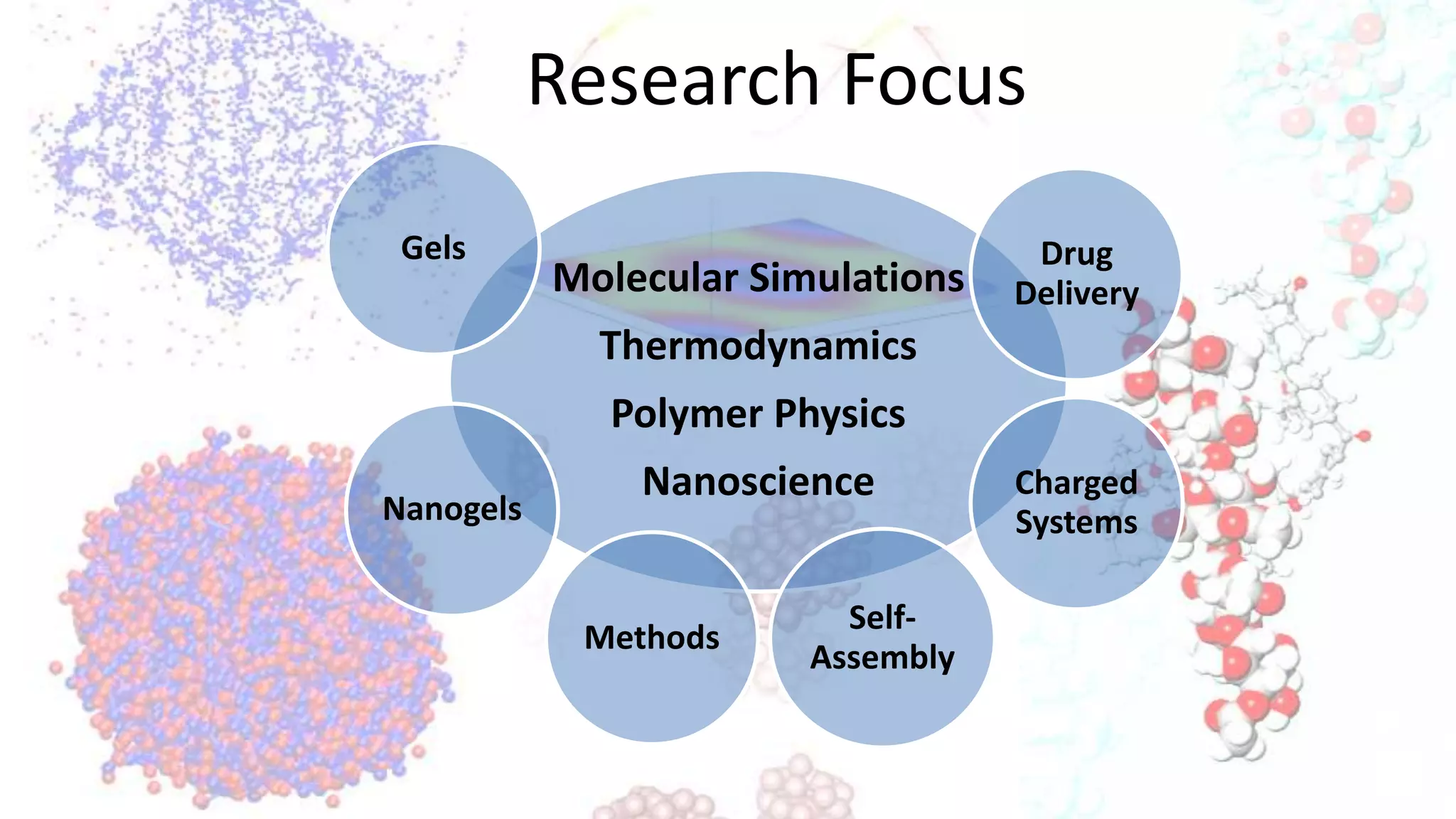



Research Focus
 Gels                               Drug
           Molecular Simulations   Delivery
             Thermodynamics
             Polymer Physics
               Nanoscience         Polymers
Nanogels

                          Self-
            Methods
                        Assembly
Polymer Gels
      Gels
                                              • Solvent-permeated networks of polymer chains
                                              • Highly responsive: Large volume changes by gaining/
                                                losing solvent with changes in T, pH, external field
                                              • Applications: Superabsorbers, Cosmetics, Contact lenses,
                                                Drug Delivery, Tissue Engineering, Artificial Muscles,
                                                Microfluidics,

F Horkay and G McKenna; Physical Properties of Polymers Handbook; 2007, Part V, 497-523
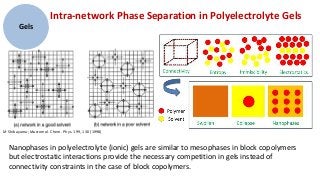
Intra-network Phase Separation in Polyelectrolyte Gels
       Gels


M Shibayama; Macromol. Chem. Phys. 199, 130 (1998)


  Nanophases in polyelectrolyte (ionic) gels are similar to mesophases in block copolymers
  but electrostatic interactions provide the necessary competition in gels instead of
  connectivity constraints in the case of block copolymers.
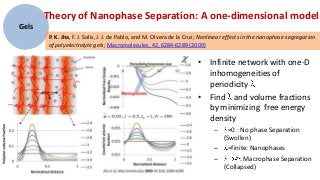
Theory of Nanophase Separation: A one-dimensional model
Gels
       P. K. Jha, F. J. Solis, J. J. de Pablo, and M. Olvera de la Cruz; Nonlinear effects in the nanophase segregation
       of polyelectrolyte gels; Macromolecules, 42, 6284-6289 (2009)

                                                                     • Infinite network with one-D
                                                                       inhomogeneities of
                                                                       periodicity
                                                                     • Find and volume fractions
                                                                       by minimizing free energy
                                                                       density
                                                                            –   =0 : No phase Separation
                                                                              (Swollen)
                                                                            – =finite: Nanophases
                                                                            –        : Macrophase Separation
                                                                              (Collapsed)
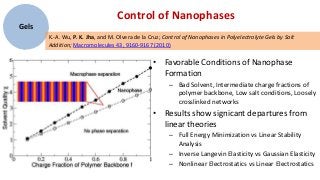
Control of Nanophases
Gels
       K.-A. Wu, P. K. Jha, and M. Olvera de la Cruz; Control of Nanophases in Polyelectrolyte Gels by Salt
       Addition; Macromolecules 43, 9160-9167 (2010)

                                                 • Favorable Conditions of Nanophase
                                                   Formation
                                                       – Bad Solvent, Intermediate charge fractions of
                                                         polymer backbone, Low salt conditions, Loosely
                                                         crosslinked networks
                                                 • Results show signicant departures from
                                                   linear theories
                                                       – Full Energy Minimization vs Linear Stability
                                                         Analysis
                                                       – Inverse Langevin Elasticity vs Gaussian Elasticity
                                                       – Nonlinear Electrostatics vs Linear Electrostatics
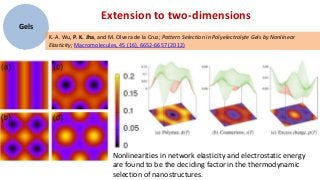
Extension to two-dimensions
Gels
       K.-A. Wu, P. K. Jha, and M. Olvera de la Cruz; Pattern Selection in Polyelectrolyte Gels by Nonlinear
       Elasticity; Macromolecules, 45 (16), 6652-6657 (2012)


                                 Nonlinearities in network elasticity and electrostatic energy
                                 are found to be the deciding factor in the thermodynamic
                                 selection of nanostructures.
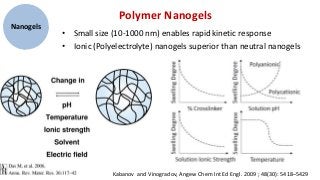
Polymer Nanogels
Nanogels
           • Small size (10-1000 nm) enables rapid kinetic response
           • Ionic (Polyelectrolyte) nanogels superior than neutral nanogels


                        Kabanov and Vinogradov, Angew Chem Int Ed Engl. 2009 ; 48(30): 5418–5429
As Drug Delivery Carriers and in Cancer treatment
   Nanogels


 • Can easily incorporate oppositely charged
   drugs/biomacromolecules, e.g.
   oligonucleotides, siRNA, DNA, proteins, …
Kabanov and Vinogradov, Angew Chem Int Ed Engl. 2009 ; 48(30): 5418–5429


                                                                           • High swelling of nanogel can be
                                                                             used in killing cancer cells
                                                                            Park et al., Journal of Controlled Release 135 (2009) 89–95
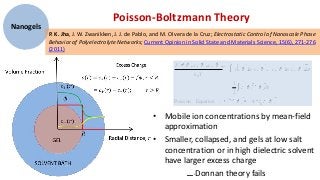
Poisson-Boltzmann Theory
Nanogels
           P. K. Jha, J. W. Zwanikken, J. J. de Pablo, and M. Olvera de la Cruz; Electrostatic Control of Nanoscale Phase
           Behavior of Polyelectrolyte Networks; Current Opinion in Solid State and Materials Science, 15(6), 271-276
           (2011)


                                                     • Mobile ion concentrations by mean-field
                                                       approximation
                                                     • Smaller, collapsed, and gels at low salt
                                                       concentration or in high dielectric solvent
                                                       have larger excess charge
                                                                Donnan theory fails
Modified Donnan Theory
Nanogels
           P. K. Jha, J. W. Zwanikken, and M. Olvera de la Cruz; Understanding Swollen-Collapsed and Re-entrant
           Transitions in Polyelectrolyte Nanogels by a Modified Donnan Theory; Soft Matter (Communication), 8,
           9519-9522 (2012)

                                                                • For nanogels at high salt
                                                                  concentrations, inclusion of the
                                                                  excluded volume effect of ions
                                                                  predicts a re-entrant behavior
                                                                  similar to that found in mitotic
                                                                  chromosomes
                                                                • Effects of a neutral component,
                                                                  salt valence, and dielectric
                                                                  mismatch, on the optimal
                                                                  compaction of nanogels are
                                                                  analyzed
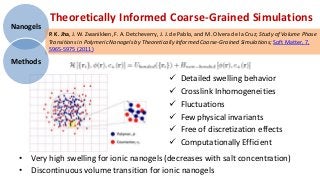
Theoretically Informed Coarse-Grained Simulations
Nanogels
           P. K. Jha, J. W. Zwanikken, F. A. Detcheverry, J. J. de Pablo, and M. Olvera de la Cruz; Study of Volume Phase
           Transitions in Polymeric Nanogels by Theoretically Informed Coarse-Grained Simulations; Soft Matter, 7,
           5965-5975 (2011)

Methods

                                                                Detailed swelling behavior
                                                                Crosslink Inhomogeneities
                                                                Fluctuations
                                                                Few physical invariants
                                                                Free of discretization effects
                                                                Computationally Efficient
  • Very high swelling for ionic nanogels (decreases with salt concentration)
  • Discontinuous volume transition for ionic nanogels
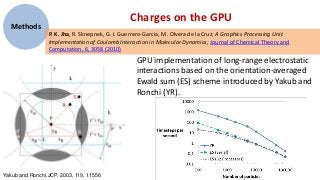
Charges on the GPU
   Methods
                 P. K. Jha, R. Sknepnek, G. I. Guerrero-Garcia, M. Olvera de la Cruz; A Graphics Processing Unit
                 Implementation of Coulomb Interaction in Molecular Dynamics; Journal of Chemical Theory and
                 Computation, 6, 3058 (2010)
                                                   GPU implementation of long-range electrostatic
                                                   interactions based on the orientation-averaged
                                                   Ewald sum (ES) scheme introduced by Yakub and
                                                   Ronchi (YR).


Yakub and Ronchi,JCP, 2003, 119, 11556
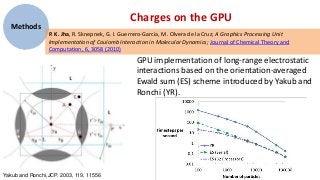
Charges on the GPU
   Methods
                 P. K. Jha, R. Sknepnek, G. I. Guerrero-Garcia, M. Olvera de la Cruz; A Graphics Processing Unit
                 Implementation of Coulomb Interaction in Molecular Dynamics; Journal of Chemical Theory and
                 Computation, 6, 3058 (2010)
                                                   GPU implementation of long-range electrostatic
                                                   interactions based on the orientation-averaged
                                                   Ewald sum (ES) scheme introduced by Yakub and
                                                   Ronchi (YR).


Yakub and Ronchi,JCP, 2003, 119, 11556
Kinetic Monte Carlo Simulations
Methods
           P. K. Jha, V. Kuzovkov, B. A. Grzybowski, and M. Olvera de la Cruz; Dynamic Self-Assembly of Photo-
           switchable nanoparticles; Soft Matter, 8, 227-234 (2012)
           P. K. Jha, V. Kuzovkov, and M. Olvera de la Cruz; Kinetic Monte Carlo Simulations of Flow-Assisted
           Polymerization; ACS Macro Letters, 2012, 1, pp 1393--1397 (2012)

                                                              •
                                                    Off-lattice with fixed step size :
                                                    Randomly pick spherical
                                                    coordinates , in 3D
                                                 • Time-step independent of
                                                    magnitude of forces (determined
                                                    by the step size)
                                                 • Unphysical moves have transition
                                                    probability=0 (NOT allowed)
                Transition probability in kinetic Monte Carlo scheme
          = Transition rate in a renormalized master equation of diffusion
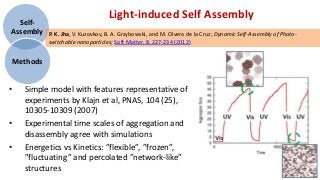
Light-induced Self Assembly
  Self-
Assembly      P. K. Jha, V. Kuzovkov, B. A. Grzybowski, and M. Olvera de la Cruz; Dynamic Self-Assembly of Photo-
              switchable nanoparticles; Soft Matter, 8, 227-234 (2012)


    Methods


•     Simple model with features representative of
      experiments by Klajn et al, PNAS, 104 (25),
      10305-10309 (2007)
•     Experimental time scales of aggregation and
      disassembly agree with simulations
•     Energetics vs Kinetics: ”flexible”, ”frozen”,
      ”fluctuating” and percolated ”network-like”
      structures
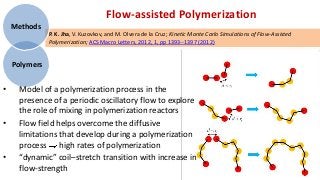
Flow-assisted Polymerization
    Methods
               P. K. Jha, V. Kuzovkov, and M. Olvera de la Cruz; Kinetic Monte Carlo Simulations of Flow-Assisted
               Polymerization; ACS Macro Letters, 2012, 1, pp 1393--1397 (2012)


    Polymers


•    Model of a polymerization process in the
     presence of a periodic oscillatory flow to explore
     the role of mixing in polymerization reactors
•    Flow field helps overcome the diffusive
     limitations that develop during a polymerization
     process high rates of polymerization
•    “dynamic” coil–stretch transition with increase in
     flow-strength
Work in Progress
Polymers
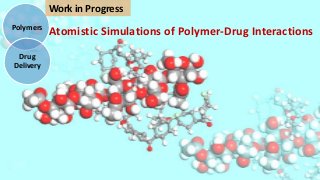
           Atomistic Simulations of Polymer-Drug Interactions
 Drug
Delivery
•   Professor Monica Olvera de la Cruz
Acknowledgments         Northwestern University
                    •   Professor Ronald G. Larson
                        University of Michigan-Ann Arbor


                                     Self-                    Drug
  Gels   Nanogels   Methods        Assembly     Polymers     Delivery

Research

  • 1.
    Research Focus Gels Drug Molecular Simulations Delivery Thermodynamics Polymer Physics Nanoscience Polymers Nanogels Self- Methods Assembly
  • 2.
    Polymer Gels Gels • Solvent-permeated networks of polymer chains • Highly responsive: Large volume changes by gaining/ losing solvent with changes in T, pH, external field • Applications: Superabsorbers, Cosmetics, Contact lenses, Drug Delivery, Tissue Engineering, Artificial Muscles, Microfluidics, F Horkay and G McKenna; Physical Properties of Polymers Handbook; 2007, Part V, 497-523
  • 3.
    Intra-network Phase Separationin Polyelectrolyte Gels Gels M Shibayama; Macromol. Chem. Phys. 199, 130 (1998) Nanophases in polyelectrolyte (ionic) gels are similar to mesophases in block copolymers but electrostatic interactions provide the necessary competition in gels instead of connectivity constraints in the case of block copolymers.
  • 4.
    Theory of NanophaseSeparation: A one-dimensional model Gels P. K. Jha, F. J. Solis, J. J. de Pablo, and M. Olvera de la Cruz; Nonlinear effects in the nanophase segregation of polyelectrolyte gels; Macromolecules, 42, 6284-6289 (2009) • Infinite network with one-D inhomogeneities of periodicity • Find and volume fractions by minimizing free energy density – =0 : No phase Separation (Swollen) – =finite: Nanophases – : Macrophase Separation (Collapsed)
  • 5.
    Control of Nanophases Gels K.-A. Wu, P. K. Jha, and M. Olvera de la Cruz; Control of Nanophases in Polyelectrolyte Gels by Salt Addition; Macromolecules 43, 9160-9167 (2010) • Favorable Conditions of Nanophase Formation – Bad Solvent, Intermediate charge fractions of polymer backbone, Low salt conditions, Loosely crosslinked networks • Results show signicant departures from linear theories – Full Energy Minimization vs Linear Stability Analysis – Inverse Langevin Elasticity vs Gaussian Elasticity – Nonlinear Electrostatics vs Linear Electrostatics
  • 6.
    Extension to two-dimensions Gels K.-A. Wu, P. K. Jha, and M. Olvera de la Cruz; Pattern Selection in Polyelectrolyte Gels by Nonlinear Elasticity; Macromolecules, 45 (16), 6652-6657 (2012) Nonlinearities in network elasticity and electrostatic energy are found to be the deciding factor in the thermodynamic selection of nanostructures.
  • 7.
    Polymer Nanogels Nanogels • Small size (10-1000 nm) enables rapid kinetic response • Ionic (Polyelectrolyte) nanogels superior than neutral nanogels Kabanov and Vinogradov, Angew Chem Int Ed Engl. 2009 ; 48(30): 5418–5429
  • 8.
    As Drug DeliveryCarriers and in Cancer treatment Nanogels • Can easily incorporate oppositely charged drugs/biomacromolecules, e.g. oligonucleotides, siRNA, DNA, proteins, … Kabanov and Vinogradov, Angew Chem Int Ed Engl. 2009 ; 48(30): 5418–5429 • High swelling of nanogel can be used in killing cancer cells Park et al., Journal of Controlled Release 135 (2009) 89–95
  • 9.
    Poisson-Boltzmann Theory Nanogels P. K. Jha, J. W. Zwanikken, J. J. de Pablo, and M. Olvera de la Cruz; Electrostatic Control of Nanoscale Phase Behavior of Polyelectrolyte Networks; Current Opinion in Solid State and Materials Science, 15(6), 271-276 (2011) • Mobile ion concentrations by mean-field approximation • Smaller, collapsed, and gels at low salt concentration or in high dielectric solvent have larger excess charge Donnan theory fails
  • 10.
    Modified Donnan Theory Nanogels P. K. Jha, J. W. Zwanikken, and M. Olvera de la Cruz; Understanding Swollen-Collapsed and Re-entrant Transitions in Polyelectrolyte Nanogels by a Modified Donnan Theory; Soft Matter (Communication), 8, 9519-9522 (2012) • For nanogels at high salt concentrations, inclusion of the excluded volume effect of ions predicts a re-entrant behavior similar to that found in mitotic chromosomes • Effects of a neutral component, salt valence, and dielectric mismatch, on the optimal compaction of nanogels are analyzed
  • 11.
    Theoretically Informed Coarse-GrainedSimulations Nanogels P. K. Jha, J. W. Zwanikken, F. A. Detcheverry, J. J. de Pablo, and M. Olvera de la Cruz; Study of Volume Phase Transitions in Polymeric Nanogels by Theoretically Informed Coarse-Grained Simulations; Soft Matter, 7, 5965-5975 (2011) Methods  Detailed swelling behavior  Crosslink Inhomogeneities  Fluctuations  Few physical invariants  Free of discretization effects  Computationally Efficient • Very high swelling for ionic nanogels (decreases with salt concentration) • Discontinuous volume transition for ionic nanogels
  • 12.
    Charges on theGPU Methods P. K. Jha, R. Sknepnek, G. I. Guerrero-Garcia, M. Olvera de la Cruz; A Graphics Processing Unit Implementation of Coulomb Interaction in Molecular Dynamics; Journal of Chemical Theory and Computation, 6, 3058 (2010) GPU implementation of long-range electrostatic interactions based on the orientation-averaged Ewald sum (ES) scheme introduced by Yakub and Ronchi (YR). Yakub and Ronchi,JCP, 2003, 119, 11556
  • 13.
    Charges on theGPU Methods P. K. Jha, R. Sknepnek, G. I. Guerrero-Garcia, M. Olvera de la Cruz; A Graphics Processing Unit Implementation of Coulomb Interaction in Molecular Dynamics; Journal of Chemical Theory and Computation, 6, 3058 (2010) GPU implementation of long-range electrostatic interactions based on the orientation-averaged Ewald sum (ES) scheme introduced by Yakub and Ronchi (YR). Yakub and Ronchi,JCP, 2003, 119, 11556
  • 14.
    Kinetic Monte CarloSimulations Methods P. K. Jha, V. Kuzovkov, B. A. Grzybowski, and M. Olvera de la Cruz; Dynamic Self-Assembly of Photo- switchable nanoparticles; Soft Matter, 8, 227-234 (2012) P. K. Jha, V. Kuzovkov, and M. Olvera de la Cruz; Kinetic Monte Carlo Simulations of Flow-Assisted Polymerization; ACS Macro Letters, 2012, 1, pp 1393--1397 (2012) • Off-lattice with fixed step size : Randomly pick spherical coordinates , in 3D • Time-step independent of magnitude of forces (determined by the step size) • Unphysical moves have transition probability=0 (NOT allowed) Transition probability in kinetic Monte Carlo scheme = Transition rate in a renormalized master equation of diffusion
  • 15.
    Light-induced Self Assembly Self- Assembly P. K. Jha, V. Kuzovkov, B. A. Grzybowski, and M. Olvera de la Cruz; Dynamic Self-Assembly of Photo- switchable nanoparticles; Soft Matter, 8, 227-234 (2012) Methods • Simple model with features representative of experiments by Klajn et al, PNAS, 104 (25), 10305-10309 (2007) • Experimental time scales of aggregation and disassembly agree with simulations • Energetics vs Kinetics: ”flexible”, ”frozen”, ”fluctuating” and percolated ”network-like” structures
  • 16.
    Flow-assisted Polymerization Methods P. K. Jha, V. Kuzovkov, and M. Olvera de la Cruz; Kinetic Monte Carlo Simulations of Flow-Assisted Polymerization; ACS Macro Letters, 2012, 1, pp 1393--1397 (2012) Polymers • Model of a polymerization process in the presence of a periodic oscillatory flow to explore the role of mixing in polymerization reactors • Flow field helps overcome the diffusive limitations that develop during a polymerization process high rates of polymerization • “dynamic” coil–stretch transition with increase in flow-strength
  • 17.
    Work in Progress Polymers Atomistic Simulations of Polymer-Drug Interactions Drug Delivery
  • 18.
    Professor Monica Olvera de la Cruz Acknowledgments Northwestern University • Professor Ronald G. Larson University of Michigan-Ann Arbor Self- Drug Gels Nanogels Methods Assembly Polymers Delivery