Representing Vector Geographic
Information As a Tensor for
Deep Learning-BasedMap
Generalization.
Azelle Courtial, Guillaume Touya​, Xiang Zhang
LASTIG, Univ. Gustav Eiffel, ENSG, IGN, Champs-sur-Marne, France
School of Geospatial Engineering and Sciences, Sun Yat-Sen University, Guangzhou, China
Content
• Context
• Problems: An in-adapted representationof geographic information
• From vector geographic database to Tensor-set: A layered and
contextual representation.
• Experiments
• Conclusion
2
3
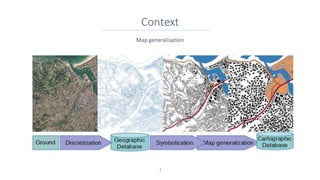
Map generalisation
Context
Context
4
Deep learning
5
Context
6
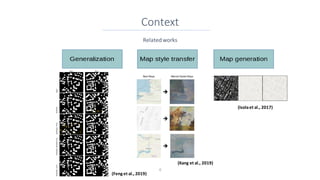
(Kang et al., 2019)
(Feng et al., 2019)
Relatedworks
Context
(Isolaet al., 2017)
7
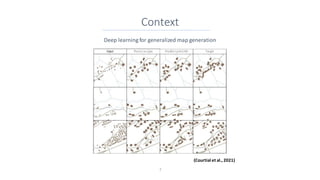
Deep learning for generalized map generation
Context
(Courtial et al., 2021)
8
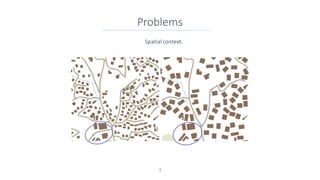
Spatial context.
Problems
9
Attribute information
Problems
1
0
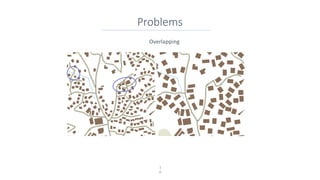
Overlapping
Problems
11
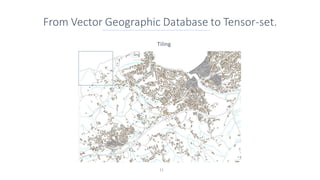
Tiling
From Vector Geographic Database to Tensor-set.
12
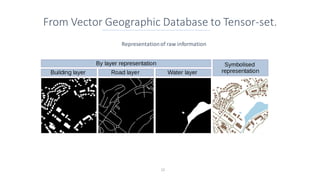
Representationof raw information
From Vector Geographic Database to Tensor-set.
13
Representationof additional information
Context Attribut
Context
and
Attribut
From Vector Geographic Database to Tensor-set.
14
Representationof additional information
Ordered categories
Un-ordered categories
Quantity
From Vector Geographic Database to Tensor-set.
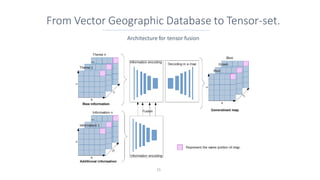
Architecture for tensor fusion
15
From Vector Geographic Database to Tensor-set.
16
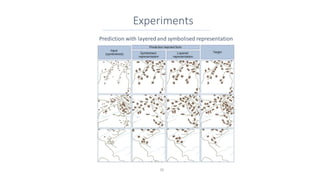
Prediction with layeredand symbolised representation
Experiments
17
Calculateroads selection indicator.
Graph based learning
Experiments
(Courtial et al., 2022)
18
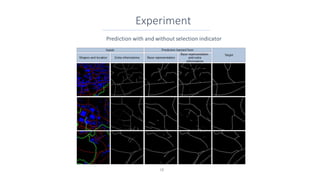
Prediction with and without selection indicator
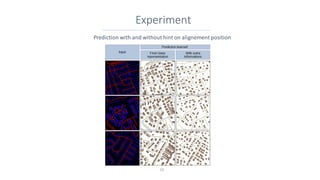
Experiment
Prediction with and without hint on alignement position
Experiment
19
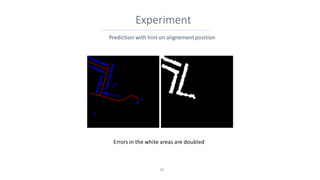
Prediction with hint on alignementposition
Experiment
20
Errors in the white areas are doubled
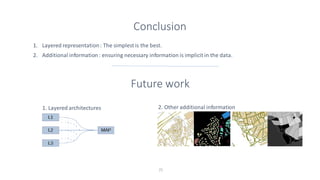
Conclusion
1. Layered representation: The simplest is the best.
2. Additional information: ensuring necessary information is implicit in the data.
21
Future work
1. Layered architectures 2. Other additional information
Thank you !
22
Contact : azelle.courtial@ign.fr

Representing Vector Geographic Information As a Tensor for Deep Learning Based Map Generalisation