Exploring the potential of
deep learning for map
generalization
Azelle Courtial
Supervised by Guillaume Touya and Xiang Zhang
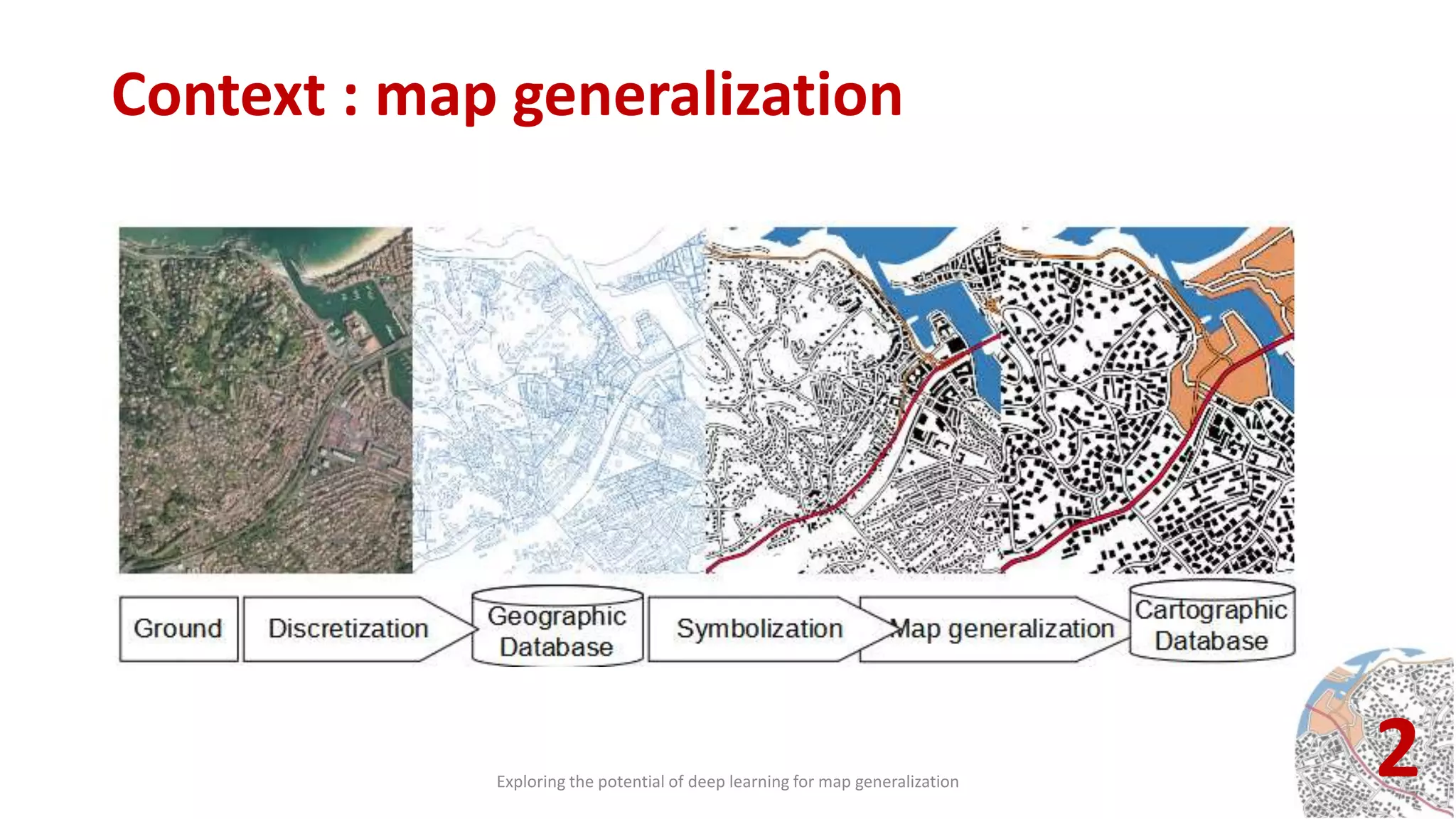
Context : map generalization
Exploring the potential of deep learning for map generalization
2
Context : map generalization
Exploring the potential of deep learning for map generalization
3
Operators
Selection
Enlargement
Simplification
Typification
Amalgamation
Context : map generalization
Exploring the potential of deep learning for map generalization
4
Geometry,
Attribute,
Context,
Etc.
Multi criteria
decision
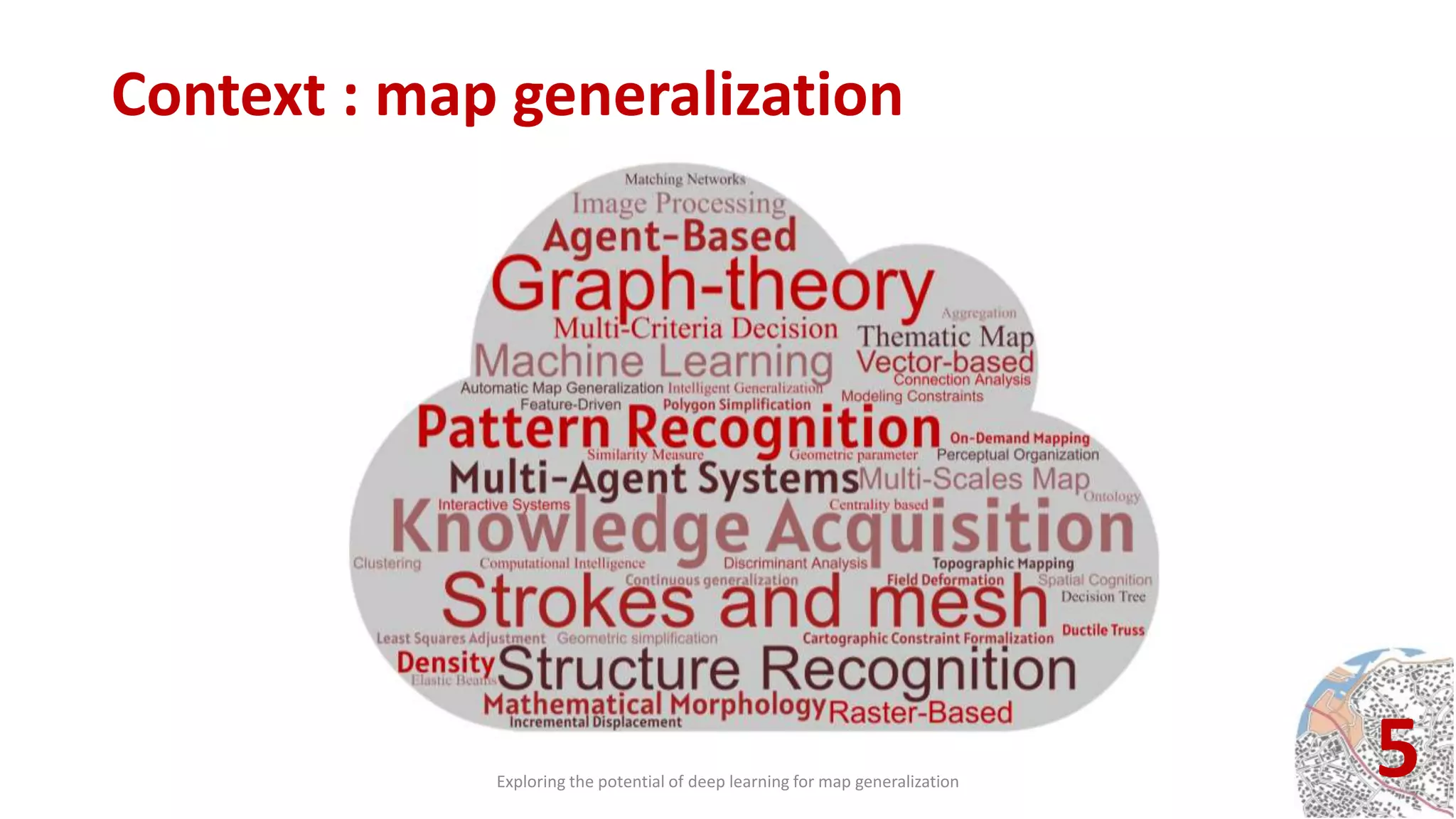
Context : map generalization
Exploring the potential of deep learning for map generalization
5
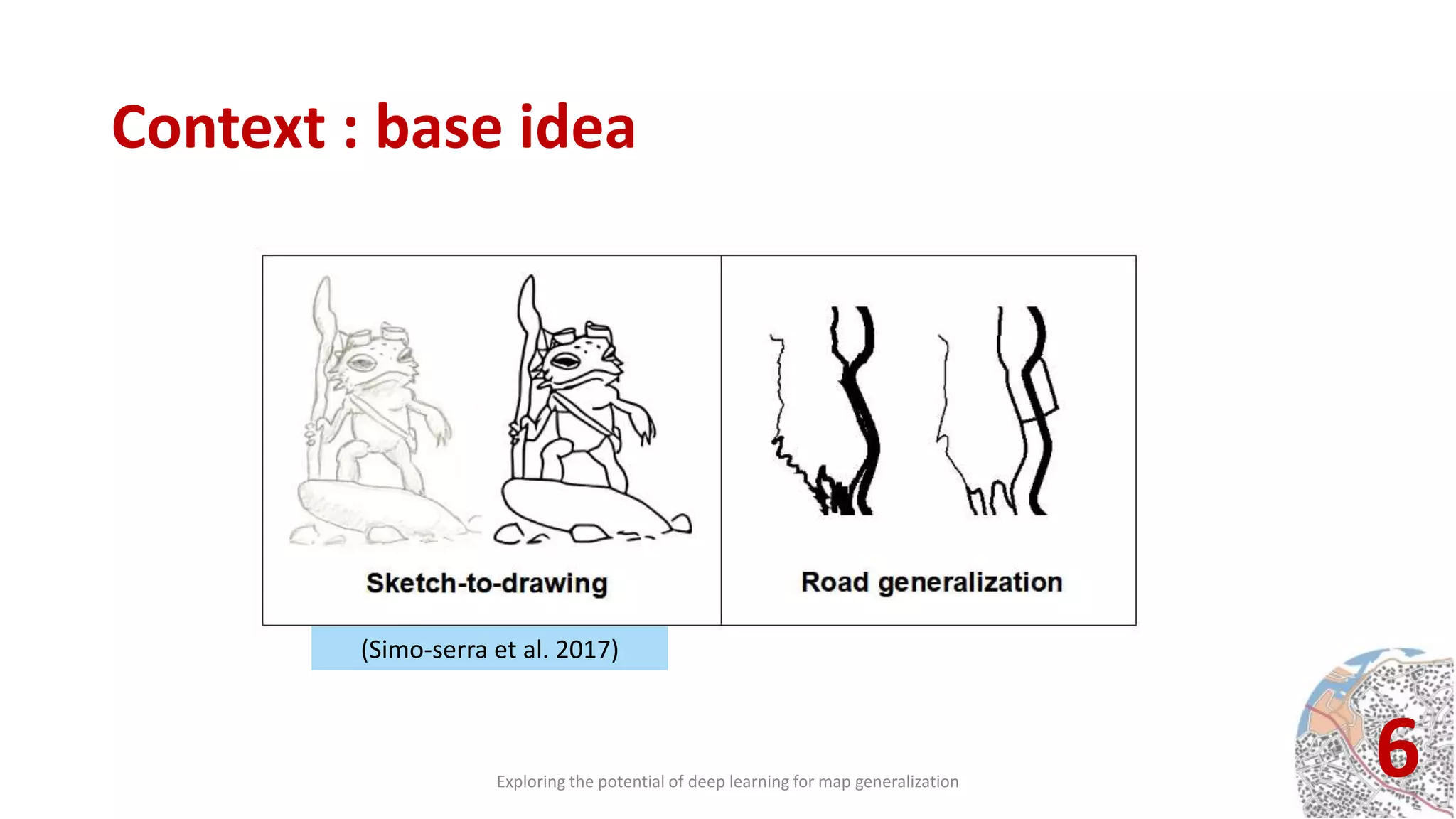
Context : base idea
Exploring the potential of deep learning for map generalization
6
(Simo-serra et al. 2017)​
Context : deep learning principle
Exploring the potential of deep learning for map generalization
7
NOT
A
MAP
A
MAP
A
MAP
Input
Prediction
Target
Model
Context : deep learning principle
Exploring the potential of deep learning for map generalization
8
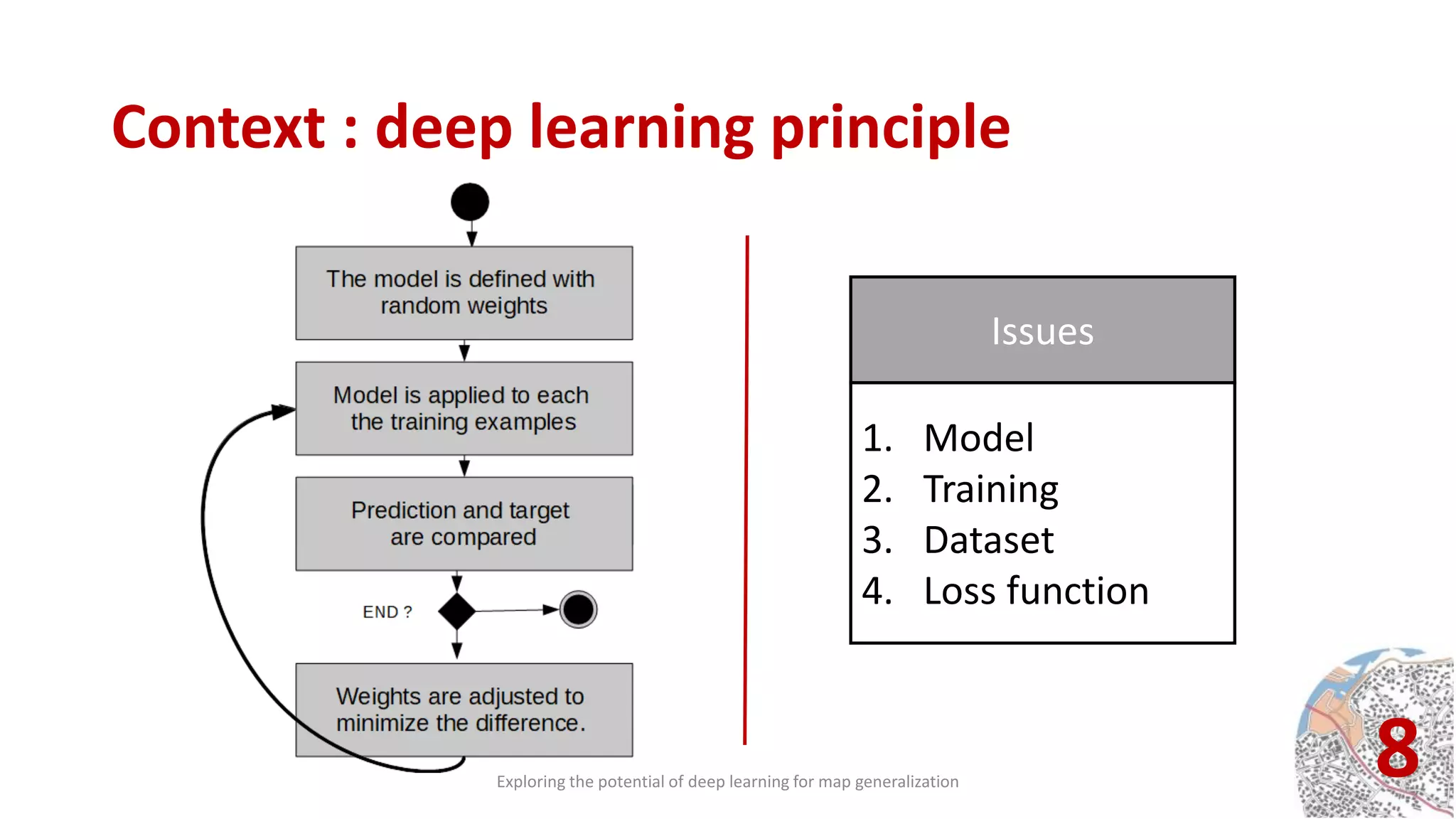
1. Model
2. Training
3. Dataset
4. Loss function
Issues
Issue 1. Designing an adapted deep
neural network
Exploring the potential of deep learning for map generalization
9
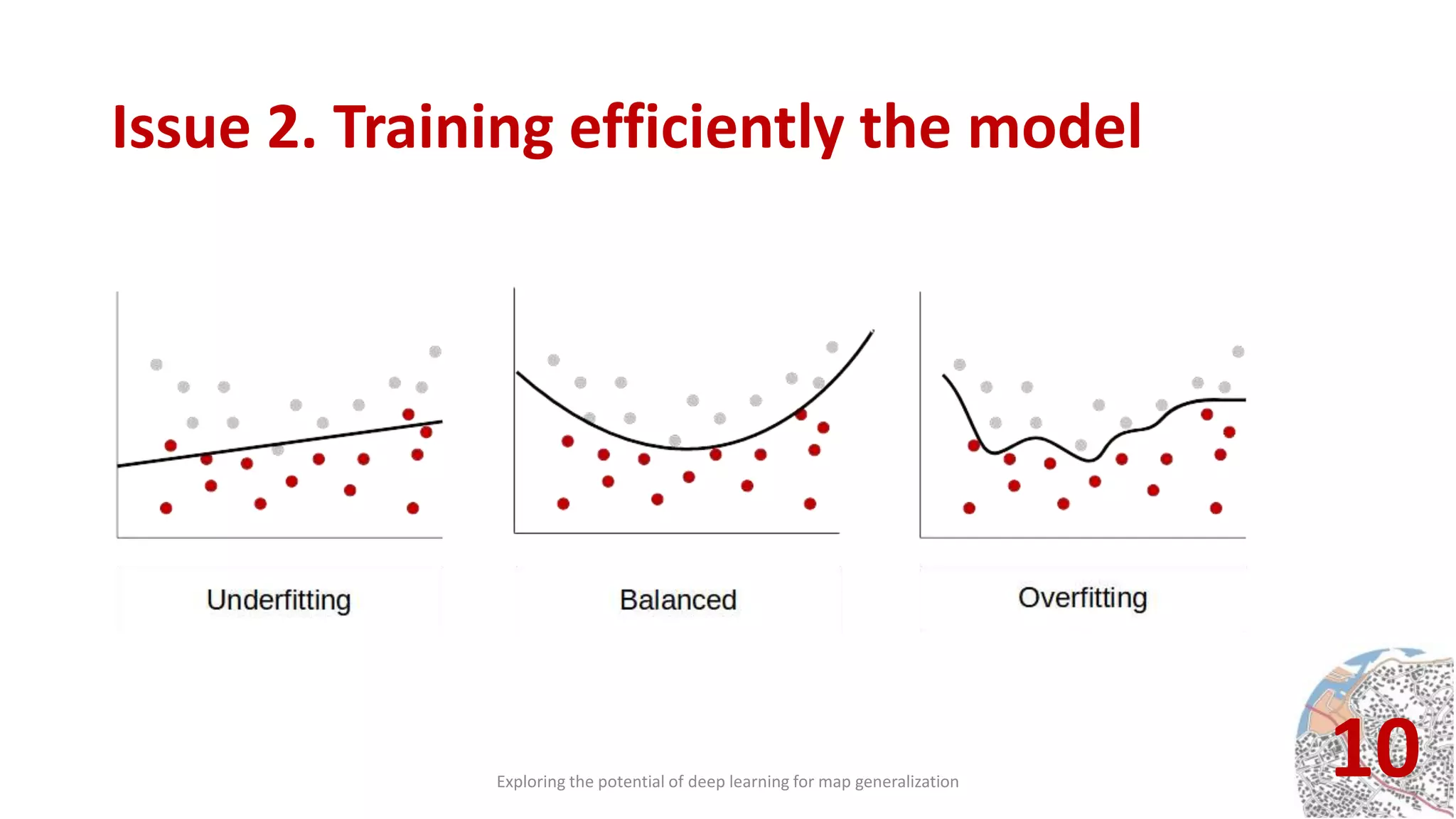
Issue 2. Training efficiently the model
Exploring the potential of deep learning for map generalization
10
Issue 3. Designing an adapted
training set
Exploring the potential of deep learning for map generalization
11
Input Target
Issue 4. Measuring the quality of
a prediction
Exploring the potential of deep learning for map generalization
12
Could you guess which prediction is the best?
Objectives
Exploring the potential of deep learning for map generalization
13
Explore the potential of deep learning to
contribute to map generalization research.
Method : an exploration through three use
cases
Exploring the potential of deep learning for map generalization
14
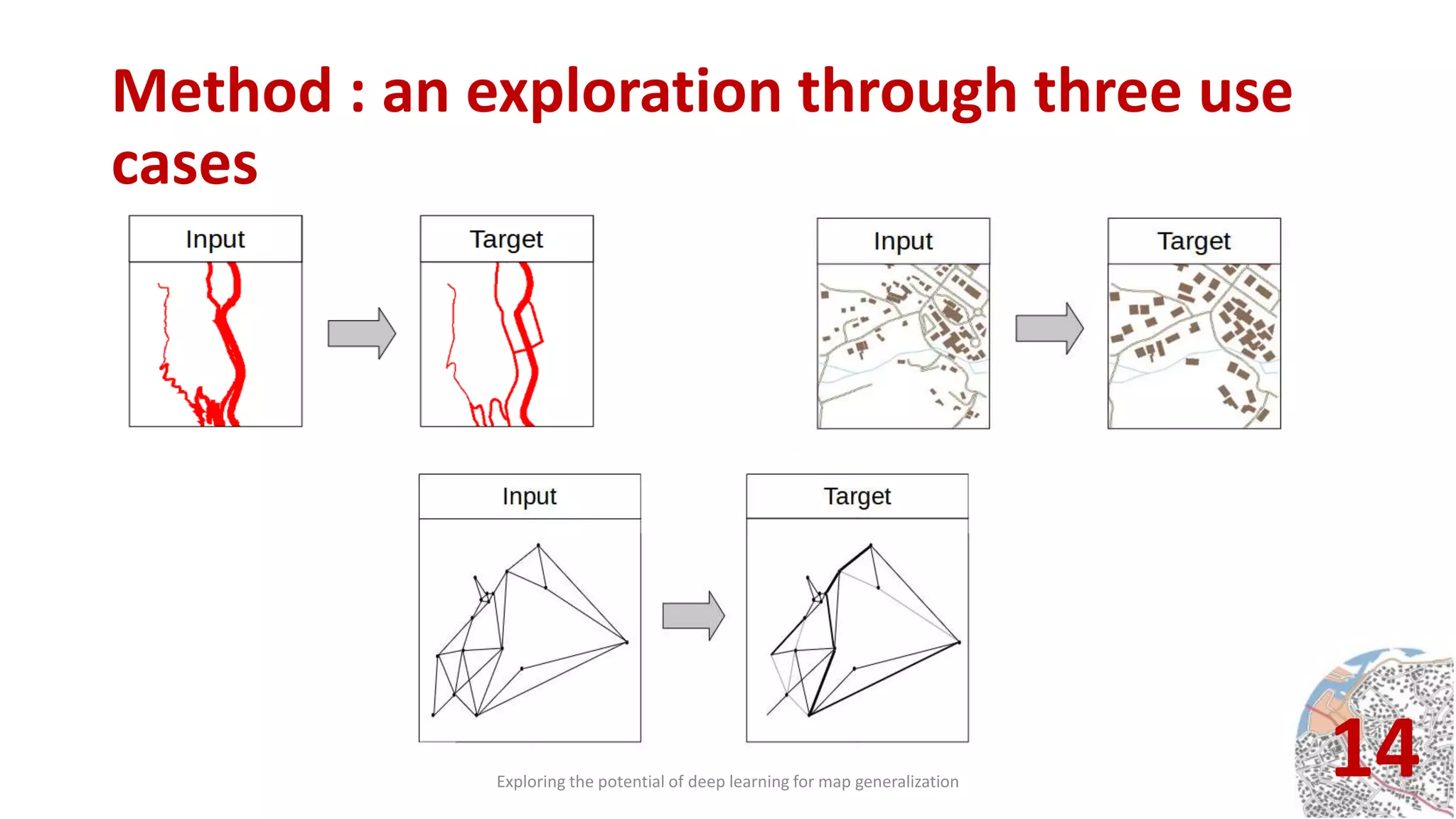
Method : an exploration through three use
cases
Exploring the potential of deep learning for map generalization
15
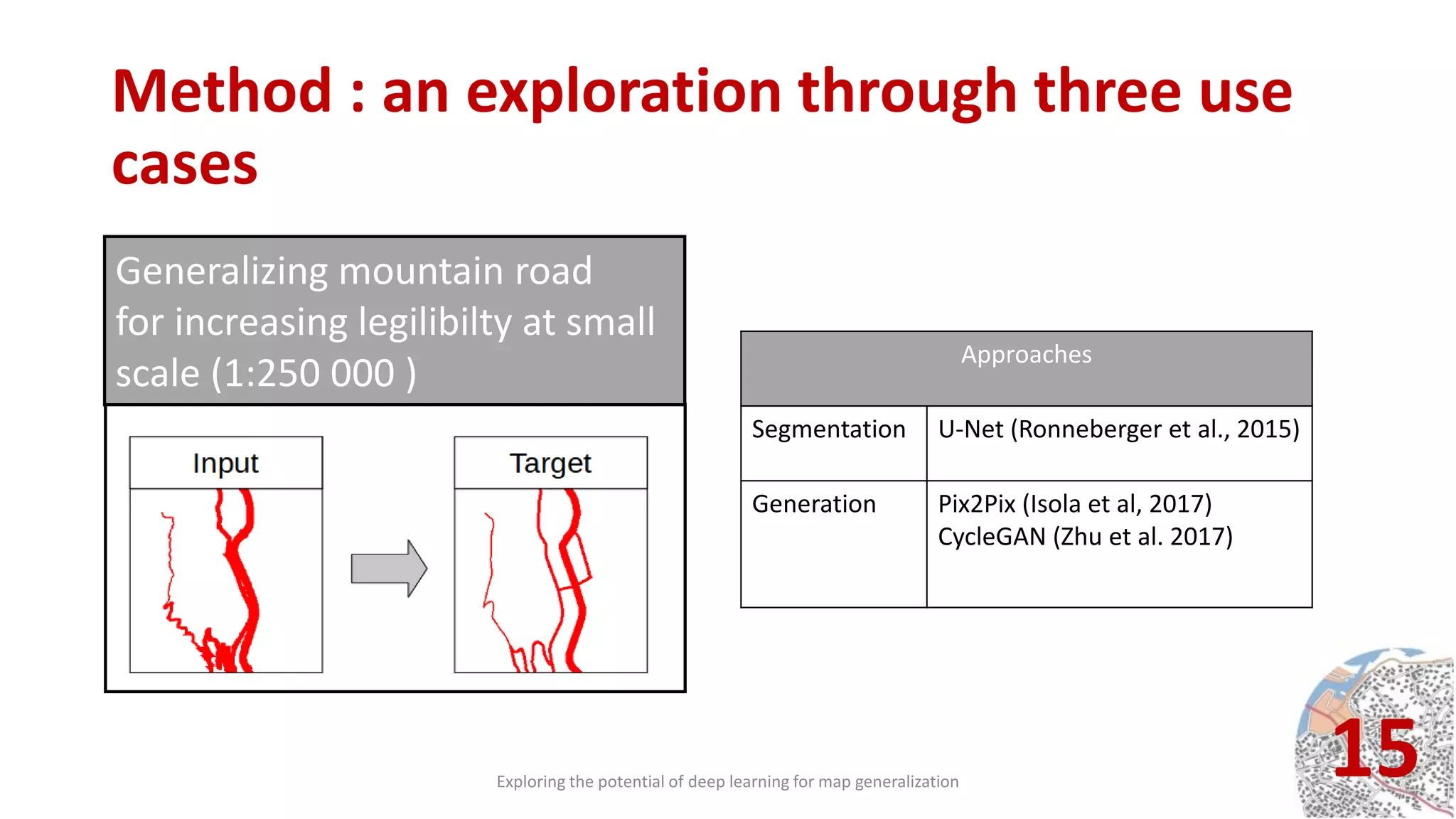
Generalizing mountain road
for increasing legilibilty at small
scale (1:250 000 )
Approaches
Segmentation U-Net (Ronneberger et al., 2015)
Generation Pix2Pix (Isola et al, 2017)
CycleGAN (Zhu et al. 2017)
Method : an exploration through three use
cases
Exploring the potential of deep learning for map generalization
16
Generalizing urban areas
in topographic maps at
medium scale (1:50 000)
Approaches
Generation Pix2Pix (Isola et al, 2017)
CycleGAN (Zhu et al. 2017)
FuseGAN
Mixed DeepMapScaler
Method : an exploration through three use
cases
Exploring the potential of deep learning for map generalization
17
Predicting necessary
information for map
generalization Approach
Node
classification
GCN (Kipf & Welling, 2016)
Outline
Exploring the potential of deep learning for map generalization
18
A. Dataset
Quality
Representation
B. Evaluation
Why and how ?
Raster-based
C. Integration
Usage
Combination
Conclusion
Dataset
Exploring the potential of deep learning for map generalization
19
A. Dataset
Exploring the potential of deep learning for map generalization
20
1. Quality
CycleGAN prediction
A. Dataset
Exploring the potential of deep learning for map generalization
21
1. Quality
Input Prediction Target
CycleGAN prediction
1km
A. Dataset
Exploring the potential of deep learning for map generalization
22
2. Representation
Layered representation
For each cartographic theme, shape and position of entities are represented using one mask. Masks are stacked
in an image with n (the number of themes) layers.
Symbolized
A cartographic symbol is applied to
each entities, the entities are
rasterized in a map looking image.
A. Dataset
23
2. Representation
Pix2Pix prediction
A. Dataset
24
2. Representation
Exploring the potential of deep learning for map generalization
Symbolized representation Layered representation
A. Dataset
Exploring the potential of deep learning for map generalization
25
2. Representation
A. Dataset
Exploring the potential of deep learning for map generalization
26
2. Representation
Input Target
Additionnal
information
Stack model
prediction
Pix2Pix prediction
Fusion model
prediction
FusePix prediction
Prediction
Pix2Pix prediction
A. Dataset
27
2. Representation
Stack model prediction Fusion model prediction
Target
Exploring the potential of deep learning for map generalization
Evaluation
Exploring the potential of deep learning for map generalization
28
B. Evaluation
Exploring the potential of deep learning for map generalization
29
1. Why and how ?
Tuning
Training set
preparation
Setting
Weight
adjustment
Controlling
Training
Validate
Testing
B. Evaluation
Exploring the potential of deep learning for map generalization
30
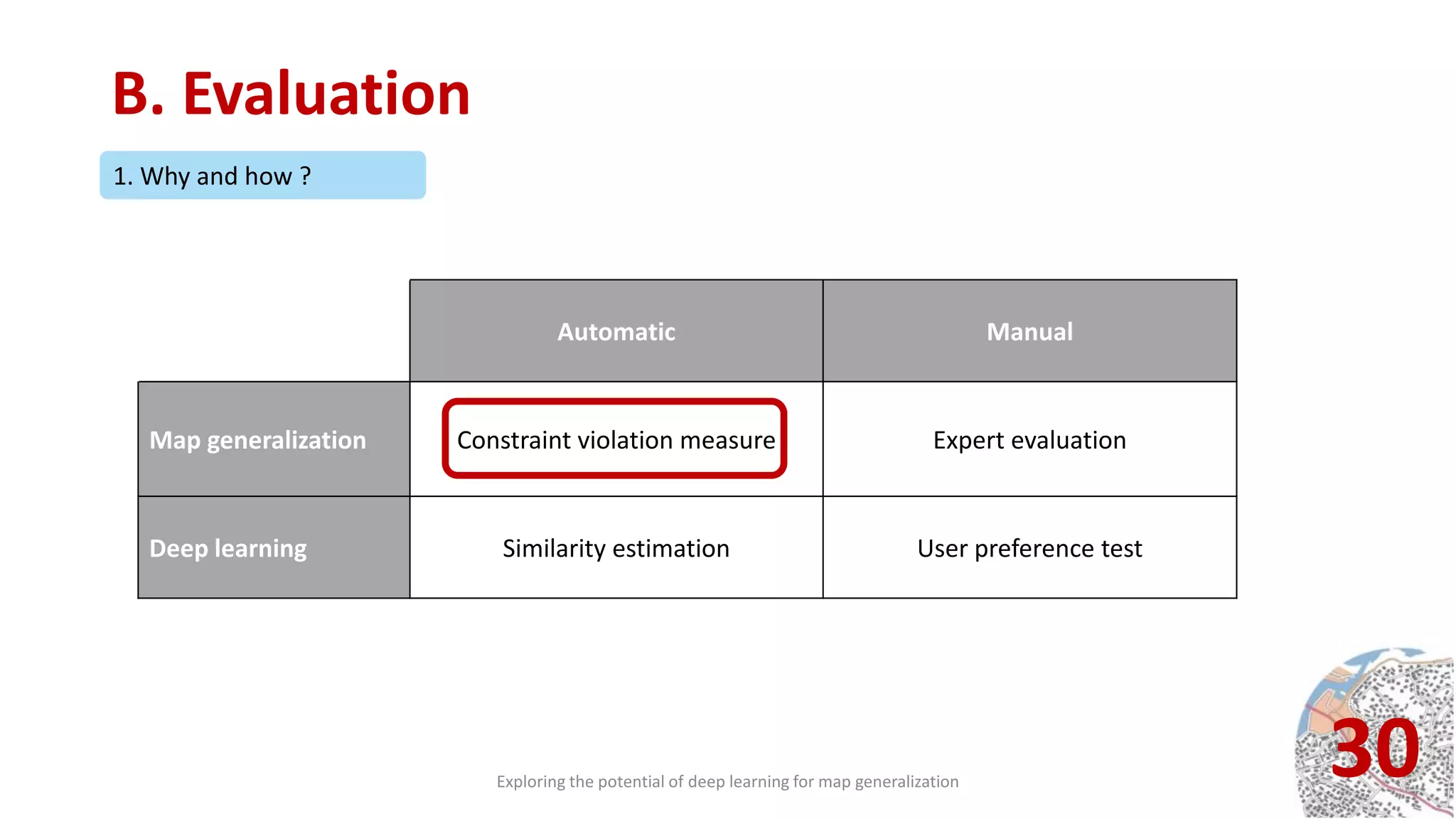
1. Why and how ?
Automatic Manual
Map generalization Constraint violation measure Expert evaluation
Deep learning Similarity estimation User preference test
B. Evaluation
Exploring the potential of deep learning for map generalization
31
2. Raster-based evaluation
Clutter Reduction
Smoothness
Coalescence Reduction
Legibility
Position Preservation
Road Connectivity
Preservation
Preservation
Color Realism
Noise Absence
Realism
B. Evaluation
Exploring the potential of deep learning for map generalization
32
2. Raster-based evaluation
Dilation N
Erosion N+6
Dilation 6
Coalescence
measure
B. Evaluation
Exploring the potential of deep learning for map generalization
2. Raster-based evaluation
33
Integration
Exploring the potential of deep learning for map generalization
34
C. Integration
Exploring the potential of deep learning for map generalization
35
1. Usage
(Touya et al., 2018) (Yan et al., 2020)
• The model is trained to
predict information about
geographic entity.
• This information is used by
generalization operators.
Deep data
enrichment
(Courtial et al., 2021)
C. Integration
Exploring the potential of deep learning for map generalization
36
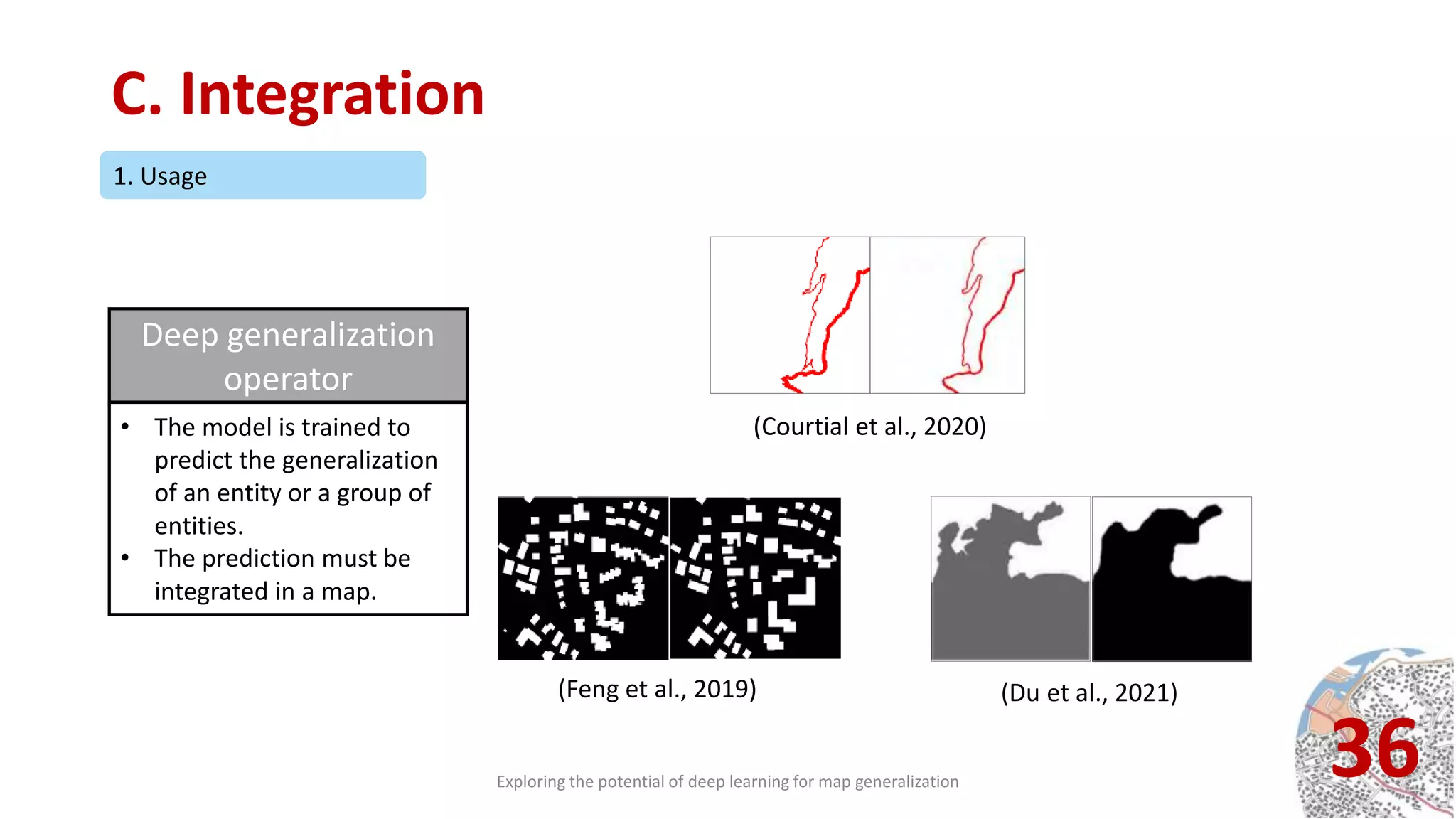
1. Usage
(Courtial et al., 2020)
(Feng et al., 2019) (Du et al., 2021)
• The model is trained to
predict the generalization
of an entity or a group of
entities.
• The prediction must be
integrated in a map.
Deep generalization
operator
C. Integration
Exploring the potential of deep learning for map generalization
37
1. Usage
Some examples
(Courtial et al., 2021)
(Kang et al., 2019) (Isola et al., 2017)
• The model is trained to
predict the generalized
map of an area.
Deep map generation
C. Integration
Exploring the potential of deep learning for map generalization
38
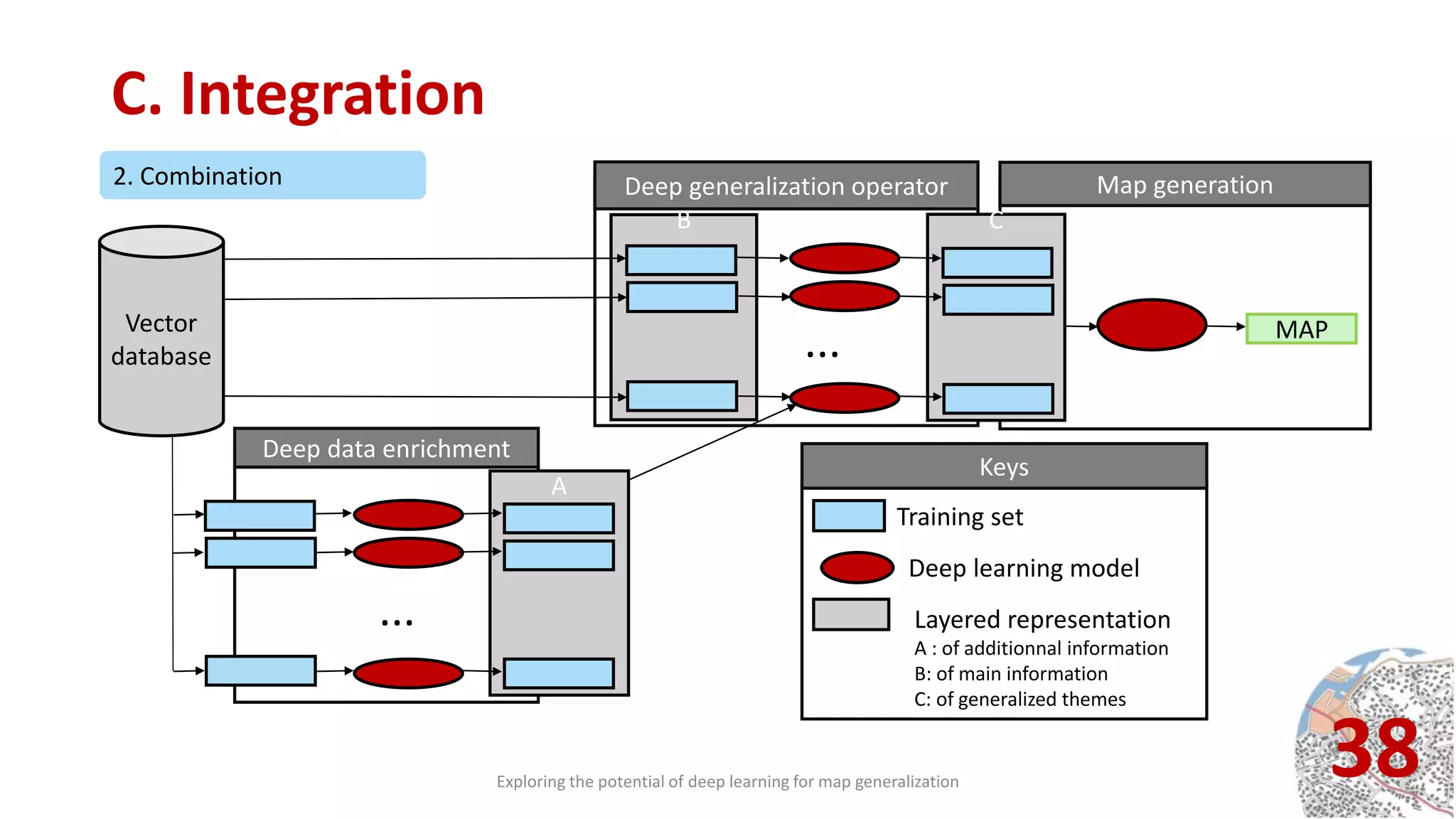
2. Combination
MAP
Map generation
B C
...
Deep generalization operator
A
...
Deep data enrichment
Vector
database
Keys
Training set
Deep learning model
Layered representation
A : of additionnal information
B: of main information
C: of generalized themes
C. Integration
Exploring the potential of deep learning for map generalization
2. Combination
39
GAN MAP
Map generation
Generalized
building
Generalized
water
Generalized
Road
GAN
GAN
Fuse
GAN
Deep generalization operator
Main
information
with a layered
representation
GCN
Road network
graph
Block graying
Deep data enrichment
Building and
road images
UNet
Road
importance
Water
Building
Road
C. Integration
Exploring the potential of deep learning for map generalization
40
2. Combination
Expliquer plus
Add input
Input Workflow prediction Unique model prediction Target
C. Integration
Exploring the potential of deep learning for map generalization
41
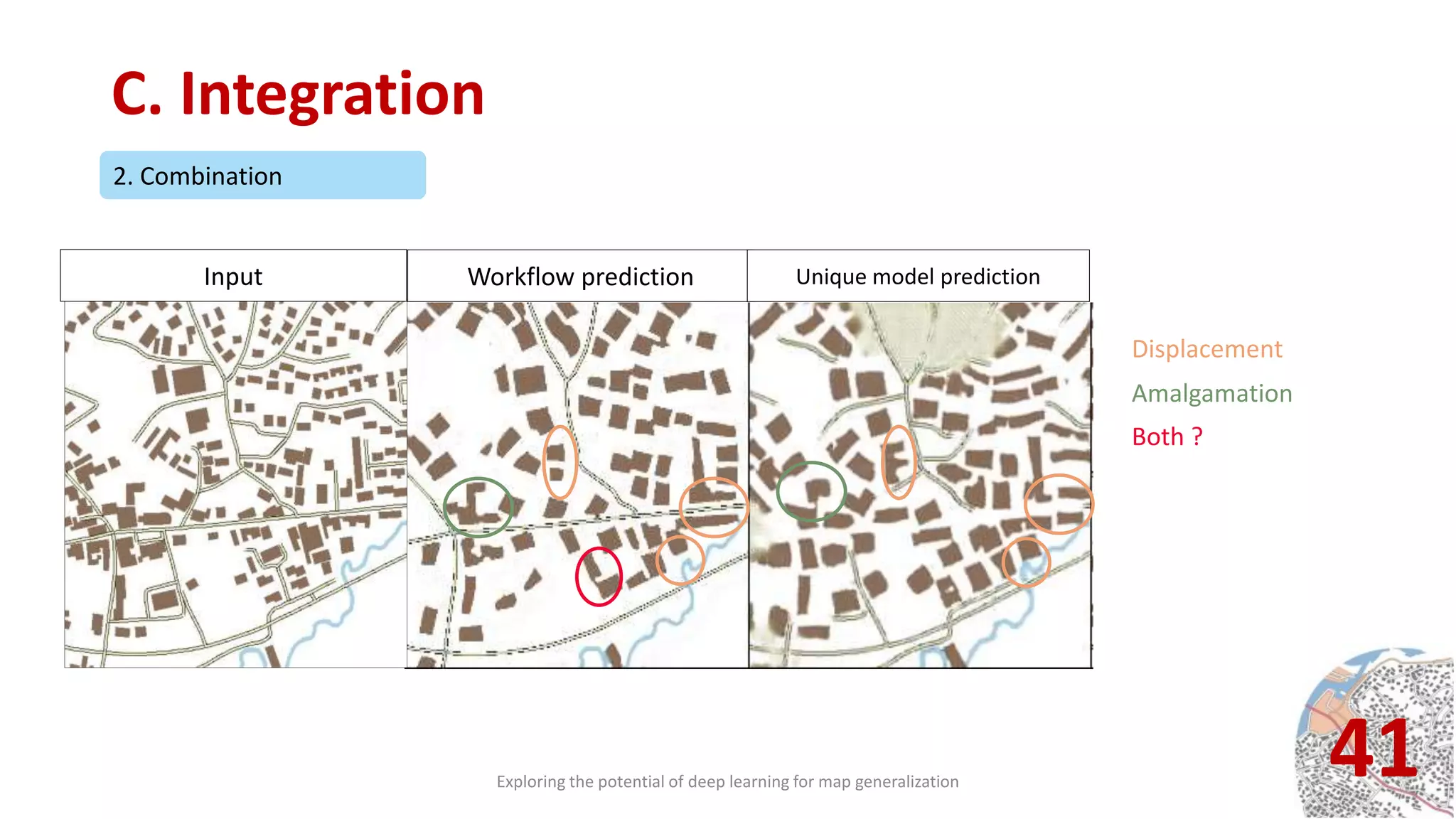
2. Combination
Input Workflow prediction Unique model prediction
Displacement
Both ?
Amalgamation
C. Integration
Exploring the potential of deep learning for map generalization
42
2. Combination
• Independent representation
• Simpler evaluation and post
processing
• Independent training
• Allows to learn new
operation
• Requires more time and
storage capacity
• The propagation of errors is
more probable
Conclusion
Exploring the potential of deep learning for map generalization
43
Conclusion
Exploring the potential of deep learning for map generalization
44
Can deep learning contribute to map generalization ?
Graph-based approach
Image-based approach
For data enrichment
Graph-based approach
Image-based approach
For operator learning
With a unique model
With a workflow
For generalized map generation
Exploring the potential of deep learning for map generalization
45
Conclusion
Perspectives
Conclusion
Exploring the potential of deep learning for map generalization
46
Perspectives
Graph based shape prediction Interpolation of spatial relation
Conclusion
Exploring the potential of deep learning for map generalization
47
Perspectives
(Liu
et
al.,
2021)
s
Thank you !

Exploring the potential of deep learning for map generalization

  • 1.
    Exploring the potentialof deep learning for map generalization Azelle Courtial Supervised by Guillaume Touya and Xiang Zhang
  • 2.
    Context : mapgeneralization Exploring the potential of deep learning for map generalization 2
  • 3.
    Context : mapgeneralization Exploring the potential of deep learning for map generalization 3 Operators Selection Enlargement Simplification Typification Amalgamation
  • 4.
    Context : mapgeneralization Exploring the potential of deep learning for map generalization 4 Geometry, Attribute, Context, Etc. Multi criteria decision
  • 5.
    Context : mapgeneralization Exploring the potential of deep learning for map generalization 5
  • 6.
    Context : baseidea Exploring the potential of deep learning for map generalization 6 (Simo-serra et al. 2017)​
  • 7.
    Context : deeplearning principle Exploring the potential of deep learning for map generalization 7 NOT A MAP A MAP A MAP Input Prediction Target Model
  • 8.
    Context : deeplearning principle Exploring the potential of deep learning for map generalization 8 1. Model 2. Training 3. Dataset 4. Loss function Issues
  • 9.
    Issue 1. Designingan adapted deep neural network Exploring the potential of deep learning for map generalization 9
  • 10.
    Issue 2. Trainingefficiently the model Exploring the potential of deep learning for map generalization 10
  • 11.
    Issue 3. Designingan adapted training set Exploring the potential of deep learning for map generalization 11 Input Target
  • 12.
    Issue 4. Measuringthe quality of a prediction Exploring the potential of deep learning for map generalization 12 Could you guess which prediction is the best?
  • 13.
    Objectives Exploring the potentialof deep learning for map generalization 13 Explore the potential of deep learning to contribute to map generalization research.
  • 14.
    Method : anexploration through three use cases Exploring the potential of deep learning for map generalization 14
  • 15.
    Method : anexploration through three use cases Exploring the potential of deep learning for map generalization 15 Generalizing mountain road for increasing legilibilty at small scale (1:250 000 ) Approaches Segmentation U-Net (Ronneberger et al., 2015) Generation Pix2Pix (Isola et al, 2017) CycleGAN (Zhu et al. 2017)
  • 16.
    Method : anexploration through three use cases Exploring the potential of deep learning for map generalization 16 Generalizing urban areas in topographic maps at medium scale (1:50 000) Approaches Generation Pix2Pix (Isola et al, 2017) CycleGAN (Zhu et al. 2017) FuseGAN Mixed DeepMapScaler
  • 17.
    Method : anexploration through three use cases Exploring the potential of deep learning for map generalization 17 Predicting necessary information for map generalization Approach Node classification GCN (Kipf & Welling, 2016)
  • 18.
    Outline Exploring the potentialof deep learning for map generalization 18 A. Dataset Quality Representation B. Evaluation Why and how ? Raster-based C. Integration Usage Combination Conclusion
  • 19.
    Dataset Exploring the potentialof deep learning for map generalization 19
  • 20.
    A. Dataset Exploring thepotential of deep learning for map generalization 20 1. Quality CycleGAN prediction
  • 21.
    A. Dataset Exploring thepotential of deep learning for map generalization 21 1. Quality Input Prediction Target CycleGAN prediction 1km
  • 22.
    A. Dataset Exploring thepotential of deep learning for map generalization 22 2. Representation Layered representation For each cartographic theme, shape and position of entities are represented using one mask. Masks are stacked in an image with n (the number of themes) layers. Symbolized A cartographic symbol is applied to each entities, the entities are rasterized in a map looking image.
  • 23.
  • 24.
    A. Dataset 24 2. Representation Exploringthe potential of deep learning for map generalization Symbolized representation Layered representation
  • 25.
    A. Dataset Exploring thepotential of deep learning for map generalization 25 2. Representation
  • 26.
    A. Dataset Exploring thepotential of deep learning for map generalization 26 2. Representation Input Target Additionnal information Stack model prediction Pix2Pix prediction Fusion model prediction FusePix prediction Prediction Pix2Pix prediction
  • 27.
    A. Dataset 27 2. Representation Stackmodel prediction Fusion model prediction Target Exploring the potential of deep learning for map generalization
  • 28.
    Evaluation Exploring the potentialof deep learning for map generalization 28
  • 29.
    B. Evaluation Exploring thepotential of deep learning for map generalization 29 1. Why and how ? Tuning Training set preparation Setting Weight adjustment Controlling Training Validate Testing
  • 30.
    B. Evaluation Exploring thepotential of deep learning for map generalization 30 1. Why and how ? Automatic Manual Map generalization Constraint violation measure Expert evaluation Deep learning Similarity estimation User preference test
  • 31.
    B. Evaluation Exploring thepotential of deep learning for map generalization 31 2. Raster-based evaluation Clutter Reduction Smoothness Coalescence Reduction Legibility Position Preservation Road Connectivity Preservation Preservation Color Realism Noise Absence Realism
  • 32.
    B. Evaluation Exploring thepotential of deep learning for map generalization 32 2. Raster-based evaluation Dilation N Erosion N+6 Dilation 6 Coalescence measure
  • 33.
    B. Evaluation Exploring thepotential of deep learning for map generalization 2. Raster-based evaluation 33
  • 34.
    Integration Exploring the potentialof deep learning for map generalization 34
  • 35.
    C. Integration Exploring thepotential of deep learning for map generalization 35 1. Usage (Touya et al., 2018) (Yan et al., 2020) • The model is trained to predict information about geographic entity. • This information is used by generalization operators. Deep data enrichment (Courtial et al., 2021)
  • 36.
    C. Integration Exploring thepotential of deep learning for map generalization 36 1. Usage (Courtial et al., 2020) (Feng et al., 2019) (Du et al., 2021) • The model is trained to predict the generalization of an entity or a group of entities. • The prediction must be integrated in a map. Deep generalization operator
  • 37.
    C. Integration Exploring thepotential of deep learning for map generalization 37 1. Usage Some examples (Courtial et al., 2021) (Kang et al., 2019) (Isola et al., 2017) • The model is trained to predict the generalized map of an area. Deep map generation
  • 38.
    C. Integration Exploring thepotential of deep learning for map generalization 38 2. Combination MAP Map generation B C ... Deep generalization operator A ... Deep data enrichment Vector database Keys Training set Deep learning model Layered representation A : of additionnal information B: of main information C: of generalized themes
  • 39.
    C. Integration Exploring thepotential of deep learning for map generalization 2. Combination 39 GAN MAP Map generation Generalized building Generalized water Generalized Road GAN GAN Fuse GAN Deep generalization operator Main information with a layered representation GCN Road network graph Block graying Deep data enrichment Building and road images UNet Road importance Water Building Road
  • 40.
    C. Integration Exploring thepotential of deep learning for map generalization 40 2. Combination Expliquer plus Add input Input Workflow prediction Unique model prediction Target
  • 41.
    C. Integration Exploring thepotential of deep learning for map generalization 41 2. Combination Input Workflow prediction Unique model prediction Displacement Both ? Amalgamation
  • 42.
    C. Integration Exploring thepotential of deep learning for map generalization 42 2. Combination • Independent representation • Simpler evaluation and post processing • Independent training • Allows to learn new operation • Requires more time and storage capacity • The propagation of errors is more probable
  • 43.
    Conclusion Exploring the potentialof deep learning for map generalization 43
  • 44.
    Conclusion Exploring the potentialof deep learning for map generalization 44 Can deep learning contribute to map generalization ? Graph-based approach Image-based approach For data enrichment Graph-based approach Image-based approach For operator learning With a unique model With a workflow For generalized map generation
  • 45.
    Exploring the potentialof deep learning for map generalization 45 Conclusion Perspectives
  • 46.
    Conclusion Exploring the potentialof deep learning for map generalization 46 Perspectives Graph based shape prediction Interpolation of spatial relation
  • 47.
    Conclusion Exploring the potentialof deep learning for map generalization 47 Perspectives (Liu et al., 2021) s
  • 48.