Representation
By Megan
Brant
Click to edit Master subtitle style
Representation means all media texts are re-presentations of reality. This means
that they are intentionally composed by their producers, and that they are
entirely artificial versions of the reality we perceive around us.

The different types of representations

A selective Re-presentation of reality.
•This is obvious in newspapers, where the form is
completely different from the events reported, but less so
in television serials, which often succeed in creating the
illusion of a transparent window on the world with a
similar time frame and rhythm to our own.
A typical or representation of reality
Media often use stereotypes to typify particular social
groups as a form of shorthand. i.e. Gender ,race ,age
• The process of speaking on behalf of or as a
representative of a particular position.
Whose views are being put forward in particular
messages? Whose voices are being heard.
Questions you would ask when analysing
representations
WHO or WHAT is being represented?
HOW is the representation being created?
WHO has created the representation?
WHY is the representation in that way? What is the
intention
WHAT is the effect of the representation?

07/
Theorists
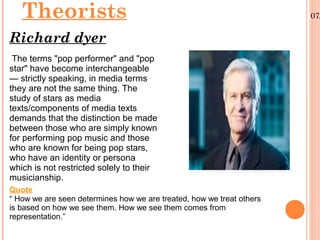
Richard dyer
The terms "pop performer" and "pop
star" have become interchangeable
— strictly speaking, in media terms
they are not the same thing. The
study of stars as media
texts/components of media texts
demands that the distinction be made
between those who are simply known
for performing pop music and those
who are known for being pop stars,
who have an identity or persona
which is not restricted solely to their
musicianship.
Quote
“ How we are seen determines how we are treated, how we treat others
is based on how we see them. How we see them comes from
representation.”

07/
Gate-keeping
A theorist called White(1961) spoke of the 'gatekeepers' –
that is that people who are part of the decision making
process in the construction of the media texts.

07/
Gate-keeping
A theorist called White(1961) spoke of the 'gatekeepers' –
that is that people who are part of the decision making
process in the construction of the media texts.

07/

Representation 2

  • 1.
    Representation By Megan Brant Click toedit Master subtitle style
  • 2.
    Representation means allmedia texts are re-presentations of reality. This means that they are intentionally composed by their producers, and that they are entirely artificial versions of the reality we perceive around us. The different types of representations A selective Re-presentation of reality. •This is obvious in newspapers, where the form is completely different from the events reported, but less so in television serials, which often succeed in creating the illusion of a transparent window on the world with a similar time frame and rhythm to our own. A typical or representation of reality Media often use stereotypes to typify particular social groups as a form of shorthand. i.e. Gender ,race ,age • The process of speaking on behalf of or as a representative of a particular position. Whose views are being put forward in particular messages? Whose voices are being heard.
  • 3.
    Questions you wouldask when analysing representations WHO or WHAT is being represented? HOW is the representation being created? WHO has created the representation? WHY is the representation in that way? What is the intention WHAT is the effect of the representation? 07/
  • 4.
    Theorists Richard dyer The terms"pop performer" and "pop star" have become interchangeable — strictly speaking, in media terms they are not the same thing. The study of stars as media texts/components of media texts demands that the distinction be made between those who are simply known for performing pop music and those who are known for being pop stars, who have an identity or persona which is not restricted solely to their musicianship. Quote “ How we are seen determines how we are treated, how we treat others is based on how we see them. How we see them comes from representation.” 07/
  • 5.
    Gate-keeping A theorist calledWhite(1961) spoke of the 'gatekeepers' – that is that people who are part of the decision making process in the construction of the media texts. 07/
  • 6.
    Gate-keeping A theorist calledWhite(1961) spoke of the 'gatekeepers' – that is that people who are part of the decision making process in the construction of the media texts. 07/