










The Brave New World of
  Continuous Release
     Baruch, JFrog
About me

 Baruch
 Developer Advocate @JFrog
  > Job definition (part of):
    @jbaruch


                                2
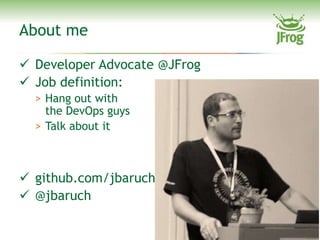
About me

 Developer Advocate @JFrog
 Job definition:
  > Hang out with
    the DevOps guys
  > Talk about it


 github.com/jbaruch
 @jbaruch

                              3
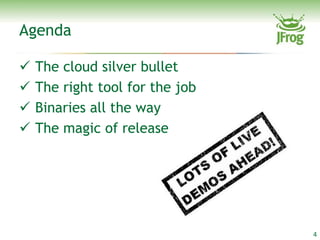
Agenda

   The cloud silver bullet
   The right tool for the job
   Binaries all the way
   The magic of release


                                 4
EVERYTHING *aaS
The New Silver Bullet
What’s So Good About *aaS?

 *aaS features Continuous Delivery


                                      6
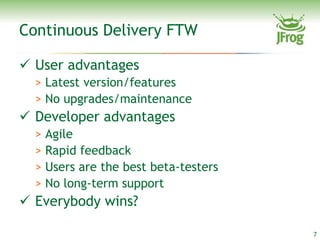
Continuous Delivery FTW

 User advantages
  > Latest version/features
  > No upgrades/maintenance
 Developer advantages
  > Agile
  > Rapid feedback
  > Users are the best beta-testers
  > No long-term support
 Everybody wins?

                                      7
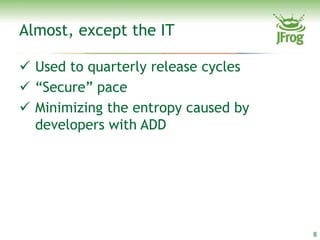
Almost, except the IT

 Used to quarterly release cycles
 “Secure” pace
 Minimizing the entropy caused by
  developers with ADD


                                     8
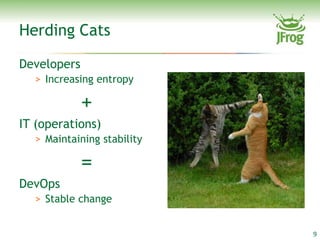
Herding Cats

Developers
  > Increasing entropy

             +
IT (operations)
  > Maintaining stability

             =
DevOps
  > Stable change


                            9
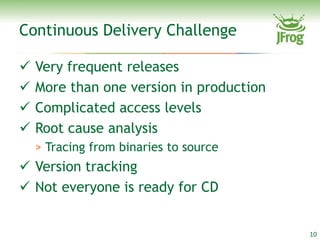
Continuous Delivery Challenge

   Very frequent releases
   More than one version in production
   Complicated access levels
   Root cause analysis
    > Tracing from binaries to source
 Version tracking
 Not everyone is ready for CD


                                          10
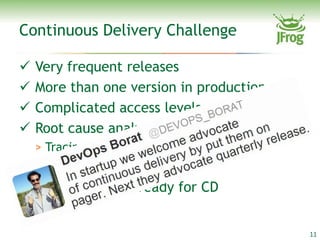
Continuous Delivery Challenge

   Very frequent releases
   More than one version in production
   Complicated access levels
   Root cause analysis
    > Tracing from binaries to source
 Version tracking
 Not everyone is ready for CD


                                          11
It’s… Agile!

 Agile principles applied for DevOps
 We have good tooling for Agile
  development
  > Version control
  > Unit testing and code coverage
  > CI servers
  > Hot swap tools
 What’s up with tooling for agile DevOps?

                                             12
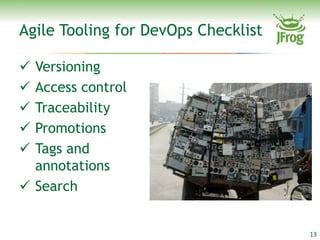
Agile Tooling for DevOps Checklist

 Versioning
 Access control
 Traceability
 Promotions
 Tags and
  annotations
 Search


                                     13
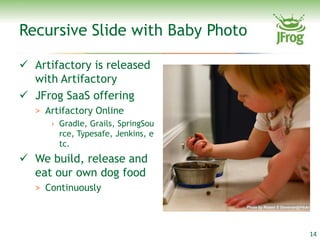
Recursive Slide with Baby Photo

 Artifactory is released
  with Artifactory
 JFrog SaaS offering
   > Artifactory Online
      › Gradle, Grails, SpringSou
        rce, Typesafe, Jenkins, e
        tc.
 We build, release and
  eat our own dog food
   > Continuously


                                    14
HERE COMES BINARY REPOSITORY
The Right Tool for the Job
Here Comes Binary Repository

 E.g. Artifactory
 Proxy
 Smart storage
  > Much more than a passive space
 Critical for CI/CD and ALM


                                     16
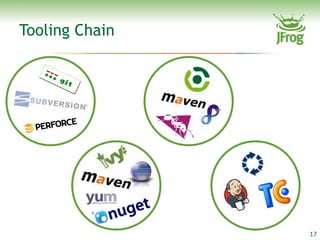
Tooling Chain


                17
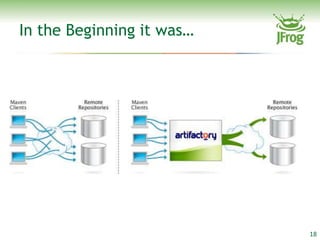
In the Beginning it was…


                           18
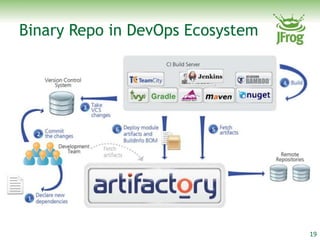
Binary Repo in DevOps Ecosystem


                                  19
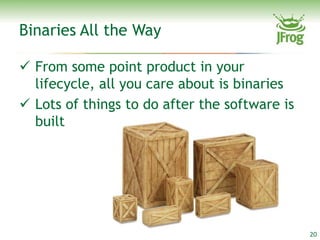
Binaries All the Way

 From some point product in your
  lifecycle, all you care about is binaries
 Lots of things to do after the software is
  built


                                               20
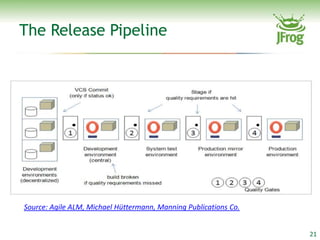
The Release Pipeline


Source: Agile ALM, Michael Hüttermann, Manning Publications Co.


                                                                  21
Passing the software to QA

 Different access rights
 Different physical location
 Ability to annotate


                                22
Staging and Preproduction

 Replication of Production environment
  > Lock versions of dependencies and artifacts
 Allow access to set of users


                                                  23
Going to Production

   Convert staging binaries to production
   Allow public access
   Change settings
   Tag


                                             24
TRACEABILITY
Why and How?
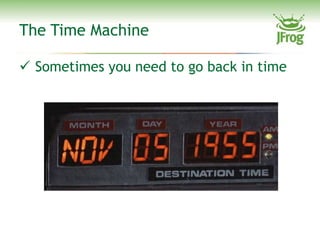
The Time Machine

 Sometimes you need to go back in time
Quest for Traceability

 What should be restored?
  > Sources
  > Dependencies
  > Environment details
  > Tags
 Where’s the information?
  > Version control system
  > Build Tool
  > Build server

                             27
Rebuilding from Sources

 Checkout branch/tag/revision
 Build
 Done!

 Time consuming
 Unstable


                                 28
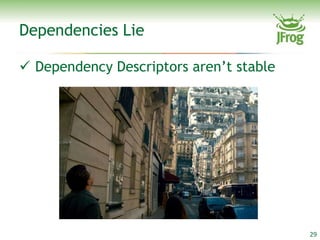
Dependencies Lie

 Dependency Descriptors aren’t stable


                                         29
Evil Dependencies Resolution

 POMs deployed
  with variables
  > Ivy is OK
 Resolution
  strategies change
  over time
  > Both Ivy and Maven


                               30
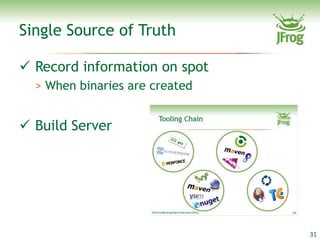
Single Source of Truth

 Record information on spot
  > When binaries are created


 Build Server


                                31
Single Target of Truth

 Truth should be saved…
 … with the binaries…
 … in binaries storage!


                           32
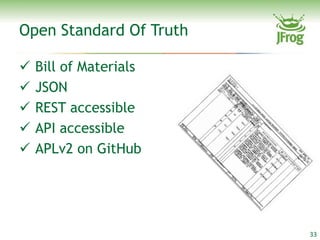
Open Standard Of Truth

   Bill of Materials
   JSON
   REST accessible
   API accessible
   APLv2 on GitHub


                         33
Build Server Plugin

 Build information
  > Resolved and realized during
    the build
  > Attached to the artifacts
  > Uploaded with the
    artifacts


                                   34
DEMO TIME!
Tracing Artifacts
WHAT MY FRIENDS THINK I DO
DevOps
What Others Think I Do


                         37
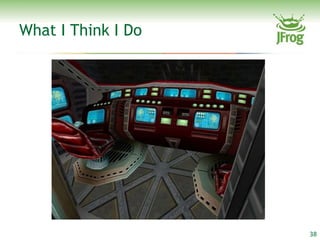
What I Think I Do


                    38
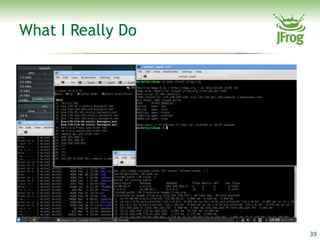
What I Really Do


                   39
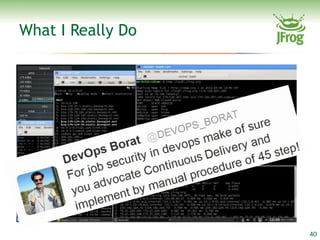
What I Really Do


                   40
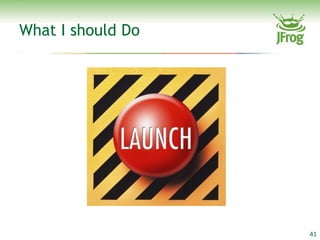
What I should Do


                   41
Target: Automation

 It’s impossible to release frequently with
  manual procedures
  > While maintaining quality
 Use your binaries storage to release


                                               42
THE MAGIC OF RELEASE
Put your repository to work
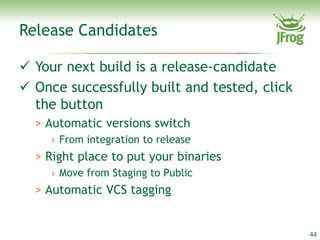
Release Candidates

 Your next build is a release-candidate
 Once successfully built and tested, click
  the button
  > Automatic versions switch
     › From integration to release
  > Right place to put your binaries
     › Move from Staging to Public
  > Automatic VCS tagging


                                              44
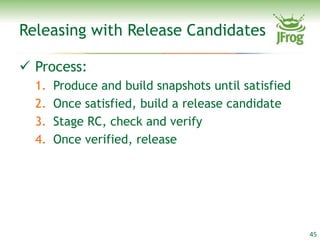
Releasing with Release Candidates

 Process:
  1.   Produce and build snapshots until satisfied
  2.   Once satisfied, build a release candidate
  3.   Stage RC, check and verify
  4.   Once verified, release


                                                     45
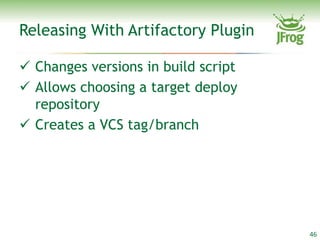
Releasing With Artifactory Plugin

 Changes versions in build script
 Allows choosing a target deploy
  repository
 Creates a VCS tag/branch


                                     46
DEMO TIME!
Release With Release Candidates
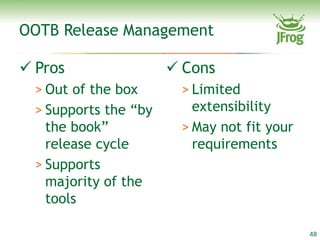
OOTB Release Management

 Pros                  Cons
  > Out of the box      > Limited
  > Supports the “by      extensibility
    the book”           > May not fit your
    release cycle         requirements
  > Supports
    majority of the
    tools

                                             48
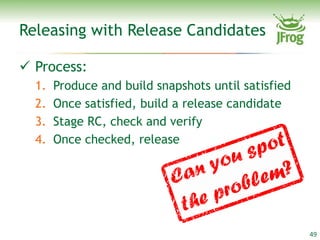
Releasing with Release Candidates

 Process:
  1.   Produce and build snapshots until satisfied
  2.   Once satisfied, build a release candidate
  3.   Stage RC, check and verify
  4.   Once checked, release


                                                     49
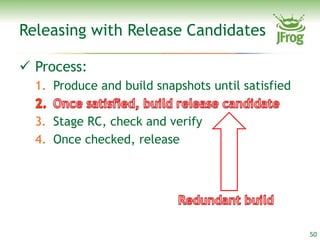
Releasing with Release Candidates

 Process:
  1. Produce and build snapshots until satisfied

  3. Stage RC, check and verify
  4. Once checked, release


                                                   50
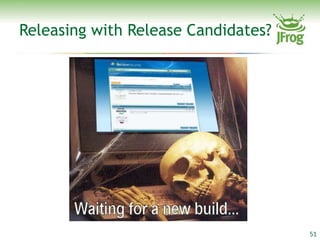
Releasing with Release Candidates?


                                     51
Releasing with Release Candidates?

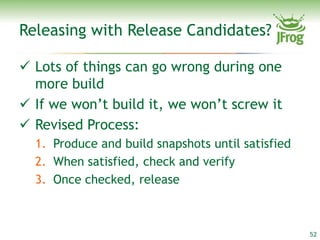
 Lots of things can go wrong during one
  more build
 If we won’t build it, we won’t screw it
 Revised Process:
  1. Produce and build snapshots until satisfied
  2. When satisfied, check and verify
  3. Once checked, release


                                                   52
Automation Flexibility

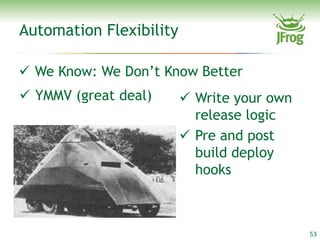
 We Know: We Don’t Know Better
 YMMV (great deal)       Write your own
                           release logic
                          Pre and post
                           build deploy
                           hooks


                                            53
Controlling Versioning Scheme

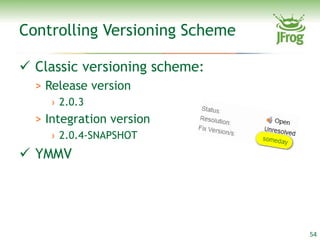
 Classic versioning scheme:
  > Release version
    › 2.0.3
  > Integration version
    › 2.0.4-SNAPSHOT
 YMMV


                                54
Flexible Release

 Code your release strategy
  > Versioning scheme
  > VCS (tagging, branching, commit comments)
  > Promotion hook
    (copy/move, comments, status)
 Available by REST


                                                55
REST == Scriptability == Automation

 It’s impossible to release frequently with
  manual procedures
  > While maintaining quality
 Use your scriptable binaries storage to
  release


                                               56
Example: Promotion of Snapshots

 Choose existing build to become a
  release
 Using REST API without build server
 Invoke promotion plugin
  > Convert to next version
  > Tag, branch, etc.
  > Promote (copy/move)


                                        57
CODE TIME!
Plugin What?
Pluggable Architecture with DSLs

   Artifactory is open for user plugins
   Groovy groovy DSL
   Your code runs inside the server
   Uses Public API (PAPI)
    > Search for artifacts
    > Search for builds
    > Copy/move artifacts
    > Manipulate files
      › E.g. change versions in descriptors

                                              59
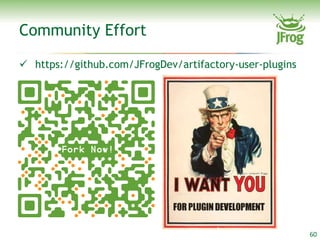
Community Effort

 https://github.com/JFrogDev/artifactory-user-plugins


                                                         60
Plugin Invocation Options

 As a response for various events
  > Download/Create/Delete
  > Login
  > Release
 Scheduled
 On demand


                                     61
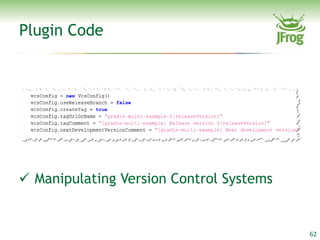
Plugin Code


 Manipulating Version Control Systems


                                         62
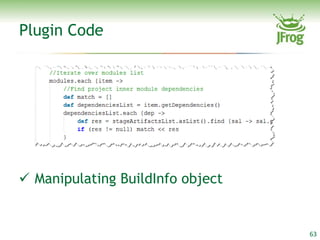
Plugin Code


 Manipulating BuildInfo object


                                  63
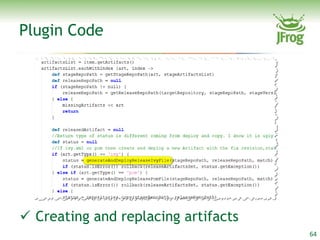
Plugin Code


 Creating and replacing artifacts
                                     64
Calling REST API With CURL


                             65
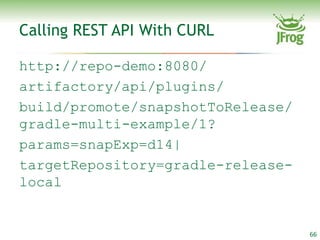
Calling REST API With CURL

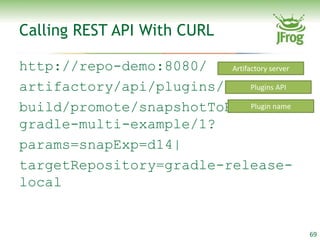
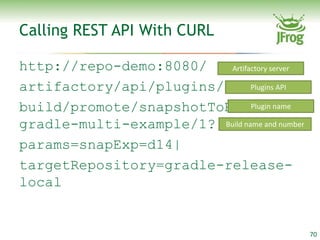
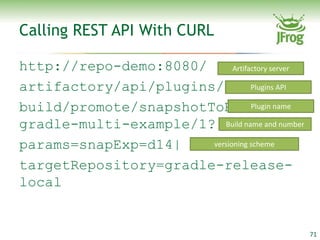
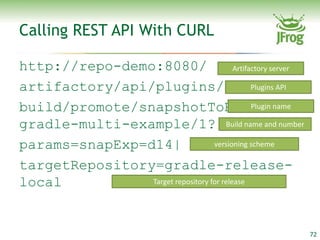
http://repo-demo:8080/
artifactory/api/plugins/
build/promote/snapshotToRelease/
gradle-multi-example/1?
params=snapExp=d14|
targetRepository=gradle-release-
local


                                   66
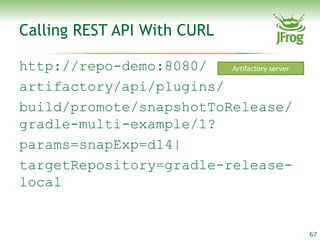
Calling REST API With CURL

http://repo-demo:8080/   Artifactory server

artifactory/api/plugins/
build/promote/snapshotToRelease/
gradle-multi-example/1?
params=snapExp=d14|
targetRepository=gradle-release-
local


                                              67
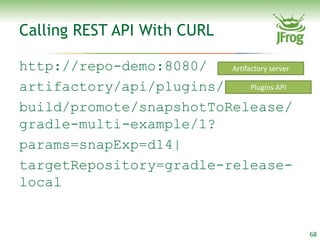
Calling REST API With CURL

http://repo-demo:8080/   Artifactory server

artifactory/api/plugins/       Plugins API

build/promote/snapshotToRelease/
gradle-multi-example/1?
params=snapExp=d14|
targetRepository=gradle-release-
local


                                              68
Calling REST API With CURL

http://repo-demo:8080/   Artifactory server

artifactory/api/plugins/       Plugins API

build/promote/snapshotToRelease/
                               Plugin name

gradle-multi-example/1?
params=snapExp=d14|
targetRepository=gradle-release-
local


                                              69
Calling REST API With CURL

http://repo-demo:8080/    Artifactory server

artifactory/api/plugins/        Plugins API

build/promote/snapshotToRelease/Plugin name

gradle-multi-example/1? Build name and number
params=snapExp=d14|
targetRepository=gradle-release-
local


                                                70
Calling REST API With CURL

http://repo-demo:8080/       Artifactory server

artifactory/api/plugins/           Plugins API

build/promote/snapshotToRelease/   Plugin name

gradle-multi-example/1? Build name and number
params=snapExp=d14|    versioning scheme

targetRepository=gradle-release-
local


                                                  71
Calling REST API With CURL

http://repo-demo:8080/                    Artifactory server

artifactory/api/plugins/                        Plugins API

build/promote/snapshotToRelease/                Plugin name

gradle-multi-example/1? Build name and number
params=snapExp=d14|                versioning scheme

targetRepository=gradle-release-
local           Target repository for release


                                                               72
Recap: Promotion of Snapshots

 Choose existing build to become a
  release
 Using the REST API without building
 Invoking the promotion plugin
  > Convert to next version
  > Tag, branch, etc.
  > Promote (copy/move)


                                        73
DEMO TIME!
Release by Snapshot Promotion
4 Commandments of DevOps

 Automate
  everything
 Version
  everything
 Trace everything
 Report/Log/Feed
  back everything


                           75
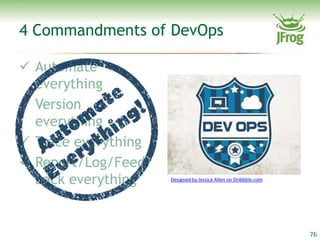
4 Commandments of DevOps

 Automate
  everything
 Version
  everything
 Trace everything
 Report/Log/Feed
  back everything    Designed by Jessica Allen on Dribbble.com


                                                                 76
The Brave New World of Continuous Release

The Brave New World of Continuous Release

  • 1.
    The Brave NewWorld of Continuous Release Baruch, JFrog
  • 2.
    About me  Baruch Developer Advocate @JFrog > Job definition (part of): @jbaruch 2
  • 3.
    About me  DeveloperAdvocate @JFrog  Job definition: > Hang out with the DevOps guys > Talk about it  github.com/jbaruch  @jbaruch 3
  • 4.
    Agenda  The cloud silver bullet  The right tool for the job  Binaries all the way  The magic of release 4
  • 5.
  • 6.
    What’s So GoodAbout *aaS?  *aaS features Continuous Delivery 6
  • 7.
    Continuous Delivery FTW User advantages > Latest version/features > No upgrades/maintenance  Developer advantages > Agile > Rapid feedback > Users are the best beta-testers > No long-term support  Everybody wins? 7
  • 8.
    Almost, except theIT  Used to quarterly release cycles  “Secure” pace  Minimizing the entropy caused by developers with ADD 8
  • 9.
    Herding Cats Developers > Increasing entropy + IT (operations) > Maintaining stability = DevOps > Stable change 9
  • 10.
    Continuous Delivery Challenge  Very frequent releases  More than one version in production  Complicated access levels  Root cause analysis > Tracing from binaries to source  Version tracking  Not everyone is ready for CD 10
  • 11.
    Continuous Delivery Challenge  Very frequent releases  More than one version in production  Complicated access levels  Root cause analysis > Tracing from binaries to source  Version tracking  Not everyone is ready for CD 11
  • 12.
    It’s… Agile!  Agileprinciples applied for DevOps  We have good tooling for Agile development > Version control > Unit testing and code coverage > CI servers > Hot swap tools  What’s up with tooling for agile DevOps? 12
  • 13.
    Agile Tooling forDevOps Checklist  Versioning  Access control  Traceability  Promotions  Tags and annotations  Search 13
  • 14.
    Recursive Slide withBaby Photo  Artifactory is released with Artifactory  JFrog SaaS offering > Artifactory Online › Gradle, Grails, SpringSou rce, Typesafe, Jenkins, e tc.  We build, release and eat our own dog food > Continuously 14
  • 15.
    HERE COMES BINARYREPOSITORY The Right Tool for the Job
  • 16.
    Here Comes BinaryRepository  E.g. Artifactory  Proxy  Smart storage > Much more than a passive space  Critical for CI/CD and ALM 16
  • 17.
  • 18.
    In the Beginningit was… 18
  • 19.
    Binary Repo inDevOps Ecosystem 19
  • 20.
    Binaries All theWay  From some point product in your lifecycle, all you care about is binaries  Lots of things to do after the software is built 20
  • 21.
    The Release Pipeline Source:Agile ALM, Michael Hüttermann, Manning Publications Co. 21
  • 22.
    Passing the softwareto QA  Different access rights  Different physical location  Ability to annotate 22
  • 23.
    Staging and Preproduction Replication of Production environment > Lock versions of dependencies and artifacts  Allow access to set of users 23
  • 24.
    Going to Production  Convert staging binaries to production  Allow public access  Change settings  Tag 24
  • 25.
  • 26.
    The Time Machine Sometimes you need to go back in time
  • 27.
    Quest for Traceability What should be restored? > Sources > Dependencies > Environment details > Tags  Where’s the information? > Version control system > Build Tool > Build server 27
  • 28.
    Rebuilding from Sources Checkout branch/tag/revision  Build  Done!  Time consuming  Unstable 28
  • 29.
    Dependencies Lie  DependencyDescriptors aren’t stable 29
  • 30.
    Evil Dependencies Resolution POMs deployed with variables > Ivy is OK  Resolution strategies change over time > Both Ivy and Maven 30
  • 31.
    Single Source ofTruth  Record information on spot > When binaries are created  Build Server 31
  • 32.
    Single Target ofTruth  Truth should be saved…  … with the binaries…  … in binaries storage! 32
  • 33.
    Open Standard OfTruth  Bill of Materials  JSON  REST accessible  API accessible  APLv2 on GitHub 33
  • 34.
    Build Server Plugin Build information > Resolved and realized during the build > Attached to the artifacts > Uploaded with the artifacts 34
  • 35.
  • 36.
    WHAT MY FRIENDSTHINK I DO DevOps
  • 37.
  • 38.
    What I ThinkI Do 38
  • 39.
  • 40.
  • 41.
  • 42.
    Target: Automation  It’simpossible to release frequently with manual procedures > While maintaining quality  Use your binaries storage to release 42
  • 43.
    THE MAGIC OFRELEASE Put your repository to work
  • 44.
    Release Candidates  Yournext build is a release-candidate  Once successfully built and tested, click the button > Automatic versions switch › From integration to release > Right place to put your binaries › Move from Staging to Public > Automatic VCS tagging 44
  • 45.
    Releasing with ReleaseCandidates  Process: 1. Produce and build snapshots until satisfied 2. Once satisfied, build a release candidate 3. Stage RC, check and verify 4. Once verified, release 45
  • 46.
    Releasing With ArtifactoryPlugin  Changes versions in build script  Allows choosing a target deploy repository  Creates a VCS tag/branch 46
  • 47.
    DEMO TIME! Release WithRelease Candidates
  • 48.
    OOTB Release Management Pros  Cons > Out of the box > Limited > Supports the “by extensibility the book” > May not fit your release cycle requirements > Supports majority of the tools 48
  • 49.
    Releasing with ReleaseCandidates  Process: 1. Produce and build snapshots until satisfied 2. Once satisfied, build a release candidate 3. Stage RC, check and verify 4. Once checked, release 49
  • 50.
    Releasing with ReleaseCandidates  Process: 1. Produce and build snapshots until satisfied 3. Stage RC, check and verify 4. Once checked, release 50
  • 51.
    Releasing with ReleaseCandidates? 51
  • 52.
    Releasing with ReleaseCandidates?  Lots of things can go wrong during one more build  If we won’t build it, we won’t screw it  Revised Process: 1. Produce and build snapshots until satisfied 2. When satisfied, check and verify 3. Once checked, release 52
  • 53.
    Automation Flexibility  WeKnow: We Don’t Know Better  YMMV (great deal)  Write your own release logic  Pre and post build deploy hooks 53
  • 54.
    Controlling Versioning Scheme Classic versioning scheme: > Release version › 2.0.3 > Integration version › 2.0.4-SNAPSHOT  YMMV 54
  • 55.
    Flexible Release  Codeyour release strategy > Versioning scheme > VCS (tagging, branching, commit comments) > Promotion hook (copy/move, comments, status)  Available by REST 55
  • 56.
    REST == Scriptability== Automation  It’s impossible to release frequently with manual procedures > While maintaining quality  Use your scriptable binaries storage to release 56
  • 57.
    Example: Promotion ofSnapshots  Choose existing build to become a release  Using REST API without build server  Invoke promotion plugin > Convert to next version > Tag, branch, etc. > Promote (copy/move) 57
  • 58.
  • 59.
    Pluggable Architecture withDSLs  Artifactory is open for user plugins  Groovy groovy DSL  Your code runs inside the server  Uses Public API (PAPI) > Search for artifacts > Search for builds > Copy/move artifacts > Manipulate files › E.g. change versions in descriptors 59
  • 60.
  • 61.
    Plugin Invocation Options As a response for various events > Download/Create/Delete > Login > Release  Scheduled  On demand 61
  • 62.
    Plugin Code  ManipulatingVersion Control Systems 62
  • 63.
    Plugin Code  ManipulatingBuildInfo object 63
  • 64.
    Plugin Code  Creatingand replacing artifacts 64
  • 65.
    Calling REST APIWith CURL 65
  • 66.
    Calling REST APIWith CURL http://repo-demo:8080/ artifactory/api/plugins/ build/promote/snapshotToRelease/ gradle-multi-example/1? params=snapExp=d14| targetRepository=gradle-release- local 66
  • 67.
    Calling REST APIWith CURL http://repo-demo:8080/ Artifactory server artifactory/api/plugins/ build/promote/snapshotToRelease/ gradle-multi-example/1? params=snapExp=d14| targetRepository=gradle-release- local 67
  • 68.
    Calling REST APIWith CURL http://repo-demo:8080/ Artifactory server artifactory/api/plugins/ Plugins API build/promote/snapshotToRelease/ gradle-multi-example/1? params=snapExp=d14| targetRepository=gradle-release- local 68
  • 69.
    Calling REST APIWith CURL http://repo-demo:8080/ Artifactory server artifactory/api/plugins/ Plugins API build/promote/snapshotToRelease/ Plugin name gradle-multi-example/1? params=snapExp=d14| targetRepository=gradle-release- local 69
  • 70.
    Calling REST APIWith CURL http://repo-demo:8080/ Artifactory server artifactory/api/plugins/ Plugins API build/promote/snapshotToRelease/Plugin name gradle-multi-example/1? Build name and number params=snapExp=d14| targetRepository=gradle-release- local 70
  • 71.
    Calling REST APIWith CURL http://repo-demo:8080/ Artifactory server artifactory/api/plugins/ Plugins API build/promote/snapshotToRelease/ Plugin name gradle-multi-example/1? Build name and number params=snapExp=d14| versioning scheme targetRepository=gradle-release- local 71
  • 72.
    Calling REST APIWith CURL http://repo-demo:8080/ Artifactory server artifactory/api/plugins/ Plugins API build/promote/snapshotToRelease/ Plugin name gradle-multi-example/1? Build name and number params=snapExp=d14| versioning scheme targetRepository=gradle-release- local Target repository for release 72
  • 73.
    Recap: Promotion ofSnapshots  Choose existing build to become a release  Using the REST API without building  Invoking the promotion plugin > Convert to next version > Tag, branch, etc. > Promote (copy/move) 73
  • 74.
    DEMO TIME! Release bySnapshot Promotion
  • 75.
    4 Commandments ofDevOps  Automate everything  Version everything  Trace everything  Report/Log/Feed back everything 75
  • 76.
    4 Commandments ofDevOps  Automate everything  Version everything  Trace everything  Report/Log/Feed back everything Designed by Jessica Allen on Dribbble.com 76

Editor's Notes

  • #9 Attention deficit disorderСиндром дефицита внимания
  • #17 Mention smart artifact/library manager
  • #18 Freedom of choice for developers, no lockinopensource
  • #20 Bill Of Materials
  • #25 Let’s admitit, maybe I shouted, but we are all scared to death
  • #48 Choose your deployment repositories - independently of VCS, build tool, etc.
  • #55 Callback -> plugin?
  • #76 DevOps Crest
  • #77 DevOps Crest