More Related Content

PPTX
SESSION 7-IDEAS FOR CLASSES FOR TEACHERS.pptx 
PPTX
Gold_Exp_Grammar_ppt_A1_U9 From the Teacher's Resources.pptx 
PPTX
Be going to improve your english level... 
PPTX
ENGLISH CLASS USE OF WILL GOING TO.pptx 
PDF

PDF

PDF

PPTX
Similar to WEEK 9-MATERRIAL TO WORK DURING CLASSES.pptx

PPTX
Grade 6 - Unit 9 - Future Simple.ppt.pptx 
PPT

PPTX
New Headway Intermediate - Unit 5 on the move 
PPTX
Back To School - Based on Back To School Idioms 3.pptx 
PPT
Unit 3a English File Preintermediate 
PPTX
Going To - Apr 28thsadwdawdawdawdawdadawd.pptx 
PPT

PPTX

PPTX

PPTX
going-to-future-tense_1492iiiiiiiiiiiiiiiiiiii17.pptx 
PDF

PPT
Means of expressing future time 
PPTX
future will - be going to_035659.pptx 
PPTX

PPT
Future will, be going to, present continuous and present simple with the idea... 
PPT

PPTX

PPT

PPTX

PPTX
GE B1+ U5_Lesson 23 Grammâssasssssar.pptx More from VANESSALISETHVERGELP1

PPTX
WEEK 1 (5)--------------------------------------.pptx 
PPTX
WEEK 4-2--------------------------------------.pptx 
PPTX
WEEK 11-CEL003-COMPARATIVES AND SUPERLATIVES.pptx 
PPTX
WEEK 12-CEL003-FUTURE FORMS-MAY,MIGHT,WILL.pptx 
PPT
adverbs-of-frequency-ppt-flashcards-fun-activities-games_42028.ppt 
PPTX
WEEK 11-CEL003-COMPARATIVES AND SUPERLATIVES.pptx 
PPTX
WEEK 10 (1)-MATERIAL FOR STUDENTS AD CLASSES.pptx 
PPTX
REPORTED SPEECH-ideas for teachers .pptx 
PPTX
UNIT 6 ideas for teacher in classes .pptx 
PPTX
WEEK 6-IDEAS FOR TEACHER IN CLASSROOMS.pptx 
PPTX
WEEK 4-VERBS FOLLOED BY ING AD INFINITIVES.pptx 
PPTX
WEEK 1-HEALTH MATTERS AND MODALS222.pptx 
PPTX
Guía para Manejar Crisis Emocionales en Estudiantes.pptx 
PPTX
SESSION 7 (1)COMPARISONS-COMPARATIVE AND SUPERLATIVE.pptx 
PPTX
THE PRESET CONTINUOUS grammar and spelling-LC002.pptx Recently uploaded

PDF
Fast Followers Project, Embedding Net Zero into Wakefield Metropolitan Distri... 
PPTX
How to Create & Manage Wizard in Odoo 18 
PPTX
HABIT. Cognitive process. I Semester Shilpa Hotakar pptx 
PPTX
Unit 3- Culture.pptx.................... 
PDF
Take This Quirky Quiz! - QGI 1st Anniversary .pdf 
PPTX
MENTAL STATUS EXAMINATION Part-1.Shilpa hotakar.pptx 
PDF
Problem Solving Agents in Artificial Intelligence with Examples and Water Jug... 
PPTX
Exploring Higher education and its pathways 
DOCX
COMMUNITY HEALTH NURSING OSCE CHECKLIST.docx 
PPTX
2026SlideShare.pptx welcome talk 2026 for peace harmony 
PPTX
Ultrasound .pptx by Nagmani ojha (paramedical department)(Radiation technolog... 
PDF
Agents in Artificial Intelligence: Types, Architecture and Real-World Examples 
PPTX
Nanomaterials and its types - Dr.M.Jothimuniyandi 
PPTX
Powerpoint for testing in embed test with Sway 
PDF
NCA New Family Orientation 2026 Dosemagen.pdf 
PDF
VIVA or SHORT ANSWER QUESTIONS or 2 MARKS QUESTIONS CHILD HEALTH NURSING.pdf 
PPTX
How to create Article in Odoo 18 Knowledge App 
PPTX
COMMUNICATION ITS PROCESS ELEMENTS & BARRIER .pptx 
PDF
PHYSICAL-CHEMISTRY-ONE-SHOT-FORMULA-REVISION-SHEETJEEMAINS-AND-NEET.pdf/PREPA... 
PPTX
YSPH VMOC Special Report - Measles - The Americas 1-25-2026 WEEK 9-MATERRIAL TO WORK DURING CLASSES.pptx
- 2.
- 5.
- 6.
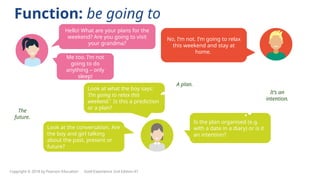
Function: be goingto
Look at the conversation. Are
the boy and girl talking
about the past, present or
future?
The
future.
Hello! What are your plans for the
weekend? Are you going to visit
your grandma?
No, I’m not. I’m going to relax
this weekend and stay at
home.
Me too. I’m not
going to do
anything – only
sleep!
Look at what the boy says:
‘I’m going to relax this
weekend.’ Is this a prediction
or a plan?
A plan.
Is the plan organised (e.g.
with a date in a diary) or is it
an intention?
It’s an
intention.
Copyright © 2018 by Pearson Education Gold Experience 2nd Edition A1
- 7.
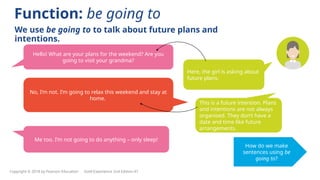
Function: be goingto
Here, the girl is asking about
future plans.
Hello! What are your plans for the weekend? Are you
going to visit your grandma?
No, I’m not. I’m going to relax this weekend and stay at
home.
Me too. I’m not going to do anything – only sleep!
We use be going to to talk about future plans and
intentions.
This is a future intention. Plans
and intentions are not always
organised. They don’t have a
date and time like future
arrangements.
How do we make
sentences using be
going to?
Copyright © 2018 by Pearson Education Gold Experience 2nd Edition A1
- 8.
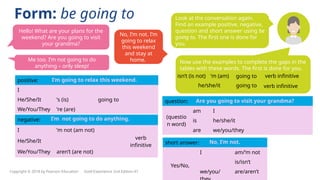
Form: be goingto Look at the conversation again.
Find an example positive, negative,
question and short answer using be
going to. The first one is done for
you.
Hello! What are your plans for the
weekend? Are you going to visit
your grandma?
No, I’m not. I’m
going to relax
this weekend
and stay at
home.
Me too. I’m not going to do
anything – only sleep!
positive:
I
going to
He/She/It ’s (is)
We/You/They ’re (are)
negative:
I ’m not (am not)
verb
infinitive
He/She/It
We/You/They aren’t (are not)
question:
(questio
n word)
am I
is he/she/it
are we/you/they
short answer:
Yes/No,
I am/’m not
is/isn’t
we/you/ are/aren’t
I’m going to relax this weekend.
I’m not going to do anything.
Are you going to visit your grandma?
No, I’m not.
Now use the examples to complete the gaps in the
tables with these words. The first is done for you.
’m (am) verb infinitive
isn’t (is not) going to
going to verb infinitive
he/she/it
Copyright © 2018 by Pearson Education Gold Experience 2nd Edition A1
- 9.
Form: be goingto
Hello! What are your plans for the weekend? Are
you going to visit your grandma?
No, I’m not. I’m going to relax
this weekend and stay at
home.
Me too. I’m not going to do
anything – only sleep!
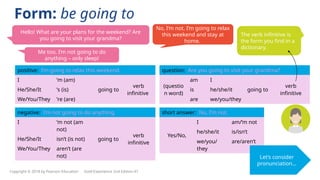
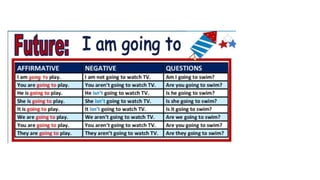
positive: I’m going to relax this weekend.
I ’m (am)
going to
verb
infinitive
He/She/It ’s (is)
We/You/They ’re (are)
negative: I’m not going to do anything.
I ’m not (am
not)
going to
verb
infinitive
He/She/It isn’t (is not)
We/You/They aren’t (are
not)
question: Are you going to visit your grandma?
(questio
n word)
am I
going to
verb
infinitive
is he/she/it
are we/you/they
short answer: No, I’m not.
Yes/No,
I am/’m not
he/she/it is/isn’t
we/you/
they
are/aren’t
The verb infinitive is
the form you find in a
dictionary.
Let’s consider
pronunciation…
Copyright © 2018 by Pearson Education Gold Experience 2nd Edition A1
- 10.
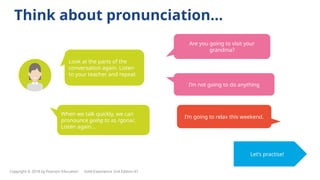
Think about pronunciation…
Lookat the parts of the
conversation again. Listen
to your teacher and repeat.
When we talk quickly, we can
pronounce going to as /gɒnə/.
Listen again…
Let’s practise!
Are you going to visit your
grandma?
I’m going to relax this weekend.
I’m not going to do anything
Copyright © 2018 by Pearson Education Gold Experience 2nd Edition A1
- 12.
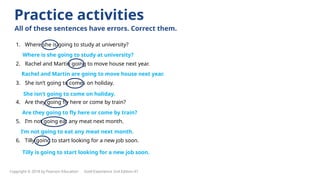
1. Where sheis going to study at university?
2. Rachel and Martin going to move house next year.
3. She isn’t going to comes on holiday.
4. Are they going fly here or come by train?
5. I’m not going eat any meat next month.
6. Tilly going to start looking for a new job soon.
Practice activities
All of these sentences have errors. Correct them.
Where is she going to study at university?
Rachel and Martin are going to move house next year.
She isn’t going to come on holiday.
Are they going to fly here or come by train?
I’m not going to eat any meat next month.
Tilly is going to start looking for a new job soon.
Copyright © 2018 by Pearson Education Gold Experience 2nd Edition A1
- 14.
- 15.
- 16.